Someone Superglued a 5-Week-Old Kitten to a Sidewalk and Left Him Screaming in the Dark—At 5:15 A.M., a Jogger Heard His Cries and Found His Tiny Paws and Belly Stuck to the Concrete. What Rescuers Discovered Broke Everyone’s Hearts.
PART3:
She knew what hardened instant adhesive looked like.
“No.”
She stared at the sidewalk.
“No.”
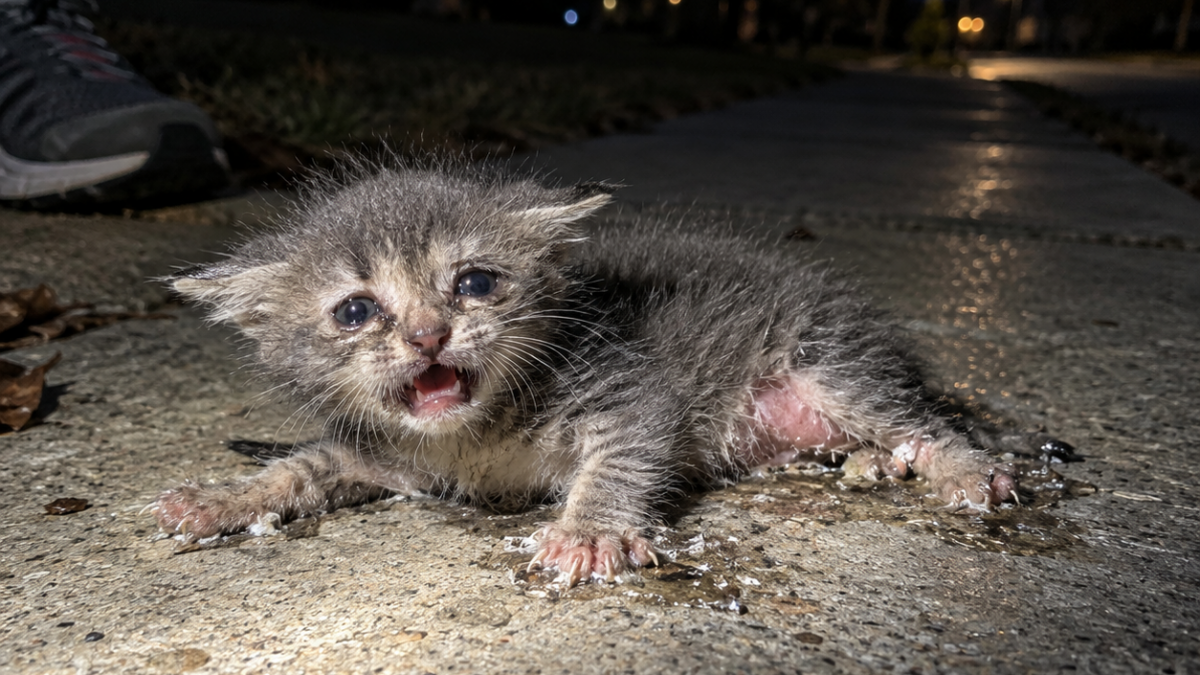
The kitten’s right front paw was completely fused to the concrete.
So was the left.
The hind paws too.
And beneath his stomach, patches of gray fur had hardened flat into a transparent crust.
Someone had glued him down.
Leah whispered, “No, no, no.”
The kitten pulled again.
A horrible tearing sound came from one paw.
He screamed.
Leah dropped beside him.
“Stop moving.”
Of course he did not understand.
“Please, sweetheart. Please.”
She took off her running jacket and folded it beside him, trying to create a barrier so he would stop twisting.
The kitten’s chest moved rapidly.
His mouth stayed open.
Leah touched one finger gently to his head.
He flinched.
“I’m not going to hurt you.”
The words felt grotesque under the circumstances.
Somebody already had.
Leah called 911.
The dispatcher answered.
“What is the address of your emergency?”
Leah looked around.
“Sycamore and Bell. Near the northwest corner.”
“What happened?”
“There is a kitten.”
Pause.
“A kitten?”
“He’s glued to the sidewalk.”
Another pause.
“What do you mean glued?”
“With superglue. His feet. His stomach. Somebody glued him down.”
The dispatcher became more focused.
“Is anyone else present?”
“No.”
“Do you see anyone nearby?”
“No.”
“Do not try to pull the animal free.”
“I wasn’t going to.”
“Animal control is being contacted.”
“How long?”
“I don’t have an exact time.”
“He’s screaming.”
“I understand.”
“No, I don’t think you do.”
Leah immediately regretted snapping.
The dispatcher remained calm.
“I have someone on the way.”
Leah gave her name and phone number.
Then she put the phone on speaker and knelt beside the kitten.
Her water bottle was clipped to her waist.
She poured a small amount around one paw.
She knew water would not dissolve cyanoacrylate.
But the concrete looked dry and rough, and the kitten’s frantic pulling was scraping everything beneath him.
Maybe moisture would help.
Maybe it wouldn’t.
She simply needed to do something.
“It’s okay.”
The kitten shivered.
“It isn’t okay.”
Leah corrected herself.
“I know.”
That felt more honest.
“I know it hurts.”
She stroked the top of his head with one finger.
“You just stay there.”
His pupils were enormous.
“I know. Stupid thing to tell you, huh?”
The kitten cried again.
Leah’s eyes filled.
The sky above the houses was beginning to lighten faintly.
People would wake soon.
Cars would come.
Children would walk toward school.
Somebody had placed this animal where the entire neighborhood would eventually see him.
That thought changed Leah’s fear into anger.
This had not happened accidentally.
A kitten had not stepped into a puddle of glue.
There was too much adhesive.
Every paw.
The belly.
Symmetrical pressure marks around the fur.
Somebody had spread it.
Or applied it.
Then positioned him.
Pressed him down.
And walked away.
Leah looked toward the dark houses.
“Who does this?”
The kitten trembled.
She stayed beside him.
Eleven minutes passed.
Then fifteen.
A pickup slowed.
The driver lowered his window.
“You okay?”
Leah stood halfway.
“Animal control is coming.”
He looked down.
“What happened?”
“Someone glued a kitten to the sidewalk.”
The man’s face changed.
“What?”
“Please don’t come close. He keeps trying to move.”
The driver parked anyway.
His name was Anthony Briggs.
He worked nights at the hospital and was heading home.
He stood several feet away.
“Jesus.”
Leah nodded.
Anthony took off his sweatshirt.
“Need anything?”
“Maybe block the road side.”
He moved his truck so the headlights illuminated the sidewalk and kept other cars away from the curb.
At 5:36, an animal control vehicle arrived.
Officer Daniel Reyes stepped out carrying a hard-sided carrier and a red medical case.
He had been doing animal control for twelve years.
He had seen hoarding.
Dog-fighting injuries.
Animals hit by cars.
Starving horses.
Dogs chained so long collars had grown into their necks.
What he saw under Leah’s flashlight stopped him.
“Who found him?”
“I did.”
“How long ago?”
“Twenty minutes.”
Daniel put on nitrile gloves and crouched.
The kitten screamed when Daniel’s shadow passed over him.
“Easy.”
Daniel examined each limb without touching.
“Cyanoacrylate.”
Leah nodded.
“You can get him off?”
“Yes.”
“Without hurting him?”
Daniel did not answer immediately.
That frightened her.
“How?”
“I have solvent.”
“Acetone?”
“Medical-grade adhesive remover first. If that isn’t enough, controlled acetone around fur and external bonding. We have to keep it away from open tissue as much as possible.”
The kitten struggled.
Daniel put a gloved hand gently over his shoulders.
“Hey.”
The kitten froze.
“That’s enough fighting for now.”
Daniel looked at Leah.
“You hold the light?”
She nodded.
The first paw took eight minutes.
Daniel soaked cotton around the hardened edge.
Waited.
Worked a blunt plastic tool beneath glued fur a millimeter at a time.
The kitten screamed.
Leah turned her head once.
Then forced herself to look back.
If he had to endure it, she could witness it.
“Almost.”
Daniel’s voice stayed steady.
The adhesive softened.
A small section released.
Then another.
The kitten pulled suddenly.
Daniel caught the leg.
“Don’t.”
A patch of fur remained on the concrete.
Underneath, the skin was pink and raw.
Leah whispered, “Oh God.”
Daniel said nothing.
The second paw was worse.
Part of one pad had bonded directly.
Daniel worked slowly.
Twenty-five minutes after he began, both front paws were free.
The kitten immediately tried to lift his chest.
His belly held him down.
He cried.
“Not yet,” Daniel said.
The hind paws took another ten minutes.
The last one released with a thin strip of damaged pad tissue stuck to the sidewalk.
Leah made a sound and covered her mouth.
Daniel looked up.
“You okay?”
“No.”
“Good answer.”
He returned to the kitten.
The belly was last.
Daniel trimmed fur wherever possible rather than pull.
Tiny scissors.
Solvent.
Patience.
The kitten was weakening.
His screams became hoarse.
That frightened Daniel more than the screaming had.
“Stay with me.”
Leah heard the change in his voice.
“Is he okay?”
“He’s cold.”
“How can he be cold?”
“Concrete pulls heat. He’s tiny.”
Daniel touched the kitten’s ear.
“And he’s exhausted.”
At 6:09, almost an hour after Leah first stopped, the final glued section released.
Daniel lifted the kitten.
The animal fit into one hand.
Barely a pound.
Perhaps less.
Where his body had been, something remained on the pavement.
Leah stared.
Gray fur.
Clear adhesive.
Tiny fragments of damaged skin.
The shape was unmistakable.
Four small paw areas.
A narrow body.
A little silhouette burned into the sidewalk by glue and fur.
It looked like a shadow.
Except the animal who had made it was now shaking in Daniel’s hands.
Leah took one photograph.
She almost didn’t.
The image felt too intimate.
Too awful.
But Daniel said, “Take it.”
She looked at him.
“For evidence.”
So she did.
Then Daniel wrapped the kitten in a thermal blanket.
The little gray face emerged from silver material.
His mouth opened.
No sound came.
Daniel moved quickly.
“Emergency clinic.”
“Can I come?”
“You can follow.”
Leah looked down at herself.
Running shoes.
Leggings.
Sweat.
“I don’t care.”
Anthony pointed to his truck.
“I’ll drive you.”
Leah hesitated.
“My car is at home.”
“You found him. Go.”
They followed.
At 6:31, Dr. Sarah Kim examined the kitten.
Daniel had already called ahead.
The staff moved efficiently.
Temperature.
Heart rate.
Oxygen.
Fluids.
Pain medication.
Bandaging.
Leah stood behind a glass partition with Anthony.
Neither spoke.
Finally Dr. Kim came out.
“He’s stable.”
Leah exhaled.
“Stable means?”
“It means I’m more optimistic than I was ten minutes ago.”
“How old?”
“Five to six weeks.”
“Weight?”
“Four hundred fifty-two grams.”
Leah stared.
“One pound.”
“Almost exactly.”
Daniel stood beside them.
Dr. Kim continued.
“His paw pads have superficial chemical burns and mechanical trauma where the adhesive pulled tissue. Belly skin is inflamed but fortunately not deeply torn.”
“Anything broken?”
“No fractures.”
“Internal injuries?”
“None obvious.”
“How long was he there?”
Dr. Kim looked through her notes.
“We can’t know precisely.”
“I know.”
“But given his dehydration, core temperature, urine concentration, and how dried the adhesive was, I’d estimate six to eight hours.”
Leah looked at the clock.
6:44.
Six to eight hours.
She worked backward.
Midnight.
Eleven p.m.
Maybe earlier.
All night.
Cars might have passed.
People might have walked dogs.
Streetlights might have gone off.
The temperature had dropped into the low forties.
And this tiny animal had remained pressed against cold concrete unable to move.
Leah sat.
Anthony put a hand on her shoulder.
Dr. Kim crouched slightly so they were closer to eye level.
“He’s going to need time.”
“Will he walk?”
“I believe so.”
“Will his paws heal?”
“Yes. There may be scarring.”
“And his fur?”
“Most should grow back.”
Leah nodded.
Then asked the question she had been avoiding.
“Could someone really do this on purpose?”
Daniel answered.
“Yes.”
No hesitation.
“The bond pattern is inconsistent with accidental exposure.”
Leah looked at him.
“So somebody held him down.”
Daniel’s jaw tightened.
“Yes.”
A police report was opened that morning.
Animal cruelty.
Felony-level conduct if intent and identity could be established.
Officer Daniel Reyes photographed everything.
The sidewalk.
Glue residue.
Fur.
The outline.
Nearby trash.
Footprints.
A torn corner of a paper towel.
One disposable glove fragment caught in a hedge.
Nothing immediately useful.
The area had no municipal cameras.
The nearest doorbell camera pointed toward a porch, not the sidewalk.
One commercial camera at a pharmacy two blocks away did not cover the scene.
Neighbors were interviewed.
Nobody had seen anything.
One man had heard a cat sometime after midnight but assumed it was fighting.
A woman walking her dog at 10:30 p.m. had not seen the kitten.
That narrowed the window.
Approximately 10:30 p.m. to 5:15 a.m.
Leah went home at 8:20.
She had missed work.
Her husband, Marcus, opened the door.
He had received seventeen text messages.
Still, the moment he saw her face, he stopped asking questions.
“What happened?”
Leah began explaining.
Halfway through, she cried.
Not delicate tears.
Her entire body shook.
Marcus held her in the kitchen.
“The sound.”
“What?”
“He kept screaming.”
She pressed her hands against her face.
“I can still hear it.”
Marcus said nothing.
Leah continued.
“If I’d put the earbuds in…”
“Don’t.”
“I almost did.”
“But you didn’t.”
“I always do.”
“But you didn’t.”
She looked at him.
“What if somebody else hadn’t come?”
“They did.”
“What if I had taken Pine Street?”
“You didn’t.”
Marcus understood where her mind was going.
The endless reconstruction of chance.
Ten minutes later.
Different route.
Headphones.
Rain.
A louder truck.
A slower pace.
One decision changed and the kitten disappeared from her morning.
Maybe permanently.
“You found him,” Marcus said.
Leah shook her head.
“I heard him.”
“Yes.”
“That was all.”
Sometimes that was all.
The neighborhood learned about the kitten before noon.
Leah had sent the photograph privately to one friend who moderated a local community group.
With Daniel’s permission, they posted a request for information.
FOUND AT SYCAMORE & BELL APPROX. 5:15 A.M.
GRAY KITTEN APPROX. 5–6 WEEKS OLD.
INTENTIONALLY ADHERED TO SIDEWALK WITH STRONG CYANOACRYLATE ADHESIVE.
ANYONE WITH INFORMATION BETWEEN 10:30 P.M. AND 5:15 A.M. PLEASE CONTACT ANIMAL CONTROL.
The post exploded.
Hundreds of comments.
Then thousands.
People were sickened.
Angry.
Some volunteered money.
Others demanded arrest.
Then came what Daniel had expected.
Names.
Accusations.
Rumors.
A mentally ill man who lived three blocks away.
Teenagers.
A homeless woman who fed stray cats.
Someone’s ex-husband.
A landscaping crew.
A local boy known to shoot BB guns.
Daniel posted a warning.
DO NOT IDENTIFY SUSPECTS PUBLICLY WITHOUT EVIDENCE.
That slowed nobody.
Leah stopped reading.
She had wanted help.
Not a mob.
That afternoon, a local television station called.
She refused an interview.
The reporter asked to use the photograph.
“No.”
“Why?”
“Because he’s alive.”
The reporter did not understand.
Leah did.
The kitten was not an image of cruelty.
He was a patient.
A life.
A tiny animal who deserved to become something other than the worst thing someone had done to him.
At the emergency clinic, he received a temporary name.
Patient 3047.
One technician refused to use it.
She called him Gumdrop.
Daniel hated it.
Dr. Kim hated it more.
Leah arrived that evening.
She stood at the kennel.
The kitten was asleep beneath a warming blanket.
Four bandaged paws extended beneath him like tiny white boots.
His abdomen had been shaved.
Pink skin showed.
Leah whispered, “Hey.”
One eye opened.
The kitten did not cry.
He looked at her.
Leah put her finger near the bars.
After several seconds, he moved his head forward.
Touched his nose to her knuckle.
That was it.
Leah went into the hallway and cried again.
The next morning, the kitten ate.
Twenty grams of wet food.
Then slept.
By afternoon he tried to stand.
His bandaged paws slipped.
A technician caught him.
“Ambitious.”
Leah asked Daniel what would happen next.
“If nobody claims him, foster.”
“Who?”
“We have several.”
“I could.”
Daniel looked at her.
“You have animals?”
“A dog.”
“Cats?”
“No.”
“Children?”
“Two.”
“Ages?”
“Nine and twelve.”
Daniel folded his arms.
“Fostering trauma cases is not the same as rescuing them.”
Leah flinched.
He softened.
“I don’t mean you can’t.”
“What do you mean?”
“He may hide. Bite. Panic. He might associate handling with pain. Bandage changes can be rough. You also become attached.”
Leah looked through the glass.
“That’s supposed to scare me?”
“Yes.”
“It doesn’t.”
Daniel sighed.
“Talk to your husband.”
She did.
Marcus stared at her.
“You want to bring home the superglue kitten.”
“Yes.”
“We have a seventy-pound Labrador.”
“Benny likes everything.”
“Benny likes eating socks.”
“He doesn’t hurt things.”
“Leah.”
She waited.
Marcus looked at her face.
“When?”
She smiled.
Two days later, the kitten came home.
Their daughter Sophie named him Echo.
“Because Mom heard him,” she explained.
The name stayed.
Echo spent the first three days inside a large soft-sided pen in the laundry room.
Benny sat outside.
The Labrador’s nose remained pressed to the mesh.
Echo hissed weakly.
Benny retreated as though emotionally devastated.
Sophie whispered, “He thinks the kitten doesn’t like him.”
Marcus said, “The kitten currently doesn’t like oxygen.”
Echo disliked everyone.
Hands.
Footsteps.
Doors.
The sound of tape being pulled from rolls.
That one caused a full panic.
Leah discovered it while wrapping a package.
Rrrrip.
Echo threw himself against the side of the pen.
She dropped the tape.
“Okay.”
His body shook.
“No tape.”
For months afterward, tape tearing remained a trigger.
So did the smell of certain solvents.
Concrete itself did not bother him at first.
Then Leah tried carrying him onto the back patio.
The moment his paw touched rough cement, Echo screamed and clawed up her shirt.
Leah carried him inside.
Never tried again.
His paws healed slowly.
The pads regenerated, but several areas remained pale and smooth.
He walked oddly for a while.
Like every step required negotiation.
At night, he cried unless somebody sat nearby.
Leah began sleeping on the laundry-room floor.
Marcus found her there one morning with a pillow beneath her head and Echo asleep against her neck.
“You realize we own beds.”
“Shh.”
“He’s asleep.”
“I can see that.”
Marcus lowered his voice.
“You have work in two hours.”
Leah opened one eye.
“I know.”
“He’s going to end up in our bedroom.”
“No.”
Marcus smiled.
Three weeks later Echo slept on Leah’s pillow.
The investigation went nowhere.
At first.
Daniel canvassed hardware stores.
Superglue was too common.
Small tubes sold everywhere.
Grocery stores.
Pharmacies.
Auto parts stores.
Dollar stores.
Online.
The lab identified the adhesive as a common ethyl cyanoacrylate formulation.
No unique manufacturer.
No fingerprints.
No usable DNA from the scene.
The glove fragment was cheap nitrile.
Available by the millions.
The paper towel generic.
No cameras.
No witness.
The case began to look like many cruelty cases Daniel hated.
Obvious crime.
Obvious victim.
No suspect.
Leah called once a week.
“Anything?”
“No.”
Then every two weeks.
Then she stopped asking because she could hear frustration in Daniel’s voice.
Meanwhile Echo became famous despite Leah’s efforts.
The sidewalk photograph circulated anyway after somebody copied it from the community post.
National animal pages reposted it.
A radio host discussed it.
A cable news segment showed a blurred version.
People sent toys.
Blankets.
Money.
One box contained thirty-seven tiny knitted sweaters.
Marcus held one up.
“Who thinks cats want sweaters?”
Echo attacked the sleeve.
Leah laughed.
“That person, apparently.”
The local community responded too.
Children left chalk drawings near the place he had been found.
HEAL ECHO.
YOU MATTER.
WE LOVE YOU LITTLE GUY.
Leah appreciated the kindness.
Daniel worried about the attention.
Cruel people sometimes enjoyed watching outrage.
That thought turned out to matter.
Six weeks after the rescue, a new comment appeared beneath an old repost.
Anonymous account.
Profile created recently.
No photo.
The comment said:
Funny how everyone cares about one filthy stray now.
Daniel saw it because the department had been monitoring public posts.
He took a screenshot.
By itself, meaningless.
Troll.
Could be anyone.
Then another comment.
Should’ve cleaned up the whole colony while they were at it.
Daniel searched.
Same account had commented on two neighborhood posts months earlier.
One about feral cats overturning trash.
Another about residents feeding strays behind a grocery store.
The tone was ugly.
Pests.
Disease.
Should be removed.
Again, not evidence of a crime.
But something bothered Daniel.
The anonymous account repeatedly mentioned one specific vacant lot near Sycamore.
He began mapping posts.
Three complaints aligned with a cluster of streets around the kitten location.
He subpoenaed platform records.
Weeks passed.
The response identified an IP address.
Shared household broadband.
Registered to a property on Bell Street.
Two hundred yards from where Echo had been found.
Daniel and Detective Mara Ellis visited.
The house belonged to a fifty-seven-year-old woman named Janice Greer.
She answered the door.
Polite.
Confused.
Her adult son lived with her.
Mason Greer.
Twenty-eight.
Worked at an auto-body supply warehouse.
Daniel recognized the name.
Mason had commented publicly on the original rescue post.
This is disgusting. Whoever did this should be locked up.
Daniel remembered because Mason’s profile picture showed him holding a German shepherd.
A dog-lover.
At least publicly.
Janice called him from the garage.
Mason emerged wiping his hands.
“What is this?”
“Animal-control follow-up.”
“About the kitten?”
“Yes.”
Mason’s face displayed immediate disgust.
“Still haven’t caught the freak?”
Daniel studied him.
“No.”
“Figures.”
“Did you post online under the name CleanTown87?”
The change was tiny.
A pause before the answer.
“No.”
Detective Ellis asked, “You sure?”
“Yeah.”
“Anyone else use your internet?”
“My mom.”
Janice looked offended.
“I don’t even know what that means.”
Mason laughed.
“Exactly.”
Daniel said, “Mind if we talk somewhere private?”
“Why?”
“Just follow-up.”
Mason folded his arms.
“You think I glued that cat?”
Daniel had not said that.
Ellis noticed too.
“No one said that,” she replied.
Mason looked at her.
“That’s obviously why you’re here.”
“Were you home the night of October third?”
“How would I remember?”
“Thursday night.”
“I work.”
“What shift?”
“Second.”
“What time do you finish?”
“Eleven.”
“Where?”
He told them.
Twelve-minute drive from the scene.
“Do you own cyanoacrylate adhesive?”
Mason laughed.
“I work around automotive supplies. Everybody does.”
“Any animals?”
“My dog.”
“Cats?”
“No.”
“You like cats?”
“Not really.”
Daniel said nothing.
Mason became irritated by the silence.
“I don’t torture them, if that’s what you’re asking.”
Again, nobody had used the word torture.
Detective Ellis asked permission to look inside the garage.
Mason refused.
Legally, he could.
They left.
Janice followed Daniel toward the sidewalk.
Quietly.
“My son has a temper.”
Daniel stopped.
Janice looked back at the house.
“He doesn’t hurt animals.”
“Has he ever threatened them?”
“No.”
Too fast.
Daniel waited.
Janice’s eyes filled.
“There were cats behind our garage.”
“When?”
“All summer.”
“Did Mason complain?”
“He hates them digging in the flower beds.”
“Anything else?”
“He said somebody needed to teach the people feeding them a lesson.”
Daniel’s attention sharpened.
“What lesson?”
“I don’t know.”
“Did he ever bring a kitten into the house?”
“No.”
“Do you remember anything unusual that night?”
Janice looked down.
“I went to bed around ten.”
“And?”
“I heard the garage door after midnight.”
Daniel did not move.
“What time?”
“Twelve-thirty, maybe.”
“Mason normally go out then?”
“Sometimes.”
“When did he come back?”
“I don’t know.”
“Did he say where he’d been?”
“No.”
Janice wrapped her arms around herself.
“Please don’t tell him I said that.”
The detectives obtained employment records.
Mason clocked out at 11:07 p.m.
A gas station camera showed his dark pickup at 11:24.
The kitten had not been on the sidewalk at 10:30.
Now the window tightened.
Daniel sought search warrants.
The first request was denied.
Insufficient probable cause.
Anonymous comments and proximity were not enough.
Daniel was furious.
Detective Ellis wasn’t.
“Then we build more.”
“How?”
“We keep looking.”
Leah knew none of this.
Investigators did not tell her.
Echo continued healing.
His fur returned in patches.
The belly grew soft gray again except for a narrow hairless strip near one side.
His paws scarred.
The right rear pad remained slightly misshapen.
He learned to run anyway.
The first time he sprinted across Leah’s living room, the entire family cheered.
Echo stopped in confusion.
Benny barked.
Echo launched himself onto the couch.
Sophie yelled, “He’s running!”
Marcus recorded it.
Leah covered her face.
This time the tears were good.
Echo became obsessed with windows.
Birds.
Leaves.
Cars.
Anything that moved outside while he remained safely behind glass.
He also developed a strange habit.
Whenever Leah tied her running shoes, Echo appeared.
Every morning.
5:00 a.m.
Leah sat on the stairs.
Shoes.
Reflective jacket.
Water bottle.
Echo would walk over.
Touch one paw to her shoe.
Sit.
“I’m coming back.”
He stared.
“You know that.”
He stayed until she opened the door.
For the first month after finding him, Leah had stopped running before dawn.
She told everyone it was temporary.
The truth was she could not pass the sidewalk.
The first time she tried, she reached Sycamore, saw the gray residue still stuck to the concrete, and turned around.
Her heart raced.
She could hear screaming that was no longer there.
A therapist explained trauma triggers.
Leah hated the word.
Nothing had happened to her.
The therapist corrected her.
“You witnessed prolonged suffering while feeling unable to stop it quickly.”
“The kitten was the one hurt.”
“Yes.”
“That matters more.”
“It doesn’t make your nervous system irrelevant.”
Leah returned to the route gradually.
Marcus ran beside her at first.
Then Sophie rode a bicycle.
Eventually Leah went alone.
No headphones.
Never again.
She began noticing things she had ignored for years.
Owls.
Sprinklers.
Newspaper trucks.
Wind in oak trees.
People arguing behind windows.
A fox crossing Palmer Avenue at 5:40.
The city before sunrise had always made sounds.
Leah had simply spent years covering them.
She did not become anti-headphone.
She did not preach.
She simply chose silence.
Three months after the rescue, Daniel received a call from an assistant manager at Mason’s warehouse.
“I heard you’re looking into that cat thing.”
Daniel sat up.
“What do you know?”
“Maybe nothing.”
“Tell me anyway.”
The man’s name was Kyle Benton.
He had worked with Mason four years.
About a week before the kitten was found, Mason had taken several small bottles of industrial instant adhesive from a damaged shipment.
“Stolen?”
“Technically scrapped inventory.”
“What kind?”
Kyle gave a brand.
Daniel checked.
Same base chemistry.
Still not unique.
“What made you remember?”
Kyle hesitated.
“Something he said.”
“What?”
“There are stray cats behind the warehouse sometimes.”
Daniel’s pen stopped.
“Go on.”
“Mason hates them getting onto his truck.”
“What did he say?”
“That people who feed strays are idiots.”
“Anything about glue?”
Silence.
“Kyle?”
“He joked that there were ways to make a cat stay where you put it.”
Daniel felt his stomach turn.
“When?”
“Couple days before that story.”
“Why didn’t you call earlier?”
“Because I thought it was a joke.”
“And now?”
Kyle exhaled.
“He started bragging after everybody got angry.”
“Bragging how?”
“Not saying he did it.”
“Exactly what did he say?”
Kyle thought.
“He said, ‘Bet whoever did it loved watching all these idiots cry over it.’”
Daniel wrote every word.
Kyle continued.
“Then he said the funniest part was that the lady who found it probably stepped right where it had been.”
Daniel looked up.
That detail had never been public.
The kitten had been removed before most people saw the adhesive outline.
Public photographs showed the kitten in Daniel’s hand, not the exact release location afterward.
Leah’s picture of the silhouette had been kept as evidence.
“Say that again.”
Kyle did.
Daniel called Detective Ellis.
They went back to the judge.
This time they got the warrant.
Mason’s garage contained dozens of adhesives.
That alone meant little.
Auto-body work involved them.
Then they found three bottles of the same brand Kyle had described.
One open.
Residue around the cap.
Lab comparison could not definitively prove it was the exact adhesive used on Echo.
But the formulation was consistent.
More important was Mason’s phone.
He had deleted browser history.
Not all of it.
Forensic recovery showed searches from the week before the crime:
super glue animal fur
how long does superglue take to dry
does acetone remove superglue
animal cruelty felony state law
That was enough to chill even investigators accustomed to ugly evidence.
But the final break came from photographs.
Deleted photos.
Recovered from cloud cache.
At 12:41 a.m. the night Echo was found, Mason’s phone had taken an image.
Dark.
Blurry.
Sidewalk.
A gray kitten.
Pinned under one gloved hand.
The photograph had probably been taken accidentally while Mason manipulated the phone.
A second image at 12:47 showed a small clear adhesive bottle on the concrete.
At the edge of the frame was Mason’s distinctive work boot.
Detective Ellis stared at the screen.
Daniel looked away.
They had him.
Then one more file appeared.
Video.
Eleven seconds.
Mason had recorded Echo struggling.
No voice.
Only the kitten’s cries.
At the end of the clip Mason laughed.
Daniel removed his headphones.
He did not play it again.
Mason was arrested at work.
Coworkers watched officers handcuff him.
Kyle stood near the loading bay.
Mason looked at him.
“You.”
Kyle did not answer.
Mason shouted.
“You little rat.”
Detective Ellis guided him toward the patrol car.
“You’re angry at the wrong witness.”
Mason turned.
“This is insane over a stray cat.”
Daniel stopped.
Those words.
He had heard versions of them before.
Just a cat.
Just a dog.
Just an animal.
The sentence people used when they needed to reduce the victim enough to excuse themselves.
Daniel looked at him.
“It weighed one pound.”
Mason smirked.
“Exactly.”
That single word would later destroy him in court.
Exactly.
As though smallness made suffering cheaper.
The arrest became public within hours.
Then came the second shock.
Mason had participated in the neighborhood outrage after the rescue.
He had written:
This is disgusting.
Hope they catch the monster.
He had donated twenty dollars to Echo’s veterinary fund.
Twenty dollars.
Leah stared at the screenshot.
“He donated?”
Daniel nodded.
“Why?”
“We don’t know.”
“He knew.”
“Yes.”
“He watched everyone looking.”
“Yes.”
Leah felt physically sick.
“He was in the comments.”
“Yes.”
The cruelty itself had been difficult to understand.
This was worse in another way.
He had wanted proximity to the reaction.
He had watched neighbors cry.
Watched strangers donate.
Watched people speculate.
And inserted himself into the grief.
Leah said, “Did he know me?”
“No evidence of that.”
“Did he target me?”
“No.”
That should have made her feel better.
It did not.
“Then why that sidewalk?”
“Near his house. Easy access. He knew strays were in the area.”
“What was he trying to do?”
Daniel took his time.
“From the phone evidence and interviews, the prosecutor believes he wanted to punish people who were feeding a small feral colony.”
Leah stared.
“By torturing a kitten.”
“Yes.”
“That’s not punishment.”
“No.”
“He wasn’t teaching anyone a lesson.”
“No.”
Daniel’s voice softened.
“He was exercising power over something smaller than him.”
Mason pleaded not guilty.
His lawyer argued the photographs lacked context.
The video did not show Mason’s face.
The adhesive bottles were common.
Search history could be curiosity.
Coworkers disliked him.
His mother was unreliable.
The anonymous comments were tasteless but not criminal.
Then forensic analysts matched metadata.
The images were taken on Mason’s device.
Location data placed the phone within thirty feet of the sidewalk.
The work boot was seized.
Its tread pattern corresponded to a partial impression photographed near the adhesive.
Fibers from Mason’s glove box were consistent with the fragment recovered from the hedge.
No single piece was perfect.
Together they became difficult to explain.
The prosecutor offered a plea.
Mason refused.
He believed the case was absurd.
That arrogance carried him into trial.
Leah attended the first morning.
She regretted it immediately.
Mason looked ordinary.
That disturbed her.
Blue button-down shirt.
Trimmed hair.
Clean-shaven.
He could have been a teacher.
Salesman.
Neighbor helping carry groceries.
Cruelty had not changed his face.
Leah had unconsciously expected it to.
The prosecution called her first.
She described the run.
The sound.
The flashlight.
The kitten trying to move.
The screaming.
The defense attorney stood.
“Ms. Morgan, you did not see my client place the kitten there.”
“No.”
“You did not see any person place the kitten there.”
“No.”
“You don’t know how long it had been there.”
“Not personally.”
“So your testimony cannot establish who committed any alleged act.”
The prosecutor objected to “alleged.”
The judge sustained.
Leah looked toward Mason.
He looked bored.
Something in her changed.
The defense attorney continued.
“Ms. Morgan?”
Leah looked back.
“No. I didn’t see who put him there.”
“Thank you.”
“But I saw what they left.”
The attorney paused.
“Objection.”
The judge looked at Leah.
“Answer only the question asked.”
“Yes, Your Honor.”
Leah sat back.
She did not need a speech.
The photographs would speak.
Dr. Kim testified next.
She explained Echo’s injuries in clinical language.
Chemical burns.
Traumatic degloving of superficial pad tissue.
Hypothermia.
Dehydration.
Pain response.
The prosecutor asked, “Could the kitten have freed himself?”
“No.”
“Eventually?”
“Not safely.”
“What would have happened if he remained there?”
Dr. Kim answered without drama.
“Exposure, progressive dehydration, shock, predation, vehicle or human injury depending on traffic proximity, potentially death.”
“How painful would repeated attempts to pull free have been?”
“Severe.”
Mason looked at the table.
For the first time, he did not look bored.
Then Daniel testified.
He described the release.
Thirty minutes of solvent work.
Four paws.
Belly.
Fur remaining on concrete.
The prosecutor displayed the photograph Leah had taken after Echo was freed.
The silhouette.
Gray hair.
Clear glue.
Small pieces of tissue.
Several jurors reacted.
One covered her mouth.
Daniel looked at the image.
He had seen it dozens of times.
Still hated it.
The prosecutor asked, “What did that photograph tell you?”
“That force had been applied across the kitten’s body into the adhesive.”
“Could he simply have walked through spilled glue and become stuck?”
“No.”
“Why not?”
“The distribution.”
Daniel pointed.
“All four paws were positioned. Abdomen flattened. Adhesive extended outside contact points. It was consistent with someone intentionally pressing him into it.”
The defense attacked procedure.
Contamination.
No direct fingerprint.
No DNA identifying Mason on the animal.
Daniel agreed with every limitation.
That made him stronger.
He did not exaggerate.
Then Kyle testified.
He described the warehouse glue.
The jokes.
The unpublished detail about the kitten-shaped residue.
Mason glared at him.
Kyle looked nervous.
The defense asked, “You dislike Mr. Greer, correct?”
“Now I do.”
People in the courtroom shifted.
“Before this?”
“Sometimes.”
“Did you want him fired?”
“No.”
“Did you benefit from his arrest?”
Kyle looked at Mason.
“No.”
The attorney pressed.
“You received overtime after his termination.”
Kyle almost laughed.
“You think I invented a felony for six hours overtime?”
The judge told him to answer directly.
“Sorry.”
“No.”
Then came the phone evidence.
Search history.
Location.
Deleted images.
And finally the eleven-second video.
The prosecutor warned the courtroom first.
Leah considered leaving.
She stayed.
The video began.
Dark sidewalk.
Gray fur.
Echo trying to lift his head.
Tiny body trapped.
The sound.
Leah stopped breathing.
It was the same scream.
Instantly she was back at 5:15.
Cold air.
Flashlight.
Concrete.
The video ended with a short laugh.
Mason’s laugh.
Not loud.
Not theatrical.
Almost casual.
That was what made it unbearable.
Leah looked at him.
For the first time since trial began, Mason’s expression changed.
Not remorse.
Embarrassment.
He hated being watched.
The prosecutor replayed only the final audio.
“Is that your laugh?”
Mason had chosen to testify against counsel’s advice.
“No.”
“Your phone?”
“People use my phone.”
“At 12:47 in the morning?”
“My friends do.”
“Which friend?”
“I don’t remember.”
“Your phone location shows it near your house.”
“So?”
“The kitten was two hundred yards from your house.”
“Lots of people live there.”
“Your browser searched whether acetone removes superglue.”
“I use glue at work.”
“Your browser searched ‘super glue animal fur.’”
Silence.
“Why?”
“I don’t remember.”
“You searched animal cruelty felony law two days before the kitten was found.”
“I read stuff.”
“You commented anonymously that stray cats should be removed.”
“That’s not illegal.”
“No.”
The prosecutor nodded.
“You publicly called the person who did this a monster.”
“Because whoever did it was.”
“Was that you?”
“No.”
“Did you donate twenty dollars to the kitten’s medical fund?”
“Yes.”
“Why?”
Mason shrugged.
“Community thing.”
The prosecutor stared at him.
“You tortured an animal, recorded it, then donated money to its recovery?”
“Objection.”
“Sustained.”
The prosecutor changed direction.
“Mr. Greer, animal control officer Reyes testified that the kitten weighed approximately one pound.”
“Okay.”
“When you were arrested, did you say this prosecution was insane ‘over a stray cat’?”
Mason’s attorney closed his eyes.
Mason said, “Maybe.”
“Did Officer Reyes tell you the kitten weighed one pound?”
“Yes.”
“And what did you answer?”
“I don’t know.”
The prosecutor read from the body-camera transcript.
“Officer Reyes said, ‘It weighed one pound.’ You responded, ‘Exactly.’”
Silence.
“Why exactly?”
Mason shifted.
“I meant it was tiny.”
“That is obvious.”
“Yeah.”
“Why did its size matter?”
“It was a stray.”
“That wasn’t my question.”
Mason’s irritation returned.
“Because everybody’s acting like I killed somebody.”
A juror stared at him.
The prosecutor became very still.
“You believe suffering matters less when the victim is small?”
“I didn’t say that.”
“You believe suffering matters less when the victim isn’t human?”
“That’s not what I said.”
“You said the prosecution was insane ‘over a stray cat.’”
“My words got twisted.”
“You recorded the kitten screaming.”
“I didn’t.”
“Your phone did.”
“Someone used it.”
“You searched glue and fur.”
“For work.”
“You were at the location.”
“I live there.”
“You had the adhesive.”
“So do millions of people.”
“You knew evidence never released publicly.”
“People talk.”
The prosecutor nodded.
Then showed the photograph of Mason’s gloved hand pinning Echo down.
“Whose hand is this?”
Mason looked.
“I don’t know.”
“Whose boot?”
“I don’t know.”
“Whose phone took it?”
“Mine.”
“And whose neighborhood?”
“Mine.”
“And whose adhesive brand?”
“Lots of people use it.”
“And whose laugh is on the video?”
Mason did not answer.
The courtroom waited.
The prosecutor waited longer.
Finally Mason said, “Could be mine.”
No further questions.
The jury deliberated three hours and eleven minutes.
Leah sat in the hallway with Marcus.
Daniel stood near a window.
Dr. Kim answered messages.
Kyle paced.
When the bailiff returned, everyone stood.
Guilty.
Aggravated animal cruelty.
Guilty.
Evidence tampering related to deletion of digital files.
Guilty on an associated misdemeanor charge involving unlawful treatment of an animal.
Mason stared straight ahead.
His mother cried behind him.
Leah felt relief.
Then unexpectedly, sadness.
Not for Mason.
For Janice.
For Echo.
For the bizarre fact that the entire room existed because one adult man had looked at a one-pound animal and decided pain would be entertaining.
Justice did not undo that.
It only named it.
Sentencing occurred five weeks later.
The prosecutor asked Leah whether she wanted to speak.
At first she said no.
Then changed her mind.
She carried no prepared statement.
She stood at the podium.
Mason sat behind his attorney.
Leah looked at the judge.
“I keep getting called the woman who saved Echo.”
She paused.
“I don’t like that.”
The room was quiet.
“I went running.”
She looked toward Mason.
“That’s all.”
“I wasn’t brave.”
“I wasn’t prepared.”
“I didn’t know how to free him.”
“I didn’t even know who to call.”
She swallowed.
“I heard a sound and stopped.”
Mason looked down.
Leah continued.
“The person who put him there depended on something.”
She looked at the judge again.
“He depended on people not stopping.”
A murmur moved through the room.
“He depended on the hour being too early.”
“On the street being dark.”
“On the kitten being too small.”
“On nobody hearing.”
“On anybody who did hear deciding it wasn’t their problem.”
Leah’s hands trembled slightly.
“I have thought about that morning every day.”
“People tell me Echo was lucky.”
“He was.”
“But he should never have needed luck.”
Her voice hardened.
“He was five weeks old.”
“Four hundred fifty-two grams.”
“He could fit in one hand.”
She looked directly at Mason.
“That did not make his pain smaller.”
Mason’s jaw tightened.
“It made your choice worse.”
His attorney shifted.
Leah went on.
“You had every advantage.”
“You were bigger.”
“Stronger.”
“You understood exactly what the glue would do.”
“You searched it first.”
“You knew he could not fight you.”
“You knew he could not tell anyone your name.”
“That is why you chose him.”
For the first time, Mason looked at her.
Leah held his gaze.
“But he made noise.”
She paused.
“And somebody heard him.”
No one moved.
“That is the part I want you to remember.”
“You didn’t get silence.”
“You didn’t get a secret.”
“You didn’t get to turn him into nothing.”
“He cried.”
“I stopped.”
“Officer Reyes came.”
“Dr. Kim treated him.”
“People fostered him.”
“Investigators kept looking.”
“Your coworker spoke.”
“Your phone remembered what you tried to delete.”
“And now everyone in this room knows exactly what you did.”
Leah stepped back from the microphone.
“That is all.”
Mason received a custodial sentence followed by probation, mandatory psychological treatment, community-service restrictions, and a long-term prohibition on owning or living with animals.
Online, some people said the sentence was too short.
Others said it was too harsh “for a cat.”
Leah stopped reading both.
She had learned not to measure justice through comments.
Justice was not the length of a viral thread.
It was consequences.
A record.
A prohibition.
A public finding that cruelty toward something small was still cruelty.
Echo knew none of it.
By then he was eight months old.
Nearly nine pounds.
His coat had become a beautiful smoky gray.
He had a white patch beneath his chin that no one noticed when he was tiny because he had been too dirty.
His rear right paw remained slightly sensitive.
When he ran, he sometimes lifted it for half a stride.
Then forgot and kept going.
He adored Benny.
The Labrador who had once frightened him became his bed.
Echo slept across Benny’s stomach.
Benny accepted this with the exhausted dignity of an older sibling.
Echo hated tape.
Always did.
The sound of packing tape made him leave the room.
He disliked acetone.
Would vanish if Leah used nail-polish remover.
Rough concrete remained difficult.
But one spring morning, almost a year after his rescue, something happened.
Leah opened the back door.
Echo stood inside.
Benny walked onto the patio.
Echo watched.
Leah did not encourage him.
She had learned that progress could be ruined by enthusiasm.
Echo extended one paw.
Touched the concrete.
Pulled back.
Waited.
Touched again.
Leah remained absolutely still.
Echo stepped out.
One paw.
Then another.
His belly stayed low.
He sniffed.
Walked two feet.
Stopped.
Looked toward Leah.
She smiled.
No cheering.
No grabbing.
No camera.
“Hi.”
Echo sat.
On concrete.
Voluntarily.
Leah cried silently.
After perhaps thirty seconds, he walked back inside.
That was enough.
The sidewalk where Echo had been found changed slowly.
Rain darkened the adhesive.
Sun bleached it.
Foot traffic wore the edges.
Municipal workers offered to grind the residue away.
Leah asked them not to.
At least not immediately.
She could not fully explain why.
It was ugly.
The little gray outline disturbed people.
Some neighbors wanted it gone.
But for months, children left chalk around it.
Hearts.
Flowers.
Paw prints.
Someone wrote:
HE GOT UP.
Leah loved that more than any other message.
Not HE SURVIVED.
Not HERO.
Not MIRACLE.
HE GOT UP.
Because for those six to eight hours, getting up had been the one thing Echo could not do.
His entire world had been one square foot of sidewalk.
Every attempt hurt.
Every struggle failed.
His body had been attached to the ground by someone else’s decision.
Then strangers arrived.
Solvent.
Gloves.
Bandages.
Warmth.
Food.
Time.
And eventually—
he got up.
On the first anniversary, Leah ran the route at 5:15.
No ceremony.
No reporters.
Marcus came.
Sophie and her younger brother rode bicycles.
Daniel met them at the corner.
Dr. Kim arrived holding coffee.
Even Anthony Briggs, the nurse who had stopped his truck that morning, came after a night shift.
They stood near the faded outline.
“Almost gone,” Sophie said.
Rain and weather had erased most of it.
Leah nodded.
“That okay?”
Sophie considered.
“Yeah.”
“Why?”
“Because Echo isn’t there anymore.”
Daniel smiled.
Exactly.
Echo was at home.
Probably stealing Benny’s bed.
The mark did not need to last forever.
Scars did not have to become shrines.
That afternoon, the city cleaned the final adhesive from the concrete.
Leah watched.
For a second she felt grief.
Then relief.
The sidewalk became ordinary again.
People walked across it without knowing.
Strollers.
Dogs.
Teenagers.
Delivery workers.
Runners.
Leah liked that.
The place where something terrible happened did not remain terrible forever.
It returned to use.
To footsteps.
To ordinary life.
Echo remained with Leah’s family.
The foster arrangement had technically ended months earlier.
Daniel came to the house with adoption paperwork.
Leah signed before he finished explaining.
“You sure?”
Marcus said, “Don’t insult us.”
Daniel laughed.
Sophie picked Echo up.
“He’s already ours.”
Echo bit the corner of the form.
Daniel pulled it away.
“Apparently he disagrees with contracts.”
“He was never good with adhesive,” Marcus said.
The room became silent.
Then Daniel laughed so hard he had to sit down.
It was the first joke any of them had made about the glue.
Leah looked at Echo.
He was attacking Sophie’s sleeve.
Healthy.
Annoying.
Alive.
She laughed too.
Healing sometimes sounded like permission to laugh near a memory that once only hurt.
Years later, Echo grew into a large cat.
Far larger than anyone expected.
Eleven pounds.
Then twelve.
His kitten face disappeared beneath broad cheeks and thick gray fur.
Visitors who heard the story before meeting him imagined something fragile.
Then Echo entered like he owned the mortgage.
“He’s the superglue kitten?”
People asked.
Leah hated the phrase.
“He’s Echo.”
That became her answer.
Because the worst thing done to him was not his identity.
He liked turkey.
Sunlight.
Benny.
Sleeping inside laundry baskets.
Watching squirrels.
Sitting on Marcus’s newspaper.
Waking Sophie at three in the morning for reasons known only to cats.
He disliked closed doors.
Tape.
Concrete during cold weather.
And vacuum cleaners.
The vacuum cleaner had nothing to do with trauma.
He simply hated it.
Leah loved that distinction.
Not everything about Echo needed to come from what happened.
He was allowed preferences that were not scars.
He was allowed to be difficult for ordinary reasons.
He was allowed to be a cat.
One winter, Leah was invited to speak at an animal-welfare fundraiser.
She nearly declined.
She did not want to become professionally associated with the worst morning of Echo’s life.
Daniel convinced her.
“Don’t tell the rescue story.”
“What else would I tell?”
“Tell what happened afterward.”
So she did.
She stood before several hundred people.
Behind her was no photograph of Echo glued to the sidewalk.
Instead, the screen showed a recent picture.
Echo asleep upside down on Benny.
Leah smiled.
“This is Echo.”
People laughed.
“He is thirteen pounds.”
More laughter.
“He steals chicken.”
“He has knocked three houseplants off windowsills.”
“He wakes my daughter by sitting on her hair.”
“He has bitten our veterinarian twice.”
Dr. Kim, seated near the front, raised two fingers.
The room laughed again.
Leah continued.
“I’m telling you this because most people first met him as evidence.”
She paused.
“A victim.”
“A photograph.”
“A terrible story.”
“But rescue is not supposed to preserve an animal in the moment we found them.”
She looked at Echo’s picture.
“The goal is to make that moment smaller.”
The room quieted.
“Smaller than all the mornings after.”
“Smaller than meals.”
“Naps.”
“Mischief.”
“Warm beds.”
“Ordinary years.”
Leah thought about the little silhouette once stuck to concrete.
“Someone tried to reduce Echo’s entire life to one night on a sidewalk.”
She smiled at the screen.
“They failed.”
That became the sentence people quoted.
But it was not Leah’s favorite part.
Her favorite happened afterward.
A teenager approached her.
Sixteen.
Nervous.
“My friend hurts animals.”
Leah’s smile disappeared.
“What do you mean?”
The girl looked down.
“Not like Echo.”
“That doesn’t matter.”
“He scares cats. Throws things. Talks about doing worse.”
“Have you told an adult?”
“No.”
“Why?”
“He’ll know it was me.”
Leah remembered Kyle.
The coworker who had spoken.
Janice.
The mother frightened of her son’s anger.
All the people who almost said nothing because speaking felt dangerous.
Leah found Daniel.
The report was made.
The teenager’s identity was protected as much as possible.
Intervention happened before another animal was badly hurt.
Leah went home that night and sat beside Echo.
He was nine years old then.
Gray fur beginning to silver around the mouth.
She touched his paw.
“You’re still making noise.”
Echo looked irritated.
She smiled.
“Not literally.”
He went back to sleep.
The line between life and death had once been described to Leah as a pair of headphones she did not wear.
She understood why people liked that version.
It was neat.
Emotional.
One tiny choice.
One saved life.
But after years, Leah believed the truth was larger.
Echo survived because of a chain.
She did not wear headphones.
She heard him.
She stopped.
The dispatcher sent Daniel.
Daniel carried solvent.
Dr. Kim knew how to treat the injuries.
A foster system existed.
Neighbors cared.
Kyle spoke when a joke stopped sounding like a joke.
A judge signed a warrant.
Forensic technicians recovered deleted files.
A jury listened.
Every person in that chain could have decided:
Not my problem.
Some nearly did.
None ultimately did.
That was what stayed with Leah.
People loved rescue stories because one heroic person made them feel safe.
But most rescues were networks.
Someone noticed.
Someone called.
Someone arrived.
Someone treated.
Someone testified.
Someone believed.
Someone stayed.
Cruelty was often solitary.
Compassion rarely was.
When Benny died at fourteen, Echo searched for him for three days.
That broke Leah in a new way.
The Labrador had been there from Echo’s first night home.
After Benny was gone, Echo walked from room to room calling.
The sound was nothing like the scream Leah remembered from the sidewalk.
But it awakened the memory.
On the third night, Echo sat by the back door.
Leah sat beside him.
“I know.”
He leaned against her leg.
The two of them remained on the floor for almost an hour.
Leah understood then what she had once misunderstood about rescue.
You could save something and still fail to protect it from every future pain.
Echo had survived glue.
That did not make him immune to grief.
Or age.
Or illness.
Or loss.
Being saved did not mean suffering ended.
It meant there was time for other things to happen too.
Love.
Friendship.
Loss.
Routine.
Age.
The full messy sequence of a life.
That was the gift.
Not a guarantee.
Time.
Echo lived a long time.
Long enough that his scarred paw pads became an old story.
Long enough for Sophie’s childhood bedroom to become a guest room after she left for college.
Long enough for Leah’s hair to begin turning gray.
Long enough that new neighbors moved onto Sycamore and had no idea why people occasionally pointed toward one ordinary section of sidewalk.
Long enough that Mason Greer’s name stopped appearing in conversation.
Leah was grateful for that.
He did not deserve permanent ownership of Echo’s story.
Cruelty had occupied six to eight hours.
Love occupied years.
That difference mattered.
One morning, many years after the rescue, Leah tied her running shoes.
Her pace was slower now.
Her knees finally had opinions about all those miles.
Echo, elderly and stiff, walked toward her.
He still appeared whenever she prepared to run.
Always.
He placed one paw on her shoe.
Same ritual.
Leah crouched carefully.
“You’re old.”
Echo stared.
“So am I.”
His muzzle had gone pale.
One ear nicked from an unrelated fight with a screen door years earlier.
The hair on his belly had fully returned except for a faint irregular patch.
Leah touched his head.
“You know where I’m going?”
Echo blinked.
“Same place.”
She opened the front door.
Cold predawn air entered.
Echo stayed inside.
Leah stepped out.
No earbuds.
Never earbuds.
At 5:15, she reached Sycamore and Bell.
The sidewalk looked ordinary.
She stopped anyway.
Cars moved several blocks away.
Leaves scraped across pavement.
A bird made a small sound from a tree.
Leah smiled.
For years, people had told her she saved Echo because she listened.
That was true.
But incomplete.
Listening did not make her extraordinary.
It was something almost anyone could do.
That was why the story mattered.
Not because the difference between life and death required a superhero.
Sometimes it required a woman on a morning run.
A dispatcher who took an unusual call seriously.
An officer willing to kneel on cold pavement for half an hour.
A veterinarian who refused to give up on one pound of gray fur.
A coworker willing to say, “I heard something strange.”
A community willing to care about what someone else dismissed as “just a stray.”
Leah stood there until 5:17.
Then continued running.
Behind her, the sidewalk remained empty.
No silhouette.
No glue.
No fur.
Nothing.
Exactly as it should be.
At home, Echo waited near the window.
When Leah came through the door, he rose slowly.
Walked toward her.
She sat on the floor so he would not have to jump.
He climbed into her lap.
Old.
Heavy.
Warm.
His scarred paws rested against her leg.
Leah remembered those same paws flattened against cold concrete.
She remembered believing, for one terrible hour, that every movement might tear him apart.
Now those paws kneaded her running jacket.
One.
Then the other.
Softly.
Rhythmically.
Alive.
Someone had once taken a five-week-old kitten weighing barely one pound and tried to make the ground itself into a trap.
They had chosen darkness.
A quiet street.
An hour when almost nobody was outside.
They had counted on helplessness.
On silence.
On anonymity.
They had pressed four tiny paws and one fragile belly into glue and walked away believing that would be the end of the story.
It wasn’t.
Because at 5:15 in the morning, in the space between one footfall and the next, Leah Morgan heard a sound.
She could have kept running.
She stopped.
Years later, that remained the most important part.
Not that she knew what to do.
She didn’t.
Not that she was fearless.
She wasn’t.
Not that she became a hero.
She refused the word.
She simply heard suffering and allowed it to interrupt her life.
That interruption became a phone call.
The phone call became a rescue.
The rescue became treatment.
Treatment became a home.
A home became years.
Years became an entire life that one cruel night had failed to erase.
And every morning when Echo touched one scarred paw to Leah’s running shoe before she left the house, she was reminded of something the person who glued him down had never understood:
Small does not mean insignificant.
Silent does not mean unseen.
Helpless does not mean worthless.
And sometimes the difference between being abandoned in darkness and being carried into the light is simply that somewhere, somehow, one person hears the cry—
and decides not to keep walking.








