Someone Spray-Painted This Cat Gold From Head to Tail — Then the Man Who Stopped at 6 A.M. Found the Clue Her Abuser Forgot
PART3:
The cat raised her head.
Her eyes were barely open.
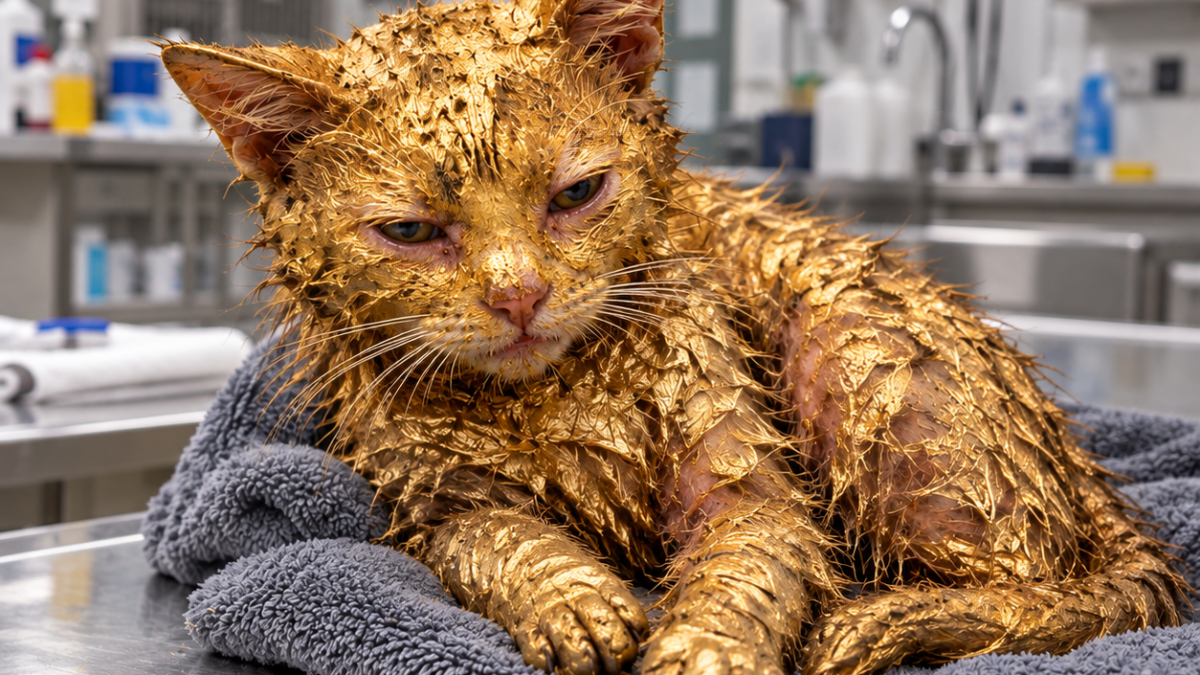
Gold paint had dried along the edges of her eyelids, pulling the skin tight.
Her whiskers were stiff.
Her ears were crusted.
Her paws stuck slightly to the pavement each time she tried to move.
Worst of all was her nose.
Both nostrils were almost entirely clogged.
She was breathing through her mouth in short, wet gasps.
Daniel had seen injured animals before.
He had lifted dogs hit by cars.
Pulled fawns from drainage ditches.
Once spent half an hour untangling a great blue heron from fishing line while being stabbed repeatedly by its beak.
This was different.
This had been done.
Intentionally.
Every inch.
Someone had held an aerosol can close enough to an animal’s face to cover the nose.
Daniel knelt.
The cat did not run.
Did not hiss.
Did not scratch.
She just looked at him through half-sealed eyes and opened her mouth again.
A tiny breath.
Then another.
“You’re okay.”
He knew she wasn’t.
“Come on.”
He removed his reflective work vest.
Wrapped her in it.
When he lifted her, her body felt rigid—not from aggression, but from dried paint stiffening the coat.
She weighed almost nothing in his arms.
Daniel carried her to the truck.
His partner, Luis Bennett, was coming up the road in a second county vehicle.
Daniel called him.
“You need to cover my section.”
“What happened?”
“I found a cat.”
“A cat?”
“Somebody painted her.”
Silence.
“What do you mean painted?”
“All of her.”
Luis swore.
“She alive?”
“Barely.”
Daniel put the cat on the passenger seat.
She tried to curl herself into the vest.
“Call Tom. Tell him I’m going to a vet.”
“Which vet is open?”
“I’ll find one.”
Daniel pulled onto the road.
His hands were shaking.
He called three clinics.
Voicemail.
Emergency line.
Another voicemail.
On the fourth call, someone answered.
“Willow Creek Veterinary.”
Daniel spoke too fast.
“I found a cat on County Road Nine. Somebody spray-painted her. She can hardly breathe.”
The woman on the phone stopped him.
“Bring her now.”
“You’re open?”
“We will be.”
The clinic normally opened at seven-thirty.
Daniel arrived at 6:19.
The lights were already coming on when he pulled into the lot.
A woman in navy scrubs opened the side entrance.
“Here.”
Daniel carried the cat inside.
Dr. Priya Shah arrived seven minutes later wearing jeans beneath her white coat and her hair pulled into a loose knot.
She had been called out of bed.
She took one look at the cat and said, “Oxygen first.”
They moved fast.
The cat was placed in an oxygen enclosure.
A veterinary technician named Megan used saline and soft swabs to begin clearing the nostrils.
Gold residue came away in tiny sticky flakes.
The cat struggled once.
Weakly.
Then stopped.
“Don’t scrub,” Priya warned. “We don’t know what’s underneath.”
They worked millimeter by millimeter.
The first goal was air.
Not beauty.
Not fur.
Not cleanup.
Air.
At 6:32, the right nostril opened enough for air to pass.
The cat inhaled.
Not normally.
But better.
Megan looked at Daniel.
“That’s good.”
Daniel stood against the wall, still wearing his orange work shirt without the vest.
“Is she going to make it?”
Priya did not answer immediately.
“I think she has a chance.”
That was not yes.
Daniel understood.
“What kind of paint?”
“Looks like aerosol enamel. Could be craft paint, automotive, construction marking. We’ll have to see.”
“Can it poison her?”
“Yes.”
The word came flat.
No comforting pause.
“If she inhaled enough propellant or solvent, yes. If she ingested it while grooming, yes. If it caused chemical burns, yes.”
Daniel stared through the oxygen enclosure.
The cat’s chest rose.
Fell.
Rose.
“She’s black,” Megan said.
Daniel looked at her.
“What?”
Megan had cleared a small section beneath the cat’s chin.
Under gold was glossy black fur.
Daniel felt his jaw tighten.
Someone had taken a black cat and turned her into a gold object.
Why?
The question would become everything.
At 6:55, animal control officer Rachel Moreno arrived.
Daniel had called dispatch from the clinic.
Rachel was forty-two, former sheriff’s deputy, and had learned over eleven years that cruelty cases tended to fall into two categories.
Neglect people denied.
And deliberate acts people minimized.
This looked like the second.
She stood beside the treatment table.
“Any collar?”
“No,” Daniel said.
“Microchip?”
“Not checked yet.”
Priya replied, “Breathing first.”
Rachel nodded.
She photographed the cat.
Face.
Paws.
Tail.
Ears.
She hated taking those pictures.
Evidence required them.
Compassion did not excuse bad documentation.
“Where exactly?” she asked Daniel.
“Southbound shoulder, just past Miller Creek bridge.”
“Any houses?”
“Two farms. One abandoned place.”
“Traffic?”
“At that hour? Almost none.”
“Anyone else stop?”
“No.”
Rachel wrote.
“What made you notice?”
“I thought she was garbage.”
He swallowed.
“I almost went around her.”
Rachel looked at him.
“But you didn’t.”
Daniel stared through the glass.
“Barely.”
For the next two hours, Priya and Megan removed paint.
They used a veterinary-safe oil-based cleansing solution in places where it was appropriate.
Saline around the face.
Lubricating drops around the eyes.
Clippers on areas where the hardened fur could not be safely cleaned.
Every few minutes, they stopped to let the cat rest.
By eight-thirty, most of the fur from her belly and sides had been shaved away.
Underneath, her skin was pink and irritated.
There were chemical burns along both ear margins.
A red patch beneath one front leg.
Another near the abdomen.
The worst irritation was around the muzzle.
But she could breathe.
Both nostrils were open.
Her eyes were flushed.
Corneas appeared intact.
No obvious pneumonia yet.
Bloodwork showed mild dehydration and elevated liver enzymes.
“Could be stress,” Priya said. “Could be toxin exposure.”
Daniel had remained the entire time.
His supervisor called twice.
The second time, Daniel answered.
“You’re not coming back today, are you?”
“No.”
His supervisor sighed.
“Fine. Use personal leave.”
Daniel almost argued.
Then didn’t.
“Thanks.”
At 9:04, the cat tried to stand.
Her shaved body looked impossibly small.
Black fur remained around portions of her neck, shoulders, and legs.
Gold residue stained the skin in places that could not yet be safely cleaned.
Megan put down a towel.
The cat stepped onto it.
Wobbled.
Then walked directly toward Daniel.
He froze.
“Me?”
Megan smiled sadly.
“Apparently.”
The cat reached his boots.
Pressed her shaved side against his ankle.
Then sat.
Daniel stared down.
“She doesn’t know me.”
“She knows you picked her up.”
“That’s not the same thing.”
“For a cat, it might be enough today.”
He crouched.
The cat lifted her head.
He touched one finger between her ears where a small patch of black fur had been exposed.
She began to purr.
Daniel closed his eyes.
That almost made him angrier.
Cruelty would have been easier to understand if she hated people.
But she didn’t.
Despite whatever hands had held her.
Whatever sound the spray can made.
Whatever she had breathed.
She still leaned toward human touch.
Rachel returned before noon.
“No chip.”
Daniel looked disappointed.
“No owner?”
“Not yet.”
Rachel laid a small evidence bag on the counter.
Inside was a thin plastic strip.
“What’s that?”
“Found it near where you picked her up.”
Daniel leaned closer.
A gold-painted zip tie.
Broken.
One end showed black plastic beneath the paint.
Priya looked up.
“From the cat?”
“Maybe.”
Rachel pointed.
“There’s hair caught in it.”
Black hair.
They all went quiet.
Daniel said, “They tied her?”
“Could have.”
“To what?”
“That’s what I’m going to find out.”
Rachel returned to County Road Nine.
By then, full daylight had turned the road ordinary.
Corn fields.
Ditches.
Utility poles.
A rusted mailbox leaning sideways.
Nothing about the place announced violence.
She parked where Daniel had stopped.
Walked the shoulder.
Found gold overspray on weeds.
A lot of it.
Not random.
The grass along one patch glittered metallic in the sun.
Rachel crouched.
There.
A cardboard rectangle.
Sprayed gold.
Part of a shipping box.
Another broken zip tie.
An empty nitrile glove.
Then twenty feet into the ditch, a spray-paint cap.
She photographed everything.
The cap had a brand name.
Premium Metallic Gold.
Sold almost everywhere.
Not enough.
She kept searching.
Behind an overgrown hedgerow stood the remains of an old farm access lane.
Tire tracks.
Fresh.
Rachel followed them.
Fifty yards in, she found a discarded fast-food cup.
Still wet with condensation.
Receipt attached.
Time stamp: 2:11 a.m.
Mason’s QuickMart.
Rachel smiled without humor.
Now she had somewhere to start.
By afternoon, the cat had a name.
Not from a chip.
From Megan.
“What are we calling her on the chart?”
Priya looked at the gold residue.
“Please don’t say Goldie.”
“I wasn’t going to.”
Daniel said, “Ash.”
Everyone turned.
“Why Ash?” Megan asked.
Daniel looked at the black fur emerging from underneath.
“Because that’s what’s left after people burn something and think they destroyed it.”
Priya considered him.
“That’s cheerful.”
Daniel shrugged.
Megan typed:
ASH.
FEMALE DOMESTIC SHORTHAIR.
APPROX. 1 YEAR.
BLACK.
The clinic posted nothing.
Rachel asked them to wait while she investigated.
That lasted twenty-four hours.
Then someone else posted first.
A customer who had seen Daniel carrying Ash into the clinic had taken a photograph through the parking-lot window.
It showed a gold-covered cat wrapped in an orange reflective vest.
Daniel’s arms around her.
The image went online with the caption:
“Does anyone know what happened to this cat at Willow Creek Vet? She looked spray-painted.”
By evening, half the county knew.
By morning, everyone did.
Willow Creek issued a short statement.
“A young female cat was brought to our clinic after being found covered extensively in metallic aerosol paint. She is receiving treatment and is currently stable. Animal control is investigating. Please do not speculate publicly about specific individuals.”
Nobody followed that last instruction.
Comments exploded.
Teenagers.
Kids.
Halloween prank.
TikTok.
Meth.
Cult.
Somebody’s ex.
People named people with no evidence.
Rachel spent more time correcting rumors than investigating.
Then the first real tip came.
A sixteen-year-old girl named Kayla Pierce sent a direct message to the animal control page.
“I think I know where the cat came from.”
Rachel called her.
Kayla sounded frightened.
“Can my mom be here?”
“Yes.”
They met at the sheriff’s office.
Kayla sat beside her mother.
Hands shaking.
She opened her phone.
“There was a video.”
Rachel leaned forward.
“What video?”
“Snapchat.”
“Do you still have it?”
“No. It disappears.”
“Who posted it?”
Kayla hesitated.
Her mother touched her arm.
“Tell her.”
Kayla whispered, “Bryce.”
“Bryce who?”
“Bryce Dalton.”
Rachel knew the name.
Twenty years old.
Local.
Two misdemeanor arrests.
One for vandalism.
One for underage alcohol possession.
Not enough to make him guilty of this.
“What was in the video?”
Kayla looked sick.
“People laughing.”
“How many?”
“I don’t know. Three? Maybe four.”
“And the cat?”
She nodded.
“What were they doing?”
Kayla started crying.
Her mother took her hand.
Rachel lowered her voice.
“You’re not in trouble.”
“I should’ve reported it.”
“When did you see it?”
“Like two in the morning.”
“You were awake?”
Kayla gave a tiny embarrassed nod.
“What did you see?”
“The cat was in a box.”
Rachel went still.
“A cardboard box?”
“Yes.”
“And?”
“Someone was spraying.”
“Who?”
“I couldn’t see the face.”
“Voice?”
“Bryce was filming.”
“What did he say?”
Kayla closed her eyes.
“He said, ‘We made the lucky cat.’”
Rachel’s stomach turned.
“Anything else?”
“Someone said, ‘Get the face.’”
Her mother gasped.
Kayla cried harder.
Rachel felt something cold settle behind her ribs.
“Did the video show where they were?”
“No.”
“Anything identifiable?”
“A truck.”
“What truck?”
“Black pickup.”
“Plate?”
“No.”
“Anything in the background?”
Kayla thought.
“A sign maybe.”
“What kind?”
“I don’t know.”
Rachel slid paper toward her.
“Draw what you remember.”
Kayla sketched a rectangle.
Two dark posts.
Maybe a farm sign.
Maybe nothing.
Then she remembered something else.
“The song.”
“What song?”
“It was playing from somebody’s truck.”
“What song?”
She named it.
Rachel wrote it down.
Small details solve big cases.
Sometimes.
The next morning, Rachel went to Mason’s QuickMart.
Security cameras covered the gas pumps and entrance.
At 2:06 a.m., a black Ford F-150 pulled in.
Four young men.
One was Bryce Dalton.
Receipt at 2:11.
Energy drinks.
Jerky.
Cigarettes.
Metallic spray paint.
Rachel paused the footage.
“Zoom.”
The store manager did.
Bryce carried two cans.
Gold.
Rachel called the sheriff.
By noon, they had a warrant request in progress.
By three, Bryce’s public social-media accounts had been preserved.
At four, his attorney called.
That was fast.
“You have no reason to harass my client,” the attorney said.
Rachel replied, “I haven’t contacted your client yet.”
“He heard you were asking questions.”
“Interesting.”
Silence.
“Tell Bryce not to delete anything.”
“My client has done nothing wrong.”
“Then that should be easy.”
The warrant came the next morning.
Search of Bryce’s phone.
Truck.
Home.
They found one gold spray can in the truck bed.
Same brand.
That was useful.
Not enough.
Gold overspray on an old moving blanket.
Black cat hair on the blanket.
Very useful.
Then the digital examiner recovered deleted media.
Five seconds.
That was all.
The beginning of the Snapchat video.
A cardboard box on the ground.
A black cat inside.
Gold already covering part of her back.
A male hand holding the can.
Someone laughing.
Bryce’s voice:
“Hold her still.”
Another voice:
“Dude, she’s pissed.”
Then a hiss.
Video ends.
Rachel watched it once.
Then again.
She hated every second.
“Can you identify the hand?”
The examiner shook his head.
“Maybe tattoos if there’s clearer frames.”
There was one.
Near the wrist.
A partial tattoo.
Three black lines.
Rachel knew someone would recognize it.
Bryce was arrested for animal cruelty and evidence tampering.
He insisted he only filmed.
That distinction mattered legally.
Morally, Rachel cared less.
“Who held the cat?” she asked.
“No idea.”
“You said ‘hold her still.’”
“I was drunk.”
“Who sprayed her?”
“I don’t remember.”
“Where did you get her?”
“I don’t remember.”
“Why was there cat hair in your truck?”
“She was in the truck.”
“Whose cat?”
“Some stray.”
“Where did you get her?”
“I told you.”
“No, you didn’t.”
Bryce leaned back.
“It was a joke.”
Rachel stared at him.
There it was.
The sentence she had expected.
Just a joke.
She placed a photograph of Ash on the table.
Not cleaned up.
Before.
Gold face.
Painted nose.
Mouth open.
“Explain the funny part.”
Bryce looked away.
“Didn’t know it would hurt her.”
“Spray paint?”
“People paint animals.”
“Not like this.”
“I didn’t do it.”
“You bought the paint.”
“For something else.”
“At two in the morning?”
Silence.
Rachel placed another image down.
Ash’s burned ear.
“What’s funny?”
“Stop.”
“Chemical irritation.”
“Stop.”
“Nearly blocked airway.”
“I said stop.”
“You filmed it.”
“I didn’t spray her!”
“Then tell me who did.”
Bryce said nothing.
The case became public within hours.
His family posted that he was being “railroaded.”
His older brother said online that people cared more about “one stupid cat” than ruining a young man’s future.
That sentence did not help.
Daniel read it while eating lunch in his county truck.
One stupid cat.
He almost responded.
Didn’t.
He had visited Ash every evening.
She was improving.
By day four, she ate normally.
By day five, she climbed onto his lap.
Most of the gold was gone.
Some remained stained into skin around her ears and paws.
She looked strange.
Mostly shaved.
Pink skin.
Black patches.
Faint gold smears.
Megan called her “a tiny punk-rock chicken.”
Daniel thought that was accurate.
“What happens when she’s discharged?” he asked Priya.
“Foster.”
“Where?”
“We’re finding one.”
Daniel looked at Ash.
She was asleep against his arm.
Priya raised an eyebrow.
“What?”
“No.”
“I didn’t say anything.”
“You were going to.”
“You have two cats already?”
“One.”
“House?”
“Yes.”
“Indoor?”
“Yes.”
“No dogs?”
“No.”
“Interesting.”
Daniel sighed.
“My wife will kill me.”
“Ask her.”
“I didn’t say I wanted her.”
Ash climbed higher onto his chest.
Priya smiled.
“Obviously.”
Daniel’s wife, Beth, arrived the next evening.
She looked at Ash.
Looked at Daniel.
Said, “Absolutely not.”
Ash walked to her.
Rubbed against her shoe.
Beth looked down.
“No.”
Ash sat on her foot.
Beth sighed.
“This is manipulation.”
Two days later, Ash went home with them as a foster.
Their existing cat, Pepper, hated her instantly.
Ash did not care.
She slept on Daniel’s chest the first night.
At 3:14 a.m., he woke because she was kneading his beard.
He whispered, “You’re weird.”
She purred.
The criminal investigation continued.
Bryce eventually gave Rachel the other names.
Not because his conscience suddenly awakened.
Because his lawyer explained conspiracy and principal liability.
There had been three others.
Evan Cole, nineteen.
Mason Trent, twenty-one.
And Caleb Reed, twenty.
Mason owned the tattooed wrist.
Caleb had driven.
Evan had found the cat.
“Found where?” Rachel asked.
Bryce looked down.
“Behind the old feed store.”
“Stray?”
“I guess.”
“You guess?”
“She came when Evan called.”
That mattered.
A truly feral cat would not casually approach four drunk young men at two in the morning.
Ash liked people.
Someone may have owned her.
Rachel circulated her picture again.
Now black.
Shaved.
Face visible.
No owner came forward.
Then an elderly woman called.
“I think that’s Midnight.”
Rachel visited her.
Her name was Louise Mercer.
Seventy-six.
Lived alone in a trailer half a mile from the feed store.
She showed Rachel photographs.
Black cat.
Yellow eyes.
Small white patch beneath the chin.
Ash had the same patch.
“What happened?”
Louise’s hands shook.
“She wasn’t mine exactly.”
“What does that mean?”
“Belonged to my neighbor.”
“Who?”
“Darlene Fitch.”
“Where is she?”
“Nursing home.”
Darlene had been hospitalized in January after a stroke.
Her niece emptied the rental house.
Midnight disappeared around that time.
Louise had been feeding her.
“She’d come every afternoon.”
“When did you last see her?”
“Three days before you found her.”
Rachel felt her chest tighten.
Ash was not a long-term stray.
She had been living outdoors only months.
“Why didn’t you bring her inside?”
“My dog hates cats.”
Louise looked ashamed.
“I made her a box in the shed.”
“You helped her.”
“Not enough.”
Rachel said nothing.
People often said not enough when what they really meant was I wish I could have controlled the outcome.
Nobody can.
Darlene confirmed the cat through photographs.
Her speech was impaired, but she cried when Rachel showed the current picture.
“Midnight.”
Her niece said, “We thought she ran away.”
Rachel asked, “Do you want her back?”
The room went quiet.
Darlene could not care independently for herself.
Her new facility did not allow cats.
Her niece lived in an apartment with two large dogs.
Darlene shook her head.
Then pointed to the photo.
“Good?”
Rachel understood.
“She’s safe.”
Darlene nodded.
That seemed to matter more.
Midnight became Ash in Daniel’s house.
At least temporarily.
He told himself foster.
Beth told herself temporary.
Owen—their fifteen-year-old son—was more realistic.
“You know she’s staying.”
“No.”
“She sleeps in Dad’s hoodie.”
“Lots of foster cats do that.”
“You’ve never fostered a cat.”
“Technicality.”
Pepper gradually stopped hissing.
Ash’s black fur returned.
Soft at first.
Then thick.
For weeks, gold remained faintly visible around one ear.
Daniel hated that mark.
Beth didn’t.
“Why?”
“Because it reminds us she survived.”
“I don’t want her to need proof.”
“She doesn’t.”
Beth touched the ear.
“We do.”
The court case started drawing attention.
Not because animal cruelty was unusual.
Because of the video.
People could see laughter.
Cruelty becomes harder to minimize when joy is visible on the faces around it.
Mason Trent was identified as the person holding the spray can.
Evan held Ash in the box.
Bryce filmed.
Caleb drove.
Investigators recovered messages.
Bryce:
gold cat lmao
Mason:
bro she looked like a trophy
Evan:
she almost bit me
Caleb:
should’ve painted the teeth too
Then, at 4:12 a.m., another message.
Mason:
think we killed it?
Bryce:
nah cats got 9 lives
No one had called for help.
No one had gone back.
They had dumped her near County Road Nine and driven away.
That became the most damaging evidence.
Not ignorance.
They knew.
Or suspected.
And still left.
The prosecutor, Assistant District Attorney Helen Park, refused to call it a prank.
At the preliminary hearing, defense attorneys repeatedly did.
“A drunken prank.”
“A stupid prank.”
“Immature conduct.”
“Poor judgment.”
Helen stood.
“Your Honor, a prank ends when everyone gets to go home.”
She held up the veterinary report.
“This animal could not breathe.”
Silence.
“She was coated in toxic aerosol while restrained.”
The judge looked at the photographs.
“This court understands.”
The charges moved forward.
Then came the humiliation.
For Daniel.
Not the suspects.
He received an anonymous letter at the county garage.
“You’re milking this for attention.”
A second said:
“It’s a cat. Get over yourself.”
His coworkers teased him too.
Mostly harmless.
“Cat dad.”
“Goldfinger.”
“Animal whisperer.”
Then one morning someone spray-painted a small gold cat silhouette on his locker.
Daniel stared at it.
Luis saw his face.
“Not funny?”
“No.”
Luis stopped smiling.
He had not done it.
The garage supervisor had the paint removed.
Daniel tried to shrug it off.
But something had changed in him.
Before Ash, cruelty had been a category.
Something bad people did.
After seeing her unable to breathe, cruelty became intimate.
The smell of aerosol.
The stiffness of painted fur.
The sound of mouth breathing.
People joking about it hit differently.
One afternoon, a local radio host said the charges were excessive.
“Look, nobody’s defending what these kids did. But felony-level consequences for painting a cat? We need perspective.”
Daniel heard it in the truck.
He pulled over.
Called the station.
He got through.
“You found the cat?” the producer asked.
“Yes.”
They put him on air.
The host said, “Daniel, first, I’m glad the animal survived.”
Daniel replied, “So am I.”
“I’m just saying young people do stupid things.”
“Sure.”
“You don’t think ruining four lives is too much?”
Daniel was quiet.
Then said, “Whose lives?”
The host paused.
“The young men charged.”
“You said four lives.”
“Yes.”
“There were five.”
Silence.
Daniel continued.
“You’re counting everybody except the one who almost died.”
The host tried to speak.
Daniel kept going.
“She couldn’t breathe through her nose.”
“We understand—”
“No, you don’t.”
His voice remained calm.
“That’s the problem.”
The producer later clipped the segment.
It spread online.
Five lives.
People repeated it.
Daniel hated becoming part of the story.
But he understood why that line traveled.
Humans are very good at counting consequences only when they happen to people we identify with.
The defendants became boys.
Young men.
Promising futures.
Families.
Jobs.
Ash was “a cat.”
A category.
Daniel had held her.
Categories are easier to dismiss than individuals.
At home, Ash had begun doing something strange.
She panicked at aerosol sounds.
Hair spray.
Cooking spray.
Air freshener.
The first time Beth sprayed dry shampoo in the bathroom, Ash fled under the bed and urinated.
Beth found her trembling.
After that, every aerosol can left the house.
Cooking oil came in bottles.
Cleaning products in pumps.
No spray deodorant.
No canned air.
Tiny adaptations.
Trauma changes households.
Even when the traumatized cannot explain why.
Dr. Priya referred Daniel to a feline behaviorist.
“Give her control,” the behaviorist said.
“Of what?”
“Distance. Contact. Exit.”
Daniel listened.
“Don’t force exposure.”
“I wouldn’t.”
“You’d be surprised.”
Ash improved.
Slowly.
She learned that hands reaching toward her could carry treats.
That boxes were toys, not traps.
That the hiss of a soda opening was not aerosol.
That the garage door meant Daniel came home.
Then, one Saturday, Owen found something.
Not Daniel’s son Owen—his name was actually Ethan. (The shelter volunteer later joked every animal-rescue story apparently needed an Owen somewhere.) Ethan was fifteen and had been going through local videos online for a school media project.
He called his father.
“Dad.”
Daniel was in the backyard.
“What?”
“You need to see this.”
On screen was an older video from Bryce’s account.
Posted months before Ash’s attack.
A raccoon near a dumpster.
Bryce tossing firecrackers.
Laughing as the animal ran.
Another video.
A frog taped to a skateboard.
Another.
A stray dog being chased with an ATV.
Daniel felt sick.
“Send these to Rachel.”
They did.
Investigators found more.
A pattern.
Minor cruelty treated as entertainment.
Nothing as severe as Ash.
But escalation rarely begins at the worst act.
It begins with laughter and no consequences.
Helen Park used some of the material to establish motive and pattern where admissible.
The defense fought hard.
“This is character assassination.”
“Unrelated juvenile behavior.”
“Social-media stupidity.”
Some clips were excluded.
Some messages stayed.
Then one former friend came forward.
His name was Noah Jensen.
He had stopped hanging around with Bryce months earlier.
He testified that cruelty had become a game.
“Who could get the biggest reaction.”
From animals?
“From each other.”
“What do you mean?”
Noah looked toward the defense table.
“You did something messed up, everybody laughed, so next time somebody did something worse.”
Helen asked, “Were animals often involved?”
“Yes.”
“Why?”
“Because animals couldn’t tell anyone.”
That sentence silenced the courtroom.
Ash could not tell anyone.
But the camera could.
The receipt could.
The phone could.
The paint could.
Kayla could.
Daniel could.
Sometimes justice begins when silence gets substitutes.
Trial was avoided.
All four eventually accepted plea agreements.
Mason, who sprayed Ash directly, received the harshest sentence.
Jail.
Probation.
Mandatory psychological evaluation.
Animal-cruelty counseling.
A multiyear prohibition on owning or living with animals.
Restitution for veterinary care.
Bryce received a shorter jail sentence for participation, filming, encouragement, and evidence tampering.
Evan and Caleb received probation, community service, counseling, and animal-contact restrictions.
People argued.
Too much.
Too little.
Always.
At sentencing, Darlene attended by video.
She had asked to speak.
Her voice remained slow from the stroke.
Helen stood beside the screen.
Darlene held a photograph of Midnight as a kitten.
“She… slept… here.”
She pointed to her shoulder.
The courtroom waited patiently between words.
“She… knew… my husband.”
Darlene’s husband had died two years before her stroke.
“After… he died… she… waited… by his chair.”
Mason stared at the floor.
Darlene continued.
“You… saw… a stray.”
Pause.
“She… was… somebody.”
That was all.
No speech.
No rage.
Somebody.
The judge looked at the four defendants.
“You are young enough that I hope this is not the worst thing that will define your character.”
Then he paused.
“But youth explains poor judgment. It does not erase suffering.”
He looked at Mason.
“You purchased aerosol paint at two in the morning.”
Bryce.
“You filmed.”
Evan.
“You restrained the animal.”
Caleb.
“You transported and abandoned her.”
He folded his hands.
“Every person in the chain had a moment to stop.”
That became another phrase people repeated.
A moment to stop.
At the store.
In the truck.
At the box.
Before the face.
After the first hiss.
Before the second can.
Before dumping her.
Before deleting the video.
Cruelty is rarely one moment.
It is a staircase.
People keep stepping.
Justice asks why no one turned around.
After sentencing, reporters surrounded Daniel outside.
He hated cameras.
One asked, “Do you forgive them?”
Daniel frowned.
“I’m not the one they hurt.”
“Do you think they deserve second chances?”
He looked back at the courthouse.
“I think a second chance should belong to the person who uses it differently.”
“What does that mean?”
“It means sorry isn’t a magic word.”
He walked away.
That evening, Daniel came home.
Ash met him at the door.
Black coat fully grown.
Yellow eyes clear.
No visible gold except one tiny fleck deep inside the edge of her left ear that Priya had advised leaving alone until it shed naturally.
Daniel sat on the floor.
Ash climbed into his lap.
Beth appeared from the kitchen.
“How’d it go?”
“Done.”
“Done done?”
“For court, mostly.”
She sat beside him.
Ash stretched across both their legs.
Daniel stroked her back.
“Remember when you said absolutely not?”
Beth smiled.
“I was under stress.”
“She’s been here seven months.”
“Temporary foster.”
“She has a stocking with her name on it.”
“That proves nothing.”
“You had it embroidered.”
“Circumstantial.”
Daniel laughed.
They officially adopted Ash the next week.
The paperwork listed:
Previous Name: Midnight.
Current Name: Ash.
Beth asked Darlene for permission.
Darlene smiled.
“New… life. New… name.”
She kept one thing.
A tiny framed photograph of Midnight.
Daniel brought Ash to visit her once.
Not in the nursing home common area.
In a private family room.
Darlene sat in a wheelchair.
Ash entered in a carrier.
The moment Darlene spoke, Ash froze.
“Ash?”
Nothing.
Darlene tried again.
“Midnight.”
The cat turned.
Darlene started crying.
“Baby.”
Daniel opened the carrier.
Ash stepped out cautiously.
She sniffed the floor.
Then Darlene’s shoes.
Then her blanket.
She climbed onto Darlene’s lap.
No dramatic leap.
No television moment.
Slowly.
One paw.
Then another.
Darlene touched her head.
Ash purred.
The old woman’s shoulders shook.
“I’m… sorry.”
Daniel looked away.
He knew that sentence.
People apologized for disasters they did not cause because grief makes responsibility feel contagious.
Darlene had suffered a stroke.
Her cat disappeared.
Still:
I’m sorry.
Daniel knelt.
“She survived.”
Darlene nodded.
Ash pressed her face beneath Darlene’s hand.
For thirty minutes, they sat together.
Then Darlene whispered, “Good… people?”
Daniel understood.
“Yeah.”
He looked at Ash.
“She has good people.”
Darlene smiled.
When they left, Ash looked back once.
Daniel could not know what she understood.
He didn’t need to.
The story changed the town in smaller ways too.
The county created a dedicated cruelty-reporting line.
Schools invited Rachel to speak about animal welfare and online behavior.
Not because every child was a future abuser.
Because spectators matter.
Kayla became part of Rachel’s presentation anonymously.
“If you see it, save it. Report it. Don’t share it for entertainment.”
The local high school added digital citizenship material about recording cruelty.
Mason’s QuickMart stopped selling spray paint after midnight to customers under twenty-one.
Legally unnecessary.
Symbolically imperfect.
Still, the owner said, “I watched the footage. I don’t want to be the stop before something like that again.”
Daniel’s county crew began keeping animal carriers in two maintenance trucks.
Luis suggested it.
“Because of Ash?”
“Because of every thing we almost think is trash.”
That line stayed private.
Daniel liked it.
One morning almost a year after he found her, Daniel was assigned to County Road Nine again.
Same stretch.
Same bridge.
Same early hour.
Fog.
Amber lights.
He slowed near the spot.
Not intentionally.
His body remembered.
He pulled over.
Walked to the shoulder.
The grass had grown back.
No gold.
No box.
No paint.
Just weeds wet with dew.
He stood there longer than necessary.
A truck passed.
Then another.
He pictured that morning.
Gold object moving.
Almost garbage.
Almost nothing.
Almost missed.
Daniel had spent a year hearing people call him a hero.
He hated it.
“I stopped a truck,” he always said.
But standing there, he understood that stopping mattered.
Not because it made him exceptional.
Because it was available to almost anyone.
Slow down.
Look again.
Stop.
Those are ordinary actions.
Sometimes life depends on them.
At home, Ash had developed a strange affection for the color yellow.
Beth bought her a mustard-colored blanket.
Ash slept on it constantly.
Daniel protested.
“That looks too close to gold.”
“She doesn’t know that.”
“I do.”
“She likes it.”
“How do you know?”
“Because she’s always on it.”
Daniel rolled his eyes.
The blanket stayed.
Ash became healthy.
Then spoiled.
She gained two pounds.
Priya said one pound too many.
Beth accused the veterinarian of body shaming.
Ash learned to steal turkey.
She opened cabinet doors.
She sat on Daniel’s newspaper every morning.
She slept with one paw against Beth’s cheek.
She still hated aerosol sounds.
Probably always would.
Recovery is not erasure.
It is safety with scars.
One evening, almost eighteen months after the attack, Daniel received an envelope.
No return address.
Inside was a handwritten letter.
From Mason.
Daniel almost threw it away.
Beth said, “Read it or don’t. But decide before you burn it.”
He read.
Mason did not ask forgiveness.
That surprised him.
He wrote that counseling had forced him to watch the veterinary footage.
Not just the social-media clip.
Ash struggling to breathe.
Paint being removed.
Skin underneath.
He wrote:
“I kept telling myself we didn’t mean to kill her. I understand now that this was another way of saying her pain mattered less than our intent.”
Daniel stopped.
Read that sentence again.
Mason continued.
“I don’t know why I sprayed her face. I remember people laughing. I remember wanting them to keep laughing. That’s the ugliest answer I have.”
Daniel set the letter down.
Beth asked, “You okay?”
“No.”
“Want me to read it?”
“No.”
He finished.
Mason had begun volunteering—not with animals, because his court order prohibited unsupervised animal contact—but with roadside cleanup.
His counselor suggested choosing work where he had to see discarded things.
Daniel almost laughed at the symbolism.
Then the final lines:
“I know you found her because you stopped.
I think about how many chances I had to stop before you had to.
I’m sorry.”
Daniel folded the letter.
He did not write back.
Not for six months.
Then he sent one sentence.
“Use your next moment differently.”
That was all.
Mason never replied.
Years passed.
Ash became famous locally whether Daniel wanted it or not.
The clinic kept a framed photograph in the lobby.
Not the gold one.
The after.
Black fur grown back.
Green collar.
Sitting on Daniel’s shoulder as if she owned him.
Below it:
ASH — FOUND APRIL 14, 6:03 A.M.
SHE SURVIVED.
Visitors asked about her.
Megan told the story.
Sometimes too dramatically, according to Priya.
Schools raised money in Ash’s name.
The county shelter created an emergency medical fund.
Darlene died three years later.
Her niece invited Daniel to the funeral.
Ash’s photograph sat beside family pictures.
That surprised him.
Then he saw another image.
Darlene younger.
Her late husband.
Midnight between them.
Ash before Ash.
A normal black cat.
No gold.
No shaved fur.
No headlines.
Just somebody’s pet sitting on a couch.
Daniel stood there a long time.
This was what cruelty steals first.
Ordinariness.
It turns a life into an event.
A victim.
Evidence.
A symbol.
Before any of that, she had been a cat.
She slept by a chair.
Chased dust.
Waited at a window.
Belonged to someone.
After Darlene’s funeral, Daniel stopped at home.
Ash was on the mustard blanket.
He picked her up.
She protested.
“You had a whole life before me.”
Ash tried to bite his shirt button.
“Deep moment ruined.”
Beth laughed from the kitchen.
“She’s consistent.”
When Ash turned eight, her left ear still carried a slight irregularity from the chemical burns.
Everything else had healed.
At nine, she developed thyroid disease.
Manageable.
At ten, mild kidney changes.
At eleven, arthritis.
Life became ordinary in the best possible way.
Medication.
Vet visits.
Warm beds.
Arguments about food.
Sunlight.
Then, one spring morning, Daniel saw something on the road again.
He was no longer on active maintenance duty.
He had moved into a supervisory role.
Driving to work.
A dark shape near the shoulder.
He slowed automatically.
A plastic garbage bag.
Nothing alive.
He drove on.
Then stopped.
Backed up carefully.
Checked.
Definitely garbage.
He laughed at himself.
But that was what Ash had done to him.
He looked twice.
Always.
Sometimes three times.
Once you mistake a living thing for trash, you never trust the first glance again.
Ash died at fourteen.
Kidney failure.
Old age.
Nothing dramatic.
Nothing violent.
Daniel considered that a victory.
Her final morning was at home.
Priya, now grayer, came to the house.
Ash lay on the mustard blanket.
Pepper had died years earlier.
Beth sat beside Daniel.
Ethan, now grown and living two states away, joined by video until the final minutes, then asked to disconnect because he wanted to remember her alive.
Daniel understood.
Priya listened to Ash’s heart.
“She’s tired.”
Daniel nodded.
He had promised himself not to make the decision too late because he was afraid.
Cruelty can be holding on for yourself.
Love sometimes means stopping.
He stroked Ash’s head.
The left ear.
The one that had been burned.
“You know what I still hate?”
Beth squeezed his hand.
Daniel whispered, “Gold.”
She laughed through tears.
Ash opened one eye.
Daniel smiled.
“You always looked better in black.”
Ash purred.
Soft.
Barely there.
Priya gave the sedative.
Ash relaxed.
Daniel remembered carrying her from the road.
Rigid fur.
Mouth open.
Unable to breathe.
Now she lay soft and warm between people who loved her.
He bent close.
“You weren’t garbage.”
His voice broke.
“You never were.”
Beth cried.
Priya cried too.
Daniel touched his forehead to Ash’s.
“I’m glad I stopped.”
Ash’s breathing slowed.
Then stopped.
The room became impossibly quiet.
Daniel had her cremated.
He kept the ashes in a black ceramic urn.
No gold.
Beth noticed.
“Petty.”
“Yes.”
“Understandable.”
On the anniversary of Ash’s rescue, Willow Creek Veterinary posted two photographs side by side.
The first was difficult to look at.
Gold paint.
Half-closed eyes.
Reflective vest.
The second showed Ash at thirteen.
Black.
Round.
Annoyed.
Sitting beside Daniel.
The caption read:
“Fourteen years ago, someone tried to turn a living cat into an object.
A road worker looked twice.
That was enough for her life to continue.
Ash died this week at fourteen after a long, loved, ordinary life.
Please remember the ordinary part.”
The post spread farther than the original rescue story ever had.
People shared their own animals.
Three-legged dogs.
Burn survivors.
Abandoned kittens.
Old shelter cats.
Animals who had once been headlines and later became couch potatoes.
Daniel read some of the comments.
Then stopped.
He did not need the internet to tell him what Ash’s life meant.
He had the scratched couch.
The damaged blinds.
The vet bills.
The fur still woven into the back seat of his truck.
The mustard blanket Beth refused to wash one last time.
Ordinary evidence.
The best kind.
Years earlier, people had asked why anyone would spray-paint a cat.
Daniel never found an answer that satisfied him.
Drunk.
Young.
Cruel.
Performing for friends.
Chasing laughter.
All explanations.
None an excuse.
Eventually he stopped asking why cruelty existed.
He became more interested in the other question.
Why do some people stop?
Kayla stopped being silent.
Rachel stopped rumors from becoming investigation.
Priya stopped treating only the body and started talking about trauma.
Darlene stopped blaming herself.
The judge stopped youth from becoming an excuse.
Mason, maybe, eventually stopped becoming worse.
And Daniel stopped his truck.
That was the first stop.
The one Ash needed most.
At 6:03 on a gray April morning, a man saw something gold moving along a rural road.
His first thought was trash.
His second was wrong.
His third made all the difference.
Wait.
Look again.
There are lives that disappear because nobody looks twice.
There are people dismissed because they are dirty, injured, homeless, addicted, old, frightened, difficult, inconvenient.
There are animals passed on roads because drivers think someone else will stop.
There are moments when kindness is nothing more heroic than interrupting your routine long enough to confirm that what you are seeing is what you think it is.
Daniel did not know there was a cat inside the gold.
He stopped anyway.
And beneath the paint, beneath the chemical burns, beneath the stiff coat and sealed nose, there was never a gold cat at all.
There was Midnight.
There was Ash.
There was a black cat who loved laps.
Who stole turkey.
Who hated aerosol cans.
Who lived fourteen years.
Who knew Darlene’s voice.
Who slept on Daniel’s chest.
Who became old enough to get kidney disease and fat enough to be scolded by a veterinarian.
Who got the privilege of becoming ordinary again.
That is the ending Daniel always preferred.
Not court.
Not punishment.
Not the viral photograph.
Not even rescue.
Ordinary.
Because whoever painted her tried, for one night, to reduce her to an object.
A joke.
A spectacle.
A gold thing on the side of a road.
But objects do not heal.
Objects do not purr.
Objects do not remember voices.
Objects do not panic at sounds.
Objects do not learn trust again.
Objects do not grow old in warm houses.
Ash did.
And in the end, the most powerful answer to the people who laughed while covering her in gold was not anger.
It was fourteen years.
Fourteen years of food bowls.
Sunlight.
Vet appointments.
Christmas mornings.
Lap naps.
Open windows.
Warm blankets.
Human hands that never held her down to hurt her again.
She had nearly become something a road crew would scrape from the pavement and throw away.
Instead, one man stopped.
He wrapped her in a reflective vest.
He carried her into a truck.
And beneath all that gold, the world found the black cat someone had tried to erase.
She was there the whole time.
Breathing.
Barely.
Waiting for somebody to look twice.
Daniel did.
And that was why she lived.








