Six Bikers Laughed at a Boy’s Homemade Toy Motorcycle—Then They Saw the Name “DIESEL” Carved Into the Tank and Went Silent.
PART2:
Shoulders that made doorways look narrow.
He had ridden with us for more than twenty years and possessed the kind of laugh that made strangers turn around in restaurants.
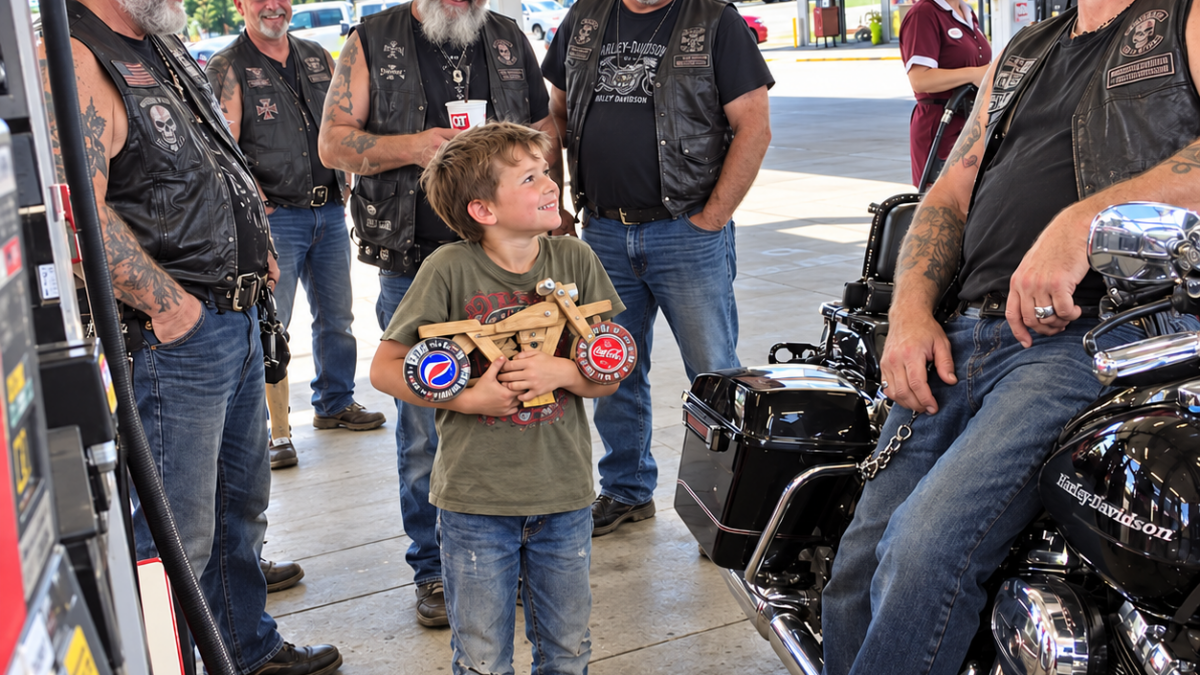
We were fueling when I saw the boy.
Maybe six.
Maybe seven.
Skinny legs.
Hand-me-down sneakers.
Jeans an inch too short.
T-shirt with a faded dinosaur on it.
He was carrying something in both hands.
At first I thought it was a block of wood.
Then he put it on the pavement.
A motorcycle.
Sort of.
It had been carved by hand.
Body from some scrap of pine.
Bottle-cap wheels.
A bent nail for a kickstand.
Coat-hanger handlebars wrapped in strips of black electrical tape.
One side sat higher than the other.
The front wheel wobbled.
The whole thing looked as though a very determined man had built it with whatever he could find in a garage.
The boy pushed it toward us.
Right up beside Hammer’s Road King.
Then he made an engine sound with his mouth.
“Brrrrrraaaap.”
Hammer looked down.
Then at us.
Then back at the toy.
He laughed.
Not mean at first.
Just surprised.
“Son, that thing’s got less horsepower than my granny’s walker.”
Ray snorted.
Tommy said:
“Bet the insurance is cheap.”
Cal added:
“Needs training wheels.”
We laughed.
Me too.
That matters.
People like telling stories afterward in a way that protects themselves.
They say:
I didn’t laugh.
I knew better.
I tried to stop them.
I didn’t.
I laughed.
The boy did not.
His whole body changed.
He picked up the motorcycle.
Held it to his chest with both arms.
Not casually.
Protectively.
Like we might take it.
Across the parking lot, at pump four, a woman stopped pumping gas.
Faded waitress uniform.
Black apron.
Hair pulled back.
She looked at us.
She did not shout.
Did not march over.
Did not tell us to leave her child alone.
She just looked tired.
That expression got me.
I have three grandchildren.
Two boys.
One girl.
I’ve seen that face on their mothers.
The look people get when something hurts a child and they are deciding whether stepping in will make the humiliation bigger.
The boy stared at the pavement.
I felt stupid.
I set the gas nozzle back in the pump.
Walked toward him.
My knees cracked when I crouched.
Getting old is mostly discovering which joints can now be heard from across a parking lot.
“Hey.”
The boy did not look up.
“I’m sorry.”
Nothing.
“We were being jerks.”
His eyes moved toward me.
“That’s a nice bike.”
He looked at Hammer’s Road King.
Then at his toy.
He knew I was lying.
I corrected myself.
“No.”
I pointed.
“That’s a pretty rough-looking bike.”
His mouth tightened.
“But I bet somebody worked hard on it.”
That got him.
He looked up.
I held out one hand.
“Can I see?”
He hesitated.
For a long time.
Then slowly gave it to me.
The thing weighed more than I expected.
Solid wood.
Not some store-bought toy painted to look handmade.
Whoever built it knew tools.
Maybe not toy making.
But tools.
The edges had been carefully sanded.
Bottle caps fixed with tiny screws.
Handlebars shaped from wire.
Electrical tape wrapped in even layers to create grips.
Tiny seat made from a piece of black leather glued over foam.
There was a little exhaust pipe made from copper tubing.
I turned it over.
The bottom had pencil marks still visible beneath varnish.
Then I turned it sideways.
And stopped breathing.
Carved into the wooden gas tank, in uneven block letters:
DIESEL.
My hands began shaking.
Below the name, smaller:
FOR MY BOY.
KEEP THE RUBBER SIDE DOWN.
For a second I could not hear anything.
No highway.
No fuel pump.
No wind.
Nothing.
The parking lot disappeared.
All I could see was those words.
Keep the rubber side down.
Danny Kowalski said that every time we split.
Every ride.
Every gas station.
Every crossroads.
Didn’t matter whether you were going two blocks or two states.
“Rubber side down, boys.”
That was Diesel.
Danny “Diesel” Kowalski.
Our brother.
Eleven years riding beside us.
Dead six years.
I looked at the boy.
Then at the woman at pump four.
Then over my shoulder.
Hammer had stopped smiling.
The color had drained from his face so completely that for one second I thought he might fall.
Ray saw it too.
“What?”
Nobody answered.
Hammer walked toward us.
Slowly.
His boots sounded too loud against the pavement.
He looked at the toy in my hands.
Then the carved name.
His mouth opened.
Nothing came out.
The boy pulled the motorcycle back from me.
“You know Diesel?”
His voice was small.
I swallowed.
“What’s your name, son?”
“Danny.”
That nearly finished me.
“Danny what?”
“Kowalski.”
Hammer turned away.
Both hands went to the back of his neck.
The woman had stopped pumping gas.
She was watching.
I knew her now.
Not because she looked the same.
She didn’t.
Six years had changed her.
Hair shorter.
Face thinner.
Hardness around the mouth that had not been there before.
But once I knew what I was looking for, I could see it.
“Jenna?”
She removed the nozzle.
Hung it up.
Then looked straight at me.
“Hello, Walt.”
No warmth.
No surprise.
Just recognition.
The boy looked between us.
“Mama?”
Jenna reached for the toy.
“Danny, get in the car.”
“But—”
“Now.”
He didn’t move.
His eyes were fixed on me.
“Mister.”
I looked down.
“Did you know my daddy?”
There are questions you answer with words.
There are questions that remove language completely.
I nodded.
The boy’s whole face changed.
Lit up.
Not because he understood grief.
Because he had been waiting.
Later, Jenna told me he had been doing it for three years.
Every gas station.
Every parking lot.
Every time he heard a Harley.
He carried that wooden motorcycle.
Walked toward strangers in leather.
Set it beside their bikes.
Waited.
Not once had anybody recognized the name.
Until us.
And we laughed at him.
Jenna looked at the boy.
“He does this everywhere.”
Her voice stayed quiet.
“He sees bikers and thinks maybe one of them knew his dad.”
She looked at us.
“Three years.”
Hammer turned back.
His eyes were wet.
Jenna continued.
“You’re the first ones.”
Then the words that put all six of us in the ground.
“And you laughed at him.”
I was shot at outside Kuwait City in 1991.
I fell thirty feet off a utility pole during the ice storm of 2007 and broke two ribs, my wrist, and a vertebra.
Those five words hurt worse.
Hammer moved.
Jenna saw him.
Her face hardened instantly.
“Danny.”
She pointed at the car.
“Inside.”
This time the boy obeyed.
Mostly.
He climbed into the rear seat but left the door open.
Hammer walked across the lot.
The biggest man I know.
Every step made him look smaller.
When he reached Jenna, he dropped to both knees.
Right there.
Oil stains.
Cigarette filters.
Gum stuck in a crack.
He knelt in it.
“Jenna.”
She stared at him.
“I need to tell you something.”
I knew what was coming.
Six years too late.
Hammer’s voice broke.
“The night Diesel died—”
Jenna’s jaw tightened.
“He wasn’t out there because my bike broke down.”
I closed my eyes.
Hammer kept going.
“I was drunk.”
Jenna said:
“I know.”
Hammer stopped.
So did I.
He stared up at her.
“What?”
“I know.”
Her voice shook now.
“Your bike wasn’t broken.”
Hammer looked at me.
I felt cold.
Jenna reached into the pocket of her waitress apron.
Pulled out an old flip phone.
Samsung.
Cracked screen.
Tape over the battery cover.
Ancient thing.
She held it up.
“I have paid twelve dollars a month for six years to keep this number alive.”
Hammer stared.
“Why?”
Jenna opened the phone.
“Because every twenty-eight days this phone tells me it’s going to delete an old voicemail.”
Her thumb pressed buttons.
“And every twenty-eight days, I save it again.”
She put the phone on speaker.
Static.
Road noise.
Then a sound none of us were ready for.
Diesel’s voice.
Six years gone.
Still alive inside a dying phone.
“Hey babe, it’s me.”
Hammer made a choking sound.
The voicemail continued.
“Hammer laid it down out by the Abilene exit. He’s okay. Just drunk and stupid.”
A turn signal clicked in the background.
“I’m gonna go get him before somebody calls it in. Don’t wait up.”
Pause.
Then Diesel laughed softly.
I remembered that laugh.
“And hey.”
His voice changed.
Tender.
“Tell my boy goodnight for me.”
Click.
Then the recorded system voice.
“Received October eighth at one sixteen a.m.”
Nobody moved.
Ray took off his cap.
Tommy looked toward the highway.
Cal sat down on the concrete curb.
Hammer folded forward.
His forehead almost touched the pavement.
His shoulders began to shake.
I had never seen him cry.
Not at funerals.
Not when his father died.
Not when his daughter stopped speaking to him for two years.
Now he cried like the parking lot had opened underneath him.
Jenna looked down.
“You thought I didn’t know?”
Hammer couldn’t answer.
“You thought I believed the stator story?”
That story was mine.
And before anybody gives Hammer all the blame, understand that part.
I invented the lie.
The night Diesel died, Hammer had been drinking at a roadhouse outside Abilene.
He rode anyway.
Stupid.
Criminally stupid.
He made it eleven miles.
Then failed a turn near an exit ramp.
The Road King went into a drainage ditch.
Hammer escaped with road rash and bruises.
He knew if law enforcement came, he was done.
One DUI already.
Another meant license.
Job.
Maybe jail.
He drove a cement mixer for a living.
No license meant no income.
So he called Diesel.
Not a tow company.
Not me.
Diesel.
Because Diesel would always come.
That was the kind of man he was.
You called at two in the morning?
He came.
Flat tire?
Came.
Marriage falling apart?
Came.
Needed somebody to sit on the porch without asking questions?
Came.
Hammer called.
Diesel got out of bed.
Jenna was seven months pregnant.
He kissed her.
Told her he’d be back.
Took his pickup and loading ramp.
At 1:43 a.m., a truck driver who had been awake nearly twenty hours drifted onto the shoulder at sixty-three miles per hour.
Diesel was standing behind his pickup lowering the ramp.
Never saw the semi.
That was what the trooper said.
As if not seeing death made it kinder.
Hammer called me after two.
I could barely understand him.
“Walt.”
“What?”
“Diesel.”
Then silence.
I heard sirens.
“Hammer, where are you?”
He gave me the exit.
I arrived around 2:45.
The Road King lay in the ditch.
Diesel’s pickup looked folded against the guardrail.
Emergency lights flashed red and blue across everything.
Hammer sat on the guardrail.
Blood on his hands.
Not his.
“I called him.”
That was all he kept saying.
“I called him instead of a tow truck.”
“I called him.”
A trooper asked what happened to Hammer’s bike.
Hammer looked at me.
I answered.
“Electrical.”
The trooper looked at me.
“Electrical?”
“Stator.”
I had no idea why that word came out.
Maybe because I had replaced mine the previous summer.
“Bike died.”
“He called Danny for a haul.”
The trooper nodded.
Maybe he believed me.
Maybe he did not care.
Disabled motorcycle was irrelevant compared to a dead man crushed on the shoulder.
Before sunrise, Hammer and I sat in my truck.
He was shaking.
“I killed him.”
“No.”
“I called him.”
“You didn’t drive the semi.”
“If I wasn’t drunk—”
“Stop.”
“I called him.”
“Hammer.”
“I called him.”
I told him what we would say.
Bad stator.
Bike failed.
Diesel came to help.
Wrong place.
Wrong time.
It would protect Hammer.
I told myself it would protect Diesel’s memory too.
No scandal.
No DUI story attached to the funeral.
No one blaming Hammer.
No one asking whether Diesel should have stayed home beside his pregnant girlfriend.
I told myself Diesel would not want his best friend destroyed.
Those were the words I used.
Really, I wanted the problem smaller.
Truth would make the grief complicated.
A truck driver caused the crash.
That was simple.
A brother called another brother because he was drunk and afraid of consequences, and that brother died answering the call?
Harder.
So I cleaned it.
Bad stator.
Six years later, Jenna stood over Hammer with the voicemail in her hand.
“I played that message the night the trooper knocked on my door.”
She put one hand over her abdomen, remembering.
“I sat on my kitchen floor.”
“I put this phone against my stomach.”
“And I played Danny’s last words for his son.”
Tell my boy goodnight.
Hammer lifted his face.
“I’m sorry.”
Jenna ignored it.
“Then I went to his funeral.”
I knew where she had sat.
Last pew.
Seven months pregnant.
Alone.
Diesel’s mother never liked her.
Danny and Jenna were not married.
They planned to be.
Eventually.
Always eventually.
His mother handled the funeral.
Estate.
Bike.
Benefit.
Everything.
We let her.
It was easier.
The club raised eleven thousand dollars after Diesel died.
We handed it to his mother.
We thought:
Next of kin.
By the book.
We didn’t ask about Jenna.
We assumed family would take care of her.
Family didn’t.
Jenna said:
“I watched you stand in that church.”
Her eyes moved to me.
“You told everybody his motorcycle failed.”
I nodded.
“I did.”
“You said Hammer called him because he needed help hauling a broken bike.”
“Yes.”
“You looked right at me.”
I had.
I remembered.
“Every one of you wore a patch for him.”
She looked at all six of us now.
“And not one person asked me what I knew.”
Nobody answered.
“I thought, if these men will lie about why he died, what else are they going to teach my son?”
Hammer whispered:
“So you left.”
“Yes.”
“A month later.”
“Yes.”
“Why didn’t you tell me you knew?”
Jenna laughed once.
Empty.
“Tell you?”
She pointed at him.
“You?”
Hammer flinched.
“My boyfriend was dead.”
“I was pregnant.”
“His mother told me I had no legal claim to his motorcycle.”
“She told me the club money was family business.”
“You all stood around her.”
“You all believed whatever made things easiest.”
She looked at me.
“And you want to know why I didn’t call?”
No.
I did not.
I already knew.
Jenna moved away.
For the first time, I noticed how thin she was.
Not naturally thin.
Working thin.
Skip-lunch thin.
Uniform washed too many times.
Shoes practical because pretty ones cost money.
Hammer wiped his beard.
“I ain’t had a drink since that night.”
Jenna stopped.
“Six years and eleven days.”
She turned.
Hammer continued.
“I know that doesn’t fix anything.”
“It doesn’t.”
“I know.”
“It doesn’t bring him back.”
“I know.”
“It doesn’t make you honest.”
“No.”
Hammer swallowed.
“I just wanted you to know.”
Jenna looked at him.
Then said:
“Somebody’s been sending money.”
Hammer froze.
I turned.
“What?”
Jenna spoke slowly.
“Money orders.”
“Three hundred dollars.”
“Every month.”
“Four years.”
“No name.”
“No note.”
“Postmarked Salina.”
She looked at Hammer.
“Diesel told me once you’d lived there your whole life.”
Hammer lowered his head.
I stared at him.
“You found her?”
He nodded.
“How long ago?”
“Took me two years.”
“You never told anybody?”
“No.”
Jenna crossed her arms.
“He never knocked.”
Hammer looked at her.
“You saw me?”
“No.”
“But I knew somebody sat across the street some nights.”
He nodded.
“I’d drive over.”
“Park.”
“Sit there.”
“Couldn’t get out.”
“You sent money instead.”
“Yes.”
“Why?”
Hammer looked toward the open car door.
Little Danny was listening.
“Because it was the only thing I knew how to do without asking you to forgive me.”
Jenna looked away.
For a long moment, the only sound was traffic.
Then she said:
“That money paid my electric bill two winters ago.”
Hammer said nothing.
“It bought his glasses.”
She pointed toward Danny.
“Paid for school shoes.”
“A birthday.”
She wiped her cheek.
“I hate that it came from you.”
Hammer nodded.
“And I’m grateful it came from you.”
Another nod.
“Both are true.”
Her voice shook.
“And I don’t know what I’m supposed to do with both.”
Hammer said:
“You don’t have to do anything.”
That may have been the first right thing he said.
Danny climbed out of the back seat.
Jenna immediately said:
“Baby—”
But he walked toward Hammer.
Hammer was still kneeling.
That made them nearly eye level.
Danny stopped.
“Are you Hammer?”
Hammer’s face collapsed again.
He nodded.
“My daddy’s best friend?”
Another nod.
“Mama says Daddy died helping his best friend.”
Jenna closed her eyes.
Danny continued.
“She says that’s what heroes do.”
I looked at Jenna.
She gave me the smallest shake of her head.
Don’t.
Later she explained.
“The drinking belonged to Hammer.”
“The lying belonged to you men.”
“Danny was six.”
“His father’s worst night didn’t need to become his childhood.”
She had told him a true sentence.
His father died helping his best friend.
Everything else could wait.
Back in the parking lot, Danny reached up.
Put his hand on Hammer’s wet beard.
“Don’t cry.”
Hammer closed his eyes.
“Mama says Daddy would’ve done anything for you.”
That sentence nearly destroyed him.
He covered Danny’s little hand with both of his.
“I know.”
Danny tilted his head.
Exactly like Diesel used to do when staring at an engine.
Then he remembered the wooden motorcycle.
He ran back to the car.
Brought it over.
“Daddy made this.”
Hammer touched the carved tank.
“I know.”
“How?”
Hammer smiled through tears.
“Because your daddy carved his name the same way he wrote it.”
Danny pointed.
“These are bottle caps.”
“I see.”
“Mama made the handlebars.”
Jenna said:
“The originals broke.”
Danny continued seriously.
“Daddy made everything else before I was borned.”
“Born.”
“Born.”
“He cut his thumb here.”
Danny pointed to the tank.
“Mama said he bled all over it.”
Jenna gave a tired smile.
“Your father wasn’t good with small tools.”
Hammer laughed.
Broken.
“What did his real motorcycle sound like?”
That question changed the air.
Hammer looked at me.
Then back at Danny.
“Loud.”
“How loud?”
“Your dad had a ninety-nine Fat Boy with straight pipes.”
Danny’s eyes widened.
“When he started it in the morning, every dog in Clay County started complaining.”
Danny laughed.
A real kid laugh.
“Where is it?”
Nobody answered.
Diesel’s mother sold the bike three months after the funeral.
Some man near Hays bought it.
Nine thousand dollars, we had heard.
At the time, none of us objected.
It was her son’s property.
Again:
By the book.
Again:
We never asked who else had lost something.
Jenna checked the time.
“I have to go.”
“Double shift.”
She buckled Danny in.
Then took a pen from her apron.
Wrote a phone number on the back of a gas receipt.
She handed it to me.
Not Hammer.
Me.
“He’s going to want to see you again.”
Danny waved through the window.
Jenna looked at us.
“I am not saying yes.”
I nodded.
“But I’m not saying no.”
Then she drove away.
Six men stayed in that parking lot after her taillights disappeared.
No motorcycles started.
No jokes.
No cigarettes even.
Finally Ray said:
“We are pieces of shit.”
Nobody corrected him.
The following Wednesday, we held church.
For people outside club life, church meant the member meeting.
Thirty-four men around tables.
Coffee.
Minutes.
Road business.
Charity accounts.
Ride schedules.
Arguments about money.
Preacher called meetings to order.
Not an actual preacher.
Nickname came from his habit of making everything sound like a sermon.
Seventy-one.
Club president for nineteen years.
Before he opened the meeting, I stood.
“I need to tell you how Diesel died.”
The room changed immediately.
Hammer sat beside me.
I told everything.
Hammer drunk.
Ditch.
Diesel’s call.
Semi.
Trooper.
Blood.
The lie in my truck.
The stator story.
The funeral.
Jenna knowing.
The voicemail.
Danny.
No excuses.
When I finished, nobody spoke.
Then Lyle stood.
Lyle had sponsored Diesel into the club.
He was almost seventy.
Hard man.
Former infantry.
Never raised his voice because he did not need to.
He shoved his chair back hard enough to hit the wall.
Walked outside.
Hammer stood.
“I’ll take whatever the club decides.”
No one moved.
“Patch.”
“Suspension.”
“Whatever.”
Preacher removed his glasses.
Rubbed both eyes.
Then said:
“Sit down.”
Hammer did.
Preacher looked around.
“Who here believed the stator story?”
Hands did not rise.
They didn’t need to.
Everybody.
“Who asked questions?”
Nothing.
“Who checked on Jenna after the funeral?”
A few men shifted.
Nobody answered.
“Who knew where she went?”
Silence.
Preacher nodded.
“Then quit looking at Hammer like he’s the only sinner at this table.”
Hammer said:
“Preacher—”
“No.”
He pointed.
“You called Diesel because you were drunk.”
“That belongs to you.”
Then he looked at me.
“Walt lied.”
“That belongs to Walt.”
Then the entire room.
“But we swallowed that lie because it tasted better than the truth.”
Nobody breathed.
“We took money raised in Danny Kowalski’s name and handed it to his mother without asking whether his pregnant woman needed diapers.”
“We let her sit in the back pew.”
“We let her disappear.”
He put his glasses down.
“That belongs to us.”
The door opened.
Lyle came back.
Sat.
Preacher looked at him.
“You done?”
“No.”
“Good.”
Then:
“How do we fix what can still be fixed?”
That was the right question.
Not:
How do we feel better?
Different thing.
First:
The motorcycle.
Diesel’s Fat Boy.
We spent three weeks finding it.
Old sale records.
Friends.
Friends of friends.
Some retired cop who remembered a plate.
Eventually:
Gene Barnhart.
Hays, Kansas.
Retired mail carrier.
Seventy-three.
We called.
“Yes, I have it.”
“Still?”
“Garage.”
“You ride it?”
“Not much.”
“Would you sell?”
Long silence.
“Why?”
We told him.
Not all details.
Enough.
He said:
“Come see me.”
The Fat Boy sat beneath a quilt.
Black and silver.
Straight pipes.
Leather worn.
Small chip near rear fender.
I knew it immediately.
Diesel had once dropped a wrench on that fender and blamed Hammer for distracting him.
Gene pulled the quilt away.
“Bike always felt like somebody else’s.”
He wanted nine thousand.
Exactly what he paid.
Fair.
The club passed the hat.
Forty-two hundred.
Hammer covered the rest.
How?
He sold the Road King.
That Road King.
The one Danny had rolled his wooden motorcycle beside.
When I asked:
“You sure?”
Hammer looked at me.
“I don’t need it.”
“You love that bike.”
He shook his head.
“I need to look that kid in the eye more than I need a Road King.”
We bought the Fat Boy.
Title went to the club temporarily while we worked out legal transfer.
We trailered it to Preacher’s shop.
For two months, Hammer rebuilt it.
Every evening.
Carburetor.
Fluids.
Rubber.
Battery.
Cables.
Chrome.
He refused help.
I tried once.
“Hand me that wrench.”
“No.”
“Hammer.”
“No.”
“It’s freezing.”
“Go home.”
“What are you trying to prove?”
He stopped working.
Looked at me.
“Nothing.”
Then:
“That’s the point.”
So I sat nearby drinking coffee.
Some nights neither of us spoke.
One January night at eleven, Hammer called.
“Walt.”
His voice sounded wrong.
“Come out here.”
I drove to the shop.
He was sitting on an upside-down bucket.
The bike beside him.
In his hands:
Diesel’s old leather tool roll.
I recognized it.
He always kept it strapped beneath the seat.
Gene had never opened it.
Hammer had removed it to clean the mounting strap.
Inside were old spark plugs.
Wire.
A pressure gauge.
Two combination wrenches.
Then a plastic sandwich bag.
Folded inside:
An ultrasound photograph.
Little gray shape.
Black background.
Across the bottom, in Diesel’s block handwriting:
LITTLE DIESEL.
RIDES WITH ME.
Hammer handed it to me.
My hands shook.
“That him?”
“Danny.”
“Has to be.”
We sat in that cold shop until almost one in the morning.
No wisdom.
No speeches.
Just two old men beside a dead friend’s motorcycle.
In March, I called Jenna.
“I found something.”
“What?”
“Can we meet?”
Long silence.
“Is Hammer coming?”
“If you allow it.”
Another silence.
Then:
“Same gas station.”
“Sunday.”
The first warm day of the year.
Twenty-two bikes rode in.
Not ninety-one.
This wasn’t a funeral.
Hammer rode last on a borrowed Sportster.
Behind Preacher’s pickup:
Trailer.
Diesel’s Fat Boy.
Jenna arrived in the same old car.
Danny in back.
He saw the motorcycle before he saw us.
The kid flew out holding the wooden bike.
Then stopped.
Ten feet away.
Real motorcycle.
Toy motorcycle.
His mother.
Then real motorcycle again.
“That’s Daddy’s.”
His voice became a whisper.
“Mama.”
Jenna had one hand over her mouth.
“That’s Daddy’s.”
Hammer rolled it off the trailer.
Set the stand.
He did not start it.
Not yet.
Then he walked to Jenna.
Handed her an envelope.
“What?”
“Title.”
She opened it.
Owner:
Daniel Kowalski Jr.
Held under custodial ownership by Jenna Miller until his eighteenth birthday.
Jenna stared.
“You bought it?”
“The club.”
Hammer added:
“Mostly me.”
“Why?”
He looked at Danny.
“Because it was his before any of us had the sense to know that.”
Then he handed Jenna the sandwich bag.
Ultrasound.
She read the writing.
Her knees gave slightly.
She sat on the curb.
“Where did you find this?”
“Tool roll.”
Her fingers touched the words.
Little Diesel.
Rides with me.
“He asked the nurse for a second copy.”
She started crying.
“He said one was for the bike.”
“I always wondered.”
Danny crouched beside her.
“What is it?”
She showed him.
“That’s you.”
“Me?”
“In my belly.”
His eyes widened.
“Daddy had me on his motorcycle?”
Hammer laughed softly.
“Before you were even born.”
Danny stared at the photograph.
Then the bike.
Then asked the only question that mattered.
“Can I hear it?”
Hammer knelt.
“Your mama says yes.”
Everybody looked at Jenna.
She nodded.
Hammer turned the key.
Fuel.
Choke.
Thumbed the starter.
The Fat Boy came alive.
That sound.
God.
Six years disappeared.
Straight pipes cracked through the gas-station lot.
The windows rattled.
A truck driver at pump six removed his cap.
Danny did not cover his ears.
He stood frozen.
Mouth open.
Eyes huge behind his glasses.
His whole chest seemed to vibrate with the engine.
Then he walked forward.
Put his palm against the gas tank.
Warm metal.
Diesel’s name wasn’t on that tank.
Not written.
But everyone there could see it.
Danny whispered:
“Hi, Daddy.”
Twenty-two bikers suddenly discovered interesting things on the ground because none of us wanted to be seen crying.
I failed.
So did Hammer.
Danny put his wooden motorcycle carefully on the seat of the Fat Boy.
Two motorcycles.
One built by a father before his son was born.
One ridden by that father before he died.
Together.
Before we left, I pulled Jenna aside.
“There’s something I need to say.”
She looked tired already.
“The stator lie.”
“I know.”
“It was mine.”
Her eyes stayed on me.
“Hammer didn’t invent it.”
“I did.”
“I told him we would say the bike failed.”
“I told the club.”
“I told everybody at the funeral.”
“I looked at you and lied.”
Jenna nodded.
Nothing else.
I wanted anger.
Maybe because anger would allow me to apologize and receive some kind of answer.
She gave me neither.
Finally:
“Danny always said you could talk your way out of anything.”
I almost smiled.
Then she added:
“He never meant it as a compliment.”
That one landed exactly where it should.
“I’m sorry.”
“I know.”
Not:
I forgive you.
Just:
I know.
That was enough.
People want redemption to be a transaction.
Confession in.
Forgiveness out.
Real life does not work that way.
Jenna and Hammer did not become friends overnight.
Some days she took his calls.
Some days she ignored them.
Sometimes Danny asked Hammer to come to a school event.
Sometimes Jenna said no.
Hammer accepted both answers.
The anonymous money orders stopped.
Instead, at Jenna’s suggestion, Hammer opened a college account for Danny.
Automatic deposit.
Three hundred a month.
Jenna had access.
No secrets.
No guilt disguised as mystery.
That mattered.
Every other Sunday, a few of us met at the gas station.
At first because it was neutral.
Later because it became tradition.
Danny told us about school.
Baseball.
A girl named Chloe who apparently cheated at kickball.
Teachers.
Homework.
We told him about Diesel.
The true stories.
Not saint stories.
How Diesel once rode seventy miles in rain because Tommy left his wallet at a motel.
How he could rebuild a carburetor but could not hang a cabinet straight.
How he hated tomatoes.
How he once slept through a tornado siren.
How he punched Hammer in a bar after Hammer insulted Jenna before they started dating.
Hammer protested:
“He sucker-punched me.”
Ray said:
“You were looking right at him.”
“Still.”
Danny loved every story.
Especially the dumb ones.
Children do not need dead parents turned into statues.
They need people.
Messy.
Funny.
Real.
Hammer began teaching him motorcycle parts.
Not riding.
Too young.
But parts.
Carburetor.
Primary.
Clutch.
Spark plugs.
Chain versus belt.
Danny sat on an overturned bucket in Preacher’s shop.
Wooden motorcycle beside him.
“What’s this?”
“Regulator.”
“What does it do?”
“Regulates.”
“That doesn’t explain nothing.”
Hammer looked at me.
“He is absolutely Diesel’s kid.”
We eventually repaired the toy too.
Or rather, Jenna did.
The coat-hanger handlebar loosened.
Hammer offered.
“No.”
“I can weld a—”
“No.”
“Jenna.”
“Danny made those handlebars with me.”
Hammer stepped back.
“Okay.”
She replaced the tape herself.
Same kind.
Black electrical tape.
One night after Danny went home, Hammer sat beside the Fat Boy.
“You ever think about how easy this could’ve gone different?”
“What?”
“If Jenna never stopped at that station.”
“All the time.”
“If the boy didn’t bring that toy.”
“Yes.”
“If I didn’t laugh.”
I looked at him.
“We did laugh.”
“I know.”
“That matters.”
“I know.”
Hammer rubbed his face.
“I keep thinking about him carrying that thing up to bikers for three years.”
“Me too.”
“Waiting for someone to know his dad.”
“Yeah.”
Hammer’s voice dropped.
“We were supposed to be the men who remembered.”
That was the deepest part of our failure.
Not money.
Not even the lie.
Memory.
We wore Diesel’s name.
Told stories about him.
Raised beers on the anniversary.
But the living evidence of his life was growing up without us.
A boy.
A woman.
We remembered the man in ways that were comfortable.
We forgot the responsibility that came with remembering.
Preacher said it best one evening.
“A memorial isn’t a patch.”
We were sitting outside the clubhouse.
“A memorial is what you do with what the dead left behind.”
Hammer stared into his coffee.
“Wish somebody told us six years ago.”
Preacher looked at him.
“Somebody probably did.”
Then:
“We weren’t listening.”
Jenna slowly let us closer.
Not because we deserved it.
Because Danny wanted the connection.
She made rules.
No drinking around him.
Easy.
Hammer had been sober since Diesel died.
No club business in front of him that glorified fights, drunk riding, or stupid behavior.
Fair.
Helmet every time he sat on a running motorcycle, even stationary.
Fine.
No promising things without checking with her.
Important.
No telling him his father was perfect.
That one surprised us.
“He deserves a dad.”
Jenna said.
“Not a myth.”
So we gave him Diesel.
Temper.
Loyalty.
Stubbornness.
Bad jokes.
Generosity.
The time he forgot Jenna’s birthday and slept in his truck because she locked the door.
The time he sold his hunting rifle to help Ray pay for his daughter’s dental surgery.
Both.
People are both.
Years passed.
Danny grew.
Seven.
Eight.
Nine.
The wooden motorcycle stayed.
He brought it less often.
Then more again whenever he was nervous.
At ten, he asked Hammer:
“Did Dad know he was going to die?”
Hammer froze.
“No.”
“You sure?”
“As sure as anyone can be.”
“Was he scared?”
“I don’t know.”
Danny nodded.
Then:
“Was he mad at you?”
Hammer’s face changed.
“Before?”
“No.”
“After?”
Danny shrugged.
“You know.”
After death.
Hammer sat.
“Your dad and me fought plenty.”
“But he loved me.”
Danny said:
“Mama says you made a bad choice.”
“Yes.”
“A really bad choice.”
“Yes.”
“She says Dad made his own choice too.”
Hammer looked at him.
“What?”
“She says you called.”
“But Dad answered.”
Hammer’s eyes filled.
“Your mama’s smarter than me.”
“I know.”
That kid.
He had Diesel’s timing.
At twelve, Danny wanted to know the whole truth.
Jenna decided.
Not us.
She told him at home.
Then called Hammer.
“He knows.”
Hammer sat for a long time.
“What does he think?”
“He doesn’t know yet.”
“Can I talk to him?”
“Not tonight.”
“Okay.”
Three days later, Danny came to Preacher’s shop.
No wooden motorcycle.
He stood in front of Hammer.
“You were drunk.”
“Yes.”
“You didn’t call a tow truck.”
“No.”
“Because you’d get arrested.”
“Probably.”
“You called Dad.”
“Yes.”
“Then he died.”
Hammer’s voice was almost gone.
“Yes.”
Danny stared.
“You lied after.”
Hammer shook his head.
“Walt lied first.”
Danny’s face hardened.
Hammer corrected himself.
“I let him.”
“Same thing?”
“Yes.”
Silence.
Then Danny punched Hammer in the chest.
Not hard.
Twelve-year-old fist against 280 pounds.
Hammer didn’t move.
Danny hit him again.
Then started crying.
Hammer did not touch him.
That impressed me.
He waited.
Danny eventually said:
“Why did Mama let me like you?”
Hammer looked toward Jenna.
She stood by the door.
She answered.
“Because people are more than the worst thing they did.”
Danny looked at her.
“Does that mean you forgive him?”
“No.”
Hammer lowered his head.
Jenna continued.
“It means I don’t want your life built around my anger.”
Danny thought about that.
Then looked at Hammer.
“Do you forgive yourself?”
Hammer answered quickly.
“No.”
Jenna said:
“Maybe work on that too.”
Hammer looked at her.
“For him?”
“For everybody.”
Another lesson.
Guilt can begin as accountability.
If you keep feeding it forever, eventually it becomes selfishness.
Hammer had been punishing himself.
Some of that was deserved.
But Danny did not need a man permanently kneeling on gas-station pavement.
He needed an adult who could stand up and behave differently.
So Hammer did.
He went to counseling.
At sixty.
Hated it.
Complained every week.
“Therapist asks too many damn questions.”
I said:
“That’s literally her job.”
“She keeps asking how I feel.”
“Terrifying.”
“No wonder people drink.”
I stared at him.
He winced.
“Bad joke.”
“Very.”
But therapy helped.
He stopped treating sobriety like a punishment.
Began treating it like life.
He volunteered with a DUI victim program.
Not as a speaker at first.
Set up chairs.
Made coffee.
Eventually he told Diesel’s story.
Correctly.
No heroic editing.
His drunk call.
Diesel’s choice.
The crash.
The lie.
The years after.
At the end of one talk, a nineteen-year-old boy asked:
“So you’re saying you killed your friend?”
Hammer sat silently for several seconds.
Then said:
“My choice put him on that shoulder.”
“The truck killed him.”
“Both truths matter.”
That answer came from Jenna.
I recognized it.
Hammer did too.
The club changed.
We instituted one rule that should never have needed writing:
If a member has been drinking, call the tow fund.
No questions.
The club pays.
No pride.
No secrecy.
No “I can make it home.”
We put a number on every member card.
Twenty-four hours.
Hammer funded half of it for years.
Preacher called it the Diesel Fund.
Jenna objected initially.
“Don’t make his death into a logo.”
She was right.
We renamed it:
GET HOME SAFE.
No memorial branding.
The purpose mattered more.
First year, thirteen calls.
Thirteen.
Men who otherwise might have ridden.
One was me.
Two beers became four at a wedding.
Old Walt would have said:
I’ve ridden worse.
Instead I called.
Tommy picked me up.
My motorcycle stayed overnight.
Next morning, I stood beside it and thought about Diesel.
Maybe thirteen is not a big number.
To thirteen families, it is.
Jenna eventually left the diner.
Hammer never offered her a job.
Important.
We had finally learned help was not supposed to control people.
Instead the club helped with tuition when she decided to finish her nursing degree.
Not charity shoved at her.
A scholarship program created in Diesel’s name for working parents.
Open to anybody.
Jenna applied like everybody else.
Committee with no Hammer.
She got it.
Earned it.
Three years later, she became an LPN.
Then RN.
The first time she walked into the gas station in blue scrubs instead of that faded waitress uniform, Hammer had to look away.
She noticed.
“Don’t.”
“What?”
“Make this about guilt.”
He nodded.
“Sorry.”
She smiled faintly.
“Try congratulations.”
Hammer swallowed.
“Congratulations.”
“Thank you.”
That was progress.
Small.
Real.
Danny became obsessed with engines.
Naturally.
At fourteen, Hammer let him help rebuild an old Honda.
Not the Fat Boy.
Never the Fat Boy unsupervised.
The Fat Boy remained legally Danny’s.
Stored at Preacher’s shop.
Started regularly.
Maintained.
Never ridden except short maintenance loops by licensed adults.
Danny knew every bolt.
At sixteen, Jenna faced the question.
License.
Motorcycle endorsement.
She hated it.
Absolutely hated it.
“Mama.”
“No.”
“You said when I’m sixteen.”
“I said we’d discuss it.”
“This is discussing.”
“No.”
Hammer stayed out.
Smart.
Danny complained to him privately.
“Tell her.”
“No.”
“You teach me.”
“I teach you machines.”
“You ride.”
“I also spent six years hating myself because I rode drunk.”
Danny rolled his eyes.
“I don’t drink.”
“Good.”
“I wear gear.”
“Good.”
“You know I’m careful.”
Hammer nodded.
“Your mama still gets the deciding vote while you’re a minor.”
“Coward.”
“Very.”
Eventually, compromise.
MSF course.
Full gear.
No passengers.
No night riding first six months.
GPS tracker.
Jenna hated every second.
But allowed it.
Not the Fat Boy.
A used 300cc Honda.
Sensible.
Danny complained it sounded like a lawn mower.
Jenna said:
“Good.”
The first time he rode away, she cried on the porch.
Hammer stood twenty feet away.
Did not touch her.
Did not say:
He’ll be fine.
Because nobody knows that.
Instead:
“I’ll follow him.”
Jenna nodded.
Hammer rode behind Danny.
Far enough not to embarrass him.
Close enough.
When they returned, Danny pulled into the driveway.
Removed helmet.
Grinning.
Then shouted:
“Keep the rubber side down!”
Jenna laughed and cried.
By eighteen, the Fat Boy was legally his.
We held the title-transfer meeting at the same gas station.
Danny arrived on the Honda.
Jenna in her car.
Hammer on an old used Softail.
He had eventually bought another motorcycle.
Took him years.
Said the first Road King belonged to a version of himself he didn’t want to recreate.
The Fat Boy stood on its kickstand.
Black.
Chrome.
Beautiful.
Danny held the wooden motorcycle.
Yes.
Still.
The bottle-cap wheels had been replaced twice.
The nail kickstand remained original.
Jenna had redone the handlebars three times.
We offered professional restoration.
She refused.
“Then it wouldn’t be his.”
Danny signed.
Title.
Daniel Kowalski Jr.
No custodian.
His.
Hammer handed him the key.
“Your dad’s.”
Danny closed his hand around it.
For a long time he did not start the bike.
He walked around it.
Touched the seat.
Tool roll.
Tank.
Then took the ultrasound photograph from his jacket.
The original had been framed at Jenna’s house.
This was a copy.
He slid it into a waterproof sleeve inside the tool roll.
Same place.
Little Diesel.
Rides with me.
Then Danny put on his helmet.
Jenna said:
“Not today.”
He looked at her.
“What?”
“First ride.”
She swallowed.
“Not alone.”
Danny looked at Hammer.
Hammer shook his head.
“No.”
“Why?”
“Your dad’s bike.”
Hammer pointed at me.
“Walt rides beside you.”
I almost dropped my coffee.
“Me?”
Hammer nodded.
“Why me?”
Jenna said:
“Because you’re the oldest.”
“Thanks.”
Danny laughed.
Then:
“No.”
He looked at all of us.
“Everybody.”
So twenty-seven motorcycles pulled out.
Not a funeral procession.
Not charity.
Not penance.
A first ride.
Danny rode Diesel’s Fat Boy in the center.
I rode left.
Hammer right.
Jenna followed in a car.
We stayed under the limit.
No showing off.
No stupid throttle.
For fifty miles, the bike looked exactly where it belonged.
At a crossroads outside Clay Center, Danny slowed.
We were splitting.
Some riders north.
Some west.
He lifted his left hand.
Then over the engine noise he shouted:
“KEEP THE RUBBER SIDE DOWN!”
Every biker answered.
That night, I sat at home with the wooden motorcycle in my hands.
Danny had let me borrow it.
“Why?”
I asked.
“Fix something?”
“No.”
“What?”
“Just look at it.”
So I did.
Bottle caps.
Bent nail.
Wire.
Tape.
DIESEL.
FOR MY BOY.
KEEP THE RUBBER SIDE DOWN.
I thought about the day we first saw it.
Six men laughing.
Thinking we understood what we were looking at.
An ugly toy.
That was all.
We didn’t know it had been built by a man waiting for his son to be born.
Didn’t know the maker would die before the boy could remember his voice.
Didn’t know the boy would carry it for years like a question.
Didn’t know his mother had kept a voicemail alive month by month.
Didn’t know Hammer had been mailing guilt in three-hundred-dollar increments from Salina.
Didn’t know Diesel’s motorcycle still existed under a quilt.
Didn’t know one toy could drag an entire group of men back toward a truth they had spent six years avoiding.
Objects become heavy when you learn what they contain.
The wooden motorcycle weighed maybe two pounds.
That night it felt heavier than Hammer’s Road King.
People sometimes tell this story as if the lesson is:
Don’t laugh at a child’s toy.
True.
Good rule.
But too small.
The lesson I carry is different.
We thought Diesel’s death belonged to the past because we buried him.
We told a story.
We held a ride.
We wore patches.
We raised money.
Then we moved on.
But Jenna and Danny did not have the luxury of moving on in the same way.
Consequences do not disappear because the people who caused them stopped talking.
Silence is not healing.
It is just silence.
Hammer learned that.
I did too.
I used to be proud of being the guy who could talk anybody out of trouble.
Tickets.
Bar fights.
Club problems.
Family arguments.
Give Walt five minutes.
He’ll find the words.
Diesel used to make fun of me for it.
“You don’t solve trouble.”
He once said.
“You decorate it until people stop looking.”
I thought he was joking.
He wasn’t.
The stator story was the biggest decoration I ever built.
Nice story.
Clean story.
Broken bike.
Friend comes to help.
Truck accident.
Nobody needs to blame themselves.
Except truth does not stop existing because a lie is more comfortable.
Six years later, truth was still sitting inside Jenna’s flip phone.
Timestamped.
Waiting.
Just like Danny.
Just like the motorcycle.
I eventually apologized to Danny too.
He was nineteen.
We were sitting outside Preacher’s shop.
“Can I tell you something?”
“You always do.”
“I lied about your dad.”
“I know.”
“No.”
“I mean I did it.”
“Not Hammer.”
“Me.”
Danny stared at his boots.
“Why?”
I gave him every reason.
Protect Hammer.
Protect club.
Protect Diesel’s reputation.
Protect Jenna from ugliness.
Then I said:
“Those are reasons.”
“Not excuses.”
Danny nodded.
“Did you think Dad would want you to lie?”
“At the time.”
“And now?”
“No.”
“What do you think he’d want?”
I smiled sadly.
“He’d probably punch me.”
Danny laughed.
“Probably.”
Then he became serious.
“I don’t hate you.”
“That isn’t why I told you.”
“I know.”
“I hate the lie.”
“So do I.”
“But if you hadn’t lied…”
He paused.
“Maybe Hammer would’ve lost his job.”
“Yes.”
“Maybe gone to jail.”
“Maybe.”
“Would that bring Dad back?”
“No.”
“So what was the right thing?”
I looked at him.
“The truth.”
“Even if it hurt more?”
“Especially then.”
Danny thought.
“That sucks.”
“Yes.”
Truth often does.
By twenty-one, Danny was studying diesel mechanics.
Of course.
Not motorcycles exclusively.
Heavy equipment.
His classmates called him Diesel Jr.
He pretended to hate it.
Did not.
Jenna graduated to charge nurse at a rehabilitation center.
She eventually bought a small house.
No mansion.
No dramatic transformation.
A house with a two-car garage.
Danny parked the Fat Boy inside.
The wooden bike sat on a shelf above his workbench.
Hammer remained in their lives.
Not father.
Not replacement.
Hammer.
Specific role.
He taught engines.
Showed up.
Listened.
Accepted no.
Some holidays Jenna invited him.
Some she did not.
He never asked why.
The college fund paid for tools and tuition.
Hammer insisted there was still money left.
Danny said:
“Keep it.”
Hammer said:
“No.”
Danny said:
“I don’t want guilt money forever.”
That hurt.
Hammer nodded.
Then asked:
“What would make it not guilt money?”
Danny thought.
“Help somebody else.”
So they converted the account balance into a scholarship for vocational students who had lost a parent.
No club logo.
No giant Diesel memorial.
Just:
Danny Kowalski Skilled Trades Scholarship.
Jenna allowed the name.
Because that one felt useful.
The first recipient was a nineteen-year-old girl studying welding.
Her father had died when she was eleven.
At the small presentation, Hammer stood in the back.
Afterward, Danny said:
“You didn’t say anything.”
“Wasn’t about me.”
Progress.
Preacher died at seventy-eight.
Natural causes.
For his funeral, Danny rode the Fat Boy.
Hammer beside him.
Me behind.
Afterward, we gathered at the clubhouse.
The club had changed.
Younger members.
Different patches.
Different bikes.
Some traditions stayed.
One of the youngest members noticed Danny’s wooden motorcycle on a shelf.
“What’s that thing?”
Before anybody answered, another young rider laughed.
“Looks like somebody built a Harley in shop class.”
The whole room went quiet.
The kid looked confused.
I smiled.
Not angry.
I walked over.
Picked it up.
“Sit down.”
He did.
That night I told the story.
All of it.
No stator.
No edited funeral.
No heroic Hammer.
No perfect Diesel.
No villain Jenna.
Just people.
Bad decisions.
Love.
Fear.
Lies.
Consequences.
Repair.
When I finished, the young rider said:
“So Hammer killed Diesel?”
Hammer was sitting three chairs away.
He answered himself.
“My choice put him there.”
Then Danny:
“The truck killed my dad.”
Then me:
“I lied afterward.”
Then Jenna, who happened to be visiting that night:
“And all of them learned something.”
The young rider looked overwhelmed.
“What?”
Jenna smiled.
“Never let old men turn complicated things into slogans.”
We laughed.
Then Danny lifted the wooden motorcycle.
“But also don’t laugh at ugly bikes.”
That became the joke.
But we knew.
One summer, years after the gas-station meeting, Danny and I stopped at that same Shell.
Different paint.
New pumps.
Same curb.
Same ice machine.
Or maybe replacement.
Hard to know.
He was twenty-four.
I was eighty-two.
Still riding, though slower.
Danny set the Fat Boy on its stand.
Then opened his saddlebag.
Pulled out the wooden motorcycle.
“You still carry that?”
“Sometimes.”
“Why?”
He placed it on the curb.
“Wanted to see it here.”
Same spot.
Or close.
We stood.
No ceremony.
A minivan fueled nearby.
Two kids argued over snacks.
A trucker cleaned his windshield.
Life did not know this place was sacred to us.
That was good.
Sacred places do not need permission.
Danny looked at me.
“You know what I remember?”
“What?”
“None of that first day.”
That surprised me.
“You remember the toy?”
“Yes.”
“Hammer?”
“Pieces.”
“My mom crying.”
“The loud bike later.”
“But I don’t really remember you guys laughing.”
I stared.
“I do.”
“I know.”
He smiled.
“You’ve reminded yourself enough for both of us.”
Fair.
He picked up the toy.
“My big memory is Hammer telling stories about Dad.”
“Good.”
“And Mom fixing the handlebars.”
“Good.”
“And the first time the Fat Boy started.”
He looked at the real bike.
“Hi, Daddy.”
I remembered.
Twenty-two bikers crying at a gas station.
Danny continued.
“I know you guys screwed up.”
“We did.”
“I know Mom suffered because of it.”
“Yes.”
“I know Hammer’s call put Dad there.”
“Yes.”
Then:
“But that’s not all I inherited.”
I looked at him.
“I inherited people.”
That was unexpected.
“Messy people.”
“Yeah.”
“Very messy.”
He smiled.
“But people who stayed after they finally came back.”
That line hit me.
Stayed after they came back.
Maybe redemption is not erasing the years you were gone.
Maybe it is staying once someone lets you return.
No dramatic forgiveness.
No clean slate.
Showing up.
Again.
Again.
Again.
Until the new pattern becomes as real as the old wound.
Hammer lived long enough to see Danny get married.
Outdoor wedding.
Small.
Jenna cried before the ceremony started.
I cried after.
Hammer cried the entire time and denied it.
At the reception, Danny handed him something.
A small box.
Hammer opened it.
Inside was the original bent nail that had once been the wooden motorcycle’s kickstand.
Jenna had replaced it years earlier and kept the old one.
Hammer stared.
“What am I supposed to do with this?”
Danny said:
“Remember where you started.”
Hammer laughed.
Then cried.
Again.
The man became very emotional with age.
A year later, Hammer died in his sleep.
Seventy-three.
Sober seventeen years and three months.
At his funeral, Danny spoke.
He did not call Hammer a hero.
Thank God.
He said:
“Hammer made the worst mistake of his life before I was born.”
The room was silent.
“He spent years hiding from it.”
“Then years trying to pay for it.”
“Then he finally learned something harder.”
Danny looked at Jenna.
“You can’t pay a debt like that.”
“You can only become somebody who doesn’t make the same choice again.”
He looked at Hammer’s casket.
“He taught me motorcycles.”
“He taught me sobriety.”
“He taught me guilt can either make you useful or make you disappear into yourself.”
Then:
“He wasn’t my dad.”
“He never tried to be.”
“He was Hammer.”
“That was enough.”
I sat beside Jenna.
She reached for my hand.
Not romantic.
Not sentimental.
Two old survivors.
After the service, Danny brought the Fat Boy outside.
Set the wooden motorcycle on the seat.
Same as years before.
Then started the engine.
Straight pipes.
Still loud.
Still making dogs complain.
Before riding away, he shouted:
“KEEP THE RUBBER SIDE DOWN!”
Everyone answered.
I think about Diesel often.
Not the accident.
Not anymore.
I think about him in the garage before Danny was born.
Piece of pine clamped to a workbench.
Jenna pregnant.
Diesel sanding tiny wooden edges.
Probably swearing because the bottle-cap wheel would not sit straight.
Cutting his thumb.
Carving:
DIESEL.
Then:
FOR MY BOY.
He never got to hand the toy to his son.
Never heard Danny speak.
Never saw him walk.
Never watched him ride.
That breaks me if I stay there too long.
So I think about what happened instead.
The toy made it.
Jenna protected it.
Danny carried it.
We recognized it.
Eventually.
Too late for Diesel.
Not too late for Danny.
Not too late for us.
That distinction matters.
Some things cannot be fixed.
Diesel remained dead.
Jenna did not get six lost years back.
Danny did not get a father.
Hammer never became innocent.
I never became a man who hadn’t lied.
Repair is not reversal.
That is another thing people misunderstand.
We could not undo.
We could only build forward.
A motorcycle recovered.
A voicemail heard.
Money made honest.
Stories corrected.
A boy connected to people who knew his father.
A drunk rider became sober.
A lying friend learned to stop decorating truth.
A club stopped pretending brotherhood ended at the cemetery.
Those things did not cancel the harm.
They existed beside it.
Both true.
Jenna taught us that.
I hate that the money came from you.
I’m grateful it came from you.
Both true.
I loved Diesel.
I lied about his death.
Both true.
Hammer caused the situation.
Hammer did not drive the truck.
Both true.
Diesel died helping his best friend.
That friend had been drunk.
Both true.
Human beings want one truth because two truths require maturity.
Jenna had more of that than all of us combined.
I am eighty-five now.
I don’t ride long distances anymore.
My knees finally negotiated a surrender.
The club keeps an old photograph on the wall.
Diesel.
Hammer.
Me.
Ray.
Preacher.
Everybody younger.
Everybody certain.
Beside it, in a glass case, sits the wooden motorcycle.
Danny allowed it after Jenna died.
Yes.
She died too.
Cancer.
Sixty-eight.
Danny was with her.
He kept the handlebars from her final repair exactly as she left them.
Black tape.
Slightly uneven.
On the glass case, there is no explanation.
No plaque about redemption.
No dramatic quote.
Only one small line.
KEEP THE RUBBER SIDE DOWN.
New members ask.
Old members tell them.
The whole story.
Every ugly part.
That’s the deal.
No stator.
No cleaning.
No heroes where ordinary flawed people belong.
Sometimes I sit across the clubhouse and watch young riders hear it.
They laugh at the beginning.
Six old bikers laughing at a toy.
Then they stop.
By the voicemail, nobody moves.
By the Fat Boy, usually somebody wipes their eyes.
At the end, I tell them one thing.
“We thought the toy was the least valuable motorcycle in the parking lot.”
Then I point at the case.
“We were wrong.”
Because a motorcycle is not worth what the chrome costs.
Not the engine.
Not the brand.
Not horsepower.
Value is what something carries.
That crooked wooden bike carried a father’s hands.
A mother’s patience.
A child’s hope.
A dead man’s nickname.
A lie.
A confession.
A friendship.
A debt.
A second chance.
And a sentence that outlived almost everyone who first said it.
Keep the rubber side down.
Danny still says it.
He is forty now.
Has a daughter.
Eight years old.
Her name is Jenna.
She rides a little electric dirt bike around their property.
Full helmet.
Full pads.
Danny is stricter than his mother ever was.
The Fat Boy still runs.
He rides it only on certain days.
Diesel’s birthday.
Jenna’s birthday.
Sometimes October eighth.
He says not because he wants to reopen anything.
Because remembrance should include motion.
The wooden bike stays in the club case most of the year.
But once, on his father’s birthday, Danny took it home.
His daughter saw it.
“What’s that?”
“My first motorcycle.”
She laughed.
“That thing is ugly.”
Danny laughed too.
Then froze.
He told me later.
“For one second I heard Hammer.”
Less horsepower than my granny’s walker.
He looked at his daughter.
Then picked up the toy.
“Yeah.”
He said.
“It’s pretty ugly.”
She touched the bottle-cap wheel.
“Who made it?”
“My dad.”
“Grandpa Diesel?”
“Yeah.”
She became serious.
Then:
“Can I hold it?”
Danny gave it to her.
Carefully.
She rolled it across the table.
Made engine noises.
Brrrrraaaap.
Same as he had.
Same age.
Same toy.
He cried.
Of course.
Runs in the family now.
Then his daughter pointed at the carving.
“What does this say?”
Danny read it.
“For my boy.”
Then:
“Keep the rubber side down.”
“What does that mean?”
He smiled.
“Means come home safe.”
That may be the best definition I’ve ever heard.
Come home safe.
Not:
Never make mistakes.
Not:
Never fall.
Not:
Never hurt anyone.
Not even:
Never lose somebody.
Just:
Do what you can to come home.
And if you fail somebody?
Come back truthfully.
If they’ll let you.
Stay.
Do better.
Remember.
Six bikers once laughed at a little boy’s wooden motorcycle because we thought it was nothing.
Turns out it was the last thing our brother built with his hands.
And the kid holding it was not some random boy interrupting our gas stop.
He was Danny Kowalski’s son.
The boy Diesel had spoken to in his last voicemail before leaving home.
The child we should have found years earlier.
The living part of our brother we had allowed to disappear because grief, guilt, and convenience made looking too uncomfortable.
We noticed too late.
But not completely too late.
Sometimes that’s the only grace life gives you.
Not another chance to undo what happened.
A chance to stop looking away.
And if you are lucky enough to get that chance, take it.
Because somewhere out there may be a little boy carrying an ugly wooden motorcycle toward strangers, hoping one of them remembers his father.
And if that boy ever walks toward me again, I know exactly what I’ll do.
I won’t laugh.
I’ll get down on one bad knee.
I’ll look at the name carved into the tank.
And I’ll tell him every true story I know.








