She Went Into the Burning Garage Five Times for Her Puppies—By the Last Two Trips, the German Shepherd Was Completely Blind
PART3:
The building had been constructed decades earlier with a raised wooden floor supported by beams over a shallow crawl space.
That crawl space had given the Shepherd somewhere dry to give birth.
Now it was becoming an oven.
Boards above her den were burning.
Hal could hear timber cracking from where he stood.
Then part of the floor collapsed.
A shower of sparks erupted through the opening.
Hal flinched.
For several seconds he saw nothing.
He thought that was it.
Then the Shepherd appeared through another gap.
She wasn’t running anymore.
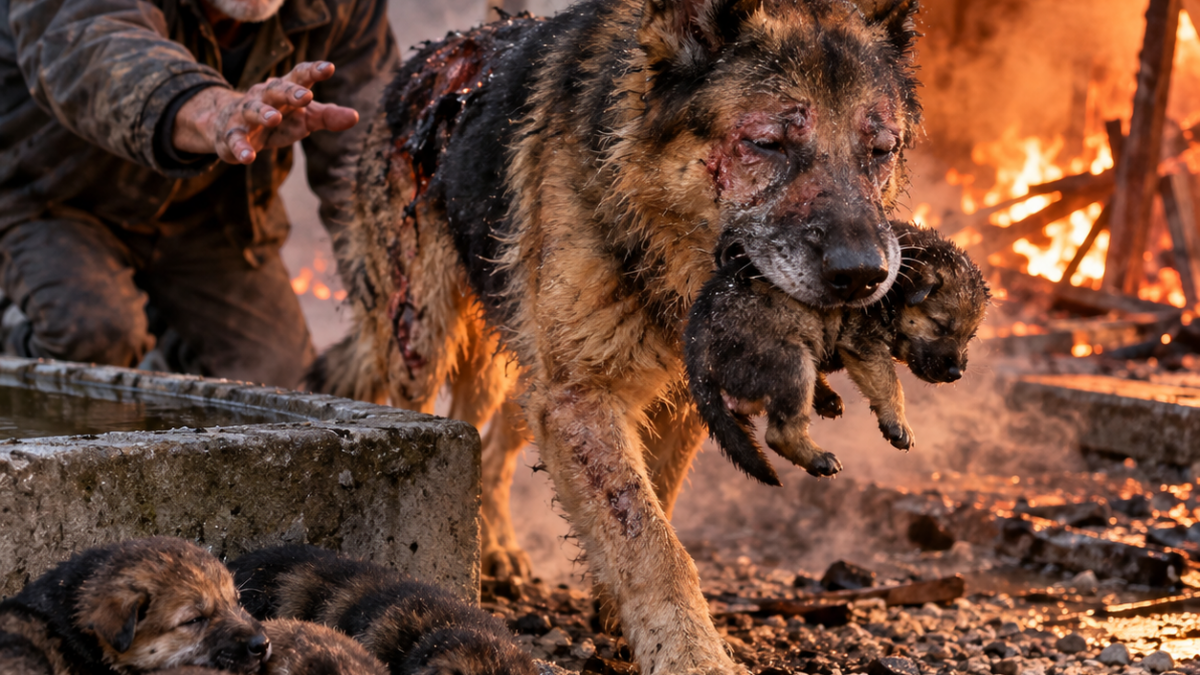
She stumbled out carrying the third puppy.
Her thick coat had protected some of her body.
But the right side of her face had taken the heat.
The fur along her muzzle was singed almost to the skin.
Her long whiskers were gone.
One ear had curled slightly along the edge.
The hair above her right eye was burned away.
The eyelid was already swelling.
She limped as she crossed the gravel.
Still, the puppy in her mouth appeared untouched.
She reached the trough.
Lowered it beside the others.
Then stood there.
For several seconds, she didn’t move.
Her sides heaved.
Her tongue hung from her mouth.
Her breathing came in harsh, fast bursts.
Smoke coated her tan fur gray.
Her eyes narrowed almost completely shut.
Hal stepped closer.
“That’s enough, girl.”
One ear turned toward his voice.
She faced him.
For one hopeful second, Hal thought she might remain there.
Then the German Shepherd turned her head toward the garage.
Or tried to.
“No.”
Hal moved in front of her.
“Don’t go back.”
She walked around him.
Hal moved again.
The Shepherd stopped.
Flames now covered much of the opening she had used before.
She lowered herself.
Pressed her belly close to the ground.
And went underneath them.
“Jesus.”
Hal ran forward.
Heat struck him so violently he raised both arms across his face.
He couldn’t get closer.
He couldn’t follow her.
Smoke swallowed the Shepherd completely.
One second.
Five.
Nine.
Fourteen.
Then something moved.
The Shepherd came crawling through the smoke almost flat against the ground.
Fourth puppy.
Still in her mouth.
A patch of her long coat along the right flank had ignited.
Not fully.
A glowing orange patch spreading through the outer fur.
Hal rushed as close as the heat allowed.
The Shepherd rolled her shoulder once against the dirt.
The flame disappeared.
But the fur remained burned away in a wide black patch.
She dragged herself across the gravel.
Her front paws slipped.
Her rear legs trembled.
When she reached the trough, both of her eyes were swollen shut.
Completely.
She could no longer see the puppies.
Could no longer see Hal.
Could no longer see the garage.
She lowered the fourth puppy.
Then collapsed.
Just for one breath.
Hal stepped toward her.
“Stay down.”
The German Shepherd lifted her head.
Her nose moved.
She touched the first puppy.
Then the second.
Third.
Fourth.
She froze.
Her ears shifted.
Her nose moved across the ground again.
One.
Two.
Three.
Four.
Something inside the dog changed.
Hal saw it.
She wasn’t resting anymore.
She was searching.
Then she turned toward the burning garage.
And Hal understood.
There were five.
“No.”
He stepped in front of her.
The Shepherd could no longer see him.
Her eyelids had swollen into blistered folds.
Smoke had turned every breath into a rasp.
But she knew where the garage was.
She could feel the heat against the damaged skin of her face.
Could smell the nest beneath the smoke.
And somewhere inside it was one puppy she had not carried out.
Hal spread his arms.
“Girl, no.”
She moved left.
He moved left.
She shifted right.
He blocked her.
For one strange second, they stood there on the gravel.
An old mechanic.
A badly burned German Shepherd.
Both trying to save the same life in completely different ways.
Hal looked behind the trough.
Four puppies.
Tiny.
Barely two weeks old.
Their eyes had only recently begun opening.
They couldn’t walk properly.
Couldn’t follow their mother.
Couldn’t crawl forty yards across gravel.
Without her, none of them would have escaped.
The Shepherd lowered her nose.
Sniffed.
Then walked around Hal.
Slowly this time.
She had almost no strength left.
Her right front paw touched the gravel.
Jerked backward.
Burned pads.
She put it down again.
Hal reached toward her.
“Please.”
She kept moving.
He would remember that moment for the rest of his life.
Not because she looked powerful.
She didn’t.
The large working-dog frame was shaking violently.
Not because she looked fearless.
She was trembling.
Not because she somehow didn’t understand danger.
Every part of her body understood.
She had already entered that fire four times.
Her burns were proof she understood.
And she went back anyway.
Hal followed until the heat forced him away.
The fire had changed dramatically in minutes.
Flames that had once climbed one wall now consumed the structure from inside.
The roof sagged.
Siding dropped away.
Sparks blew across the yard.
Hal covered his face.
The Shepherd continued.
She reached the edge of the building.
Then vanished.
Hal shouted after her.
“Come on, girl!”
Nothing.
He looked toward the road.
No fire engine yet.
No siren close enough.
He looked back.
The roof creaked.
He had spent four decades around mechanical failure.
He knew the sound of metal under stress.
Knew wood reaching the point where it could no longer carry itself.
The garage was close.
Hal pulled off his jacket.
If she didn’t emerge in seconds, he was going in.
Terrible idea.
He knew.
A person without protective gear had no business entering that structure.
He knew that too.
But somewhere beneath the floor was a German Shepherd who had walked into it blind.
He wrapped the jacket around his hands.
Counted.
One.
Two.
Three.
Four.
Nothing.
Five.
Six.
Smoke rolled close to the ground.
Seven.
Eight.
Glass shattered.
Nine.
Ten.
Hal moved toward the garage.
Eleven.
Twelve.
Part of the roof dropped inward.
Hal flinched.
Thirteen.
He started running.
Then he saw movement near the far end of the foundation.
Fourteen.
The German Shepherd appeared.
She wasn’t standing.
She was crawling.
Her broad chest scraped the ground.
Her rear legs barely pushed.
The fifth puppy hung from her mouth.
Hal stopped.
For several seconds he could not understand how she knew where she was going.
Both eyes shut.
One ear burned.
Smoke surrounding her.
Then he saw.
She had turned the burned right side of her face toward the ground.
Her cheek almost touched the soil.
Where the heat became unbearable, she shifted away.
Where the ground felt cooler against the damaged skin, she followed it.
Temperature.
Smell.
Memory.
That was all she had.
Blind.
Hal dropped his jacket.
“Come on.”
The Shepherd crawled.
“Come on, girl.”
Front legs pulling.
Rear legs pushing weakly.
Fifth puppy never left her mouth.
The little body swung gently each time she moved.
She reached open gravel.
Forty yards remained between the garage and the trough.
On her first trip she’d crossed it quickly.
On the fifth, it looked endless.
She tried to stand.
Her burned paws collapsed beneath her.
Chest hit the gravel.
The puppy squeaked.
Immediately, the Shepherd lifted her head.
Her jaw tightened carefully around the loose skin of the puppy’s neck.
Never biting down.
Never dropping it.
Then she began crawling again.
The gravel tore at her injured paws.
A thin trail appeared behind her.
First singed fur.
Then blood.
Hal crouched several feet away.
He wanted to pick her up.
Wanted to take the puppy.
Wanted the whole thing to stop.
Every time he approached, the Shepherd turned away from him.
She didn’t know him.
For weeks she had avoided every human being who came near.
Even now there was one job.
Carry the puppy.
Reach the others.
Hal backed away.
“All right.”
His voice shook.
“You do it.”
Another yard.
Then another.
The garage roared behind her.
Finally, her nose struck the concrete trough.
She stopped.
Turned.
Sniffed.
One puppy made a tiny sound.
The Shepherd followed it.
Crawled behind the trough.
Fifth puppy still in her mouth.
She lowered her head.
Released it.
And collapsed.
Hal ran forward.
For one horrible moment he thought she was dead.
Her entire body lay limp.
Then he saw ribs moving.
Fast.
Shallow.
Alive.
Hal dropped to his knees.
He already had emergency dispatch on the line.
“Tell them there’s a dog.”
The dispatcher asked him to repeat himself.
“A mother dog.”
He swallowed.
“German Shepherd.”
“Five puppies.”
Behind him, another section of the garage collapsed.
“I need somebody for the dogs too.”
He looked down.
The Shepherd moved.
At first Hal thought it was a reflex.
Then her muzzle stretched toward the nearest puppy.
Her nose touched its back.
Sniff.
Then the next.
First.
Second.
Third.
Fourth.
She searched.
The fifth puppy was several inches farther away.
Her nose moved over gravel.
Found it.
Touched it.
Only then did tension leave her shoulders.
The Shepherd began pulling the puppies toward herself.
One at a time.
Nose.
Paw.
Gentle nudge.
The babies wriggled toward her belly.
She used the less-damaged front leg to gather them closer.
Hal realized what she was doing.
She was counting.
Not with numbers.
Not with sight.
Smell.
Touch.
Memory.
Five small bodies that had spent two weeks nursing against her beneath the floor.
One.
Two.
Three.
Four.
Five.
All there.
Only then did she stop.
Hal sat beside her.
“You got them.”
His voice cracked.
“You got all of them.”
The Shepherd barely reacted.
Her breathing remained weak.
He looked at her face.
Most of the fur was gone from the right side of the muzzle.
Exposed skin angry red.
Edges of both ears damaged.
All four paws burned.
Large patches of coat scorched from her flank.
And yet the five puppies looked almost untouched.
One had soot across its back.
Another had ash on its head.
No burns.
No serious wounds.
Their mother had carried every one through the fire with her body between them and the heat.
The first engine arrived minutes later.
To Hal it felt like an hour.
A firefighter ran toward him.
“Anyone inside?”
“No people.”
“Animals?”
Hal pointed behind the trough.
The firefighter saw them.
Stopped.
The German Shepherd had curled as much of her burned body around her puppies as she could.
Even nearly unconscious, she was forming a barrier.
The firefighter pulled off one glove.
Touched the nearest puppy.
Warm.
Alive.
Next.
Alive.
All five.
Then he looked at the mother.
“She needs a vet now.”
Hal nodded.
“I’m coming.”
The firefighter glanced at him.
“Your dog?”
Hal looked down.
“No.”
Then again.
“Not yet.”
The garage could not be saved.
By sunrise, almost nothing remained except foundation blocks, smoking lumber, twisted metal and wet ash.
The den beneath the floor was gone.
The Shepherd and all five puppies were rushed to an emergency veterinary hospital.
Hal followed.
He hadn’t planned to.
Still wore the clothes he’d thrown on after seeing the flames.
Hands smelled like smoke.
One knee ripped open from kneeling on gravel.
He had no reason to think the stray dog would ever let him near her.
He still followed.
The puppies were examined first.
The veterinarian handling the first frowned.
Then checked again.
“What?”
Hal asked.
“She’s okay.”
Second.
Third.
Fourth.
Fifth.
Mild dehydration.
Hungry.
Terrified.
Smoke odor.
But no burns.
The fifth puppy had a tiny scrape.
Nothing significant.
“All five?”
Hal asked.
“All five.”
He looked toward the treatment area.
“And her?”
The veterinarian didn’t answer immediately.
That told him.
When she returned:
“The mother is in critical condition.”
“How critical?”
“Second- and third-degree burns.”
“How much?”
“Roughly forty percent of the body surface.”
Hal looked away.
“Face?”
“Face.”
“Right side.”
“All four feet.”
“Both ears.”
“Her eyes?”
Pause.
“We don’t know.”
Hal stared through the small treatment-room window.
Several people worked around the Shepherd’s motionless body.
“She couldn’t see the last two times.”
The veterinarian looked at him.
“What?”
“She was blind.”
“Eyes swollen shut.”
“She went back anyway.”
Hal told her everything.
First puppy.
Second.
Third.
Floor collapse.
Fourth.
He tried to block the dog.
Fifth.
Crawling.
Face against the ground.
The veterinarian listened.
“She went in five times?”
“Yes.”
“For five puppies?”
“Yes.”
Long exhale.
Then:
“That explains why the puppies look better than their mother.”
The Shepherd weighed fifty-nine pounds.
Too little for her frame.
Nursing had pulled weight from her body.
Weeks outside had done the rest.
No microchip.
No collar mark.
Nobody searching.
Staff estimated the puppies around two weeks old.
She had almost certainly given birth beneath that garage alone.
The first twenty-four hours were uncertain.
Burn cleaning.
IV fluids.
Pain control.
Antibiotics where appropriate.
Bandaging.
Monitoring.
Her paws required constant attention.
Her eyes were worse.
Heat.
Smoke.
Corneal damage.
Both remained swollen completely closed.
No one initially knew whether she would ever see again.
Hal stayed in the waiting room.
Hours.
A receptionist eventually told him:
“We have your number.”
He nodded.
“We’ll call.”
“I heard you.”
He stayed.
Around noon, the veterinarian came back.
“You should sleep.”
“I will.”
“At home.”
Hal looked embarrassed.
“I just want to know if she makes it through today.”
“She’s stable right now.”
“What does stable mean?”
“It means she’s alive.”
“That isn’t what I asked.”
The veterinarian studied him.
“No.”
Hal rubbed his hands across his face.
“I watched her go back.”
“I understand.”
“No.”
He shook his head.
“I tried stopping her.”
“I stood in front of her.”
“She went around me.”
“I could’ve grabbed her.”
“You might have been bitten.”
“I don’t care.”
“She was terrified.”
“I could’ve stopped her.”
The veterinarian leaned forward.
“And if you had?”
Hal knew.
One puppy would have died.
He said nothing.
“You didn’t make her go back.”
“No.”
“You didn’t make her burns happen.”
Hal looked toward treatment.
“She knew there were five.”
The veterinarian nodded.
“I know.”
“She couldn’t see.”
“I know.”
“She still knew.”
His eyes filled.
He looked away.
Eventually, he went home.
Slept less than three hours.
Then returned.
For the first several days, Hal visited twice daily.
The Shepherd didn’t know him.
Or if she recognized his smell from the fire, she gave no sign.
Medication kept her sleepy.
Her face was partially bandaged.
Eyes closed.
Hal stood outside her enclosure.
He had not owned a dog since childhood.
Wasn’t the kind of man who spoke to animals in baby voices.
So he talked the way he used to talk to mechanics in his shop.
“Morning.”
“You look terrible.”
A technician stared at him.
Hal corrected himself.
“Better than yesterday.”
One burned ear twitched.
Next visit:
“Your kids eat like mechanics after a twelve-hour shift.”
The Shepherd’s nose moved.
“Five of them.”
Pause.
“All fine.”
Her head lifted slightly.
Hal stopped.
“Five.”
Head rose another inch.
The veterinary nurse whispered:
“Say it again.”
“Five puppies.”
The mother tried to stand.
Bandaged paws slipped.
Staff helped her down.
Hal swallowed.
“She understood?”
“Maybe your tone.”
The nurse smiled.
“Maybe more.”
Because of her burns, the puppies couldn’t remain continuously against her.
Staff managed nursing carefully and supplemented feeding.
But whenever those puppies were brought near, the mother transformed.
Exhausted.
Sedated.
Barely responsive.
The moment she smelled one puppy, her nose began working.
She checked them.
Always.
And staff learned something.
Bringing only four was a mistake.
If four puppies were placed within reach, the German Shepherd became restless.
Head up.
Nose searching.
Whining.
The first time, staff thought she was in pain.
Then someone carried in number five.
The Shepherd touched it.
Immediately settled.
After that, the clinic developed an unofficial rule.
All five.
Or none.
Hal heard about it on day four.
He laughed for the first time.
“That figures.”
A technician asked:
“Does she have a name?”
“No.”
“We need something besides stray female German Shepherd.”
Hal looked through the kennel window.
She rested with her head between her bandaged paws.
One side of her face hairless.
Ears wrapped.
Eyes hidden.
“Five.”
The technician blinked.
“Five?”
“She counted them.”
The technician wrote it down.
Five.
The name stayed.
By the end of week one, Five could stand briefly.
Walking hurt.
All four paws had been burned.
Even with medication and bandaging, each step reminded her of the gravel.
Staff laid padded mats.
Five still hesitated.
Lean forward.
Test surface.
Pull paw back.
Try again.
Hal watched one afternoon.
“Stubborn.”
A technician smiled.
“Sounds like someone else.”
Hal looked at her.
“I’m retired.”
“That wasn’t what I meant.”
Five took three steps.
Then four.
Hal crouched several feet away.
“Come on.”
She stopped.
Nose lifted.
By then she knew his voice.
He held out one hand, realized she couldn’t see it, and tapped the floor.
Once.
Twice.
Five moved.
Another step.
Another.
Her nose touched his knuckles.
Both froze.
For weeks before the fire, she had avoided human hands.
Now her nose remained against his.
Hal waited.
Five sniffed.
Then lowered her head.
He placed two fingers against the unburned fur beneath her jaw.
“That’s it.”
She stayed.
From that day forward, she recognized him.
Hal visited even when there was nothing new to report.
Sometimes he read the newspaper.
Sometimes he talked about the burned property.
“Owner cleared most of it.”
Five rested her head on the blanket.
“You wouldn’t like it.”
Ear movement.
“No roof.”
“Nothing to crawl under.”
Pause.
“Probably for the best.”
The puppies grew quickly.
Eyes fully open.
Oversized paws.
Unsteady legs.
Each developed a personality.
One noisy.
One always asleep.
One constantly climbing over littermates.
One immediately friendly with people.
The smallest stayed closest to Five.
And every time staff brought them near, Five counted.
Nose to back.
Head.
Shoulder.
One.
Two.
Three.
Four.
Five.
Then relax.
Hal started doing the same thing without noticing.
One.
Two.
Three.
Four.
Five.
Then Five.
Six lives.
Still there.
In the second week, the swelling around Five’s eyes decreased.
That should have been good news.
Instead it revealed how serious the damage was.
The right eye looked terrible.
The left uncertain.
A veterinary ophthalmologist examined her.
Hal waited outside.
He understood broken machines.
What could be repaired.
What could not.
He did not want to understand those categories when applied to eyes.
The specialist came out.
“How bad?”
“The right eye probably cannot be saved.”
Hal swallowed.
“And the left?”
“Significant corneal damage.”
“Blind?”
“Not necessarily completely.”
“How much will she see?”
“We need time.”
Time.
Hal could deal with time.
What he could not deal with was the thought that an animal could lose sight one trip at a time and never know the price.
Then he realized that was probably the wrong way to understand it.
Five hadn’t sacrificed her vision after carefully weighing the cost.
She hadn’t chosen blindness.
She had chosen the next puppy.
Then the next.
Then the next.
The cost arrived afterward.
People like courage to be clean.
A calculation.
I know the danger.
I know the price.
I choose anyway.
Five’s courage had been simpler.
Older.
Puppy missing.
Go back.
Nothing else mattered.
During week four, Five’s right eye had to be removed.
The tissue could not recover.
Hal came before surgery.
By then Five allowed him to rub the unburned side of her neck.
“You already did the hard part.”
She leaned toward his hand.
“Let them do theirs.”
Surgery went well.
When Five woke, she was disoriented.
The remaining eye still detected little more than light and large movement.
Hal sat beside her enclosure.
Her nose lifted.
“It’s me.”
Her tail moved once.
One small movement.
It hit him harder than he expected.
Years later, when people asked when he decided he would adopt her, Hal never knew.
Maybe fifth trip.
Maybe the counting.
Maybe her nose touching his hand.
Maybe that tail wag after surgery.
Maybe the decision happened before he understood there was a decision.
By week six, the puppies were becoming independent.
Rescue volunteers began taking applications.
Hal immediately became worried.
“They’re separating them?”
“They’ll be old enough soon.”
“All five?”
“Eventually.”
“We’re screening homes carefully.”
“That isn’t what I asked.”
The rescue coordinator smiled.
“They aren’t disappearing tomorrow.”
Still, Hal watched.
The puppies eventually went to three homes.
Two families adopted pairs.
Another adopted the last puppy.
Every family received the real history.
Their mother had been a stray German Shepherd living beneath a garage.
She had no known home.
When the building burned, she went inside five times.
Every puppy went home without burn injuries because their mother had taken almost all of the damage.
When the first two left, Five searched.
Bedding.
Room.
Air.
Staff brought the remaining three.
Five counted.
One.
Two.
Three.
Then searched again.
Hal sat beside her.
“They’re okay.”
She turned toward his voice.
“They went home.”
Head tilted.
“You did your part.”
Five leaned into his leg.
Days later, two more left.
Then the final puppy.
That was hardest.
Five searched the room repeatedly.
Eventually she lay on the empty blanket where the puppies had slept.
Hal sat beside her on the floor.
“I know.”
Her nose touched his boot.
“They’re safe.”
He looked at the scars on her face.
“All five.”
Her breathing slowed.
“All five.”
He said it again because it seemed to be the only number she trusted.
Five stayed under veterinary supervision for eleven weeks.
Eleven weeks of bandage changes.
Medication.
Scar treatment.
Physical rehabilitation.
Learning surfaces again.
Learning where steps began.
Learning to trust human hands.
The left eye improved.
Somewhat.
The veterinarian estimated around thirty percent functional vision.
Enough for light.
Movement.
Contrast.
Doorways.
Large objects.
Not enough to judge distance reliably.
Missing right eye meant a permanent blind side.
She sometimes stopped before steps.
Occasionally bumped furniture.
Her burned ears healed with thick scar tissue.
The edges became uneven.
One never stood quite as straight as before.
Most of the thick black-and-tan coat returned.
The face did not fully recover.
Smooth pink scar tissue stretched along the right cheek toward the jaw.
There would always be evidence.
Then came discharge.
Where would Five go?
A foster family could be found.
Eventually, adoption.
But she needed someone patient.
Comfortable with visual impairment.
Able to manage sensitive paws.
Long-term skin issues.
Potential eye complications.
Fear of smoke.
Hal was standing nearby.
“I’ll take her.”
The coordinator looked up.
“Foster?”
“No.”
“Adopt?”
“Yes.”
“You’ve owned German Shepherds before?”
“No.”
“Any large working breeds?”
“No.”
“Special-needs dogs?”
“No.”
The coordinator hesitated.
Hal crossed his arms.
“I rebuilt transmissions for forty years.”
She blinked.
“I’m not sure that qualifies you.”
“It means I can follow instructions.”
A veterinarian laughed.
The coordinator continued.
“She may need ongoing medical treatment.”
“I know.”
“Her vision is limited.”
“I know.”
“She may have trauma around smoke, fire or enclosed spaces.”
“I know.”
“She may never behave like a typical German Shepherd.”
Hal looked down.
Five stood against his leg.
“Good.”
The coordinator stopped.
“What?”
“I’m not typical either.”
Nobody argued.
The first night Five entered Hal’s house, she stopped just inside the door.
Hal lived alone.
His wife had died years earlier.
Children grown.
Different states.
The house had become very quiet.
Too quiet, though he rarely admitted it.
Five sniffed the entry.
Hal removed the leash.
“Take your time.”
She mapped everything with her nose.
Living room.
Kitchen.
Hallway.
Doorways.
Corners.
Every threshold required investigation.
The woodstove caused the first problem.
Five felt heat.
Stopped.
Her entire body stiffened.
Hal saw immediately.
“All right.”
He stepped between her and the stove.
Turned it down.
Moved her bed farther away.
Five backed into the hallway.
For days she refused to enter when the fire was burning.
Hal never forced her.
He placed a folded horse blanket in a cool corner.
Thick.
Heavy.
Five eventually used it.
First when the stove was cold.
Later when a small flame burned.
Then with a normal fire.
Weeks later, Hal sat reading.
Five slept peacefully on the blanket.
Orange light moved behind the stove window.
Her breathing remained slow.
Hal lowered the newspaper.
“You know that isn’t the same fire.”
Five slept.
He watched her.
“I guess you do.”
Life required adjustments.
Textured mats near stairs.
Furniture never moved.
Tools never left in hallways.
That last rule almost killed Hal.
For forty years, he’d dropped tools wherever he finished using them.
Not anymore.
A neighbor visited.
Looked at the spotless walkway.
“I’ve never seen your floor this clean.”
Hal pointed at Five.
“She’s management.”
Five slept through her promotion.
Then came his bed.
Too high.
Five wanted to sleep near him.
First night she stood beside it.
Looked upward with the one damaged eye.
Jumped.
Misjudged distance.
Hit the mattress with her chest.
Hal grabbed her.
“No.”
She tried again.
“No.”
Tail wag.
“Absolutely not.”
He lifted her onto the bed.
Five circled twice.
Lay against his legs.
The next morning Hal went into his workshop.
Built a ramp.
First one too steep.
He tested it.
Swore.
Tore it apart.
Built another.
Wider.
Lower angle.
Side rails.
Old carpet for traction.
He set it beside the bed.
Five sniffed.
“Up.”
She hesitated.
Hal tapped the ramp.
“Come on.”
One paw.
Another.
Slowly upward.
At the top, Five stepped onto the mattress.
Hal smiled.
“There.”
Then Five turned.
Walked back down.
“What?”
She climbed again.
Then down.
Three test runs.
Mechanic’s dog.
Of course.
Finally she lay on the bed.
Hal sat beside her.
“I built you a ramp.”
Five rested her head on his thigh.
“I hope you appreciate the engineering.”
Her eye closed.
“That means yes.”
For months, smoke from neighboring chimneys bothered her.
Nose lifted.
Body tightened.
Sometimes pacing.
Hal learned the routine.
Open the door.
Let Five smell outside.
Walk through the house.
Nothing burning.
Nothing collapsing.
No puppies trapped.
Over time the episodes lessened.
Thunder didn’t bother her.
Car backfires didn’t.
Only smoke.
One autumn afternoon, Hal burned leaves at the back of his property without thinking.
Five smelled the smoke from inside.
When he returned, he found her wedged behind the couch.
Shaking.
Hal looked at her.
Then at the smoke.
“Oh, hell.”
He extinguished the fire immediately.
Came inside.
Sat on the floor.
Five wouldn’t move.
“That was stupid.”
She trembled.
“I know.”
Twenty minutes.
Thirty.
Eventually a black nose appeared.
Hal never reached toward her.
“I won’t do that again.”
Five crawled out.
Pressed against his side.
He never burned leaves again.
People around town learned about Five.
Some recognized her.
Occasionally strangers asked to see the scars.
Hal hated that.
“She isn’t an exhibit.”
One woman apologized.
“I just wanted to meet her.”
“You can meet her.”
He softened.
“Just don’t make the burns the first thing you see.”
The woman approached from Five’s left.
Crouched.
Waited.
Five sniffed.
Eventually stepped forward.
The woman touched her neck.
“She’s beautiful.”
Hal nodded.
“That’s better.”
Photographs of the puppies kept coming.
German Shepherd mixes now growing into large young dogs.
One sleeping upside down on a couch.
One wearing a blue collar.
Two siblings swimming at a lake.
One sitting beside a child.
The smallest curled next to another dog.
Hal printed every photograph.
Put them in a folder.
Sometimes sat beside Five.
“This one’s getting fat.”
Five sniffed the photograph.
“Your fault.”
Turn page.
“This one stole a shoe.”
Five turned her head away.
“Also your fault.”
By the first anniversary of the fire, Five weighed sixty-seven pounds.
Healthy now.
Muscle returned.
Coat thick and shiny wherever it had regrown.
Scars remained.
Missing eye.
Pink skin along the face.
Uneven ears.
Burned paws sometimes painful after long walks.
But alive.
Warm.
Fed.
Safe.
Her favorite place remained the horse blanket beside the woodstove.
Not too close.
Never too close.
Enough to feel warmth.
Sometimes Hal sat watching her.
And saw both dogs at once.
Five now.
And the Shepherd crawling across the gravel.
Fifth puppy in her jaws.
Eyes swollen shut.
Blood behind her.
He wished he could forget.
Knew he never would.
One afternoon an old friend visited.
They had known each other decades.
Both mechanics.
Both men from a generation not famous for discussing fear.
Five slept beside the stove.
Friend pointed.
“So that’s her?”
“That’s her.”
“She’s bigger than I expected.”
“She’s a German Shepherd.”
“I meant after the photographs.”
“She was half-starved then.”
Friend moved closer.
Five’s left eye opened.
“Come around this side,” Hal said.
“Why?”
“That’s where she sees you.”
He adjusted.
Five sniffed his hand.
Then settled again.
For a while the men talked engines.
Old coworkers.
Dead friends.
People who moved away.
Finally:
“Why’d you keep her?”
Hal looked at him.
“What?”
“I know the story.”
His friend gestured toward Five.
“But that’s a lot of care.”
Hal rubbed the edge of his coffee cup.
“I’ve known brave men.”
His friend waited.
“Good men.”
“Hard men.”
“Firefighters.”
“Soldiers.”
“People who pulled strangers out of wrecked cars.”
He looked at Five.
“But that morning I watched a dog go under a burning garage three times.”
Pause.
“Then her eyes closed.”
His friend stopped moving.
“She went back a fourth time.”
Five shifted in her sleep.
“Then she counted.”
“Counted?”
“With her nose.”
Hal swallowed.
“She had four.”
“Knew there should be five.”
“I stood in front of her.”
“Told her no.”
“She walked around me.”
He looked down at his hands.
“She went back blind.”
“Could barely walk.”
“Roof coming down.”
“Paws burned.”
“And she went because four wasn’t five.”
Quiet.
Hal continued.
“I’ve spent my life thinking courage was about not being afraid.”
Five breathed slowly.
“That dog taught me it isn’t.”
His friend waited.
“I don’t think she wanted to go back.”
“I think everything in her body was telling her not to.”
“But one puppy was missing.”
“So she went.”
His friend nodded.
“That why you adopted her?”
Hal looked embarrassed.
“No.”
“Why?”
He glanced at the stove.
Horse blanket.
Ramp.
Scarred German Shepherd asleep in safety.
“Because I can’t undo what happened.”
“I can’t give her eye back.”
“Can’t remove the scars.”
“Can’t make her forget the fire.”
He reached down.
Rested a hand on Five’s shoulder.
“But I can make sure she’s warm for the rest of her life.”
Five woke.
Left eye opened.
She lifted her head.
Placed her chin on his knee.
Hal smiled.
“That I can do.”
His friend cleared his throat.
“She seems to agree.”
Five’s tail tapped once.
The garage across the street was eventually rebuilt.
New electrical wiring.
Smoke detectors.
Sealed crawl space.
No animal could den beneath it again.
The concrete trough stayed.
The homeowner considered removing it.
Hal asked him not to.
“Why?”
Hal looked at it.
“That’s where she finished.”
So the trough remained.
Rain filled it.
Birds drank there.
Grass grew around the base.
Most people saw a piece of concrete.
Hal saw the place where a blind German Shepherd touched five living puppies and finally allowed herself to stop.
Five never returned to the rebuilt garage.
Once, Hal walked her past.
She stopped across the road.
Nose lifted.
Stood several seconds.
Then turned toward home.
Hal followed.
“Good choice.”
At home, Five climbed her bed ramp.
Turned twice.
Lay down.
Hal removed his boots.
“You know this is technically my bed.”
Five stretched across his side.
“That’s my side.”
Nothing.
“Fine.”
Hal slept on the other half.
The following spring, one of Five’s puppies returned for a visit.
Almost grown.
Strong.
Healthy.
Long Shepherd-like legs.
Large ears that couldn’t decide whether to stand straight.
Hal agreed but pretended he wasn’t excited.
“She won’t remember.”
The family arrived.
Young dog jumped from the car.
Five stood on the porch.
Her remaining eye couldn’t make out the dog from that distance.
But her nose lifted.
The young dog froze.
Five stood.
Hal stopped breathing.
The young dog approached.
Slowly.
No barking.
No pulling.
Just scent.
Their noses met.
Then Five performed the ritual.
Nose to head.
Shoulder.
Back.
Long inspection.
The young dog wagged violently.
Five’s tail moved.
The grown puppy licked the scarred side of Five’s face.
Five leaned toward him.
Hal turned away.
The visiting family politely pretended not to notice.
After they left, Five settled beside the stove.
Hal sat nearby.
“One.”
Five looked up.
He smiled.
“Only one today.”
Her head went down.
The other four remained in good homes.
Healthy.
Loved.
Living lives they would never know had almost ended beneath a garage floor.
Five couldn’t understand adoption agreements.
Couldn’t understand photographs.
Couldn’t understand medical percentages.
Forty percent burns.
Thirty percent vision.
Eleven weeks of treatment.
Five trips.
She understood simpler things.
Warm floor.
Full food bowl.
Hal’s voice.
Ramp.
Bed.
Sunlight.
No smoke.
And perhaps somewhere deep inside the memory that drove her through those flames, she still carried one number.
Five.
Hal thought about that number often.
What if there had been six?
He hated the question.
Never said it.
Because he knew the answer.
Five would have gone back.
That frightened him.
There had been no point at which the Shepherd seemed to decide she’d suffered enough.
She stopped only after every puppy was out.
Only after the count was complete.
That was why Hal treated her medical care so seriously.
It felt like finishing the job she started.
She kept them alive.
Now someone had to keep her alive.
At annual veterinary visits, Five behaved patiently.
Except paw examinations.
She hated those.
But tolerated them if Hal kept one hand against her shoulder.
The veterinarian who first treated her still remembered the morning of the fire.
“You look much better.”
Hal snorted.
“She looked like hell.”
The veterinarian glanced at him.
“So did you.”
“I wasn’t burned.”
“You hadn’t slept.”
“Different.”
Five leaned into his leg.
The veterinarian smiled.
“She trusts you completely.”
Hal looked down.
“She has questionable judgment.”
The vet laughed.
Then became serious.
“You know she might not have survived all the aftercare without somebody taking responsibility.”
Hal shrugged.
“She did the hard part.”
“Eleven weeks wasn’t easy.”
“For me?”
“For either of you.”
Hal scratched Five’s neck.
“She walked into a fire five times.”
He looked at the veterinarian.
“Everything afterward counts as easy.”
No one argued.
Forty years repairing machinery had taught Hal that damage leaves evidence.
A rebuilt transmission is not new.
Welded steel shows the weld.
Metal remembers heat.
Five remembered it too.
She did not need to look untouched in order to be whole.
That thought changed him.
Before Five, Hal believed scars were proof of what went wrong.
Now he saw something else.
Scars also proved the body continued after the worst thing happened.
Five’s missing eye did not tell him the fire defeated her.
It told him the fire took everything it could and still didn’t get puppy number five.
The smooth pink skin across her cheek marked the side she had held near the cool earth while crawling home.
The damaged ears remained because she had listened through smoke for sounds from her litter.
Her paws were sensitive because they crossed burning debris five times.
Hal never romanticized pain.
He would’ve erased every scar if he could.
But he couldn’t.
So he refused to treat them as ugliness.
Five didn’t care either.
Dogs rarely waste much time wishing their bodies looked the way they used to.
She learned.
House.
Ramp.
Distance to the stove.
Water bowl.
Sound of Hal’s truck.
Footsteps of visitors.
Which side people should approach.
Adapted.
Continued.
Lived.
Cold evenings came.
Hal added logs to the stove.
Five watched from her blanket.
Sometimes he studied her while firelight moved over her scarred face.
Did warmth feel different there?
Did she remember?
Did dogs dream about fire?
He would never know.
What he knew:
She no longer ran.
She slept.
Deeply.
That was enough.
One winter storm knocked out the electricity.
House went dark.
The stove kept the living room warm.
Five climbed onto the couch beside Hal.
Snow pressed against the windows.
Hal rubbed her shoulder.
“Not a bad life.”
Five sighed.
“You’ve got a blanket.”
Tail movement.
“Food.”
Thump.
“A ramp better engineered than half the houses I repaired.”
Five closed her eye.
“And me.”
Nothing.
Hal frowned.
“That deserved a tail wag.”
Still nothing.
He nudged her.
Five opened her eye.
Licked his wrist.
Hal laughed.
“All right.”
Outside:
Cold.
Dark.
Inside:
Orange stove.
Warm room.
Five’s head resting on his leg.
Hal remembered another orange glow.
The one that had awakened him before dawn.
The one that sent him running across the road.
The one that showed him a German Shepherd carrying a puppy from beneath a burning building.
At first, Hal believed he was watching an animal escape.
Later, he understood.
Five wasn’t escaping.
Not yet.
She was moving her family out.
One life at a time.
First puppy.
Back.
Second.
Back.
Third.
Burned.
Back.
Fourth.
Blind.
Back.
Count.
Only four.
Back.
Fifth.
Then collapse.
There was something unbearable about how simple it was.
No audience.
No promise anyone would save her.
No knowledge veterinarians were waiting.
No understanding strangers would one day talk about her courage.
At the time, Five wasn’t even Five.
She was a nameless stray German Shepherd living under somebody else’s garage.
She had no reason to expect humans would care whether she survived.
She expected nothing.
She went back anyway.
Years later, Hal woke before dawn one morning.
Room cold.
Five wasn’t on the horse blanket.
He sat up instantly.
“Five?”
Nothing.
Panic.
Then he heard nails on the ramp.
Five appeared beside the bed carrying something.
One of Hal’s socks.
He stared.
She climbed.
Dropped it beside him.
“This is theft.”
Tail wag.
“You survived a garage fire for this?”
Tail thump.
“Terrible judgment.”
Five lay beside him.
Hal put the stolen sock on the nightstand.
Rested his hand on her shoulder.
She was older now.
So was he.
Her remaining eye cloudier.
Muzzle gray.
Long walks became short walks.
Ramp now necessity.
Hal had replaced the carpet twice.
Lowered the incline once more.
Neither climbed as easily.
But every morning Five followed him toward the kitchen.
Every evening she returned to the horse blanket.
Every night before turning out the light, Hal looked toward her.
Not because he expected her to disappear.
Because some habits come from gratitude.
There.
Breathing.
Warm.
Safe.
One.
He didn’t need to count higher anymore.
The puppies had families.
Five had hers.
Years before, behind a burning garage, she dragged herself over gravel because four was not enough.
She needed five.
Now Hal finally understood something Five had never needed words to explain.
Family is not a number until somebody is missing.
Then the missing one becomes the only number that matters.
That Saturday morning, Five lost her sight before she lost count.
She lost fur.
Skin.
Strength.
Blood.
Part of her ears.
Eventually one eye.
But she never lost the knowledge that one small body remained beneath the floor.
So she went back.
Because she went back, all five puppies grew up without a single burn scar.
Because strangers treated her wounds, Five survived.
And because a sixty-three-year-old mechanic could not forget watching a blind German Shepherd crawl out of fire with her final puppy, she never slept beneath another building.
Never searched garbage for food.
Never raised another litter alone.
Never wondered where warmth would come from.
The woodstove handled that.
The horse blanket handled that.
The ramp beside Hal’s bed handled that.
And the old man who once stood helplessly in front of her while she walked blind toward a burning garage spent the years afterward keeping the only promise he believed he was qualified to make.
He could not make Five unburned.
He could not give her back the right eye.
He could not erase the fire from her body.
But every winter night, when the scarred German Shepherd curled beside the stove and fell asleep in a house where nothing was burning, Hal could make sure she was warm.








