She Was Blind. The German Shepherd Beside Her Was Deaf—And They Came Out of the Drainpipe Holding Onto Each Other Like One Body
PART3:
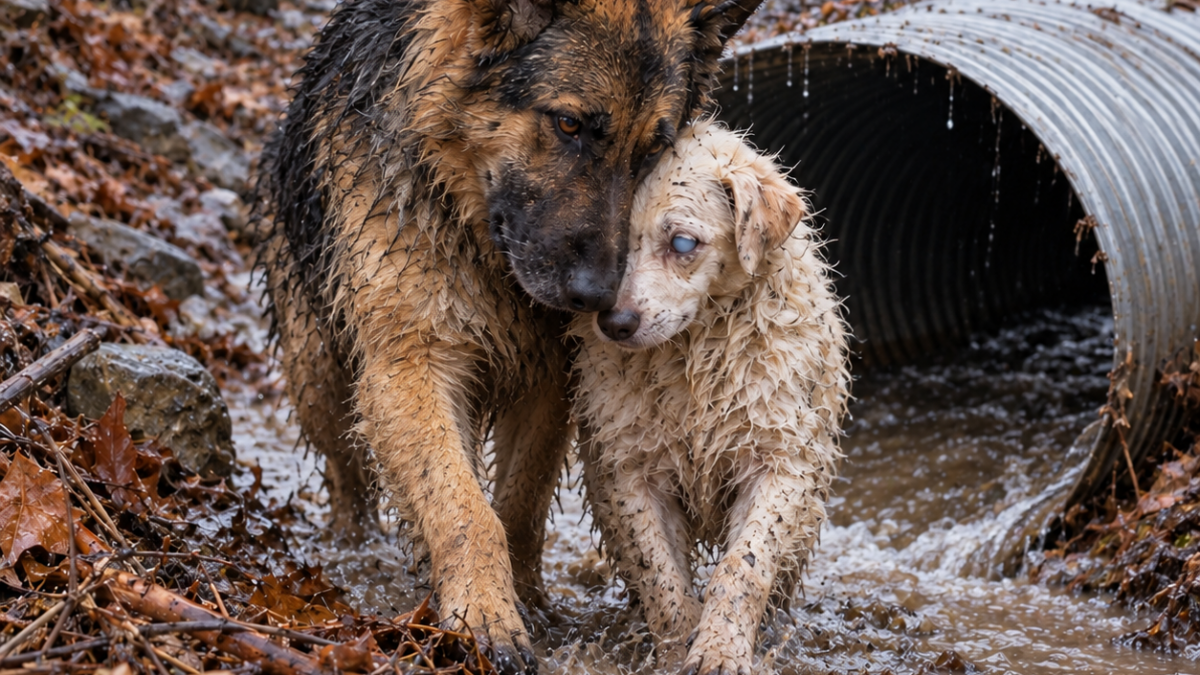
His coat was so filthy and waterlogged that the rich tan along his legs and chest had turned brown-gray.
The black saddle across his back was matted.
His ribs were visible.
His hip bones rose beneath wet fur.
He had the long frame and heavy paws of a powerful Shepherd who should have weighed seventy-five or eighty pounds.
Rick guessed he might not have weighed sixty.
His body was curved around the white female.
One foreleg stretched across her.
His shoulders shielded her from the water still pouring from the pipe.
Almost as if while trapped inside he had tried to make himself into a wall.
Both dogs were alive.
Barely.
The little white female shook so violently that the mud around her rippled.
Her eyes were open.
Rick saw them.
Then wished he had not.
Both were completely clouded.
Not the soft haze of age.
Scar tissue.
White-gray.
Damaged so badly that there was no question she could see anything in front of her.
One of the younger workers whispered:
“Jesus.”
The German Shepherd attempted to lift his head.
His forelegs buckled.
He tried again.
Ears up.
Eyes amber-brown and exhausted.
Rick spoke.
“Easy, boy.”
The Shepherd looked past him.
Not toward his voice.
Rick moved left.
The dog’s eyes followed the movement.
Rick stopped.
Then clapped once.
Nothing.
The Shepherd did not blink.
Did not turn.
The little white dog reacted instantly.
Her ears snapped toward the clap.
Her body went rigid.
The German Shepherd saw her ears move.
He looked in exactly the direction she had indicated.
Rick stared.
He clapped again from the other side.
Again the white dog’s ears turned.
Again the Shepherd followed her reaction.
“Oh.”
Rick lowered his hand.
“He can’t hear.”
Another worker crouched.
“What?”
Rick nodded toward the little female.
“She can.”
The Shepherd lowered his forehead until it touched the white dog’s face.
Her trembling slowed slightly.
A worker reached down.
“We need to get them into the truck.”
The moment his hands began separating the dogs, the female came apart.
She did not bite.
Did not growl.
Her legs began paddling wildly.
Blind eyes opened wide.
Her body twisted as if falling through empty space.
The worker immediately released her.
The German Shepherd could not hear whatever sounds she made.
But he saw her panic.
Felt her legs striking his body.
And despite having almost no strength left, he dragged himself forward through the mud.
One foot.
Then another.
Until his forehead touched hers again.
The white dog froze.
Her muzzle found the thick fur beneath his jaw.
Breathing slowed.
Rick stood over them.
Rain ran from the brim of his hard hat.
He had seen frightened animals.
Injured animals.
Protective animals.
He had never seen anything like this.
“Don’t separate them.”
One of the crewmen looked at him.
“We have to move them.”
“Then move them together.”
Nobody argued.
Rick called for a tarp.
They slid the heavy blue plastic beneath the dogs as carefully as they could.
Every time the little female lost physical contact with the German Shepherd, her body stiffened.
Every time that happened, the Shepherd shifted himself back against her.
Not aggressively.
Never once did he snap at the men.
He simply kept putting his body between the workers and the only creature he seemed certain about.
Rick noticed something else.
The female’s ears were constantly moving.
Truck engine.
Boots on gravel.
Water.
A crow calling from the fence.
Every sound changed the direction of her head.
And every time her ears moved sharply, the Shepherd looked where she indicated.
“She hears for him,” Rick murmured.
The youngest crewman, Caleb, watched.
The crow called again.
The blind dog’s ears turned.
The Shepherd looked toward the fence.
Caleb swallowed.
“Oh, man.”
Rick nodded.
“And he looks for her.”
For several seconds, none of them spoke.
There were two broken dogs lying in a ditch.
One had lost the world of sight.
The other lived in silence.
Yet between them, somehow, they had built one functioning map.
Rick had expected mud that morning.
He had not expected his throat to tighten.
They lifted the tarp.
The little dog panicked.
The Shepherd immediately curved his body around her.
“Stop.”
Everybody froze.
Rick adjusted the tarp.
“Keep them chest to chest.”
“Like this?”
“Exactly like that.”
So they carried them in the same position in which the water had delivered them.
The German Shepherd curled protectively around the smaller dog.
The white female tucked her muzzle beneath his jaw.
They loaded both into the municipal truck.
Rick climbed in with them.
That was not procedure.
He did not care.
Caleb drove slowly toward the maintenance garage.
The trip took fifteen minutes.
Rick remembered every second.
The blind dog lay motionless except for her ears.
The Shepherd watched everything.
Road.
Fence posts.
Truck cab.
Rick.
Passing trees.
But every few seconds he looked down at her.
If she moved, he adjusted.
If she stiffened, he pressed closer.
At one point the truck hit a pothole.
The tarp shifted.
The female jolted.
Before Rick could reach down, the German Shepherd placed one enormous paw over her shoulder.
Not pinning her.
Just pressure.
I’m here.
She settled.
Rick looked away toward the fields.
Rain blew into his face.
He let himself pretend that was why his eyes were wet.
By the time they reached the garage, office staff had called the woman everybody in that part of the county called when an animal had nowhere else to go.
Her name was Gloria Whitcomb.
Sixty-eight.
Retired elementary school teacher.
Widow.
Unofficial rescue network for three small towns, two farm communities, and several miles of back road where unwanted animals had an unfortunate habit of appearing.
Her rescue had no building.
No paid staff.
No polished sign.
No donor department.
There was Gloria.
Her little blue house.
Several foster homes.
Two veterinarians who gave discounts when they could.
And a retirement pension that somehow converted itself every month into dog food, cat litter, antibiotics, towels, gasoline, and flea medication.
She arrived wearing rain boots and a yellow slicker.
Rick met her.
“You Gloria?”
“That’s me.”
“They came out of the culvert.”
“Alive?”
“Barely.”
“How many?”
“Two.”
Then:
“And before you touch them, you need to know something.”
Gloria looked at him.
“What?”
“Don’t separate them.”
She stepped toward the truck bed.
The German Shepherd lay curled around the little white dog.
Her chin now rested across his lower back.
He had shifted during the ride.
But never away.
Gloria stopped.
The Shepherd saw her.
The blind female heard Gloria’s boots.
Her ears turned.
The Shepherd immediately looked toward the direction they pointed.
Gloria whispered:
“Oh.”
Rick stood beside her.
“You see it?”
“Yes.”
“She can’t see.”
“And he can’t hear.”
Rick turned.
“How’d you know?”
Gloria kept watching.
“He watches her ears.”
She crouched slowly.
Her knees cracked.
The Shepherd stared at her face.
The female listened.
Gloria did not reach.
She simply made herself smaller.
“I don’t know how long you two were in there.”
The white dog’s ears lifted toward her voice.
The German Shepherd watched the movement.
“But apparently you figured something out.”
She placed a blanket beside the tarp.
Waited.
Then touched only the tarp.
The Shepherd watched her hand.
The female pressed closer to him.
“It’s all right.”
Gloria smiled faintly.
“We’ll take you both.”
Both.
The word mattered.
Even before Gloria gave them names.
Both meant no choosing.
No one rescued the easier dog.
No one decided one had more adoption potential.
No one put them in opposite kennels because paperwork required two animals to become two cases.
Both meant whatever fragile system had kept them alive would be respected.
Gloria brought a large crate used for nursing mothers.
It was big enough for the Shepherd to lie along one wall while the smaller dog curled into him.
When Gloria closed the door, the female heard the latch.
Her ears turned.
The Shepherd looked toward the latch because she had told him something happened.
Then he looked back at Gloria.
“I know.”
She placed two fingers against the wire.
“You don’t know me.”
He watched.
“But you will.”
Dr. Elaine Morris met them that afternoon.
Silver hair.
Square glasses.
Twenty-eight years in veterinary practice.
Voice calm enough that even terrified animals seemed less offended by it.
Gloria had worked with her for years.
Elaine knew that whenever Gloria called during a storm and said, “I have a situation,” the situation usually required rearranging the afternoon.
She examined the white female first.
Only because the German Shepherd remained close enough for the little dog to feel his breathing.
Even then:
Difficult.
Each time the female lost physical contact with him, she trembled violently.
Legs rigid.
Breathing fast.
Blind eyes wide.
The German Shepherd watched her.
He could not hear her breathing.
Could not hear the small sounds she made.
But he saw the shaking.
He moved forward until his head touched her shoulder.
Immediately:
Less trembling.
Elaine looked at Gloria.
“Well.”
“What?”
“That answers whether separating them is optional.”
“It isn’t.”
“No.”
Elaine shook her head.
“It absolutely isn’t.”
The little female was about two.
Mixed breed.
No microchip.
No collar.
Her blindness was old.
Untreated infection had destroyed both eyes.
Scar tissue covered the damaged structures.
She may have been blind more than a year.
Maybe longer.
How a blind stray dog survived rural roads, fields, coyotes, vehicles, and winter weather made little sense.
Until you watched the German Shepherd move beside her.
Then it became obvious.
He had been her eyes.
He positioned himself slightly ahead.
She rested her chin near his flank or lower back.
If he stopped, she stopped.
If he turned, she followed the movement of his body.
Steps?
He paused.
Doorway?
Paused.
Obstacle?
He shifted himself around it slowly enough for her to understand the direction.
He did not drag.
Did not shove.
Did not herd her with the intensity many Shepherds use on livestock.
He guided her with extraordinary patience.
Then Elaine examined him.
Approximately three years old.
Male German Shepherd.
Large frame.
Severely underweight.
No microchip.
Old scars along muzzle and forelegs.
His ears told another story.
German Shepherd ears usually stand open and alert.
His did too.
But the canals beneath them were thickened and badly damaged.
Years of untreated infection.
Scar tissue.
Calcification.
Elaine tested him several ways.
Clap behind.
Nothing.
Whistle.
Nothing.
Metal bowl dropped outside his line of sight.
Nothing.
But each sound made the blind female’s ears move.
And every time they did, Archer—
though he did not yet have that name—
turned toward the direction she indicated.
Elaine lowered the metal bowl.
Gloria pressed one hand to her chest.
“He reads her.”
“Constantly.”
“Can anything be done?”
“About the infection, yes.”
“Hearing?”
Elaine shook her head.
“Probably not.”
“Completely deaf?”
“Profoundly.”
Gloria looked at the German Shepherd.
He looked back.
Silence was normal to him.
Maybe it had happened slowly.
Maybe neglect caused it.
Maybe some congenital problem had started the process.
No one knew.
What mattered was that he no longer heard the world.
But the blind female did.
She heard cars.
Footsteps.
Doors.
Dogs.
Thunder.
Food wrappers.
Danger.
The Shepherd read all of it through her body.
Gloria said:
“She is his ears.”
Elaine nodded.
“And he is her eyes.”
The sentence settled quietly over the exam room.
It was not sentimental.
Not exaggeration.
It was observable.
Two damaged dogs had built one whole way of navigating the world.
Nobody trained them.
Nobody rewarded them.
No harness.
No command.
No service-animal certificate.
They simply needed one another badly enough to invent a language.
Elaine treated dehydration.
Parasites.
Skin infections.
Ear infections.
Cracked paw pads.
Started nutrition carefully.
Took blood.
Cleaned wounds.
And gave Gloria instructions.
Gloria named the little white female Wynn.
“Because she already beat odds I wouldn’t have given her.”
The Shepherd became Archer.
“Why Archer?” Elaine asked.
Gloria watched him stand slightly ahead of Wynn.
“Because he’s always pointed toward whatever she needs.”
The first night, Gloria made a mistake.
A reasonable mistake.
New rescue animals were usually quarantined separately until parasites and illness were understood.
So she put two large recovery crates in the same room.
Only a few feet apart.
Wynn in one.
Archer in the other.
They could smell each other.
Archer could see Wynn.
Wynn could hear him moving.
Surely enough.
It wasn’t.
Gloria gave medication.
Fresh blankets.
Water.
Food.
Dimmed the lights.
Went to prepare the next round of medication.
When she returned fifteen minutes later, Wynn sat facing the far wall.
Food untouched.
Water untouched.
Her ears had stopped moving.
“Wynn?”
Nothing.
Gloria tapped the crate.
Nothing.
She wasn’t asleep.
She had shut down.
Across the room, Archer paced.
Back.
Forth.
Back.
Forth.
His paws hit the metal floor with a rhythm he could not hear.
He could see Wynn.
But could not touch her.
And seeing wasn’t enough.
Gloria moved the crates closer.
Sat between them.
Talked.
Nothing.
Wynn remained facing the wall.
Archer continued pacing.
At two in the morning:
Still pacing.
At four:
Blood on the crate floor.
The pads of Archer’s front paws had begun rubbing raw.
Gloria stared at the red smears.
“That’s enough.”
She called Elaine.
The vet listened.
“Disease control matters.”
“I know.”
“But not if the stress itself is hurting them.”
“Exactly.”
Gloria opened both crates.
Archer came out immediately.
Wynn did not move.
He limped across the floor.
Pushed his head inside her crate.
His shoulder touched hers.
Wynn inhaled sharply.
Ears lifted.
Body unfolded.
She stood.
Moved forward until her chin found the familiar place near his lower back.
Then closed her useless eyes.
Archer stopped moving completely.
For several seconds he simply stood there as if confirming:
Here.
You’re here.
Then he lowered himself.
Wynn curled against him.
Archer wrapped his long German Shepherd body around her.
Three minutes later:
Both asleep.
Gloria sat on the laundry-room floor in her robe and cried silently.
She never separated them again.
Recovery took months.
Wynn’s eyes could not be saved.
Elaine eventually told Gloria:
“There is nothing to restore.”
“Pain?”
“Some irritation. We can manage it.”
“But sight?”
“No.”
Gloria looked under the examination table.
Wynn pressed against Archer.
“She doesn’t seem to think the whole world is missing.”
Elaine followed her gaze.
“No.”
“She borrowed enough of his.”
Archer’s ears improved medically.
Infection controlled.
Pain reduced.
But hearing was gone permanently.
He would never hear Gloria call his name.
Never hear rain.
Food bowl.
Doorbell.
Wynn’s breathing.
His own bark.
But he knew whenever Wynn heard something.
He trusted her ears more than any sound he could never receive.
At Gloria’s house, volunteers began stopping to watch them.
Morning:
Archer woke first.
He did not simply walk away.
He waited.
Wynn raised her head.
Archer turned his body so her chin could find the base of his back.
Only then did he move.
Living room.
Hallway.
Door.
He paused at thresholds.
Wynn felt the stop through her muzzle.
Then followed.
At the back steps, he waited longer.
One paw down.
Pause.
Second paw.
Wynn discovered the drop through his movement.
Then descended.
“Clever boy,” Gloria whispered the first time she noticed.
Wynn heard Gloria.
Her ears turned.
Archer watched them.
No tension.
So he continued.
Outside, Archer guided their route.
He avoided the shallow hole near the fence.
Circled widely around lawn chairs.
Stopped before the water dish.
Wynn gave him sound.
Vehicle approaching?
Her ears lifted.
Archer scanned the driveway.
Volunteer entering?
Wynn recognized familiar footsteps and relaxed.
Archer remained calm.
Dog barking nearby?
Wynn flinched.
Archer stepped in front before he even knew where the threat might be.
Food bag opening?
Wynn’s ears shot straight up.
Archer immediately headed for the kitchen.
Gloria laughed.
“I see Wynn informed you dinner exists.”
Wynn wagged.
Archer glanced back.
Then continued.
Their food bowls sat side by side.
One day Gloria placed them twelve inches apart.
Archer stared.
Then pushed his metal bowl across the floor with his nose until the rim touched Wynn’s.
Only then did he eat.
Next meal:
Same thing.
Gloria deliberately separated them again.
Archer corrected the mistake.
From then on:
Bowls touching.
If any volunteer forgot, Archer fixed it.
Two bowls.
Two dogs.
No gap.
Sleeping arrangements were similar.
Separate beds?
Ignored.
Two blankets?
Dragged together.
Finally Gloria received an oversized oval orthopedic bed donated after an elderly Labrador passed away.
Archer stepped into it.
Turned once.
Looked back.
Wynn followed.
She curled in the middle.
Archer wrapped around her.
His chin over her head.
Her muzzle against his chest.
Every night afterward:
Same position.
Wynn never saw his face.
Archer never heard her soft breathing.
But when she sighed into his chest, he felt it.
When he shifted, she adjusted.
They had built a language of pressure.
Breath.
Scent.
Movement.
Trust.
Gloria had rescued animals fifteen years.
Before Wynn and Archer, she thought survival meant toughness.
Willpower.
Endurance.
These two changed her definition.
Survival could also mean cooperation.
Tenderness.
One body slowing down so the other does not fall.
In January 2018, Gloria received a call from Martin and Elise Bennett.
Mid-fifties.
Married thirty-two years.
Single-story ranch home outside a small town.
Adult children.
No other pets.
They had recently lost their old dog to cancer.
A friend had told them about the blind little white dog and the deaf German Shepherd who moved through Gloria’s house like one animal.
“We’d like to meet them.”
Gloria had heard that phrase before.
People liked unusual rescue stories.
Being fascinated by an animal did not mean you could provide the home it needed.
“They are bonded.”
“We understand.”
“No.”
Gloria leaned against her kitchen counter.
“I need you to understand what I mean.”
“All right.”
“They cannot be separated.”
“We wouldn’t.”
“You don’t adopt Archer without Wynn.”
“We know.”
“You don’t decide six months from now that German Shepherd hair is too much and keep the smaller dog.”
“No.”
“You don’t decide the blind one needs more veterinary care and return her.”
“No.”
“You don’t take them to separate boarding facilities.”
“We understand.”
Gloria paused.
Elise said:
“My husband has arthritis in his hands.”
Gloria waited.
“I developed balance problems after an inner-ear illness.”
Another pause.
“Some mornings Martin opens jars for me.”
“Some mornings I button his shirt.”
Her voice softened.
“I understand the difference between helpless and needing somebody.”
Gloria sat down.
“All right.”
“Come meet them.”
The Bennetts arrived on Saturday.
Martin:
Tall.
Silver-haired.
Quiet.
Elise:
Warm eyes.
Soft brown coat.
She spoke to the dogs before attempting to touch them.
Gloria liked that immediately.
“They’re in the sunroom.”
She stopped them at the door.
“Let them choose.”
Wynn and Archer lay in their oval bed.
Winter sunlight across them.
Archer’s black-and-tan coat had transformed.
Healthy now.
Thick.
Glossy black saddle.
Rich tan along his chest, cheeks, and legs.
Still lean, but strong.
Ears upright.
Amber eyes alert.
Wynn’s white coat had become clean and soft.
Scarred eyes closed.
When the door opened:
Wynn heard it.
Ears lifted.
Archer saw her ears.
Raised his head.
Looked at the strangers.
Elise stopped.
Hand to chest.
“Oh.”
Martin sat quietly in a chair.
Elise crouched several feet away.
No reaching.
No clicking fingers.
No calling repeatedly.
Just:
“Hello, sweetheart.”
Wynn’s ears turned toward her.
Archer watched.
Wynn remained calm.
That told him something.
Several minutes passed.
Most visitors could not tolerate silence.
They wanted proof the dog liked them.
A wag.
A lick.
Anything.
Martin and Elise simply waited.
Eventually Archer stood.
Wynn rose.
Her chin found his back.
They walked toward Elise.
Archer stopped three feet away.
Wynn stopped too.
Elise held out one relaxed hand.
Wynn sniffed.
One step.
Her nose touched Elise’s fingers.
Elise did not grab.
“Hi, Wynn.”
Tail movement.
Once.
Archer stepped beside her.
Martin held out his hand too.
Archer watched him.
Wynn heard Martin breathe.
Her ears remained soft.
Archer saw that.
Moved closer.
Martin smiled.
“You trust her, don’t you?”
Archer could not hear the words.
But he did not move away.
The visit lasted two hours.
Gloria watched everything.
Elise guiding Wynn gently away from a table leg.
Martin waiting until Archer looked directly at him before moving.
Both listening carefully.
“Furniture needs to stay predictable.”
“Fine.”
“No stairs.”
“One-story house.”
“Bowls together.”
“Together.”
“One large bed.”
“Together.”
“No other animals initially.”
“Fine.”
“And they are never separated.”
Elise looked at Wynn’s chin resting along Archer’s back.
“We would never take away the one thing that makes them feel safe.”
Gloria approved the adoption after a home visit.
She made recommendations.
Hallway rugs for traction.
Textured runner to back door.
No furniture changes without reorientation.
Baby gate at laundry step.
Bowls same place.
Large bed against wall.
Elise had already bought textured mats.
Gloria noticed.
“You planned this?”
“I thought Wynn could feel where she was.”
Gloria turned away before they saw her cry.
A lot of people loved rescue stories.
Fewer changed their home before the rescued animals ever entered it.
Adoption day came.
Gloria cried openly.
She had promised herself she wouldn’t.
Didn’t work.
A double-leash system let Wynn and Archer walk shoulder-to-shoulder without tangling.
Wynn’s muzzle stayed near Archer’s hip.
Martin had placed the familiar oval bed across the back seat.
Gloria crouched.
One hand against Wynn.
One against Archer’s chest.
“You two be good.”
Wynn leaned closer.
Archer pressed his forehead against Gloria’s arm.
“I know.”
She swallowed.
“I know.”
Then to Martin and Elise:
“Remember.”
Martin nodded.
“Never separated.”
Elise repeated:
“Never.”
Gloria let them go.
Their first week in the Bennett house was slow.
Wynn mapped the rooms using scent, texture, and Archer.
Archer mapped everything visually.
Then translated the house into movement she could follow.
Living-room rug:
Safe open space.
Textured hallway:
Path.
Tile:
Kitchen.
Back-door mat:
Yard.
At one corner Wynn bumped lightly into a bookcase.
After that, Archer paused before that exact point every time.
Martin once left shoes in the hallway.
Archer stopped so abruptly Wynn bumped into his back.
He stared at the shoes.
Then at Martin.
Elise laughed.
“I think the Shepherd is criticizing your housekeeping.”
Martin moved them.
“Sorry.”
Archer waited until the path was clear.
Then continued.
The Bennetts learned something important.
Wynn and Archer were not helpless.
They did not want pity.
They needed consistency.
Wynn’s ears told half the story.
Archer’s pauses told the other.
Wynn heard the mail truck.
Archer saw it.
Wynn heard someone at the door.
Archer watched the entrance.
Archer found the sunny spot.
Wynn followed.
Wynn heard the treat jar.
Archer immediately discovered religion.
Their days became predictable.
Breakfast.
Walk.
Sunroom.
Yard.
Dinner.
Bed.
No hunger.
No cold culvert.
No water rising.
No humans deciding convenience mattered more than their bond.
Six years passed.
More than two thousand days.
And their routines barely changed.
Archer still woke first.
Wynn still found his back.
Wynn listened.
Archer watched.
Their bowls still had to touch.
If Elise placed them even an inch apart, Archer pushed his toward Wynn’s until the metal rims met.
Every time.
Martin once laughed:
“He thinks dinner doesn’t officially begin until they’re together.”
Gloria answered:
“Maybe he’s right.”
They wore out the oval bed.
The Bennetts replaced it.
Same shape.
Same corner.
Archer inspected.
Wynn waited.
Then both climbed in.
Turned.
Wynn curled.
Archer curved around her.
His chin over her head.
Sometimes Wynn made small sounds while dreaming.
Archer never heard them.
But he felt vibration against his chest.
His body would tighten around her slightly.
Enough.
As the dogs aged, the Bennetts adapted.
Gray appeared around Archer’s muzzle.
Wynn’s white coat thinned.
Archer’s hips stiffened.
Wynn became slower in damp weather.
Martin built a ramp into the yard before they needed it badly.
Elise placed textured mats near water and bed.
No furniture moved unexpectedly.
At Christmas, treats came loosely wrapped in paper.
Wynn loved the crinkling sound.
Archer loved watching her ears react.
Summer evenings:
Porch.
Elise reading.
Martin watering flowers.
Wynn listening to cicadas.
Archer watching Wynn as if her ears could show him music.
During thunderstorms, Wynn heard thunder before everyone else.
Ears flattening.
Body tightening.
Archer noticed.
He moved beside her.
He could not hear the storm.
But he knew what storms did to Wynn.
Extra blankets went beside the couch.
Archer outside.
Wynn tucked between him and wall.
Thunder shook windows.
Archer felt vibration through the floor.
Wynn heard it through the sky.
Between them, they managed.
One afternoon, Gloria visited.
Older now.
Whiter hair.
Slower knees.
Still dog treats in her pocket.
Wynn heard Gloria’s voice before she entered.
Ears up.
Archer looked toward the driveway.
He stood.
Wynn followed.
By the time Gloria reached the door, both were waiting.
Elise laughed.
“Someone remembers you.”
Gloria entered.
Wynn’s tail moved first.
Archer watched Gloria.
Then stepped forward.
Gloria lowered herself with considerable negotiation from her knees.
“Oh, my babies.”
Wynn found her hand.
Archer pressed his forehead to Gloria’s shoulder.
For one second Gloria was back in the maintenance garage.
Mud.
Rain.
Two starving dogs wrapped around each other.
Now:
Clean fur.
Strong bodies.
Warm house.
Home.
“You look good.”
Archer couldn’t hear.
Wynn could.
Wynn leaned harder into Gloria.
Later, over coffee, Martin said:
“Most days we forget they’re missing anything.”
Gloria looked at them.
Martin watched Archer stop so Wynn could negotiate the coffee table.
“They don’t complete each other.”
Elise nodded.
“We talked about this.”
Martin searched for words.
“They replace what the other lost.”
The room became quiet.
Elise grabbed a notepad.
“Say it again.”
Martin looked embarrassed.
“They replace what the other lost.”
Elise wrote.
Then added:
“And they do it so gently that most days you almost forget anything is missing.”
Gloria took that piece of paper home.
Taped it to her refrigerator.
For years, after difficult rescues, she read it.
They do not complete each other.
They replace what the other lost.
And they do it so gently that most days you almost forget anything is missing.
It reminded her of something rescuers sometimes forget.
Saving an animal is not always about repairing every broken thing.
Sometimes you cannot.
Wynn would never see.
Archer would never hear.
The goal was not to force them into some idea of normal.
It was to recognize what already kept them whole and protect it.
When Wynn reached eight and Archer nine, their pace slowed.
Archer took longer standing.
And something beautiful happened.
For years, Archer had waited for Wynn.
Now Wynn waited for him.
Morning.
She would wake first sometimes.
Instead of pushing against him, she listened.
If his breathing stayed deep, she remained curled beside him.
When he finally shifted:
She stood.
Then waited while his old hips gathered strength.
He had spent years slowing himself so a blind dog would not stumble.
Now she slowed herself for him.
“He was her eyes,” Martin whispered one morning.
Elise looked up.
“And now?”
“Now she’s his patience.”
On cold mornings, Martin warmed a towel and placed it across Archer’s hips.
Wynn listened for the dryer.
Her ears turned when it stopped.
Archer saw them perk.
He knew warmth was coming.
Elise occasionally cried watching them.
Not because their lives were sad.
Because they were so ordinary.
Breakfast still mattered.
Treats.
Sun.
Blankets.
Shoes in wrong hallway.
German Shepherd judgment.
They were not inspirational symbols to themselves.
They were dogs.
They liked food.
Warmth.
Routine.
And each other.
One spring morning, Wynn heard something outside.
She stood by the back door.
Ears fixed toward the yard.
Archer saw her.
Looked toward the door.
Elise opened the curtain.
A young raccoon staggered strangely near the fence in daylight.
“That’s not right.”
They kept the dogs inside.
Called animal control.
Later Martin stroked Wynn.
“She heard it.”
Elise looked at Archer.
“And he believed her.”
That was their relationship reduced to its purest form.
Wynn noticed what Archer couldn’t.
Archer acted on what Wynn couldn’t see.
Neither questioned the other.
Trust had become instinct.
Later that year Gloria returned.
This time she brought Rick Mallory.
He had retired from county maintenance after knee surgery.
For six years, Rick had remembered the culvert.
Rain.
Mud.
The blind little dog shaking.
The German Shepherd dragging himself through sludge just to touch his forehead to hers.
He stood awkwardly in the Bennetts’ living room holding his cap.
“Do they remember me?”
Gloria smiled.
“Maybe not the way you remember them.”
Rick nodded.
“Probably better that way.”
Wynn heard unfamiliar footsteps.
Ears lifted.
Archer saw.
Looked toward Rick.
The old foreman sat.
Waited.
Eventually Archer stood.
Wynn stood.
Together they crossed the room.
Archer stopped in front of Rick.
Wynn stopped.
Rick held out one trembling hand.
Archer sniffed.
Wynn sniffed.
Then Wynn touched her nose to his wrist.
Rick covered his mouth.
“Well.”
His eyes filled.
“Look at you.”
Archer watched the man’s face.
Wynn heard the change in his voice.
Rick bent forward.
Rested his forehead lightly against the German Shepherd’s head.
“I thought both of you were going to die.”
Archer stared at him.
“I’m glad I was wrong.”
Gloria looked away.
Rick had spent twenty-two years clearing debris from roads.
He was not a man comfortable with tenderness.
But that afternoon he let himself cry.
Years gathered.
Neighbors learned the rules.
Children were taught not to rush.
The mail carrier placed packages away from Wynn’s path.
The veterinary clinic scheduled both dogs together.
Same room.
Same appointment window.
One technician once tried leading Archer to the scale alone.
He walked three steps.
Stopped.
Wynn stiffened.
Elise immediately said:
“They go together.”
The technician apologized.
After that, the chart contained bold writing:
DO NOT SEPARATE.
It became less an instruction than a fact.
Wynn and Archer were two individual dogs.
But they had built one shared method of experiencing the world.
The Bennetts sometimes wondered how they met.
No records existed.
No chips.
No collars.
No matching missing-dog reports.
Had they been abandoned together?
Had Archer found Wynn after she went blind?
Had Wynn stayed as Archer’s hearing disappeared?
Nobody knew.
Martin imagined they met as young strays.
Maybe Wynn heard a dog moving through weeds but couldn’t see him.
Maybe Archer saw a blind white dog walking dangerously near a road but couldn’t hear her crying.
Maybe one night both chose the same abandoned barn.
Maybe necessity did the rest.
Elise liked believing it started with choice.
That somewhere before the culvert, one dog looked at another damaged creature and decided:
You.
I’ll stay near you.
However it started, it became something simple.
Where are you?
Here.
Can you hear that?
Can you see this?
Stop.
Turn.
Wait.
Closer.
Sleep.
I’ve got this part.
You take the other.
As Archer grew older, arthritis worsened.
Medication.
Joint supplements.
Shorter walks.
Wynn adjusted before the humans.
For years, her chin had rested firmly on his lower back.
Now she touched him more lightly.
She seemed to understand that some of his pauses were no longer directions.
They were pain.
One evening, Archer stopped in the hallway.
Wynn stood beside him.
No pushing.
No anxiety.
She waited.
Martin watched.
“She knows.”
Elise looked.
“What?”
“That he hurts.”
Archer breathed.
Gathered himself.
One step.
Wynn followed.
“He slowed down for her all those years,” Elise whispered.
Martin nodded.
“Now she’s slowing down for him.”
That night they slept differently.
Instead of Wynn tucked beneath Archer’s chin, she stretched along his side with her head across his front legs.
Archer rested his chin on her shoulder.
A small change.
But the Bennetts understood.
Wynn was beginning to brace him too.
The following October marked six years since the culvert.
Gloria brought pumpkin bread.
Rick sent a card because his knee hurt too much to travel.
Dr. Morris, semi-retired now, mailed a note:
“Tell Wynn and Archer they remain my favorite medical mystery and my favorite reminder never to assume disability means helplessness.”
Gloria brought the framed quotation from her refrigerator.
Martin groaned.
“You actually kept that?”
“For six years.”
“I don’t remember saying it that well.”
“I do.”
She read aloud:
“They don’t complete each other.”
Wynn’s ears turned toward Gloria.
Archer watched.
“They replace what the other lost.”
Wynn relaxed.
Archer lowered his head.
“And they do it so gently that most days you almost forget anything is missing.”
Elise wiped her eyes.
Martin placed one hand on Archer’s back.
One on Wynn.
“That still feels true.”
Gloria smiled.
“It may be the truest thing anyone ever said about them.”
That evening, rain began.
Soft autumn rain.
Nothing violent.
Just water tapping glass.
Dark yard.
Wet leaves.
Wynn heard it first.
Her ears turned toward the window.
Archer lifted his head.
Looked where she indicated.
For a moment, something seemed to pass through both dogs.
Not a human memory exactly.
Something older.
Water.
Metal.
Cold.
Darkness.
Mud.
Pressure.
Wynn shifted closer.
Archer adjusted around her.
Elise started to stand.
Martin touched her hand.
“Wait.”
They watched.
No panic.
Wynn listened.
Archer looked.
Then both lowered their heads.
Rain continued.
House stayed warm.
No water rose.
Nobody separated them.
Bowls touched in kitchen.
Their bed held both.
Hallway was clear.
Door closed.
Home.
Elise leaned against Martin.
“Do you ever wonder what would’ve happened if Rick’s crew hadn’t cleared that pipe?”
“Yes.”
“What do you think?”
Martin looked at the dogs.
“We were lucky somebody found them.”
Then:
“But I think they found each other first.”
Outside, water ran from gutters.
Inside, Archer’s chin rested over Wynn’s head.
She made a tiny noise in sleep.
He could not hear it.
But he felt it against his chest.
His body softened.
Enough.
People eventually learned their story.
Some called them miraculous.
Inspirational.
Unbreakable.
Gloria never argued.
The words weren’t exactly wrong.
They were just too loud.
Wynn and Archer’s bond was quiet.
A German Shepherd pausing at a doorway.
A blind dog’s ears turning toward footsteps.
Two bowls touching.
One bed.
A muzzle on a back.
A Shepherd’s body curling protectively around a smaller one.
They never performed bravery.
Never tried to teach humans anything.
They were simply living the only way that made sense.
Together.
One seeing.
One hearing.
Both trusting.
Both giving.
Both receiving.
One October night, Martin woke after midnight for water.
As he crossed the living room, he stopped.
A lamp near the couch had been left low.
The oval bed sat in its usual corner.
Wynn slept curled in the center.
Archer lay around her.
Black-and-tan body curved protectively.
Gray now around muzzle.
Chin resting across her head.
But one of Wynn’s front paws stretched over Archer’s leg.
A tiny anchor.
Martin stood with the water glass in his hand.
He remembered everything.
The story Gloria had told him.
The pipe.
Mud.
Storm water.
Rick.
The first afternoon the dogs walked through his living room.
The bowls.
Hallway runner.
Archer staring accusingly at shoes left in Wynn’s path.
So much had changed.
So much had not.
Martin returned to bed.
Elise was awake.
“You okay?”
“Yeah.”
He climbed in.
“They’re sleeping.”
Elise smiled.
“They usually are.”
“No.”
Martin looked toward the hallway.
“I mean really sleeping.”
She understood.
Some animals sleep with one ear open forever.
Wynn did not have to anymore.
Some animals watch every shadow forever.
Archer did not have to anymore.
For years they had survived by remaining alert for each other.
Now they could rest inside the safety their bond had carried them toward.
Elise found Martin’s hand beneath the blanket.
“They’re home.”
“Yes.”
“They are.”
In the living room, Wynn dreamed in darkness.
Archer dreamed in silence.
Neither dreamed alone.
The world had taken something enormous from both of them.
Wynn’s sight.
Archer’s hearing.
Maybe people had failed them before anyone ever found them.
Maybe they were abandoned.
Maybe neglected.
Maybe nobody would ever know.
But the world had failed to take everything.
It had not taken Wynn’s ability to listen.
It had not taken Archer’s ability to watch.
It had not taken their patience.
Their tenderness.
Their willingness to trust one another completely.
Most of all, it had not taken the certainty that whenever one stepped forward, the other would still be there.
She was blind.
He was a deaf German Shepherd.
They came out of a drainage pipe beneath a rural road after three days of autumn rain nearly swallowed them.
And from the moment rescuers saw that starving black-and-tan Shepherd wrapped around the little white dog in the mud, there was one thing everybody eventually learned.
Neither animal was whole in the way people usually meant the word.
They didn’t need to be.
Archer never got his hearing back.
Wynn never saw another sunrise.
But every morning, Archer still rose first.
Every morning, he waited.
Every morning, Wynn found his back.
She listened.
He watched.
She heard the world approaching.
He showed her where it was.
If she became afraid, his forehead found hers.
If he missed a warning, her ears told him where to look.
And then, together, they stepped forward.
Again.
And again.
And again.
The crew that pulled them from the culvert thought they were rescuing two broken dogs.
Years later, Rick Mallory understood they had gotten that part wrong.
The dogs had already rescued each other.
All the humans had really done was finally give them somewhere safe enough to stop surviving.








