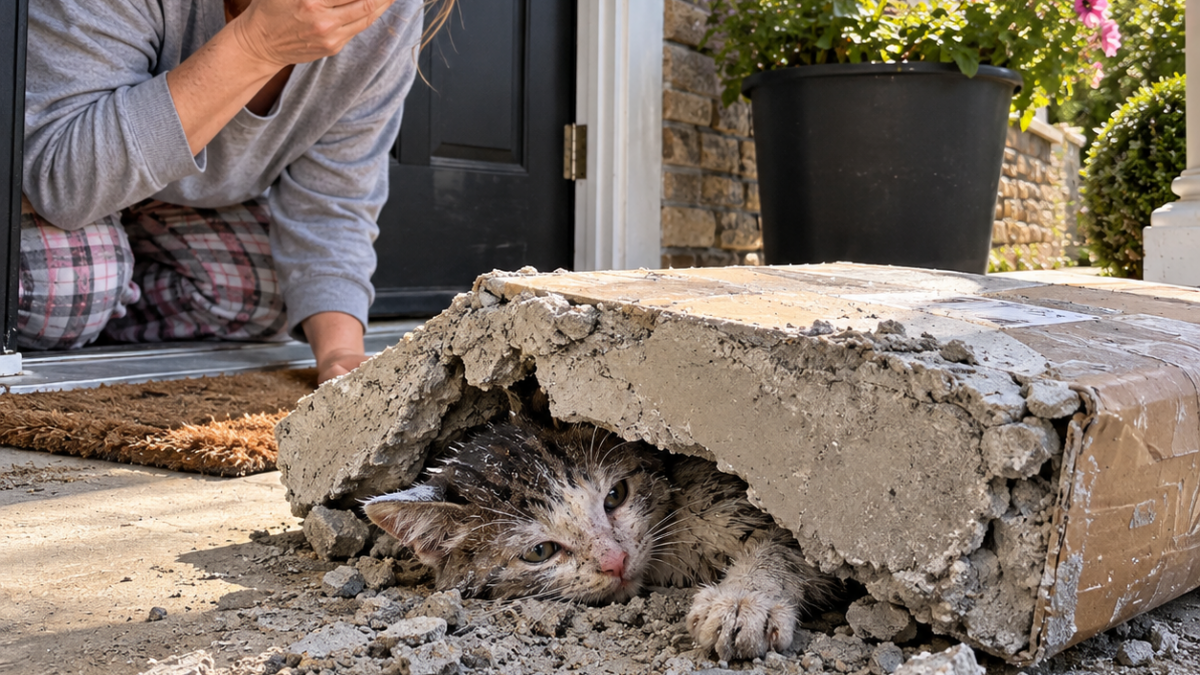
She Thought Someone Had Left a Package on Her Porch—Then She Realized It Was a Young Cat Trapped Beneath Hardened Concrete.
PART3:
She knew what a frightened healthy cat normally did when a stranger came too close.
Flatten.
Run.
Hiss.
Strike.
This cat did none of those things.
He could not even open his eyes.
She called for help.
Her hands shook so badly she nearly dropped the phone.
The person on the other end asked questions.
Was the cat conscious?
“I think so.”
Breathing?
“Yes.”
Bleeding?
“I can’t tell.”
What exactly was on him?
Faye looked again.
“Concrete.”
The person paused.
“Concrete?”
“Yes.”
“Wet?”
“No.”
She touched one edge carefully with one fingertip.
“Hard.”
Completely hard.
That answer changed the urgency.
Hardened concrete is not simply heavy.
Depending on what material it contains and how long it remains against skin, it can cause chemical burns.
Dust can damage eyes.
Material can enter the nose or mouth.
If inhaled deeply enough, respiratory injury becomes a serious concern.
And nobody knew whether Grant—though he did not have that name yet—had been covered while the material was wet.
Nobody knew whether he had breathed it.
Swallowed it.
Struggled through it.
Or been intentionally placed there after it had already hardened around him.
Faye did not know any of that.
She only knew one thing.
The cat was alive.
“Stay with me.”
She said it without thinking.
The absurdity struck her later.
As though he might choose otherwise based on the request.
But people say things when they are frightened.
They fill silence with hope.
She found an old towel.
Placed it around the cat without trying to wrap him tightly.
He made a sound.
Not a meow.
More like air escaping.
Faye froze.
“Sorry.”
The cat’s mouth opened slightly.
Then closed.
His breathing was shallow.
She kept one hand near him.
Not on him.
Near.
“I’m here.”
A neighbor noticed her kneeling.
“What happened?”
Faye looked up.
“There’s a cat.”
The neighbor came closer.
Then stopped.
“Jesus.”
“Don’t touch the concrete.”
“I wasn’t going to.”
“Can you get a box?”
The neighbor ran inside.
Another person appeared.
Then another.
Within minutes, a small circle had formed at a careful distance.
Everybody had the same reaction.
Confusion.
Then recognition.
Then horror.
Someone asked:
“Who would do that?”
Nobody answered.
There would be time for anger later.
Right now, anger could do nothing useful.
A carrier arrived.
The problem became moving him.
The concrete had hardened unevenly around his fur.
Nobody knew what injuries existed beneath.
Faye slid the towel under as much of his body as she safely could.
The cat cried.
Soft.
Pain.
She stopped.
Waited.
Tried again.
This time supporting the heaviest parts so the crust did not twist against his body.
The cat’s head lifted maybe half an inch.
Then dropped.
Faye whispered:
“I know.”
“I know.”
“I’m sorry.”
They placed him in the carrier.
His body remained rigid from the material.
The carrier door closed.
Faye looked down.
Gray concrete.
Orange fur.
One visible paw.
She could not stop staring.
At the veterinary clinic, the staff moved quickly.
The first priority was not appearance.
It was breathing.
A veterinarian named Dr. Sheridan Hale—whom everyone simply called Sheridan—met them in treatment.
Faye began explaining too fast.
“I found him outside.”
“Concrete.”
“I don’t know how long.”
“His eyes—”
Sheridan raised one hand.
“You did the right thing bringing him.”
Then she looked at the cat.
“Let’s stabilize first.”
They checked airway.
Breathing.
Heart rate.
Temperature.
Mucous membranes.
Hydration.
Sheridan listened carefully to his lungs.
Again.
Then again.
One of the nurses asked:
“Anything?”
“Breath sounds present.”
“Equal?”
“Pretty close.”
That was the first good sign.
Not safety.
Just one good sign.
They began with oxygen nearby while assessing whether he could tolerate more handling.
The hardened material around his face created the most urgent problem.
Eyes sealed.
Fur matted into cement.
Small fragments near nostrils.
Sheridan examined his mouth.
No obvious large obstruction.
She looked inside the nose as much as she could.
“Respiratory imaging.”
A nurse nodded.
Faye stood near the doorway.
“Is he going to survive?”
Sheridan looked at her.
“I don’t know yet.”
Not comforting.
Honest.
Faye preferred it.
“What’s the biggest danger?”
“If he inhaled significant material.”
Another pause.
“Or if there are injuries underneath we can’t see.”
“Could the concrete burn him?”
“Yes.”
“Can you remove it?”
“We’re going to.”
“But?”
“We have to do it without taking skin with it.”
They sedated him carefully.
Enough to reduce stress and pain.
Not enough to compromise a breathing system they still did not fully understand.
Warm water.
Specialized softening.
Gentle mechanical removal.
Millimeter by millimeter.
No dramatic hammer.
No chiseling.
No pulling giant chunks away.
That would have been dangerous.
Instead:
Soak.
Wait.
Loosen.
Trim fur where possible.
Protect skin.
Repeat.
The first eye emerged after what felt to Faye like hours.
Actually closer to forty minutes.
The eyelid was swollen.
Red.
But intact.
The second followed.
When Grant eventually opened one eye slightly, the veterinary nurse nearest him whispered:
“There you are.”
The orange cat blinked.
Once.
Light clearly bothered him.
But the eye was there.
The concrete had not destroyed it.
Another good sign.
They continued.
Back.
Shoulder.
Face.
Neck.
Paws.
Some pieces came free with clipped fur.
Others had to be softened repeatedly.
Underneath were cuts.
Abraded skin.
Small areas of irritation.
But no large open wound.
No exposed bone.
No catastrophic crush injury.
Sheridan kept waiting for the terrible discovery.
Broken ribs.
Collapsed lung.
Chemical burn deep enough to require surgery.
Something.
When the chest images returned, she stared at them.
The nurse beside her leaned closer.
“How bad?”
Sheridan pointed.
“Not bad.”
“What?”
She checked again.
“No obvious concrete aspiration.”
“No severe pulmonary injury.”
“You’re sure?”
“Nothing major showing.”
The nurse looked toward the treatment table.
“How?”
Sheridan exhaled.
“Luck.”
That word would come up often over the next few days.
Grant was lucky.
Lucky the material had not sealed his nose.
Lucky it had not damaged his lungs.
Lucky his eyes had been protected enough.
Lucky the weight had not caused severe chest compression.
Lucky the chemicals had not produced worse burns.
Lucky Faye walked outside when she did.
People later called it a miracle.
Veterinary professionals tend to use quieter words.
Fortunate.
Unexpected.
Remarkable.
Because they know animals die from much less.
By the time most of the concrete had been removed, the cat looked completely different.
Small.
Skinny.
Orange.
Young face.
Large eyes.
Maybe two years old.
His fur had been shaved unevenly where the concrete was impossible to separate.
He looked ridiculous.
And beautiful.
Faye stood beside the recovery kennel.
“Does he have a microchip?”
“No.”
“Collar?”
“No.”
“Any idea whose he is?”
“Not yet.”
He needed a name for the records.
The staff debated briefly.
Someone suggested Rocky.
Too obvious.
Someone else said Mason.
Worse.
Faye looked through the kennel.
The cat opened one eye.
Then the other.
Someone asked:
“What about Grant?”
Nobody remembered exactly why Grant.
Maybe because it sounded dignified.
Maybe because after everything, the cat deserved a name that did not turn his injury into a joke.
Grant stayed.
For the next twelve hours, they watched his breathing.
That was the concern everyone kept returning to.
Concrete dust can look harmless until the lungs tell another story.
But his oxygen stayed acceptable.
Chest sounds remained clear.
No increasing respiratory effort.
No alarming cough.
No collapse.
Sheridan finally allowed herself to say:
“I think his lungs are okay.”
Faye exhaled so hard she laughed.
“That’s good?”
“That’s very good.”
“What about the rest?”
“A few cuts.”
“Skin irritation.”
“He’s sore.”
“Probably dehydrated.”
“But?”
Sheridan smiled slightly.
“But I’m not seeing obvious permanent damage.”
Faye looked at Grant.
He was asleep.
For the first time since she found him, his face was visible.
Tiny orange nose.
Whiskers cut short on one side.
Patch of shaved fur across his forehead.
One ear slightly nicked.
He looked ordinary.
That was extraordinary.
The question everyone kept asking remained unanswered.
How did concrete end up on him?
Accident?
Cruelty?
Construction site?
Did he fall into something?
Was material poured over him?
Had he crawled through wet cement and collapsed later?
There were too many possibilities and not enough evidence.
People wanted certainty.
Especially once photographs circulated.
The image was shocking.
Orange cat.
Gray hardened material.
Eyes sealed.
People saw cruelty immediately.
Maybe they were right.
Maybe not.
Responsible rescuers were careful.
They knew what they had found.
They did not know every detail of how it happened.
What they did know was enough.
Grant had suffered.
Grant needed care.
Grant deserved safety.
The story spread.
Local posts first.
Then wider.
People shared his photograph.
Comments multiplied.
“Monster.”
“Who could do this?”
“Find whoever did it.”
“Poor baby.”
Then something unexpected happened.
People began claiming him.
One woman contacted the rescue.
“That’s my cat.”
They asked:
“What’s his name?”
“Ginger.”
“Do you have photographs?”
Her answer became vague.
Another person said Grant belonged to her brother.
Proof?
No clear photos.
No veterinary history.
No microchip registration.
No distinctive markings they could identify before seeing public images.
Someone else claimed he had been missing for months.
Could they describe the scar near his ear?
No.
Any older photographs?
Phone had broken.
Records?
None.
Another person insisted:
“He always wandered.”
“What food did he eat?”
Silence.
“What vet?”
Couldn’t remember.
“Neutered?”
Think so.
Sheridan became frustrated.
Not because ownership claims were impossible.
Unmicrochipped cats get lost.
People genuinely have terrible records.
But once an animal’s story becomes public, something strange happens.
People want proximity to it.
Some want to help.
Some want attention.
Some may genuinely convince themselves an animal looks familiar.
That meant Grant could not simply be handed to the first confident person who said:
“He’s mine.”
Proof mattered.
Faye felt guilty about that at first.
“What if his real family is looking for him?”
Sheridan answered:
“Then we want them to find him.”
“So why not—”
“Because returning a vulnerable animal to the wrong person is also harm.”
That made sense.
They documented every claim.
Asked consistent questions.
Requested photos.
Records.
Distinctive traits.
Nobody initially provided convincing proof.
So Grant remained in care.
That was how he ended up with Sheridan temporarily.
Her home was already dangerous territory for foster cats.
Not physically.
Emotionally.
Sheridan had a terrible habit of saying:
“Just for a week.”
Then rearranging her entire house around an animal.
Grant needed somewhere quiet.
Shelter kennels would be stressful.
He needed skin monitoring.
Eye medication.
Weight checks.
Observation for respiratory issues.
Sheridan lived five minutes from the clinic.
Practical.
That was how she justified it.
Her only concern had a name.
Lady Hissingtons.
Lady Hissingtons was Sheridan’s resident cat.
Ten years old.
Black-and-white.
Thirteen pounds.
Possessed of the firm belief that the house, furniture, windows, humans, and possibly neighboring airspace belonged exclusively to her.
Her original name had been Lady.
The Hissingtons part developed naturally.
Grant arrived in a carrier.
Lady smelled him before the carrier entered the room.
She appeared at the top of the stairs.
Back straight.
Eyes narrowed.
Tail twice normal size.
“Hrrrrrr.”
Sheridan looked up.
“Yes.”
“I know.”
Lady hissed.
Grant shrank inside the carrier.
“Very welcoming.”
Lady hissed again.
Sheridan set Grant up in the office.
Separate litter box.
Food.
Water.
Bed.
Covered hiding space.
Door shut.
No forced meeting.
Grant exited the carrier after almost an hour.
He walked low.
One careful step at a time.
His body seemed to expect danger from above.
Every unfamiliar sound froze him.
Heating pipe.
Car outside.
Floorboard.
Sheridan sat at her desk pretending to work.
She did not reach for him.
Animals recovering from trauma often do not need immediate affection.
They need predictability.
Food appears.
Nobody grabs.
Door closes gently.
Hands move slowly.
Nothing hurts.
Again.
Again.
Again.
Trust is frequently repetition.
Grant found the space beneath Sheridan’s desk.
Curled there.
Stayed.
The first night, he ate only after she left the room.
Second morning, half the bowl was gone.
“Good.”
She refreshed it.
Did not celebrate too loudly.
Lady Hissingtons waited outside the office.
Sniffed under the door.
“Hiss.”
Grant froze.
Sheridan sighed.
“Also predictable.”
Day three, Grant emerged while Sheridan was still at the desk.
She typed.
He approached.
Stopped two feet away.
She continued typing.
One foot.
Then closer.
Grant sniffed the leg of her chair.
Sheridan did not move.
He walked away.
That counted.
That afternoon, he did it again.
Then something changed.
Sheridan rested one hand on the desk while reading.
Grant jumped onto the chair beside her.
She looked over.
He froze.
She returned to the computer.
He stepped onto the desk.
Walked across paperwork.
Directly over a printed invoice.
Then stopped beside her right hand.
Sheridan remained still.
Grant lowered his head.
Pushed his forehead underneath her palm.
She almost cried.
Not because head-butting is unusual for cats.
Because of what those hands represented.
Human hands had either failed him or harmed him somewhere before that room.
At minimum, humans had been absent while he suffered.
Yet here he was.
Seeking one.
Sheridan slowly scratched between his ears.
Grant closed his eyes.
Then pushed harder.
“Oh.”
She whispered.
“You want that.”
He did.
From that day forward, the desk became Grant’s territory.
Laptop open?
Grant.
Paperwork?
Grant lying on it.
Phone call?
Grant walking between Sheridan and the screen.
Hands typing?
Grant pushing his head underneath.
The first time Faye visited, she could barely believe it.
“This is him?”
Sheridan laughed.
“Most of him.”
His coat had begun growing where it was shaved.
The patches looked uneven.
Orange velvet beside longer orange fur.
He had gained weight.
Eyes bright.
No cement.
No hardened mask.
No frozen body beside a porch.
Grant approached Faye.
She crouched.
He sniffed her.
Then rubbed his face against her knee.
Faye covered her mouth.
“I thought he was dying.”
Sheridan nodded.
“So did I.”
Faye touched his head.
Grant leaned in.
“I didn’t even know there was a cat under it.”
She started crying.
Sheridan gave her tissues.
Grant attempted to steal one.
Normal.
That became the goal.
Normal.
Not viral rescue cat.
Not concrete cat.
Grant.
Cat.
Hungry at six.
Sleeps in sun.
Knocks pens onto floor.
Demands affection during inconvenient phone calls.
The more normal he became, the less Sheridan wanted people defining him by the worst thing that happened to him.
She corrected visitors gently.
“He isn’t the cement cat.”
“He’s Grant.”
The distinction mattered.
Trauma is something that happened.
It does not need to become a permanent identity.
Grant learned toys.
At first, he did not understand a feather wand.
He stared.
Then Lady Hissingtons attacked it from the other side of the cracked office door.
That was their first interaction not based entirely on mutual suspicion.
Grant watched the black-and-white paw slam beneath the door.
Feather disappeared.
Grant pounced.
Lady hissed.
Grant jumped backward.
Then returned.
Another paw.
Pounce.
Hiss.
Repeat.
Sheridan sat on the floor laughing.
“This may be progress.”
Introductions continued slowly.
Blankets exchanged.
Food on opposite sides of the door.
Door cracked.
Then baby gate.
Lady Hissingtons displayed the emotional range suggested by her name.
Grant mostly wanted friendship.
He chirped.
She hissed.
He rolled.
She hissed.
He walked away.
She hissed after him for principle.
Then one morning Sheridan entered the kitchen and found them three feet apart.
Grant eating.
Lady drinking water.
No noise.
She took a photograph.
Sent it to a friend:
DIPLOMATIC RELATIONS ESTABLISHED.
The reply:
DON’T JINX IT.
Correct.
Two hours later Lady slapped Grant because he touched her tail.
Still.
Progress.
Meanwhile, ownership claims continued.
A man contacted the rescue saying Grant was his cat, missing for six months.
This time he had photographs.
Sheridan felt her stomach drop.
The cat in the images was orange.
Young.
Similar face.
But markings around the nose differed.
Ear shape differed.
Veterinary records described an intact male.
Grant had already been neutered before the incident.
Not him.
Another claim came from a woman whose cat disappeared three streets away.
She had dozens of photos.
Everyone hoped.
Again, not Grant.
The woman cried.
Not because Grant was not hers exactly.
Because hope had opened briefly.
Sheridan stayed on the phone with her for twenty minutes.
Lost animals create entire constellations of grief around stories like this.
Grant’s survival reminded people of cats who had not returned.
The rescue became careful about publicity.
Photos helped.
But attention complicated everything.
One headline described Grant as having been “encased alive.”
Another implied deliberate torture as established fact.
Sheridan pushed back.
“We do not know exactly what happened.”
Some people disliked uncertainty.
They wanted villain.
Hero.
Victim.
Clean roles.
Real rescue stories are often messier.
Faye found him.
Veterinary staff treated him.
Grant survived.
Beyond that, some questions remained questions.
That did not make his suffering less real.
Grant’s skin healed.
Cuts closed.
Eyes recovered.
His lungs continued sounding clear.
Follow-up imaging showed nothing alarming.
The miracle everyone kept expecting to unravel simply… didn’t.
He was okay.
Not untouched.
But okay.
One evening Sheridan sat at her desk reviewing his medical record.
Initial concerns:
Chemical burns.
Aspiration.
Ocular injury.
Crush trauma.
Skin necrosis.
Respiratory compromise.
Then outcomes.
Mild abrasions.
Small cuts.
Temporary irritation.
No obvious permanent respiratory damage.
No blindness.
No serious internal injury identified.
She looked down.
Grant was sleeping across her keyboard.
“You have no idea.”
He opened one eye.
“Do you?”
He closed it.
Probably not.
That was another thing humans do.
We carry the story for animals.
Grant did not need to understand that he had survived something statistically frightening.
He needed dinner.
A clean litter box.
Safety.
Warm places.
Hands that did not hurt.
Maybe resilience is easier when you do not build an identity around having been hurt.
Humans could learn something there.
But Sheridan was careful.
She did not romanticize.
Grant’s trust was beautiful.
His suffering was not necessary to make it beautiful.
Nobody should look at what happened and say:
It made him stronger.
Maybe it didn’t.
Maybe he was always affectionate.
Maybe cruelty simply stole days from him.
Healing does not justify injury.
It only proves injury did not get everything.
Faye visited again.
Brought toys.
Grant ignored the expensive mouse and played with the paper bag.
Naturally.
They sat drinking tea while Grant walked across the desk.
Faye said:
“I still see him the way I found him.”
Sheridan nodded.
“When?”
“Every time I step outside.”
“Does it get easier?”
“Yeah.”
Then:
“But sometimes I think, what if I hadn’t looked?”
Sheridan put down her cup.
“You did.”
“I almost didn’t.”
“But you did.”
Faye looked toward Grant.
“What if I had been late?”
Sheridan understood.
Rescue guilt.
A strange thing.
People save an animal and then torture themselves with alternate universes in which they failed.
“You can invent ten thousand versions where something worse happened.”
Sheridan said.
“None of them are the one you’re living in.”
Faye smiled weakly.
“That sounds like therapy.”
“It’s mostly veterinary exhaustion.”
Grant climbed into her lap.
Faye stroked his back.
The new fur was softer than she expected.
“Do you think someone did it intentionally?”
Sheridan looked at him.
“I don’t know.”
“I want to know.”
“I understand.”
“If someone hurt him…”
“I understand.”
Faye’s hand tightened slightly.
Grant looked up.
She relaxed.
Sheridan continued:
“You may never know.”
“That bothers you?”
“Yes.”
“But?”
“But Grant doesn’t need us to solve the mystery before we give him a life.”
That became enough.
For a while.
Weeks passed.
Grant discovered windows.
Birds.
Central heating.
The sound of the refrigerator opening.
Lady Hissingtons continued tolerating him.
Some days better.
Some days diplomatic relations collapsed over a cushion.
Grant learned that if he approached her too quickly, she hissed.
If he sat near her without looking, she sometimes stayed.
One rainy evening Sheridan found them both on the sofa.
Not touching.
Six inches apart.
Lady sleeping.
Grant sleeping.
She did not move for twenty minutes because she was afraid to ruin it.
Then the doorbell rang.
Lady vanished.
Grant woke.
Progress reset.
Cats.
Grant became especially attached to Sheridan’s hands.
Not just general affection.
Hands.
If she typed, he inserted his head beneath her wrist.
If she wrote, he sat on the notebook.
If she rested her palm flat, he walked underneath it.
Sheridan joked:
“He’s trying to wear me as a hat.”
But privately, the behavior affected her.
She had been part of his first veterinary treatment.
Hands touching concrete.
Hands trimming damaged fur.
Hands cleaning wounds.
Hands examining eyes.
Those procedures had been necessary, but frightening.
Yet Grant had not learned:
Hands equal pain.
He had learned something new.
This hand feeds.
This hand scratches.
This hand lifts gently.
This hand stops when I pull away.
This hand waits.
Trust was not amnesia.
It was new evidence.
Grant accumulated enough new evidence.
Then the question came.
Was Sheridan keeping him?
The rescue coordinator asked over the phone.
“You know this cannot be indefinite foster.”
“I know.”
“Applications are coming.”
“I know.”
“Good ones.”
“I know.”
Silence.
Then:
“How is Lady?”
“Hissing.”
“So normal.”
“Yes.”
“Are you adopting him?”
“I have not decided.”
“You just answered like somebody adopting him.”
“No.”
“You used the phrase ‘his side of the sofa’ yesterday.”
“That means nothing.”
“You bought a second cat tree.”
“The old one is small.”
“You changed feeding stations.”
“Lady was stealing.”
“You moved your desk so Grant can sit beside you.”
“That was ergonomic.”
The coordinator laughed.
“Sheridan.”
“Fine.”
She looked across the office.
Grant was asleep with one paw over his face.
“Maybe.”
The problem was Lady.
Sheridan loved Grant.
That was obvious.
But resident animals matter.
People sometimes adopt out of emotion and expect the existing pet to simply cope.
Sheridan refused.
If Grant’s presence made Lady chronically stressed, he needed another home.
No amount of romantic storytelling changed that.
So they waited.
Behavior logs.
Separate resources.
Vertical spaces.
Slow integration.
No forced closeness.
Weeks.
Lady’s hissing reduced.
Not disappeared.
Reduced.
Grant learned her boundaries.
Then something happened.
Sheridan was sick.
Nothing serious.
Flu.
Fever.
She spent a day in bed.
Lady Hissingtons slept by her feet.
As expected.
Grant remained outside the bedroom because Sheridan had not yet allowed unsupervised access at night.
Around noon she heard scratching.
Then Lady got up.
Walked to the door.
Meowed.
Sheridan opened it.
Grant stood outside.
He entered.
Lady watched.
Grant jumped onto the bed.
Curled near Sheridan’s shoulder.
Lady returned to the foot.
No hiss.
Three hours later, Sheridan woke.
Both cats still there.
Different ends.
Same bed.
She took that as Lady’s vote.
Grant’s adoption paperwork was completed two weeks later.
Sheridan changed his status from:
FOSTER.
To:
PERMANENT.
The coordinator sent:
CALLED IT.
Sheridan replied:
PROFESSIONAL DECISION.
Response:
SURE.
Faye cried when she heard.
Not sadness.
Relief.
“He stays?”
“He stays.”
“With you?”
“Yes.”
“And Lady?”
“Has agreed not to murder him.”
“That’s practically love.”
“Exactly.”
Grant’s story continued spreading for a while.
Then, as stories do, attention moved.
Another rescue.
Another headline.
Another emergency.
That was good.
Viral attention is exhausting when you are trying to become an ordinary cat.
Grant gained another pound.
His coat fully returned.
Only a few small marks remained.
One cut healed into a pale line beneath the fur.
If you met him without knowing the story, you would never guess.
That became Sheridan’s favorite thing.
Visitors would see orange cat.
Friendly.
Annoying.
Climbing onto desk.
Then Sheridan would show the original photograph.
People always looked twice.
“That’s him?”
“Yes.”
“No.”
“Yes.”
“The concrete cat?”
“Grant.”
She always corrected gently.
Grant.
Name first.
Story second.
One afternoon, a school group visited the clinic for an animal-welfare program.
Grant was not officially part of the curriculum.
Then he wandered into reception.
A little girl crouched.
“Can I pet him?”
Sheridan said:
“Hold your hand out.”
The girl did.
Grant walked forward.
Sniffed.
Then pushed his head under her fingers.
The child giggled.
“He put me on him.”
Sheridan smiled.
“He does that.”
Another child asked:
“Was he hurt?”
Sheridan hesitated.
Then showed a carefully chosen photograph.
No graphic detail.
The children gasped.
Someone said:
“That’s mean.”
Sheridan answered:
“It was very dangerous.”
“Who did it?”
“We don’t know exactly how it happened.”
That disappointed them.
Children like answers too.
One boy asked:
“Is he scared of people now?”
Grant was currently rubbing against the first child’s legs.
Sheridan pointed.
“What do you think?”
“No.”
“Not very.”
“Why?”
Sheridan considered.
“Because people can learn new things about each other.”
Maybe that was too simple.
But for eight-year-olds, enough.
Grant reached adulthood fully.
Then middle age.
Lady Hissingtons grew older.
The relationship between them never became the storybook friendship people wanted.
No constant cuddling.
No dramatic grooming.
Mostly coexistence.
Occasional shared sunbeam.
Occasional slap.
Occasional theft of beds.
Real relationships.
One winter morning Sheridan entered the sitting room and stopped.
Lady was asleep.
Grant beside her.
Their backs touching.
Barely.
Half an inch of contact.
Sheridan took seventeen photos.
None looked as meaningful as the moment felt.
Lady woke.
Realized what was happening.
Hissed.
Walked away.
Grant stayed.
“Worth it.”
Sheridan said.
Years after his rescue, concrete construction started across the street.
Mixers.
Dust.
Gray bags.
Sheridan noticed Grant’s reaction carefully.
Nothing.
He watched from the window.
Then slept.
She had not realized until that moment she had been holding a tiny irrational fear.
That something sensory might bring it back.
Trauma.
Memory.
Panic.
Again, humans often write stories animals never agreed to.
Grant simply watched a truck.
Yawned.
Walked to the kitchen.
Sheridan laughed at herself.
“You’re doing better than I am.”
Faye remained in touch.
Every September she messaged:
How’s the boy?
Sheridan answered with photographs.
Grant stealing a pen.
Grant in laundry.
Grant asleep.
Grant looking offended.
One year, Faye wrote:
I still think about that morning.
Sheridan replied:
So do I.
Then another message:
I used to wish I could erase it.
Sheridan typed back:
I don’t.
She paused.
That looked wrong.
Clarified:
I wish it never happened to him. But since it did, I’m glad someone saw him.
Faye understood.
There is an important difference.
You do not need to be grateful for trauma to be grateful for rescue.
Grant grew older.
His face broadened.
His orange coat deepened.
The kittenish narrowness disappeared.
At eight, he developed mild arthritis.
At nine, a thyroid issue.
Treatable.
At ten, he began sleeping more.
Still demanded hands.
Always hands.
Sheridan could be reading with both hands occupied.
Grant would stand on the book.
If she used a laptop, he placed one paw on the keyboard until she surrendered.
Visitors found it charming.
Sheridan sometimes did.
Sometimes she had invoices due.
“Grant.”
Head under palm.
“No.”
Push.
“I’m working.”
Push harder.
“Five minutes.”
Purr.
“Fine.”
That was his greatest revenge against the world.
Not anger.
Expectation.
He expected gentleness.
He demanded it.
That thought came to Sheridan one evening.
Grant sat beside her.
She scratched under his chin.
He lifted his head.
Eyes closed.
Completely vulnerable.
The cat she first saw with his face sealed shut now closed his eyes voluntarily beneath a human hand.
Trust is not the absence of memory.
She reminded herself.
It is believing the next moment does not have to repeat the worst one.
Lady Hissingtons died before Grant.
Kidney failure.
Fifteen.
Old queen.
Final months comfortable.
Grant changed afterward.
For three days he looked for her.
Checked the bedroom.
Window.
He sat beside her empty bed.
Sheridan almost laughed at the irony.
Lady had hissed at him for years.
Now he searched.
“Yeah.”
She whispered.
“She was awful.”
Grant looked at her.
“And you loved her anyway.”
He eventually began sleeping in Lady’s favorite window.
Not immediately.
Weeks later.
Sheridan allowed it.
She adopted no new cat for almost a year.
Then a frightened tabby foster arrived.
Young.
Hiding.
Grant sat outside the foster-room door.
Sheridan stared.
“Absolutely not.”
Because she knew how these things started.
Grant sniffed beneath the door.
Tabby hissed.
Grant walked away.
Maybe nothing.
Next day, he returned.
The tabby began eating closer to the door.
Sheridan laughed.
“Really?”
History does not repeat perfectly.
But sometimes kindness becomes a habit.
Grant was never the protector Ivy had been in another life, another story.
He was simply calm.
A resident cat comfortable enough to show a frightened newcomer:
Food arrives.
Doors open.
Humans can be safe.
The tabby eventually found another home.
Grant stayed.
At twelve, his health declined more noticeably.
Kidneys.
Arthritis.
Weight loss.
Sheridan had spent her career telling families:
A long life is not the same thing as an endless life.
Now she had to hear herself say it internally.
Good days.
Bad days.
Comfort.
Mobility.
Appetite.
Interest.
Connection.
Grant still had plenty.
Then fewer.
He stopped jumping onto the desk.
Sheridan put a chair beside it.
He climbed chair.
Then desk.
Eventually chair became difficult.
She added a step.
Then another.
Grant used them.
Still pushed his head beneath her hand.
One morning he could not manage even the first step.
Sheridan lifted him.
He complained loudly.
“Good.”
She smiled.
“Still opinionated.”
But she knew.
Bloodwork confirmed progression.
Nothing dramatic that day.
No crisis.
Just the beginning of the final stretch.
She called Faye.
“He’s slowing.”
Faye came that weekend.
Older too.
She sat on the sofa.
Grant walked toward her slowly.
No concrete.
No fear.
No emergency.
Just an old orange cat.
Faye held out her hand.
Grant reached it.
Pushed his forehead underneath.
Exactly.
Faye cried.
“Still doing that?”
“Every day.”
“He doesn’t remember me.”
“Probably not.”
Faye stroked him.
“That’s okay.”
After a while she said:
“I think I needed him to.”
Sheridan looked at her.
“Why?”
“I don’t know.”
“Proof it mattered?”
Faye nodded.
Sheridan pointed toward Grant.
“He’s here.”
“That’s proof.”
Faye smiled through tears.
Yes.
Eventually Grant stopped eating enough.
Then stopped grooming properly.
Sheridan helped.
Warm cloth.
Brush.
Medication.
One night he climbed onto the bed and slept beside her shoulder.
Something he had not done in months.
Sheridan woke at four.
His head beneath her hand.
She stayed still.
Did not move until morning.
The next day she called a colleague.
Not because she could not perform the medical part.
Because she did not want to be Grant’s veterinarian that day.
She wanted to be his person.
They chose home.
Sunny afternoon.
Favorite blanket.
Faye came.
The rescue coordinator came briefly.
Then left so the final hour would be quiet.
Grant ate a little tuna.
Good.
Lady’s old window was open slightly.
Fresh air.
Sheridan sat on the floor.
Grant in her lap.
The vet administered the sedative.
Grant’s body relaxed.
Sheridan’s hand rested beside his face.
Even drowsy, he moved his head.
One last push beneath her fingers.
That was what broke her.
Not the injection.
Not the diagnosis.
That tiny familiar motion.
Hand.
Head.
Trust.
“Oh, Grant.”
Faye covered her mouth.
Sheridan bent down.
“You did okay.”
He had.
More than okay.
No permanent lung damage.
No blindness.
No life defined by what hardened over him on one terrible morning.
He had been a foster.
Desk thief.
Housemate.
Annoyance to Lady Hissingtons.
Companion.
Old cat.
Loved.
Grant’s breathing slowed.
Then stopped.
Sheridan kept her hand on his head.
Faye whispered:
“I thought he was a package.”
Sheridan looked at her.
“What?”
“That morning.”
Faye cried quietly.
“I almost walked past him because I thought someone had dumped rubbish.”
Sheridan reached across and held her hand.
“But you looked.”
Faye nodded.
“I looked.”
That was enough.
Afterward, Sheridan kept one photograph on her desk.
Not the concrete photo.
Never that one.
Grant at about five years old.
Healthy.
Rounder.
Orange fur bright in sunlight.
Standing across a pile of paperwork with his head shoved underneath Sheridan’s palm.
If people asked about him, she told the whole story.
But she always began with the photograph.
“This was Grant.”
Not:
This was the cat covered in concrete.
That came later.
Because the worst thing that happened to an animal should not always be the first thing we use to describe them.
Grant survived something terrifying.
That matters.
But so did everything afterward.
The bowl he emptied.
The first desk walk.
The first head-butt.
Lady Hissingtons glaring across a baby gate.
The shared sunbeam.
The school child laughing when Grant forced himself beneath her fingers.
The old-cat steps beside the desk.
The last afternoon.
All part of him.
People understandably focus on the cruelty.
They ask:
Who could do that?
Sheridan eventually stopped trying to answer.
Maybe someone knew.
Maybe investigators learned more.
Maybe not.
What mattered to Grant’s daily life was what happened next.
Somebody saw him.
Somebody stopped.
Somebody picked up the phone.
Veterinary staff removed the concrete carefully instead of tearing it away.
People monitored his lungs.
Fed him.
Treated cuts.
Waited when he hid.
Did not demand affection.
Gave him choices.
Then Grant did something nobody could force.
He trusted.
Again.
That is the part Faye carried longest.
Not the concrete.
The hand.
Grant approaching Sheridan’s desk.
Walking across paperwork.
Lowering his orange head.
Pushing until fingers rested between his ears.
Again.
Again.
Again.
It would be easy to say Grant forgave humans.
Nobody could know that.
Forgiveness is a human word.
Maybe Grant simply learned Sheridan was safe.
Maybe safety accumulated.
Meal by meal.
Touch by touch.
Day by day.
That is more than enough.
He did not need a philosophy.
He needed evidence.
Concrete hurt.
These hands did not.
One terrible experience told him the world was dangerous.
Hundreds of ordinary gentle experiences told him something else could also be true.
That is resilience without mythology.
Not:
Nothing hurt me.
Not:
I forgot.
Simply:
I can still move toward something good.
Faye never again walked past an unexplained shape near her porch without looking closely.
Sheridan never stopped telling adopters to microchip their cats.
Lady Hissingtons remained legendary in clinic stories long after she was gone.
And Grant became the reason several foster families agreed to take animals they might otherwise have thought were “too damaged.”
Sheridan always corrected that phrase.
“Injured.”
“Frightened.”
“Recovering.”
“Complicated.”
Fine.
But damaged?
Maybe.
Everyone is damaged eventually.
That does not tell you what comes next.
Grant’s body had been covered in something that hardened around him.
For hours, perhaps longer, his world had become dark.
Heavy.
Still.
Then somebody looked closer.
That was all Faye did at first.
She looked.
One step closer.
Then another.
She noticed orange fur.
She noticed breath.
And everything after that became possible.
Years later, when people asked her what she remembered most, they expected:
The concrete.
The sealed eyes.
The horror.
Instead she often said:
“His ear moved.”
That tiny ear.
Because that was the moment the abandoned package became a living being in her mind.
One movement.
Proof.
Still here.
Still alive.
Still reachable.
Grant deserved better before that morning.
He deserved never to have suffered at all.
Nothing about his recovery makes what happened acceptable.
Nothing beautiful afterward excuses cruelty beforehand.
But suffering did not get the last sentence.
Grant did.
He survived.
His lungs remained clear.
His eyes opened.
His wounds healed.
His fur returned.
His appetite returned.
His curiosity returned.
And after being given every imaginable reason to fear what human hands could do, he kept walking toward them anyway.
Not every hand.
Not immediately.
Not without caution.
But the safe ones.
He learned those.
And for the rest of his life, whenever Sheridan tried to work, Grant would walk across her desk, interrupt whatever important thing she believed she was doing, place his orange head beneath her palm, and wait.
He no longer needed rescuing.
He simply wanted to be petted.
And somehow, after everything, that ordinary little demand felt like the most extraordinary ending he could have had.








