She Froze Herself to the Ground to Save Her Five Kittens—And When the Road Worker Lifted Her, Everyone Learned What a Mother’s Love Can Survive
PART3:
A flash of mottled fur near the feed store.
Green eyes beneath a porch.
Tiny paw prints crossing fresh snow at dawn.
A girl named Lily Grant tried to leave food out behind her family’s trailer, but her stepfather kicked the bowl into a ditch.
“We are not feeding every stray thing in the county,” he said.
Lily cried in her room that night, pressing her face into her pillow so no one would hear.
At fourteen, she already knew what adults meant when they said every stray thing.
Sometimes they meant animals.
Sometimes they meant people.
By January, Mabel was pregnant.
No one knew whether it happened before Ruth died or during those first desperate weeks outside. Her belly rounded beneath her winter-thick fur, and hunger became sharper. She moved slower. She took more risks. She approached porch lights, sniffed at garbage cans, squeezed through gaps in sheds, and endured thrown boots, barking dogs, and the casual cruelty of people who believed hardship was natural as long as it belonged to something smaller than them.
On the night she gave birth, the temperature dropped below zero.
She chose an old culvert beneath the edge of a private logging road, half-blocked with leaves and ice, sheltered by a tangle of brush. It was not safe, but it was hidden. To an exhausted mother, hidden can feel like safe enough.
Five kittens came into the world blind, damp, and furious.
Mabel cleaned them with frantic tenderness. One by one, she pulled them against her belly and curled herself around them. Their tiny mouths found her. Their paws kneaded. Their bodies, no larger than folded socks, trembled against her.
Outside the culvert, trees cracked in the cold.
Inside, Mabel purred.
It was a thin sound, raspy from hunger, but it filled the dark tunnel like a promise.
For six days, she kept them alive.
She left only when she had to, slipping out to search for food while they slept in a pile that smelled of milk and mud. Each time, she returned thinner. Each time, the kittens rooted blindly toward her warmth, and she lowered herself around them as if she had carried back more than her own body.
On the seventh day, the storm came.
The forecast had warned people for three days, but forecasts mean nothing to animals without doors.
By afternoon, snow began falling thick and fast. By evening, the culvert entrance was narrowing beneath drifting white. Wind pushed snow into every gap. The temperature dropped with a speed that frightened even seasoned road crews.
Mabel tried to move the kittens.
That part was never known by the people who would later tell her story, but it was written in the snow if anyone had understood how to read it.
Small paw prints.
A shallow drag mark.
A second set of prints circling back.
She carried the first kitten in her mouth and made it nearly twenty feet toward the fence line before the wind knocked her sideways. Snow stung her eyes. The kitten squeaked against her teeth. Mabel crouched, shielding it beneath her chest, then turned back.
She could not move all five through that storm one by one.
Not fast enough.
Not safely.
The culvert was filling. The open field was worse. The fence line had a slight hollow where the snow had drifted around the base of a rotted post. Not shelter, exactly. But a pocket. A place where her body could block the wind if she positioned herself right.
So she made a choice.
Animals make choices all the time. Humans like to pretend instinct explains everything because instinct asks less of us. Instinct is easy to admire from a distance. Love is harder, because love means we have to admit a creature understood the cost.
Mabel carried them one by one.
Five trips.
Each shorter and harder than the last.
By the fifth, ice had crusted her whiskers. Snow clung to her belly. Her paws burned, then stopped burning, which was worse. She could feel the numbness spreading up her legs, feel the wind cutting through her fur, feel her milk-heavy body weakening with every step.
But the fifth kitten was alive when she reached the fence post.
That was enough.
She gathered them beneath her.
All five.
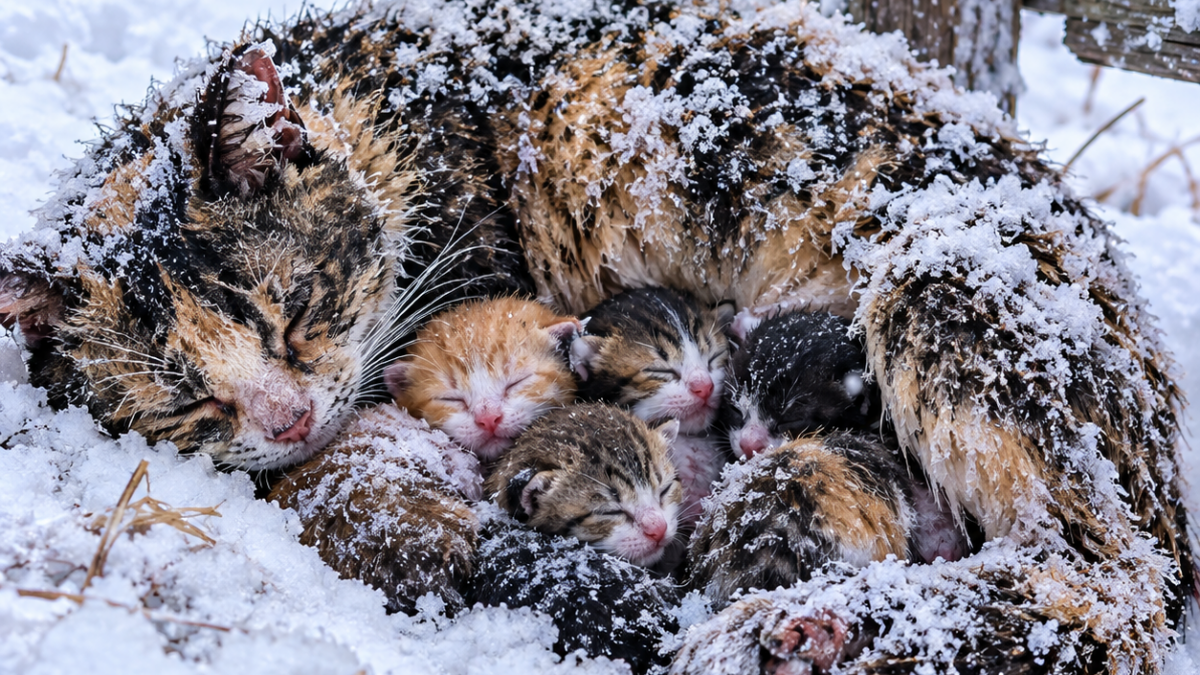
She curved her spine against the storm and pressed her belly low to the ground. Her paws tucked around the smallest one. Her tail wrapped where it could. Her chin lowered, blocking the last gap. Beneath her, the kittens squirmed, searching for warmth, blind mouths opening and closing.
The storm deepened.
Snow climbed her sides.
Wind drove ice into her ears.
Hours passed.
Mabel did not move.
When pain became too large, her body tried to betray her. It begged for motion. Stand. Run. Find shelter. Save yourself. A living body is built to preserve itself, to recoil from cold, to seek heat, to choose breath.
But every time one kitten cried, Mabel stayed.
The world shrank to that.
One cry.
One breath.
One more minute.
The snow covered her back until she became part of the drift. Ice hardened in her fur. Her ears froze first, delicate tips stiffening beneath the wind. Her paws, pressed into snow and frozen ground, lost feeling. Her tail curled around the kittens and slowly turned numb.
Still she held.
Sometime near midnight, headlights moved far away on the main road and disappeared.
No one saw her.
Sometime after two, coyotes cried beyond the tree line.
She lifted her head then, just enough to listen, and a blade of wind struck the wet fur under her chin. The kittens stirred. One squealed thinly. Mabel lowered herself again and made a sound that was not quite a purr, not quite a growl.
The coyotes moved on.
By dawn, she was no longer shivering.
That was dangerous.
Shivering means the body is still fighting.
Still, beneath her, five tiny hearts beat in a pocket of borrowed warmth.
At 5:11 a.m., Caleb Morse’s alarm went off in a dark bedroom seventeen miles away.
He hated that sound.
Not because he hated work. Caleb had been with the county road maintenance department for eleven years, and he took a quiet pride in being one of the reasons other people could get to hospitals, grocery stores, schools, and nursing homes after storms. He liked engines, salt maps, clean passes through deep snow, the particular satisfaction of turning an impassable road into something usable.
But that winter, every morning began with a weight on his chest that no alarm could explain.
His wife, Rachel, slept facing away from him. Or pretended to sleep. He could no longer tell. Between them lay six inches of mattress and nearly two years of things they did not know how to say.
On the dresser stood a framed photo of their daughter, Sophie.
Eight years old.
Missing both front teeth.
Purple winter hat crooked over one eye.
Holding a snowball in one mittened hand and laughing at the camera like the whole world had just told her a secret.
Caleb looked at the photo every morning and died a little before putting on his boots.
Sophie had loved storms.
That was the worst joke of all.
She had loved snow days, loved cocoa, loved pressing her nose to cold windows, loved shouting, “Daddy, plow mountain!” when Caleb pushed snow into a pile at the edge of the driveway. She had loved every stray animal she had ever seen with a reckless devotion that frightened her parents.
Once, at six, she tried to bring a raccoon into the mudroom because “he looked misunderstood.”
Another time, she spent three weeks feeding a half-feral orange tom behind the school, naming him Senator Pickles and writing a persuasive essay about why he deserved a heated bed.
Sophie’s heart had always run ahead of safety.
Then, two winters earlier, she got sick.
Fast.
A fever on Monday. Hospital by Wednesday. Pediatric ICU by Thursday. Words Caleb still could not hear without leaving the room: sepsis, complications, doing everything we can.
By Saturday morning, Sophie was gone.
The world after that became functional.
Bills paid. Snow cleared. Groceries bought. Funeral casseroles accepted. Thank-you cards half-written and abandoned. Marriage preserved in shape but not in warmth.
Rachel grieved inward. Caleb grieved by working until his hands cracked open.
That morning, as the storm still screamed beyond the bedroom window, Caleb dressed quietly. Thermal shirt. Work pants. Wool socks. Orange reflective jacket. He paused at the dresser and touched Sophie’s photo with two fingers.
“Morning, bug,” he whispered.
Rachel’s voice came from the bed, rough with disuse.
“Roads bad?”
“Real bad.”
“Be careful.”
It was the most she had said to him in three days.
He looked at her back.
“You too.”
Downstairs, he poured coffee into a dented thermos and checked his phone. County alerts. Crew assignments. Wind chill warning. A message from his supervisor, Gus: Start north loop. Trees down near Miller. Watch visibility.
Caleb stepped onto the porch and the cold hit him like a physical hand.
By 6:02, he was in the county garage, where fluorescent lights buzzed over snowplows, salt trucks, and men holding coffee like it was medicine. Everyone looked older in winter gear.
Gus Hanley stood by the dispatch board, gray beard tucked into his collar, tapping routes with a gloved finger.
“Morse, you take seventeen out past Miller Pond,” Gus said. “Eddie and Ron are already ahead on the main stretch. Fence line curve is drifting bad.”
Caleb nodded.
“You good?” Gus asked quietly.
People asked Caleb that carefully now, as if grief were a sleeping animal they did not want to startle.
“Fine.”
Gus did not believe him. Gus was too kind to say so.
“Radio if you need backup.”
“Always do.”
Caleb climbed into Truck 4, started the engine, and listened to it rumble awake beneath him. The cab smelled of diesel, old coffee, vinyl, and the peppermint gum Eddie constantly left in the cupholders. Snow struck the windshield in fast silver streaks.
For the next three hours, the world existed inside the sweep of his headlights.
Plow down. Blade angled. Salt spreader running. Wipers fighting a losing war. Radio crackling. Trees bowed under snow. Mailboxes appeared and vanished. Once, he passed a farmhouse where a woman in a red robe stood in the doorway holding a small child, watching the plow like rescue had a shape.
Caleb lifted one gloved hand.
She lifted hers back.
That was why he did the job.
At 9:37, the worst of the snowfall eased, though wind still carried loose snow across the road in ghostly sheets. Caleb turned onto the stretch near the abandoned field by Miller Pond. He knew that curve well. It drifted every storm because the open land gave wind a running start.
He slowed.
The plow blade pushed a heavy curl of snow toward the shoulder.
That was when he saw the dark shape.
At first, it looked like a torn trash bag caught near a fence post.
He almost passed it.
Then something about the shape bothered him.
Too round.
Too still.
He braked.
Truck 4 hissed and groaned to a stop. Caleb leaned forward, squinting through the windshield. The shape lay half-buried in the snow just beyond the road shoulder, near the old wooden fence. Snow had crusted over it. A thin black-and-orange patch showed through.
Animal, he thought.
His stomach tightened.
He put the truck in park, radioed dispatch that he was stepping out for debris near the fence line, and climbed down into wind that immediately stole the warmth from his face.
Snow came up nearly to his knees off the plowed edge.
He trudged toward the fence, boots crunching through a hard top layer into powder beneath. The closer he got, the more his throat closed.
Cat.
A small tortoiseshell cat curled against the frozen ground.
Ice coated her fur. Snow had built along her back. Her ears looked wrong, darkened at the tips. Her whiskers were stiff with frost. She did not lift her head when he approached.
“Oh, no,” Caleb whispered.
The words vanished in the wind.
He crouched beside her.
For a moment, he could not touch her.
Since Sophie, he had developed a terrible hesitation around small still bodies. Dead birds beneath windows. A rabbit struck on the road. Once, a child’s dropped mitten in a parking lot had made him stand frozen for nearly a minute before he realized what it was.
Now this cat lay curled in the snow, and all Caleb could see was the hospital bed, the pale hand, the purple hat folded in a plastic belongings bag.
He forced himself to breathe.
“Okay,” he said. “Okay, little one.”
He reached out and touched her side.
Stiff.
Cold.
Lifeless.
A wave of anger moved through him, sudden and sharp. Not at the cat. At the world. At weather. At whoever had left her. At every warm house within miles where someone might have opened a door and did not.
“I’m sorry,” he whispered.
He slid both gloved hands beneath her to lift her from the snow.
She did not move.
But something beneath her did.
Caleb froze.
A sound came up from under the cat’s body.
Faint.
Thin.
Almost swallowed by wind.
Mew.
His heart slammed once against his ribs.
He pulled back, then leaned closer.
Another sound.
Tiny. Desperate. Alive.
“No way,” he breathed.
Carefully, he brushed snow away from the cat’s side. Her body was curled so tightly that at first he could not see anything beneath. Then a small pink mouth opened in the shadow under her belly.
A kitten.
Then another.
And another.
Caleb ripped off one glove with his teeth so he could feel better, ignoring the instant bite of cold on his fingers. He lifted the mother cat slightly, just enough to see.
Five newborn kittens were tucked beneath her.
Their eyes were sealed shut. Their bodies were no bigger than his palm. They were cold, but not frozen. They squirmed weakly against one another inside the little hollow their mother had made with her own body.
Caleb’s breath left him in a broken sound.
“Oh, sweetheart,” he said to the mother cat. “What did you do?”
The cat did not answer.
Her body remained stiff, but not in the way he first thought. Beneath the ice and cold, there was something else. A shallow movement. So faint he nearly missed it.
A breath.
Caleb leaned close, his cheek almost against her frozen fur.
Again.
Barely there.
But there.
“She’s alive,” he said, though no one was beside him. “She’s alive.”
Everything inside him changed at once.
The road, the schedule, the route, the storm cleanup—all of it fell away.
He keyed his radio with shaking fingers.
“Dispatch, this is Truck 4.”
Static.
“Go ahead, Four.”
“I’ve got an animal emergency. Cat and newborn kittens off Route 17 near Miller fence curve. Mother is hypothermic but breathing. Five kittens alive. I’m transporting to Kingdom Valley Animal Clinic.”
A pause.
Then the dispatcher, Marlene, said, “Copy that, Four. Do you need animal control?”
“No time.”
“Road conditions toward town are rough.”
“I know.”
Gus came over the radio. “Morse, you sure?”
Caleb was already unzipping his coat.
“I’m sure.”
He stripped off his outer jacket, then his fleece liner, leaving himself in thermal layers that the wind cut through immediately. He spread the fleece on the snow and moved with a delicacy that surprised him. His hands were large, built for tools and steering wheels, but he lifted the kittens like they were sparks that might go out.
One.
Two.
Three.
Four.
Five.
He tucked them together inside the fleece, then worked on the mother.
She was frozen to the ground.
Not completely, but enough that the fur along one side had iced into the snow. Caleb swore under his breath, then stopped because it felt wrong to swear near something that had suffered so quietly.
He went back to the truck and grabbed the emergency blanket, a bottle of water from his lunch cooler, and the small first-aid kit he barely ever used. The water was cold but liquid. He poured a little around the frozen fur, shielding the kittens from the wind with his body, loosening the ice bit by bit. He worked slowly though panic screamed at him to hurry.
When the mother finally came free, she made a sound.
Not a meow.
Not even a cry.
Just a broken breath.
Caleb’s eyes burned.
“I know,” he said. “I know. I’ve got you.”
He wrapped her with the kittens inside his fleece, then wrapped the emergency blanket around them all, then held the bundle against his chest inside the open front of his orange jacket. The cold of her body shocked him through his shirt.
She felt like winter itself.
He stumbled back to the truck, climbed in, and cranked the heat as high as it would go. The fan roared. He placed the bundle on the passenger seat but kept one hand on it, afraid that if he stopped touching them, they might vanish.
The kittens moved weakly.
The mother’s head lolled.
Her eyes opened once.
Just a slit.
Green, clouded, exhausted.
She looked at him, but Caleb had the strange sense she was not seeing him at all. She was searching beneath herself.
“The babies are here,” he said quickly, as if she could understand. “They’re here. All five. You did it.”
Her eyes closed.
Caleb drove.
He had driven snowplows through whiteouts, ambulances blocked by drifts, school buses stuck sideways on hills. He had never driven like that.
Not reckless.
Precise.
Focused.
Every bump felt like betrayal. Every slow car ahead of him felt impossible. He radioed ahead, and Marlene called Kingdom Valley so they would be ready. The clinic was twenty-two miles away, half of it on roads that had only been partially cleared.
As he drove, Caleb talked.
He did not plan to. The words just came.
“My daughter would’ve loved you,” he told the bundle. “She would’ve named every one of those babies before we hit town. Something ridiculous too. Pancake. Mittens. Sir Fluff. She had no restraint.”
The heater blasted his face. His hands shook on the wheel.
“She used to tell me animals understood more than adults. I told her she was being dramatic.” He swallowed hard. “She was right about most things.”
A kitten cried.
Small.
Angry.
Alive.
Caleb laughed and cried at the same time, a rough sound that hurt his throat.
“That’s it,” he said. “Yell at me. Good.”
The mother did not move.
By the time he reached Kingdom Valley Animal Clinic, the staff was waiting.
Hannah Lewis stood at the door in blue scrubs and winter boots, a towel in her hands. Dr. Miriam Patel—not the same Dr. Patel from any other life, but Kingdom Valley’s own exhausted miracle worker—stood behind her with two techs, an incubator already warming in the treatment room.
Caleb pulled in crooked across two parking spaces.
Hannah opened the passenger door before he shut off the engine.
“What do we have?” she asked.
“Mother cat,” Caleb said, his voice breaking despite his effort to steady it. “Five newborns. Found under her. She’s breathing, but barely. Frozen to the ground when I found her.”
Hannah’s professional calm flickered.
“Under her?”
He nodded.
Her face changed, but only for a second. Then training took over.
“Inside. Now.”
They rushed the bundle through the clinic.
The waiting room went silent as Caleb followed. A man with a beagle stood up. A woman holding a carrier pressed one hand to her mouth. The receptionist, Dina, whispered, “Oh my God.”
In the treatment room, movement became choreography.
Warm towels.
Rectal thermometer.
Stethoscope.
Tiny kitten weights.
Heating pad.
Oxygen.
IV catheter.
Blood glucose.
Fluids warmed carefully, not too fast.
“Temperature?” Dr. Patel asked.
Hannah read the thermometer and went pale.
“Eighty-seven point two.”
The room tightened.
Normal for a cat should have been around one hundred to one hundred two and a half. Eighty-seven was not just low. It was catastrophic.
“Severe hypothermia,” Dr. Patel said. “Warm gradually. Check paw pads. Ears. Tail. Hannah, kittens in the incubator after quick exam, but keep them close. We need to know if they can nurse once mom stabilizes.”
Caleb stood by the door, suddenly aware of his own uselessness.
His hands were numb. Snow melted from his pants onto the floor. His fleece lay on the exam table, soaked and dirty, now part of a medical emergency.
Hannah glanced at him.
“You okay?”
He almost said yes.
Then he looked at the mother cat lying on the towel, her body too still beneath gloved hands, and he could not make the lie work.
“No.”
Hannah’s eyes softened, but she kept moving.
“What’s your name?”
“Caleb.”
“Caleb, you got them here alive.”
“I don’t know if she—”
“You got them here alive,” she repeated, sharper. “That matters.”
He nodded once.
One of the kittens began crying in the warming box. Then another. Their tiny voices rose, thin but determined.
The mother’s ear twitched.
Everyone saw it.
Hannah leaned close. “You hear them, mama?”
The cat’s eyes opened halfway.
Not toward the people.
Toward the sound.
Caleb turned away and pressed the heel of his hand against his mouth.
He had not cried in front of strangers when his daughter died. Not in the hospital hallway. Not at the funeral. Not when the school sent home a box of Sophie’s drawings and unfinished worksheets. He had saved his breaking for the garage, the truck, the shower, places where no one could see enough to comfort him.
But that little frozen cat heard her babies cry and tried to lift her head.
Something in him split open.
Dr. Patel looked at Hannah.
“Do we have a name?”
Hannah looked at the mother’s mottled fur, the frostbitten ears, the body that had become shelter.
“Not yet,” she said. “But she needs one.”
Caleb wiped his face quickly.
“My daughter would’ve named her something brave,” he said.
Hannah turned to him.
“What was your daughter’s name?”
His throat closed.
“Sophie.”
The room quieted in a different way.
Hannah looked at the cat.
“Then for now,” she said gently, “we’ll call her Sophie’s Brave Girl.”
Caleb covered his eyes.
No one spoke for a moment.
Then Dr. Patel said softly, “Let’s save Sophie’s Brave Girl.”
For the next twelve hours, the clinic fought for her.
They warmed her slowly because warming a hypothermic animal too fast can be dangerous. They gave fluids. Pain medication. Oxygen. They monitored her heart, her blood sugar, her breathing. They examined the frostbite and exchanged grim looks over her ears, paw pads, and tail.
The kittens, impossibly, were stronger than expected.
Dehydrated, chilled, hungry, but alive.
All five.
Three girls, two boys.
Their fur was still hard to judge at that age, but one looked mostly black, one orange, one gray tabby, and two had mottled patches like their mother. They rooted against the towels, mouths opening for milk that was not there yet.
Hannah tried formula.
The smallest refused.
“Come on,” she whispered. “Don’t be stubborn.”
The kitten squeaked angrily and turned his head.
Hannah looked toward the mother cat.
“She kept them alive this long,” Dina said from the doorway. “Maybe they’re waiting for her.”
“Maybe,” Hannah said.
The mother remained barely conscious, but when Hannah placed one kitten near her belly for a brief supervised attempt, the cat shifted.
It was almost nothing.
A weak curling of her front leg.
But she drew the kitten closer.
The room went still.
The kitten latched.
Then another.
Then another.
Dr. Patel watched, expression unreadable except for the shine in her eyes.
“Short session,” she said. “She doesn’t have much energy.”
But Sophie’s Brave Girl had made a decision no one in that clinic could overrule.
She would feed them.
Even half-frozen.
Even wounded.
Even when lifting her head required more strength than her body had to give.
Caleb stayed until Gus called and told him, gently but firmly, that he needed to either return to work or go home before he became another emergency.
“How is she?” Gus asked.
“Bad.”
“Kittens?”
“Alive.”
Gus exhaled over the line. “Hell of a thing.”
“Yeah.”
“You did good, Morse.”
Caleb looked through the treatment room window at Hannah adjusting a towel around the mother cat.
“I don’t know.”
“I do. Go home. Warm up. That’s an order.”
Caleb left his number with Dina.
In the parking lot, he sat in Truck 4 with the engine running, hands around the steering wheel, and cried until he had nothing left.
Then he drove back into the storm.
News of the cat traveled first through the county garage.
By lunch, every road worker on shift knew that Caleb had found a frozen mother cat with five live kittens underneath her.
By evening, half the town knew.
The story moved the way stories do in small places: from dispatcher to husband, husband to diner waitress, waitress to customer, customer to school secretary, school secretary to Facebook, Facebook to everyone.
At first, the details stayed close to true.
Then they grew.
The cat had been frozen solid.
No, she had dug a cave.
No, she had dragged the kittens from a burning barn before the storm.
No, Caleb had heard them crying from inside the plow.
No, there were seven kittens.
By the next morning, Dina posted an official update on the clinic’s page because the phone would not stop ringing.
Found during the February storm by a county road worker: a severely hypothermic mother cat and five newborn kittens. Mom is critical but fighting. Kittens are currently stable. We are not taking adoption inquiries yet. Donations toward their care may be made directly to Kingdom Valley Animal Clinic.
She included one photo.
Not graphic.
Just the mother cat wrapped in a warm blanket, eyes half-open, one kitten pressed against her chest.
Within two hours, the post had been shared hundreds of times.
By evening, thousands.
Messages arrived from across Vermont, then New Hampshire, Maine, Massachusetts, and eventually farther.
“She is a hero.”
“Please let me adopt the whole family.”
“I’m crying at work.”
“That mother deserves the world.”
“Who left her out there?”
“People are monsters.”
“Animals are better than us.”
Hannah read the comments during breaks and felt uneasy.
Not because the love was wrong.
Because admiration can become another way of looking away from responsibility.
Everyone wanted to call the cat a hero.
Fewer people wanted to ask why a starving, pregnant cat had been outside in a storm in the first place.
On the second night, Sophie’s Brave Girl crashed.
Her blood pressure dropped. Her breathing became shallow. Her temperature, which had risen slowly through the day, began slipping again. The kittens were moved to the incubator and offered formula, but two refused and cried until their voices went hoarse.
Hannah was off shift.
She stayed anyway.
Dr. Patel found her sitting beside the warming kennel at 1:30 a.m., one hand through the small opening, fingers resting lightly on the mother cat’s blanket.
“You need sleep,” Dr. Patel said.
“So does she.”
“That was not an answer.”
Hannah did not look up. “Her paws are worse.”
“I know.”
“Her ears too.”
“I know.”
“Tail?”
Dr. Patel sighed. “We’ll see what declares itself.”
That meant tissue would die or survive over the next days. Hannah knew. She had seen frostbite before. Blackened skin. Infection risk. Amputation when damage went too deep. She also knew what severe hypothermia could do unseen.
The cat might survive the first night and die the third.
Hannah hated hope sometimes.
It made every hour dangerous.
Dr. Patel leaned against the counter.
“You recognized her, didn’t you?”
Hannah’s hand stilled.
“What?”
“When she came in. You looked like you’d seen a ghost.”
Hannah swallowed.
“Her name was Mabel.”
Dr. Patel’s expression shifted.
“Ruth Ellery’s cat?”
Hannah nodded.
For a moment, grief moved through the room in a new direction.
Dr. Patel had treated Ruth’s arthritis-stiff hands almost as often as she treated Ruth’s cat, because Ruth had insisted on coming into exam rooms even when walking hurt.
“She disappeared after Ruth died,” Hannah said. “I tried to get her from the nephew. He wouldn’t let me.”
Dr. Patel’s jaw tightened.
“Darren.”
“You know him?”
“Everyone knows Darren enough.”
Hannah looked at the cat in the kennel. “I should have pushed harder.”
“No.”
“I knew she wasn’t safe.”
“You had no legal authority.”
“I could have called more people. Gone back. Done something.”
Dr. Patel’s voice sharpened. “Hannah.”
Hannah looked up.
“This job will eat you alive if you make yourself responsible for every person who refuses to do right.”
Hannah’s eyes burned.
“She came to our door once,” she whispered. “At Ruth’s house. She looked at me like she knew I could help.”
“And now she’s here.”
“Barely.”
“Here,” Dr. Patel repeated.
The mother cat stirred then.
A tiny sound came from her throat.
Hannah leaned close. “Hey, Mabel.”
The name slipped out.
The cat’s eyes opened.
Just slightly.
But enough.
Hannah began to cry.
“Oh, you do know it,” she whispered. “You do.”
Dr. Patel said nothing.
From that moment on, the clinic called her Mabel again.
Not because Sophie’s Brave Girl was wrong.
Because before she was a symbol, before she was a viral post, before strangers called her a hero, she had been Ruth’s little cat with a proper name.
And she deserved to have it returned.
On the third day, Mabel lifted her head.
It happened at 10:16 in the morning, while snow melted from the clinic roof in slow drops and Hannah was trying to convince herself that vending machine pretzels counted as breakfast.
Dina shouted from the treatment room.
“Hannah!”
Hannah ran.
Mabel was awake.
Not fully. Not strongly. But her head was up, wobbling slightly above the blanket. Her eyes were open. She looked terrible—thin, patchy, ears damaged, whiskers bent, one front paw heavily bandaged. But she was awake.
The first thing she did was not look at the people.
She turned toward the incubator.
Five kittens lay in a warmed pile, bellies round from the last feeding. One twitched in sleep. One opened its tiny mouth in a silent mew.
Mabel stared at them.
Her body trembled with the effort of staying upright.
Hannah looked at Dr. Patel.
Dr. Patel nodded.
“Carefully.”
They moved the kittens one by one beside her.
Mabel made a sound then that none of them ever forgot.
Not quite a purr.
Not quite a cry.
It was too weak for joy and too deep for simple relief.
It was the sound of a mother counting what the world had failed to take.
She touched each kitten with her nose.
One.
Two.
Three.
Four.
Five.
At the fifth, her head lowered as if her strength had snapped. Hannah reached in quickly, but Mabel did not collapse. She curled herself, slowly, painfully, around them.
Even with bandaged paws.
Even with frostbitten ears.
Even with tubes and blankets and human hands hovering nearby.
She made herself into shelter again.
Dina turned away, crying openly.
Dr. Patel wiped under one eye with her wrist and pretended she was adjusting her glasses.
Hannah pressed both hands over her mouth.
For three days, she had fought to keep professional distance. She had told herself Mabel was a patient. A critical case. A mother cat with frostbite and neonatal kittens. Facts. Medical tasks. Objective measurements.
But watching Mabel count her babies broke every wall she had left.
“You’re all there,” Hannah whispered. “They’re all there.”
Mabel closed her eyes.
And purred.
The sound was faint, rough, uneven.
But it filled the treatment room.
The clinic changed after that.
People brought blankets, towels, heating pads, kitten formula, gift cards, handwritten notes. A retired carpenter built a small wooden donation box shaped like a cat house and left it by the front desk without giving his name. A fourth-grade class mailed construction-paper cards covered in crooked hearts and cats with enormous eyes.
Caleb came every day after his shift.
At first, he stood awkwardly near the kennel, hat in his hands, as if visiting a relative who might not want company. He brought nothing but himself because he did not know what animals needed beyond warmth, food, and not being left in storms.
Mabel watched him with wary green eyes.
“She knows you,” Hannah said the first time.
“She looks like she wants to press charges.”
“That’s normal.”
He smiled faintly.
The kittens came to know his smell before they could see him. He would wash his hands, sit in the corner, and let Hannah place them one at a time in his palms while she cleaned bedding. They fit there like living commas, warm and wriggling, their tiny claws catching on the rough skin of his fingers.
The smallest one, a little black male with a white mark under his chin, always screamed until Caleb tucked him against his flannel shirt.
“That one’s dramatic,” Hannah said.
“My daughter would’ve respected that.”
Hannah glanced at him.
Caleb had told her about Sophie in pieces. Not the whole thing at once. Grief rarely comes out in order. First the raccoon story. Then Senator Pickles. Then the purple hat. Then, one snowy evening while Mabel slept and the kittens nursed, the hospital.
Hannah listened without trying to fix it.
That was one of her gifts.
Some people heard grief and reached for comfort like a roll of tape, desperate to cover the wound. Hannah did not. She let the wound exist in the room without pretending it was anything else.
“My wife and I don’t talk much anymore,” Caleb admitted one night.
Hannah was weighing the gray tabby kitten. “About Sophie?”
“About anything.”
“That happens.”
“Does it unhappen?”
She looked at him then.
“I don’t know.”
He appreciated the honesty.
Rachel came to the clinic on the ninth day.
Caleb had not asked her. He had barely told her more than updates: cat alive, kittens okay, frostbite bad. But that morning, as he was leaving for work, she stood in the kitchen in her robe and said, “Can I come with you after your shift?”
He stared.
“To see them,” she added. “If that’s allowed.”
“Yeah,” he said quickly. “I think so.”
They drove in near silence that afternoon. Rachel wore Sophie’s purple scarf tucked into her coat, something Caleb had not seen her do since the funeral. Her face looked pale and carefully blank.
At the clinic, Hannah led them back.
Mabel was stronger by then, though still painfully thin. Her ears had begun to darken at the damaged tips, and her tail was bandaged. The kittens had grown rounder. Their eyes were still closed, but their bodies had the soft satisfaction of newborns who trusted warmth would continue.
Rachel stopped in the doorway.
Her hand went to her mouth.
“Oh,” she said.
Just that.
Oh.
Mabel lifted her head and looked at Caleb, then Rachel, then lowered her chin over the kittens as if reminding everyone of the terms.
Rachel laughed through sudden tears.
“She’s protective.”
“She earned the right,” Hannah said.
Rachel stepped closer.
Caleb watched his wife’s face as she looked down at the little family. Something in her loosened. Not healed. Not fixed. But loosened, like a knot soaked in warm water.
“She stayed on top of them?” Rachel asked.
Caleb nodded. “Through the whole storm.”
Rachel closed her eyes.
A tear slid down her cheek.
“I couldn’t save mine,” she whispered.
The room went still.
Caleb felt the words strike him physically.
“Rach,” he said.
But she shook her head, not looking at him.
“I know it wasn’t rational. I know the doctors said there was nothing else. But my body doesn’t know that.” Her voice cracked. “My body still thinks I should have covered her somehow. Kept her warm. Held on harder.”
Caleb could not breathe.
For two years, he had carried his own guilt like a stone. He had never understood that Rachel carried the same stone in a different shape.
He stepped toward her.
Slowly, giving her time to move away.
She did not.
He put his arm around her shoulders.
She leaned into him and broke.
Not loudly. Rachel was never loud. But completely.
Hannah slipped out of the room, closing the door halfway behind her.
Mabel watched the two humans with tired eyes while her kittens nursed, blind and alive beneath her.
Later, Caleb would say that was the first time he and Rachel truly cried together after Sophie died.
Not beside each other.
Together.
Mabel did not know she had done that.
She was busy keeping five kittens fed.
But sometimes survival sends ripples far beyond the body that survives.
The public loved Mabel more each day.
A local reporter asked to do a story. Dr. Patel resisted at first, worried the attention would stress the clinic and turn Mabel into a spectacle. But donations were covering her care, and there were larger conversations worth having—about winter abandonment, spay and neuter access, emergency fostering, and the quiet crisis of rural stray animals.
So Dr. Patel agreed on strict terms.
No flash photography.
No handling Mabel.
No sensationalizing her injuries.
The reporter, a young woman named Claire Dennison, arrived with a photographer and a notebook. She expected a sweet animal rescue piece. Something heartwarming. Something people could read over coffee and feel better about the world.
Instead, she found Hannah.
Hannah told the truth.
“She is extraordinary,” Hannah said, standing outside the treatment room while Mabel slept. “But I want people to understand that she should never have needed to be extraordinary. This happened because somewhere along the line, humans failed her. Maybe more than once.”
Claire’s pen moved quickly.
Hannah continued, voice steady. “People will say she’s a miracle mother, and she is. But if your takeaway is only ‘look how much she endured,’ you miss the point. Animals should not have to endure this to earn compassion.”
The article ran that Sunday.
The headline called Mabel “The Mother Who Wouldn’t Move.”
By Monday, everyone knew.
That included Darren Ellery.
He walked into Kingdom Valley Animal Clinic at 4:36 p.m. wearing a heavy canvas jacket and the offended expression of a man who believed accountability was something other people invented to inconvenience him.
Dina recognized him immediately.
Her smile cooled.
“Can I help you?”
“I’m here about the cat.”
“What cat?”
“The one from the news.” He looked around the lobby, lowering his voice too late. “Mabel.”
Hannah, who had been restocking syringes behind the reception area, froze.
Dina’s eyes flicked toward her.
Then back to Darren.
“What about her?”
“She belonged to my aunt.”
Hannah stepped out.
“No,” she said.
Darren turned. Recognition moved across his face, then irritation.
“You.”
“Me.”
“She’s part of the estate.”
Dina’s mouth fell open slightly.
Hannah felt the air leave the room.
The beagle owner in the corner looked up from his phone.
Darren lifted his chin. “That cat was my aunt’s property. I saw online people are donating money and asking to adopt kittens. I’m saying nobody had permission to take her.”
For one dangerous second, Hannah could not speak.
Dr. Patel emerged from the hallway.
She had the particular calm of a woman who had spent twenty-three years telling upset pet owners things they did not want to hear and had not been successfully intimidated since 2007.
“Mr. Ellery,” she said. “I’m Dr. Patel. Let’s speak outside.”
“I’ll speak right here.”
“Fine.”
Darren glanced around, perhaps expecting support.
He found none.
“This clinic has my aunt’s cat,” he said. “I want her returned.”
Hannah laughed once.
It was not a pleasant sound.
Dr. Patel lifted one hand slightly, a warning.
Darren pointed at Hannah. “She came by the house harassing me after Ruth died. I told her the cat ran off. Now suddenly the thing is worth something and everybody’s acting like heroes.”
“Worth something,” Hannah repeated.
“You raised money using my aunt’s property.”
Dr. Patel’s voice remained even. “Mabel was found abandoned, severely hypothermic, with life-threatening injuries, beside a public road. She had no collar, no microchip registered to you, and no current caretaker providing care. She is under veterinary treatment.”
“She’s still legally—”
“She is evidence in a potential animal neglect investigation if you want to make ownership claims,” Dr. Patel said.
That stopped him.
Hannah looked at her, surprised.
Dr. Patel did not look away from Darren.
“We documented her condition thoroughly. Frostbite on both ears, all four paw pads, and tail. Body temperature at intake was eighty-seven point two degrees. Weight four point eight pounds. Recently postpartum. Found frozen to the ground with five neonatal kittens. If you are stating you were responsible for her care, I can call animal control and the sheriff’s office right now so you can make that statement formally.”
Darren’s face flushed dark red.
“I didn’t say I put her there.”
“No one said you did.”
“You’re twisting my words.”
“I’m explaining the situation.”
His eyes shifted toward the hallway.
“Those kittens worth money?”
The lobby went dead silent.
Dina actually stood up.
Hannah took one step forward.
Dr. Patel’s voice turned to steel.
“Leave my clinic.”
Darren scoffed, but something in the room had turned against him so completely that even he felt it.
“You’ll hear from my lawyer.”
“Please have them contact ours.”
“You people are insane. It’s a cat.”
Caleb walked in just in time to hear that.
He had come straight from work, still in his orange jacket, boots leaving wet marks on the floor. He stopped behind Darren.
“What did you say?”
Darren turned. Caleb was not a small man, and grief had left him with a stillness people mistook at their own risk.
“I said it’s a cat.”
Caleb looked at him for a long moment.
Then he said, quietly, “That cat had more honor freezing in a ditch than you have standing upright in a warm room.”
No one moved.
Darren’s mouth tightened.
“Who the hell are you?”
“The man who found what you threw away.”
“I didn’t throw away anything.”
“Then make your claim formally,” Dr. Patel said. “We’ll start with animal control.”
Darren looked from Caleb to Hannah to Dr. Patel to Dina, and finally saw what cruel people hate most: witnesses.
He backed toward the door.
“This isn’t over.”
But it was.
Not legally that second, maybe. Not officially.
But morally, in that lobby, in front of everyone, Darren Ellery lost any claim he thought he had.
The door slammed behind him.
Dina sat down hard.
The beagle owner muttered, “What a jackass.”
No one corrected him.
That night, Hannah went into Mabel’s recovery room and sat on the floor beside the kennel.
Mabel was awake, nursing the kittens. Her ears looked worse each day as the dead tissue declared itself. Her paws were bandaged. Her tail would not be saved. Pain medication kept her comfortable, but nothing could make her recovery easy.
“I’m sorry,” Hannah whispered.
Mabel blinked.
“People keep failing you, and you keep being better than us.”
Mabel lowered her head and began washing the smallest kitten with slow, careful strokes.
Hannah stayed there long after her shift ended.
The surgeries happened in stages.
First, the ear tips.
Both had suffered full-thickness frostbite. Dr. Patel removed the dead tissue cleanly, shaping what remained so it could heal. When Mabel woke, her silhouette had changed forever. Her once-pointed ears were now rounded and uneven, giving her an oddly bear-like face.
The internet loved them.
Hannah hated that at first.
Not because Mabel was not adorable—she was—but because every “cute little frost ears” comment ignored the pain that had made them.
Then Dr. Patel said, “She doesn’t know she looks different. Don’t give her your grief about it.”
So Hannah tried not to.
Next came the tail.
The tip had blackened, then the damage spread farther than they hoped. Partial amputation became necessary to prevent infection. Mabel came through that too, waking groggy and furious, which Dr. Patel declared an excellent sign.
The paw pads were more complicated.
Two front pads lost sensation permanently. One cracked deeply and required weeks of bandage changes. Mabel hated bandage changes with the focused rage of a tiny warlord. She hissed, growled, and once managed to smack Caleb’s wrist with a wrapped paw so precisely that Hannah laughed for the first time in days.
“She’s got fight,” Caleb said, admiring.
“She has lawsuits pending,” Hannah replied.
Through all of it, Mabel nursed.
The staff expected to supplement the kittens. They prepared formula, bottles, feeding schedules. They were ready.
Mabel refused to make it necessary.
Every two hours, she fed them. If a kitten was moved too far, she dragged herself toward it. If staff handled them too long, she watched with narrowed eyes until they returned what belonged to her. If pain made her tremble, she still curled around them.
“She shouldn’t have this much milk,” Dr. Patel said one evening, half to herself.
Hannah looked up. “Meaning?”
“Meaning her body is depleted. She’s underweight, recovering from hypothermia, healing from frostbite. Nursing five should be too much.”
“But she is.”
“She is.”
They both watched Mabel reposition herself so the smallest kitten could latch.
Dr. Patel shook her head.
“Motherhood is biology,” she said. “But this? This is will.”
As the kittens grew, their personalities emerged.
The orange boy was loudest, so Caleb named him Siren.
The gray tabby girl constantly climbed over her siblings despite not being able to see where she was going, so Rachel named her Summit.
The black kitten with the white chin, the smallest, became Button because Lily Grant, the fourteen-year-old who once tried feeding Mabel behind the trailer, visited the clinic with a school donation box and whispered, “He looks like a little coat button.”
The two tortoiseshell girls were harder to tell apart until one developed a habit of sleeping upside down with all four paws in the air. She became Tumble. The other, who always tucked herself beneath Mabel’s chin, became Mercy.
Hannah pretended the names were temporary.
Everyone knew they were not.
Lily began volunteering at the clinic after school.
Her stepfather complained, but her mother signed the permission form with a tired little smile and told her, “Go be somewhere kind for a while.”
Lily was shy with people and fearless with animals. She cleaned cages, folded towels, restocked food, and spent her breaks sitting outside Mabel’s room sketching the kittens in a spiral notebook.
One afternoon, Hannah found her crying near the storage closet.
“What happened?”
Lily wiped her face quickly. “Nothing.”
Hannah sat on an overturned bucket beside her.
“Nothing usually doesn’t cry near paper towels.”
Lily tried to smile and failed.
“I saw her before,” she said.
“Mabel?”
Lily nodded. “Before the storm. A bunch of times. I tried to feed her, but…” She twisted her sleeve in her hands. “I should have done more.”
Hannah felt the old guilt move in her own chest.
“Lily, you’re fourteen.”
“So?”
“So adults were responsible.”
Lily looked unconvinced.
Hannah leaned forward.
“I saw her too. Before. I tried once, and when it got hard, I let myself believe I couldn’t do anything else.”
“That’s different. You’re a vet tech.”
“And you’re a kid. Neither of us put her in that storm.”
“But we saw her.”
“Yes,” Hannah said. “We did.”
Lily looked at her then.
Hannah chose her next words carefully.
“Guilt can become useful if it teaches us to act sooner next time. But if all it does is convince us we’re terrible, then it’s just another way of doing nothing.”
Lily wiped her cheeks.
“So what do I do?”
“You’re here.”
“That’s not enough.”
“No,” Hannah said gently. “But it’s a start.”
Two weeks later, Lily organized a donation drive at school for winter shelters for stray cats. Caleb and Gus helped build them from storage bins, foam insulation, and straw. Rachel brought cocoa for the volunteers. Hannah taught the students how to place shelters safely and why straw was better than blankets outdoors because blankets could freeze.
By the end of March, forty-three shelters had been distributed across the county.
Mabel never knew that either.
She was busy teaching five kittens how to be cats.
By then their eyes had opened.
Five tiny pairs of blue-gray eyes blinking at the world with offended wonder. They wobbled around the recovery pen, climbed over Mabel, chewed one another’s ears, and collapsed into sleep without warning. Mabel watched them with exhausted patience, occasionally pinning one down for a bath as if restoring order to the universe.
Her own recovery was slower.
She gained weight ounce by ounce. Her coat improved. Her surgical sites healed. Her paws remained tender, and cold would likely bother her forever. She moved carefully, especially after bandage changes, but she moved.
The first time she stood fully and took three steps to reach her water bowl, the clinic applauded.
Mabel ignored them.
The first time she climbed into Hannah’s lap voluntarily, Hannah cried so hard Mabel immediately left.
“Too much emotion?” Caleb asked from the doorway.
“She finds me embarrassing.”
“She’s right.”
“Don’t you have roads to fix?”
“Probably.”
Caleb and Rachel came together now.
Not every day, but often. Sometimes they brought coffee for the staff. Sometimes Rachel sat quietly with Mabel while Caleb held kittens. Sometimes they spoke softly about Sophie, not easily, but more than before.
One evening, Rachel brought a small purple knitted blanket.
“I made it for Sophie’s dolls,” she said. “She hated dolls, so it mostly sat in a drawer. I thought maybe…”
She did not finish.
Hannah took the blanket with both hands.
“We can put it in with the kittens during supervised time.”
Rachel nodded.
When Hannah placed the blanket near Mabel, the mother cat sniffed it, kneaded it once with her damaged paws, then settled her kittens on top of it.
Rachel turned into Caleb’s chest and cried.
Healing did not arrive like sunlight breaking through clouds.
It came like that.
One small unbearable tenderness at a time.
The question of adoption arrived before anyone was ready.
By late April, the kittens were old enough to begin planning for homes. The clinic had received hundreds of applications. Some were thoughtful. Some were ridiculous. One woman from Florida offered to fly up and take all six cats to live in what she called “a healing crystal sanctuary,” which Dina printed out solely so everyone could enjoy Dr. Patel’s facial expression.
“We are not sending Vermont frostbite kittens to a crystal cult,” Dr. Patel said.
“No one suggested we were,” Hannah replied.
“You were thinking it was funny.”
“It was a little funny.”
The real decisions were harder.
Three kittens—Siren, Summit, and Tumble—had become inseparable chaos. They slept together, played together, and cried when separated. A family from the same county applied to adopt a bonded trio. The parents, Aaron and Melissa Whitcomb, had two gentle children, a heated mudroom, experience with cats, and references so glowing Dina said they sounded fake until she called them.
The other two kittens, Button and Mercy, were quieter and deeply bonded. The retired teacher, Elaine Porter, applied for them after losing her eighteen-year-old cat the year before. She wrote a letter instead of filling only the form.
I am not looking to replace what I lost, she wrote. Nothing replaces a life. But my house has become too quiet in a way that does not feel peaceful. I have time, patience, and a sunroom. I would be honored to give two small survivors a safe place to become ordinary cats.
Hannah read that sentence three times.
A safe place to become ordinary cats.
That was what she wanted for all of them.
Not fame.
Not symbolism.
Ordinary.
Food bowls. Windowsills. Toys under couches. Vet visits. Warm laps. The right to be boring and loved.
Mabel’s adoption was the problem no one discussed.
Applications came in for her too. Many. People wrote that they loved her story, that she inspired them, that they wanted to give her everything. Some meant it. Some wanted proximity to a miracle.
Hannah rejected them all in her head before Dr. Patel even reviewed them.
At first, she told herself she was being protective as a technician. Mabel had medical needs. Paw sensitivity. Cold intolerance. Possible future complications. She needed someone experienced. Someone who understood.
Then one night, while closing the clinic, Dr. Patel found Hannah sitting on the floor with Mabel asleep in her lap.
“You know,” Dr. Patel said, “denial is less charming when you’re covered in cat hair.”
Hannah did not look up.
“I’m not denying anything.”
“No?”
“I’m thinking.”
“About whether you’re adopting her?”
“I can’t.”
“Why?”
Hannah stroked Mabel’s back. The cat’s coat had grown glossy again in patches, though scars remained where winter had written itself into her body.
“I work too much.”
“Yes.”
“My apartment is small.”
“Yes.”
“I already have Oliver.”
“Oliver is sixteen and sleeps twenty-two hours a day.”
“He’s particular.”
“Mabel survived Darren Ellery and a blizzard. I suspect Oliver won’t be her breaking point.”
Hannah sighed.
Dr. Patel leaned against the doorframe. “What’s the real reason?”
Hannah’s hand stilled.
The clinic hummed around them. Refrigerator. Heat vent. Distant dog shifting in a kennel.
“I’m afraid I only want her because of what she went through,” Hannah admitted. “Because I feel guilty. Because I couldn’t save her before.”
Dr. Patel came in and sat on the bench opposite her.
“That’s worth asking.”
“I don’t want to turn her into my redemption project.”
“Good. Don’t.”
Hannah looked down at Mabel, who was drooling slightly in her sleep.
“What if I’m not enough?”
Dr. Patel’s expression softened.
“For her?”
“For any of them.”
It was not really about Mabel then.
Dr. Patel knew that.
Hannah was thirty-two, unmarried, childless by circumstance more than decision, carrying a history of foster homes she rarely mentioned and an old terror that love was always something temporary people gave until paperwork changed. She had built her life around caring for animals partly because animals did not pretend permanence and then leave notes on kitchen tables.
Dr. Patel said, “Enough doesn’t mean perfect. It means present and accountable. You are both.”
Hannah swallowed.
Mabel woke, stretched one bandaged paw, and looked up at her with sleepy irritation.
Then she pressed her forehead into Hannah’s stomach.
That decided it.
Not dramatically.
Not officially.
But completely.
Hannah adopted Mabel three days later.
There was paperwork, because Dr. Patel insisted on paperwork even when everyone involved worked in the same building. Dina took a photo of Hannah holding Mabel, who looked offended and magnificent with her rounded ears and shortened tail.
The clinic posted the adoption update online.
Mabel has chosen her person, the caption read. After everything she survived, she will be going home with Hannah, the veterinary technician who helped care for her through the hardest nights of her recovery. Her kittens also have loving homes waiting when they are ready. Thank you to everyone who helped this family survive and heal.
The post spread even farther than the first.
People cried in the comments.
Hannah did too, though privately, in the supply closet.
The day the kittens left, Mabel seemed to know.
Cats understand change through smells and routines, through carriers appearing, blankets moving, human voices turning too bright. The Whitcomb family came first, speaking softly, the children holding handmade cards for the clinic. Siren, Summit, and Tumble tumbled into their carrier with the reckless confidence of kittens who believed every new place existed for their entertainment.
Mabel watched from her bed.
Hannah crouched beside her.
“They’ll be loved,” she whispered.
Mabel blinked slowly.
Whether she understood or simply trusted the calm in Hannah’s voice, no one could say.
Elaine Porter came in the afternoon for Button and Mercy. She wore a blue cardigan and carried a soft carrier lined with a fleece blanket. Before leaving, she knelt near Mabel, not touching, just lowering herself respectfully.
“Thank you,” Elaine said.
Dina started crying at the front desk.
Mabel sniffed the air.
Button cried once from the carrier.
Mabel lifted her head.
Hannah’s heart twisted.
Then Mercy answered, and the two kittens curled together inside the carrier, warm and safe.
Mabel lowered her head again.
That night, for the first time since the storm, Mabel slept without kittens pressed against her body.
Hannah brought her home after closing.
Her apartment sat above a bookstore in town, with slanted floors, too many plants, and one elderly orange cat named Oliver who had outlived three veterinarians’ predictions and considered himself a hostage in his own home.
Oliver greeted Mabel by hissing once from the armchair.
Mabel, who had faced death and Darren Ellery, looked at him for three seconds and then walked to his food bowl.
Oliver stared, stunned.
Hannah laughed until she had to sit down.
Mabel adjusted slowly.
For the first week, she slept under Hannah’s bed during the day and came out only at night to eat, use the litter box, and inspect the apartment like a tiny suspicious landlord. She avoided the cold windows. She disliked sudden wind sounds. If the radiator clanked too sharply, she crouched and looked for her kittens.
Hannah kept the purple blanket from Rachel folded in a basket beside the couch. Mabel slept on it often.
Her paws remained sensitive. Hannah bought rugs so she would not have to walk on cold floors. She placed heated beds in three rooms. She learned that Mabel liked turkey baby food, hated salmon, tolerated being brushed for exactly twelve strokes, and would commit minor crimes for rotisserie chicken.
At night, Mabel sometimes climbed onto Hannah’s chest.
The first time, Hannah held her breath, afraid to ruin it.
Mabel settled there, light but solid, her rounded ears silhouetted in the glow from the streetlight outside.
Hannah touched her back.
“You’re safe,” she whispered.
Mabel purred.
It sounded stronger now.
Still rough.
Still marked by what she had survived.
But steady.
Caleb kept a photo of Mabel on his phone.
Not the viral one.
A different photo Hannah sent him a month after the adoption. Mabel sat in a sunbeam on Hannah’s windowsill, one paw lifted mid-bath, face deeply annoyed by the interruption. Her ears were small and rounded. Her tail was shorter. Her eyes were bright.
Caleb showed that photo often.
At the garage.
At the diner.
Once to a state trooper who pulled in during a storm and asked why half the county trucks had little cat stickers on the dashboard.
“She was frozen solid on top,” Caleb told him. “But those kittens were warm underneath her. She chose that.”
He always said chose.
People sometimes looked uncomfortable.
Good, he thought.
Let them.
The county changed in small ways after Mabel.
Not all at once. Not enough. Never enough.
But enough to matter.
The shelter project continued. Lily Grant became its fiercest organizer, eventually convincing the school board to let students build winter cat shelters as part of a service program. Gus arranged for leftover materials from county projects to be donated instead of thrown away. Rachel began volunteering with grief support groups and, later, with children who had lost siblings or parents. Caleb and Rachel started talking again, haltingly at first, then honestly, then with the painful tenderness of people learning that grief had isolated them when it should have been shared.
They did not “move on” from Sophie.
They moved with her.
Her purple scarf hung by the door every winter. Senator Pickles, the feral orange cat she had once fed behind school, was eventually trapped, neutered, vaccinated, and relocated to a heated barn where he ruled over mice and three goats with political authority. Lily named one of the community shelter sites “Sophie’s Stop,” and Caleb cried when he saw the little sign.
Darren Ellery did not go to jail.
That angered people.
But cruelty is not always punished as neatly as stories deserve. Animal control investigated. There was not enough proof to charge him with abandonment. There were, however, enough unpaid estate issues, tax problems, and public disgust to make his life deeply uncomfortable. The local buyer who had been considering Ruth’s house backed out after the article. Another insisted on a lower price. People stopped hiring Darren for odd jobs. His name became one of those names people said with a pause.
Sometimes justice is a courtroom.
Sometimes it is a community finally seeing someone clearly.
Months later, Ruth’s blue house sold to a young couple with two rescue dogs and a baby on the way. They painted the shutters white, fixed the porch, and kept one of the winter shelters near the back steps.
Hannah drove by once with Mabel in a carrier on the passenger seat after a vet check.
She did not stop.
Mabel looked out through the mesh as the house passed.
Maybe she recognized it.
Maybe not.
Hannah reached over and touched the carrier.
“You’re not going back,” she said.
Mabel blinked.
Then turned away from the window.
That felt like an answer.
By the following February, one year after the storm, Kingdom Valley Animal Clinic held a small fundraiser for the winter shelter program.
They did not want to make it too sentimental, but small towns are built partly out of sentiment, so there were cupcakes with paw prints, a bulletin board covered in updates from the kittens’ adopters, and a slideshow Dina made despite everyone begging her not to use dramatic music.
Siren, Summit, and Tumble had grown into gorgeous chaos in the Whitcomb home. In one photo, Siren sat inside a mixing bowl. In another, Summit perched on a curtain rod looking proud and confused. Tumble slept upside down in every picture, apparently committed to her brand.
Button and Mercy lived with Elaine Porter, who sent handwritten updates on cream stationery. Button had become a lap cat. Mercy liked sleeping on the piano while Elaine played old hymns and show tunes. Both were “excellent company and terrible at respecting yarn.”
People gathered in the clinic lobby to look at the photos.
Caleb came with Rachel.
Lily came with three classmates and a box of shelter supplies.
Dr. Patel made a short speech that she claimed would be under two minutes and was not.
Then Hannah brought out Mabel.
Not for long. Not to be passed around. Just for a moment, held securely in Hannah’s arms, wearing no costume, no bow, nothing that turned her into entertainment. She was simply herself: small, scarred, rounded ears alert, green eyes unimpressed by the applause.
The room fell quiet.
That moved Hannah more than cheering would have.
Mabel looked around at the faces—Caleb, Rachel, Lily, Dr. Patel, Dina, Gus, Elaine, the Whitcombs, children, neighbors, strangers who had donated five dollars or fifty, people who had followed her story because it reminded them of something tender they thought the world had taken from them.
Then Mabel tucked her face against Hannah’s elbow.
A collective sound moved through the room.
Half laugh.
Half sob.
Hannah spoke then, though she had not planned to.
“When Mabel came to us, everyone wanted to know how she survived,” she said.
The room stayed still.
“I don’t know the full answer. Medicine helped. Warmth helped. Caleb stopping helped. Donations helped. But before any of us got there, she survived because she refused to move away from the lives depending on her.”
Hannah looked down at Mabel.
“I think people love this story because we recognize something in it. Not just motherhood. Not just animals. We recognize the part of love that stays. The part that says, ‘I am cold, I am tired, I am hurting, but you are not alone beneath me.’”
Rachel wiped her eyes.
Caleb looked at the floor.
Lily stood very straight, crying silently.
“But I also hope we remember this,” Hannah continued. “Mabel should not have had to freeze to be worthy of rescue. No animal should have to become a hero before someone decides their life matters. Compassion should come before the emergency.”
Dr. Patel nodded once.
Hannah’s voice softened.
“So yes, she is brave. Yes, she saved her babies. Yes, what she did was extraordinary. But the best way to honor her is not just to admire what she survived. It is to notice sooner. Feed sooner. Call sooner. Help sooner. Care before suffering becomes a story.”
No one clapped at first.
They were too busy feeling the truth of it.
Then Caleb started.
One clap.
Then another.
Soon the room filled with applause, gentle and sustained.
Mabel hated it.
She flattened her ears, or what remained of them, and gave Hannah a look of deep betrayal.
Everyone laughed through tears.
That night, after the fundraiser, Hannah took Mabel home.
Snow began falling again, soft this time, not the violent sideways snow of the storm but a quiet winter dusting that made streetlights glow. Hannah carried Mabel’s carrier upstairs, unlocked the apartment, and was greeted by Oliver’s raspy complaint from the couch.
“Yes, we’re home,” she told him. “No, nobody brought you chicken.”
Mabel stepped out of the carrier and walked straight to the radiator bed.
Hannah hung her coat, washed her hands, fed both cats, and made tea. The apartment was warm. The windows were frosted at the corners. Downstairs, someone left the bookstore lights on, and their glow came up through the floorboards like a second hearth.
Mabel finished eating and climbed onto the couch.
Hannah sat beside her.
For a while, they listened to the heat tick through the pipes.
Then Mabel crawled into Hannah’s lap.
Slowly, because her paws still had days when they ached.
Carefully, because her body remembered cold even in warmth.
Completely, because trust, once rebuilt, is one of the bravest things any living creature can offer.
Hannah rested one hand on her back.
“You did enough,” she whispered.
Mabel purred.
Outside, snow gathered on rooftops, fences, parked cars, and the empty branches of trees. It covered old tracks and softened sharp edges. It fell on County Route 17, on the curve by the broken fence post, on the place where a road worker once saw what looked like a lifeless shape in the snow and stopped.
By morning, the road would need clearing again.
Caleb would drive the plow before sunrise. He would pass that fence line slowly, as he always did now. Sometimes he would glance toward the hollow where he found her and feel the old ache. Sometimes he would whisper Sophie’s name. Sometimes he would simply keep driving, blade down, opening a path for whoever needed one.
In five different homes, five young cats would wake warm.
Siren would scream for breakfast before anyone’s alarm.
Summit would knock something breakable off a shelf.
Tumble would sleep upside down in a patch of sun.
Button would curl in Elaine’s lap while she read the morning paper.
Mercy would stretch across the piano keys and make a terrible song.
And Mabel, scarred and safe, would sleep through the storm in a heated bed beside a woman who understood exactly what she had done.
She had lost the tips of her ears.
She had lost part of her tail.
She had lost feeling in places that would never fully heal.
But beneath her body, five helpless lives had kept beating.
That was the part people remembered.
The mother in the snow.
The kittens beneath her.
The impossible warmth she made out of her own fading strength.
But Hannah always remembered something else too.
The moment Mabel woke on the third day and turned her head, not toward food, not toward comfort, not toward the humans fighting to save her, but toward the box where her babies lay.
As if survival itself did not matter until she knew they had survived with her.
That was love in its purest form.
Not pretty.
Not easy.
Not decorated with perfect words.
Love, sometimes, is a body between danger and the ones who cannot protect themselves.
Love is staying when leaving would save you.
Love is a tiny heartbeat sheltered under frozen fur in a world that nearly looked away.
And because one mother refused to move, five lives opened their eyes to spring.








