Rich Kids Wrecked a Boy’s Paper-Route Bike — Unaware His Grandpa Ran the Iron Saints MC.
PART2:
The city was still half asleep, and for fifty minutes, I belonged only to myself.
My bicycle waited against the side of our duplex, chained to the drainpipe the way my mother insisted, even on our own porch.
It was not much to look at.
A used frame from a swap meet on Figueroa Street.
Handlebars scavenged from a bike somebody had left for trash pickup on Avenue 57.
A seat my mother found at a garage sale and cleaned with dish soap until it stopped smelling like somebody else’s yard.
But I had built that bike myself.
Piece by piece.
Over eleven months.
I folded papers into thirds, wrapped them with rubber bands, delivered them before sunrise, saved every dollar I could, and spent most of it on parts other kids would have called junk.
The chain slipped every third pedal stroke at first.
The brakes squealed loud enough to wake dogs.
The front wheel wobbled so badly my mother said she was not sure whether I was riding a bike or negotiating with one.
Then a neighbor two doors down showed me how to tighten the chain properly.
That neighbor was my grandfather.
Gus Dawson.
To everyone else on the block, he was the huge old biker who ran the Iron Saints garage on Figueroa Street.
To me, he was complicated before I even knew what complicated meant.
He lived four doors down from us in a garage-front row house with a hand-painted sign over the roll-up door.
IRON SAINTS.
My mother never forbade me from visiting him.
That was the strange part.
She only flinched a little whenever I said I had stopped by.
PART3:
Paige Dawson, my mother, worked the overnight shift at Huntington Hospital. She was a good nurse and a good mother, and she carried both jobs on shoulders that seemed to get thinner every year after my father left when I was four.
She never spoke badly about the Dawson side of the family.
But she also did not speak about them much at all.
Children notice silences.
Adults think they hide them well.
They do not.
I knew my father had left.
I knew my mother had raised me without asking anyone for much.
I knew my grandfather lived close enough to walk to but far enough emotionally that every visit felt like I was stepping into a room nobody wanted to explain.
At the bus stop, the other kids had opinions about the Iron Saints.
Bikers, they said, like the word smelled bad.
Criminals.
Old men playing dress-up in leather.
Guys who thought noise made them important.
I heard all of it.
Then I would pass the garage and see Gus sitting on an overturned crate with a mug of coffee, grease on his hands, watching the street like a man waiting for weather.
He was sixty-one.
Six foot three.
Broad through the chest.
Gray beard trimmed close.
A road name, Tiny, that the club had given him thirty years earlier as a joke that apparently refused to die.
He looked like the kind of man parents told children to avoid.
But when he spoke to me, his voice was gentler than his size.
“Route good?” he would ask.
“Route’s good,” I would answer.
That little exchange became one of the steadiest things in my life.
I had been inside the Iron Saints garage exactly six times before the bicycle was destroyed.
Each time, Gus showed me something small and specific.
How a carburetor worked.
How to true a bicycle wheel by feel.
How to read tire wear like a sentence written in rubber.
How to listen for a problem before it became expensive.
He never talked about club business.
He never talked about himself.
And whenever anyone asked how he knew so much about weight, stress, and the exact place where something was about to fail, his eyes always moved toward the locked drawer beneath the workbench.
Then away.
I noticed.
I did not understand.
That morning, two days before my bike ended up folded like trash in the gutter, everything still felt whole.
I finished my route in fifty minutes, same as always.
The sun rose gold behind the hills, catching the top of the Southwest Museum’s tower.
For a few minutes, Highland Park looked softer than it really was.
Quieter.
Almost fair.
I rode home slowly past the garage.
Gus was outside with coffee.
“Route good?”
“Route’s good.”
He nodded.
That was all.
I did not know that three boys with bicycles nicer than anything I could ever afford were four blocks away, already deciding mine looked like something fun to ruin.
Preston Ashkam was twelve years old and had never saved for anything in his life.
He lived six blocks up the hill in a renovated Craftsman on Yosemite Drive with a view of Sycamore Grove Park.
His bicycle was a full-suspension model his father had bought him for a birthday Preston barely remembered.
It cost more than my mother made in two weeks at the hospital.
Preston did not think of himself as cruel.
That is important.
Most cruel people do not.
He thought he was bored.
When you are rich enough and protected enough, boredom can become cruelty without ever having to introduce itself.
His mother, Diane Ashkam, sat on the board of the Highland Park Homeowners Alliance.
For two years, she had circulated petitions, filed complaints, and whispered polished concerns about the Iron Saints garage.
Zoning.
Noise.
Safety.
Property values.
The character of the neighborhood.
She used the kind of words people use when they want prejudice to sound like responsible citizenship.
Preston absorbed his mother’s opinions the way children absorb most things.
Without examining where they came from.
So when he and his friend Tucker Whitmore saw my homemade bicycle chained outside the corner market on Figueroa while I ran in to buy milk for my mother, they did not see eleven months of paper routes.
They did not see cold mornings.
They did not see my hands learning tools.
They did not see pride.
They saw junk.
They saw a poor kid’s bike near a biker garage.
They saw something they could destroy without imagining consequences.
They rode past twice.
On the third pass, they stopped.
Tucker held the chain taut against the drainpipe while Preston worked the frame back and forth, testing how much force it would take before something gave.
It did not take long.
The rear derailleur snapped first.
Then the welded joint at the seat tube broke, the same joint I had reinforced myself after watching a repair video on my mother’s phone three times.
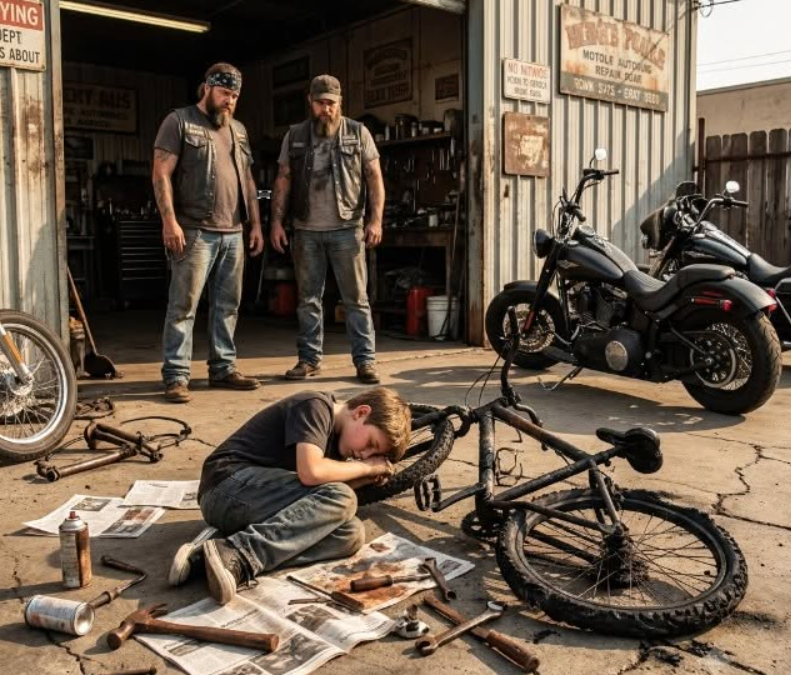
By the time I came out of the market, the milk cold against my side, my bicycle was folded nearly in half against the pole.
The front wheel had bent into an ugly oval.
Spokes fanned out like ribs.
The chain lay in a broken loop in the gutter.
Preston and Tucker were already a block away, laughing in the careless way boys laugh when they have never once had to imagine punishment landing on them.
I did not cry.
Not right away.
I set the milk on the curb and crouched over the bike.
I tried to straighten the wheel with my bare hands, as if eleven months of work could be destroyed in ninety seconds and then reversed by stubbornness.
It could not.
The roll-up door of the Iron Saints garage rattled open.
Gus stepped into the afternoon light.
Warren Kessler came out behind him, wiping his hands on a shop rag.
Warren was fifty-eight, wiry, sharp-eyed, and kept the club books more carefully than most accountants kept bank records.
The two of them walked over without hurrying.
They stood above the wreckage.
Silent.
That silence drew the whole block.
A woman watering her lawn paused with the hose still running.
A man walking his dog slowed his pace.
Diane Ashkam drove past on her way home from a board meeting, saw two large men in leather vests standing over a distraught child and a mangled bicycle, and pulled to the curb.
She did not see a grandfather and his friend coming to help.
She saw exactly what she had already decided she would see.
Her car engine stayed running.
Her hand stayed on the wheel.
I could almost feel the message she was already composing in her head.
“Who did this?” Gus asked.
It was not really a question the way he said it.
Low.
Even.
Controlled.
I knew the answer.
I had seen Preston Ashkam clearly.
But some instinct inside me told me that if I said his name, everything would become worse.
If the Iron Saints went to Preston’s house, the neighborhood would not see justice.
It would see bikers threatening children.
It would see Diane’s story confirmed before anyone listened to mine.
So I lied.
“I don’t know.”
Gus crouched slowly until he was eye level with me.
His knees cracked.
For a moment, the size of him seemed to fold smaller on purpose.
“Your bike,” he said.
Not a question.
I nodded.
He picked up the bent front wheel and turned it once in his hands, feeling the truth of the damage.
I had seen him do that with engines, brakes, chains, tools.
Now he was reading my wreckage like a letter.
Warren crouched on the other side of the frame and ran a finger along the snapped weld.
Neither of them spoke.
“It’s fine,” I said.
That was my second lie in under a minute.
Gus looked at me.
In that look, I realized he knew both lies.
By Wednesday morning, the story had traveled the length of Marmion Way twice over.
In one version, the Iron Saints had cornered a group of children on the sidewalk.
In another, Gus had threatened to burn down a house on Yosemite Drive.
Diane Ashkam posted in the Homeowners Alliance forum before the milk I bought had even made it into the refrigerator.
Her words were careful and reasonable-sounding, which made them more dangerous.
Concern for local children.
Known motorcycle gang.
Residential safety.
Escalating intimidation.
She did not mention that her own son’s bicycle had been seen near the scene.
She did not have to.
The narrative had already assembled itself around the shape everyone expected.
Inside the garage, Gus laid my ruined bike across two sawhorses like something in a hospital.
My mother had dropped me off after her shift because she was too tired to argue and too worried to leave me alone with the kind of silence that follows loss.
I sat on an overturned bucket near the back wall.
Close enough to hear.
Far enough to pretend the conversation was not about me.
Warren stood across from Gus with his arms folded.
“Kessler thinks we should find the kid,” Warren said.
The Iron Saints had a habit of speaking about their own opinions in the third person, even when nobody was fooled.
“Ask around,” Warren continued. “Somebody knows whose bike that was.”
“And then what?” Gus asked.
“We show up on some family’s porch in our cuts and ask their kid nicely to apologize. You know how that photograph looks before anyone even takes it.”
Warren sighed.
“So we do nothing?”
“We do the opposite of nothing,” Gus said. “We just don’t do what they’re waiting for us to do.”
He set down the wheel.
“That boy has been telling himself all week that nobody helps him because of who I am. I’m not handing the whole street proof that he was right to be ashamed of me.”
My throat tightened.
I had not known he understood that part.
Two days later, a patrol car idled outside the garage for nearly an hour.
Diane had filed a complaint claiming the Iron Saints had made threatening statements toward a minor.
A young officer named Dale Corbin came to the roll-up entrance with one hand near his belt.
He asked Gus questions in a flat, careful tone, half script and half suspicion.
Gus answered every question without raising his voice.
He did not step closer.
He did not fold his arms.
He did not move any faster than necessary.
Even at ten, I understood he was making himself small inside his own doorway so no one could turn his body into evidence.
When Officer Corbin left, he seemed unconvinced of wrongdoing but not fully convinced of innocence either.
That was how suspicion worked.
It did not need proof.
It only needed somewhere to sit.
Warren watched the patrol car pull away.
“They’re not going to let this go easy,” he said.
“No,” Gus replied. “But that’s her problem to carry, not mine to solve by giving her a better story.”
I had been quiet through most of it.
Finally, I said, “Maybe I shouldn’t come around here anymore.”
Gus turned.
“Maybe it’s making things worse for you. For Mom.”
Something old moved across his face.
Something I had glimpsed only once before when I caught him staring at the locked drawer beneath the workbench.
“You think I built this garage, this club, this whole life so a woman with a petition could scare my own grandson off my property?”
“I just don’t want it to be my fault.”
My voice cracked on fault.
That embarrassed me more than crying would have.
“Come here,” Gus said.
I went.
He did not hug me exactly.
He put one heavy hand on the back of my neck, steadying me the way he would steady something shaking before it fell.
“None of this is your fault. Not one piece of it. You hear me?”
I nodded.
His eyes moved toward the locked drawer again.
“There are things about me this street doesn’t know,” he said. “Things I don’t talk about because talking about them never fixed anything the way doing them did. But whatever they think they see when they look at me and Warren and the boys, it is not the whole picture.”
He straightened with a quiet wince.
Only then did I notice the way his lower back seemed to hurt him.
Children rarely question the aches carried by adults who seem unbreakable.
“It has never once been the whole picture,” he said.
Then, after a moment, he added, “Give it time. People believe what’s easiest until something makes it impossible to keep believing it.”
I did not understand.
Not fully.
But I held on to those words anyway.
The Highland Park Homeowners Alliance met on the third Thursday of every month at the old fieldhouse in Garvanza Park, a squat brick building from the 1920s that had survived two earthquakes and, judging by the stained ceiling tiles, was not confident about a third.
That October, a week of unusual rain had swollen the flat roof’s old drainage system past what it could handle.
Nobody on the board had thought to inspect the building before the meeting.
Their only agenda item was a motion to request formal zoning review of the Iron Saints clubhouse.
Gus had not planned to attend.
Warren convinced him.
“Show up quiet and reasonable,” Warren said. “It’ll do more damage to her story than a hundred police visits.”
So at 6:30 that evening, Gus Dawson walked into the Garvanza Park fieldhouse wearing a clean shirt instead of his cut.
He sat in the back row of folding chairs and said nothing while thirty neighbors debated his character as though he were not in the room.
I sat beside him.
My mother had not wanted me to come, but I insisted, and Paige Dawson was too tired to fight every battle twice.
Diane Ashkam stood at the podium, reading from prepared notes about safety, property values, and the character of the neighborhood.
Her son Preston sat in the front row.
Beside him was his little sister, Ivy.
She was six years old.
Dark braids.
Pink sneakers.
A coloring book on her lap.
She did not care about zoning.
She cared about keeping inside the lines.
It was 6:47 by the crooked clock over the old stage when the ceiling let go.
Not all at once.
First came a deep groan.
Most people thought it was thunder.
Then a section of ceiling tile near the front buckled and dropped a shower of wet debris.
Right above Ivy.
A half second later, a chunk of the original roof decking—the kind of old wood hidden above drop ceilings for decades—came down with it.
People screamed and scattered.
Diane’s first instinct was to run toward her daughter.
That was the right instinct.
And almost the wrong one.
Because a second section of the ceiling was already sagging above the exact spot she was running into.
“Stop!”
Gus’s voice cut through the room.
Not loud.
Absolute.
The kind of voice trained to be heard over a structure failing.
“Nobody moves under that section. Look up before you look at her.”
He was already moving.
Faster than a man his size and age had any right to move.
Warren was half a step behind him.
Ivy was pinned beneath a fallen joist and a tangle of collapsed lath.
She was conscious, crying, one arm trapped under debris.
Nobody in the room could tell whether the debris was crushing her or holding up the next section.
Gus could.
“Everybody out from under this roof now,” he said. “That’s not a request.”
Something in the crowd’s panic organized itself around his command.
People moved toward the exits.
Not gracefully.
Not calmly.
But they moved.
Gus crouched beside the debris.
For the first time in my life, I watched my grandfather’s hands move with a precision that had nothing to do with bicycles or carburetors.
He placed his palm against the sagging joist above Ivy and tested its give.
Like he had tested my bent wheel.
Like he was reading the building through his skin.
“Warren,” he said, “I need the far end braced before we touch anything close to her. That joist is load-bearing on a compromised connection. If we pull from her side first, the whole section comes down.”
Warren was already dragging a heavy folding table across the floor.
“Here,” Gus said.
Warren moved.
“Higher.”
Warren lifted.
“Hold.”
Together, they wedged the table beneath the sagging beam at the exact point where the weight shifted away from Ivy.
Diane stood three feet away, one hand over her mouth.
The woman who had spent two years describing my grandfather as a danger to the neighborhood was now watching him calculate the exact physics required to save her daughter’s life.
“Talk to me, sweetheart,” Gus said to Ivy.
His voice changed.
It dropped into something so gentle that the whole room seemed to hear it.
“I need you real still for me. Can you do that?”
Ivy cried, but she nodded.
“I’ve done this before,” Gus said. “I promise you, I’ve done this a hundred times before, and every single time, the kid was fine. You’re going to be fine too.”
It took four minutes.
Four minutes of Gus and Warren working with a coordination that came from decades of trust.
Four minutes of dust hanging in the air.
Four minutes of Diane Ashkam discovering that certainty can collapse as quickly as a roof.
When the joist was finally braced, Gus lifted the final piece of lath away and drew Ivy out from beneath the wreckage.
He checked her arm with two fingers pressed gently along the bone.
“Bruised,” he said. “Not broken.”
Then he looked at Diane.
“She’s going to be fine.”
The paramedics arrived nine minutes later and found the situation already controlled.
The injured child stabilized.
The collapse zone cleared.
Folding chairs arranged as an improvised barrier.
Warren standing guard beside them like he had been born for exactly that task.
One of the paramedics, an older man with a gray mustache, looked at Gus for a long moment.
Then his face changed.
“You’re Dawson,” he said. “Fire Captain Dawson. Engine 41.”
The room went quiet in a different way.
The man shook his head.
“You were before my time, but I heard the stories. Didn’t know you were still around.”
My mother arrived twenty minutes later, breathless after a neighbor called her.
She took one look at Gus.
Then Ivy.
Then Diane.
Then the wreckage.
And something in her face settled.
Maybe she had kept his secrets too long.
Maybe she was tired of letting silence protect people who had not earned protection.
So she said it plainly.
Gus Dawson had spent twenty-five years with the Los Angeles Fire Department’s Urban Search and Rescue Division before retiring.
Before that, he had trained as an Army combat engineer during the invasion of Panama in 1989.
He had spent a career reading the exact moment a structure decided to fail and finding the six inches of space where a person could still be pulled out alive.
My mother did not say it with pride.
Or apology.
She said it like a fact that should not have needed saying.
Diane sat on the fieldhouse steps outside with Ivy wrapped in a blanket from someone’s car.
Rainwater dripped from the roof behind them.
Ambulance lights washed red and blue across the wet asphalt.
When Gus came to check Ivy’s arm one more time, Diane looked up at him.
For the first time in two years, she did not see leather.
She did not see ink.
She did not see the wall of his shoulders.
She reached out with both hands and took his hand in hers.
She said nothing.
There was nothing she could say that would not sound too small.
Gus sat beside me on the fieldhouse steps afterward.
For a while, he watched the ambulance lights move across the puddles.
Then he said something I would carry for the rest of my life.
“You don’t get to decide what a man’s made of by what he’s wearing.”
He spoke quietly, mostly to me, though Diane was close enough to hear every word.
“You find out what he’s made of by what he does when everything is falling down around somebody who can’t save themselves. That’s the only test that ever meant a damn thing.”
He looked across the parking lot.
“Everything else is just guessing.”
By the following Thursday, the zoning petition was gone.
Diane withdrew it herself in a two-line email.
No explanation.
None was needed.
By then, half the neighborhood had already heard what happened on the fieldhouse floor.
Stories move faster than official notices when people are ashamed of being wrong.
What replaced the petition surprised everyone.
Diane personally invited Gus to speak to the Homeowners Alliance safety committee about emergency preparedness for older buildings on the block.
Gus accepted with the same flat calm he brought to everything else, as if public vindication were simply one more task on a list rather than a victory.
Preston came to the garage on a Saturday morning in early November.
Alone.
He walked from Yosemite Drive without telling his mother where he was going.
Later, I learned it had taken him almost an hour to work up the nerve to cross the street.
I was elbow-deep in a tune-up Gus was teaching me on Warren’s motorcycle when Warren called from the roll-up door.
“Somebody here.”
I straightened.
My stomach dropped when I saw Preston.
The boy who had destroyed my bike stood in the open mouth of the garage with his hands at his sides, smaller than he had looked from the curb that day.
“I came to say I’m sorry,” he said.
Not to Gus.
Not to the room.
To me.
“For the bike. I know sorry doesn’t fix it. But I wanted to say it to your face instead of having my mom say it for me.”
He held out an envelope thick with folded bills.
Money he had saved himself, though none of us knew that until Diane mentioned it later, sounding surprised by her own son.
Gus watched from across the garage with a rag in his hand.
Nobody spoke for a moment.
Apologies create a particular silence.
Nobody knows where to put their hands.
I thought I would be angry when I saw Preston again.
But the anger had drained out of me over the weeks, replaced by something like tired curiosity.
I wondered what had made him laugh that day.
I wondered what it felt like to destroy something and then have to stand in the doorway of the people you had blamed.
Gus set the rag down.
He crossed the garage.
“Money isn’t what’s owed here,” he said.
Preston’s face fell.
He had expected judgment.
Maybe even wanted it.
Judgment is easier than responsibility.
“What’s owed is work,” Gus said. “You want to make it right? You come back here Saturday mornings for a while and learn how a bicycle actually gets built. Then maybe next time you’ll understand what it costs before you think about touching one that isn’t yours.”
Preston swallowed.
Then nodded.
Gus looked past him toward the street, where Ivy stood at the end of the driveway wearing a light brace on her arm, uncertain whether she was allowed to come closer.
“Bring your sister too, if she wants,” Gus said. “We’re better teachers than you’d think.”
That winter, Saturday mornings became a ritual.
Preston learned to true a wheel the same careful way Gus had taught me.
He learned how to grease a chain, tighten brakes, patch tubes, and keep his mouth shut when somebody else was showing him something.
That last lesson took longest.
But he learned.
Ivy came too.
She colored at first, then sorted bolts by size, then asked better questions than both of us.
Preston and I did not become best friends.
That would be too clean.
Life is not clean.
But we became something.
Not enemies.
Not strangers.
Two boys standing over the same wheel, learning that repair takes longer than damage.
My bicycle was rebuilt by the whole garage.
Not by Gus alone.
Warren machined a replacement derailleur bracket with a precision I did not know bicycle parts could have.
Lonnie Ferris repainted the frame a deep, showy green I chose from a chip card at the hardware store on York Boulevard.
Another Iron Saint found better brake cables.
Someone else replaced the grips.
Gus made me do as much of the work as my hands could manage.
“It’s still yours,” he said. “That means you build it too.”
When it was finished, it was better than the bike Preston had destroyed.
Not because it cost more.
Because more hands and more care had gone into it.
I rode it on my route the following Monday.
Same 4:45 alarm.
Same dark blue sky over Marmion Way.
Same papers folded in my bag.
But something inside me had shifted.
My mother noticed it in how I held my shoulders a little straighter when I passed the Iron Saints garage.
She noticed I no longer flinched when classmates said biker like an insult.
Once, at the bus stop, Cody Price said the Iron Saints were probably criminals.
I looked at him and said, “Gus was a fire captain for twenty-five years.”
Cody blinked.
Nobody had given him a sentence for that.
That is how ignorance loses power sometimes.
Not with a speech.
With one fact it cannot swallow.
Gus never spoke much about Engine 41 after that night.
He never told long stories about the buildings he entered when everyone else was being pulled out.
He never bragged about commendations.
He never introduced himself as anything other than Gus.
Eventually, I learned what was in the locked drawer beneath the workbench.
Old commendations.
A few newspaper clippings.
A photograph of Gus younger and leaner in LAFD gear.
A medal from a rescue after an earthquake.
A folded Army certificate.
Proofs of a life the neighborhood had never bothered to imagine.
He kept them there quietly because men who have done that kind of work rarely want to be introduced by it.
On the surface, he went back to being what the street had always assumed he was.
A big man in a leather vest who fixed motorcycles on Figueroa Street and said little.
But underneath, for anyone who cared to keep watching, the truth of him was plainly visible.
That became the whole lesson to me.
The men everyone had crossed the street to avoid had simply been waiting, without complaint, for someone to bother looking twice.
On the second Saturday of December, after Preston and Ivy had gone home with Diane, Warren stayed behind in the garage.
He said he wanted to check my rebuilt bicycle one last time before I rode it home.
He noticed the handlebars were missing something.
A small thing.
A detail only a mechanic would think to fix.
Without mentioning it to anyone, without asking for thanks, Warren pulled a brass bell from a drawer of spare parts he had collected for years.
He mounted it carefully to the left grip.
He tested the ring twice with his thumb until the pitch satisfied him.
Then he turned off the garage lights and went home.
The next morning, 4:45 as always, I found it.
A small brass bell on the green handlebars.
I pressed it once.
The sound was bright in the dark.
Clear.
Almost proud.
I stood there beside the porch for a long moment with my paper bag over my shoulder and my breath showing in the cold air.
Then I rode.
The bell rang once when I hit the first crack in the sidewalk.
Gus was outside the garage when I passed.
Coffee in hand.
He looked at the bell.
Then at me.
“Route good?” he asked.
I smiled.
“Route’s good.”
He nodded.
That was all.
But this time, I understood the silence.
Some men say the most important things without decorating them.
Years have passed since then.
I am not ten anymore.
The Iron Saints garage is still there on Figueroa Street.
The sign has been repainted twice.
Gus moves slower now.
Warren complains more, which everyone says is impossible because he already complained professionally.
Ivy Ashkam is in college studying architecture, which nobody finds as surprising as they should.
Preston works with his hands now.
He says it helps him think before he breaks things.
My mother still works too hard.
Some things do not change easily.
But she and Gus talk more now.
Not about my father much.
Not about the old hurt directly.
Their peace is practical.
He fixes things around her duplex without announcing it.
She brings him food and tells him his blood pressure is probably terrible.
He tells her nurses are bossier than fire captains.
She says someone has to be.
That is family, sometimes.
Not grand forgiveness.
Not speeches.
Just people slowly returning tools they should never have dropped.
As for me, I kept that bicycle long after I outgrew it.
The green paint chipped.
The tires went flat.
The brass bell dulled.
But I could never throw it away.
Because that bike taught me what effort costs.
Its destruction taught me what prejudice looks like when it thinks it has permission.
Its rebuilding taught me that repair is not the same thing as replacement.
And my grandfather taught me the rest.
You do not get to decide what a man is made of by what he wears.
Leather tells you nothing.
Ink tells you nothing.
A patch tells you nothing.
A clean shirt tells you nothing either.
People can dress fear in polite language.
They can call gossip concern.
Cruelty boredom.
Control safety.
Prejudice neighborhood standards.
But when things fall down around somebody who cannot save themselves, the truth steps forward.
That night in the fieldhouse, Diane Ashkam learned who Gus Dawson was.
But I think I learned something harder.
I learned who the rest of us could become when we stop looking closely.
A crowd can be wrong.
A petition can be wrong.
A mother can be scared and wrong.
A child can be poor and proud.
A rich boy can be sorry and still owe work.
A biker can know more about saving lives than every respectable person in the room.
And a broken bicycle can become the thing that forces an entire street to look again.
People ask me sometimes whether I forgave Preston.
I tell them forgiveness is not a switch.
It is more like rebuilding a wheel.
You tighten one spoke.
Then another.
Then another.
You test it.
It wobbles.
You adjust.
You keep working until the thing can carry weight again.
Preston did the work.
So did I.
So did Diane, in her own way.
So did my mother.
So did Gus, though I think he had been doing it quietly all along.
That is the part I carry most.
The quiet work.
The unseen work.
The work nobody praises because nobody noticed it was happening.
Gus had spent twelve years on that block being feared by people who never asked what he had survived, what he had built, whom he had saved, or why he could read a failing structure like scripture.
He never shouted his résumé over the fence.
He never waved medals at city hall.
He never demanded the neighborhood see him correctly.
He just kept opening the garage.
Kept fixing what came through the door.
Kept teaching a ten-year-old boy how to listen for the catch in the rhythm.
Kept choosing not to become the story people were waiting to tell about him.
That was strength.
Not the size of his shoulders.
Not the leather.
Not the ink.
That.
Now, whenever I hear a bicycle bell, I think of that cold morning.
The green frame.
The newspapers in my bag.
The street still dark.
The garage lights off.
The brass bell Warren mounted without asking for thanks.
I think of how small the sound was.
And how much it meant.
A bright little ring in the dark, saying something had been broken, yes.
But not ended.
Something had been destroyed.
But not wasted.
Something had been judged too quickly.
But finally seen.
So when people ask what my grandfather taught me, I never start with the ceiling collapse.
I start with the bike.
I tell them I built something from nothing.
I tell them someone destroyed it because they thought nothing would happen.
I tell them the whole street expected my grandfather to answer with violence.
Instead, he answered with patience.
With work.
With rescue.
With truth.
And in the end, the people who had feared him were forced to understand what I had known since the first morning he asked about my route.
Gus Dawson was never the danger on our street.








