Returned to the Shelter 7 Times, an Unwanted Old Cat With One Blind Eye Spent 15 Years Comforting 340 Frightened Kittens on Their Worst Night
PART3:
A cat whose body had learned not to expect anything from cameras.
The caption said:
NONA — 4-year-old female. Quiet and affectionate once comfortable. Would prefer a calm home.
That was optimistic.
But not dishonest.
A family adopted her in March.
Mother.
Father.
Two children.
The little girl liked Nona because she was quiet.
The little boy stood several feet away.
“What happened to her eye?”
The mother said quickly, “Don’t stare.”
Nona sat on the meet-and-greet room floor, tail wrapped around her feet.
The girl knelt down.
Nona sniffed her fingers.
Then touched her cheek to the child’s hand.
I remember thinking, This could work.
Eleven days later, they brought her back.
The father carried the same shelter carrier.
Nona was inside.
She looked exactly as she had when she left.
That somehow made it worse.
“We tried,” he said.
I hated those words before I even knew why.
“What happened?”
“The kids are scared.”
“The kids?”
He looked uncomfortable.
“Her eye.”
I stared at him.
“The cloudy one?”
He nodded.
“My son says she looks at him weird at night.”
“She barely sees from that eye.”
“I know.”
He lowered his voice.
“My wife thinks maybe we weren’t ready.”
I wanted to say, She was ready.
Instead, I opened the paperwork.
Reason for return:
Children afraid of appearance.
Nona walked back into Intake Kennel 6 without protest.
Not once did she turn around.
The second family came two months later.
An older couple.
No children.
Quiet house.
Exactly the kind of home we thought she needed.
They kept her three weeks.
When they returned her, the woman cried.
That made it almost harder.
“She’s sweet,” she said. “She really is.”
“What happened?”
The woman looked at Nona’s shoulder.
“My sister visited.”
I waited.
“She asked about the lump.”
“The tumor.”
“She said it made her uncomfortable.”
I thought I had misheard.
“Your sister?”
“She comes often.”
Nona sat inside the carrier.
The woman would not look at me.
“My husband and I just feel like… we don’t want every guest asking about it.”
My hand tightened around the pen.
Reason for return:
Visible mass makes visitors uncomfortable.
The third family kept her eight days.
Their return form simply said:
Not what we expected.
I asked what that meant.
They could not explain.
Too quiet.
Then too reserved.
Then “just not bonding.”
Nona had been in their home for eight days.
Eight.
Some people expect animals to enter a strange house, lose every memory of abandonment, and become grateful by breakfast.
We took her back.
Then a young woman adopted her.
Returned her because Nona hid when friends came over.
Another family returned her because the veterinary estimate for the tumor frightened them.
Another said their existing cat “didn’t like her,” although they had introduced them face-to-face on the first night.
By the sixth return, Nona had begun doing something new.
Every time someone placed her carrier on the front counter, she stopped looking out through the door.
She would turn around inside the carrier and face the back wall.
I noticed it first.
I told myself it did not mean anything.
Cats do not understand adoption like people do.
They do not know paperwork.
They do not count.
They do not tell themselves, This is the sixth time somebody has decided against me.
That is what I told myself.
Then came the seventh adoption.
Her name was Rebecca.
Thirty-two.
Elementary school teacher.
Lived alone.
No other pets.
She sat with Nona for nearly an hour.
Did not care about the eye.
Did not care about the ear.
Asked good questions about the tumor.
Dr. Avery spoke with her personally.
“We can’t promise what it will do,” he said.
Rebecca nodded.
“I understand.”
“Could become a larger medical expense.”
“I understand.”
Nona approached Rebecca on her own.
Slowly.
One step.
Then another.
She sniffed Rebecca’s shoe.
Rebecca did not reach.
Nona walked around her once, then sat beside her leg.
I remember looking at one of our other volunteers and whispering, “This is it.”
We wanted it too badly.
That was our mistake.
Nona left that afternoon with a blue blanket, two cans of wet food, and a new collar Rebecca bought from the display near the desk.
Six weeks later, I was unlocking the shelter at 7:15 in the morning when I saw Rebecca’s car in the parking lot.
My stomach dropped before she even got out.
Nona was in the passenger seat.
Rebecca stood beside the car crying.
“What happened?”
“I can’t do it.”
“Do what?”
“She won’t sleep on the bed.”
I thought she was joking.
She was not.
“She sleeps under the dresser,” Rebecca said. “Or in the hallway. Sometimes she sits in the doorway and watches me.”
“She’s adjusting.”
“It’s been six weeks.”
“For a cat returned six times before you?”
Rebecca flinched.
I regretted it immediately.
Not because it was untrue.
Because Nona deserved better than having her history used like a weapon in a parking lot.
Rebecca looked through the windshield.
“I thought I could handle all of it. I thought I’d be the person who didn’t care what she looked like.”
There it was.
“But?”
“I keep waiting for her to love me.”
I stared at her.
Rebecca wiped her face.
“And I feel terrible saying that.”
Nona was inside the car, sitting on the seat.
Facing away from us.
Rebecca whispered, “I think she’d be happier here.”
No.
She would not.
Shelters are not homes simply because the people working there care.
We did not have sofas.
We had disinfectant.
Metal.
Noise.
Schedules.
Rotating hands.
Love in shifts.
But I could not force Rebecca to keep her.
So we took Nona back.
Seventh return.
Reason:
Owner feels cat has not bonded.
That afternoon, our shelter director, Helen Brooks, stood in front of Nona’s kennel for a long time.
Helen had been running that building since before I volunteered there. She was the kind of woman who could administer vaccines, repair a broken drain, argue with county officials, and bottle-feed a kitten while doing all three.
“She’s done,” Helen said.
I looked at her.
“With adoption?”
“For now.”
I knew what that meant.
Long-term housing.
Back corridor.
Kennel 14B.
We hated the phrase long-term kennel.
It sounded like storage.
Technically, those cages were larger than standard cat kennels. Clean. Quiet. Raised shelves. Bedding. Toys. Regular enrichment. Volunteers spent time with long-stay cats.
But they were still cages.
14B sat in the rear hallway between 14A and 15A, beneath a narrow window too high for a cat to see through.
That became Nona’s home.
I told myself it was temporary.
We all did.
Temporary is one of the kindest lies shelter workers tell themselves.
For the next year, Nona existed mostly outside public view.
She was not hidden.
People could ask to meet her.
But she no longer appeared on the main website rotation. She was older now. Her tumor was visible. Her eye worse. The kittens in the front adoption room were younger, brighter, easier.
Families came in saying things like, “We’re open to any cat.”
Then chose the six-month-old orange tabby.
Or the fluffy black kitten.
Or the affectionate young calico reaching through the bars.
Nona did not reach.
She sat.
She watched.
Sometimes she slept.
I visited her during evening shifts.
At first, she tolerated me.
Later, she trusted me enough to lean into my hand for three strokes.
Never four.
Four was presumptuous.
“Your rules,” I would tell her.
Her good eye narrowed.
She seemed to agree.
The mass over her shoulder grew slowly.
Walnut.
Then slightly larger.
Dr. Avery checked it every three months.
Still low grade.
Still slow.
Still not painful.
We discussed surgery repeatedly.
Every time, the same brutal arithmetic appeared.
One major surgery for Nona meant fewer resources for emergency spays, infections, fractures, respiratory cases, abandoned litters.
People who have never worked animal rescue sometimes imagine love removes choices.
It does not.
Sometimes love is choosing while hating every option.
Then came the night everything changed.
It was late summer, during Nona’s second year in the long-term corridor.
I was working overnight because two litters had come in with respiratory infections and our regular night volunteer had a sick child.
At 9:40 p.m., a deputy brought us a cardboard box.
Three kittens.
Found behind a gas station.
Maybe three weeks old.
No mother.
Dehydrated.
Dirty.
Terrified.
The box screamed before he placed it on the counter.
That is the only way I can describe it.
Three voices, high and relentless.
The deputy looked traumatized.
“They’ve been doing that for forty minutes.”
“Welcome to neonates.”
“Can I go?”
“Coward.”
He left laughing.
We examined the kittens.
Two tabbies.
One black.
All underweight.
No major injuries.
We fed them, warmed them, and placed them together in a kennel two doors down from Nona.
Then they cried.
And cried.
And cried.
For more than an hour.
Nothing worked.
Warm towels.
Food.
Dim lights.
A stuffed toy.
My voice.
They wanted something we could not reproduce.
A mother.
At around 11:15, I walked past 14B and saw Nona pressed against the side wall of her kennel.
Not sitting near it.
Pressed.
Her cheek against the bars nearest the kittens.
Body flattened along that side.
Good eye open.
Watching the direction of the cries.
“Nona?”
She did not look at me.
One kitten screamed.
Nona pushed her face harder against the metal.
I stopped.
The crying continued.
Nona remained there for twenty minutes.
Thirty.
Finally, I did something that probably violated three protocols and at least one section of Helen’s shelter manual.
I opened 14B.
Nona stepped out immediately.
That was unusual.
Normally she waited.
I opened the kitten kennel.
Nona walked in.
The kittens went silent for approximately half a second.
Then all three rushed her.
I almost removed her.
Nona was spayed.
We had no record of her ever nursing.
She was not lactating.
She had never shown maternal behavior with adult cats.
I worried she might become overwhelmed.
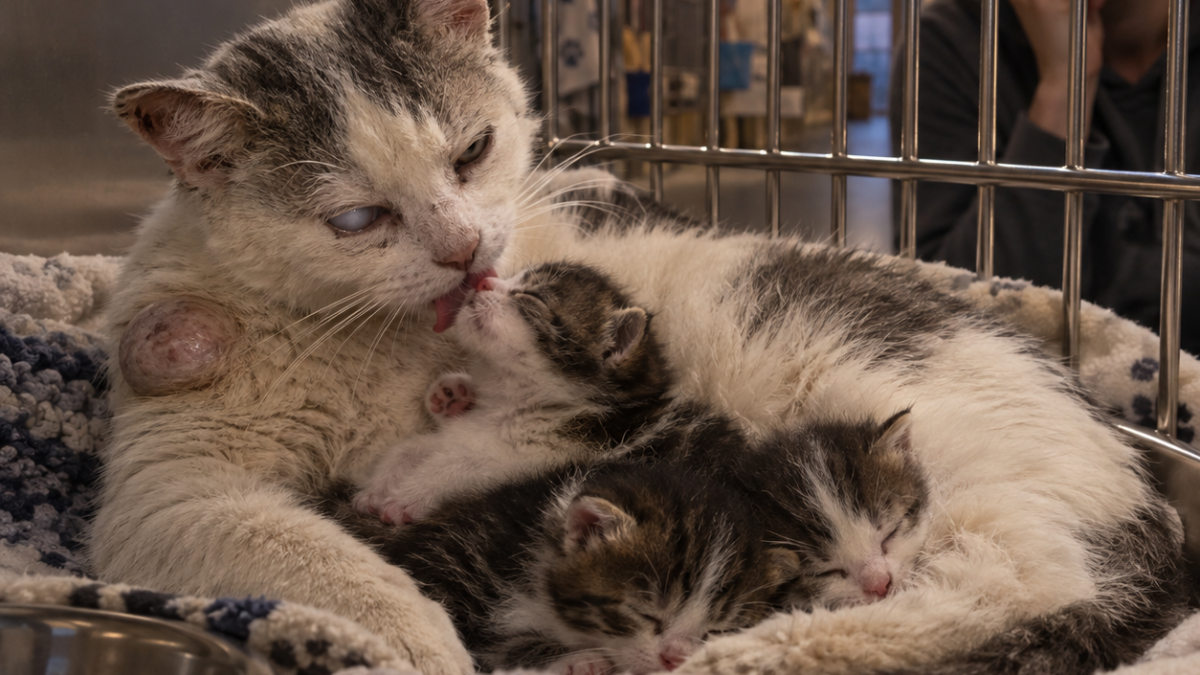
Instead, she lay down.
One kitten climbed over her front leg.
Another shoved its face against her belly and became offended by the lack of milk.
The black one continued crying directly into her ear.
Nona began grooming him.
Slowly.
One deliberate lick across his forehead.
Then another.
Then his ear.
Then his cheek.
The kitten stopped screaming.
Nona moved to the first tabby.
Face.
Ear.
Head.
The second tabby.
Face.
Ear.
Head.
Fifteen minutes later, all three were asleep against her belly.
I stood outside the cage with tears running down my face.
No dramatic reason.
No tragedy had occurred.
Quite the opposite.
It was simply the first time I had seen Nona look necessary.
That word matters.
Necessary.
For two years, people had evaluated her according to what was wrong.
The eye.
The ear.
The tumor.
The reserve.
The age.
In that kennel, none of those things mattered.
Three frightened kittens needed warmth, rhythm, a body, grooming, presence.
Nona had all of those.
She stayed with them until morning.
When Helen arrived, I expected trouble.
Instead, she stood in front of the kennel.
One tabby was sleeping half on Nona’s neck.
The black kitten had wedged himself beneath her front leg.
Nona was awake.
Watching the hallway.
“What happened?” Helen asked.
“I made a decision.”
“I can see that.”
“I’ll take responsibility.”
Helen stared at Nona.
Then at the kittens.
“You’re an idiot.”
“I know.”
She walked away.
Five minutes later, she returned with a clean blanket and placed it inside.
That was approval.
The kittens stayed with Nona for nine days.
Not constantly.
We removed them for feeding, weighing, examinations, and cleaning.
But every night, they returned.
Nona groomed them.
Slept beside them.
Let them climb over her.
And when they were old enough, healthy enough, and irritating enough to prove survival, they went to foster care.
Then adoption.
All three found homes within weeks.
The morning the last one left, I carried him down the back corridor before opening.
He was a tabby called Milo by then.
Big enough to complain with confidence.
I stopped at 14B.
Nona stood.
Milo reached one paw through his carrier door.
Nona sniffed it.
Then he left.
Nona watched him disappear down the hall.
I remember wondering if she understood.
I think about that question even now.
The next frightened kitten arrived six days later.
Nona heard him before I did.
She stood against the side of her cage.
Waiting.
That became the pattern.
A new kitten would arrive.
Abandoned.
Found under a porch.
Pulled from an engine compartment.
Dropped in a box.
Separated from a feral mother.
Rescued from a barn after the rest of the litter disappeared.
The first night was always the worst.
They screamed.
Shook.
Hid.
Bit gloves.
Refused food.
Climbed the cage walls.
Nona would rise.
Walk to the side of 14B.
Press her body against the bars.
Sometimes scratch once at the door.
Let me in.
We did.
And every time, she did exactly what she had done with the first litter.
Groom.
Lie down.
Wait.
No forcing.
No correction.
No magical transformation.
Just presence.
Some kittens immediately crawled against her.
Others hissed.
One orange kitten attacked her nose so aggressively I nearly removed him.
Nona blinked.
Then groomed the top of his head while he continued threatening her.
Five minutes later, he was asleep under her chin.
We started calling it Nona Night.
At first as a joke.
“Who’s on Nona Night?”
“Three tabbies.”
“Two bottle babies.”
“One spicy black kitten from the feed store.”
Then it became routine.
Every new kitten spent the first forty-eight hours with Nona when medically appropriate.
We were careful.
Sick kittens with contagious conditions stayed isolated.
Nona received regular veterinary exams.
We never endangered her or them.
But whenever it was safe, Nona worked the first shift nobody else could.
She taught them the shelter was not empty.
That was how Dr. Avery explained it years later.
“Medicine can warm a kitten,” he told a reporter once. “We can hydrate them, feed them, treat parasites, vaccinate them. But there’s something Nona does we can’t put in a syringe.”
“What?”
He looked toward 14B.
“She teaches them that confinement doesn’t necessarily mean abandonment.”
I wrote that sentence down.
I still have it.
The staff kept informal records.
Not intentionally at first.
Someone wrote on a whiteboard:
3 tabbies — Nona.
Then another note appeared.
Black kitten, eyes barely open — Nona overnight.
Then:
2 torties from Highway 9 — Nona.
Eventually, we started a notebook at reception.
Blue cover.
Cheap spiral binding.
We called it Nona’s Babies.
No official medical purpose.
Just memory.
Every page held small entries.
Sometimes dates.
Sometimes names.
Sometimes only descriptions.
Gray male from barn.
4 kittens, abandoned crate.
Tiny calico, bitey.
Orange female, cried 3 hrs.
Bottle baby “Beans.”
And beside each:
Nona.
Years passed.
Kittens came.
Kittens left.
Nona stayed.
That was the part I could never stop thinking about.
She watched them disappear into carriers with families smiling beside them.
I saw it hundreds of times.
A couple would arrive to adopt a kitten that had spent its first shelter night pressed against Nona.
They would fill out forms.
Buy a carrier.
Choose a collar.
Take photographs.
Then we would bring the kitten down the hallway.
Sometimes I stopped at 14B.
Not always.
It felt unfair somehow.
But when I did, Nona usually approached.
The kitten would sniff through the carrier bars.
Nona would touch noses.
Then the family walked away.
And Nona remained behind metal.
Once, after a kitten named Lucy left with a young couple, one of our teenage volunteers asked me, “Doesn’t that make you sad?”
“What?”
“That Nona never goes.”
I looked through the kennel door.
Nona was washing one paw.
“Yes.”
“Do you think it makes her sad?”
I almost gave the responsible answer.
We cannot assign human emotions to animals.
Instead, I said, “I don’t know.”
The girl nodded.
Then Nona looked toward the empty hallway where Lucy had disappeared.
The volunteer whispered, “I think she knows.”
I think so too.
By 2016, Nona had comforted more than a hundred kittens.
By 2018, more than two hundred.
Her tumor had grown to the size of a small lemon by then.
It looked dramatic.
That became another reason people never reconsidered her for adoption.
Visitors would occasionally pass through the long-term corridor and see her.
“What’s that on her shoulder?”
“A slow-growing tumor.”
“Is she sick?”
“Not the way you mean.”
“Does it hurt?”
“No.”
“Can’t you remove it?”
Sometimes I wanted to scream.
Not because the questions were unfair.
Because all anyone saw was what had been wrong with her for years.
They never asked why the tiny kitten beside her was sleeping so peacefully.
One afternoon a family came through looking for an adult cat.
Their daughter, maybe ten, stopped at Nona’s cage.
“Can I meet her?”
My heart jumped despite everything.
Helen crouched beside the girl.
“Sure.”
The mother looked worried.
“She has a growth.”
The girl shrugged.
“So?”
Children are sometimes better at the obvious.
We took Nona into the visiting room.
The girl sat on the floor.
Nona approached her after several minutes.
The child did not grab.
Did not squeal.
Just waited.
Nona sat beside her.
For one impossible moment, I thought perhaps the eighth time would be different.
Then the father came in.
He looked at Nona’s shoulder.
His expression changed.
“She’s pretty old, right?”
“She’s thirteen.”
“And the tumor?”
“Stable.”
He shook his head.
“We want something the kids can have for years.”
The girl protested.
Her mother promised they could look at kittens.
They adopted a six-month-old cat that afternoon.
I stood beside 14B afterward.
“I’m sorry,” I told Nona.
She looked at me with one eye.
Then a kitten cried from isolation intake.
Nona stood.
Walked to the side wall.
Waited.
That was her answer to almost everything.
Somebody else needed her.
In 2020, the vision in Nona’s left eye disappeared completely.
The eye had been cloudy for years, but now there was no useful sight at all. Her right eye remained functional, though age had begun softening that one too.
Her torn ear sagged lower.
She developed arthritis.
We added a lower step to her resting shelf.
We thickened her bedding.
We placed food and water closer so she would not have to move as much.
We talked about retirement.
That word sounded absurd.
Retirement from what?
Mothering kittens that were not hers?
Standing watch over a hallway no adopter ever chose her from?
Still, we wondered if Nona should stop taking overnight kittens.
The answer came the next time a litter arrived.
Four babies.
Maybe five weeks old.
Found in a farm equipment shed after their mother disappeared.
They screamed as soon as we closed the kennel.
Nona had been asleep.
She lifted her head.
Slowly.
Got to her feet.
Her back legs shook.
She crossed 14B.
Pressed herself against the bars.
Helen looked at me.
“Apparently retirement has been rejected.”
We laughed.
Then cried.
Nona stayed with those kittens until morning.
By then, new volunteers were trained with her story.
We would walk them down the rear corridor and say, “That’s Nona.”
Sometimes they reacted to her appearance.
We learned to wait.
Then a kitten would crawl out from beneath her blanket.
Their face would change.
“Oh.”
Yes.
Oh.
That was the entire story in one sound.
The old cat nobody wanted.
The baby everyone would.
The body people had judged.
The body making another creature feel safe.
We estimated Nona crossed 300 kittens sometime in late 2022.
There was no celebration.
No cake.
No social media campaign.
Honestly, we did not know the exact day.
The notebook had missing entries. Years of staff turnover. Notes written on scraps and never transferred. Litters counted together instead of individually.
When we finally totaled what we could confirm and estimate conservatively, the number was around 340.
Three hundred forty kittens.
I sat at the reception desk one night with the notebook open.
Page after page.
Names.
Descriptions.
Tiny lives.
Most adopted.
Some still sending us holiday photos.
A few had grown old enough to die while Nona was still living in 14B.
That realization hurt in a way I cannot explain.
Cats she had comforted as newborns had lived entire family lives.
Sofas.
Windows.
Beds.
Christmas trees.
Children growing up.
Sunlight across living room floors.
Some had died in homes with names spoken by people who loved them.
Nona was still behind the same door.
I hated the world for that sometimes.
Then I would watch her with a new kitten and wonder whether Nona hated anything at all.
In January 2024, she stopped eating.
I knew before the lab results.
When you have cared for an animal that long, you learn the difference between tired and leaving.
Nona was nineteen.
Her kidneys were failing.
Dr. Avery had retired by then. Dr. Lena Park had taken over most shelter care. She examined Nona gently, listening to her heart, checking hydration, reviewing the bloodwork twice even though we all knew.
Helen had retired too.
I had become the shelter’s volunteer coordinator, though in my mind I was still the woman breaking rules on overnight shifts.
Dr. Park pulled me aside.
“She’s not in acute pain.”
I nodded.
“But?”
“Her body is shutting down.”
“How long?”
She hesitated.
“Days. Maybe a week.”
I looked through the exam-room window.
Nona sat on a towel.
Her tumor was large.
Her fur thinner.
Her torn ear folded.
Both eyes cloudy now.
Nineteen years.
Fifteen with us.
Twelve-plus in 14B.
“Should we euthanize?”
The question nearly killed me.
Dr. Park did not answer quickly.
“She’s comfortable right now. Eating very little. Sleeping more. If that changes, yes.”
I nodded.
“We won’t let her suffer.”
“I know.”
I went into the room.
Nona lifted her head.
I sat beside her on the floor.
For years, she had allowed three strokes.
Now she let me rest my hand on her side.
“I’m sorry,” I whispered.
For what?
All of it.
The first family.
The seventh.
The surgery we never managed.
The window she never had.
The sofas she never slept on.
The fact that kindness from staff is not the same as having one person choose you forever.
I said, “You should have had a home.”
Nona closed her eyes.
I cried until my face hurt.
Then, from intake, a kitten started screaming.
Nona’s eye opened.
I laughed through tears.
“Of course.”
The kitten had arrived that afternoon.
Five weeks old.
Gray tabby.
Found alone beneath a bridge.
Cold.
Hungry.
No mother.
He had been medically cleared, but every time we left him alone, he cried.
At 8:30 that night, one of the volunteers carried him down the rear corridor.
We had not planned a Nona Night.
Nona was dying.
Nobody wanted to ask anything else of her.
But the moment the kitten cried near 14B, Nona lifted her head.
Then she tried to stand.
Her legs failed the first time.
I reached forward.
She tried again.
This time she made it.
She walked two slow steps toward the cage door.
The volunteer looked at me.
“No,” I said.
Then Nona scratched once at the door.
Weak.
Barely audible.
The same request she had made for years.
Let me in.
I opened 14B.
The volunteer set the kitten inside.
He stood uncertainly.
Nona lowered herself onto the blanket.
The kitten approached.
He sniffed her face.
Nona raised her head.
One lick.
Across his forehead.
A second.
Over his ear.
A third.
Across his cheek.
Then she stopped.
Her head lowered.
She rested her chin on her front paws.
The kitten crawled against her side.
He stopped crying.
Nona closed her eye.
I sat outside 14B all night.
So did two other volunteers.
Nobody talked much.
The kitten slept pressed against her belly.
Sometimes he woke, shifted, then buried his face in her fur again.
Nona did not groom him anymore.
She did not have the strength.
But she stayed.
At 3:17 a.m., I reached through the bars and touched her paw.
She did not move.
Still breathing.
At 5:02, same.
At 6:10, the gray kitten woke and stepped across her front legs.
Nona opened her eye once.
Looked toward him.
Then toward the hallway.
I do not know what she saw.
Maybe almost nothing.
Maybe light.
Movement.
Shapes.
Maybe she saw every kitten who had ever screamed in that corridor.
Maybe that is a foolish human thought.
I no longer care.
At 6:43, her breathing changed.
I called Dr. Park.
She arrived twelve minutes later.
Nona was still alive.
Barely.
The kitten had been moved to a warm carrier beside the cage.
He cried once.
Nona’s ear twitched.
Dr. Park knelt.
“She’s going.”
I opened the cage.
For the first time in more than a decade, I climbed halfway into 14B.
It was awkward.
Undignified.
My back hurt.
I did not care.
I placed one hand behind Nona’s shoulders.
Another volunteer, Jess, touched her paw.
Dr. Park listened to her chest.
Nona took one breath.
Then another.
Then stopped.
No drama.
No cry.
No final movement.
Just stillness.
The same stillness she had practiced all those years ago when people were deciding whether she was worth taking home.
Except this time nobody was deciding.
We already knew.
Nona died in cage 14B.
The same cage that had held more than twelve years of her life.
She was nineteen.
She had never slept on a family sofa after coming to us.
Never stretched across somebody’s bed at midnight and been complained about affectionately.
Never sat in a sunny window that belonged to her.
Never had one permanent human say, This one. I choose this one, for good.
That truth remains painful.
I will not make it prettier just because her story became meaningful.
Nona deserved a home.
She did not get one.
Both things can be true:
Her life mattered enormously.
And she deserved more.
After she died, we removed the gray kitten.
He cried in his carrier.
I took him to the staff room and held him against my sweater until he slept.
We named him Jonah.
Not for any profound reason.
One volunteer said he looked like a Jonah.
Three weeks later, a retired woman named Margaret adopted him.
She had recently lost her husband.
She wanted a cat who would sleep near her.
When she came to meet Jonah, he climbed into her lap within six minutes.
I watched from the doorway.
She stroked his gray back.
“He’s so trusting,” she said.
My throat closed.
“Yes.”
“He must have had a good foster.”
I looked down the hallway toward 14B.
“The best.”
After Nona’s death, the shelter closed cage 14B permanently.
The county hated that.
We did not have spare space.
Every cage mattered.
But for once, practicality lost.
Helen came out of retirement for the small memorial.
Dr. Avery came too.
Rebecca—the seventh adopter—heard about Nona somehow and sent a letter. I did not open it for weeks. When I finally did, she wrote:
I have thought about her for years. I was too impatient. I wanted her love to make me feel good about myself, and when she could not give it fast enough, I returned her. I am sorry. Please place this donation toward whatever animal has waited the longest.
Inside was a check for five thousand dollars.
I cried at my kitchen table.
We used part of it to build a windowed long-stay cat room.
Not cages.
A real room.
Shelves.
Beds.
Hiding spaces.
Sunlight.
We named it Nona’s Room.
But 14B remained empty.
We cleaned it.
Removed the food dishes.
Folded the last blanket.
Then attached a small card to the door.
NONA
2005–2024
She stayed so they wouldn’t feel alone.
Below it, smaller:
340 kittens spent their first shelter nights beside her.
For months, visitors stopped there.
People asked the obvious question.
“Why was she never adopted?”
There was no good answer.
Appearance.
Age.
Fear.
Timing.
Human preference.
Seven failed attempts.
A tumor.
A cloudy eye.
A torn ear.
A cat who stopped performing affection for strangers after too many strangers changed their minds.
Maybe all of it.
One local reporter asked me whether I thought Nona understood she never went home.
I hated the question because I had asked myself the same thing for years.
Did she know?
Did she watch each carrier disappear and understand that kittens left while she remained?
Did she remember every return?
Did she stop expecting because expectation hurt?
I answered the only way I could.
“I think she knew every time somebody left.”
The reporter waited.
“And I think the next night, when another kitten cried, she got up anyway.”
My voice broke.
“That’s the part I can’t forget.”
He asked if I believed her behavior was instinct.
Maybe some of it was.
Animals are animals.
Humans are terrible at knowing where instinct ends and individual choice begins.
But I had watched Nona for fifteen years.
I had watched her ignore adult cats who did not need her.
I had watched her remain asleep through normal shelter noise.
Then a frightened kitten would cry.
Nona would stand.
Even old.
Even arthritic.
Even half blind.
Even dying.
She would stand.
So I told him, “Call it whatever you want. Instinct. Maternal behavior. Conditioning. Empathy. But she chose to respond every time.”
I paused.
“She made her life useful to creatures having the worst night of theirs.”
The reporter lowered his pen.
I said, “Three hundred forty kittens went home after being comforted by a cat nobody wanted. I don’t know what word is big enough for that.”
For months after Nona died, I heard phantom crying at night.
Not kittens.
Her.
Except Nona had almost never cried.
That was the strange part.
What I really heard was absence.
I would walk past the rear corridor and expect to see her body pressed against the bars.
Nothing.
A litter would arrive.
Someone would say, “Nona Night,” then stop halfway through.
We had to relearn how to comfort kittens without her.
Heating pads.
Heartbeat toys.
Foster placement.
Extra staff.
All useful.
None exactly the same.
Some kittens cried longer.
That hurt more than it should have.
One night, six months after Nona died, we received two feral kittens from a drainage culvert.
They were tiny demons.
Spitting.
Hissing.
Launching themselves at gloves.
One volunteer got scratched through a towel.
At midnight, I found myself carrying their crate toward 14B without thinking.
I stopped in front of the empty cage.
The kittens screamed inside the carrier.
I stood there, holding them.
Then I opened 14B.
Empty.
Still clean.
Card on the door.
I sat on the floor.
For nearly an hour, I talked to those kittens.
I told them about Nona.
Ridiculous, I know.
They did not understand English.
They barely understood humans as anything except danger.
Still, I told them.
“There used to be a cat here who would know exactly what to do with you.”
One kitten hissed.
“I know.”
The other screamed.
“I know.”
Eventually, I placed the carrier beside me and leaned against the cage.
The kittens grew quieter.
Not because I was Nona.
I was not.
Because I stayed.
That was the lesson.
Not perfect comfort.
Not solving everything.
Stay.
Nona had done it 340 times.
Stay until fear becomes tired.
Stay until crying stops.
Stay until the cage feels less empty.
Stay until tomorrow arrives.
Over the next year, Nona’s story spread farther than we expected.
Not because we tried to make it viral.
One adopter posted a photograph of the memorial card.
Someone else shared it.
Then people who had adopted Nona’s kittens over the years began contacting us.
A woman sent a photograph of an orange cat named Pumpkin sleeping beside her newborn baby.
“Adopted 2015,” she wrote. “We were told he spent his first shelter night with Nona.”
A college student sent a picture of a black cat stretched across textbooks.
“This is Salem. Adopted 2018. He still grooms every kitten we foster.”
A family mailed a Christmas card with two elderly tabbies.
“Toby and Max. Nona babies, 2010.”
That one destroyed me.
Those cats had been among her earliest.
Another message arrived from a man whose cat had recently died at seventeen.
“She taught him not to be afraid,” he wrote. “He slept on my pillow every night for sixteen years.”
I printed every message.
We put them into a binder beside 14B.
Nona’s Babies, Volume Two.
People started visiting specifically to see the empty cage.
At first, I disliked that.
It felt like turning her life into a display.
Then something unexpected happened.
Visitors began asking about our oldest cats.
Not kittens.
The ones who had waited.
A fifteen-year-old black cat with arthritis went home with a retired couple.
A one-eyed tortoiseshell was adopted by a college professor.
A shy twelve-year-old tabby who had lived with us for eighteen months went home with a woman who said, “I don’t need him to love me immediately.”
I nearly hugged her.
We also started a fund.
The Nona Fund.
For visible medical conditions that made otherwise adoptable cats harder to place.
Tumors.
Dental disease.
Eye removals.
Chronic skin conditions.
The things families looked at and immediately calculated into reasons not to choose.
The first cat helped was a six-year-old calico named Pepper with a benign shoulder growth.
Dr. Park removed it.
Surgery went perfectly.
Pepper was adopted four weeks later.
I stood beside the recovery cage and thought about Nona.
Too late for her.
Not too late for the next one.
That distinction became important.
Grief can become another cage if all you do is stare backward.
So we changed things.
We stopped using phrases like “long-term resident” on some adoption cards.
We started writing what the animals actually did.
Loves warm laundry.
Prefers quiet mornings.
Will sit near you before sitting on you.
Needs patience, not pity.
We changed meet-and-greets.
No more expecting shy cats to perform.
We told families, “You may not see who this cat really is today.”
Some walked away.
Good.
Better before adoption than after.
We created a mandatory return conversation.
Not to shame people.
To slow them down.
“What have you tried?”
“How long?”
“What did you expect?”
“Can we help?”
Returns still happened.
They always will.
But fewer came back because “the cat didn’t bond” after eight days.
Whenever a new volunteer asked why we were so particular, somebody would point toward 14B.
Nona changed policy after death in ways she had never been allowed to change her own life.
That irony still hurts.
Years from now, somebody new will work at our shelter.
They will not have known her.
They will see the empty cage.
Maybe ask why we waste space.
Someone will tell them.
A white-and-gray cat.
Blind in one eye.
Half an ear.
Tumor.
Seven returns.
Nineteen years old.
Three hundred forty kittens.
They may think the number sounds exaggerated.
I would understand.
If I had not seen it, I might too.
But numbers do not explain Nona anyway.
You need one night.
One kitten.
One cage.
Imagine a five-week-old animal ripped away from every familiar smell.
Placed beneath fluorescent lights.
Metal door closes.
Dogs barking down the hall.
Strangers.
Disinfectant.
No mother.
No siblings.
No idea what happened.
The kitten screams.
Then an old scarred cat appears.
She does not demand silence.
Does not punish fear.
Does not ask the kitten to become adorable.
She lies down.
Cleans his face.
Offers her body as warmth.
Keeps one cloudy eye open while he sleeps.
That is Nona.
Multiply that by 340.
Then remember she did it from a place she herself could not leave.
That is the part people struggle with.
They want justice in stories.
The good creature should be rewarded.
The ugly duckling should become beautiful.
The overlooked cat should finally be chosen.
Nona was not.
There was no final family arriving one week before her death.
No elderly woman saying, “I’ve been looking for exactly her.”
No last-minute miracle.
She died in 14B.
I refuse to change that ending.
Because changing it would suggest a life needs a conventional reward to matter.
Nona’s life mattered even though the world failed her in one important way.
She should have had a home.
She did not.
She still gave home-like comfort to hundreds who passed through.
That is not proof she needed less.
It is proof she gave more than she received.
Those are different things.
On the first anniversary of her death, we held no public ceremony.
Just staff and volunteers.
Helen came.
Dr. Avery.
Dr. Park.
Even Rebecca, the woman who had returned Nona the seventh time, stood quietly near the back.
She looked older.
Ashamed.
I almost avoided her.
Then she approached.
“Do you hate me?”
I did not know how to answer.
So I told the truth.
“I did.”
She nodded.
“I hated myself.”
“That doesn’t help her.”
“I know.”
We stood in silence.
Then she looked toward Nona’s Room, where sunlight spilled across shelves and three senior cats slept in beds.
“I should’ve waited longer,” she said.
“Yes.”
“I wanted her to fix something in me.”
I looked at her.
She continued.
“I thought choosing the unwanted cat would make me a good person. When she didn’t immediately become grateful and affectionate, I felt rejected.”
There it was.
A truth ugly enough to be useful.
Rebecca wiped her eyes.
“I’m sorry.”
I said, “Then keep doing what you’re doing with the fund.”
She nodded.
She had continued donating.
Not five thousand once.
Every month.
A smaller amount.
Quietly.
“Does it matter?”
“Yes,” I said. “Not to the past.”
She looked down.
“To the next cat.”
That was enough.
During the memorial, we read some names from the notebook.
Milo.
Lucy.
Beans.
Pumpkin.
Toby.
Max.
Salem.
Some names made us laugh because the kittens had been terrible.
Some made people cry.
Then we read the final entry.
Gray tabby, five weeks, found under bridge.
Nona — final night.
Adopted.
I could not finish aloud.
Helen did.
Afterward, everyone left except me.
The shelter became quiet.
I walked to 14B.
The card remained on the door.
I opened it.
I had not gone inside since Nona died.
The cage was not large.
That fact struck me harder than expected.
For twelve years, this had been most of her physical world.
I sat where her bed once was.
Through the bars I could see the opposite wall.
That was all.
No window.
No grass.
No sofa.
No child sleeping beside her.
I cried with a kind of anger I had avoided for a year.
“You deserved better,” I said.
The empty cage did not answer.
“You deserved better.”
I said it again because sometimes truths need repetition.
Then I thought about the hundreds of kittens who had slept against her.
About all the houses they entered.
All the windows they watched.
All the couches they ruined.
All the children they woke.
All the Christmas trees they climbed.
All the hands they learned to trust.
Maybe Nona never crossed those thresholds.
But something she gave did.
Hundreds of times.
A kitten arrived screaming.
Nona said with her body:
You are not alone.
The kitten learned to sleep.
Then learned to eat.
Then play.
Then approach a human.
Then enter a carrier with a family.
Then a home.
Maybe love is sometimes like that.
It travels farther than the one who gives it.
Nona never had a family choose her forever.
But pieces of what she gave ended up in hundreds of homes.
I do not mean that sentimentally.
I mean behaviorally.
Literally.
Kittens who might have become more fearful became social.
Kittens who might have associated cages only with terror learned that warmth could exist behind bars.
They carried that forward.
Some became affectionate adults.
Some became foster companions themselves.
Some comforted children.
Some slept beside grieving widows.
Some met babies.
Some grew old on windowsills.
Nona’s influence left the shelter in carriers 340 times.
Maybe more.
That is a kind of legacy no adoption certificate could measure.
Today, cage 14B is still empty.
We have been pressured more than once to put it back into service.
We probably will someday.
Space is always short.
Animals do not stop arriving because memory needs room.
But the plaque will remain.
And Nona’s Room will remain.
And the fund will remain as long as we can keep it alive.
Every new kitten still gets a first-night comfort plan.
We no longer call it protocol.
We call it Nona Night.
Not because there is another Nona.
There is not.
But because the standard she set matters.
When a kitten cries, somebody stays.
Sometimes a volunteer sits outside the cage.
Sometimes we use a heartbeat toy.
Sometimes another calm adult cat serves as companion after medical screening.
Sometimes the kitten only needs a warm towel and a quiet voice.
Whatever it takes.
Nobody spends the first night screaming alone if we can prevent it.
That is her rule.
A few months ago, a new volunteer asked me the same question that reporter did years ago.
“Do you think Nona knew she was helping them get adopted?”
I smiled.
“No.”
The volunteer seemed disappointed.
I continued.
“I think she knew they were scared.”
That is enough.
Animals do not need our stories to make their actions meaningful.
Maybe Nona never understood adoption.
Maybe she did not know those carriers led to living rooms.
Maybe she did not compare their departures with her staying.
Maybe she simply heard fear and responded.
Honestly, I hope that is true.
Because then there was no bitterness in it.
No calculation.
No fairness.
Just one creature recognizing distress in another and moving closer instead of away.
Still, some nights, I believe she knew more than we gave her credit for.
I remember how she watched each kitten leave.
How she rarely cried.
How she went back to her blanket.
How the next time a new voice screamed down the hallway, she stood again.
Every time.
That is the part that stays with me.
Not 340.
Not the tumor.
Not seven returns.
The standing.
Nona was old.
Hurting.
Half blind.
Ignored.
Still, somebody cried.
She stood.
Again.
Again.
Again.
Until the final night of her life.
A gray kitten cried.
Nona stood.
Three licks.
Then rest.
That was all she had left.
She gave it.
People ask what I think Nona’s life meant.
I have stopped trying to make it sound poetic.
It meant this:
Being unwanted did not make her incapable of loving.
Being returned did not make her stop offering comfort.
Being overlooked did not make her invisible to frightened animals who needed exactly what she knew how to give.
And being trapped in one place did not stop what she gave from traveling far beyond it.
Nona never found a home.
I still wish she had.
But 340 kittens found their worst night easier because she was there.
Hundreds eventually walked out our front door with families because an old scarred cat had taught them, before anyone else could, that being behind bars did not mean they had been abandoned forever.
She spent most of her life in cage 14B.
She died there at nineteen.
Nobody adopted her for good.
But every time another frightened kitten cried in the dark, Nona moved toward the sound.
Maybe that is all love has ever really been.
Not being chosen first.
Choosing to stay anyway.








