Police Came to Take a Nurse’s Service Dog After Someone Questioned His Past—Then an Officer Found a Hidden Compartment Sewn Inside the K9’s Harness.
PART2:
Not after all the mornings Rex had walked through those doors beside me.
“What about him?”
The officer unfolded a document.
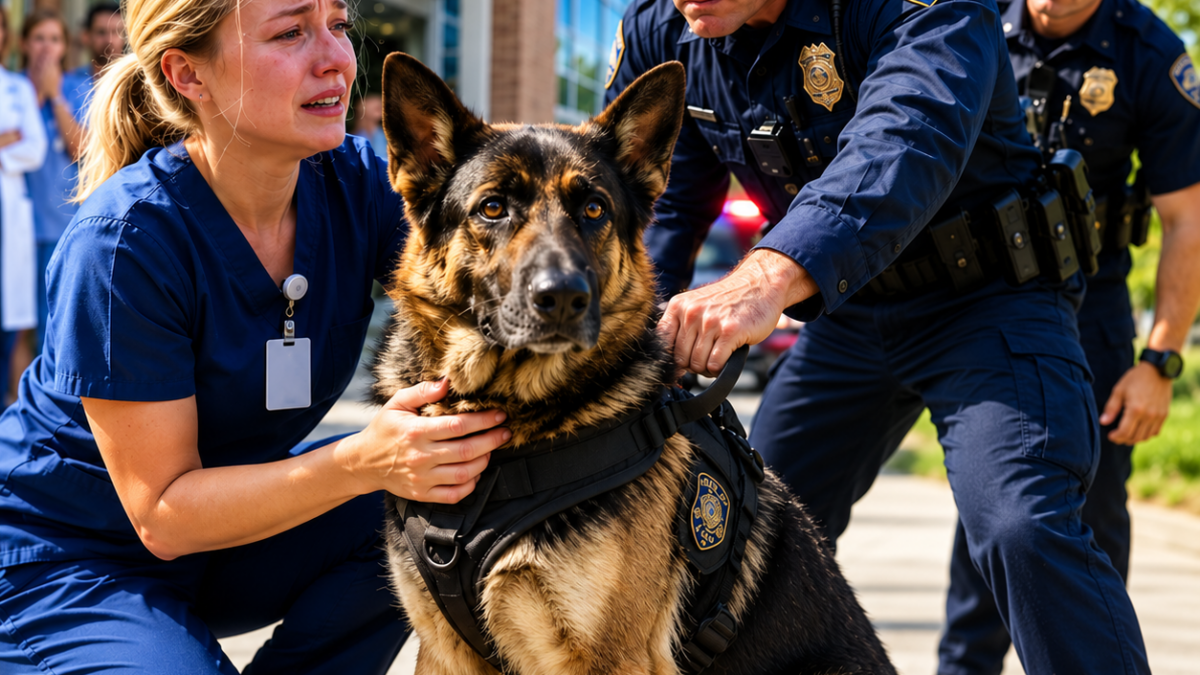
“We’ve received a formal complaint questioning the legality of this dog’s registration. Until ownership and certification can be verified, we’re authorized to take temporary custody.”
For a moment, I honestly thought I had misheard him.
Temporary custody.
Of Rex.
My Rex.
“There has to be a mistake,” I said.
“Ma’am, we simply need your cooperation.”
Around us, conversations faded.
A nurse froze beside her car.
A hospital volunteer lowered a box of supplies onto the sidewalk.
The security guard near the entrance straightened.
Then phones appeared.
Quietly at first.
One by one.
Because people will hesitate to help, but they rarely hesitate to record.
Someone whispered, “They’re taking her dog.”
Someone else said, “Maybe it’s not a real service animal.”
Another voice, lower but sharp enough to reach me, said, “You never know anymore. Some people fake everything.”
The words hit me in places I was too tired to protect.
I opened my mouth to explain, but emotion tightened around my throat.
Rex did not move.
He did not bark.
He did not growl.
He did not lean protectively against me.
Instead, he lowered himself into a perfect seated position beside my left leg.
Ears forward.
Breathing slow.
Eyes steady.
The youngest officer noticed immediately.
“That’s unusual,” he murmured.
I looked down.
Rex’s attention moved from one officer to another with remarkable precision, as though he were memorizing each face, each badge, each voice.
The older officer glanced at the younger one.
“Daniel.”
“Sorry, Sergeant.”
The older man was Sergeant William Brooks.
The younger officer was Daniel Hayes.
I learned their names later.
At that moment, all I knew was that two police officers were standing between me and my car, and one of them had paperwork saying they could take the dog who kept me from falling apart.
Sergeant Brooks kept his tone respectful.
“Miss Bennett, we are not accusing you of anything. We need to investigate a complaint.”
“Rex has been with me for two years. I have medical documentation. Physician letters. Vaccination records. Hospital clearance. Obedience evaluations.”
“We’ll need to review all of that.”
“I can show you.”
“You can. But the complaint specifically questions his origin.”
“His origin?”
The word seemed too cold for what Rex was to me.
Brooks looked down at the document.
“The report alleges the dog displays military-style behavior inconsistent with normal civilian service training. It also claims he may have been stolen, illegally retained, or falsely represented.”
My stomach turned.
“That’s absurd.”
“I understand this is upsetting.”
“No, Sergeant. Upsetting is when someone spills coffee on chart notes. This is insane.”
Rex lifted his eyes toward me.
One glance.
Calm.
Present.
The way he looked at me when my breathing got too fast in a supply closet or when a trauma room became too loud and my hands started shaking.
I inhaled.
Slowly.
His eyes returned to the officers.
Sergeant Brooks saw the exchange.
So did Officer Hayes.
The younger officer studied Rex closely.
Most nervous dogs pant.
Protective dogs lean forward.
Fearful dogs tuck.
Rex did none of those things.
He sat like the parking lot had become an assignment and he had already accepted it.
The senior officer reached carefully toward the leash clip.
“Easy, buddy.”
Rex remained still.
Not submissive.
Not frightened.
Waiting.
That silence unsettled everyone more than barking would have.
Then the metal buckle on Rex’s harness shifted slightly as the breeze caught the strap.
A faint sound clicked beneath the leather.
Almost nothing.
But Rex heard it.
His ears twitched once.
His eyes moved—not to the officer’s hand, not to me, but to the inside edge of his own harness.
For half a second, the air itself seemed to pause.
And before I understood why, my mind pulled me back two years.
Back to the first morning I saw him.
Snow had fallen all night over Cedar Falls.
The sidewalks outside Saint and Medical Center were buried beneath a soft white layer that made the whole town look gentler than it was.
I had just finished a sixteen-hour shift in the emergency department.
My body ached.
My eyes burned.
My hands smelled like antiseptic no matter how many times I washed them.
I had lost a young patient that night.
A little girl with pink mittens still tucked inside her coat pocket.
We did everything right.
Chest compressions.
Airway.
Meds.
Blood.
Callouts.
Timing.
All of it.
And still, her mother’s sound when we stopped would follow me for months.
Maybe forever.
When I stepped into the freezing Montana air, I had just enough strength left to get to my car.
Then I saw him.
A large German Shepherd lying beside a snow-covered park bench across the street.
His coat was dusted white.
His breathing was slow but steady.
People walked by.
Some glanced.
Some didn’t.
A few probably assumed he belonged to someone nearby.
He made no attempt to approach anyone.
No barking.
No begging.
No fear.
He simply watched the world pass, as if he had been instructed to wait and was still honoring that instruction.
I crossed the street before I had time to talk myself out of it.
I knelt several feet away.
“Hey there,” I said softly. “Are you waiting for someone?”
He looked at me.
His amber eyes held neither desperation nor panic.
Only patience.
As if he had not been waiting for anyone.
As if he had been waiting for me.
I offered him water from my bottle and half a turkey sandwich from my lunch bag.
He accepted both gently.
No grabbing.
No rush.
No desperation.
When animal control arrived almost an hour later, they scanned him for a microchip.
Nothing.
No identification.
No missing report.
No owner.
The strangest thing was the harness.
It was expensive, professionally fitted, worn but beautifully maintained, made from dark leather thick enough to have lasted years. Yet every patch had been removed. No name. No agency. No organization. No service marking. Nothing.
It looked as if someone had erased him.
At the shelter, the veterinarian estimated he was about six years old and in excellent health despite signs he had been living alone for some time. Beneath his thick coat were faint healed scars. His teeth showed careful medical attention. His posture showed years of structure.
During the weeks that followed, I visited after nearly every shift.
I did not mean to.
I told myself I was checking on him.
Then I brought books.
At first, he did not greet me with excitement. He would simply stand, walk to the kennel door, and rest quietly near the fence while I read aloud from whatever novel I had in my bag.
The shelter staff joked he cared more about my voice than my treats.
They were probably right.
Then came the afternoon that changed everything.
I had another panic episode after losing a patient.
It was not loud.
Not cinematic.
No collapse.
I sat behind the shelter near the back fence because I did not trust myself to drive yet. My hands shook. My chest felt too tight. My breathing came too fast. I kept hearing monitor alarms that were no longer there.
The German Shepherd walked slowly to the fence.
He did not bark.
Did not paw.
Did not whine.
He pressed one side of his body against the chain link and stayed there.
No demand.
No pressure.
Just presence.
Something inside me settled.
My breathing slowed.
The shaking stopped.
No one had trained him to do that for me.
Not that I knew of.
But somehow he understood exactly what I needed before I did.
I named him Rex.
Because strength deserved a simple name.
And somehow, the name fit as if it had always been his.
Medical specialists later documented that his presence interrupted the physical symptoms of my post-traumatic stress. My physician signed the forms. My therapist completed the evaluations. Rex passed obedience and public-access assessments with such ease that one evaluator said, “This dog was trained before anyone here met him.”
There was only one mystery no paperwork answered.
Sometimes, when a military helicopter crossed the Montana sky, Rex would stop completely.
Ears raised.
Body still.
Eyes lifted toward the clouds.
Not fear.
Recognition.
As if a life he refused to forget had passed overhead.
That memory vanished as Sergeant Brooks unfolded my documentation in the hospital parking lot.
I handed over everything.
Physician recommendations.
Therapy evaluations.
Vaccination records.
Public-access behavior assessment.
Obedience certification.
Hospital accommodation approval.
Brooks examined each page carefully.
Officer Hayes stood beside him, reading over his shoulder.
Every document was real.
Every requirement satisfied.
But I saw the line that troubled them.
Origin of animal: unknown.
Previous ownership: unknown.
Initial identification: none.
Officer Hayes looked at me.
“Nobody ever found where he came from?”
“No. The shelter searched. Veterinarians searched. I searched. Nobody claimed him.”
Rex sat beside me, perfectly still.
Across the lot, an elderly maintenance worker stepped outside with a toolbox. He paused when he saw Rex.
“That dog walks like a soldier,” he muttered.
Officer Hayes heard him.
He looked at Rex again.
So did Sergeant Brooks.
I saw the moment both officers began to understand what I had lived with for two years.
Rex did not merely obey.
He assessed.
He scanned the parking lot in a slow, deliberate pattern. Parked cars. Entrances. Pedestrians. Officers. My position. Back to the doors.
Systematic.
Predictable.
Professional.
Sergeant Brooks crouched several feet away.
“Easy there, boy.”
Rex neither approached nor retreated.
Brooks extended one open hand.
Rex lowered his nose, inhaled once, then calmly looked directly into the sergeant’s eyes before returning his attention to me.
Brooks stood slowly.
“He just completed a scent assessment.”
Officer Hayes frowned.
“Civilian service dogs don’t usually do that.”
“No,” Brooks said quietly. “They usually do not.”
The parking lot had grown almost silent.
Then Rex turned his head toward the hospital entrance.
His ears lifted with absolute precision.
Somewhere inside, beneath the ordinary sounds of rolling carts, elevator chimes, and morning rounds, a faint electronic tone sounded.
I barely heard it.
Rex did.
He stayed still, eyes fixed on the entrance as if waiting for a command no one else knew had been given.
Sergeant Brooks followed his gaze.
“Did you hear something?”
“Only monitors inside,” I said.
Officer Hayes moved a few feet to Rex’s right, careful not to crowd him.
Rex tracked him only with his eyes.
His body never shifted.
Hayes stopped.
“Sergeant,” he said softly, “watch his head.”
Brooks looked.
Rex was not staring randomly.
His gaze moved in a pattern.
Building entrance.
Vehicles.
People.
Me.
Officers.
Back to the entrance.
“That is not ordinary scanning,” Brooks admitted.
I swallowed.
“He has always been like this.”
Officer Hayes gave me a gentle look.
“Exactly.”
A hospital security supervisor approached, face tense. His name was Martin Cole. He had worked at Saint and Medical for twelve years and knew both of us well.
“Clare,” he said. “Everything all right?”
Sergeant Brooks explained the complaint without unnecessary details.
Martin listened, then looked at Rex.
“This dog has spent hundreds of hours in this building. He has comforted frightened children, sat quietly beside veterans receiving treatment, and once alerted staff before an elderly patient collapsed in the lobby. I have never seen him act aggressively toward anyone.”
“I appreciate that,” Brooks said. “But character isn’t the only issue. We still have to establish where he came from.”
Martin nodded.
“I hope you do. Because wherever he learned what he knows, it wasn’t obedience school.”
A breeze stirred the edge of Rex’s leather harness.
That was when Officer Hayes noticed something.
He crouched again, this time focused not on Rex’s eyes but on the harness itself.
The leather was dark and aged, but exceptionally cared for. The brass hardware had been polished often enough that even years could not dull it completely. Across the shoulders, the harness looked thicker than standard civilian gear.
Hayes leaned closer without touching.
“May I take a look?”
I hesitated.
“As long as I stay with him.”
Sergeant Brooks nodded.
I knelt beside Rex and rested one hand on his shoulder.
“Easy, boy.”
Rex blinked slowly.
Hayes slipped on thin gloves from his patrol bag and examined the inside edge of the harness.
“There’s stitching here,” he said.
I looked.
Near one folded strap was a row of tiny hand-sewn stitches that did not match the rest of the craftsmanship. They were nearly invisible unless someone was inches away.
“I’ve never seen that,” I whispered.
“Did you ever replace the harness?” Brooks asked.
“Never. It was already on him when I found him. The shelter suggested a new one, but he became anxious whenever we tried removing this for more than a few minutes. His vet said to leave it unless absolutely necessary.”
Officer Hayes traced the seam gently.
Then stopped.
“There’s something inside.”
My heartbeat quickened.
“What?”
“I don’t know. Firm, but thin. Metallic maybe. Smaller than a wallet.”
Brooks lowered his voice.
“Don’t force anything.”
“I’m not.”
Hayes pressed near one corner of the folded strap.
A tiny brass snap, hidden beneath years of polish and leather, released with a soft click.
The stitching had not sealed the compartment.
It had hidden the opening.
My hand flew to my mouth.
“I never knew that was there.”
Hayes lifted the narrow leather flap.
Inside rested a weatherproof fabric sleeve, protected from moisture and dust with extraordinary care.
Nobody spoke.
Even the crowd behind us fell silent.
Hayes slid the sleeve free and opened it.
The first object slipped into his gloved hand with a faint metallic sound.
An old military challenge coin.
Worn smooth around the edges but polished often enough to preserve the engraved detail.
Beneath it was a folded identification wallet no larger than a palm.
Sergeant Brooks accepted it carefully and opened the weathered leather.
Inside were two official-looking badges mounted side by side behind clear sleeves.
One displayed the insignia of a specialized military working dog program.
The other carried a federal emblem and identification number unlike anything Brooks had seen in local records.
Tucked behind the badges was a stainless steel military dog tag on a faded black cord.
One side held a serial number.
The other held one word.
REX.
The world narrowed.
I stared at the tag.
“That was already his name,” I whispered. “I thought I chose it.”
My eyes filled before I could stop them.
Rex stayed beside me, calm and still, as if this moment had been waiting inside the leather all along.
Brooks turned the identification wallet over.
Inside the back cover was one final item under a yellowed transparent sleeve.
A small photograph.
A younger Rex sat proudly beside a man in military uniform. The man’s face was partly shadowed beneath the brim of his cap, but the insignia on his chest matched the badge in Sergeant Brooks’s hand.
For several seconds, nobody moved.
Then Brooks closed the wallet with the care of someone handling a family heirloom.
Officer Hayes stepped back and spoke into his radio.
“Dispatch, I need every available record connected to military working dog tag serial number…” He read it slowly. “And federal identification package…”
The response took several minutes.
The parking lot remained still beneath the Montana morning.
People who had been recording lowered their phones.
Some looked embarrassed.
Others looked shaken.
Nobody whispered about fake service animals anymore.
When Daniel’s radio crackled again, his expression changed.
“Repeat that,” he said carefully.
The dispatcher spoke longer this time.
He looked at Brooks.
“Sergeant. Dispatch found a restricted file.”
Brooks walked over.
“Restricted how?”
“The serial number is active in a federal archive. Operator can’t access the full record. The system referred it to a military records liaison.”
Brooks looked down at Rex.
“That means someone still recognizes the identification.”
A second radio transmission came almost immediately.
The dispatcher’s voice was urgent now.
A retired military records officer had recognized the serial format and requested a secure video call.
Within moments, Sergeant Brooks accepted the connection on his department tablet.
An older man appeared on the screen.
Gray hair.
Straight posture.
Glasses adjusted with careful fingers.
“My name is Colonel Thomas Mercer, retired. Who currently possesses identification package Echo-Seventy-Four?”
Brooks held the open wallet toward the camera.
The colonel studied the badges.
The coin.
The photograph.
Then Rex.
His expression softened.
For several seconds, he said nothing.
Then he smiled quietly.
“Well,” he said, “I never thought I would see him again.”
Brooks looked down at Rex.
“You know this dog?”
“Know him?” Mercer’s voice changed. “Son, that German Shepherd served alongside some of the finest handlers I ever commanded.”
My hand tightened in Rex’s fur.
“His official designation was Rex,” Colonel Mercer continued. “He completed multiple specialized deployments. He was known for locating survivors, detecting hidden threats, and remaining absolutely calm under pressure most men could not withstand.”
The colonel paused.
“More importantly, he protected people. That was always his instinct.”
Rex watched the tablet without moving.
My tears spilled silently.
Colonel Mercer leaned closer to the camera.
“Years ago, there was an emergency during a transport operation. Rex became separated from his unit. We searched extensively. We believed someone had taken him in, but there was never confirmation.”
“I found him outside this hospital two years ago,” I said softly. “In the snow.”
Mercer looked at me through the screen.
“Then fate was kinder than we imagined.”
Sergeant Brooks lifted the wallet.
“Colonel, why would badges be hidden in his harness?”
Mercer’s eyes lowered for a moment.
“Those badges were never meant to grant privilege. They were hidden to protect him if he became separated from the people who knew his history. Whoever concealed them wanted him judged by his character, not by the missions he completed.”
That sentence broke something open inside me.
Judged by his character.
Not his badges.
Not his records.
Not the things he had survived.
Just who he was.
I looked down at Rex.
He leaned ever so slightly into my touch, then resumed his steady posture.
I knelt beside him fully now.
“I wish I could tell you I knew all this,” I said. “I don’t. The day I found him, he had nothing except that harness and the kindness to trust a stranger.”
Colonel Mercer listened.
“The shelter told me I could adopt another dog if I wanted one with a known history. They said he might always be a mystery. But every time I visited, he waited by the gate before I arrived. He never barked for attention. Never begged. He just watched the parking lot until I walked in.”
My voice shook.
“After a while, I realized he wasn’t waiting for someone to rescue him anymore. He had already decided who his person was.”
Rex rested his head against my knee.
The crowd was quiet.
Even the wind felt softer.
I continued because now that the truth had opened, I could not close it again.
“There were nights after shifts when I came home and sat on the floor because I didn’t have strength to reach the couch. Rex always found me. Sometimes he put his head in my lap. Sometimes he stayed awake beside my bed until sunrise. I thought I was helping a lonely dog heal from whatever happened before we met.”
I looked at the officers.
“I never imagined he had been helping me all along.”
Colonel Mercer’s face softened.
“Miss Bennett, may I ask you something?”
“Of course.”
“Did Rex ever try to leave you?”
“Never,” I said immediately. “I forgot to close the backyard gate more than once. He could have walked away any day he wanted. Instead, he waited by the front door until I came home.”
Mercer nodded slowly.
“That tells me everything I need to know.”
Sergeant Brooks looked from the tablet to me.
“Colonel, if Rex officially belonged to the government at one time, what happens now?”
Mercer folded his hands.
“Nothing should happen except gratitude. Working dogs are not equipment. They are partners. When they retire, they deserve peace, safety, and someone willing to love them for who they are after the uniform is gone.”
He looked directly at me.
“From everything I have heard today, Rex already found that person years ago.”
Officer Hayes exhaled quietly.
“So Miss Bennett never hid his past.”
“How could I hide something I never knew?” I said.
Hayes smiled.
“Exactly.”
Sergeant Brooks carefully returned the badges, the challenge coin, the photograph, and the tag to the protective sleeve. Then he placed them back inside the hidden compartment of the harness.
I looked up.
“You’re putting them back?”
Brooks nodded.
“They belong with him.”
He secured the flap gently but left the compartment accessible.
“They stayed hidden until the right people needed to see them. Now they tell a different story. Not about secrets. About trust.”
Rex lifted his eyes toward the sergeant.
Then gave the smallest wag of his tail.
Only one.
Barely a second.
But somehow it felt warmer than anything anyone could have said.
Sergeant Brooks removed his patrol cap.
“Miss Bennett,” he said, voice different now, stripped of official distance. “On behalf of the Cedar Falls Police Department, I owe you an apology. We responded to a complaint in good faith, but we judged the situation before we understood the full story. I am sorry for the distress this caused you.”
I looked at him for a long moment.
Part of me wanted to stay angry.
Maybe I had the right.
But Rex leaned against my knee, calm as ever, and I remembered that he had survived more than misunderstanding without becoming bitter.
“Thank you, Sergeant,” I said. “I know you were doing your job.”
Brooks nodded.
“That doesn’t make kindness any less important.”
Officer Hayes opened his incident report.
He drew a single line through the recommendation for temporary custody.
Under it, he wrote a new conclusion.
Investigation verified lawful status. No evidence supporting original allegations. No grounds for seizure.
He signed his name.
Then looked up.
“This case is closed.”
The words lifted an invisible weight from the parking lot.
People began moving again.
Slowly.
Awkwardly.
The way people move after realizing they had almost watched an injustice and called it procedure.
An elderly hospital volunteer approached first.
She knelt carefully, despite her aching knees, and smiled at Rex.
“Thank you for taking care of our nurse,” she whispered.
Rex lowered his head and accepted her touch with quiet dignity.
A respiratory therapist brought me coffee that had gone lukewarm.
A resident physician admitted he had believed the rumors when the police first arrived.
“I’m sorry,” he said.
I gave him a tired smile.
“Sometimes we all believe too quickly.”
Martin, the security supervisor, came forward holding a small navy cloth.
Without a word, he polished the brass buckle on Rex’s harness until it caught the morning sunlight.
On the tablet, Colonel Mercer cleared his throat.
“Before we end this call, there is one more thing.”
Everyone looked toward him.
“Many years ago, when handlers completed difficult assignments with their partners, they rarely celebrated themselves. They thanked the dog first.”
The colonel raised his hand to his forehead in a salute.
Sergeant Brooks did the same.
Officer Hayes followed.
Martin straightened and saluted.
The maintenance worker removed his cap.
Nobody had planned it.
Nobody had instructed them.
Yet there they stood beneath the Montana sky, offering silent respect to an aging German Shepherd who had spent his life protecting people without asking for recognition.
Rex remained seated beside me.
He did not look proud.
He did not seek attention.
He looked at each face, then lifted his eyes toward mine.
I knelt beside him and wrapped one arm around his neck.
“You never needed those badges for me to know who you were,” I whispered. “You have always been my hero.”
Rex answered the only way he ever had.
He rested the side of his face against my shoulder and closed his eyes.
The first full sunlight of morning spilled across the hospital entrance, warming the brick walls, the fallen leaves, the patrol cars, and the weathered harness that no longer carried the burden of hidden secrets.
Weeks later, the story changed shape.
At first, people talked about police lights, hidden badges, military files, and the mystery of Rex’s past.
Then, slowly, it became something quieter.
A reminder passed between neighbors over coffee.
A warning about assumptions.
A story about a nurse and the dog who had been more than anyone knew, though she had loved him long before proof appeared.
Life at Saint and Medical returned to its rhythm.
Ambulances arrived before sunrise.
Families waited beside windows.
Doctors moved fast.
Nurses moved faster.
Some patients recovered.
Some did not.
Through all of it, Rex and I walked through the front entrance every morning the same way we always had.
Except people greeted him differently now.
The security guard no longer just nodded.
He smiled.
Volunteers kept fresh water near the reception desk.
Children visiting grandparents often asked if they could wave to the handsome German Shepherd sitting beside the nurse with kind blue eyes.
Rex accepted every greeting with the same quiet dignity he carried the morning everyone discovered who he had once been.
He never sought attention.
He never expected applause.
He stayed close enough that I knew I was not facing another hard day alone.
One Saturday afternoon, Sergeant Brooks stopped by off duty.
In his hands was a handcrafted wooden display case lined with deep blue felt.
Inside was a brass nameplate engraved with a simple message.
HONOR IS NOT WORN.
IT IS LIVED.
“It’s for the badges,” he said. “If you want them displayed.”
I looked at the beautiful case.
Then at Rex, lying near the window with his chin on his paws.
“It’s wonderful,” I said softly. “But the badges belong with him.”
Brooks smiled like he had expected that answer.
Together, we returned the coin, photograph, identification wallet, and dog tag to the hidden compartment inside Rex’s harness.
Only the brass nameplate stayed with me.
I placed it on my bookshelf at home, where evening light touched it without making it too obvious.
Months passed.
Winter gave way to spring.
The maple trees outside the hospital filled with new leaves.
Rex’s muzzle grew whiter.
His pace slowed slightly.
But every morning, when I reached for my keys, he rose without hesitation.
Ready.
Some mornings we paused near the same park bench where I had first found him in the snow.
I would sit with coffee.
Rex would rest at my feet and watch the town wake.
There was no need to speak.
The silence between us had long ago become its own language.
One morning, a young nursing student approached carefully.
She looked nervous in the way new nurses often do, carrying both courage and fear in equal measure.
“Can I ask you something?”
“Of course.”
She looked down at Rex.
“When did you realize he was a hero?”
I ran my fingers through the weathered fur along Rex’s neck.
He closed his eyes beneath my touch.
“I didn’t realize it because of the badges,” I said.
The student looked confused.
I smiled.
“I realized it on the days when nobody was watching. Every time I thought I had nothing left to give, he stayed. Every time I forgot how to believe in tomorrow, he stayed. That is what heroes do.”
The student nodded slowly.
Then walked toward the hospital doors.
Rex stood beside me.
Together, we began the familiar walk across the sidewalk.
One of us wore worn nursing shoes.
The other carried hidden memories beneath an aging leather harness.
No one passing us could see the badges tucked safely inside.
Maybe that was how the story was always meant to be.
Some honors shine from polished metal.
Others reveal themselves in quiet footsteps that never leave the side of someone who needs them most.
Rex had carried both.
But only one had truly defined his life.
Not the badges.
Not the missions.
Not the file numbers locked away in federal archives.
The choice he made every morning.
To stay.








