Parents Started Recording When a Face-Tattooed Biker Refused to Give Up a Glitter Wand—Then a Sick Little Girl Called Him Her Fairy
PART3:
“That’s not how fairies work.”
“How do they work?”
“They say yes first.”
That was the trap.
I should have heard it click shut.
Instead, I nodded.
Ellie reached under her pillow and pulled out three folded pieces of paper.
The first was blue.
The second yellow.
The third white.
“The blue one is first,” she said. “The yellow one is second. You don’t get to read the white one until the first two happen.”
“What if the first one is a pony?”
“No ponies.”
“Good.”
“What if it’s a motorcycle?”
“You already have too many.”
From the doorway, Lena made a strangled sound.
I turned.
She stood there with one hand over her mouth, trying not to laugh because laughing felt dangerous in a room where fear had been living for weeks.
“What does the fairy wear?” Lena asked.
Ellie’s eyes brightened.
“Wings. A silver dress. A crown. Glittering boots. Pink lip gloss. And a wand with a star.”
I looked at my wife.
Lena looked away because she was laughing now.
Not the tired kind.
Real laughter.
I had not heard that sound in days.
The next morning, I visited three costume stores.
Nothing fit.
At the first store, a teenager looked at me like I had asked where they kept live dragons.
At the second, a woman led me to a rack of fairy costumes designed for girls who weighed less than one of my arms.
At the third, I tried to ask whether they had “adult wings” and watched a cashier visibly regret working in retail.
At the fourth store, an elderly clerk with cat-eye glasses and no fear whatsoever looked me up and down and said, “Honey, we’re going to need two costumes and a sewing machine.”
“I don’t sew.”
“You will.”
She sold me two silver fairy dresses, transparent wings, a plastic crown, glitter boots two sizes too small until I cut the backs open, a wand, and a packet of elastic.
That night, I learned what a seam allowance was.
Badly.
Mack from the club helped attach the wings.
He took pictures.
I threatened him.
He kept taking pictures.
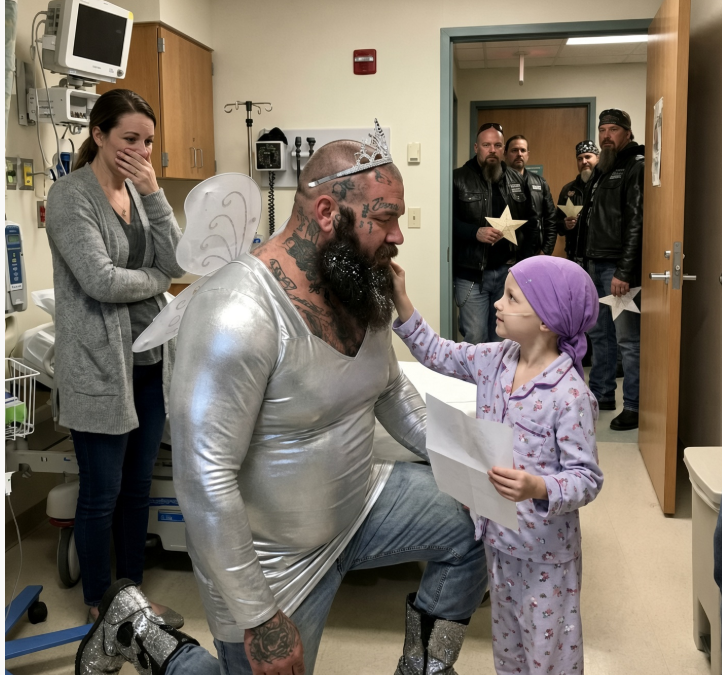
By morning, I was wearing silver fabric over faded jeans, glittering boots over motorcycle socks, a crooked plastic crown, and wings strapped across my back by a system of elastic, duct tape, and club brotherhood.
Rico drove the wings in his pickup because they would not survive the motorcycle.
He parked two blocks from Riverbend Children’s Hospital.
“Why are we stopping here?” I asked.
“Because I love you,” he said, “but brotherhood has limits.”
“You helped sew the wings.”
“Under protest.”
I walked.
People stared.
A teenager laughed until I looked toward him. Then he suddenly became fascinated by a vending machine.
A woman across the street lowered her phone, then raised it again.
A delivery driver shouted, “Looking good, Tinker Bell.”
I raised the wand.
He shut up.
By the time I reached Riverbend, the crown had slipped, one wing leaned left, glitter had gotten into my beard, and one painted fingernail had already lost half its shine.
But I had granted nothing yet.
And for the first time since the relapse, I knew exactly what my daughter needed me to do that day.
Say yes first.
I entered through the main doors at 8:03 a.m.
That was when everything went wrong.
Riverbend Children’s Hospital had seen costumed volunteers before.
Superheroes.
Princesses.
Mascots.
Holiday elves.
But those people usually came through scheduled entrances with badges, name tags, cheerful handlers, and costumes that did not involve face tattoos, motorcycle boots, and a star-shaped object gripped too tightly in one hand.
Security saw an unidentified, agitated biker carrying a pointed object.
I saw a father late for his daughter’s fairy appointment.
“Sir,” one officer said, stepping away from the desk. “I need you to put down the wand.”
“No.”
I answered too quickly.
I know that now.
The lobby shifted.
Parents looked up from clipboards.
Children in masks turned their heads.
A mother near reception moved behind a chair. Several visitors raised phones. One man said loudly, “Is anyone else seeing this?”
Yes.
They were seeing it.
A massive biker in a crooked silver dress refusing hospital security.
What they were not seeing was Ellie choosing that wand during better months.
Ellie tapping fuel tanks in my garage.
Ellie telling grown men their motorcycles needed blessings.
Ellie putting the wand under her pillow before treatment because “magic sleeps better near brave people.”
I had carried that plastic wand from home wrapped in a towel.
Nobody was taking it from me.
“Put it down,” the officer ordered.
“Check it in my hand.”
“Sir.”
“I’m already late.”
A second security officer approached from behind.
Phones rose higher.
A man near the elevators shouted, “He’s scaring the kids.”
He was not entirely wrong.
I looked frightening.
That was not the same as being dangerous.
Then Diane Keller stepped between us.
Diane had worked pediatric oncology for seventeen years. She had held Ellie through blood draws, distracted her during spinal taps, and once smuggled a stuffed raccoon into imaging because Ellie said the raccoon had “MRI anxiety.”
Diane looked at the security officer.
“That is Mason Callahan,” she said. “Ellie Callahan’s father. He is expected on the fourth floor.”
The officer’s hand did not leave his belt.
“He refused to surrender the object.”
“It’s a plastic wand.”
“It needs inspection.”
Diane turned to me.
“Mason.”
“No.”
“Mason.”
I looked at her.
She looked tired.
Not impatient.
Not scared.
Tired in the way hospital nurses get when adults make them solve problems that should have been solved with gentleness.
“Let me hold it,” she said.
That was different.
I handed her the wand.
Security inspected it.
Plastic.
Hollow.
Star tip.
No threat to anyone except dignity.
That should have ended the problem.
Then the second officer looked at my back.
“The wings exceed elevator width. You’ll need to remove them.”
“No.”
The lobby inhaled again.
“They can be carried upstairs.”
“She asked for wings.”
“You can put them back on outside the room.”
“She might see me first.”
“Mason,” Diane warned softly.
“No.” I turned toward the officer. “You don’t understand. She asked for the fairy. Not a man carrying fairy parts.”
We stood there wasting precious time over a difference adults considered small.
Children know better.
If a child asks for magic, you do not show up holding it in pieces.
The security desk phone rang.
Diane answered.
Her expression changed.
Then she pressed a button.
Ellie’s weak voice filled the lobby speaker.
“Please let my fairy upstairs. He’s bad at being late.”
The lobby went quiet.
Then someone laughed.
Not cruel laughter.
The kind that releases pressure from a room before it explodes.
The officer lowered his hand.
Diane handed me back the wand.
“Elevator,” she said. “Sideways.”
I turned sideways inside the elevator.
One wing folded against the wall.
The other hit every floor button between one and four.
By the time the doors opened, I had apologized to three people, scratched one wall, and dusted a surgeon with glitter.
Ellie waited in her wheelchair outside the oncology unit.
She wore a purple headscarf and a yellow blanket around her shoulders. Her skin looked too pale. Her eyes looked too old.
But when she saw me, she smiled.
Not politely.
Not carefully.
All the way.
She looked me up and down.
Glittering boots.
Silver dress.
Faded jeans.
Crooked crown.
Thorn tattoo.
Beard full of sparkles.
Then she frowned.
“You forgot lip gloss.”
“I didn’t forget.”
“Then where is it?”
“In the trash.”
Ellie held up a pink tube.
A nurse had helped her.
I looked at Diane.
Diane looked at the ceiling.
I surrendered.
Ellie opened the tube and painted gloss across one side of my mouth.
Only one side.
“Why just half?”
“You need room for improvement.”
She clicked the lid shut.
Then she handed me the blue paper.
Wish one.
I unfolded it.
Chocolate-chip pancakes at midnight, served on real plates, with everyone wearing crowns.
I stared at her.
Hospital dietary rules stood against us.
Medication schedules stood against us.
The fact that hospital kitchens did not operate like diners stood against us.
Common sense stood against us.
Ellie raised one eyebrow.
“Fairies say yes first.”
I unfolded my wings.
“Yes.”
The pancakes required negotiation.
A lot of negotiation.
Ellie could not leave the oncology floor. Outside food required approval. Her treatment schedule made midnight inconvenient. Her appetite came and went. The hospital kitchen did not keep pancake batter waiting around for magical emergencies.
Diane found a way.
Diane always found a way.
A dietitian approved a small portion. The kitchen prepared batter earlier and stored it. At 11:56 p.m., a night nurse named Carla cooked three uneven pancakes on an electric griddle inside the family lounge.
We used real ceramic plates from the staff room.
Lena wore a paper crown.
Diane wore one over her surgical cap.
Carla wore one crooked over her ponytail.
I remained in the full fairy costume because Ellie said costume continuity mattered.
At midnight, Ellie sat propped against pillows while I carried in the plate.
Three tiny chocolate-chip pancakes.
Whipped cream no one admitted authorizing.
A plastic cup of warm syrup.
Ellie clapped softly.
Not because she had the energy to clap loudly.
Because she was polite to miracles.
She ate three bites.
That was all her body allowed.
But after the third bite, she leaned back and said, “Wish one completed.”
The yellow paper held wish two.
I want stars below my window because I’m tired of looking up.
That one stopped me.
Riverbend’s fourth-floor oncology rooms faced an enclosed courtyard. Ellie had spent months looking through that glass at concrete, service doors, and a narrow strip of sky.
She was tired of looking up.
She wanted the sky to come down.
I called the club.
Twenty-four bikers answered.
Not six.
Not ten.
Twenty-four.
We bought battery-powered lights, cut hundreds of stars from white and silver paper, and requested access to the courtyard.
The hospital approved six participants.
Twenty-four arrived.
Security nearly canceled the entire plan.
I could not blame them.
From a distance, two dozen motorcycles crowding a service lane outside a children’s hospital looked less like a wish and more like a problem wearing leather.
I stood in the courtyard wearing fairy wings over my leather vest while an administrator counted riders.
“We approved six.”
“She has twenty-four uncles.”
“She cannot see twenty-four people clearly from the window.”
“She’ll know.”
The administrator looked toward the fourth floor.
Then she changed the plan.
Motorcycles were pushed by hand into safe positions.
Engines stayed off.
Extension cords were replaced with battery lights to remove trip hazards.
Riders stood inside marked areas away from hospital doors.
Wings had to stay clear of equipment.
Glitter had to stay contained.
Wands required soft ends from that day forward.
At 7:14 p.m., the courtyard lights went dark.
Twenty-four handlebars glowed.
Twenty-four bikers lifted paper stars above their heads.
I raised the wand.
Ellie appeared behind the glass with Lena and Diane.
Her purple headscarf had slipped slightly, revealing fine brown hair returning near one ear.
She pressed both palms against the window.
From above, the lights looked scattered and imperfect.
A fallen sky.
Exactly what she wanted.
Then Ellie’s knees weakened.
Lena caught her before she hit the floor.
The riders below could not see what had happened.
They kept holding their stars.
Thirty full minutes.
Arms aching.
Faces lifted.
Paper stars trembling in cold hands.
Upstairs, doctors checked Ellie’s vitals and adjusted medication. Her exhaustion had deepened. Her body needed rest before the next phase of treatment.
I removed the crown without realizing it.
Ellie noticed.
“Wish two isn’t done until you put it back.”
I put it back.
She closed her eyes.
The white paper remained beneath her pillow.
Ellie slept for nearly four hours.
I sat beside her wearing the full costume because I feared she would open her eyes, see ordinary clothes, and believe the fairy had left before finishing.
Diane suggested I change.
“She knows you’re her father.”
“That isn’t why I’m wearing it.”
Lena understood.
Ellie had asked for someone who said yes before explaining why something was difficult.
Adults had spent months telling her what could not happen.
The costume was my agreement to stay inside her version of the day.
When Ellie woke, the courtyard lights had gone dark.
The paper stars remained taped to the bikers’ hands because several refused to leave until they knew she was stable.
Ellie touched my beard.
“You stayed.”
“Contract.”
She reached beneath her pillow and removed the white paper.
Before handing it to me, she studied my face.
“Do fairies stay fairies when kids get too old to believe in them?”
“Yes.”
“What if the kid gets better?”
“Yes.”
“What if she doesn’t?”
My mouth went dry.
I could hear Lena’s breath catch beside the bed.
I forced the word out.
“Yes.”
Ellie placed the folded paper in my hand.
My fingers did not want to open it.
The first two wishes had been hard, but they had been possible.
Pancakes.
Stars.
Costumes.
Negotiations.
Things I could move, fix, build, carry, threaten, or arrange.
The third wish felt heavier before I read it.
The paper contained eight words.
I wish Dad will always be my fairy.
That was all.
No cure.
No promise of more time.
No request to skip needles.
No guarantee no doctor could give.
My daughter did not ask me to save her life.
She asked me not to disappear inside fear.
I looked at her.
She was eight years old, exhausted from treatment, small beneath blankets, a child who had already learned too much about adult helplessness.
And she had seen me clearly.
For months, I had been turning harder.
Hardness felt useful.
I spoke to doctors.
Managed medications.
Handled insurance calls.
Repaired broken drawers, broken toys, broken cabinet hinges.
Tracked bills.
Changed oil.
Organized rides.
Held Lena in the laundry room when she cried.
Refused to cry where Ellie could see.
I thought I was protecting her.
Ellie thought I was leaving.
Not physically.
Worse.
She feared the gentle version of me would vanish when the costume came off.
That if treatment ended—one way or another—the fairy would disappear and the hard man with tattoos and silence would be all that remained.
I lowered myself onto one knee beside her bed.
The silver dress tore slightly near the seam.
Nobody mentioned it.
“What does always mean?” I asked.
Ellie considered this carefully.
“Even when you’re old.”
“Fairies don’t get old.”
“You already are.”
Fair point.
“Even when I don’t wear the wings?”
“You have to wear them sometimes.”
“Define sometimes.”
“Birthdays. Bad hospital days. If I ask.”
“And glitter?”
“Always glitter.”
I looked toward Lena.
She was crying without hiding.
That mattered.
We had both done too much hiding.
I turned back to Ellie.
“Until my last breath,” I said.
Ellie held out her little finger.
I linked mine around it.
The club brothers watched through the glass from the corridor.
They could not hear the wish.
But they saw the promise.
Later, I told them.
Mack removed his sunglasses inside the hospital hallway and wiped both eyes.
Rico claimed glitter had gotten into his.
Owen looked toward Ellie’s room and said the only words that mattered.
“Then we help you keep it.”
The third wish belonged to me.
Not because I granted it.
Because it would never be finished.
Ellie completed that treatment cycle.
Recovery was slow.
Several complications delayed her return home, and the word remission did not enter our conversations for months.
I kept the costume.
The wings hung inside my motorcycle garage beside leather jackets and riding gear. Glitter stayed trapped in the seams. The plastic crown cracked along one side after I accidentally sat on it.
Ellie repaired it with silver tape and said it had character.
On difficult hospital days, she requested the fairy.
Sometimes I wore the entire costume.
Sometimes she accepted only the crown and wand.
The Iron Lantern Riders became involved despite claiming they had dignity to protect.
Mack wore green wings during a blood draw.
Rico appeared in a pink cape after Ellie caught him saying fairies were not his job.
Owen wore a crown while carrying a toolbox and dared anyone to comment.
Children from nearby rooms noticed.
One boy asked if he could borrow a biker fairy for an MRI appointment. Mack went with him and said very little, which was exactly right.
A six-year-old girl asked Owen to wear a crown while she received medication. He did.
The hospital developed rules.
Costumes had to remain clear of equipment.
Loose glitter was banned near treatment areas.
Wands needed soft ends.
Wings required quick-release straps.
No engines in the courtyard.
No unscheduled biker processions.
We followed every rule.
The program was never advertised as magic capable of curing anyone.
We made no promises about outcomes.
We offered ridiculous clothing and honest company.
Ellie called it the Garage Fairy Crew.
Once a month, riders met inside my shop to repair costumes, clean wings, and prepare paper crowns for children who requested visits. The garage smelled of gasoline, leather, hot glue, and craft paint.
My face tattoos remained.
Children traced their shape in the air and asked whether they hurt.
I told the truth.
“Some days.”
Ellie entered remission shortly before her tenth birthday.
We did not ring bells or declare victory over something that required continued monitoring.
We went home.
Ate pancakes on real plates.
Slept.
On her birthday, I attempted to wear ordinary clothes.
Ellie pointed toward the garage.
“Third wish.”
I put on the wings.
Ellie is thirteen now.
She no longer believes fairies live under flowers or fly through bedroom windows.
She understands that her first two wishes required nurses, administrators, kitchen staff, dietitians, security officers, and twenty-four bikers following safety instructions.
She also understands the third wish better than I did.
It was never about the costume.
It was about access.
When Ellie needs me, I do not hide behind the face tattoo, the leather vest, or the silence I once mistook for strength.
I sit down.
I listen.
I say yes before explaining what might be difficult.
The wings still hang inside my garage.
They are patched, crooked, and too small across my shoulders. The silver dress has been repaired several times. Glitter appears whenever someone moves a motorcycle jacket, though nobody can explain where it continues coming from.
Once a year, Riverbend Children’s Hospital holds an evening of lights in the courtyard.
Families watch from windows while riders hold paper stars below.
No engines run.
No speeches are given.
Some windows remain empty the following year.
We remember those children without turning their families into stories that belong to us.
That matters.
Not every child gets a remission party.
Not every parent gets to keep a promise in the way they hoped.
Some wishes remain unfinished because love sometimes outlives the person who asked.
The Garage Fairy Crew learned that too.
We learned to show up without making ourselves the center.
We learned to wear ridiculous crowns without pretending laughter fixed grief.
We learned that tenderness is not weakness.
It is work.
Harder work than looking frightening.
Last month, Ellie came with me on a fairy visit.
A newly diagnosed child refused to speak with the enormous biker wearing wings.
Fair enough.
I had seen mirrors.
Ellie sat beside the girl.
The child whispered, “He looks scary.”
“He does,” Ellie agreed.
“Is he magic?”
Ellie looked at me.
Then at the patched wings.
Then back at the child.
“Only when he listens.”
The girl eventually handed me a yellow wand.
I accepted it.
Afterward, Ellie and I walked through the hospital lobby where security had once surrounded me. The same officer worked near the entrance.
He looked at my repaired crown, the glitter in my beard, and the soft-ended wand in my hand.
“Still doing this?” he asked.
I glanced at Ellie.
“Third wish.”
Outside, evening light struck the glitter caught in my beard.
Ellie took my tattooed hand, and we crossed the parking lot together.
I am still her fairy.
Not because I look the part.
I never did.
Not because I can fix everything.
I cannot.
I am her fairy because a frightened eight-year-old girl once asked whether the softest part of her father would survive whatever happened next.
And I said yes.
First.
Until my last breath.








