“Nobody Wants Me Home,” an Elderly Woman Whispered—Then a Marine’s K9 Refused to Leave Her Side, and the Truth About Why She Couldn’t Go Home Came Out.
PART3:
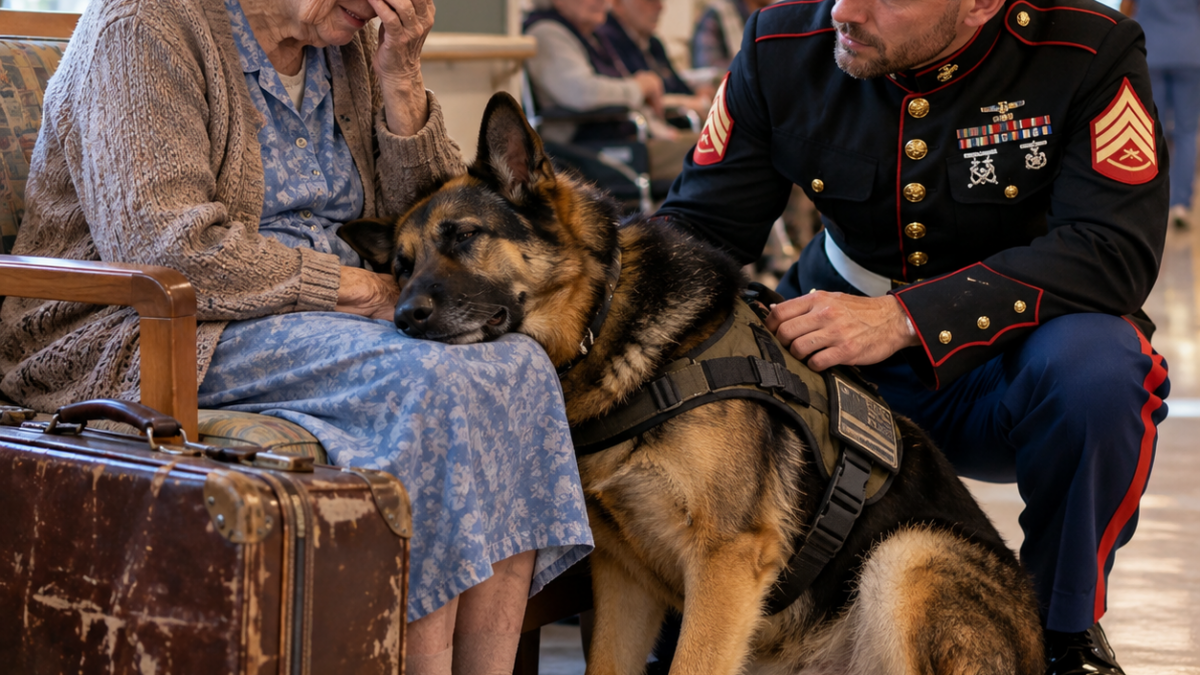
A person already practicing being forgotten.
“Ma’am?” Cole said.
She finally looked up.
“I’m sorry. I was talking to your dog.”
“He gets more conversation than I do most days.”
A tiny smile appeared and vanished.
Cole nodded toward the empty chair beside her.
“May I?”
“It isn’t my chair.”
The answer carried something deeper than humor.
Cole sat anyway, because Harker had not moved, and because some situations became more serious the longer no one acknowledged them.
“I’m Cole Maddox.”
“Evelyn Mercer.”
“Harker,” Cole said, nodding to the dog.
Evelyn’s hand moved gently behind Harker’s ear.
“Harker,” she repeated, as if committing the name to memory. “That’s a strong name.”
“He thinks so.”
“I imagine he thinks many things.”
“Usually things that make my life harder.”
Harker sighed through his nose as though disappointed in both of them.
Evelyn smiled again.
This time it stayed half a second longer.
Her name came first.
Then the farmhouse.
Cole did not ask questions the way staff asked questions. He had spent too many years around debriefs and medical forms not to know when people heard inquiry as examination. He started with ordinary things. The weather. The hills. Whether the facility was warm enough. Harker’s age. Evelyn answered lightly at first, then more fully when she realized he was not trying to catch her in anything.
She told him she lived—or had lived, she corrected herself, though the correction seemed to cost her—twelve miles outside Roanoke on nearly thirty acres.
“Not much of it useful anymore,” she said. “Woods, pasture, a gravel strip toward the back road. Thomas used to say the land didn’t need to be useful every minute to be worth keeping.”
“Thomas?”
“My husband.”
Cole nodded.
“Gone six years.”
“I’m sorry.”
“So am I,” Evelyn said simply.
When Cole casually asked if she remembered the address, she gave him the road, house number, and directions from the highway without hesitation. She knew the mile marker near the turn. Knew the neighbor whose mailbox leaned after a delivery truck clipped it in August. Knew the name of the church with the white steeple where drivers often missed the left bend if they were looking at their phones.
She knew she took her blood pressure medication at seven every morning.
Knew her orthopedic follow-up was December 4th.
Knew exactly what she owed in property tax.
Complained that the west gutter on her farmhouse needed clearing before the first hard freeze.
Nothing about her sounded confused.
Nearly three months earlier, Evelyn explained, she had fallen inside her barn and fractured her hip. Her late husband had been gone for six years, and the relative who came when the hospital called was her nephew, Darren Pike.
Darren had paid the first bills.
Checked the farmhouse.
Collected her mail.
Sat beside her hospital bed when she was frightened.
“Darren was good to me at first,” she said.
That phrase made Cole look at her more carefully.
At first.
Evelyn continued stroking Harker’s fur.
“He came at two in the morning when they called. I remember being embarrassed because my hair was awful, and I had mud on my sleeve from the barn floor. Imagine that. I’d broken my hip, and I was embarrassed about mud.”
“People worry about strange things when they’re scared.”
She looked at him then.
“Yes,” she said softly. “I suppose they do.”
She had trusted Darren enough to agree when he suggested temporary emergency guardianship while she recovered.
“Just until you’re steady again, Aunt Evelyn,” he had told her. “Just so the bills get paid and the doctors have someone to call.”
The hospital social worker had explained it.
A judge had approved it.
Ninety days.
Temporary.
A bridge.
At least, that was how Evelyn remembered it.
“Ninety days,” she said. “The judge said ninety.”
“How much is left?”
“Thirteen.”
Cole’s eyes narrowed slightly.
“And your doctors?”
“My hip is healing. I use the cane. I’m slower.”
Evelyn looked toward the window.
“Slow and incapable aren’t the same thing.”
Cole understood that distinction better than she could know.
Limited duty had made him feel like every person around him mistook injury for uselessness. The difference was that Cole still had rank, command structure, medical review, and an eventual return date. Evelyn had a suitcase and someone else’s authority wrapped around her life like a locked door.
“Why haven’t you gone home?” he asked.
“I keep asking.”
Her fingers stopped moving in Harker’s fur.
“They say there needs to be an approved discharge plan because Darren still has temporary guardianship. Every time I ask when that will happen, there’s another evaluation, another meeting, another reason to wait.”
She gave a small embarrassed laugh.
“I thought about calling a cab once. Apparently, I’m not allowed to discharge myself while the order is active.”
Then she said it.
So softly Cole almost wished he had misheard.
“Nobody wants me home.”
Harker lifted his head.
Cole felt the leash slacken between his fingers.
There are sentences a man can answer immediately.
Orders.
Questions.
Problems with measurable solutions.
A jammed weapon.
A faulty radio.
A missing convoy marker.
A report with wrong coordinates.
This was not one of them.
Across the room, a staff member called Evelyn’s name.
The moment passed like a hand withdrawing.
Cole rose slowly.
“I should go.”
“Of course.”
Her expression changed at once, becoming politely accepting.
Cole recognized it.
She had expected him to leave from the moment he sat down.
Harker did not move.
“Harker.”
The German Shepherd remained with his head near Evelyn’s knee.
Cole lowered his voice.
“Harker. Heel.”
The dog finally stood.
As Cole reached for the leash, his eyes fell on a folder resting partly beneath Evelyn’s suitcase.
A printed label was visible across the top.
Long-term placement pending.
Cole stopped.
The words were so ordinary that for a moment they seemed harmless. Just administrative language. Facility language. Care-plan language. The kind of phrase that appeared on paperwork because bureaucracy liked turning human lives into categories that fit file tabs.
Then the meaning settled.
Cole looked at Evelyn.
She followed his gaze.
For several seconds, she said nothing.
Then her face lost what little warmth Harker had put there.
“I’ve never seen that before.”
Cole stared at the words again.
Long-term placement pending.
“I never agreed to stay here,” Evelyn said.
Cole could feel the old instinct rising.
Identify the problem.
Establish control.
Fix it.
But this was not his command.
Not his battlefield.
Not his authority.
So he made only one promise.
“I’ll come back.”
Evelyn looked at him as if he had handed her something sharp and fragile.
“People say that.”
“I know.”
“Harker believes you.”
Cole glanced down at the dog.
“Unfortunately, Harker believes many things without consulting me.”
Evelyn almost smiled.
Almost.
Outside, the cold had sharpened.
Cole crossed the parking lot with Harker beside him, but halfway to the truck, the German Shepherd stopped again and looked back.
Through the tall lobby window, Evelyn remained beside the battered suitcase.
Cole looked at her.
Then at Harker.
“Thirteen days,” he said.
Harker’s ears flicked.
For the first time since putting on a Marine uniform, Cole wondered whether the fight in front of him might be one his rank could do absolutely nothing to win.
Three days later, rain had settled over Roanoke in a thin gray sheet, darkening the roads and turning Willow Creek’s windows into pale mirrors.
Cole Maddox returned with Harker beside him, and thirteen days had already become ten.
He told himself he was not involving himself beyond reason.
That was a lie.
He knew it when he parked.
Knew it when Harker stood before the truck door before Cole even reached for the handle.
Knew it when the receptionist looked up and said, “You’re here for Mrs. Mercer?” as if visitors for elderly women with suitcases were rare enough to be noticeable.
Cole signed in.
Community visitor.
He hated the phrase.
He found Evelyn in a small reading room off the main lobby.
But she was not alone.
A woman sat across from her with a legal pad balanced on one knee.
Rachel Boone was forty-six, medium height and sparely built, with warm brown skin, dark curly hair threaded with early gray and pulled loosely behind her head, and steady hazel eyes behind thin rectangular glasses. She wore a charcoal wool coat over plain office clothes and carried the battered leather satchel of someone who spent more time in other people’s homes than behind a desk.
She looked up before Cole spoke.
“Gunnery Sergeant Maddox?”
“Cole is fine.”
“I understand you spoke with Mrs. Mercer Friday.”
Cole glanced at Evelyn.
“I did.”
Rachel closed the folder in front of her.
“Then you understand I can’t discuss her medical or legal information with you.”
The boundary was delivered without apology.
Cole respected it immediately.
“Understood.”
Evelyn tapped one swollen finger against her cane.
“I want him here.”
Rachel looked at her.
“You’re sure?”
“Yes.”
“Not because you think you owe him anything?”
Evelyn almost smiled.
“He brought canned soup and a nosy dog. I think we’re even.”
Harker settled beside her chair as if the matter had been legally resolved.
Only after Evelyn gave explicit permission did Rachel reopen the folder.
Rachel worked in adult protective services for the county, specializing in elder welfare and contested care situations. Twelve years earlier, as she later told Cole, she had watched an elderly client lose control of his own affairs because everyone around him mistook physical frailty for mental incapacity. Since then, she had developed an almost stubborn habit of asking one question before every other.
What does the person themselves want?
What concerned Rachel was not a diagnosis.
It was a pattern.
The hospital notes written after Evelyn’s surgery described her as alert, oriented, able to understand treatment, and capable of participating in discharge decisions.
Weeks later, however, Willow Creek assessments began using different language.
Intermittent confusion.
Resistance to care.
Poor judgment.
One recent notation called her a potential risk to herself.
Cole’s jaw tightened.
“She told me her tax bill down to the dollar.”
“That proves memory,” Rachel said calmly. “It doesn’t prove capacity.”
Cole started to respond.
Rachel lifted one hand slightly.
“And these notes don’t prove incapacity either. That’s why we verify.”
Cole liked her more for refusing to give him the answer he wanted.
Rachel had already decided to request the hospital records, Willow Creek’s assessment history, the temporary guardianship filings, and relevant financial documentation before any petition to extend Darren Pike’s authority could be evaluated.
She also wanted an independent cognitive and functional assessment.
“Someone with no connection to the facility, Darren, or you,” Rachel said.
“Me?”
She looked at him over her glasses.
“You care. Caring can still become pressure.”
Cole sat back.
He disliked how true that was.
Footsteps sounded behind them.
“Aunt Evelyn.”
The change in Evelyn was immediate.
Her shoulders drew inward.
Harker lifted his head.
Darren Pike entered the reading room looking exactly like the sort of man people trusted when nothing had yet gone wrong.
Fifty-one, a little under six feet, with a solid middle-aged build beginning to soften around the waist. Sandy-brown hair thinning at the crown and carefully combed. A short, neatly trimmed beard covered a face that might otherwise have seemed boyish. He wore a navy quilted jacket, pressed khakis, and clean brown boots.
Nothing about him looked threatening.
His pale brown eyes were tired rather than cold.
He greeted staff members by name as he crossed the room.
Darren had spent most of his adult life managing a regional building supply store, where being agreeable had become almost professional instinct. Even now, his voice carried the practiced patience of a man accustomed to making difficult things sound reasonable.
He kissed Evelyn lightly on the forehead.
“You should have told me you had company.”
“I didn’t know I needed permission.”
Darren paused.
Cole saw it.
The smallest tightening around the mouth.
Then the smile returned.
“You know that’s not what I meant.”
Evelyn’s hand found Harker’s neck.
Darren introduced himself to Cole and shook his hand firmly.
There was no hostility at first.
He even thanked Cole for visiting.
“She gets lonely,” Darren said. “This has been hard on everybody.”
Especially at the beginning, Evelyn admitted.
Darren had been the one who came to the hospital at two in the morning. He had paid bills she could not reach. Bought clothes for rehabilitation. Checked the farmhouse after storms. When temporary guardianship was suggested, signing had felt less like surrender than relief.
Something had changed afterward.
“When can I go home?” Evelyn asked.
Darren exhaled.
“We’ve talked about this.”
“I’m asking again.”
“That house isn’t designed for you anymore. The barn steps alone—”
“I fell once.”
“And broke your hip.”
“I healed.”
“You’re healing.”
The correction was gentle.
That somehow made it worse.
Darren crouched slightly beside her chair.
“I’m trying to keep you safe, Aunt Evelyn.”
“Safe where?”
He blinked.
“At Willow Creek. Or wherever is appropriate.”
“Appropriate for who?”
“Please don’t do this.”
Evelyn’s fingers tightened on Harker’s fur.
Darren lowered his voice in that public way people use when they want to appear kind to everyone except the person being corrected.
“Sometimes we have to accept that what we want isn’t what’s best for us.”
Cole felt an old reflex rise in him, but Rachel spoke first.
“Mr. Pike, an independent assessment should help establish what level of support Mrs. Mercer actually requires.”
Darren stood.
“Another assessment?”
“A neutral one.”
“For what purpose? She’s been assessed here repeatedly.”
“Yes,” Rachel said. “That’s why I want a neutral one.”
For the first time, Darren’s expression lost its polish.
Only for a second.
But everyone in the room saw it except perhaps the staff member passing the door.
“I’m not trying to take anything from her,” he said.
“No one said you were.”
“I dropped everything for her.”
“I understand.”
“I’ve been paying bills, dealing with her mail, talking to doctors, fielding calls. People act like I wanted this.”
Rachel’s pen moved once.
Darren noticed and went silent.
Evelyn said nothing until he left.
Then her shoulders lowered.
Harker leaned against her shin.
Later, while Rachel made a phone call, Evelyn told Cole about the land.
Twenty-nine acres.
Most of it woods and pasture.
After Thomas died six years earlier, she had leased a gravel section near the back road to a local equipment company for storage. The monthly rent was not a fortune, but it helped cover taxes, insurance, and repairs.
Since the guardianship began, Darren had been managing the account receiving those payments.
Cole asked the question plainly because Evelyn did not need another person speaking in circles.
“Do you think he’s stealing from you?”
Evelyn stared at her hands.
“I don’t know.”
It was the first question she could not answer.
Near dusk, Cole went to retrieve his jacket from the lobby. Passing an administrative office, he heard a woman’s clipped voice through a half-open door.
“If Mercer transitions home, the long-term care payment ends with the discharge date.”
Pause.
“I understand that. I’m telling you to revise the projection.”
Cole kept walking.
The woman emerged seconds later.
Lydia Crane, Willow Creek’s administrator.
Late fifties, tall and narrow-shouldered, with pale skin, steel-gray hair cut into a precise chin-length bob, and a composed face that seemed built for unpleasant conversations. Her dark suit was immaculate. She acknowledged Cole with a professional nod and continued down the hall without recognizing what he had heard.
He found Rachel.
“There’s money tied to keeping Evelyn here.”
Rachel listened.
Then shook her head.
“Be careful.”
“I heard her.”
“You heard an administrator discussing revenue.”
“She said if Evelyn transitions home, payment ends.”
“Care facilities get paid for residents. That isn’t evidence she falsified anything.”
“And Darren controls Evelyn’s account.”
“Also not evidence he misused it.”
Cole disliked the answer because it was correct.
Rachel closed her satchel.
“Two financial interests can exist without a conspiracy, Cole. My job is to find facts before deciding what they mean.”
“You always this slow?”
“When people’s rights are involved? I try to be.”
He almost smiled.
Almost.
Before leaving, Cole returned to the window where he had first seen Evelyn.
Harker immediately settled beside her.
“There’s something I haven’t told you,” Evelyn said.
Cole waited.
“My husband planted an apple tree the year we bought the farmhouse.”
Her gaze drifted beyond the rain-streaked glass.
“Said every real home needed something that would still be growing after we were gone.”
She looked down at Harker.
“If they gave me one day there, just one, I’d sit underneath it.”
Cole looked at the old suitcase beside her chair.
For three days he had thought he was trying to understand why someone wanted Evelyn Mercer to remain at Willow Creek.
Now he wondered whether the more dangerous question was how long it would take before Evelyn herself began believing she no longer belonged anywhere else.
Four days later, the rain had passed, leaving the Virginia hills washed clean beneath a brittle December sky. Frost silvered the roadside grass as the county vehicle turned onto the narrow lane leading to Evelyn Mercer’s farmhouse.
The independent evaluation had taken nearly two hours the previous afternoon.
Evelyn had identified the date, explained her medications, described the risks of living alone, balanced simple financial questions, and corrected the evaluator when he misstated the dosage of one prescription. The conclusion was careful but clear.
There was no evidence of major cognitive impairment.
Evelyn’s primary limitations were physical: reduced balance, slower movement, residual weakness following hip surgery.
That finding did not automatically send her home.
It did, however, make the next question impossible to avoid.
Could her home be made safe enough for her to return?
Rachel arranged the supervised assessment.
Cole came with Harker at Evelyn’s request, while the practical evaluation belonged to Nina Patel, a fifty-two-year-old occupational therapist with a compact build, medium-brown skin, thick black hair streaked with silver and tied at the nape, and observant dark eyes that seemed to measure distances without a tape.
Nina had spent twenty-six years helping injured and elderly patients return home.
She was warm without being sentimental and had learned early in her career that a perfectly safe room could become another kind of prison if the person living in it no longer recognized it as her own.
When the farmhouse appeared beyond the bare oaks, Evelyn stopped talking.
The white clapboard house was smaller than Cole had imagined. A deep porch stretched across the front, its paint weathered but intact. Beyond it stood the barn where Evelyn had fallen. Pasture sloped behind the house toward a line of woods. A gravel lane curved to the side. The roof needed attention, though not urgently. The west gutter did indeed need clearing.
The vehicle stopped.
Evelyn did not move.
“You ready?” Cole asked.
Her hand tightened around the cane.
“I thought I was.”
No one rushed her.
That was Rachel’s doing, though she did not say so.
Harker climbed out first.
He crossed the yard, trotted up three porch steps, then stopped at the door and looked back, waiting.
Evelyn stared at him.
“Well,” she whispered, “apparently somebody thinks I’m taking too long.”
Her first step onto the porch trembled.
The second was steadier.
Inside, time had not stopped so much as been abandoned mid-sentence.
A ceramic mug still sat upside down beside the kitchen sink. Mud-stained gardening shoes rested beneath a bench. Behind the back door hung a faded green wool sweater that had belonged to Thomas.
Evelyn touched its sleeve.
“Thomas always forgot this thing.”
Cole looked away.
Evelyn lowered herself into an old kitchen chair.
Harker settled near her feet.
For several moments, she simply listened to the house.
“I started thinking I’d die at Willow Creek,” she said.
Rachel remained silent.
Evelyn looked around the kitchen.
“In a room where people know my room number better than they know my name.”
Nina began the assessment only when Evelyn was ready.
She measured porch steps, bathroom clearance, the distance between bed and doorway, the height of shelves, the width of the hall, the turn radius with Evelyn’s cane, the lighting between bedroom and bathroom, the danger of rugs, cords, thresholds, uneven floorboards, and the barn path.
The farmhouse had problems.
But not impossible ones.
A second handrail would make the porch safer.
Motion-sensor lights could illuminate the hallway at night.
Loose rugs needed non-slip backing.
The shower needed a chair and grab bars.
The bedroom layout needed minor adjustments.
A few hours of daily home assistance could cover bathing, heavier chores, laundry, medication setup, and tasks Evelyn could not yet safely manage.
“What has to go?” Evelyn asked.
Nina looked around.
“Less than you probably think.”
For the first time that morning, Evelyn smiled.
Over the next several days, approved follow-up visits turned the farmhouse into a place being prepared rather than preserved. Contractors handled the heavier work. Cole, still restricted by his shoulder, changed light bulbs, organized low shelves, replaced a loose cabinet latch, cleared the west gutter with one arm doing less than it wanted and one contractor doing more than Cole liked admitting.
Harker appointed himself supervisor.
Then Cole made a mistake.
He was moving a narrow table away from the hallway when Evelyn caught him.
“Put that back.”
“It narrows the walkway.”
“I know.”
“You could catch the cane on it.”
“I haven’t in thirty-four years.”
Cole stared at the table.
Evelyn stared at Cole.
“Ma’am, it would be safer.”
“Cole.”
Something in her voice stopped him more effectively than rank ever had.
“This is my house.”
He slowly set the table back.
She pointed toward the wall beside the bathroom.
“And I want the grab bar there. Not where you marked it.”
“That position gives you better leverage.”
“That position means drilling through the tile Thomas installed himself.”
Cole almost argued.
Almost.
Then he erased the pencil mark.
“Where do you want it?”
Evelyn showed him.
The lesson embarrassed him because it was so obvious.
He had spent his adult life identifying risks, assigning priorities, and solving problems before they grew teeth. Somewhere along the way, protection had become inseparable from control.
Evelyn had already had enough people controlling her.
That afternoon, Rachel received the first batch of records she had requested.
She said little, but Cole noticed her reread two dates and then photograph several pages for the case file.
A withdrawal from Evelyn’s account did not clearly match an expense listed for her care.
More troubling, one facility assessment describing significant disorientation appeared to have been written shortly after a rehabilitation physician had documented Evelyn as alert and oriented.
“Does that prove anything?” Cole asked.
“Not yet.”
“Then what does it prove?”
“That I need the rest.”
Cole let it go.
Near sunset, Evelyn finally walked to the back of the property.
The apple tree stood beyond the farmhouse, old and crooked, its branches bare against the winter sky. Thomas had planted it the year they bought the place. It looked half asleep in the cold, but alive.
Evelyn lowered herself onto a wooden bench beneath it, breathing hard from the walk but smiling.
Harker lay across her shoes.
Cole sat several feet away.
For ten quiet minutes, nobody tried to fix anything.
Then Cole’s phone rang.
He stepped away to answer.
“Yes, Gunny Maddox.”
He listened.
“Understood.”
Another pause.
“Limited duty ends on schedule. Yes, sir. I’ll report back as directed.”
When he turned, Evelyn was looking at him.
The next morning, Cole found the old leather suitcase open on her bed during another approved visit.
Her clothes were folded inside.
“What are you doing?”
“Making this easier.”
“For who?”
“For you.”
Cole stared at her.
Evelyn fastened one buckle with trembling fingers.
“You have a unit to return to. Rachel has other cases. Nina has other patients. Everybody has somewhere they’re supposed to be, and I will not become the old woman who keeps people from getting there.”
“You’re not keeping me from anything.”
“Not yet.”
There it was.
The fear beneath everything else.
Not Willow Creek.
Not Darren.
Not the folder.
Being a burden.
“I can go back,” Evelyn said. “I did it before.”
Cole knelt beside the suitcase but did not touch it.
“You think this is duty?”
“What else would it be?”
“Duty is what I do because I have to.”
She looked at him.
Cole’s voice softened.
“I’m here because I choose to be.”
Evelyn’s eyes filled, but she refused to look away.
“And if I lose?”
“Then it’ll be your loss to face.”
“And if I win?”
“Your home to come back to.”
“Not yours?”
“No.”
“Not Darren’s?”
“No.”
“Mine?”
“Yours.”
Evelyn looked at the suitcase for a long time.
Then she unbuckled it.
“I want to go home, Cole.”
He nodded.
For once, he did not tell her what came next.
Evelyn closed the suitcase herself.
Two days later, a hard frost whitened the farmhouse roof and the fields beyond it.
The sky was clear, but the cold had teeth, and every step across the porch boards sounded sharper than it had the week before.
The short home trial began that morning.
It was not freedom.
Not yet.
It was a formally approved test arranged through Rachel Boone and Evelyn’s care team, with scheduled home assistants, medication checks, home modifications, follow-up visits, and documentation so thick Cole joked it might qualify as load-bearing.
Evelyn understood the conditions and accepted them without complaint.
For the first time in nearly three months, however, she would sleep beneath her own roof.
Darren objected before her suitcase was unpacked.
His written challenge arrived that afternoon.
He argued that Evelyn’s improved performance during evaluation did not prove she could manage emergencies alone. He questioned whether the farmhouse modifications were sufficient. Then he turned toward Cole.
According to Darren, a wounded Marine on limited duty had inserted himself into a vulnerable elderly woman’s affairs, encouraged her distrust of family, and developed inappropriate influence over decisions involving valuable property.
Cole read the accusation twice.
The first time made him angry.
The second made him understand how dangerous anger would be.
He called his command immediately.
The officer who returned his call was Captain Aaron Beckett, thirty-eight, Cole’s company commander, a lean, dark-haired Marine with close-cropped hair, a clean-shaven angular face, and deep-set brown eyes. Beckett was known for speaking quietly even when everyone else had started raising their voices. Two deployments and the loss of a close friend after a preventable disciplinary mistake had made him almost relentless about procedure.
He trusted Cole.
But trust, in Beckett’s view, was never an excuse to ignore boundaries.
“You threatened the nephew?”
“No, sir.”
“Touched financial records?”
“No.”
“Represented yourself as acting for the Corps?”
“No, sir.”
“Used rank?”
“No, sir.”
“Good. Keep it that way.”
Cole looked through the farmhouse window.
Evelyn was learning how to use the new shower chair with a home care aide.
“Sir, she’s being pushed somewhere she doesn’t want to live.”
“Then let Boone and her attorney prove it. You can be her friend. You can be a witness if asked. You cannot become her investigator, lawyer, or personal enforcement detail.”
Cole hated how much sense that made.
“Understood.”
“And Maddox?”
“Yes, sir.”
“Standing beside somebody still counts as standing.”
Cole ended the call and put his phone away.
That evening Evelyn ate tomato soup at her own kitchen table.
She complained that the home care aide had put the spoons in the wrong drawer. She checked the back door twice, then laughed when Harker checked it after her. She sat too long with her hand resting on Thomas’s sweater near the back door. She nearly cried when the furnace clicked on because the sound was familiar.
Nothing remarkable happened.
That was precisely why it mattered.
The following afternoon, two vehicles turned into the driveway.
Evelyn saw them first.
The spoon in her hand struck the saucer.
One vehicle carried the county seal.
The other belonged to the sheriff’s office.
“No.”
Cole looked up.
Evelyn was already standing, one hand gripping the kitchen table.
“No, no, no.”
“Evelyn.”
“They’re taking me back.”
She moved toward the porch faster than her hip wanted to allow.
Cole followed but did not touch her.
A woman stepped from the county vehicle.
Denise Holloway, fifty-four, was an adult protective services field investigator from a neighboring district assigned to conduct the welfare check because Rachel was already involved in Evelyn’s case. Denise was short and sturdy, with dark skin, closely cropped natural hair, and a practical navy coat. Her expression was direct rather than unfriendly. Years of entering homes where every person insisted someone else was lying had taught her to distrust certainty until she had seen the situation herself.
The deputy who emerged from the second vehicle was Mark Ellison, forty-seven, broad through the chest, with a weather-reddened face, sandy-gray hair cut short, and a thick mustache. He had spent eighteen years with the county sheriff’s office and carried himself with the deliberate calm of a man who had learned most tense doorways became worse when a uniform tried to dominate them.
Evelyn reached the porch.
Her hand closed around the new rail.
“This is my home,” she said.
Denise slowed.
Evelyn’s voice broke.
“Please don’t take me back there.”
Harker moved beside her.
He did not bark.
Did not bare his teeth.
He simply stood with one shoulder near Evelyn’s leg, watching.
Cole stayed one step behind.
Denise explained that a report had been filed alleging Evelyn was being kept in an unsafe environment and possibly influenced by someone with no family relationship to her.
“Do you have a court order requiring Mrs. Mercer’s removal?” Cole asked.
Deputy Ellison looked at him.
“No, sir.”
“Then I’d like her caseworker contacted before anything changes.”
No rank.
No threat.
Just the question.
Rachel arrived twenty minutes later with a copy of the approved home trial plan.
Denise inspected the modifications, medication schedule, and home care arrangement. She spoke privately with Evelyn, then separately with Cole.
Nothing supported emergency removal.
Evelyn remained home.
Only after the vehicles left did her knees begin to shake.
Cole reached toward her.
Then stopped.
Evelyn noticed.
She offered him her hand.
He took it.
By evening, Rachel had another reason to stay.
The remaining records she had requested were finally arriving.
The picture was no longer a single suspicious line.
Several withdrawals from Evelyn’s account had funded expenses with no clear connection to her care. One payment covered repairs to a vehicle registered to Darren. Another appeared connected to personal credit card debt. The land rental income had continued arriving throughout Evelyn’s stay, but Darren’s accounting of it was incomplete.
Then Rachel laid two medical documents side by side.
The first came from Evelyn’s rehabilitation physician.
Alert, oriented, demonstrates understanding of treatment options and discharge planning.
The second had been entered at Willow Creek days later.
Significantly disoriented, poor insight, long-term supervised placement recommended.
Cole stared at the dates.
“Who wrote the second one?”
“A facility assessment team.”
“And before I ask?”
Rachel looked at him.
“No. This alone doesn’t prove they intentionally falsified it. But the pattern needs explaining.”
The unfavorable assessments had increased shortly after Evelyn began asking about returning home.
Willow Creek would now have to explain why.
Darren would have to explain the money.
Rachel found no evidence that Darren and Lydia Crane had secretly coordinated anything.
What she saw was less dramatic and perhaps more believable.
Darren had begun with legitimate responsibility and gradually discovered that control was convenient.
Willow Creek had financial reasons not to question long-term placement too aggressively.
One person had learned to call control protection.
One institution had learned that asking fewer questions kept a paying bed occupied.
Evelyn listened without interrupting.
When Rachel finished, she closed the folder.
“The court will decide what happens to the guardianship, but I need your answer clearly documented before that hearing.”
Evelyn nodded.
“If the court restores your authority to make this decision, what do you want?”
Cole stood near the kitchen doorway.
Months earlier, Evelyn might have looked toward Darren.
Weeks earlier, she might have looked toward Cole.
She looked at neither.
Her swollen hands rested calmly on the table.
Harker lay beneath it, his head across her shoes.
Evelyn met Rachel’s eyes.
“I want to go home.”
Rachel glanced around the kitchen.
“You are home.”
Evelyn’s eyes filled.
This time, she smiled.
“Then I want the right to stay.”
The morning of the hearing arrived under a pale winter sun, with frost shining along the courthouse steps and the Blue Ridge Mountains barely visible beyond Roanoke through a veil of cold haze.
Evelyn walked into the courtroom with her cane in one hand and nothing in the other.
No suitcase.
Cole noticed that before anything else.
The hearing was quieter than he had imagined.
There were no shouted accusations.
No dramatic confessions.
No villain revealing a plan.
Real harm rarely presented itself that neatly.
A rehabilitation physician confirmed that Evelyn understood her medical condition, the risks of returning home, and the support she would require. Nina Patel explained that the farmhouse had been modified appropriately and that several hours of daily assistance could address the tasks Evelyn could not safely perform alone. Denise Holloway described the welfare check. Rachel laid out the documentary record in the same measured manner she had approached everything else.
Hospital findings.
Later facility assessments.
Dates that did not align.
Financial transactions requiring explanation.
Darren sat across the room looking older than he had weeks earlier.
When asked about the money, he insisted he had believed some expenses were justified because he had been managing Evelyn’s affairs and maintaining responsibilities around the property.
“I didn’t think of it as stealing,” he said once.
The room went very still.
Evelyn looked down.
Cole did not.
There was no grand confession because there had never been a grand conspiracy. There was simply a line Darren had crossed a little at a time until helping someone and controlling them had become indistinguishable in his own mind.
Willow Creek faced a separate administrative review over how Evelyn’s assessments had been documented and whether financial considerations had influenced discharge planning. Lydia Crane’s name appeared in the record, but the hearing did not turn her into the architect of Evelyn’s captivity.
The question before the court was narrower and more important.
Did Evelyn Mercer still require someone else to make her decisions?
When Cole was asked why a Marine with no family relationship to Evelyn had become involved, he took a moment before answering.
He looked at Evelyn.
Then at the judge.
“Mrs. Mercer never needed me to decide for her,” he said. “She just needed someone willing to believe her when she said her choices were being taken away.”
Evelyn lowered her eyes.
The ruling came shortly before noon.
Darren’s temporary guardianship would not be extended.
Evelyn’s authority over her own medical care, residence, and personal decisions was restored.
Because questions remained about past transactions, an independent fiduciary service would temporarily review the accounts until everything was reconciled.
The judge asked Evelyn whether she understood.
“Yes.”
“And where do you intend to live?”
For weeks, Evelyn had needed paragraphs to explain herself.
Now she needed four words.
“I’m going back home.”
Three days later, the home care plan was finalized.
Cole drove out to the farmhouse with Harker.
Evelyn was already on the porch when they arrived, wrapped in her brown cardigan despite the cold. The old leather suitcase stood inside the doorway, empty now except for folded blankets she had decided to store in it.
Cole unclipped Harker’s leash in the yard.
“Go on.”
The German Shepherd looked at him.
Then at Evelyn.
Cole expected him to remain at heel.
Harker crossed the yard instead, climbed the porch steps, and circled once beside Evelyn’s chair before lying down. His chin settled across his paws.
Evelyn looked at Cole.
Cole looked at Harker.
Neither said anything.
They did not need to.
The first time Harker had chosen Evelyn, she had been sitting beside a suitcase in a place she believed she might never leave.
Now he had chosen her again.
Only this time, she was home.
Cole’s limited duty ended exactly when it was supposed to.
He reported back to his unit on schedule.
There was no last-minute resignation.
No decision to abandon the Marine Corps because Evelyn needed him.
She did not.
That mattered.
He called when he could. He and Harker visited on available weekends. Sometimes Evelyn made too much food and complained when Cole refused a third helping. Sometimes Cole repaired something small only after asking permission.
Once he started moving the narrow table in the hallway, caught Evelyn watching him, and put both hands up before she said a word.
She laughed so hard she had to sit down.
By early spring, Cole’s assignment had him working regularly enough in the Roanoke area that the small cottage near the far edge of Evelyn’s property became practical.
Evelyn insisted on a written lease.
“You’re paying rent.”
“Yes, ma’am.”
“Market rent.”
Cole frowned.
“That seems aggressive.”
“You can sleep in your truck.”
He signed.
Within weeks, a narrow path appeared through the grass between the cottage and farmhouse.
Cole never made it.
Harker did.
The dog traveled between the two houses so often that Evelyn began keeping a water bowl on the porch, and Cole stopped pretending Harker belonged entirely to him.
One April afternoon, Rachel’s car appeared in the driveway.
She was not alone.
The man beside her was Walter Keen, seventy-four, a recently widowed retired machinist whose small rental house had burned six weeks earlier. Walter was tall but stooped, with a narrow, weathered face, thinning white hair, and large rough hands permanently marked by decades of machine oil. Grief had made him quieter than age had.
Since his wife’s death two years earlier, he had lived mostly alone, and the fire had taken the few routines he still trusted. Temporary housing was ending, and the possibility of entering a residential care setting frightened him more than he admitted.
Rachel had not brought him for Evelyn to rescue.
She had brought him because sometimes people listen differently to someone who has already sat where they are sitting.
Walter stopped at the porch steps.
“I shouldn’t have come.”
Evelyn looked up.
“I don’t want to be anybody’s burden.”
The words crossed the yard like something returning home.
Cole was repairing a loose fence board fifty yards away.
His hammer stopped.
Evelyn stared at Walter.
For an instant, she was back at Willow Creek beside an old leather suitcase, warning a German Shepherd not to get used to her.
Then she reached for the second porch chair and pulled it closer.
Harker rose from the shade, walked between them, and lay down.
Evelyn patted the empty chair.
“Then today, don’t be anybody’s burden.”
Walter looked at her.
“Sit down and be a neighbor first.”
Slowly, he did.
Harker rested his head across Walter’s shoe.
The old man laughed.
It was a small sound, but Evelyn smiled as though she understood exactly how much it had cost him.
Across the field, Cole watched for another moment.
Months earlier, he would have crossed the yard.
He would have looked for the problem, found the solution, and tried to carry whatever weight he saw.
Now, he picked up his hammer.
Evelyn was speaking.
Walter was listening.
Harker lay between them beneath the spring sunlight.
The second chair on the porch was no longer empty.
Cole returned to the fence.
This time, Evelyn did not need him to come closer.
And that was how he knew they had won.
Sometimes miracles do not arrive with thunder, bright lights, or answers we can immediately understand.
Sometimes they arrive quietly.
A stranger who chooses to listen.
A faithful dog who refuses to walk past someone who feels forgotten.
A second chair pulled closer when a lonely soul believes there is no place left for them.
Evelyn Mercer thought she was fighting only to return to a house.
In the end, she was fighting for something much larger.
The right to be believed.
The right to be slow without being erased.
The right to need help without surrendering her voice.
The right to sit beneath an old apple tree planted by the man she loved and say, this is still mine.
Home was more than walls and a roof.
It was the place where her voice mattered, where her dignity was protected, where help did not become control, and where someone chose to stay not because he had to, but because he cared.
Cole learned that protection without listening can become another kind of cage.
Rachel learned, again, that the simplest question can be the strongest one: What does the person herself want?
Walter learned that needing a chair on someone else’s porch did not make him a burden.
And Harker, who had understood before any of them, kept choosing the people who needed someone to stop cold.
Months later, when cold weather began to return to the hills outside Roanoke, Evelyn sat on the porch wrapped in Thomas’s old green sweater.
Harker lay across her feet.
Cole stood near the railing with coffee in one hand, pretending not to inspect the gutter he had already cleaned twice.
Evelyn looked toward the apple tree, its leaves bronze in the late afternoon light.
“You know,” she said, “the first day I met you, I told your dog not to get used to me.”
Cole glanced down at Harker.
“That was optimistic.”
“He didn’t listen.”
“He rarely does when it matters.”
Evelyn smiled.
Then she looked toward the lane, where Walter was slowly making his way up the path with a covered dish in both hands.
“I used to think nobody wanted me home,” she said.
Cole did not answer immediately.
Harker lifted his head.
Evelyn’s voice softened.
“I was wrong.”
Walter reached the porch, breathing hard but pleased with himself.
“I brought cobbler,” he announced.
Evelyn raised an eyebrow.
“Did you bake it?”
“No.”
“Good. Come sit down.”
Walter laughed and took the second chair.
Harker stretched between them like a bridge.
Cole looked at the farmhouse, the porch rail, the old suitcase visible through the open door, the apple tree beyond the yard, and the people gathered where loneliness had once convinced Evelyn there was no one left waiting.
He thought of Willow Creek.
The lobby window.
The folder.
The words long-term placement pending.
The old woman who had whispered that nobody wanted her home.
Then he looked at Harker, who had chosen her before anyone else understood why.
“Good call,” Cole murmured.
Harker thumped his tail once against the porch boards.
Evelyn heard it.
She smiled.
And for a little while, nobody moved, because sometimes healing does not look like a courtroom victory, a signed order, or a dramatic rescue.
Sometimes it looks like an old woman sitting on her own porch while the evening settles over the hills.
A Marine standing nearby.
A faithful dog asleep at her feet.
And a home that finally knows her name again.








