Nobody Noticed the Quiet School Librarian—Until the Military K9 Refused to Leave Her
PART2:
He had noticed Eleanor’s hand tremble once while she reshelved a stack of encyclopedias.
He had seen the way her eyes sometimes drifted toward the window during morning announcements, not toward the parking lot, not toward the football field, but somewhere much farther away.
He never asked.
It did not feel like his place.
But he wondered.
The only personal item on Eleanor’s desk was a single photograph in a plain wooden frame, turned slightly away from the students’ view.
It showed a much younger woman in desert fatigues standing beside a transport vehicle, one arm around the neck of a German Shepherd whose tongue hung out in a happy pant.
Nobody asked about that photograph either.
Most students assumed it was a nephew.
Maybe a son.
Maybe someone in the family who had served.
They never imagined the woman in the photograph and the woman behind the library desk were the same person.
Eleanor liked it that way.
She had built a quiet life out of being overlooked.
For eleven years, it worked exactly as she intended.
Until the morning the dogs came to town.
PART3:
Every November, Millbrook High held a Veterans Day assembly in the gymnasium.
Every year, it followed the same routine.
The marching band played something patriotic and slightly out of tune.
The mayor gave a speech about sacrifice, duty, and freedom.
A few local veterans stood while the students clapped politely, most of them eager to return to their phones.
This year was supposed to be bigger.
The school board had arranged a demonstration from a regional military working dog unit based out of a nearby Army Reserve facility. It was the kind of event adults loved because it sounded educational, patriotic, and exciting enough to keep students awake.
Three handlers arrived with three German Shepherds.
All tactical harnesses.
All sharp eyes.
All calm discipline.
The students loved them immediately.
Phones came out.
Even the back-row kids who never paid attention sat straighter.
The senior handler, Staff Sergeant Marcus Coleman, stood at the front of the gym with the easy confidence of a man who trusted his dogs more than he trusted any microphone.
He introduced the first dog.
Then the second.
Then the third.
The crowd cheered loudest for Atlas.
Atlas was seven years old, broad through the chest, dark along the back, with a faint scar near one shoulder and eyes that seemed to miss nothing. He sat calmly at heel beside Coleman, still enough to look carved from duty.
“Atlas here has done two overseas deployments,” Coleman told the crowd. “Explosive detection. Perimeter work. More confirmed lifesaving alerts than I can count on two hands. He’s about as steady as they come.”
It was meant as praise.
It was meant to reassure everyone.
Within the next ninety seconds, it would become the most wrong sentence spoken in that gym.
Principal Diane Whitfield stood near the podium, smiling her practiced school-administrator smile. The bleachers were packed. Teachers lined the walls. Veterans sat in the reserved front rows.
And in the back, nearly hidden behind a cluster of sophomores, Eleanor Voss sat exactly where she always sat during assemblies.
Present.
Invisible.
She had not wanted to come. She rarely attended school events when she could avoid them. But the front office had asked her to help with seating, and Eleanor never said no to anyone.
So she sat in a folding chair at the rear of the gym and hoped to disappear into the noise.
She had no idea that ninety feet away, Atlas had lifted his head.
His nostrils flared once.
Then his entire body went still.
Coleman was demonstrating a basic obedience command when Atlas broke formation.
He did not lunge.
Did not bark.
Did not drag the leash in panic.
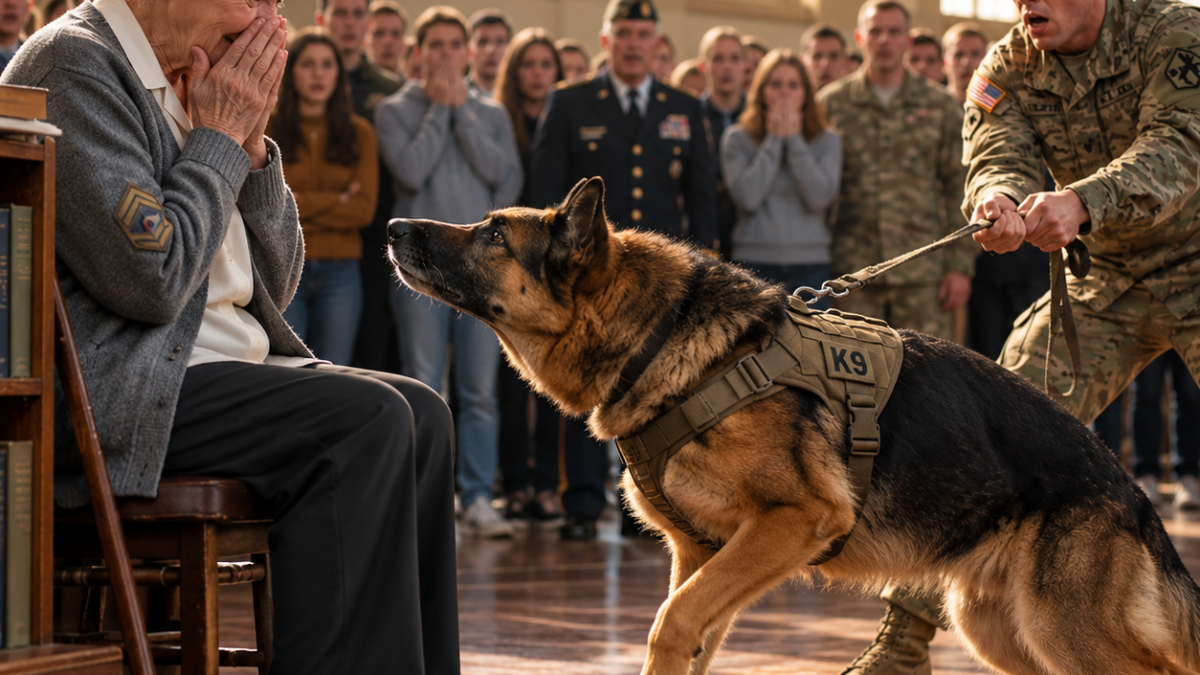
He simply rose from his seated position, ignored the correction, ignored Coleman’s sharp command, and began walking down the center aisle of the gym.
Calm.
Deliberate.
Unstoppable.
“Atlas. Heel.”
Coleman’s voice cut through the gym.
Atlas did not so much as flick an ear.
Students scrambled out of the aisle as the German Shepherd moved past them, weaving between folding chairs with a focus so intense that whispers died before they could spread.
Teachers exchanged confused looks.
Principal Whitfield’s smile vanished.
Daniel Ruiz stepped away from the wall.
He had been watching Eleanor, not the dog.
He saw the moment she noticed Atlas.
Her hands tightened in her lap.
Her face did not change, but something behind it went very far away.
Atlas reached the back row and stopped directly in front of her.
For one long moment, no one moved.
No one breathed.
The German Shepherd sat at perfect attention before the quiet librarian everyone had overlooked for years.
His dark eyes locked onto her face.
This was not curiosity.
This was not a dog smelling food in someone’s purse.
This was recognition.
Coleman jogged down the aisle, embarrassed and alarmed in equal measure.
“Atlas, come.”
The dog ignored him.
“Atlas, heel.”
Nothing.
Then Atlas leaned forward and pressed his broad head gently into Eleanor’s lap.
The gymnasium froze.
A low sound rose from the dog’s chest.
Not a growl.
Not exactly a whine.
Something deeper.
Something almost like grief.
A girl in the third row whispered, “Is he okay?”
Nobody answered.
Eleanor sat perfectly still, her hand hovering above the dog’s head as if she was afraid to touch a memory that had found its way back to her.
Coleman crouched beside Atlas.
In five years of handling military working dogs, he had built his reputation on predictability. A dog breaking command in front of three hundred civilians was more than embarrassing. It was a report. An inquiry. A problem.
But this did not look like misbehavior.
It looked like an old promise being remembered.
“Ma’am,” Coleman said carefully, looking up at Eleanor, “I’m so sorry. I don’t know what’s gotten into him. He’s never done anything like this before. Did you say something to him?”
Eleanor shook her head.
“I haven’t said a word.”
Her voice was as quiet as always.
But Daniel heard something in it.
Not surprise.
Recognition.
Coleman reached for the leash, intending to guide Atlas away.
The moment his hand touched the leather, Atlas stiffened.
The sound in his chest deepened.
Not aggressive.
Protective.
The unmistakable posture of an animal guarding something precious.
Coleman released the leash.
“Okay,” he murmured. “Okay, big guy.”
The gymnasium had gone fully silent now.
Three hundred students.
A dozen teachers.
Several veterans.
All staring at the librarian in the gray cardigan and the military dog who refused to leave her.
Principal Whitfield stepped down from the stage.
Her heels clicked against the gym floor so loudly it seemed disrespectful.
“Sergeant Coleman,” she said carefully, “what exactly is happening here?”
Coleman looked at Atlas.
Then at Eleanor.
“Honestly, ma’am, I don’t know. Atlas is one of the steadiest dogs I’ve ever handled. He doesn’t break command. Something about her is triggering a response I’ve never seen before.”
A nervous laugh rose from somewhere in the bleachers.
It died quickly when Eleanor finally lifted her hand.
Slow.
Hesitant.
She rested it on top of Atlas’s head.
The dog exhaled.
Long.
Shuddering.
Then he closed his eyes.
That was when Staff Sergeant Coleman stopped thinking about embarrassment and started thinking about history.
“Mrs. Voss,” he said, reading her name from the staff badge clipped to her cardigan, “have you ever worked with military working dogs before? Training, kennel work, anything like that?”
The pause was long enough for the entire gym to feel it.
Eleanor kept her hand on Atlas.
“A long time ago,” she said.
Coleman’s brows lifted.
“Where was that, ma’am?”
She looked down at the dog who still had not moved.
“It doesn’t matter anymore.”
Her answer should have ended the moment.
Maybe Coleman would have filed an odd incident report.
Maybe Atlas would have been coaxed away.
Maybe the students would have whispered for a few days before returning to their normal lives.
But then Walt Higgins stood.
Walt was seventy-four, a Vietnam-era veteran who attended every Veterans Day assembly mostly out of habit. He leaned on a cane, moved slowly, and had the kind of eyes old soldiers get when they have spent decades noticing what younger people miss.
He had been watching Atlas’s harness.
More specifically, the faded unit patch stitched near the dog’s shoulder.
Walt made his way down the aisle with the unhurried determination of a man who had decided something mattered.
“Sergeant,” he said, voice raspy but carrying, “mind if an old man takes a look at that dog’s gear?”
Coleman nodded, grateful for anything that felt like explanation.
“Go ahead, sir.”
Walt crouched slowly beside Atlas, his knees protesting. He studied the insignia.
Then his face changed.
“I know this patch,” he said.
The gym stayed silent.
Walt looked from the insignia to Eleanor.
“I had a nephew who served with a K9 unit using this exact symbol out of Kandahar almost a decade back.”
Eleanor’s hand went still on Atlas’s head.
Walt narrowed his eyes, studying her face.
“Ma’am, forgive me for asking, but have we met before?”
“I don’t believe so,” Eleanor said.
But her voice had lost some of its careful steadiness.
Walt frowned.
“There was a woman attached to that unit. Combat medic, if I remember right. My nephew talked about her for years. Said she saved half a dozen soldiers during an ambush near the border. Said she disappeared after she got out. Nobody ever heard from her again.”
A murmur moved through the room.
Principal Whitfield looked at Eleanor as if the woman had transformed in her chair.
“Mrs. Voss,” she said softly, “is there something you’d like to share with us?”
Eleanor did not answer.
Atlas lifted his head and looked into her eyes.
As if even he understood the quiet had run out.
The truth did not come from Eleanor first.
It came from the dog.
Or, more precisely, from the history he carried with him.
Coleman, still trying to find some explanation he could put into a report, took out his service phone and opened the unit’s digital archive. Deployment records. Training logs. Old photographs going back more than a decade.
It should have been a long shot.
But something about Walt’s story had lodged under his ribs.
Four minutes later, Coleman went pale.
“Captain,” he said.
A quiet, serious-faced officer named Captain Renata Oyelaran stepped forward.
Coleman turned the screen toward her.
“You need to see this.”
The photograph showed a much younger woman in desert fatigues kneeling beside a stretcher, hands pressed against the chest of a wounded soldier. Blood soaked through a field dressing she had clearly just applied.
Beside her, barely more than a puppy, sat a German Shepherd with a faint scar forming along one shoulder.
The same shoulder.
The same scar.
Older now.
Wider.
But unmistakable.
The caption beneath the archived photo read:
Combat medic E. Voss assists wounded handler during ambush recovery. K9 Atlas, 8 months, remains at side throughout extraction. Helmand Province.
Captain Oyelaran looked from the phone to the woman in the gray cardigan.
“That’s not possible,” she murmured.
Then, louder, “Does anyone here know this woman’s full service record?”
Nobody did.
Nobody had ever asked.
Walt leaned closer to the phone.
His weathered face went slack.
“That’s her,” he said softly. “That’s the medic. My nephew said she pulled three men out of a burning vehicle after an IED hit the convoy. Said she did it under fire with that puppy refusing to leave her side the whole time.”
Captain Oyelaran approached Eleanor slowly.
Not like a school guest approaching a librarian.
Like an officer approaching someone who had earned the right to be addressed carefully.
“Ma’am,” she said, holding the phone, “is this you?”
Eleanor was quiet for a long moment.
Atlas pressed his head deeper into her lap.
Finally, she said, “Yes.”
The word was almost too soft to hear.
But everyone heard it.
“That’s me.”
The gym erupted in whispers.
Students who had spent years walking past Eleanor’s desk without looking at her properly now stared like they were seeing a hidden door open in the middle of an ordinary wall.
Teachers exchanged stunned looks.
Principal Whitfield pressed one hand to her chest.
Coleman looked at Atlas, then back at Eleanor.
“Atlas was a puppy in that photograph,” he said carefully. “He’s seven now. That would mean…”
“That he’s the same dog,” Eleanor finished.
Her hand moved over the shepherd’s head.
“Yes. I trained him myself before he was reassigned. Before I came home.”
The gymnasium needed several seconds to understand what had just happened.
The quiet librarian.
The woman who stamped overdue slips.
The woman who ate sandwiches alone and asked students to lower their voices during finals week.
The woman nobody noticed.
She had been a combat medic.
She had served two tours.
She had saved soldiers under fire.
She had helped train the very military K9 who had just crossed a crowded gymnasium because after eleven years, he still remembered her.
Captain Oyelaran knelt slightly so she was not towering over Eleanor.
“Ma’am,” she said, voice gentle now, “can you tell us what happened?”
Eleanor looked at the floor.
Old habits do not release their grip easily.
“I served two tours as a combat medic,” she said. “During my second tour, I was attached to a unit that worked closely with the K9 program. Atlas was assigned to a young handler named Specialist Daniel Reyes.”
The dog’s ears flicked at the name.
Eleanor noticed.
So did Coleman.
“He was a good kid,” she continued. “Barely twenty. He loved that dog more than he admitted. During downtime, he let me help train Atlas because I had grown up around dogs, and Atlas was young enough to think everyone with patience was worth listening to.”
A small, fragile smile crossed her face.
It vanished quickly.
“Then there was an ambush. Daniel was hit badly. I got to him in time, but he lost his leg below the knee. Atlas would not leave either of us. Not for a second. He stood over Daniel’s stretcher during extraction like he understood exactly what was happening.”
The gym was so quiet the microphone on the podium hummed faintly.
“After that,” Eleanor said, “I was discharged for medical reasons of my own. Some injuries do not show up right away.”
Nobody moved.
Nobody made a sound.
“I came home and needed quiet. I needed to disappear somewhere nobody would ask questions. Millbrook seemed like as good a place as any.”
Walt’s voice was gentle.
“And Atlas?”
“Daniel couldn’t keep working with him after the injury. Atlas was young. Strong. He still had years of service left. So he was reassigned.”
Her hand trembled once against Atlas’s fur.
“I never thought I would see him again. I didn’t even know he was still active until…”
Her voice broke.
“Until he walked through that door today.”
Coleman looked at the dog he thought he knew completely.
“He never forgot you,” he said quietly.
Eleanor swallowed.
“I suppose not.”
“No,” Coleman said. “Dogs don’t forget the people who shape them. Whatever bond you built with him as a puppy, it never left. It was just waiting.”
The assembly did not resume.
Not really.
Principal Whitfield asked Eleanor if she would be willing to say a few words.
At first, Eleanor shook her head.
“No. I don’t think that’s necessary.”
But Atlas leaned his weight against her leg.
Steady.
Patient.
Stubborn in the way only old working dogs can be.
Something about that small act seemed to give her the courage she could not find for herself.
She stood.
Atlas stood with her.
No command needed.
The crowd parted as she walked toward the podium with the dog at her side.
Not at heel exactly.
Closer than that.
Like an old memory walking beside her.
Eleanor stood behind the microphone where mayors and principals usually stood. Her hands rested lightly on the edge of the podium.
For a moment, she looked out at the students, teachers, veterans, officers, and staff who had finally gone still enough to see her.
“I didn’t come here today to be recognized,” she said.
Her voice was soft, but steadier now.
“I came here to help with chairs.”
A ripple of gentle laughter moved through the gym.
“I think most of you know me as the woman who stamps your library books and tells you to be quiet during finals week.”
This time, more students laughed.
Not mockingly.
Warmly.
“But I want you to understand something,” she continued. “Whatever I did over there, I did not do it for medals or recognition. I did it because somebody needed help, and I happened to be standing close enough to give it.”
Her gaze dropped to Atlas.
“This dog and I went through something together that most people never have to face. I did not expect him to remember me. I certainly did not expect him to forgive me for leaving.”
Atlas looked up at her.
“But he did.”
Her voice shook, then steadied again.
“And I think that says more about loyalty than anything I could ever put into words.”
Captain Oyelaran stepped forward.
In front of the entire assembly, she rendered Eleanor a slow, formal salute.
Not theatrical.
Not hurried.
The kind of salute given by one service member to another when rank is not the point.
A gesture that said, I see you.
I honor what you carried.
Eleanor froze.
Then, slowly, her hand rose.
Her salute was not as sharp as it had once been.
Her fingers trembled.
But nobody in that gym misunderstood it.
The applause began with Walt Higgins.
He stood with his cane in one hand, tears slipping freely down his weathered face, and brought his palm against the floor in a steady rhythm.
Then Daniel Ruiz stood.
Then the teachers.
Then the students.
Then the veterans.
Within seconds, three hundred people were on their feet applauding the woman they had ignored for eleven years.
Eleanor did not smile exactly.
But something in her face loosened.
Something that had been held tightly for a very long time.
Atlas leaned against her leg and closed his eyes.
Word spread through Millbrook before lunch.
By the end of the day, everybody knew.
The quiet librarian.
Combat medic.
Kandahar.
Ambush recovery.
Military K9.
Atlas.
Students began seeing details they had missed for years.
The long sleeves.
The flinch when lockers slammed.
The photograph on her desk.
The way she always noticed who was sitting alone.
The way she never raised her voice, not because she was weak, but because she had heard enough shouting for one lifetime.
Daniel Ruiz stopped by the library after school.
Eleanor was behind the desk, sorting returned books as if nothing had happened.
Atlas was not there. The unit had taken him back to base after the assembly, though Coleman promised to check on a possible visit.
Daniel stood at the counter.
For once, he did not know what to say.
Eleanor saved him.
“You’re here about the photograph.”
He glanced at it.
It no longer faced away.
“Yes.”
She picked up the frame and turned it toward him.
The younger Eleanor looked back from the desert, her arm around a puppy who had not yet learned how much war could ask from him.
“I thought it was a relative,” Daniel admitted.
“Most people did.”
“Did you want it that way?”
“For a long time.”
“And now?”
She looked through the library window toward the empty hallway.
“I don’t know yet.”
That was the honest answer.
People think being recognized heals everything at once.
It does not.
Sometimes attention is just another loud room.
Over the next week, students came into the library in unusual numbers.
Some actually checked out books.
Most did not.
They returned overdue novels, asked awkward questions, pretended to browse near her desk, and tried to figure out how to speak to someone they had spent years overlooking.
A freshman named Lily brought her a handmade card that said THANK YOU FOR YOUR SERVICE in blue marker.
A senior football player returned a history book from sophomore year and admitted he had kept it under his bed because he was embarrassed to bring it back.
Eleanor waived the fine.
“Consider it time served,” she said.
He did not know whether to laugh.
Then Atlas returned.
One month after the assembly, the Army Reserve unit received permission to bring him to Millbrook High for a scheduled visit. Officially, the reason was public outreach and behavioral enrichment. Unofficially, everyone understood that Atlas had made his own request in front of three hundred witnesses.
The morning he arrived, the library was fuller than it had ever been.
Students lined the doorway pretending not to wait.
Atlas entered with Coleman, calm and professional until he saw Eleanor.
Then his whole body softened.
Not broke.
Softened.
He walked directly to her desk, placed his head in her lap, and sighed like he had reached the only appointment that mattered.
Eleanor rested one hand on his head.
“Hello, old friend.”
The students went silent.
Not because a teacher asked them to.
Because some moments teach respect without instruction.
After that, Atlas visited once a month.
The school board approved it unanimously.
The official explanation was that the visits supported veteran education, animal-assisted outreach, and military-community connection.
The real explanation sat behind the library desk with a gray cardigan and one hand resting on the head of a dog who had refused to forget her.
Students changed too.
Not all at once.
Teenagers are still teenagers.
They still forgot books.
Still whispered.
Still spilled drinks they were not supposed to have.
Still asked questions that could have been answered by reading the first paragraph.
But now they looked at Eleanor when they spoke to her.
Really looked.
Some asked about books on military history.
Some asked about working dogs.
Some asked whether courage meant not being afraid.
Eleanor always answered that one the same way.
“No,” she would say. “Courage usually means being afraid and doing the next right thing anyway.”
Walt Higgins began visiting the library every Friday afternoon.
He did not check out books.
He sat near Eleanor’s desk and talked quietly about weather, knees, old friends, bad coffee, and the strange silence that follows people home from war.
Sometimes neither of them spoke for several minutes.
That seemed to help both of them.
Then Specialist Daniel Reyes called.
He was in his thirties now, working as a high school football coach two states away. Walt’s nephew had seen the local news clip and sent it to him.
The first call lasted nearly three hours.
Eleanor took it in the back office with the door closed.
When she came out, her eyes were red.
Daniel Ruiz happened to be returning a stack of books.
He pretended not to notice.
Eleanor noticed anyway.
“He’s doing well,” she said.
“I’m glad,” Daniel replied.
“He thanked me.”
Daniel waited.
Eleanor looked down at the desk.
“I spent eleven years thinking about the ones I could not save. Sometimes I forgot there were some I did.”
Daniel did not offer a cheap answer.
He only said, “Maybe Atlas remembered for you.”
That was the first time Eleanor smiled.
A real smile.
Small, but unmistakable.
On the last day of the school year, Millbrook High sounded like every high school sounds when summer is about to begin.
Lockers slammed.
Students shouted.
Teachers pretended not to be relieved.
The air smelled like floor wax, sweat, and freedom.
Eleanor stood on the front steps, watching the students pour out toward buses, cars, bikes, and three months of noisy possibility.
Atlas sat beside her.
His muzzle was grayer now than in the old photo.
His shoulder scar caught the light whenever he shifted.
Eleanor scratched behind his good ear, the one that had not been nicked by shrapnel all those years ago.
“You waited a long time for me, didn’t you?” she murmured.
Atlas leaned his weight against her leg and closed his eyes in the warm afternoon sun.
For eleven years, Eleanor Voss had lived as quietly as possible.
She had stamped books, shelved stories, made tea, and let an entire town believe there was nothing more to know.
Maybe she had needed that.
Maybe disappearing had saved her in its own way.
But standing there with Atlas beside her, students waving as they passed, teachers nodding with a respect they should have shown sooner, and the photograph on her desk no longer turned away from view, Eleanor understood something she had not allowed herself to believe.
Being seen did not have to mean being taken apart.
Sometimes it meant being brought back.
Some bonds do not fade with distance.
Some loyalty does not weaken with age.
Some promises sit quietly inside a dog’s memory until the day they are needed again.
Nobody in Millbrook High had noticed the quiet school librarian.
Not really.
Not until a military K9 broke formation, ignored every command, crossed a crowded gymnasium, and laid his head in her lap like he had finally found the person he had been looking for all along.
Atlas did not reveal Eleanor’s past to embarrass her.
He did not drag her into the light.
He simply remembered her when everyone else had forgotten to ask.
And sometimes, that is enough to change how an entire town sees the person who had been standing right in front of them the whole time.








