**Nobody Could Touch My Scarred Bulldog—Then an Eight-Year-Old Girl Whispered One Name and He Broke Down in Her Lap**
PART3:
This continued for maybe ten minutes.
Me moving.
Him watching.
Then he started walking.
Not toward me.
Same direction.
I followed at idle.
We ended up at the diner where my chapter spent too much money on bad coffee and decent pie.
The place sat by itself outside Barstow, one of those desert stops held together by grease, stubbornness, and the fact that truckers need somewhere to sit.
The neon sign only lit half of EAT.
So at night it just said EA.
Nobody ever fixed it.
I liked that.
Tank stopped near the back lot.
I pulled in.
Got off.
He turned.
Teeth.
“Not touching you.”
I put half a beef sandwich on the gravel.
Backed away.
He waited until I was twenty feet off.
Then ate.
That was the beginning.
The next morning he was still there.
So I brought water.
The next day, food.
On the third day, I tried getting closer.
He lunged.
The chain came later.
People hear that and think cruelty.
It was not.
Tank kept wandering onto the highway.
The county animal officer had already been called twice.
First time they tried a catch pole.
Tank nearly tore it out of the man’s hands.
Second time they discussed sedation.
Then possibly euthanasia if he could not be safely handled.
I told them I would take responsibility.
They made me sign paperwork.
I put a long chain on a steel post behind the diner where he had shade, water, shelter, and room to move.
Not ideal.
Temporary, I told myself.
I thought once he learned I was not going to hurt him, I could move him somewhere better.
Eight months later, the chain was still there.
So was the distance between us.
I tried everything I knew.
Which, as it turned out, was not much.
Food.
Patience.
Sitting quietly.
Talking.
Ignoring him.
Letting him approach.
Then two trainers.
The first lasted forty minutes.
Tank lunged three times.
The trainer left.
The second looked at the scars, watched his body language for maybe ten minutes, and said:
“This dog has history.”
“No kidding.”
“He may never be safe.”
“What do I do?”
“Management.”
“You mean chain him forever?”
“I mean don’t pretend love erases trauma.”
I respected that answer more than I liked it.
So I adjusted.
I stopped trying to pet him.
Stopped trying to prove anything.
Every morning I sat ten feet away on an overturned milk crate.
Coffee.
Cigarette I usually forgot to smoke.
Tank watched.
I talked.
Not about him.
Weather.
Motorcycle problems.
People who annoyed me.
The price of fuel.
Once, Big Rich walked outside and heard me telling Tank about a carburetor issue.
He said:
“You know the dog doesn’t understand motorcycles.”
I looked at him.
“You don’t understand carburetors either and I still talk to you.”
Rich went back inside.
The crew teased me.
Until Tank bit them.
Then they stopped.
Not bad bites most of the time.
Warnings.
A hand too close.
A fast reach.
A raised arm.
That was the pattern.
Raised hands were worst.
The first time I noticed it, Rich had lifted a wrench above his head to reach something on the awning.
Tank hit the end of the chain so hard he choked himself.
Not trying to get Rich.
Trying to respond to the hand.
Something had been done to him.
That much was obvious.
Not neglect alone.
Human violence.
Repeated.
I knew because trauma has choreography.
The body remembers positions before the mind can decide whether they matter.
I had seen it in men.
Women.
Veterans.
Prisoners.
Myself.
Now I saw it in a dog.
One morning I got within touching distance.
Tank had just eaten.
He was lying near the post.
I sat six feet away.
Then five.
Then four.
No reaction.
I held my hand low.
Not toward his face.
Just there.
He sniffed.
Did not growl.
I moved toward the torn ear.
Barely touched fur.
For half a second, Tank leaned into my fingers.
Half a second.
Then something inside him flipped.
He snapped.
Caught my palm.
Not deep.
Enough blood.
He backed away immediately.
That part stayed with me.
He did not come forward after.
He retreated.
Almost like he was afraid of what he had just done.
I wrapped my hand.
Sat back down.
“You’re okay.”
Tank stared.
“I’m not mad.”
He did not know the words.
Maybe tone.
Maybe nothing.
Still, I stayed.
That half second of leaning into my hand became evidence in my head.
Somewhere underneath all that defensive behavior was a dog who remembered what safe touch felt like.
I just did not know how to get him back there.
The diner had two people holding it together most days.
Hector in the kitchen.
And Rey Calder out front.
Rey was maybe thirty-one.
Looked forty some mornings.
Thin.
Dark hair always tied back.
Hands rough from work.
She worked doubles six days a week because poverty does not care about labor law.
She could carry six plates on two arms.
Remember every trucker’s coffee order.
And disappear emotionally before an argument started.
That last part took me longer to notice.
Raise your voice near Rey and she flinched.
Tiny.
Shoulder first.
Then eyes.
Then she covered it.
Most people never saw.
I did.
Tank did too.
Sometimes when somebody got loud inside, Tank would rise in the yard even though walls separated them.
Rey had a daughter.
Lily.
Eight years old.
Small.
Quiet.
Gray eyes that looked older than eight when she was not smiling.
She came to work because childcare costs money Rey did not have.
She spent hours in a back booth with coloring books.
Homework.
Cheap headphones.
Paper cup of water.
Never caused trouble.
Never demanded attention.
Loud adults barely noticed her.
Quiet children become invisible around loud men.
I saw her.
But only enough to nod.
“Hey, kid.”
She would nod back.
Then return to drawing.
What I did not know was that Lily watched Tank every day.
From the booth.
Through the window.
Apparently for months.
She watched me sit on the crate.
Watched Rich get bitten.
Watched every man approach too quickly.
Watched Tank slam into the chain when somebody raised a hand.
And according to Rey, sometimes Lily whispered toward the glass.
Rey told her repeatedly:
“Stay away from that dog.”
Lily always answered:
“Yes, Mama.”
Children can say yes while planning the exact opposite.
It happened on a Tuesday.
Hot.
Slow.
Lunch crowd gone.
Most of my crew inside playing cards.
I was near the front checking something on my bike when I heard Rich.
Not angry.
Scared.
“Hey!”
Then louder:
“Kid!”
I rounded the building.
Lily was walking across the gravel toward Tank.
Half a sandwich in one hand.
My body went cold.
Tank was already standing.
Head low.
Chain beginning to straighten.
“Lily.”
My voice did not come out right.
Rich moved.
I stopped him.
“Don’t run.”
Because if six men suddenly charged the dog, something terrible happened faster.
Tank growled.
Lily kept walking.
Rey burst through the back door.
Hands wet.
“Lily!”
That sound could have split stone.
“Baby, stop!”
Lily did.
Six feet from the end of Tank’s chain.
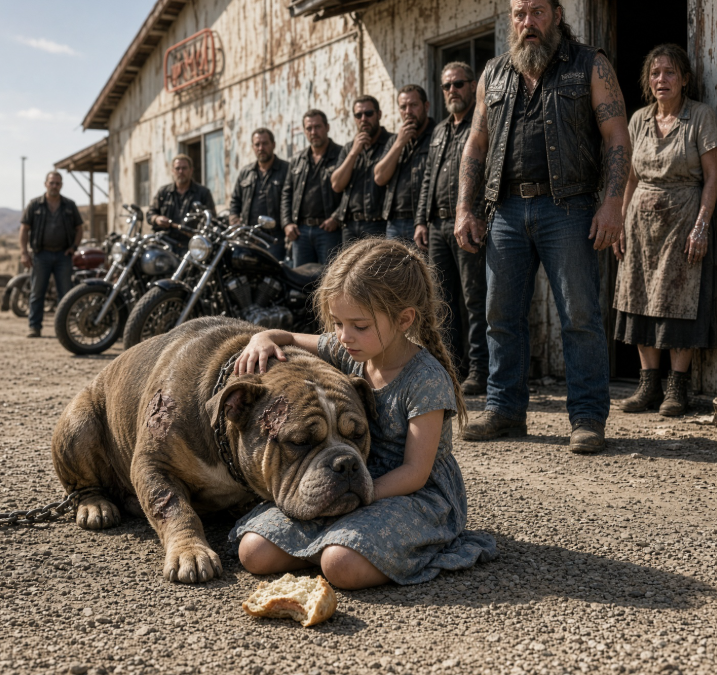
Then she did the last thing any of us expected.
She sat down.
Right in the gravel.
Cross-legged.
Made herself small.
Did not reach.
Did not call Tank.
Did not hold food out.
She placed half the sandwich near her own knee.
Tank growled.
Lily started talking.
Low.
Steady.
Too quiet for us to hear at first.
Nobody moved.
I remember every detail.
Heat shimmering above the highway.
A fly near my face.
Rich’s cards still tucked in his back pocket.
Rey gripping the doorframe.
Tank’s chain dragging half an inch when he shifted.
Then I heard the word.
“Buddy.”
I thought I misheard.
Lily said it again.
“Buddy.”
Tank stopped growling.
Not gradually.
He stopped.
Ears moved forward.
Head tilted.
Lily’s voice trembled for the first time.
“It’s me.”
Tank took one step.
I almost moved.
Did not.
Another step.
The chain scraped.
He reached the sandwich.
Ignored it.
Then crossed the final distance.
Lowered his massive head.
And placed it directly in Lily’s lap.
Nobody breathed.
Lily touched the back of his neck.
The exact place most of us would never have dared.
Tank closed his eyes.
Then let out a long, shuddering breath.
Not a sigh.
Something bigger.
Like his entire body had been holding tension for years and had finally received permission to put it down.
Lily looked toward Rey.
Tears already running down her face.
“I told you.”
Rey covered her mouth.
Lily whispered:
“He still knows me, Mama.”
That sentence changed the entire day.
At first nobody understood.
I certainly did not.
Rey moved slowly toward Lily.
Tank looked up.
Not aggressive.
Watchful.
Lily kept one hand against his neck.
“It’s okay, Buddy.”
Buddy.
Not Tank.
Rey knelt several feet away.
Her face had gone white.
“I’m sorry.”
“To me?”
“To everybody.”
“Why?”
She stared at the dog.
“Because that isn’t your dog.”
I almost laughed.
Nothing about the sentence made sense.
“What?”
“That’s Lily’s dog.”
Inside the diner, chairs stopped scraping.
Rich came closer.
Rey said:
“His name is Buddy.”
I looked toward the dog.
Tank—Buddy—was still pressed into Lily’s body like he was terrified she might disappear if he moved.
“How?”
Rey began shaking.
Not from heat.
I led everybody inside except Lily.
She refused to leave Buddy immediately.
So we let her sit near him.
Rey stood behind the counter.
Both hands gripping a towel.
Then the story came out.
Her husband’s name was Cutter Boyd.
Ex-husband legally by then.
Husband in the years that mattered.
He had been charming early.
They usually are, Rey said.
Not all at once.
First jealousy.
Then monitoring.
Then grabbing her wrist.
Then apologies.
Then doors slammed near her head.
Then one day she woke on a kitchen floor and could not remember falling.
Buddy had belonged to Lily since she was three.
Small puppy.
Bulldog mix.
Slept at the foot of her bed.
Waited near the door for her.
Followed her around the house.
Cutter hated him.
Not at first.
Later.
Because Buddy began doing something.
Standing between Cutter and Rey.
Between Cutter and Lily.
Whenever Cutter raised his voice, Buddy moved.
Not attacking.
Blocking.
Body in the gap.
The first scar came from that.
Then another.
Torn ear.
Rey looked at me.
“Every mark.”
I felt sick.
“Cutter did that?”
She nodded.
I looked through the window.
Buddy’s scarred side.
The flinch when men lifted hands.
The immediate defense.
Eight months I had spent wondering how to make that dog trust me.
The dog was telling me exactly what happened the entire time.
I just did not know the language.
Rey continued.
A year and a half earlier, she ran.
Not dramatic.
No suitcase packed over days.
One night.
Cutter passed out.
Truck.
Two bags.
Lily.
Go.
She tried getting Buddy.
Could not.
Cutter’s brother was coming up the road.
Headlights.
Seconds.
Rey chose Lily.
Drove.
Left Buddy behind the fence.
She cried telling me.
Not polite tears.
Guilt coming out physically.
“I told Lily he ran away.”
Why?”
“What was I supposed to say?”
She wiped her face.
“That I left him?”
“You saved your child.”
“I left him.”
“You had seconds.”
“I left him.”
Trauma can freeze one interpretation into a person.
Facts become irrelevant.
Rey had decided she betrayed Buddy.
Lily believed Buddy disappeared.
Cutter, after discovering they were gone, dumped the dog in the desert.
Highway 58.
The dog I found in my headlights.
I sat.
Everything aligned.
Buddy had not been wandering randomly.
He survived.
Found by chance.
Ended up at the diner where Rey worked.
And Lily had spent months recognizing him through glass while her mother apparently had not looked closely enough, or could not let herself believe it.
“Why didn’t Lily tell you?”
“She did.”
Rey’s face collapsed.
“I thought she was imagining it.”
Children say lost pets are everywhere after losing them.
A similar coat.
Same ears.
Hope turns every dog into the one you miss.
“I told her no.”
“And she believed you?”
“No.”
Rey gave a broken laugh.
“She watched him every day.”
I looked outside.
Lily was now lying on her stomach near Buddy.
Talking.
He watched her face.
Not the chain.
Not the men.
Her.
Something warm moved through me.
Then an engine came off the highway.
Fast.
Old truck.
One headlight.
Rey froze.
Completely.
Not normal recognition.
Body memory.
“What?”
No answer.
Truck entered the gravel lot.
She whispered:
“He found us.”
Cutter Boyd stepped out.
Large man.
Work boots.
Heavy shoulders.
Beard.
Anger arriving before him.
He did not look around.
That told me everything about men like Cutter.
They survive by controlling smaller rooms.
Eventually they assume every room belongs to them.
“REY!”
Buddy was on his feet outside.
Growling.
Different growl from earlier.
Not fear alone.
Recognition.
Lily stood.
I moved between her and the truck.
“Go inside.”
She did.
Rey did not.
Cutter crossed the lot.
“What did I tell you?”
Rey’s whole body changed.
Shoulders in.
Head down.
Suddenly the competent waitress who handled truckers all day looked like somebody shrinking to survive a familiar storm.
“Go.”
Cutter ignored me.
“You’re coming home.”
“No.”
Rey’s voice was almost inaudible.
He reached for her arm.
I caught his wrist.
He turned.
Only then did he actually see me.
Then the bikes.
Then the men behind me.
I did not need to threaten him.
The room had changed.
His certainty weakened.
“This is family business.”
“No.”
He tried pulling free.
I let go because holding a man can escalate faster than people think.
I placed myself between him and Rey.
“You’re leaving.”
“She’s my wife.”
“She says no.”
“My daughter’s here.”
“She says no.”
“What are you, a cop?”
“No.”
“Then mind your business.”
I looked toward Buddy.
“He’s my business.”
Cutter followed my eyes.
His face changed.
“You got that dog?”
“Found him.”
“Should’ve left him there.”
Something inside me went very quiet.
Not rage.
The dangerous part comes after rage.
When you become clear.
“You dumped him.”
Cutter smiled.
Wrong response.
“He was useless.”
Behind me, Lily spoke.
“You threw Buddy away.”
Everyone turned.
She stood in the doorway.
Rey reached for her.
“Lily—”
“No.”
The child looked directly at Cutter.
“You said he ran away.”
Cutter laughed.
“Your mother told you that?”
“You hurt him.”
His face hardened.
“Get inside.”
“No.”
Rey moved beside her daughter.
For the first time since Cutter arrived, she stood straight.
“Do not speak to her like that.”
Cutter stepped forward.
Buddy erupted.
The old clip at the post failed.
Maybe eight months of strain weakened it.
Maybe I should have replaced it earlier.
The chain came loose.
Buddy crossed the yard.
Fast.
Cutter turned.
Dog hit him.
He fell.
Everybody moved.
I reached Buddy first.
He stood over Cutter.
Teeth near his face.
Shaking violently.
Not biting.
Yet.
Cutter screamed.
“GET HIM OFF!”
Then I said the name.
Not Tank.
“Buddy.”
One word.
The dog froze.
I could see his muscles trembling.
“Buddy.”
He looked at me.
That moment mattered more than people understood.
He knew my voice.
Eight months.
Coffee crate.
Food.
Distance.
No touch.
Maybe none of it had been wasted.
I lowered my hand.
Did not reach.
“Back.”
Buddy looked toward Lily.
She said:
“Come here.”
The dog stepped away from Cutter.
Crossed to Lily.
Then positioned himself between her and her father.
Exactly as Rey had described.
Same behavior.
Different place.
He had not forgotten the job.
I called 911.
That surprised some of my crew.
Rich said:
“You’re calling cops?”
“Yes.”
“What happened to handling things?”
“This is handling things.”
Because Cutter had crossed state lines to confront an ex-wife who had fled abuse.
Because he grabbed her.
Because there were witnesses.
Because threats from a motorcycle club might frighten him tonight, but paperwork, restraining orders, documented assault, and legal consequences could keep Rey safer after we were gone.
I had made enough mistakes in my life to know violence feels final when you are angry and temporary once anger fades.
Protection required tomorrow too.
Deputies arrived.
Cutter argued.
Then lied.
Then threatened lawsuits.
Then said Rey had stolen property.
Then changed his story.
He was arrested for the assault we had all witnessed and additional violations uncovered after Rey finally told authorities the full history.
The officers photographed Buddy’s scars.
Rey gave a statement.
So did I.
So did Rich, who complained that writing hurt his hand.
Lily was not interviewed in the diner.
A child advocate met with her later.
That mattered.
Children are witnesses sometimes.
They should not be made into evidence machines.
After the patrol cars left, the diner became quiet.
Rey sat on the floor.
Lily beside her.
Buddy pushed his head between them.
Three bodies connected.
Rey cried into the dog’s neck.
“I’m sorry.”
Buddy licked her chin.
Dogs are inconvenient that way.
They accept apologies without making speeches.
I sat outside on my crate.
The empty chain lay in the dirt.
I had spent eight months believing I rescued that dog.
Maybe I did.
Food.
Water.
Medical care.
Time.
But rescue is rarely owned by one person.
I kept him alive long enough for him to find where he had been trying to return.
That was different.
Rey came outside later.
Lily had fallen asleep in the booth.
Buddy beside her.
“I need to ask you something.”
“Okay.”
“About him.”
She looked through the window.
“I know you took care of him.”
“Yes.”
“He’s yours now.”
“No.”
Her eyes filled.
“Duke—”
“He never was.”
“You fed him for eight months.”
“So?”
“Vet bills.”
“I have money.”
“Training.”
“Failed spectacularly.”
Despite everything, she smiled.
“I can’t repay you.”
“Good.”
“What?”
“I’m terrible with invoices.”
She shook her head.
“I’m serious.”
“So am I.”
I looked through the window.
Buddy’s head was in Lily’s lap.
“That dog has been waiting for her.”
Rey cried again.
People cry differently when danger ends.
Fear leaves the body through whatever door it can find.
“You take him home.”
“Our apartment doesn’t allow big dogs.”
“It does now.”
She stared.
“What did you do?”
“Nothing yet.”
That was technically true.
By the following afternoon, the landlord had agreed to a reasonable pet accommodation after seeing veterinary records, behavioral plans, and proof Buddy had lived safely around Lily.
We did not pressure him.
We solved the problem.
The first night Buddy went home with Rey and Lily, we loaded him into Rey’s truck.
No chain.
No dragging.
He jumped into the passenger side.
Lily climbed beside him.
He immediately put his head in her lap.
Rey stood near the driver door.
“Thank you.”
I hated that sentence.
“Stop.”
“No.”
She stepped closer.
“You could have driven past him.”
I thought about the desert.
Headlights.
Skinny dog standing in the road.
“So could a lot of people.”
“But you didn’t.”
I looked at Buddy.
“Maybe he looked like something I understood.”
“What?”
I took time.
“Something everybody else had already decided was trouble.”
Rey nodded.
She understood that too.
Things changed around the diner.
Not magically.
Rey still worked too much.
Bills remained bills.
Trauma did not evaporate because Cutter was gone.
For months she flinched whenever an unfamiliar truck entered the lot.
Lily had nightmares.
Buddy barked at male voices.
His first weeks inside their apartment were difficult.
He paced at night.
Slept against Lily’s bedroom door.
Could not tolerate brooms raised overhead.
Panicked when Rey dropped a metal lid.
They got help.
Actual trauma-informed canine behavior work.
No dominance nonsense.
No forcing.
No “show him who’s boss.”
Choice.
Predictability.
Counterconditioning.
Safe spaces.
Rey also entered counseling through a domestic violence program.
That may have been harder for her than helping Buddy.
She was used to thinking she had already escaped.
Someone eventually taught her escape and recovery were not the same thing.
I knew something about that.
Lily became louder.
That was one of the first changes.
Not obnoxious.
Just more present.
She started laughing across the diner instead of covering her mouth.
Asked Rich questions while he played cards.
Corrected his math.
Beat him at gin.
He claimed she cheated.
She did.
I was proud.
Buddy began visiting the diner during quiet hours.
No chain.
Leash at first.
Then enclosed yard once I rebuilt the fence.
He still did not like most men touching his head.
So we stopped insisting.
That was the revolutionary idea.
Everyone had spent months asking:
“How do we make this dog let us touch him?”
Lily changed the question.
“Why does he need us to?”
If Buddy wanted contact, he approached.
If not, we left him alone.
Rich, who had once said broken animals should be put down, became the second person Buddy voluntarily touched.
It happened months later.
Rich was sitting near the back door eating fries.
Buddy approached.
Rich froze.
“Duke.”
“What?”
“Dog.”
“I see him.”
“What do I do?”
“Nothing.”
“I am doing nothing.”
“Do it quieter.”
Buddy sniffed his boot.
Then his hand.
Rich kept it low.
Buddy leaned against his knee.
Rich’s face changed.
The biggest fool in California nearly cried.
He scratched gently behind the torn ear.
“Hey.”
Buddy closed his eyes.
Rich looked at me.
I said nothing.
Neither did he.
Some moments become smaller when named.
Rey eventually reduced one double shift.
Not because she became rich.
Because a veterans’ family-owned trucking company nearby hired her for dispatch three mornings a week.
Better pay.
Predictable hours.
Insurance.
One of our riders knew the owner.
That was the kind of help I could accept giving.
Not control.
Opportunity.
Lily started school regularly instead of spending every day in the diner.
First week, Buddy waited at the apartment window for the bus.
Rey sent me a photograph.
Dog standing on couch.
Entire front half pressed toward the glass.
I called.
“He’s going to destroy your blinds.”
“I know.”
“He looks happy.”
Long silence.
“Yeah.”
Rey’s voice broke.
“He does.”
Cutter’s legal case took time.
Real consequences usually do.
The court issued protective orders.
Prior reports from other jurisdictions surfaced.
Evidence of abuse.
Animal cruelty investigation.
He eventually pleaded to multiple charges rather than go through trial.
Rey did not attend sentencing.
People assumed she should want to look at him one final time.
She did not.
“I spent years looking at him,” she said.
“I’m done.”
That sounded like freedom.
I never became Lily’s father.
Never wanted to.
Rey did not need another man claiming ownership over her life.
What developed between all of us was less definable.
Family-adjacent.
Our chapter became a safe circle around them, but I became strict about one thing.
Protection did not mean making decisions for them.
That line matters.
Men who enjoy feeling like protectors can accidentally reproduce control while telling themselves they are helping.
I had seen it.
Maybe done it in other parts of my life.
So I asked.
Need a ride?
Need help with the truck?
Need someone at court?
No?
Fine.
Yes?
Done.
When Lily turned nine, she invited half my chapter to her birthday.
Rey nearly had a nervous breakdown about the guest count.
The diner owner let us use the back lot.
Balloons tied to motorcycles.
Terrible idea aesthetically.
Excellent in practice.
Buddy wore a blue bandana.
Hated it.
Lily insisted.
He tolerated exactly seventeen minutes.
Then pulled it off.
Cake was chocolate.
Rich bought a ridiculous stuffed bulldog bigger than Lily.
She named it Tiny.
I gave her a small toolbox.
Rey looked at me.
“A toolbox?”
“She needs useful gifts.”
Lily immediately loved it.
“I can fix things.”
Rey laughed.
“Apparently.”
At sunset, I watched Buddy follow Lily across the yard.
No leash.
No chain.
He moved differently.
Still alert.
Still scarred.
But relaxed.
That was when something uncomfortable hit me.
For eight months, I had thought my failure was not being able to tame him.
I had been wrong twice.
First, because Buddy did not need taming.
Second, because his resistance had not been failure.
It had been survival.
Every growl was information.
Every flinch had history.
Every bite warned:
Do not do to me what somebody else did.
We kept interpreting the warning as a defect.
Lily did not.
She sat down.
Made herself nonthreatening.
Used his real name.
Let him decide.
That was all.
Except it was everything.
Months later, a rescue group asked if I would speak at a fundraiser.
I laughed at them.
“Why?”
“Because people know Buddy’s story.”
“I’m not giving a speech about a dog.”
“You talk for free at the diner every morning.”
“That’s different.”
Lily heard.
“You should.”
Traitor.
So I went.
No leather vest.
Rey told me to wear it.
“Why?”
“Because people decide things when they see you.”
Exactly.
So I wore it.
I stood in front of maybe eighty people.
Dog trainers.
Rescue workers.
Families.
Veterans.
I told them the short version.
Scarred bulldog.
Highway.
Eight months.
Little girl.
Real name.
Then I said:
“I thought patience meant waiting long enough until the dog became what I wanted.”
People listened.
“I was wrong.”
“Real patience meant giving him room to remain himself until he decided what was safe.”
I thought about Buddy.
“And sometimes the most compassionate thing you can do with a damaged animal is stop demanding proof that it trusts you.”
A woman in the front row wiped her eyes.
I hated public speaking.
Finished quickly.
Lily said afterward:
“You forgot the sandwich.”
“What sandwich?”
“The one I put down.”
“That detail matters?”
“Yes.”
“Why?”
“Because he didn’t eat it.”
She was right.
I had spent eight months using food as a bridge.
Buddy ignored Lily’s sandwich.
He wanted her.
Memory outweighed hunger.
Belonging outweighed reward.
That still gets me.
Years passed.
The desert does that strangely.
Every season looks almost the same until suddenly a child is taller.
Lily grew.
Eleven.
Twelve.
Fourteen.
Buddy slowed.
His face whitened.
Old injuries caught up.
Arthritis.
Torn ear remained.
Scars faded but never disappeared.
Lily still sat on the floor with him.
That never changed.
One afternoon I stopped by Rey’s place.
Lily was doing homework.
Buddy sleeping nearby.
He opened one eye when I entered.
No growl.
No bark.
I sat on the couch.
“Hey, Tank.”
Lily looked up sharply.
“Duke.”
“Sorry.”
I smiled.
“Buddy.”
Tail thumped once.
That was progress.
He eventually allowed me to touch the torn ear.
Years after the first half second.
This time he did not flinch.
I scratched gently.
Buddy leaned into my hand.
Full weight.
I almost stopped breathing.
Lily noticed.
“You okay?”
“Yeah.”
“You look weird.”
“I always look weird.”
She smiled.
I stayed there a long time.
No victory feeling.
No sense I had finally earned something.
Mostly gratitude.
Trust offered late is not worth less.
Maybe more.
When Buddy was thirteen, the veterinarian found cancer.
Advanced.
There were treatments.
None fair.
Rey called me.
I arrived before sunset.
Buddy lay in the living room.
Lily was seventeen then.
Almost grown.
Still looked eight when she cried.
She lay beside him.
His head in her lap.
Exactly like the gravel lot.
Rey sat nearby.
I stayed near the doorway.
Not my moment.
Then Lily looked at me.
“Come here.”
I sat on the floor.
Buddy opened his eyes.
I put my hand near his paw.
Did not touch.
Old habit.
Buddy moved his paw onto my hand.
I had to look away.
Rey whispered:
“He loved you too.”
I shook my head.
“He tolerated me.”
Lily said:
“That was love for Buddy.”
Fair.
The veterinarian came to the house the next morning.
Buddy was tired.
Pain medication no longer enough.
Nobody wanted to make the decision.
So we made it because that is part of loving an animal too.
Lily held him.
Rey held Lily.
I sat beside them.
Before the final medication, Lily whispered:
“You found me.”
That sentence wrecked me.
Because technically she found him.
But maybe Buddy’s whole path across the desert had been a search.
Dying highway.
Headlights.
Diner.
Window.
Months waiting.
Until one little girl ignored every adult warning and sat down where he could see her.
The veterinarian gave the medication.
Buddy relaxed.
His breathing slowed.
Lily whispered his name.
“Buddy.”
His eyes closed.
Gone.
We buried him on land behind the diner.
The owner let us choose a spot near the mesquite where he used to lie in the afternoon.
No chain.
No steel post.
Just earth.
Lily placed his old collar in the grave.
I kept the broken chain clip.
Still have it.
Not because I am sentimental about chains.
Because it reminds me what restraint can look like when everybody thinks restraint is protection.
That empty post stayed behind the diner for years.
Eventually I removed it.
Rich asked why.
“Don’t need it.”
He looked at the concrete hole.
“No.”
We filled it.
Lily left for college.
Veterinary behavior science.
Of course.
Rey cried for two weeks.
Then pretended she did not.
The diner changed owners.
Neon sign finally got repaired.
I hated that.
My beard went almost completely gray.
Riding got harder on my knees.
Rich developed cholesterol and denied it as a political conspiracy.
Life continued.
Then one summer Lily came back.
Twenty-four.
Degree finished.
Working with rescue dogs from abuse and neglect cases.
She visited the old diner.
I was sitting outside.
Same crate style.
Different crate.
“You know,” she said, “you did almost everything wrong with Buddy at first.”
I looked at her.
“Good to see you too.”
“I’m serious.”
“I know.”
“Chain.”
“I know.”
“Too much approach.”
“I know.”
“Trying to pet him before he was ready.”
“I know.”
She smiled.
“But you stayed.”
That mattered.
“You didn’t punish him for not trusting you.”
I thought about that.
“No.”
“Most people would’ve.”
“Some tried.”
“You stopped them.”
“I guess.”
She sat beside me.
“He needed that too.”
“What?”
“Someone keeping the world back until he was ready to choose.”
I looked toward the empty patch where the post had once stood.
For years I had told myself Lily saved Buddy.
She did.
But healing is rarely one hero.
Rey saved Lily by leaving.
Buddy saved Rey and Lily over and over while they still lived with Cutter.
I kept Buddy alive after the highway.
Lily gave him memory back.
Rey gave him home again.
Trainers later helped him learn that unfamiliar men were not all threats.
Rich learned to keep his hands low.
Everybody contributed.
Even Buddy.
Especially Buddy.
He chose not to bite when he could.
Chose to back away.
Chose to trust selectively.
Chose Lily instantly.
Chose me eventually.
People love stories where a broken animal becomes gentle because one good person appears.
That is not how it worked.
Buddy remained complicated.
He always hated raised voices.
Never liked strangers hugging him.
Needed space around food.
Could not tolerate being cornered.
Loved Lily beyond reason.
Followed Rey from room to room.
Accepted Rich after two years.
Accepted me after longer.
He did not become a different dog.
He became a safer version of the dog he already was because his environment finally stopped demanding that fear prove itself.
That distinction matters.
People too.
I learned that from all three of them.
Rey never became carefree.
She still checked locks twice.
Still sat facing doors in restaurants.
Still went quiet when certain men raised their voices.
But she laughed more.
Said no without apologizing.
Told employers when hours were unfair.
Dated eventually.
Years later.
Good man.
Soft-spoken electrician named Ben.
The first time he met Lily, she told him:
“If you yell at my mom, Duke will hear about it.”
Ben looked at me.
I said:
“She is exaggerating.”
Pause.
“Slightly.”
Rey laughed.
That was enough.
What happened to Cutter?
People always ask.
Prison for a time.
Probation after.
Court orders.
Eventually moved east.
I never saw him again.
That was good.
Not every villain needs a final confrontation.
Sometimes the best ending is irrelevance.
He stopped being the center of their fear.
That was the real defeat.
Not getting hit.
Not being threatened.
Not having a biker club scare him.
Being removed from the story.
Rey built a life.
Lily grew up.
Buddy grew old.
Cutter became paperwork.
That is justice more often than people realize.
I used to think strength meant making somebody back down.
Being the biggest presence in the room.
The one nobody challenged.
That is one kind.
There are others.
Rey packing a truck while terrified.
Lily walking across gravel toward the dog everybody feared.
Buddy standing between a little girl and a violent man despite knowing what that might cost him.
Rich learning that touching gently sometimes requires more courage than grabbing.
Me calling the police when an older version of myself might have chosen another solution.
Strength can be restraint.
Patience.
Leaving.
Staying.
Sitting down.
That last one was hardest for me.
Lily’s whole miracle, if you want to call it that, came from sitting down.
She did not dominate Buddy.
Did not rescue him in some grand gesture.
Did not command.
Did not grab.
She lowered herself.
Used his name.
Waited.
Sometimes the powerful thing is refusing to make another frightened being climb up to your level before you are willing to understand them.
You go down instead.
Meet them where fear lives.
I stood behind that diner one evening years after Buddy died.
Sun going down red behind the desert.
Motorcycles in the lot.
Truckers inside.
For a second, I could see the old scene.
Steel post.
Chain.
Dog low to the ground.
Men backing away.
Then Lily.
Small.
Half a sandwich.
Sitting.
“Buddy.”
One word.
That was the shocking thing everybody remembered.
The dangerous dog becoming gentle.
But they had it backward.
Buddy was never waiting to become gentle.
He was waiting to become recognized.
He was waiting for somebody who knew his name.
There is a difference.
A name can be history.
Belonging.
Proof that before the scars, before the highway, before the chain, there was a life in which you were loved.
Lily did not teach Buddy love.
She reminded him he had already known it.
That was why he crossed the gravel.
Why he ignored the sandwich.
Why he put his head in her lap.
Not because she conquered him.
Because for the first time in years, someone looked at the scarred thing everybody called dangerous and spoke to the dog he had been before the world taught him fear.
I spent twenty years leading men who believed power meant nobody could make you step backward.
An eight-year-old girl taught me better.
Real power was sitting in the dirt six feet from something capable of hurting you and refusing to treat it like a monster.
Real power was a mother driving away from an abusive house with almost nothing except her child.
Real power was a scarred dog choosing not to become the thing violence had trained him to be.
And real strength, I finally learned, is not always the ability to control what is broken.
Sometimes it is the patience to stay close without forcing it to heal on your schedule.
That is what Lily saw before any of us.
And that is why the dog nobody could touch finally laid his head in her lap.








