Neighbors Called Cops on a Black Man Swimming in “Their” Pool—Then Learned He Owned the Whole Community
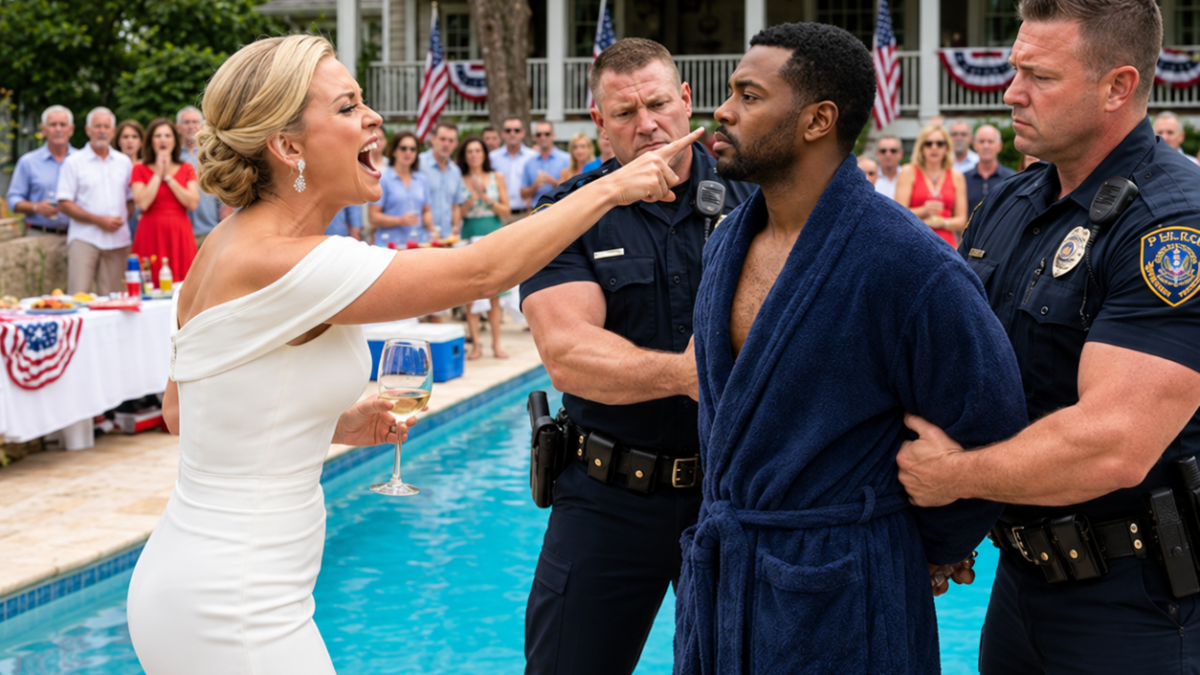
Neighbors Called Cops on a Black Man Swimming in “Their” Pool—Then Learned He Owned the Whole Community
They called the police because they saw a Black man step into the pool at their Fourth of July party.
They laughed when I told them I owned the house, the pool, and every street behind the gates.
Then my butler walked out the front door, saw me in handcuffs on my own lawn, and told forty neighbors the truth they had never bothered to imagine.
My name is Bryant Sullivan.
For most of my adult life, I built places other people called home.
Not metaphorically.
Literally.
Streets, foundations, clubhouse roofs, drainage systems, pool decks, walking trails, mail kiosks, lamp posts, playgrounds, lakefront benches, dog parks, irrigation lines, security gates, landscaping contracts, HOA bylaws, financing agreements, punch lists, warranties, insurance binders, and every ugly little detail that turns bare dirt into a neighborhood.
I started with one foreclosure at twenty-two.
A collapsing bungalow with a flooded crawlspace, cracked brick, and a roof that leaked so badly I had to keep buckets in three rooms. I bought it with borrowed money, maxed-out credit cards, and the kind of blind faith only young men with nothing to lose can afford.
By thirty, I owned fourteen properties.
By thirty-five, I had developed three residential communities across the Carolinas.
By forty-two, I had more money than sleep, more employees than real friends, and a resting heart rate my doctor said belonged to a man being chased by wolves.
The Meridian at Crystal Lake was supposed to be the one that let me rest.
One hundred forty-two homes.
A clubhouse with floor-to-ceiling glass.
Walking trails through old-growth oaks.
A resort-style heated pool.
A small private lake that caught the sunrise like polished copper.
Every street curved exactly the way I designed it. Every lamp post had been chosen after three unnecessary meetings and one argument with a contractor who thought black metal would be cheaper than bronze. Every blade of landscaped grass existed because I had once stood on raw red clay and imagined families walking there.
My own house sat at the center of the community.
Largest lot.
Highest elevation.
Four bedrooms.
Wraparound porch.
Old oaks surrounding the yard.
And the only year-round heated pool on the entire property.
It was not just my house.
It was the crown of everything I had built.
But almost nobody there knew it belonged to me.
That part was not secrecy.
Not exactly.
I traveled too much to be a neighborhood presence. Atlanta on Monday. Dallas on Wednesday. Jacksonville on Friday. Early flights. Late calls. Airport food. Hotel beds. Back pain ignored until it became a language my body spoke louder than I did.
My house was managed by Harold Ashford.
Harold was sixty-two, white-haired, gracious, and so polished he looked formal even while holding a garden hose. He had worked for my family for more than twenty years. He answered the door when packages arrived. He waved from the porch. He trimmed hedges. He kept the pool clean enough to reflect stars at night.
Every resident in The Meridian believed Harold owned the house.
It made sense to them.
He was always there.
He was dignified.
He was white.
No one ever asked.
Harold never corrected them because he considered my business mine to share.
I never asked him to correct them because, to be honest, it never occurred to me that the truth would matter.
That was my mistake.
PART2:
The week before Fourth of July, my doctor looked me in the eye and said, “Bryant, your body is shutting down.”
He did not say it dramatically.
That made it worse.
Doctors usually soften bad news for men like me because we know how to negotiate everything except mortality. This one did not soften anything.
Stress fractures in my spine.
Blood pressure spikes.
Inflammation.
A resting heart rate that had not truly rested in years.
“You need to stop,” he said.
“I can cut travel by half.”
“No.”
“I can delegate more.”
“No.”
“I can work from home.”
He closed the folder.
“Not slow down. Stop.”
I laughed because the alternative was fear.
“I own a company with two hundred employees.”
“And you have one body.”
I looked away.
He was not finished.
“Go home. No travel. No calls except emergencies. No negotiations from airport lounges. No sleeping in hotel rooms. Sit still long enough to remember you’re a human being.”
I drove back to The Meridian late Thursday night.
Harold had the guest room made up, soup on the stove, and the porch light glowing.
“You look terrible,” he said when he opened the door.
“I missed you too.”
He took my bag.
“The doctor was right?”
PART3:
“The doctor was aggressive.”
“That means right.”
I slept fourteen hours.
Friday passed in a blur of soup, pain medication, and silence so unfamiliar it almost felt hostile.
On Saturday morning, I woke to music.
Laughter drifted through the open windows.
The smell of charcoal and grilled meat moved through the house. Children shouted somewhere outside. Ice clinked in coolers. A portable speaker played country music near the pool deck.
Harold had mentioned the Fourth of July party.
Natalie Prescott, the self-appointed HOA president, had asked if the community could use the pool and yard. I had said yes. I liked the idea. Truly. I had built the place for families to gather, neighbors to know each other, kids to run barefoot under oak trees.
I just had not planned on being home for it.
I stood near the upstairs window and looked down.
Forty people were on my lawn.
Tables had been arranged around the pool.
American flags hung from the fence posts.
A banner stretched between two oak trees.
FREEDOM AND EQUALITY FOR ALL.
I actually smiled.
Maybe rest would not be so bad.
Maybe I could swim a few quiet laps, introduce myself, eat a burger, and let my neighbors become more than names in property files.
I put on old blue swim trunks with a frayed drawstring and a faded gray T-shirt with a small hole near the collar. I slid into rubber sandals, grabbed a towel from the bathroom, and went downstairs.
When I stepped out the back door, the July heat wrapped around me immediately.
The pool shimmered turquoise beneath the afternoon sun. Kids ran across the far lawn. Adults stood in clusters, laughing with drinks in hand. Someone near the grill told a story that made half a table burst out laughing.
No one noticed me at first.
I walked past two couples near the grill.
One man glanced at me.
Just a quick look.
Shoes.
Swim trunks.
Shirt.
Face.
Then he turned away.
A woman near the cooler shifted her purse to her other shoulder as I passed.
I reached the pool steps, set my towel on a lounge chair, and pulled my shirt over my head.
That was when Natalie Prescott saw me.
Natalie stood on the far side of the pool deck with a glass of white wine in one hand and two women hanging on her every word. She was thirty-five, blonde, polished, and dressed in a white sundress that looked too expensive to risk near barbecue sauce. Her smile had been bright a second earlier.
Then she saw me.
A Black man she had never met, shirtless in old swim trunks, standing at the edge of the pool she had always envied and now clearly believed she controlled.
The smile disappeared.
She placed her wine glass on a table and walked toward me.
Her gold sandals clicked against the stone.
Each step sounded louder than it needed to.
“Excuse me.”
I looked at her.
“Yes?”
“This is a private event.”
“I know.”
“This pool has been reserved for our community party.”
“I know.”
She frowned.
“I’m sorry. Who are you?”
“I live here.”
Her eyes moved down to my sandals.
Then my swim trunks.
Then the faded shirt on the chair.
“You live here?”
The tone was not curiosity.
It was a verdict.
“Yes, ma’am.”
“This house belongs to Harold Ashford.”
“No, it doesn’t.”
She blinked.
“I know Harold. I’ve known him for three years.”
“I’m sure you do.”
“So let me ask you again.” Her smile tightened. “Who are you?”
“I’m the homeowner.”
She laughed.
Short.
Sharp.
The kind of laugh that is meant to invite everyone nearby into the humiliation.
“The homeowner,” she repeated.
The two women behind her looked at each other.
One covered her mouth.
The other looked away.
I did not react.
I stepped toward the pool.
Natalie moved into my path.
“You don’t just walk into someone’s home and use their pool.”
“I’m not walking into someone’s home,” I said. “I’m walking into mine.”
Her face changed.
The softness vanished.
She pulled out her phone and aimed the camera at me.
Click.
Click.
“What are you doing?” I asked.
“Documenting.”
She typed quickly, then turned the screen toward the women behind her.
I could read the message.
Unknown man claiming to be homeowner. Possible trespasser at Fourth of July party. Stay alert.
I looked at the phone.
Then at Natalie.
Then at the pool.
My pool.
The pool I had designed with the architect.
The pool I had paid extra to heat year-round because I liked swimming at sunrise.
The pool whose blue tile I had chosen from a supplier in Savannah because I wanted the water to look like the Caribbean on clear mornings.
I sat on the edge and put my feet in.
The warmth wrapped around my ankles.
Natalie’s face flushed.
People like Natalie are not used to being ignored.
They are especially not used to being ignored in front of an audience.
“Natalie?” a man asked.
Glenn Sawyer appeared beside her, stocky, goatee, phone already in hand. He had been recording from about ten feet away.
“You want me to call someone?” Glenn asked.
Natalie did not take her eyes off me.
“Call the police.”
I looked up.
She continued, louder now.
“Tell them we have a trespasser at the Ashford residence. Tell them he’s refusing to leave.”
Glenn dialed.
He spoke low, but not low enough.
“Yes, I’d like to report a trespassing. We have an unidentified Black male at a private pool party. He’s refusing to leave the property.”
I heard every word.
Unidentified.
Black.
Male.
As if my race were part of the emergency.
I sat with my feet in my own water while a man I had never met called the police on me.
The flag over the pool fence barely moved.
The banner still read:
FREEDOM AND EQUALITY FOR ALL.
Natalie picked up her wine glass and took a slow sip.
“You should have left when I told you to,” she said. “Now it’s going to be much worse.”
Around us, the party shifted.
Music still played.
The grill still smoked.
But the laughter became thinner.
Guests moved closer under the pretense of refilling plates or checking on children. Phones appeared. Whispers floated across the pool deck.
Who is he?
Never seen him.
Harold owns this place.
Natalie said he walked in.
He says he owns the house?
Each whisper was small, but together they felt like stones being placed one by one on my chest.
No one asked me anything.
No one said, “Maybe we should check.”
No one walked to the house to find Harold.
No one wondered why I was so calm if I had broken into a party in broad daylight.
They simply arranged the facts around the conclusion that made them most comfortable.
I did not belong.
A woman in a red sundress leaned toward her husband.
“I told you we needed better gate security.”
He nodded.
“This is exactly what I’ve been saying at HOA meetings.”
Gate security.
For me.
The man who paid for the gate.
The man who signed off on the stone columns.
The man whose company still owned the land under their streets.
Glenn kept filming.
His phone was steady.
He framed me perfectly: a Black man sitting alone by a pool surrounded by white faces and American flags. I almost admired the accidental symbolism.
Almost.
The patrol car rolled through the gate at 2:43 p.m.
I remember the time because later the body camera footage would confirm it.
Officer Nathan Brewer drove.
Officer Kyle Dunham sat in the passenger seat.
Glenn met them before they reached the pool.
“Thank God you’re here,” he said. “We’ve got a situation at the main residence. A man broke into the pool area. He’s refusing to leave.”
Officer Brewer asked the right first question.
“Broke in how?”
Glenn hesitated.
“He just walked in through the yard like he owned the place.”
I almost laughed.
Like he owned the place.
Officer Brewer and Officer Dunham followed Glenn through the party.
The guests parted for them.
Natalie had positioned herself near the pool like a crisis manager handling an emergency she had created.
“Officers,” she said, extending her hand. “Thank you for coming.”
Brewer shook it.
Dunham didn’t.
“What’s going on?” Brewer asked.
Natalie inhaled like she was preparing to give testimony before Congress.
“That man entered this property uninvited during our community party. He refused to leave. He even claimed he owns this house and the entire neighborhood.”
She gave a small laugh.
“Which is obviously not true.”
Brewer walked toward me.
“Sir, can I see some identification?”
I pulled my driver’s license from the pocket of my swim trunks and handed it over.
He looked at it.
Bryant Sullivan.
Address: The Meridian at Crystal Lake.
Photo matched.
“Address checks out,” Brewer said to Dunham. “He lives here.”
Natalie stepped forward immediately.
“That doesn’t mean anything, officer. Harold Ashford owns this house. Everyone knows that. This man could have put any address on his license.”
Several residents nodded.
“We’ve never seen him before,” someone said.
“Harold is the owner,” another added.
“He just showed up.”
I spoke for the first time since the officers arrived.
“My name is Bryant Sullivan. I own this house. I also own the development company that built and still controls this community. All one hundred forty-two homes.”
Silence.
Then laughter.
It started with Glenn and spread through the deck like fire across dry grass.
Natalie shook her head, arms crossed, lips pulled into a smirk.
“See?” she said to the officers. “He’s delusional. Or running a scam.”
Officer Dunham’s posture changed.
I saw it happen.
His shoulders squared.
His hand moved toward his belt.
“Sir,” he said, “I’m going to need you to stand up. Turn around and place your hands behind your head.”
I stood.
Turned.
Placed my hands behind my head.
I did not ask why.
I already knew.
Dunham searched me in front of forty people.
Hands along my sides.
Waistband.
Pockets.
Back.
Thighs.
Slow.
Thorough.
Public.
I stared at the American flag hanging from the pool fence while the people who lived in my houses watched a police officer pat me down in my own backyard.
A woman near the buffet recorded the whole thing with her phone held high.
No one intervened.
No one said, “His ID matches the address.”
No one said, “Maybe we should verify his ownership claim before treating him like a criminal.”
No one said anything.
That silence was worse than Natalie’s voice.
Brewer found nothing.
No weapon.
No contraband.
No wallet beyond the license he already held.
Just me in swim trunks standing barefoot on sun-heated stone I had paid to install.
The reasonable thing would have been to pause.
Ask another question.
Run the property records.
Call Harold.
But reasonable things often die in front of crowds because nobody wants to admit the first conclusion was wrong.
Natalie stepped forward again.
“Officers, I want him removed from this property. He’s disrupting our community event. He clearly doesn’t belong here.”
Clearly.
Doesn’t.
Belong.
Glenn raised his phone.
“I’ve been recording everything.”
Natalie turned toward the residents.
“I want everyone to know I’m going to increase security at the gate. We need stricter guest policies. We need to make sure people like this can’t just walk in.”
People like this.
Three words.
Three words that told the whole truth before she understood what she had confessed.
Not trespassers.
Not strangers.
People like this.
I stood with my hands still behind my head because Dunham had not told me to lower them.
The sun beat down on my shoulders.
The stone burned beneath my feet.
I had lived through worse.
At twenty-three, I slept in my car because I could not pay rent and keep my first property alive.
I had been rejected by fourteen banks before one loan officer finally looked past my age, my skin, and my zip code.
I had sat across from investors who called me “young man” while I was holding spreadsheets better than theirs.
I had built a company that employed two hundred people across four states.
And now I stood in front of forty neighbors being treated like a threat by people who owed their homes to my work.
Dunham finally said, “You can put your hands down, but don’t leave. We’re not done.”
I lowered my arms slowly.
I did not rub my wrists.
I did not stretch my shoulders.
I just stood there.
Natalie whispered something to Glenn.
Glenn nodded and kept recording.
His live stream was already running.
He cared about being the man who caught the trespasser.
He had no idea he was livestreaming his own public disgrace.
Natalie turned back to Officer Brewer.
“I want him arrested for trespassing.”
Brewer hesitated.
I saw it.
He still held my license.
The address matched.
Something about this did not sit right with him.
But Dunham had already pulled out his handcuffs.
Metal flashed in the sun.
“Sir, turn around. Hands behind your back.”
I looked at Brewer.
Then at Dunham.
Then at Natalie.
I turned.
The first cuff closed around my left wrist.
Then the right.
Click.
Click.
Click.
Each sound landed in the yard like a nail driven into wood.
Natalie exhaled.
She actually exhaled like she had been waiting for that sound all afternoon.
Then she smiled.
“Thank you, officers,” she said loudly. “Thank you for protecting our community.”
Some guests clapped.
Not all.
Enough.
One man near the grill shouted, “About time.”
A woman said, “This is why we have rules.”
The officers gripped my arms and began walking me across the yard.
Past the buffet table.
Past the cooler full of drinks.
Past the lounge chairs.
Past the speaker.
Past the oak trees I had personally selected from a nursery in Asheville because their canopies would shade the pool by late afternoon.
My wet feet left prints on the stone.
The cuffs bit into my wrists.
Forty people watched me go like I was a stain being wiped from a surface.
We were ten feet from the gate when the front door opened.
Every head turned.
Harold Ashford stepped onto the porch.
Pressed gray suit.
Silver hair.
Polished shoes.
Straight posture.
Every inch the distinguished man they believed owned the house.
He took two steps forward.
Then he saw me.
Handcuffed.
Shirtless.
Being marched between two officers across my own yard while neighbors watched with drinks in their hands.
Harold’s face went white.
Not pale.
White.
Like every drop of blood had drained from him at once.
He gripped the porch railing.
Then he moved faster than I had seen him move in twenty years.
Down the steps two at a time.
“Stop!”
His voice cracked across the yard.
“What are you doing? Take those handcuffs off him right now.”
The officers froze.
Natalie’s smile flickered.
A guest near the porch laughed nervously.
“Relax, Harold. We caught the guy who snuck into your house.”
Harold stared at him.
Then at Natalie.
Then at the officers.
“My house?”
His voice shook.
He pointed at me.
“I’m the butler. I’m the estate manager.”
He looked around the silent yard.
“The man you just put in handcuffs is Bryant Sullivan. He is the owner of this house.”
No one moved.
Harold stepped closer.
“Not just this house.”
His voice rose now.
“He owns this entire community. Every home. Every street. Every amenity. Including the pool you have been swimming in all afternoon.”
His eyes locked on Natalie.
“Including yours.”
The music was still playing.
No one seemed to hear it.
Harold reached into his jacket and pulled out a leather folder. His hands were shaking, but his grip was firm.
He opened it and held it out to Officer Brewer.
Inside were documents.
Master deed.
Development records.
Purchase agreements.
Contracts.
One hundred forty-two homes.
Each agreement carried the same signature at the bottom.
Bryant Sullivan.
Owner and developer.
Natalie’s contract was there.
So was Glenn’s.
Brewer took the folder.
Read the first page.
His face changed.
He read the second.
His jaw tightened.
Then he looked at me, still cuffed, still silent, still standing on ground I owned.
I looked at Natalie.
The woman who had called me a trespasser.
The woman who posted my photo in the HOA chat.
The woman who smiled when the cuffs clicked shut.
For the first time since I stepped outside, Natalie Prescott had nothing to say.
Her lips parted.
No sound came out.
Her wine glass slipped from her fingers and shattered on the stone deck.
White wine pooled around the broken glass like a small, quiet surrender.
Brewer moved first.
He stepped toward me and unlocked the cuffs.
The metal fell away from my wrists with a dull click.
Red marks circled both wrists.
“Sir,” Brewer said.
His voice cracked.
He cleared his throat and tried again.
“Mr. Sullivan, I am deeply sorry. We should have verified your identity before—”
“Before you searched me in front of forty people?”
He looked down.
“Before you put me in handcuffs,” I said.
Dunham took one step back.
Neither officer could meet my eyes.
Natalie moved suddenly.
Not toward apology.
Toward survival.
She clasped her hands in front of her chest, softened her face, lowered her chin.
A woman changing costumes in public.
“Bryant,” she said.
I did not respond.
“Mr. Sullivan,” she corrected quickly. “We were just trying to protect the community. How were we supposed to know? You never introduced yourself. You never told anyone who—”
“Stop.”
Harold’s voice cut through the yard.
He stood three feet from her.
For three years, Harold had been polite to that woman.
Professional.
Warm.
Patient.
There was none of that in his eyes now.
“You weren’t protecting anything,” he said.
His voice trembled, but every word was precise.
“You saw a Black man in a pool and decided he did not belong. You are standing on his property. You organized this party on his lawn. You ate his food. You swam in his pool. He gave you permission to be here.”
He looked around at the guests.
“All of you.”
Then back at Natalie.
“And you had him arrested.”
Natalie opened her mouth.
Nothing came.
Glenn had stopped recording.
He held his phone at his side, screen turned inward, as though hiding it could undo the last twenty minutes.
It could not.
The live stream had been running.
Hundreds had already seen it.
Some had recorded it.
The truth had left the yard before the guests did.
Harold turned to the crowd.
“Mr. Sullivan’s purchase agreements contain an anti-discrimination covenant. He wrote it himself. It is included in every single contract signed by every homeowner in this community.”
The word covenant moved through the yard like a cold wind.
People began pulling out phones.
Not to film.
To check their contracts.
Harold continued.
“What happened here today is a direct violation.”
I spoke then.
Quietly.
But the yard heard me.
“The current HOA board is dissolved, effective immediately.”
Natalie’s head snapped up.
“You can’t.”
“I can,” I said. “I own this community. The HOA operates on my land under my rules, with my permission. That permission is revoked.”
I looked at Harold.
He reached into his jacket and produced three envelopes.
White paper.
Typed addresses.
Sullivan Property Group letterhead.
He handed one to Natalie.
One to Glenn.
The third he gave to Officer Brewer.
“For your department,” Harold said.
Natalie stared at the envelope.
“What is this?”
“A formal notice of violation,” Harold said. “You and Mr. Sawyer are under review for discriminatory conduct. The anti-discrimination clause carries a forced-sale provision. If the review confirms what happened here today, you may be required to sell your home and leave The Meridian within ninety days.”
Her fingers trembled.
Glenn stared at his envelope like it had teeth.
Harold looked toward his phone.
“There are forty witnesses and a live stream.”
That was when the party ended.
Not all at once.
At first, people stood frozen, unsure whether leaving would look guilty or staying would look worse.
Then someone set down a plate.
Someone folded a chair.
A woman gathered her children.
Coolers were closed.
Bags lifted.
Nobody said goodbye.
Nobody apologized.
They left in ones and twos, heads down, avoiding my eyes.
Within fifteen minutes, the yard was empty.
Half-eaten burgers sat on the buffet table.
Paper plates tumbled across the lawn.
Melted ice dripped from the cooler onto the patio stone.
The speaker still played country music, but now it sounded ridiculous.
Natalie stood alone by the pool.
The pool she had envied for three years.
The pool she had treated as hers.
She held the envelope in both hands and stared at the water.
I walked past her without a word.
Up the porch steps.
Harold held the door open.
I stepped inside my own house.
The door closed behind me.
I did not watch the video that night.
I did not have to.
I had lived it.
But the world watched.
Glenn’s live stream ran for twenty minutes before he turned the camera off. A viewer in Ohio screen-recorded the whole thing and posted it with one sentence:
HOA president called cops on the man who owns the entire neighborhood.
Within six hours, it had two million views.
Within twenty-four, eight million.
Within seventy-two, fifteen million people had watched Natalie Prescott demand my arrest on my own property.
The footage showed everything.
Natalie’s “people like this.”
The laughter when I said I owned the community.
The search.
The cuffs.
The applause.
Harold rushing down the porch steps, voice breaking as he shouted, “I’m the butler. That man is the owner.”
The internet did not need narration.
The footage told the story better than any reporter could.
CNN picked it up Monday morning.
Local Charlotte news ran it as their lead.
A reporter stood outside the gates of The Meridian with the Freedom and Equality for All banner still visible in the background. That image alone could have been a courtroom exhibit.
Then consequences arrived.
Natalie’s name was public.
Her face was everywhere.
Her words became headlines.
People like this.
Three words she could never pull back.
She was dropped from two charity boards within a week. The Charlotte Women’s Leadership Council removed her from its annual gala program. Her husband’s consulting firm issued a public statement distancing itself from her actions after three clients called and two terminated contracts.
Glenn Sawyer’s employer identified him in the video by Monday afternoon.
By Tuesday, human resources had opened an internal review.
By Wednesday, he was on administrative leave.
The company’s statement said it did not condone discriminatory behavior.
Glenn hired a lawyer.
The lawyer told him to stay quiet.
Glenn stayed quiet, but the video kept speaking.
The police department opened its own internal affairs investigation.
The question was simple.
Why did two officers arrest a man without verifying his ownership claim when his driver’s license matched the property?
Brewer’s body camera confirmed what the live stream showed.
I had provided valid identification.
The address matched.
The officers had enough information to slow down and verify.
They escalated instead.
Both were placed on desk duty pending review.
The chief called the incident deeply troubling.
That was his phrase.
Deeply troubling.
I had other phrases, but Harold advised me not to use them publicly.
Meanwhile, my legal team began reviewing three years of HOA records.
Natalie had not simply humiliated me once.
She had built a system.
Pool access had been selectively restricted.
Guest passes for residents of color were denied at three times the rate of white residents.
Random inspections had been conducted overwhelmingly against homes owned by minority families.
Complaints by Black and Latino residents were ignored unless filed against them.
Fines had been applied unevenly.
Neighborhood watch emails showed language that made my attorneys go silent.
Pattern.
That was the word.
Not mistake.
Not misunderstanding.
Pattern.
Three weeks after the Fourth of July, I held a town hall at the clubhouse.
Every resident was invited.
Most came.
I stood at the front in a simple button-down shirt and dark pants.
No suit.
No tie.
No podium.
Just me, Harold, my attorney Reginald Owens, and a room full of people who suddenly understood that every rule they lived under could change because of what they had allowed.
I looked at them for a long moment before speaking.
“Three weeks ago, I was handcuffed in my own yard, searched in front of my neighbors, and marched across my own property like a criminal.”
No one moved.
“Because I’m Black. Because I did not look like what you expected an owner to look like.”
Someone in the back lowered their eyes.
“But this is not only about me.”
Reginald advanced the first slide.
“Our investigation found that for three years, this HOA was used as a tool to discriminate against residents of color.”
A murmur moved through the room.
“Selectively,” I said. “Deliberately. Consistently.”
We presented the findings.
Fact by fact.
Graph by graph.
Guest-pass denials.
Violation notices.
Inspection patterns.
Selective enforcement.
Complaint delays.
The room grew quieter with every slide.
Numbers have a way of removing excuses.
By the end, no one could honestly claim Natalie had acted only on one bad afternoon.
“The old HOA board is permanently dissolved,” I said. “We will hold open elections for a new board with transparent rules and diverse representation.”
A few people clapped.
Most did not.
That was fine.
I was not there for applause.
“Effective today, I am establishing the Meridian Community Equity Fund. It will support any family targeted, harassed, or financially harmed under the previous administration.”
A woman in the back row began crying silently.
I recognized her.
She had been at the pool party.
She had watched the search and said nothing.
Natalie and Glenn accepted buyout agreements two days later.
Fair market value.
Ninety days to leave.
No lawsuit.
No criminal charges from my side.
Just exit.
Natalie signed the papers in Harold’s kitchen.
Her hand shook as she wrote her name.
She did not look up.
She did not say goodbye.
Glenn signed his downtown with his lawyer present.
Within sixty days, both houses were listed.
Within seventy-five, both were sold.
New families moved in.
The gate code changed.
The banner came down.
Not because freedom and equality were wrong words.
Because I wanted to build a community where nobody needed a banner to pretend.
Six months later, The Meridian looked the same from the outside.
The gates still opened with a code.
The lawns were still green.
The clubhouse glass still caught the morning sun.
The pool still shimmered blue beneath oak shadows.
But something had changed.
You could feel it.
The new HOA board held its first meeting in September.
Five members.
Three women.
Two men.
Two Black.
One Latina.
Two white.
Elected by open ballot.
Every resident over eighteen had a vote.
Minutes posted online within twenty-four hours.
Budget transparent.
Rules applied evenly.
No secret committees.
No gatekeeping disguised as community standards.
The Meridian Community Equity Fund helped fourteen families in its first four months.
Three received legal support for housing discrimination claims outside the community.
Four received grants to cover selectively imposed fees.
Others were connected with counseling, job placement, or educational support.
I paid for it myself.
I never announced the amount.
I was home more often now.
My blood pressure dropped twenty points.
My back began healing.
I slept eight hours a night for the first time in a decade.
Harold said I looked ten years younger.
He also said my swimming form was terrible.
Both things were probably true.
Every Sunday morning at six, I swam in my pool.
Same time.
Same routine.
The water was warm and still.
The sky turned pink over the clubhouse roof.
Sometimes Harold sat on the porch with coffee.
Sometimes a neighbor walked by and waved.
I always waved back.
One Sunday in January, as I climbed out of the pool, a woman approached.
Catherine Moore.
Fifties.
Short gray hair.
Kind eyes carrying something heavy.
“Mr. Sullivan,” she said.
“Bryant.”
She hesitated.
“I was there at the party.”
I wrapped a towel around my shoulders.
“I know.”
“I saw everything that happened to you.”
I said nothing.
She looked down at her hands.
“I didn’t say anything.”
The morning wind moved lightly across the water.
“I stood there with a plate of food,” she said, “and I watched them put handcuffs on you. I didn’t open my mouth.”
I waited.
“I’m ashamed of that. I’ve been ashamed every day since. I keep thinking, what if it had been my son? What if someone treated my son that way and nobody helped?”
Her voice broke.
She pressed her lips together and looked at the pool.
I was quiet for a long moment.
Then I said, “The question isn’t whether you were silent then.”
She looked at me.
“The question is whether you’d be silent now.”
Her eyes filled.
“I wouldn’t,” she said. “Not anymore.”
I nodded.
I did not say it was okay.
I did not say I forgave her.
Some things do not need easy words.
They need truth.
Catherine turned to leave.
At the gate, she stopped and looked back.
“Thank you,” she said, “for giving us a second chance.”
I watched her walk home.
Then I stood by the pool for a while.
The morning was quiet in a way that did not feel empty.
It felt full.
Full of repairs that would take time.
Full of people learning slowly.
Full of second chances that did not erase the first failure but still mattered.
I thought about the Fourth of July.
The laughter.
The cuffs.
Natalie’s smile.
Glenn’s camera.
The forty faces that watched me walk across my own yard in chains.
I did not hate them.
I never had.
Hate takes energy.
I had spent my life building instead of burning.
But








