My Wealthy Neighbor Called 911 on Our Backyard BBQ and Told Dispatch a Black Family Was “Causing Trouble”—She Had No Idea Who Was Standing Behind the Grill.
My Wealthy Neighbor Called 911 on Our Backyard BBQ and Told Dispatch a Black Family Was “Causing Trouble”—She Had No Idea Who Was Standing Behind the Grill.
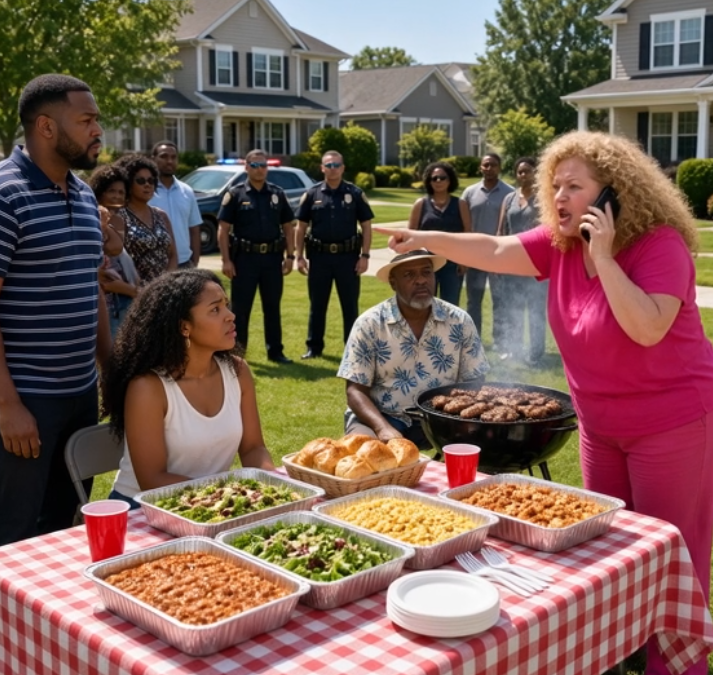
Diane Covington watched sixty people laughing in my backyard and called it an infestation.
She told 911 there was smoke, strangers, danger, and a Black family turning Magnolia Lane into a threat.
What she did not know was that the man flipping ribs at the grill was the police chief of the town she had just tried to weaponize.
My name is Aaron Fletcher.
For twenty-eight years, I wore a badge.
Patrolman.
Detective.
Sergeant.
Captain.
Then chief of police for Ridgewood Township, a quiet, polished suburb south of Atlanta where the magnolia trees were older than most of the houses and the lawns looked like they had been measured with rulers.
But when I came home, I did not wear the badge.
That was the rule.
Not because I was ashamed of it.
Because I wanted my children to live in a neighborhood, not a jurisdiction.
I wanted my son Elijah to be known as the kid who ran track and burned toast at breakfast.
I wanted my daughter Naomi to be known as the girl who painted flowers on everything and did cartwheels barefoot through wet grass.
I wanted my wife Denise to be known as a school counselor, a mother, a woman with the kind of calm voice that could make a furious teenager sit down and tell the truth.
And I wanted to be known as the man with the smoker.
That was enough for me.
At least, I thought it was.
We moved to Magnolia Lane in late March.
The house was a two-story brick colonial with white shutters, a deep backyard, and an oak tree wide enough to shade three picnic tables. Denise fell in love with the kitchen. Naomi loved the bay window. Elijah liked that the high school had a championship track program.
I loved the backyard because it gave me room for my smoker, my grill, and the kind of Saturdays that had held my family together for generations.
The Fletchers passed down barbecue like other families passed down jewelry.
My grandfather ran a little juke joint outside Macon. No sign out front. No polished menus. Just music, folding chairs, dominoes, and smoke rising from the back lot every weekend.
My father learned the rub from him.
Brown sugar.
Paprika.
Cayenne.
Garlic.
Black pepper.
A few things I still will not tell anyone because some family secrets deserve to outlive the internet.
My father taught me before he taught me how to shave.
“Low and slow, Aaron,” he used to say, tapping the side of the smoker with his knuckles. “Don’t rush what needs time.”
That advice applied to meat.
It also applied to justice.
I did not know I would need both on Magnolia Lane.
Our first Saturday barbecue started before sunrise.
I was in the backyard at five in the morning, hands deep in rub, brisket resting on butcher paper, ribs lined up like soldiers waiting inspection. The charcoal caught with a crack and hiss. Hickory smoke curled into the wet morning air.
On the porch rail, a Bluetooth speaker played Marvin Gaye.
Always Marvin on barbecue mornings.
House rules.
By eight, the whole family was moving.
Denise set folding tables across the patio. Elijah strung lights between the oak branches. Naomi did cartwheels across the lawn and nearly wiped out a stack of paper plates. By ten, the smoker was rolling steady. By noon, friends began arriving.
Church folks.
Elijah’s teammates.
Denise’s coworkers.
My sister and her husband.
Three cousins.
Two retired officers from my old precinct.
A neighbor from two streets over who smelled the smoke and came with peach cobbler, which meant she was family now whether she knew it or not.
That was how it was supposed to work.
Barbecue was never just food in my family.
It was invitation.
It was memory.
It was a table wide enough for whoever needed one.
PART2:
By one o’clock, my backyard sounded alive. Kids chased each other near the oak tree. Elijah and his friends argued about track times while pretending not to load their plates a third time. Denise’s coworkers sat under a canopy laughing harder than school counselors usually allowed themselves to laugh. My brother-in-law managed the cooler like it was a government operation. Naomi painted tiny flowers on paper cups so people could tell whose drink was whose.
Smoke rose slow and blue.
Music played low.
Neighbors walked by and waved.
Some even came in.
That was the part Diane Covington never understood.
Community is not built by keeping people out.
It is built when someone smells ribs over a fence and hears, “Grab a plate.”
I noticed Diane around one-thirty.
She stood at the edge of her front lawn across the street, wearing white linen pants, oversized sunglasses, and a sun hat wide enough to cast its own weather system. Her house was the largest on Magnolia Lane, a three-story Southern-style mansion with gas lanterns, iron balconies, and a circular driveway built more for display than convenience.
People called it Covington House.
Diane called it “the historic anchor property.”
It was built in 1997.
She had introduced herself the week we moved in by handing Denise a folder labeled Magnolia Lane Residential Courtesy Expectations. Not HOA rules, she clarified, because Magnolia Lane did not technically have an HOA. It had a “voluntary preservation association,” a phrase rich people use when they want power without accountability.
The folder contained suggestions about mailbox styles, lawn maintenance, acceptable exterior paint colors, trash-can placement, seasonal decorations, parking etiquette, and “noise sensitivity expectations.”
Denise read the first page, smiled politely, and set it in the recycling bin.
Diane did not like us from the beginning.
She smiled when she said hello, but the smile never reached her eyes. She asked what I did for a living before asking my name. When I said I worked in public service, she said, “How admirable,” in the same tone people use for expired coupons.
She asked Denise whether we were renting.
Denise said, “We bought.”
Diane blinked too many times.
“How wonderful,” she said.
After that, she watched us.
Not obviously at first.
From her porch.
From behind upstairs curtains.
PART3:
From her driveway while pretending to water plants that had an automatic irrigation system.
She watched when Elijah ran sprints in the street.
She watched when Naomi chalked flowers on the sidewalk.
She watched when Denise carried groceries inside.
She watched when I wheeled the smoker into the backyard.
That Saturday, Diane did not wave.
She stood across the street with her phone in her hand.
I saw her lift it once toward my backyard.
Then lower it.
Then lift it again.
Denise noticed too.
“She filming?”
“Looks like it.”
“Should I go talk to her?”
“No.”
“Why?”
“Because my ribs are at a sensitive point, and I do not want her energy near the smoker.”
Denise laughed, but her eyes stayed on Diane.
“Be careful, Aaron.”
“I’m always careful.”
“No,” she said softly. “You’re controlled. That is not the same thing.”
I looked at her then.
After twenty-eight years married to a cop, Denise had learned every version of my face. The one I wore for crime scenes. The one for press conferences. The one for bad news delivered to families under porch lights. The one I wore when someone disrespected me and I decided not to give them the satisfaction of seeing it land.
That was the face I had on when Diane lifted her phone again.
“I see it,” Denise said.
“I know.”
At two-thirteen, the first police cruiser turned onto Magnolia Lane.
Then the second.
Then a third.
The music seemed to fade before anyone touched the speaker.
Children stopped running.
Adults turned.
My son Elijah stood near the drink table, paper plate in one hand, jaw tightening in the way I had hoped he would never learn from me.
Naomi came close to Denise and slipped her hand into her mother’s.
The cruisers rolled slowly to the curb in front of my house.
Not with sirens.
No lights.
But the effect was the same.
Every Black person in my backyard understood what had just happened before a single officer opened a door.
That is a weight some families learn to carry early.
The sudden quiet.
The mental inventory.
Hands visible.
Voices calm.
Children near adults.
Nobody make a joke.
Nobody reach too fast.
Nobody give fear a shape someone can call suspicious.
I set down the tongs.
A young officer stepped out of the first cruiser.
Officer Brentley.
Twenty-six years old.
Fresh uniform.
Nervous eyes.
Good kid, from what I remembered of his file. Hired six months earlier. Still learning how much damage a frightened officer can do while believing he is being safe.
Behind him stepped Sergeant Marissa Grant.
That was when things changed.
Sergeant Grant saw me.
Her face went still.
Then her eyes flicked to the smoker, the guests, the children, Diane across the street, and the three cruisers behind her.
I gave her the smallest shake of my head.
Not here.
Not yet.
She understood.
Good sergeants understand more than words.
Officer Brentley approached the gate.
“Good afternoon, sir.”
“Good afternoon, Officer.”
“We received a call about a disturbance.”
I wiped my hands on a towel.
“What kind of disturbance?”
He checked his notes.
“Smoke complaint. Large gathering. Possible trespassing. Suspicious persons.”
A few people in the backyard murmured.
I kept my voice even.
“This is a private family barbecue at my home. No one is trespassing. The smoke is from my smoker.”
Officer Brentley looked past me at the crowd.
His hand did not go to his weapon.
I noticed.
So did everyone else.
That mattered.
“Sir, can I ask how many people are here?”
“About sixty.”
“Do you have a permit?”
“For a barbecue in my backyard?”
His face reddened.
Sergeant Grant stepped closer.
“Officer Brentley.”
He turned slightly.
She gave him a look.
The kind of look senior officers use when they are correcting a rookie without humiliating him in public.
He swallowed.
“Right.”
Diane crossed the street before anyone invited her.
She moved quickly, phone up, sunglasses still on, voice already loud.
“Officers, I am the caller. Diane Covington. I live across the street. This situation is completely out of control.”
Sergeant Grant turned toward her.
“Ma’am, please stay on the sidewalk while we assess.”
Diane ignored her and pointed toward my backyard.
“There are dozens of people. Cars everywhere. Smoke. Loud music. People I do not recognize walking all over the neighborhood.”
A retired detective from my old unit, Calvin Price, looked down at his paper plate and muttered, “Lord, give me strength.”
I shot him a look.
He pretended to study a rib.
Diane continued.
“I have lived on Magnolia Lane for twenty-one years. We do not allow this kind of activity.”
I looked at her.
“We?”
She finally turned toward me.
Her smile was tight and poisonous.
“Mr. Fletcher, I tried to be welcoming.”
“No, you tried to be supervisory.”
A few guests shifted.
Denise gave me a warning look.
Diane lifted her chin.
“This is a quiet residential street, not a public park.”
“It is also not your street.”
“My concern is safety.”
“Your concern was smoke a minute ago.”
“Smoke can indicate unsafe fire practices.”
I gestured toward the smoker.
“It can also indicate barbecue.”
Officer Brentley’s mouth twitched.
Sergeant Grant did not let hers move.
Diane pointed at the street.
“There are vehicles parked along the curb.”
“Legally,” Sergeant Grant said.
“There are strangers.”
“Guests,” Denise said, stepping forward.
Diane looked at my wife the way some people look at a stain they want removed.
“I was not speaking to you.”
The backyard went silent in a new way.
Denise’s hand tightened around Naomi’s.
I felt something old and hard move through me.
Not anger.
Anger was too hot.
This was colder.
Officer Brentley heard it too. I saw it in his face. The moment he realized the call was not really about smoke.
Sergeant Grant asked, “Mrs. Covington, what exactly did you report to dispatch?”
Diane looked offended.
“I reported suspicious activity.”
“What suspicious activity?”
She gestured toward my guests.
“This. All of this.”
“People eating barbecue?”
“Large groups can become volatile.”
Calvin Price set down his plate.
My sister whispered, “Calvin, don’t.”
He folded his arms but stayed quiet.
Diane kept talking.
“And frankly, I do not know who half these people are.”
I said, “You are not required to know my relatives.”
“They are not all relatives.”
“No. Some are friends.”
“From where?”
I stared at her.
“From life.”
Her lips tightened.
Officer Brentley looked down at his notepad because he knew better than to look amused.
Sergeant Grant’s body camera blinked red.
That red light mattered.
Diane did not seem to understand how much.
“Mrs. Covington,” Sergeant Grant said, “do you have evidence of a crime?”
Diane’s nostrils flared.
“I should not have to wait for a crime.”
“No one asked you to.”
“I called because I felt threatened.”
“By what?”
Diane looked past me into the backyard.
Children.
Paper plates.
Lemonade.
Smoke.
Music.
Black joy.
She did not say the last one.
She did not need to.
“By the situation,” she said.
Sergeant Grant held the silence.
Then Diane made her first real mistake.
She turned toward Officer Brentley and said, “You understand, don’t you? I told the dispatcher. This is not the kind of element we usually have on Magnolia Lane.”
The quiet after that sentence was so complete I heard fat drip onto coals inside the smoker.
Element.
There are words people use when they want the meaning heard but not quoted.
Element was one of them.
My son Elijah took one step forward.
I lifted my hand without turning around.
He stopped.
That broke my heart a little.
Not because he obeyed.
Because he knew why he had to.
Sergeant Grant’s voice changed.
“Mrs. Covington, I need you to step back.”
Diane blinked.
“Excuse me?”
“Step back.”
“I am the complainant.”
“And I am instructing you to step back.”
That was when the fourth cruiser arrived.
This one belonged to Lieutenant Marcus Bell.
He stepped out slowly, took in the scene, saw me, and closed his eyes for half a second like a man wishing he had called in sick.
Diane saw the extra stripes on his uniform and brightened.
“Lieutenant, thank goodness. I am Diane Covington, and these officers are not taking this seriously.”
Lieutenant Bell walked toward us.
“Mrs. Covington.”
“You know me?”
“I know the address.”
That should have warned her.
It did not.
She pointed at me.
“This man has turned Magnolia Lane into a public event space. I want this shut down immediately.”
Lieutenant Bell looked at me.
I saw the question in his eyes.
Do you want me to say it?
I gave no signal.
Not yet.
He turned to Sergeant Grant.
“What do we have?”
She answered professionally.
“Complaint of smoke, large gathering, suspicious persons. No observed criminal activity. Vehicles appear legally parked. Fire source appears to be a backyard smoker. Homeowner states private gathering.”
Diane snapped, “He could say anything.”
Lieutenant Bell looked at her.
“He could.”
“Well?”
He waited.
Diane looked confused.
“Well, aren’t you going to ask who he is?”
Lieutenant Bell’s face stayed carefully blank.
“No, ma’am.”
“Why not?”
“Because I know who he is.”
For the first time, Diane hesitated.
I stepped forward then.
Not fast.
Not dramatic.
Just enough that every officer, guest, neighbor, and recording device could see my face.
“Mrs. Covington,” I said, “my name is Aaron Fletcher. This is my home. These are my guests. This is my family. You called police on a barbecue because you saw Black people in a backyard and decided we were a threat.”
Her face went red.
“How dare you.”
“I dare because I heard what you said.”
“You are twisting my words.”
“No. I am repeating their meaning.”
She looked at the officers.
“Are you going to let him accuse me like this?”
Nobody answered.
That frightened her more than argument would have.
I looked at Lieutenant Bell.
“Lieutenant, please handle this as you would any call involving a false or biased report. I am the complainant’s neighbor and the homeowner involved, so I will not direct this response.”
Diane’s eyes narrowed.
“Direct?”
Then Sergeant Grant said quietly, “Chief.”
The word landed like thunder.
Diane looked at her.
“What did you say?”
Sergeant Grant straightened.
“Chief Fletcher.”
The backyard erupted into whispers.
Diane turned slowly back to me.
I did not smile.
This was not a moment for satisfaction.
Too many people were watching my children.
Too many cameras were recording Black guests standing in a backyard that had become a scene because one wealthy neighbor decided comfort was law.
“You’re…” Diane started.
“Yes,” Lieutenant Bell said. “He is the chief of police.”
Diane’s mouth opened.
Closed.
Opened again.
“That is impossible.”
Calvin Price muttered, “That’s new.”
My sister elbowed him.
Diane looked at me differently now.
Not respectfully.
Calculating.
A person like Diane does not abandon superiority. She simply searches for a new route to it.
“Well,” she said, voice shaking slightly, “then surely you understand the importance of maintaining order.”
I almost felt sorry for her.
Almost.
“Mrs. Covington,” I said, “order is not the absence of people who make you uncomfortable.”
Her face hardened.
“I did nothing wrong.”
Lieutenant Bell stepped in.
“Mrs. Covington, we need to speak with you regarding the statements you made to dispatch.”
“I was concerned.”
“Then we will document that concern.”
“I want a supervisor.”
“I am a supervisor.”
“I want someone above you.”
The silence returned.
Diane did not understand what she had just asked for.
I said nothing.
Lieutenant Bell said, “The person above me is standing at the grill.”
A cousin near the cooler choked on sweet tea.
Denise closed her eyes.
Diane’s face went pale.
Sergeant Grant asked Diane to step toward the sidewalk for a statement. Diane refused twice, then complied when Officer Brentley gently explained that refusing to cooperate after making an emergency call would not help her complaint.
The officers interviewed her.
They interviewed me.
They took down vehicle counts.
They confirmed no noise ordinance violation.
They confirmed no open flames beyond the smoker.
They confirmed no blocked driveways.
They confirmed no trespassing.
They confirmed no crime.
Then Lieutenant Bell approached me privately near the porch.
“Chief,” he said quietly, “dispatch flagged the call.”
“How?”
He looked uncomfortable.
“She specifically mentioned race.”
I already knew.
Still, hearing it made my chest tighten.
“Exact wording?”
“We’ll pull the recording.”
“Do that. Preserve CAD notes, audio, bodycam, and all written reports. I am recusing myself from any administrative review involving this call. Send it to Deputy Chief Harris and the city attorney.”
“Yes, sir.”
“And Marcus?”
He looked at me.
“Make sure Officer Brentley gets debriefed properly. He did fine, but I want him to understand what this was.”
“He will.”
I nodded.
Then I turned back toward my yard.
Everyone was pretending not to watch me.
That hurt too.
A barbecue should not have had to wait for my expression before deciding whether it was allowed to continue.
I walked to the smoker.
I picked up the tongs.
I turned the ribs.
Then I looked at my guests.
“Food’s getting cold,” I said.
For two seconds, nobody moved.
Then my brother-in-law shouted, “Not mine,” and grabbed a plate.
The tension cracked just enough for laughter to return.
Not fully.
Not the same.
But enough.
Diane stood across the street while the officers finished speaking with her. She looked smaller now, though her house behind her still seemed enormous. Her phone was no longer raised. For once, she did not look like the person controlling the neighborhood story.
She looked like someone finally standing inside it.
The officers left twenty minutes later.
Nobody was cited.
Nobody was arrested.
Not that day.
Diane stormed into her house and slammed the door hard enough to rattle the decorative wreath.
The barbecue continued.
But the taste had changed.
I watched Elijah laughing with his teammates, but his shoulders stayed tight.
I watched Naomi painting flowers on cups again, but she kept looking at the street.
I watched Denise move through guests with soft reassurance, but I knew she would cry later in our bedroom where the children would not hear.
People who have never been targeted like that often think harm ends when police leave.
It does not.
The sirens may not sound.
The cruisers may pull away.
The official report may say unfounded.
But something remains in the yard.
A question.
Are we safe here?
That night, after everyone left and the last foil tray was stacked in the kitchen, I found Elijah sitting on the deck steps.
He was sixteen.
Tall.
Fast.
Too young to look that tired.
I sat beside him.
For a while, neither of us spoke.
Then he said, “If you weren’t chief, what would’ve happened?”
I looked out at the dark yard.
The smoker had gone cold.
The oak branches moved slightly in the night air.
“That depends on the officers.”
“That’s not an answer.”
“No,” I said. “It’s the truth.”
He stared ahead.
“She knew what she was doing.”
“Yes.”
“She called because we’re Black.”
“Yes.”
“You’re allowed to say that?”
“I have to say that.”
He looked at me then.
At home, I was Dad.
Not Chief.
Not Officer.
Not community leader.
Dad.
That made the next question hurt more.
“Why didn’t you tell her who you were right away?”
“Because I shouldn’t need a title to be treated like a homeowner.”
He swallowed.
“But you did.”
I had no answer that would protect him from the truth.
So I gave him the truth.
“Yes,” I said. “Today, maybe I did.”
He looked away.
I put a hand on his shoulder.
“Elijah, listen to me. What happened today was not your fault. It was not our fault. Her fear is not our responsibility.”
He nodded, but the nod was angry.
Good.
Some anger is healthy when the world tries to teach you humiliation.
Naomi came downstairs later in pajamas, holding a paper cup she had painted with yellow flowers.
“Daddy?”
“Yes, baby.”
“Are the police going to come every time we have people over?”
Denise stopped in the hallway behind her.
I crouched in front of Naomi.
“No.”
“But that lady called them.”
“She did.”
“Why?”
There are questions children ask that expose every adult failure around them.
I could have said misunderstanding.
I could have said some people get nervous.
I could have said she was confused.
But those were lies dressed as comfort.
And Black children do not survive on lies.
“She called because she judged us before she knew us,” I said.
Naomi thought about that.
“Because we’re new?”
“Partly.”
“Because we’re Black?”
Denise put one hand over her mouth.
I held Naomi’s eyes.
“Yes,” I said softly. “I think so.”
Naomi looked down at the cup.
Then she whispered, “But we were just eating.”
“I know.”
That was the part I could not fix.
The next morning, the 911 call became official record in the internal review.
By noon, I had read the transcript.
By one, I wished I had not.
Diane’s voice came through sharp and breathless, but not frightened. Agitated, yes. Angry, definitely. But not truly afraid.
“There are at least fifty or sixty people in their backyard,” she told the dispatcher.
“Are they on your property?” the dispatcher asked.
“No, but they are all over the area.”
“Are they threatening anyone?”
“They are loud. There is smoke everywhere. I don’t know who these people are.”
“Do you see weapons?”
“I can’t tell.”
“Has anyone made threats?”
“They don’t belong here.”
“Ma’am, can you explain what you mean?”
There was a pause.
Then Diane said, “It is a large Black family gathering. This is not normal for Magnolia Lane. We need officers before this becomes something.”
Before this becomes something.
That phrase sat in my chest all day.
Something.
Not a crime.
Not violence.
Not danger.
Just Black people becoming visible in a place she believed should stay curated.
I sent the transcript to Deputy Chief Harris and the city attorney.
Then I went home early.
Denise was in the kitchen.
She had already read it because the city attorney had called to ask whether our family wanted the address redacted from any public records release.
She looked at me.
“She said infestation too.”
I closed my eyes.
That word had been in the audio but not the first transcript I read.
“She said the cars and people were spreading down the block like an infestation,” Denise said.
Her voice did not break.
That made it worse.
“I’m sorry,” I said.
“I am tired of being sorry about other people’s ugliness.”
I sat at the table.
“So am I.”
“What happens now?”
“Review. Possible citation for misuse of emergency services. Referral to the solicitor if they think it rises to false reporting. The town can also address bias-based calls under the nuisance emergency ordinance.”
“And as her neighbor?”
I looked toward the window.
Across the street, Diane’s curtains were closed.
“As her neighbor, I document everything.”
The story did not stay quiet.
Stories like that never do.
Someone at the barbecue had filmed the interaction after the officers arrived. Not the whole thing. Enough. Diane saying “element.” Sergeant Grant calling me Chief. Lieutenant Bell saying the person above him was standing at the grill.
The clip hit social media Monday morning.
By lunch, local reporters were calling the department.
By dinner, national accounts had grabbed it and added captions with flame emojis and words like KAREN, RACIST 911 CALL, and POLICE CHIEF BBQ.
I hated all of it.
Not because Diane looked bad.
Because my family became content.
Naomi’s pink dress appeared in some clips, and even though her face was blurred by most responsible outlets, I still hated that she had been there at all.
Elijah’s track friends were tagged in comments.
Denise’s coworkers got calls from reporters.
People praised me for staying calm.
They said I was “classy.”
I understood the compliment.
I also hated it.
Calm is not always grace.
Sometimes calm is armor.
Sometimes calm is exhaustion.
Sometimes calm is knowing that if you raise your voice, the story will become about your tone instead of their conduct.
At the Tuesday town council meeting, the room was packed.
Not because of a budget vote.
Not because of zoning.
Because a wealthy white woman had called 911 on a Black family’s barbecue and discovered the homeowner was the police chief.
That twist brought cameras.
But beneath the cameras were real people with real stories.
A Black teacher said Diane had once followed her down Magnolia Lane while she delivered tutoring materials.
A Latino delivery driver said Diane had photographed his license plate and reported him for “circling,” though he had been delivering groceries.
A white neighbor admitted that many residents had let Diane act as Magnolia Lane’s unofficial gatekeeper because it was easier than confronting her.
Then Samira Watkins stood.
She was seventy-four, lived three houses down from Diane, and had been on Magnolia Lane longer than anyone else in the room. She was white, widowed, sharp as a tack, and carried herself like a church organist who had outlived everybody’s nonsense.
“I remember when the Fletchers moved in,” she said. “I was delighted. Young family, beautiful children, that handsome smoker in the backyard.”
The room chuckled.
Samira did not.
“Then I watched Diane Covington watch them. I watched her make notes. I watched her slow her car near their driveway. I watched myself decide not to say anything because I am old, and tired, and did not want conflict.”
She turned toward me.
“I owe your family an apology, Chief Fletcher. Not because I called. Because I saw the spirit behind the call before it happened, and I stayed quiet.”
The room went still.
That was the first apology that mattered.
Not because it fixed anything.
Because it named the thing most people avoid.
Silence is not neutral when someone else is being targeted.
Diane attended the meeting with an attorney.
Of course she did.
She sat in the third row wearing navy silk and pearls, lips pressed tight, looking offended by the existence of consequences. When public comment ended, her attorney read a statement.
Mrs. Covington deeply regrets any misunderstanding caused by her good-faith safety concerns. She rejects any characterization of her conduct as racially motivated and asks the community to avoid divisive assumptions during this difficult time.
Good-faith safety concerns.
Divisive assumptions.
Difficult time.
Soft words again.
The kind people use when the truth is too ugly to market.
I did not respond that night.
I did not need to.
The 911 audio was released the next morning.
No commentary could improve it.
People heard Diane’s voice.
They heard the dispatcher ask whether there were weapons.
They heard Diane say she could not tell.
They heard the dispatcher ask whether anyone had threatened her.
They heard Diane say, “They don’t belong here.”
They heard the pause before she said, “It is a large Black family gathering.”
They heard “infestation.”
After that, her statement collapsed under its own perfume.
The solicitor charged Diane with making a false emergency report and misuse of 911 resources.
The charges were not dramatic.
Misdemeanors.
Fines.
Community service.
Possible probation.
Some people wanted more.
Some wanted jail.
Some wanted her house seized, her life ruined, her name burned forever.
I understood the anger.
But I had spent too long in law enforcement to confuse satisfaction with justice.
What mattered more to me was what changed afterward.
The department reviewed our dispatch screening policies.
Not to discourage people from calling when truly afraid.
To train dispatchers and responding officers to identify biased or vague suspicion calls without ignoring legitimate safety concerns.
We added scenario training.
Backyard barbecue.
Teenagers walking home.
Delivery driver waiting in a car.
Black realtor entering a listing.
Latino landscaper working near a property line.
Asian student taking photographs for a school project.
People doing ordinary things that become “suspicious” only when filtered through prejudice.
Officer Brentley attended the first training.
So did Sergeant Grant.
So did I, but not as chief.
As the homeowner in the case study.
That was uncomfortable.
Good training often is.
At one point, Brentley raised his hand.
“I keep thinking about how close I came to asking for IDs.”
The room quieted.
He continued, “I didn’t because Sergeant Grant slowed the call down. But I thought about it. I heard ‘large gathering’ and ‘unknown people’ and I started moving toward control instead of facts.”
I looked at him.
“That admission matters.”
He swallowed.
“It scared me.”
“It should.”
He nodded.
That was how officers learn.
Not by pretending bias is something only bad people carry.
By recognizing the moment when a vague call, an anxious voice, and a uniform can turn ordinary citizens into suspects.
Meanwhile, Magnolia Lane changed in stranger ways.
Some neighbors overcorrected.
People who had barely waved before suddenly brought muffins, flowers, apology cards, invitations, and once, bizarrely, a decorative birdhouse from a man named Greg who looked like he had never apologized without buying something.
Denise accepted the muffins.
She rejected the guilt.
“There is a difference between being sorry and wanting me to make you feel less guilty,” she told one woman on our porch.
The woman cried.
Denise handed her a tissue and did not apologize for making her cry.
That is why I married Denise.
Elijah handled it differently.
He ran.
Every evening after practice, he ran Magnolia Lane from end to end. Past Diane’s mansion. Past the houses with curtains that used to move. Past the corner where the cruisers had parked.
One night, I asked if he was doing it to make a point.
He tied his shoes and said, “I live here.”
That was answer enough.
Naomi began painting flowers on rocks and leaving them along the sidewalk.
At first, just near our house.
Then farther down.
Then near Samira Watkins’s mailbox.
Then near the corner.
One morning, a painted rock appeared near Diane’s driveway.
Yellow petals.
Blue background.
One word in Naomi’s careful handwriting:
Welcome.
I asked her why.
She shrugged.
“Because she needs it more than we do.”
Children can humble you with a sentence.
Diane did not respond to the rock.
But she did not move it either.
Her case resolved four months later.
She entered a plea to misuse of emergency services. The false-report charge was held in abeyance pending completion of probation terms. She paid a fine, issued a written apology, completed community service, and was required to attend a restorative conference if our family agreed.
We did not agree immediately.
Denise and I talked for two weeks.
Elijah said no at first.
Naomi asked whether Diane would yell.
I told her no one would be allowed to yell.
Finally, we agreed to attend without the children.
Diane arrived at the community mediation center wearing gray, no pearls, no sunglasses. Her attorney sat outside. A mediator sat at the head of the table. Denise and I sat across from her.
For a long time, nobody spoke.
Then Diane read from a paper.
“I apologize for the distress caused by my call on April—”
Denise raised one hand.
“No.”
Diane looked up.
The mediator said gently, “Mrs. Fletcher?”
Denise leaned forward.
“Do not apologize for distress caused. That makes it sound like weather. Apologize for what you did.”
Diane’s fingers tightened around the paper.
She looked at the mediator.
The mediator said nothing.
Diane looked back at Denise.
“I apologize,” she said slowly, “for calling 911 on your family’s barbecue when there was no emergency.”
Denise waited.
Diane swallowed.
“I apologize for using language that was hurtful.”
Denise’s face did not change.
Diane closed her eyes briefly.
“I apologize for using language that was racist.”
There it was.
Small.
Strained.
Almost dragged out of her.
But there.
I did not feel triumph.
I felt tired.
Diane looked at me.
“I did not know you were the police chief.”
“I know.”
“If I had known—”
I held up one hand.
“That is the problem, Mrs. Covington. You are apologizing because you called 911 on the wrong Black man.”
Her face flushed.
“That is not what I meant.”
“It is what happened.”
She looked down.
I continued.
“My badge protected us that day. It should not have had to. My family should have been safe because we were home, because we were lawful, because we were human. Not because I outranked the responding officers.”
Diane said nothing.
Denise spoke next.
“You scared my children.”
Diane looked up then.
Denise’s voice shook, but she did not stop.
“My daughter asked whether police would come every time we had people over. My son asked what would have happened if his father was not chief. Those questions came from you.”
Diane’s mouth trembled.
Maybe from shame.
Maybe from discomfort.
Maybe because consequences feel cruel to people who never expected them.
“I’m sorry,” she whispered.
This time, she did not read it.
That did not fix everything.
But it was the first human thing she had said.
Spring turned into summer.
The grass grew thick.
The town moved on, as towns do.
The internet found another story.
Reporters stopped calling.
Diane kept mostly to herself. She resigned from the voluntary preservation association after Samira Watkins and three other neighbors rewrote its charter to clarify that it had no enforcement authority, no security function, and absolutely no role in determining who belonged on Magnolia Lane.
Samira became chair.
Her first act was to cancel the Courtesy Expectations folder and replace it with one page.
MAGNOLIA LANE NEIGHBOR GUIDE
Wave if you want to.
Respect property lines.
Keep music reasonable after 10 p.m.
Offer help before judgment.
Call 911 for emergencies, not assumptions.
Bring a dish if invited.
Denise framed it.
The second Fletcher barbecue happened in August.
I almost canceled it.
Not because I was afraid.
Because I was tired of being symbolic.
Sometimes you just want to cook ribs without representing progress, pain, law enforcement, racial bias, neighborhood healing, and the entire American experiment.
But Denise said, “We are not letting her take barbecue from us.”
So at five in the morning, I lit the smoker.
Charcoal cracked.
Hickory smoke rose.
Marvin Gaye played from the porch rail.
Low and slow.
By noon, people arrived.
Family.
Friends.
Neighbors.
Officers off duty.
Teachers.
Track teammates.
Samira brought sweet tea strong enough to restart a dead car battery.
Greg brought another birdhouse, because apparently that was who he was now.
Officer Brentley came in plain clothes with his wife and a peach pie he said he made himself.
Nobody believed him.
Sergeant Grant brought potato salad.
Lieutenant Bell brought folding chairs and refused to let me help carry them because, as he put it, “You are off duty, Chief.”
Elijah ran races with little kids in the yard and let them win until Naomi called him out for fraud.
Naomi painted flowers on paper cups again.
Denise laughed from the patio, sunlight on her face.
Around one-thirty, I looked across the street.
Diane Covington stood on her porch.
Alone.
No phone.
No sunglasses.
No folded arms.
Just standing there.
For a long moment, she watched.
Then she stepped down from the porch.
Every conversation near me seemed to soften.
People noticed.
Of course they did.
Diane crossed the street carrying a covered dish.
She stopped at the edge of my driveway.
Not the yard.
The driveway.
That mattered.
She looked at me.
“Chief Fletcher.”
I wiped my hands on a towel.
“Mrs. Covington.”
She looked past me at Denise, then back.
“I know I was not invited.”
“No,” I said. “You were not.”
She accepted that.
“I made pound cake.”
A small voice behind me said, “Is it poisoned?”
Naomi.
Denise whispered, “Naomi Grace Fletcher.”
Diane’s face did something almost like a smile.
“No,” she said. “But I understand the question.”
That surprised me.
She held the dish out.
“I wanted to bring this. And then I will leave.”
I looked at Denise.
Denise looked at Diane for a long time.
Then she walked over, took the dish, and said, “Thank you.”
Diane nodded.
She turned to go.
Naomi called after her.
“You can have a plate.”
Everyone froze.
Diane turned back.
I looked at my daughter.
She lifted her chin, stubborn as her mother.
“She can have a plate and leave if she wants.”
Diane’s eyes filled.
She looked at me, but she did not ask me.
She looked at Denise.
Denise said, “One plate.”
So Diane Covington stood at the edge of my backyard with a paper plate in both hands while the Black family she once called an infestation kept laughing, eating, and existing in the place she had tried to police.
No speeches.
No dramatic forgiveness.
No hug.
Life is not that clean.
She ate quietly near Samira, who spoke to her with the firm kindness of a woman willing to forgive but not willing to forget. After ten minutes, Diane left. She took no leftovers. She made no scene.
It was not redemption.
It was a beginning.
Maybe not even that.
Maybe just one better choice after a terrible one.
Sometimes that is all a person can manage.
That night, after the last guests left, Elijah helped me cover the smoker.
He looked across the street at Diane’s dark house.
“You think she changed?”
“I think she learned consequence.”
“That’s not the same thing.”
“No,” I said. “It isn’t.”
He nodded.
Then he said, “But she came over.”
“She did.”
“And nobody called the police.”
I smiled.
“No. Nobody did.”
He laughed quietly.
That was enough for that day.
Years from now, people may tell this story the easy way.
A rich neighbor called 911 on a Black family’s barbecue and found out the dad was police chief.
That version has a twist.
People like twists.
But the truth is heavier.
The truth is that my title saved us from a version of that day many families have lived without protection. The truth is that Diane’s call was not just one woman’s mistake; it was the product of a neighborhood that let her believe comfort was authority. The truth is that my children learned something that afternoon I wish they had not needed to learn in their own backyard.
They learned that joy can be treated as suspicious.
They learned that home does not always protect you from being questioned.
They learned that some people will see smoke from a grill and imagine danger because of who is standing near it.
But they learned something else too.
They learned that dignity can stand still.
They learned that truth sounds different when body cameras, dispatch tapes, and witnesses are allowed to speak.
They learned that a badge can command a room, but it should never be the reason a person is treated as human.
And they learned that we would not shrink.
Not from Magnolia Lane.
Not from our backyard.
Not from barbecue mornings.
Not from smoke curling into the Georgia air while Marvin Gaye played and children ran barefoot through grass.
The next spring, I replaced the old smoker with a bigger one.
Denise said it was excessive.
She was right.
I bought it anyway.
On the first Saturday warm enough to use it, I woke before sunrise, rubbed down ribs, lit charcoal, and watched hickory smoke rise slow and blue beneath the oak tree.
Across the street, porch lights flickered on one by one.
Nobody called 911.
By noon, Magnolia Lane smelled like brisket, peach cobbler, cut grass, and something close to peace.
Not perfect.
Peace rarely is.
But real enough to feed people.
Real enough to invite them in.
Real enough for my daughter to paint flowers on cups, my son to laugh too loud with his friends, my wife to stand beside me smiling, and me to tend the fire the way my father taught me.
Low and slow.
Do not rush what needs time.
That advice applied to meat.
It applied to justice.
And on Magnolia Lane, after one woman tried to turn our family gathering into an emergency, it applied to healing too.








