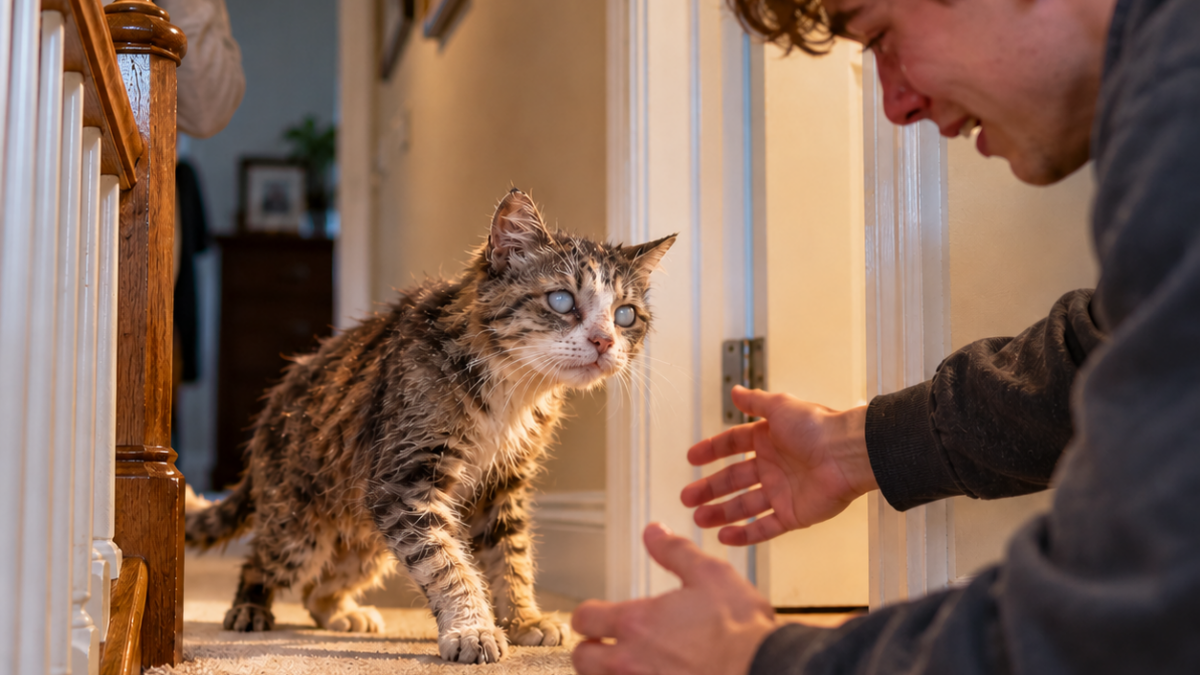
My Son Came Home From College After 10 Months—And His 19-Year-Old, Nearly Blind Cat Did Something She Hadn’t Done in Over a Year. Despite Her Crippling Arthritis, She Climbed 14 Stairs Just to Reach Him… What Happened at the Top Left Our Entire Family in Tears.
PART3:
A cardboard volcano on the kitchen table.
Poppy sitting inside the volcano.
Thirteenth birthday.
Poppy licking frosting off the edge of his cake while everyone shouted at her.
High-school homecoming.
Ethan wearing a suit for the first time.
Poppy’s hair all over the jacket five minutes before he left.
Graduation morning.
Cap.
Gown.
Parents trying not to cry.
Poppy asleep on the folded ceremony program.
She was there for all of it.
Every fever.
Every snow day.
Every breakup.
Every exam.
Every night Ethan fell asleep on the couch after insisting he was not tired.
Poppy would find him.
Always.
She had a particular way of sleeping against him.
Front half across his chest.
Head under his chin.
One paw resting near his shoulder.
When he was little, they fit together naturally.
As he grew, Poppy simply adjusted.
At ten, she slept across his ribs.
At sixteen, mostly on his stomach.
By nineteen, she had become a small warm weight pressed beside him because his chest had gotten too broad.
She adapted.
Cats are good at that.
People sometimes aren’t.
When Ethan was eight, he got pneumonia.
Bad enough for an emergency-room visit.
Nothing catastrophic, but frightening when you are a parent looking at a child who suddenly seems too small inside a hospital bed.
He came home exhausted.
Poppy did not leave him for three days.
She ate in his bedroom.
Slept beside his pillow.
Followed Claire whenever she brought medicine.
Once I tried carrying Poppy downstairs because I thought Ethan needed uninterrupted sleep.
She scratched me.
Not badly.
Just enough to communicate that I had fundamentally misunderstood the situation.
I put her back.
When Ethan was fourteen, his first girlfriend broke up with him.
He pretended not to care.
Teenage boys often believe emotional pain becomes less obvious if they become extremely interested in refrigerators.
He opened the refrigerator six times that evening.
Ate almost nothing.
Answered every question with “I’m fine.”
Then disappeared upstairs.
Around midnight I walked past his bedroom.
The door was partly open.
Ethan sat on the floor beside his bed.
Poppy was in his lap.
He had his face buried in her fur.
I kept walking.
There are moments a father should not interrupt.
Poppy knew that before I did.
By the time Ethan was seventeen, she had started slowing down.
Nothing dramatic.
Sleeping more.
Jumping less.
Thinking twice before climbing onto high furniture.
Our veterinarian, Dr. Patel, called it normal aging.
“She’s earned the right to be lazy.”
Poppy was fifteen then.
At sixteen, we put a small step beside the couch.
At seventeen, another beside our bed.
At eighteen, arthritis became the word we could no longer pretend was abstract.
Both hips.
Lower spine.
Not severe enough to destroy her quality of life.
Severe enough to change it.
The changes came gradually.
That was perhaps why they were so painful to notice.
One day you realize the cat who used to jump onto the kitchen counter has not done it in months.
Then you realize she no longer sits in the window because climbing onto the sill is difficult.
Then you buy pet stairs for the couch.
Then you buy a lower litter box.
Then medication.
Then another medication.
Then one day your wife asks:
“When was the last time Poppy went upstairs?”
And nobody can remember.
Last January, we stopped wondering.
Poppy stood at the bottom of the staircase one evening.
Ethan was upstairs.
He had returned from college for a weekend.
He called her.
“Pop!”
Her ears lifted.
She looked up.
For years, she would have gone.
That night she placed one paw on the first step.
Paused.
Then backed away.
Ethan came downstairs immediately.
He sat on the floor.
Poppy walked into his lap.
He said:
“That’s okay.”
He kissed her head.
“I’ll come to you.”
After that, she never attempted the stairs again.
Fourteen steps.
Not steep by human standards.
Carpeted.
A handrail along one wall.
To Poppy, they may as well have become a mountain.
So we moved her life downstairs.
Food and water into the kitchen.
Litter box near the laundry room.
Her favorite basket into the living room beside the radiator.
Medication beside the coffee maker so we would never forget.
At night, she slept in her basket.
Sometimes on the sofa if one of us lifted her.
The upstairs portion of the house disappeared from her life.
We accepted it.
What else do you do?
Aging creates boundaries.
Parents learn that with their own parents.
Pet owners learn it too.
You do not rage at the boundary.
You rearrange the world around it.
Poppy’s eyesight was also failing.
Cataracts at first.
Then general degeneration.
Dr. Patel explained that she could probably still distinguish movement.
Light.
Large shapes.
Not detail.
“If you move furniture,” he told us, “she’ll struggle.”
So we stopped rearranging furniture.
Claire taped soft padding to one sharp corner of the coffee table.
We added night-lights.
Poppy adapted again.
She walked familiar paths.
Basket to water.
Water to litter.
Litter to kitchen.
Kitchen to sofa.
She navigated mostly through memory, whiskers, scent, and whatever blurred vision remained.
Sometimes she bumped into my shoe if I left it somewhere unusual.
She would stop.
Look offended.
Then continue.
Most importantly, she still recognized voices.
Especially Ethan’s.
He left for college in August.
That departure was harder on all of us than I expected.
Ethan chose a university several hours away.
Not across the country.
Not unreachable.
But far enough that the shape of our house changed immediately.
His room remained upstairs.
Too clean.
Too quiet.
His cereal disappeared from the pantry because nobody else liked it.
I stopped tripping over sneakers near the front door.
Claire stopped complaining about wet towels on the bathroom floor, then began missing the wet towels.
Parenthood is cruel that way.
You spend eighteen years preparing children to leave.
Then feel betrayed when they succeed.
Ethan knelt beside Poppy before leaving.
She was in her basket.
He stroked her head.
“You behave.”
Poppy purred.
“I’m serious.”
She pushed her nose against his wrist.
I stood near the door pretending to check the car.
Ethan looked at me.
“She’ll be okay, right?”
The question surprised me.
He was asking about the cat.
But not entirely.
Poppy was nineteen.
At that age, “okay” becomes a promise nobody should make.
“She’s doing well.”
“That’s not what I asked.”
I looked at her.
“She’s comfortable.”
Ethan nodded.
He understood.
His hand remained on her back.
“I’ll come home.”
Poppy purred.
“I mean it.”
He left.
For the first two days, Poppy searched.
Not dramatically.
She did not roam the house screaming.
She walked to the bottom of the stairs.
Sat.
Listened.
Sometimes she wandered toward the front door in the late afternoon around the time Ethan used to come home from school.
Claire noticed first.
“She’s looking for him.”
“Maybe.”
“She is.”
I did not argue.
Eventually Poppy adjusted.
Again.
She had almost two decades of practice.
Ethan called often.
Sometimes Claire put him on speakerphone beside Poppy.
I thought that was ridiculous.
Until the first time.
“Hey, Pop.”
Poppy’s ears moved.
Her head lifted.
The purr began.
Immediately.
Ethan heard it through the phone.
“Oh my God.”
Claire smiled.
“She knows.”
“Put me closer.”
Claire lowered the phone.
“Poppy!”
The old cat pushed her face against it.
Ethan laughed.
I left the room because I suddenly had something extremely urgent to do in the garage.
He came home three times that first year.
Thanksgiving.
Christmas.
A weekend in March.
Each return followed the same pattern.
Door.
Bag dropped.
“Poppy!”
Ears lift.
Purr.
Ethan sits on floor.
Poppy approaches slowly.
He lifts her into his lap.
She settles.
For several minutes, college disappears.
He is ten again.
Maybe four.
Maybe every age at once.
Then he leaves.
Each time, Poppy returns to her basket afterward.
Each time, I wonder whether animals understand departures.
Maybe not the way we do.
Maybe that is mercy.
By spring, her hips worsened.
Dr. Patel adjusted medication.
We had the conversation every owner of a very old animal eventually has.
“How do we know?”
I hated asking.
Dr. Patel understood.
He had known Poppy since she was six.
He had watched our son grow up too.
“Quality of life,” he said.
“Eating?”
“Yes.”
“Drinking?”
“Yes.”
“Grooming?”
“Less, but yes.”
“Pain?”
“Controlled most days.”
“Interested in you?”
I almost laughed.
“She screams if dinner is late.”
“Then she still has opinions.”
He smiled.
“That’s a good sign.”
He grew more serious.
“You’re watching for when bad days consistently outnumber good ones.”
I nodded.
“And stairs?”
“Forget stairs.”
He shook his head.
“At nineteen, Poppy has nothing to prove.”
That sentence stayed with me.
Nothing to prove.
Exactly.
We carried her when needed.
Brought the world to her.
She had done enough.
Then yesterday happened.
Ethan’s freshman year ended on Thursday.
He drove home Friday afternoon.
Claire had been cleaning the house since Tuesday as if university students inspected baseboards after returning from dormitories.
I told her:
“He lived with three boys.”
She said:
“That is exactly why this house needs to be clean.”
At 2:18 p.m., I heard a car door.
Poppy was asleep in her basket in the living room.
I was in the kitchen making coffee.
Claire was upstairs carrying laundry.
The front door opened.
“Hello?”
I smiled.
Ethan.
He dragged a duffel inside.
Something hit the wall.
Probably the duffel.
Then he yelled:
“Poppy! I’m home!”
From the living room came a sound.
Not a meow.
Movement.
I looked through the doorway.
Poppy’s head was up.
Her ears forward.
Then she stood.
Slowly.
Her back legs took an extra second.
Normal now.
I expected her to wait.
She always waited.
Ethan would drop his things.
Come into the living room.
Sit on the floor.
Same reunion.
Instead Poppy walked into the hallway.
I watched.
“Where are you going?”
She moved toward the front door.
But Ethan had already grabbed part of his luggage and started upstairs.
“Mom?”
Claire answered from above.
“Up here!”
“I’m putting my stuff away.”
His footsteps moved upstairs.
Poppy stopped.
Her head tilted.
She listened.
Then she turned.
Toward the stairs.
I froze.
“No.”
Poppy walked to the first step.
I put down my coffee.
“Poppy.”
She placed one front paw on it.
I moved forward.
Claire’s voice came from above.
“What?”
“Nothing.”
Poppy placed the second front paw on the step.
Then pulled.
Her back feet scrambled.
One slipped.
She corrected.
She was on the first stair.
My heart began hammering.
“Claire.”
“What?”
“Come here.”
“Why?”
“Just come.”
Something in my voice changed her tone.
She appeared at the top of the staircase holding a laundry basket.
Then looked down.
“Oh my God.”
Poppy was attempting the second step.
Claire set the basket down.
I whispered:
“Don’t touch her.”
“I’m not.”
We watched.
Second stair.
Front paws first.
Pull chest upward.
Shift weight.
One rear leg.
Then the other.
Pause.
Breathe.
Third.
That was where Claire first spoke.
“Come see this. Right now.”
She thought she was calling me.
I was already there.
Maybe she meant Ethan.
But he had gone into his room.
Poppy reached the third stair.
Her back legs trembled.
Visible even from below.
Her arthritic hips shook from the effort.
I moved closer.
“What if she falls?”
Claire whispered:
“I’ll catch her.”
“You’re above her.”
“You catch her.”
I positioned myself two steps behind.
Not touching.
Ready.
Every instinct in me screamed to pick her up.
But something stopped me.
Poppy did not look confused.
This was not an old cat accidentally wandering somewhere dangerous.
She knew.
Every few seconds Ethan made noise upstairs.
Drawer.
Closet door.
Footsteps.
Poppy’s ears tracked him.
Fourth stair.
She paused.
Her breathing was faster.
Claire crouched at the top.
“Poppy.”
I whispered:
“Don’t call her.”
“Why?”
“She’s following him.”
Claire covered her mouth.
Fifth step.
Sixth.
The staircase had never looked so large.
I had climbed it thousands of times.
Carrying laundry.
Half asleep.
Angry.
Late for work.
Never thought about a single stair.
Now each one seemed obscene.
Six inches of vertical rise.
A tiny thing.
Except when your hips have nineteen years inside them.
Poppy reached step seven.
Halfway.
Then stopped.
She crouched.
Back legs shaking.
Head lowered.
Thirty seconds passed.
Maybe forty.
I thought:
That’s it.
Good.
Enough.
We’ll carry you.
I moved one hand forward.
Claire whispered:
“Wait.”
Poppy raised her head.
Upstairs, Ethan laughed at something on his phone.
Her ears moved.
She stood.
Eighth.
I had to turn my face away.
It was suddenly too much.
Not because I feared she would fall.
Because I understood what I was seeing.
She was not climbing stairs.
She was closing distance.
Ten months.
College.
Dorm room.
Weekends too short.
A voice from upstairs.
Distance existed.
So she was eliminating it.
Ninth stair.
Her rear right leg slipped.
My heart stopped.
My hand went under her immediately without touching.
She caught herself.
Claire inhaled sharply.
Poppy waited.
Then pulled again.
Tenth.
At that moment, Ethan called:
“Dad, have you seen my—”
I snapped:
“Stay where you are.”
Silence.
“What?”
“Stay.”
“Why?”
Claire said:
“Just stay there.”
He must have heard something in our voices because he stopped moving.
Eleven.
Poppy’s breathing was audible now.
Small exhalations.
Effort.
I wanted to end it.
Every rational part of me said:
Pick up the cat.
The destination matters, not the method.
She does not need to prove anything.
Dr. Patel’s words.
Nothing to prove.
But Poppy was not proving.
That was the difference.
She had not started for us.
She was not performing.
She did not know we were watching with tears in our eyes.
There was no audience in her mind.
Only Ethan.
Twelve.
She stopped again.
Longer this time.
Her body rested against the carpet.
Claire sat on the top step.
Tears running down her face.
I whispered:
“That’s enough, sweetheart.”
Poppy’s ear moved.
Then from the hallway above:
“Pop?”
Ethan.
He had heard us saying her name.
Poppy lifted her head.
Thirteen.
I heard Claire sob.
Poppy got her front feet onto the next step.
Pulled.
Her hind legs shook violently.
One.
Then the other.
Fourteen.
The final stair.
She reached the landing.
Then stopped.
She stood slightly crouched.
Back legs trembling.
Clouded eyes turned toward the hallway.
Toward Ethan’s bedroom.
Claire took the photograph.
I did not even know until later.
Poppy at the top.
Old.
Small.
Her fur thinner than it once was.
Body unsteady.
Head turned toward the place she remembered him being.
Ethan stepped into the hallway.
He froze.
“Poppy?”
I will never forget his face.
First confusion.
Then disbelief.
Then fear.
He looked at Claire.
“But she can’t climb stairs.”
Claire wiped her cheek.
“She just did.”
Ethan stared at the cat.
Poppy heard him.
Her body changed.
Not younger.
Not magically healed.
Nothing sentimental like that.
She simply moved.
One slow step.
Then another.
Ethan dropped to the floor.
“Come here.”
Poppy walked toward him.
Her hips swayed.
Her rear feet shuffled.
Ethan reached forward but did not grab her.
He let her finish.
Five feet.
Maybe six.
Poppy reached his knees.
Then tried to climb onto his lap.
Her front paws landed.
Her back legs could not manage.
Ethan lifted her.
Gently.
Like he had done a thousand times.
Poppy settled against his chest.
Exactly where she had always belonged.
Her head beneath his chin.
One paw near his shoulder.
Then she started purring.
The sound reached us from halfway down the stairs.
Ethan bowed his head.
At first I thought he was kissing her.
Then I saw his shoulders moving.
He was crying.
Not the embarrassed quiet tears young men try to hide.
He broke.
Both arms around Poppy.
Face in her fur.
“Oh, baby.”
Poppy purred.
“I missed you.”
Purr.
“I missed you so much.”
Claire sat beside them.
Put one hand on Ethan’s back.
I stayed where I was.
Halfway down the staircase.
I could not move.
Because suddenly every version of my son was sitting in that hallway.
Four-year-old Ethan carrying a cardboard box.
Eight-year-old Ethan sick with pneumonia.
Fourteen-year-old Ethan heartbroken on his bedroom floor.
Eighteen-year-old Ethan wearing a graduation gown.
Nineteen-year-old Ethan packing for college.
Twenty-year-old Ethan now holding the cat who had connected all those versions.
Poppy was not simply his pet.
She was continuity.
She had watched him become himself.
Children change so quickly that parents can lose track.
One year they need help tying shoes.
Then suddenly they are taller than you.
They drive.
Vote.
Leave.
But Poppy had existed across the entire transformation.
She was almost like proof.
Proof that the little boy had happened.
That childhood had not been imagined.
Her fur had been on every version of his life.
Now he held nineteen years of it against his chest.
Ethan looked at me.
“How did she do that?”
I shook my head.
“I don’t know.”
“She hasn’t gone upstairs.”
“Not since January.”
“No.”
Claire corrected softly.
“Longer.”
Ethan looked at Poppy.
“You crazy old lady.”
She purred.
He laughed through tears.
“You could’ve waited.”
That was the line that destroyed me.
Because he was right.
She could have waited.
He would have come downstairs.
Thirty seconds.
Maybe one minute.
She had no practical reason to climb.
None.
She was safe below.
He always came to her.
She knew that routine.
But for whatever reason cats understand the world, waiting had become unacceptable.
He was home.
He was upstairs.
She had heard his voice.
Go.
That was apparently enough.
We eventually had another problem.
How would she get down?
Absolutely not on her own.
Ethan carried her.
One hand beneath her chest.
One supporting her hips.
Poppy looked almost annoyed by the assistance.
He brought her back to the living room.
Placed her in her basket.
She immediately fell asleep.
Four minutes of stairs had emptied her.
Ethan sat beside the basket for nearly an hour.
Sometimes petting her.
Sometimes simply watching.
That evening, Poppy ate normally.
Took her medication.
Walked to the litter box.
Everything fine.
I called Dr. Patel anyway.
He laughed when I told him.
Not because it was funny.
Because he had known Poppy for years.
“Fourteen stairs?”
“Fourteen.”
“On her own?”
“Yes.”
“How long?”
“Almost four minutes.”
He became quiet.
“Any limping afterward?”
“No more than usual.”
“Pain?”
“Doesn’t seem like it.”
“Keep an eye on her tonight.”
“We will.”
I waited.
Then asked:
“How?”
“How what?”
“How did she do it?”
Dr. Patel knew what I meant.
He was careful.
“She still has muscle.”
“Barely.”
“She has arthritis, not paralysis.”
“I know.”
“Adrenaline and motivation can change what an animal is willing to attempt.”
“So hearing Ethan—”
“Could have motivated her.”
I nodded.
That was the medical answer.
It was correct.
I liked it.
I did not need magic.
Love does not become less meaningful because biology participates.
But Dr. Patel added something.
“I wouldn’t let her do it again.”
“I won’t.”
“Whatever reserve she used, she probably doesn’t have much of it.”
That sentence stayed.
Whatever reserve she used.
Later that night, Ethan and I sat in the kitchen.
Poppy slept in the living room.
Claire had gone to bed.
Ethan looked through the photograph on his phone.
Mom had sent it to him.
Poppy on the final stair.
“You can see her legs shaking.”
“I know.”
He zoomed in.
“I hate that.”
“What?”
“That she hurt herself.”
“She’s okay.”
“She shouldn’t have done it.”
“No.”
“Why didn’t you stop her?”
The question hurt.
“I almost did.”
“You should have.”
Maybe he was right.
I looked at my son.
“I think I needed to see where she was going.”
He stared at the photograph.
Then his expression softened.
“She was coming to me.”
“Yes.”
He put the phone down.
“I feel terrible.”
“Why?”
“I left.”
It took me a second.
“For college?”
“Yes.”
“Ethan.”
“She’s nineteen.”
“I know.”
“What if she dies while I’m gone?”
There it was.
The fear beneath everything.
Probably one he had carried to campus.
Every phone call home.
Every weekend.
Waiting for us to say:
Poppy isn’t doing well.
I knew because I had once carried the same fear about my own father.
Living far enough away that every ringing phone becomes briefly dangerous.
“You were supposed to go.”
“I know.”
“You staying home would not stop her from aging.”
“I know.”
“She never wanted you to stay.”
He smiled sadly.
“She’s a cat.”
“You know what I mean.”
Ethan looked into the living room.
Poppy slept deeply.
“I grew up with her.”
“I know.”
“I don’t remember life before her.”
“I know.”
He rubbed his face.
“I don’t know how to do it.”
“What?”
“Lose her.”
There are questions children ask that fathers desperately want to answer.
Sometimes the best we can do is refuse to lie.
“You don’t know how.”
He looked at me.
“You just do.”
“That sucks.”
“Yes.”
“I thought you were supposed to have useful dad advice.”
“My useful advice is that some things hurt because they are supposed to.”
He frowned.
“That’s terrible advice.”
“Probably.”
I smiled.
“But loving something for nineteen years and then losing it is supposed to hurt.”
He stared toward Poppy.
“Otherwise the nineteen years didn’t cost anything.”
He went quiet.
Then said:
“Today cost her.”
I knew exactly what he meant.
The stairs.
“Yes.”
“She spent something.”
“Yes.”
We sat silently.
Finally Ethan said:
“Why would she do that?”
I looked at him.
“You really need me to answer?”
He shook his head.
“No.”
The next morning, Poppy did not approach the stairs.
Of course she didn’t.
She woke at 6:30.
Ate breakfast.
Complained about her medication.
Walked into the patch of sunlight near the living-room window.
Ethan came downstairs.
She looked up.
Purred.
He sat beside her.
That was all.
The stairs had returned to being stairs.
A boundary.
No second miracle.
No sudden rejuvenation.
No montage where the nineteen-year-old cat began sprinting through the house.
I was relieved.
The story was better that way.
Because what happened was not recovery.
It was expenditure.
Poppy had a small amount of physical ability left.
Yesterday she spent it.
That is the part I cannot stop thinking about.
We talk about love as if it is mostly feeling.
Warmth.
Affection.
Attachment.
Words.
But yesterday, watching Poppy climb, I saw love behave like currency.
Each stair cost something.
First step.
A little strength.
Second.
More.
Third.
Pain.
Fourth.
Effort.
Fifth.
Time.
Sixth.
Something from her hips.
Seventh.
Something from whatever reserve an old body keeps hidden.
She kept paying.
Not because anyone asked.
Because the destination mattered more than the price.
I do not mean Poppy consciously calculated sacrifice.
She is a cat.
I know that.
I do not need to turn her into a human in fur.
If anything, the simplicity is what overwhelms me.
Voice heard.
Person recognized.
Distance exists.
Close distance.
That was it.
No speech.
No debate.
No promise of reward.
Move.
Ethan stayed home all week.
He rearranged his schedule around Poppy without announcing it.
Morning coffee on the living-room floor.
Video games with his laptop beside her basket.
Lunch on the couch.
At night he carried her upstairs once.
I almost protested.
Then understood.
He placed her on his childhood bed.
Poppy sniffed the blanket.
Walked slowly in one circle.
Then settled in the place near his pillow where she had slept for years.
Ethan lay beside her.
I stood in the doorway.
“You want me to take her down later?”
“No.”
“She needs her litter box.”
“I brought one.”
I looked.
He had bought a low disposable tray.
Food.
Water.
Medication.
Everything.
“You planned this.”
“Yeah.”
Poppy was already asleep.
Ethan smiled.
“She climbed up here.”
He touched her gently.
“She gets to stay tonight.”
I nodded.
“Goodnight.”
At 2:00 a.m., I woke.
Parents retain the strange ability to wake when their grown children move around the house.
I walked into the hall.
Ethan’s door was open.
The bedside lamp remained on.
He was asleep.
Poppy was pressed against his chest.
One paw near his shoulder.
Exactly like every photograph from his childhood.
Except now the boy was a man.
The cat was old.
And time was visible in both directions.
I took one picture.
I almost felt guilty.
Then remembered how grateful I am for every old photograph.
I went back to bed.
The next afternoon Ethan found me in the garage.
“You took a picture.”
“Your mother told me to.”
“Liar.”
“Mostly.”
He looked at the photo.
Then smiled.
“Send it to me.”
I did.
He saved both pictures.
The stair.
The bed.
One showed the effort.
One showed why.
Over the next two weeks, Poppy seemed normal.
Normal for nineteen.
Slow.
Hungry at inconvenient times.
Irritated by pills.
Mostly blind.
Very opinionated.
Ethan drove her to the veterinarian himself.
Dr. Patel examined her.
Listened to her heart.
Moved the hips carefully.
Poppy objected.
“That’s encouraging.”
Ethan looked confused.
“She tried to bite me.”
“Exactly.”
Dr. Patel smiled.
“She still has standards.”
He ran blood work.
Kidneys stable.
Heart good for her age.
Weight slightly lower than six months earlier but not alarming.
Then he looked at Ethan.
“So you’re the staircase motivation.”
Ethan smiled.
“I guess.”
Dr. Patel scratched Poppy under the chin.
“I’ve known this cat almost her whole life.”
“She likes you.”
“She tolerates me.”
“That’s basically love from her.”
The veterinarian became serious.
“You understand where we are, though.”
Ethan’s smile faded.
“Yes.”
“Could be months.”
Ethan nodded.
“Could be longer.”
Another nod.
“Could be shorter.”
“I know.”
Dr. Patel watched him.
“What matters is that she is still having a life.”
Ethan looked at Poppy.
“She is.”
“Then don’t spend all your time grieving her before she’s gone.”
That was better advice than mine.
Ethan told me later.
I wrote it down.
Not literally.
But I kept it.
Do not grieve them so hard while they are alive that you miss the living.
That became our rule that summer.
Poppy got chicken.
Probably too often.
She sat outside on warm mornings with us.
Never alone.
She liked the porch.
Could still feel sunlight even if she could not see much of it.
Ethan carried her into the backyard sometimes.
Placed her in grass.
She walked three careful steps.
Smelled everything.
Then sat.
Once, a bird landed nearby.
Poppy’s ears turned.
Her head snapped toward it.
For three seconds she looked young.
Ethan laughed.
“You still think you’ve got it.”
Poppy crouched.
The bird flew.
She stared after the sound.
Ethan scratched her head.
“Almost.”
He spent that summer becoming reacquainted with home.
That is something college students do.
They return to the same house but do not fit inside it exactly the same way.
They have habits you did not teach them.
New friends whose names appear constantly.
Opinions stronger.
Bedtimes worse.
Confidence mixed with uncertainty.
Ethan had become more independent.
Poppy did not care.
To her, he was still Ethan.
No résumé.
No GPA.
No adult identity.
Voice.
Smell.
Lap.
Her boy.
There is something deeply comforting about being known that simply.
Humans complicate love.
Animals often reduce it.
Are you here?
Good.
Come sit.
In July, Poppy had a bad week.
She ate less.
Slept more.
One morning she stumbled near her water bowl.
Ethan immediately panicked.
Dr. Patel adjusted her pain medicine.
She improved.
Not completely.
But enough.
The scare changed Ethan.
He stopped pretending September was far away.
Sophomore year approached.
He had to return.
The guilt returned too.
One evening he said:
“I could commute.”
I looked at him.
“No.”
“I’m serious.”
“Absolutely not.”
“The university’s only—”
“Hours away.”
“I could take fewer classes.”
“Ethan.”
He stared at Poppy.
“She might not make it until Thanksgiving.”
There was no answer that fixed that.
“Maybe not.”
He swallowed.
“So I’m just supposed to leave?”
“Yes.”
He looked angry.
“That’s easy for you.”
“No.”
“It kind of is.”
“I’m losing her too.”
“Not the same.”
That hurt.
I knew what he meant.
And I understood why he said it.
So I did not defend myself.
“No.”
I nodded.
“It isn’t.”
He rubbed his eyes.
“I’m sorry.”
“Don’t be.”
We sat.
Poppy slept between us.
I finally said:
“If she could decide, what do you think she’d want?”
“She’s a cat.”
“Humor me.”
Ethan looked down.
He smiled sadly.
“She’d want me to stay and open food cans every twenty minutes.”
“Probably.”
Then:
“But if she understood?”
He was quiet.
“She’d probably want me to go.”
“Why?”
“Because she always waited.”
That answer surprised me.
“What do you mean?”
“When I went to school.”
He stroked Poppy’s fur.
“When I went to practice.”
“When I stayed at friends’ houses.”
“She always waited.”
He swallowed.
“I always came back.”
I nodded.
“Then maybe that’s enough.”
The night before Ethan returned to college, he slept downstairs.
Not because Poppy could not come upstairs.
Because he wanted to meet her where she was.
He dragged a blanket beside her basket.
Claire found them around midnight.
Ethan asleep on the floor.
Poppy half inside her basket, half outside, one paw touching his wrist.
Claire took a photo.
Of course.
The next morning, Ethan loaded the car.
Then sat beside Poppy.
No dramatic goodbye.
At least not initially.
He stroked her head.
“I’m going.”
Poppy purred.
“I’ll be back.”
Purr.
“Thanksgiving.”
He hesitated.
“Probably sooner.”
Poppy pushed against his hand.
Ethan laughed.
“You climbed stairs for me.”
His eyes filled.
“Don’t do that again.”
I looked away.
He kissed her forehead.
“I’ll come to you.”
Then he left.
Poppy walked to the front door.
Sat.
Listened to the car pull away.
Then returned to her basket.
Claire cried.
I made coffee.
Life continued.
September.
October.
Ethan called Poppy over video almost every Sunday.
She still reacted to his voice.
Every time.
Even when she was asleep.
“Hey, Pop.”
Ear movement.
Head lift.
Purr.
One Sunday, Ethan laughed.
“She really knows.”
“Yes.”
“Still.”
“Yes.”
I never told him that sometimes Poppy sat at the bottom of the stairs afterward.
Not attempting.
Just sitting.
Listening.
Maybe that would have made him sad.
Maybe I was wrong not to tell him.
Parents keep strange little mercies.
In early November, Poppy’s appetite decreased.
Then returned.
Then decreased again.
Dr. Patel ran blood work.
Kidneys were worsening.
Not catastrophic.
But moving.
He changed food.
Medication.
Fluids twice a week.
Claire learned first.
Then me.
Eventually Ethan.
He came home the next weekend.
No laundry.
No friends.
No plans.
He walked inside.
“Poppy.”
She was asleep.
Her ears moved before her eyes opened.
He smiled.
“There you are.”
He sat.
She walked to him.
No stairs required.
That weekend he barely left the house.
Sunday afternoon, before driving back, he asked Dr. Patel on the phone:
“Are we being selfish?”
The vet replied:
“Is she eating?”
“Some.”
“Drinking?”
“Yes.”
“Using her litter box?”
“Yes.”
“Seeking affection?”
Ethan looked down.
Poppy was sleeping against his thigh.
“Yes.”
“Then no.”
“What if we wait too long?”
“That is a loving fear.”
Dr. Patel paused.
“Keep asking it.”
Ethan nodded.
I watched him become an adult in another way that day.
Not through college.
Through responsibility for an ending.
Thanksgiving came.
Poppy was still there.
Slower.
Thinner.
But there.
Ethan entered.
Called her.
She did not rise immediately.
My heart sank.
Then Poppy’s head lifted.
Purr.
Ethan smiled.
He went to her.
No stairs.
No test.
No performance.
He sat.
She leaned against him.
“That’s okay.”
He whispered the same words he had said the first time she stopped climbing.
“I’ll come to you.”
For Thanksgiving dinner, Poppy received a tiny piece of turkey.
She ignored her prescription food and ate the turkey instantly.
Dr. Patel would have disapproved.
Nobody cared.
Christmas came too.
We had not expected that.
Poppy slept beneath the tree.
Ethan spent most evenings on the floor beside her.
On Christmas Eve, he found the old photograph of Poppy as a kitten inside the cardboard carrier.
He brought it to us.
“Look.”
Four-year-old Ethan.
Tiny Poppy.
Claire stared.
“Oh.”
We compared it to the stair photograph.
Nineteen years apart.
Same two lives.
Beginning.
Near end.
Ethan became quiet.
“She was so little.”
“So were you.”
He looked at me.
“I don’t remember this.”
“I do.”
“Was I really that annoying?”
“Worse.”
Claire slapped my arm.
Ethan laughed.
Poppy slept through it.
In January, almost exactly a year after she had stopped climbing stairs, Poppy declined sharply.
Her kidneys.
Age.
Everything.
She became nauseated.
Drank less.
Started losing interest in food.
Dr. Patel visited the house.
That told us enough before he said anything.
He examined her in the living room.
Her universe.
The basket.
The water bowl.
The radiator.
The staircase twenty feet away.
Ethan joined by video because classes had restarted.
His face filled the phone screen.
“How bad?”
Dr. Patel sat on the floor.
“Ethan.”
That tone.
I saw my son understand.
“Should I come home?”
The vet looked at us.
Then back at the phone.
“Yes.”
Ethan left campus that afternoon.
Four hours later, the front door opened.
He did not shout this time.
He walked into the living room.
Poppy lay in her basket.
“Hey, Pop.”
Her ears moved.
Barely.
Then the purr.
Faint.
But there.
Ethan knelt.
“Oh.”
He put both hands around her.
“You waited.”
Poppy pushed her head weakly into his palm.
That night we all slept downstairs.
Claire on the couch.
Me in the recliner.
Ethan on the floor beside Poppy.
Nobody really slept.
Around 3:00 a.m., I woke.
Ethan was whispering.
“Remember when you scratched Dad because he tried to move you?”
I almost laughed.
“Remember when you threw up in my backpack?”
Poppy’s eyes were closed.
“Remember Lily?”
His first girlfriend.
“You hated her.”
Poppy purred weakly.
“I knew it.”
He stroked her.
“Remember the stairs?”
My throat tightened.
He paused.
“You shouldn’t have done that.”
Poppy breathed.
“But I’m glad you did.”
Silence.
Then:
“I saw you.”
That phrase almost broke me.
I saw you.
Maybe that is what love asks most.
Not immortality.
Not miracles.
Witness.
You did this.
I saw.
You were here.
I know.
The next morning Poppy refused water.
Dr. Patel returned.
Nobody needed a quality-of-life chart anymore.
We knew.
Ethan asked:
“Can we do it here?”
“Yes.”
“In her basket?”
“Yes.”
“No clinic?”
“No clinic.”
Poppy stayed in the living room.
Sunlight entered through the front windows.
Her basket had been moved into the warm patch.
Ethan sat on the floor.
He lifted her carefully.
Placed her against his chest.
The same position.
Always.
Head under chin.
Paw near shoulder.
Claire sat beside him.
I sat on the other side.
Dr. Patel prepared the medication quietly.
Ethan was crying before anything began.
“I’m sorry.”
I put my hand on his back.
“For what?”
“I don’t know.”
Poppy purred.
He laughed through tears.
“She’s still doing it.”
“Yes.”
“I don’t want her to think I’m sad.”
I swallowed.
“She knows you’re here.”
He kissed her forehead.
“That’s enough.”
Dr. Patel explained the first injection.
Sedative.
Poppy relaxed.
Her body became softer.
Pain leaving.
Maybe awareness too.
Ethan held her.
“I’m home.”
He whispered it.
The same phrase.
Poppy, I’m home.
Her ears moved.
Or maybe I imagined it.
I do not care.
Ethan said it again.
“I’m home.”
Her breathing slowed.
Dr. Patel gave the final medication.
Poppy died on Ethan’s chest.
Nineteen years after climbing into his lap inside a county adoption hall.
The house changed instantly.
That surprised me.
Poppy had been small.
At her healthiest, barely ten pounds.
Yet when she was gone, every room felt physically larger.
The basket remained.
The bowl.
Medication.
Pet steps.
Litter box.
All those accommodations that had gradually become invisible suddenly looked like evidence.
Claire removed nothing for a week.
Neither did I.
Ethan stayed three days.
On the second night, he sat on the staircase.
The same one.
I found him halfway up.
“Can’t sleep?”
He shook his head.
I sat beside him.
He looked toward the final step.
“I keep thinking about that day.”
“Me too.”
“Four minutes.”
“About that.”
“She must’ve hurt so much.”
“Probably.”
He looked at me.
“Do you think we should have stopped her?”
There it was again.
The question.
Months later.
Still unresolved.
I thought longer this time.
“Maybe.”
He smiled sadly.
“Helpful.”
“I don’t know, Ethan.”
I looked up the stairs.
“I think sometimes love makes you want to remove every difficulty from someone’s path.”
He listened.
“But maybe dignity means letting them choose what effort is worth making.”
Ethan stared at the carpet.
“She chose.”
“Yes.”
“For me.”
“Yes.”
His eyes filled.
“That’s too much.”
I put my arm around him.
“Then spend the rest of your life being worth it.”
He laughed through tears.
“No pressure.”
“None.”
He returned to school.
Poppy’s ashes came home two weeks later.
We put the urn near a photograph.
Not the stair picture.
Ethan chose another.
Four years old.
Poppy asleep on his chest.
Both tiny.
Both beginning.
The stair photograph stayed on my phone for months.
I could not look at it often.
Then one evening I finally printed it.
Poppy on step fourteen.
Body crouched.
Hips trembling.
Clouded eyes aimed toward the hallway.
I placed it beside the earlier photo.
Beginning.
Effort.
No ending photo.
We did not need one.
That spring, Ethan came home from college again.
Second year finished.
He entered.
For one irrational second I expected him to call:
“Poppy!”
He did not.
He put down his bag.
Looked into the living room.
The basket was gone.
He stood quietly.
Then smiled at me.
“Still weird.”
“Yes.”
He walked toward the staircase.
Stopped.
Touched the banister.
Fourteen steps.
“Mom still have the photo?”
“About seventy copies.”
He laughed.
“That sounds right.”
Later that night, Ethan sat with Claire and me on the porch.
We talked about school.
Internships.
A girl he had started dating.
Normal things.
At some point he said:
“I think I understand why the stairs mattered.”
I looked at him.
“Why?”
“Because I thought leaving meant losing time.”
He stared into the yard.
“And it did.”
Neither of us interrupted.
“But Poppy didn’t care about the ten months.”
He smiled.
“She heard me once and it was like I’d never been gone.”
I nodded.
“She didn’t make me repay the distance.”
That sentence stayed with me.
Maybe that was another thing animals do better.
Humans keep ledgers.
You did not call.
You left.
You forgot.
You disappointed me.
Sometimes rightly.
Boundaries matter.
Accountability matters.
But animals can remind us of another form of attachment.
Recognition without accounting.
You are back.
Come here.
Ethan looked toward the window.
“Fourteen stairs.”
“Fourteen.”
“She was insane.”
“Absolutely.”
We laughed.
Then he said:
“I’m glad you didn’t stop her.”
I looked at him.
“Me too.”
That answer finally felt true.
I still would not recommend it.
Dr. Patel was right.
Poppy had nothing to prove.
But that climb was never proof.
It was expression.
Her body had narrowed her world to one floor.
Love briefly widened it.
Not forever.
Not even for a day.
Four minutes.
Fourteen stairs.
One reunion.
Then back downstairs.
That was enough.
I have thought often since then about what exactly Poppy taught me.
At first, I thought the lesson was sacrifice.
Love costs something.
That remains true.
But there was another lesson hidden inside the stairs.
Love also moves.
Feeling alone would have allowed Poppy to remain in her basket.
She loved Ethan downstairs.
She could wait.
He would come.
Instead some impulse turned attachment into motion.
That seems important.
We say:
I love you.
I care.
I miss you.
Beautiful words.
But eventually love becomes visible in movement.
The drive you make.
The chair you sit beside.
The meal you bring.
The call you answer.
The apology you cross a room to give.
The fourteen stairs your old body should not climb.
Love closes distance.
Sometimes physically.
Sometimes otherwise.
A year after Poppy died, Ethan graduated.
We brought one small thing to the ceremony.
Not the urn.
Too much.
Claire carried a photograph in her purse.
The kitten picture.
Ethan asked for it afterward.
He held it while we took one family photo.
Then put it into his jacket pocket.
“Bringing her?”
Claire asked.
“Obviously.”
At dinner he told his girlfriend, Rachel, the staircase story.
She had heard parts.
Not the whole thing.
Ethan described it.
Third step.
Pause.
Shaking legs.
Four minutes.
Rachel cried.
Ethan laughed.
“Everybody cries.”
I said:
“You cried.”
“I was twenty.”
“You cried last week watching a dog-food commercial.”
“That dog was old.”
Rachel looked at him.
“So Poppy basically raised you.”
Ethan thought.
Then nodded.
“Yeah.”
He smiled.
“She did.”
Years pass strangely after a pet dies.
For a while, absence is active.
You notice every place they are not.
Then slowly memory changes.
The absence stops cutting every time.
It becomes part of the architecture.
You can say the name without breaking.
You can laugh.
You can tell the same story for the fiftieth time.
You begin remembering more life than death.
That is where we are now.
Poppy has been gone several years.
Ethan is an adult.
A real adult.
Job.
Apartment.
Bills.
Still calls me when something breaks as though fatherhood includes lifetime appliance support.
He and Rachel eventually married.
Their first home had stairs.
Fourteen, strangely enough.
I counted.
Did not tell them for months.
When they adopted a cat, Ethan chose a senior.
Of course.
Eleven years old.
Gray.
One eye.
Named Walter by the rescue.
Rachel asked whether they wanted to rename him.
Ethan said no.
“He’s had that name too long.”
I liked that.
Walter was nothing like Poppy.
Loud.
Food obsessed.
Hated being held.
Loved Rachel first.
Ethan pretended this offended him.
It did.
A little.
One Christmas, Walter sat at the bottom of the stairs and screamed because everybody was upstairs.
Ethan came down immediately.
I watched him sit on the floor.
Walter climbed beside him.
No stairs.
Ethan looked at me.
“What?”
“Nothing.”
He knew.
He smiled.
“I’ll come to you.”
The same words.
That was when I realized Poppy had not simply left memories.
She had changed behavior.
That may be the most real form of legacy.
What we learn to do because someone once loved us.
Ethan learned to meet old animals where they are.
Claire learned to keep night-lights on longer than necessary.
I learned not to rush past effort simply because I could solve the problem faster.
There are people in my life now who move more slowly.
My own knees are not what they were.
My mother is gone.
Claire’s father needs help walking.
I think about Poppy more often than you might expect.
When someone needs time.
When I want to say, “Let me do that.”
Sometimes help is right.
Sometimes the better gift is standing nearby in case they fall.
Fourteen stairs taught me that distinction.
A few months ago, Ethan found the original photograph.
Not digital.
Claire had printed one almost immediately after the climb.
Poppy at the top.
He texted me:
Found this.
I replied:
Still gets me.
He wrote:
Me too.
Then:
I don’t think she knew how old she was.
I smiled.
Maybe not.
Maybe animals are spared the concept.
They know pain.
Fatigue.
Limitation.
But perhaps they do not construct identities around them the way we do.
I am old.
I cannot.
I used to.
Maybe Poppy simply knew:
There is Ethan.
There are stairs.
Move.
That thought comforts me.
Because people surrender so much to the stories we tell ourselves about our limits.
Sometimes accurately.
Sometimes not.
Poppy did not become young again.
Love did not cure arthritis.
It did not restore her eyesight.
It did not erase nineteen years.
She was still old on stair fourteen.
Still nearly blind.
Still arthritic.
Still shaking.
That is precisely why the moment mattered.
Courage does not require the obstacle to disappear.
Neither does love.
Sometimes love simply decides the obstacle does not get the final vote.
I once wrote down the exact timeline because I was afraid I would forget.
2:18 p.m. — Ethan arrived.
Approximately 2:20 — Poppy reached the stairs.
Approximately 2:24 — Poppy reached the landing.
Four minutes.
Fourteen steps.
That does not sound like much written on paper.
People run marathons.
Climb mountains.
Cross oceans.
Rescue strangers from burning buildings.
Four minutes.
Fourteen stairs.
But scale depends on the body doing the traveling.
For Poppy, that staircase was Everest.
And on that afternoon, the only reason to climb Everest was a young man’s voice upstairs.
That was enough.
Sometimes people ask whether cats love humans.
Science has answers.
Attachment behavior.
Scent recognition.
Social bonding.
Oxytocin.
Vocal recognition.
All useful.
All true.
I am not qualified to argue any of it.
I only know what I saw.
A cat who had stopped climbing stairs.
A voice.
Her body rising.
One step.
Another.
Fourteen.
If science wants to give that behavior a more precise name, I welcome it.
In our family, we call it love.
Not because we need Poppy to have thought like a human.
She did not.
Because whatever she felt produced the thing love so often produces in us when it is at its best.
Movement toward someone.
Despite cost.
That is enough for me.
I keep the photograph now in a frame near my desk.
Visitors occasionally ask.
“What’s the story?”
I tell them.
Not always all of it.
Sometimes simply:
“That was my son’s cat.”
“She was nineteen.”
“She hadn’t climbed stairs in over a year.”
“He came home from college.”
“She heard him.”
Then I let the picture do the rest.
Most people smile.
Some cry.
One man stared at it for a long time and said:
“My dog did something like that before he died.”
Then he told me his story.
A woman said her mother with dementia stopped recognizing everyone except the family dog.
Someone else told me about a horse that stood at a gate for days after another horse died.
Another person told me about a cat who slept beside her father through hospice.
Everyone had a story.
That surprised me at first.
Then it didn’t.
Maybe love leaves small impossible moments everywhere.
Most never become famous.
No video.
No headline.
No scientific paper.
Just families remembering.
The dog that waited.
The cat that climbed.
The bird that returned.
The old person who said one clear name.
The child who came home.
These moments matter because ordinary life rarely announces when something sacred is happening.
Yesterday afternoon, we thought Ethan was coming home.
That was all.
Laundry upstairs.
Coffee in the kitchen.
Duffel in the hallway.
Nobody knew Poppy was about to spend one of the last great reserves of her old body.
Nobody knew the staircase would become family history.
That is another reason I try to pay attention now.
You never know which ordinary minute will become the one everyone remembers.
Sometimes love enters dramatically.
More often, it is already in the house.
Sleeping in a basket.
Waiting for a familiar voice.
Then one day the voice comes.
And love gets up.
Slowly.
Painfully.
One step at a time.
I am older now than I was when Poppy climbed those stairs.
Old enough to understand something I could not quite articulate then.
People sometimes describe love as limitless.
I no longer think that is what makes it beautiful.
Bodies have limits.
Time has limits.
Energy has limits.
Lives absolutely have limits.
Poppy was not limitless.
That is why fourteen stairs mattered.
She had so little available.
She used some of it anyway.
There is generosity in spending from abundance.
There is another kind of generosity in spending from scarcity.
Poppy did not have young hips.
She did not have clear eyes.
She did not have endless energy.
She had enough for fourteen stairs.
And for one afternoon, she gave all fourteen to him.
That is what I mean when I say the old cat taught me what love costs.
Not suffering for suffering’s sake.
Not destroying yourself.
Not martyrdom.
Simply this:
Sometimes someone matters enough that the distance between you becomes unacceptable.
And when that happens, love starts looking for whatever strength remains.
A strong body may run.
A tired person may drive through the night.
A frightened person may make the call.
A stubborn father may apologize.
A child may come home.
And one nearly blind nineteen-year-old cat with failing hips may place two front paws onto the first stair of a staircase she has not climbed in more than a year.
Then pull.
Rest.
Listen.
Pull again.
Fourteen times.
Until the boy she raised walks into the hallway and says her name.
Until she is back where she has been since he was four years old.
Against his chest.
Under his chin.
Purring.
Home.








