My Neighbors Swore My 72-Year-Old Dad Was Selling Missing Cats—Then the Cop Opened His Truck and Saw the Truth That Made Him Cry
PART2:
Mrs. Donnelly stood on the sidewalk with her phone held high, recording with the determined posture of a woman who had already written the caption in her head. Her husband, Frank, hovered behind her in slippers and a winter coat, looking uncomfortable but not uncomfortable enough to tell her to stop. Two houses down, Mr. Alvarez stood by his mailbox with his arms crossed. The Brooks twins, both retired and both addicted to local scandal, had come onto their porch with mugs in their hands. Even old Mrs. Keene from the corner had her curtain pulled back just enough for one eye to shine through.
And in our driveway, beside Dad’s old blue pickup with the camper shell, a young police officer stood with one hand resting near his belt and the other held slightly up, as if trying to calm a dog he was not sure would bite.
The officer looked too young for the moment.
Maybe twenty-six. Maybe twenty-seven. Clean-shaven, tense around the mouth, trying hard to be professional while ten neighbors watched him like judges.
Dad opened the door before I could stop him.
Cold November air rushed into the house.
“Mr. Callahan?” the officer asked.
Dad stepped onto the porch slowly, his cane tapping once against the wooden boards.
“That’s me.”
Mrs. Donnelly lifted her phone higher. “Tell him about the cats, Officer. Tell him what we told you.”
The officer’s eyes flicked toward her, then back to Dad.
“Sir,” he said carefully, “we’ve had multiple calls.”
Dad did not answer.
The officer continued, choosing each word like it might explode. “Neighbors say you’ve been bringing cats home from shelters and rescue centers. They say you keep them here for a few months. Then the cats disappear.”
I felt my stomach tighten.
Because that part was true.
Not the way they meant it.
But true enough to sound ugly in the open air.
For three years, my father had done the same strange thing.
He would drive out before sunrise, usually on a Tuesday or Thursday, wearing his old canvas coat and carrying a folded blanket. He would come back with a cat.
Never kittens.
PART3:
Never the pretty cats in the front cages, the ones that rubbed against bars and reached through with soft paws. Never the cats families noticed first.
Dad went to the back.
Always the back.
To the cages with warning signs.
NO CHILDREN.
FEARFUL.
BITE HISTORY.
FERAL BACKGROUND.
MEDICAL NEEDS.
DO NOT HANDLE.
He chose the scarred ones. The one-eyed ones. The tomcats with torn ears and thick necks. The trembling females who pressed themselves flat in the corner. The old cats who had stopped performing hope for visitors. Cats that shelter staff spoke about in lowered voices because everyone knew what happened when space ran out and nobody came.
Dad brought them home to his small house outside Spokane and treated them like royalty.
He had a spare room set up better than most guest bedrooms. Heated pads. Clean blankets. Low-sided litter boxes. Covered hiding spaces. A water dish clipped to the side of a crate so panic could not spill it. He labeled food containers by date. He wrote notes in thick black marker. He sat on the floor for hours without reaching for them.
I had seen him do it.
He would sit with his back against the wall, one knee stretched out stiffly, a book open in his lap, reading in a low voice while some wild-eyed creature stared at him from beneath a chair like he was death itself.
“You’re okay,” he would whisper.
“Nobody’s coming for you here.”
“You don’t have to be nice yet.”
“Just stay alive.”
And slowly, impossibly, the cats changed.
The hissing became silence.
The silence became watching.
The watching became one step closer.
Then one day, a cat that had once tried to shred the curtains would lean against Dad’s leg like it had been waiting its whole life to do that.
And then, after a few months, it would be gone.
No announcement.
No adoption post.
No smiling photos.
Just an empty bed, a washed food bowl, and Dad’s truck rolling out before dawn.
The first time it happened, I asked where the cat went.
Dad had said, “Somewhere he was needed.”
That was all.
At first, I assumed he was working with a rescue network. Then I assumed he was privately rehoming them. Then, after the third and fourth cats disappeared, I stopped asking because Dad stopped answering.
I trusted him.
But trust is a quiet thing.
Suspicion is loud.
And our neighborhood loved loud.
“People believe you may be selling them,” the officer said, looking ashamed of the words even as he said them. “Possibly to individuals involved in illegal activity.”
My hands curled into fists.
Mrs. Donnelly’s mouth tightened with satisfaction.
“There!” she shouted. “He said it. We’re not crazy.”
Dad stood on the porch in the flashing lights, one hand wrapped around his cane, his white hair mussed from sleep even though it was barely six in the evening. He wore old jeans and house shoes. His shoulders were narrower than they used to be. His face had more lines than I remembered from childhood, though maybe I was only noticing because everyone else was staring at him like those lines were proof of something rotten.
“I’m not selling cats,” Dad said.
His voice was not loud.
That was Dad’s way.
He never wasted volume when certainty would do.
Mrs. Donnelly scoffed. “Then where do they go, Earl? Huh? Where do they go?”
Dad looked at her.
For a moment, I thought he might finally tell them.
I wanted him to.
I wanted him to burn the whole street down with the truth. I wanted him to name every cat, every person, every reason. I wanted him to make them ashamed.
But Dad only looked away.
The officer shifted his weight. “Sir, I need to check your truck.”
My heart lurched.
“On what grounds?” I snapped before Dad could speak.
The officer’s eyes moved to me. “And you are?”
“His son.”
“Then you understand we’re responding to multiple complaints.”
“I understand gossip travels faster than decency.”
Mrs. Donnelly gasped like I had slapped her.
Dad raised one hand slightly.
Not to silence me harshly.
Just enough.
I hated that he could still stop me with one tired gesture.
“It’s all right, Matthew,” he said.
I was forty-six years old, and hearing my father say my full name in that voice still made me feel like a boy standing too close to a fight he did not understand.
“It is not all right,” I said.
Dad did not look at me.
He stared at the garage door for a long second.
Then he nodded to the officer.
“I’ll open it.”
His fingers shook when he pulled the keys from his pocket.
Not much.
Just enough for me to see.
The neighbors saw too. I knew because Mrs. Donnelly zoomed in with her phone.
That was the moment I almost lost control.
Not when they accused him.
Not when the police lights hit the house.
When she filmed his shaking hands.
My father had buried his wife, worked two jobs until his back gave out, fixed half the homes on that street for free when people were young and broke and grateful, and now they were recording his tremor like evidence.
Dad walked down the porch steps slowly, cane first, foot, foot, cane again. The officer followed. I followed the officer. Mrs. Donnelly stepped closer until the officer gave her a look.
“Ma’am, please stay back.”
“I have a right to record.”
“And I have a right to ask you not to interfere.”
That shut her up for exactly three seconds.
Dad reached the truck.
The blue pickup had belonged to him since 1998. The paint was faded almost gray on the hood. Rust had chewed at the wheel wells. The bumper had a dent from the year he backed into a mailbox and blamed the mailbox for being “aggressive.” The camper shell was newer, though still old, with tinted side windows and a lock Dad oiled every month.
To the neighborhood, that camper shell had become a mystery.
To Mrs. Donnelly, it had become proof.
Dad unlocked it.
The hatch lifted with a groan.
I braced myself, though I do not know for what. A cage, maybe. Supplies that looked bad out of context. Something that would feed their story before he had a chance to explain.
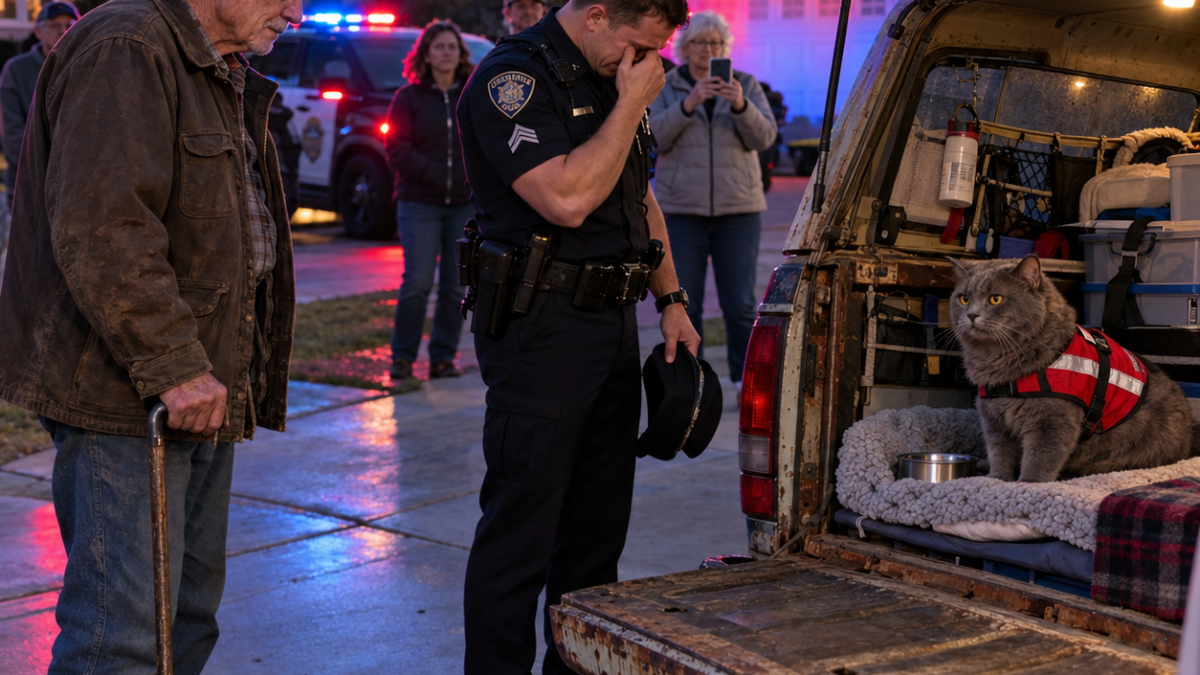
Instead, the officer leaned in and went still.
I stepped closer.
Inside the truck bed was not a crime scene.
It was a sanctuary.
A thick foam mattress covered most of the floor, fitted neatly beneath a washable gray blanket. A second blanket was rolled and strapped to the side. A clipped water dish hung secure near the front. Small bins were fastened along one wall—treats, first-aid supplies, folded towels, disposable pads, a brush, a flashlight, a worn notebook, and a laminated card that said: SLOW HANDS, SOFT VOICE, LET THEM CHOOSE.
And sitting in the middle of it all, calm as a judge, was a big gray cat with gold eyes.
He wore a red vest with reflective strips.
The vest had no flashy patches. No fake badge. No nonsense.
Just one small white tag stitched near the shoulder:
ATLAS.
My breath caught.
I knew that cat.
Dad had brought Atlas home in January, during a snowstorm so bad the shelter had almost closed early. Back then, Atlas had been a nightmare made of claws and panic, especially around men. He had a wide head, heavy paws, and a torn left ear that gave him a battered, undefeated look. The shelter staff said he had been found behind a machine shop, half-starved and covered in old bite wounds. He trusted nobody. If a man came too close, he attacked first and asked questions never.
Dad had looked at him through the cage bars and said, “That one knows how to survive.”
The shelter worker warned him twice.
Dad took him anyway.
For months, Atlas lived in the spare room. I heard the crashes. The hisses. The long nights when Dad sat outside the closed door whispering like a man speaking to a frightened soldier behind enemy lines.
Then Atlas changed.
Slowly.
Dad could touch him. Then brush him. Then lift him. Then place a vest on him without losing blood.
And then Atlas disappeared.
Or so I thought.
Now he sat in the back of Dad’s truck with that steady gold gaze, looking at all of us like we were the ones on trial.
The officer stared.
Mrs. Donnelly lowered her phone half an inch.
“What is that?” she demanded.
Dad did not answer her.
He looked at the officer.
Then at me.
Then back at Atlas.
“Get in,” he said.
The officer blinked. “Sir?”
“If you’re going to accuse me,” Dad said, not loud, just final, “you might as well see where I’m going.”
The neighbors murmured.
Mrs. Donnelly’s eyes widened with delight. She thought she had pushed him into revealing something terrible.
“Officer, you can’t just go with him,” she said.
The officer looked at Dad. Then at the truck. Then at Atlas, who calmly lifted one paw and began washing it as if bored by due process.
“I’ll follow in my cruiser,” the officer said.
Dad shook his head. “No. You ride with us. If I wanted to hide something, I wouldn’t have opened the truck.”
The officer hesitated.
I could see the professional caution in his face.
Then, maybe because the setup in the truck had unsettled him, maybe because Atlas was too calm to fit the accusation, maybe because Dad looked too tired to be lying, he nodded.
“Fine. But I’m notifying dispatch.”
“Do that.”
I climbed into the passenger seat, heart pounding so hard I could feel it in my throat. The officer got into the back seat, awkward with his belt and radio. Dad lowered the camper hatch, checked the latch twice, then got behind the wheel.
Mrs. Donnelly stood on the sidewalk filming as we pulled away.
“Where are we going?” I asked.
Dad did not look at me.
“To finish what I started.”
We drove forty minutes through the cold dark.
No one spoke much at first.
The truck’s heater rattled. The windshield wipers squeaked against mist. The officer’s radio muttered quietly from his shoulder. Behind us, through the small sliding window into the camper shell, I could see Atlas lying down on the mattress, body balanced with the movement of the truck, eyes open and calm.
“Mr. Callahan,” the officer said after a while, “I need to know what I’m walking into.”
Dad kept his eyes on the road.
“A handoff.”
“A handoff of what?”
Dad’s jaw tightened.
“A lifeline.”
The officer glanced at me in the rearview mirror.
I had no answer for him.
I was trying to understand too.
We left the nicer neighborhoods behind. We passed grocery stores, gas stations, a closed diner with a broken neon sign, and the small industrial strip where half the buildings always seemed one bad winter away from collapse. Finally, Dad turned into a worn-down apartment complex near the veterans’ clinic on East Sprague.
The buildings were low and beige, with peeling paint and buzzing hallway lights. The parking lot was cracked. A vending machine near the office glowed like the last bright thing in a tired world. A few people stood outside smoking with their collars up against the cold.
A young man waited under a stairwell light.
He could not have been more than twenty-five, but his face looked older than my father’s. He wore a black hoodie under a denim jacket, jeans, and boots he kept shifting like the ground itself did not feel trustworthy. His right sleeve was pinned neatly at the elbow.
Missing arm.
His left hand shook.
Not a little.
Enough that he kept jamming it into his pocket, then pulling it out, then rubbing it against his thigh as if friction could burn the tremor away.
When our truck pulled in, the young man straightened too fast, flinched at the sound of a car door slamming somewhere across the lot, and scanned the corners before looking at Dad.
Dad parked.
The officer got out slowly.
I did too.
Dad moved to the back of the truck and opened the camper shell.
Atlas stood.
Not rushed.
Not startled.
He stepped down from the truck bed onto the bumper, then to the pavement, heavy and controlled. Dad made a soft clicking sound with his tongue. Atlas turned toward him once, then walked straight to the young man.
The young man covered his mouth.
Atlas pressed himself against the man’s left leg.
Full body.
Steady weight.
Then he rose carefully on his hind legs, front paws braced against the man’s thigh, and leaned his broad head into the man’s chest.
The young man folded.
Not collapsed.
Folded.
He dropped to his knees in the parking lot and buried his face in Atlas’s thick gray fur. His hand clutched the red vest like it was the only solid thing left in the world.
Atlas purred.
I heard it from ten feet away.
Deep.
Constant.
Not cute.
Grounding.
The young man’s shoulders shook once.
Then again.
Then the shaking slowed.
His breathing changed.
It went from shallow, broken pulls to something lower. Something his body seemed to remember how to do only because Atlas was pressing warmth into him with absolute certainty.
The officer removed his hat.
He did it slowly, like he did not realize his own hand had moved.
Dad stood beside the truck, leaning on his cane, watching the two of them with a face I had seen only once before.
At my mother’s funeral.
The young man lifted his head, eyes wet, face pressed into Atlas’s neck.
“Thank you,” he choked. “I haven’t slept. I can’t shut it off. I can’t—” His voice broke. “Thank you.”
Dad reached into the truck and pulled out a thick envelope.
He did not hand over cash.
He handed over paperwork.
Logs. Notes. Feeding schedule. Vet records. Behavioral observations. Triggers to avoid. Routines. What Atlas did during panic spikes. How he responded to heavy breathing, shaking, pacing, nightmares. How he climbed onto the chest and purred until the body remembered it was not dying.
The young man took the envelope like it weighed more than paper.
Dad said, “His name’s Atlas. He doesn’t like loud male voices. He hates being grabbed from behind. He’ll hide the first day or two if you rush him. Don’t rush him. Sit on the floor. Read anything. Doesn’t matter what. Let him learn your voice.”
The young man nodded quickly.
“Keep the vest for travel only at first,” Dad continued. “Don’t make him wear it all day. He’ll sleep near the door if he thinks you might leave. Let him. Don’t shut him out. He needs to know where you are.”
The officer looked at Dad.
I looked at Dad.
My father sounded like a man giving away a part of himself and pretending it was instructions.
“What if I mess it up?” the young man whispered.
Dad’s face softened.
“Then you call me.”
“I don’t want to bother—”
“You call me,” Dad repeated. “You hear?”
The young man nodded.
Behind me, the officer cleared his throat, turned away, and wiped his eyes with the heel of his hand as if angry at himself for needing to.
I felt my own chest tightening.
“Dad,” I said, and my voice did not sound like mine. “You’ve been doing this the whole time?”
Dad’s eyes stayed on Atlas.
“Most people can’t afford trained support animals,” he said quietly. “Waiting lists are long. Programs are full. Paperwork eats months. Sometimes years.”
He nodded toward the young man.
“Some people don’t have years.”
The officer looked back at him.
Dad’s voice dropped.
“Some don’t have another week.”
The young man’s hand remained buried in Atlas’s fur.
Atlas kept purring.
I thought of every empty cat bed in my father’s house. Every washed bowl. Every early-morning drive. Every time I had asked where one went and Dad had closed the door with a sentence too small to hold the truth.
Somewhere he was needed.
It had not been secrecy for secrecy’s sake.
It had been protection.
Protection of the people receiving the cats.
Protection of the cats.
Maybe even protection of my father’s heart, though that part had clearly failed.
“Why hide it?” I asked. “Why let them think you’re some kind of monster?”
Dad exhaled through his nose.
Under the parking lot light, he looked old.
Not weak.
Old in the way mountains are old after weather takes pieces of them for years.
“If I talk,” he said, “it becomes noise.”
“No, it becomes truth.”
He shook his head.
“Truth turns into noise when enough people want attention from it.”
I had no answer.
He reached into his jacket pocket and pulled out a cigarette. He had quit six years ago, then unquit after my mother died, then quit again when his doctor threatened him with photographs of lungs. Apparently tonight had earned one from the secret emergency pack.
I wanted to scold him.
I didn’t.
His lighter flame trembled in the wind.
“And because I can’t do this,” he added, “if I’m busy defending myself.”
The officer stepped closer then.
“What exactly are you doing, Mr. Callahan?”
Dad took one drag, then lowered the cigarette.
He looked toward the apartment stairwell where the young man was now sitting on the bottom step with Atlas half across his lap.
“I take the cats nobody wants,” Dad said. “The ones too angry, too scared, too ugly, too old, too damaged for families looking for cute. I give them routine. Calm. Touch if they want it. Space if they don’t. I learn what settles them. What scares them. What they notice. Then Denise at the clinic lets me know who might match.”
“Denise?” the officer asked.
“Veterans outreach counselor. Sometimes others too. People alone. People coming home wrong. People grieving. People who can’t sleep. People who need something steady that won’t ask them to explain.”
The officer swallowed.
“That’s not an official program.”
“No.”
“You’re not licensed.”
“No.”
“You’re not charging?”
Dad looked insulted.
“Charging?” he said. “Son, I eat soup four nights a week so these cats can have decent food.”
The officer looked down.
I turned away because if I looked at my father too long, I was going to lose the fight with my own eyes.
The young man stood after a while with Atlas in his arms. Not carrying him like a pet exactly. Holding him like a sandbag against a flood. Atlas allowed it, his gold eyes half-closed, his purr still going.
“Earl,” the young man said. “I mean it. Thank you.”
Dad nodded once.
No speech.
No hug.
No performance.
But when the young man disappeared into the building with Atlas, my father looked after him like he had just watched a ship leave shore in bad weather.
On the ride home, the officer did not say much.
When we pulled into the driveway, Mrs. Donnelly was still outside.
So were several neighbors.
They had waited.
Forty minutes there.
Forty minutes back.
They had stood in the cold for the satisfaction of seeing what guilt looked like when it returned.
Mrs. Donnelly lifted her phone again as Dad parked.
The officer got out first.
She hurried toward him.
“Well?” she demanded. “What did you find?”
The officer looked at her for a long moment.
Then he reached into his ticket book, pulled out the citation he had started before we left, and tore it clean in half.
The sound was small.
But it cut through the whole street.
Mrs. Donnelly’s face shifted.
“What are you doing?”
The officer looked at my father.
Then he held out his hand.
Dad hesitated before taking it.
The officer shook it hard.
“I’m sorry we came like this,” he said. “And thank you.”
Mrs. Donnelly lowered her phone.
Not all the way.
People like her never lower it all the way.
“For what?” she asked sharply.
The officer turned to her, and something in his young face had changed. Not anger exactly. Disappointment.
“For reminding me,” he said, “that sometimes people look suspicious because they’re doing good work quietly.”
Dad said nothing.
He just went inside.
That should have been enough.
It should have ended there, with embarrassment settling over the neighborhood like frost. It should have made people apologize. It should have made them knock on Dad’s door with casseroles and shame. It should have made Mrs. Donnelly delete the video and reconsider the moral thrill of turning another person into a villain from across the street.
But truth rarely stops people who have built their identity around being right.
By morning, the video had been posted anyway.
Not the whole truth.
Of course not.
Mrs. Donnelly posted the beginning.
Police lights.
Dad with his cane.
The camper shell opening.
Atlas in the red vest.
Then the video cut.
Her caption read:
Something strange is still happening at Earl Callahan’s house. Police took a ride with him last night and came back acting like everything was fine. No explanation. Neighbors deserve answers. Where are these cats going?
By lunchtime, the neighborhood group was a fire.
Some defended Dad.
Most speculated.
A few people who had never met him wrote confidently about animal trafficking. Others suggested mental decline. Someone said old men get weird when they live alone. Someone else said service animal scams were everywhere now and “people will believe anything if there’s a sad veteran attached.”
A sad veteran.
I stared at that comment until the words blurred.
The young man in the parking lot had a name, though I did not know it then.
To them, he was a prop in an argument.
To Dad, he was the reason Atlas existed.
I found my father in the garage that afternoon, sitting at his workbench with Atlas’s empty folder open in front of him.
Inside were months of notes.
January 12: Refuses food if watched. Eats after lights out. Growls at male voices.
January 19: Less reactive to low talking. Start reading aloud nightly.
February 2: First time sleeping outside carrier. No touch yet.
February 17: Accepted treat from floor two feet away.
March 3: Head bump against boot. Accidental? Do not push.
March 29: Climbed onto lap during thunder. Stayed 4 minutes.
April 11: Pressure response strong. Purr deep, sustained. Seems to regulate breathing when human distressed.
April 26: Trial vest. Tolerated 90 seconds. Reward chicken.
May 8: Ready for short truck rides.
I had never seen the folders before that night.
Now I understood why Dad kept them in the garage instead of the house.
The house was where he cared.
The garage was where he made caring look like work so it would not kill him.
“Dad,” I said.
He did not look up.
“I saw the post.”
His mouth tightened.
“Don’t read it.”
“That’s not a plan.”
“Worked fine for me until you came over.”
I pulled up the old stool and sat across from him.
“You can’t let them keep saying this.”
He turned a page in Atlas’s folder.
“I can.”
“No, you can endure it. That’s not the same thing.”
His eyes lifted then.
Tired.
Sharp.
“Matthew, if I explain, it becomes a show.”
“It already is.”
“Not from me.”
“That doesn’t protect you.”
“It protects them.”
He tapped the folder.
“People receiving these cats aren’t content. They’re not proof. They’re not characters in the neighborhood drama. They’re people trying not to drown.”
I hated that he was right.
I hated more that being right could still leave him defenseless.
Two days later, County Animal Services arrived.
The truck was white with blue lettering on the side. No sirens. No drama. Just authority in a clean jacket with a clipboard.
The woman who stepped out looked tired before she even reached the porch. Mid-fifties, short gray hair, practical boots, eyes that had probably seen every version of human neglect and still showed up for work. Her name was Marla Henderson.
Dad opened the door before she knocked.
Like he had expected her.
Like part of him had been waiting for the next accusation since the first cat left.
“Mr. Callahan?” she asked.
“Yes.”
“I’m Marla with County Animal Services. We’ve received complaints.”
Dad nodded.
Across the street, Mrs. Donnelly appeared on her porch in record time.
Marla noticed.
Of course she did.
People who work in animal services learn to notice watchers.
She looked back at Dad. “May I come in?”
Dad stepped aside.
I arrived twenty minutes later, after Dad called and said, “You might want to be here.”
That was all.
By the time I got there, Marla was standing in the spare room doorway.
Inside the room was Coal.
He was not Coal yet, technically.
At that point, he was just the black cat Dad had brought home the night after Atlas left. He had come from a county shelter with a warning tag so dramatic it might as well have said DO NOT OPEN UNLESS PREPARED TO BLEED.
He was crouched inside a large crate with a blanket covering half of it. His fur was patchy, black with a smoky brown undercoat, his ears torn, his eyes bright gold and furious. When Marla leaned slightly closer, he exploded.
A black blur hit the side of the crate.
The bars rattled.
Marla stepped back, startled.
Dad did not.
He lowered himself slowly onto the floor outside the crate, bad knee stiff, one hand gripping the edge of a chair until he could settle.
“It’s okay,” he murmured. “You’re safe. You’re safe.”
Coal snarled.
Marla looked around the room.
I watched her take it in.
No filth.
No hoarding.
No cages stacked wall to wall.
Just one damaged cat in a carefully prepared room. Clean blankets. Clean water. Litter box. Food chart. Notes taped near the door.
ROUTINE MATTERS.
NO DIRECT EYE CONTACT.
DO NOT REACH FROM ABOVE.
SIT LOW.
LET HIM CHOOSE.
Marla’s expression shifted.
Not enough to become approval.
Enough to become curiosity.
“Mr. Callahan,” she said, “why are you taking cats like this?”
Dad kept his eyes on Coal.
“Because nobody else wants them.”
“That’s not the whole answer.”
Coal growled again.
Dad smiled faintly.
No humor in it.
“No,” he said. “It’s not.”
He struggled to stand, and I moved automatically to help. He waved me off. Pride first, knee second.
Then he led Marla to the garage.
On the workbench sat the plastic storage bin.
Dad pulled off the lid.
Folders.
Lots of them.
Each labeled in thick black marker.
ATLAS.
JUNO.
MOOSE.
SWEET PEA.
RUSTY.
PIPER.
OREO.
MISS BIRDIE.
Names I had heard once, maybe twice, before they vanished into the mystery my father refused to explain.
Marla reached for the Atlas folder.
Dad allowed it.
She opened it carefully.
The first pages were logs. Dates. Behavior notes. Vet records. Feeding preferences. Known fears. Settling strategies. The kind of detailed, stubborn documentation only my father would make because he believed every living thing could be understood if you paid attention long enough.
Then Marla found the letters.
She paused.
The top one was handwritten.
Mr. Callahan,
I didn’t think I’d make it through last winter.
Marla’s throat moved.
She turned the page.
Another letter.
Earl,
Moose woke me up three times this week before the nightmares got bad. I don’t know how he knows. He just knows. I’m still here because he doesn’t let me disappear in my sleep.
Another.
Dear Mr. Callahan,
My daughter laughed yesterday for the first time since her brother died. Sweet Pea knocked over a cereal box and scared herself so badly she hid under the couch. My daughter laughed until she cried. Then she cried for real. I think both helped.
Another.
I still can’t go to the grocery store alone. But Piper sits by the door when I come home, and for the first time in two years, I feel expected somewhere.
Marla closed the folder slowly.
“Are these all placements?”
Dad nodded.
“With veterans?”
“Mostly.”
“Mostly?”
“Some are widows. Some are kids who lost someone. One was a firefighter. One was a nurse. I don’t ask for tragedy credentials. Denise calls when someone needs steady.”
“Denise at the veterans’ clinic?”
“Yes.”
“You are placing animals with people in crisis.”
Dad’s eyes flashed.
“I am matching steady cats with people who are alone.”
Marla did not flinch.
“Are you charging?”
Dad barked out a laugh so sharp it echoed in the garage.
“Charging? Lady, I can barely afford the good litter.”
Marla looked at the folders again.
Then toward the street, where Mrs. Donnelly’s silhouette was visible through the garage window.
“You understand why people are concerned.”
“No,” Dad said.
Marla looked back.
Dad’s face had hardened.
“I understand why people are nosy. I understand why people like a story. I understand why a woman with a phone would rather imagine evil than knock on my door and ask if I need help carrying cat food.” His voice stayed low, but there was iron beneath it. “Concern looks different.”
Marla was quiet.
Then she said, “There are rules.”
Dad nodded once.
“I know.”
“You may be violating some.”
“I know.”
“You can’t just create an unofficial emotional support placement network out of your garage.”
Dad looked at the folders.
Then said something that made the air change.
“I’d rather break a rule than bury a kid.”
Marla’s face went still.
I looked at my father.
He had never told me the whole reason.
Not like that.
Maybe I should have guessed. Maybe the young man with Atlas should have been enough. But hearing those words in my father’s garage, surrounded by folders named after broken cats, felt like finding the root beneath every strange thing he had done.
Marla swallowed.
“Mr. Callahan,” she said softly, “you need allies.”
Dad looked up.
“Not attention,” she added. “Not cameras. Allies. Documentation. Oversight that protects the people involved. Otherwise, sooner or later, someone will decide your intentions don’t matter.”
Dad’s mouth tightened.
“If this becomes public,” she continued, “people will ask for names. Proof. Outcomes. Money records. They’ll question whether vulnerable people can consent. They’ll question whether the cats are trained, certified, safe. They’ll question every mile you drive.”
“I don’t promise miracles,” Dad said.
“I believe you.”
“I don’t call them service animals.”
“I believe you.”
“I don’t take a dime.”
“I believe you,” Marla repeated. “But belief won’t protect you from a formal complaint.”
Dad stared at her.
And in his eyes I saw something I had not seen during the police visit.
Fear.
Not for himself.
For the work.
For the next person.
For the next cat.
For the fragile bridge he had built quietly with his own hands.
Marla placed the Atlas folder back in the bin.
“I’m not writing you up today,” she said. “But I am telling you this cannot continue exactly as it has.”
Dad nodded once, the motion stiff.
After she left, Mrs. Donnelly watched from across the street, waiting for handcuffs that did not come.
Dad stood in the doorway until Marla’s truck disappeared.
Then he closed the door and went to the kitchen.
He sat at the table.
In front of him was a bill.
I recognized the paper.
Veterinary clinic.
His jaw had that locked look it got when numbers did not bend.
I sat across from him.
He stared at the bill a long time before speaking.
“People think I’m making money.”
The words came out flat.
Not angry.
Wounded.
I looked around his kitchen.
The old laminate counter curling near the edge. The mismatched chairs. The coffee maker held together with tape on one side. The stack of coupons near the bread box. The house too cold because he kept the heat low and wore sweaters instead.
My father was not making money.
He was bleeding it quietly.
“Let me help,” I said.
“No.”
“You didn’t even ask what kind of help.”
“Money.”
“I have some.”
“So do I.”
“No, you have bills.”
He looked at me sharply. “Don’t start parenting me.”
“Somebody has to.”
The second I said it, I regretted it.
His face changed.
A small thing.
A flinch hidden behind pride.
I softened my voice.
“Dad, I didn’t mean—”
“Yes, you did.”
Silence settled between us.
From down the hall, Coal hissed at something only he could see.
Dad rubbed both hands over his face.
“I’m tired, Matt.”
It was the first time he had said it plainly.
Not joked.
Not complained about his knee.
Tired.
The word scared me.
Because my father had always believed tired was a weather condition, not a warning.
“I know,” I said.
“No, you don’t.” His voice was low. “Every time I hand one over, I tell myself it’s the point. I tell myself keeping them would be selfish. I tell myself my heart is old enough to take it.”
His eyes shone.
He looked away before the tears could fall.
“But the house gets quiet after,” he said. “And I still hear them. Atlas chirping at the laundry room. Moose scratching the chair. Sweet Pea knocking over my pills. They leave, but they don’t leave.”
I had no clever answer.
There was none.
“So stop,” I said softly, though it hurt to say it. “If it’s too much, stop.”
Dad looked at me then.
His eyes were wet and fierce.
“And do what?” he asked. “Sit here and watch television while someone else sits awake at two in the morning with a pistol on the nightstand and nobody to call?”
My blood went cold.
He had never said it that directly before.
Dad leaned back in his chair, suddenly looking all of his years.
“My heart can break,” he said. “Theirs might not survive it.”
That night, I stayed.
Not because Dad asked.
He would never ask.
I slept on the couch beneath the old quilt my mother had made, though sleep did not come easily. I heard Dad in the spare room twice, speaking low to Coal. I heard the floorboards creak. Heard the kettle. Heard his cough.
Around midnight, I found him sitting outside Coal’s room with his back against the wall.
The door was cracked open.
Dad’s hand rested palm-up on the floor near the gap.
Inside, Coal growled softly.
Not attacking.
Not sleeping.
Existing at the edge of trust.
Dad’s eyes were closed, but he was awake.
“You should go to bed,” I whispered.
“So should you.”
“I’m serious.”
“Me too.”
I sat beside him.
For a while, neither of us spoke.
Then I said, “Why didn’t you ever tell me all of it?”
Dad’s eyes opened.
He stared at the opposite wall.
“Because you had your own life.”
“I’m your son.”
“I know.”
“That means I should have known.”
He sighed.
“I didn’t want you thinking you had to save me.”
The words settled hard.
“Maybe I wanted the chance.”
He looked at me then.
For the first time in years, maybe the first time since Mom died, my father looked unsure what to do with me.
Inside the room, Coal’s growl faded into silence.
The next morning, Denise called.
I was standing at the stove making eggs because Dad’s idea of breakfast was coffee and blood pressure medication, which I had decided was not a meal.
Dad answered on speaker by accident.
“Earl?” Denise’s voice came through tight and strained.
Dad straightened.
“What happened?”
That was Dad. No hello if the tone was wrong.
“I need to ask you something,” she said. “Did anyone share what you’ve been doing?”
Dad’s eyes moved to mine.
“No.”
“It’s online,” Denise said. “Not all of it, but enough. The clinic director has seen posts. People are calling. Some are asking if we’re connected. Some are accusing us of sending vulnerable clients to an unlicensed man with aggressive animals.”
Dad closed his eyes.
The spatula in my hand went still.
Denise continued, quieter. “Earl, I’m trying to protect you. I’m trying to protect them. But the director is nervous.”
“Nervous means what?”
“It means they want you to pause.”
Dad’s hand tightened around the phone.
“For how long?”
“I don’t know.”
“People don’t pause falling apart, Denise.”
“I know.”
Her voice broke slightly on the last word.
Then she said, “There’s a woman named Kayla. Late twenties. Two kids. Husband died by suicide last year after he came home. She found him. Her oldest found her finding him.”
The kitchen disappeared around me.
Dad opened his eyes.
Denise swallowed audibly.
“She’s not sleeping. She’s having panic episodes. She won’t go inpatient because she’s afraid of losing the kids. She asked if you had someone.”
Dad looked down the hallway toward the spare room.
Coal.
The cat still hissed when we entered. Still watched with rage. Still had not accepted touch.
Too soon, I thought.
Dad’s jaw clenched.
“How soon?” he asked.
“Earl, with everything happening—”
“How soon?”
Denise was quiet.
Then she said, “Soon.”
Dad hung up and stood there.
The eggs burned.
Neither of us moved.
Finally, he turned off the burner.
“They’re going to make me pick,” he said.
Between safety and need.
Between rules and real life.
Between protecting himself and answering the next call.
He went down the hall.
I followed.
Coal was crouched inside the crate, black fur bristled, gold eyes blazing. When Dad entered, he hissed automatically, but the sound lacked some of its first-day violence.
Dad lowered himself into the chair.
He looked at the cat for a long time.
“You’re not ready,” I said quietly.
Dad did not look at me.
“Neither is she.”
“That’s not an answer.”
“It’s the only one we’ve got.”
“Dad.”
He leaned forward slowly, elbows on knees, hands hanging open.
Coal watched every movement.
Dad spoke softly.
“You need a name.”
Coal’s ears twitched.
Dad nodded once, as if the cat had responded.
“Coal,” he said. “Because you look cold, but inside you’re still burning. And because coal keeps people alive in winter.”
Coal hissed.
Dad smiled faintly.
“Yeah. I figured you’d have an opinion.”
By afternoon, Coal was loaded into the truck in his crate.
Dad’s routine was careful.
Foam pad. Familiar blanket. Water dish. Paperwork folder. Treats. Emergency towel. Window cracked for air. No sudden noise. No strangers leaning over the crate.
Mrs. Donnelly came outside the second she heard the engine.
Phone up.
Always phone up.
I stared at her from the passenger seat, rage burning my throat.
Dad did not look.
He drove like the road was the only thing that mattered.
Kayla lived in a small duplex near the clinic, the kind of place where toys in the yard looked both hopeful and heartbreaking. A plastic dinosaur lay on its side near the steps. A child’s bicycle leaned against the railing. One window had a paper snowflake taped inside even though Christmas was still weeks away.
Kayla opened the door before we knocked.
She was thin in the way grief makes people thin, like her body had forgotten hunger was supposed to matter. Her hair was pulled into a messy knot. She wore an oversized sweatshirt with bleach stains on the sleeve. Two children clung behind her, a boy maybe six and a girl around nine. The girl’s face was too serious. The boy held a stuffed dinosaur missing one eye.
Kayla looked at Dad, then at me, then at the crate.
Her eyes filled before anyone spoke.
“You came,” she said.
Dad nodded.
“I said I would.”
Coal growled from inside the crate.
Kayla flinched.
The little boy hid behind his sister.
Dad set the crate down slowly on the porch.
“He’s scared,” Dad said. “Not evil.”
Kayla let out a sound between a laugh and a sob.
“I’m scared too.”
Dad looked at her.
“Then you’ll understand each other.”
We brought Coal inside.
The house smelled like laundry soap, instant noodles, and exhaustion. The living room was cluttered but clean. A folded blanket sat on the couch. Children’s drawings covered one wall. A framed photo stood on the bookshelf: Kayla, the two kids, and a smiling man in uniform with one arm around all of them like he believed he could hold the whole world together.
Beside the photo was a folded flag.
I looked away.
Dad noticed everything.
He always did.
But he did not comment.
He helped Kayla set up the crate in a quiet corner of her bedroom, not the living room. He explained why: Coal needed a retreat, and Kayla needed to build trust away from the children’s noise.
“No grabbing,” Dad said.
Kayla nodded.
“No direct staring. No reaching from above. Sit near him and read. Doesn’t matter what. Bills, cereal box, kids’ books. Just let your voice be steady.”
Kayla wiped her cheek. “My voice isn’t steady.”
Dad’s expression softened.
“Then borrow his stubborn until yours comes back.”
Coal hissed again, but when Kayla sat on the floor near the crate, something changed. Maybe he smelled grief. Maybe he recognized fear shaped like his own. Maybe broken things know each other before anyone explains.
Kayla placed her hand on the carpet near the crate, not touching.
Coal watched.
His body stayed low.
His tail flicked once.
Then he moved forward.
Not much.
Just enough to press his nose through the bars and sniff her fingers.
Kayla stopped breathing.
Coal sniffed again.
Then, slowly, he leaned his forehead against the metal bars.
Not affection yet.
Not trust.
But contact.
Kayla sobbed.
The little girl covered her mouth.
Dad looked away fast.
I saw his jaw working.
“He has a big mouth,” Dad said gruffly, “but he has a job.”
Before we left, Kayla hugged him.
Dad froze.
He was not a hugger. He had hugged like a man handling fragile lumber since Mom died.
But after a second, his hand rose and patted Kayla’s back.
She whispered, “How do I repay you?”
Dad’s voice went flat.
“Don’t.”
She pulled back.
He nodded toward her children.
“Stay alive for them.”
Kayla cried harder.
On the drive home, Dad said nothing.
Neither did I.
Coal’s absence filled the truck.
That was the thing nobody understood about what my father did. He did not give away cats he did not want. He gave away cats he had earned inch by inch. Cats who had bitten him, hidden from him, slept near him, trusted him. Every placement was not disposal.
It was loss with purpose.
When we turned onto Dad’s street, my stomach dropped.
Two cars waited outside the house.
One patrol car.
One plain sedan.
The same young officer from the first night stood near the cruiser, arms crossed, face tight with discomfort. Beside him was a man in a button-down shirt holding a folder.
Paperwork.
The kind of weapon that does not need a holster.
Mrs. Donnelly stood on her porch.
Filming.
Dad parked slowly.
His hand rested on the gearshift for a moment before he turned off the engine.
“Let me talk,” I said.
“No.”
“Dad—”
“No.”
He got out with his cane.
The man in the button-down stepped forward.
“Mr. Callahan? I’m Raymond Price with county compliance. We’ve received formal complaints regarding unauthorized placement of animals, possible misrepresentation, and endangerment of vulnerable individuals.”
Dad’s face did not change.
“I don’t misrepresent anything.”
Raymond’s expression was smooth and bureaucratic. “Sir, this is not about what you believe you’re doing. It’s about what can be documented.”
Dad glanced toward Mrs. Donnelly.
Then back to Raymond.
“You can look at my records.”
“We may need names of recipients.”
“No.”
Raymond blinked. “Sir, if you are placing animals with individuals through an informal process—”
“No.”
The officer shifted, visibly uncomfortable.
Dad’s voice hardened.
“I’m not handing you a list of vulnerable people so the internet can chew on them next.”
Raymond’s mouth tightened. “Then you may be ordered to cease all placements pending review.”
The street went still.
Even Mrs. Donnelly stopped moving for a second.
Dad looked at Raymond for a long time.
Then he said quietly, “If you stop me, you’d better replace me.”
Raymond frowned. “That’s not how this works.”
Dad nodded like he had expected that answer.
He turned slightly, looking past Raymond, past the officer, past the porches and phones and watching faces.
Then he spoke loud enough for all of them.
“You want to call the police on an old man because he brings home broken cats? Fine.”
Mrs. Donnelly lifted her phone higher.
Dad’s voice stayed steady as a hammer.
“But if you take away the one thing helping people sleep through the night, you don’t get to walk away feeling righteous.”
Raymond stiffened. “Sir, I understand this is emotional—”
“No,” Dad said. “You understand paperwork.”
The words landed hard.
I saw the officer bite the inside of his cheek.
Dad continued, “I understand the sound a man makes when he hasn’t slept in five nights and thinks nobody would notice if he disappeared.”
The porches went quiet.
Mrs. Donnelly’s phone dipped half an inch.
Dad’s face was pale now, but his voice did not break.
“I understand cats nobody wants because they’re scared enough to look mean. I understand people nobody checks on because they’re proud enough to look fine. I understand matching one to the other before both run out of time.”
Raymond looked unsettled.
But bureaucracy recovers quickly.
“We will conduct a review,” he said. “Until that review is complete, you are instructed to cease further placements.”
Dad stared at him.
For one second, I thought my father might refuse right there in the driveway.
Instead, he nodded once.
Not agreement.
Endurance.
After they left, Mrs. Donnelly called across the street.
“Maybe now you’ll stop!”
Her voice had triumph in it.
That ugly brightness people get when punishment confirms their worldview.
Dad turned.
He looked at her for a long moment.
Then said softly, “I hope you never need what I’ve been giving away.”
For once, she had no quick answer.
That night, the spare room was empty.
No crate.
No hiss.
No low voice through a cracked door.
The emptiness felt different now that I understood what usually filled it.
Dad sat at the kitchen table with his hands wrapped around a mug of coffee gone cold.
I sat across from him.
“What do we do?” I asked.
He stared at the table.
“We keep doing what we can.”
“They told you to stop.”
“They told me to stop making them uncomfortable.”
“Dad.”
He looked up.
I saw grief there.
Not frustration.
Grief.
The kind that comes when the world punishes you for caring in a way that does not fit neatly into its forms.
“My heart is old,” he whispered.
I knew the sentence now.
I knew where it was going.
“It can take breaking,” he said.
Then he looked down at his hands.
“But there’s a limit.”
Those words scared me more than any police car.
Because for the first time, I understood my father was not invincible.
He was stubborn.
And stubborn does not last forever.
Around midnight, someone knocked on the door.
Not a polite knock.
A frantic one.
Dad and I both froze.
The knock came again.
“Earl?” a woman’s voice called. “Earl, please.”
Mrs. Donnelly.
Dad closed his eyes.
For a moment, he did not move.
Then he stood slowly, cane in hand, and went to the door.
I followed.
When he opened it, Mrs. Donnelly stood on the porch with no phone in her hand.
That was the first shocking thing.
The second was her face.
Pale. Bare. Terrified.
Behind her, a car idled at the curb. A young man stood beside it, maybe nineteen or twenty, wearing a gray hoodie and sweatpants despite the cold. He was trembling so hard I could see it from the doorway. His shoulders hunched inward. His eyes darted from the porch light to the bushes to the street to the car behind him.
He looked like the whole world had become too loud.
Mrs. Donnelly’s mouth opened, but no words came out.
Dad waited.
She swallowed.
“It’s my grandson,” she whispered.
Dad’s expression did not change.
“He came back from training,” she said. “He’s not… he’s not right.”
The young man flinched at a car passing two streets over.
Mrs. Donnelly’s eyes filled.
“He won’t sleep. He won’t eat. He sits in the bathroom with the light on because he says the dark feels like—”
She stopped.
Her lips trembled.
For the first time since I had known her, Mrs. Donnelly looked smaller than her certainty.
“I didn’t believe you,” she whispered. “I thought you were doing something awful. I thought—”
Her voice broke.
“I’m sorry,” she sobbed. “I’m so sorry.”
The porch light buzzed above us.
The street was quiet.
My father stood there with his cane planted, his face unreadable.
A lesser man would have enjoyed that moment.
A wounded man might have shut the door.
A proud man might have demanded she say it louder for every neighbor who had watched and whispered.
Dad did none of that.
He stepped aside.
“Bring him in,” he said.
Mrs. Donnelly blinked. “What?”
“Bring him in,” Dad repeated. “And stop standing out there like shame is going to fix anything.”
She flinched.
Then turned and waved her grandson forward.
He moved like walking hurt.
Not his legs.
His nerves.
Dad guided him to the couch. No questions. No lecture. No demand for gratitude. He turned off the overhead light and left only the lamp near Mom’s old chair glowing warm in the corner.
The young man sat, knee bouncing violently, hands clamped together. His breathing came shallow and fast.
Dad sat across from him.
“What’s your name?” Dad asked.
“Tyler,” he whispered.
“Tyler. You’re in my living room. You’re safe. That’s my son, Matt. That’s the front door. Kitchen’s behind you. Nobody here is going to grab you.”
Tyler nodded, but his eyes kept moving.
Dad did not tell him to calm down.
He did not tell him to breathe.
He did not say any of the useless things people say when they want fear to become convenient.
He just stayed steady.
“You’re not crazy,” Dad said. “Your body’s still on guard.”
Tyler’s face crumpled.
“I can’t turn it off,” he whispered.
Dad nodded.
“Yeah,” he said. “I know.”
Then he looked at Mrs. Donnelly.
“You got a cat?”
She stared. “A cat?”
“In your house. Any cat.”
“My daughter’s cat,” she said, confused. “He hides mostly. Orange one. Mean little thing.”
Dad nodded. “Go get him.”
“What?”
“Go get him.”
“He’ll scratch.”
“That means he still has opinions.”
Mrs. Donnelly looked at me, then Dad, then Tyler.
Then she left.
Fifteen minutes later, she returned holding an orange cat wrapped in a towel like a very angry burrito. The cat’s eyes were huge. His tail thumped beneath the towel. His ears were flat with insult.
Dad stood slowly.
He took the cat with careful hands.
Not timid.
Not forceful.
Experienced.
The cat growled.
Tyler flinched.
Dad stopped.
“This one’s scared too,” he said.
Tyler looked at the cat.
The cat looked at Tyler.
Two frightened creatures, neither one trusting the room.
Dad placed the cat gently on Tyler’s lap.
The cat froze.
Tyler froze.
Mrs. Donnelly covered her mouth.
For a moment, nothing happened.
Then the cat did what cats do when they do not know what else to do.
He climbed.
Up Tyler’s sweatshirt.
Onto his chest.
Turning once, then twice.
Finding warmth.
Finding heartbeat.
Then he settled.
A small orange weight against a shaking body.
Tyler’s breath hitched.
His hands hovered, afraid to touch.
The cat’s eyes half-closed.
A purr began.
Tiny at first.
Then stronger.
Tyler’s shoulders dropped.
His knee slowed.
His face twisted, and the sound that left him was not quite a sob and not quite laughter.
Relief.
Mrs. Donnelly wept openly then.
No performance.
No phone.
No audience.
Just tears she had earned the hard way.
She looked at Dad like she was seeing him for the first time.
“I ruined you,” she whispered.
Dad did not look away from Tyler and the cat.
“You can fix it.”
“How?”
He turned to her.
“Tell the truth,” he said. “Even if it makes you look bad.”
She swallowed.
“Especially then,” he added.
The next morning, Mrs. Donnelly posted again.
Same neighborhood group.
Same audience.
But no video.
No dramatic headline.
Just words.
I owe Earl Callahan an apology.
She wrote everything.
Not perfectly. Not beautifully. But plainly. She admitted she had accused him without asking. Admitted she filmed him. Admitted she helped turn suspicion into a public spectacle. Admitted she did not understand what he was doing until her own family needed the kind of help she had mocked.
She did not name the veterans.
She did not expose Kayla.
She did not turn Tyler into content.
For once, she protected the vulnerable instead of using them.
The group exploded.
Some called her brave.
Some called her fake.
Some doubled down because admitting wrongness hurts more than staying cruel.
And some went quiet.
Quiet is not always guilt.
Sometimes it is the sound of a person finally thinking.
Two weeks later, the county review ended in Dad’s kitchen.
Raymond came back.
So did Marla.
Denise came too, carrying a folder of letters with names blacked out and details protected. Dr. Harris, the clinic director, attended on speakerphone. The young officer came off duty and stood in the corner with his hat in both hands, not because he had to, but because he wanted to.
Dad sat at the table like a man awaiting sentence.
I sat beside him.
Marla did most of the talking.
She had a proposal.
Not a flashy program. Not a charity with a logo. Not a viral page. A quiet volunteer framework. Documented placements. Written consent. Protected identities. Vet checks. Behavioral notes. Follow-up calls. No claims of certification. No money changing hands. No public names. No spectacle.
All the things Dad had mostly been doing alone, now supported enough that the world could not crush him with one rumor.
Dad listened.
Suspicious.
Proud.
Afraid to hope.
Raymond cleared his throat. “Mr. Callahan, we cannot officially endorse every aspect of what has happened informally.”
Dad snorted.
Raymond paused, then continued.
“But we also cannot ignore positive outcomes supported by documentation.”
Dad looked at Denise.
She gave him a small smile.
Marla leaned forward.
“Earl,” she said, “you need help.”
“I don’t need—”
“You do,” she said.
He bristled.
She did not back down.
“You’re seventy-two. Your knee is bad. Your truck is older than some of the people you’re helping. You are doing something bigger than you, and if you keep pretending you can carry it alone, you’re going to become the next one who breaks.”
The kitchen went silent.
Dad looked away.
His throat moved.
That sentence had reached him.
Not because it challenged his strength.
Because it named the thing beneath it.
Fear.
He had spent three years building lifelines for other people while refusing one for himself.
Finally, he nodded once.
“Fine,” he muttered. “But we keep it quiet.”
Marla smiled.
“Quiet.”
Denise wiped her eyes.
Raymond looked relieved to have found a way for compassion and paperwork to stop wrestling on his desk.
The officer stepped forward before leaving.
He shook Dad’s hand again.
“I never got your cat’s name right,” he said.
“Atlas.”
The officer nodded.
“Atlas,” he repeated. “Good name.”
Dad’s mouth twitched.
“He carried more than he should have.”
“Sounds familiar,” the officer said.
Dad pretended not to understand.
But I saw him blink hard.
That night, Dad went back to the shelter.
Not alone.
I drove because his knee was acting up, though he complained the whole way that I braked like a librarian and took turns like a man transporting soup.
Marla met us there.
Denise too.
And, to my complete disbelief, Mrs. Donnelly came with a box of clean blankets and the posture of a woman prepared to be disliked.
Dad did not greet her warmly.
He greeted her honestly.
A nod.
That was enough for now.
Inside, the shelter smelled like bleach, old fear, and hope trying its best.
Dad walked past the front cages.
Past the kittens climbing bars with bright eyes.
Past the friendly cats rubbing their faces against metal.
Straight to the back.
Of course.
There, in a lower cage, crouched a scarred brown tabby with one cloudy eye and a warning card clipped to the door.
FEARFUL.
NO HANDLING.
EXPERIENCED FOSTER ONLY.
The tabby hissed before Dad even bent down.
Dad lowered himself carefully onto the concrete floor.
His cane rested beside him.
He did not reach.
He did not stare.
He placed his palm flat on the floor, fingers open, empty.
“Hey,” he murmured.
The cat hissed again.
Dad nodded like that was a perfectly acceptable beginning.
Mrs. Donnelly stood behind him, tears sliding silently down her face.
After a long while, she whispered, “How do you know which ones to pick?”
Dad did not turn around.
He looked at the trembling cat.
“I don’t pick the broken ones because they’re broken,” he said. “I pick the ones still fighting.”
The tabby spat.
Dad smiled faintly.
“See?” he murmured. “Plenty of fight left.”
Mrs. Donnelly pressed a hand to her mouth.
Denise looked at Marla.
Marla looked at me.
And I stood there watching my father become what he had always been when nobody was filming.
Not a hero.
Heroes are too clean a word.
He was an old man with a bad knee, a rusted truck, unpaid bills, a stubborn heart, and the strange holy patience to sit on cold concrete in front of a terrified cat and offer nothing but time.
Later, on the drive home, Dad was quiet.
The tabby came with us in a crate. Dad had not named him yet. Names were promises, and Dad did not hand those out carelessly.
When we pulled onto our street, porch lights glowed in the dark.
No one came outside with a phone.
Not that night.
Dad noticed.
He said nothing.
Inside the house, we set the crate in the spare room. Fresh blankets. Heating pad. Water. Food. Door cracked open.
The tabby crouched in the back, one cloudy eye shining.
Dad sat down outside the crate with a groan.
“You’re too old for this,” I said.
He glanced at me.
“So are you.”
“I’m forty-six.”
“Exactly.”
I laughed despite myself.
For a while, we sat together in the spare room. Father, son, frightened cat. The house quiet around us, but not empty anymore.
“Dad,” I said after a while.
“Mm.”
“I’m sorry I didn’t ask sooner.”
He looked at me.
“About the cats. About where they went. About you.”
His face softened in a way that made him look suddenly much older and much younger at the same time.
“You trusted me.”
“I also left you alone with it.”
He looked toward the crate.
“Maybe.”
The word was not accusation.
It was truth.
I accepted it.
“I don’t want you doing it alone anymore,” I said.
Dad sighed. “You have a job.”
“So do you, apparently.”
“This doesn’t pay.”
“Most important things don’t.”
He gave me a side look.
“That sounds like something your mother would say.”
“Good.”
His eyes grew wet.
He looked away.
Inside the crate, the tabby shifted.
One paw moved forward.
Just an inch.
Dad noticed.
Of course he did.
He lowered his voice.
“There you go,” he whispered. “No rush.”
The cat froze.
Dad became still as stone.
I watched them.
The old man.
The scared cat.
The space between them slowly becoming less dangerous.
And I understood, finally, why my father had hidden it for so long.
Not because he was ashamed.
Because some work is so tender that the world’s loud hands can ruin it.
But I also understood something he had not.
Silence protects until it isolates.
And even lifelines need someone holding the other end.
Months passed.
The framework stayed small.
Quiet.
Protected.
Three volunteers became five. Five became eight. Not influencers. Not saviors. Just people willing to clean crates, drive to vet appointments, sit still in shelter rooms, write notes, and learn that patience is not passive.
Mrs. Donnelly became the best blanket washer in Spokane County, a title nobody officially gave her but everybody understood. She never asked Dad to forgive her in public. She did not deserve an easy redemption, and to her credit, she stopped looking for one. She showed up. She washed. She drove supplies. She corrected rumors she had helped start, even when people snapped at her.
Tyler kept the orange cat.
His name was Marmalade, which Dad said was too soft a name for a cat with that much attitude. Tyler said that was the point.
Kayla and Coal made it through the winter.
Coal never became friendly in a traditional sense. He did not want strangers. He did not tolerate nonsense. But Kayla sent a note through Denise that said Coal slept outside her bedroom door every night and growled at nightmares before they swallowed her whole.
Atlas thrived.
The young man from the apartment complex eventually wrote Dad a letter.
Dad let me read it once.
Only once.
Mr. Callahan,
Atlas woke me up before the panic got bad last night. I don’t know how he knew. He put his whole body on my chest and purred until I could count the room again. I made coffee this morning. I opened the blinds. I called my sister back. That probably sounds small. It isn’t.
Dad folded the letter afterward and put it in Atlas’s folder.
He cried in the garage where he thought I could not see.
The scarred tabby with the cloudy eye earned a name two weeks after coming home.
Judge.
Because he watched everyone like they were disappointing but redeemable.
Dad said the cat reminded him of my mother.
I said Mom had better manners.
Dad said that was debatable.
Judge eventually went to a retired firefighter named Sam who had lost his wife and slept in a recliner because the bed was too quiet. Judge bit Sam twice the first week, then slept on his feet every night after. Sam called Dad after a month and said, “He’s a mean old thing.”
Dad asked, “You want me to take him back?”
Sam said, “Touch my cat and I’ll break your hand.”
Dad hung up smiling.
The neighborhood changed slowly.
Not magically.
People do not become better because one truth embarrasses them.
But some waved again.
Some apologized badly, which is still better than never.
Mr. Alvarez brought over canned cat food and pretended he had bought the wrong kind for his own nonexistent cat. The Brooks twins donated towels. Mrs. Keene from the corner began leaving envelopes in Dad’s mailbox with twenty-dollar bills and notes that said FOR GAS, because she had known my mother and apparently inherited her talent for making help impossible to refuse.
Dad grumbled about all of it.
Then used every bit.
One evening in late spring, Dad and I sat on his porch after returning from the shelter. No new cat that day. Just a visit. Just sitting with the ones not ready. Just letting them learn that not every human hand arrives demanding something.
The sun was low. The street was quiet. Mrs. Donnelly was across the road watering her roses. She lifted one hand.
Dad lifted his fingers from his coffee cup.
Not forgiveness exactly.
But not nothing.
I looked at him.
“Do you forgive her?”
Dad took a long sip.
“I don’t know.”
That surprised me.
He had always seemed so certain about what mattered.
He stared down the street.
“Forgiveness isn’t something you hand out to make other people comfortable,” he said. “It’s something you do when you’re ready to stop carrying the sharpest part.”
I nodded.
“Are you ready?”
He watched Mrs. Donnelly bend stiffly over the rosebush.
“No,” he said.
Then, after a moment, “But I’m closer.”
The porch boards creaked as he shifted his bad knee.
“You know what bothers me most?” he asked.
“What?”
“Not that she accused me.”
I looked at him.
He stared into his coffee.
“It’s that she never asked why.”
That stayed with me.
Because that was the real wound beneath the spectacle.
Not the police.
Not the posts.
Not the humiliation.
The absence of curiosity.
The willingness to choose a villain because villains are easier than complicated neighbors.
A few weeks later, the local paper called.
Dad said no.
Then they called again.
He said no louder.
Then Denise suggested that a carefully written article might help with donations, volunteer screening, and correcting misinformation without exposing recipients.
Dad said absolutely not.
Marla said, “Earl, you can either let other people tell this wrong forever or tell it carefully once.”
Dad glared at her.
Then at me.
I shrugged. “She’s right.”
He muttered something about betrayal.
The article came out on a Sunday.
No photos of recipients. No names. No dramatic headline. Just Dad standing by his truck, looking deeply uncomfortable, with Judge’s empty crate visible behind him and his cane in one hand.
The title read:
Retired Spokane Man Matches Hard-to-Adopt Cats With People Who Need Quiet Companions
Dad hated it.
He said it made him sound like he ran a dating service for trauma.
But donations came in.
So did volunteer applications.
So did letters.
So many letters.
From veterans. Widows. Parents. Nurses. People who had never heard their own loneliness described so gently before. People who did not want to be fixed. Just accompanied. People who understood that an animal with fear in its bones could sit beside a human with fear in theirs and somehow both could become less alone.
One letter had no return address.
It simply said:
I was one of the people who commented badly about you. I thought I was protecting animals. Maybe I was protecting myself from feeling guilty. I’m sorry. I adopted a senior cat yesterday. He has one eye and hates me so far. I’m going to keep trying.
Dad read that one three times.
Then put it in a new folder labeled PEOPLE.
By summer, Dad’s truck had a new lock, a proper transport setup donated by a local carpenter, and a small magnetic sign Marla insisted on despite Dad’s protests.
It read:
QUIET PAWS COMPANION FOSTER NETWORK
Dad said the name sounded like a quilting circle.
Maddy from the clinic said that was better than his suggestion, which had been “Cats for Folks Who Need Cats.”
He still called it that privately.
On a warm July night, nearly eight months after Mrs. Donnelly first shouted at him from the sidewalk, Dad and I drove to the same worn-down apartment complex where Atlas had gone.
The young man was moving.
Not far. Just to a better place across town, with more light and fewer hallway noises. He had asked Dad to come by before the move because Atlas had been unsettled by the boxes.
When we arrived, Atlas was in the window.
Big gray head.
Gold eyes.
Red vest hanging on a hook nearby.
He looked healthier than I remembered. Fuller. Softer. Still dignified in that way cats manage even when sitting on a cardboard box labeled KITCHEN.
The young man opened the door.
His name was Caleb.
I knew that now.
He smiled when he saw Dad.
A real smile.
Tired, maybe. But real.
Atlas jumped down from the windowsill and came straight to Dad.
For one second, my father’s face broke.
Just a little.
Atlas pressed his head against Dad’s knee.
Dad lowered a shaking hand and touched the torn ear.
“Hey, soldier,” he whispered.
Atlas purred.
Caleb looked at me.
“He does that when the bad nights start,” he said. “Gets on my chest. Purrs like a motor. Annoying as hell.”
His voice cracked slightly.
“Works, though.”
Dad nodded.
“He always did have a job.”
Caleb handed Dad an envelope.
Dad frowned. “No money.”
“It’s not money.”
Dad opened it.
A photo.
Caleb and Atlas sitting outside in sunlight. Caleb’s sister beside them. A picnic table. Coffee cups. Atlas wearing the expression of a cat tolerating democracy.
On the back, Caleb had written:
Proof I went outside.
Dad stared at it.
Then he slipped it into Atlas’s folder without a word.
On the drive home, the sunset burned orange over the road. Dad sat silent in the passenger seat because I drove now when it was dark, though he still complained about my turns.
After a while, he said, “Your mother would’ve liked Atlas.”
“She liked anything that made you act human.”
He gave me a look.
Then laughed.
It was small.
But it was real.
When we got back to the house, Mrs. Donnelly was on her porch.
No phone.
Just sitting with a cup of tea, Marmalade curled shamelessly in her lap while Tyler sat beside her, his shoulders looser than they had been that first night. The orange cat opened one eye as Dad climbed out of the truck.
Dad nodded toward the cat.
“Traitor,” he called.
Marmalade yawned.
Tyler laughed.
Mrs. Donnelly smiled, then lowered her eyes.
Still ashamed sometimes.
Still learning how to live with what she had done.
Dad walked toward our porch, then stopped.
He looked back at her.
“Evening, Margaret,” he said.
She looked up.
Her eyes filled instantly.
“Evening, Earl.”
It was not forgiveness.
Not fully.
But it was a door unlocked.
Later that night, Dad sat in the spare room with a new foster, a white-and-black female named Birdie who trembled whenever footsteps passed in the hall. He sat on the floor, back against the wall, reading aloud from an old mystery novel he had already read three times.
I stood in the doorway and watched.
Birdie hid beneath the chair.
Dad did not reach for her.
He simply turned a page.
“You know,” I said, “you could let someone else take tonight.”
He looked up.
“I know.”
“You have volunteers now.”
“I know.”
“You have me.”
His face softened.
“I know.”
But he stayed on the floor.
Not because he had to carry everything alone anymore.
Because some parts of love still require your own hands.
Birdie’s nose appeared beneath the chair.
Dad lowered his voice.
“There you are,” he murmured. “No rush.”
Her whiskers twitched.
He smiled.
That same small, stubborn smile.
The one he had given Coal.
Atlas.
Judge.
Every unwanted creature that still had fight left.
I sat down beside him.
My knee cracked loudly.
Dad smirked.
“Old man.”
“Runs in the family,” I said.
He went back to reading.
After a while, Birdie crept one inch forward.
Then another.
The house was quiet.
Not empty.
Quiet.
There is a difference.
I think about that night often—the night police lights painted our driveway and everyone believed they were about to expose my father’s secret.
They did expose it.
Just not the one they expected.
They exposed how quickly suspicion becomes entertainment.
How easily fear dresses itself as concern.
How a neighborhood can watch an old man carry heavy bags of cat food for years and never once ask if he needs help.
But they also exposed something else.
Something better.
A tired man can still build lifelines.
A broken cat can still become steady.
A person who has done harm can still tell the truth and begin repairing what they ruined.
And sometimes the thing that looks suspicious from across the sidewalk is just love doing its work without asking to be applauded.
My father is seventy-three now.
His knee is worse.
His truck still leaks oil.
He still eats too much canned soup when I am not watching.
And every so often, when a cat leaves for good, I find him sitting alone in the garage with a folder open, crying like a fool over a creature he loved enough to give away.
He lets me sit with him now.
That is new.
He does not always talk.
He does not need to.
A few weeks ago, I asked him if it ever gets easier.
He knew what I meant.
The giving away.
The empty room.
The part where love succeeds and still leaves.
Dad thought about it for a long time.
Then he said, “No.”
I waited.
He rubbed one hand over his knee.
“But it gets clearer.”
“What does?”
He looked toward the spare room, where Birdie had finally fallen asleep on a blanket instead of under the chair.
“That keeping something isn’t the only way to love it.”
I did not answer.
I could not.
Outside, the street was quiet. Porch lights glowed. Somewhere across the road, Marmalade probably ruled Mrs. Donnelly’s house with orange tyranny. Across town, Atlas pressed his heavy body against Caleb’s chest when the nights got bad. Coal guarded Kayla’s bedroom door. Judge slept on Sam’s feet. Other folders sat in Dad’s garage, each one a name, a promise, a piece of his old heart broken and sent where it was needed most.
The neighbors once said my father made cats disappear.
They were right in one way.
The cats did disappear.
From cages.
From warning labels.
From back rooms where nobody looked twice.
From the category of unwanted.
And they reappeared where they were needed.
On the chests of men who could not sleep.
Beside widows who had forgotten what another heartbeat sounded like.
At the feet of people who were still alive because something small and stubborn expected breakfast.
My father never became comfortable with being called good.
He still waves away thanks like smoke.
But I know what I saw.
I saw a young officer tear up a citation because truth humbled him.
I saw a woman who had filmed cruelty into existence come to the door without her phone and ask for help.
I saw a scarred gray cat press a veteran’s breathing back into rhythm.
I saw my old father stand in the middle of shame and refuse to let pride cost someone their life.
So when people ask me what Earl Callahan really does, I tell them the simplest version.
My dad takes the ones everyone gave up on.
He teaches them that hands can be gentle.
Then he gives them to people who need to learn the same thing.
And if that breaks his heart a little every time, he lets it.
Because real love is not always what you keep.
Sometimes it is what you build in silence, document carefully in a folder, load into a rusted truck, and give away with shaking hands because someone else cannot survive one more night alone.
That is what my neighbors saw when the officer opened Dad’s truck.
Not a crime.
Not a scam.
Not a strange old man’s secret.
A lifeline.
Built out of broken cats.
And a heart old enough, stubborn enough, and brave enough to keep breaking.








