My Neighbor Went to Prison and Asked Me to Watch His Cat for “a Few Weeks.” Three Years and 34 Letters Later, She Still Waits at His Door Every Morning. What Happens When He Comes Home?
PART3:
I had lived next to R for about two years before he disappeared from the duplex.
Calling us friends would have been generous.
We were neighbor-friendly.
The kind of people who nodded when taking out the trash.
He once helped me carry a secondhand dresser upstairs because the delivery guy had left it on the sidewalk.
I once signed for a package containing what turned out to be a twenty-pound bag of cat food.
When my kitchen sink backed up at eleven at night, he loaned me a wrench.
When somebody smashed the driver-side window of his truck, I gave him the number of the glass place my brother used.
That was basically the extent of our relationship.
R was in his mid-thirties then, though he looked older when he was tired.
He had dark hair that was always a little too long, work boots that left dirt on the porch, and the permanently exhausted expression of a man whose schedule never matched the rest of the world.
Sometimes I heard him leave at five in the morning.
Sometimes I heard his truck return after midnight.
He worked warehouse jobs, construction jobs, delivery shifts, whatever he could get.
He was polite without being social.
Quiet without seeming unfriendly.
And he loved that cat.
That part was impossible to miss.
Clementine sat in his front window every day.
If I came home carrying groceries, she watched me.
If the mailman approached, she watched him.
If a squirrel crossed the yard, Clementine became a creature of intense military concentration.
R had placed a small padded shelf against the window specifically for her.
Once, I teased him about it.
“You built her a surveillance station.”
He looked at Clementine, then at me.
“She likes to know what everybody’s doing.”
“She knows too much.”
“That’s why I stay on her good side.”
Then he scratched the top of her head.
Clementine closed her eyes and leaned into his hand.
It was one of those tiny moments you forget until something later makes it important.
The night he knocked on my door changed all of that.
It was cold enough that I remember wearing socks and a sweatshirt inside.
I had just taken pasta off the stove.
Three sharp knocks came from the hallway.
When I opened the door, R was standing there with a cat carrier in one hand, a grocery bag in the other, and Clementine pressed against his leg.
He looked terrible.
Not drunk.
Not sick exactly.
Just emptied out.
His face had gone pale, and there were dark shadows under his eyes.
“Hey,” he said.
“Hey.”
“You got a second?”
Something in his voice made me turn the stove off.
“Yeah.”
He looked behind himself toward his apartment.
Then back at me.
“I need a favor.”
I remember joking because I was nervous.
“If it involves hiding a body, my freezer’s full.”
He didn’t smile.
That was when I knew something was wrong.
He lifted the bag slightly.
“It’s Clementine.”
I stared at him.
“What about her?”
“I have to go away for a little while.”
“How long?”
His eyes moved down to the cat.
“Couple weeks.”
There are sentences you remember because they become cruel with hindsight.
That was one of them.
A couple weeks.
He handed me a plastic folder containing Clementine’s veterinary records.
Vaccinations.
Microchip information.
The phone number for her clinic.
Her feeding schedule was written on an index card.
One cup divided between morning and night, though I later discovered Clementine considered that recommendation a personal insult.
There was a small bag of dry food.
A few cans of wet food.
A litter scoop.
Medication for a skin allergy.
And one faded green T-shirt.
I held it up.
“What’s this?”
“She sleeps on it.”
R said it like that explained everything.
It did, eventually.
I looked at Clementine.
She was rubbing her cheek against his shin.
“R, what’s going on?”
He took a breath.
His jaw tightened.
“I just need you to keep her safe.”
“For a couple weeks?”
“Yeah.”
“You sure?”
He didn’t answer immediately.
Then he crouched down.
Clementine walked straight into the space between his knees.
He placed both hands along the sides of her face.
I saw his mouth move.
I couldn’t hear the words.
Maybe I wasn’t supposed to.
Clementine purred.
R scratched the white fur beneath her chin and pressed his forehead lightly against hers.
Then he stood.
Too quickly.
As if staying low another second would make leaving impossible.
He picked Clementine up.
Carried her across my threshold.
And put her down inside my apartment.
She immediately turned around.
R stepped backward into the shared hallway.
Clementine followed.
I blocked the opening gently with my foot.
“What do I tell her?” I asked.
It was supposed to be another joke.
This time he did smile.
Barely.
“Tell her I’m coming back.”
Then he left.
Clementine watched through the screen door as he crossed the porch.
She watched him reach his truck.
She watched him stop before getting in.
He turned.
For one second, maybe two, he looked directly at her.
Then he drove away.
That was the last time she saw him for nearly three years.
Two days later, a neighbor told me why.
R had been convicted on a nonviolent charge and sentenced to prison.
The details aren’t mine to tell.
I learned enough over time to understand that he had made serious mistakes.
There were financial consequences.
People had been hurt in ways that didn’t involve bruises or broken bones.
Trust had been broken.
Responsibility had been avoided.
R wasn’t innocent.
He never claimed to be.
What mattered to me then was far simpler.
A man had told me to watch his cat for a few weeks.
A few weeks were not what awaited us.
The first night, Clementine cried for six hours.
Not meowed.
Cried.
There is a difference.
She wandered from room to room making a low, broken sound I had never heard from a cat before.
She checked behind furniture.
Under the bed.
Inside my closet.
She stood at the door.
Then the window.
Then the door again.
At 2:00 in the morning, I put R’s green T-shirt in a laundry basket beside my bed.
Clementine climbed inside.
She buried her face in the fabric.
And finally slept.
That shirt never went back into a drawer.
For the first several weeks, I expected something to happen.
A phone call.
A relative.
A lawyer.
Someone who would take Clementine.
Nobody came.
R’s apartment stayed dark.
His truck disappeared.
His mailbox filled until someone collected it.
I learned he had been transferred to a facility roughly three hours away.
I wrote down the address but did nothing with it.
What would I say?
Hello, I’m the woman you barely knew who now owns your cat by accident?
Instead, I waited.
Clementine waited better.
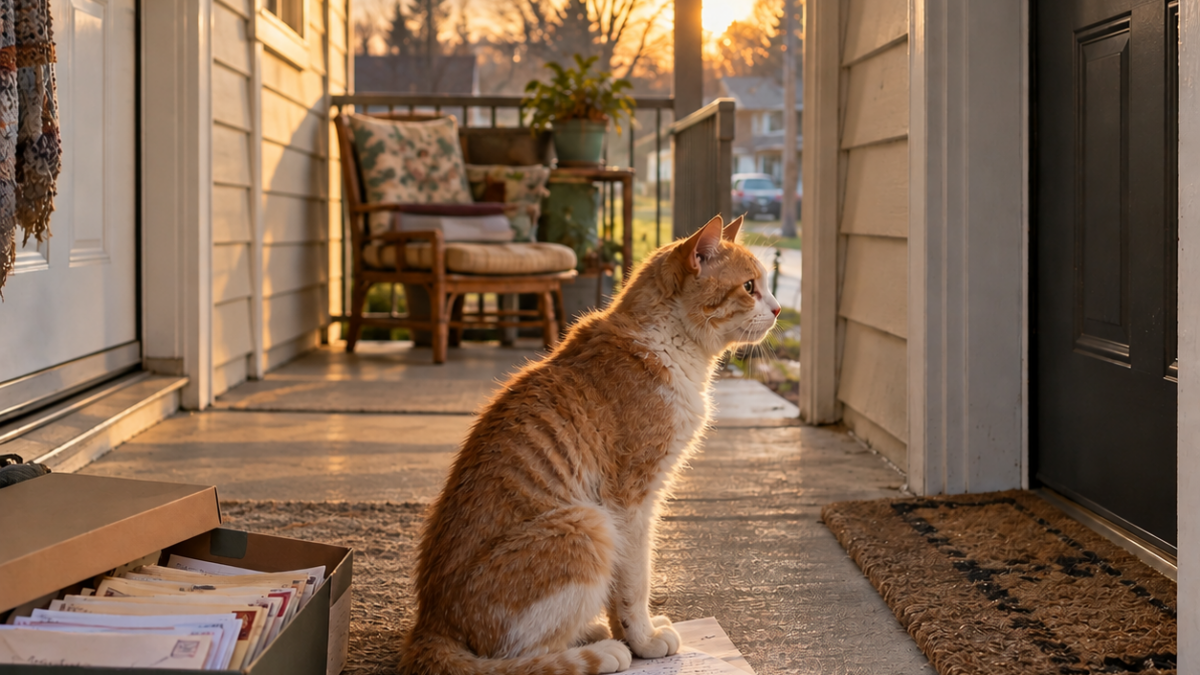
Every morning, she sat by my front door.
At first I thought she wanted outside.
So I opened it.
She walked across the porch to R’s door.
And sat.
The first time, she stayed almost forty minutes.
The second morning, twenty-three.
The third, thirty.
By the end of the month, her ritual had become exact.
Wake up.
Wait at my door.
Cross porch.
Sit at R’s door.
Listen.
Return.
Breakfast.
She did not scratch.
She did not howl.
She just waited.
That was somehow worse.
There is something uniquely painful about quiet hope.
In December, snow came.
She still went.
In January, freezing rain coated the railings.
She still went.
By February, I had started carrying a towel.
When she came back inside, I dried her paws.
“You realize he’s not in there, right?”
Clementine would stare at me.
“I’m serious. We have discussed this.”
Blink.
“He is three hours away.”
Tail flick.
“Fine. Keep your secrets.”
By spring, R’s landlord entered the apartment.
Furniture disappeared.
Boxes went out.
The window shelf vanished.
The place smelled like paint for several weeks.
Then a FOR RENT sign appeared.
That day hit me harder than I expected.
Because until then, some stupid part of me had believed the apartment was waiting too.
Like the whole place had been frozen.
R’s mug still in the kitchen.
His shoes by the door.
Clementine’s toys under the sofa.
But when strangers carried his life out through the front door, something became permanent.
At least to me.
Not to Clementine.
She sat there the next morning.
Same spot.
Then the first letter arrived.
It was January of 2024.
I remember because the envelope had gotten damp around one corner.
The handwriting was blocky and slightly uneven.
The return address showed the correctional facility.
The recipient line said:
Clementine.
Then beneath it:
c/o my name.
My address.
I stood beside the mailbox for a long time.
I actually laughed at first.
Not because it was funny.
Because the alternative was crying over an envelope addressed to a cat.
Inside was a sheet of lined notebook paper.
I won’t repeat the words exactly.
They weren’t written for me.
But I can tell you what they said.
R told Clementine about the weather.
About breakfast.
About a guy who snored in the bunk near him.
He told her he had seen a bird outside and thought about how crazy she used to go at the living room window.
He apologized for leaving.
He said he hoped she wasn’t giving me trouble.
He promised he was coming home.
At the bottom of the page was a terrible drawing of a cat.
Round head.
Triangle ears.
Six whiskers.
One crooked smile.
I read the letter twice silently.
Then I looked at Clementine.
She was sitting in the kitchen watching me.
“This is ridiculous,” I told her.
She blinked.
“It’s for you.”
Her ears lifted.
I sat on the floor.
Then I read the letter aloud.
At first I felt stupid.
By the second paragraph, I didn’t.
Clementine walked closer.
She sat about three feet away.
She watched my face while I read.
Not the paper.
Me.
When I finished, I laid the letter on the floor.
“There.”
She approached it.
Sniffed the corner.
Walked once around the page.
Then sat directly on top of it.
I laughed.
“Seriously?”
She tucked her paws beneath her chest.
The letter disappeared under thirteen pounds of cat.
Five minutes later, she was still there.
Ten minutes.
Almost twenty.
Finally she stood, stretched, and walked away.
I picked up the page.
It was warm.
I put it back into the envelope.
The next month, another arrived.
Same handwriting.
Same return address.
Same recipient.
Clementine.
The second letter was slightly longer.
R asked whether she still slept with one paw over her face.
He wrote about books from the prison library.
He said he had started walking laps in the recreation yard.
Again he promised to come home.
Again I read it aloud.
Again I put it on the floor.
And Clementine sat on it.
By the third letter, I had stopped calling it coincidence.
By the sixth, I bought a shoebox.
It was black with a white Nike logo across the lid.
I put the letters inside in chronological order.
January.
February.
March.
April.
May.
June.
By the end of the first year, there were eleven.
No letter came in December.
I didn’t think much about it until January arrived with another envelope.
Inside, R apologized.
There had been some kind of facility lockdown.
Mail had been delayed.
He wrote that he had spent Christmas wondering whether Clementine had tried to climb the tree.
I wrote my first note back.
I didn’t know the rules, so I kept it plain.
No perfume.
No colored paper.
No stickers.
Just a sheet of white paper.
Clementine is healthy.
She still likes the window.
She hates the vacuum cleaner.
She gained two pounds, and the vet blamed both of us.
I hesitated before adding one more sentence.
She still sleeps on your green shirt.
Then I mailed it.
Three weeks later, his next letter was five pages long.
He thanked me.
Not casually.
Repeatedly.
He apologized for putting Clementine on me.
He said he had thought someone in his family would take over after sentencing, but family relationships had fallen apart faster than he expected.
He said his sister wouldn’t speak to him.
His father had stopped answering calls.
An old friend had promised to help but vanished.
I remember sitting at the kitchen table feeling irritated.
Because I’d been angry at R.
Quietly.
I had never admitted it.
Not for going to prison.
Not exactly.
I was angry because he had handed me a living creature while saying “a couple weeks,” knowing he might not be coming home for years.
That had felt like betrayal.
A small one, compared with whatever else existed in his life.
But still betrayal.
I had spent hundreds of dollars on food.
Veterinary visits.
Flea medication.
Emergency bloodwork after Clementine ate half a ribbon off a birthday gift.
I had changed travel plans because I couldn’t find a pet sitter she trusted.
I had given up the idea of moving when my landlord offered to renew because I worried another building wouldn’t allow cats.
I loved Clementine by then.
But love doesn’t erase resentment.
So I wrote him.
I told him the truth.
You should have told me.
That was most of the letter.
You should have told me that “a couple weeks” might mean years.
You didn’t give me a choice.
I will not abandon her.
But you didn’t give me a choice.
I expected anger.
Or silence.
Instead, R wrote back:
You’re right.
No excuses.
I was ashamed and scared.
I thought if I admitted how long I might be gone, you would say no.
That wasn’t fair.
I’m sorry.
Those sentences changed something.
Not everything.
But something.
People apologize badly all the time.
They explain.
Defend.
Rearrange blame.
R didn’t.
He simply admitted that he’d manipulated the situation.
He had counted on my conscience.
He had known that once Clementine was inside my apartment, I would never take her to a shelter.
And he had been right.
That bothered me.
But his honesty about it mattered.
After that, our correspondence changed.
His letters were still addressed to Clementine.
Always.
But he began writing little notes in the margins for me.
Did she ever stop knocking water glasses over?
Is she still scared of the ceiling fan?
Does she snore?
The answer to all three was yes.
I started replying more often.
Not every month.
But often enough.
At first, the letters were only about Clementine.
Then slowly, life slipped in.
I mentioned my mother’s knee surgery.
He told me prison had a horticulture program.
I complained about the upstairs pipes freezing.
He told me he had started tutoring another inmate for a GED.
I said Clementine had learned how to open my bedroom door by throwing her entire body at it.
He wrote back:
Sounds right.
Somewhere in the second year, the letters became less like mail from a prisoner and more like the monthly continuation of a strange conversation between three people, one of whom had paws.
R never asked for sympathy.
That surprised me.
When he wrote about prison, he described it plainly.
Noise.
Waiting.
Rules.
Humiliation.
The constant absence of privacy.
He told me once that the hardest part wasn’t being locked in.
It was knowing that everyone outside kept living.
People celebrated birthdays.
Changed jobs.
Had babies.
Got sick.
Moved away.
Pets aged.
And he experienced it all through secondhand sentences.
I read that one twice.
Then I looked at Clementine sleeping in a square of winter sunlight.
Her orange fur had begun whitening around the mouth.
Not much.
But enough.
Time was happening to her too.
That scared me.
So I took pictures.
Not many.
R never asked constantly.
Maybe because he understood that the prison system made photographs complicated.
But once every few months, I printed one.
Clementine in the window.
Clementine sprawled on my bed.
Clementine wearing a paper bag handle around her neck after stealing it from the recycling bin.
The first photograph I mailed showed her sitting on the green T-shirt.
His response arrived three weeks later.
He wrote that he had put the photo above his bunk.
He said another inmate asked who she was.
R replied, “My family.”
I cried at that.
Quietly.
Then I got angry at myself for crying.
Because this is where people simplify stories.
They want villains.
Heroes.
Innocent people.
Guilty people.
They want the moral math to be easy.
R had done something wrong.
Wrong enough that a judge took years of his life.
There were people who had every right to be angry with him.
Some probably still were.
I never wanted Clementine’s love to erase that.
Love isn’t an acquittal.
Loyalty isn’t evidence in court.
A cat waiting at a door doesn’t make a man innocent.
But guilt doesn’t erase every decent thing a person has ever done either.
That truth became harder to ignore the longer Clementine waited.
The first time someone challenged me about R was during the second summer.
Her name was Denise.
She lived three houses down and had been in the neighborhood longer than anyone.
Denise knew everything about everybody.
Or believed she did.
One afternoon, she saw Clementine sitting outside R’s old door.
“That cat still waiting for him?”
I looked up from watering the porch plants.
“Yep.”
Denise shook her head.
“Poor thing.”
Clementine glanced toward us.
Denise lowered her voice.
“You know what I don’t understand?”
I already knew I wouldn’t enjoy the next sentence.
“What?”
“Why you’d even want him back here.”
I turned off the hose.
“He’s not moving in with me.”
“You know what I mean.”
“No, actually.”
Denise sighed.
“People like that. They get themselves locked up. Then everybody acts like we’re supposed to forget.”
“I don’t think anybody asked you to forget anything.”
“Well, I heard what he did.”
I stared at her.
Neighborhood gossip had inflated R’s crime into several different versions over the years.
In one, he had stolen from an elderly woman.
In another, he had been part of organized fraud.
Someone once confidently told me he’d robbed a bank.
That one made me laugh so hard I nearly dropped my groceries.
“I don’t discuss his case.”
“I’m just saying, if that were my cat—”
“It’s not.”
Denise blinked.
I regretted the sharpness immediately.
But only slightly.
She folded her arms.
“You feel sorry for him.”
“No.”
That surprised her.
“I feel responsible for Clementine.”
“Same thing.”
“No. It isn’t.”
Denise looked toward the cat.
Clementine was still facing the door.
“You think animals know if someone’s bad?”
I looked at her.
“Animals know who was good to them.”
That was different.
And I meant it.
Clementine had scars from life before R.
The veterinarian once noticed an old healed fracture in one of her ribs.
She had been around five when R adopted her from a county shelter after she’d been surrendered twice.
He told me that before prison, back when I barely paid attention.
“She hated everybody,” he’d said once.
“Especially me.”
“What changed?”
“I sat near her cage.”
“For how long?”
“Four Saturdays.”
I had laughed.
“You spent four Saturdays sitting near a cat you hadn’t adopted?”
“She looked mad.”
“That was your reason?”
“I related.”
Eventually Clementine allowed him to touch her.
Then she started waiting near the front of the shelter cage whenever he visited.
He adopted her the next week.
That story stayed with me.
Not because it proved he was good.
Because it explained the waiting.
He had once waited for her.
Now she was returning the favor.
In the second year, something happened that nearly broke the ritual.
Matt and Alyssa moved into R’s old apartment.
They were young.
Early twenties.
Newly married.
Their daughter, Emma, was six months old.
I warned them about Clementine.
“There’s a cat who sits outside your door every morning.”
Matt stared.
“Your cat?”
“Technically complicated.”
Alyssa laughed.
“Why?”
“Her owner used to live here.”
“Oh.”
“He’s incarcerated.”
The laugh disappeared.
I quickly added, “She won’t bother you. She just sits.”
And she did.
For two weeks, Matt found it strange.
Then Clementine became part of their morning too.
One Saturday, he opened the door while she was waiting.
Clementine looked inside.
I was standing on my side of the porch.
For one horrible second, I thought she would walk into the apartment looking for R.
She didn’t.
She sniffed the threshold.
Looked past Matt.
Then turned around.
That destroyed me more than if she’d gone inside.
Because it meant she knew.
The apartment wasn’t what she was waiting for.
The person was.
Alyssa started leaving a little folded towel near the doorway during winter.
“You don’t have to do that,” I told her.
“She gets cold.”
“She has a heated bed inside my apartment.”
Alyssa shrugged.
“She wants that spot.”
After Emma learned to walk, she started waving through the screen door.
“Kitty!”
Clementine ignored her.
“Kitty!”
Eventually Clementine tolerated a few forehead pats.
One morning, Emma dropped a cracker beside her.
Clementine ate it.
A friendship was born.
By the third year, almost everyone in the building understood.
At 6-something in the morning, the orange cat waited.
Nobody disturbed her.
The mailman knew about the letters.
I discovered that by accident.
One afternoon he handed me an envelope instead of putting it in the box.
“Another one for Clementine.”
I stared.
“You noticed?”
He smiled.
“Hard to miss.”
Then he leaned down as Clementine approached.
“You’ve got more mail than I do, ma’am.”
She sniffed his bag.
He laughed.
“Not for you.”
He was wrong.
It was.
Letter twenty-seven arrived after R learned his release date.
November.
The word appeared three times on one page.
He told Clementine he had been approved for release then, assuming nothing changed.
He wrote that he was scared to believe it.
Scared to picture the outside.
Scared that she wouldn’t remember him.
I stopped reading.
Clementine was sitting beside me.
I looked at her.
“Idiot.”
Her ears moved.
“He thinks you’re going to forget him.”
I continued.
R asked whether he should expect her to hide.
He wondered if she would recognize his voice.
He said he knew animals moved on because they had to.
Then he wrote something that made me put the page down again.
If she’s yours now, I understand.
I read that sentence several times.
If she’s yours now, I understand.
Something inside me clenched.
Because by every practical measure, Clementine was mine.
I had fed her for nearly three years.
Taken her to the veterinarian.
Cleaned her litter box.
Paid the bills.
Slept with her pressed against my feet.
Bought a couch with fabric specifically because the furniture store employee claimed it was “cat resistant.”
I knew which flavor of wet food she refused.
Which cabinet she could open.
Which thunderstorm sounds frightened her.
I knew that if I sneezed more than twice, Clementine would come check on me.
I loved her.
And I had never allowed myself to think seriously about what happened when R came home.
Until that letter.
I folded it.
Clementine immediately sat on it.
I looked down at her.
“What do you want me to do?”
She began washing one paw.
“Helpful.”
I couldn’t sleep that night.
The next morning, she went to R’s old door.
Like always.
That answered something.
Not everything.
But something.
A week later, I wrote R a longer letter.
She remembers you.
I stopped there.
Then crossed the sentence out.
I don’t know why.
It felt like saying too much.
Instead, I wrote:
We’ll figure everything out when you get back.
That was cowardly.
But honest.
There were truths I wasn’t ready to tell him in ink.
Especially the door.
I had never told him about the door.
Not once.
In thirty-four letters, not once had I written:
Every morning your cat walks to the place where she watched you leave.
I didn’t know why I kept that secret.
At first I thought it might hurt him.
Then I thought it might give him false hope.
Then the truth became so powerful that writing it felt wrong.
It belonged to Clementine.
It belonged to the moment they saw each other again.
Assuming that moment came.
By late summer, R had begun preparing for release.
He wrote less poetically.
More anxiously.
He needed documents.
Employment.
Transportation.
Housing.
The world he was returning to didn’t have a spot waiting for him.
His old apartment belonged to another family.
His father had moved to Arizona.
His sister had not spoken to him in almost two years.
Several former friends ignored letters.
The construction company he’d worked for had closed.
He would be released with a few belongings and several years missing from his life.
One afternoon I received a phone call from an unknown number.
“Hello?”
A recorded voice announced that I was receiving a call from a correctional facility.
My stomach dropped.
I had never spoken to R on the phone.
I accepted.
Static.
Then his voice.
“Hey.”
For a second, I couldn’t answer.
Three years had changed his voice somehow.
Or maybe memory had.
“Hey.”
“You okay?”
“I’m not the one calling from prison.”
He laughed.
It was the first time I’d heard that laugh in years.
“Fair.”
A pause.
“I got your number approved.”
“I figured.”
Another pause.
Then:
“How is she?”
I looked across the room.
Clementine was asleep in the window.
“Fat.”
R laughed again.
“Still?”
“The vet says she’s curvy.”
“The vet is diplomatic.”
Clementine opened one eye.
R’s voice became quieter.
“Seriously.”
“She’s good.”
“Yeah?”
“Yeah.”
“Healthy?”
“Very.”
“Happy?”
I looked at her.
That question was harder.
“Mostly.”
Silence.
“I think about her every day,” he said.
I swallowed.
“I know.”
“She really okay with you?”
“R.”
“I mean it. If she’s settled. If moving her back would mess her up. I’m not going to just—”
“She’ll decide.”
“What?”
“When you get back.”
He was quiet.
Then he exhaled.
“Okay.”
Before the call ended, he asked something strange.
“Do you still have that shirt?”
I looked toward Clementine’s bed.
The green T-shirt was faded almost gray.
“Yeah.”
“Does she use it?”
I lied.
“Sometimes.”
The truth was every night.
His next letter came six days later.
Letter thirty-four.
I didn’t know then that it would be the last one before he came home.
The release date had been moved forward.
Not dramatically.
Three weeks.
But enough.
The letter was shorter than some.
R said he had started packing.
That sentence sounded absurd.
What does a man pack after three years in prison?
A few books.
Letters.
Photographs.
Paperwork.
He told Clementine that he had her picture folded inside a book.
He said he was afraid she would look older.
Then admitted he knew he looked older too.
At the bottom, beneath the usual badly drawn cat face, he wrote:
I’ll see you soon, Clem.
I read it aloud.
She sat on it.
Twenty-two minutes.
I timed her.
Then I put the page into the shoebox.
Thirty-four letters.
Thirty-four months.
Thirty-four small pieces of a man trying to remain connected to an animal that had no way to write back.
Three weeks later, my phone rang.
R.
“Date changed.”
I sat down.
“When?”
“Friday.”
It was Tuesday.
I looked at Clementine.
She was eating.
Of course she was eating.
The world could have ended and Clementine would have wanted dinner first.
“This Friday?”
“This Friday.”
“What time?”
“They don’t guarantee it.”
“How are you getting here?”
“A reentry volunteer said he can drive me.”
“Here?”
A pause.
“If that’s okay.”
I looked toward the front door.
My chest tightened.
“Yeah.”
“Are you sure?”
“Yes.”
“Okay.”
His voice shook slightly.
“Okay.”
He didn’t ask about Clementine again.
Maybe he couldn’t.
I barely slept Thursday night.
At 5:48 Friday morning, Clementine jumped off my bed.
I woke immediately.
She walked to the front door.
Earlier than usual.
I stared after her.
“You know something?”
She sat.
My throat tightened.
“No. That’s ridiculous.”
She looked at the door.
I checked my phone.
Nothing.
6:02.
6:15.
At 6:21, I opened the door.
Clementine crossed the porch.
She sat outside R’s old apartment.
But that morning she didn’t leave after ten minutes.
Or twenty.
At 7:00 she was still there.
I brought coffee outside.
At 7:20, Alyssa opened her door carrying Emma.
“Oh.”
She saw Clementine.
“She’s been there a while.”
“Yeah.”
“Everything okay?”
I hesitated.
“R comes home today.”
Alyssa froze.
Her eyes widened.
“Oh my God.”
“Yeah.”
She looked down at Clementine.
“Does she know?”
“I don’t know.”
Emma reached toward the cat.
“Kitty.”
Alyssa pulled her gently back.
“Not today, baby.”
At 8:00, Clementine was still sitting.
I brought her breakfast.
She ignored it.
That scared me more than anything.
Clementine had never ignored breakfast.
At 8:17 my phone buzzed.
R.
We’re leaving.
Three hours.
My hands started shaking.
I typed back:
Okay.
Nothing else.
What could I say?
Your cat has been waiting outside your old door for two hours.
Instead, I went inside and pulled the Nike shoebox from the closet.
I wiped dust from the lid.
Thirty-four letters.
The earliest paper had softened at the folds.
I carried the box to the kitchen table.
Then I took the green T-shirt from Clementine’s bed.
It still held a trace of something that maybe only she could smell.
I placed it beside the box.
At 9:11, Clementine finally came inside.
She ate half her breakfast.
Drank water.
Then returned to the front door.
I stopped pretending coincidence explained anything.
At 10:30, Denise appeared.
Neighborhood networks work faster than government agencies.
“I heard he’s coming back.”
I didn’t ask how.
“Yep.”
She pursed her lips.
“You comfortable with that?”
I was too tired for this.
“Comfortable with what?”
“Him being around.”
“He served his sentence.”
“That doesn’t mean people have to forget.”
“No one asked anyone to forget.”
“He might bring trouble.”
I looked at her.
“He’s arriving with one volunteer and a cardboard box.”
“You don’t know what people are capable of.”
Neither did she.
That was the problem.
We rarely do.
I noticed two other neighbors watching from farther down the sidewalk.
Curiosity disguised as yard work.
A man across the street suddenly became deeply invested in trimming the same hedge for forty minutes.
R had become neighborhood entertainment before his shoes touched free ground.
My irritation hardened.
Whatever he’d done, I wasn’t going to let his first minutes home become some public spectacle.
Then Denise noticed Clementine.
The cat had gone back to R’s door.
Denise’s expression changed.
Just slightly.
“She’s been sitting there?”
“Since before six.”
Denise looked at me.
“Does she do that every day?”
“Yes.”
“Every day?”
“For three years.”
Her mouth opened.
Then closed.
For once, Denise had nothing to say.
At 11:07, R called.
“We’re close.”
“How close?”
“Maybe twenty minutes.”
My heart began pounding.
I walked inside.
Found Clementine’s brush.
Ran it through her fur twice before she slapped at my wrist.
“Fine. Be ugly.”
I put the brush down.
Then I changed shirts.
Then changed back because changing shirts was ridiculous.
At 11:19, Matt stepped outside.
“You want us gone?”
“What?”
“If this is private.”
I appreciated the question.
“No.”
Alyssa stood behind him holding Emma.
Denise remained down the block.
Others had found excuses to be outside.
I couldn’t control that.
At 11:26, Clementine stood.
Not stretched.
Not repositioned.
Stood.
Her head turned toward the street.
I heard nothing.
She did.
Her ears came forward.
Her body went completely still.
Then she took three steps toward the porch stairs.
I stopped breathing.
A car turned onto our street.
Blue sedan.
Slow.
Clementine moved down one step.
The car approached.
Passed two houses.
Slowed.
Stopped at the curb.
Before either door opened, Clementine made a sound.
I had heard almost every sound that cat could produce.
Angry.
Hungry.
Annoyed.
Scared.
Content.
That sound was none of them.
It was high and broken and urgent.
Like recognition happening faster than her body could contain it.
The passenger door opened.
A man stepped out.
For one second, I didn’t recognize R.
He was thinner.
Much thinner.
His hair was shorter.
There was gray at his temples that hadn’t existed before.
He wore plain jeans, sneakers, and a dark jacket that looked new and didn’t fit quite right.
He held a small cardboard box against his side.
Then he looked toward the porch.
The box fell.
Not hard.
He simply forgot to keep holding it.
Clementine screamed.
That’s the only word.
She launched herself down the steps.
R dropped to his knees.
“Clem?”
His voice cracked.
Clementine ran.
Not gracefully.
She was too fat for grace.
She ran across the narrow strip of lawn like her entire body had been wound tight for three years and somebody finally cut the string.
R opened his arms.
She hit his chest.
He nearly fell backward.
I heard people gasp around me.
R wrapped both arms around her.
Clementine climbed.
Front paws onto his shoulder.
Her face against his neck.
She made that broken sound again.
And again.
And again.
R buried his face in her fur.
“Oh, baby.”
His shoulders started shaking.
“I’m sorry.”
Clementine pushed her forehead beneath his chin.
“I’m sorry.”
He said it again.
And again.
I turned my face away.
Not because I didn’t want to watch.
Because it felt private.
Then I heard R laughing through tears.
“She got fat.”
I looked back.
“Watch yourself.”
He wiped his face with one hand while holding Clementine with the other.
She would not let go.
Every time he loosened his arm, she hooked her claws lightly into his jacket.
R stood eventually.
Clementine remained attached to him like she’d become part of the clothing.
He looked toward me.
For a long moment, neither of us spoke.
Then he said, “You kept her.”
Three words.
Not accusation.
Not surprise.
Something deeper.
I nodded.
“You asked me to.”
“For a couple weeks.”
There it was.
We both laughed.
Then his face collapsed again.
He walked toward me carrying Clementine.
“I don’t know how to thank you.”
“Don’t.”
“I mean it.”
“I know.”
“I had no right to—”
“I know that too.”
He looked down.
“I’m sorry.”
“I know.”
Clementine purred loud enough that I could hear her from two feet away.
R glanced at the apartment door behind me.
His old door.
Then something strange happened.
Clementine wriggled from his arms.
She landed on the porch.
Walked directly to that door.
Sat.
R stared.
“What is she doing?”
I couldn’t answer immediately.
Clementine looked at him.
Then the door.
Then him.
R looked at me.
“Why is she sitting there?”
I felt my eyes burn.
“She does that.”
“What?”
“Every morning.”
He didn’t move.
“Every morning?”
“For three years.”
His face emptied.
I continued because if I stopped, I wouldn’t finish.
“She waits at my door until I open it. Then she comes across the porch. She sits right there. Sometimes five minutes. Sometimes twenty. When it snows, she waits. When it rains, she waits. New people moved into your apartment. She doesn’t care.”
R stared at Clementine.
“No.”
“Yes.”
“She… every day?”
“Every day.”
His mouth opened.
Nothing came out.
Clementine stood and walked back to him.
R dropped down again.
This time he cried without hiding it.
No wiping his face.
No turning away.
He simply cried into the fur of a cat who had kept an appointment with him for one thousand mornings.
Nobody watching said anything.
Not even Denise.
After a while, I went inside.
I came back carrying the shoebox.
R was standing near the porch rail.
Clementine was at his feet.
I held out the box.
“What’s that?”
“Yours.”
He frowned.
I gave it to him.
He lifted the lid.
Saw the envelopes.
His own handwriting.
Thirty-four letters.
He looked confused.
“You kept these?”
“All of them.”
“Why?”
I shrugged.
“They weren’t mine to throw away.”
He picked up the first one.
January 2024.
His fingers moved across the envelope.
Then he saw the creases.
The faint fur.
Some had tiny claw marks.
“What happened to them?”
I smiled.
“After I read each one to her, I put it on the floor.”
He looked at me.
“And?”
“She sat on it.”
He laughed once.
I shook my head.
“Every single one.”
His smile disappeared.
“What?”
“Every letter.”
“No.”
“Every one. Five minutes. Ten. Sometimes twenty. Then she’d walk away, and I’d put it in the box.”
R looked down at the envelopes.
His hands began shaking.
“She sat on them?”
“Yes.”
He took a breath that didn’t work.
I pointed through my doorway toward Clementine’s bed.
“And she still sleeps on your shirt.”
R covered his mouth.
That was when Denise walked away.
I saw her go.
She didn’t say anything.
Just turned and walked back toward her house.
Maybe she was embarrassed.
Maybe emotional.
Maybe nothing changed in her opinion of R at all.
It didn’t need to.
This wasn’t a ceremony of absolution.
It wasn’t proof that consequences had been unfair.
Nobody was erasing what happened.
What we were watching was something else.
A man seeing evidence that while the human world had judged him, sentenced him, distanced itself from him, and in many cases abandoned him completely, one creature had continued believing his absence was temporary.
That mattered.
R sat on the porch for more than an hour.
The volunteer who drove him waited patiently.
Eventually I invited them both inside.
R stopped at the threshold.
Clementine walked in ahead of him.
Then turned.
She looked back.
R laughed softly.
“She always did that.”
“What?”
“Checked if I was following.”
He stepped inside.
Clementine led him through my apartment as if giving a tour.
Kitchen.
Living room.
Window.
Her food bowls.
Her scratching post.
Her bed.
When R saw the green shirt, he touched it carefully.
“It doesn’t even smell like me anymore.”
Clementine immediately climbed into the bed.
R smiled.
“To her it does.”
Later, we talked about what came next.
The conversation I had feared.
R wasn’t allowed to move back into the old apartment, obviously.
He had a temporary room through a reentry program across town.
Pets weren’t permitted.
At least not initially.
His face tightened when he told me.
“I knew this might happen.”
I looked at Clementine.
She was asleep against his thigh on the couch.
“What are you thinking?”
“That she stays here.”
The answer came immediately.
I wasn’t prepared for that.
“R.”
“No.”
He stroked her side.
“Look at her. This is her home.”
“You are her home.”
His eyes lowered.
“Maybe I was.”
“She just launched herself at you like a cannonball.”
He smiled.
Then grew serious.
“She’s older.”
“So are you.”
“She has a routine.”
“Your old door is part of the routine.”
“That doesn’t mean I should rip her out of here.”
“I’m not asking you to.”
He looked at me.
“I don’t want to lose her again.”
There it was.
The fear underneath everything.
“I know.”
“But if loving her means leaving her where she’s safe…”
His voice broke.
I sat across from him.
“Then we don’t make a decision today.”
He nodded.
“Okay.”
“You visit.”
“As often as I’m allowed?”
“As often as you want.”
“We see what she wants.”
He looked at Clementine.
“She’d pick food.”
“Correct.”
For the first month, R visited almost every day.
Sometimes for twenty minutes.
Sometimes hours.
He found work at a warehouse.
Not glamorous.
Not easy.
But steady.
He rode two buses across town.
On his days off, he sat at my kitchen table filling out applications for better jobs while Clementine slept beside his laptop.
At first she panicked when he left.
That was hard.
The first evening he stood to go, Clementine blocked the door.
Literally.
She planted herself in front of it and refused to move.
R crouched.
“I have to go.”
She stared.
“I’ll come back tomorrow.”
Her tail lashed.
He looked at me helplessly.
“What do I do?”
“You’re asking me?”
“She thinks you’re management.”
“I am management.”
Eventually I picked Clementine up.
R left.
She cried for forty-five minutes.
The next day he returned.
Then again.
Then again.
Slowly, something shifted.
Clementine stopped treating departures like disappearances.
Because R kept returning.
That was healing I hadn’t expected.
Not one dramatic reunion.
Repetition.
He leaves.
He returns.
He leaves.
He returns.
Trust rebuilt in increments.
Maybe that was true for humans too.
R’s sister eventually called him.
I learned that because he arrived one afternoon looking shaken.
“She wants to meet.”
“You okay?”
“No.”
“Good start.”
He laughed.
They met at a diner.
It didn’t fix everything.
Some wounds aren’t repaired over coffee.
But it opened a door.
He later repaid money he owed.
Apologized to people who refused to forgive him.
Accepted that refusal.
One former friend told him never to make contact again.
R respected it.
Another eventually agreed to talk.
He started attending counseling through the reentry program.
He hated discussing it.
Which probably meant it helped.
Three months after release, he found a pet-friendly studio.
Small.
Ugly carpet.
No dishwasher.
But one large window.
When he showed me the listing, I stared at the photo.
“You picked this because of the window.”
“No.”
“R.”
He looked away.
“Maybe.”
The move happened on a Saturday.
We decided Clementine would visit first.
No carrier initially.
I drove.
R sat in the passenger seat.
Clementine complained the entire trip from the back.
When we arrived, she inspected the studio.
Every corner.
Every closet.
The bathroom.
Under the bed.
Then she jumped onto the wide windowsill.
Sat.
Looked outside.
R stood beside me.
“That’s promising.”
“Don’t get cocky.”
We stayed two hours.
Clementine explored.
Then curled up on R’s jacket.
When it was time to leave, I picked up the carrier.
Clementine looked at me.
Then at R.
Then walked beneath his kitchen table.
I laughed.
R froze.
“She doesn’t want to go.”
“Nope.”
His face changed.
Hope.
Fear.
Joy.
All mixed.
I crouched.
“Clem.”
She backed farther beneath the table.
R sat on the floor.
“Guess that’s a vote.”
I sat too.
For several minutes, neither of us spoke.
Then I asked, “You ready?”
He looked around the apartment.
At the food dishes.
The litter box.
The bed.
The window.
Then at Clementine.
“No.”
I smiled.
“Probably the right answer.”
“What if I mess up?”
“With a cat?”
“With everything.”
His voice had gone serious.
“What if I do something wrong again?”
I considered that.
“You probably will.”
He looked offended.
“Great pep talk.”
“Everybody does things wrong.”
“You know what I mean.”
“Yes.”
I leaned against the cabinet.
“You don’t prove you’ve changed by never making another mistake.”
He listened.
“You prove it by what you do when you make one.”
R looked at Clementine.
She emerged from beneath the table and walked onto his lap.
He put a hand on her back.
“I don’t deserve her.”
“That’s not your decision.”
“Whose is it?”
Clementine started purring.
I stood.
“Hers.”
I left without her.
That night, my apartment was painfully quiet.
No paws in the hallway.
No scratching at my bedroom door.
No dramatic complaint because dinner was thirty seconds late.
I cried while washing an empty food bowl.
I hated myself for it.
Then reminded myself that grief doesn’t require permanent loss.
Sometimes grief is simply love changing address.
At 6:11 the next morning, I woke automatically.
For the first time in three years, no cat sat beside my door.
I stared at the empty hallway.
Then my phone buzzed.
A photo from R.
Clementine was sitting on his windowsill.
Beneath it he wrote:
She woke me at 5:30.
I replied:
Your problem now.
Three dots appeared.
Then:
Thank you for making it possible.
I didn’t answer.
Not immediately.
Because some gratitude is too large to respond to with text.
Clementine stayed with R.
Mostly.
I say mostly because cats operate under their own legal system.
About twice a month, R brings her over when he works a long weekend shift.
She enters my apartment like she still owns it.
Because she does.
She checks her old spots.
Eats something expensive.
Sleeps on my bed.
Then waits for him to return.
But she doesn’t go to the old apartment door anymore.
That stopped.
The first time I realized it, I nearly cried again.
She stood at my entrance around six in the morning during one of her visits.
I opened the door automatically.
Old habit.
She stepped onto the porch.
I expected her to cross.
She didn’t.
She looked once toward the door where R had once lived.
Then turned away.
She sat beside me instead.
Five minutes later, a familiar truck rolled into the street.
R had bought an old pickup with peeling paint and a heater that worked only when it felt inspired.
Clementine heard it before I did.
Her ears lifted.
She ran to the steps.
Not the old door.
The street.
That’s when I understood.
For three years, she had not been waiting for an apartment.
Or a smell.
Or a place.
She had been waiting for the return.
Once he returned, the door had no purpose anymore.
The ritual ended because the promise had been fulfilled.
A few months later, R asked me if I still had the shoebox.
“I gave it to you.”
“I know.”
“So why are you asking?”
He smiled.
“I added something.”
He brought it over that afternoon.
The old black Nike box had been reinforced with tape at the corners.
Inside were the thirty-four letters.
But there was a thirty-fifth.
The envelope said:
Clementine.
No prison return address.
Just R’s new apartment.
I looked at him.
“You mailed your cat a letter from across town?”
“I wrote it.”
“Why?”
“Read it.”
I shook my head.
“It’s hers.”
“Then read it to her.”
Clementine was on my couch.
I opened the envelope.
Again, I won’t give every word.
Some things should remain private.
But the letter wasn’t about prison.
It wasn’t about regret.
It wasn’t about waiting.
R thanked Clementine for remembering him.
He told her he was sorry she had needed to.
He promised that if he ever had to leave again, she would know exactly when he was coming back.
He wrote that she had waited for him long enough.
At the bottom was the same terrible cat drawing.
I laughed through tears.
“You still can’t draw.”
“Three years of practice wasted.”
I put the letter on the floor.
Clementine walked over.
Sniffed it.
R watched.
So did I.
She circled once.
For one second, I thought she would sit.
Instead, she stepped over the page.
Climbed directly into R’s lap.
Curled into a ball.
And fell asleep.
R stared at me.
I smiled.
“She doesn’t need the letter anymore.”
He looked down at her.
Then nodded.
“No.”
The shoebox still exists.
R keeps it now.
Top shelf of his closet.
Thirty-five letters.
Thirty-four from prison.
One from freedom.
Clementine is older these days.
There is more white around her mouth.
She doesn’t jump quite as high.
R bought little carpeted steps so she can reach the window without trying.
He pretends they were cheap.
They were not.
He still works at the warehouse, though he was promoted last spring.
His sister visits occasionally.
Their relationship isn’t perfect.
Neither is he.
Neither am I.
Nobody in this story became perfect.
That is probably why it matters.
The victims of R’s mistakes didn’t magically stop being hurt because a cat loved him.
The sentence didn’t become unjust because Clementine waited.
The years weren’t erased because he cried on a lawn.
But people are more than the worst thing they’ve done.
That truth is dangerous when used as an excuse.
It is necessary when used as a beginning.
R did his time.
Then he did the harder work of coming home.
He faced people who distrusted him.
Employers who rejected him.
Neighbors who whispered.
Friends who never returned.
He accepted consequences he couldn’t argue away.
He built a life from pieces.
And through all of it, a fat orange-and-white cat measured him by a much simpler standard.
Did you come back?
For three years, the answer had been no.
Now, every day, he gets another chance to answer yes.
Last week, I stopped by his apartment with groceries.
R had worked overtime and texted asking whether I could check on Clementine.
When I opened the door, she was sitting in the window.
Her old position.
Security guard.
Neighborhood intelligence officer.
Guardian of everything important.
I put the groceries away.
Filled her water bowl.
Then sat beside her.
Outside, the late afternoon sun turned the sidewalk gold.
A truck pulled into the parking lot.
Clementine stood before I could hear the engine clearly.
She jumped down.
Walked to the apartment door.
And waited.
Footsteps approached from the hallway.
Not imagined.
Not remembered.
Real.
R’s key entered the lock.
Clementine began purring before the door even opened.
He stepped inside.
“There’s my girl.”
She walked toward him.
No desperate crying.
No frantic claws.
No fear that he might vanish for years.
Just certainty.
He dropped his work bag.
Bent down.
She pressed her forehead against his hand.
I watched from the kitchen.
R looked up.
“What?”
I shook my head.
“Nothing.”
But it wasn’t nothing.
It was the entire story.
Once, Clementine waited in front of a locked door because the person she loved had disappeared through it.
Now she waits because she knows he is coming home.
And maybe that is the difference between loss and healing.
Loss teaches us that someone can leave.
Healing teaches us that sometimes, they come back.
Not unchanged.
Not absolved.
Not magically repaired.
But willing to stand in the doorway again.
Willing to accept what they broke.
Willing to rebuild what can still be rebuilt.
For thirty-four months, R wrote letters to a cat who could never answer.
For thirty-four months, Clementine answered anyway.
She answered by sleeping on his shirt.
By sitting on his words.
By returning each morning to the last place she’d seen him.
By refusing to let time turn absence into abandonment.
And when he finally came home, she didn’t ask where he’d been.
She didn’t ask whether he deserved forgiveness.
She didn’t care what the neighbors whispered.
She heard his footsteps.
She ran.
Sometimes I still think about that first night when R stood at my door holding a bag of cat food and told me it would only be a couple of weeks.
He lied.
Maybe because he was frightened.
Maybe because he was ashamed.
Maybe because he knew I would say no if I understood what he was really asking.
I was angry with him for a long time.
Part of me still believes I had every right to be.
But if I could go back to that moment, knowing everything I know now, I would open the door again.
Not for R.
Not even for myself.
For Clementine.
Because behind me would be three years of mornings.
Thirty-four letters.
One faded green shirt.
A shoebox full of handwriting.
A reunion on a front lawn.
A man on his knees.
A cat against his chest.
And proof that while consequences matter, so does what comes after them.
There are people who will always see R as the man who went to prison.
Some have reasons for that.
I don’t argue with them.
But when I think of him now, I remember something else.
I remember a cold October night when a scared man placed the thing he loved most inside my apartment because he couldn’t take her where he was going.
I remember the first letter.
I remember Clementine sitting on it.
I remember thirty-three more.
And most of all, I remember a Friday morning almost three years later when a blue car turned onto our street and a cat who had been waiting since before sunrise suddenly stood up because she heard something none of us could hear yet.
Footsteps returning.
The promise finally becoming real.
The door opening again.
And this time, someone coming home.








