My Neighbor Called 911 Claiming I Was Shooting Toward Homes—Then the Deputies Arrived and Realized I Was the Man Who Had Trained Them.
PART2:
Two years earlier he had sat in the third row of a training room at the sheriff’s office with a legal pad in front of him.
He had been one of those students instructors remember.
Not because he talked the most.
Because he listened.
He asked precise questions.
Wrote things down.
Waited until everyone else had left to ask about one scenario involving a confused witness, an armed homeowner, and conflicting information.
I had told him:
“When you don’t know what happened, slow the situation down until you do.”
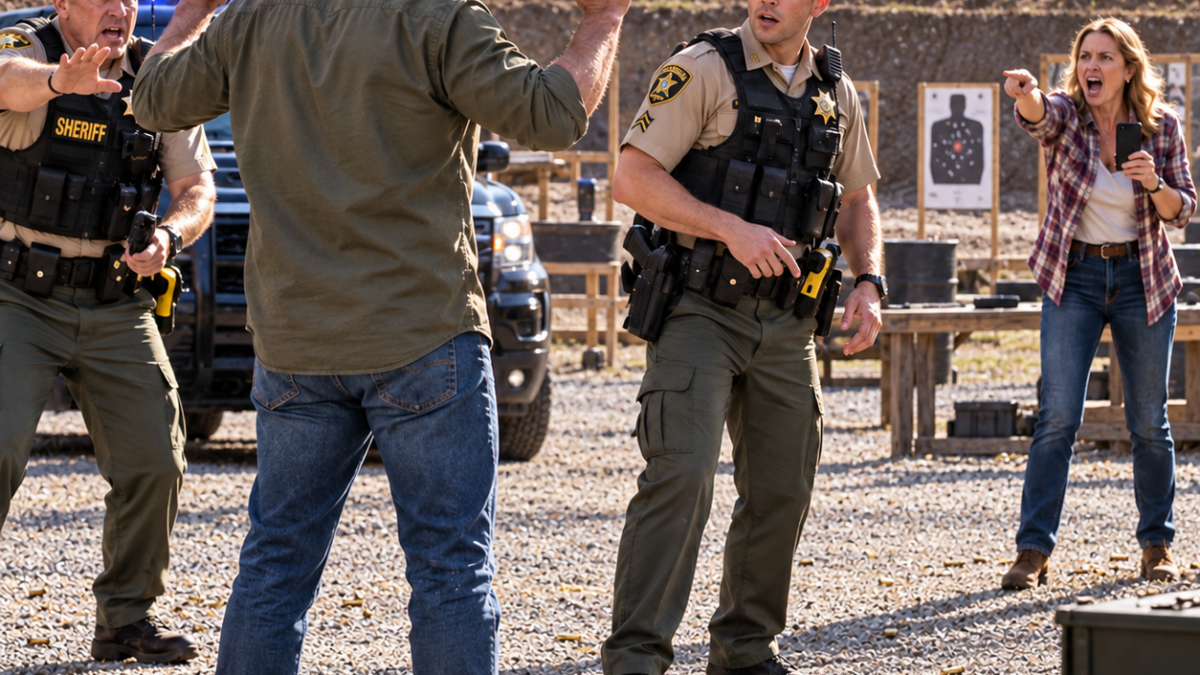
Now he was standing in my driveway.
And I was the armed homeowner.
Vanessa heard the recognition.
“You know him?”
Her voice sharpened.
“That doesn’t change what he did!”
Aaron looked toward her.
Then me.
Something uncomfortable passed across his face.
I knew exactly what he was thinking.
If he immediately treated me differently because he recognized me, everything about this response became suspect.
For him.
For me.
For the department.
I looked at Aaron.
Then Ramirez.
“Do your job.”
Aaron blinked.
“Sir?”
“Check everything.”
I meant it.
Because if knowing me was enough to make them lower their guard, I had taught them badly.
And if I used my history with the sheriff’s office to avoid scrutiny, Vanessa’s story gained something it did not yet have.
A reason for people to believe I was protected.
Ramirez stepped closer.
“Sir, while we determine what happened, I’m going to place you in restraints.”
“I understand.”
Cold metal closed around my wrists.
I did not resist.
Did not remind them I had trained dozens of deputies.
Did not say I knew their captain.
Did not mention my contract.
Did not tell them my county paperwork was perfect.
I stood on my gravel driveway with my hands cuffed behind my back.
Then I looked toward the house.
That was the moment it stopped being professional for me.
Eli stood behind the glass side door.
One palm flat against it.
His face had gone white.
Lena was behind him.
One hand resting on his shoulder.
Neither shouted.
Neither rushed outside.
Lena knew better.
She had spent eleven years married to me.
She knew the quickest way to make an uncertain police scene worse was to add another emotional person moving toward it.
But my son was watching deputies treat his father as a potential threat.
And Vanessa was filming the whole thing from the road.
The handcuffs came off forty minutes later.
My son’s memory of them did not.
My name is Caleb Mercer.
I was forty-four when all of this happened.
Lena and I had been married seventeen years.
Eli was our only child.
We lived on a little more than ten acres outside a midsized city in the Midwest.
Not a ranch.
Not a survivalist compound.
Not some fortified property surrounded by warning signs.
Just a rural family home.
Two stories.
White siding.
Red workshop.
Gravel driveway.
Vegetable garden Lena cared about more than any person reasonably should.
A stand of trees along the western edge.
Enough land that our nearest house was well beyond what people in the suburbs would consider a neighbor.
We had lived there eleven years.
Long before the large properties farther down the road began turning into expensive country homes for people who wanted acreage without actually wanting rural life.
That distinction eventually mattered.
Behind my workshop was a private practice area.
At the far end sat a broad earthen berm.
Packed soil.
Grass on top.
High enough and deep enough for its purpose.
Before I ever used it, I checked everything that applied.
County rules.
Setbacks.
Land-use restrictions.
Noise provisions.
What was allowed.
What wasn’t.
I was almost annoyingly careful.
Because my livelihood depended on being careful.
I owned Mercer Safety and Training.
Despite what people later assumed after Vanessa’s posts, I did not run some paramilitary academy.
Most of my clients were ordinary civilians.
New firearm owners who wanted safe handling instruction.
Parents who wanted storage plans.
Older people who had inherited equipment and did not know what to do with it.
Couples who wanted to understand basic safety before keeping anything in the house.
I built the business around one idea.
If somebody is embarrassed to ask a basic question, the instructor has already failed.
I hated macho nonsense.
No yelling.
No humiliating beginners.
No pretending everyone needed to become a tactical operator.
Safety.
Judgment.
Responsibility.
A smaller part of my business involved contract instruction for the county sheriff’s office.
Decision-making.
Communication.
De-escalation.
Scenario analysis.
Officer safety in ambiguous situations.
I need to be precise.
I was not a deputy.
Never had been.
No badge.
No arrest authority.
No special privilege.
I was a civilian instructor hired periodically because of my training background and the curriculum I had developed.
Once deputies left my classroom, I had no authority over them.
That distinction would become one of the most important parts of what happened later.
The first time Vanessa Pike came to my property, she was pleasant.
Almost overly pleasant.
Early autumn.
Saturday morning.
I had been behind the workshop preparing for a class the following week.
When I finished, I noticed her standing near the fence line beside the road.
Tailored tan jacket.
Dark pants.
Low heels entirely unsuited for gravel.
Phone in one hand.
Leather folder tucked against her side.
I knew Vanessa the way rural neighbors sometimes know each other.
Waves.
Mailbox conversations.
Weather.
Nothing personal.
She was fifty-two and one of the most successful real-estate agents in the county.
Her face appeared on signs.
Bus benches.
Grocery-store carts.
She had the polished confidence of someone who had spent years learning how to make strangers feel they were already friends.
“Hi, Caleb.”
“Morning.”
She smiled.
“I’m showing Gregory Hail’s place today.”
Gregory lived several lots away.
Retired engineer.
Beautiful home.
Seven or eight acres.
Stone exterior.
Updated kitchen.
Huge detached garage.
The kind of property that ended up in glossy brochures with drone photos at sunset.
Vanessa lifted one hand apologetically.
“I hate to ask this.”
“Ask what?”
“Could you not do this today?”
She nodded toward the practice area.
“What time?”
“Showing at two.”
I checked my watch.
I was nearly done.
“Sure.”
Her shoulders relaxed immediately.
“You’re a lifesaver.”
“I was wrapping up anyway.”
“Thank you.”
“Not a problem.”
She walked back toward the road.
I went inside.
Told Lena:
“Vanessa’s showing the Hail house, so I finished early.”
Lena was making lunch.
“That was nice.”
That was it.
A normal interaction between adults.
She asks.
I can accommodate.
I do.
Four days later Vanessa came back.
No folder this time.
No smile.
She walked directly to the edge of my property.
“Caleb.”
I was closing the workshop.
“What’s up?”
“We had an issue Saturday.”
“With the house?”
“With the showing.”
I waited.
“One buyer heard gunfire.”
“Okay.”
“He asked what it was.”
“Did you tell him?”
“I said a nearby property owner sometimes shoots.”
“That’s accurate.”
“He was concerned.”
“What did he say?”
Vanessa paused.
“He asked whether it happens often.”
“That isn’t exactly the same as being concerned.”
“He said it could affect the value.”
There it was.
The first honest problem.
Not safety.
Money.
I understood.
A buyer considering a million-dollar rural property might not love hearing occasional gunfire.
That could influence whether they wanted the house.
Or what they offered.
Vanessa continued.
“I need this stopped until Gregory’s property closes.”
I thought I misunderstood.
“Stopped?”
“Yes.”
“For how long?”
“The listing shouldn’t take long.”
“That could still be months.”
“I doubt it.”
“But it could.”
She folded her arms.
“This is one of the highest-value residential listings in this part of the county.”
“Okay.”
“There is a significant amount at stake.”
“I understand.”
“Then surely you understand why we need certainty.”
I stared at her.
“I can coordinate around scheduled showings if you give me reasonable notice.”
“That’s not enough.”
“It’s reasonable.”
“I need you to stop.”
“On my property?”
“Until the sale closes.”
“No.”
I did not say it angrily.
That mattered.
Just no.
Vanessa looked at me as if she had never considered that answer possible.
“Excuse me?”
“I’m willing to coordinate.”
“I heard you.”
“I’m not agreeing to stop lawful activity on my property indefinitely because someone three lots away put his house on the market.”
“That is an incredibly selfish way to look at this.”
“No.”
“You know what is at stake.”
“What exactly is at stake?”
“Gregory’s investment.”
“And your commission?”
That landed.
Her face changed.
Only slightly.
But enough.
“This isn’t about me.”
“Good.”
I nodded.
“Then scheduling around showings should solve the problem.”
She thanked me in a tone that meant exactly the opposite.
Then walked away.
I watched her go.
That was the moment the relationship changed.
After that day, Vanessa almost never talked directly about the listing.
Her language evolved.
Instead of buyers, she said families.
Instead of open houses, she said community peace.
Instead of commission, she said property values.
Then neighborhood safety.
One evening she caught me near the mailbox.
“Several people have expressed concern.”
“About?”
“Gunfire near residential homes.”
“Which people?”
“I’m not going to identify neighbors who spoke to me privately.”
“Okay.”
“Parents are uncomfortable.”
“Which parents?”
“That isn’t the point.”
“Then what is?”
“The area is changing.”
“My property isn’t.”
“Exactly.”
She said the word as if it proved everything.
I stared.
“Exactly what?”
“There are more homes now.”
“Yes.”
“More families.”
“There were families before.”
“You need to adapt.”
“I have.”
“No, you haven’t.”
“I avoid early mornings.”
“I keep sessions short.”
“I offered to schedule around your showings.”
“You still shoot.”
“Yes.”
“Then you haven’t adapted.”
That night I told Lena.
She was rinsing dishes.
At first she listened without saying much.
Then set the towel down.
“Why is she talking like she’s building a case?”
I laughed.
“She sells houses.”
“That didn’t answer me.”
“She has a big commission tied up in Gregory’s listing.”
“Then why is she talking about children?”
“Because saying ‘my commission’ sounds worse.”
Lena did not smile.
“Keep everything.”
“What?”
“Every email.”
“Lena.”
“Every text.”
“She’s irritating. That’s all.”
“Maybe.”
She picked the towel back up.
“But keep everything.”
My wife was right.
Again.
A few days later, Frank Dawson called me.
Not the later deputy.
Different Frank.
Retired electrician.
Seventy years old.
Lived half a mile down.
“Caleb.”
“Yeah?”
“Your realtor friend is taking pictures of your place.”
“Vanessa?”
“Been on the shoulder twenty minutes.”
He sent me a photo.
Vanessa stood near the bend.
Phone raised.
She moved left.
Right.
Crouched.
Zoomed.
I went outside after she left.
From that particular point on the public shoulder, I understood what she had been trying to capture.
The top of one of my targets appeared in the same compressed visual line as the roof of a distant house.
A phone photograph flattened the distance.
Target in foreground.
Roof in background.
If someone did not understand the actual geometry, the picture looked disturbing.
Like the target was positioned toward the home.
From the firing position, it wasn’t.
There was no house behind the target.
There was a berm.
But photographs do not always show relationships honestly.
They show perspective.
A week later, Lena handed me her phone.
Neighborhood bulletin board.
Vanessa had posted:
CONCERNED ABOUT POSSIBLE SHOOTING ACTIVITY NEAR RESIDENTIAL HOMES. HAS ANYONE ELSE NOTICED THIS?
She did not name me.
Smart.
No direct accusation.
Concerned.
Possible.
Near homes.
Each word did work.
Comments came quickly.
Longtime residents defended me.
“Caleb’s been there forever.”
“Never been a problem.”
“I hear it maybe once in a while.”
Then newer residents.
“I heard shots last Saturday.”
“We have children.”
“Is this legal?”
“Someone should call the sheriff.”
I stood at the kitchen island reading.
Coffee untouched beside me.
I wanted to answer.
Not irrationally.
Factually.
Long answer.
Distances.
Rules.
Backstop.
County requirements.
Lena took the phone away.
“No.”
“I didn’t say anything.”
“You were about to.”
“How do you know?”
“I married you.”
I laughed despite myself.
She opened her laptop.
“We save it.”
“Every comment?”
“Anything relevant.”
“Why?”
“Because three months from now, people won’t remember what was actually written.”
That evening we created a folder.
Screenshots.
Dates.
Texts.
Emails.
Photos.
Vanessa’s first request mattered most.
She had written:
I HAVE BUYERS THIS WEEKEND. I NEED THE GUNFIRE STOPPED UNTIL THIS PROPERTY CLOSES.
Lena pointed.
“What does that not say?”
I read it.
Then again.
“Safety.”
“Exactly.”
No children.
No threat.
No danger.
Buyers.
Closing.
I wrote Vanessa a short email.
Professional.
I said if she had a specific safety concern, I wanted to hear it and would take it seriously.
I repeated my offer to coordinate around scheduled showings with reasonable notice.
Her reply came fifty-two minutes later.
YOU DON’T GET TO DECIDE WHAT THE NEIGHBORHOOD CONSIDERS SAFE.
Lena saved it.
Then the rumors reached my business.
A man named Eric, registered for a beginner class with his wife, called.
“Caleb, can I ask something awkward?”
“Sure.”
“We saw stuff in the neighborhood group.”
“I figured.”
“Is there some… investigation?”
“No.”
“Any violations?”
“No.”
“Police complaints?”
“Not that I know of.”
Pause.
“My wife is uncomfortable.”
“I understand.”
“We may postpone.”
“That’s okay.”
“I’m sorry.”
“You don’t need to apologize.”
He hung up.
I sat in my office staring at the blank computer screen.
My business was reputation.
Not branding.
Not social-media followers.
Trust.
A safety instructor associated with the phrase reckless gunfire can lose that trust faster than he can explain what actually happened.
Eli noticed the tension.
Fifteen is an awkward age.
Old enough to understand adults are not telling you everything.
Young enough to assume adults can probably fix things if they try harder.
One evening he stood in the workshop doorway.
“Dad?”
“Yeah?”
“Why does that lady hate us?”
“She doesn’t.”
“She keeps telling everybody you’re dangerous.”
“She wants something.”
“What?”
“She wants me to stop using the practice area while she sells Gregory’s house.”
“Why?”
“She thinks buyers won’t like the noise.”
Eli frowned.
“That’s stupid.”
“It may matter to buyers.”
“So she lies?”
“I didn’t say that.”
“She’s saying you’re dangerous.”
“She’s saying things in a way that supports what she wants.”
He considered.
“That sounds like lying with extra steps.”
I almost laughed.
Instead I said:
“Don’t decide somebody’s motive until you can prove it.”
He rolled his eyes.
“You always say that.”
“There’s a reason.”
That lesson came back to both of us.
The Saturday Vanessa called 911 was beautiful.
Clear.
Cool.
Late-afternoon autumn sun.
Lena was inside doing paperwork from the dental clinic where she worked as office manager.
Eli was in the garage.
I checked equipment for a class.
A short session.
A handful of rounds.
Target.
Berm.
Secure.
Finished.
Then sirens.
Vanessa’s call to dispatch did not say:
I hear gunfire.
It did not say:
I am concerned about a nearby target.
According to the report I saw later, she said:
“He is firing toward the occupied homes behind his target.”
Not maybe.
Not looks like.
He is.
That sentence brought Ramirez and Bell into my driveway with a completely different level of concern.
They cuffed me.
And they should have.
I want that clear.
This is not a story about corrupt deputies.
Not incompetent deputies.
Not law enforcement persecuting an innocent homeowner.
They had been told a man with a firearm was firing toward homes.
They arrived expecting that possibility.
That was their job.
Ramirez walked the property.
Target.
Berm.
Slope.
Tree line.
Surrounding structures.
He asked where I had stood.
Where I had fired.
How many rounds.
When.
What equipment.
I answered.
Aaron stayed near me.
Vanessa continued talking.
“The target points toward the houses.”
Ramirez did not accept or reject her statement.
He asked:
“Where were you when you observed that?”
She pointed toward the road.
He walked there.
Stood.
Looked.
Moved a few feet.
Looked again.
From that angle, the distant roof appeared above the target.
But from the firing position?
Earth.
Berm.
No road.
No occupied structure.
Ramirez returned.
Vanessa approached.
“You can see the houses from there.”
Ramirez looked at her.
“From where?”
“The road.”
“That’s not what I asked.”
She frowned.
“You can see the roofs behind the target.”
“Did you see any rounds impact near a residence?”
“I saw the direction.”
“Did you see impacts?”
“No, but—”
“Could you see Mr. Mercer’s hands from your location?”
Pause.
“You’re missing the point.”
“What point?”
“There are children living here.”
Ramirez’s voice stayed neutral.
“I’m asking what you personally observed today.”
That was where the certainty began shrinking.
“I could see his target.”
“That’s different from seeing where rounds traveled.”
“I could see the houses behind it.”
“From your angle.”
“Yes.”
“Could you clearly see Mr. Mercer’s position?”
“I saw enough.”
Aaron stood near me.
Silent.
So was I.
Ramirez asked again.
“Did you observe Mr. Mercer physically pointing or firing a weapon toward any occupied structure?”
Vanessa hesitated.
“I heard shots.”
“That was not my question.”
“No.”
A minute passed.
Then:
“But the setup is dangerous.”
Now she had retreated from:
I saw him firing toward homes.
To:
The setup is dangerous.
Those are not the same statement.
After approximately forty minutes, Aaron approached.
“Mr. Mercer.”
“Yes?”
“I’m removing the restraints.”
He unlocked them.
My shoulders ached when my arms came forward.
He said:
“Based on what we can determine right now, we do not see evidence supporting the allegation that rounds were fired toward occupied homes.”
I looked toward Eli.
Still behind the door.
He saw the cuffs come off.
Good.
Aaron continued.
“The complaint will be documented.”
“I understand.”
Vanessa heard him.
Her wording shifted again.
“I may not have had the exact angle.”
Then:
“I definitely heard the gunfire.”
Then:
“I was only trying to protect people.”
Nobody argued.
The deputies completed their documentation.
Aaron shook my hand briefly.
Not some dramatic recognition scene.
No:
Sorry, sir.
No salute.
No embarrassed speech.
Just professional closure.
Then they left.
I thought that was the worst of it.
That evening Vanessa uploaded her video.
She had edited nothing visually.
She did not need to.
The clip began after the deputies arrived.
Me in handcuffs.
Deputies around me.
My home behind them.
Her caption read:
POLICE FINALLY RESPONDED TO BACKYARD GUNFIRE COMPLAINTS.
Finally.
Complaints.
Plural.
By morning, the post had spread through three neighborhood groups.
People who had not seen Vanessa’s earlier messages saw only:
Police.
Handcuffs.
Firearms instructor.
Homes.
A second client canceled.
On Monday morning Captain Mara Whitfield called.
Mara supervised professional development at the sheriff’s office and had renewed my contract more than once.
“Caleb.”
“Captain.”
“I wanted you to hear this from me.”
I already knew.
“Training class is postponed.”
“Yes.”
I closed my eyes.
“We have an open firearm-related complaint involving one of our contract instructors.”
“I understand.”
“I’m not saying the department believes the allegation.”
“I know.”
“But I can’t ignore it.”
“You shouldn’t.”
She paused.
“You mean that?”
“Yes.”
“We’ll review the incident.”
“Do what you need to.”
When the call ended, I sat at my desk.
The money mattered.
Cancelled training cost money.
But the real pain was watching a professional relationship built over years become questionable because one allegation existed.
That evening Eli asked:
“If those deputies knew you, why did they put you in handcuffs?”
I looked at him.
“Because knowing me isn’t evidence.”
He frowned.
“They knew you teach them.”
“Aaron knew.”
“So he knew you wouldn’t shoot at houses.”
“No.”
“Dad.”
“He knew things about me.”
“That’s different.”
“How?”
“If police give different rules to people they know, what happens to the person nobody knows?”
Eli looked down.
“But you didn’t do anything.”
“Exactly.”
“Then why cuff you?”
“Because the report was serious enough that they needed control while they figured that out.”
He hated the answer.
I understood.
“The only reason the result matters,” I told him, “is because they checked.”
That became our strategy.
Not:
Trust me.
Not:
I’m a respected instructor.
Not:
Vanessa is crazy.
Not:
Everybody knows me.
Check.
Lena opened her laptop.
We built a timeline.
First friendly request.
Then demand.
Buyer.
Sale.
Closing.
Then neighborhood concern.
Children.
Safety.
Photos.
Police.
Video.
Business cancellations.
Contract suspension.
Everything dated.
Everything preserved.
I was furious.
More than once.
One afternoon, after another client canceled, I sat in the workshop composing a public response on my phone.
Lena walked in.
Read my face.
“Don’t.”
“Don’t what?”
“Give her the clip she wants.”
I knew exactly what she meant.
Angry man.
Workshop.
Firearms.
Pointing at a phone.
Ranting about a woman.
Perfect.
I locked the screen.
Put the phone in a drawer.
“Thank you.”
“That’s my job.”
“No.”
“Keeping you from doing stupid things is absolutely my job.”
We requested the official incident record through proper channels.
Waited.
The neighborhood group refused to remove Vanessa’s video because there was, technically, an active police report.
Vanessa used that fact.
She would reply to skeptical people:
“There is an official incident.”
True.
Misleading.
An allegation being documented is not the same as the allegation being confirmed.
Those two ideas merged quickly online.
Then the report arrived.
I read Vanessa’s dispatch statement at the kitchen table.
One line.
She stated she could see me firing toward occupied residences.
See.
I called Lena.
“Come here.”
She sat.
Read.
Then read again.
“She told them she saw your actual firing direction?”
“Yes.”
“Could she?”
“No.”
Lena looked at me.
“Could we prove that?”
“That’s what we’re going to check.”
The next morning we stood exactly where the report placed Vanessa.
Public roadside.
Near the bend.
Lena walked across our land.
From Vanessa’s location, brush blocked Lena below the waist.
A slight rise obscured more.
I could see the target.
I could see the distant roof above it.
I could not see Lena’s hands.
Could not see her body orientation clearly.
Could not determine a firing angle from what little was visible.
We documented it.
Photos.
Measured approximate lines.
Then moved to the actual firing position.
The relationship between target and berm was unmistakable.
The more we checked, the less Vanessa’s statement fit the physical scene.
She had likely seen three things.
Target.
Distant roof.
My presence somewhere beyond vegetation.
She had heard shots.
Then she had converted those pieces into:
I saw him firing toward the houses.
Maybe she consciously exaggerated.
Maybe expectation filled in what she could not see.
I did not need to decide which.
The statement itself was inaccurate.
Then Lena found another email.
Older.
Sent before any safety post.
IF BUYERS KEEP HEARING THIS, THE HOUSE WILL NEVER CLOSE.
I stared.
There it was.
The original motive.
Not evil.
Not criminal.
Commercial.
She wanted a house sold.
I called Gregory Hail.
Carefully.
I did not accuse Vanessa.
I said his listing had become connected to a dispute involving me.
He sounded genuinely confused.
“What dispute?”
I explained the 911 response.
Long pause.
“Vanessa told me there had been multiple police complaints.”
My hand tightened around the phone.
“What?”
“She said this had been going on for months.”
“It hasn’t.”
“She said neighbors had involved law enforcement before.”
“The Saturday call was the first serious police response I’ve had in eleven years.”
Another silence.
“That’s not what I was told.”
I asked whether I could show him something.
The next afternoon, I stood on Gregory’s porch.
He read Vanessa’s first message.
I HAVE BUYERS THIS WEEKEND. I NEED THE GUNFIRE STOPPED UNTIL THIS PROPERTY CLOSES.
Once.
Twice.
Removed his glasses.
“No mention of danger.”
“No.”
“She told me residents approached her first.”
“She approached me because a buyer asked whether the sound might affect value.”
Gregory looked exhausted.
I said:
“I’m not asking you to fire her.”
“I’m not asking for anything about your listing.”
“I want the record corrected.”
He nodded.
“I understand.”
The sheriff’s review ended two weeks later.
Captain Whitfield called.
“There is no evidence supporting the allegation that you fired toward occupied residences.”
I sat down.
“Thank you.”
“Your contract suspension is being lifted.”
“Understood.”
“I’m sorry we had to postpone.”
“You did what you had to do.”
Pause.
“You really believe that.”
“Yes.”
Because I did.
What I did not yet have was my public reputation back.
The neighborhood still had Vanessa’s video.
A man in handcuffs makes a stronger image than an administrative conclusion.
I contacted the group administrator and provided the incident disposition.
Vanessa responded publicly before the caption could be updated.
THE FACT THAT HE TRAINS DEPUTIES DOES NOT MAKE HIM ABOVE THE RULES.
Clever.
Now the department’s familiarity with me became suspicious.
Favoritism.
Potential corruption.
I typed a long answer.
Deleted it.
Typed another.
Deleted that too.
Finally wrote one sentence:
Agreed. That is why the deputies checked. The issue is whether the original claim was accurate.
Then I stopped.
The conversation underneath Vanessa’s post began changing.
Someone asked:
“If he wasn’t above the rules, then shouldn’t her report also be reviewed?”
Another:
“Was he actually shooting toward houses?”
Then:
“Why were the cuffs removed?”
Then someone posted the official disposition:
ALLEGATION OF SHOTS FIRED TOWARD OCCUPIED HOMES NOT SUBSTANTIATED.
Short.
Boring.
Powerful.
The deputies never defended me online.
Good.
I did not want them to.
Their job was not to vouch for my character.
Their work was the evidence.
Gregory confronted Vanessa privately.
I learned the details later.
He asked why she had described one new call as a history of complaints.
She apparently told him she was trying to protect the listing.
Then said something that bothered him more.
“I thought he’d get the message.”
The message.
That sentence exposed the underlying problem.
Law enforcement had not necessarily been called because Vanessa expected me to be arrested.
It had become leverage.
Pressure.
Maybe she believed if deputies arrived once, I would stop.
Instead, the police response created an official record contradicting the most serious allegation.
Gregory terminated her listing contract.
His choice.
Not mine.
The commission Vanessa had spent weeks protecting disappeared.
There was no dramatic scene.
No public firing.
No office confrontation.
He simply stopped trusting her.
The accuracy of Vanessa’s emergency report was referred for review.
Again:
No dramatic arrest.
No handcuffs outside her house.
No theatrical punishment.
Just statements.
Records.
Questions.
That was appropriate.
The neighborhood group updated the video caption:
ORIGINAL ALLEGATION OF SHOTS FIRED TOWARD RESIDENCES WAS NOT SUBSTANTIATED.
Same video.
Different sentence.
Suddenly people saw something different.
One person commented:
“I assumed the cops confirmed the complaint.”
Another:
“Why post the handcuffs but not the outcome?”
Then the question that did the most damage to Vanessa’s version:
“If this started over an open house, how did it become a 911 emergency?”
Exactly.
Because the timeline was simple.
First:
Buyers.
Then:
Closing.
Then:
Property values.
Then:
Families.
Then:
Children.
Then:
Safety.
Then:
Possible shooting.
Finally:
He is firing toward homes.
Every stage more serious.
But no new physical event justified the escalation.
The only thing that had changed was my refusal to stop indefinitely.
Neighbors began approaching us.
Frank came by.
Raised one hand.
Same wave he had given me for years.
No speech.
No apology.
A young mother named Kristen brought muffins.
She spoke mostly to Lena.
“I feel awful.”
Lena asked:
“For what?”
“I believed Vanessa.”
“You had one version.”
“I should’ve waited.”
“Maybe.”
Kristen looked uncomfortable.
“When somebody says bullets are going toward houses and you have kids…”
“Of course.”
That mattered.
I did not blame every person who believed Vanessa.
If someone tells you a man is shooting toward homes, fear is reasonable.
The problem was not that people took danger seriously.
The problem was the quality of the information they were given.
Captain Whitfield later called me into her office.
She closed the door.
“When Bell recognized you, we reviewed the body camera carefully.”
“Good.”
“You know what impressed me?”
“What?”
“He didn’t change procedure.”
I smiled.
“Good.”
“Ramirez didn’t either.”
“Better.”
“They checked the firing position.”
“Yes.”
“The berm.”
“Yes.”
“Caller location.”
“Yes.”
“Documents.”
“Yes.”
“They separated familiarity from evidence.”
I sat quietly.
Mara continued:
“You taught that.”
“I know.”
“Was that strange?”
“That’s one word.”
My contract returned.
The first class afterward felt different.
Twenty deputies.
Coffee.
Projector.
Same room.
Aaron Bell sat near the back.
Nobody mentioned my driveway.
During break, Aaron approached.
“Mr. Mercer.”
“Aaron.”
“I need to say something.”
“Go ahead.”
“I hated putting cuffs on you.”
I looked at him.
“You shouldn’t.”
He blinked.
“I knew who you were.”
“That’s why you especially shouldn’t regret it.”
He frowned.
“You had bad information.”
“Yes.”
“Your job was to control the scene long enough to test it.”
He nodded.
“It felt wrong.”
“Because you recognized me.”
“Yes.”
“And if you had immediately removed the cuffs because of that?”
Aaron thought.
“I’d have treated you differently.”
“Yes.”
He looked toward the classroom.
“That would have been a mistake.”
“Yes.”
“The cuffs bought time.”
He looked back.
“A pause.”
“Exactly.”
“Time to check.”
“Exactly.”
The lesson had landed twice.
Once in a classroom.
Once in my driveway.
That may be the part of this whole story I am proudest of.
Not Vanessa losing the listing.
Not my contract coming back.
Not people apologizing.
The fact that Aaron recognized me and still did what procedure required.
Because favoritism would have poisoned everything.
If knowing the right person can stop an investigation, then people who know nobody are in trouble.
That is not fairness.
The county eventually concluded Vanessa’s emergency report was inaccurate.
No spectacular punishment.
The most meaningful thing for me was that the official record no longer contained her accusation without the result beside it.
My clients returned gradually.
Not all.
One family never came back.
Another called months later.
Eric.
The man who had canceled the beginner class.
“You still offer the Saturday course?”
“Yes.”
“We’d like to register.”
“Sure.”
“I owe you an apology.”
“No.”
Pause.
“I canceled because I didn’t trust you.”
“You canceled because you had incomplete information.”
“I should’ve believed you.”
“No.”
He sounded surprised.
“You should’ve waited for facts.”
That sentence became important to me.
Trust is useful.
Evidence is better.
Gregory hired another agent.
A quiet guy named Martin from the next county.
The house sold six weeks later.
The eventual buyers were a younger couple.
No campaign required.
No police.
No panic.
Martin simply told them what the area actually was.
Rural residential.
Acreage.
Occasional equipment noise.
Occasional legal shooting on private property.
The buyers accepted it.
That was all.
Adults communicating normally solved the problem Vanessa had spent weeks trying to eliminate through pressure.
Months later, Vanessa came to my property line.
No folder.
No phone.
Hands in her jacket pockets.
I stopped several feet away.
“Caleb.”
“Vanessa.”
She looked tired.
“None of this would’ve happened if you had just stopped until Gregory’s house sold.”
That was when I knew she had learned almost nothing.
“You were allowed to ask.”
She said nothing.
“You were allowed to tell me when showings were scheduled.”
Silence.
“You were allowed to explain the financial concern.”
Her expression tightened.
“You were allowed to be angry when I said no.”
I paused.
“You were not allowed to turn no into an emergency.”
Vanessa stared.
“I believed people were in danger.”
“I don’t know what you believed.”
That surprised her.
I continued.
“But I know what you wrote before you called 911.”
Her eyes shifted.
“I know what you told Gregory.”
Nothing.
“I know what you told dispatch.”
Nothing.
“And I know what the deputies found.”
She crossed her arms.
“You think you’re completely innocent?”
“I followed the county rules.”
“You created something people found frightening.”
“I offered coordination.”
“That wasn’t enough.”
“For you.”
“For buyers.”
There it was.
“Buyers.”
Vanessa looked away.
I nodded.
“You needed the sale.”
“That doesn’t make safety concerns fake.”
“No.”
She looked back.
“But it explains why my refusal became intolerable.”
She stood there several seconds.
Then walked away.
That was the last real conversation we ever had.
The ending that mattered happened with Eli.
We were sitting on the back steps.
Sun dropping behind the trees.
The practice area quiet.
He had been different since the police response.
Not anti-police.
Not afraid of me.
Just watchful.
I hated that.
“Dad?”
“Yeah?”
“Did you know the deputies would recognize you?”
“No.”
“Really?”
“Really.”
“Were you glad Aaron did?”
I considered.
“Part of me.”
“That makes sense.”
“Another part wasn’t.”
“Why?”
“Because I didn’t want that to be the reason I was okay.”
He frowned.
“If they hadn’t recognized you, what would have happened?”
“Probably the same investigation.”
“Probably?”
“Same procedures, yes.”
“So what protected you?”
I looked across the yard.
I had spent months answering that question without noticing.
Reputation?
Helpful.
Calm behavior?
Important.
County compliance?
Essential.
Training relationships?
Complicated.
But none was the real answer.
“The fact that somebody checked.”
Eli stayed quiet.
“They checked the berm.”
He nodded.
“They checked Vanessa’s angle.”
Another nod.
“They checked what she told dispatch.”
“Yes.”
“They checked the records.”
“So evidence.”
“Yes.”
“That’s what saved you?”
“It’s what corrected the story.”
He thought.
“What if nobody checked?”
I did not have a comfortable answer.
“That’s why process matters.”
Something in his face softened.
Life eventually returned to normal.
I planted evergreens along part of the road.
Not to hide the range.
Privacy.
They also reduced misleading sightlines from passing cars.
I started notifying nearby neighbors before longer training periods.
Short message.
Nothing legal required.
Just courtesy.
If there was a graduation party two houses away, I worked around it when possible.
Why?
Not because Vanessa had been right.
She wasn’t.
Because being correct does not mean you are incapable of learning.
Perception matters.
Not more than facts.
But before facts get checked, perception can cause damage.
A five-minute message can prevent an hour of misunderstanding.
That is not surrendering your rights.
It is being a functional neighbor.
There is a difference.
My business recovered.
Slowly.
Reputational damage does not vanish when an official document says “not substantiated.”
Some people never see the correction.
Some see it and still remember the handcuffs.
Images are sticky.
Corrections are boring.
I stopped trying to control everyone’s opinion.
Returned to work.
One class.
Then another.
Clients came.
Deputies came.
Time did what arguments could not.
Eventually the incident became:
“Wasn’t there some complaint?”
“Yes.”
“What happened?”
“Investigated. Not substantiated.”
Enough.
I never used Vanessa’s name in my classes.
Never made jokes about “Karens.”
Never described myself as someone targeted by the police.
Because I wasn’t.
The deputies responded to information.
The problem was the information.
That distinction matters.
Police encounters become dangerous when everybody arrives with a completed story.
Caller has one.
Officer starts building one.
Subject has one.
The job is to slow things down long enough for facts to ruin everybody’s favorite version.
That afternoon, Ramirez and Bell were told:
Armed man firing toward houses.
Then they found:
Private property.
Legal activity.
Earthen berm.
No impact evidence.
No firing line toward residences.
Caller positioned where she could not clearly observe what she claimed.
That is how claims should live or die.
Verification.
Not charisma.
Not social status.
Not outrage.
Vanessa may never have sat down and deliberately thought:
I’m going to fabricate an emergency.
I don’t know.
Human beings rarely narrate their own bad decisions that clearly.
What I think happened is more ordinary.
And maybe more dangerous.
She wanted an outcome.
Sell the house.
Buyer mentioned noise.
Noise threatened value.
Value threatened sale.
Sale threatened commission.
I refused the solution she preferred.
Then each new belief made the next escalation easier.
Property values.
Families.
Children.
Safety.
Danger.
By the time she stood at the road hearing shots and seeing a target with a roof in the distant background, perhaps the conclusion already existed in her mind.
Expectation became certainty.
That is why evidence matters.
Lena understood that before I did.
She kept the first email.
The screenshots.
The exact wording.
Stopped me from sending angry messages.
Created order.
One evening, months after everything ended, she opened the folder.
Hundreds of images and documents.
“Delete?”
I thought.
“No.”
“Why?”
“Archive it.”
She smiled.
“I knew you were going to say that.”
“Predictable?”
“Painfully.”
We kept it.
Not revenge.
Reminder.
Sequence matters.
First:
I need it stopped until the sale closes.
Later:
People are afraid.
Then:
He is firing toward houses.
Side by side, the statements told the story without adjectives.
That taught me something about defending yourself.
You do not always need a louder story.
Sometimes you need a cleaner chronology.
Vanessa had emotion.
I had dates.
Vanessa had implication.
I had wording.
Vanessa had a video of me in cuffs.
I had the conclusion explaining why they came off.
Vanessa had a frightening photograph angle.
I had the geometry.
Eventually repetition lost.
The hardest part remained Eli.
For months I wondered what the incident had done to him.
One night I finally asked.
“Do you think differently about me because they put me in cuffs?”
He looked shocked.
“No.”
“Okay.”
Then:
“I was scared.”
“I know.”
“I thought maybe they knew something I didn’t.”
That hurt worse than I expected.
“What do you mean?”
“When I saw you.”
He paused.
“I thought maybe you actually had done something.”
I nodded.
He looked guilty.
“That makes sense.”
“It does?”
“You saw police handcuffing someone.”
“But you’re my dad.”
“Being your dad doesn’t make me automatically right.”
He stared.
“You really believe that?”
“Yes.”
“Then how do you know who to trust?”
“You don’t trust titles.”
“What?”
“You look at behavior.”
“A deputy can be wrong.”
“Yeah.”
“A dad can be wrong.”
He nodded reluctantly.
“A teacher.”
“Yes.”
“A realtor.”
He smiled a little.
“Yes.”
“So everybody gets checked.”
“Pretty much.”
“That sounds exhausting.”
I laughed.
“It is.”
“I wanted an easier answer.”
“So did I.”
That conversation mattered more to me than anything Vanessa lost.
Because the whole thing became a lesson I never intended to teach my son.
Authority.
Evidence.
Restraint.
By spring, ordinary problems returned.
Driveway needed gravel.
Workshop roof leaked.
Eli started learning to drive.
Terrifying.
Lena continued running her dental office with the organizational intensity of an aircraft carrier.
The berm stayed behind the house.
I did not remove it.
Did not decorate it.
Did not fire some ridiculous victory shot.
No signs toward the road.
No social-media posts.
Nothing.
My name had come back.
Enough.
Gregory’s house had new owners.
Good people.
One spring, the husband walked over.
“We’re having family outside Saturday.”
“Okay.”
“If you were planning anything loud…”
“I can work around it.”
He looked surprised.
“That easy?”
“That easy.”
“Thanks.”
Normal.
That was what Vanessa could have had from the beginning.
Reasonable request.
Real answer.
Compromise works only if the other person is allowed to say no.
Otherwise it is not a request.
It is an order wearing polite clothes.
That became the sentence I remembered most.
You were allowed to ask.
You were not allowed to turn no into an emergency.
Years passed.
Aaron Bell kept working for the sheriff’s office.
I saw him in classes occasionally.
Older.
More confident.
One afternoon he was speaking to a group of newer deputies during a witness-analysis exercise.
“A confident witness can still be wrong.”
I looked up.
Aaron glanced at me.
Neither of us mentioned Vanessa.
He continued.
“Verify the scene, not the personality.”
That was mine.
Or maybe it had become his.
That is the best part of teaching.
Eventually the lesson no longer belongs to you.
Captain Whitfield later told me Aaron became one of the most careful deputies on his shift.
I believed it.
He had learned something complicated early.
Recognition creates bias in both directions.
You can favor someone you know.
Or become unnecessarily harsh because you are terrified of appearing biased.
Neither is useful.
Procedure protects everybody.
Including the accused.
Including the caller.
Vanessa deserved to have her report heard.
She also deserved to have it tested.
So did I.
That is fairness.
Not automatic belief.
Not automatic disbelief.
Testing.
The older I get, the more I think when people say they want justice, what they often mean is that they want a process strong enough to survive everybody’s emotions.
My father used to say:
“A lie runs fast, but it gets tired.”
I never understood the second half until Vanessa.
Her version traveled instantly.
Gunfire.
Homes.
Police.
Handcuffs.
Danger.
My version was painfully boring.
County rules.
Berm.
Angles.
Brush.
Dispatch wording.
Emails.
Dates.
Incident disposition.
Boring wins slowly.
But sometimes it lasts longer.
A dramatic allegation can cross a neighborhood in twenty minutes.
A corrected record can take weeks.
The important question is what remains after both have stopped moving.
What remained was simple.
I had not fired toward occupied homes.
The physical scene did not support the allegation.
Vanessa could not clearly see what she told dispatch she saw.
The dispute began with a real-estate listing.
The sheriff’s office reinstated my contract.
Gregory ended his relationship with Vanessa.
The neighborhood corrected the post.
Everything else eventually became noise.
Years later, Eli asked if I still hated her.
We were driving.
He was applying to colleges by then.
“Do you?”
“Do I what?”
“Hate Vanessa.”
I thought.
“No.”
He laughed.
“Come on.”
“I was furious.”
“That sounds like hate.”
“No.”
“What’s the difference?”
I looked at the road.
“Anger usually wants something corrected.”
“And hate?”
“Sometimes hate wants the person reduced.”
He considered.
“So you didn’t want her ruined.”
“No.”
“What did you want?”
“The sentence corrected.”
“What sentence?”
I knew instantly.
“He’s firing toward the houses.”
One sentence.
That sentence put me in cuffs.
Paused my contract.
Cost clients.
Scared my son.
Changed how neighbors looked at me.
I never needed Vanessa destroyed.
I needed that sentence tested.
Then rejected.
Eventually it was.
People retell the story wrong sometimes.
They say:
“Weren’t you the guy Karen called the cops on, and then the deputies realized you trained them?”
Technically.
Yes.
But that recognition was not the victory.
If Aaron had seen me and said:
“Oh, that’s Caleb. He’s fine.”
we would have had a much worse ending.
Vanessa could have spent years saying the sheriff’s office protected one of its own contractors.
People would have believed her.
Instead:
Forty minutes.
Questions.
Property walk.
Berm.
Witness angle.
Documents.
Then cuffs off.
No favor.
No special exemption.
No shortcut.
Verification protected me better than influence ever could.
That is why I told Aaron not to regret the handcuffs.
He made the right decision with the information he had.
Vanessa was responsible for the quality of the information.
Different issue.
Different responsibility.
The practice berm is still behind my house.
The evergreens are taller now.
They block most of the road view.
The Hail property has different owners.
We wave.
Sometimes they text before a party.
Sometimes I text before a longer class.
Normal people solving normal problems.
Vanessa disappeared from our daily lives.
She was never banned from anything.
Nobody organized against her.
People simply stopped assuming that when she said something was dangerous, it must be dangerous.
Credibility rarely disappears with one dramatic explosion.
It changes how every later sentence is heard.
The next time she said:
“I’m concerned,”
people wondered:
About what?
The next time she said:
“This is a safety problem,”
they asked:
What happened?
That was the strongest consequence she faced.
Not legal.
Not financial.
Credibility.
Mine had to be rebuilt too.
Slowly.
Work.
Consistency.
Time.
There is some symmetry in that.
One evening, years after everything, Eli and I sat on those same back steps.
He was almost grown.
Sunset across the grass.
The trees moved in a light wind.
“You know what I remember most?” he asked.
“The cops?”
“Yeah.”
I nodded.
“Me too.”
“No.”
He looked at me.
“I remember you telling them to check everything.”
I stared.
“You heard that?”
“Through the door.”
“I didn’t know.”
“I thought you were insane.”
I laughed.
“Fair.”
“You were literally in handcuffs telling them to investigate you.”
“Yes.”
“Why?”
I thought about the question.
All those years of teaching.
All those screenshots.
Vanessa.
Ramirez.
Aaron.
Lena.
Gregory.
Then I answered.
“Because I knew the truth could survive the investigation.”
Eli looked toward the berm.
After a while:
“That’s a pretty good rule.”
“It is.”
“For everything?”
“Most things worth believing.”
He nodded.
We sat without talking.
Birds in the trees.
Distant truck on the county road.
Wind through the evergreens.
Quiet.
That was the irony.
Quiet was what Vanessa had wanted from the beginning.
Quiet for a showing.
Quiet for a buyer.
Quiet long enough to close a sale.
I wanted quiet too.
Just a different kind.
The kind where your property is your property.
Your neighbors speak to you.
Nobody turns disagreement into emergency.
She tried to create quiet by controlling somebody else.
I got mine by letting the facts finish their work.
If you drove past my house today, nothing about it would tell you any of this happened.
No signs.
No giant flag planted in triumph.
No security camera pointed at the road out of spite.
No memorial to the day I was handcuffed.
Exactly how I want it.
I did not win because Vanessa lost.
I did not win because the deputies recognized me.
I did not win because I had trained them.
I did not even win when my contract came back.
I got my life back because one serious accusation eventually encountered a process more durable than the accusation.
Someone checked the ground.
Someone checked the berm.
Someone checked the angle.
Someone checked what the witness could physically see.
Someone checked the county requirements.
Someone checked the original messages.
Someone checked the dispatch recording.
Someone checked the timeline.
And after enough people checked enough things, Vanessa’s version could not hold its own weight anymore.
That is the ending.
Not revenge.
Not status.
Not influence.
Verification.
Vanessa called 911 and told them I was firing toward houses.
The deputies arrived prepared for danger.
One of them recognized the handcuffed man standing in the gravel as the instructor who had once taught him how to handle uncertain information.
And the best thing Aaron Bell did for me that afternoon was refuse to let recognition answer the question.
He checked.
Ramirez checked.
The department checked.
The facts survived all of it.
When the checking was finished, the cuffs came off.
Later the allegation collapsed.
My name came back.
My son learned that knowing someone is not proof.
The deputies learned the lesson from the classroom mattered most when it was uncomfortable.
And Vanessa learned something she should have understood before she ever lifted her phone at the edge of my property.
There is a difference between making people afraid and proving they have something to fear.
She spent weeks trying to turn my backyard into a threat because it stood between her and the outcome she wanted.
In the end, the berm never moved.
The target never moved.
The property line never moved.
The only thing that kept moving was her story.
And once everyone finally stopped listening long enough to check it, that story had nowhere left to go.








