My Neighbor Built a Fence 80 Feet Inside My Pasture and Claimed the Survey Proved It—Then I Remembered the Old Iron Pin My Father Told Me Never to Move.
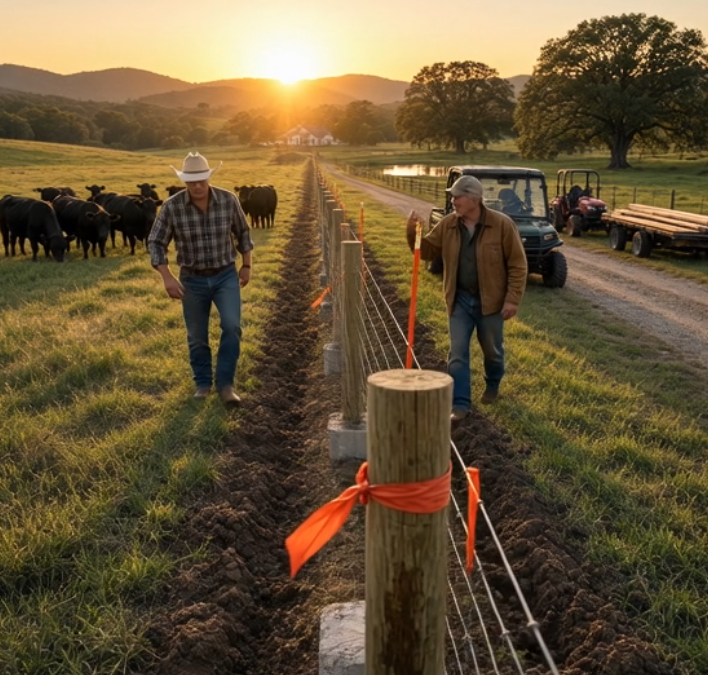
PART3:
This was not a misunderstanding Richard intended to discuss.
It was something he intended to finish.
I stepped directly in front of the tractor.
“Nobody installs another post.”
Richard’s face hardened.
“Don’t interfere with my equipment.”
“Get it off my pasture.”
“My pasture.”
We stood there staring at each other across twenty feet of grass we had both known for years.
Then Richard pointed at one of the orange stakes.
“There’s the survey marker. That’s all the proof I need.”
I looked down.
Something about it bothered me.
The steel was clean. The cap was bright. The soil around it was freshly disturbed.
But I remembered another marker.
Years earlier, while replacing a drainage pipe with my father, we had found an old iron pin near the ditch. I could still see him bending down, tapping it with the toe of his boot, and speaking in that low, serious voice he used when he wanted me to remember something.
“Don’t ever pull that,” he had said. “That’s the corner.”
I looked toward the drainage ditch.
The old oak tree still stood near the bend.
The ditch still curved the same way it always had.
But the ground near it looked wrong.
Not from a distance.
Only if you knew it.
A patch of soil near the oak was darker than the rest, loose and churned, with tractor tread marks pressed into the soft earth. A small pile of clay sat near the ditch, partly hidden under grass clippings and cedar bark.
My father’s voice came back to me again.
Land only stays yours if you remember where it ends.
I turned back to Richard.
“Where’s the old pin?”
He did not blink.
“What old pin?”
“The iron pin by the ditch.”
“There was no pin.”
“Yes, there was.”
“Then maybe your father was wrong.”
That was the moment he lost any chance of me treating this like a neighbor dispute.
My father had been gone eleven years.
Cancer took him slow enough to make us both bitter and fast enough to leave too much unfinished. During his last summer, when he could still sit in the passenger seat of my truck, he made me drive the whole property with him one more time.
He pointed out where the county road used to run before it was moved.
Where the old springhouse foundation sat under blackberry vines.
Where the south pasture flooded first.
Where the fence stood inside the boundary because his father had never trusted putting wire directly on the line.
And that iron pin.
Especially that iron pin.
He made me get out of the truck.
He made me kneel beside it.
He made me brush the dirt away with my fingers.
“Not the fence,” he said. “Not the ditch by itself. This pin and the survey call. That’s what matters. A fence can rot. A ditch can fill. A man can lie. Iron in the ground tells a quieter story.”
At the time, I thought he was just being sentimental about land.
He was not.
He was warning me.
Richard took a step toward me.
“Jack, I don’t want this to get ugly.”
“It already got ugly when you poured concrete on my side of the pasture.”
“You can call whoever you want. Sheriff. County. Lawyer. It won’t change the line.”
“We’ll see.”
His jaw tightened.
“You don’t have the money to fight this.”
That was the first honest thing he said.
Not because it was true.
Because it revealed what he had been counting on.
I was a widower living in an old farmhouse on twelve acres, driving a twelve-year-old truck with faded paint and a dented tailgate. I still patched my own fences, cut my own firewood, and wore boots until the soles gave up. Richard saw all that and assumed I was tired, broke, and easy to push.
He was right about tired.
Wrong about easy.
“You don’t know what I have,” I said.
Richard smiled.
“I know what this land is worth.”
There it was.
The reason.
Not pride.
Not confusion.
Not a survey.
Value.
His five acres had been enough when he bought it. Then the county approved a small commercial rezoning two miles east. Then a new subdivision broke ground down the road. Then Richard started talking about building a second house, then a rental cabin, then maybe selling “a few improved lots” someday if the market stayed hot.
My pasture was the only thing stopping his property from having a clean rectangular expansion toward the creek.
Eighty feet of my land would give him road frontage, drainage room, and enough open ground to make his next plan easier.
I looked past him at Tyler.
The boy’s face was pale.
He knew.
Maybe not all of it.
But enough.
“Tyler,” I said, “don’t touch another post.”
Richard snapped, “Don’t talk to my son.”
“Then keep your son off my property.”
Richard took a step toward the tractor.
I took out my phone.
“Sheriff first,” I said. “Then surveyor. Then lawyer.”
His face changed slightly at the word lawyer.
“Do what you need to do,” he said.
“I will.”
I called the sheriff’s office first.
The dispatcher told me a deputy would be out when available. Boundary disputes were usually civil, she said carefully, but if someone was actively trespassing or property was being damaged, they would document it.
That was good enough for the first hour.
Next, I called a surveyor.
Not the cheapest.
Not the fastest.
The best one I knew.
Her name was Melissa Grant, and my father had trusted her father before her.
Grant Surveying had been in our county for nearly sixty years. They still kept old field books in metal cabinets and treated boundary monuments like church relics.
Melissa answered herself.
“Grant Surveying.”
“Melissa, it’s Jack Cole.”
A pause.
“Cole property off Mill Creek Road?”
“Yes.”
“What happened?”
That was why I called her.
She did not ask if something happened.
She knew people rarely called surveyors in a calm voice because everything was fine.
“My neighbor built a fence eighty feet inside my pasture overnight. Claims he has a survey. There are new orange stakes. Old corner pin near the drainage ditch may be missing or buried.”
Her tone changed.
“Do not pull anything. Do not move his stakes. Do not dig yet.”
“I haven’t.”
“Take photos. Video the entire fence line. Get close shots of every new stake, post, disturbance, and any equipment tracks. I can be there by eleven.”
“Today?”
“Jack, if someone buried an original monument, I’ll be there by eleven.”
I took photographs for the next hour.
Every post.
Every wire tie.
Every orange stake.
Every tire track.
Every mound of disturbed soil.
Richard watched from his utility vehicle for part of it, then pretended not to.
Tyler unloaded no more posts.
At 10:23, Deputy Paul Reeves arrived.
He was a broad man in his forties with a calm face and tired eyes. He had been sheriff’s deputy long enough to know that land disputes could turn neighborly men into idiots with shotguns.
He stopped near my porch first.
I handed him copies of my deed, the old survey plat, and a photograph of the drainage ditch from two years earlier.
He looked at the new fence.
“Was this here yesterday?”
“No.”
“You see them install it?”
“No. It happened overnight.”
He looked toward Richard.
“Did you give permission?”
“No.”
“Have a current survey?”
“Surveyor is on the way.”
He nodded.
Then he walked toward Richard.
I followed, staying several steps back.
Deputy Reeves introduced himself.
Richard became polite immediately.
Men like Richard often do.
“Deputy, this is a civil boundary matter,” he said before Reeves had asked a question.
“Maybe,” Reeves replied. “But I’m still going to ask questions.”
Richard gestured toward the fence.
“We had a survey done. The old assumed line was incorrect. We are simply fencing our property.”
“Can I see the survey?”
“It’s being finalized.”
“Who conducted it?”
Richard hesitated.
“Private consultant.”
“Licensed surveyor?”
“He works with survey data.”
“That was not my question.”
Richard’s face tightened.
“He’s qualified.”
Deputy Reeves wrote something in his notebook.
“What is his name?”
“Martin Bell.”
That name meant nothing to me.
But Deputy Reeves looked up.
“Martin Bell the excavator?”
“He does land work.”
“He is not a licensed surveyor.”
“He uses GPS equipment.”
Deputy Reeves glanced at the orange stakes.
“GPS equipment does not make a boundary.”
Richard’s voice sharpened.
“With respect, Deputy, you’re not a surveyor either.”
“No,” Reeves said. “That is why I’m waiting for one before I decide whether someone is about to get cited for trespass or worse.”
Richard said nothing.
At eleven-oh-seven, Melissa Grant arrived in a white truck with her company name on the side.
She stepped out wearing work boots, jeans, a field vest, and an expression that told me she had already decided she disliked the situation.
Her assistant, a young man named Owen, unloaded equipment.
Melissa walked straight to me.
“Show me the old paperwork.”
I gave her the folder.
She read the deed calls.
Then the old plat.
Then the notes my father had written in pencil on a copy from 1989.
Her face softened slightly at his handwriting.
“I remember your dad,” she said.
“He remembered everything.”
“He did.”
Then she looked toward the fence.
Her face changed back.
“Let’s find out what your neighbor remembered.”
Richard tried to speak to her first.
“Melissa, I think there’s been a misunderstanding.”
She held up one hand without looking at him.
“I’ll talk after I measure.”
That was the right answer.
For the next two hours, the pasture became a place of instruments, flags, measurements, old records, and silence.
Melissa found the western reference marker near the road.
Still intact.
She found the southern pin near the creek.
Still intact.
She tied both into the old survey.
Then she and Owen worked toward the drainage ditch.
The new orange stakes did not match any recorded call.
Not one.
They formed a straight line that looked neat to the eye and wrong to anyone who understood old rural property boundaries.
Melissa stood near the first orange stake and checked her tablet.
“This is not a boundary marker.”
Richard crossed his arms.
“It marks the corrected line.”
“No,” she said. “It marks where someone put a stake.”
“Based on GPS.”
Melissa finally looked at him.
“Consumer GPS, construction GPS, even mapping-grade GPS does not override original monuments, deed calls, occupation evidence, and a licensed boundary survey.”
Richard’s jaw worked.
“My consultant said—”
“Your consultant is not licensed.”
“He does site work for half the county.”
“And if he set these as boundary monuments, he may have a problem.”
Tyler looked at his father.
Richard looked away.
Melissa moved toward the ditch.
I followed.
The old oak stood where it had always stood, roots twisting along the bank. The drainage ditch curved beneath it, half filled with leaves. The soil near the base was disturbed, and now that I stood close, I saw something else.
A square patch.
Not natural.
Not from tractor tires.
A deliberate dig.
Melissa saw it too.
She crouched.
“Owen, metal detector.”
Richard stepped forward.
“You can’t dig on my side.”
Melissa did not look up.
“We are on Mr. Cole’s deeded parcel according to preliminary ties.”
“That’s disputed.”
“That’s why we’re locating monuments.”
Owen swept the detector slowly across the disturbed soil.
For several seconds, nothing.
Then a sharp tone.
My chest tightened.
Melissa marked the spot with a small flag.
She brushed leaves aside.
The top inch of soil was loose.
Beneath that, packed clay.
Then gravel.
Fresh gravel.
Not pasture gravel.
Crushed stone.
The kind someone dumps into a hole because they want it filled tight.
Melissa looked at me.
“Jack, do you authorize excavation to locate the monument?”
“Yes.”
Deputy Reeves stepped closer.
“Carefully,” he said.
Melissa used a hand trowel.
Not a shovel.
Not at first.
She removed soil slowly, layer by layer. Owen photographed each step. Deputy Reeves recorded from behind her. I stood there with my hands closed so tightly my knuckles hurt.
Four inches down, the trowel scraped metal.
The sound went through me.
Melissa stopped.
She cleared around it with a brush.
A rusted iron pin emerged from the clay.
Old.
Dark.
Set below grade.
Exactly where my father had shown me.
For a moment, I could not speak.
It was just a piece of iron.
A rod in the ground.
But seeing it there felt like hearing my father answer from beneath eleven years of silence.
Melissa sat back on her heels.
“There it is.”
I looked at Richard.
His face had gone gray.
Tyler whispered, “Dad?”
Richard snapped, “That doesn’t prove anything.”
Melissa did not raise her voice.
“It proves this is an original monument consistent with the Cole deed, prior survey, occupation line, and drainage call.”
“It could have been planted.”
I almost laughed.
Not because it was funny.
Because it was desperate.
Melissa looked at the rusted pin, then at him.
“Planted forty years ago?”
Richard pointed at me.
“His family could have put it there.”
“My father showed it to me when I was sixteen,” I said.
“Convenient.”
Deputy Reeves looked at Richard.
“Mr. Hail, I’d stop talking for a minute.”
Richard did not.
“That pin means nothing if the updated survey—”
Melissa stood.
“What updated survey?”
“My survey.”
“From Martin Bell?”
Richard said nothing.
Melissa pointed toward the new fence.
“Those stakes are not survey monuments. They are not capped with a licensed surveyor’s identification. They are not referenced by recorded plat. They do not match the deed. And now we have evidence that someone covered an original corner monument with fresh fill.”
“I didn’t cover anything.”
Tyler stared at the ground.
That was when I saw it.
The boy knew.
Not everything.
But enough.
I looked at him.
“Tyler.”
His eyes lifted.
Richard snapped, “Don’t.”
But Tyler’s face had already changed.
Guilt has a way of making young men look younger.
Deputy Reeves noticed too.
“Tyler,” he said calmly, “did you help dig here?”
Richard stepped between them.
“My son doesn’t have to answer questions.”
“No,” Reeves said. “He doesn’t. But you should think carefully before deciding for him.”
Tyler swallowed.
His voice came out low.
“We didn’t know it was a real marker.”
Richard turned on him.
“Be quiet.”
Tyler took a step back.
“You said it was old junk.”
The pasture went silent.
Even the wind seemed to stop.
Richard stared at his son.
Tyler looked at me, then at the deputy.
“He told me to dig around the oak because there was metal messing with the GPS reading. We found that pin. I asked if it mattered. He said no, it was probably from an old fence. He told me to cover it so the posts could run straight.”
Richard’s face twisted.
“That is not what happened.”
Tyler’s voice broke.
“You poured gravel on it, Dad.”
There it was.
Not a misunderstanding.
Not a survey error.
Not neighbor confusion.
Richard had found the old pin.
He had buried it.
Then he built a fence eighty feet inside my pasture and called it correction.
Deputy Reeves looked at Richard for a long moment.
“Mr. Hail, step away from your equipment.”
Richard’s mouth opened.
Reeves said, “Now.”
For the first time since I had known him, Richard looked truly unsure.
He stepped back.
Melissa continued her work.
Now that the old pin had been found, the whole story unfolded fast.
The original boundary followed the drainage ditch northward, then turned at the iron pin near the oak before running toward the tree line. My old fence sat several feet inside my property because my grandfather had built it that way to keep cattle from damaging the ditch. The area between the fence and the true boundary had always been mine, but my family had never needed to use it aggressively.
Richard had mistaken restraint for weakness.
Or maybe he had not mistaken anything.
Maybe he had simply gambled that a buried pin and a straight line of fake stakes would be enough to scare me into silence.
Melissa flagged the true line with pink ribbon.
The new fence stood deep inside it.
In some places, seventy-eight feet.
At the widest point, eighty-three.
Near the road, Richard had already staged posts to continue the encroachment all the way to the shoulder.
If I had let him finish, he would have enclosed nearly an acre of my pasture.
Not worthless land.
Flat, buildable, well-drained land near road access.
Exactly what he needed.
Deputy Reeves took statements.
From me.
From Melissa.
From Owen.
From Tyler.
Richard refused to give one.
That was his right.
It was also the first wise decision he had made all morning.
The deputy issued a stop-work order pending further review. He photographed the fence, the equipment, the buried pin, the orange stakes, and the disturbed soil.
Then he told Richard to remove his tractor from my pasture.
Richard argued.
Reeves listened for about ten seconds.
Then he said, “Your tractor is on land currently supported by evidence as Mr. Cole’s. Move it now, or I’ll have it towed as part of the trespass documentation.”
Richard moved it.
Slowly.
Angrily.
But he moved it.
Tyler did not look at him.
That mattered more than Richard understood.
By evening, the pasture was quiet again.
The new fence still stood there, ugly and wrong, but now pink survey flags marked the truth beyond it. The old iron pin had been cleaned, photographed, and protected with a temporary witness stake.
I stood beside it after everyone left.
For a long time, I just looked down.
My father had been right.
The iron told a quieter story.
I wished he had been there to see it.
Then again, maybe he was, in the only way land allows the dead to remain.
In a pin set carefully below grade.
In a note written in pencil.
In a son who finally remembered where to look.
The next morning, Richard’s attorney sent me a letter.
That impressed me.
Not because it was strong.
Because it was fast.
The letter claimed there was a “good-faith boundary disagreement,” warned me not to remove or damage the fence, and suggested that any attempt to interfere with Richard’s “improvements” would expose me to civil liability.
I drove straight to town and hired my own attorney.
Her name was Nora Caldwell, and she had represented farmers, widows, contractors, and one deeply confused church board in land disputes for thirty-two years. She was short, silver-haired, and had the calmest voice I had ever heard.
She read the letter.
Then the deed.
Then Melissa’s preliminary survey notes.
Then Tyler’s written statement, which Deputy Reeves had taken that afternoon after Tyler came back alone and asked to tell the truth officially.
Nora removed her glasses.
“Well,” she said, “Mr. Hail appears to have confused ambition with title.”
“I want the fence gone.”
“It will be.”
“I want him to pay for the damage.”
“He should.”
“I want the pin protected.”
“That matters most.”
She drafted a response that same day.
It was polite in the way knives can be polished.
It demanded immediate removal of the fence, restoration of the pasture, reimbursement for surveying and legal expenses, written acknowledgment of the true boundary, and preservation of all communications with Martin Bell, contractors, and anyone involved in placing the false stakes.
It also warned that covering or disturbing an original boundary monument could expose Richard to far more than a civil dispute.
Richard did not remove the fence.
Of course he did not.
Men like Richard never retreat at the first open door.
They wait until it becomes a wall.
So Nora filed suit.
Quiet title.
Trespass.
Damage to property.
Interference with boundary monument.
Injunctive relief.
Costs.
Attorney fees.
The court issued a temporary order prohibiting Richard from continuing fence work, altering the land, removing stakes, disturbing the old pin, or entering the disputed area pending hearing.
Richard ignored it within forty-eight hours.
He did not build more fence.
He did something dumber.
He came at night with a pry bar.
My trail camera caught everything.
At 11:38 p.m., Richard walked toward the old oak carrying a flashlight and a steel pry bar. He looked around twice, then knelt beside the witness stake Melissa had placed. He did not see the camera because it was mounted high in the oak itself, angled downward.
My father had taught me property lines.
My grandson had taught me trail cameras.
Every generation contributes.
Richard tried to pull the witness stake first.
When that did not move easily, he began digging near the old pin.
He got less than two minutes.
The motion alert woke me.
I watched him live on my phone from the edge of my bed, boots still on because after the fence I had stopped sleeping like a trusting man.
Then I called Deputy Reeves directly on the non-emergency number he had given me.
“Richard is at the pin with a pry bar,” I said.
Reeves swore once.
Quietly.
Then said, “Stay inside.”
“I’m not going out.”
“Good.”
I did go to the porch.
That was technically still inside my restraint, if not the house.
Ten minutes later, blue lights washed across the pasture.
Richard froze like every guilty man who thought darkness was a legal strategy.
Deputy Reeves and another officer crossed the field.
Richard stood slowly, pry bar in hand.
From my porch, I could not hear every word.
But I heard Reeves clearly once.
“Drop it.”
Richard dropped it.
He was arrested that night.
Not for the boundary dispute.
For violating a court order, trespassing, and attempting to disturb evidence related to an active civil and potential criminal matter.
Seeing him placed in handcuffs did not feel as good as I expected.
It felt sadder.
Smaller.
A grown man had risked his freedom because he could not stand a rusted piece of iron telling the truth.
The hearing two weeks later was not dramatic.
Not in the way television makes court dramatic.
No shouting.
No surprise witness bursting through the doors.
Just maps, photographs, measurements, documents, and a judge who had clearly seen too many neighbors become enemies over land they could have simply respected.
Melissa testified first.
She explained the original deed calls, the drainage ditch, the recovered iron pin, the old survey records, the occupation evidence, and the location of Richard’s new fence.
She did not exaggerate.
She did not need to.
Good evidence speaks best in a normal voice.
Then Deputy Reeves testified about the initial scene, Tyler’s statement, the buried pin, and Richard’s later attempt to disturb the area after the court order.
Tyler testified too.
That took courage.
He sat on the stand with his hands clasped tightly and said his father told him the old iron pin was junk. He said he helped cover it because he trusted him. He said he knew it was wrong when he saw my face the next morning, because a person does not look at junk the way I looked toward that ditch.
Richard stared at the table the whole time.
When his turn came, his attorney tried to frame everything as confusion.
Old rural boundaries.
Unclear records.
Unreliable memory.
A good-faith effort to modernize fencing.
The judge listened.
Then he asked one question.
“Mr. Hail, if you believed the iron pin was meaningless, why did you attempt to remove it after the court ordered that it not be disturbed?”
Richard had no good answer.
He gave several bad ones.
The judge did not help him.
The order came down that afternoon.
The court confirmed the boundary along the line Melissa surveyed.
The buried iron pin was recognized as an original monument consistent with the deeds and survey history.
Richard was ordered to remove the fence at his expense, restore the pasture, pay my survey costs, pay damages for trespass and soil disturbance, reimburse part of my attorney fees, and permanently refrain from entering my land without written permission.
He was also ordered to pay for a recorded boundary survey to be filed with the county, making the true line impossible to dispute quietly again.
The judge looked directly at him before ending the hearing.
“Property rights are not strengthened by hiding evidence. They are destroyed by it.”
Richard’s face was pale.
Tyler looked relieved.
I looked down at my hands and thought of my father.
The fence came out three days later.
Not by Richard.
The court did not trust him for that.
A fencing company removed it under Melissa’s supervision while Deputy Reeves sat in his cruiser near the road and pretended not to enjoy the weather.
Post by post, the line disappeared.
Cedar pulled from concrete.
Wire rolled.
Orange ribbons cut down.
The pasture looked wounded afterward, dotted with holes and raw soil, but at least it looked like mine again.
I spent the next week filling ruts, reseeding torn patches, and repairing the section near the ditch where Richard had churned the ground with the tractor.
Tyler came by on the fourth day.
Alone.
He parked by the road and walked toward the pasture with his hands visible, like he was approaching something dangerous.
I was spreading straw over new seed.
He stopped ten feet away.
“Mr. Cole?”
I leaned on the rake.
“Yes.”
“I’m sorry.”
I studied him.
He looked exhausted.
Not in the body.
In the conscience.
“I should’ve said something sooner,” he said.
“Yes,” I replied.
He swallowed.
That was not the answer he wanted, but it was the answer he deserved.
After a moment, I added, “But you did say it.”
He nodded, looking toward the old oak.
“He told me it was for the family. Said you weren’t using that part anyway. Said old boundaries were always wrong.”
“People say a lot when they want land.”
Tyler’s eyes filled, though he did not let tears fall.
“He’s my dad.”
“I know.”
“I hate what he did. I still don’t know how to hate him.”
That hit harder than I expected.
Because I had loved a complicated father too.
Not dishonest like Richard.
But hard.
Stubborn.
Sometimes unfair.
A father can be wrong and still be the voice inside your head teaching you how to hold a hammer.
“You don’t have to solve that today,” I said.
Tyler looked at me.
“I don’t think he’ll forgive me.”
“For telling the truth?”
“For telling on him.”
I pushed the rake into the soil.
“Those are not the same thing.”
He looked toward the ditch.
Then nodded.
Before leaving, he helped me spread the last bale of straw.
We worked in silence.
It was awkward.
But not useless.
Sometimes silence is the only bridge strong enough to hold what words would collapse under.
Richard sold his place the following spring.
Not immediately.
First, he tried to stay angry.
He appealed part of the damages.
Lost.
He refused to pay promptly.
Nora filed enforcement paperwork.
He complained to anyone who would listen that I had ruined him over “a strip of grass.”
That phrase traveled.
A strip of grass.
That was what he called nearly an acre he had tried to take by burying the truth.
Eventually, the money, the legal fees, the court order, and the broken relationship with Tyler did what morality had not.
They pushed him out.
The For Sale sign went up in April.
By June, he was gone.
The new neighbors were a retired couple named Ben and Louise Harper.
Before they moved in, they asked Melissa to walk the line with them and me together.
That told me they would be fine.
We met at the old oak on a warm Saturday morning.
Melissa showed them the recorded boundary.
The drainage ditch.
The iron pin.
The witness stake.
Ben listened carefully.
Louise took notes.
When Melissa finished, Louise looked at me and said, “We plan to plant blueberries near our side of the ditch. We’ll keep them well back.”
I almost laughed from relief.
“Blueberries are welcome.”
“Fences?”
“Discussed first.”
She smiled.
“Always.”
That was how neighbors were supposed to begin.
With clarity.
Not conquest.
That summer, the pasture healed.
Grass came back over the post holes.
The soil near the ditch settled.
The old oak leafed out full and green.
I built a low protective marker near the iron pin, not directly over it, but beside it. A small limestone block set flush with the ground, engraved with three simple words:
THE LINE REMEMBERS.
My daughter said it sounded dramatic.
She was right.
I was my father’s son after all.
On the anniversary of the morning I found the fence, I walked the boundary alone.
No coffee.
No phone.
Just me, the pasture, and the early light.
I started at the creek and followed the ditch north. The air smelled like wet grass and leaves. Birds moved in the hedgerow. The Harpers’ blueberries stood in neat rows well beyond the line.
At the old oak, I stopped.
The iron pin was buried again, properly this time, protected below grade where equipment would not tear it out. Melissa had recorded it. The county had the survey. The court order sat in my safe.
But I knew exactly where it was.
I tapped the ground lightly with the toe of my boot, just as my father had done years earlier.
For a second, I could hear him.
Remember this spot, Jack.
“I remembered,” I said.
The pasture gave no answer.
Land rarely does.
It simply remains, which is sometimes answer enough.
People think property disputes are about dirt.
They are not.
Not really.
They are about memory.
Boundaries.
Promises.
The difference between what a person owns and what another person thinks they can take if they move fast enough.
Richard thought a fence could make land his.
He thought straight lines looked more believable than old ditches.
He thought fresh orange stakes could speak louder than rusted iron.
He thought burying the truth would make it disappear.
But land has a way of keeping records.
In roots.
In water.
In old pins under clay.
In fathers who teach sons where to look.
In survey notes folded into drawers.
In the memories of people who still know why a fence was built five feet inside the line instead of on it.
That fence was not there when I went to bed.
By the next year, no trace of it remained.
But the lesson stayed.
A man can pour concrete around a lie.
He can stretch wire across it.
He can tie orange ribbons to it and call it proof.
He can stand in someone else’s pasture and say the record is wrong.
But the truth does not move just because a dishonest man needs more room.
It waits.
Quietly.
Patiently.
Beneath the soil.
And if you remember where to look, you can still find it.








