My Granddaughter Heard Knocking Inside a Stranger’s Trunk—Then a Deputy Saw Our Leather Vests, Reached for His Gun, and I Opened the Wallet I’d Kept Hidden for 11 Years.
PART2:
The transmission shop I opened after leaving police work and later converted into a used-parts business because I discovered retirement was just unemployment with more doctor appointments.
My late wife June.
My dog that died in 2019.
The knee.
The motorcycles.
The fact that I had developed an embarrassing interest in bird feeders after seventy.
The thirty years before retirement were harder.
Lucy was seven that summer.
Small for her age.
Brown ponytail.
Front tooth missing.
Pink shoelaces she refused to tie properly.
She had the kind of attention adults often misunderstand because it moved according to importance rather than instruction.
Tell her to clean her room and she could forget before crossing the hallway.
Let one person whisper sadly across a crowded room and she would hear it.
Her mother, Erin, worked Saturdays at the Copper Lantern.
I had promised to keep Lucy close while our riders ate.
That was not supposed to be difficult.
Lucy loved motorcycles.
Her favorite thing was counting them.
She had never successfully counted an entire group because the second somebody moved a bike she accused reality of cheating.
That day she stopped at sixty-eight.
“The brown one,” she said.
I followed her finger.
PART3:
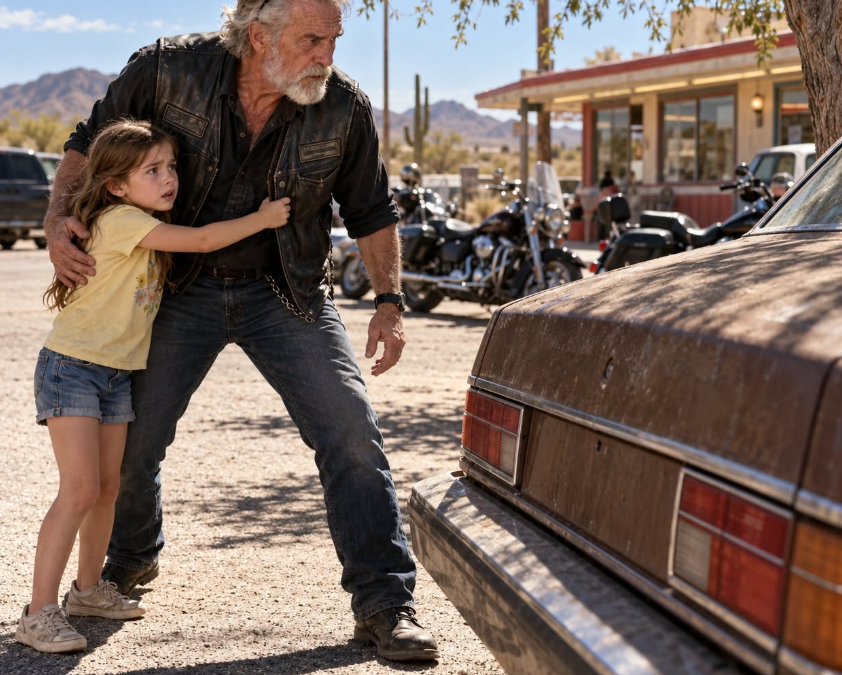
The sedan sat near the far end of the parking lot, crooked beneath a cottonwood tree that offered almost no useful shade.
Older vehicle.
Late-model enough not to be antique.
Dust on lower panels.
Arizona plate.
Rear passenger side slightly low.
A thin man in a clean blue button-down shirt stood near the trunk.
At first, nothing about him registered.
Then he looked at Lucy.
Not at me.
Lucy.
Then he looked toward the trunk.
Then back toward the diner.
And walked behind the building.
Something old woke up inside me.
Not instinct in the mystical sense.
Training.
Pattern.
A man leaving a car is ordinary.
A man looking at a child who is watching his trunk before walking away becomes less ordinary.
“What did you hear?” I asked.
Lucy tapped her knuckles against my belt buckle.
Three times.
Pause.
Two.
Tap.
Tap.
Tap.
Pause.
Tap.
Tap.
I looked toward the sedan.
Around us, people laughed.
A motorcycle started again near the entrance.
A waitress dropped a tray inside.
Somebody shouted that Frank owed him twenty dollars.
Then I heard it.
Barely.
A faint impact beneath the noise.
The kind of sound a person could explain away if explaining things away was what he wanted to do.
I turned toward Ben Crawford.
Ben was sixty-two, six-foot-four, tattooed from both wrists to both shoulders, with a gray beard that made children assume he was either Santa Claus after a bad divorce or the drummer in a heavy-metal band.
He had worked diesel engines for forty years.
He could rebuild a transmission blindfolded.
He also carried dog biscuits for every stray within three counties.
“Ben.”
He heard my voice and stopped smiling.
“Get Frank.”
Frank Morales was our ride captain.
“Have someone call 911. Possible person trapped in a vehicle.”
Ben did not ask whether I was sure.
That was one reason we had been friends eleven years.
He moved.
Lucy followed before I caught her shoulder.
“Stay with me.”
We approached the sedan but stopped short of touching it.
I looked through rear glass.
Nothing obvious.
No visible person.
No broken interior.
No obvious blood.
No need to invent facts.
Lucy grabbed my vest near the lower patch.
“It smells like the gas can in your shed.”
I smelled it then.
Fuel.
Not overwhelming.
Enough.
My heartbeat changed.
Ben returned carrying a tire iron from his saddlebag.
Behind him Frank was already waving riders away.
“Put that down,” I told Ben.
“What if somebody’s in there?”
“Fire is coming.”
“That could be five minutes.”
“I know.”
His eyes changed.
He had ridden with me long enough to recognize when a sentence had another sentence beneath it.
Still, he lowered the tire iron.
“Don’t force anything yet.”
Fuel smell changes rescue.
Break into the wrong space carelessly and you can create ignition, move evidence, trigger something you do not understand, injure whoever is inside, or simply make a dangerous problem worse.
A sound came through the trunk.
Not a knock.
A scrape.
Then something weaker.
A voice.
I stepped closer without touching the vehicle.
“Hello?”
Nothing.
I crouched.
“Can you hear me?”
A scrape.
My mouth went dry.
Erin came running from diner porch.
“Lucy!”
“There’s somebody inside, Mom.”
“Take her back,” I said.
Erin looked at me.
Not grandfather Walter.
Not biker Walter.
Something in my face reached back into her childhood.
She obeyed immediately.
“Come on, Lu.”
“I heard her.”
“I know.”
“No, Mom, I heard—”
“I know. Come with me.”
Frank started moving everyone toward the diner.
“Back up. Give the car space.”
A few riders protested.
Frank shouted once.
That ended it.
Engines shut down.
Cigarettes were stamped out.
That part mattered with fuel odor.
Three hundred bikers can become a crowd or a team depending who is leading them.
That afternoon they became a team.
Within perhaps forty seconds, a parking lot that had sounded like a factory became quiet enough for everyone to hear another weak thump from the trunk.
That silence terrified me more than the noise.
Because now there was no explaining it away.
Someone was inside.
The first sheriff’s cruiser arrived before fire-rescue.
One deputy.
Young.
Maybe early thirties.
Later I learned his name was Andrew Keller.
At that moment he was just a uniform stepping into a scene designed to produce all the wrong first impressions.
Three hundred motorcycles.
Leather vests.
A giant tattooed man standing ten feet from a sedan with a tire iron on the ground.
A crying child.
A seventy-four-year-old man in a patched vest nearest the vehicle.
Keller’s hand moved toward his holster.
Not drawing.
Ready.
“Put the tool down.”
Ben raised both hands.
“It’s down.”
“Everybody step away from the vehicle.”
I moved back one pace.
“There’s someone inside the trunk. We have a fuel smell. Fire and medical have been requested.”
“I said step away.”
“We need contact with whoever’s inside.”
He looked past me.
Rows of bikers.
Then at Ben.
Then Lucy.
Then the car.
I watched him make a story.
That is something detectives learn to fear.
Human beings hate incomplete scenes.
We build narratives automatically.
A screaming woman and a man with blood on his shirt.
A broken window and a teenager running.
A child crying beside bikers.
Most mistakes begin when the first story becomes more important than the evidence.
The actual emergency was behind him.
“Deputy, listen.”
“I’m going to need identification from everyone involved.”
Identification.
My stomach tightened.
From the porch Lucy shouted:
“The man went behind the building!”
Keller looked toward her.
“What man?”
“The man with the blue shirt!”
Erin pulled Lucy close.
Keller told her:
“Ma’am, keep your daughter back.”
“She saw him leave the car,” I said.
“I need everybody to stop talking at once.”
The trunk went silent.
That was when my past came through the door I had spent eleven years holding shut.
Another car.
Another summer.
Another missing girl.
Emily Rhodes.
Nine years old.
Yellow shorts.
Purple backpack.
Her mother had reported her missing at 4:12 p.m.
A witness placed a suspicious vehicle near a convenience store.
License plate came in incomplete.
We ran combinations.
One vehicle matched.
We found it abandoned outside an industrial property.
I was detective sergeant then.
Forty-eight.
Too confident in the way men become after surviving enough bad scenes to believe experience can negotiate with time.
There was confusion over whether a second vehicle on property belonged to suspect.
Four minutes.
That was the difference.
Four minutes between the first officer arriving and the trunk being opened.
Emily was alive when the vehicle entered the lot.
The medical examiner could not give me precision down to seconds.
Nobody can.
But enough evidence existed to make four minutes feel like a number carved into my bones.
Her mother asked me later:
“Was she scared?”
I have carried that question longer than my badge.
I did not know which answer was mercy.
If I said no, I might lie.
If I said yes, I would give a mother images she could never remove.
So I said:
“We were with her as soon as we could be.”
A bureaucratic sentence.
True.
Useless.
Emily’s case ended with conviction.
People thought that should help.
It did not.
The killer went to prison.
Emily stayed dead.
Those are separate facts.
I worked another eleven years.
Then retired.
I carried my badge because I could not throw it away.
I carried it because after thirty years, not having it felt like walking without part of my skeleton.
But I never showed the Black Mesa Riders.
I liked being Walter.
Not Detective Bennett.
Not Sergeant Bennett.
Not the man reporters once called “lead investigator.”
Just Walter who knew carburetors and brought coffee.
Fire was coming.
The deputy said it over radio.
I asked:
“How far?”
Keller held up a hand.
“Sir.”
“How far?”
“Stop.”
Lucy was crying now.
Not afraid crying.
Angry.
The kind children do when adults keep answering the wrong question.
“Please!” she shouted. “She knocked!”
Keller looked toward Ben.
My pulse hammered.
I made myself speak slowly.
Every movement had to be clean.
“I’m reaching into my vest for a wallet.”
His eyes locked onto my hand.
“Nothing else.”
I reached inside.
The leather case had cracked along the fold.
Eleven years in a vest pocket.
I opened it.
Badge.
Retired ID.
Old photo of me before gray beard.
“Walter Bennett. Retired homicide detective. Thirty years with the department.”
Keller stared.
I continued.
“And once I reached a child four minutes too late.”
My voice nearly failed.
“Please don’t make me do it again.”
Something scraped inside the trunk.
This time Keller heard it.
His head snapped toward vehicle.
Everything changed.
Not because of badge.
I want that clear.
The badge did not make the trapped person real.
It only disrupted the story Keller had told himself long enough for him to hear the evidence already there.
He moved toward rear of car.
“Sheriff’s department!”
No response.
“We’re here. Can you hear me?”
A weak tap.
Keller grabbed radio.
“Dispatch, confirm fire expedited. Possible juvenile or adult confined in trunk. Fuel odor present.”
Then:
“Second unit, suspect description: white male, thin build, blue button-down shirt, dark footwear, last seen behind Copper Lantern. Witness is a seven-year-old female.”
Finally.
He looked toward Erin.
“Ma’am, can your daughter tell me which direction?”
Erin crouched beside Lucy instead of speaking for her.
Good mother.
Lucy pointed.
“Behind the sheds.”
“Anything else?”
“He dropped his cigarette.”
“What?”
“When he walked away.”
Keller relayed it.
Ben muttered:
“Kid notices everything.”
I said nothing.
I moved close enough to speak through metal.
Not touching latch.
“My name is Walter.”
A faint scrape.
“Help is right here.”
Nothing.
“If you can hear me, make any sound.”
One tap.
Single.
Weak.
I closed my eyes.
“All right.”
My throat tightened.
“I heard you.”
Fire engine arrived with ambulance behind it.
The rescue captain stepped out, assessed scene, smelled fuel, began issuing instructions.
I gave him only what we knew.
“Possible person in trunk.”
“Responsive to voice by tapping.”
“Unknown condition.”
“Fuel odor.”
“No forced entry attempted.”
“Suspect fled behind diner.”
He nodded.
“Good.”
Then took over.
I stepped back.
I did not tell firefighters how to open car.
I did not tell paramedics how to stage.
Thirty years carrying authority teaches you something people without authority sometimes miss:
Knowing when your authority ends is part of being competent.
Ben stood beside me.
Hands opening and closing.
“I nearly hit that lock.”
“You stopped.”
“What if Lucy hadn’t heard?”
“She did.”
“What if—”
“Ben.”
He looked.
“Do not do that.”
“Do what?”
“Build alternate endings while this one is still happening.”
He nodded slowly.
I could not afford that road.
Too many ghosts lived there.
Behind diner someone shouted.
A younger rider named Rico pointed past storage sheds.
“Blue shirt!”
The thin man appeared.
Maybe he had tried circling around.
Maybe he thought motorcycles would provide cover.
Maybe panic had finally outrun planning.
A second deputy had just arrived.
Blue Shirt saw cruiser.
Ran.
He made perhaps thirty yards.
Not because bikers tackled him.
They did not.
Frank shouted for everybody to stay back.
The deputy pursued.
Another unit entered from access road.
Commands.
“Stop!”
“Hands!”
The man slipped on loose gravel.
Recovered.
Then froze when he found one deputy ahead and one behind.
They took him into custody.
No biker punch.
No cinematic beating.
I was grateful.
An angry crowd can destroy a clean case in seconds.
Our men knew why Ride for the Missing existed.
It was not revenge ride.
It was remembrance.
We stayed back.
My eyes never left trunk.
Firefighters used tools deliberately.
One checked under vehicle.
Another stabilized.
A third monitored vapor hazard.
The rescue seemed to take hours.
It was probably less than four minutes.
Metal shifted.
Latch released.
The trunk lifted.
Fuel odor rolled across parking lot.
Inside was a girl.
Teenager.
Later we learned she was fourteen.
At that moment, age did not matter.
She was curled beside a stained blanket and a small red fuel container that appeared to be leaking around cap.
Her wrists were bound loosely enough she had apparently managed limited movement.
Her face was pale.
Hair stuck to forehead.
Eyes blinked at sunlight without understanding.
Paramedics moved in.
Nobody shouted except necessary commands.
That quiet competence nearly broke me.
I stood behind the line.
One paramedic looked back.
“Who’s Walter?”
My heart stopped.
“Me.”
“She’s asking for you.”
I walked forward only when told.
They had transferred her to stretcher.
Oxygen.
Monitor.
Blanket.
Her lips were dry.
Eyes unfocused.
I lowered myself beside her.
My left knee sent pain up my thigh.
I was grateful.
Simple pain.
Physical.
No memory attached.
“I’m here.”
She searched my face.
“I knocked.”
Her voice was hardly sound.
“I know.”
“I thought nobody—”
Her mouth trembled.
“We heard you.”
That was all I said.
Not:
You’re safe forever.
Not:
He can never hurt you again.
Not:
Everything is okay.
Those promises belong in movies.
I gave her what was already true.
“We heard you.”
She caught two of my fingers.
Held them.
The paramedic needed room.
I released.
Before they moved stretcher, I said:
“You’re out.”
Her eyes closed.
They took her to hospital.
Only then did my legs start shaking.
I sat on curb.
Lucy broke away from Erin and came to me.
“Was it a girl?”
“Yes.”
“Is she okay?”
“They’re helping her.”
“But is she okay?”
Children hate procedural answers.
“I don’t know yet.”
She leaned against me.
“I knew I heard her.”
“Yes.”
“You believed me.”
“Yes.”
That mattered to her.
Later, it mattered to me even more.
We gave statements.
Keller apologized for initial delay before leaving scene.
Not performative.
He stood near Ben first.
“I treated you like the problem before I knew what was happening.”
Ben crossed arms.
Keller continued:
“I saw the tool and the crowd before I listened to what you were saying.”
Ben stared.
Then nodded.
“Fair.”
“No.”
Keller shook head.
“Understandable maybe. Not fair.”
That was better.
Then he approached me.
“I’m documenting delay.”
“Good.”
“My supervisor will review bodycam.”
“Good.”
“I should have listened sooner.”
I looked toward Lucy.
“To her.”
He followed my eyes.
“Yes.”
“Before my badge.”
His face tightened.
“I know.”
“That’s the part that matters.”
He crouched several feet from Lucy.
Not too close.
“You were right.”
Lucy held Erin’s hand.
Keller continued.
“I’m sorry I didn’t listen.”
Lucy asked:
“Next time, will you?”
He swallowed.
“Yes.”
I hoped that promise followed him for the rest of his career.
Our ride ended there.
Nobody complained.
Ride for the Missing had a route planned.
Memorial stop.
Fundraiser dinner.
Auction.
We canceled everything after lunch.
Nobody cared.
By three, investigators had locked down sedan.
Federal agents were notified because initial information suggested possible interstate conduct.
The man in blue had identification under one name and documents pointing to another.
I did not know details then.
Didn’t need.
Erin stayed close to Lucy.
I sat on diner steps.
Frank brought me bottled water.
He handed one to Ben, then one to me.
He lowered himself with a groan.
“Thirty years.”
I looked.
“What?”
“Thirty years with homicide.”
“Yes.”
“I’ve known you eleven.”
“Yes.”
“You never mentioned it.”
“You never asked.”
He gave me a look.
“That is a garbage answer.”
“Probably.”
Ben sat on other side.
“You were homicide?”
“Yes.”
“Like murders?”
“That is usually what homicide means.”
He looked offended.
“I know words.”
Frank said:
“He fixes carburetors like an idiot, and he used to solve murders.”
“I do not fix carburetors like an idiot.”
Ben laughed.
Then went quiet.
“What happened with the other girl?”
I looked toward Lucy.
She heard.
Of course.
Erin stood near doorway.
She knew outline.
Not details.
June had known everything.
My daughter had known enough to understand why certain missing-child cases on television made me leave room.
Lucy knew nothing.
I turned bottle.
“Her name was Emily Rhodes.”
Nobody moved.
“She was nine.”
I swallowed.
“We found her in a vehicle after a search.”
“Too late.”
Frank’s face changed.
“How late?”
“Four minutes.”
Silence.
Ben said softly:
“You know that exactly?”
“Yes.”
“Why?”
Because I had reconstructed timeline one hundred times.
Traffic camera.
Convenience-store timestamp.
Witness.
Officer arrival.
Entry.
Paramedic notes.
Four minutes.
“I know.”
Lucy sat beside me.
“What did you do wrong?”
Children ask questions adults work around.
“I don’t know that there was one thing.”
“But you said too late.”
“Yes.”
“Did you not believe somebody?”
That hurt.
“Not exactly.”
There had been confusion.
Command handoff.
Safety assumptions.
The vehicle sat on property connected to a violent suspect.
Officers waited for additional backup before opening.
Defensible.
Understandable.
And Emily died.
Two truths.
“I learned that sometimes being careful and being slow can look very similar,” I said.
Lucy frowned.
“Was she knocking too?”
I looked down.
“No.”
That was worse.
She leaned against shoulder.
“Did saving this girl make it better?”
Frank looked at me.
Erin too.
“No.”
I said it quickly.
“It doesn’t change Emily.”
“Then why are you crying?”
I touched my face.
I had not realized.
“Because I’m glad today ended differently.”
Lucy nodded.
Children are better at allowing two emotions in one room.
Adults keep trying to evict one.
At 4:20 Erin got the call.
Hospital.
The girl’s name was Hannah Cole.
Fourteen years old.
Stable.
Dehydrated.
Exposed to heat and fumes.
Other injuries being assessed.
Family contacted.
She had been missing eleven days.
Eleven.
I sat forward and covered my face.
Eleven days.
Missing-child time is different.
Every hour is its own country.
Some families sleep with phones in hand.
Some do not sleep.
Every unknown number makes heart stop.
Every knock.
Every police car.
Every day forces hope to coexist with things nobody should imagine.
Hannah’s mother was driving from New Mexico.
Her father had been flown home from work out of state.
I knew none of them.
Still I felt relief so intense it hurt.
Lucy sat beside me.
“You don’t look okay.”
“No.”
“Are you?”
“Not quite yet.”
She took my hand.
We stayed there.
That night, after taking Lucy home, I could not sleep.
At 1:00 a.m., I stood in garage.
Old badge wallet on workbench.
I had hidden it for eleven years.
Not literally.
I carried it.
But hidden from the life I had built.
June used to tell me retirement was not supposed to be witness protection.
I told her I was not hiding.
She said:
“You joined a motorcycle club three counties away from everyone you worked with and told them you sold transmissions your whole life.”
“I did sell transmissions.”
“After thirty years as detective.”
“Details.”
She died five years after I retired.
Cancer.
Quick.
Six months from diagnosis to funeral.
After that, Black Mesa Riders became less hobby and more family.
They never asked too much.
That made hiding easier.
At two in morning Ben called.
“You awake?”
“Yes.”
“Knew it.”
“How?”
“Old men don’t sleep after adrenaline.”
“What do you want?”
“Nothing.”
Silence.
Then:
“I’m glad you told us.”
“I didn’t.”
“Badge did.”
“Different.”
“No.”
He paused.
“You thought if we knew homicide cop, we’d look at you different?”
“Yes.”
“Why?”
Because I did not want every silence interpreted as trauma.
Did not want every skill explained.
Did not want to be man whose identity began with dead children.
I said:
“I liked who I was with you.”
Ben answered:
“You’re same idiot.”
That helped.
Three days later detectives came to my shop.
Not because I was involved beyond witness.
Because suspect had longer story.
His name, according to investigators, was Darren Vale.
Forty-one.
Outstanding warrants under another jurisdiction.
Prior fraud.
Assault.
Possible connection to two attempted abductions that had never been linked.
Hannah’s case crossed state lines.
Federal agents joined.
I gave statement again.
Lucy was interviewed by a trained child forensic interviewer with Erin present according to appropriate process.
Not by ten cops asking same question.
Good.
Her observations mattered.
Blue shirt.
Dark shoes.
Cigarette.
Direction.
She remembered a silver ring.
A sticker on sedan rear window shaped like a fish.
Children see details when adults stop telling them where to look.
The investigation became much larger.
I stayed out.
That was hard.
Retired detectives are terrible at not investigating.
I wanted reports.
Timelines.
Search affidavits.
I wanted to know where Hannah had been eleven days.
I wanted answers.
I had no right to them.
She deserved privacy before I deserved resolution.
So I waited.
Two weeks later, Sheriff’s Office internal supervisor called.
Deputy Keller wanted permission to contact me.
I agreed.
He came to used-parts yard.
Uniform.
No cruiser lights.
I made coffee.
Bad coffee.
He drank anyway.
“I reviewed bodycam.”
“I figured.”
“My supervisor did too.”
“And?”
“I lost about ninety seconds.”
I looked at him.
“From arrival until I reoriented to trunk.”
“Ninety seconds.”
He nodded.
“Maybe less depending marker.”
“Feels longer when somebody’s inside.”
“I know.”
I did not soften.
He needed sentence.
He continued.
“I focused on threat assessment.”
“Your job.”
“I over-weighted visible threat.”
“Also human.”
“Not enough.”
Good.
He stared at coffee.
“When I saw bikes and vests and tool, I stopped hearing content.”
“Yes.”
“I’ve been on two calls involving motorcycle groups.”
“Bad ones?”
“Yes.”
“So you saw third before it happened.”
He looked up.
“Exactly.”
We sat.
Then:
“What would you have done?”
I hated question.
Because retired old cops become self-righteous fast.
“I don’t know.”
“You were detective.”
“Not patrol arriving alone to three hundred bikers.”
“Still.”
I thought.
“I would like to believe I’d create distance, order tool down, call backup, and verify trunk immediately.”
“Would you?”
“I hope.”
That honesty seemed to matter.
“No one is immune to first impression,” I said.
“Training exists because instinct lies sometimes.”
Keller nodded.
“My sergeant says that too.”
“Listen to him.”
“He says I need remedial scenario training.”
“Do it.”
“I am.”
Then he asked:
“Why’d you carry badge eleven years if you wanted past hidden?”
I looked toward shelves of alternators.
“Couldn’t let it go.”
“Why not?”
“Same reason some people keep wedding rings after spouse dies.”
He understood enough not to ask more.
Before leaving, Keller said:
“I’m sorry.”
“You’ve said that.”
“No.”
He looked at me.
“For Emily too.”
That surprised me.
I stiffened.
He continued quickly:
“Not because I know case.”
“Just…”
“I’m sorry you carry that.”
I nodded.
He left.
I sat alone twenty minutes.
Six weeks after the diner, Hannah’s mother called.
Her name was Melissa Cole.
She had gotten my number through investigator after asking permission.
Her voice shook.
“Hannah wants to meet Lucy.”
I closed eyes.
“Does her counselor think that’s okay?”
“Yes.”
“And Lucy’s mother decides.”
“Of course.”
“We are not going to make this some reunion for cameras.”
“No.”
Her answer came fast.
“Please no.”
Good.
I spoke with Erin.
Then Lucy.
“Do you want to meet Hannah?”
She thought.
“Is she scared?”
“Probably sometimes.”
“Of me?”
“I don’t know.”
“Why does she want to meet me?”
“Because you heard her.”
Lucy looked at floor.
“Will she cry?”
“Maybe.”
“What do I do if she cries?”
“You don’t have to fix it.”
She looked relieved.
That is a lesson adults need too.
The families met at Copper Lantern on Sunday before opening.
Quiet.
No riders.
No reporters.
Hannah arrived holding her mother’s hand.
She looked younger than fourteen.
Not because small.
Because trauma can strip confidence out of posture.
Loose sweatshirt despite heat.
Hair pulled low.
She watched exits.
I noticed.
Then hated myself for noticing like detective.
I forced myself to be grandfather.
Lucy wore denim jacket with little Ride for Missing patch Ben gave her.
Blue road.
Rising sun.
For several seconds girls stared.
Then Hannah asked:
“You heard me?”
Lucy nodded.
“The motorcycles were loud.”
Hannah smiled weakly.
“I thought nobody could.”
“They stopped.”
“Why?”
“My grandpa told them.”
I said:
“Frank told them.”
Lucy rolled eyes.
“Grandpa told Ben to get Frank.”
Accurate chain of command.
Hannah almost laughed.
Then tears came.
She looked embarrassed.
Lucy glanced at Erin.
Then opened arms.
Hannah stepped in.
The hug was brief.
Awkward.
Correct.
They were strangers.
Surviving same afternoon did not create instant sisterhood.
Afterward they sat in booth.
Erin ordered pancakes.
Hannah said chocolate chips belonged in pancakes.
Lucy said obviously.
Within ten minutes they were arguing about whether syrup should touch eggs.
That ordinary argument was one of most beautiful things I had seen.
Melissa stood beside me at counter.
She took my hand.
“Thank you for believing her.”
I looked at Lucy.
“No.”
“What?”
“Thank Lucy.”
“She heard.”
“You listened.”
“Eventually.”
Melissa tightened grip.
“She told us she thought nobody would.”
I swallowed.
“I’m sorry.”
“For what?”
Everything?
Eleven days?
The world?
Darren Vale?
Every adult who did not see?
“I don’t know.”
She understood.
“Me too.”
We stood.
Then she said:
“Hannah told me there was a point she stopped hitting trunk because she thought it didn’t matter.”
I closed eyes.
Melissa continued:
“Then she heard motorcycles.”
I looked toward girls.
“She thought maybe somebody would notice because there were so many people.”
“She started again.”
Three taps.
Pause.
Two.
Lucy heard.
Life sometimes turns on unbearable little things.
A child counting motorcycles loses count and looks away.
A suspect glances wrong direction.
A tire iron stays on gravel.
A deputy finally hears one scrape.
A badge interrupts assumption.
A firefighter arrives.
Nobody controls whole chain.
We like hero stories because they give order.
Reality is more fragile.
Hannah survived because dozens of small choices aligned before one bad choice finished its work.
That realization humbled me.
Months passed.
The criminal case developed slowly.
Hannah did not testify publicly right away.
Investigators connected Darren Vale to a motel in New Mexico, a rented storage unit, and an earlier attempted kidnapping in Nevada.
Some things never became public because victims were minors.
I did not seek details.
What was publicly confirmed was enough.
He eventually faced federal and state charges.
The process took more than a year.
There was no dramatic biker courtroom takeover.
No cheering gallery.
I attended only sentencing after Hannah’s family said they were comfortable.
I sat back.
No vest.
Just jacket.
Lucy did not attend.
Children do not need every chapter.
Darren did not look like monster.
That bothered people.
Thin.
Short hair.
Ordinary face.
Blue shirt memory had made him larger.
Courtroom made him smaller.
That is often true.
Danger does not always announce itself visually.
Maybe that was the whole story.
We saw leather vests and imagined danger.
Hannah’s captor wore clean blue shirt.
Appearances had almost spent time we did not have.
The prosecutor described abduction.
Interstate movement.
Confinement.
Evidence.
Hannah gave victim statement through appropriate process.
I heard only part.
One line stayed:
“I kept making noise because my mom always told me if something is wrong, make somebody notice.”
Lucy had noticed.
After sentence, Melissa hugged me.
No celebration.
Accountability is not joy.
Hannah survived.
That was joy.
Prison was paperwork afterward.
Ride for the Missing changed too.
The next year’s ride was larger.
Too large.
News coverage turned Lucy into story.
We hated that.
A local station called her “Little Listener.”
Erin shut that down.
No interviews.
No national morning shows.
No sponsored posts.
Lucy asked why.
“Because you did something good,” Erin said. “That doesn’t mean strangers own it.”
I was proud of her.
We changed fundraiser focus.
Before, money went broadly to missing-person nonprofits.
After Hannah, part went to emergency training materials about listening to child witnesses and safe response around suspected vehicle confinement.
Not because we invented policing.
Because Hannah’s case exposed communication gap.
Keller volunteered at one event.
Wearing uniform initially.
Then later plain clothes.
Ben made him put away department coffee and drink biker coffee.
“This tastes like axle fluid.”
Ben said:
“Builds character.”
Keller became friend in strange way.
Not close.
But he stopped at shop sometimes.
He eventually promoted.
Years later he told me new deputies in his training sessions watched selected bodycam clip.
Not to humiliate him.
His idea.
Clip started with arrival.
Tool.
Vests.
Orders.
Then trunk sound.
Then transition.
He would pause video and ask recruits:
“What facts do you have?”
Not:
What story?
Facts.
Large group.
Possible tool.
Child reporting person inside trunk.
Fuel odor.
Caller requested emergency service.
Suspect left.
Distinguish hazard from stereotype.
That mattered more than apology.
Lucy grew.
At eight, she stopped counting motorcycles because she decided horses were more interesting.
At nine, dinosaurs returned somehow.
At ten, she asked me why I had hidden badge.
I told more.
Not everything.
She asked about Emily.
“Was it your fault?”
I still did not know how to answer.
“I was responsible for part of response.”
“That isn’t same.”
Smart kid.
“No.”
“Did you do your best?”
Dangerous question.
People use best as absolution.
“I did what I knew to do then.”
“Would you do it different now?”
“Yes.”
“Then you learned.”
Children.
Again.
She hugged me.
I wished I could borrow her simplicity without stealing its innocence.
Emily’s mother was still alive.
For years, I had avoided contact.
Not because she blamed me.
She did not publicly.
Because I could not bear possibility.
After Hannah’s rescue, something changed.
I wrote letter.
Not asking forgiveness.
Not telling her I had saved someone else.
That would have been obscene.
I wrote:
I still think of Emily.
I still think of your question.
I am sorry for every minute she spent waiting for us.
I have carried those four minutes for eleven years.
I don’t know whether that means anything to you.
I only wanted you to know she was not forgotten.
I mailed.
Two months passed.
Then letter returned.
Not unopened.
Reply.
Her name was Joanne Rhodes.
Walter,
I never wanted you to carry Emily as punishment.
I wanted people to remember she existed before she became a case.
She loved purple.
She hated peas.
She cheated at Go Fish and denied it.
If you remember her, remember those things too.
I cried harder than I had in years.
I had remembered vehicle.
Timeline.
Scene.
Cause.
Four minutes.
I had let detective facts consume child.
Purple.
Peas.
Go Fish.
That changed something.
I framed nothing.
Kept letter in drawer.
But when Ride for Missing held memorial stop following year, I wrote Emily’s name on ribbon.
Not case number.
Emily Rhodes.
Nine.
Loved purple.
Hated peas.
That is how I began putting badge down.
Not physically yet.
But inside.
Hannah and Lucy did not become best friends.
That would make a better movie.
They lived two states apart.
They texted birthdays.
Sent pictures.
Met maybe once a year at diner or charity event.
Their bond was particular.
Hannah never wanted to be defined as girl in trunk.
Lucy never wanted to be girl who heard her.
Good.
They became themselves.
Hannah took up photography.
Lucy became obsessed with animal rescue.
At sixteen, Hannah sent me photo she had taken of cottonwood beside Copper Lantern.
Brown sedan long gone.
Parking lot empty.
Caption:
I used to hate this tree.
Now I think it was first thing I saw when trunk opened.
I asked permission to print it.
She said yes.
It hangs in my parts office.
Not because trauma.
Because sky in photograph is beautiful.
That is the point.
Survivors get to make beautiful things without everything being metaphor.
Ben died before Lucy turned fifteen.
Heart attack.
Shop floor.
Fast.
I was with him.
Different kind of helplessness.
We had spent years joking his heart was too stubborn.
Turns out jokes do not negotiate.
At funeral, Keller came.
Hannah’s family sent flowers.
Frank cried openly.
Black Mesa Riders escorted Ben’s ashes to mountain overlook.
Lucy wore patch he had given her.
Afterward she asked:
“Do you think Uncle Ben was scared?”
There it was again.
Question parents ask detectives.
Was she scared?
Was he scared?
We want to edit final minutes because we cannot edit ending.
“I don’t know.”
Lucy nodded.
Then:
“But he knew we loved him.”
“Yes.”
That answer I could give.
I sold used-parts shop at seventy-eight.
The new owner kept cottonwood photo.
My bike got heavier every year.
Eventually I bought trike.
Ben would have mocked me brutally.
I can hear him.
Frank said:
“At least paint it black.”
I did.
Pride survives adaptation.
The badge wallet?
For long time, still in vest.
Then one anniversary of diner rescue, I took it out.
Placed in lockbox with June’s wedding ring, service revolver transferred properly, and old photographs.
Lucy watched.
“You aren’t carrying it?”
“No.”
“Why?”
I thought.
“Don’t need it to remember who I was.”
“Are you still detective?”
“No.”
“Are you still grandpa?”
“Unfortunately.”
She smiled.
That was enough.
People tell story wrong sometimes.
They say:
Retired homicide detective flashes badge and saves kidnapped girl.
No.
My granddaughter heard her.
Ben listened to me.
Frank controlled crowd.
Somebody called 911.
A deputy made an error then corrected.
Firefighters opened trunk safely.
Paramedics kept Hannah alive.
Other deputies arrested suspect.
Investigators built case.
Doctors treated her.
Counselors helped.
Her family stayed.
Hannah survived her own nights.
There was no single hero.
That matters because hero stories let systems off hook.
If safety depends on one retired detective happening to stand beside right car, we have not built safety.
The lesson was not:
Respect old man with hidden badge.
The lesson was:
Listen before credentials.
Lucy had no badge.
She was right first.
That became central to how I remembered day.
The deputy did not owe me trust because I had police history.
He owed evidence attention because a child reported knocking from a trunk and fuel smell existed.
My wallet should not have been necessary.
I am glad it worked.
I wish it hadn’t needed to.
Keller agreed.
Years later, he told Lucy that at charity dinner.
“You taught me something.”
She rolled eyes.
“I was seven.”
“Exactly.”
“What?”
“That people without authority can still have information.”
She said:
“That’s obvious.”
Keller laughed.
“Yes.”
“Now it is.”
Hannah graduated high school.
We attended virtually.
She hated big public congratulations.
I sent card.
Inside:
You’re out was first truth.
Now there are thousands more.
She called afterward.
“You still think like detective.”
“Old habit.”
“Thank you.”
“For what?”
“For not asking me what happened.”
That froze me.
I realized over years I had never asked details.
Only how she was.
She noticed.
“I figured investigators asked enough.”
“They did.”
“Then you didn’t owe me story.”
Silence.
Then she said:
“A lot of people think because something bad happened to you, they deserve explanation.”
I knew.
Survival becomes public curiosity.
I was glad I had not added.
At eighty, I stopped riding long-distance.
Still club.
Black Mesa Riders gave me honorary road-captain patch.
Meaning they did not trust me to keep up but did not want to say.
Lucy was thirteen then.
She rode behind Erin, who had finally bought motorcycle despite my objections.
Terrible influence.
At one memorial ride, we stopped outside Copper Lantern.
New owners.
Same parking lot.
Cottonwood larger.
Lucy stood beside me.
“Do you still hear knocking?”
Question surprised me.
“Sometimes.”
“In dreams?”
“Yes.”
“Emily or Hannah?”
I looked.
“Both.”
She slipped hand into mine.
“Which ending?”
I understood.
“Hannah’s mostly now.”
That was true.
For years, Emily’s four minutes were loudest.
After diner, another sound entered memory.
Single tap.
Then trunk opening.
A girl saying:
I knocked.
We heard you.
Healing did not erase Emily.
It gave memory another room.
That is all healing may be.
Not demolition.
Addition.
I am eighty-two now.
Lucy is fifteen.
Hannah twenty-two.
Keller a lieutenant.
Frank retired from ride captain.
Erin finally makes better coffee.
Not good.
Better.
My knee still predicts rain.
Badge stays locked away.
Every year, Ride for Missing stops at Copper Lantern.
Not because Hannah wants a shrine.
She does not.
We stop because diner lets us fill water coolers and because parking lot can hold ridiculous number of motorcycles.
Before riders leave, Frank—or whoever replaced him—says one thing:
“Look where nobody else is looking.”
That became informal motto.
Not official.
No patches.
No merchandise.
Thank God.
Look where nobody else is looking.
Lucy looked at brown sedan while everyone watched bikes.
I looked at deputy while Hannah was behind him.
Keller looked at bikers before trunk.
We all choose focus.
Sometimes survival depends on changing it quickly.
I have spent most of my life around people who want certainty.
Victims’ families want answers.
Detectives want timelines.
Judges want evidence.
Children want promises.
Old men want redemption.
Life provides less than requested.
Did showing my badge save Hannah?
Maybe it saved seconds.
Maybe trunk sound would have turned Keller anyway.
Did those seconds matter medically?
Doctors never gave me exact answer.
Good.
I do not need another number.
Four minutes was enough for one lifetime.
What I know:
Lucy heard.
We believed.
Keller corrected.
Fire arrived.
Hannah lived.
That sequence is enough.
The wallet I carried eleven years was never magic.
It could not reopen Emily’s trunk sooner.
Could not undo grief.
Could not turn a retired detective into authority at current scene.
It simply forced a young deputy to update his assumptions.
That day, that was useful.
But if there is a lesson I would leave Lucy, it is not to depend on badges.
Badges matter.
Training matters.
Authority matters.
Procedure matters.
But attention comes first.
A frightened person may not look credible.
A witness may be child.
A rescuer may wear leather.
A criminal may wear clean blue shirt.
A crowd may look dangerous and still be trying to help.
Evidence does not dress for our comfort.
Listen.
Then decide.
At Ben’s funeral, Lucy wore blue-road patch.
At Hannah’s graduation, she wore same patch under jacket.
It had faded.
Threads loose.
Ben would have loved that.
Hannah saw it on video and laughed.
“You still have that?”
Lucy said:
“Obviously.”
Objects remember too.
My badge.
Her patch.
Cottonwood photo.
They carry moments because people cannot hold everything unaided.
The last time I spoke to Joanne Rhodes, Emily’s mother, was by phone.
She had read article about Hannah despite my attempt to stay out press.
“You did good,” she said.
I could not answer.
She continued:
“Walter.”
“Yes.”
“Hannah is not Emily.”
“I know.”
“You don’t owe Emily a replacement ending.”
That sentence broke me.
I had been trying without admitting it.
Every missing-child ride.
Every fundraiser.
Every time I scanned parking lots.
As if somewhere in desert there existed an equation:
Save enough children and one dead girl becomes less dead.
No.
Joanne said:
“Remember her.”
“Don’t bargain with her.”
I cried.
Old man.
Phone.
Parts shop.
No dignity.
“Thank you.”
“For what?”
“Letting me stop.”
She answered:
“You should’ve stopped years ago.”
Maybe.
I did afterward.
Not caring.
Punishment.
Different.
There is one thing Lucy remembers differently from me.
She says when I opened badge wallet, my hands were shaking.
I don’t remember.
She does.
For years I thought I had been calm.
Controlled.
Detective.
She says no.
“You looked scared, Grandpa.”
Maybe that is better.
Courage is not absence of fear.
I dislike slogans, but that one earned itself.
I was terrified.
Of trunk.
Fuel.
Deputy delay.
Emily.
History repeating.
Lucy watching me fail.
All of it.
I spoke anyway.
Keller listened eventually.
Ben put tire iron down.
Firefighters opened trunk.
Sometimes successful emergency response is just several frightened people choosing not to make fear everybody else’s problem.
That is a decent definition of professionalism.
The diner kept security footage.
Investigators took copy.
Years later owner asked if I wanted clip after retention period.
No.
I have enough recordings inside my head.
What I wanted was ordinary.
So now, when Ride stops there, I order pie.
Lucy complains I should not eat sugar.
Hannah, if visiting, gets chocolate-chip pancakes.
She and Lucy still agree chocolate chips belong in them.
They disagree on syrup touching eggs.
Some conflicts survive trauma.
Good.
One Sunday morning, years after rescue, I sat at booth while both girls—older now—argued about college applications.
Hannah wanted photography program.
Melissa worried job prospects.
Lucy planned veterinary medicine then changed mind six times.
I listened.
No trunk.
No deputies.
No sirens.
Just young women being irritatingly alive.
That was all I wanted.
Not gratitude.
Not recognition.
Not badge restored.
Noise.
Ordinary noise.
The kind families take for granted until a child disappears and every room becomes too quiet.
Hannah laughed.
Lucy threw straw wrapper.
Melissa complained.
Erin refilled coffee.
I looked out window at cottonwood.
And for once, I did not hear knocking.
I heard girls laughing.
That was enough.








