My General Father Called Me a Disgrace for Working in Army Logistics—Then Ordered Security to Throw Me Out During a Military Crisis. But One Secret Call Sign Made the Entire Command Room Freeze
PART3:
I walked toward my office.
“Inventory control.”
He looked toward the screaming alarms.
“Right now?”
I opened my door.
“Especially right now.”
My office was deliberately forgettable.
Metal desk.
Two filing cabinets.
Whiteboard.
Supply schedules.
Computer.
Mug that said LOGISTICS: BECAUSE EVEN HEROES NEED PART NUMBERS.
Reed gave it to me for Christmas.
I opened the bottom desk drawer.
Under equipment manifests sat a locked compartment.
Palm scan.
Six-digit sequence.
Inside:
One plain black access card.
No photograph.
No rank.
No name.
No insignia.
Just matte polymer.
I clipped it inside my jacket.
Reed appeared in my doorway.
“Ma’am.”
I looked up.
“Security just sealed the east connector.”
“I know.”
His eyes narrowed.
Again.
“You say things like that and then expect me to believe you count boxes for a living.”
“I do count boxes.”
“That’s not what I said.”
I smiled.
“Keep everybody upstairs.”
Then left.
The freight elevator at the south end of the annex appeared to serve three levels.
Ground floor.
Sub-basement storage.
Mechanical.
I entered alone.
The doors closed.
I touched the black card to a section of brushed steel beneath the ordinary control panel.
A fourth indicator illuminated.
No number.
No label.
The elevator descended.
Past basement.
Past mechanical.
Continued eleven seconds farther than anybody using the normal controls would have known possible.
Then stopped.
When the doors opened, the building changed.
Painted concrete became reinforced composite.
Ordinary fluorescent light became recessed white strips.
Two armed security officers stepped toward me.
“Authentication.”
“Hale, Evelyn. Specter compartment.”
One officer scanned the black card.
The other indicated a biometric pad.
I placed my hand.
“Secondary phrase?”
“Clear skies are borrowed.”
The inner door unlocked.
The emergency sirens were louder underground.
I crossed into a staging area where technicians were removing covers from machinery the public would never see.
Neither would most uniformed personnel assigned to our command.
In the center of the room, behind a transparent containment wall, waited a pressure suit.
Black.
Minimal insignia.
No visible name.
Beside it rested a matte-black flight helmet with a deeply curved visor.
Dr. Lena Park hurried toward me carrying a tablet.
Lena was forty-two, chief systems engineer for Project Nightglass, and one of three people alive who could insult my flying while I was wearing a classified pressure suit and get away with it.
“We have an airborne breach.”
“What kind?”
“We don’t know.”
“That isn’t an answer.”
“It is currently the best one available.”
She turned the tablet.
A track crossed the Pacific defense corridor.
Fast.
Too fast.
Standard radar had lost it twice in ninety seconds.
Satellite tracking was intermittent.
The automated defense network could not build a reliable identification.
Speed fluctuated.
Altitude profile made no sense.
No flight plan.
No transponder.
No response.
I watched the line move.
“How long to inner corridor?”
“Six minutes.”
“Conventional interceptors?”
“Nearest pair can’t establish geometry.”
“Backup?”
“Too low.”
“Naval?”
“Same problem.”
I looked at the sealed hangar doors behind her.
Lena followed my eyes.
“No.”
“You called me down here.”
“Protocol requires notifying Specter flight personnel during a theater-level breach.”
“That means me.”
“That does not mean you have launch authority.”
“Who does?”
“The joint crisis group.”
My father sat on the joint crisis group.
For the first time that afternoon, the siren stopped sounding like machinery.
Lena watched me carefully.
“Evelyn.”
“He doesn’t know.”
“About you?”
“Yes.”
“Absolutely not.”
Of course.
Nightglass compartmentation was strict enough that even Lieutenant General Gideon Hale, commanding officer of Pacific Joint Defense Command, knew only fragments.
He knew a deep-black capability existed.
He did not know where.
He did not know how many aircraft.
He did not know who flew them.
And he definitely did not know one of the pilots was the daughter he had not invited home for Thanksgiving in five years.
A technician approached.
“Dr. Park.”
“Yes?”
“Track accelerated.”
The red line jumped.
“Time?”
“Five minutes.”
I reached toward the suit.
Lena caught my wrist.
“If you walk onto the crisis floor dressed for Nightglass, there is no putting the cover back.”
“If the track crosses the corridor, cover is not our largest problem.”
“You understand what this does.”
“Yes.”
“To your father.”
I looked at her.
“I’m not launching to settle a family dispute.”
“I know.”
“Then suit me.”
She released my wrist.
Three minutes later, the pressure seals locked around my shoulders.
Technicians checked environmental connections.
Life support.
Telemetry.
Helmet seal.
I carried the helmet under my left arm and took the secure elevator toward the command deck.
The elevator climbed.
The doors opened.
I could hear my father before I saw him.
“Launch the northern pair.”
A colonel answered.
“Sir, they cannot make the intercept.”
“Then launch them anyway.”
“They will arrive after the track crosses the inner corridor.”
“I did not ask when they would arrive.”
My father’s voice.
Controlled.
Sharp.
The voice I grew up with.
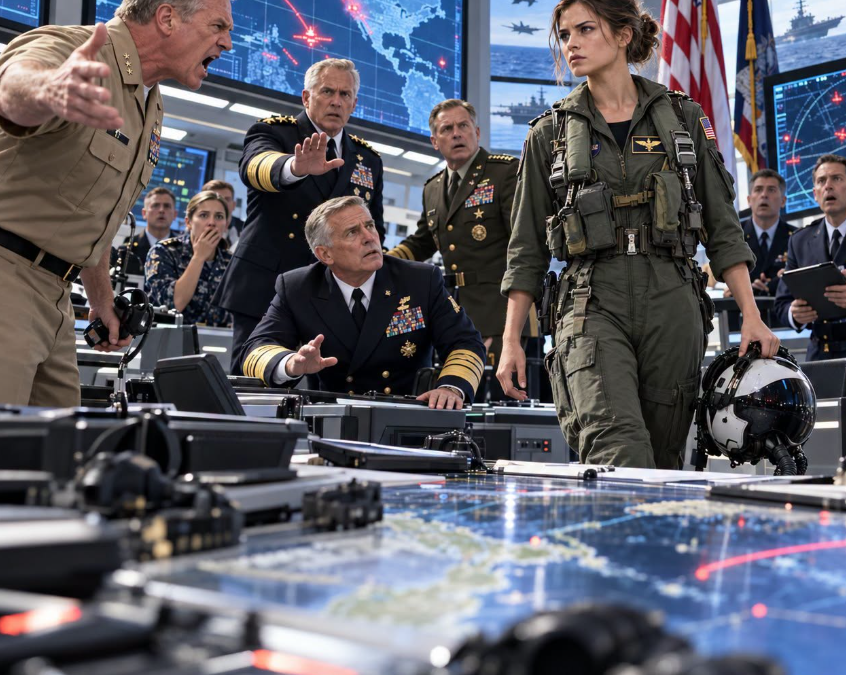
The crisis room was packed.
Officers stood at illuminated consoles.
Analysts called tracks.
Warning boxes flashed across a thirty-foot display.
At the center, one hand braced against the tactical table, stood Lieutenant General Gideon Hale.
My father.
Sixty-one.
Three stars.
Thirty years in uniform.
Three generations of officers behind him.
A man who believed uncertainty was often a character defect.
Opposite him stood Admiral Thomas Ryland.
Senior naval representative to the joint command.
Silver hair.
Tall.
Calm.
He almost never raised his voice because people usually stopped talking before he needed to.
Ryland looked at the tactical display.
“Gideon, wasting fuel on an impossible intercept does not change geometry.”
My father turned.
“Then give me another aircraft.”
“That is what everyone in this room is trying to find.”
I crossed the security threshold.
The first officer noticed my suit.
Then another.
Conversations died outward in a ripple.
Eyes went to the helmet.
The unmarked collar ring.
The pressure seals.
The recessed telemetry port.
My father looked last.
For half a second, he didn’t recognize me.
Then he did.
His expression moved through confusion.
Disbelief.
Then anger.
“Evelyn?”
I stopped at the lower tactical rail.
“What are you doing here?”
I looked toward Admiral Ryland.
“Sir, reporting under emergency access protocol.”
My father laughed.
Not amusement.
That harsh, disbelieving sound he made whenever somebody beneath him said something he considered ridiculous.
“Emergency access protocol?”
His gaze swept my suit.
“You work in supply.”
Nobody laughed with him.
That made him angrier.
“Get out.”
“General—”
“Do not waste our time.”
The contempt carried farther because he wasn’t shouting.
Two officers looked away.
Dad pointed toward the doors.
“This is an active defense emergency. You are an administrative logistics officer.”
His eyes went to the helmet.
“Whatever costume you found and whatever door somebody let you walk through, you do not belong on this floor.”
I had imagined this moment.
For five years.
In some versions I finally told him everything.
Every qualification.
Every hidden hour.
Every evaluation.
Every mission simulation.
Every instructor rating.
Every night he believed I was pushing forms through logistics while I was underground flying systems he was not cleared to know existed.
In my imagination, I made him understand.
Standing there with an unidentified aircraft closing on restricted airspace, I felt none of that satisfaction.
There was no time.
I turned toward Admiral Ryland.
“Sir. Nightglass is flight-ready.”
My father’s head snapped toward him.
“Nightglass?”
Ryland did not answer.
That frightened Dad more than an explanation.
He stepped between us.
“Tom.”
Ryland’s eyes stayed on my helmet.
“Tom, what is she talking about?”
Recognition entered the admiral’s face.
Not of me personally.
Of equipment.
The recessed port.
Gold lock ring.
Suit configuration.
Ryland had been briefed enough to recognize the compartment.
“Code signature?”
My father looked between us.
“What?”
Ryland repeated:
“Captain. Code signature?”
The room became silent.
I could hear ventilation beneath my boots.
“Specter-Zero Actual.”
Admiral Ryland straightened.
An officer behind him whispered:
“Jesus.”
My father did not react immediately.
The words meant nothing to him.
That was almost more powerful.
“What the hell is Specter-Zero?”
Ryland turned.
“General Hale.”
“Yes?”
“Step away from Captain Hale.”
Dad stared.
“Captain Hale is my daughter.”
“I am aware.”
“She is assigned to logistics.”
“Step away.”
The insult hit him.
“Thomas.”
“This is not a discussion.”
My father’s shoulders squared.
“If somebody has placed my daughter inside a special-access program without my knowledge, I want her removed until I understand how she gained access.”
Security personnel near the wall shifted uncomfortably.
Dad pointed toward me.
“Take her outside.”
Nobody moved.
His voice rose.
“That was an order.”
Admiral Ryland stepped fully between us.
“Stand down, General.”
My father’s face flushed.
“Do not tell me to stand down in my own command center.”
“I will tell you whatever operational authority requires.”
A warning tone interrupted.
“Track crossing outer corridor in one-eight-zero seconds.”
My father slammed both hands onto the tactical table.
“Then why are we arguing about my daughter?”
Ryland turned to the senior controller.
“Bring up Black Directive Seven.”
The controller froze.
“Sir?”
“Now.”
“Requires dual flag authentication.”
Ryland put his hand to the console.
“Ryland, Thomas. Admiral. Joint emergency authority.”
Biometric accepted.
The screen requested a second flag authorization.
Every eye turned toward Dad.
He stared at the panel.
“What am I authorizing?”
Ryland said:
“Verification.”
“Of what?”
“Her.”
Dad looked at me.
“And if she isn’t what you think?”
“Then you get to be right.”
That did it.
My father placed his palm on the second reader.
The entire command display went black.
All maps vanished.
Tracks disappeared.
For two long seconds, nothing remained.
Then a gold emblem appeared.
Classification warnings followed.
My father’s confidence began leaving his face.
A biometric prompt opened.
I stepped forward.
“Captain Evelyn Mara Hale.”
Camera focused on my eyes.
“Authentication Specter-Zero.”
Scan.
Pause.
Gold emblem pulsed.
My profile opened.
First:
CAPTAIN EVELYN HALE
PACIFIC JOINT DEFENSE COMMAND
LOGISTICS INTEGRATION
My father looked almost relieved.
Then one line appeared beneath it.
COVER.
His expression stopped.
A second profile unfolded.
PROJECT NIGHTGLASS SPECIAL ACCESS PROGRAM.
FLIGHT COMMAND QUALIFICATION: ACTIVE.
SPECTER ELEMENT LEAD.
EMERGENCY THEATER AUTHORITY: CONFIRMED.
He stared.
“No.”
Nobody answered.
The tactical officer called:
“Two minutes.”
Admiral Ryland opened a secure compartment beneath the table.
Removed a black encrypted transponder.
Carried it to me with both hands.
“Specter-Zero.”
I took it.
“You are cleared to launch.”
My father found his voice.
“Evelyn.”
I didn’t look at him.
“Launch window closing.”
Then left.
The underground hangar was moving before I arrived.
Technicians disconnected diagnostic cables.
Sealed panels.
Cleared the safety zone.
Inside the launch cradle sat Phantom X.
The aircraft looked less constructed than cut from darkness.
Narrow.
Angular.
No conventional markings.
Low-reflective skin absorbed the overhead light.
Most of the people around it had known me for years.
None cared that my father had just discovered my real assignment.
That helped.
Lena met me at the ladder.
“Authorization came through.”
“I noticed.”
“How bad?”
“He tried to have me removed.”
She winced.
“That bad.”
“Worse for him.”
She looked toward the aircraft.
“Still no positive ID. Communications interference increasing.”
“Armed?”
“No indication.”
“Then unknown, not hostile.”
“Your father disagreed.”
“Of course.”
Technician locked my final suit connection.
Thumbs-up.
I climbed into the cockpit.
The seat reclined.
Harness tightened.
Canopy lowered.
Outside noise softened.
Helmet connected to the suit ring.
Panoramic displays woke around me.
Flight condition.
Navigation.
Propulsion.
Environmental status.
Encrypted communication.
I breathed once.
“Specter-Zero Actual. Comm check.”
Ryland responded.
“Loud and clear.”
My father remained silent.
Launch came fast.
Acceleration pressed me back.
Protected corridor.
Climb.
Cloud deck vanished beneath.
The sky darkened with altitude.
Crisis rooms are noise.
Up there, there was only geometry.
The unknown aircraft appeared first as a track.
Then a glint.
Smaller than expected.
Movement too precise for conventional manned flight.
I held distance.
“Command, Specter-Zero. Contact visual.”
“Identify?”
“Negative markings.”
Sensor package sampled.
No recognizable signature.
My father entered the channel.
“If it continues toward the inner corridor, you are authorized to destroy it.”
I almost smiled.
He couldn’t use my name anymore.
Admiral Ryland cut in.
“General Hale, operational control rests with Specter-Zero.”
“I understand command structure.”
“Then let her work.”
I ignored both.
The intruder changed direction.
My display recalculated.
Not inland.
Not toward population.
It shifted diagonally toward a communications corridor supporting military and civilian satellite traffic.
“Lena.”
“Seeing it.”
“It isn’t trying to penetrate inland.”
“No.”
“What is it doing?”
I watched the path.
Then understood.
“Mapping.”
Silence.
Everybody had assumed speed meant attack.
My father had assumed speed meant attack.
The entire crisis room had prepared for an attack.
The object might have been doing something worse.
Learning.
I adjusted course.
The unknown platform turned.
Matched.
“Command, contact reacting to my movement.”
“Human control?”
“Unknown.”
My display flickered.
Navigation vanished for less than a second.
Returned.
Lena’s voice sharpened.
“Evelyn.”
“I saw.”
“It probed the datalink.”
My stomach tightened.
“Handshake?”
“Attempted.”
I switched one system.
Then another.
The intruder moved closer.
This was when fear finally arrived.
I had trained for depressurization.
Guidance faults.
Sensor corruption.
Engine events.
Loss of communications.
Electrical faults.
High-altitude recovery.
Hundreds of failures imagined by engineers paid to be pessimistic.
No simulator had included an unidentified platform actively interrogating the classified architecture of a program whose existence was protected more carefully than most weapons.
If the intruder extracted enough information, the loss would not be airspace.
It would be Nightglass itself.
I switched Phantom X to isolated navigation.
Remote feeds disappeared.
“No external updates,” Lena said.
“I know.”
“You’ll lose theater cues.”
“I know.”
My father said:
“Negative.”
I almost laughed.
“I wasn’t asking.”
I cut datalink.
Silence.
Absolute.
No father.
No admiral.
No controllers.
No engineers.
Just aircraft.
Target.
Geometry.
I climbed over the contact.
Changed vector.
Crossed far enough ahead to force its sensors to choose.
Track me.
Or maintain its network probe.
The intruder banked away.
Good.
It was watching me.
I let it.
Twenty-eight seconds later, I restored communications.
The headset exploded with voices.
“Specter-Zero, report.”
“Still here.”
Ryland exhaled.
“Status?”
“Probe broken.”
Lena said:
“Confirmed. It lost access.”
“Can we drive it away?”
Pause.
“We might interrupt guidance long enough for onboard failsafe to take control.”
“What do you need?”
“You close.”
“How close?”
She gave the distance.
I stared.
“Lena.”
“I know.”
“That is inside simulator separation.”
“This is not a simulator.”
The simplest truth of the day.
I repositioned.
Intruder accelerated.
So did I.
Below us, the Pacific curved blue and almost peaceful.
I remember thinking how obscene beauty can feel during a crisis.
Dozens of people underground were staring at clocks while the ocean looked indifferent.
Then my father entered the channel.
“Evelyn.”
He had finally said my name.
I waited.
His voice was quieter.
“Bring it home.”
Something inside me hurt.
I put it away.
“Stand by.”
I moved Phantom X into position.
Lena counted.
“Three.”
“Two.”
“One.”
Electronic disruption fired.
No missile.
No explosion.
No cinematic flash.
The intruder’s precision simply disappeared.
It rolled.
Corrected.
Yawed.
Recovered.
Then turned west.
Display showed it descending toward international water.
Lena shouted:
“It worked.”
I watched another ten seconds.
Then:
“Command. Specter-Zero.”
Ryland answered.
“Go.”
“Airspace secure.”
The command room erupted in my headset.
I let them.
For twelve seconds.
Then I saw the outgoing signal.
Narrow.
Directional.
West.
“Lena.”
“Yes?”
“Save the final track.”
“Already.”
“Signal burst after disruption.”
“I see it.”
“This wasn’t random.”
Silence.
Ryland came back.
“Specter-Zero, return.”
“Copy.”
My father’s channel remained quiet.
The flight home felt longer.
Adrenaline withdrew.
Shoulders began aching.
My hands shook slightly.
The aircraft descended through cloud.
Entered protected recovery.
Landed underground.
Canopy opened.
Lena waited.
“You’re shaking.”
“Cold.”
“Liar.”
“I know.”
She handed me water.
I drank half the bottle.
On the elevator back up, I considered everything I might say to my father.
Sarcasm.
Anger.
Nothing.
I had rehearsed speeches for five years.
When the doors opened, I forgot all of them.
The operations floor stood.
One lieutenant near the elevator saw me.
Snapped to attention.
Then another.
Within seconds almost everybody was standing.
Admiral Ryland stepped forward.
Saluted.
“Outstanding work, Captain.”
I returned it.
“Thank you, sir.”
Several people started clapping.
Ryland stopped them.
“We are not finished.”
That was why I respected him.
Relief is not victory.
He looked toward the main screen.
“Contact escaped intact. We don’t know who controlled it.”
I approached the display.
My father stepped into my path.
“Evelyn.”
I stopped.
For five years I imagined him looking at me the way he did then.
Not contempt.
Not embarrassment.
Confusion.
Regret.
“I didn’t know.”
The cruel answer was obvious.
That was why I didn’t use it.
“You weren’t cleared.”
His jaw tightened.
“I’m your father.”
“That isn’t a clearance level.”
Several officers nearby became very interested in their consoles.
Dad lowered his voice.
“Why didn’t you tell me you were still flying?”
“Because I signed an agreement saying I wouldn’t.”
“You could have told me there was more.”
“No.”
“Anything.”
I looked at him.
“You stopped inviting me home because you thought I worked in logistics.”
“That isn’t fair.”
“Isn’t it?”
“You let me believe you had abandoned everything you trained for.”
“And that justified treating me like I embarrassed you for five years?”
His face changed.
That question had waited a long time.
Before he could answer, Lena’s voice came over the room.
“Admiral.”
Ryland turned.
“We found something.”
A signal-history display replaced the main map.
Lena appeared by secure video.
“The contact transmitted encrypted bursts during the incursion.”
Ryland nodded.
“We saw that.”
“Most went offshore.”
Pause.
“One didn’t.”
I felt cold.
“What do you mean?”
“It wasn’t transmitting outward.”
The room quieted.
“It was responding.”
Ryland leaned toward the display.
“To what?”
“Something inside our defense network.”
My father turned.
“No.”
Lena looked at him with the expression engineers reserve for senior officers trying to overrule measurable data.
“General.”
“That is impossible.”
“No, sir.”
“Could the source be spoofed?”
“We considered that.”
“And?”
“It used a valid internal authentication sequence.”
Nobody spoke.
A map appeared.
Signal origin:
Inside the installation.
The crisis changed shape.
The aircraft had not simply penetrated the corridor.
Someone inside had helped it.
Within twenty minutes, the air-defense operation became an internal security investigation.
Access logs frozen.
External connections limited.
Contractor records preserved.
Network data imaged.
Credentials revoked.
My father immediately started issuing orders.
Ryland stopped him.
“General Hale.”
Dad turned.
“You’re recused from internal review.”
His face hardened.
“Why?”
“One relevant authentication route touches systems supervised by your office.”
“That doesn’t mean my staff is compromised.”
“It means conflict.”
“I command this installation.”
“And for the next few hours, you’re going somewhere else.”
The humiliation struck harder than my revelation.
Then Ryland turned to me.
“Captain Hale.”
“Sir.”
“Nightglass technical liaison.”
My father stared.
“You’re putting her on the investigation?”
“Yes.”
“She is my daughter.”
“That is becoming less operationally relevant by the minute.”
For the first time in my life, I watched my father receive an order he could not overpower with rank.
He looked at me.
I saw the old instinct.
Tell me what to do.
Demand allegiance.
Recover control.
I waited.
Whatever he saw in my face stopped him.
He left.
I should have felt victorious.
I was exhausted.
At midnight, the source was identified.
A secure communications terminal.
Credential authority:
Commanding General’s office.
Nobody accused Gideon Hale of treason.
That distinction mattered.
Gossip rarely respects distinctions.
The terminal sat in a planning suite accessed by dozens of officers, aides, contractors, and visitors.
The certificate had been issued seven months earlier during routine modernization.
Still, somebody had used credentials connected to my father’s office to communicate with an unknown aircraft during a live incursion.
At 6:10 the next morning, Dad entered a secure briefing.
He looked twenty years older.
None of us had slept.
Lena displayed access history.
“The compromised sequence traces to a contractor maintenance event.”
My father frowned.
“Which contractor?”
“Arcspan Dynamics.”
The name changed the room.
Arcspan was everywhere.
Software.
Components.
Network maintenance.
Facilities support.
Command integration.
My father had personally championed an Arcspan modernization package.
“Arcspan passed every review.”
Lena nodded.
“At the time.”
“Are you saying they built a back door?”
“We found one.”
Dad looked at Ryland.
Then me.
I read the report.
There was cruel symmetry in the moment.
My father had judged my life from visible evidence.
Now evidence pointed toward his office.
It would have been easy to let people assume the worst.
I hated many things he had done.
I did not hate him enough to become unfair.
“The credential alone doesn’t prove General Hale knew about the vulnerability.”
The room shifted.
Dad looked at me.
Surprised.
Ryland nodded.
“Correct.”
I continued.
“If the access method was inserted during authorized contractor maintenance, command staff may never have seen it.”
My father kept watching.
I didn’t return the look.
Lena expanded another view.
“There’s more.”
Of course.
The compromised system had transmitted four times in three months.
Tiny encrypted bursts.
All during large exercises.
Traffic heavy.
Irregular activity easy to hide.
“What data?”
“Reconstructing.”
“Estimate?”
“Air-defense response timing.”
My stomach tightened.
Detection.
Track development.
Command decisions.
Launch times.
Communications.
Someone had been measuring us.
“Yesterday wasn’t an attack.”
Lena nodded.
“It was an exam.”
Dad leaned back.
“And we gave them answers.”
“Some.”
He looked at me.
“Not all.”
Nightglass was absent from every ordinary response model.
Whoever planned the breach had discovered something unexpected when Phantom X launched.
For the first time, secrecy was useful again.
Counterintelligence began digging into Arcspan.
A name surfaced.
Martin Keller.
Senior systems specialist.
Excellent clearance history.
Years of sensitive work.
Attended command receptions.
There was even a photograph of him beside my father after completing the modernization project early.
Dad stared at that image.
“I shook his hand.”
Nobody said anything.
“He sat in my office.”
Still silence.
Finally:
“Did you meet him?”
“Once.”
“When?”
“Three months ago.”
“Where?”
“Logistics audit.”
“Anything odd?”
“He asked about decommissioned hangar environmental-control systems.”
Dad frowned.
“And?”
“I reported it.”
“To my office?”
“No.”
“Why?”
“Nightglass security.”
His face hardened.
“You never told us.”
“I wasn’t allowed.”
“There it is again.”
“What?”
“That answer.”
I set the report down.
“What answer would make you happier?”
“Maybe secrecy has consequences.”
He realized what he had said after it was too late.
For five years, he punished me for keeping a secret required by duty.
Now he was blaming the same secrecy because he failed to see a threat.
Ryland cleared his throat.
My father ignored him.
“If commands can’t share information, patterns get missed.”
“True.”
He looked surprised.
Then I finished.
“But you didn’t stop speaking to me because I withheld classified information.”
His face tightened.
“You stopped speaking to me because the version of my career you could see wasn’t impressive enough for you.”
Silence.
“That is a different failure.”
Dad lowered his voice.
“We don’t need to do this here.”
“We don’t need to do it anywhere.”
I stood.
“Our personal history is irrelevant.”
“Evelyn.”
“We have work.”
For forty-eight hours, we did.
Martin Keller disappeared before investigators reached his home.
Phone abandoned at an airport parking garage.
Credentials wiped remotely.
Security footage:
Keller entering a car driven by an unidentified person.
Arcspan denied knowledge.
Suspended contracts.
Cooperated.
Then Keller made one mistake.
Three weeks before the breach, he searched logistics records.
Replacement components.
Obsolete environmental-control hardware.
Ordinary request.
Except only two regional facilities still used those components.
One research laboratory.
And our hidden hangar.
Someone had been looking for Nightglass before the incursion.
That changed everything.
Maybe Nightglass was not the unexpected variable.
Maybe forcing Nightglass into the open was the entire objective.
The intruder may never have intended to attack.
Maybe it only needed every conventional option to fail badly enough that we were forced to reveal what we kept hidden.
That thought kept me awake.
For five years, secrecy shaped my life.
Missed holidays.
Canceled dates.
Training disguised as inventory emergencies.
Flights erased from ordinary records.
My father thinking I was afraid.
My father telling other people I had abandoned the family legacy.
My mother’s empty chair after she died.
All of that, and Keller might have come close through a spare-parts request.
Lena found me in the underground cafeteria at three in the morning.
“You look awful.”
“Thank you.”
She put coffee in front of me.
“You’re welcome.”
I drank.
“Do you think they learned too much?”
“I think they know Nightglass exists.”
“That isn’t what I asked.”
“No.”
She wrapped her hands around the cup.
“They saw one aircraft.”
“Correct.”
“Speed. Altitude. Some electronic capability.”
“Yes.”
“They don’t know fleet size.”
“No.”
“Basing.”
“No.”
“Full mission set.”
“No.”
“Operational doctrine.”
“No.”
“They know Specter-Zero.”
“Maybe.”
“They heard the code.”
“Then they know a code.”
I rubbed my eyes.
Lena watched.
“This isn’t about Keller.”
“I don’t know what you mean.”
“You flew a live intercept, found an insider-assisted breach, and slept four hours in three days.”
She took a drink.
“And you’re grinding your teeth because of your father.”
I hated engineers.
They noticed things.
“He wants to talk.”
“Will you?”
“No.”
“Why?”
I looked at the coffee.
“Because now he’s proud of me.”
Lena waited.
“That is worse.”
Understanding appeared immediately.
My father ignored me when he believed I filed supply forms.
The moment he discovered Phantom X, I became impressive again.
That was not growth.
It was proof.
He had not learned I deserved respect without prestige.
He had merely discovered my prestige was hidden.
The next afternoon, he cornered me outside a briefing room.
“Five minutes.”
“No.”
“Evelyn.”
“I have a meeting.”
“So do I.”
“Then go.”
He stepped into my path.
Not aggressively.
Desperately.
“Please.”
That stopped me.
My father rarely said please.
I followed him into an empty conference room.
He closed the door.
We stood.
Then:
“I owe you an apology.”
I leaned against the table.
“Yes.”
His mouth tightened.
He had expected help.
“I was wrong about your career.”
“That isn’t the apology.”
“I was wrong about you.”
“Closer.”
His eyes hardened.
There he was.
The general.
A man who wanted even confession conducted according to his preferred structure.
“I thought you were afraid.”
“I know.”
“You were one of the best young aviators I’d seen.”
“Okay.”
“Then suddenly you left that path, accepted supply, refused to explain.”
He shook his head.
“I thought you were throwing your life away.”
“So you threw me away first.”
He flinched.
Good.
Some truths should.
“That wasn’t my intention.”
“It was your action.”
“I was angry.”
“For five years?”
“Disappointed.”
“For five years?”
He looked toward the wall.
“My father would have considered what you did unforgivable.”
“What exactly did I do?”
“Walked away from the Hale tradition.”
I stared.
“You mean I chose a job you didn’t respect.”
Silence.
“That’s all this was.”
“Evelyn—”
“Even if the cover had been real.”
My voice remained quiet.
“Even if I spent my entire career moving pallets and signing supply requests, I would still have been your daughter.”
“I know.”
“No.”
I looked directly at him.
“You know now.”
His face went pale.
It might have been the cruelest sentence I had ever spoken to him.
It was also accurate.
A knock.
Ryland opened the door.
“Keller surfaced.”
Conversation over.
Investigators traced a financial transfer to a charter operation on Guam.
Keller had moved again.
But financial records linked him to a second Arcspan-associated contact.
A name appeared on the screen.
Rachel Dunn.
My father said:
“No.”
Ryland looked at him.
“You know her.”
Dad sat down.
“She is my civilian executive adviser.”
Silence.
Rachel Dunn had worked beside him almost four years.
Scheduling.
Correspondence.
Contractor coordination.
Access to meetings.
She had attended dinner at our family home twice before my mother died.
My father trusted her completely.
Why?
Because Rachel looked like competence to him.
Organized.
Controlled.
Confident.
Polished.
She spoke the language he respected.
I had become suspicious because I looked ordinary.
She earned his trust because she looked important.
Investigators now believed she helped Keller.
Dad looked at me.
This time no pride.
Only shame.
“I trusted the wrong person.”
I did not need to say anything.
He understood.
Rachel Dunn was arrested before sunrise the next day.
Civilian gate.
Encrypted storage devices in a document case.
Second phone under false identity.
Her computer was worse.
Years of correspondence.
Small pieces of administrative information.
Meeting schedules.
Maintenance windows.
Vendor access.
System downtime.
Names.
Nothing individually explosive.
Together:
A map.
Keller had cultivated access through pieces too small to attract attention.
Money.
Resentment.
Ego.
No cinematic ideology.
No manifesto.
Rachel believed she deserved influence and money she didn’t have.
Keller paid.
My father’s confidence made her access easy.
Nobody wrote that exact sentence into the official report.
They didn’t need to.
Dad requested reassignment while command reviewed contractor oversight.
Ryland did not fight him.
For the first time in my life, I saw Lieutenant General Gideon Hale without command.
He still wore three stars.
People saluted.
His name still opened doors.
But he no longer controlled the room.
Investigators asked questions.
Other officers reviewed his decisions.
He waited for permission to speak.
I expected to enjoy that.
I didn’t.
Wanting accountability is different from wanting somebody destroyed.
Three days after Rachel’s arrest, he found me on the observation deck above the harbor.
Sunset behind low clouds.
“You still come here.”
“I used to.”
“You liked watching ships.”
“You used to tell me where they were going.”
“I made up half the answers.”
“I know now.”
He almost smiled.
We stood.
Then he handed me an envelope.
“What?”
“Statement to the review board.”
I opened it.
Several pages.
He accepted responsibility for contractor-access failures.
Acknowledged procedural weaknesses.
Near the end:
A section about me.
He wrote that his assumptions about my visible career distorted the way he treated his own daughter.
That he confused prestige with value.
That discovering my classified assignment exposed a failure of judgment predating the security incident.
I stopped reading.
“You didn’t have to put this into an official statement.”
“Yes.”
“Why?”
His eyes stayed on the harbor.
“Because most of my life, when I made a mistake, I found language that allowed me to call it leadership.”
I looked at him.
“My father did it.”
“That doesn’t excuse you.”
“I know.”
No argument.
New.
“I thought if I pushed you hard enough, you’d become impossible to disappoint.”
I said:
“I became impossible for you to know.”
He closed his eyes.
“Yes.”
For one moment I remembered being fourteen.
Air show.
Dad explaining lift.
Seventeen.
Driving lesson in freezing rain.
My mother laughing because we were equally stubborn.
Memory is inconvenient.
It preserves love long after trust changes shape.
Dad turned toward me.
“Can we start over?”
There it was.
The question people who hurt someone eventually want.
As if years can be folded away.
“No.”
He didn’t move.
“I don’t hate you.”
His eyes dropped.
“But five years happened.”
“I know.”
“I built a life without you because you required me to.”
He swallowed.
“I am not going to erase that life because you finally learned something painful.”
“I am not asking you to pretend.”
“You are asking me to become your daughter again in the version you remember.”
“You are my daughter.”
“Biologically.”
He flinched.
I hated hurting him.
Still said it.
“What am I supposed to do?”
“For once?”
I folded his statement.
Returned it.
“Live with not controlling the answer.”
He nodded.
I walked away.
The command review eventually cleared my father of involvement in the breach.
It also formally criticized contractor oversight under his command.
Several policies changed.
He accepted reassignment to training and doctrine on the mainland.
Honorable.
Still important.
But far from the operational command he had spent his life chasing.
Before leaving, he texted:
Proud of you, Evelyn.
Four words.
Years earlier I would have stared at them until they filled something inside me.
I stared now.
Then put the phone face down.
Went back to work.
Not answering was not punishment.
It was the first boundary between us that belonged entirely to me.
Six months after the breach, Nightglass moved.
Secret programs should never become sentimental about buildings.
The underground hangar emptied.
Equipment disappeared inside sealed containers.
Teams scattered.
The entrance I had used for years became what the paperwork always claimed.
Climate-controlled storage.
I transferred with the program.
Official assignment:
Advanced Logistics Integration.
When I read it, I laughed.
Some covers are too useful to waste.
Lena came too.
We stood beside shipping cases.
“Congratulations.”
“On?”
“You remain a supply officer.”
“I’ve peaked.”
“I always believed.”
The mission expanded.
We spent months rebuilding security around everything Keller and Dunn exposed.
No single contractor could see enough pieces.
No executive office held unchecked credentials.
Administrative searches became compartmented.
Maintenance requests became less predictable.
The biggest lesson had little to do with airplanes.
Secrets fail when systems become predictable.
My father had been predictable.
So had I.
He believed important people looked important.
I believed silence automatically meant strength.
Both assumptions cost us.
He contacted me occasionally.
Never often.
He asked before calling.
He did not write long apologies.
Did not invite me to holidays and pretend nothing happened.
Instead:
How is Arizona?
Hope the heat hasn’t killed you.
Your mother would hate my apartment.
I answered some.
Ignored others.
That was our relationship.
Not reconciliation.
Not complete estrangement.
Distance with rules.
At Christmas, a package arrived.
Inside:
A wooden box that belonged to my grandfather.
Inside that:
Old pilot wings.
No letter.
Years earlier, those wings would have felt like admission into the Hale story.
Now:
Different.
I placed them beside a photograph of my mother.
Not because I had forgiven Dad.
Because the family history belonged to me too.
The following spring, Admiral Ryland visited our new facility.
He found me outside a briefing room drinking terrible coffee.
“Captain Hale.”
“Admiral.”
“Still hiding in logistics?”
“Deep commitment to inventory.”
“So I’ve heard.”
He smiled.
Then became serious.
“There will be an opening.”
“For?”
“Program flight director.”
I nearly dropped the cup.
“That is a colonel billet.”
“Usually.”
“I’m a captain.”
“Currently.”
I stared.
“You’re serious.”
“Unfortunately.”
“Why me?”
He looked toward the hangar.
“During the breach, everybody senior in that room was trying to prove they already knew the answer.”
Then at me.
“You were the only one comfortable saying you didn’t.”
That stayed.
As a child, I believed leadership meant certainty.
My father performed certainty better than anyone.
He entered rooms as if doubt were something weaker people caught.
Nightglass taught the opposite.
Good pilots question instruments.
Good commanders question assumptions.
Good people question themselves.
Three months later, I accepted.
Promotion ceremony small.
Almost everything meaningful remained classified.
Lena came.
Reed came too.
He had been moved into program support with limited clearance.
The first time Owen Reed saw the Nightglass facility, he stood silently for ten minutes.
Then:
“So inventory control?”
I smiled.
“Technically.”
“You are the worst person I’ve ever trusted.”
“Dramatic.”
“You disappeared during a defense emergency carrying a nameless access card.”
“And you kept the annex secure.”
“Because you ordered me.”
“You’re welcome.”
He shook his head.
My father did not attend.
I did not invite him.
People who knew parts of our history seemed surprised.
I wasn’t.
Achievements no longer felt unfinished without his approval.
That might have been the greatest thing I gained from the entire crisis.
Months later, during a joint exercise, I entered another command center under the cover identity.
An unfamiliar brigadier general looked at my logistics insignia.
Then the chair reserved near the tactical table.
“I think you’re in the wrong room, Captain.”
For one second, I was back with my father pointing toward the door.
Then I smiled.
“Possibly, sir.”
Admiral Ryland entered behind me.
The general turned.
Ryland nodded toward the chair.
“She is with me.”
Nothing dramatic.
No screens flashing my profile.
No room freezing.
No secret call sign.
The general nodded.
Moved on.
I sat.
That was enough.
My father had taught me that respect was earned through rank, achievement, visible strength.
For years, even while resenting that rule, I believed it.
I don’t anymore.
Rank can force attention.
Talent can earn admiration.
Mystery can create fascination.
None guarantees respect.
Respect is what remains when someone thinks you are ordinary.
My father failed that test.
Maybe one day he would become the sort of man who passed it.
That was his work.
Not mine.
The last time we spoke before his retirement, he called from his apartment.
His voice sounded older.
Less interested in filling silence.
“I’ve been thinking about that day.”
“Which part?”
“When you walked into the crisis room.”
I waited.
“I told you not to waste our time.”
“Yes.”
“I thought I was the most important person in the room.”
“You usually did.”
He laughed quietly.
“I deserved that.”
“Yes.”
Silence.
“Then Tom asked for your code signature.”
I looked through my office glass at technicians moving across the hangar below.
“And?”
“I remember your face.”
“What about it?”
“You weren’t angry.”
“I was busy.”
“That’s what bothers me.”
I understood.
Dad spent years imagining I would eventually confront him.
Beg him to understand.
Defend myself.
Break.
Prove him wrong.
When the moment came, his opinion was irrelevant to what needed doing.
“You had already stopped needing me to believe you.”
“Yes.”
The answer came easily.
He breathed out.
“I’m sorry, Evelyn.”
“I know.”
I did not say I forgave him.
He did not ask.
That mattered.
We talked another few minutes about ordinary things.
His retirement.
Weather.
A restaurant near his apartment.
Then hung up.
An hour later, I walked onto Nightglass operations for evening readiness.
Engineers reviewing upgrades.
Pilots arguing over coffee.
A half-eaten sandwich beside maintenance reports.
Nothing heroic.
Exactly why I loved it.
Lena looked up.
“Everything okay?”
“Yes.”
“Your dad?”
“Yes.”
She studied me.
“Good yes or bad yes?”
“Just yes.”
She nodded.
Enough.
I crossed toward the aircraft bay.
Behind glass, Phantom X sat beneath white light.
Silent.
It was no longer the aircraft that proved my father wrong.
No longer the secret that made me worthy in his eyes.
It was simply work.
My work.
My choice.
Five years earlier, Gideon Hale decided that a daughter sitting behind a desk represented failure.
During the breach, he learned the desk had never told him who I was.
Years later, I understood something more important.
Neither did the cockpit.
I did not deserve respect because I was Specter-Zero.
I did not deserve a place in my family because I could fly a classified aircraft faster and higher than my father imagined.
I did not become worthy the moment a four-star admiral recognized my code signature.
I had been worthy when I was carrying a clipboard through the supply annex.
I had been worthy when my father thought I spent twelve hours a day reconciling manifests.
I had been worthy at every Thanksgiving table where my chair remained empty.
That was the truth Gideon Hale needed years to learn.
And the truth I needed even longer to believe.
Sometimes people ask me what it felt like to say the call sign.
Specter-Zero Actual.
They expect satisfaction.
Revenge.
The thrill of watching a powerful man realize he had underestimated his own daughter.
I felt none of those things.
The hostile track was less than three minutes from the corridor.
People were waiting on a pilot.
So I did my job.
That was all.
Maybe that is why the moment stayed with my father.
He spent five years believing one day I would need him to see me.
Then, in the most dramatic moment of both our lives, I walked into his command center and didn’t care whether he did.
He had become irrelevant to the mission.
And that was the thing he had never prepared himself to survive.
Not discovering that I was secretly exceptional.
Discovering I had learned how to exist without his approval.
The call sign only made that visible.
The rest had happened years before.








