My Cousin Ordered Nine Soldiers to Throw Me Out of His Deployment Party—Six Hours Later They Stood at Parade Rest While I Checked His Manifest
PART2:
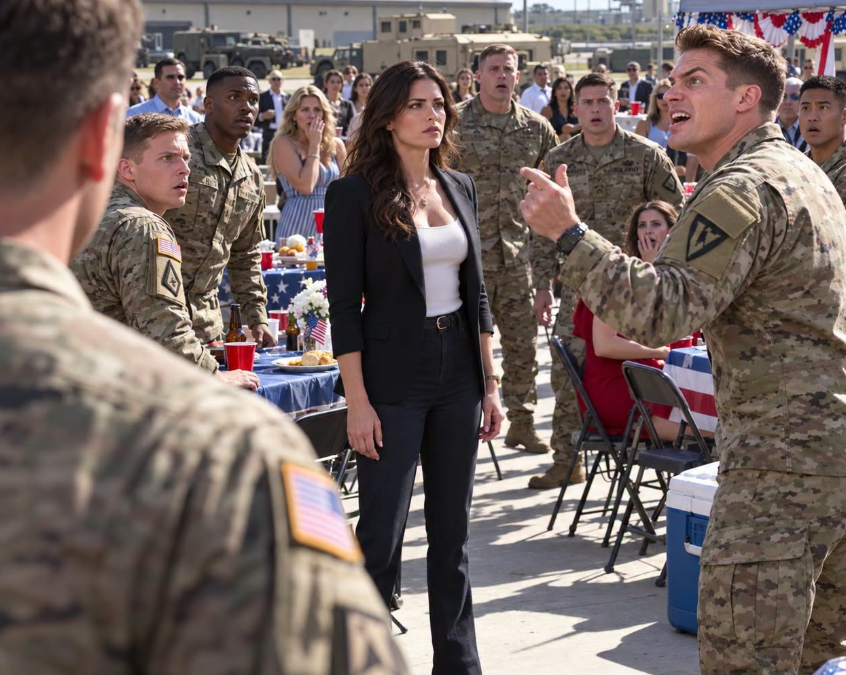
She had climbed onto a low platform near the booths and raised a plastic cup beneath red, white, and blue streamers she had taped to the wall herself.
She thanked Caleb’s soldiers.
Thanked his wife Shelby.
Praised Caleb for “doing what Halvorsen men have always done.”
Then she looked toward me.
That bright smile appeared.
The one she used before saying something cruel enough to pass as humor.
“And Mara,” she said, “who somehow never misses a military send-off even though the military didn’t exactly work out for her.”
Civilians laughed harder than the soldiers.
That told me something.
My uncle Martin stared at his beer.
Shelby adjusted the carrier holding her five-week-old son.
Caleb saw that his mother had gotten a reaction.
So he decided to improve it.
He climbed onto the brass rail.
Steadied himself on Specialist Malik Turner’s shoulder.
Then looked toward me.
“She dropped out of ROTC.”
More laughter.
PART3:
“Twenty-three years later she still hangs around Fort Campbell like somebody might hand the scholarship back.”
I took a drink.
Turner wasn’t laughing.
Neither was Sergeant Owen Price.
Price was Caleb’s team leader.
Thirty-four.
Married.
Two daughters.
Excellent NCO.
I knew because I had signed his last evaluation.
Caleb did not know that.
He snapped his fingers.
Twice.
“Price.”
Price looked up.
“Turner.”
Turner slowly lowered his drink.
“Come on.”
Caleb pointed toward me.
“Carry her out.”
Nobody moved.
The jukebox kept playing.
Pool ball hit a rail behind us.
Somebody near the bathrooms laughed because he thought Caleb was still joking.
Caleb snapped his fingers again.
“I’m serious.”
Price stared at him.
Turner stared at me.
So did seven other soldiers around the pushed-together tables.
Every one of them was part of the aviation brigade I served as command sergeant major.
Every one of them knew exactly who I was.
Several had stood in formations while I spoke.
Two had sat across from me during disciplinary reviews.
Turner had seen me three weeks earlier at one in the morning beneath flight-line work lights after I stopped him halfway through a refueling procedure that could have injured somebody if he finished it incorrectly.
Caleb lived on the same installation.
Received brigade emails.
Attended brigade training.
Saw my name on correspondence.
Yet family stories are powerful things.
He had never connected Command Sergeant Major Mara Keene with Cousin Mara Halvorsen.
Different last name after marriage.
Civilian clothes at family events.
A family that had spent more than two decades insisting I had never really become anything in the Army.
Caleb laughed again.
Less confident.
“Price.”
Sergeant Price put both palms flat on the table.
“Sergeant.”
Something in his voice finally reached Caleb.
“What?”
Price looked at me.
Then back at his squad leader.
“You really don’t recognize her?”
The bar became quieter.
Caleb looked at me.
For the first time that evening, really looked.
I stood.
Not fast.
Not dramatically.
I slid two twenties beneath my glass.
“Thanks, Gus.”
Gus Murphy stood behind the bar polishing the same glass he had been polishing through most of Renee’s speech.
He had seen enough soldiers destroy their own evenings to recognize one doing it in real time.
He nodded.
I picked up my keys.
Walked past Caleb.
Past Renee’s sheet cake.
PROUD OF YOU, CALEB.
Blue frosting.
Past Uncle Martin.
Past Shelby.
Nobody tried to stop me.
At the door, I glanced back once.
Nine soldiers remained exactly where they had been.
No one had obeyed.
I stepped outside.
Cold gravel beneath my shoes.
Fort Campbell Boulevard glowing beyond the parking lot.
Cars passing.
Tattoo parlors.
Pawn shops.
Fast-food signs.
And beyond the perimeter fence, staging-area floodlights illuminating long rows of charter buses.
At four in the morning, those buses would begin carrying almost three thousand soldiers toward aircraft bound for Europe.
I had work to do before then.
I had once been dragged out of a burning helicopter on the side of an Afghan valley with one wrist fractured and blood running into my left eye.
I was not going to be carried ten yards through a Kentucky bar by nine embarrassed young soldiers because their squad leader had confused family humiliation with leadership.
I drove home with the radio off.
The Army story my family believed about me began twenty-three years earlier.
I was eighteen.
My grandfather, retired Lieutenant Colonel Elias Halvorsen, was still the center of gravity inside our family.
He had flown helicopters in Vietnam.
Later taught military science.
Kept photographs of himself in uniform throughout the house.
He loved the Army in the complicated way men sometimes love institutions that gave shape to the best and worst years of their lives.
Neither of his sons served.
My father Daniel had gone into roofing.
His younger brother Martin built an insurance agency.
Grandpa never openly said their civilian careers disappointed him.
He didn’t have to.
Then I won an Army ROTC scholarship to Western Kentucky University in 2002.
Grandpa drove me to campus himself.
Outside the armory, he squeezed the back of my neck.
“Second lieutenant in four years.”
I smiled.
“That’s the plan.”
“Then you’ll be the one people salute.”
The difficult part is that I loved ROTC.
That matters.
If I had hated it, the family story would have been easier.
I liked morning runs in freezing rain.
Liked land navigation.
Liked discovering that confusion made me calmer instead of panicked.
Liked being given responsibility.
Liked the future.
More than that, I liked making Grandpa proud.
I hadn’t yet signed the contract obligating me to accept a commission.
But I intended to.
Then my father died.
Daniel Halvorsen was forty-seven.
Roofer.
Strong enough to carry bundles of shingles up ladders until his body finally disagreed.
One February morning outside Glasgow, Kentucky, he sat down on the edge of a customer’s roof.
Leaned back like he needed a minute.
Never stood up.
Heart.
No warning.
Funeral Saturday.
On Sunday morning, I found the bank envelope.
My mother Evelyn stored flour inside a ceramic rooster because she hated anything left visible on the kitchen counter.
I opened it looking for the scoop.
Found folded paperwork underneath.
Three mortgage payments behind.
Second mortgage.
Late notices.
Foreclosure warning.
Amounts I had never known existed.
Mom found me sitting on the floor with flour across my jeans.
She took the letter.
Folded it.
“It’s handled.”
“With what?”
“Martin said he’d help.”
I believed her.
Why wouldn’t I?
Martin was my father’s brother.
Family helped family.
At least that’s what people said.
Three weeks later, I drove home from campus on a Friday afternoon.
Uncle Martin’s truck was parked outside.
Mom stood on the porch wearing her cafeteria uniform.
Martin stood in front of her.
I got out down the street.
Stopped when I heard his voice.
“Six thousand dollars isn’t a little favor, Evelyn.”
Mom said something too softly.
Martin shook his head.
“I have two kids.”
Renee.
Caleb.
Bills.
His agency.
Taxes.
Everything.
Then:
“Daniel should’ve planned better.”
I remember that one.
Mom’s shoulders folded slightly.
Martin continued.
“If you can’t keep the place, sell before the bank takes it.”
Pause.
“At least somebody in the family could do something useful with the property.”
His truck backed past mine a few minutes later.
He didn’t see me.
Or pretended not to.
Inside, Mom stood at the sink with water running into an empty basin.
I said nothing that night.
I went upstairs.
Spread my scholarship documents.
Bank statements.
Legal pad.
Calculator.
Started doing math.
By Monday, I had a plan.
The Army recruiter on Scottsville Road thought grief had broken something in my brain.
Sergeant First Class Coleman.
Office between a nail salon and pizza shop.
Whole recruiting station smelled like garlic after four in the afternoon.
I sat across from him.
“What aviation job has the largest enlistment bonus with a summer ship date?”
He typed.
Looked at me.
Typed again.
“Fifteen Tango.”
“Black Hawk?”
“UH-60 repairer.”
“How much?”
“Eight thousand if the contract stays available.”
Enough.
Not everything.
Enough to stop the immediate foreclosure step after training.
He leaned back.
“You’re giving up ROTC to enlist as a mechanic?”
“Yes.”
“Does your family know?”
“They will.”
The first half of the bonus came after training.
I was nineteen when I walked into a Bowling Green bank carrying a cashier’s check large enough to catch up the mortgage and late fees.
The teller printed a receipt.
Slid it across.
Looked at me in a way that suggested she understood sacrifice better than some people who shared my blood.
Mom cried when I showed her.
Then held my face.
“Promise me something.”
I should have known.
“What?”
“Don’t tell your grandfather.”
“About what?”
“The debt.”
“Mom.”
“He’ll know your father left us with it.”
“Dad is dead.”
“I know.”
“He can’t be embarrassed.”
“I can.”
Her voice broke.
“I will not have people talking about Daniel as if he failed us after he’s gone.”
“Grandpa’s going to think I failed him.”
“I know.”
That hurt.
She knew.
Still asked.
There are promises you make because you agree.
Others because someone you love looks too fragile to survive your refusal.
My mother stood beneath the kitchen ceiling Dad had planned to repair, wearing his wedding ring on a chain beneath her blouse.
I promised.
I believed truth would eventually correct itself.
That was naive.
Thanksgiving became the first test.
I had returned from Fort Eustis stronger through the shoulders.
My old dress didn’t fit.
I borrowed one.
Fourteen Halvorsens around Grandpa’s table.
Caleb was eight.
Sat with younger cousins at a folding table.
Grandpa waited until pie.
“Do you all know what Mara did?”
Silence.
“Two generations waited for somebody in this family to take a commission.”
He looked directly at me.
“She had it handed to her.”
Pause.
“And walked away to turn wrenches.”
“Grandpa—”
“Then tell me.”
The whole room watched.
I looked at Mom.
She stared at her plate.
Under the table, her hand found mine.
Squeezed.
Her wedding ring cut into my knuckle.
Keep the promise.
I said nothing.
Grandpa nodded slowly.
“Halvorsens don’t quit.”
Then he lifted his dining chair.
Turned it a quarter turn away.
Finished dessert facing the window.
That chair turning became family history.
Caleb stopped swinging his legs beneath the children’s table.
He watched Grandpa.
Then me.
Children understand stories through scenes before words.
Decorated veteran turns away.
Adults remain silent.
Young woman offers no defense.
Obvious conclusion:
Grandpa is right.
Mara failed.
That story hardened.
Aunt Renee told people at church I had “washed out.”
By 2007, she shortened my entire Army career to:
“Mara did one enlistment turning wrenches.”
I could have corrected her.
But every correction led to:
Then why did you leave ROTC?
That answer belonged partly to Mom.
So I wore civilian clothes at home.
Brought food.
Said little about work.
The Army kept moving.
In 2006, I was a Black Hawk crew chief in northern Iraq.
People who don’t know helicopters hear mechanic and imagine somebody standing under a hood with tools.
Crew chiefs learn an aircraft intimately.
Sound.
Vibration.
Leaks.
Temperatures.
Moods.
You learn the difference between harmless noise and the wrong noise.
One night, we dropped into a dry riverbed to evacuate wounded soldiers.
Brownout swallowed everything.
Pilots lost visual reference.
I leaned outside.
Called distance.
“Ten feet.”
“Seven.”
“Five.”
Dust hammered my helmet.
“Three.”
We landed.
Loaded casualties.
Got out.
Afterward, shaking in a plywood operations room, I wrote Grandpa a letter.
I told him I was flying.
Told him I wasn’t afraid.
Told him somebody I loved had needed money more than I needed one particular college plan.
I didn’t betray Mom’s details.
I just asked him to believe there had been a reason.
Six weeks later, the envelope returned.
Unopened.
REFUSED.
Written across the front in Grandpa’s square handwriting.
I kept it.
Then Afghanistan.
Eastern mountains.
Approach under fire.
Aircraft hit.
Hard landing.
Tail damage.
Fire.
Fuel.
Hydraulic fluid.
One pilot trapped.
My wrist fractured.
Blood through my eyebrow.
An infantry sergeant dragged me clear by the back of my vest.
I fought him because I was trying to go back.
I did go back.
We got the pilot out.
I came home with a scar and a decoration I never mentioned at Thanksgiving.
Renee noticed the scar.
“What happened?”
“Equipment accident.”
She laughed.
“You always were careless.”
Grandpa kept eating.
Years passed.
Promotion.
Responsibility.
More soldiers.
More deployments.
Then Caleb enlisted.
Petroleum supply.
Aviation depends on fuel the same way lungs depend on oxygen.
At a Fourth of July cookout, I told him that.
“Good fuelers keep aircraft alive.”
Caleb gave me a sympathetic smile.
“No offense, Mara.”
“None taken.”
“I’m trying to make the Army work.”
Renee laughed beside the grill.
Uncle Martin stared at the hamburger he was turning.
I said:
“I hope it does.”
I meant it.
For thirteen years, Caleb and I served on the same installation without truly knowing each other.
That sounds impossible.
Our family made it easy.
By the time I married Ben Keene in 2015, I had become skilled at living two lives.
Fort Campbell:
First Sergeant Mara Keene.
Soldiers brought me broken cars.
Broken marriages.
Sick children.
Financial disasters.
Bad decisions.
And sometimes truth.
Bowling Green:
Cousin Mara.
The woman who “worked around helicopters.”
Ben knew everything before we married.
Lineman for an electric cooperative.
Broad shoulders.
Quiet.
Unimpressed by rank in exactly the right way.
First Christmas with my family, Renee asked:
“Doesn’t it worry you that Mara gets bored and quits things?”
Ben looked at me.
I shook my head.
He changed subjects.
Later:
“You are kinder than I am.”
“No.”
I took off my earrings.
“I’m more tired.”
In 2019, I pinned on sergeant major.
Mom sat second row.
Navy dress.
Mascara ruined before the ceremony began.
Afterward she made me promise not to post photographs where family might see.
Six months later:
Pancreatic cancer.
Fast.
Brutal.
Eleven days in hospice.
Rain on windows.
Last afternoon she was fully alert, she took my hand.
“Don’t tell them about the mortgage.”
“Mom.”
“Please, Jo.”
Only she called me that.
“I tell the nurses about you.”
Her voice was thin.
“All of them know what you’ve done.”
“Then why can’t Grandpa?”
“I can’t have Martin and your grandfather turning Daniel’s mistakes into gossip.”
“I don’t care what Martin thinks.”
“I do.”
I promised again.
She died the next morning.
Three weeks later, I became command sergeant major of an aviation brigade.
Renee continued telling people I had a civilian job on post.
Caleb received brigade emails:
KEENE, MARA J., CSM.
Never connected the name.
Why would he?
Comfortable stories are difficult to replace with information you never bother to seek.
That was how he stood on a brass rail years later and ordered nine soldiers to carry his cousin out.
When I got home from Murphy’s, Ben sat at our kitchen table pretending to do a crossword.
He looked at the clock.
“That was quick.”
“Short party.”
“Renee?”
“And Caleb.”
He removed his glasses.
I walked into our bedroom.
My uniform lay across the bed.
Combat patch.
Badges.
Command sergeant major rank.
Ruck packed.
Ben leaned against the doorframe.
“Somebody recognized you.”
“One of his soldiers.”
“What happened?”
“Then nobody carried me anywhere.”
My phone rang.
CALEB HALVORSEN.
I watched.
Didn’t answer.
Later, Price told me what happened after I left.
He had taken Caleb outside.
“Have you met the brigade command sergeant major yet?”
Caleb said no.
I had spent the previous week in Germany at a planning conference.
Price said:
“That was her.”
Caleb laughed.
Thought he was joking.
Then Turner described the refueling correction.
How I knew every soldier’s name.
How I’d asked after Caleb’s new baby.
How I stayed until Turner repeated the sequence correctly and stopped shaking.
Caleb stopped laughing.
At 10:15, SFC Damon Hayes arrived at Murphy’s in basketball shorts and shower shoes after Price called him.
That detail still makes me smile.
Good leaders don’t need costume to lead.
Hayes didn’t yell.
He explained who I was.
What my position meant.
Then explained something more important.
Ordering subordinates to physically humiliate a person for a private joke was unacceptable regardless of whether I was a command sergeant major, civilian, janitor, or stranger.
Then he asked Caleb:
“How are you related to her and don’t know any of this?”
Caleb said:
“Nobody told me.”
Pause.
Then:
“I never asked.”
Twelve minutes after midnight, he called again.
I answered.
Wind in the background.
“Sergeant Major?”
“It’s Mara tonight.”
“I didn’t know.”
“I know.”
“Mom always said you got out after one enlistment.”
“I know what your mother says.”
“Why didn’t you tell me?”
Twenty-three years of possible answers.
None would help get his squad on an aircraft in a few hours.
“You need sleep.”
“Mara—”
“Manifest zero-four hundred.”
“I—”
“Your soldiers need you sharp.”
I hung up.
At 1:17, Renee started texting.
YOU HUMILIATED HIM.
Then:
YOU COULD HAVE SAID SOMETHING YEARS AGO.
Then:
DO NOT SHOW UP TOMORROW IN UNIFORM JUST TO PROVE A POINT.
Then the one that mattered.
GRANDPA IS COMING. YOU KNOW WHAT SEEING YOU DOES TO HIM. LET CALEB HAVE HIS DAY.
I read that twice.
Grandpa was eighty-six.
Wheelchair most days.
Still capable of making me feel nineteen without saying my name.
Then Hayes texted:
Your call on bar incident. Can address formally if desired.
I considered it.
Caleb had publicly issued an improper personal order.
Witnesses.
Subordinates.
Clear leadership issue.
But I remembered eight-year-old Caleb watching Grandpa turn his chair.
Caleb had not created the original lie.
He had inherited it.
Polished it.
Repeated it.
Used it as a weapon.
That made him responsible for his behavior.
Not for the first deception.
I replied:
No action from me. Address leadership conduct at your level. Get the squad on the aircraft.
Then I looked at Renee’s message again.
Stay away.
Twenty-three years.
I had confused honoring my mother’s secret with making myself invisible.
At 3:30, I pinned my hair.
Put on my uniform.
Laced boots.
Picked up my ruck.
Left.
I was not going to expose anybody.
I had simply decided I was done hiding.
Deployment manifests began under fluorescent hangar lights at four.
Soldiers moved table to table.
ID.
Dog tags.
Medical.
Weapons.
Baggage.
Rosters.
Rucks piled like green rocks.
Coffee functioning as medicine.
Caleb’s fuel squad reached my station at 4:38.
Turner first.
He saw me.
Came to parade rest.
“Sergeant Major.”
“Specialist Turner.”
I checked his sheet.
“Grounding sequence.”
He didn’t hesitate.
“Truck, aircraft, bond nozzle, then fuel.”
“Good.”
I handed back his paperwork.
“Get on the plane.”
One after another.
Price.
Small nod.
Nothing more.
Professional.
Caleb came last.
Correct position for a squad leader moving his people.
He looked like he had not slept.
Uniform immaculate.
“Sergeant Major.”
“Staff Sergeant Halvorsen.”
I put his ruck on the scale.
Fifty-eight.
Manifest:
Sixty-five.
“You’re seven pounds light.”
He blinked.
“Sergeant Major?”
“Your declared weight is sixty-five.”
I tapped the scale.
“This is fifty-eight.”
He looked at his bags.
“You left something.”
“Yes, Sergeant Major.”
“Reweigh.”
“Roger.”
He moved.
No apology.
No family conversation.
Good.
His soldiers needed Staff Sergeant Halvorsen.
Not Cousin Caleb processing twenty-three years of family history beside a baggage scale.
Families entered at six.
Hundreds.
Spouses.
Parents.
Children half asleep.
Signs.
Balloons.
Grandparents bundled in jackets.
A huge American flag hung behind the formation.
I saw my family near a pillar.
Renee in red.
Martin beside her.
Shelby holding Mason.
Grandpa in wheelchair.
VFW cap.
Plaid blanket.
He hadn’t seen me.
Colonel Elena Torres stepped to the microphone.
Former attack helicopter pilot.
Calm even when three thousand details were trying to become problems.
She welcomed families.
Explained the deployment.
Then:
“Before we send these soldiers forward, I want you to hear from the senior enlisted leader who will be watching over them while we are overseas.”
She turned.
“Command Sergeant Major Mara Keene.”
I walked toward the microphone.
Somewhere near the pillar, a paper coffee cup hit concrete.
I didn’t look.
“Good morning.”
My family stood frozen.
I gave the same speech I had given before deployments.
Communication.
Family support.
Emergency numbers.
Preparation.
Confidence in the soldiers.
Then I saw movement.
Grandpa.
He gripped both sides of his wheelchair.
Pushed.
Renee reached for him.
He waved her away.
Blanket slipped.
He stood.
Barely.
Arms shaking.
He stared at me.
For the remaining ninety-three seconds of my remarks, he stayed standing.
I counted because counting kept my voice steady.
“We will take care of your soldiers.”
Pause.
“Please take care of each other while we’re gone.”
Applause.
Ceremony released.
Families flooded the floor.
I answered questions.
One worried father.
Three spouses.
A child who wanted to know whether Poland had chicken nuggets.
Then I went toward my family.
Nobody moved.
Grandpa was seated again.
I crouched.
“Don’t do that again.”
His eyes moved across me.
Scar.
Combat patch.
Badges.
Rank.
He reached up.
Touched the embroidered wreath around the star.
“How long?”
“Twenty-three years.”
Jaw tightened.
“They told me you got out.”
“I never told anybody that.”
“You never told me this.”
“You never asked.”
He stared.
“Why?”
Mom’s voice came back.
Let it be mine.
I gave him the shortest truthful answer.
“You turned your chair, Grandpa.”
He closed his eyes.
Behind him, Martin said:
“Dad.”
Everyone turned.
Martin twisted his cap.
He had spent his life surviving conflict by becoming quiet enough to disappear from it.
Not that morning.
“She didn’t quit.”
Renee snapped:
“Martin.”
He ignored her.
“Evelyn came to me after Daniel died.”
Grandpa looked at him.
“They were behind on the mortgage.”
Martin swallowed.
“She needed six thousand dollars.”
Pause.
“I told her no.”
I looked at him.
He continued.
“Mara left school because she needed the enlistment bonus.”
Renee’s face went pale.
“She paid the mortgage herself.”
The hangar roared around us.
Our little circle became silent.
Grandpa said:
“You knew?”
“Yes.”
“All these years?”
“Yes.”
Renee folded her arms.
“We were young, Dad. Martin had children. A business. Nobody forced Mara to leave school.”
Shelby looked at her.
Something changed in her face.
No confrontation.
She simply shifted Mason and walked toward Caleb.
Renee watched her go.
Grandpa put both hands to his wheels.
Turned the chair a quarter turn.
For one terrible second, I thought the past was repeating.
Then I realized:
He was turning away from Martin.
Same movement.
Different target.
Martin lowered his head.
Across the hangar, Caleb stood with his soldiers.
Watching everything.
Loudspeaker called another bus.
I stood.
“I need to go.”
Grandpa caught my sleeve.
Weak grip.
“Mara.”
Just my name.
First time in more than twenty years he had spoken it directly to me.
I touched his VFW cap.
Then walked away.
At 11:42, our aircraft climbed out of Tennessee.
Fort Campbell became rectangles.
Then lines.
Then vanished under cloud.
I expected vindication.
Somewhere over the Atlantic, I realized being proven right couldn’t return a single year.
What I didn’t know:
Martin’s confession had only exposed half the truth.
The rest sat inside a cedar chest at my grandfather’s house.
Poland was rain.
Mud.
Jet lag.
Lost equipment.
Failed tent heaters.
Vehicles arriving without drivers.
Drivers arriving without vehicles.
Arguments over electrical adapters.
The word temporary being abused daily.
I barely saw Caleb.
That was appropriate.
He had his squad.
I had a brigade.
On the third night, I listened to Mom’s last voicemail.
“Jo, don’t drive tonight. Roads are bad.”
Hospital television in background.
“I tell the nurses about you.”
Pause.
“All of them.”
Then:
“I just can’t tell them.”
I knew who.
I listened twice.
Put the phone down.
October third brought our first major night refueling exercise.
Farmer’s field.
Fifteen kilometers from the main site.
Cold rain.
Mud above boot soles.
Red-lens lights.
Fuel trucks positioned in darkness.
Helicopters dropping low over the trees.
Caleb’s squad ran the north pad.
Turner grounded correctly.
Price checked hoses.
Caleb stood ankle-deep in mud calling timing.
No snapping fingers.
Around 10:30, aircraft flow paused.
Caleb walked over.
Two paces.
Parade rest.
“Sergeant Major, permission to speak.”
“Go.”
“I apologized.”
I waited.
“To the squad.”
Rain ran from his helmet.
“All nine.”
I said nothing.
“I told them what I did.”
He looked miserable.
“I told them it was wrong before I knew who you were.”
Good.
“And still wrong after.”
Better.
“I told them I’d repeated that family story since I was eight without ever once asking you if it was true.”
He rubbed rain from his face.
“And if I ever order them to humiliate someone for me again, they should refuse.”
“That matters.”
His jaw tightened.
“I don’t know what to do with the rest.”
“What rest?”
“You.”
“Don’t.”
He looked confused.
“Don’t perform guilt.”
Pause.
“Change your behavior.”
“Roger.”
He didn’t leave.
Reached inside his rain jacket.
Plastic sandwich bag.
Folded paper.
“I wrote something for Mason.”
“Your son.”
“For when he’s older.”
He handed it to me.
“Read the circled part.”
Under red light, I read:
Your dad’s cousin Mara didn’t quit. She paid for a house that wasn’t her debt and protected people who didn’t protect her. I believed something for twenty-three years because the people I trusted said it, and because asking questions was harder than repeating it. Don’t be wrong about somebody that long. Ask.
I read twice.
“You got it right.”
His shoulders dropped.
Rotors sounded beyond the tree line.
“Aircraft two minutes, Staff Sergeant.”
“Roger.”
He started away.
Then:
“Thanks, Mara.”
That was the first apology I accepted.
He hadn’t used the word sorry.
Didn’t need to.
He repaired the damage in front of the same soldiers who watched him cause it.
Three days later, Grandpa emailed through Martin.
Photo:
His old hand on plaid blanket.
Gold second-lieutenant bars in his palm.
Caption:
YOU EARNED MORE THAN THESE. I WAS THE ONE WHO WALKED AWAY.
I stared until the screen dimmed.
Saved it.
Not forgiveness.
Beginning.
Renee chose another road.
Her emails said the departure had been unnecessarily dramatic.
Martin had betrayed private family matters.
Shelby was punishing her by limiting visits.
I ignored them.
Caleb received developmental counseling from Hayes.
I had declined personal action.
Hayes correctly decided leadership conduct remained leadership conduct.
“You gave an improper order in public,” Hayes told him.
“The only reason it didn’t become worse is your soldiers had enough judgment not to obey.”
Caleb signed.
Kept rank.
Lost an illusion.
Then Grandpa started asking questions.
Dates.
Bank.
Documents.
What happened to Mom’s records after she died.
Martin remembered boxes placed in Grandpa’s attic after probate.
On October twenty-second, he went looking for my unopened Iraq letter.
Didn’t find it.
Found Mom’s cedar chest.
Tax returns.
Roofing invoices.
Church programs.
Recipes.
Photographs.
And one white envelope.
My name.
FOR MARA IF THEY EVER DECIDE THEY WANT THE TRUTH.
Grandpa refused to open it.
Had Martin photograph it.
Email me.
I sat in my temporary office staring.
Mom had demanded secrecy until the day she died.
Yet sometime before death, she had prepared something for the day the family finally asked.
For the first time in twenty-three years, I wondered whether I knew the entire story.
Martin sent it registered international mail.
Ten days later, it reached me.
I opened it alone.
Bank receipt.
My cashier’s check.
Original delinquency notice.
Then a sheet of yellow legal paper.
Renee’s handwriting.
Dated three days after Martin refused Mom money.
Evie, please don’t bring Dad into this. Martin feels terrible, but Dad will make it into a character issue and never let him forget it. If Mara leaves school, let people believe she changed her mind about ROTC. She’s young. She’ll recover. Martin says if the house becomes too much, we may be able to buy it later and keep it in the family. Please don’t turn this into something that divides everyone.
I read it again.
And again.
Renee knew.
Before Thanksgiving.
Before Grandpa turned his chair.
She had not inherited the lie.
She helped design it.
The second paper was worse.
A photocopy.
Martin’s handwriting.
Offer to buy Mom’s house two weeks before I enlisted.
Far below assessed value.
Mom could remain one year.
Pay rent.
The house bordered a parcel Martin controlled through his agency.
Together, commercially useful if zoning changed.
At the bottom, Mom had written:
No. Daniel built too much of this house with his own hands.
Suddenly the sentence from the porch made sense.
At least somebody in the family could do something useful with the property.
Martin had seen grief.
Debt.
Opportunity.
He didn’t cause Dad’s death.
Didn’t create the mortgage.
But when his widowed sister-in-law became vulnerable, he offered to acquire the house cheaply.
Renee protected him.
How?
By making me the failure.
I called Martin first.
“Mara.”
“Did you try to buy Mom’s house?”
Silence.
“Yes.”
“Why?”
“I thought I was helping.”
“You offered a widow less than it was worth.”
“I would have let her stay.”
“For rent.”
Long exhale.
“Yes.”
“You never told Grandpa.”
“No.”
“You let him blame me.”
“I was ashamed.”
“That is not protection.”
“I know.”
I believed his regret.
Regret is not trust.
Then Renee.
She became defensive before I finished.
“You don’t know how things were then.”
“I was there.”
“You were nineteen.”
“I was old enough to pay the mortgage.”
Silence.
Then:
“Martin had children.”
“So?”
“Business wasn’t stable.”
“Did you tell Mom to let Grandpa believe I quit?”
“I told her not to create another family war.”
“You selected who would lose it.”
“That’s unfair.”
“No.”
I looked at the letter.
“It is exactly what happened.”
She started crying.
“Mara, this family is being destroyed over something twenty-three years old.”
“No.”
My voice remained calm.
“It happened for twenty-three years.”
Silence.
“You repeated it at Caleb’s party last month.”
“I was joking.”
“You were using a lie you helped create.”
“I never forced you to stay silent.”
That sentence ended something.
She was technically right.
No one physically forced me.
Mom asked.
Grandpa judged.
Martin concealed.
Renee manipulated.
I chose silence repeatedly because I confused endurance with loyalty.
That part belonged to me.
“I’m not asking you to agree.”
“What are you asking?”
“Nothing.”
“Mara—”
“I am done asking this family for anything.”
I hung up.
Grandpa called Sunday.
Martin held the phone because his hands shook.
“I saw Renee’s note.”
“So did I.”
“I should’ve asked.”
“Yes.”
“You.”
“Yes.”
“Your mother.”
“Yes.”
“Martin.”
“Yes.”
Long silence.
“Are you going to forgive us?”
He sounded old.
I leaned against plywood.
Rain outside.
“I am not carrying anger forever.”
Pause.
“But forgiveness isn’t pretending trust exists because people finally admit the truth after twenty-three years.”
“I understand.”
“You don’t need to agree.”
“I understand.”
That mattered.
Renee did not.
She told extended relatives I was using military rank to punish everyone.
Difficult accusation.
I was thousands of miles away and contacting almost nobody.
Two cousins emailed asking whether Grandpa was removing Martin from his will.
Deleted.
It had never been about inheritance.
It was about the way certain families protect strong personalities by asking quiet people to absorb the cost.
Caleb changed.
Stopped calling his mother every night.
Called Shelby.
Called home to see Mason.
And once a week, found some excuse to cross my path.
Never asked for normal.
That was why something new slowly became possible.
One freezing December morning, I watched him correct a private.
Paperwork error.
He took the soldier aside.
Quiet.
No audience.
No humiliation.
Explained.
Had him fix it.
Private left.
Caleb noticed me.
“You checking up?”
“I check everybody.”
He smiled.
“Fair.”
Back home, Renee kept fighting reality.
Eventually that cost her something she assumed nobody would take away.
Shelby.
Near Christmas, Renee arrived at Shelby’s house without calling.
Complained about me while Shelby fed the baby.
Shelby asked her to stop.
Renee didn’t.
Apparently said:
“I don’t know why everybody suddenly worships Mara because she wears fancy rank.”
Shelby put the bottle down.
“She isn’t the problem.”
Renee laughed.
Shelby told her to leave.
Renee refused.
Shelby took Mason upstairs.
Locked nursery.
Called Caleb.
He put his mother on speaker.
“You won’t visit again until you stop using my son’s home to continue an argument that isn’t his.”
“Your family is turning against me.”
“No.”
Caleb answered.
“People are finally answering you.”
She hung up.
Caleb told me days later.
I did not celebrate.
Consequences are less satisfying when they travel through people you love.
“You don’t have to fight my fight.”
“I’m not.”
He looked at me.
“I’m fighting mine.”
That distinction mattered.
Martin began writing letters.
Actual paper.
First:
Four pages explaining 2003.
Business.
Children.
Debt.
Fear.
I read it.
Put it away.
Explanation becomes excuse when it spends too much time proving no better option existed.
Second letter:
One page.
I was afraid Dad would think I had failed my brother’s family. So I let him think you had failed ours. There is no version of that where I was decent.
I kept that one.
Grandpa called Sundays.
Sometimes two minutes.
Sometimes ten.
Weather.
Helicopters.
Polish food.
Fuelers.
No demands for medals.
No interrogation.
No lectures.
One Sunday:
“I found your letter.”
“What?”
“Iraq.”
The one marked REFUSED.
He had kept it in a drawer since 2006.
Never opened.
After the hangar, he finally did.
“I was a stubborn old fool.”
“Yes.”
Unexpected laugh.
“You always answered directly.”
“You didn’t ask many questions.”
Silence.
Then:
“You wrote about the riverbed landing.”
“I remember.”
“You sounded proud.”
“I was.”
“I wish I had known you then.”
That hurt more than apology.
“You could have.”
“I know.”
By March, Caleb’s squad had become one of our best refueling teams.
Turner progressed toward promotion.
Price continued leading well.
Caleb learned to make soldiers explain procedures rather than simply repeat memorized answers.
When errors happened:
Correct problem.
Then emotion.
His counseling remained in record.
I never removed it.
He never asked.
Colonel Torres asked whether Caleb deserved a competitive leadership course after redeployment.
“He’s qualified,” I said.
“You recommending?”
“No.”
She looked up.
“Why?”
“Family relationship.”
“You’re harder on him than anybody else.”
“I’m trying not to be anything on him.”
“That may be impossible.”
She was right.
Awareness doesn’t remove bias.
Best you can do is build barriers.
In May, Grandpa mailed a small box.
Inside:
The gold second-lieutenant bars.
Note:
These were mine. I spent too long believing they represented the only honorable road. Keep them or throw them away. I finally understand they were never yours to earn.
I held them.
Then placed them inside my helmet bag.
Not because I regretted the commission I never took.
Because they reminded me:
Uniform is one road.
Character is another.
Military families sometimes confuse them.
Renee emailed again in June.
Apologized for “how things were perceived.”
Wanted us to “put the past behind us for Grandpa.”
No mention of her letter.
No mention of the twenty-three years.
No mention of Murphy’s.
I finally answered.
Renee, I am not asking you to punish yourself forever, and I am not going to spend my life punishing you either. But I will not pretend trust exists where it does not. You protected Martin by helping people believe something false about me, and you continued using that story long after there was anything left to protect. I wish you well. I am choosing distance.
Eleven minutes later:
Family shouldn’t treat family like strangers.
I deleted it.
People often say family should not behave like strangers only after strangers would have treated you better.
A week later Caleb found me outside the dining facility.
“Mom says you won’t forgive her.”
“I told her I’m choosing distance.”
“She wants me to talk to you.”
“And?”
“I said no.”
That was all.
Nine months earlier, he’d ordered soldiers to move me because he wanted me gone.
Now he understood that respect sometimes means refusing to move someone at all.
We returned to Fort Campbell in July.
Tennessee heat.
Hangar like an oven.
Families against barriers.
Balloons.
Signs.
Children on shoulders.
Soldiers pretending discipline still existed while searching for one specific face.
I saw Ben.
Back of crowd.
Hands in pockets.
Pretending calm.
Then Grandpa.
Wheelchair.
Martin behind him.
Shelby.
Mason almost one year old.
Renee absent.
Later Caleb told me she had asked if she could attend.
He said:
“Ceremony is public. But I am not arranging reconciliation.”
She stayed home.
Formation released.
Caleb reached Shelby first.
Lifted Mason.
Cried.
Did not hide it.
I learned more about his growth from that than any evaluation.
I found Ben.
He wrapped both arms around me.
“Welcome home, Sergeant Major.”
“At home it’s Mara.”
“Good.”
“What?”
“Sergeant Major Keene leaves socks everywhere.”
“I do not.”
“You absolutely do.”
Normal conversation felt luxurious.
Grandpa waited.
I approached after crowd thinned.
Martin stepped away.
Grandpa looked smaller.
“You came back.”
“That was the plan.”
“Plans fail.”
“They do.”
He extended his hand.
Not salute.
Hand.
I took it.
For years, I had imagined perfect reconciliation.
The exact apology.
Exact words.
Exact moment everything lost would somehow return.
Age teaches you that closure rarely gives refunds.
We got coffee instead.
A week later, I drove to Bowling Green.
Grandpa’s kitchen.
Same table.
Different curtains.
More scratches.
No children’s card table.
He pulled out a metal photograph box.
Vietnam.
My father as teenager.
Martin with braces.
Mom laughing beside a station wagon.
Then me.
Eighteen.
Outside WKU armory.
Grandpa’s hand on my shoulder.
“You looked happy.”
“I was.”
“Do you regret leaving?”
Hard question.
“I regret why I had to.”
“The Army?”
“No.”
“The commission?”
“No.”
He studied me.
“You would’ve been a good officer.”
“Maybe.”
He nodded.
“You became a better sergeant than I deserved to know.”
I didn’t call that forgiveness.
It wasn’t.
But I let the words remain.
Martin arrived with sandwiches.
He did not ask for absolution.
Helpful.
Before I left:
“Your mother should never have needed nineteen-year-old you to save that house.”
“No.”
“I should’ve helped without trying to gain something.”
“Yes.”
“I can’t repair it.”
“No.”
“I know.”
Enough.
Renee called three days later.
Almost voicemail.
I answered.
No crying.
No excuses.
No family-unity speech.
“I knew what I was doing.”
I leaned against my kitchen counter.
“Yes.”
“I thought if Grandpa blamed you, he wouldn’t blame us.”
“Yes.”
“I kept doing it after Evelyn died.”
“Yes.”
“Because admitting it later would’ve made me look worse.”
“Yes.”
Long silence.
“I’m sorry.”
“I believe you.”
“Can we start over?”
“No.”
The answer came easily.
Sharp inhale.
“I’m not going to hate you.”
Silence.
“I’ll be civil when we’re together. I hope things improve between you and Caleb.”
Pause.
“But I am not rebuilding closeness because you finally admitted why you hurt me.”
“I’m your aunt.”
“I know.”
Call ended.
No triumph.
Clarity.
Caleb and I never became the cousins we might have been as children.
You can’t recreate childhood when both people are over forty.
We became something else.
He called sometimes about Army problems.
Sometimes fatherhood.
Two years later, he made sergeant first class.
I attended in civilian clothes.
Stood beside Shelby.
Renee sat three rows back.
We exchanged polite hello.
Nothing more.
Grandpa lived long enough to see Caleb promoted.
Called me Sundays until the final month.
“How are the helicopters?”
“Loud.”
“Fuelers behaving?”
“Mostly.”
“You behaving?”
“Never.”
He’d laugh.
After he died, Martin brought me the VFW cap Grandpa had worn at the deployment ceremony.
Inside the sweatband:
A folded note.
Mara—A leader asks before he judges. I taught you the opposite. You learned better anyway.
I keep it beside the lieutenant bars.
Not because wounds require souvenirs.
Because memory becomes dangerous when families polish it until nobody remembers what actually happened.
The night at Murphy’s became smaller with time.
Gus still runs the bar.
Challenge coins beside register.
Price eventually left the Army.
Turner became a sergeant.
Caleb barely drinks now.
The sheet cake.
The fingers snapping.
My gray sweatshirt.
All moved backward.
But occasionally a young NCO comes into my office furious because a soldier refused an order.
I ask:
“What was the order?”
Then:
“Why did they refuse?”
Then:
“What happened before the moment you’re angry about?”
Questions first.
Judgment afterward.
I learned that from nine soldiers beneath faded unit photographs while a frightened squad leader tried to turn a twenty-three-year family lie into an order.
Caleb told them:
Carry her out.
Not one moved.
For a long time, I believed that night mattered because they knew my rank.
It didn’t.
The most important thing they did happened before consequences were clear.
They saw an order designed only to humiliate somebody.
And decided it was wrong.
My family had spent twenty-three years doing the opposite.
They inherited a story.
Found it useful.
Repeated it.
Protected it.
Never stopped to ask whether it was true.
I carried things too.
My mother’s promise.
My anger.
The bank receipt.
The rejected letter.
A rank nobody at Thanksgiving knew existed.
Eventually, I learned there is a difference between protecting a secret and disappearing inside it.
I kept my promise to Mom as long as she needed me to.
I did not keep protecting the people who used that silence against me.
Those are not the same thing.
And I did not forgive everyone simply because the truth eventually embarrassed them.
Caleb earned a place back by changing how he led people.
Grandpa earned a smaller place because he finally learned to ask questions while time remained.
Martin received honesty and distance.
Renee received the same.
That was enough.
Some families believe reconciliation means returning everything to the way it was before the truth came out.
I wanted something better.
I wanted a life where truth did not require my disappearance.
So that is what I kept.








