My Boyfriend Forgot the One Pill That Kept My Rescue Cat Alive—At 3:17 A.M., He Said One Sentence That Changed What I Thought Our Relationship Was.
PART3:
“But you act like they’re my job unless I assign you a task.”
“That’s not true.”
“It is, Mark.”
He got up then, hugged me from behind, kissed my hair. “I’m sorry. I’ll do better.”
I wanted to believe him, so I did.
That became our loop.
I would explain.
He would soften.
He would apologize.
For a week, maybe two, he would perform attentiveness like a man auditioning for the role of partner. He would wipe counters. Text me from the store to ask if we needed anything. Feed Juniper when I reminded him. Put his dishes in the dishwasher instead of the sink.
Then slowly, gravity would pull him back to where he was comfortable, and the work would roll downhill until it landed on me again.
Every time, he seemed surprised that I was tired.
Every time, he thought the problem was my tone.
“You could just ask nicely,” he said once, when I found wet towels mildewing in the washer after he had promised to move them to the dryer.
“I did ask nicely,” I said. “Yesterday.”
“You know I forget things.”
“I know. That’s why I’m exhausted.”
He looked wounded. “I’m not doing it on purpose.”
For a long time, I let that sentence end the argument.
I’m not doing it on purpose.
As if harm only counted when it arrived with intent.
As if negligence could not bruise.
As if a person crushed under someone else’s carelessness should be comforted by the fact that the weight was accidental.
The week everything ended was already heavy before Tuesday came.
At the animal clinic where I worked as an administrative coordinator, we had been short-staffed for months. People hear “animal clinic” and imagine puppy kisses and grateful owners. There were those moments, yes, but there were also overdrafted credit cards, emergency euthanasias, panicked families, dogs hit by cars, old cats failing quietly in carriers, and the endless choreography of trying to make medicine, money, grief, and compassion fit into fifteen-minute appointment slots.
That Tuesday started with a German shepherd who had eaten a sock, a receptionist calling in sick, and a woman screaming at me because the doctor would not refill heart medication for a pet we had not seen in eighteen months.
By noon, my shoulders had crawled up to my ears.
By three, I had skipped lunch.
By five, the waiting room smelled like wet dog and disinfectant, and Dr. Patel was running forty minutes behind because a terrier had crashed during dental recovery.
I knew I would be late before I said it out loud.
At 6:14 p.m., I looked at the appointment board, then at the clock, then at my phone.
Juniper’s face stared back at me from my lock screen. One ear up, one ear tilted, green eyes narrowed like she knew all my secrets.
My chest tightened.
Mark was home. He had left work early that day because his company had switched to remote after lunch due to a server outage. He had texted me a picture at 3:02 p.m. of Juniper sitting on his laptop keyboard.
Supervisor is ruining productivity, he wrote.
I replied with three laughing emojis and a reminder: Her pill tonight, please. I might be late.
He wrote back: Yep. Blue box. 8 PM. I know.
I stared at that message at 6:14 and still called him.
He answered on the fourth ring. There was noise in the background, canned laughter from a sitcom and the faint crackle of a pizza box opening.
“Hey,” he said. “Everything okay?”
“I’m stuck at work,” I said. “We had an emergency, and I don’t know when I’ll get out.”
“No problem.”
“Dinner’s in the fridge if you want it, but I guess you ordered pizza.”
He laughed. “Caught me.”
“Juniper’s pill is at eight. Blue box on the counter. Half tablet in her wet food, make sure she eats it.”
“Got it, babe.”
I closed my eyes, pressing two fingers to the bridge of my nose. “Not around eight. Eight.”
“I know.”
“She had that cluster seizure last winter after she was late, remember?”
“Emma.” His voice shifted, gentle but slightly amused, the way he sounded when he thought I was being anxious. “I’ve got it.”
“I’m sorry. I just—”
“Babe. I said I’ve got it.”
Something in me wanted to keep talking. To ask him to set an alarm while we were still on the phone. To make him repeat it back. To tell him to put the pizza down and take the pill out right now, set it beside her bowl, do everything except swallow it for her.
But I heard myself becoming the woman I was tired of being.
The manager.
The reminder.
The safety net.
The person responsible not only for doing everything, but for preventing him from forgetting the few things he agreed to do.
So I swallowed the instructions rising in my throat.
“Okay,” I said. “Thank you.”
“Drive safe later,” he said. “Love you.”
“Love you too.”
At 7:45, between checking out a golden retriever and answering a phone call about flea prevention, I texted him anyway.
Pill in 15 minutes.
His reply came thirty seconds later.
👍
A thumbs-up.
Tiny. Yellow. Cheerful.
A symbol that would later make me feel physically sick.
I looked at it and forced myself to put the phone down.
Trust him, I told myself.
You cannot build a life with someone if you refuse to let them carry anything.
So I let him carry it.
I let him carry the one thing that mattered most that night.
I finished work at 9:38. By then my feet ached, my hair had escaped its clip, and there was a smear of something brown on my scrub sleeve that I prayed was wet food. Dr. Patel thanked me twice on my way out, which told me I looked as bad as I felt.
In the parking lot, cold wind slapped my face awake.
I called Mark as I walked to my car.
No answer.
That did not worry me at first. Mark often left his phone on the coffee table while watching TV, or so he said. I sent a text.
Heading home.
No reply.
I pulled out of the clinic lot at 9:47, the city lights blurring through my windshield. It had rained earlier, and the roads shone black and silver under the streetlamps. I remember sitting at a red light beside a gas station and imagining Juniper asleep on the armchair, paws tucked, medication safely working through her tiny strange body.
I wanted to come home, shower, kiss Mark on the forehead, kiss Juniper on the head even though she hated it, and collapse.
Instead, at 10:15 p.m., I opened our apartment door and knew something was wrong before I saw anything.
Silence has textures.
There is peaceful silence, the kind that settles over a home after dinner.
There is empty silence, the kind that waits in rooms where no one has lived for a while.
And then there is the silence of something interrupted.
Our apartment had that third kind.
Usually, Juniper met me at the door with theatrical irritation. She would stretch, chirp once, and lead me toward the kitchen as if I had returned specifically to apologize for my absence. Even on her sleepiest nights, I would hear the soft thump of her jumping down from the chair.
That night, nothing moved.
The TV was loud. Too loud.
Mark lay on the couch with one arm behind his head, laughing at something on-screen. An open pizza box sat on the coffee table, two slices gone cold beside a half-empty beer. His socks were on the floor. His laptop glowed on the ottoman.
“Hey,” he said without looking away. “Long night?”
I stood in the doorway, keys still in my hand.
“Where’s June?”
“Upstairs somewhere,” he said. “She’s being lazy.”
The word lazy landed wrong.
Juniper was not lazy.
Juniper was ritual.
If she did not greet me, there was a reason.
I dropped my bag onto the chair and walked into the kitchen.
The blue medication box sat exactly where I had left it that morning.
Unopened.
Not moved.
Not touched.
For one second, my brain refused to understand what my eyes were seeing. It was like looking at a glass on the edge of a table mid-fall. You know what will happen, but some primitive part of you believes you can still stop it.
I picked up the box.
The seal I had folded over in the morning was still tucked the same way.
My hand went cold.
“Mark,” I said.
He laughed at the TV again.
“Mark.”
This time my voice cut through the room.
He turned. “What?”
“Did you give Juniper her pill?”
His face changed slowly.
Not into horror.
Not into immediate regret.
Into confusion first.
Then calculation.
Then discomfort.
“I thought I did,” he said.
The sentence was impossible.
“You thought?”
He sat up. “Wait. I fed her.”
“Did you put the pill in the food?”
“I…” He looked toward the kitchen like the answer might be floating there. “I meant to.”
The room tilted.
I did not scream.
That is one of the things I remember most.
I did not scream because all the energy in my body had narrowed into a single sharp point.
I turned and ran upstairs.
“Emma, hold on,” Mark called behind me.
I did not hold on.
Our bedroom door was half open. The lamp on Mark’s side was off. My laundry basket sat by the dresser. The quilt was twisted from where we had made the bed in a hurry that morning.
“June?” I said.
Nothing.
I checked the closet. Under the bed. The bathroom. My office nook. I kept saying her name softer and softer, as if volume might frighten whatever was waiting.
Then I heard it.
A faint, wet clicking sound.
I dropped to my knees beside the bed.
At first, I could only see the corner of the nightstand and the dark slit between it and the wall. Then my eyes adjusted.
Juniper was wedged between the nightstand and the bed frame, her body rigid, legs jerking in short violent kicks. Foam clung to her mouth and chin. Her eyes were wide open but unfocused, fixed on something far beyond the room. One claw scraped the wooden floor in a frantic, useless rhythm.
“Oh God,” I whispered.
The sound that came out of me did not feel human.
I reached for her, then stopped because I knew not to put my fingers near her mouth during a seizure. Training and terror collided in me. I shoved the nightstand aside hard enough to knock over a book and a half-empty glass of water. Water spread across the floor and soaked into the rug.
Mark appeared in the doorway.
“Oh my God,” he said.
I wanted him to move. To get towels. To call the emergency vet. To do anything without being told.
He froze.
I grabbed a towel from the laundry basket and waited for the worst of the convulsions to loosen. Juniper’s body jerked, paused, jerked again. Her back legs kicked the air. Foam bubbled at her lips.
“Call Brightside Emergency,” I said.
Mark did not move.
“Mark!”
He fumbled for his phone. “What’s the number?”
“It’s on the fridge.”
He stared at his phone.
“On the fridge!” I shouted.
He ran downstairs.
Juniper’s legs slowed.
Her body went limp so suddenly I thought she had died.
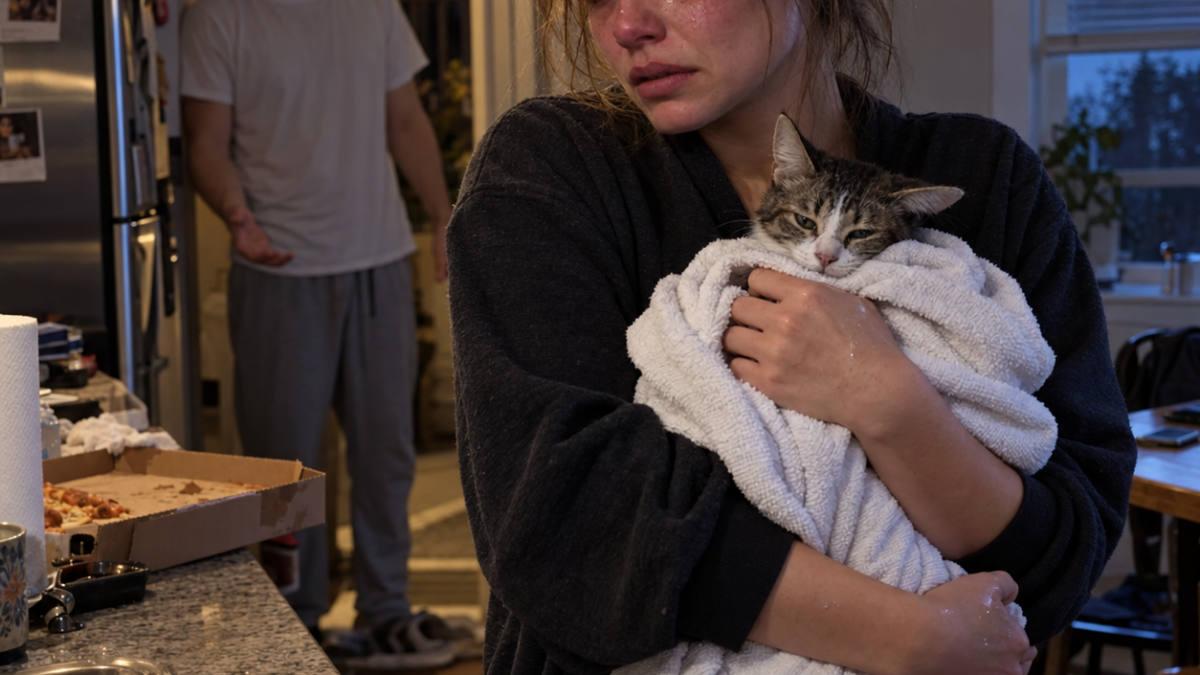
I slid the towel beneath her and lifted her against my chest. She was wet. Her fur at the mouth was slick. Her head rolled backward, too heavy, too soft. I could feel her heart hammering through the towel, fast and fragile.
I carried her downstairs.
Mark stood in the kitchen staring at the magnet on the refrigerator like it was written in code.
“Did you call?” I asked.
“I’m doing it.”
“Give me the phone.”
He handed it over.
The receptionist at Brightside answered on the second ring. I told her Juniper’s name, weight, diagnosis, medication, seizure duration as best I could estimate. My voice sounded calm because emergency turns some people sharp. I am one of those people. Panic comes later, when there is room for it.
“Bring her in now,” the woman said. “Drive safely. We’ll be ready.”
I hung up and looked at Mark.
He had one hand over his mouth. His face had gone pale.
“Emma,” he said. “I’m so sorry.”
I moved past him.
“Get her carrier,” he said, reaching toward the closet.
“No,” I snapped. “She’s staying in my arms.”
I do not know if that was medically correct. I only knew I could not put her down.
The drive to Brightside lived afterward in flashes.
Rain misting the windshield.
Mark in the passenger seat saying, “I’m sorry,” too many times.
My left hand gripping the steering wheel, my right hand pressed against Juniper through the towel.
A red light that seemed to last forever.
My own voice whispering, “Stay with me. Stay with me. Stay with me.”
Mark touched my shoulder once.
I flinched so hard he pulled away.
At the emergency clinic, two vet techs met us before we fully reached the counter. One took Juniper from my arms with practiced gentleness. Another asked questions while guiding me toward a plastic chair.
“When was her last dose?”
“Yesterday. Eight p.m.”
“Was tonight missed?”
I looked at Mark.
His face crumpled.
“Yes,” I said.
The tech did not react with judgment. Professionals usually do not have to. Facts can condemn a person all by themselves.
“How long was the seizure?”
“I don’t know. I found her at 10:20. She was already seizing.”
“Any cluster activity before this?”
“Last winter, after a delayed dose. She stabilized after medication adjustment.”
“Okay. We’re going to take her back, start anticonvulsants, check her temperature and bloodwork. The doctor will come talk to you.”
Then Juniper was gone behind swinging doors.
The lobby smelled like bleach, coffee, and fear.
A man across from us held a shoebox in both hands. A teenage girl cried silently into her hoodie while her mother stroked her hair. Somewhere behind the wall, a dog barked once, then whimpered.
Mark sat beside me, elbows on knees, hands clasped.
“I really thought I would remember,” he whispered.
I stared at the doors.
He tried again. “The show was on, and I was going to do it after the episode, but then I guess—”
“Stop.”
“I know. I know there’s no excuse.”
But there always was.
That was the thing.
With Mark, there was always no excuse followed immediately by an excuse.
No excuse, but he was tired.
No excuse, but work had been stressful.
No excuse, but he thought I would be home earlier.
No excuse, but the reminder came while he was in the bathroom.
No excuse, but I knew how his memory was.
No excuse, but the episode was almost over.
No excuse, but he had meant to.
He looked at me with wet eyes. “Please say something.”
“I can’t.”
“Emma.”
“I need to know if she’s going to live before I can talk to you.”
That silenced him for almost ten minutes.
The doctor came out at 11:06. Her name was Dr. Mendoza. She was small, tired-looking, with kind eyes and a voice that made every sentence sound like something stable enough to hold.
“Juniper is alive,” she said first.
My body folded.
Not collapsed. Folded. Like a string had been cut.
Mark put a hand on my back, and I moved forward out of reach.
Dr. Mendoza either noticed and ignored it or had seen enough family dynamics in emergency rooms to know when not to step into one.
“She’s sedated now,” she continued. “Her temperature was elevated, which can happen after prolonged seizure activity. We’ve given medication to stop any ongoing activity and started fluids. Her bloodwork doesn’t show anything catastrophic right now, but we want to monitor her for several hours to make sure she doesn’t cluster again.”
“Will there be brain damage?” I asked.
“We can’t say tonight. The fact that she responded is good. The next twelve to twenty-four hours matter. I’m cautiously optimistic.”
Cautiously optimistic.
I clung to those words like rope.
“Can I see her?”
“In a little while.”
Mark cleared his throat. “Doctor, could missing one dose really cause all this?”
Dr. Mendoza turned to him.
She did not glare. She did not accuse. She simply looked at him with the unbearable calm of someone who tells the truth for a living.
“For some seizure patients, yes,” she said. “Consistency is very important. Timing matters.”
Mark nodded, swallowing hard.
I felt no satisfaction. No victory. Only a terrible hollow ache.
Because I had told him.
I had told him, and texted him, and trusted him anyway.
We waited.
Midnight came and went.
At 12:40, they let me see her.
Juniper lay in a warmed kennel with an IV taped to one shaved leg. Her body looked too small beneath the blanket. Her eyes opened halfway when I whispered her name, then closed again. The fur around her mouth had been cleaned, but it still looked damp. One ear stood up. The other leaned.
“Oh, baby,” I said.
A tech opened the kennel so I could reach in and touch her forehead. Juniper gave the faintest sigh.
That sigh nearly broke me.
It was trust.
Pure, stupid, undeserved trust.
She did not know who had forgotten. She did not know promises or weaponized incompetence or the architecture of emotional labor. She only knew that I was there now, and that my hand meant safety.
I pressed my forehead to the metal edge of the kennel and cried in a way I had not allowed myself to cry in the lobby.
Not loud.
Not dramatic.
Just tears pouring silently down my face, dropping onto the blanket near her paws.
Mark stood behind me.
“I’m sorry,” he whispered again.
This time, the words did something strange inside me.
They did not soften me.
They clarified me.
Apologies are supposed to reach the place that hurts. His never did anymore. They hovered near the surface, polished and familiar, waiting to be accepted so things could go back to normal.
But normal had nearly killed Juniper.
At 2:58 a.m., Dr. Mendoza said Juniper was stable enough to go home under strict observation, with rescue medication, updated instructions, and a warning to return immediately if she seized again. She told us to keep her warm, quiet, and away from stairs until fully coordinated.
I signed the paperwork with a hand that shook from exhaustion.
The bill was $1,184.62.
I paid it without looking at Mark.
He watched my card go into the reader.
“I can Venmo you half,” he said.
I turned my head slowly.
He seemed to understand, too late, that he had said another wrong thing.
“Or all,” he added quickly. “I mean, I’ll pay for it. Obviously.”
Obviously.
Nothing about that night had been obvious to him until someone else named it.
We drove home in silence.
Juniper slept in her carrier this time, because the sedative made her limp and the vet tech had helped me settle her safely with rolled towels. I kept one hand on the carrier door at every red light. Mark sat beside me, staring forward, eyes shiny in the passing streetlights.
When we pulled into the driveway, the apartment building looked unreal. Same cracked walkway. Same leaning mailbox. Same second-floor neighbor’s wind chime turning in the cold. Same porch light that flickered when it rained.
But I was not the same person walking back inside.
Mark noticed before I did.
He stepped out of the car and waited while I lifted Juniper’s carrier.
“Let me take her,” he said.
“No.”
“Emma, please. I want to help.”
I looked at him over the roof of the car.
There was that word again.
Help.
“I’ve got her.”
He followed me upstairs.
Inside, the apartment still smelled like pizza. The TV was off now, but the pizza box remained open on the table. The beer bottle sat where he had left it. His socks were still on the floor. The blue medication box was still on the kitchen counter, bright and innocent under the overhead light.
I carried Juniper into the bedroom, but then remembered the spilled water and the chaos beside the bed. So I set her up in the living room instead, in her round gray bed near the radiator. I layered blankets around her, checked her breathing, arranged the rescue medication where I could reach it, set three alarms on my phone, then wrote the next dose time on a sticky note even though I knew I would not sleep enough to need reminding.
Mark stood in the doorway.
He looked smaller than usual.
Guilt can do that to a person.
For a few minutes, neither of us spoke.
Juniper stirred, lifted her head weakly, then lowered it again. I touched her back with two fingers. Her fur rose and fell beneath them.
“Is she okay?” Mark asked.
“She had a seizure,” I said. “She’s sedated.”
He rubbed both hands over his face. “Babe… you’re overreacting.”
The words were quiet.
Almost tired.
He did not say them like a villain.
That was what made them worse.
He said them like a man reaching for the nearest tool that had always worked before. Minimize the damage. Soften the accusation. Reposition reality until my reaction became the problem.
I looked at him.
He continued, because men like Mark often mistake silence for permission.
“I mean, I know it was scary,” he said. “I’m not saying it wasn’t. But she’s alive. She’s home. The vet said she’ll probably be okay.”
I did not move.
“And I said I was sorry,” he added. “I don’t know what else you want me to do. You could’ve called me again at eight to make sure.”
There it was.
Not shouted.
Not thrown.
Placed gently on the table between us like something reasonable.
You could’ve called me again.
The sentence landed with a final click.
A door locking.
Or unlocking.
I am still not sure which.
For a second, my mind emptied. Then years of tiny moments began lighting up behind my eyes, one after another, like windows in a dark building.
Why didn’t you call me from the grocery store?
You should’ve reminded me about the dinner.
I didn’t know the towels had to go in right away.
You’re better at scheduling.
My mom likes hearing from you.
I would have done it if you asked.
You know I forget things.
Why are you making such a big deal out of this?
It was all there, the whole map of our relationship, suddenly visible from above.
Mark could be relaxed because I was vigilant.
Mark could be easygoing because I absorbed consequence.
Mark could seem kind because I kept arranging the world so his carelessness rarely touched anyone but me.
And when it finally did—when his forgetfulness reached past my inconvenience and put a living creature’s body on the floor—he still found a way to place the last piece of responsibility back in my hands.
I stood slowly.
He watched me with caution.
“I asked you at 6:30,” I said.
“I know.”
“I texted you at 7:45.”
“I know.”
“I told you exactly where the medication was.”
“Yes.”
“I told you why it mattered.”
His jaw tightened. “Emma, I know I messed up.”
“No,” I said. “You don’t.”
His expression shifted. A flash of irritation appeared beneath the remorse. It was quick, but I saw it.
“I almost watched her die tonight,” I said.
“That’s not fair.”
“To who?”
“To me,” he said, then seemed surprised by his own honesty.
I almost laughed.
Not because it was funny, but because pain sometimes reaches a pressure point where laughter becomes the only escape valve.
“To you,” I repeated.
“I’m not the monster you’re making me out to be.”
“I didn’t call you a monster.”
“But you’re looking at me like one.”
“I’m looking at you like someone I trusted with one important thing, and you failed her.”
His eyes hardened then, wounded pride rising where accountability should have been.
“It was one mistake.”
“No,” I said. “It was one emergency. The mistake has been happening for years.”
He shook his head. “That is so unfair.”
I walked to the kitchen counter and picked up the blue box.
It weighed almost nothing.
That tiny box had become the heaviest thing in our home.
“I have explained this to you so many times,” I said. “I have begged you to understand that I don’t want to be your manager. I don’t want to be the person who has to remember everything and then remind you and then check whether you did it.”
“I do things around here.”
“You do tasks when I assign them.”
“That’s not true.”
“Name one thing you fully own.”
He opened his mouth.
Closed it.
Then said, “I pay the internet bill.”
“It’s on autopay from your account because I set it up.”
His face flushed.
“I take out the trash.”
“When I tie the bag and put it by the door.”
“I feed Juniper sometimes.”
“When I remind you.”
“I cleaned the bathroom last weekend.”
“Because your parents were coming.”
He threw his hands up. “So nothing counts with you.”
“Consistency counts,” I said. “Reliability counts. Not needing applause for doing things adults do counts.”
He stepped back like I had slapped him.
Maybe part of me wanted to.
Not with my hand. Never that.
But with truth.
With every swallowed frustration I had buried because he was not cruel, because other women had it worse, because he loved me in the ways he found easy.
“I can’t do this tonight,” he muttered.
“That’s the problem. You never can when it matters.”
His eyes snapped back to mine. “I said I was sorry.”
“And I heard you.”
“So what now? You’re just going to punish me forever?”
I looked at Juniper asleep in the little gray bed, her body small beneath the blanket.
Something settled in me.
Not rage.
Not even certainty.
A grief so clean it felt almost calm.
“No,” I said. “I’m not going to punish you.”
He exhaled like he had won some small ground.
Then I walked past him to the hall closet and pulled down my duffel bag.
His face changed.
“Emma.”
I went to the bedroom.
“What are you doing?”
I opened the dresser and began pulling clothes from the top drawer. Underwear. Socks. Two pairs of jeans. A sweater. My clinic hoodie. I moved carefully, not frantically. That seemed to scare him more.
“Babe, stop.”
I did not stop.
He followed me into the room. “You can’t be serious.”
I grabbed my charger from the outlet.
“You’re exhausted,” he said. “You’ve been up all night. This isn’t the time to make some dramatic decision.”
I opened the bathroom cabinet and took my toothbrush, face wash, medication, the little bottle of lavender oil my sister had given me.
“I’m not being dramatic.”
“You’re packing a bag at three in the morning.”
“Yes.”
“Over a cat.”
I turned.
There it was.
The sentence beneath every apology.
Not our cat.
Not Juniper.
A cat.
Something lesser.
Something replaceable.
Something too small to justify consequences.
I looked at this man I had loved, this man who had held me when my father died, who knew how I took my coffee, who had once driven forty minutes in a snowstorm because I mentioned craving soup from one specific diner. He was not evil. That almost made it harder.
He had enough kindness to make leaving look unreasonable from the outside.
But not enough responsibility to make staying safe.
“I’m leaving,” I said, “because I can’t build a life with someone who treats responsibility like it’s optional.”
He stared at me.
Then came the anger.
Not explosive. Mark did not do explosive. His anger was cleaner, quieter, designed to make the other person feel unstable.
“You know what?” he said. “Fine. Go. But don’t pretend this is all on me. You hover over everything. You make it impossible for anyone to do anything right, and then you act like a martyr.”
The words hit places he knew were tender.
For years, I had feared I was too much. Too anxious. Too controlling. Too particular. I had apologized for my lists, my alarms, my need to know details, my inability to “just relax” when something mattered.
Mark knew that.
He had comforted me through it.
Now he used it.
I folded another shirt and placed it in the duffel.
“I’m not discussing this while Juniper is sedated in the living room.”
He laughed once, bitterly. “Of course. Saint Emma. Always calm. Always right.”
My hands trembled, but my voice did not.
“No. Not always. Just done.”
He followed me back to the living room as I gathered Juniper’s medication, her discharge papers, the rescue syringe, her favorite blanket, and the small stuffed mouse she had carried around since the shelter.
“You’re really going to take her?” he asked.
That stopped me.
I looked at him, stunned.
“Were you planning to keep her?”
His face reddened. “No, I just mean—this is our apartment.”
“She is my cat.”
“I know that.”
“No, Mark. You apparently don’t.”
He looked toward Juniper, then away.
I crouched beside her bed.
“June,” I whispered. “Baby, we’re going.”
Her eyes opened halfway. The sedative made her slow, clumsy. She blinked at me, then gave a tiny rasping meow that shredded what remained of my composure.
I slid my hands under her carefully, blanket and all, and placed her in the carrier. She did not resist. She trusted me completely.
That trust felt like forgiveness I had not earned yet.
Mark stood by the door as I lifted the carrier and slung the duffel over my shoulder.
“Where are you going?” he asked.
“My sister’s.”
“At this hour?”
“Yes.”
“What am I supposed to tell people?”
I paused with my hand on the doorknob.
And despite everything, that was the moment I knew there was no coming back.
Not when he forgot the pill.
Not when he blamed me.
Not when he said “over a cat.”
But when his first clear fear was not losing me.
It was explaining himself.
“Tell them the truth,” I said.
Then I opened the door and walked out.
The hallway was cold and smelled faintly of someone’s old cigarette smoke. My footsteps echoed down the stairs. Behind me, Mark did not call my name.
Outside, the sky was beginning to pale at the edges.
The world had the strange suspended quality of early morning, when even the city seems ashamed of how much pain can happen while everyone else sleeps.
I put Juniper’s carrier on the passenger seat and buckled it in, because some absurd practical part of me still knew how to protect what mattered. She shifted inside, pressing her face against the mesh.
“I’m sorry,” I whispered.
She blinked slowly.
No accusation.
No understanding.
Just presence.
I sat behind the wheel and gripped it until my knuckles hurt.
For the first time all night, I shook.
Not a little.
My whole body trembled so violently I had to wait before I could start the car. The adrenaline had drained out, leaving grief in its place. I thought I would feel brave. Instead, I felt hollow, humiliated, and strangely weightless.
I had imagined leaving someone before. Quietly, in angry fantasies after an argument. I had pictured clean lines, firm words, maybe the satisfaction of finally choosing myself.
The real thing felt nothing like that.
It felt like failure.
Like walking away from a house I had spent years decorating with hope.
At 3:29 a.m., I called my sister.
Maya answered on the first ring, which meant she had not been sleeping well again. She was five years older than me, a high school English teacher, divorced, and allergic to nonsense in a way I had always admired but rarely managed to imitate.
“Em?” Her voice sharpened instantly. “What happened?”
“I left Mark,” I said.
Silence.
Then, “Where are you?”
“In the car.”
“Are you safe?”
“Yes.”
“Is Juniper with you?”
That question broke me.
I began crying so hard I could barely breathe.
Maya did not ask for details. She simply said, “Come here. Drive slow. I’m making coffee.”
Twenty-two minutes later, I pulled into her driveway.
Maya came out wearing flannel pajama pants, snow boots, and her ex-husband’s old college sweatshirt, her hair twisted on top of her head like she had fought sleep and lost. She opened the passenger door before I could move.
“Oh, June Bug,” she whispered, looking into the carrier.
Juniper gave one weak blink.
Maya’s face changed from worry to fury so fast I almost stepped back.
“He forgot.”
I nodded.
She looked past me toward the empty street as if she might see Mark there and commit a felony.
“Inside,” she said.
Maya’s house was small, warm, and cluttered in a way that made every room feel lived in rather than neglected. Student essays covered the dining table. A stack of library books leaned dangerously near the couch. Her golden retriever, Max, whined from behind the baby gate in the kitchen, deeply offended that a crisis was happening without his participation.
We settled Juniper in Maya’s guest room, away from Max, with towels on the floor and the carrier door open. I gave Maya the vet instructions, then repeated them because my brain kept snagging on details.
“She needs quiet,” I said. “No stairs. Next dose at eight p.m., but they added this rescue med if she has another seizure lasting more than—”
“I’ve got it,” Maya said.
I flinched.
She noticed immediately.
Her face softened. “I mean I am writing it down, setting alarms, and doing it with you. Not taking it lightly.”
That made me cry again.
Maya wrote every instruction on a yellow legal pad in her sharp teacher handwriting. Medication. Time. Dosage. Emergency vet number. Signs to watch for. She set alarms on her phone and mine. She put the rescue medication in a bowl on the nightstand where we could see it.
Then she handed me coffee I did not drink.
For a while, we sat on the guest room floor and watched Juniper breathe.
At 5:12, my phone lit up.
Mark.
I stared at his name until the screen went dark.
It lit up again.
Then a text appeared.
Please tell me you got there safe.
Another.
Emma, I’m sorry. I don’t know what else to say.
Another.
You scared me leaving like that.
Maya saw my face and held out her hand.
“Give it to me.”
“No.”
“Then put it on Do Not Disturb.”
I did.
At 6:03, his mother called.
I almost laughed.
“Already?” Maya said.
“I guess.”
“Do not answer that.”
“I wasn’t going to.”
But the call did something worse than interrupt. It opened the door to the outside world.
By noon, Mark’s version had begun circulating.
Not publicly at first. Quietly. Privately. Through the polite little tunnels people use when they want to gather support before facts arrive.
My mother called while I was sitting beside Juniper, who had eaten two teaspoons of wet food and looked offended by the blandness of it.
“Sweetheart,” she said carefully, “Mark called.”
Of course he had.
“What did he say?”
“He said there was an accident with Juniper’s medication.”
“An accident.”
“He said he forgot one dose and you left in the middle of the night.”
“That’s true.”
My mother exhaled. “Emma.”
I closed my eyes.
That one word contained an entire childhood of being told to calm down.
My mother was not a bad woman. She loved me fiercely in the way she understood love. But she had stayed married to my father for thirty-six years, and my father had been the kind of man who could build a porch, charm a room, and forget every emotional need that did not directly involve him. My mother’s whole life had been one long exercise in explaining men to disappointed women.
“Mom,” I said, “Juniper had a seizure.”
“I know, honey. Mark was very upset.”
I looked at Juniper’s thin shaved leg where the IV had been.
“Mark was upset.”
“He cried on the phone.”
“He should cry.”
“I’m not saying he shouldn’t. I just…” She paused. “Sweetheart, you know how men can be. They don’t always think the way we do.”
That old sentence.
Passed from woman to woman like an heirloom nobody wanted but everyone kept polishing.
“They can learn,” I said.
“Yes, but ending a relationship over one mistake—”
“It wasn’t one mistake.”
“Did he hit you?”
The question came so bluntly that I opened my eyes.
“No.”
“Did he cheat?”
“No.”
“Then maybe you should take a breath before making a permanent decision.”
I loved my mother.
I knew she meant well.
But in that moment, I saw the invisible measuring stick she had been handed and had handed to me without meaning to.
Did he hit you?
Did he cheat?
Did he pay the bills?
Was he polite in public?
Then perhaps your hurt was negotiable.
“Mom,” I said quietly, “I am tired of having to prove neglect counts.”
She was silent.
I continued, “I am not asking you to hate him. I’m not asking you to pick sides. But I need you to understand that he was responsible for keeping a living creature safe for one evening. I reminded him twice. He forgot. Then he told me I should have called again. That is not an accident. That is a pattern with consequences.”
My mother did not answer right away.
When she did, her voice was softer.
“Is Juniper going to be okay?”
“I hope so.”
“Are you?”
I looked around Maya’s guest room at the legal pad, the medication, my duffel half-unzipped on the floor.
“No,” I said. “But I think I might be later.”
That afternoon, Mark came to Maya’s house.
I knew he would.
Men like Mark did not like unresolved discomfort. They liked apologies accepted quickly, order restored, their image returned to them clean.
He arrived at 2:18 p.m. carrying a bouquet of grocery store tulips and a canvas tote bag filled with Juniper’s things he had gathered from the apartment. The sight of the tote nearly undid me. Her brush. Her ceramic bowl. The ridiculous banana-shaped toy she loved. A bag of treats.
Maya opened the door while I stood halfway down the hall, hidden but listening.
“Hi, Maya,” Mark said, voice low and humble.
“Mark.”
“I was hoping to talk to Emma.”
“She’s resting.”
“I really need to see her.”
“No, you want to see her.”
A pause.
“I brought Juniper’s things.”
“Leave them on the porch.”
“Maya, please.”
The old charm was there, frayed but still practiced. The gentle wounded voice. The decency costume.
“I made a terrible mistake,” he said. “I know that. But Emma just left. She won’t talk to me. I love her.”
Maya stepped onto the porch and pulled the door mostly closed behind her. Her voice dropped, but not enough.
“You love how easy she makes your life.”
“That’s not fair.”
“If you say that one more time, I’m going to start charging you royalties.”
“Maya—”
“No. You don’t get to come here and manage the optics.”
“That’s not what I’m doing.”
“It is exactly what you’re doing. You called your mother. You called her mother. You framed it as Emma having some emotional overreaction because you forgot a pet chore.”
“It was not a chore to me.”
“Then why didn’t you do it?”
Silence.
Maya had always been better than me at letting silence force truth out into the open.
Mark eventually said, “I forgot.”
“And then blamed her.”
“I was panicked. I said the wrong thing.”
“You said the honest thing.”
Another silence.
I gripped the hallway wall.
Mark’s voice changed. Sharper. “Can I talk to my girlfriend, please?”
Maya laughed once, without humor.
“Interesting word. Girlfriend. Not manager. Not mother. Not emergency backup system.”
“You don’t know our relationship.”
“I know my sister weighed ninety-eight pounds in tenth grade because she was so anxious trying to keep peace in our house that she couldn’t eat. I know she learned to anticipate everyone’s needs like survival depended on it. I know she has spent years trying not to become Mom, and somehow she still found a man who made her carry the entire invisible life of the home while he got praised for being pleasant.”
My throat tightened.
Mark said nothing.
Maya softened slightly, which for her meant going from blade to blunt instrument.
“Go home. Give her space.”
“I just want her to know I’m sorry.”
“She knows.”
“Then why won’t she talk to me?”
“Because sorry doesn’t resurrect trust on command.”
The porch boards creaked.
“I’ll leave the bag,” he said.
“Good.”
“And the flowers?”
“Take them with you.”
“Maya.”
“She does not need something else alive that you’ll forget to care for.”
The door opened a moment later.
Maya came in carrying the tote, her mouth tight.
“He’s gone,” she said.
I sat down on the hallway floor.
She set the tote beside me and lowered herself across from me.
“You heard?”
“Most of it.”
“Good. I was brilliant.”
A broken laugh escaped me.
Then I leaned forward, and she held me while I cried into her shoulder like I was seventeen again.
That should have been the end.
It wasn’t.
The next week became a masterclass in how a nice man protects his image.
Mark did not insult me publicly. He did not post vague quotes about loyalty or heartbreak. He did not show up drunk or angry. That would have been too obvious.
Instead, he became quietly devastated in ways people could witness.
He took time off work because he “couldn’t focus.” He told mutual friends he was worried about me. He said I was under a lot of stress. He said Juniper’s medical emergency had triggered something. He said he respected my space, but he hoped I would eventually be willing to “process things rationally.”
Rationally.
That word reached me through three different people.
The first was my coworker, Lindsay, who cornered me by the vaccine fridge two days after I returned to work.
“I probably shouldn’t say anything,” she began, which guaranteed she would.
I kept counting syringes.
“Then don’t.”
“It’s just that my husband knows Mark from that softball league, and he said Mark is really torn up.”
I placed another syringe into the tray.
“He should be.”
Lindsay shifted. “He said it was a misunderstanding.”
My hand stopped.
“A misunderstanding of what?”
“I don’t know. The medication or something. He said he thought you were coming home to do it.”
I turned slowly.
Lindsay’s face changed as she realized she had stepped into deeper water than expected.
“He said that?”
“That’s what Jason said he said. Maybe it got repeated wrong.”
Of course.
Stories always soften around men like Mark. Their edges sanded down by other men who hear themselves in him and women who have been taught not to make domestic failures sound too serious.
“He did not think I was coming home to do it,” I said. “I called him. He confirmed. I texted him. He sent a thumbs-up. He forgot and blamed me for not calling again.”
Lindsay’s eyes widened.
“Oh.”
“Yeah.”
She looked toward the exam room hallway, embarrassed. “I’m sorry. I didn’t know.”
“That’s why it’s usually better not to carry messages for men who are trying to look wounded.”
It was harsher than I usually would have been at work.
But I was done making my pain easier to digest.
The second person was Mark’s best friend, Daniel.
He texted me Friday night.
Hey Emma. I know things are rough. Mark is wrecked. I don’t want to get involved, but he’s a good guy who made a dumb mistake. Don’t throw away four years over one bad night.
I stared at the message while Juniper slept beside me on Maya’s couch, her head on my thigh. She had improved slowly. Still wobbly. Still tired. But alive, eating, irritated by medication, and therefore herself.
I typed three different responses and deleted them all.
Then I wrote:
I’m not throwing away four years. I’m refusing to throw away the rest of my life. Please don’t message me about this again.
Daniel did not reply.
The third person was Mark’s mother, Susan.
She called from a number I did not recognize because I had stopped answering hers.
I picked up thinking it might be a client from work.
“Emma,” she said, already crying. “Honey, please don’t hang up.”
I closed my eyes.
“Susan, I can’t do this.”
“Mark is falling apart.”
I stood in Maya’s kitchen, staring out at the backyard where Max was rolling shamelessly in wet leaves.
“I’m sorry he’s hurting.”
“He loves you so much.”
“I know.”
“Then why are you doing this?”
That question had followed me everywhere all week.
Why are you doing this?
As if I had created the damage by responding to it.
As if consequences were cruelty.
“I’m leaving a relationship that does not feel safe for me anymore.”
“He would never hurt you.”
“He did.”
“You know what I mean.”
“Yes,” I said. “I do. That’s the problem.”
Susan breathed shakily. “It was a cat, Emma.”
The words were quiet. Maybe she regretted them immediately. Maybe not.
Either way, they cleaned the last fog from the glass.
“She has a name,” I said.
“I know that.”
“No. You don’t. You think this is about me choosing a pet over your son. It isn’t. It’s about your son agreeing to be responsible for a vulnerable life, failing, and then blaming me because I didn’t supervise him enough. That is the man I would be marrying. That is the father of any child I might have. That is the person I would rely on in sickness, grief, emergencies, aging, everything. And he showed me what happens when the responsibility is inconvenient.”
Susan was silent.
I continued, more gently than I felt, “I know you love him. I know you want to protect him. But I am not going to sacrifice myself to preserve the version of Mark everyone prefers.”
Her voice came back colder.
“You always did think you were better than us.”
There it was.
The family resemblance.
I hung up.
Then I blocked the number.
By the end of that week, I had enough clarity to go back to the apartment.
Not alone.
Maya came with me, along with her friend Tessa, who worked as a paralegal and had the calm, alert energy of someone who knew exactly how badly things could go when people underestimated paperwork.
Mark agreed by text to be out of the apartment from noon to three so I could collect my belongings. His message was formal, wounded, and clearly edited by someone else.
I respect your need for space. I will not interfere. I hope we can eventually handle this with kindness.
Kindness.
I nearly threw my phone across the room.
The apartment looked different in daylight.
Smaller.
Messier.
Less like a shared life and more like a set I had been maintaining.
The pizza box from that night was gone, but everything else bore the marks of my absence. Dishes filled the sink. Mail piled on the counter. A laundry basket overflowed beside the bedroom door. One of Juniper’s water bowls sat empty near the bookshelf.
Maya saw it and muttered something that would have made our mother gasp.
I moved through the rooms with a clipboard because Tessa insisted.
“Photograph what you take,” she said. “Photograph what you leave. Photograph damage. Screenshot every message. Assume future you will need evidence current you thinks is unnecessary.”
So we documented.
Furniture I had paid for.
Books.
Clothes.
Kitchen equipment.
Juniper’s supplies.
The framed print from our first trip to Maine.
I stopped in front of that one.
It showed a foggy coastline, gray rocks, a white lighthouse barely visible in the distance. We had bought it from a little gallery on a rainy afternoon two years earlier. Mark had held my hand the entire walk back to the inn. That night, we ate clam chowder and planned a future with such casual confidence it hurt to remember.
A house someday.
Maybe outside the city.
A room for my books.
A garage for his woodworking tools, though he had never actually built anything more complicated than an IKEA shelf.
Maybe children.
Maybe not.
Definitely old dogs, he had said, because old dogs deserved soft landings.
Definitely cats, I had added.
He had kissed my temple and said, “As many weird little creatures as you want.”
I stood there looking at the print until Maya touched my arm.
“You don’t have to take it.”
“I know.”
“You also don’t have to leave it because it hurts.”
So I took it down.
Behind the frame, the wall was a cleaner rectangle, protected from dust and light.
That was what leaving felt like.
Discovering the outline of what had been there by seeing what remained unstained.
In the bedroom, I found the ring.
Not an engagement ring.
Not officially.
But close enough to steal my breath.
It was in the back of Mark’s sock drawer, inside a small navy velvet box tucked beneath a stack of winter socks. I only found it because I was looking for my passport, which he had once put in that drawer “for safekeeping” after a trip and never returned to the document folder.
The ring was simple. Oval sapphire. Tiny diamonds on either side. Exactly the kind of ring I had once mentioned liking while scrolling online beside him, thinking he was not listening.
For a moment, the room went silent around me.
Maya came to the doorway.
“What?”
I held up the box.
Her face crumpled with pity before she could stop it.
Tessa, practical as ever, said, “Do not take that unless it belongs to you.”
A laugh tore out of me, sharp and ugly.
“No risk there.”
I closed the box and put it back exactly where I had found it.
Then I sat on the edge of the bed we had shared and pressed my palms against my eyes.
The grief came differently this time.
Not for the relationship as it was.
For the relationship I had thought we were close to becoming.
That is one of the cruelest things about leaving someone who is not all bad. You mourn the future version of them you kept waiting for. The man who was always just one breakthrough away. One serious talk. One consequence. One big enough moment that would finally make him understand.
A ring in a sock drawer meant Mark had been planning to ask me to marry him.
It did not mean he was ready to be a husband.
I put my passport in my bag and kept packing.
At 2:43, while Tessa was helping me carry boxes downstairs, Mark came back early.
Of course he did.
His car pulled into the lot as Maya and I were loading Juniper’s scratching post into the back of her SUV. He stepped out wearing jeans, a gray sweater, and the devastated expression of a man arriving to witness his own abandonment.
“You said until three,” Maya called.
“I know,” he said. “I couldn’t stay away.”
Tessa straightened beside the open trunk. “You agreed in writing to give her until three.”
He looked at her, confused. “Who are you?”
“The person reminding everyone that written agreements are useful.”
Mark ignored her and looked at me.
His eyes were red.
Seeing him hurt still hurt me.
That made me angry.
“Emma,” he said. “Can we please talk?”
“No.”
“Five minutes.”
“No.”
“After four years, I don’t deserve five minutes?”
There it was again.
Deserve.
He had moved from apology to bargaining to moral accounting.
I wiped my hands on my jeans. “You can email me about logistics.”
He laughed softly in disbelief. “Email you? I’m not a coworker.”
“No. Coworkers usually follow written instructions.”
Maya made a sound that might have been a cough.
Mark’s face tightened.
“I get it,” he said. “You’re angry. You want to hurt me.”
“I want to leave.”
“That’s the same thing right now.”
“No, Mark. It isn’t.”
He stepped closer. “I found the medication schedule you wrote on the fridge. The new one. Color-coded. Three alarms. Backups. Emergency numbers. You don’t need a partner, Emma. You need an employee.”
The words hit hard because they were polished.
He had been rehearsing.
“You think needing reliability makes me controlling,” I said.
“I think you don’t trust anyone.”
“I trusted you.”
He looked away.
For one moment, shame broke through.
Then pride covered it again.
“I made one mistake,” he said.
“You keep saying that because it makes the story survivable for you.”
“And what’s your story?” His voice rose slightly. “That I’m some neglectful monster? That I almost killed your cat on purpose?”
“No.”
“Then what?”
I looked at him in the parking lot where we had unloaded groceries together, kissed in the rain, argued about nothing, carried Christmas decorations, built a life of ordinary moments that now felt contaminated by all the things I had refused to see.
“My story,” I said, “is that you were given responsibility without me standing over you, and you treated it like something you could get to when convenient. Then when consequences came, you reached for my failure before your own. I can forgive forgetfulness. I can’t marry entitlement.”
His mouth opened slightly.
Behind him, Mrs. Alvarez from 2B had paused by the mailboxes, pretending not to listen. A delivery driver slowed near the curb. Somewhere above us, a window slid open.
Mark noticed too.
Humiliation flushed his face.
“Can we not do this in front of everyone?”
I almost smiled.
Not because I enjoyed his embarrassment.
Because he finally understood public exposure as pain.
I had been privately humiliated for years by the gap between who everyone thought he was and how alone I felt beside him. Now that gap had opened where others could see it, and he wanted privacy.
“I tried doing it privately,” I said. “You called my mother.”
His face changed.
“That was different.”
“How?”
“I was worried about you.”
“You were worried about the story.”
He lowered his voice. “You’re being cruel.”
Maybe I was.
But there is a difference between cruelty and refusing to keep cushioning someone from the truth.
Tessa stepped between us just enough to alter the geometry.
“We’re leaving now,” she said.
Mark looked at the boxes in the car.
Then at me.
Then he said the thing that made Maya take one sharp step forward.
“I hope Juniper was worth it.”
The parking lot went still.
Even Mrs. Alvarez stopped pretending.
For one second, I saw Mark hear himself.
Not the polished version.
Not the nice man.
The small, resentful man beneath it.
His face drained.
“Emma, I didn’t mean—”
“Yes,” I said quietly. “You did.”
I got into Maya’s SUV.
This time, when we drove away, I did not shake.
Two days later, Juniper had another seizure.
Shorter.
Less violent.
But enough to send us back to Brightside with my heart in my throat.
Dr. Mendoza adjusted her medication and recommended follow-up with a neurologist. The earliest appointment was three weeks out unless there was a cancellation. The new routine was stricter, more expensive, more frightening.
For days, my life narrowed to Juniper’s breathing.
Maya and I built our schedules around her medication. I slept in ninety-minute increments. At work, Dr. Patel let me bring Juniper in and keep her in a quiet recovery cage near the back, where I could check on her during breaks. The techs spoiled her shamelessly. Someone made a sign for her kennel that read QUEEN JUNE: ROYAL PATIENT, DO NOT ANNOY.
Juniper accepted the worship as her due.
Mark texted after the second seizure.
Maya must have told someone, or someone told someone, because gossip travels faster than decency.
Is she okay?
I stared at the message.
Then I wrote:
She had another seizure. The vet adjusted her medication. I am handling it.
He replied:
I want to help pay.
I typed:
Send payment to Brightside directly. Account under Juniper Hart.
He did.
To his credit, he paid the full emergency bill and the follow-up deposit. I did not thank him. Payment was not grace. It was responsibility arriving late.
A week passed.
Then another.
I found a short-term sublet through one of Maya’s teacher friends—a small attic apartment above a retired couple’s garage, furnished with mismatched furniture and smelling faintly of cedar and cinnamon. It had slanted ceilings, terrible water pressure, and a window overlooking a maple tree that turned gold all at once.
I loved it immediately.
Not because it was beautiful.
Because every object in it was either mine or temporary.
There were no socks on the floor unless I left them there. No dishes in the sink unless I chose not to wash them. No invisible inventory of someone else’s needs humming beneath my skin.
Juniper adjusted with suspicion.
She spent the first day under the bed, the second day glaring from the windowsill, and the third day claiming the old green armchair as her throne. By the fourth day, she had developed a routine involving sunbeams, judgment, and shouting at birds through the glass.
I began to sleep again.
Not well.
But enough to dream.
The first time I slept six hours straight, I woke up in a panic because no alarm had gone off. Then I remembered Juniper’s medication was not due for two more hours, and I lay there in the morning light with one hand on my chest, feeling something unfamiliar move through me.
Peace.
Not happiness yet.
Peace.
It was quieter than I expected.
Leaving did not fix my life all at once. That is another lie people tell in stories because clean arcs feel better than real healing.
I still cried in grocery store aisles when I reached for the cereal Mark liked.
I still almost texted him when the car made a weird noise because he knew more about engines than I did.
I still missed his laugh during dumb comedies.
I still woke some nights remembering the ring in the sock drawer and had to sit up until my breathing slowed.
But missing someone is not the same as being wrong.
Loneliness is not proof that the life you left was healthy.
Grief is not a command to go back.
A month after I moved into the attic apartment, Mark asked to meet.
His email was careful.
Emma,
I know I don’t have the right to ask for anything. I’ve started therapy. I’m trying to understand the patterns you talked about. I’m not writing to pressure you. I would like one conversation, in a public place, only if you feel comfortable. There are things I need to apologize for properly, without defending myself.
Mark
I read it six times.
Then I sent it to Maya.
Her response came immediately.
Therapy after consequences. Revolutionary.
Then:
But you get to decide. Not me.
I did not answer him for three days.
During those three days, I tried to separate the part of me that wanted closure from the part of me that wanted proof he had changed so I could stop grieving. Those are not the same thing, though they often wear the same face.
In the end, I agreed to meet at a coffee shop downtown on a Saturday morning. Public. Daylight. One hour.
I arrived ten minutes early and chose a table near the window.
Mark arrived exactly on time.
He looked thinner. His beard was slightly untrimmed. He wore the navy jacket I had bought him for his birthday. Seeing it made my stomach twist.
He did not try to hug me.
Good.
“Hi,” he said.
“Hi.”
We ordered coffee. Mine black, because I had forgotten to ask for oat milk. His with cream, no sugar. I hated that I still knew.
For a while, we sat with the awkwardness of people who have seen each other half-asleep, sick, naked, laughing, furious, and now must speak like acquaintances.
“How’s Juniper?” he asked.
“Stable.”
“I’m glad.”
I nodded.
He looked down at his cup. “I rehearsed a lot of things to say, but they all sound like excuses now.”
“That’s probably a good sign.”
A faint, sad smile crossed his face.
Then he took a breath.
“I did blame you,” he said. “That night. And before that. In ways I didn’t let myself see.” He rubbed his thumb along the paper cup seam. “I kept thinking because I didn’t mean harm, I wasn’t responsible for harm. My therapist keeps asking me what things cost you even when I didn’t intend them to. I hate that question.”
“It’s a good question.”
“Yeah.”
He looked at me then, and for the first time since that night, I saw something more useful than remorse.
I saw shame without performance.
“I am sorry I forgot her medication,” he said. “I’m sorry I sent that thumbs-up and then didn’t set an alarm. I’m sorry I watched TV and ate pizza while she was upstairs suffering because of me. I’m sorry that when you came home terrified, I froze. I’m sorry I made you handle the emergency alone while I stood there feeling bad about myself.”
My throat tightened.
He continued.
“I’m sorry I said you were overreacting. I’m sorry I asked why you didn’t call again. I’m sorry I said ‘over a cat.’ I’m sorry I told people a version that made me sound confused instead of negligent. I’m sorry I made you look unstable because I didn’t want to look careless.”
The coffee shop blurred slightly.
I blinked hard.
Mark’s eyes shone, but he did not cry. I appreciated that more than I expected.
“I also need to say something else,” he said. “You were right about the bigger pattern. I called it helping because it let me feel generous instead of accountable. I waited to be told because then failure could be shared. I made you carry the mental load and then resented you for being tired under it.”
That one hurt most.
Not because it was new.
Because it was true, and he finally knew it.
“Thank you for saying that,” I whispered.
He nodded.
“I’m not asking you to come back.”
I looked at him carefully.
He swallowed.
“I want to. I’d be lying if I said I didn’t. But I know asking would be another way of making my growth your problem. So I’m not asking.” He paused. “I just wanted to say it without needing you to forgive me.”
Outside the window, people moved along the sidewalk in coats and scarves. A little boy dropped a mitten, and his father picked it up, then crouched to help him put it back on. Such a small act. Such a complete one.
“I do forgive parts of it,” I said slowly.
Mark’s face tightened.
“But forgiveness is not access.”
He nodded like the words hurt but landed somewhere fair.
“I know.”
“I hope therapy helps you. I mean that.”
“Me too.”
We sat quietly.
Then he reached into his jacket pocket and pulled out an envelope.
“This is for you,” he said. “Not dramatic. No letter trying to win you back. Just the remaining half of the pet insurance deductible and Juniper’s neurologist deposit. I called Brightside, but they said only you could authorize account payments beyond the last bill.”
I took the envelope.
“Thank you.”
“And this.” He placed a small plastic bag on the table.
Inside was the banana toy.
I stared at it.
“I found it under the couch after you moved,” he said. “I know she likes it.”
I almost smiled.
“She loves that stupid thing.”
“I know.”
For a second, grief sat between us gently.
Not as a weapon.
As proof that something real had existed, even if it could not survive.
When the hour ended, we walked out together. The air was cold and bright.
At the corner, Mark stopped.
“I was going to ask you to marry me,” he said.
I already knew, but hearing it aloud still struck deep.
“I found the ring.”
He gave a small nod.
“I figured.”
“It was beautiful.”
His eyes filled then.
I let the silence hold that.
Then I said, “A proposal would have made me happy.”
“I know.”
“But it wouldn’t have made me safe.”
He closed his eyes briefly.
When he opened them, he looked older.
“You’re right.”
We stood there, two people on a sidewalk with an entire lost life passing invisibly between us.
Then he said, “Take care of yourself, Emma.”
“You too, Mark.”
I walked away first.
That time, I did cry.
But I did not turn around.
Winter came early that year.
The maple outside my attic window lost its leaves, and the world became gray branches, slate skies, and the kind of cold that slips under doors. Juniper grew stronger. Her neurologist, Dr. Chao, was a blunt woman with silver hair and bright red glasses who called Juniper “spicy” after Juniper tried to bite her during an exam.
“She has opinions,” I said.
“She has excellent boundaries,” Dr. Chao replied.
I liked her immediately.
The medication adjustment worked. Juniper went six weeks without a seizure. Then eight. Then ten.
I began building a life that did not require constant translation to someone else.
On Tuesdays, Maya came over after work, and we ate takeout on the floor because I still did not have a dining table. On Thursdays, I went to a yoga class where I was terrible and nobody cared. On Sundays, I volunteered at a rescue that specialized in senior and special-needs cats, which was either healing or masochism depending on the week.
One of the rescue coordinators, a woman named Beth, asked me once why I came in so reliably.
I was cleaning a litter box at the time.
“Because creatures shouldn’t suffer because people get busy,” I said.
Beth looked at me for a long second, then nodded.
“No,” she said. “They shouldn’t.”
At work, something shifted too.
Maybe because I had changed.
Maybe because once a woman stops apologizing for having limits, people either adjust or reveal themselves.
When Dr. Patel asked if I could stay late for the third Friday in a row, I said, “I can stay until six, but not after.”
She blinked. “Okay.”
That was it.
No punishment.
No disappointment.
Just okay.
It stunned me how often boundaries survived being spoken.
Not always. But often enough to make me wonder how much of my life I had surrendered to imagined consequences.
Lindsay eventually apologized.
Not in the rushed hallway way people apologize to clear tension, but properly. She brought me a coffee one morning and said, “I repeated something without knowing the truth. I’m sorry.”
I accepted.
Then she lowered her voice and said, “Can I ask you something personal?”
I raised an eyebrow.
“My husband does the ‘just ask me’ thing. A lot.”
I looked at her tired eyes, her messy ponytail, the baby spit-up on her shoulder from her six-month-old.
“I’m sorry.”
“How did you know when it was enough?”
The question stayed with me.
I could have said, When Juniper almost died.
But that was only the event.
Not the answer.
“I think,” I said slowly, “it was enough when I realized I wasn’t asking for help anymore. I was asking not to be alone.”
Her eyes filled.
She nodded once and walked away before crying.
After that, women at work began telling me things.
Not all at once. Not dramatically. Just little pieces.
A husband who called watching his own children “babysitting.”
A boyfriend who never planned dates but complained they had no romance.
A fiancé who forgot rent twice because money stressed him out, so she paid it and he paid her back “eventually.”
A father who praised himself for doing school pickup once a week while his wife arranged everything else.
Their stories were different.
The shape was familiar.
I did not tell everyone to leave. Life is more complicated than slogans. People have children, mortgages, disabilities, immigration paperwork, shared businesses, fear, hope, love, history, and a thousand tangled reasons for staying.
But I stopped saying, “At least he means well.”
I started saying, “What does it cost you?”
That question changed the room.
In January, I found my permanent apartment.
It was on the second floor of an old brick building with radiators that clanked at night and windows deep enough for Juniper to sit in like a queen surveying her disappointing kingdom. The kitchen had yellow tile from the seventies, the bedroom barely fit my bed, and the bathroom sink dripped unless you turned the handle exactly right.
I signed the lease with a blue pen at a property office that smelled like toner and dust.
When the landlord handed me the keys, I held them in my palm longer than necessary.
Mine.
Not perfect.
Mine.
Maya helped me move, along with Tessa, two coworkers, and Mrs. Alvarez from my old building, who had somehow found out through the neighbor network and arrived with empanadas and the firm declaration that “men are temporary but good Tupperware is forever.”
I laughed harder than I had in months.
We painted the living room a soft warm white. We assembled bookshelves badly and then fixed them. We hung the Maine lighthouse print above the couch.
Maya questioned that.
“You’re sure?”
“Yes.”
“Doesn’t it make you sad?”
“Sometimes.”
“Then why keep it?”
I looked at the foggy coastline, the lighthouse almost hidden but still standing.
“Because I was there too,” I said. “He doesn’t get every memory.”
Maya smiled.
“That,” she said, “is annoyingly healthy.”
Juniper claimed the windowsill before the movers left.
That night, after everyone went home, I sat cross-legged on the floor eating empanadas from a paper plate while Juniper slept in a patch of lamplight. Boxes surrounded us. My back hurt. My bank account was traumatized. Half my furniture did not fit.
I felt happy.
Not triumphant.
Not healed.
Happy in the small, sturdy way of a person who has stopped abandoning herself.
At 8:00 p.m., my alarm went off.
I reached for the blue box.
Juniper opened one eye, already offended.
“Don’t start,” I told her.
She swallowed the pill hidden in a treat, then glared at me as if I had personally ruined medicine.
I checked the time.
8:00.
Exactly.
Nobody praised me.
Nobody saw.
Nobody needed to.
Love happens there too.
In the unseen keeping of promises.
Spring arrived slowly.
Juniper’s fur grew back over the shaved patch on her leg. She regained the weight she had lost. She resumed her hobbies: knocking pens off tables, yelling at closed doors, and pretending she did not enjoy being brushed.
I dated no one.
People had opinions about that.
My mother, who had gradually come around after several long conversations and one private lunch with Maya that I suspect involved emotional violence, tried to be subtle.
“There’s no rush,” she said one afternoon while helping me hang curtains. “But someday, when you’re ready, not all men are like Mark.”
“I know.”
She looked relieved.
“I’m just not interested right now.”
“That’s fair.”
She clipped a curtain ring into place, then said quietly, “I’ve been thinking about what you said. About neglect counting.”
I looked at her.
She did not meet my eyes.
“Your father wasn’t a bad man.”
“I know.”
“But I was very tired.”
There was an entire marriage inside that sentence.
I stepped closer and took the curtain from her hands.
“I know, Mom.”
Her chin trembled.
“I used to think being tired was just part of being loved.”
I swallowed hard.
She laughed sadly. “That sounds terrible out loud.”
“A lot of things do.”
She looked around my apartment, at the yellow kitchen tile, the mismatched furniture, Juniper’s scratching post already shedding cardboard flakes onto the rug.
“I’m proud of you,” she said.
It was not the kind of pride people announce at graduations.
It was quieter.
Harder won.
I hugged her.
For a moment, I felt the strange mercy of breaking a pattern backward, not just forward. Not only saving myself from repeating my mother’s life, but giving my mother language for parts of it she had never been allowed to name.
Mark’s life moved on too.
I heard about it in fragments because we still shared enough social circles for news to drift.
He continued therapy.
He moved into a smaller apartment across town.
He adopted no pets, which I considered growth.
In April, Daniel’s wife, Priya, messaged me asking if we could talk. I hesitated, then agreed to meet at a park near my apartment.
Priya was seven months pregnant, moving slowly, one hand on her belly as we walked. I had always liked her. She was sharp, funny, and had the calm presence of someone who noticed more than she said.
“I wanted to apologize,” she said.
“For what?”
“For believing Mark too easily. Daniel told me the first version, and I thought, well, Emma always was anxious.” She winced. “That was unfair.”
I appreciated her honesty, even though it stung.
“I was anxious,” I said. “That doesn’t mean I was wrong.”
“I know that now.”
We walked past a playground where a toddler was having a full emotional collapse over a stick.
Priya smiled faintly, then grew serious.
“After everything happened, I started noticing how often Daniel says he’ll ‘help’ with the baby.” She looked at me sideways. “Not parent. Help.”
There it was again.
The ripple effect of one woman refusing to carry a story alone.
“What did you say?” I asked.
“I told him if he plans to help me raise his own child, he can start helping by finding another place to live.”
I laughed.
She did too.
Then she sighed.
“He’s trying. Actually trying. Not perfectly. But he read a book. Made a spreadsheet. Scheduled pediatrician interviews without me asking.”
“Good.”
“I think seeing Mark lose you scared him.”
I looked at the trees budding pale green against the sky.
“I don’t want to be someone’s cautionary tale.”
“Maybe you’re not,” Priya said. “Maybe you’re evidence.”
That stayed with me too.
Evidence.
That leaving was possible.
That standards were not cruelty.
That the bare minimum could stop being mistaken for grace.
In May, the rescue asked me to foster a cat.
I said no immediately.
Then I asked for details.
His name was Arthur. Twelve years old. Diabetic. Missing several teeth. Found behind a grocery store with matted fur and the offended dignity of a retired judge.
“He needs insulin twice a day,” Beth said carefully. “Very consistent timing. I know that might be a lot given Juniper.”
I looked at Juniper, who sat on the rescue office desk batting at Beth’s pen because I had brought her for moral support and because she enjoyed ruining paperwork.
Consistent timing.
Medication.
Responsibility.
A year earlier, those words would have tightened around my throat.
Now they felt different.
Not light.
But honest.
Care is heavy sometimes. The problem had never been the weight. The problem had been carrying it alone beside someone pretending his empty hands were clean.
“I can do it,” I said.
Beth studied me.
“You’re sure?”
I smiled.
“Yes. But only if Juniper approves.”
Juniper did not approve.
Juniper considered Arthur an insult, a threat, and possibly a tax auditor. She hissed at his carrier from across the room, then retreated to the top of the bookshelf to look down on him with religious judgment.
Arthur, who had survived the streets and therefore feared nothing, stepped out of the carrier, looked around my apartment, sneezed, and walked directly to Juniper’s food bowl.
Their relationship improved from attempted murder to cold war over six weeks.
Arthur’s insulin routine became part of my life. Seven in the morning. Seven at night. Food first, dose after. Logbook on the fridge. Backup supplies in the cabinet. Vet number on the wall. Maya joked my apartment was becoming a small feline assisted living facility.
Maybe it was.
I liked the rhythm.
I liked being needed by creatures who did not pretend not to need me.
I liked knowing that care given freely did not diminish me the way care extracted silently had.
One evening in June, I came home late from the rescue after a transport delay. Maya was already at my apartment because she had offered to handle the seven o’clock insulin if I got stuck.
When I rushed in at 7:12, breathless and guilty, Arthur was eating calmly, insulin already given, logbook updated.
Maya sat at my kitchen table grading essays.
“You did it,” I said.
She looked up. “Obviously.”
The word made me laugh because from her it meant what it was supposed to mean.
Obviously I listened.
Obviously I understood.
Obviously you are allowed to rely on someone.
I leaned against the doorway and felt tears prick my eyes.
Maya saw.
“Oh, Em.”
“I’m fine.”
“You’re doing that thing where you say you’re fine and look like a Victorian orphan.”
I laughed through the tears.
She stood and hugged me.
“I just forgot what it felt like,” I said into her shoulder.
“What?”
“To have someone do what they said they would do.”
Maya held me tighter.
The final piece of the story with Mark came in late summer, almost a year after the night I left.
It happened at a wedding.
Of course it did.
Life loves bad timing.
Daniel and Priya had their baby in June, then decided in August to have the small backyard wedding they had postponed twice. Priya invited me herself, and after some hesitation, I went. Mark would be there. I knew that. But I was tired of shrinking my life to avoid discomfort.
The wedding took place under string lights in Priya’s parents’ backyard. There were folding chairs, marigold garlands, barbecue from Daniel’s uncle, and a cake that leaned slightly to one side but tasted incredible.
I wore a green dress Maya said made me look “like a woman who pays her own bills and knows secrets.”
Mark arrived alone.
We saw each other first near the lemonade table.
For a moment, the air tightened.
Then he smiled, small and careful.
“Hi, Emma.”
“Hi, Mark.”
He looked well.
Not happy exactly.
But steadier.
“You look good,” he said.
“So do you.”
A silence.
Then, to my surprise, he said, “I heard you’re fostering a diabetic cat.”
I raised an eyebrow.
“News travels.”
“Apparently.”
“What’s his name?”
“Arthur.”
“Of course it is.”
I smiled despite myself.
“He looks like an Arthur.”
“I believe that completely.”
The ease lasted only a few seconds, but it was real.
Then Daniel called Mark over, and he nodded goodbye.
I thought that would be all.
Later, after dinner, speeches began.
Daniel cried through most of his vows. Priya made everyone laugh by promising not to murder him if he loaded the dishwasher incorrectly, “provided he first learns that the dishwasher exists.” People applauded. Daniel bowed his head in acknowledgment. It was sweet.
Then Daniel gave a short speech thanking friends and family.
He thanked Mark as his best man.
Mark stood, embarrassed, raising his glass.
Daniel said, “A lot of you know Mark has had a hard year. He probably won’t love me saying this, but he’s been doing the work. He’s the reason I knew I had to show up differently before my daughter arrived.”
The yard quieted slightly.
Mark looked uncomfortable.
Daniel continued, voice thick. “Sometimes your friends teach you by example. Sometimes they teach you by messing up badly and being honest about it. Mark did both.”
A few people laughed gently.
Then Daniel turned toward Priya. “And Emma, if this is weird, sorry.”
Every head turned.
My stomach dropped.
Priya covered her face with one hand, smiling in horror.
Daniel pressed on because men at weddings are dangerous with microphones.
“But I need to say thank you too. You probably don’t know this, but the way you refused to accept less than partnership changed conversations in our house. It made me look at myself. It made me realize loving Priya wasn’t enough if I expected her to be the project manager of our whole life.”
The backyard went very still.
Mark looked at me, then down at his glass.
Daniel’s voice broke.
“My daughter has a better father because someone told the truth before I became one.”
Priya was crying now.
So was Maya beside me.
So, humiliatingly, was I.
It was not vindication exactly.
It was something quieter.
A recognition that pain, when named honestly, can become more than damage. It can become a door someone else does not have to hit face-first.
After the speeches, I escaped to the side yard to breathe.
The night smelled like grass, smoke, and late-summer flowers. Music started behind me, muffled by laughter. I stood near a fence covered in ivy, pressing a napkin under my eyes.
A few minutes later, Mark appeared at the corner of the house.
He stopped when he saw me.
“Sorry,” he said. “I didn’t know anyone was out here.”
“It’s okay.”
He hesitated. “Daniel should have warned you.”
“Yes.”
“I’m sorry.”
“I’m getting used to men apologizing for Daniel.”
Mark laughed softly.
Then silence again.
Crickets sang in the dark.
Finally, he said, “He’s right, though.”
I looked at him.
“I was angry at you for a long time,” Mark admitted. “Not because you were wrong. Because you became the point in my life where denial stopped working. I hated that.”
“That sounds honest.”
“It is.”
He leaned against the fence, leaving several feet between us.
“I’m not going to pretend I’m transformed. I still catch myself waiting to be told things. I still want credit for basic adulthood sometimes.” He smiled faintly. “My therapist says noticing is not the same as changing, but it’s the part before changing.”
“I like your therapist.”
“She scares me.”
“Good.”
He looked toward the lights where people were dancing.
“I miss Juniper.”
The words surprised me.
My guard rose automatically.
He noticed.
“I know I don’t have the right to. I just do.”
I let that sit.
“She’s okay,” I said. “Still dramatic.”
“I’m glad.”
“And Arthur is worse.”
“Arthur?”
“The foster. He has the moral authority of a judge and the hygiene of a raccoon.”
Mark laughed, really laughed, and for one strange second I remembered why I had loved him.
Then the sadness returned, but softer.
“I hope you’re happy, Emma,” he said.
“I’m getting there.”
“Good.”
He nodded once and turned to leave.
“Mark,” I said.
He looked back.
“I hope you become the man everyone thought you were.”
His face changed.
Not wounded.
Moved.
“I’m trying,” he said.
Then he walked back toward the music.
I stayed outside a little longer, under the dark open sky, and realized I no longer needed him to fail for my leaving to be justified.
That was freedom.
Not needing the person who hurt you to remain a villain so your pain can be valid.
Not needing everyone to understand.
Not needing the story to be simple.
When I got home that night, Juniper was waiting at the door.
Arthur was behind her, because he had learned from the best.
“You two look suspicious,” I said.
Juniper yelled.
Arthur sneezed.
I fed them, medicated them, updated Arthur’s logbook, and changed into pajamas. At 8:00, Juniper took her blue pill from my fingers with her usual disdain.
I sat on the floor afterward, watching both cats groom themselves in the lamplight.
My apartment was quiet.
Not empty.
Not tense.
Quiet.
The kind of quiet I had once mistaken for loneliness because I had never known peace could sound so plain.
I thought about the night it ended. The porch light. Mark’s bare feet. The carrier seat-belted into my car. My shaking hands on the wheel. Juniper’s small body trusting me when I did not yet trust myself.
I used to believe love was proven by endurance.
By how much you could forgive.
How much you could carry.
How long you could explain the same wound in different words and hope that this time the person holding the knife would recognize it.
But love is not proven by how quietly you suffer.
It is proven in the keeping.
The showing up.
The remembering.
The way someone treats what is fragile when nobody is applauding.
It is easy to be charming at dinner.
Easy to be gentle in photographs.
Easy to be the man everyone praises when someone else is smoothing the edges of your life before the world sees them.
But real love lives in the unglamorous hours.
It lives in calendars and pill boxes, in full water bowls and paid bills, in remembering what matters to someone because it matters to them. It lives in doing the task without turning yourself into a hero for having done it. It lives in accountability when you fail, not self-pity. It lives in the difference between “I forgot” and “I forgot, and that hurt you, and I will change how I live so it does not happen again.”
Juniper curled into my lap then, heavy and warm.
Her one upright ear twitched in her sleep.
I rested my hand over her ribs and felt her breathing, steady beneath my palm.
A year earlier, I had driven away before dawn believing my life had cracked apart.
Maybe it had.
But not every breaking is destruction.
Some breaks are exits.
Some cracks are where the truth gets in.
I ended our relationship at 3:17 a.m. with my cat’s foam still on my hands, but that was not the moment my life fell apart.
That was the moment I finally stopped confusing someone else’s comfort with my own safety.
And when the alarm sounded at 8:00 p.m., as it did every night, I reached for the little blue pill, smiled at the furious cat in front of me, and kept the promise.
Exactly on time.








