My Boss HOA Fired Me After 22 Years and Called Police to Remove Me From “His” Property—Then I Showed Them the Deed Proving I Owned It.
PART2:
Which trailer spot flooded first in heavy rain.
Which forklift battery claimed to have thirty percent charge but actually had about twelve.
I knew our customers.
Our busy season.
Our slow season.
Our people.
I knew the building too.
Better than almost anybody.
That last part became important.
But to explain why the building belonged to me, I have to tell you about my wife Audrey’s uncle Raymond.
Raymond Mercer was the least flashy wealthy man I ever met.
Actually, for most of his life, nobody knew he was wealthy at all.
He worked almost thirty years as an industrial electrician in a paper mill.
Later became maintenance supervisor.
Drove the same Ford pickup until it crossed three hundred thousand miles.
When it finally died, he bought another used Ford almost identical to it because, in his words, “I already know where everything is.”
Raymond lived in the same three-bedroom ranch house from 1979 until he died.
Owned four flannel shirts.
Maybe five.
His coffee maker looked old enough to vote.
His television had a remote held together with black electrical tape.
If something could be repaired, Raymond repaired it.
If it couldn’t be repaired, he’d usually repair it anyway.
Everyone assumed he lived comfortably.
Paid-off house.
Mill pension.
Social Security.
No expensive habits.
Nobody thought he had serious money.
What none of us knew was that Raymond had spent almost four decades putting part of every paycheck into investments.
Boring ones.
Index funds.
Dividend stocks.
A few industrial companies he understood.
He reinvested dividends.
Rarely sold.
Never bragged.
Audrey once asked how he had the patience to invest for decades.
He told her, “Buy it, then forget your password.”
That was Raymond.
He had two children.
Gary and Denise.
I won’t tell you they were terrible people.
Human beings are usually more complicated than that.
But they had treated their father like an emergency bank account for years.
Gary always had a business idea.
Food truck.
Mobile detailing.
Vape store.
A small cryptocurrency operation that produced more electric bill than cryptocurrency.
Raymond loaned Gary fifteen thousand dollars twice.
Neither loan came back.
When Raymond refused another request, Gary didn’t speak to him for eight months.
Denise was quieter.
She called.
Just mostly when she wanted something.
When Raymond had hip replacement surgery, Denise said she couldn’t get away from work to help him.
That same weekend, she posted beach pictures from Destin.
Raymond never complained much.
That wasn’t his style.
But one Thanksgiving, after Denise grumbled that he’d given her “just a check” for Christmas the year before, he came outside where I was smoking a turkey and said, “Apparently I’ve become a disappointing ATM.”
I laughed.
He didn’t.
Then he smiled.
“A bank would’ve said no sooner.”
Audrey was different.
Raymond was her mother’s older brother.
She was a registered nurse.
Worked twelve-hour hospital shifts that regularly became fourteen.
Yet nearly every Sunday she went to Raymond’s house.
Groceries.
Doctor appointments.
Changed air filters he could have changed himself.
Reprogrammed the television when he’d pressed the wrong input button.
Mostly she drank awful coffee at his kitchen table while he told stories she’d already heard.
She never asked him for money.
It genuinely never occurred to her.
When Raymond died at eighty-one from heart failure, Audrey was devastated.
A few weeks later, the family gathered at his attorney’s office.
Nobody expected much drama.
House.
Truck.
Tools.
Savings.
Maybe Raymond had a couple hundred thousand dollars.
His attorney, Walt, was older than everybody except Raymond had been.
He went through the estate carefully.
Gary and Denise each received twenty-five thousand dollars.
They split the household property.
Gary got the truck.
A scholarship fund went to Raymond’s church for trade-school students.
Then Walt reached the investment accounts.
He said most were designated to pass to Audrey.
Gary laughed.
Actually laughed.
“What investment accounts?”
Walt gave the approximate balance.
A little over four million dollars.
Nobody moved.
Denise eventually said, “That’s impossible.”
Walt replied, “Apparently not.”
Gary stared at Audrey.
Then things became ugly.
Had Raymond been competent?
Had Audrey pressured him?
Had she known about the money?
Had she manipulated him?
Denise said Raymond would have wanted his wealth to “stay in the family,” which was an interesting accusation to make against his niece.
Audrey’s mother, Carol, had remained silent until then.
She finally looked at Raymond’s children and said, “Funny how neither of you worried about his mental capacity when he was alive enough to lend you money.”
Gary told her to stay out of it.
Carol said she’d been Raymond’s sister for seventy-eight years and would decide for herself when to stay out.
The legal challenge never went very far.
Raymond had updated his estate plan four years earlier.
There were beneficiary designations.
A doctor’s letter confirming capacity.
Attorney notes.
And a handwritten explanation.
One line was for Audrey.
You came because you wanted to.
That’s the whole reason.
She kept the inheritance.
Not because she felt victorious.
She didn’t.
For months afterward, she’d still reach for her phone on Sunday mornings before remembering there was nobody to call.
Money didn’t replace Raymond.
But it changed our options.
We paid off the last hundred and forty thousand dollars on our mortgage.
Paid what our kids had already borrowed for college.
Covered the rest of their tuition.
Our son was a junior.
Our daughter had just started freshman year.
Neither would graduate with student debt.
Then we invested most of the remaining money the same way Raymond had.
Boringly.
Audrey eventually left nursing.
She had worked twenty-three years.
She loved patients.
She hated what hospitals had become.
Not enough staff.
Mandatory overtime.
Constant pressure.
Twelve-hour shifts that became fourteen.
More charting.
Less time with people.
After Raymond’s inheritance gave us breathing room, she quit.
For the first time in decades, she had weekends.
She drove four hours to eat lunch with our son because she could.
Helped our daughter move apartments.
Spent Christmas morning without checking a staffing app.
I kept working.
Everyone asked why.
The answer was simple.
I liked my job.
I didn’t know what I’d do all day.
Audrey joked that she escaped her stressful workplace before I realized mine was stressful.
Around a year after the inheritance, our financial adviser suggested real estate.
Something productive.
Something tangible.
Audrey found the property.
Fourteen acres at the edge of an industrial district.
Sixty-thousand-square-foot warehouse.
Two-story office wing.
Paved truck yard.
Trailer parking.
Four wooded acres behind the developed portion.
A drainage swale ran through those woods into a detention pond.
The previous manufacturer had gone bankrupt.
The site needed work.
Roof repairs.
Dock plates.
Lighting.
Parking lot resurfacing.
But the structure was solid.
Price was $1.2 million.
We bought it through an LLC Audrey created.
Pine Ridge Commercial Holdings.
Name came from a road near where she’d grown up.
Nothing in the company name pointed to us.
The timing became strange almost immediately.
Southline’s lease at our old warehouse was ending.
That property owner planned to sell.
Corporate wanted another facility in the same region.
Our new building fit.
Perfectly.
I recognized the conflict immediately.
So I went to my boss, Dale Morton.
Dale had managed me for eleven years.
Old-school guy.
No nonsense.
I closed his office door.
“Audrey and I bought a property.”
“Congratulations.”
“It may come up in the facility search.”
He looked up.
“What property?”
I told him.
He whistled.
“That’s one corporate was looking at.”
“Exactly.”
I put both hands up.
“I want nothing to do with the decision.”
Dale understood.
Corporate real estate was notified.
Legal too.
A broker evaluated Pine Ridge against three competing sites.
Rent.
Transportation.
Access.
Building condition.
Labor pool.
Expansion options.
I stayed out of every meeting.
I didn’t recommend it.
Didn’t negotiate rent.
Didn’t lobby anybody.
Southline chose it.
I found out through the company announcement.
Then went home and ate dinner with one of the landlords.
The lease was ten years with options.
The leased premises included the warehouse, office wing, main paved yard, and designated trailer parking.
About ten acres.
The back four acres—the woods, drainage swale, and detention pond—were specifically excluded on Exhibit B of the lease. Alterations required the landlord’s written approval, and the landlord retained inspection rights with proper notice.
Everyone who needed to know knew.
Corporate real estate.
Legal.
Accounting.
Senior management.
Dale.
Monthly rent checks went to Pine Ridge Commercial Holdings.
Most employees didn’t know.
Not because we hid it.
Why would warehouse employees ask who owned the land beneath the loading docks?
For five years, it worked perfectly.
If Southline wanted to add fencing, corporate real estate emailed Pine Ridge.
Audrey usually responded.
If they wanted new dock equipment involving structural changes, written consent.
If Pine Ridge needed roof inspection, notice.
Separate roles.
At work, Dale was my boss.
At home, Audrey and I were the landlords.
It felt strange for maybe a month.
Then it became boring.
Boring contracts are good contracts.
Then Dale retired.
His retirement party was in the warehouse break room.
We gave him a fishing rod.
He gave a speech nobody expected from him.
I cried.
Denied it.
Then Kent Mercer arrived.
No relation to Raymond.
Kent was forty-two.
Regional operations director.
Transferred from a larger facility in another state.
He technically oversaw three sites, but ours became his base.
He wore a fleece vest over button-down shirts even in August.
Listened to leadership podcasts loudly enough that people walking past his office could hear phrases like “radical accountability.”
He loved the word alignment.
Everything needed alignment.
People.
Projects.
Shift schedules.
Parking spaces.
I once heard him say we needed to “align the break-room refrigerator ecosystem.”
I still don’t know what that meant.
I tried to like him.
And honestly, some of his ideas were good.
He changed our warehouse slotting.
Fast-moving products moved closer to shipping.
That improved pick times.
He pushed through a warehouse management system upgrade I’d been requesting for two years.
Our accuracy improved.
He wasn’t incompetent.
That would’ve been easier.
Kent’s problem was different.
He needed every improvement to prove the previous way had been wrong.
Legacy thinking.
That was another phrase.
He used it constantly.
“Legacy thinking keeps organizations stagnant.”
“Legacy habits prevent scalable change.”
Whenever he said legacy, he usually looked at me.
Twenty-two years made me legacy.
At first I ignored it.
I’ve survived managers before.
New bosses arrive.
Move chairs.
Change schedules.
Create PowerPoints.
Eventually reality smooths the edges off them.
I assumed Kent would settle.
Instead he accelerated.
First shift started at six.
Kent changed it to 5:30.
No operational need I could identify.
He said earlier loading would create “morning velocity.”
I pointed out several employees relied on daycare that didn’t open early enough.
“Change is uncomfortable.”
“That isn’t discomfort. That’s childcare.”
“People adapt.”
Then he reserved parking closest to the building for management.
Hourly employees moved to the far lot.
Georgia.
August.
Asphalt.
Ninety-five degrees.
Tony Ramirez, a second-shift lead who had been at Southline almost as long as me, closed my office door.
“Is this guy going to be like this forever?”
“Give him time.”
“You said that about the break schedule.”
“He’ll settle.”
“You believe that?”
At the time, yes.
The first real problem was six shipping containers.
Seasonal overflow was coming.
Kent ordered six forty-foot storage containers.
Fine.
We used containers before.
Then he instructed the yard crew to place them beyond the back fence on a gravel strip near the woods.
Outside the leased property.
I knew because I had reviewed Exhibit B when we bought the site.
Also because I owned it.
I found Kent outside.
“Those containers can’t go there.”
He turned.
“Why?”
“Lease line ends at the fence.”
He looked toward the woods.
“The company pays for this facility.”
“Part of it.”
He stared at me.
“Excuse me?”
“The back acreage isn’t leased.”
“It’s all one parcel.”
“Not all of it is in Southline’s lease.”
He laughed.
“Wesley, I don’t need a property history lesson.”
“You might want to check Exhibit B.”
“We need overflow capacity.”
“Put them in the south trailer row.”
“That interferes with operations.”
“Then ask the landlord.”
Kent gave me a look.
The company pays for this property.
We’ll use what we need.”
I almost told him.
Right there.
I almost said:
Kent, I am the landlord.
But something stopped me.
Maybe pride.
Maybe professionalism.
Maybe because ownership shouldn’t have mattered.
The lease mattered.
Even if I had been a janitor who rented an apartment across town, Kent still had no right to use acreage outside the lease.
I didn’t want to win a workplace argument by pulling rank from another role.
So I sent an email.
Short.
Kent,
Following our conversation, the gravel area beyond the rear fence is outside Southline’s leased premises under Exhibit B. Recommend confirming with corporate real estate before placing storage containers there.
—Wes
The containers went in anyway.
That evening I told Audrey.
She looked up from paperwork at the kitchen table.
“Want me to send a landlord notice?”
“No.”
“Why?”
“They’re movable.”
“So?”
“I don’t want Pine Ridge becoming my weapon every time I disagree with my boss.”
Audrey stared at me.
“He’s using our land.”
“Six boxes.”
“He’s still using it.”
“I’ll handle it at work.”
She shook her head.
“Men.”
“What?”
“You think waiting makes a problem smaller.”
“Sometimes.”
“Not this one.”
She was right.
Three weeks later, Kent announced his expansion project.
Staff meeting.
PowerPoint.
BEFORE.
Trees.
AFTER.
Concrete trailer parking.
He wanted to clear approximately an acre and a half behind the warehouse.
Grade it.
Install base material.
Pour a large concrete pad.
Additional trailer capacity.
On paper, good operational idea.
Except the proposed pad was outside Southline’s lease.
And it ran directly across the drainage swale.
That swale carried stormwater from much of the developed property into the detention pond.
Fill it incorrectly and water had somewhere new to go.
Probably toward dock doors three and four.
I stayed after the meeting.
“Kent.”
He looked up from his laptop.
“Yes?”
“The trailer project can’t happen as shown.”
He sighed.
“Why not?”
“The property line.”
“Again?”
“Lease line.”
“Same difference.”
“No.”
I stepped toward the screen.
“This entire area is excluded acreage.”
“We need trailer capacity.”
“Then speak to corporate real estate.”
“Why?”
“Because they need landlord approval.”
He actually laughed.
“I’m not asking some property holding company for permission to park trailers.”
At that exact moment, “some property holding company” was probably at our kitchen table working a crossword puzzle.
I looked down so I wouldn’t smile.
Then back up.
“There’s also drainage.”
“What drainage?”
“The swale.”
“That ditch?”
“Yes.”
“We’ll fill it.”
“You can’t just fill it.”
“Why?”
“Because it carries stormwater.”
“We’ll regrade.”
“With an engineer?”
“We have contractors.”
“Permit?”
Kent leaned back.
“You’re overcomplicating a parking project.”
“Land disturbance that size probably needs approval.”
“I’ve got this, Wesley.”
“Kent—”
“I said I’ve got it.”
So I documented it.
Again.
Email.
Lease issue.
Landlord approval.
Drainage.
Possible permitting.
Flooding risk.
Corporate real estate should review before work.
No response.
Two weeks later, I arrived at 5:15 a.m.
Flatbed outside the rear fence.
Excavator.
Small dozer.
Workers setting stakes.
Some stakes were inside the drainage swale.
The grading contractor was owned by Jimmy Cole.
I’d worked with him before.
Good contractor.
I walked over.
“Jimmy.”
“Morning, Wes.”
“You got drawings?”
He looked around.
“Layout sketch.”
“Engineer?”
“No.”
“Permit?”
“Kent said permits were handled.”
“Landowner approval?”
“Kent said owner signed off.”
That got my attention.
“Did you see it?”
Jimmy frowned.
“See what?”
“The approval.”
“No.”
“You might want it.”
He looked at the swale.
“What’s the issue?”
“If that stops draining, water can back into the dock yard.”
Jimmy scratched his head.
“Seriously?”
“I wouldn’t be standing here before coffee if I wasn’t serious.”
He pulled out his phone.
Called his office.
Twenty minutes later, his equipment started going back onto the trailer.
Not because I ordered him.
Because professional contractors don’t like digging drainage structures without permits, engineering, or owner authorization.
Kent arrived just as the excavator was being chained down.
He spoke to Jimmy.
Then came toward me.
Fast.
About twelve employees were outside on first break.
Watching.
“My office.”
He didn’t yell.
That made it worse.
Once the door closed, Kent said, “You just undermined me in front of a vendor and my entire first shift.”
“I stopped undocumented excavation.”
“You don’t have authority to countermand a regional project.”
“I didn’t.”
“You told Jimmy to leave.”
“No.”
“You interfered.”
“I asked whether he had permits.”
“That isn’t your role.”
“As operations manager, flooding the loading docks is definitely my role.”
“You have a pattern.”
“What pattern?”
“Resistance.”
“I’m telling you the project crosses land we don’t lease.”
“You’ve said that.”
“And you keep ignoring it.”
Kent leaned forward.
“You need to understand something.”
I waited.
“I own this operation.”
Not property.
Operation.
Maybe that’s what he meant.
But then he added:
“When I authorize something on this site, you don’t run behind me telling contractors they can’t work on company property.”
I stared at him.
“I understand who owns this place better than you think.”
He took that as attitude.
Three days later, written warning.
Insubordination.
Interfering with authorized vendor activity.
Tara Mills from HR joined by video.
Professional.
Calm.
Reading Kent’s notes.
I asked whether I could attach a response.
“Yes.”
I wrote one page.
Dates.
Emails.
Lease reference.
Drainage concerns.
Permit issue.
No emotion.
Then I started saving copies at home.
Twenty-two years and I had never felt the need.
A week later, Tony stopped me by the time clock.
“Wes.”
“What?”
“Kent asked me about you.”
“What about me?”
“How long you’ve been here.”
“That’s publicly available.”
“Asked if you’ve always resisted change.”
I stared.
Tony lowered his voice.
“He’s building a file.”
I knew.
Second warning came two weeks later.
Failure to support management initiatives.
It cited:
Shift change objections.
Container placement.
Drainage project.
Funny thing about documentation.
Kent believed he was documenting why I should be fired.
He was also documenting every warning I gave him.
I signed acknowledgment.
Not agreement.
Attached another response.
Then on Friday at 3:30, I was called into the conference room.
Kent.
Laptop.
Tara from HR.
My stomach knew before my brain did.
Tara spoke.
“Wesley, following repeated concerns regarding insubordination and failure to support management direction, Southline is ending your employment effective today.”
Twenty-two years.
I looked at Kent.
“This your decision?”
“It was a regional decision.”
Meaning yes.
He folded his hands.
“This isn’t personal.”
I nearly laughed.
“The operation has to move forward.”
I waited.
“And you’ve made it clear you don’t want to move with it.”
I had opened that facility.
Helped coordinate the move from the old warehouse.
Trained supervisors.
Stayed overnight during ice storms.
Covered Christmas shifts.
Missed family dinners.
Helped Southline make millions of dollars.
Now I didn’t want to move forward because I suggested they read their lease.
I wanted to say all of it.
Instead:
“Anything to sign?”
There was.
Separation paperwork.
Property return.
Benefits information.
I read every page.
Kent looked irritated.
When I returned toward my office, badge no longer worked.
That hurt more than expected.
Twenty-two years.
Red light.
Access denied.
Marcus Reed, security supervisor, came.
He’d worked the gate eight years.
He carried my box.
We walked silently through the warehouse.
People stared.
Tony looked furious.
Ben from inventory hugged me.
Kent appeared near the entrance before I got into my truck.
Probably wanted to make sure the troublesome old operations manager truly left.
Marcus put the box in my passenger seat.
“This ain’t right, Wes.”
“It is what it is.”
I started the engine.
Then saw Kent.
I lowered the window.
“For the record.”
He stopped.
“I’d still check that lease before you pour concrete.”
His face hardened.
“Goodbye, Wesley.”
I drove away.
Kent went home that Friday thinking he’d finally solved the Wesley problem.
What he had actually done was remove the only employee trying to keep his next mistake inexpensive.
Audrey was in the kitchen.
I walked in carrying a cardboard box.
She looked at it.
Then me.
“No.”
“Yep.”
“They fired you?”
“Yep.”
She sat down.
“From our building?”
“Technically from Southline.”
“Which operates in our building.”
“Yes.”
She stared.
Then started laughing.
Not because it was funny.
Because sometimes reality becomes too ridiculous for another reaction.
“You were fired by a man standing on land we own.”
“Correct.”
“Can I raise the rent?”
“Lease doesn’t allow it yet.”
She laughed harder.
Then abruptly stopped.
Anger arrived.
“Can we throw them out?”
“No.”
“Why not?”
“Because Southline has a valid lease.”
“Wes.”
“My employment and our landlord relationship are separate.”
“He just fired you.”
“Georgia is an at-will state.”
“So?”
“If the termination isn’t illegal for some other reason, Southline can decide I’m not their employee.”
“And we still have to let them stay?”
“As long as they follow the lease.”
Audrey stared.
“That’s absurd.”
“No.”
I sighed.
“It’s actually why contracts exist.”
I spent the weekend being terrible at unemployment.
Mowed grass that didn’t need mowing.
Reorganized sockets.
Cleaned gutters.
Audrey finally said, “If you rearrange one more shelf, I am getting you another job myself.”
Tuesday morning, Tony texted.
Photo.
Excavator.
Different contractor.
Trees down.
A huge raw patch behind the warehouse.
My stomach dropped.
Another photo.
The drainage swale filled with red clay.
Concrete forms beginning.
Six containers moved deeper onto our acreage.
Text:
He started it anyway.
I called Tony.
“Jimmy?”
“No.”
“Different crew.”
“Permit?”
“No idea.”
I stared at the photograph.
Southline had crossed from workplace mistake into landlord problem.
Then Wednesday it rained.
Georgia rain.
Hard.
Two hours.
Tony sent video.
Water across the rear yard.
Pooling near dock doors three and four.
I watched brown water spread across pavement that had never flooded in five years.
That was it.
I called Audrey.
She already had the lease open.
“I’ll send inspection notice.”
“Do it.”
Forty-eight hours.
Written notice.
Email and overnight delivery to Southline’s official addresses.
Corporate real estate.
Facility manager.
Kent.
Then I called Greg Harmon.
Civil engineer.
He had evaluated drainage when we purchased the building.
“Got Friday morning free?”
“Depends.”
“Somebody filled the swale.”
Pause.
“The swale?”
“Yes.”
“Why?”
“To park trailers.”
Longer pause.
“I’ll be there at nine.”
Friday morning, I drove onto the property for the first time since being fired.
Not as an employee.
As landlord representative.
That felt strange.
Marcus was at the security gate.
He saw my truck.
Eyebrows rose.
I stopped.
“Morning.”
“Morning, Wes.”
“Scheduled landlord inspection.”
I handed him the notice.
He read it.
Then smiled slightly.
“Have a good morning.”
Greg met me near the back acreage.
We walked beyond the leased line.
Mud everywhere.
An acre and a half cleared.
Stumps.
Red clay.
Filled swale.
Sediment washing toward the detention pond.
Concrete forms ready.
Greg took photographs.
Measurements.
Muttered engineer profanity.
Not actual profanity.
Things like “That’s unfortunate.”
Engineers say “unfortunate” when normal people say “What idiot did this?”
Kent spotted me from the dock.
He came across the yard.
“You need to leave.”
Greg kept taking photographs.
Kent stopped in front of me.
“You were terminated.”
“Yes.”
“You don’t have access to company property anymore.”
“I’m not here as an employee.”
“I don’t care why you’re here.”
“Scheduled inspection.”
“Scheduled by who?”
“The landlord.”
He waved his hand.
“Pine Ridge?”
“Yes.”
“They’re not here.”
I looked at Greg.
Greg looked at me.
I almost felt sorry for Kent.
Almost.
Kent pulled out his radio.
“Marcus, back yard.”
Marcus arrived in a golf cart.
Stopped.
Looked at Kent.
Looked at me.
Looked at Greg.
“Morning again.”
“Morning.”
Kent pointed toward me.
“Escort him off the property.”
Marcus didn’t move.
I held up the inspection notice.
“Marcus, notice went out Wednesday.”
He stepped down.
Read the document.
Handed it back.
Then looked at Kent.
“Sir, I’m not putting hands on him.”
“He’s a former employee.”
“He’s got landlord paperwork.”
“Southline controls this property.”
Marcus shook his head.
“I’m security, not a judge.”
Kent’s face darkened.
He called the police.
I heard enough of the conversation.
“Disgruntled former employee.”
“Trespassing.”
“Refuses to leave.”
Greg looked at me.
“Should I stop?”
“No.”
“Might get exciting.”
“We’ve got forty-eight-hour notice.”
He shrugged.
“Okay.”
The police arrived about twenty minutes later.
Two officers.
Older one, Officer Daniels.
Heavyset.
Calm.
Looked like nothing surprised him anymore.
Younger officer stayed slightly behind.
Kent met them first.
Talked.
Pointed.
Then Daniels came to me.
“Sir, can I see ID?”
I gave it.
“What are you doing here?”
“Property inspection.”
“You work here?”
“Not anymore.”
Kent jumped in.
“He was terminated last week for insubordination.”
Daniels looked at him.
Then back at me.
“Whose property is this?”
“Pine Ridge Commercial Holdings.”
Kent said, “Southline operates the facility.”
Officer Daniels nodded.
“Operates or owns?”
Kent paused.
“We lease it.”
“From?”
He looked annoyed.
“Pine Ridge Commercial.”
“Are they here?”
I said, “Yes.”
Kent looked at me.
Daniels looked too.
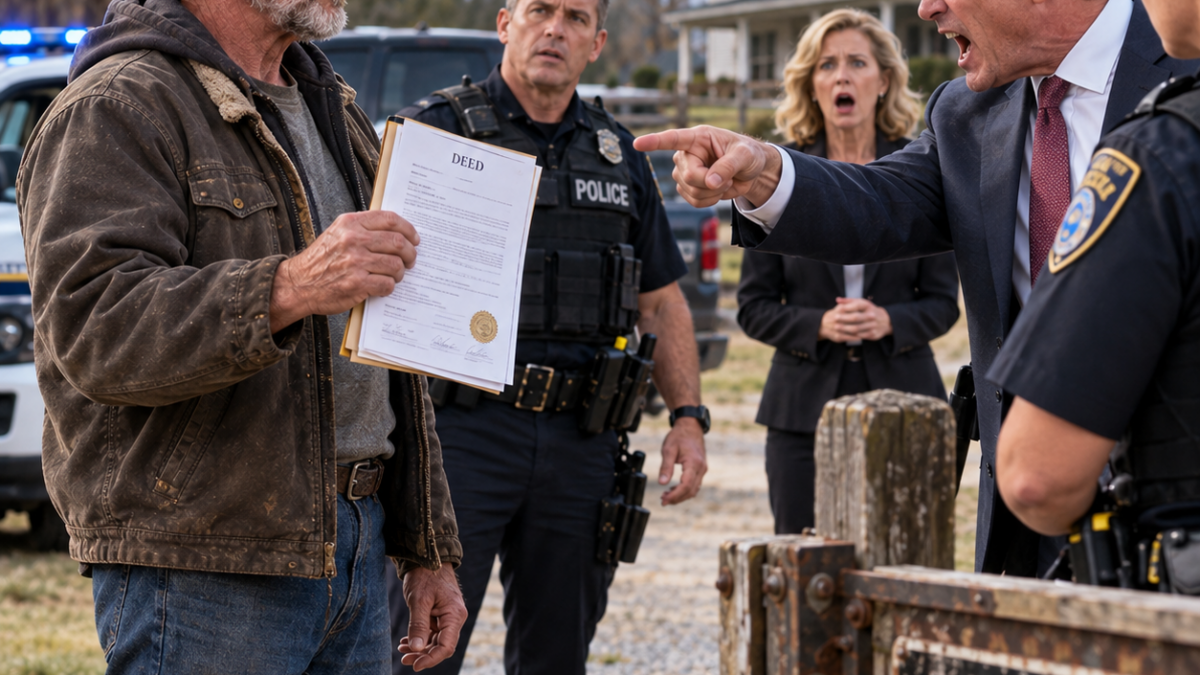
I opened my folder.
Recorded deed.
LLC formation documents.
Operating agreement showing Audrey and me as members.
Lease.
Exhibit B.
Inspection clause.
Notice.
Delivery confirmation.
Officer Daniels read slowly.
Kent’s expression changed with every page.
Daniels looked at me.
“You’re one of the owners of the landlord company?”
“Yes, sir.”
“Your wife is the other?”
“Yes.”
“You gave notice?”
“Wednesday.”
Daniels turned to Kent.
“Did you receive something like this?”
Kent pulled out his phone.
Scrolled.
Scrolled longer.
Stopped.
His face shifted.
“It came Wednesday.”
“What did you think it was?”
“A routine landlord notice.”
I couldn’t stop myself.
“It is a routine landlord notice.”
The younger officer looked down to hide a smile.
Daniels handed the papers back.
“This is a civil landlord-tenant issue.”
Then to Kent:
“He’s shown documentation that he’s authorized to inspect the property and that notice was provided.”
Kent stared at me.
“Nobody told me he owned this.”
The words came out quietly.
I said nothing.
I had told him to read the lease repeatedly.
Ownership wasn’t even the point.
Officer Daniels continued.
“Mr. Carter, stay within the inspection scope.”
“Absolutely.”
“Don’t enter restricted operational areas unless your notice permits it.”
“Understood.”
Then to both of us:
“You need lawyers, not police.”
They left.
Marcus drove away.
Kent stood in the mud.
For the first time since I’d met him, he had nothing to align.
He looked at me.
“You could’ve told me.”
I almost laughed.
“I told you the land wasn’t leased.”
“That’s not the same thing.”
“It should’ve been enough.”
“You let me fire you without saying you owned the building?”
“I didn’t own my job.”
His face tightened.
“You know what I mean.”
“No.”
I looked at him.
“If I’d walked into your office during a disciplinary meeting and said, ‘Be careful, I own the building,’ you’d have called it a threat.”
He didn’t answer.
“And you’d have been right.”
Greg cleared his throat.
“We’re losing light.”
It was nine-thirty in the morning.
He just wanted Kent gone.
Kent went inside.
Greg finished the inspection.
Bad.
An acre and a half cleared.
Drainage channel filled.
Sediment in the detention pond.
Erosion beginning.
No posted permit.
Later we confirmed no land-disturbance permit had been issued.
Concrete had not yet been poured.
“That part’s lucky,” Greg said.
“Lucky?”
“You caught them before the expensive irreversible part.”
He pointed toward the tree line.
“Some things aren’t reversible.”
The trees.
Mature pines.
Oaks.
Gone.
“You can replant.”
“When does it look like woods again?”
Greg looked at the stumps.
“Ask me in fifteen years.”
Monday morning, Pine Ridge’s real-estate attorney sent Southline formal notice of default.
Her name was Beth Warren.
She was excellent.
Which meant expensive.
Unauthorized alterations.
Unauthorized occupancy outside leased premises.
Drainage modification.
Potential permitting violations.
Property damage.
Southline had thirty days to cure.
Stop construction.
Remove containers.
Remove forms.
Submit engineered restoration plan.
Restore the swale.
Address sediment in the pond.
We did not try terminating the lease.
That’s important.
Southline had been a good tenant for five years.
The rent was why we’d bought the property.
My employment dispute did not make the lease disappear.
Kent had other ideas.
Two days after the police incident, he wrote corporate.
Recently terminated employee Wesley Carter has revealed an undisclosed financial interest in our leased property and is now using his landlord position to retaliate against Southline following lawful termination.
Serious conflict of interest.
Potential bad-faith lease enforcement.
He copied legal.
HR.
Regional leadership.
Corporate real estate.
Unfortunately for Kent, several of those people already knew exactly who Pine Ridge belonged to.
Southline legal did not automatically take our side.
Nor should they have.
Their attorney, Paul Grant, called Beth.
Then called me.
He asked direct questions.
“When did you disclose ownership?”
“Before Southline signed the lease.”
“To whom?”
“Dale. Corporate real estate. Legal.”
“Did you participate in site selection?”
“No.”
“Rent negotiation?”
“No.”
“Lease drafting?”
“No.”
“Did you ever use your landlord interest to influence an employment decision?”
“No.”
“Why was the default notice sent after your termination?”
“Because the excavation happened after my termination.”
“What about the containers?”
“I warned Kent internally.”
“Why didn’t Pine Ridge issue notice then?”
“Because they were movable and I hoped site management would correct it without escalating.”
Paul paused.
“That was probably generous.”
“Or stupid.”
“Maybe both.”
Then he asked the most important question.
“Do you have records?”
I laughed.
“I worked operations twenty-two years.”
Meaning yes.
He pulled the company’s records too.
The timeline destroyed Kent’s retaliation theory.
My first container email:
Seven weeks before termination.
My drainage email:
Five weeks before termination.
Both referenced the lease.
Both recommended corporate real-estate review.
Jimmy’s company confirmed Kent had told them owner approval was handled.
No owner approval existed.
Pine Ridge had never been contacted.
Corporate real estate had never approved the work.
Then HR sent the disciplinary records.
Kent’s own documents.
First warning:
Cited interference with the drainage contractor.
Second warning:
Cited objections to container placement and drainage project.
The file Kent built to justify firing me proved I had warned him before he fired me.
Sometimes people create their own evidence beautifully.
Corporate investigation expanded.
Who authorized spending?
Did Kent bypass procurement?
Who approved contractor change after Jimmy withdrew?
Were permits requested?
Why was work proceeding outside leased acreage?
Who told the second contractor owner approval existed?
A month after the police incident, Southline asked for an in-person meeting.
Beth’s office.
Conference room.
Audrey came.
So did I.
Southline sent Paul Grant and Linda Shaw, senior vice president for regional operations.
Kent attended first portion.
Linda was probably in her mid-fifties.
No theatrics.
No motivational vocabulary.
She opened a thick binder.
“Let’s separate issues.”
Thank God.
“Employment.”
“Lease.”
“Property damage.”
“Potential compliance failures.”
“Those are related factually but need to be treated separately.”
I liked her immediately.
She asked Kent to explain the trailer project.
He came prepared.
Capacity constraints.
Peak-season overflow.
Trailer congestion.
Safety problems from double parking.
Driver delays.
His business case was not ridiculous.
That was the tragedy.
The company may actually have needed more trailer parking.
Linda listened.
Then asked:
“Did you read the lease?”
Kent hesitated.
“Real estate manages leases.”
“Did you read Exhibit B?”
“No.”
“Did you contact corporate real estate?”
“I believed we controlled the parcel.”
“Based on what?”
“Operational use.”
Paul slid Exhibit B across the table.
Kent looked down.
The boundary was clear.
Linda asked:
“Why did the contractor believe owner approval existed?”
Kent shifted.
“I believed corporate rights covered the full site.”
“That isn’t what I asked.”
Silence.
“Did you tell Jimmy that the owner approved the project?”
“I may have said approvals were handled.”
“Were they?”
“No.”
Linda wrote something.
Then:
“Why did you replace the contractor after Jimmy withdrew?”
“He couldn’t meet the schedule.”
“Did you ask why he withdrew?”
“He raised paperwork concerns influenced by Wesley.”
Jimmy had already given a statement.
He had withdrawn because he lacked documentation.
Not because I ordered him.
Linda turned toward me.
“Did you stop Jimmy’s work?”
“No.”
“What did you say?”
“I asked whether he had engineering, permits, and written landlord approval.”
“Did you tell him you owned the property?”
“No.”
“Why not?”
“Because it shouldn’t matter.”
Kent looked at me.
I continued.
“If the lease says he needs approval, then he needs approval whether the landlord is me or somebody in Seattle.”
Linda nodded.
Kent said, “You could’ve told me.”
I looked at him.
“I told you to read the lease.”
“You deliberately withheld a conflict.”
“No.”
I shook my head.
“If I’d told you during our argument that I owned the building, you’d have said I was using landlord status to undermine you.”
Kent opened his mouth.
Stopped.
Because that was exactly what he would have done.
Linda asked me:
“What outcome do you want?”
I had thought about it.
A lot.
I could have demanded Kent’s job.
Could have demanded my job back.
Could have pushed for lease termination.
Could have made everything personal.
I didn’t.
“You run Southline.”
I looked at Linda.
“Who you employ is your decision.”
Kent glanced at me.
“Pine Ridge wants the lease honored.”
“Restore the drainage.”
“Remove equipment from excluded land.”
“Fix the pond.”
“Replant the cleared area.”
“Follow permit requirements.”
“And ask permission before altering property you don’t lease.”
Linda nodded.
“Anything regarding your employment?”
“No.”
Kent looked surprised.
Paul did too.
I continued.
“I may have complaints about how I was fired.”
“But that’s separate.”
Linda closed her pen.
“That’s reasonable.”
Then she asked Kent to step outside.
He left.
The rest took ninety minutes.
Southline agreed to restoration.
Containers removed.
Concrete forms removed.
Civil engineer retained.
Swale rebuilt.
Sediment removed from pond.
Erosion controls.
Replanting.
All future alteration requests through corporate real estate.
Southline paid Greg’s inspection expenses and Pine Ridge’s reasonable legal fees related to curing the default.
Then Linda said something I did not expect.
“We also reviewed the management transition after Dale retired.”
I waited.
“Site-level lease obligations should have been included in Kent’s onboarding.”
“Okay.”
“Corporate failed there too.”
Audrey looked at her.
Linda continued.
“That does not excuse what occurred.”
“But I don’t want to pretend this was one individual’s failure.”
I respected that.
Then:
“If you are interested in returning to Southline, we’re willing to discuss reinstatement.”
Audrey didn’t turn toward me.
She didn’t need to.
Twenty-two years.
I had loved that job.
For a moment I pictured going back.
Morning floor walk.
Tony complaining.
Forklifts.
Truck schedules.
People I’d known half my life.
Then I pictured the red badge reader.
Marcus carrying my box.
Kent standing at my truck.
I pictured every future disagreement turning into:
Well, Wes owns the property.
Or:
Careful what you say to the landlord.
That relationship was broken.
Maybe not beyond repair.
Beyond what I wanted.
“Thank you.”
Linda waited.
“But no.”
She looked surprised.
“You’re sure?”
“Yes.”
“Why?”
“Because I don’t want to spend every morning wondering whether I’m operations manager or landlord.”
Audrey smiled slightly.
“And I don’t want employees wondering either.”
Linda nodded.
“Fair.”
Southline offered a separation package.
More generous than what I’d initially received.
Beth reviewed it.
Twice.
I signed.
Kent was not part of the rest of the meeting.
Six weeks later, Tony texted:
Kent’s gone.
That’s all.
I didn’t ask why.
Nobody officially told me.
Southline had a regional director who authorized construction on land the company didn’t lease.
Ignored written warnings.
Allowed unpermitted site work.
Misrepresented owner approval.
Filled drainage infrastructure.
Created flooding risk.
Then called police on one of the landlords during a contractually authorized inspection.
I assume the company made its own decision.
Some employees blamed me.
That hurt.
Not everybody knew the full file.
To them:
Kent arrived.
Wes fought him.
Wes got fired.
Then suddenly Wes revealed he owned the building.
Lawyers appeared.
Kent disappeared.
I could understand how that looked.
Tony didn’t.
“He got himself fired.”
“Maybe.”
“Don’t do that.”
“Do what?”
“Make excuses for him.”
“I’m not.”
“You warned him.”
“I know.”
“Twice.”
“More.”
“He fired you.”
“Yes.”
“Then he cut your trees.”
“Technically contractors did.”
Tony stared.
“You’re annoying when you’re unemployed.”
Restoration took nearly four months.
The swale was reopened.
Engineered.
Proper grade.
Riprap in some sections.
Vegetation replanted.
Detention pond cleaned.
Erosion repaired.
Concrete project canceled.
Dock yard stopped flooding.
The trees were replaced.
Young ones.
Thin trunks.
Standing where mature woods had been.
Greg was right.
You can restore land.
You cannot uncut a tree.
That bothered Audrey more than anything.
She used to walk those woods when she came to inspect the property.
One afternoon she stood beside the new saplings.
“Twenty years.”
“What?”
“That’s how long before this looks remotely similar.”
“Probably.”
She stared.
“Because he couldn’t read Exhibit B.”
“Basically.”
She shook her head.
“I’m still raising the rent in year six.”
I laughed.
“We’ll use market rate.”
“I am the market.”
“No.”
“Fine.”
Southline continued paying rent.
On the first of each month, the payment hit Pine Ridge’s account.
Audrey tracked everything in a spreadsheet.
Rent received.
Taxes.
Insurance.
Repairs.
Loan balance.
Every month she placed a little check mark.
Three weeks after Southline fired me, she made the first check mark after the incident.
Then looked at me.
“Your old employer paid us.”
“Yep.”
“How does that feel?”
“Confusing.”
“I find it hilarious.”
“You would.”
“They fired you from their property.”
“Leased property.”
“Our property.”
“Yes.”
She smiled.
“Then called the police on the landlord.”
“Yes.”
“Can I put that on a coffee mug?”
“No.”
She probably still will.
My first month unemployed was bad.
I’m not built for empty calendars.
I reorganized the garage.
Audrey told me to stop touching shelves she hadn’t asked me to organize.
I washed the truck twice in one week.
Changed oil that had another thousand miles.
Then we drove to see our son.
Middle of the week.
Something I hadn’t done in years.
Had lunch.
Stayed overnight.
No vacation request.
No calls about missed trailers.
Then we helped our daughter move.
Again.
I don’t know why young adults move so often.
Maybe furniture companies pay them.
Eventually a small logistics company called.
Someone I’d worked with years earlier.
They needed help.
Three days a week.
Process improvement.
Warehouse layout.
Training.
No direct reports.
No weekends unless I wanted them.
I took it.
Audrey said, “So you’re retired.”
“I’m working.”
“Three days.”
“That’s work.”
“You’re semi-retired.”
“Consulting.”
“Retired with a clipboard.”
I ignored her.
Six months later, Pine Ridge held its first formal inspection after restoration.
I drove through Southline’s security gate.
Marcus was there.
He saw me.
Smiled.
“Morning, landlord.”
“Don’t.”
He laughed.
“Inspection?”
“Twice yearly.”
“Notice is in the system.”
Imagine that.
Paperwork.
Working.
We walked the site with Southline’s facility manager.
Not Kent.
New manager named Alicia Grant.
First thing she did after starting?
Asked corporate real estate for the lease.
Read it.
Every page.
She called Audrey once about installing a small maintenance shed.
Sent drawings.
Site location.
Drainage note.
Audrey approved it in writing.
Process took four days.
The world did not end.
I told Alicia that.
She smiled.
“I prefer not having police at property inspections.”
Good philosophy.
Around the one-year anniversary of my termination, Southline had an issue with a dock-leveler replacement.
The contractor wanted to cut concrete.
Alicia called Pine Ridge before scheduling work.
Audrey approved.
I realized then how simple all of it could have been.
Kent’s original trailer problem?
Probably solvable.
Had he called Pine Ridge at the start, we might have discussed leasing additional acreage.
Maybe not where the swale ran.
Maybe another section.
Engineering.
Permits.
New rent.
Could have been done.
Nobody was trying to stop Southline from growing.
Kent never asked.
He believed asking made him smaller.
That was his real problem.
Not ignorance.
Pride.
He mistook authority for ownership.
Companies do that sometimes.
Managers too.
They control operations inside a space long enough that they begin to feel the space itself belongs to them.
People do the same thing with employees.
Your time becomes their time.
Your expertise becomes their asset.
Your loyalty becomes their entitlement.
Then one day they tell you to leave and are surprised to discover not everything on the site walked out with your cardboard box.
Dale called me about nine months after the whole mess.
Retirement apparently bored him too.
“You causing trouble?”
“Constantly.”
“Heard about Kent.”
“Small town.”
“Company called me during review.”
That interested me.
“What’d they ask?”
“Whether I knew you owned the property.”
“What’d you say?”
“I negotiated half the lease.”
“Good answer.”
He laughed.
“Asked whether ownership was disclosed.”
“And?”
“I told them everyone above site level knew.”
“Good.”
Pause.
“I should’ve made sure Kent knew.”
I thought about it.
“Maybe.”
“Would it have changed anything?”
“Initially.”
“How?”
“He might’ve acted differently if he knew I was landlord.”
“Exactly.”
“That would’ve been worse.”
Dale went quiet.
I continued.
“I wanted him to respect the lease because it was the lease.”
“Not because I owned it.”
Dale understood.
“You always were stubborn.”
“That’s why you promoted me.”
“That’s not why.”
“It’s partly why.”
He laughed.
Then became serious.
“You miss it?”
I looked toward Audrey.
She was on the porch reading.
“Parts.”
“Come back?”
“No.”
“Good.”
That surprised me.
“Good?”
“You stayed too long anyway.”
“Twenty-two years and you tell me now?”
“I needed you.”
There it was.
Honest.
I laughed.
After we hung up, I thought about that sentence.
I needed you.
Companies need people.
Sometimes deeply.
But need is not ownership.
That distinction mattered more to me after Kent.
He had said:
You need to understand who owns this operation.
The funny thing is, he wasn’t entirely wrong.
He owned certain decisions by position.
Shift structure.
Yard operations.
Staffing.
Performance.
And ultimately, with HR approval, whether I stayed employed.
He exercised that authority.
Fired me.
Perfectly legal unless some separate protected issue existed.
What he did not own:
The excluded four acres.
The woods.
The drainage swale.
The pond.
My silence.
My experience.
My identity.
My future.
Or the building he kept calling his.
Audrey and I still own Pine Ridge Commercial Holdings.
The mortgage on the property is much lower now.
Southline remains the tenant.
Their renewal option is coming up.
Corporate real estate contacted us six months early.
Professional.
Market analysis.
Proposed terms.
No drama.
They want to stay.
The location works well.
Audrey and I will probably renew.
At market rent.
She remains disappointed she can’t add a “called police on landlord” surcharge.
I told her lawyers dislike creative billing.
She said lawyers lack vision.
The replanted trees are maybe wrist-thick now.
Some survived.
A few didn’t.
Pine Ridge replaced them.
The swale works.
During heavy storms I sometimes drive over just to watch water flow properly into the pond.
That’s probably strange.
Operations people become attached to systems that work.
Marcus still waves.
Tony still calls.
He was promoted to operations supervisor.
I told him congratulations.
He said:
“Legacy thinking.”
I told him to go to hell.
Our kids joke that I got fired into early retirement.
Not exactly.
I still work.
Just differently.
Three days a week.
Sometimes two.
I take Fridays off.
Audrey and I travel more.
Nothing extravagant.
We visit the kids.
Drive places.
Rent cabins.
We finally took a ten-day trip without me opening a warehouse email.
On day three, Audrey asked whether I was okay.
“Why?”
“You haven’t checked your phone.”
“I don’t work there.”
She smiled.
“I’m aware.”
There’s a freedom in no longer being needed somewhere you once thought couldn’t function without you.
Southline survived.
Of course it did.
Companies almost always do.
That’s another lesson.
For years I stayed late because things needed fixing.
Skipped lunches.
Answered calls.
Cancelled plans.
Some of that was necessary.
Some was pride.
You want to believe you’re essential.
Then your badge gets shut off before you reach your office.
And trucks still ship Monday morning.
That’s not insulting.
It’s healthy to learn.
My value didn’t disappear because Southline could replace my job.
My value had never come from being irreplaceable.
It came from doing work well while I was there.
Teaching people.
Solving problems.
Protecting the operation.
Even when the person running it didn’t want protecting from himself.
Sometimes people ask why I didn’t reveal the ownership earlier.
Why let Kent write me up?
Why let him fire me?
Why not walk into HR with the deed and end the whole thing?
Because ownership was never supposed to protect my job.
That would’ve been abuse too.
Imagine the reverse.
An employee’s landlord interest lets him ignore his supervisor.
Threatens lease consequences during discipline.
Uses building ownership as leverage to stay employed.
That would have been wrong.
Kent had every right to judge me as an employee.
He judged badly.
Southline had every right to terminate me.
They did.
Pine Ridge had every right to enforce its lease.
We did.
Keeping those boundaries separate is what made the ending clean.
Kent blurred them.
Not me.
He thought firing the employee erased the warning.
Instead it removed the employee restraint.
Before termination, I kept trying to solve the land problem internally because I worked for Southline.
After termination, I had exactly one role.
Landlord.
When Tony sent that first photograph, the issue stopped being:
My boss won’t listen to me.
It became:
A tenant is altering land outside its lease without consent.
Much simpler.
Much more expensive.
The police officer understood it in about five minutes.
I still remember Kent’s face when Officer Daniels asked who actually owned the property.
For weeks, he had told people I was resisting him.
Undermining him.
Blocking progress.
He had put in writing that I needed to understand authority.
Then he called police to remove me from land where I had a contractual right to stand.
And the officer looked at the paperwork.
No argument.
No speech.
No revenge.
Just documentation.
That’s usually how arrogance ends.
Not with fireworks.
With someone reading the page the arrogant person couldn’t be bothered to read.
Years earlier, Raymond used to say something similar.
He spent his career around industrial electrical systems.
High voltage.
Large motors.
Paper machines.
He told Audrey once:
“The machine doesn’t care who the boss is.”
She asked what that meant.
He said:
“You can have the fanciest title in the mill. If the motor needs forty amps and you give it twenty, your title won’t make it turn.”
Reality doesn’t care about hierarchy.
Neither does property law.
Neither does drainage.
Kent could call the swale a ditch.
Stormwater still needed it.
He could call our land company property.
Exhibit B still excluded it.
He could call me disgruntled.
The deed still had Pine Ridge’s name on it.
He could call police.
The inspection notice still existed.
He could fire Wesley Carter, operations manager.
He could not fire Pine Ridge Commercial Holdings, landlord.
Those were different relationships.
Three weeks after I lost my badge, Southline’s monthly rent came in.
Audrey sat at the kitchen table.
Spreadsheet open.
She entered the payment.
Then placed the little check mark.
I was making coffee.
She said, “You know what’s funny?”
“Dangerous opening.”
“Kent got exactly what he wanted.”
“What?”
“You don’t work there anymore.”
“Correct.”
She tapped the screen.
“They just have to pay you to stay gone.”
I laughed.
“Technically rent isn’t paying me personally.”
“Do not ruin this.”
“Sorry.”
She looked at the payment.
Then at me.
“He wanted you off company property.”
I shook my head.
“Leased property.”
“Wes.”
“Sorry.”
She smiled.
“In the end, you left the company.”
She tapped the rent entry again.
“The property never went anywhere.”
That’s still true.
On the first of every month, Southline sends money to Pine Ridge Commercial Holdings.
Audrey records it.
Check mark.
The company that fired me still occupies our warehouse.
Trucks still back into docks I used to manage.
People I trained still work inside.
And twice a year, after forty-eight hours’ written notice, I drive through the security gate.
Marcus usually looks at my paperwork for about half a second.
Then waves.
“Morning, Wes.”
“Morning.”
“Here to trespass?”
He thinks that’s hilarious.
I tell him every time it stopped being funny after the first twenty repetitions.
He disagrees.
Then I walk the property.
Roof.
Drainage.
Exterior walls.
Parking.
The young trees.
The swale.
The pond.
I don’t go into operations unless necessary.
That’s Southline’s space.
Because boundaries work both ways.
I expect them to stay on what they lease.
I stay out of what they control.
That is how the relationship should have worked from the beginning.
The last time I inspected the property, I stood beside the drainage swale after a night of rain.
Water moved cleanly through the grass.
Into the detention pond.
No flooding at Door Three.
No flooding at Door Four.
Young trees growing along the restored line.
Alicia came out.
“Everything okay?”
“Looks good.”
She glanced toward the trees.
“Still ugly.”
“Give them fifteen years.”
She smiled.
“I’ll be retired.”
“So will I.”
“You’re already retired.”
“Ask my wife.”
“She told me you are.”
Traitor.
We walked back toward the building.
At the dock, I could hear forklifts.
Reverse alarms.
Drivers talking.
Everything moving.
Same sounds I’d listened to for twenty-two years.
For a second, I missed it intensely.
Not Kent.
Not HR.
The work.
Knowing every problem.
Being useful there.
Then my phone buzzed.
Audrey.
Lunch?
I texted back.
On my way.
I looked at the warehouse once more.
Then left.
No bitterness.
Not much, anyway.
Kent thought firing me meant he’d finally established who was in charge.
In one narrow sense, he had.
He was my boss.
He had authority over my employment.
What he never understood was that authority ends somewhere.
Sometimes at an employment contract.
Sometimes at a property line.
Sometimes at a drainage swale.
Sometimes at a paragraph marked Exhibit B.
And if you’re going to tell somebody to understand who owns the ground beneath his feet, you should probably make very sure you know the answer first.








