My 6-Year-Old Son Was Sent to the Principal for Refusing to Erase Our Rescue Cat From His Family Tree—Then He Asked Me One Question I Couldn’t Answer With a Rule.
PART3:
He looked down. “I wouldn’t erase him.”
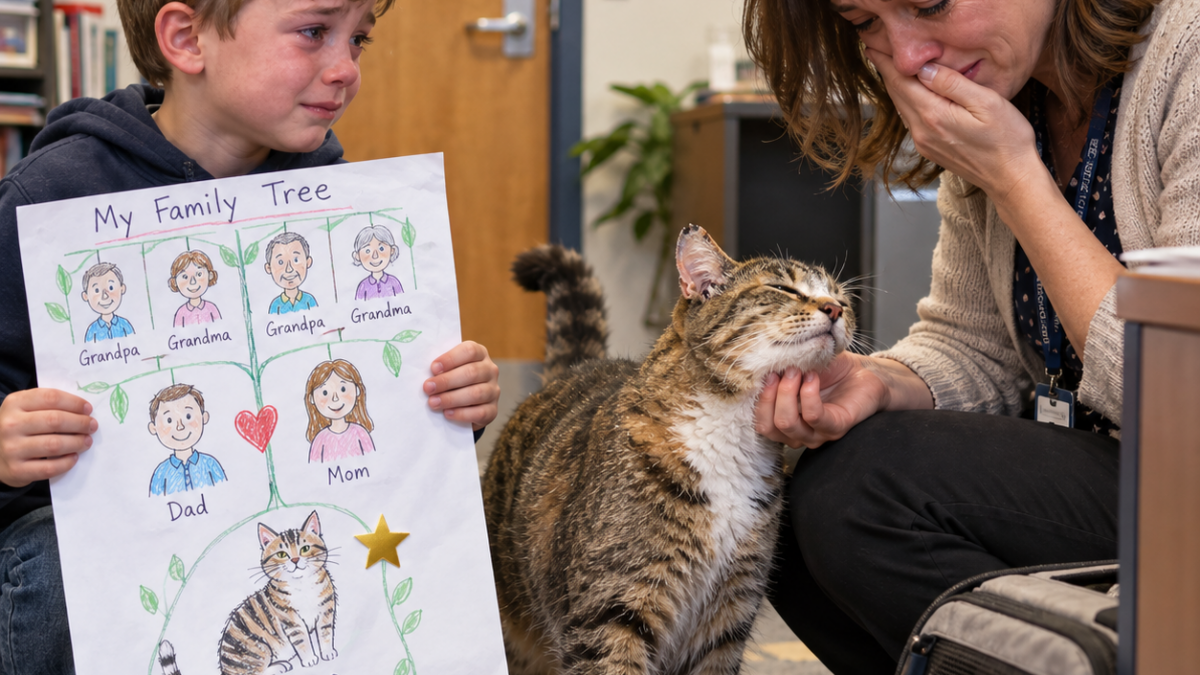
The image hit me hard. My small son standing in front of a classroom, holding his poster, refusing to wipe away a cat who had been part of his life since before he could tie his shoes.
“What did you do?”
“I said no.”
“To Ms. Harris?”
He nodded miserably. “She gave me an eraser. She said I could fix it before turning it in. I said I didn’t want to fix Toro. He wasn’t a mistake.”
I had to close my eyes for a second.
There are moments as a parent when pride and anger rise together so quickly you can hardly tell them apart.
I was proud of him.
I was furious that he had needed to be brave.
“What happened then?” I asked.
“She told me to sit down. Then after reading time, she sent me to Mr. Bowers.”
The principal.
“Did Mr. Bowers yell?”
“No. He was nice. He gave me tissues. But he said assignments have instructions and we have to follow instructions even when we feel strongly.”
I pressed my tongue to the roof of my mouth.
Of course he did.
Not because he was cruel.
Because schools are held together by rules, schedules, liability forms, hallway procedures, allergy plans, curriculum standards, emergency drills, and adults trying very hard to keep thirty small lives from turning into chaos every seven minutes.
But sometimes rules become so heavy in adults’ hands that they stop seeing the child underneath.
William folded the poster again.
“Do I have to redo it?”
I looked at the red words.
Not correct.
Relatives only.
Redo.
“No,” I said.
His eyes widened.
“No?”
“You may have to add something. We may have to talk about what a family tree means. But you do not have to erase Toro like he never mattered.”
William’s face crumpled, and he started crying again, harder this time.
I unbuckled my seat belt, climbed halfway into the backseat like an idiot, and pulled him against me. He smelled like crayons, cafeteria pizza, and little-boy sweat. He clung to me with both hands.
“He sleeps with me every night,” William sobbed into my jacket. “When I had the big fever, he stayed. He didn’t even go eat breakfast.”
“I know.”
“He knows when I’m sad.”
“I know.”
“He’s not just a cat.”
“I know, buddy.”
And I did know.
Toro was not a perfect pet.
He was not the kind of cat people put in commercials, all fluffy and clean and graceful. We adopted him from a shelter four years earlier, when William was two and still called every animal “baby.” Toro had arrived with a crooked tail, a small scar across the bridge of his nose, and one ear that looked like someone had taken a bite from the edge. He flinched when cabinets slammed. He hid under the couch for the first three days. He ate like he did not trust food to return once it disappeared.
The shelter said he had been found behind a closed-down auto shop, thin, dirty, and guarding a pile of trash like it was treasure. Nobody knew what had happened before that. Animals carry their histories differently than people do, but they carry them all the same.
For weeks after we brought him home, Toro wanted nothing to do with us.
Except William.
Nobody could explain it.
William would lie on the carpet with one cheek pressed to the floor, whispering nonsense stories under the couch. He told Toro about trucks, dinosaurs, clouds, breakfast cereal, and once, in great detail, about how socks were “foot blankets that get lost on purpose.”
Toro listened.
On the fourth night, he came out.
Not for me.
Not for Anna.
For William.
He crept into William’s room after bedtime and jumped onto the corner of the toddler bed. Anna and I watched from the doorway, barely breathing. William opened his eyes, saw him, and whispered, “Hi, baby.”
Toro curled at his feet.
He had slept there every night since.
When William had pneumonia the winter before, Toro refused to leave his room. He sat at the foot of the bed, eyes half-closed, body pressed against William’s blanket as if he could hold the fever down by weight alone. When William cried during breathing treatments, Toro stood beside the nebulizer and bumped his head against William’s knee. When Anna and I took turns sleeping in the chair, Toro watched us like a night nurse with fur.
So no, he was not just a cat.
And I was not going to teach my son that love only counted when it could be charted by blood.
That night, after William went to bed, Anna and I sat at the kitchen table with the poster between us.
Toro sat on the chair beside William’s empty seat, tail curled around his paws, looking deeply suspicious of the red ink.
Anna traced the edge of the poster with one finger.
“She wrote ‘redo’?”
“Yeah.”
Anna’s jaw tightened.
My wife was usually the calmer one between us. She had the patient steadiness of a pediatric occupational therapist, which meant she spent her days helping children do hard things in small steps. She believed in structure. She believed in teachers. She believed most conflicts could be solved with good communication and fewer assumptions.
But she also believed in William.
And she loved Toro with the reluctant intensity of someone who once claimed she was “not really a cat person” and now bought him salmon treats that cost more per ounce than steak.
“She shouldn’t have used red pen like that,” Anna said.
“I know.”
“And she definitely shouldn’t have said family is blood.”
“I know.”
Anna looked toward the hallway, where William’s nightlight glowed faintly.
“Do you think he’ll remember this?”
I wanted to say no.
I wanted to say children forget small humiliations.
But I remembered my third-grade teacher laughing because I wrote that my father was “gone but still mine” on a family worksheet after my parents divorced. I remembered the heat in my face. I remembered erasing him because it was easier than explaining custody to a woman who wanted tidy boxes.
So I told the truth.
“Maybe.”
Anna closed her eyes.
Toro jumped down from the chair, walked across the kitchen, and sat on the poster. Right on his own drawing.
Anna laughed despite herself.
“Well,” she said, wiping one eye, “he has a sense of timing.”
I scratched Toro under the chin.
He lifted his head like a king accepting tribute.
The next morning, I emailed Ms. Harris and asked for a meeting after dismissal.
I tried to keep it polite.
Dear Ms. Harris,
I’d like to talk about William’s family tree assignment and what happened yesterday. He was very upset when he came home, and I think it would be helpful for us to discuss how to approach the assignment in a way that teaches the intended lesson without making him feel ashamed for including someone important to him.
Thank you,
Evan Parker
She replied within twelve minutes.
Mr. Parker,
I’m available tomorrow at 3:45. I’m sorry William was upset. My intention was not to shame him but to clarify the assignment requirements. We can discuss then.
Ms. Harris
Professional.
Careful.
Already defensive.
I read the email three times and felt my anger cool into something more useful.
The next day, I brought William.
And I brought Toro.
That decision was either brilliant or stupid, depending on which moment of the story you ask about.
Toro was zipped securely in his soft carrier, the one with mesh sides and a fleece pad inside. I did not plan to let him out. I did not plan to parade him through school like an emotional support exhibit. I simply wanted Ms. Harris to understand that we were not talking about a theoretical pet. We were talking about a living creature my son loved, a creature whose presence had shaped our home.
We came after dismissal, when the halls were mostly empty except for the squeak of custodial carts and the occasional burst of laughter from after-school care. William held the poster board with both hands. Toro sat quietly in the carrier against my leg, wide-eyed but calm.
Room 14 smelled like crayons, pencil shavings, floor cleaner, and the faint sour sweetness of twenty-four lunchboxes. Paper leaves hung from the windows. Sight words marched across one wall. A bulletin board near the sink read OUR FAMILIES, OUR STORIES.
Ms. Harris stood at her desk organizing papers into perfect stacks.
She was in her late forties, with silver beginning at her temples and tired blue eyes behind thin glasses. She looked up when we entered, saw the carrier, and immediately stiffened.
“Mr. Parker,” she said carefully, “animals are not allowed in the school.”
“I understand,” I said. “He’ll stay in the carrier. We’ll stay by the doorway if you prefer. I’m not trying to create a problem.”
Her eyes moved to William.
William looked down.
That softened her slightly.
“All right,” she said. “But briefly.”
I nodded.
William held up his poster.
Ms. Harris sighed, not harshly, but like a woman who had already explained this once and expected to explain it again.
“William,” she said, “your drawing of Toro is lovely. Truly. But the point of a family tree is genealogy. Parents, grandparents, relatives. It shows how people are connected.”
William’s voice came out small.
“Toro is connected.”
Ms. Harris folded her hands. “Emotionally, maybe. But not genealogically.”
He frowned. “What does that mean?”
“It means by birth,” she said. “By family line.”
“Mom and Dad aren’t family by birth.”
Ms. Harris opened her mouth.
Then closed it.
I tried not to react.
William looked at her with those serious brown eyes.
“They chose each other,” he said. “And they chose me. And we chose Toro.”
Ms. Harris’s face shifted.
Not enough to surrender.
Enough to feel the ground move.
“William,” she said gently, “definitions matter.”
I stepped in then, because I saw my son’s shoulders fold inward.
“They do,” I said. “But so does how we teach them. I understand the assignment is about relatives. I’m not arguing that Toro belongs on a genealogy chart. What I’m saying is that when he included Toro, he wasn’t being defiant. He was showing you who makes him feel safe.”
Ms. Harris looked tired.
“I have twenty-three students, Mr. Parker. If one child includes a cat, another includes a hamster, another includes a lizard, and before long the assignment no longer teaches what it is designed to teach.”
“That may be true,” I said. “But if a child includes the only stable presence in their life, and we mark it wrong without curiosity, what are we teaching then?”
Her eyes flicked toward the bulletin board.
Our Families, Our Stories.
William whispered, “He sleeps with me.”
The carrier shifted.
Toro had been quiet until then, but as if his name had pulled him into the conversation, he stood, pressed one paw against the mesh, and let out a low, rusty meow.
William instinctively reached down.
“Can I?” he asked me.
I should have said no.
I know that now.
Policy-wise, legally, practically, I should have said no.
But parenting does not always happen in the clean space between rule and reason. Sometimes it happens in a classroom doorway with your child’s heart in his hands.
I glanced at Ms. Harris.
She looked alarmed.
“Maybe we shouldn’t—”
William unzipped the carrier.
Toro stepped out.
No bolting. No panic. No claws. Just one slow paw, then another, landing softly on the classroom rug.
He looked around once, tail low but steady, then walked directly toward Ms. Harris.
She froze.
Toro stopped near her leg, sniffed the hem of her slacks, and leaned his warm side against her shin.
The whole room changed.
I cannot explain it better than that.
One moment, we were adults debating categories. The next, a scarred rescue cat was pressing himself against a tired teacher’s leg like he had found the exact bruise no one had named.
Ms. Harris stared down at him.
Her hands hovered in the air.
William whispered, “He can tell when someone’s sad.”
Ms. Harris’s face cracked.
Not like anger.
Like a wall giving way.
She lowered herself slowly into her chair.
Toro stayed pressed against her.
For a moment, none of us spoke.
Then Ms. Harris said, almost too softly to hear, “My husband died two years ago.”
I felt the air leave my lungs.
William looked at me, confused and concerned.
Ms. Harris kept looking at Toro.
“We had a cat,” she said. “Milo. Orange tabby. Terrible manners. He used to sit like this against my leg every night after the funeral. He followed me from room to room like he was afraid I might disappear too.”
Her voice trembled.
“When Milo died last spring, I told myself I was being ridiculous for grieving so much. He was old. He was sick. He was a cat.”
Toro lifted his head and bumped his forehead against her hand.
She closed her eyes.
“And then today,” she whispered, “I told a child cats aren’t family.”
William stepped closer.
“He didn’t know you were sad,” he said.
Ms. Harris opened her eyes.
“What?”
“Toro,” William said. “He just knew you needed him.”
That did it.
Ms. Harris pressed one hand to her mouth and looked away.
I felt my anger change shape.
It did not disappear. But it became more complicated.
That is the inconvenient truth about people who hurt us. Sometimes they are carrying wounds too. It does not excuse the harm. It does not erase accountability. But it makes the story heavier than villain and victim.
After a moment, Ms. Harris reached for William’s poster.
She looked at the red ink.
Not correct. Relatives only. Redo.
Her face tightened.
“I am sorry,” she said.
William stood very still.
“I should not have written it that way,” she continued. “I was trying to teach the assignment. But I made your love sound like a mistake.”
William’s lips parted.
Ms. Harris opened a drawer, took out a sheet of gold star stickers, and peeled one off.
Then she placed it directly on Toro’s drawing.
“For the family tree,” she said carefully, “we still need to show relatives. That is what that kind of chart means.”
William’s shoulders began to sink.
“But,” she added quickly, “we are going to add something. A second part. A circle of care.”
“A what?” William asked.
“A circle of people—and maybe animals—who help you feel safe. Who care for you. Who belong to your life even if they do not belong on a genealogy chart.”
William looked at me.
I nodded once.
Ms. Harris picked up her pen. This time, she wrote in calmer handwriting beneath the red note.
Toro belongs in William’s circle of care. Chosen family matters, too.
William stared at it.
Then he smiled.
It was small at first, cautious, like he did not fully trust the happiness. Then it spread across his whole face.
Toro, having apparently solved the matter to his satisfaction, sat down on Ms. Harris’s foot.
She laughed through tears.
Walking back to the car, William looked lighter.
Toro sat in his carrier like a king returning from a diplomatic mission.
“Dad,” William said, “Ms. Harris can be in my circle too.”
I glanced down at him.
“Because she fixed it?” I asked.
He nodded.
“And because Toro helped her.”
I did not answer right away.
Some lessons you think you are teaching your children.
Others, they hand back to you before you are ready.
For one day, I thought the story was over.
That was naive.
The next afternoon, I was standing in the cereal aisle at Miller’s Market, holding the box William insisted was “the only one that tastes like Saturdays,” when my phone rang.
Maple Ridge Elementary.
My stomach dropped.
I answered.
“This is Evan Parker.”
“Mr. Parker,” a man’s voice said, warm but official. “This is David Bowers, principal at Maple Ridge. Do you have a moment?”
The cereal box suddenly felt heavy in my hand.
“Yes.”
“I’m calling about an incident reported after dismissal yesterday. Something involving an animal brought onto campus.”
I closed my eyes.
“Toro was in a carrier,” I said. “We came after dismissal. We stayed near the doorway. It was a private meeting.”
“I understand.”
But the pause after it told me what he really meant.
I understand you did not mean harm, but harm and policy are not always concerned with intention.
“There are safety policies,” he continued. “Allergies. Liability. Student health plans. I’m sure you understand.”
“I do,” I said.
And I did.
That was the frustrating part.
I was not one of those parents who thought my child’s feelings automatically canceled everyone else’s needs. Allergies are real. Fear is real. Liability is real. Schools cannot run on exceptions made from emotion.
But I also knew my son had been wounded by a definition that had landed like rejection.
Both things were true.
People hate when both things are true.
“Would you be willing to come in tomorrow morning?” Mr. Bowers asked. “Just you. We can talk through what happened and how we move forward.”
Move forward.
The phrase sounded like a door closing politely.
“I’ll be there,” I said.
That night, William sat cross-legged on the living room rug, drawing a new version of Toro. He made the crooked tail extra dramatic, like a lightning bolt. Toro lay belly-up beside him with one paw draped across William’s shin.
William looked up.
“Am I in trouble?”
“No,” I said immediately.
“Is Ms. Harris?”
That question hurt worse.
Kids notice everything. They notice tone shifts, long pauses, tight smiles, adults pretending something is fine when it is not. They may not understand the machinery, but they feel the gears moving under the floor.
“I don’t think so,” I said carefully. “But when rules get bent, grown-ups ask questions.”
William frowned.
“But she fixed it.”
“I know.”
“And Toro didn’t hurt anybody.”
“I know.”
“So why is it bad?”
Anna looked at me from the couch.
I wished I had a clean answer.
Instead, I sat beside him on the rug.
“Sometimes,” I said, “grown-ups get nervous when something does not fit the way they expected it to fit.”
William considered that.
“Toro doesn’t fit in lots of things,” he said. “He still tries.”
Toro rolled onto his side and sneezed.
Anna laughed softly.
I kissed William’s head.
The next morning, I sat in a plastic chair outside the main office beneath a bulletin board that read KINDNESS STARTS HERE! in cheerful cut-out letters.
Children’s artwork lined the hallway. Handprint turkeys. Paper pumpkins. A poster about being respectful. Another about listening with your whole body.
I wondered how often adults posted words on walls because living by them was harder.
Mr. Bowers opened his office door at 8:05.
He was younger than I expected, maybe late thirties, with tired eyes and a navy tie slightly loosened at the collar. He shook my hand firmly.
“Mr. Parker. Thank you for coming.”
His office smelled like coffee and printer toner. On one wall hung framed certificates. On another, photos of school events. On his desk sat a picture of two little girls in soccer uniforms and a small framed quote:
Be the adult you needed when you were young.
I looked at it longer than I meant to.
Mr. Bowers noticed.
“My wife gave me that when I got the job,” he said. “Some days it feels inspirational. Some days it feels like evidence against me.”
Despite myself, I smiled.
He sat and opened a folder.
Inside was a plain incident report.
Unapproved animal brought on campus after dismissal.
My name.
William’s name.
Ms. Harris’s name.
Toro, described as cat.
Seeing him reduced that way—cat—made something in me bristle.
“I want to be clear,” Mr. Bowers said. “This is not disciplinary. William is not in trouble. You are not being banned from campus. Ms. Harris is not being punished.”
“Then why are we here?”
He leaned back.
“Because it has already become bigger than the room it happened in.”
He explained that two staff members had seen the carrier. One reported it. Another mentioned it to a parent during pickup. That parent’s child had a severe cat allergy. By evening, three families had called. One wanted assurance that no animals had been in classrooms. One wanted to know whether the school was allowing emotional support pets without documentation. One wanted Ms. Harris disciplined for permitting it.
I rubbed both hands over my face.
“I wasn’t trying to make a point at the expense of other kids’ safety.”
“I believe you,” Mr. Bowers said.
“I won’t bring Toro again.”
“I appreciate that.”
“But my son shouldn’t be taught that his heart is wrong.”
Mr. Bowers folded his hands.
“No,” he said. “He shouldn’t.”
That surprised me.
He opened another document and slid it across the desk.
It was a draft memo.
Clarification on Family Tree Assignment and Inclusive Language.
It acknowledged that family structures vary. It clarified that family tree assignments should focus on relatives and ancestry, but teachers should avoid language that invalidates a child’s lived experience. It suggested optional companion activities: “Circle of Care,” “People Who Help Me,” “My Safe Place,” and “Important Beings in My Life.”
Important beings.
I almost laughed.
It was such a principal phrase.
Careful. Broad. Policy-friendly.
And somehow deeply kind.
“I read William’s poster,” Mr. Bowers said. “And I spoke with Ms. Harris.”
“How is she?”
“Upset. Mostly with herself.” He paused. “She has been teaching for twenty-one years. Good teachers can still have blind spots.”
“I know.”
He looked at the incident report.
“I also know policies matter. No more animals on campus unless formally approved under district procedure.”
“Agreed.”
“One more thing.”
There it was.
The real reason behind the tiredness in his eyes.
“I need to ask you not to post about this online.”
I stared at him.
“I haven’t.”
“I know. But stories like this spread. Someone shares one detail. Somebody else adds another. Suddenly there are villains and heroes and a comment section full of people who do not know the child they are arguing about.”
He glanced at the photo of his daughters.
“Kids get caught in adult storms.”
I thought of William in the backseat with tears on his cheeks.
“I’m not looking for a villain,” I said. “I’m looking for my son to be treated like his love is not a mistake.”
“Then we are on the same side,” Mr. Bowers said.
At the time, I believed him.
At the time, I also believed we could keep the storm inside the building.
That lasted until 6:42 that evening.
Anna walked into the kitchen holding her phone like it was hot.
“Evan,” she said carefully, “did you tell anyone about this?”
I was rinsing a pasta pot.
“No. Why?”
She turned the screen toward me.
It was a post in a neighborhood parenting group.
No names at first glance.
But the story was unmistakable.
Apparently a first-grader got in trouble for putting a CAT on a family tree assignment. Dad brought the cat to school. Teacher cried. Principal involved. Is this what school is now?
My stomach sank.
The comments were already multiplying.
Some were kind.
Pets are family. That poor child.
Some were furious.
School is for facts, not feelings.
Some were mocking.
So now cats have rights to attend parent-teacher conferences?
Some were scared.
My daughter has severe allergies. This is dangerous.
Some were cruel in that casual, lazy way that makes you wonder what people become when they forget a real child is at the center of the story.
Teach the kid reality. Cats aren’t relatives.
I felt heat crawl up my neck.
William came into the kitchen in dinosaur pajamas.
“What is it?”
Anna lowered the phone too fast.
“Nothing, honey.”
That was the wrong answer.
William looked from her to me.
“Are people mad about Toro?”
I crouched.
“Some grown-ups are talking about what happened.”
“Do they know him?”
“No.”
His little jaw tightened.
“Then they can’t decide.”
There it was again.
The truth, clean and simple.
They don’t know him.
So they can’t decide.
After William went to bed, with Toro in his usual place at the foot of the mattress, I sat at the kitchen table staring at my laptop.
Anna sat across from me.
“Don’t,” she said.
“I’m not going to attack anyone.”
“That’s not what I mean. Don’t feed the fire.”
I watched the neighborhood post grow.
People tagged each other. Argued. Invented motives. Turned my son’s private heartbreak into an arena.
“I hate this,” I whispered.
“I know.”
“What happens if the loudest version becomes the only version?”
Anna’s face softened.
“What happens if William hears it from someone else first?”
She did not answer.
Because she knew.
Silence does not stay neutral online.
Silence gets filled.
So I wrote.
Not a rant.
Not a call-out.
No school name. No teacher name. No principal name. No parent names.
I wrote about William’s family tree.
I wrote about Toro’s crooked tail and scarred nose.
I wrote about the question my son asked in the car.
You and Mom don’t have the same blood, right? So why can’t I choose Toro?
I wrote about Ms. Harris realizing the word “family” had landed harder than she intended.
I wrote about the compromise: family tree for relatives, circle of care for chosen love.
At the end, I asked one question.
When you were a kid, who made you feel like family—blood, chosen, or both?
Anna watched me hit post like she was watching me step onto thin ice.
For thirty seconds, nothing happened.
Then the notifications began.
By morning, the post had been shared hundreds of times.
By noon, thousands.
Messages poured in from people I knew, people I barely knew, people from towns I had never heard of.
A woman wrote that her grandparents raised her, but teachers always made her write her absent mother’s name first.
A man wrote that his dog was the only reason he survived the year after his brother died.
A foster mother wrote that the phrase “real family” had injured children in her home more than once.
A college student wrote, My cat was my family when my family wasn’t safe.
I read that one three times.
Then came the other messages.
You’re raising a fragile kid.
Family has meaning. Stop changing words.
This is why schools are a mess.
What about allergies?
What about rules?
What about common sense?
By pickup that afternoon, the air outside Maple Ridge Elementary felt charged.
Parents clustered in small groups. Phones were out. Conversations stopped when I walked past, then restarted behind me. A few people smiled. A few looked away. One older man standing near the fence shook his head like I had personally ruined childhood.
William burst through the door wearing his backpack and holding his updated poster.
“Dad!”
His smile was wide.
For one second, the world was still safe.
Then a man in a baseball cap stepped in front of me.
“You’re William’s dad.”
I looked at him.
“Yes.”
His jaw was tight. He held his phone in one hand.
“My daughter has a severe cat allergy,” he said. “We carry an emergency kit everywhere. You think it’s okay to bring a cat into school because your kid got sad?”
The pickup area quieted.
I felt every adult nearby lean in without moving.
I also felt William’s small hand slide into mine.
“You’re right to care about your daughter’s safety,” I said.
The man blinked, clearly expecting a fight.
“I shouldn’t have brought Toro inside,” I continued. “Even in a carrier. Even after dismissal. I understand that now, and I agreed it won’t happen again.”
Some of the tension shifted.
Not gone.
Shifted.
“But,” I said, “my son also shouldn’t be told his love is wrong. Those two things can both be true.”
The man’s mouth tightened.
“Kids need reality.”
“They do.”
“Cats aren’t relatives.”
“No,” I said. “They’re not.”
William’s fingers squeezed mine.
“But family is bigger than a worksheet,” I added.
The man shook his head.
“This is exactly the problem. Everyone wants feelings to rewrite facts.”
Before I could answer, William stepped slightly behind my leg and whispered, “Is he mad at Toro?”
The man heard him.
His face changed.
Just for a second.
Not enough to apologize.
Enough to remember there was a child standing there.
He looked away.
“I’m mad at adults,” he muttered.
Then he walked off.
I knelt in front of William.
“He’s worried about his daughter,” I said. “Not mad at Toro.”
“Toro didn’t want to hurt her.”
“I know.”
“I didn’t either.”
“I know, buddy.”
He looked toward the school doors.
“Why do grown-ups make love into fights?”
I had no answer for that.
That evening, Ms. Harris emailed us.
No defensiveness. No blame.
Just honesty.
She wrote that she had seen my post. She understood why I wrote it. She wished the story had stayed smaller but admitted it had touched something bigger than the assignment. She said she had received messages too, some kind and some cruel.
Then she wrote one sentence that made my throat burn.
I did not realize how many children were silently translating their lives to fit our assignments.
I printed that email and kept it.
Not because I wanted evidence against her.
Because I wanted evidence of what accountability looked like when it was real.
The next week, the school sent out the official announcement for the Family Showcase.
Students would present two connected projects.
My Family Tree: Relatives and Ancestry.
My Circle of Care: People and Pets Who Help Me Feel Safe.
No live animals permitted.
The last line was bolded.
Anna laughed when she read it.
“At least Toro has been formally addressed by district communication.”
Toro, asleep in a laundry basket he had no right to occupy, did not care.
The announcement should have calmed things.
It did not.
If anything, it turned a messy little online argument into a full community debate.
Some parents loved it.
Some hated it.
Some sent careful questions about foster children, stepfamilies, adoption, custody arrangements, grief, incarcerated parents, deployed parents, and whether children would be forced to disclose things they wanted private.
Those were fair questions.
Good questions.
Questions the school should have been asking long before my son drew a cat.
Then there were the other voices.
The loudest belonged to Cynthia Whitmore.
I knew Cynthia vaguely. Everyone did. She was PTA vice president, fundraiser captain, room parent coordinator, spirit week organizer, and the kind of person who introduced herself with her volunteer roles before her name. She was always polished: blond bob, pearl earrings, expensive leggings, smile bright enough to count as lighting.
She had a son in third grade and a daughter in kindergarten. She also had a talent for making judgment sound like concern.
Cynthia began commenting on every thread.
I support all children feeling safe, but schools must not blur biological reality.
I worry this sends a confusing message.
What happens when children start identifying pets as siblings on official records?
We need boundaries.
Definitions matter.
There it was again.
Definitions matter.
The phrase moved through the town like a slogan.
At first, I ignored her.
Then she posted a photo.
Not of William’s whole poster.
Just the corner with Toro’s drawing and the gold star.
She must have taken it in the hallway when projects were briefly displayed outside Room 14. William’s name was not visible, but I knew his handwriting. I knew his crooked little lightning-bolt scar on Toro’s nose. I knew the gold star Ms. Harris had placed there.
The caption read:
This is what our school is rewarding now. Where do we draw the line?
Anna saw it before I did.
She walked into the living room pale with anger.
“Evan.”
The moment I saw the picture, something cold moved through me.
Not hot anger.
Cold.
Focused.
“She posted his work,” Anna said.
“She cropped his name out.”
“That doesn’t matter. It’s his.”
I zoomed in.
There, in the corner of the image, barely visible, was the edge of William’s blocky W.
Not enough for strangers maybe.
Enough for parents at Maple Ridge.
Enough for children.
The next morning, William came home from school quieter than usual.
He did not mention the post.
He did not have to.
At dinner, he pushed peas around his plate and finally said, “Eli said his mom said Toro can’t be my brother because that’s weird.”
Anna froze.
I set down my fork.
“What did you say?”
William shrugged.
“I said Toro doesn’t care what his mom thinks.”
Anna pressed her lips together, trying not to smile and cry at the same time.
Then William added, “But Eli laughed.”
That landed like a stone.
The debate had found my child.
I emailed Mr. Bowers that night.
Not angry.
Not performatively calm.
Clear.
Mr. Bowers,
A parent has posted a cropped photo of William’s schoolwork in a public neighborhood group to criticize the Family Showcase change. His name is mostly cropped out, but enough of the assignment is visible that families in the school can identify it. William was teased today because of it.
I understand the school’s concerns about privacy and escalation. I now need the school to address the privacy of my child with the same seriousness.
Please let me know how you intend to handle this.
Evan Parker
He replied at 10:48 p.m.
Mr. Parker,
Thank you for bringing this to my attention. I agree this is concerning. I will review it tomorrow morning and follow district procedure.
David Bowers
District procedure.
Another door phrase.
But this time, I wanted the door opened.
The investigation began quietly.
Mr. Bowers asked families not to share student work without permission. Cynthia deleted the post but not before screenshots spread. She claimed she had not known whose assignment it was. She claimed the poster was displayed in a public hallway, so it was “community discussion.” She claimed she was being silenced for raising safety and academic concerns.
By Friday, she had gathered thirty-seven signatures asking the school to cancel the Circle of Care portion of the showcase.
The petition language was polished.
Protect academic integrity.
Respect family values.
Maintain safety standards.
Avoid emotional confusion.
But at pickup, in whispers near the fence, it became uglier.
“This is what happens when parents let kids run the house.”
“It’s a cat. A cat.”
“What about real families?”
“Next they’ll let kids marry their goldfish.”
People laughed.
Not everyone.
But enough.
And children heard.
On Monday, Ms. Harris called me.
Her voice sounded hoarse.
“I wanted you to know,” she said, “I offered Mr. Bowers my resignation from the showcase committee.”
“What? Why?”
“Because this started with my classroom.”
“No. It started with adults who would rather shame a child than rethink a worksheet.”
She was quiet.
“I hurt him first,” she said.
The honesty disarmed me.
“Yes,” I said. “You did. And then you fixed it.”
“Some parents don’t see it that way.”
“Some parents don’t want to.”
She breathed in shakily.
“I have taught for twenty-one years. I thought I knew how to manage a classroom. But lately I keep thinking of all the assignments I gave without wondering who they left out.”
“That means you’re still learning.”
“I wish learning didn’t feel so much like guilt.”
“It often does at first.”
She gave a small, sad laugh.
Then she said, “William put me in his circle.”
“I know.”
“I don’t deserve that.”
“Kids don’t think in deserve,” I said. “They think in who showed up.”
Ms. Harris was silent for a long moment.
“Tell him I am honored,” she whispered.
“I will.”
The school board meeting was scheduled for Thursday.
Technically, it was not about William.
Officially, the agenda item read: Parent Concerns Regarding Family Showcase Curriculum Addition.
Everyone knew.
The cafeteria was fuller than I had ever seen it outside of holiday concerts. Folding chairs stretched in rows. Parents lined the walls. Teachers sat together near the front, faces carefully neutral. Mr. Bowers stood by the podium with a folder in his hand and the exhausted dignity of a man who had spent the week trapped between policy, outrage, and children’s feelings.
Anna sat beside me, her hand resting on my knee.
William was at home with my mother.
So was Toro.
Thank God.
Cynthia Whitmore sat two rows ahead, surrounded by supporters. She wore a cream blazer and held a printed statement. She looked calm in the way people look calm when they believe the room is already theirs.
The board chair opened public comment.
A few parents spoke first in support of the showcase.
A foster mother talked about children in her care who dreaded family assignments.
A grandfather said he was raising his granddaughter and wanted her life to feel normal at school.
A quiet father admitted his son had two homes after divorce and always panicked over “draw your family” projects.
Then Cynthia stood.
She carried herself to the microphone like a woman stepping into a spotlight.
“My concern,” she began, “is not with any individual child.”
People always say that right before making a child into an argument.
“My concern is with a school drifting away from clear educational goals into emotional activism. A family tree has a definition. A relative has a definition. A pet has a definition. If we teach children that words mean whatever they feel, we are not helping them. We are confusing them.”
A few people clapped.
Cynthia continued.
“We can be kind without abandoning standards. We can love animals without pretending they are family members. And we can certainly protect children’s emotions without rewarding defiance in the classroom.”
Defiance.
Anna’s hand tightened on my knee.
I stared at Cynthia.
She had never met William.
She had never watched Toro sleep at his feet.
She had never seen my son’s face when he asked whether chosen love counted.
But she had found a word sharp enough to make his tenderness sound like misconduct.
Defiance.
Cynthia turned slightly toward the board.
“I also want to address the serious safety issue. A cat was brought into the building. We have children with allergies. What if a child had suffered a reaction? Would we still be celebrating this?”
That was when the man in the baseball cap stood up.
The allergy father.
I later learned his name was Marcus Reed.
He walked to the microphone before the board chair could call the next speaker.
Cynthia’s smile flickered.
Marcus adjusted the microphone downward.
“My daughter is the student with the severe cat allergy people keep mentioning,” he said.
The room quieted.
I sat up.
Marcus glanced toward me, then at the board.
“I was angry when I first heard what happened. I confronted Mr. Parker at pickup. I still believe animals should not be brought into school without approval. He agreed with that. Immediately.”
He looked at Cynthia.
“What I do not agree with is using my daughter’s medical condition as a weapon in an argument about whether another child’s love is legitimate.”
A murmur moved through the cafeteria.
Cynthia’s face tightened.
Marcus continued.
“My daughter was not in that classroom. She was not in the building at the time. The school has since clarified the animal policy. That part is handled. So if we are going to keep saying this is about safety, let’s be honest about what safety means. My daughter’s physical safety matters. So does the emotional safety of children whose families do not fit neat little boxes.”
He turned back to the board.
“I don’t want my kid used to shame another kid.”
Then he stepped away.
For the first time all night, Cynthia looked uncertain.
Mr. Bowers rose next.
He did not defend himself dramatically. He did not scold the room. He spoke like someone choosing every word because children would live with the consequences.
“Family tree assignments are common,” he said. “They can teach vocabulary, history, relationships, and ancestry. But they can also unintentionally hurt students whose lives include adoption, foster care, divorce, guardianship, loss, estrangement, or other complexities.”
He looked down at his notes.
“The Circle of Care activity does not replace genealogy. It sits beside it. One teaches relatives. One teaches belonging.”
Cynthia interrupted from her seat.
“But where does it end?”
Mr. Bowers looked up.
“With compassion,” he said.
The room went still.
He continued, “And with clear policy. No live animals. No student work shared online without permission. No public shaming of children’s assignments. No teacher is being asked to change definitions. We are asking adults to use definitions without using them as weapons.”
My throat tightened.
Then Ms. Harris stood.
I had not expected that.
She walked to the microphone with a folded piece of paper in one hand. She looked pale but steady.
“My name is Margaret Harris,” she said. “I teach first grade.”
Everyone already knew.
She looked toward me briefly.
Then back at the board.
“I was the teacher who wrote ‘Not correct. Relatives only. Redo’ on a child’s paper.”
The cafeteria became painfully quiet.
“I regret those words,” she said. “Not because the academic clarification was wrong. A family tree does show relatives. But because my wording communicated to a child that what he loved did not count.”
She unfolded the paper.
“I want to read something. No names.”
She adjusted her glasses.
“In the past week, after this conversation began, I asked my students a private question during morning meeting. I asked, ‘Who helps you feel safe?’ These were some of their answers.”
Her voice trembled once, then steadied.
“My grandma, because Mom works nights.”
“My big brother, because he checks the closet for monsters.”
“My dad’s girlfriend, because she knows how to braid my hair.”
“My foster mom, because she stayed at the hospital.”
“My dog, because he listens.”
“My teacher, because she fixed it when she made a mistake.”
Anna inhaled sharply.
I looked down.
Ms. Harris folded the paper.
“These children are not confused,” she said. “They are telling us where love shows up. We can teach vocabulary and still listen when children tell the truth about their lives.”
She stepped away from the microphone.
For a moment, nobody spoke.
Then applause started.
Not from everyone.
But from enough.
Cynthia stood again, face flushed.
“So we are letting children define family now?”
The board chair started to intervene, but another voice came from the back.
“Maybe they’re reminding us.”
Everyone turned.
It was Mrs. Alvarez, our old neighbor, who had apparently come because Anna told her and because Mrs. Alvarez considered any public meeting without her a wasted opportunity.
She was seventy-three, four feet eleven, and feared no one.
She walked to the microphone slowly, using a cane she did not medically need but enjoyed pointing at people.
“My husband died fifteen years ago,” she said. “My children live in three different states. You know who checked on me during the ice storm? Not blood. The young man upstairs who brought me soup. The mail lady who noticed I had not picked up letters. The teenager next door who shoveled my steps. And yes, my dog, who barked until someone came when I fell in the kitchen.”
She looked straight at Cynthia.
“If your definition of family cannot recognize who shows up, then your definition is too poor to teach children.”
The cafeteria erupted.
The board chair banged the gavel three times.
I covered my mouth with one hand.
Anna whispered, “I love that woman.”
The final speaker was someone no one expected.
A boy named Mateo from William’s class.
He stood beside his aunt, who held his shoulders while he spoke into the microphone. He was tiny, even smaller than William, with solemn eyes and a sweater too big at the sleeves.
“My poster had a blank part,” he said.
The room quieted instantly.
“My dad is not there. My mom is sometimes there. My auntie takes care of me. I didn’t want to show my poster because I thought people would ask why it was empty.”
His aunt wiped her eyes.
“Ms. Harris said I could put my auntie in my circle,” Mateo continued. “So I did. And then it wasn’t empty.”
No one clapped right away.
People cried instead.
Even the board chair looked down at the table for a long moment.
That was the night the argument ended, though a few people refused to admit it.
The board voted unanimously to keep the Family Showcase as revised.
They also directed the school to update guidelines around family-based assignments, student privacy, and inclusive classroom language.
Then came the part Cynthia did not expect.
Mr. Bowers announced that the district had reviewed the unauthorized sharing of student work online. While he did not name Cynthia publicly, everyone knew. The PTA later sent an email stating that Cynthia Whitmore had “stepped back from leadership responsibilities effective immediately.”
Stepped back.
A polite phrase.
A soft landing.
Still, it was consequence.
The next morning, William asked if the meeting had gone okay.
“It did,” I said.
“Did they say Toro can be in my circle?”
“Yes.”
He grinned.
Then he frowned.
“Is the lady who was mad still mad?”
“Probably.”
He considered that while pouring too much syrup on his waffle.
“Maybe she needs a circle.”
Anna and I looked at each other.
Kids will humble you before breakfast.
The Family Showcase happened the following Friday.
No cameras were allowed except by parents for their own children. No live animals. No drama, at least not the destructive kind.
The classroom glowed with paper leaves and string lights. Projects lined the walls.
Family trees.
Circles of care.
Two truths, side by side.
I walked slowly around the room and saw lives too complicated for old worksheets.
A child with two moms and a donor listed as “helper.”
A child with a stepfather drawn larger than the biological father because “he makes pancakes.”
A child whose grandmother occupied the center of the circle.
Mateo’s poster showed a small tree, unfinished at the top, and beside it a bright circle with his auntie, his cousin, Ms. Harris, and a stuffed dinosaur named Captain Roar.
Nobody laughed.
William stood proudly beside his own poster.
On the left, his relatives.
On the right, his circle.
Me.
Anna.
Grandma.
Ms. Harris.
Mateo.
And in the middle, larger than everyone else, Toro.
He had drawn Toro with a crown.
Ms. Harris came over and laughed.
“Is Toro royalty now?”
William looked at her like that was obvious.
“He was always royalty.”
Fair enough.
When it was his turn to present, William stood in front of the class and held the poster so tightly the edges bent.
“This is my family tree,” he said. “It shows relatives. Relatives are people connected in a family line.”
He pointed to me and Anna, grandparents, branches.
Then he turned to the circle.
“This is my circle of care. It shows who helps me feel safe.”
He pointed to Anna.
“My mom helps me when my socks feel wrong.”
Parents laughed softly.
He pointed to me.
“My dad helps me when I have big questions.”
I swallowed.
He pointed to Ms. Harris.
“Ms. Harris is in my circle because she made a mistake and fixed it.”
Ms. Harris’s eyes filled.
Then William pointed to Toro.
“And Toro is in the middle because he stays.”
The room went very quiet.
William looked around, suddenly nervous.
I held my breath.
Then Mateo started clapping.
One small pair of hands.
Then another child joined.
Then another.
Soon the whole classroom was clapping.
Not because William had won.
Not because adults had lost.
Because a six-year-old had said something everyone understood before the world trained them to argue with it.
Toro stays.
That night, William taped a copy of his circle above his bed.
Toro jumped up, sniffed it, and immediately tried to bite the corner.
“Toro,” William said seriously, “don’t eat your family.”
Toro ignored him.
Life settled after that, but not back into what it had been.
Something had shifted.
At Maple Ridge, teachers began reviewing old assignments. Not dramatically. No press release. No big banner. Just quiet adjustments.
Instead of “Draw your mom and dad,” worksheets said, “Draw the adults who care for you.”
Instead of “Bring a baby picture,” teachers offered alternatives for children who did not have one.
Instead of assuming every child had a simple answer to “Where is your family from?” they began asking, “What is a story your family or someone important to you shares?”
Small changes.
But small changes can be mercy.
Ms. Harris adopted a cat in November.
An orange tabby from the same shelter where we had found Toro. He was old, overweight, missing several teeth, and reportedly “difficult.”
She named him Milton.
When she told William, he clapped both hands over his mouth like she had announced a royal birth.
“Can Toro meet him?”
“Absolutely not,” I said.
Ms. Harris laughed.
“Milton is still learning friendship,” she said.
“So is Toro,” Anna replied.
They settled for exchanging photos.
Marcus Reed, the allergy father, became one of the strongest advocates for clear animal policies and inclusive assignments. He and I were not exactly friends, but we respected each other. Sometimes that is better than pretending conflict never happened. His daughter drew her EpiPen in her circle of care, along with her parents, her nurse, and a stuffed rabbit named June.
Cynthia Whitmore removed her children from Maple Ridge after winter break.
The rumor was that she found a private school with “more traditional values.”
I wished her children well.
I wished her growth, though I doubted she would appreciate the gift.
One afternoon in early spring, Mr. Bowers invited me to see something.
He led me down the main hallway to the bulletin board that had once said KINDNESS STARTS HERE!
Now it read:
WHO HELPS YOU FEEL SAFE?
Beneath it were paper circles from every grade.
Some named parents.
Some named grandparents.
Some named siblings, neighbors, coaches, nurses, bus drivers, friends, dogs, cats, teachers, librarians, and one cafeteria worker named Miss Dee who apparently gave extra peaches on hard days.
At the bottom, in careful handwriting, was a sentence:
Family trees show where we come from. Circles of care show who helps us grow.
I stood there longer than I expected.
Mr. Bowers stood beside me.
“I thought you’d want to see it,” he said.
“I do.”
He tucked his hands into his pockets.
“For what it’s worth, I’m sorry the school didn’t get there before your son got hurt.”
I looked at the wall.
“Thank you.”
He nodded.
“William changed us,” he said.
I shook my head.
“No. William told the truth. The rest of you chose whether to listen.”
Mr. Bowers smiled faintly.
“That sounds like something a principal should put on a poster.”
“Please don’t.”
He laughed.
That evening, I found William in his room reading to Toro.
The book was about a dragon who did not fit in with other dragons because he liked baking instead of burning things. William read slowly, sounding out words, while Toro slept with his chin on William’s ankle.
I leaned against the doorway.
William looked up.
“Dad?”
“Yeah?”
“Was I bad when I said Toro was my brother?”
I hated that the question still lived in him.
I crossed the room and sat on the edge of his bed.
“No,” I said. “You were brave.”
“But Ms. Harris said I was wrong.”
“She corrected one thing. Then she learned another.”
He thought about that.
“Can grown-ups be wrong?”
“All the time.”
“Even teachers?”
“Yes.”
“Even you?”
“Especially me.”
That made him smile.
Then his face grew serious again.
“If someone says Toro isn’t family, what do I say?”
I looked at the cat at his feet.
Toro’s crooked tail twitched in sleep.
“You can say, ‘He isn’t my relative. He’s my chosen family.’”
William repeated it softly.
“He isn’t my relative. He’s my chosen family.”
Then he nodded.
Like that settled it.
Maybe it did.
Years from now, William may not remember every detail.
He may not remember the red ink exactly.
He may not remember the school board meeting or the online comments or the way adults made his little poster carry the weight of their fear.
But I hope he remembers this:
He loved something openly.
Someone told him it did not count.
And the people who loved him did not ask him to make his heart smaller so the room could stay comfortable.
That matters.
Because children are always learning where love is safe to show.
They learn it when adults laugh.
When adults correct.
When adults listen.
When adults apologize.
When adults choose policy over tenderness or find a way to hold both.
Toro died many years later, old and round and thoroughly convinced every soft surface in our house belonged to him.
William was thirteen.
Too old, he thought, to cry the way he did.
But grief does not care about age or dignity.
He sat on the living room floor with Toro’s head in his lap, one hand resting on that crooked tail, whispering, “You stayed. You stayed so good.”
Anna and I sat beside him, crying too.
Afterward, when we brought Toro’s ashes home, William asked for the old family tree poster.
I found it in a box in the closet, carefully wrapped in tissue paper. The edges were worn. The crayon had faded a little. The gold star was still there, pressed over Toro’s drawing.
William touched it gently.
“I forgot how small I wrote his name,” he said.
“You were small.”
He smiled sadly.
“Can we frame it?”
So we did.
It hangs in our hallway now.
Not because Toro was our blood.
Not because a cat belongs on a genealogy chart.
But because a six-year-old understood something many adults spend their whole lives trying to relearn.
Family is not only where you come from.
It is who stays when you are sick.
Who waits outside your door.
Who knows your sadness before you name it.
Who curls at the foot of your bed and guards your dreams without needing credit.
Who fixes the note after getting it wrong.
Who stands beside you when the room argues.
Who chooses you.
And sometimes, the most human lesson a child will ever teach a room full of grown-ups comes from a scarred rescue cat with a crooked tail, a gold star, and a little boy brave enough to say:
“He counts.”








