My 6-Year-Old Son Secretly Left Half His Dinner Outside Every Night—Then I Checked Our Porch Camera and Discovered Who Arrived at 8:40 PM. What I Saw Broke My Heart.
PART3:
I had worked nine hours that day at a medical billing company, picked Owen up from after-school care, stopped for milk, answered two work emails while boiling noodles, and discovered sometime around six that the washing machine had decided to leak.
I was thirty-eight years old and had been raising Owen alone for almost two years.
His father, Mark, did not die.
Sometimes people hear “single mother” and immediately soften their face because they assume widowhood.
No.
Mark lived in Arizona.
With another woman.
A woman he met while we were still married.
He called Owen every Sunday, sent birthday presents late, and paid child support when the legal system reminded him strongly enough.
I had spent the last two years trying very hard not to become bitter.
Some days I succeeded.
Other days a six-year-old hiding bread in his pajama pocket was one inconvenience too many.
“Food isn’t cheap,” I told Owen.
He stared at the floor.
“We don’t throw it away.”
“I know.”
“If you’re full, tell me. Don’t hide it.”
“Okay.”
“Do you understand?”
He nodded.
I took the bread.
That should have been the end.
It wasn’t.
Over the next week, I noticed more food disappearing.
A piece of chicken.
Half a biscuit.
Three slices of turkey.
A spoonful of rice.
Nothing dramatic.
Just enough to irritate me.
Twice I told him, “Owen, stop wasting food.”
Both times, he gave me the same answer.
“Okay, Mom.”
No argument.
No excuse.
No confession.
And then he kept doing it.
That was unusual.
Owen argued about everything.
If I told him bath time was at seven, he wanted to know why seven was better than 7:04.
If I said he needed a jacket, he wanted meteorological evidence.
If I said no cookies before dinner, he became a constitutional scholar.
But about the missing food?
Nothing.
He simply nodded.
That should have told me something too.
It didn’t.
Then came Thursday.
I had made grilled chicken, egg noodles, peas, and sliced bread.
Owen ate while telling me an extremely complicated story about a disagreement between two boys in his class over whether sharks could beat gorillas in a fight.
I was only half listening.
“Gorilla’s on land,” he said.
“Mm-hmm.”
“But if it’s underwater, shark.”
“Sure.”
“So it depends on the location.”
“Very important.”
“Mom, you’re not listening.”
“I am listening.”
“What did I say?”
“Shark jurisdiction is complicated.”
He considered this.
“Okay.”
After dinner, I loaded the dishwasher.
Owen picked up his plate.
Usually, he carried it to the sink.
That night, he walked toward the back door.
I watched.
He did not know I was watching.
He opened the door.
The porch light came on automatically.
He stepped outside in his socks.
“Owen?”
He didn’t hear me.
Or pretended not to.
He crouched near the edge of the porch.
Then I saw what he was doing.
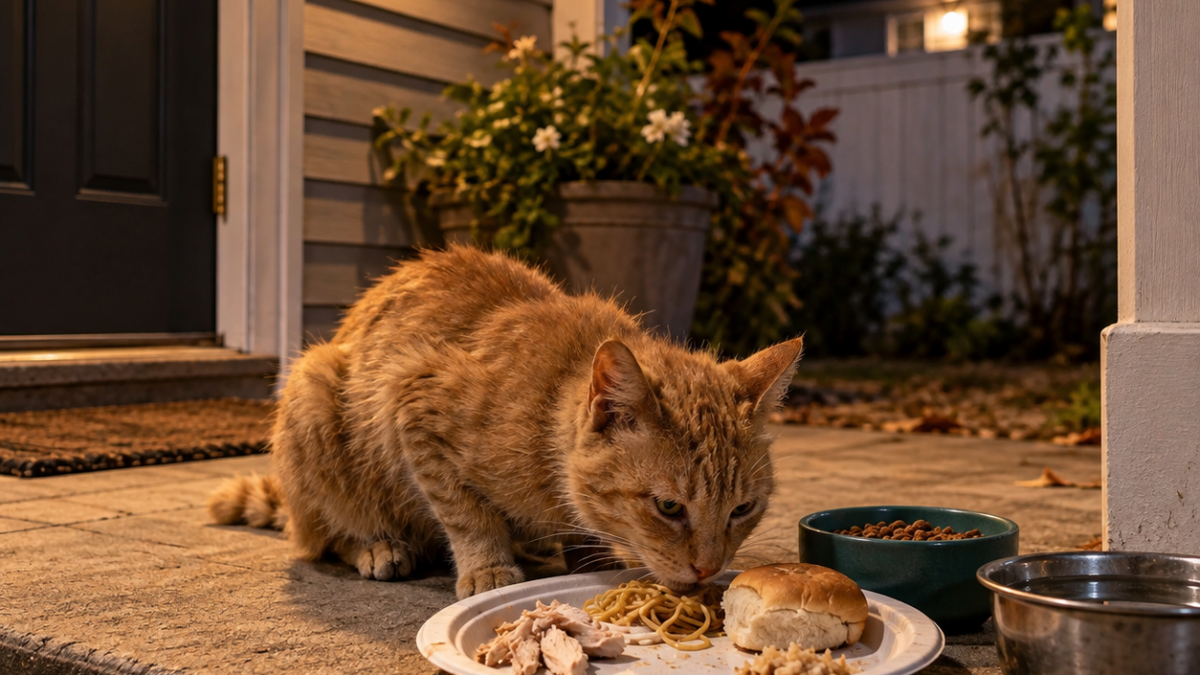
He had taken one of the cheap paper plates from the package beneath the kitchen sink.
On it, he placed several small pieces of chicken.
A little pile of noodles.
Half a slice of bread.
He did not dump them.
He arranged them.
That detail still gets me.
Chicken on one side.
Noodles in the middle.
Bread beside them.
As if whoever was going to eat it deserved a real plate.
He adjusted the bread when it partly covered the chicken.
Then he stood.
He looked toward the dark backyard.
For a second, I thought he might call someone.
He didn’t.
He came inside.
Closed the door.
Carried his dinner plate to the sink.
Then said, “I’m going to brush my teeth.”
As though nothing strange had happened.
“Owen.”
He stopped.
His shoulders went up.
“Yeah?”
“Come here.”
That little face changed immediately.
Not guilt exactly.
Fear of being in trouble.
He came back slowly.
“What did you put outside?”
His eyes dropped.
“Food.”
“I can see that.”
Silence.
“Why?”
He started picking at one thumbnail with the other.
I knew that habit.
Owen did it whenever he thought he had disappointed me.
“I’m not yelling,” I said.
He nodded.
“Look at me.”
He did.
“What’s the food for?”
His voice became very quiet.
“The orange cat.”
I paused.
“What orange cat?”
“The one outside.”
“We don’t have a cat.”
“I know.”
“Whose cat?”
“I don’t think anybody’s.”
I pulled out a kitchen chair.
“Sit down.”
He sat.
I sat opposite him.
“Start from the beginning.”
Owen looked toward the back door.
“There’s a cat.”
“I got that part.”
“He’s orange.”
“Okay.”
“He’s skinny.”
“How skinny?”
“Like you can see where his bones go.”
That immediately changed the temperature of the conversation.
“How long have you been seeing him?”
“A while.”
“How long is a while?”
He looked down.
“Three weeks.”
I stared at him.
“Three weeks?”
Nod.
“And you’ve been feeding him every night?”
Another nod.
“With your dinner?”
“Some.”
“Owen.”
“I don’t give him vegetables.”
Despite myself, I almost laughed.
“Why not?”
“He doesn’t like peas.”
“You’ve seen him eat the food?”
“No.”
That stopped me.
“What?”
“I don’t see him.”
“Then how do you know there’s a cat?”
“I saw him the first time.”
“When?”
“One morning.”
Owen explained.
Three weeks earlier, he had come downstairs early on a Saturday.
I had still been asleep.
He went to the kitchen to get cereal.
He looked through the back window and saw an orange cat near the porch.
“He looked at me,” Owen said.
“Then what?”
“He ran away.”
“And that made you start leaving food?”
“Not right away.”
The following morning, Owen saw him again.
The cat was near our garbage cans.
He appeared thin.
His fur was dirty.
He ran when Owen opened the door.
“So I thought maybe he was hungry.”
“And you put food outside?”
“I put bacon.”
“You gave a cat bacon?”
“It was only half.”
“Owen.”
“I didn’t know.”
I rubbed my forehead.
“The plate was empty the next morning?”
“Yes.”
“So you kept doing it?”
“Yes.”
“Every night?”
“Yes.”
“For three weeks?”
“Yes.”
I felt irritation rising again.
Not because of the cat.
Because he had hidden it.
“Why didn’t you tell me?”
There are answers that sound simple when you repeat them later.
In the moment, they can split something open inside you.
Owen looked down at his hands.
“Because you said stop wasting food.”
My chest tightened.
“I said that after you started feeding him.”
“I know.”
“Then why didn’t you explain?”
He whispered, “I thought you’d make me stop.”
I didn’t answer.
He looked at me.
“He’s really skinny.”
“I understand.”
“He might not have anybody.”
“Owen—”
“If I told you and you said no, then I’d have to stop.”
There it was.
Six-year-old logic.
Perfect and devastating.
He wasn’t trying to trick me because he didn’t respect me.
He was hiding it because he thought obedience might require him to leave something hungry.
I leaned back.
“How do you know he eats it if you never see him?”
Owen’s expression softened.
“Because the plate is empty in the morning.”
“Could be a raccoon.”
“No.”
“Possum.”
“No.”
“Squirrels.”
“At night?”
“Sometimes.”
“It’s him.”
“You sound very sure.”
“He comes.”
“How do you know?”
He shrugged.
“I just know.”
That night, I tucked Owen into bed at 8:30.
Same as every school night.
He asked, “Are you going to take the plate?”
“No.”
“You promise?”
“I promise.”
His face relaxed.
“Okay.”
I kissed his forehead.
“Good night.”
“Night.”
I closed the door.
Then I went downstairs and opened the security-camera app on my phone.
We had installed a cheap motion camera over the back porch the previous year after packages started disappearing from the neighborhood.
I barely used it.
Mostly it captured squirrels.
Occasionally me taking the garbage out while looking terrible.
I scrolled backward.
8:37.
Nothing.
8:39.
Nothing.
Then a motion alert.
8:41 p.m.
I tapped it.
An orange cat appeared around the side of the house.
Slowly.
He stopped at the bottom of the porch steps.
Looked left.
Looked right.
Then walked directly toward the paper plate.
Owen had not exaggerated.
The cat was thin.
Not cartoonishly skeletal.
But thin enough that the hip bones were visible beneath his coat.
His orange fur was dull and rough.
There was a dark mark near one ear.
He approached the plate carefully.
Smelled the food.
Then ate.
Not frantically.
That surprised me.
He ate each piece slowly.
Almost delicately.
Chicken first.
Then noodles.
He ignored the bread for several seconds.
Eventually ate that too.
When he finished, he sat beside the empty plate.
He licked one paw.
Wiped his face.
Then looked toward our back door.
Not at the camera.
At the door.
He sat that way for almost a full minute.
Then he left around the same corner of the house.
I checked the time.
8:42.
I went backward another night.
8:39.
Orange cat.
Another.
8:43.
Another.
8:40.
Another.
8:41.
Another.
I kept scrolling.
Night after night.
Same cat.
Same route.
Same plate.
Between 8:35 and 8:45.
Every single night.
I watched fourteen days.
He never missed one.
Owen went upstairs at 8:25 to brush his teeth.
Lights out at 8:30.
The cat came ten minutes later.
They had never seen each other.
Not after that first glimpse through the window.
My son prepared dinner for a living thing he never watched eat.
He did not stay awake.
He did not hide behind the curtain.
He did not ask for proof.
He put down the plate.
Went upstairs.
And trusted.
I sat alone at the kitchen table holding my phone.
Then I cried.
I wish I could say it was purely because I was moved.
It wasn’t.
Part of it was shame.
I had twice looked my son in the face and told him he was wasting food.
He knew better.
Not academically.
Not because he understood household budgets or food insecurity or animal welfare.
He simply knew the food was not wasted if something hungry ate it.
And when I misunderstood him, he did not give me a speech.
He quietly continued doing what he believed was right.
The next morning, I woke him ten minutes early.
“I want to show you something.”
He sat at the kitchen table in dinosaur pajamas.
Hair sticking straight up.
I opened the camera app.
Played the clip from the previous night.
The second the cat appeared, Owen sat upright.
“That’s him!”
His face changed completely.
I cannot describe it any other way.
Joy.
Pure joy.
Not pride.
Not “I told you so.”
Relief.
“He came.”
“Yes.”
“He really came.”
“He did.”
“Play it again.”
I did.
He watched.
“Again.”
I played it again.
By the fourth time, Owen was leaning so close his nose was almost touching my phone.
“He ate the noodles.”
“Yep.”
“He doesn’t like bread that much.”
“Apparently not.”
“Can I give him chicken tonight?”
“Yes.”
He looked at me.
“Really?”
“Really.”
His eyes widened.
“And cat food.”
“What?”
“We’re buying actual cat food.”
A huge smile.
“And a bowl.”
“Two bowls.”
“Why two?”
“Food and water.”
He thought for a second.
“Can they be orange?”
“We’ll see.”
At school drop-off, before he opened the car door, I said, “Owen.”
He looked back.
“I’m sorry.”
“For what?”
“For saying you were wasting food.”
He shrugged.
“It’s okay.”
“No. Listen.”
Children are often better at receiving apologies than adults are at giving them.
I wanted him to understand mine.
“I should have asked you why before deciding what you were doing.”
Owen looked thoughtful.
Then said, “But you didn’t know.”
“No.”
“I knew.”
I laughed once.
“That is unfortunately correct.”
Then he gave me the sentence that I still think about.
“It wasn’t wasted if he needed it.”
He climbed out.
Ran toward school.
And left me sitting in the car feeling like I had just lost an argument to someone who still occasionally put his shoes on the wrong feet.
That afternoon we bought cat food.
Owen chose the bowls.
Blue, not orange.
One had little fish printed around the edge.
At 8:25, he filled one with dry food.
I filled the other with water.
He put both on the porch.
Then he went upstairs without asking to watch.
“Don’t you want to stay up and see if he comes?” I asked.
He looked confused.
“He always comes.”
Of course.
At 8:40, the motion notification appeared.
There he was.
The cat walked to the bowls.
Ate.
Drank.
Then sat by the door.
Something about the way he sat bothered me.
I zoomed in.
He was not staring at the food.
He was staring through the glass.
As if waiting for someone.
The next three nights were identical.
Food.
Water.
8:40.
The exact same side of the house.
The exact same pause afterward.
Then Friday night, something changed.
The cat limped.
Only slightly.
But I saw it.
He put less weight on his right rear leg.
I called a local animal rescue the next morning.
The organization was called Second Chance Street Cats.
A volunteer named Dana answered.
I explained everything.
She asked questions.
“How close can you get?”
“I haven’t tried.”
“Friendly?”
“Don’t know.”
“Ear tipped?”
“What?”
She explained trap-neuter-return ear tipping.
I checked the footage.
“No.”
“Collar?”
“No.”
“Male or female?”
“I have no idea.”
She laughed.
“We can set a humane trap.”
“When?”
“We’re slammed this weekend.”
“How slammed?”
“Twenty-three cats in foster homes and one woman with six kittens in her laundry room.”
“Okay.”
“Monday?”
I looked toward the porch.
The cat had limped.
“Can we do anything sooner?”
Dana went quiet.
“You’re hooked.”
“My six-year-old is hooked.”
“Same difference.”
She walked me through buying a humane trap at a farm supply store.
She told me not to let Owen approach the cat.
No human food.
Fresh water.
Consistent feeding.
Then she said, “If he comes at exactly the same time, that’s useful.”
“Why?”
“Routine.”
“For trapping?”
“For everything.”
“What do you mean?”
“Cats that precise usually learned it somewhere.”
That sentence stayed with me.
Monday evening, Dana came over.
Late forties.
Gray ponytail.
Work boots.
A sweatshirt covered in cat hair.
She watched the camera footage.
“He doesn’t act feral.”
“He runs from people.”
“Feral and afraid aren’t the same.”
“How can you tell?”
“The sitting.”
“What sitting?”
“After he eats.”
She pointed at the screen.
“He relaxes.”
I looked.
“He grooms.”
“Yes.”
“Feral cats groom.”
“They do. But look where he’s facing.”
The door.
“You think he lived in a house?”
“I’d bet money.”
We set the trap.
Sardines inside.
Covered most of it with a towel.
At 8:40, the cat arrived.
Walked toward it.
Stopped.
Looked at the trap.
Looked at the camera.
Then sat down.
He stared at the trap for three minutes.
Turned around.
Left.
Dana laughed.
“He’s smarter than us.”
Owen was devastated the next morning.
“He didn’t eat?”
“No.”
“Because of the cage.”
“Probably.”
“You scared him.”
“I know.”
“Take it away.”
“We need to get him checked.”
“He won’t trust us.”
“That’s possible for a little while.”
Owen’s face tightened.
“You said we were helping.”
“We are.”
“He was eating before.”
“Owen.”
“He came every day before grown-ups started doing stuff.”
That one landed.
Dana returned that evening.
Different trap.
Chicken this time.
We skipped feeding.
At 8:38, the cat appeared.
He circled once.
Twice.
Went inside.
The trap door dropped.
The sound through the camera microphone was awful.
Metal snap.
Cat slamming backward.
Owen heard it from upstairs.
“Mom!”
He came running.
I met him at the bottom of the stairs.
“He’s okay.”
“He’s scared.”
“I know.”
“You hurt him!”
“No.”
The cat was thrashing.
Dana immediately covered the trap fully.
Within seconds, he quieted.
Owen stood behind me crying.
“I told you.”
Dana crouched to his level.
“What’s your name?”
“Owen.”
“Owen, do you know why he’s scared?”
“Because we trapped him.”
“Yes.”
“You shouldn’t.”
“He has a hurt leg.”
Owen wiped his nose.
“He still eats.”
“He does.”
“But if the leg gets infected, he could get very sick.”
Owen looked toward the trap.
Dana said, “Sometimes helping someone means they don’t understand what you’re doing yet.”
That seemed to reach him.
He approached slowly.
The covered trap sat on the porch.
He whispered, “Sorry, Orange.”
The cat stopped moving.
Dana and I looked at each other.
Owen crouched.
“We’re taking you to the doctor.”
A small sound came from inside.
Not a hiss.
A meow.
Owen’s eyes widened.
“He talked.”
The vet clinic opened early the next morning.
We arrived at 7:30.
Owen came with me because there was no universe in which he would have gone to school without knowing what happened.
Dr. Melissa Ford examined the cat after mild sedation.
Male.
Neutered.
Around seven years old.
Underweight.
Fleas.
Minor infection in the rear paw caused by a cut.
Dental tartar, but otherwise surprisingly healthy.
“He has definitely lived indoors,” Dr. Ford said.
“How can you tell?”
“Paw pads, muscle condition, teeth, behavior.”
She scanned him.
The scanner beeped.
“Microchip.”
My heart jumped.
Owen gasped.
“What’s that?”
“It means someone put information inside a tiny chip under his skin.”
“Like a robot?”
“Not exactly.”
Dr. Ford smiled.
“It means we may know his name.”
The chip company record came back registered.
Copper.
The cat’s name was Copper.
Owner: Eleanor Whitmore.
Address: 614 Willow Street.
Phone disconnected.
I knew Willow Street.
Six blocks from my house.
I also knew 614.
Not personally.
But I had driven past it.
A white Craftsman bungalow with green shutters.
Except the shutters weren’t green anymore.
The house had been renovated recently.
Gray siding.
Black trim.
For Sale sign.
I felt something shift inside me.
“When was the chip registered?”
Dr. Ford checked.
“Seven years ago.”
“Any update?”
“None.”
“Can you find another phone number?”
“Not through the chip company.”
I pulled out my phone.
Search.
Eleanor Whitmore.
Our town.
First result: an obituary.
I froze.
Then realized it was the wrong Eleanor Whitmore.
Eighty-nine.
Different state.
Second result.
Local library fundraising committee.
Eleanor Whitmore.
Retired elementary music teacher.
A photograph.
Silver hair.
Round glasses.
Smiling beside a group of children.
Posted eleven months earlier.
No obituary.
Owen tugged my sleeve.
“Is that his mom?”
“I don’t know.”
“Can we call her?”
“We’ll try.”
I found a social-media profile.
Inactive for nearly six months.
Then a comment beneath the last public post.
“Thinking of you, Ellie. Hope rehab is going well.”
Rehab.
I called the number listed for the town senior center.
It took three conversations to reach someone who knew her.
The woman’s name was Janice.
The moment I said Copper, she stopped talking.
“You found him?”
“Yes.”
“Oh my God.”
“You know the cat?”
“Everybody knows Copper.”
“Where is Eleanor?”
Silence.
Then Janice asked, “Who are you?”
I explained Owen.
The porch.
Three weeks.
The microchip.
Janice’s voice cracked.
“Eleanor thinks he’s dead.”
I stood in the veterinary hallway.
“What?”
“She was told he got hit by a car.”
I felt cold.
“Who told her?”
Another pause.
“Her daughter.”
That was the beginning.
Eleanor Whitmore was seventy-one years old.
She had taught elementary-school music for thirty-six years.
She had been widowed for nine.
No sons.
One daughter.
Vanessa.
Copper had belonged originally to Eleanor’s husband, Peter.
Peter found him as a kitten underneath the shed.
When Peter died from pancreatic cancer, Copper slept on Eleanor’s pillow every night for two months.
“Those two were attached,” Janice told me.
“What happened to Eleanor?”
“She fell in May.”
At home.
Hip fracture.
Neighbor found her.
Surgery.
Rehabilitation facility.
She planned to return home.
Vanessa came from Chicago to help.
She took control of the bills.
Mail.
House.
Copper.
“She told everyone she was doing a wonderful thing,” Janice said.
“What happened?”
“Depends who you ask.”
“What do you think?”
Janice’s voice lowered.
“I think Vanessa realized her mother’s house was worth more empty than occupied.”
My stomach tightened.
According to public property records, Eleanor’s home had been transferred into a family trust in July.
Listed for sale in September.
Interior renovated.
“Did Eleanor agree to sell it?”
“Eleanor told me in June she was going home.”
“Where is she now?”
“Maple View Assisted Living.”
“Why assisted living if she was in rehab?”
“Vanessa said doctors determined she couldn’t live alone.”
“Did doctors determine that?”
“I don’t know.”
I thought about Copper.
“Where did Vanessa say the cat was?”
“At first, staying with her.”
“And then?”
Janice started crying.
“She told Eleanor Copper escaped and was hit.”
“Did she see it?”
“She said someone found him on the road.”
“Was there a body?”
“No.”
I closed my eyes.
“How long ago?”
“About two months.”
Copper had been showing up at our house for three weeks.
“What did Eleanor do?”
“What do you think?”
Janice’s voice broke.
“She stopped eating for days.”
That afternoon, I drove to Maple View.
I did not bring Copper.
Not yet.
I brought Owen.
In hindsight, I’m not sure why.
Maybe because none of this would have happened without him.
Maybe because I was already learning that adults had made enough decisions around Eleanor without asking her.
We sat in the lobby while Janice contacted Eleanor.
A nurse came out.
“Ms. Whitmore will see you.”
Eleanor’s room was small but bright.
One bed.
One dresser.
A recliner.
An electric keyboard against the wall.
Sheet music stacked on a chair.
She sat near the window with a walker beside her.
The woman from the online photograph looked smaller in person.
Thinner.
But the same round glasses.
Same intelligent eyes.
Janice stood beside her.
Eleanor looked at me.
Then Owen.
“You’re the people with Copper.”
Not a question.
I nodded.
“We found a cat whose microchip is registered to you.”
Her hand rose to her mouth.
“Is he alive?”
Owen answered before I could.
“Yes.”
Eleanor started crying.
Not loudly.
She folded forward and covered her face.
Janice put an arm around her.
“Oh, Ellie.”
Eleanor looked up again.
“Where?”
“Our house,” Owen said.
“He comes at night.”
She stared at him.
“You fed him?”
Owen nodded.
“Every day.”
“How long?”
“Three weeks.”
Eleanor’s shoulders shook.
I knelt beside her chair.
“He’s at a veterinary clinic right now. He has a small cut on his paw. He’s thin, but he’s going to be okay.”
“He’s alive.”
“Yes.”
“My daughter told me—”
“I know.”
Eleanor’s expression changed.
Pain became confusion.
Then suspicion.
“Why would she say that?”
I had no answer.
Neither did Janice.
Owen moved closer.
“He eats chicken.”
Eleanor laughed through tears.
“He loves chicken.”
“He doesn’t like bread.”
“He never did.”
Owen smiled.
“He comes at eight-forty.”
Eleanor went completely still.
“What?”
“Every night.”
I looked at her.
“Usually between 8:38 and 8:42.”
Eleanor’s face drained of color.
Janice noticed too.
“What is it?”
Eleanor stared toward the window.
“Peter.”
“Your husband?”
She nodded.
“When Peter was alive, he worked second shift at the hospital.”
Her voice became distant.
“He got home at 8:40 every night.”
Something moved through me.
“Copper waited by the back door?”
“Every night.”
Her eyes closed.
“Peter came in. Put his lunchbox on the counter. Gave Copper a piece of chicken or turkey if he had any left.”
Owen looked at me.
I felt goosebumps rise along both arms.
Eleanor whispered, “Even after Peter died, Copper would go to the kitchen around 8:40.”
The room became very quiet.
“He did it for years.”
I thought of the camera footage.
Copper appearing out of darkness.
Exactly on time.
Sitting by our door after eating.
Waiting.
Not for Owen.
Not exactly.
Waiting because, somewhere in his body, 8:40 still meant someone comes home and food means love.
Owen asked, “Can she see him?”
I looked at Eleanor.
“Yes.”
The reunion happened two hours later.
Dr. Ford agreed Copper was stable enough to leave.
Maple View allowed pets to visit.
Dana drove him over in a carrier.
Eleanor sat in the common room.
She had changed her sweater.
Brushed her hair.
That detail destroyed me more than I expected.
She had prepared herself.
For her cat.
When Dana placed the carrier on the floor, Copper began meowing before we opened it.
Eleanor covered her mouth.
“Copper?”
The meowing became frantic.
Not fear.
Recognition.
Dana opened the door.
Copper came out.
Looked around.
Saw Eleanor.
He ran.
His injured paw did not matter.
He jumped onto her lap.
Eleanor cried his name.
Again.
Again.
Again.
Copper pressed his entire body against her chest.
He rubbed his face against her glasses.
Her chin.
Her neck.
He purred so loudly we could hear it from several feet away.
Owen stood beside me.
He whispered, “He knows her.”
“Yes.”
Eleanor held Copper with both arms.
“My boy.”
Copper kneaded her sweater.
“I’m sorry.”
Her voice cracked.
“I’m so sorry.”
She kissed his head.
“I thought you were gone.”
Then her expression changed.
She looked at Janice.
Then at me.
“Vanessa lied.”
Nobody answered.
Eleanor’s hands tightened around Copper.
“She lied to me.”
I had expected grief.
What came next was anger.
Not explosive anger.
Older.
Sharper.
The kind that has spent a lifetime learning to stand upright.
“Call her.”
Janice hesitated.
“Ellie—”
“Call my daughter.”
“We should talk to the social worker first.”
“Janice.”
Eleanor looked at her.
“My daughter told me my cat was dead.”
Copper purred against her chest.
“She sold my house.”
My skin prickled.
“What?”
Eleanor looked at me.
“I never agreed to sell it.”
That sentence changed everything.
Over the next forty-eight hours, I learned far more about guardianship, powers of attorney, property transfers, and elder financial abuse than I had ever wanted to know.
Eleanor had signed a limited power of attorney after surgery.
Vanessa told her it was necessary to pay bills while Eleanor was in rehabilitation.
Eleanor remembered signing papers.
She did not remember authorizing a trust.
She did not remember agreeing to list her home.
She absolutely did not remember agreeing to move permanently into assisted living.
“She told me the rehab doctor said I couldn’t go home,” Eleanor explained.
“Did the doctor tell you directly?”
“No.”
“Did anyone?”
“Vanessa.”
I looked at Janice.
Janice looked sick.
The Maple View social worker, Christine Lee, pulled Eleanor’s file.
Admission paperwork identified Vanessa Whitmore as responsible representative.
A physician’s form said Eleanor required assistance with bathing, transportation, and some medication management.
It did not say she lacked capacity.
It did not say she needed twenty-four-hour supervision.
It did not say she could not live at home.
“Ms. Whitmore,” Christine said carefully, “did you choose Maple View?”
Eleanor laughed.
“No.”
Christine stopped writing.
“Did you authorize the sale of your home?”
“No.”
“Did your daughter explain what would happen to the proceeds?”
“What proceeds?”
That answer silenced all of us.
Adult Protective Services was contacted that afternoon.
Then an attorney from a nonprofit elder-law organization.
Her name was Priya Shah.
She arrived with three legal pads and the calmest voice I had ever heard.
“Mrs. Whitmore—”
“Eleanor.”
“Eleanor, I’m going to ask you a number of questions. Some may feel insulting.”
“Go ahead.”
“I need to understand your ability to make financial and medical decisions.”
Eleanor stared at her.
“Ask me what year it is.”
Priya smiled slightly.
“October 2026.”
“Good.”
“Who is president?”
Eleanor answered.
“What did you eat for breakfast?”
“Oatmeal that should be prosecuted.”
Even Priya laughed.
Eleanor knew her bank.
Her pension amount.
Approximate property tax.
Medication list.
Former mortgage company.
She remembered every teacher on her school team from the year she retired.
This was not a confused woman incapable of participating in her own life.
It became clear that nobody had declared Eleanor incompetent.
Vanessa had simply behaved as though convenience and legal authority were the same thing.
We still didn’t know exactly what she had done with Copper.
That answer came sooner than expected.
Vanessa arrived at Maple View the next morning.
I was there because Owen had asked to visit Copper before school.
We heard her before we saw her.
“I want that animal removed.”
Eleanor sat upright.
Copper was on her bed.
Vanessa entered.
Early forties.
Expensive coat.
Perfect hair.
The kind of polished appearance that photographs well.
She stopped when she saw me.
Then Owen.
“Who are these people?”
Eleanor’s voice was steady.
“They found my cat.”
Vanessa looked at Copper.
For one second, guilt flashed across her face.
Then it vanished.
“Mom, you can’t keep a cat here.”
Christine, the social worker, stood near the door.
“Residents can have approved pets with a care plan.”
Vanessa turned.
“This is a medical facility.”
“Assisted living.”
“You know what I mean.”
Eleanor stroked Copper.
“No. She doesn’t.”
Vanessa looked at her mother.
“We need to talk privately.”
“No.”
“Mom.”
“No.”
Vanessa exhaled.
“This is exactly what I was worried about. Strangers involving themselves in your affairs.”
Priya stepped into the room.
“Hi. Priya Shah. I represent Eleanor.”
Vanessa’s expression changed.
“Represent her?”
“Yes.”
“For what?”
“Currently, several matters.”
“What matters?”
“Your mother’s property transfer.”
Vanessa’s jaw tightened.
“This is ridiculous.”
Eleanor said, “Did I tell you to sell my house?”
Vanessa looked at her.
“We discussed this.”
“When?”
“Multiple times.”
“No.”
“You don’t remember.”
The cruelty of that sentence was not in its volume.
It was in its confidence.
You don’t remember.
Three words.
A weapon used against anyone old enough for people to question their certainty.
Eleanor’s back straightened.
“I remember you telling me the pipes were bad.”
“They were.”
“You told me repairs would cost forty thousand dollars.”
“Approximately.”
“You told me the doctor said I’d never be safe alone.”
“That was the recommendation.”
“Whose?”
Vanessa looked toward Christine.
“The medical team.”
Christine said, “Our records do not contain that recommendation.”
Vanessa’s face flushed.
“This isn’t the time.”
Eleanor’s voice trembled.
“Did you kill my cat?”
Owen’s hand found mine.
Vanessa looked horrified.
“Of course not.”
“You told me he was dead.”
“He ran away.”
“You said he was hit by a car.”
“I didn’t want you obsessing over him.”
There it was.
Not the full truth.
But enough.
Eleanor whispered, “Where did he run away from?”
Vanessa folded her arms.
“My apartment.”
“Your apartment is in Chicago.”
Silence.
“Was Copper ever in Chicago?”
Vanessa looked away.
Eleanor’s face changed.
“Was he ever in your apartment?”
“Mom.”
“Answer me.”
“I had a lot going on.”
“Answer me.”
Vanessa snapped.
“No.”
The room went still.
Owen squeezed my fingers.
Eleanor asked, “Where did you take him?”
“I was trying to handle the house.”
“Where?”
“The shelter wouldn’t take him.”
“Which shelter?”
“I don’t remember.”
“Where did you put my cat?”
Vanessa’s voice rose.
“I let him out!”
Nobody moved.
Vanessa realized too late what she had admitted.
“He was always indoor-outdoor anyway.”
Eleanor stared at her.
“No, he wasn’t.”
“Mom—”
“He never went farther than my backyard.”
“I couldn’t take him.”
“You could have called Janice.”
“I had enough to do.”
“You could have called the vet.”
“I was cleaning out a whole house!”
“My house.”
“You weren’t going back!”
Eleanor’s voice sharpened.
“You decided that.”
“You fell!”
“I broke a hip. I did not die.”
Vanessa flinched.
Eleanor pointed toward Copper.
“You put him outside?”
“I left food.”
“For how long?”
No answer.
“For how long, Vanessa?”
“A few days.”
“Then what?”
“I went home.”
Owen made a tiny sound beside me.
Not crying.
Something like disbelief.
Vanessa noticed him for the first time.
“This is not appropriate for a child.”
I moved Owen behind me slightly.
Eleanor said, “That child fed the cat you threw away.”
Vanessa stared at him.
Eleanor continued.
“For three weeks.”
Vanessa’s face hardened.
“Great. So now we’re all going to pretend this is some movie?”
Priya said quietly, “I think you should leave.”
“This is my mother.”
“Your mother has requested that you not make decisions on her behalf until her legal documents are reviewed.”
Vanessa laughed.
“She has no idea what she’s doing.”
Eleanor stood.
Slowly.
Using the walker.
Copper jumped down.
Eleanor faced her daughter.
“I taught music to children for thirty-six years.”
Her voice shook.
“I buried my husband.”
Vanessa looked away.
“I handled his hospice bills.”
She took one step.
“I handled the insurance.”
Another.
“I paid off this house.”
Another.
“I managed my pension.”
Vanessa’s eyes filled.
“And because I fell in my kitchen, you decided I stopped being a person.”
“Mom, that’s not—”
“You sold my house.”
“I was protecting you.”
“You threw my cat outside.”
“I couldn’t—”
“You told me he was dead.”
Vanessa started crying.
“Do you know what I was dealing with?”
Eleanor stared.
And for half a second, I saw something complicated.
A mother still seeing her daughter.
Not simply an enemy.
That made what came next harder.
Vanessa said, “I have two kids. A mortgage. My marriage is falling apart. You expected me to drive five hours every week, maintain some old house, manage your bills, deal with that animal—”
“That animal was my family.”
“So am I!”
“Yes.”
Eleanor’s voice broke.
“You were.”
Vanessa went silent.
Eleanor immediately looked as if she regretted saying it.
But she did not take it back.
Vanessa left.
The investigation widened.
Property records showed the home had been transferred to a revocable trust naming Vanessa as trustee.
The signature looked like Eleanor’s.
Eleanor swore she had never knowingly signed it.
A mobile notary had visited her rehabilitation center.
According to the notary, Vanessa presented the documents and repeatedly “clarified” questions for Eleanor before she could answer.
The notary had written notes.
“Client appeared tired.”
“Daughter stated transaction previously discussed.”
“Client asked whether she could return home after rehab.”
That last note mattered.
If Eleanor believed she was returning home, why would she knowingly transfer control of the property for immediate sale?
The sale had not closed yet.
Thank God.
There was an accepted offer.
Closing scheduled in nine days.
Priya obtained an emergency court order freezing the transaction.
Then the bank records arrived.
Vanessa had used nearly $18,000 from Eleanor’s account.
Some expenses were legitimate.
Rehab bills.
Insurance.
Utilities.
But thousands went elsewhere.
A resort hotel.
Credit-card payments.
Furniture delivery to Chicago.
A cosmetic dental clinic.
When investigators questioned her, Vanessa said Eleanor had given permission.
Eleanor said she had not.
The district attorney’s elder-abuse unit became involved.
And because life apparently enjoys adding gasoline to fires, a local reporter learned about Copper.
The headline appeared two days later.
SIX-YEAR-OLD’S SECRET PORCH DINNERS LEAD TO ALLEGED ELDER ABUSE CASE
I nearly threw my phone.
I had not told a reporter.
Neither had Priya.
Someone at Maple View had.
The story exploded.
The camera clip of Copper arriving at 8:40 aired on local television.
Then national websites picked it up.
People loved Owen.
Too much.
Reporters called him “The Porch Angel.”
I hated that.
He was six.
He was not a mascot.
I refused television interviews involving his face.
One station agreed to blur him and use only a photograph of the bowls.
Another kept calling.
Then Vanessa gave an interview.
That was the moment everything became ugly.
She stood outside her attorney’s office.
She cried.
She said she had been “vilified for trying to help an aging parent.”
She said Eleanor had become forgetful.
She said Copper escaped.
She said strangers had manipulated Eleanor.
Then the reporter asked whether she had used her mother’s money for personal expenses.
Vanessa replied, “Families don’t document every dollar.”
I watched from my kitchen.
Owen was upstairs.
Good.
Then Vanessa said, “I think it’s disgusting that someone is using a little boy and a cat to create a public spectacle.”
I turned the television off.
My hands were shaking.
The next morning, someone taped a printed article to our mailbox.
Across Owen’s blurred photograph, someone had written:
MIND YOUR OWN BUSINESS.
I called police.
No fingerprints.
No useful camera angle.
For the first time, I wondered if I had made a terrible mistake.
Not by helping Copper.
By stepping into the rest.
I was a mother.
Not an investigator.
Not a lawyer.
I had brought my child into the orbit of people fighting over property and money.
That night, after Owen went to sleep, I sat beside the porch bowls.
Copper was staying temporarily at Maple View with Eleanor.
The bowls were empty now.
For three weeks, this spot had meant something.
At 8:40, the camera motion light came on anyway.
A moth.
Nothing else.
I started crying.
Then the back door opened.
Owen stood there in dinosaur pajamas.
“You’re supposed to be asleep.”
“You’re outside.”
“I know.”
“Is Copper coming?”
“No, buddy. He’s with Eleanor.”
“Oh.”
He sat beside me.
“Why are you sad?”
I wiped my face.
“Grown-up stuff.”
He hated that phrase.
“What grown-up stuff?”
“People are angry.”
“At us?”
“Some.”
“Why?”
“Because we found out things they didn’t want people to find out.”
He considered this.
“Vanessa?”
I looked at him.
“How do you know about Vanessa?”
“Grandma Linda said her name.”
My mother.
Of course.
“Yes.”
“Did she put Copper outside?”
“Yes.”
“Why?”
“She didn’t want to take care of him.”
Owen was quiet.
Then he said, “She could’ve asked.”
Six years old.
Five words.
The entire case.
“She could have.”
“Eleanor would’ve wanted him.”
“Yes.”
“She thought he died?”
“Yes.”
His face became angry.
“That’s mean.”
“Yes.”
He looked at the porch.
“I didn’t know he was Eleanor’s.”
“No.”
“I just fed him.”
“I know.”
“Did I do something bad?”
I turned toward him.
“What?”
“Because everyone’s mad now.”
That question nearly destroyed me.
I put both hands around his face.
“No.”
He blinked.
“No, Owen. Listen to me.”
I pulled him closer.
“You saw a hungry animal and fed him. That’s all you did.”
“But then—”
“What happened after that belongs to the adults who made those choices.”
“Vanessa made bad choices?”
“Yes.”
“Did I get her in trouble?”
“No.”
He stared at me.
“Her choices got her in trouble.”
That sentence was as much for me as him.
He leaned against my shoulder.
After a minute he asked, “Can Copper still come here sometimes?”
I laughed.
“Yes.”
“Good.”
We sat there until 8:50.
Then I took him upstairs.
The next major development came from the porch camera.
Not our recent footage.
Older footage.
Police asked whether I could search back farther.
Our camera plan stored only thirty days in the cloud.
But my ex-husband had configured an external backup when he installed the system.
I had forgotten.
There were months of clips on a hard drive in the hall closet.
I started looking.
June.
July.
August.
Mostly nothing.
Raccoons.
Delivery people.
Me dragging garbage cans.
Owen playing with bubbles.
Then September 11.
2:13 a.m.
Orange cat.
Copper.
He appeared almost six weeks earlier than Owen first noticed him.
He was heavier.
Cleaner.
He walked across our yard but did not stop.
September 13.
Copper again.
September 18.
Again.
Different direction.
I began tracking his route.
Always coming from west.
Heading east.
At night.
Then September 22, 8:41 p.m.
Copper stopped on our porch.
No food.
He sat near the door.
For nearly four minutes.
Then left.
Why?
There had been no bowls.
No Owen.
Nothing.
The next night, 8:40.
Again.
Same place.
Sit.
Wait.
Leave.
He had been coming before Owen began feeding him.
I called Eleanor.
“Was there anything about my house?”
“What do you mean?”
“Did Peter know someone who lived here?”
I gave her the address.
She went quiet.
“That was the Beckers’ house.”
“Who?”
“Tom and Susan Becker.”
“Did Peter know them?”
“Tom worked with Peter.”
My skin prickled.
“At the hospital?”
“Yes.”
“Second shift?”
“Yes.”
“What time did he get home?”
Eleanor laughed softly.
“Same time.”
I looked toward my back door.
“Oh my God.”
Peter and Tom had carpooled.
For years.
Peter drove some weeks.
Tom drove others.
At 8:40, both men reached the neighborhood.
Sometimes Peter dropped Tom at our house—before we owned it—then continued six blocks to his own.
Copper had occasionally ridden with Eleanor to pick Peter up years ago.
After being dumped outside near Eleanor’s old house, Copper had stayed in the area.
At 8:40, he followed old routes.
Old scents.
Old memory.
Our porch was not random.
He was visiting a place connected to the time of day when his world once became safe.
Then Owen, by accident, started leaving food.
Two routines found each other.
A cat waiting for a dead man’s schedule.
A little boy leaving dinner for a cat he never watched eat.
Neither understood the other.
Both kept showing up.
When I told Eleanor, she cried.
Then she said, “Peter would have loved Owen.”
At the emergency hearing over the house, Vanessa appeared with two attorneys.
Eleanor came using her walker.
Copper stayed at Maple View.
I sat behind her with Janice and Priya’s assistant.
The courtroom was small.
No dramatic jury.
No television speeches.
Just wood benches, fluorescent lights, papers, and people trying to translate betrayal into legal language.
Vanessa’s attorney argued Eleanor had knowingly executed estate-planning documents.
Priya argued the documents had been obtained through undue influence and misrepresentation.
Then the notary testified.
She admitted Vanessa had answered several questions for Eleanor.
She admitted Eleanor appeared confused about whether the house would remain hers.
She admitted she should have stopped the signing and asked Vanessa to leave the room.
The judge asked, “Why didn’t you?”
The notary looked down.
“Ms. Whitmore’s daughter said her mother became anxious when separated from her.”
Eleanor whispered, “That’s a lie.”
The judge heard her.
He looked over his glasses.
“Ms. Whitmore, you’ll have an opportunity.”
When Eleanor testified, Vanessa stared at the table.
Priya asked, “Did you wish to sell your home?”
“No.”
“Did you want to return after rehabilitation?”
“Yes.”
“Did you authorize your daughter to use your money for her personal expenses?”
“No.”
“Did you authorize her to abandon your cat?”
Eleanor’s voice tightened.
“No.”
Vanessa’s lawyer stood.
“Objection.”
“Sustained.”
Priya shifted.
“Were you told your cat was dead?”
“Yes.”
“By whom?”
“My daughter.”
“Was that true?”
“No.”
Vanessa began crying.
The judge looked at her.
Then back at Eleanor.
“Why is your home important to you?”
That question seemed to surprise everyone.
Eleanor took a breath.
“My husband died there.”
She swallowed.
“That sounds strange.”
“No,” the judge said. “Continue.”
“I don’t mean the building killed him.”
A few people smiled gently.
“I mean that’s where hospice brought his bed.”
Her voice trembled.
“That’s where I held his hand.”
She looked toward Vanessa.
“That’s where my daughter slept on the couch for four nights because none of us wanted to be alone.”
Vanessa covered her mouth.
Eleanor continued.
“My piano is there.”
“Was.”
Vanessa’s shoulders shook.
Eleanor’s eyes filled.
“My husband’s workbench was there.”
“Was.”
“My Christmas ornaments.”
“Were.”
Her voice broke.
“Forty-one years.”
The courtroom was silent.
“I may eventually choose to sell that house.”
She straightened.
“But I wanted the choice.”
That was the center of everything.
Not the house.
Not Copper.
Not even the money.
Choice.
Vanessa had taken ordinary vulnerabilities—age, injury, exhaustion—and treated them as permission.
The judge suspended Vanessa’s authority under the disputed documents, appointed an independent temporary fiduciary, and blocked the property sale pending further review.
It was not the final victory.
But Eleanor cried anyway.
Outside the courthouse, reporters waited.
Priya had told her she did not have to speak.
Eleanor said she wanted to.
A reporter asked, “Mrs. Whitmore, do you blame your daughter?”
Eleanor looked toward the cameras.
“I hold her responsible.”
Not blame.
Responsible.
The distinction mattered.
“Do you want her punished?”
Eleanor took her time.
“I want her to stop telling people she did this because I’m old.”
Another reporter asked, “What do you mean?”
Eleanor said, “There’s a difference between needing help and surrendering your life.”
The microphones moved closer.
“I needed help after surgery.”
She lifted one hand.
“I did not need someone to decide what I owned, where I lived, what happened to my money, and whether the living creature I loved was inconvenient.”
A reporter shouted, “Do you forgive her?”
Eleanor’s face changed.
For a moment, she looked less like a public figure and more like a mother.
“I still love my daughter.”
She paused.
“That is not the same thing as trusting her.”
Then she walked away.
That clip spread faster than the cat video.
Vanessa became the villain of the week.
I hated that too.
Not because I defended her.
Because the internet simplifies people into characters.
Saint.
Monster.
Angel child.
Cruel daughter.
Real life was uglier.
Vanessa had done terrible things.
But she had also spent years helping Eleanor with taxes after Peter died.
She had once driven through a snowstorm to bring medicine.
She had sat beside her father’s hospice bed.
She had a photograph on Eleanor’s dresser holding Copper as a kitten.
People kept asking how someone who loved her mother could do what she did.
The answer was uncomfortable.
Love does not prevent selfishness.
Sometimes people hurt the people they love precisely because they convince themselves they know what is best.
Vanessa wanted money.
Yes.
Investigators eventually proved that.
But she also wanted the burden reduced.
One less house.
One less cat.
One less weekly drive.
One less set of decisions.
Instead of admitting she could not manage it, she turned her mother into the problem.
Too old.
Too confused.
Too dependent.
Then she called control “help.”
The district attorney eventually charged her with financial exploitation, theft, falsification of documents, and fraud.
The house transfer was voided.
Several purchases were traced.
Some money recovered.
Some gone.
The piano had been sold.
Peter’s workbench too.
Most furniture.
Eleanor’s Christmas ornaments were found in a storage unit because apparently even betrayal has inefficient inventory management.
Copper’s abandonment was referred to animal-control authorities.
That charge was minor compared with the financial case.
Eleanor cared about it more than the prosecutors did.
“She threw him outside.”
“I know.”
“He could have died.”
“I know.”
Then she would look at Owen.
“But he didn’t.”
No.
He didn’t.
Eleanor spent another six weeks at Maple View.
Physical therapy improved her strength.
Priya helped arrange a home-safety evaluation.
Railings.
Bathroom bars.
Medication dispenser.
Meal deliveries.
A neighbor agreed to check in.
Janice promised grocery runs.
I volunteered too.
Eleanor looked at me and said, “I am not collecting women to supervise me.”
“We’re not supervising.”
“You have a spreadsheet.”
“That is organization.”
“That is supervision with columns.”
She was impossible.
I loved her.
In December, Eleanor went home.
Not the way she had left it.
That mattered.
The house had been renovated for sale.
Walls painted gray.
Old wallpaper stripped.
Peter’s den emptied.
The kitchen cabinets replaced.
Vanessa had removed the faded floral curtains Eleanor hated but had kept because Peter liked them.
Eleanor stood inside the front door.
Copper in a carrier beside her.
For a long time, she said nothing.
Owen held my hand.
“This isn’t my house.”
Janice said, “It is.”
“No.”
Eleanor touched the wall.
“They erased it.”
That sentence hurt.
We had all treated getting the house back as the happy ending.
But possession is not restoration.
You can recover a building without recovering the exact home that lived inside it.
Owen let go of my hand.
He walked to Eleanor.
“Can you make it yours again?”
She looked down.
“What?”
“You can put stuff back.”
“Most of it is gone.”
“You can get new stuff.”
Eleanor’s eyes filled.
“It won’t be the same.”
Owen thought.
Then said, “It can still be yours.”
Children do not always offer sophisticated grief counseling.
Sometimes they just refuse a false choice.
Same or ruined.
Those were not the only options.
Eleanor knelt as far as her hip allowed.
She hugged him.
“You know,” she whispered, “you’re very bossy.”
“I know.”
We opened Copper’s carrier.
He came out cautiously.
Sniffed the entryway.
Walked toward the living room.
Stopped.
Turned.
Then headed straight for the hallway leading to the kitchen.
Eleanor followed.
Copper reached the back door.
Sat down.
Looked up.
The kitchen clock read 8:37.
Nobody spoke.
Eleanor started crying.
At 8:40, Copper stood.
He looked at the door.
Waited.
One minute.
Two.
Then he turned.
Walked back to Eleanor.
Rubbed against her leg.
She picked him up.
“Peter isn’t coming, buddy.”
Copper purred.
Owen whispered, “He knows.”
Maybe.
Maybe not.
Animals are allowed mysteries.
We stayed for dinner.
At 8:25, Owen took a small portion of chicken from his plate.
He started toward the back door.
Then stopped.
Copper was under the table.
Owen looked confused.
“What do I do now?”
I smiled.
“You can give it to him here.”
He crouched.
Copper ate from his hand.
Owen laughed.
“That’s better.”
Yes.
It was.
Vanessa pleaded guilty the following spring.
The evidence was too strong.
As part of the agreement, she admitted using Eleanor’s funds without permission and misrepresenting her authority over the home.
She received a combination of jail time, probation, restitution, and a court order preventing her from acting as fiduciary for Eleanor.
The animal-abandonment case resulted in additional penalties and community-service requirements.
People online argued the sentence was too light.
Some wanted years.
Some wanted her publicly destroyed.
Eleanor refused to participate in that conversation.
At sentencing, the judge offered her an opportunity to speak.
She stood.
Vanessa sat at the defense table.
They had not spoken privately in months.
Eleanor unfolded one page.
“My daughter has been described in the news as a monster.”
Vanessa looked up.
“I do not believe she is a monster.”
The courtroom shifted.
Eleanor continued.
“Monsters are easy.”
Her voice was calm.
“You do not expect goodness from monsters.”
Vanessa started crying.
“I expected goodness from my daughter.”
Eleanor paused.
“That is why this hurts.”
No one moved.
“You did not take advantage of me because I could not understand.”
She looked directly at Vanessa.
“You took advantage of me because I trusted you.”
Vanessa lowered her head.
“That is worse.”
Eleanor’s hands trembled.
“I hope you understand someday that being overwhelmed did not give you permission to erase me.”
Vanessa whispered, “I’m sorry.”
The judge looked toward Eleanor.
Eleanor said, “I believe you’re sorry now.”
Vanessa looked up.
“I don’t yet know whether you’re sorry for what you did or for what it cost you.”
That was the line that stayed with me.
Then Eleanor folded the page.
“I love you.”
Vanessa began sobbing.
“But I will never again confuse loving you with giving you control over me.”
Eleanor sat down.
That was justice, I think.
Not the sentence.
Not the headlines.
Not people cheering online.
A woman saying where she ended and another person began.
A boundary.
A name.
A choice.
Vanessa eventually wrote letters.
Eleanor read some.
Ignored others.
They did not reconcile dramatically.
There was no courthouse embrace.
No montage.
Healing did not behave like television.
It came in strange increments.
A birthday card returned unopened.
Then a Christmas card kept but unanswered.
A phone call six months later.
Eight minutes.
Then another.
Trust, once broken, rebuilt like scar tissue.
Slower.
Less flexible.
Still real.
Owen turned seven.
He finally learned to tie his shoes consistently.
Then immediately became obsessed with slip-ons and stopped using the skill.
He stopped mispronouncing “breakfast.”
I miss it.
He still hates folded socks.
Some things remain.
Eleanor became part of our lives.
Not because we rescued her.
She would hate that sentence.
Because Copper connected two households that otherwise had no reason to meet.
Every Wednesday, she came for dinner.
Sometimes we went there.
She taught Owen piano.
He was terrible.
He played every piece too fast.
Eleanor told him music required patience.
He told her patience made songs longer.
They fought constantly.
Copper grew fat.
Not dangerously.
But comfortably.
Dr. Ford used the phrase “a little heavy.”
Eleanor called it slander.
At 8:40 every evening, Copper still went to a door.
Usually Eleanor’s back door.
Sometimes ours when he visited.
He sat.
Waited.
Then moved on.
The ritual softened over time.
Some nights he forgot.
Some nights he slept through it.
But often enough, he remembered.
Owen never forgot.
If we were at Eleanor’s house at 8:40, he would glance at Copper.
“He’s waiting for Peter.”
Eleanor would say, “Maybe.”
One evening I asked her if that made her sad.
She thought.
“No.”
“Really?”
“It used to.”
She watched Copper by the door.
“Now I think memory is just love with nowhere obvious to go.”
I wrote that down.
Eleanor caught me.
“Don’t put that on Facebook.”
“I wasn’t going to.”
“You absolutely were.”
“I don’t even post.”
“You put my cat on television.”
“That was not me.”
“You started it.”
“Owen started it.”
From the floor, Owen shouted, “Copper started it.”
We all laughed.
The porch bowls remained at our house for months after Copper went home.
Empty.
I kept meaning to put them away.
I didn’t.
One rainy evening in April, Owen filled the water bowl.
“Why?”
“In case somebody needs it.”
“What somebody?”
He shrugged.
“Anybody.”
I almost told him no.
Standing water.
Bugs.
Mess.
Then I stopped.
“Okay.”
A bird drank from it the next morning.
Owen saw on camera.
He acted like he had received an award.
That summer, he began putting water out during hot days.
No food unless we knew what animal we were dealing with.
We established rules.
Compassion needs rules too.
That was something Owen learned from me.
Maybe.
I hope.
But I learned more from him than I expected.
Before Copper, I thought generosity required certainty.
You should know your help is useful.
Know the person deserves it.
Know the outcome.
Know you are not being fooled.
Adults become experts in conditions.
Children sometimes begin from another question.
Is something hungry?
Is something hurt?
Can I do anything?
Owen had no proof Copper ate the food.
For three weeks, he had never watched him.
He simply saw the empty plate in the morning and trusted that the small thing he left had mattered.
I think about that often.
Because adult life trains us to demand evidence of impact.
Did they say thank you?
Did anything change?
Did anyone notice?
Was it worth it?
Owen received none of that.
Every night at 8:25, he placed dinner on a paper plate.
Every night at 8:30, he went to bed.
Every night at 8:40, a cat arrived after the child who cared about him was already asleep.
Two lives crossing by ten minutes.
One giving without seeing.
One receiving without knowing who gave.
And somehow that was enough to keep Copper coming.
Enough to keep him fed.
Enough to keep him near the neighborhood.
Enough for us eventually to scan a chip.
Find a name.
Find Eleanor.
Find the lie.
Stop a house from being sold.
Return a woman to her own decisions.
People like to say Owen saved Eleanor.
He didn’t.
Lawyers helped Eleanor.
Social workers helped Eleanor.
Investigators helped Eleanor.
Friends helped Eleanor.
Eleanor saved a great deal of herself.
Owen fed a cat.
That sounds smaller.
It isn’t.
Because sometimes your part in someone else’s story is not to solve everything.
Sometimes your part is simply to keep one living thing going long enough for the next person to notice.
A plate of chicken.
A bowl of water.
A phone call.
A ride.
A question.
A witness.
A boundary.
Small things become bridges when enough people keep building from opposite sides.
A year after Copper returned home, Eleanor invited us over on Peter’s birthday.
She made his favorite dinner.
Pot roast.
Mashed potatoes.
Carrots.
Owen asked if it was also Copper’s favorite.
“Everything is Copper’s favorite now.”
At 8:20, Eleanor took an old photograph from a drawer.
Peter in hospital scrubs.
Young.
Dark hair.
Holding an orange kitten.
Copper.
Owen studied it.
“That’s him?”
“Yep.”
“He was tiny.”
“Very.”
“Was Peter nice?”
“The nicest.”
“Did he feed Copper every night?”
“When he got home.”
“At 8:40.”
“Yes.”
Owen smiled.
“So I did Peter’s job.”
Eleanor went quiet.
I did too.
She reached across the table.
Took Owen’s hand.
“For a while.”
His face became serious.
“Did I do it right?”
Eleanor’s eyes filled.
“You did it perfectly.”
At 8:25, Owen put one tiny piece of pot roast into Copper’s bowl.
At 8:30, we turned down the kitchen lights.
Not for drama.
Because Owen insisted.
At 8:40, Copper walked to the back door.
Sat.
Waited.
Then turned toward the bowl.
Ate.
Eleanor cried quietly.
Owen noticed.
“Are you sad?”
“A little.”
“Because Peter died?”
“Yes.”
He thought.
“Copper didn’t forget him.”
“No.”
“So he’s not all gone.”
Eleanor wiped her cheek.
“No.”
Then Owen asked, “Do people come at 8:40 when they die?”
I nearly choked on my water.
Eleanor laughed through tears.
“I have no idea.”
“Maybe.”
“Maybe.”
That was enough for him.
He went to play with Legos.
Eleanor looked at me.
“How do they do that?”
“What?”
“Say something completely ridiculous and profound in the same breath.”
“I don’t know.”
She looked toward Copper.
“You’re raising a good one.”
I shook my head.
“He’s raising me too.”
She smiled.
“I believe that.”
I used to think parenting meant staying one step ahead.
Knowing the danger first.
Understanding the lesson.
Being the person with the answer.
Then a six-year-old hid chicken in his pocket because he had noticed hunger before I had.
He taught me that doing good without witnesses still counts.
That care does not become waste just because nobody applauds it.
That sometimes trust is placing something useful in the dark and going to bed without knowing whether you will ever see the result.
Most of all, he taught me to ask one more question before I judge what I am seeing.
Why?
Why is food missing?
Why is a child hiding it?
Why does a cat arrive at the same minute every night?
Why is an elderly woman living somewhere she never chose?
Why does a daughter insist her mother cannot remember?
Why was a house being sold so quickly?
Why was the cat declared dead when no body existed?
The first question opened the next.
And the next.
Until a little paper plate on a back porch led all the way to the truth.
I still have the first camera clip saved.
October 22.
8:41 p.m.
Copper comes around the corner.
Thin.
Dirty.
Careful.
He walks to the paper plate.
Chicken.
Noodles.
Bread.
He eats slowly.
Then he sits in front of our door.
If you did not know the story, it would look like nothing.
Just a stray cat eating leftovers.
You would not know a six-year-old placed the food there five minutes before brushing his teeth.
You would not know the cat’s name.
You would not know he belonged to a woman six blocks away who had been told he was dead.
You would not know he was waiting at the hour when a man named Peter once came home from work.
You would not know that the empty plate would lead to a microchip.
The microchip to Eleanor.
Eleanor to questions.
Questions to bank statements.
Documents.
A frozen house sale.
A courtroom.
A woman standing in her own kitchen again.
You cannot see any of that in the video.
That is the strange thing about small acts.
They almost never look important while they are happening.
Owen did not know he was starting anything.
He certainly did not know he was helping expose a crime.
He thought there was a skinny orange cat outside.
He had food.
That was enough.
Last month, Owen asked me why I still call Copper “the porch cat.”
“He has a home,” he said.
“You’re right.”
“So he’s not a porch cat.”
“What should I call him?”
“Copper.”
“Fair.”
Then he added, “He always had a home.”
I looked at him.
“What do you mean?”
“With Eleanor.”
“She wasn’t there.”
“But she still loved him.”
I felt my throat tighten.
“Yeah.”
He returned to his cereal.
For him, the answer was obvious.
Home was not canceled because somebody interrupted it.
Love did not stop existing because someone lied about it.
A cat could be outside and still belong somewhere.
A woman could be removed from her house and still know exactly where home was.
A child could never watch a hungry animal eat and still believe leaving food mattered.
Owen is eight now.
He ties his own shoes.
Usually.
He says “breakfast” correctly.
His socks still have to lie perfectly flat.
Eleanor is seventy-three.
She still lives in her house.
She eventually chose to sell it herself.
That part surprises people.
Two years after fighting to keep it, she decided the stairs were becoming too much.
The difference was that this time she made the decision.
She chose the realtor.
She chose the price.
She chose what to keep.
She chose a small one-story condo five minutes from us.
She chose curtains.
She chose where Peter’s photographs went.
She chose where Copper’s bowls sat.
Choice made all the difference.
Vanessa was not involved in the sale.
But Eleanor called her after closing.
Their relationship remains fragile.
They speak.
Carefully.
Vanessa has apologized without explanation more than once.
Eleanor says that is progress.
“I don’t need her to explain me into forgiving her.”
Copper moved into the condo like he had purchased it himself.
At 8:40 the first night, he sat beside the new back door.
Owen noticed.
“He found Peter’s time.”
Eleanor smiled.
“He always does.”
Then Copper walked to Owen.
Rubbed against his legs.
Owen bent down.
“You’re okay now.”
Copper purred.
Maybe that is the line I would put at the end of all of this if life allowed neat endings.
You’re okay now.
But life is rarely that complete.
Eleanor still misses Peter.
She still grieves the betrayal.
Vanessa still lives with consequences.
Some money was never recovered.
Some family photographs disappeared during the house cleanout and never came back.
Owen still asks questions I cannot answer.
And Copper, being a cat, occasionally vomits on rugs at 3 a.m. without remorse.
Healing is not perfection.
Justice is not restoration.
Kindness does not prevent every loss.
But some things were returned.
A cat.
A home.
A woman’s voice.
A little boy’s faith that leaving something good in the dark could matter.
I no longer tell Owen he was wasting food.
Now, sometimes, when I throw something away too quickly, he says, “Are you sure somebody couldn’t use that?”
It is incredibly annoying.
He is often correct.
The paper plates are gone from our porch.
The blue bowls remain.
One for water.
One usually empty.
During summer, Owen fills the water every morning.
Birds drink.
A squirrel once climbed inside it.
A possum visits sometimes.
No more mystery orange cat at 8:40.
Copper has somewhere else to be.
But every now and then, when the kitchen clock turns 8:40, Owen looks toward the back door.
So do I.
Neither of us says anything.
We remember.
We remember a six-year-old boy who could not tie his shoes but understood hunger.
A skinny cat who trusted the same porch every night.
An old woman who had been told she could no longer trust her own memory.
A daughter who confused control with care.
A dead husband whose routine survived in the body of an animal that loved him.
And a plate no one was supposed to notice.
I began this story by saying I owed my son an apology.
I did apologize.
Many times.
He barely remembers why.
That is probably good.
But I remember exactly what he told me when I said I was sorry for thinking he had wasted his dinner.
He shrugged.
He looked at the video of Copper eating.
And he said:
“I knew it wasn’t wasted.”
He was six.
I was thirty-eight.
And he was right.
Because anything given with love to keep another living thing from going hungry is not wasted.
Sometimes it is dinner.
Sometimes it is trust.
Sometimes it is time.
Sometimes it is the willingness to believe your small action matters even when you will never be awake to watch what happens next.
Every night for three weeks, my son placed a little plate on the porch.
Then he went upstairs and fell asleep.
Ten minutes later, at 8:40, Copper came.
My son never saw him.
Copper never saw the boy leaving the food.
Neither knew the full story.
Neither needed to.
One trusted there would be a plate.
The other trusted somebody would need it.
And somewhere between those two acts of faith, a cat survived long enough to find his way home.








