My 5-Year-Old Daughter Secretly Ate Only Half Her Lunch for Three Weeks—Then Her Teacher Called Me. When I Discovered Who Was Waiting Behind the School Fence, I Broke Down in Tears.
PART2:
I replied to Ms. Alvarez and told her I would talk to Lily that evening.
Then I spent the rest of the afternoon thinking about every possible explanation.
Was she giving food to another child?
Was someone taking it?
Was she being teased?
Had she suddenly decided she hated eating at school?
Was this some early anxiety thing I had missed?
By the time I picked her up from after-school care, I had scared myself into twelve different parenting failures.
Lily ran toward me wearing her pink backpack half open and her coat dragging from one sleeve.
“Mommy!”
She hit me around the waist.
I kissed the top of her head.
“You have a good day?”
“Yes.”
“What did you do?”
“Painted.”
“What did you paint?”
“A volcano.”
“Nice.”
“It exploded a family.”
“Less nice.”
“They escaped.”
“Better.”
She talked all the way to the car.
Nothing seemed wrong.
At home she colored at the kitchen table while I made spaghetti.
I waited until dinner because I didn’t want the conversation to feel like an interrogation.
When she had sauce on her chin and parmesan cheese on her sleeve, I said, “Hey, bug?”
She looked up.
“Yeah?”
“Ms. Alvarez emailed me today.”
The fork stopped halfway to her mouth.
That was the first sign.
Lily had a tell.
Whenever she believed she had done something wrong, she looked down and picked at the skin beside her thumbnails.
She started doing it immediately.
I softened my voice.
“You’re not in trouble.”
She kept looking down.
“I just want to ask you something.”
Silence.
“Ms. Alvarez says you haven’t been eating all your lunch.”
Lily’s shoulders moved slightly.
“Are you not hungry?”
She shrugged.
“Do you not like what I’ve been packing?”
“No.”
“No, you don’t like it?”
“I like it.”
“Is somebody taking your food?”
Her eyes shot up.
“No!”
Too fast.
My stomach tightened.
“Okay.”
I moved to the chair beside her.
“Is someone asking you to give them your food?”
“No.”
“Are you giving it to another kid?”
She shook her head.
Then her eyes filled.
That scared me more than anything.
“Lily.”
“I didn’t throw it away.”
“I didn’t say you did.”
“Ms. Alvarez thinks I did.”
“She doesn’t know what happened.”
Lily wiped her nose with her wrist.
I pulled a paper towel from the roll.
“Tell me.”
She stared at her plate.
Then whispered, “I save it for the orange one.”
I blinked.
“The orange one?”
She nodded.
“What orange one?”
“The kitty.”
There are moments in parenting where your brain takes several seconds to catch up because children regularly say things that make perfect sense inside their own heads and nowhere else.
“What kitty?”
“The one behind school.”
I sat back.
“There’s a cat behind your school?”
“Yes.”
“Whose cat?”
“Nobody’s.”
“How do you know?”
“He doesn’t have a collar.”
“That doesn’t always mean nobody owns him.”
“He’s hungry.”
“How do you know he’s hungry?”
Lily looked at me as if this was the most obvious question I had ever asked.
“Because he eats fast.”
I almost smiled.
I didn’t.
“How long have you been feeding him?”
She returned to her thumbnail.
“A little while.”
“How long is a little while?”
“Three weeks.”
I stared at her.
“Three weeks?”
She nodded.
Every school day.
For three weeks.
My daughter had been eating half her lunch and carrying the rest outside to a cat I had not known existed.
“What do you feed him?”
“Whatever I have.”
“Lily.”
“He likes turkey.”
I closed my eyes.
Of course he did.
“He doesn’t like cucumber.”
“That makes two of you.”
Her mouth twitched.
I kept my voice calm.
“Tell me exactly what happens.”
So she did.
About three weeks earlier, Lily had gone outside for recess after lunch.
At the far end of the school playground was a chain-link fence separating the school property from a narrow strip of grass, an overgrown drainage ditch, and a small employee parking area belonging to an old church next door.
The cat had been sitting outside the fence.
Orange.
Skinny.
Dirty.
Watching the children.
“He looked cold,” Lily said.
“What did you do?”
“I said hi.”
“Then what?”
“He didn’t come.”
“So you gave him food?”
“I had sandwich.”
“You pushed it through the fence?”
She nodded.
“He ate it.”
“And then?”
“The next day he came again.”
Of course he did.
Children understand cause and effect in ways adults often overcomplicate.
Feed a hungry animal once, and you become part of its map of the world.
“So you kept feeding him?”
“He waits.”
That word got me.
Waits.
Not comes.
Not visits.
Waits.
Lily slid off her chair.
She went to her backpack.
From the front pocket, she took out a small clear sandwich bag.
Inside were crumbs.
Tiny bits of turkey.
Half a cracker.
A piece of cheese.
“I forgot to give him all of it today because Ben fell down and everybody had to go inside.”
I stared at the bag.
“Lily, have you been carrying food in your coat pocket?”
She nodded.
“Every day?”
Another nod.
I felt an absurd mix of emotions.
Concern.
Pride.
Guilt.
A flash of irritation because she had been hiding something from me.
Then shame for feeling irritated.
“Why didn’t you tell me?”
Her answer came immediately.
“Because you might say no.”
There it was.
The simple, devastating honesty of a five-year-old.
I leaned back.
“Why did you think I’d say no?”
“Because grown-ups say not to touch animals you don’t know.”
That was true.
“And Ms. Alvarez says we can’t feed animals on the playground.”
Also true.
“And Daddy said stray cats have fleas.”
Also probably true.
“So you knew we might tell you to stop.”
Lily’s eyes filled again.
“He’s hungry.”
I reached across the table.
“Come here.”
She climbed onto my lap.
At five, she was beginning to become too big for it, but she still folded into me the way she had when she was two.
I kissed her hair.
“You’re not in trouble.”
“Really?”
“Really.”
She exhaled.
“But we have to do this safely.”
She looked up.
“You won’t make him go away?”
“I don’t know yet what we’re going to do.”
Her face crumpled.
“Mommy.”
“Listen. He could be sick. He could belong to someone. He needs real cat food, not half your lunch.”
“He likes cheese.”
“Cats should not be surviving on string cheese and crackers.”
“He only had a little cracker.”
“Still.”
She frowned.
I touched her cheek.
“You need your lunch too.”
“He needs it more.”
There are sentences children say that remain in a room after they stop speaking.
That was one.
He needs it more.
I looked at my daughter.
Five years old.
Small enough that her feet didn’t touch the floor when she sat in a kitchen chair.
She had somehow looked at an animal and done moral arithmetic.
I have food.
He does not.
Therefore, I can eat less.
She had not announced it.
Had not asked for praise.
Had not even told me.
She had just decided.
And for three weeks, she had followed through.
The next morning I packed her usual lunch.
Then I added a second small bag containing actual cat food.
I wrote CAT BAG on it in black marker.
When Lily saw it, she looked at me.
“For him?”
“Yes.”
Her entire face changed.
Children can smile with every part of their body.
Lily did.
She threw both arms around my waist.
“Thank you, Mommy.”
“But.”
She froze.
“You do not touch him.”
“But I already—”
“From now on, not until a vet checks him.”
She pouted.
“And you tell Ms. Alvarez.”
The smile disappeared.
“Do I have to?”
“Yes.”
“What if she says no?”
“Then she and I will figure it out.”
Lily sighed like someone carrying a mortgage.
“Okay.”
I emailed Ms. Alvarez before school.
Her reply came twenty minutes later.
“Oh my goodness. That explains everything. I had no idea. I’ve seen a cat by the back fence a few times but didn’t realize Lily was feeding him. Please don’t worry—she is not in trouble. I’ll speak with the principal because we do have rules about feeding stray animals, but we can figure out a safe way to handle this.”
That afternoon, Ms. Alvarez called.
Her voice sounded unsettled.
“Claire, I wanted to tell you something.”
“What?”
“The cat was there again today.”
“Lily fed him?”
“Through the fence. I supervised.”
“Thank you.”
“But there was something else.”
I straightened.
“What?”
“After the children went inside, he stayed there.”
“Okay.”
“For almost forty minutes.”
My stomach tightened.
“Doing what?”
“Just sitting.”
“Waiting?”
“I guess.”
She paused.
“I went closer after recess. He’s very thin.”
“How thin?”
“Enough that I’m concerned.”
“Can anyone catch him?”
“He won’t let adults get close.”
“But he lets Lily?”
“He comes directly to her.”
That evening I called our local humane society.
They were overloaded.
Of course they were.
Fall kitten season.
Two hoarding cases.
A dog seizure.
No one could come immediately.
A woman named Marcy explained how humane traps worked and said they might be able to send a volunteer by the end of the week.
“Does he appear injured?”
“I haven’t seen him yet.”
“Any discharge from eyes or nose?”
“I don’t know.”
“Limping?”
“I don’t know.”
“Ear tipped?”
“I don’t know what that means.”
“It means the very tip of one ear is clipped. Usually indicates a community cat has been neutered through a trap-neuter-return program.”
“I’ll look.”
“Can you get a photograph?”
“Yes.”
“Don’t let your daughter handle him.”
“I know.”
I hung up and realized how little I actually knew.
The next day, I rearranged work and went to school during lunch.
The office secretary recognized me.
“Lily’s mom?”
“Yes.”
“You’re here about Garfield.”
“Garfield?”
She smiled.
“That’s what the office is calling him.”
I sighed.
“I guess there are worse names.”
The principal, Dr. Morgan, came out.
He was a broad-shouldered man with a shaved head and an expression that suggested he had spent fifteen years negotiating with six-year-olds.
“Ms. Bennett.”
“Hi.”
He shook my hand.
“Ms. Alvarez told me what’s going on.”
“I hope Lily isn’t in trouble.”
“No.”
He smiled.
“Although technically feeding animals through the fence is not approved school policy.”
“Understood.”
He lowered his voice.
“Off the record, half the staff is emotionally invested now.”
I laughed.
“That happened quickly.”
“Ms. Alvarez made the mistake of showing people a picture.”
He opened the side door.
“I’ll take you out.”
The playground was empty.
Lunch had not finished yet.
Dr. Morgan pointed toward the far end.
“That fence.”
I saw the narrow strip of grass beyond it.
Behind the grass was a church parking lot and several large maples.
No cat.
“I’m going to stand near the building,” I said. “I don’t want Lily to see me.”
Dr. Morgan nodded.
“You want to watch what she does naturally.”
“Exactly.”
Five minutes later, children burst through the doors.
The playground exploded with sound.
Running shoes on asphalt.
Plastic swings creaking.
Kids screaming for no reason other than they were outside and five.
I spotted Lily immediately.
Purple coat.
Pink knit hat.
Instead of running toward the swings, she walked straight across the playground.
Not hurried.
Not distracted.
Purposeful.
She reached the fence.
Before she even crouched, the cat appeared.
He came out from beneath an old hedge near the church lot.
Orange tabby.
Bigger than I had imagined.
Or maybe just longer.
He was thin enough that I could see the angle of his hips beneath his coat.
One ear had a small notch missing, but not the clean tip Marcy had described.
His fur looked rough.
Patchy near his shoulders.
He stopped several feet from the fence.
Then Lily said something.
I couldn’t hear the words.
The cat walked toward her.
My daughter knelt.
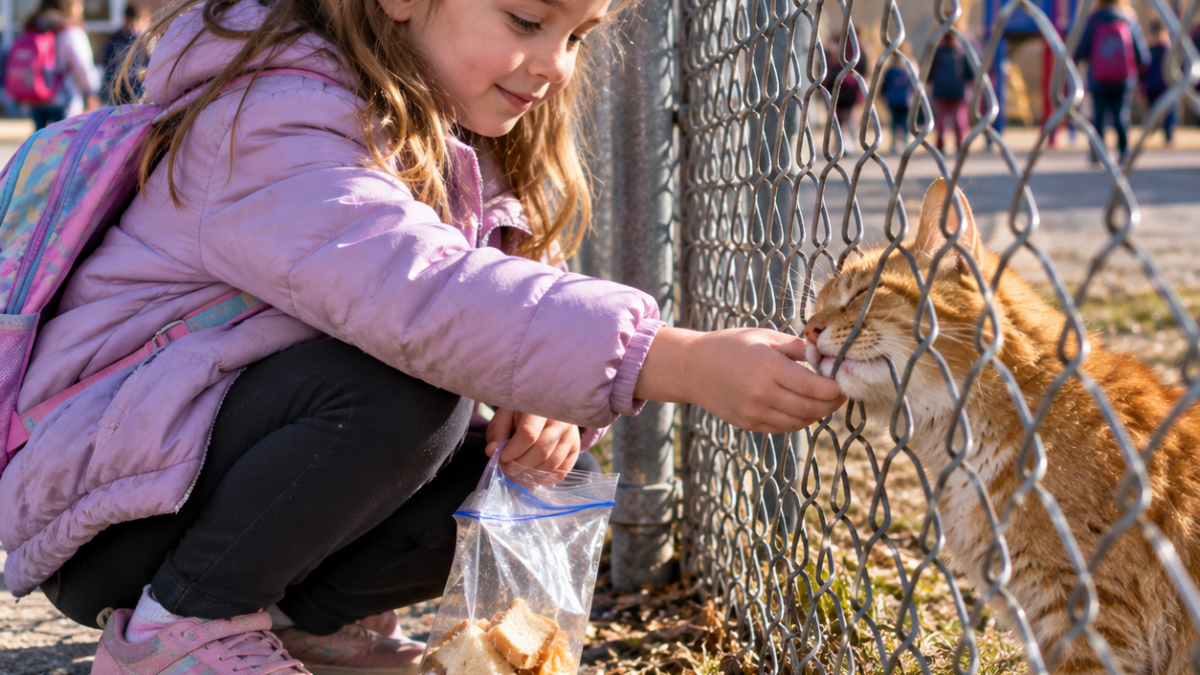
She reached into her coat pocket and pulled out the bag I had packed.
She pinched a few pieces of kibble between her fingers.
Pushed them through the chain-link.
The cat ate.
She gave him another few pieces.
He ate those too.
Slowly.
Not frantically.
That surprised me.
I had expected desperate hunger.
Instead he took each piece carefully.
Then looked at her.
She talked to him.
Constantly.
Little gestures.
Nods.
As if they were discussing important business.
He ate every bite she offered.
When the bag was empty, Lily pressed her fingertips through the fence.
My heart jumped because I had told her not to touch him.
Then the cat leaned forward.
He pressed his face against the metal.
Against her fingers.
He rubbed his cheek slowly from one side to the other.
Lily smiled.
I could see it from fifty yards away.
Then she whispered something.
The cat sat down.
She remained crouched.
For maybe two minutes.
Then Ms. Alvarez called the class.
Lily stood.
She said something else through the fence.
She ran back toward the building.
The cat did not follow.
He simply sat there.
Watching.
Even after the door closed.
Even after every child disappeared.
He stayed.
I don’t know what happened inside me.
Maybe it was the contrast.
That tiny child running away in a purple coat.
That thin cat sitting in cold grass.
Maybe it was the fact that he knew the schedule.
Maybe it was the obviousness of their routine.
This was not a child occasionally tossing scraps to an animal.
This was a meeting.
At the same time.
At the same place.
Every day.
I walked back to my car.
I got inside.
Then I cried.
Not because the story was cute.
People kept calling it cute later.
It wasn’t.
Not to me.
It was beautiful, yes.
But it hurt.
Because my daughter had noticed suffering that adults walked past every day.
Teachers.
Parents.
Delivery drivers.
Church members.
Me, if I had ever been there.
And instead of telling herself someone else would handle it, she had reduced her own lunch.
That bothered me in ways I couldn’t fully explain.
When you’re a parent, you spend so much time believing your job is to shape a child.
Teach kindness.
Teach manners.
Teach patience.
Teach right from wrong.
Then occasionally your child does something that reveals how badly adults complicate things they already understand.
Someone is hungry.
I have food.
Share.
Simple.
I sent the photograph to Marcy at the humane society.
She called ten minutes later.
“He needs to be caught.”
“That bad?”
“His body condition looks poor. Hard to tell from one picture, but I’m worried about his coat too.”
“When can someone come?”
“Tomorrow afternoon.”
“Can’t we do it today?”
A pause.
“You’re attached already.”
“I watched my daughter feed him.”
“That’ll do it.”
She told me where to buy a humane trap.
By three-thirty I owned one.
Dr. Morgan allowed me to place it beyond the school fence with permission from the church, whose property technically included the grass strip.
We baited it with tuna.
Then we waited.
The cat did not go near it.
Not that day.
Not the next morning.
Not the next afternoon.
He appeared for Lily.
He ate beside the trap.
He walked around the trap.
He sat on top of the trap once, which felt disrespectful.
“He’s smart,” Marcy said.
“He’s infuriating.”
“He survived outside. Those usually go together.”
By Friday, he still had not been caught.
The forecast said temperatures would fall into the twenties overnight.
I felt increasingly desperate.
Lily did too.
“Can’t we just open the fence?”
“No.”
“Why?”
“Because school fences do not work that way.”
“Can Dr. Morgan cut it?”
“No.”
“What if I pick him up?”
“Absolutely not.”
“He likes me.”
“I know.”
“He won’t bite.”
“You don’t know.”
“I know.”
This became our first real argument about the cat.
Lily cried.
I raised my voice.
Then hated myself.
“He trusts me!”
“I understand that!”
“No, you don’t!”
She ran upstairs.
The sentence hit harder than it should have.
Maybe because she was right.
I understood rules.
Liability.
Vaccinations.
Animal behavior.
Disease risk.
I understood all the adult reasons caution mattered.
Lily understood trust.
Neither of us was entirely wrong.
Ten minutes later, I went to her room.
She was under the blanket with Mr. Buttons.
I sat beside her.
“I’m sorry I yelled.”
No answer.
“I know you care about him.”
“He’s cold.”
“I know.”
“You keep saying you know.”
I almost smiled.
“That’s fair.”
Her face appeared above the blanket.
“Can he die?”
I hated that question.
“Yes.”
Her eyes widened.
“Mommy!”
“That’s why we’re trying to catch him.”
She started crying.
I pulled her close.
“Listen to me. There are people helping now.”
“You should’ve helped before.”
I froze.
Children do not always mean to accuse.
Sometimes they simply state timelines.
But guilt does not care about intent.
“I didn’t know,” I whispered.
“I did.”
There it was.
Again.
The truth in its smallest form.
She knew.
I didn’t.
That night, after Lily fell asleep, I sat at the kitchen table and stared at the picture on my phone.
Then I noticed something.
The cat’s left flank.
There was a darker patch in the fur.
Not dirt.
Something rectangular.
I zoomed in.
The image pixelated.
I sent it to Marcy.
“Do you see that?”
She replied:
Could be shaved fur growing back.
Shaved?
Why would a stray cat have been shaved?
The next morning, Marcy brought a different trap.
Larger.
Covered.
She also brought fried chicken.
“Cats make fools of people with tuna,” she said. “Chicken changes negotiations.”
We set it before school.
At lunch, Lily fed the cat only a tiny amount so he would remain hungry enough to investigate the trap later.
She hated this.
“You’re tricking him.”
“Yes.”
“That’s mean.”
“It’s temporary.”
“He’ll think I lied.”
“Cats do not understand contract law.”
Lily glared at me.
At 4:12, my phone rang.
Marcy.
“We got him.”
I grabbed my coat.
Lily screamed when I told her.
Not a happy scream.
A panicked one.
“Is he scared?”
“Yes.”
“Is he hurt?”
“We don’t know.”
“Can I come?”
I looked at the clock.
Then at her.
“Yes.”
The cat was furious.
Not aggressive.
Terrified.
He crouched at the back of the trap, eyes enormous, breathing fast.
When Lily approached, he changed.
His ears lifted.
He stopped pressing backward.
She knelt several feet away.
“Hi, Orange.”
That was what she called him.
Not Garfield.
Not Rusty.
Orange.
The cat stared.
“It’s okay,” she said.
“You’re going to the doctor.”
Marcy looked at me.
I saw tears in her eyes.
She turned away before Lily noticed.
We transported him to a veterinary clinic that worked with the humane society.
The veterinarian, Dr. Wilson, examined him under mild sedation.
Male.
Neutered.
Approximately four years old.
No microchip.
Fleas.
Intestinal parasites.
Underweight.
A healing wound on one hind leg.
And the strange shaved patch?
“That’s from a recent medical procedure,” Dr. Wilson said.
My heart jumped.
“How recent?”
“Maybe six to eight weeks.”
“What procedure?”
“Could have been ultrasound. Could be surgery prep.”
“So he belonged to someone?”
“Almost certainly.”
“How do we find them?”
Dr. Wilson checked for a second microchip.
Nothing.
“Sometimes owners don’t chip.”
“Could he have escaped?”
“Absolutely.”
“Could he have been abandoned?”
“Also possible.”
Lily sat in the corner swinging her feet.
“Can he come home with us?”
Dr. Wilson looked at me.
I looked at Lily.
“We’re not there yet.”
“He needs a home.”
“We need to find out if he already has one.”
Lily frowned.
“What if his people are looking?”
“Exactly.”
For the next week, his photograph went everywhere.
Local lost-pet groups.
Neighborhood pages.
Flyers.
Veterinary clinics.
The school newsletter.
The church bulletin.
No one claimed him.
Then the strange messages started.
The first came through Facebook.
That cat belongs to a man named Mr. Harris. Used to live by Maple Terrace.
No number.
No explanation.
I replied.
No response.
The second message came from a woman named Denise Cole.
Please be careful who you give that cat to.
I called her.
She hesitated.
“Are you Claire Bennett?”
“Yes.”
“You’re Lily’s mother?”
“Yes.”
“How do you know my daughter’s name?”
“Everybody knows now. The school story is everywhere.”
My stomach tightened.
The photo of Lily by the fence had spread after another parent posted about it.
I had asked people not to share her face, and most respected that.
Still, the story traveled.
“What do you know about the cat?”
Denise was quiet.
Then she said, “I think his name is Sunny.”
My heart started beating faster.
“You know him?”
“I think so.”
“Whose cat is he?”
“A man named Arthur Harris.”
“Where is Arthur?”
Another pause.
“Nursing home.”
The next morning, I met Denise at a diner.
She was in her sixties.
Gray hair.
Navy scrubs.
She worked as a home health aide.
Arthur Harris had been one of her clients.
Seventy-eight years old.
Widower.
Retired school custodian.
Lived in a small rental house two blocks from the elementary school.
Sunny had belonged to Arthur’s wife first.
Her name was Ruth.
When Ruth died from ovarian cancer three years earlier, Sunny became Arthur’s shadow.
“He talked to that cat like it was Ruth,” Denise said.
“What happened?”
“Arthur fell.”
“When?”
“August.”
He fractured his hip.
Then developed complications.
Hospital.
Rehab.
Then long-term care.
“And Sunny?”
Denise looked uncomfortable.
“Arthur’s nephew was supposed to take him.”
“Supposed to?”
“Supposed to take care of the house too.”
“What did he do?”
“He cleared it out.”
“What happened to the cat?”
“I don’t know.”
“You don’t know?”
“I wasn’t assigned once Arthur entered rehab. When I went back for some medical equipment, the house was nearly empty.”
“Did you see Sunny?”
“No.”
“Did you ask the nephew?”
“He said the cat ran away.”
Something cold moved through me.
“What’s the nephew’s name?”
“Brian.”
“Last name?”
“Harris.”
“Does Arthur know Sunny is missing?”
Denise stared down at her coffee.
“No.”
“Why not?”
“Because every time I visited him, he asked about the cat.”
My throat tightened.
“What did you tell him?”
“That Brian had him.”
“Why?”
“Arthur was recovering from surgery.”
Her eyes filled.
“He kept saying the only reason he was doing physical therapy was because he had to get home to Sunny.”
I covered my mouth.
Across the table, Denise whispered, “I couldn’t tell him.”
“Where is Arthur now?”
“Pine Ridge Care Center.”
“Can we visit?”
Denise looked at me.
“With the cat?”
“Yes.”
Her expression changed.
“You really have him?”
“He’s at a foster home through the humane society.”
“Does he respond to Sunny?”
I didn’t know.
That afternoon I went to the foster home.
The cat had gained almost a pound.
His fur looked better.
He was less fearful.
I stood near the doorway.
“Sunny?”
The cat’s head snapped around.
My skin prickled.
“Sunny.”
He came toward me.
Slowly.
But directly.
I called Denise.
“It’s him.”
There are decisions you think require days of thought that somehow become obvious in seconds.
The next morning, I signed Lily out of school for an “appointment.”
That was technically true.
We drove to Pine Ridge with Marcy.
Sunny rode in a carrier in the back seat.
Lily talked to him the entire way.
“We’re going to see somebody who knows you.”
Sunny meowed.
Lily gasped.
“He never talks!”
Apparently he did.
Just not often.
Pine Ridge smelled like disinfectant, coffee, and something overcooked.
Denise met us in the lobby.
She hugged Lily even though they had never met.
“Arthur doesn’t know you’re coming.”
“Is that okay?”
“I told him he had visitors.”
We walked down a hallway.
Sunny became restless.
Not afraid.
Alert.
He stood inside the carrier.
His nose pressed toward the ventilation holes.
Denise stopped outside Room 118.
“Wait here.”
She went inside.
I heard an old man’s voice.
“Who is it?”
“Someone brought you a surprise.”
“I don’t like surprises.”
“I know.”
A minute later, Denise opened the door.
Arthur Harris sat in a wheelchair by the window.
He was thin.
White hair combed straight back.
Plaid shirt buttoned to the throat.
A blanket over his knees.
He looked at Lily.
Then at me.
Then at the carrier.
His face changed.
Not recognition yet.
Fear.
Hope is frightening when disappointment has happened often enough.
“What’s that?”
I stepped forward.
“Mr. Harris, my name is Claire.”
He stared at the carrier.
“My daughter found a cat behind her school.”
Arthur stopped breathing.
At least that’s how it looked.
Lily knelt.
She opened the carrier door.
Sunny walked out.
For one second, no one moved.
Arthur whispered, “Sunny?”
The cat froze.
Then everything happened at once.
Sunny ran.
Not walked.
Ran across the room.
He jumped onto Arthur’s lap so hard the old man grunted.
Arthur made a sound between a laugh and a sob.
“Oh, God.”
Sunny stood against his chest.
Arthur buried both hands in orange fur.
“Oh, God. Sunny.”
Lily grabbed my hand.
Arthur was crying openly now.
“Where have you been?”
Sunny pushed his head beneath Arthur’s chin.
The old man rocked him.
“I thought you were with Brian.”
Denise began crying.
I did too.
There are reunions that look cinematic because the emotions are large.
This one was almost painfully small.
An old man.
A thin orange cat.
A little girl holding my hand.
That was all.
But the room felt full of everything people spend years regretting.
Arthur kept repeating the same phrase.
“I’m sorry.”
Not to us.
To Sunny.
“I’m sorry, buddy. I’m sorry.”
I crouched beside him.
“This isn’t your fault.”
He looked at me sharply.
“Where did you find him?”
“Behind Oak Valley Elementary.”
His face collapsed.
“That’s near my house.”
“Yes.”
“How long?”
“At least a few weeks.”
Arthur looked at Denise.
“I thought Brian had him.”
Denise started crying harder.
“Arthur, I’m sorry.”
He stared.
“What?”
She sat down.
“I didn’t know what to tell you.”
“What happened?”
“I think Brian let him out.”
Arthur went very still.
“He said Sunny was at his apartment.”
“I know.”
“I gave him money for food.”
Denise lowered her head.
“I know.”
Arthur’s hand trembled on Sunny’s back.
“How long have you known?”
“Not for sure.”
“How long?”
“Since September.”
It was November.
Arthur turned toward the window.
His face seemed to age ten years.
“I called him every Sunday.”
Nobody spoke.
“I asked how Sunny was.”
His voice became smaller.
“He told me he slept on his couch.”
Lily looked up at me.
“Mommy?”
I shook my head gently.
Not now.
Arthur whispered, “He lied to me.”
Denise touched his arm.
“I’m sorry.”
Arthur pulled away.
The pain in his face was not only about a cat.
It was humiliation.
Betrayal.
Realizing someone you trusted had listened to you worry week after week and answered with invented details because the truth was inconvenient.
“What did he do with my house?”
Denise looked at me.
I realized there was more.
Much more.
Arthur’s nephew, Brian, had power of attorney.
Limited power.
Originally, it was meant to allow him to pay Arthur’s bills during rehabilitation.
Instead, Brian had begun dismantling Arthur’s life.
The rental house had been surrendered.
Furniture sold.
Tools sold.
Ruth’s jewelry missing.
Arthur’s truck transferred.
Bank withdrawals Arthur did not recognize.
The facility bill had fallen behind despite Arthur having enough retirement income to cover it.
The cat was only the part no one had wanted to tell him.
I watched Arthur’s face as Denise explained.
Something inside him hardened.
“Call my bank.”
“Arthur—”
“Call my bank.”
“We should get a social worker.”
“Call my bank.”
He looked at me.
“Are you the lady who found Sunny?”
“My daughter did.”
Arthur looked at Lily.
She stepped closer.
“I gave him my lunch.”
Arthur’s eyes filled again.
“You did?”
She nodded.
“He was hungry.”
Arthur covered his mouth.
Lily reached into her pocket.
She pulled out one piece of cat kibble she had apparently carried with her from the foster home.
“He likes these.”
Arthur laughed.
Then cried again.
“You kept him alive.”
Lily shook her head.
“He was alive already.”
That sentence silenced the room.
Later, I understood why.
Adults love to use grand language around children.
Hero.
Angel.
Rescuer.
We turn simple compassion into something exceptional because it makes us feel good.
Lily did not see herself that way.
Sunny had been alive already.
He had simply been hungry.
She fed him.
To her, that was the entire moral universe.
Arthur reached out.
Lily took his hand.
“Thank you.”
She looked embarrassed.
“Okay.”
That afternoon, Pine Ridge’s social worker filed an adult protective services report.
The bank froze suspicious transfers.
Arthur revoked Brian’s power of attorney.
Police became involved when missing property and financial transactions began adding up.
Brian called me two days later.
I still don’t know how he got my number.
Maybe from social media.
Maybe from the school.
Maybe from someone at Pine Ridge.
His voice was smooth at first.
“Claire Bennett?”
“Yes.”
“My name is Brian Harris.”
I immediately started recording on my second phone.
Pennsylvania allows one-party consent for recording, something I knew from work.
“I know who you are.”
“I think you’ve gotten involved in a private family matter.”
“I found your uncle’s cat.”
“My uncle is confused.”
“He knew the cat’s name.”
“That isn’t what I mean.”
“What do you want?”
“I want you to stop talking to staff at Pine Ridge.”
“I’ve spoken to a social worker.”
“Yes, and now people are making ridiculous accusations.”
“About missing money?”
Silence.
“About a misunderstanding.”
“What misunderstanding led Sunny to live behind an elementary school?”
Brian exhaled.
“That cat ran away.”
“From where?”
“My place.”
“What’s your address?”
Another silence.
Then, “Excuse me?”
“If Sunny ran from your home, where is your home?”
“That is none of your business.”
“Then how did he end up two blocks from Arthur’s former house?”
Brian’s voice hardened.
“You don’t know anything.”
“I know you told Arthur Sunny slept on your couch.”
“I was trying not to upset him.”
“So you knew the cat was missing.”
“He got out.”
“When?”
“That doesn’t matter.”
“It matters to Arthur.”
“Arthur is seventy-eight years old, on medication, and not capable of understanding complicated situations.”
I felt anger rise.
“Interesting.”
“What?”
“You sound exactly like someone who hopes everybody believes that.”
“You need to stay out of this.”
“Is that a threat?”
“No. It’s advice.”
“I don’t need it.”
His voice dropped.
“You have a daughter.”
Every muscle in my body went cold.
“What did you say?”
“You’re putting her online. Turning her into some little mascot. You should think about protecting your family instead of meddling in mine.”
I stood up.
“Do not mention my daughter again.”
“I’m simply saying—”
I hung up.
Then I called the police.
Maybe he meant nothing.
Maybe he was trying to scare me.
It worked.
That was the part I hated most.
For the next week, I checked the locks twice every night.
I watched cars behind me.
I stopped posting anything about Sunny.
I asked the school to remove Lily’s picture from a newsletter.
I almost withdrew her from the situation entirely.
Then Brian made his next mistake.
He went to the media.
A local reporter had covered the story of the five-year-old secretly feeding a stray cat.
It was the kind of human-interest piece stations love in November.
Cute child.
Orange cat.
Happy reunion.
Then Brian contacted the station and claimed we had “emotionally manipulated” Arthur into believing his family had mistreated him.
He said Sunny had escaped accidentally.
He said Arthur suffered from cognitive decline.
He said outsiders were exploiting an old man.
Worst of all, he said Lily’s story had been exaggerated for attention.
When I saw that, something in me went quiet.
There is a certain kind of anger that is hot.
You yell.
You pace.
You send texts you regret.
Then there is the colder kind.
The kind that organizes documents.
I called Arthur.
“Did you see Brian’s interview?”
“Yes.”
“You okay?”
“No.”
“Do you want me to stay out of it?”
“No.”
His voice was firm.
“I want my life back.”
So we started there.
Arthur’s life.
Not the viral cat story.
Not Brian’s insults.
The facts.
Arthur had worked thirty-four years as a custodian for the same school district.
He had retired with a pension.
He and Ruth rented the same small house for twenty-one years.
They had no children.
Brian was Ruth’s sister’s son.
They had helped raise him.
Paid for part of his community college tuition.
Loaned him money twice.
Let him live in their basement after a divorce.
Arthur trusted him.
When Arthur fell, Brian offered to help.
“He said, ‘Uncle Art, you don’t worry about anything. I’ll take care of the house and Sunny until you’re home.’”
Arthur remembered those words exactly.
He had signed the power of attorney while medicated after surgery.
The document allowed Brian to manage bills.
It did not authorize gifting or selling Arthur’s property for personal benefit.
Bank statements showed cash withdrawals.
Charges at electronics stores.
A payment toward Brian’s personal credit card.
A check written to a used-car dealer.
Arthur’s truck title had been signed over using a document investigators believed was forged.
The landlord confirmed Brian had ended Arthur’s tenancy.
He had told the landlord Arthur would never return home.
Arthur had not known.
“Why would he do all that?” Lily asked me one night.
We were making pancakes for dinner because I had forgotten to grocery shop.
“Money.”
She frowned.
“But Grandpa Arthur loves him.”
She had started calling Arthur Grandpa Arthur without permission.
Arthur loved it.
“Sometimes people can love you and still do things that hurt you.”
“Did Brian love him?”
I flipped a pancake.
“I don’t know.”
“Then why did Grandpa Arthur love Brian?”
That was harder.
“Because loving someone doesn’t guarantee they’ll deserve it.”
Lily considered this.
Then said, “That’s bad.”
“Yes.”
“Can I have chocolate chips?”
“Yes.”
Children move on when answers are sufficient.
Adults rarely do.
The case moved quickly because the evidence was ugly.
Brian was charged with financial exploitation of an older adult, theft, forgery, and related offenses.
He surrendered through an attorney.
His lawyer issued a statement saying the case arose from “family misunderstandings and informal financial arrangements.”
Arthur watched the report from his room.
Sunny was curled beside him.
The care facility had made an exception after the story gained attention and because a therapist documented that the cat improved Arthur’s mood and participation.
Arthur looked at the television.
Then at me.
“A family misunderstanding.”
“That’s what they’re calling it.”
“He sold Ruth’s wedding ring.”
My chest tightened.
Investigators had found pawn records.
“Yes.”
“Family misunderstanding.”
His voice shook.
Sunny lifted his head.
Arthur stroked him automatically.
“I changed that boy’s diapers.”
I said nothing.
“He cried when his father left. Ruth and I let him sleep in our bed for a week.”
Arthur looked at me.
“Do you know what happens when someone steals from you?”
I waited.
“You start going through every good memory looking for the point where you were stupid.”
I knew enough not to say you weren’t.
Arthur continued.
“You wonder if every birthday card was fake. Every phone call. Every Christmas.”
He looked down at Sunny.
“Then you get angry at yourself for still loving the kid.”
“That part doesn’t make you weak.”
“No?”
“No.”
“What does it make me?”
“Human.”
He laughed once.
“Human is overrated.”
A week before Christmas, the school held its winter concert.
Lily was supposed to be a snowflake.
She wore white tights and a silver paper crown.
Halfway through rehearsal week, Dr. Morgan called me.
“Claire, we have a situation.”
That phrase should be banned from schools.
“What happened?”
“Nothing bad.”
“That’s not how you start ‘we have a situation.’”
He laughed.
“Arthur wants to come to the concert.”
I smiled.
“Okay.”
“He also wants Sunny to come.”
I closed my eyes.
“Of course he does.”
“We obviously don’t normally allow animals.”
“Obviously.”
“But.”
“But?”
“Lily told her whole class Sunny was coming.”
“Of course she did.”
“And now the kindergarten teachers are asking.”
“Dr. Morgan.”
“I know.”
Sunny came.
Officially as an emotional support accommodation for Arthur.
Unofficially because an entire elementary school had lost perspective.
Arthur sat in the front row in his wheelchair.
Sunny wore a red bow tie.
It was ridiculous.
Lily spotted them from the stage.
Her mouth opened.
She waved.
Thirty kindergarteners immediately started waving because kindergarten is a collective organism.
The music teacher tried to recover.
It failed.
Parents laughed.
Arthur laughed so hard he coughed.
Then the children sang.
Mostly off-key.
One child cried.
Another stared at the ceiling through an entire song.
Lily shouted the last line of “Jingle Bells” two beats early.
It was perfect.
Afterward, people gathered around Arthur.
Teachers.
Parents.
Children.
Not because he was the victim from the news.
Because he was Sunny’s person.
That mattered.
A woman I didn’t recognize approached.
Maybe sixty-five.
She stood several feet from Arthur.
“Mr. Harris?”
Arthur looked up.
“Yes?”
“I’m Elaine Porter.”
He stared.
Then his expression changed.
“Elaine?”
She had lived beside Arthur and Ruth fifteen years earlier.
They had lost touch.
She had seen the news.
They hugged.
Then another former coworker arrived.
Then another.
Within twenty minutes, Arthur was surrounded by pieces of a life Brian had nearly convinced him were gone.
That was one of the things nobody tells you about isolation.
Sometimes losing your home does not only cost you walls.
It costs you geography.
Your barber.
Your grocery clerk.
Your neighbor.
The guy at the coffee shop.
The woman across the street who knows you hate snow.
The route your body understands without thinking.
When Arthur lost his house, he lost the place where people knew where to find him.
The story returned him to their map.
In January, Adult Protective Services helped Arthur apply for a small senior apartment complex with supportive services.
He did not want to stay permanently at Pine Ridge.
His hip had improved.
He could walk short distances with a walker.
The new apartment allowed pets.
When I told Lily, she asked one question.
“Does it have a fence?”
“No.”
“Good.”
Arthur moved in on a Saturday.
We helped.
Denise brought kitchen supplies.
Marcy brought a cat tree.
Dr. Morgan brought a box of books from the school.
Ms. Alvarez brought a plant.
Walter, a custodian who had worked with Arthur years earlier, brought tools.
Nathan came too.
That surprised me.
My ex-husband and I had argued about how involved Lily should remain in all of this.
He thought the media attention was too much.
He was right.
I thought withdrawing Lily from Arthur and Sunny would teach the wrong lesson.
I was right too.
Co-parenting is sometimes two people holding competing truths without using the child to prove which adult wins.
Nathan carried the heaviest boxes.
At one point, Arthur said, “You Lily’s dad?”
Nathan smiled.
“Yeah.”
“You got a good kid.”
“I know.”
Arthur pointed at me.
“Her mother cries a lot.”
Nathan laughed.
“She always did.”
I glared at both of them.
It was the first time Nathan and I had laughed together without tension in months.
Maybe years.
Healing is sneaky like that.
It enters through side doors.
That afternoon, Arthur placed Ruth’s photograph on a bookshelf.
Investigators had recovered several boxes Brian had stored in a rented garage.
Not everything.
The wedding ring was gone.
So were some tools.
But family albums came back.
Documents.
A quilt.
Ruth’s recipe box.
Arthur opened it at the kitchen table.
He ran his fingers over her handwriting.
For several minutes he didn’t speak.
Lily climbed onto the chair beside him.
“What is it?”
“Recipes.”
“What kind?”
“Cookies.”
She leaned closer.
“Can we make them?”
Arthur smiled.
“Ruth’s molasses cookies?”
“Are they good?”
“No.”
Lily looked confused.
“They’re terrible.”
“Why would we make them?”
“Because she thought they were good.”
Lily considered this completely reasonable.
“Okay.”
They made them the next weekend.
They were terrible.
Lily ate two.
Sunny refused them.
The criminal case against Brian took eight months.
During that time, the public story became uglier before it became quieter.
Brian’s attorney tried to suggest Arthur had given gifts voluntarily.
The defense produced text messages in which Arthur thanked Brian for “handling everything.”
They argued that selling property had been necessary because Arthur could no longer maintain the home.
They said transfers were reimbursements.
Then prosecutors found the message that changed everything.
It was on Brian’s old phone.
Sent to a friend two days after Arthur entered rehab.
Old man’s not going home. Cleaning out the place this weekend. There’s probably 10k in tools/jewelry if I move fast.
Another message followed.
Cat’s a problem. Shelter wants surrender paperwork. Might just leave the door open.
I was in court when that message was read.
Arthur sat beside me.
His hand closed around the head of his cane.
The prosecutor continued.
The friend had replied:
That’s messed up lol.
Brian:
It’ll survive. Cats do.
Arthur stood.
Not fully.
He pushed against the cane as if he intended to cross the courtroom.
I grabbed his arm.
“Arthur.”
“He put him out.”
“I know.”
“He put Sunny out.”
“I know.”
“He told me every Sunday—”
His voice broke.
The judge called for order.
Arthur sat.
He cried silently.
That was worse than anger.
Later, outside court, reporters waited.
Arthur normally refused interviews.
That day, he stopped.
A reporter asked, “Mr. Harris, what was it like hearing those messages?”
Arthur looked at the cameras.
Then he said, “My nephew thought the cat would survive.”
He paused.
“He was right.”
Everyone waited.
“But not because of him.”
Arthur turned slightly.
Lily was standing with Nathan near the courthouse steps, holding my hand on the other side.
Arthur pointed gently toward her.
“He survived because a five-year-old saw hunger and didn’t need anybody to explain why it mattered.”
The reporter asked, “Are you angry?”
Arthur looked back at the courthouse.
“Yes.”
“Do you forgive your nephew?”
“No.”
The honesty startled people.
Arthur continued.
“Maybe someday.”
Then he shook his head.
“People think forgiveness is something victims owe everybody so the story ends nicely.”
I felt my throat tighten.
“I don’t owe anybody a nice ending.”
He looked directly into the camera.
“What I owe myself is not becoming what he did.”
That clip spread everywhere.
But by then Arthur didn’t care.
Neither did I.
The internet had already moved on to newer stories.
That was fine.
Real life was getting quieter.
Better.
Brian pleaded guilty in late summer.
He avoided the maximum sentence but received jail time, probation, restitution requirements, and a permanent order barring him from acting in a fiduciary capacity for Arthur.
Some people said it wasn’t enough.
Arthur said prison could not return trust.
So he stopped measuring justice that way.
He cared about smaller things.
His bank account was protected.
His pension went where it was supposed to.
His name was on his own lease.
His cat slept on his bed.
His door locked.
He chose who came through it.
Those things became sacred.
Lily turned six.
At her birthday party, Arthur gave her a small silver necklace.
A cat charm.
I objected immediately.
“This is too much.”
“It was Ruth’s.”
I stopped.
Arthur looked at Lily.
“She loved animals.”
“Grandpa Arthur—”
“She had twenty-three cat figurines.”
“That doesn’t mean—”
“I need someone to save my apartment from twenty-three ceramic cats when I die.”
“Arthur.”
He smiled.
“It’s one necklace.”
Lily held it carefully.
“Was it Sunny’s mommy’s?”
Arthur’s face softened.
“Sort of.”
She put it on.
“Thank you.”
Then she hugged him.
Arthur closed his eyes.
Sometimes family is not blood.
Sometimes blood is the thing that wounds you.
Sometimes family is whoever shows up with a folding chair, a casserole, a humane trap, a legal form, a cat carrier, or half a sandwich.
Lily stopped sharing her lunch.
That was my rule.
Instead, we began keeping cat food in the garage.
Not because we were running a private rescue.
Because apparently once your child teaches you to notice things, pretending not to see them becomes harder.
Every month, Lily used five dollars from her allowance to buy one bag of food for the humane society.
I paid for the rest.
She believed she paid for all of it.
I let her.
One afternoon in early fall, nearly a year after this began, Ms. Alvarez emailed me again.
The subject line was:
You’re Going to Laugh
I opened it.
There was a photograph.
Lily, now in first grade, crouched near the same fence.
My heart stopped.
Then I looked closer.
No cat.
A boy from her class sat on the grass.
His lunchbox had fallen open.
Food was scattered.
Lily was handing him half her sandwich.
The message below said:
“He forgot his lunch card, dropped what he packed, and was upset. Before any adult could help, Lily sat down and split hers with him. I promise we got him another lunch immediately. I thought you’d appreciate the photo.”
I did laugh.
Then I cried.
Of course.
That evening, I showed Lily the picture.
She groaned.
“Why does everybody take pictures?”
“Because apparently your life is a documentary.”
She rolled her eyes.
“Did you share your sandwich?”
“Only until he got more food.”
“What kind was it?”
“Turkey.”
“Good choice?”
She shook her head.
“He likes peanut butter better.”
“Everyone’s a critic.”
Then she said, “Mommy?”
“Yeah?”
“Do you remember when I used to feed Sunny?”
“I remember.”
“I thought you were going to be mad.”
“I know.”
“Were you?”
I thought about that first email.
The worry.
The instinct to control.
The fear.
“A little.”
“Why?”
“Because I thought something was happening to you.”
“Something was.”
“What?”
“I had a friend.”
I stopped washing dishes.
Lily continued coloring.
To her, it required no further explanation.
A friend.
That was Sunny.
Before the rescue organization.
Before Arthur.
Before Brian.
Before reporters.
Before court.
Before adults turned everything into rules and evidence and consequences.
Sunny was simply a friend waiting behind a fence.
One who was hungry.
One who came back.
One who pressed his face against her fingers.
That night I called Arthur.
“How’s the old man?”
“Rude.”
“How’s Sunny?”
“Also rude.”
“Good.”
“What do you want?”
“Nothing.”
“You never call for nothing.”
“Lily was talking about him.”
There was a pause.
“Tell her he’s fat.”
“He is not fat.”
“Dr. Wilson says eleven pounds.”
“That’s normal.”
“Dr. Wilson is part of the conspiracy.”
I smiled.
“How are you really?”
Arthur took longer to answer.
“Good.”
“You sound surprised.”
“I am.”
He looked out his apartment window while we talked.
I could hear television in the background.
“She’s here, you know.”
“Who?”
“Ruth.”
I didn’t speak.
“Not like a ghost.”
“I know.”
“She’s in the recipes. That stupid plant Ms. Alvarez brought. Sunny scratching the couch even though I bought him a post.”
He laughed.
“I spent a long time thinking when Ruth died, that was the end of the life I understood.”
I leaned against the kitchen counter.
“Then?”
“Then I thought when I lost the house, that was another ending.”
He was quiet.
“I’m starting to think old people are wrong about endings.”
“What do you mean?”
“We call things endings because we can’t see far enough yet.”
I wrote that down after we hung up.
Not because I wanted to post it.
Because I wanted to remember.
Months later, on the anniversary of the day Lily first noticed Sunny, we went back to the fence.
Not as a ceremony.
Lily’s school was having a fall picnic.
Arthur came.
Sunny did not.
Arthur said the cat had “retired from education.”
After lunch, Lily dragged us toward the back of the playground.
“That’s where he sat.”
Arthur stood on the school side this time.
He looked through the chain-link toward the patch of grass.
“That’s how close he got to home.”
His old house was visible through the trees.
Barely.
A roofline.
A chimney.
Two blocks away.
Sunny had not wandered randomly.
He had stayed near the place where his life had made sense.
That realization still hurts me.
All those weeks, he had remained close.
Close to Arthur’s house.
Close to familiar smells.
Close to the route he may have known.
Waiting near a school where hundreds of people passed.
Maybe because he had learned people meant food.
Maybe because Ruth once worked near children.
Maybe because animals build maps differently than we do.
We’ll never know.
Arthur rested both hands on his cane.
“He came this far.”
I nodded.
Lily said, “Then he found me.”
Arthur looked at her.
“No.”
She frowned.
“He did.”
Arthur smiled.
“You found each other.”
Lily accepted that correction.
We sat on a bench.
Children ran around us.
Parents opened bags of chips.
Someone grilled hot dogs.
A teacher yelled at three boys to stop climbing something clearly labeled DO NOT CLIMB.
Ordinary life.
That is where most important things happen.
Not in courtrooms.
Not on television.
Not beneath headlines.
Behind schools.
In hospital rooms.
At kitchen tables.
In quiet decisions nobody sees.
I used to think generosity was something you taught by explaining it.
Say please.
Say thank you.
Share your toys.
Include everyone.
Be kind.
Those things matter.
But Lily taught me something I had not understood.
Real compassion often happens before anyone is watching.
It happens when there is no reward.
No approval.
No audience.
No guarantee the person—or animal—you help can ever give you anything back.
For three weeks, Lily ate half a lunch.
Not because someone praised her.
Not because a teacher assigned kindness as homework.
Not because a camera was there.
She thought she was breaking a rule.
That part matters.
She believed adults might stop her.
So she kept quiet.
I still don’t know whether that makes me proud or slightly terrified.
Probably both.
She had no strategy.
No nonprofit.
No trap.
No veterinarian.
No police report.
No legal authority.
She had crackers.
Turkey.
Cheese.
Apple slices Sunny apparently had the good sense to reject.
She used what she had.
Adults eventually brought the rest.
That is how community is supposed to work, I think.
Not everyone does everything.
Someone notices.
Someone feeds.
Someone calls.
Someone verifies.
Someone opens a door.
Someone fills out paperwork.
Someone testifies.
Someone brings a box.
Someone refuses to look away.
Lily was simply first.
Arthur sometimes says she saved Sunny.
Lily always corrects him.
“No. He was alive already.”
I understand now why I love that answer.
Saving can sound like ownership.
Like power.
Like one person stands above another and decides whether they continue.
Lily never saw Sunny beneath her.
She saw him beside her.
Hungry.
Waiting.
Alive.
Worth sharing with.
That difference feels important.
Brian eventually wrote Arthur a letter from county jail.
Arthur did not show it to me for several weeks.
When he did, I asked if he wanted me to read it.
“Yes.”
The letter was four pages.
Brian apologized.
Then explained.
Then apologized again.
He had debts.
He had lost his job.
He had been drinking.
He told himself Arthur would never use the things he sold.
He told himself the money was basically family money.
He said leaving Sunny outside was “a terrible decision made under stress.”
That line made me angry.
Arthur watched me reading.
“Keep going.”
Near the end Brian wrote:
“I know you probably hate me.”
Arthur had underlined it.
“What did you think?” I asked.
“He still thinks hate is the worst thing that can happen between people.”
“What’s worse?”
Arthur looked at Sunny sleeping on the windowsill.
“Trust dying.”
I handed the letter back.
“Are you going to answer?”
“Already did.”
“What did you say?”
Arthur opened a drawer.
One page.
Three paragraphs.
He let me read it.
He wrote that he did not hate Brian.
He wrote that love had not vanished.
But love did not erase accountability.
He said forgiveness, if it came, would not restore access to his money, his home, or his decisions.
Then the final paragraph:
“I hope you become someone you can live with when no one is watching. That is the part you need to fix. Not the part people caught.”
I read that twice.
Then I thought of Lily.
No one watching.
That was where character had revealed itself in both directions.
A child secretly gave food away.
A grown man secretly took what wasn’t his.
Same invisibility.
Different choices.
Maybe that is why the story stayed with me.
Not because it was about a cat.
Not really.
It was about who we are when there is no audience.
Who we become when we believe nobody will know.
Lily shared.
Brian stole.
Denise lied to protect Arthur and later admitted it.
I hesitated.
Marcy showed up.
Arthur chose not to let betrayal make him cruel.
Every person stood somewhere in that moral weather.
Some of us moved.
Some of us learned.
One Sunday afternoon, almost two years after Lily first met Sunny, Arthur invited us over.
He had something to show her.
A wooden box sat on the table.
Inside were Ruth’s old photographs.
Arthur pulled out one.
A younger Ruth sat on the back steps of their old house.
Beside her was a tiny orange kitten.
Sunny.
Lily gasped.
“He was a baby!”
“Once.”
“He was so little.”
Arthur handed her another picture.
Ruth held Sunny on his back like a baby.
Sunny’s paws were curled.
His eyes were closed.
Lily smiled.
“She loved him.”
Arthur nodded.
“She did.”
Then he gave Lily one final photograph.
Ruth standing in front of Oak Valley Elementary School.
The school.
Lily stared.
“What was she doing there?”
Arthur smiled.
“She volunteered in the reading program.”
“How long?”
“Eleven years.”
My skin prickled.
“What side of the building?”
Arthur looked at me.
“What?”
“Where did she usually go in?”
He thought.
“Back entrance. The parking lot side.”
The same side.
The same fence.
The same patch of grass.
We all went quiet.
“Sunny used to ride with us sometimes,” Arthur said slowly. “Stayed in the car while she dropped books off. I’d sit with him.”
Lily looked at the picture.
“Maybe he remembered.”
Arthur’s eyes filled.
“Maybe.”
There was no way to prove it.
Maybe it meant nothing.
Maybe Sunny had simply found food near a school.
Maybe the old house was nearby and the fence was shelter from wind.
But I have learned not every meaningful thing requires proof.
Sometimes an animal waits in a place connected to the person who loved him.
Sometimes a child appears there.
Sometimes that is enough.
Arthur framed the photograph of Ruth at the school.
It hangs beside the picture I took of Lily by the fence.
Two women.
Seventy years apart in age.
One grown.
One five.
Both part of Sunny’s strange map home.
Lily is seven now.
She barely remembers being five the way I remember it.
That’s another cruelty of parenting.
Some of the moments that permanently shape you are only faint images in your child’s mind.
She remembers Sunny.
She remembers the fence.
She remembers feeding him.
She does not remember being hungry at school.
She does not remember me crying in the car.
She does not remember the first email.
She does not remember the way the cat pressed his face against her tiny fingers.
I remember all of it.
Parents become museums for childhoods children outgrow.
We keep exhibits they no longer know exist.
The purple coat.
The sandwich bag.
The photograph.
The cat charm necklace.
The email from Ms. Alvarez.
I printed that first email.
I don’t know why.
Maybe because it began with concern.
It ended with an entire life being uncovered.
Arthur’s.
Sunny’s.
Ours, in some ways.
I still have the original photograph.
Lily kneeling by the fence.
One hand through the metal.
Sunny leaning into her fingers.
She did not know I was there.
That is why it matters so much to me.
If Lily had known I was watching, people could have said she was performing.
If she had known her teacher was watching, maybe she wanted praise.
If she had known there would be photos, reporters, a reunion, a court case, maybe people could assign all kinds of motives.
She knew none of it.
She thought she was alone.
Just a five-year-old.
A skinny orange cat.
Half a lunch.
That is the version of my daughter I hope life never trains out of her.
Not the secret keeping.
We have discussed that.
Many times.
But the instinct.
The refusal to walk away because a problem is inconvenient.
The willingness to part with something small because it matters more to someone else.
I hope she keeps that.
I hope I do too.
Last week, we visited Arthur.
Sunny is now officially overweight.
Dr. Wilson has placed him on a diet.
Arthur is offended on his behalf.
“This cat lived outside,” he complains. “He earned gravy.”
Dr. Wilson disagrees.
Lily sides with Arthur.
I side with science.
Sunny sides with whoever currently holds food.
He has become shameless.
His coat is thick now.
Bright orange.
The bald patch is gone.
His ribs no longer show.
He sleeps stretched across Arthur’s bed like he pays rent.
Sometimes I look at him and struggle to connect this spoiled animal with the thin cat sitting outside a chain-link fence.
Arthur struggles too.
“He doesn’t remember being homeless,” he says.
“I hope not.”
“He remembers Lily.”
He does.
Every time she enters, Sunny comes to her.
Not always running anymore.
He is older.
Comfortable.
Lazy.
But he comes.
He rubs his face against her hand.
The same way.
Always the same.
Last Sunday, Lily sat on Arthur’s carpet doing homework.
Sunny lay across her spelling sheet.
Arthur and I drank coffee.
Lily pushed him gently.
“Sunny, move.”
He didn’t.
“You’re messing me up.”
Still nothing.
Arthur said, “That’s his spelling sheet now.”
Lily sighed.
Then she broke a cat treat in half.
She gave Sunny one piece.
She put the other back into the bag.
I watched her.
Of course I did.
She caught me smiling.
“What?”
“Nothing.”
“Why are you looking at me?”
“I’m not.”
“Yes, you are.”
Arthur winked at me.
Lily returned to her homework.
For a moment, I saw the five-year-old again.
Purple coat.
Small hands.
Half a sandwich.
Someone once asked me whether I was embarrassed that my daughter had been hiding food from me for three weeks.
No.
I was embarrassed it took me that long to understand what she had seen immediately.
Hunger is a problem.
Loneliness is a problem.
Being forgotten is a problem.
And when you cannot fix everything, you still fix the piece within reach.
Half a sandwich will not solve homelessness.
A bag of cat food will not stop elder exploitation.
A five-year-old cannot investigate fraud.
A teacher cannot prosecute theft.
A humane society cannot repair a family.
A court cannot restore years of trust.
But that does not make small actions useless.
Because one small action can expose the next necessary thing.
Lily fed Sunny.
Sunny returned.
The teacher noticed Lily wasn’t eating enough.
The teacher emailed me.
I went to the fence.
We called Marcy.
Marcy caught Sunny.
A veterinarian noticed his history did not match a feral cat.
Someone recognized him.
Denise told the truth.
Arthur learned what happened.
The bank looked.
Investigators looked deeper.
Brian’s lies collapsed.
Arthur regained control of his life.
And Sunny went home.
Not to the old house.
That home was gone.
To Arthur.
Maybe that is the real lesson.
Home is not always the place you return to.
Sometimes home is the person who still knows your name after everything familiar disappears.
Sunny knew Arthur’s voice.
Arthur knew the weight of Sunny on his lap.
Lily knew where he waited.
And I learned that compassion is often less complicated than adults make it.
My daughter never gave a speech.
She never said she was rescuing anyone.
She never asked whether Sunny deserved help.
She never asked what mistakes had led him behind that fence.
She never asked who was responsible.
She never asked whether feeding him would solve everything.
She simply noticed that he was hungry.
Then she looked at what she had.
And for three weeks, without telling anyone, she divided it in half.
Half for herself.
Half for the orange one waiting behind the school.
I am older than she was by almost thirty years.
I have a college degree.
A mortgage.
A retirement account.
A calendar full of responsibilities.
I know how to file taxes.
Negotiate insurance.
Compare interest rates.
Schedule pediatric appointments.
Explain divorce in age-appropriate language.
And yet there are still days when I think my five-year-old daughter understood something fundamental before I did.
You do not need abundance to be generous.
You do not need permission to care.
You do not have to fix an entire life before you are allowed to make one moment less painful.
Sometimes all you have is half a sandwich.
Sometimes that is where everything begins.








