Move Your K9,” They Told the SEAL—Then the Nurse Realized the Dog Was Blocking Anyone Who Tried to Make Him Stand Before His Blood Pressure Crashed
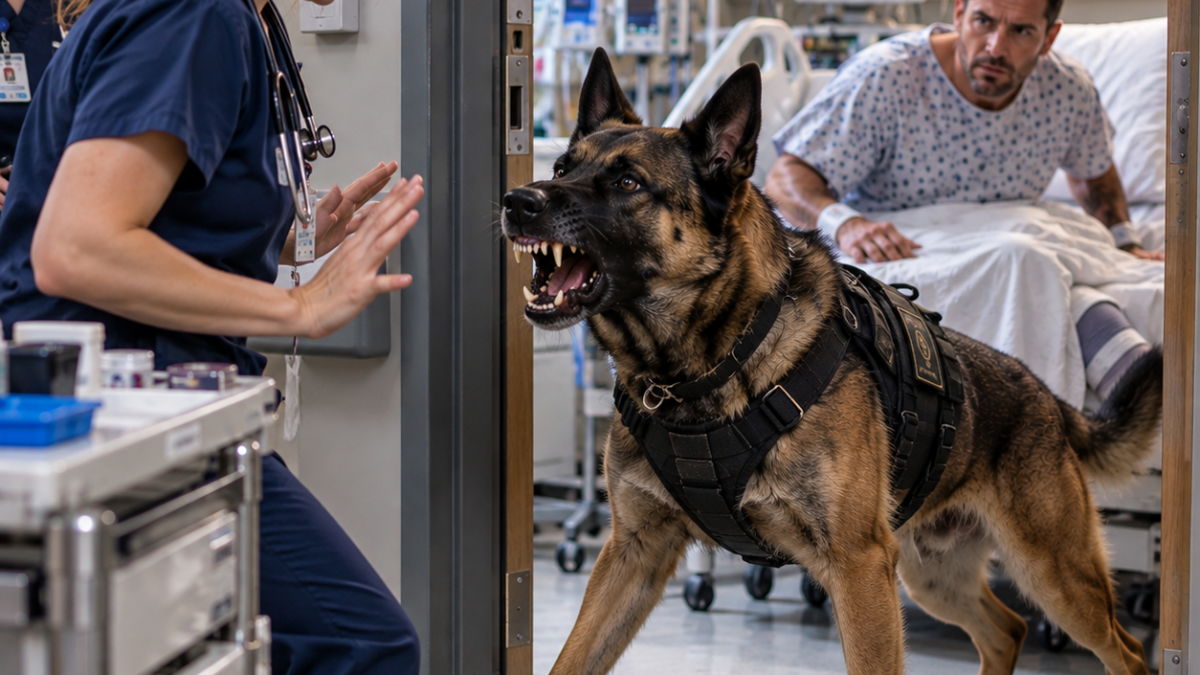
PART3:
“I can call security.”
Ethan’s hand immediately moved to the edge of the mattress.
“Please don’t.”
Clare noticed that too.
The reaction was fast.
Not anger.
Concern.
“You just told her he’s unstable,” Megan said.
“I said I can’t predict him.”
“That does not make this better.”
Ethan tapped two fingers against the mattress.
Once.
Twice.
A tiny motion.
Rook’s left ear rotated toward the sound.
His body remained across the doorway.
“Rook.”
The dog did not turn.
“Place.”
Nothing.
Ethan stopped.
That bothered him.
Clare could see it.
According to the chart, Ethan had handled Rook for seven years.
Seven years in military work was not casual companionship.
That meant thousands of repetitions.
Commands.
Signals.
Movement patterns.
A dog like Rook should know Ethan’s voice better than most humans did.
Megan glanced toward the nurse’s station.
Another call light blinked.
“Clare, leave the meds with me. We’ll deal with this.”
Ethan looked at Clare.
“Just leave them.”
Reasonable.
Medication could be delayed a few minutes.
There were six other patients.
Nobody needed to prove courage against an eighty-pound Malinois.
Clare reached for the cart.
Rook moved.
Fast.
Megan’s hand went toward the phone clipped at her waistband.
Clare froze.
The dog had not moved toward either nurse.
He had spun away from them.
Straight to Ethan.
Rook crossed the room and pressed his shoulder against the side of the mattress.
Clare stared.
“Wait.”
Megan kept one hand on the phone.
“Clare.”
“Give me a second.”
Ethan looked irritated.
“He’s reacting to you leaving.”
“Maybe.”
“That’s not what I saw.”
Clare took one deliberate step backward.
Rook did not follow.
He remained beside Ethan.
Shoulder against the bed.
His nose lifted toward Ethan’s hand.
“Has he blocked anybody else today?”
Ethan frowned.
“Physical therapy.”
“Did he bite?”
“No.”
“Lunge?”
“No.”
“Growl?”
“No.”
“Follow them when they backed out?”
Pause.
“No.”
Clare looked at Rook.
Then Ethan.
“What were you doing when physical therapy came in?”
“Getting ready.”
“For what?”
“To stand.”
Megan stopped looking at the call light.
Clare said nothing for a moment.
Ethan gave her a tired, skeptical look.
“What?”
“You said he blocked physical therapy when you were about to stand.”
“So?”
“And he was blocking us.”
“Yes.”
“But when you moved to get out of bed just now, he left us.”
Ethan looked down at Rook.
Clare continued.
“He went to you.”
“That doesn’t mean anything.”
“I didn’t say it did.”
Rook nudged Ethan’s wrist.
Ethan automatically scratched behind the dog’s ear.
A practiced movement.
The dog stayed pressed against the bed.
Clare pointed gently toward the blanket.
“Lie back.”
Ethan looked at her.
“Excuse me?”
“You started sitting up to crate him.”
“I can crate my own dog.”
“You’re on assisted mobility.”
“I can stand for ten seconds.”
“No.”
The answer came so naturally Clare surprised herself.
Ethan stared.
Megan’s mouth twitched.
Clare added:
“You do not get ten unassisted seconds because my medication cart is inconvenient.”
“You want to stand in the hall all night?”
“No.”
“Then I need to move him.”
“Maybe.”
“Maybe?”
Clare watched Rook.
“Lean back first.”
Ethan’s expression hardened.
“Why?”
“Humor me.”
“I don’t do that.”
“Then humor your surgeon.”
That worked better.
Ethan shifted backward against pillow.
Rook waited.
Two seconds.
Three.
Then walked back to doorway.
Same position.
Sideways.
Between hall and bed.
Clare felt something click into place.
Not an answer.
A pattern.
Two data points.
That was not enough to diagnose anything.
It was enough to stop repeating the same action.
She looked at Megan.
“Nobody makes him stand.”
Ethan laughed once.
“Because of my dog?”
“No.”
Clare met his eyes.
“Because twice the problem changed when you tried.”
The humor left his face.
Megan lowered her hand from the phone.
Clare leaned lightly on cart.
“What does Rook normally do when something is wrong with you?”
Ethan looked at dog.
“That’s different.”
“How?”
Silence.
“Mr. Cole?”
“He used to create space.”
“Meaning?”
“During rehab.”
“What kind of rehab?”
Ethan hesitated.
The chart noted extensive orthopedic reconstruction after blast injury.
Multiple surgeries.
Chronic nerve damage.
He rubbed his jaw.
“After my second surgery, I had a couple episodes.”
“What kind?”
“Blood pressure drops.”
Megan looked at Clare.
Ethan continued reluctantly.
“Orthostatic. Pain. Medication. Whatever combination.”
“You passed out?”
“Almost.”
“How many times?”
“Twice.”
“And Rook?”
“He got between me and people.”
“Before you felt it?”
Ethan’s expression changed slightly.
“Once.”
Clare stayed very still.
She did not look at Rook as if he had suddenly become a medical device.
That mattered.
“What did he do?”
“Wouldn’t let a therapist take my arm.”
“Same as tonight?”
“Similar.”
Clare nodded.
“How do you feel now?”
“Fine.”
She waited.
“Really.”
She kept waiting.
Ethan sighed.
“Tired.”
“Dizzy?”
“No.”
“Nauseated?”
“No.”
“Chest pain?”
“No.”
“Warm?”
He paused.
“Maybe.”
Megan looked down at chart.
Clare asked:
“What was his last pressure?”
Megan scrolled.
“108 over 68.”
“When?”
“About forty-five minutes ago.”
Ethan immediately said:
“That’s low for me.”
Clare looked at him.
“What’s normal?”
“Low 120s. Sometimes 130.”
Megan checked previous readings.
“He’s right.”
Rook left doorway.
No one had moved.
He walked to Ethan.
Pressed his shoulder against mattress again.
Ethan’s fingers found fur automatically.
Then Rook nudged his wrist once.
Ethan stopped rubbing.
Clare saw it.
“So he does that?”
Ethan looked at dog.
“Sometimes.”
“When?”
“Before…”
He stopped.
Clare refused to finish sentence for him.
“Before what?”
“Before I notice I’m off.”
Megan moved closer to Clare.
The question in the hallway had changed completely.
Five minutes earlier:
How do we remove the dog so we can treat the patient?
Now:
Why is this dog changing behavior specifically around a recovering patient who has a history of blood pressure instability?
Clare still did not know.
That uncertainty mattered.
She pulled the portable monitor toward herself.
Then stopped.
Rook had returned to doorway.
She would have to enter.
“Don’t get up.”
Ethan’s hand was already moving toward blanket.
“Clare.”
“No.”
“I need to secure him.”
“Not until we check you.”
“You cannot even get in.”
“Then we solve access without making you stand.”
Ethan looked frustrated.
“You’re basing this on a dog.”
“No.”
Clare’s tone sharpened just enough.
“I’m basing this on your history, your pressure trend, a new symptom, and the fact that standing is not medically necessary right this second.”
She nodded toward Rook.
“He’s part of the picture. He is not the diagnosis.”
That silenced him.
Clare reached for phone.
“Who’s covering?”
“Dr. Wells,” Megan said.
Clare called.
“Dr. Wells, this is Bennett in recovery, room twelve.”
She gave numbers first.
Always data first.
Pressure trend.
Baseline.
Medication timing.
Recent surgery.
Assisted mobility.
Patient reporting warmth.
Then she said:
“There’s another factor.”
“What?”
“The patient’s working dog was previously trained during rehab to create space when Cole experienced physiologic episodes.”
Pause.
“And?”
“He’s interfering specifically when Cole prepares to stand.”
Another pause.
“You think the dog is detecting hypotension?”
“I don’t know.”
Clare heard herself answer immediately.
“That’s why I want Cole reassessed before we force a standing transfer just to secure the dog.”
Dr. Wells said:
“Good answer.”
Clare blinked.
“What?”
“The ‘I don’t know’ part.”
Then:
“I’m coming.”
She hung up.
Megan nodded toward blinking lights.
“I’ll cover your other rooms.”
“Thanks.”
“Nobody gets him out of bed.”
“Agreed.”
Megan walked away.
Clare stayed in hall.
Ethan watched her across Rook’s back.
“You believed me.”
“I believed what you told me was relevant.”
“That’s what I meant.”
“It’s not the same thing.”
Ethan almost smiled.
“No.”
Clare leaned against cart.
“Tell me about him.”
Ethan’s eyes went to Rook.
“What do you want to know?”
“How long together?”
“Seven years.”
“Military?”
“Six.”
“And after?”
“He retired with me.”
“Was that always the plan?”
Ethan’s face shut slightly.
“No.”
Clare recognized boundary.
Did not push.
Rook lowered himself at doorway but remained alert.
“He always guarded you?”
“Not like this.”
“What was his actual job?”
Ethan looked toward hall, considering.
“Detection first.”
“Explosives?”
“Yes.”
“Then?”
“Multi-purpose.”
Clare understood enough to know that meant more than she wanted details about.
“Protection?”
“Yes.”
“Tracking?”
“Yes.”
“He worked off leash?”
Ethan glanced at her.
“You’ve read about working dogs?”
“Only enough to know I’m not pretending I know yours.”
That earned first real half-smile.
“He worked off leash.”
“Hand signals?”
“Yes.”
“Voice commands?”
“Both.”
“And normally he obeys ‘place.’”
“Immediately.”
“But tonight he doesn’t.”
“That’s why I called him unstable.”
Clare considered.
“Maybe.”
Ethan looked up.
“Here we go.”
“I’m not saying he’s stable either.”
“Comforting.”
“I’m saying ‘unstable’ tells the next person what to fear.”
She nodded at Rook.
“It doesn’t tell them what to do.”
Dr. Aaron Wells arrived with one glove half on.
He stopped when he saw dog.
“This the access problem?”
“Part of it.”
Clare handed him chart.
“Last pressure 108 over 68, lower than his usual trend. Reports warmth. Breathing changed slightly during conversation. No chest pain, nausea, or dizziness while supine. Rook has prior training to create space around episodes and has blocked access twice when Cole attempted to stand.”
Wells scanned.
“You think he’s unstable?”
“I don’t know.”
Ethan looked at her.
Clare continued:
“I think standing him before reassessment creates an unnecessary variable.”
Wells nodded.
“Cole.”
Ethan looked over.
“Can you position Rook from bed?”
“Maybe.”
“Try.”
Ethan lowered hand.
“Rook. Place.”
Dog looked back.
Moved one step.
Stopped.
“Place.”
Second command.
Rook shifted beside bed.
Still standing.
Wells waited.
Nobody moved.
Eventually Rook lowered himself.
Head high.
Eyes on Ethan.
Wells said:
“I’m going in alone.”
Clare pushed cart farther away.
“Ethan, keep him with you.”
Wells entered sideways.
No direct stare.
Rook tracked him.
Did not rise.
Wells cuffed Ethan’s arm.
Machine inflated.
98 over 62.
Ethan saw number.
His jaw tightened.
Wells checked manually.
Similar.
“That’s low for you?”
“Yes.”
“Dizzy?”
“No.”
“Warm?”
“Mostly passed.”
“Breathing?”
“Fine.”
He took a slightly deeper breath immediately afterward.
Wells noticed.
Clare did too.
Wells listened to lungs.
Checked pulse.
Reviewed medications.
“When was this dose last given?”
Clare answered from hall.
“What intake?”
She gave documented volume.
Wells looked at Ethan.
“Hold the scheduled medication for now.”
Clare made note.
“Repeat pressure in fifteen. No standing until we understand trend.”
Ethan looked down.
“What about Rook?”
Wells glanced toward dog.
Then Clare.
“What are we documenting?”
Clare understood what he was asking.
“What he does.”
“And?”
“Not what we think it means.”
Wells nodded.
“If his behavior changes with Cole’s activity or condition, we reassess Cole before treating the dog as purely an access problem.”
“Good.”
Ethan said:
“So nobody’s removing him?”
Wells looked at him.
“Not while we can safely provide care around him.”
“And if you can’t?”
“Then we revisit.”
Wells turned to Clare.
“One person approaches at a time. No improvising.”
“Understood.”
He left.
Ethan’s hand rested in Rook’s fur.
The Malinois finally put his chin down.
For first time since Clare arrived, his body looked almost relaxed.
“You really don’t think he’s some kind of monitor.”
Clare set timer.
“He’s a dog.”
“That sounded dismissive.”
“It wasn’t.”
She looked at him.
“He may notice something before we do. Dogs notice scent, posture, movement, routine. You know him better than I do.”
She tapped chart.
“But if I decide every thing he does means your pressure is dropping, I stop being your nurse and start making guesses.”
Ethan studied her.
“And you hate guesses.”
“When somebody can get hurt.”
Timer counted.
For next fifteen minutes, room 12 remained oddly calm.
Clare charted in hall.
Rook watched.
Ethan rested.
When timer sounded, Clare lifted cuff.
“Ready?”
Ethan looked surprised.
“You’re asking.”
“You know his cues.”
“You’re nurse.”
“I know what I need. You know how he moves. Tell me how we do both.”
Ethan studied doorway.
“Come in slow.”
“Okay.”
“Don’t walk straight at me.”
“Okay.”
“If he stands, stop.”
“Okay.”
He gave hand signal.
“Rook. Place.”
Dog stayed down.
Clare crossed yellow line for first time that night.
Along wall.
Not direct.
Rook’s ears changed.
One forward.
One angled toward Ethan.
Clare stopped.
Ethan gave tiny signal toward chair.
Rook moved two feet.
Lay down.
Clare approached.
Put cuff on Ethan.
99 over 64.
Pulse seventy-eight.
“How do you feel?”
“Fine.”
“Dizzy?”
“No.”
“Warm?”
“No.”
“Breathing?”
“Normal.”
She recorded.
Then backed out.
Ethan watched her.
“That worked.”
“Because you positioned him.”
“You think that’ll work for labs? Food service? PT?”
“No idea.”
He gave her a look.
“Excellent.”
Clare pulled blank communication card from cart.
Wrote:
ANNOUNCE BEFORE ENTERING.
ASK COLE TO POSITION ROOK.
IF ACCESS BECOMES UNSAFE, STEP OUT AND REASSESS BEFORE PROCEEDING.
She clipped it outside door.
Ethan read.
“You didn’t write unstable.”
“No.”
“Why?”
“Because unstable tells people what to fear.”
She capped marker.
“This tells them what to do.”
Twenty minutes later a lab technician arrived.
Read card.
“Mr. Cole, blood draw.”
Ethan glanced toward Rook.
“Place.”
The dog moved.
Technician entered.
Drew blood.
Left.
No Clare.
No security.
No struggle.
Ethan watched hallway.
“That was almost boring.”
“Boring is excellent in hospitals.”
He smiled faintly.
Then call light came from room 12.
Clare approached.
“What do you need?”
“Bathroom.”
She checked order.
Assisted ambulation.
Pressure improved slightly, not baseline.
She unfolded walker outside.
Rook stood at Ethan’s left leg.
“He stays left when I walk,” Ethan said.
Clare looked at walker.
“It also needs your left side.”
“I know.”
“Can you reposition him and still walk safely?”
“I can tell him to move.”
“That wasn’t the question.”
Ethan’s irritation returned.
“What do you want?”
“I need to know whether changing his position changes what you rely on him to do.”
“He’s supposed to stay with me.”
“Why?”
“That’s his job.”
“Which part?”
Ethan stared.
“The whole part.”
“That doesn’t fit in this room.”
He looked at Rook.
Dog stood exactly where repetition had put him for seven years.
Left side.
Close.
Watching.
Clare left walker outside.
“I’m not asking you to choose between your dog and your care.”
“It feels like you are.”
“No.”
She nodded toward Rook.
“I’m asking what has to stay the same.”
Ethan was quiet.
“And what doesn’t.”
He looked toward bathroom.
Then dog.
“Seven years.”
“What?”
“That’s where he works.”
“Then don’t move him because I told you.”
“That’s helpful.”
“I’m serious.”
Ethan looked annoyed.
“Then what do I do?”
Clare said:
“Figure out whether the position is the job.”
Pause.
“Or the purpose.”
That irritated him even more because she could see him thinking.
She waited.
Finally Ethan looked at Rook.
“His job is to keep me safe.”
Clare said nothing.
“Not stand on left.”
She nodded.
Ethan pointed toward wall near bathroom.
“If he holds there, he can see me.”
“And I can guard your right side while walker takes left.”
Ethan considered.
Then signaled.
“Rook. Forward place.”
Dog hesitated.
Ethan’s jaw tightened.
“Forward place.”
Rook crossed room.
Settled against wall.
Eyes locked on Ethan.
Clare brought walker in.
Megan appeared in hallway.
“Backup.”
Ethan noticed.
Clare said:
“If needed.”
He gripped walker.
She guarded his weaker side.
“Your call.”
Ethan stood.
Rook’s head came up.
Clare did not look at dog.
“How do you feel?”
“Steady.”
“Dizzy?”
“No.”
“One step.”
He moved.
Then another.
Halfway, Rook stood.
Ethan stopped.
Rook moved one step toward him.
“Rook.”
Dog stopped.
Ethan looked at Clare.
She gave him no answer.
It was his dog.
His decision.
“Forward place.”
Rook hesitated.
Returned.
Ethan exhaled.
“Still steady?”
“Yes.”
“Keep going.”
They reached bathroom.
Return trip smoother.
Only after Ethan was safely seated did he release dog.
Rook came immediately.
Pushed head beneath Ethan’s hand.
Ethan rubbed behind ear.
“Seven years on my left.”
Clare folded walker.
“He was still doing his job.”
Ethan looked at Rook.
“From somewhere else.”
“You decided that.”
A tired smile.
“He’s going to hate rehab.”
“He can file a complaint.”
The smile stayed.
Clare checked pressure.
Stable enough.
She reached for communication card.
Ethan noticed.
“Why are you taking it down?”
“It did its job.”
“People still need to know.”
“They need to know about you.”
“If you remove it—”
“If that card stays up too long, people start treating three lines I wrote like permanent instructions for your dog.”
“So?”
“You’re his handler.”
Clare removed card.
“I shouldn’t become one because I have a marker.”
That silenced him.
Megan came for handoff update.
Looked at empty space.
Then asked Ethan:
“What do you need from us?”
Ethan glanced at Clare.
She looked down at chart deliberately.
He answered himself.
“Ask before entering.”
Megan wrote.
“Give me time to position him.”
She wrote.
“If he won’t position…”
Ethan looked at Rook.
“Don’t fight him first.”
Megan waited.
“Check me first.”
“And if you’re fine?”
“Then I handle him.”
“Emergency?”
“You do your job.”
Megan nodded.
“I’ll do mine.”
Clare clipped handoff into chart.
Rook lay beside bed.
Doorway empty.
The problem had not vanished.
Everyone had simply stopped trying to make one person—or one dog—own all of it.
Around two in the morning, Clare finally had time to sit.
Her feet hurt.
She ate half a granola bar at workstation.
Across hall, Ethan was awake.
Rook beside bed.
Clare looked at chart.
Lieutenant Commander Ethan Cole.
Retired.
Navy special warfare.
Blast injury eighteen months earlier.
Multiple surgeries.
The current admission followed revision surgery to address nerve compression and hardware complications.
She did not need combat details.
Still, later, while she checked another patient, Ethan called.
Not urgent.
When she arrived:
“Water.”
She handed cup after he positioned Rook.
He drank.
Then said:
“You’re new.”
Clare smiled.
“That obvious?”
“You still explain things.”
“That goes away?”
“Usually.”
“How long were you in?”
“Fourteen years.”
“With him seven?”
“Yes.”
“What happened?”
Ethan’s hand stopped on Rook.
Clare regretted asking.
“You don’t have to answer.”
“Explosion.”
One word.
Enough.
Then:
“I got thrown.”
He stared at dark window.
“Woke up underneath part of wall.”
Rook’s ear turned toward him.
“He wouldn’t let medics near me.”
“Because you were hurt?”
“Because he was trained to guard space until I gave release.”
“You couldn’t.”
“No.”
“What happened?”
“My teammate did.”
Clare waited.
Ethan continued.
“After that, Rook started doing it sometimes before episodes.”
“Blood pressure?”
“Pain spikes too.”
“Was he trained medically?”
“No.”
The answer was immediate.
“Never.”
“So he adapted.”
“Maybe.”
Ethan rubbed neck.
“I don’t make claims.”
Clare smiled.
“Good.”
“You really hate those.”
“I hate confidence without evidence.”
Ethan nodded toward badge.
“Rookie nurse says that?”
“My mother’s a pharmacist.”
“That explains it.”
Clare laughed quietly.
“What?”
“She raised me on ‘show me the data.’”
Ethan looked down at Rook.
“He’s changed since I got hurt this time.”
“How?”
“Closer.”
“More protective?”
“Possessive.”
“Those aren’t same.”
“You know dogs now?”
“No.”
She smiled.
“I know words.”
Ethan’s expression softened.
“He sleeps against door at home now.”
“Didn’t before?”
“No.”
“Could be pain association.”
“Could be.”
“Could be you move differently.”
“Could be.”
“Could be ten other things.”
Ethan looked at her.
“You’re exhausting.”
“I’ve heard.”
At three-thirty, Dr. Wells placed order for imaging once pressure stabilized.
By four-fifteen, numbers improved enough that transport was scheduled.
Wheelchair came.
Ethan reached for shoes.
Rook stood.
“He comes.”
Wells nodded.
“If transport can be done safely.”
Clare rolled chair to doorway.
Before she asked, Ethan said:
“I’ll place him until I’m seated.”
“Works.”
He positioned Rook opposite side.
Clare helped Ethan sit edge of bed.
“Dizzy?”
“No.”
“Lightheaded?”
“No.”
Transferred.
Once seated:
“Rook, heel.”
Dog moved beside wheelchair, clear of feet.
Transporter approached.
“I’ll take him.”
Clare looked at Ethan, not transporter.
Ethan said:
“Keep left side clear. Rook travels there. If he needs repositioning, I handle him.”
“Understood.”
Before they left, Wells asked for another pressure.
Machine cycled.
Lower again.
Ethan frowned.
“I feel fine.”
Wells said:
“Confirm manual.”
Clare moved.
Ethan positioned Rook.
She took reading.
Similar.
Wells closed chart.
“Transport waits.”
Transporter released chair immediately.
Nobody argued.
Rook stood.
Attention fully on Ethan.
Ethan looked down.
His thumb moved along armrest.
“Seven years.”
Clare waited.
“I used to know what he was going to do before he did it.”
His eyes remained on dog.
“Tonight I keep getting it wrong.”
Clare did not say:
You’re doing fine.
That would have been easy.
Instead:
“Then don’t guess for him.”
Ethan looked up.
“What if he gets between you and me again?”
“I stop.”
“Even if I say he’s fine?”
“If I cannot safely reach you, I stop.”
“And if he won’t listen?”
“You decide what command he gets.”
Clare rested hand on wheelchair.
“You do not have to decide what his behavior means.”
That answer bothered Ethan.
Wells stepped in.
“And neither of you decides whether you’re medically cleared.”
He tapped chart.
“You handle Rook.”
Then Clare.
“She handles safe access.”
Then himself.
“I handle whether you go anywhere.”
Three responsibilities.
No one had to own whole room.
Ethan nodded slowly.
“You hear that?”
Rook’s ear turned.
For first time, Ethan smiled without tension.
Transporter waited several feet away.
Wells reviewed trend.
Still low.
He decided Ethan should return to bed and reassess before imaging.
Clare unlocked chair.
“Same rules.”
Ethan looked at Rook.
“Place.”
Dog moved into room.
Settled far side.
Clare rolled chair inside.
Locked brakes.
“Ready?”
“Ready.”
Ethan pushed from armrests.
The instant his weight shifted forward, Rook stood.
“Place.”
Nothing.
“Rook. Place.”
Dog crossed narrow room and planted himself directly between Clare and Ethan.
No bark.
No growl.
Just blocked.
Clare removed hand.
“Sit back.”
Ethan lowered into wheelchair.
“Rook, move.”
Nothing.
His jaw clenched.
“He’s ignoring me.”
Ethan reached toward collar.
Stopped.
Clare said nothing.
He looked at her.
“Tonight I keep getting it wrong.”
The words came back.
Clare backed away.
“You handle Rook.”
She crossed yellow line.
“I decide whether I can reach you.”
Ethan looked at dog.
Did not repeat command.
That was new.
He waited.
Rook watched Clare leave.
Then turned toward Ethan.
Abandoned doorway.
Crossed room.
Pressed shoulder hard against Ethan’s knee.
Once.
Again.
Ethan frowned.
“Rook?”
The dog pushed.
Ethan reached down.
Fingers found familiar place behind ear.
His hand stayed there.
Clare saw color drain from his face.
“Ethan.”
He blinked.
“Wait.”
His other hand clamped armrest.
Wells was already moving.
“Cole, look at me.”
Ethan swallowed.
“Dizzy.”
There.
First time all night.
Wells came through open side.
“Stay seated.”
Pulse.
Breathing changed.
Shorter.
“Chest pain?”
“No.”
“Nausea?”
“No.”
Clare picked up portable cuff.
Held it across threshold.
Wells took it.
Rook shifted enough for physician, remained against Ethan.
Pressure cycled.
Wells’ expression hardened.
“Transport canceled.”
No alarms.
No dramatic monitor.
No dog barking.
Just a man becoming pale and a Malinois refusing to let a nurse help him stand seconds before he admitted dizziness.
Clare felt cold crawl along arms.
Not because Rook was magic.
Because if she had treated behavior as inconvenience, Ethan would have been standing.
Maybe he would have been fine.
Maybe not.
Hospital safety often lived in maybes you never wanted to test.
Wells asked:
“Manual cuff.”
Clare reached.
Rook moved back to doorway.
Blocked her again.
She stopped automatically.
No frustration now.
No one reached for security.
No one called dog unstable.
Wells extended hand.
“Pass it.”
She passed cuff.
Megan arrived.
Saw Rook.
Stopped.
“What do you need?”
“Clear hall,” Clare said.
“Transport down.”
“Done.”
Megan moved wheelchair from traffic.
Inside room, Wells reassessed.
Care continued through threshold.
Clare read medication times aloud.
Fluid totals.
Latest labs.
Rook moved only when Ethan was shifted safely toward bed.
Then followed Ethan.
Not Clare.
Never Clare.
The dog was not keeping nurses away.
He was staying with Ethan.
That distinction became obvious only after hours of everyone assuming doorway was problem.
Once Ethan stabilized in bed, Wells stepped into hall.
“Imaging waits.”
Clare nodded.
“Vitals every fifteen?”
“Yes.”
Then Wells looked at Rook.
“If behavior changes before timer, reassess Cole.”
“Agreed.”
“Chart the patient.”
“Rook as context.”
“Exactly.”
He walked off.
Clare began documentation.
Inside room, Ethan looked toward her.
Rook had left doorway.
It stood open.
“You can come in.”
Clare looked up.
“Do you need something?”
“No.”
“Then I don’t need to.”
Ethan glanced at empty entrance.
“You’ve been trying to get in all night.”
Clare returned to chart.
“I’ve been trying to take care of you.”
Pause.
“Those aren’t the same thing.”
He said nothing.
Fifteen minutes later Megan approached.
Not Clare.
“Ethan, ready for pressure?”
“Give me second.”
“Rook. Place.”
Dog moved.
Megan waited.
Ethan nodded.
She entered.
Took vitals.
Numbers improving.
Asked symptoms.
Left.
Clare never moved.
Ethan watched.
Nobody had needed rookie nurse to choreograph it.
That was the point.
A safe system should survive the person who first notices the problem.
At four forty-five, Ethan called Clare.
Not for medical reason.
He looked embarrassed.
“What?”
“You want coffee?”
She stared.
“You’re offering me hospital coffee?”
“No.”
“I was worried.”
He nodded toward half-empty cup.
“I’m not allowed more.”
“That makes more sense.”
Clare leaned on doorway but did not cross.
Rook lay beside bed.
Ethan rubbed his ears.
“I called him unstable.”
Clare waited.
“I couldn’t predict him.”
“Neither could I.”
“You listened anyway.”
“I paid attention.”
Ethan looked down.
“You still don’t think he knew?”
Clare considered.
“I think he changed behavior.”
“Right before my pressure dropped.”
“Yes.”
“And that made us check.”
“Yes.”
“That’s all you’ll say.”
“That’s all I know.”
A faint smile.
“You really don’t like guessing.”
“Not when care depends on it.”
Ethan looked toward Rook.
“He saved me before.”
“In combat?”
“More than once.”
Clare did not ask for details.
“He found wires humans missed.”
He paused.
“Tracked men.”
Another pause.
“Once he pulled me back by vest before a floor gave way.”
Clare glanced at dog.
“Sounds like he has strong résumé.”
“He has better résumé than I do.”
“That’s possible.”
Ethan laughed.
First actual laugh of night.
Rook lifted head.
Ethan stroked him.
“When I got hurt last year, command wanted to retire him.”
“Because of age?”
“Partly.”
“You fought it?”
“Yes.”
“Why?”
Ethan looked at Clare as if answer was obvious.
“He wasn’t done.”
She nodded.
“And now?”
Long silence.
“I don’t know.”
That sounded less about dog.
Clare understood.
Ethan had been a man whose entire identity depended on knowing what to do.
Lead.
Assess.
Command.
Protect.
Then his body stopped obeying.
Now even dog did things he did not anticipate.
“You think he doesn’t trust you?”
Ethan’s face tightened.
“Maybe.”
“Or maybe he does.”
“That’s generous.”
“He ignored your command because something changed.”
“That’s disobedience.”
“In work?”
“Yes.”
“In this room?”
Ethan looked at Rook.
Clare said:
“You told Megan: if he won’t position, check you first.”
“Yes.”
“Sounds like you’re already changing definition.”
He did not answer.
At five-thirty, pressure climbed closer to baseline.
116 over 70.
Ethan ate part of breakfast.
Rook lay beside chair.
Morning staff arrived.
Rachel Moore took handoff from Megan.
“Anything special with dog?”
Megan paused.
Earlier she would have said:
Potentially unstable K9.
Now:
“Ask Ethan before entering.”
Rachel wrote.
“Let him position Rook.”
Another note.
“If Rook changes behavior, check Ethan before assuming it’s only handling.”
Rachel nodded.
“Got it.”
No mythology.
No “medical alert dog.”
No diagnosis.
No panic.
Just useful information.
Rachel approached room 12.
“Mr. Cole?”
Ethan looked up from toast.
“Morning meds and vitals. Ready?”
“Give me second.”
He turned.
“Rook. Place.”
The Malinois rose.
Crossed beside chair.
Settled clear.
Rachel waited.
Ethan nodded.
“Come in.”
She entered.
Checked wristband.
Reviewed meds.
One remained on hold per Wells.
Ethan put cuff on himself.
116 over 70.
“That looks better.”
“Feels better.”
“Dizzy?”
“Not lying down.”
“Warm?”
“No.”
“Breathing?”
“Okay.”
She finished.
Left.
Neither Rachel nor Ethan looked at Clare once.
Clare closed chart at workstation.
That felt like success.
Her shift was almost over.
She clipped badge reel.
Picked up bag.
Ethan called from room.
“Heading out?”
“Yeah.”
“Want to come in before you go?”
Clare looked at him.
No medication.
No assessment.
No medical reason.
“I’m good here.”
He smiled tiredly.
“Fair.”
She walked toward elevator.
As she passed room, Rook lifted his head.
Watched her.
For first time all night, Clare slowed without fear.
The dog’s ears were neutral now.
Body loose.
He watched a moment.
Then turned back to Ethan.
Put chin on paws.
Clare kept walking.
Elevator doors opened.
“Nurse Bennett.”
She looked back.
Ethan had one hand resting near Rook’s neck.
“Thank you.”
Clare held his gaze.
Gave a small nod.
Nothing else.
Rachel was already beside him checking IV.
The hospital kept moving.
The elevator chimed again.
Clare stepped inside.
As doors began closing, she heard Rachel:
“Where do you want him for the next set?”
Ethan answered immediately:
“I’ll position him.”
Doors closed.
Clare leaned back against wall.
Only then did she let herself breathe.
It had been one shift.
One patient.
One dog.
Nothing dramatic enough for most people outside medicine to understand.
Nobody had coded.
No emergency surgery.
No heroic rescue.
But Clare knew how close ordinary care sometimes came to becoming dangerous simply because everyone was trying to solve the most visible problem.
A dog in a doorway.
Move the dog.
Simple.
Except the dog was not the whole problem.
The patient was changing.
The handler was losing confidence.
The staff were worried about access.
Everyone had been looking at Rook because Rook was eighty pounds of muscle standing where nurses needed to walk.
The quieter thing had been Ethan.
His pressure.
His symptoms.
His movement.
The pattern.
If Clare had walked away when told to leave the meds, maybe someone else would have noticed.
Probably.
Maybe.
She would never know.
That was healthcare.
You rarely get to see the bad outcome you prevented.
You just see a shift that becomes boring again.
Two weeks later, Clare was working a day shift when she saw Ethan in physical therapy gym.
Walker.
Therapist.
Rook on his left.
Then, after a command, Rook moved to a mat several feet ahead.
Ethan walked.
Not far.
Not fast.
But without dog glued to old position.
Clare watched from hallway.
Ethan spotted her.
Raised eyebrow.
She raised hers back.
Rook remained where placed.
After session Ethan rolled wheelchair over.
“You stalking patients now?”
“I have hobbies.”
“Sure.”
“How’s pressure?”
“Boring.”
“Excellent.”
He glanced toward Rook.
“He’s adjusting.”
“So are you.”
Ethan ignored that.
“PT hates him.”
“Does he file complaints?”
“Frequently.”
Rook looked at Clare.
Then at Ethan.
“He still block people?”
“Sometimes.”
“What do you do?”
“Check myself first.”
“And?”
“If I’m okay, I handle him.”
Clare nodded.
“That sounds familiar.”
“Don’t get smug.”
“I would never.”
He almost laughed.
Then grew serious.
“They offered to have him evaluated again.”
“For what?”
“Retirement.”
Clare looked at Rook.
Dog sat calmly.
“Do you want that?”
Ethan rubbed thumb along wheelchair arm.
“I thought retirement meant I failed him.”
“Why?”
“He worked because I worked.”
Clare waited.
“And now?”
Ethan looked toward physical therapy room.
“I’m learning position isn’t purpose.”
She smiled.
“You hate that sentence.”
“I do.”
“Still true.”
He nodded.
“Maybe his job changes.”
“That happens.”
“What does a retired K9 do?”
“I don’t know.”
“Helpful.”
“Maybe becomes dog.”
Ethan stared at Rook.
That seemed harder than expected.
Rook had always had mission.
So had Ethan.
Maybe becoming ordinary frightened both of them.
Three months later, Ethan returned to the hospital.
Not as patient.
He walked with cane.
Rook beside him.
No vest except simple working harness.
Clare was charting.
He stopped.
“Bennett.”
She looked up.
“Cole.”
“Got something.”
He handed paper bag.
“Please tell me that’s not hospital coffee.”
“Real coffee.”
She opened.
Then:
“What’s this for?”
“Rook’s retirement.”
She looked at dog.
“You did it?”
“Last week.”
“How’s he taking civilian life?”
Ethan looked down.
“Poorly.”
Rook yawned.
“Clearly devastated.”
“He stole half a steak yesterday.”
“Transition is hard.”
Ethan smiled.
Clare asked:
“And you?”
He leaned more comfortably on cane than before.
“Still figuring it out.”
Then:
“I volunteer with a veterans’ dog program now.”
“Training?”
“More like helping handlers transition working dogs out of service.”
“That sounds suspiciously useful.”
“Don’t start.”
Clare scratched nothing because she still did not assume permission to touch Rook.
Ethan noticed.
“Go ahead.”
She looked at him.
“He okay?”
“Yes.”
Clare crouched.
Not directly over dog.
Held hand.
Rook sniffed.
Then placed his head beneath her palm.
For first time.
His coat was warmer and softer than she expected.
“You know.”
Ethan said.
“What?”
“He never disliked you.”
Clare stroked behind ear.
“I know.”
“You do?”
“He never came after me.”
“No.”
“He kept leaving me to go to you.”
Ethan went quiet.
That was the whole thing.
Months later, when new nurses heard the story, it changed in retelling.
Stories always do.
The SEAL’s K9 sensed a blood-pressure crash.
The dog saved his life.
The rookie nurse trusted the dog over doctors.
None of those versions were quite true.
Clare corrected them whenever she heard.
“No.”
She would say.
“Rook wasn’t a monitor.”
Then someone would ask:
“So what happened?”
And Clare would explain.
The dog changed behavior.
She noticed timing.
Ethan supplied history.
They checked patient.
Physician made decisions.
The team adapted access.
Nobody had supernatural knowledge.
Nobody needed it.
Attention was enough.
That answer disappointed people looking for miracle.
Clare did not care.
Real medicine was usually less dramatic and more interesting.
Rook knew Ethan.
Maybe through scent.
Maybe posture.
Maybe subtle movement.
Maybe a combination nobody could isolate.
Ethan knew Rook.
Clare knew nursing.
Wells knew medicine.
Megan knew workflow.
Each held one part.
Trouble began when any one part tried to become whole answer.
That was the lesson Clare carried.
Not “always trust the dog.”
Not “never call security.”
Not “military K9s can diagnose hypotension.”
Nothing that simple.
The lesson was:
Before you remove an obstacle, make sure you understand what changed around it.
Sometimes the thing blocking the doorway is the danger.
Sometimes it is responding to one.
And sometimes you do not know yet.
In those moments, slow down.
Observe.
Ask.
Check.
Do not guess just because guessing is faster.
Ethan carried another lesson.
Seven years of working with Rook had taught him commands.
Room 12 taught him uncertainty.
The hardest command he learned was not one he gave the dog.
It was one he gave himself.
Wait.
Do not force.
Do not interpret everything immediately.
Let other people hold their responsibilities.
He had spent most of his adult life believing safety meant control.
Control the room.
Control the dog.
Control his body.
Control the plan.
In recovery, none of those worked completely.
Rook ignored him.
His blood pressure dropped.
A rookie nurse told him no.
A physician stopped transport.
For a man trained to take charge, dependence felt almost like failure.
Eventually he understood something Clare had not meant to teach:
Accepting help was not surrendering responsibility.
It was dividing it correctly.
You handle Rook.
I handle safe access.
Wells decides whether you go.
Three responsibilities.
No one owns whole room.
Ethan later wrote those words down.
Not because Clare said anything profound.
She had simply refused to do someone else’s job.
That restored his ability to do his.
A year after room 12, Ethan came back again.
This time for a veterans’ support event hosted by the hospital.
Rook was older.
Gray around muzzle.
No working harness.
Just collar.
He walked more slowly.
Ethan stood at podium and told a room full of handlers, therapists, nurses, and veterans:
“The night I thought my dog was becoming unreliable was the night he reminded me I was.”
The room laughed lightly.
Ethan shook head.
“I mean that literally.”
Then he explained.
He had been so focused on Rook not obeying familiar positions that he missed his own body changing.
“I thought his job was to stand left.”
Ethan looked toward Rook lying near chair.
“It wasn’t.”
He paused.
“His job had always been the purpose behind that position.”
Keep Ethan safe.
Sometimes that meant left side.
Sometimes doorway.
Sometimes refusing.
Retirement eventually meant no position at all.
Only presence.
Clare stood at back.
She had not known Ethan would mention her.
He did.
“There was a nurse that night.”
Clare immediately wanted to disappear.
“Brand-new enough to still ask annoying questions.”
People laughed.
Clare folded arms.
Ethan continued:
“She never decided Rook was right.”
That surprised audience.
“She never decided he was wrong either.”
He looked around.
“She just kept asking what changed.”
That was the part Ethan remembered.
Not dramatic pressure number.
Not blocked doorway.
Question.
What changed?
When Rook blocked physical therapy, Ethan was about to stand.
When Rook blocked Clare, Ethan was about to stand.
When Ethan rested, Rook returned doorway.
When pressure fell further, dog stayed close.
Pattern.
Observation.
Enough to pause.
Not enough to claim miracle.
After event Clare approached.
“You called my questions annoying.”
“They were.”
“You brought me here under false pretenses.”
“I bought you coffee.”
“A year ago.”
“Still counts.”
Rook lay between them.
Clare crouched.
The old dog pushed his head against her knee.
Ethan said:
“He remembers.”
Clare looked up.
“You guessing?”
Ethan smiled.
“Fair.”
Rook eventually died at eleven.
Not in combat.
Not protecting Ethan.
Not in hospital.
At home.
On a rug near fireplace.
Ethan called Clare afterward.
They were not close friends exactly.
But some people become permanent witnesses to one strange night in your life.
“I thought you’d want to know.”
“I do.”
Silence.
“He had a good retirement?”
Ethan laughed softly.
“Terrible employee.”
“Perfect.”
“Stole food.”
“Excellent.”
“Wouldn’t stay off couch.”
“Sounds rehabilitated.”
Then silence again.
“I miss him.”
“I know.”
Ethan said:
“Room feels wrong.”
Clare looked across her own apartment.
She knew better than to fill grief with advice.
So she said:
“Tell me something stupid he did.”
Ethan laughed.
Then spent twenty minutes describing the time Rook stole an entire roast and tried hiding behind a chair much too small to hide an eighty-pound dog.
That was how Rook deserved to be remembered too.
Not only military K9.
Not only alert behavior.
Not only dog in doorway.
A dog.
One who worked seven years.
Protected.
Adapted.
Retired.
Stole roast.
Slept on couch.
Loved one human enough to know his rhythms better than most people ever would.
Years later, Clare became a charge nurse herself.
New nurses came to her with problems.
Difficult patient.
Uncooperative family.
Service dog.
Confusing order.
She had one question she used more than any other.
“What changed?”
Not:
Who is wrong?
Not:
Who do we call first?
Not:
How do we force this back into normal?
What changed?
Sometimes nothing important.
Sometimes everything.
On particularly difficult nights, she remembered room 12.
Rook across threshold.
Ethan irritated.
Megan reaching toward security phone.
Clare herself one step from simply leaving medication and moving on.
The dramatic version of story says rookie nurse realized why military dog refused to leave.
The truth was quieter.
She did not realize.
Not all at once.
She noticed.
Then asked.
Then checked.
Then refused to pretend certainty where there was none.
That was enough.
Sometimes enough is what saves you.
The hospital never put a plaque outside room 12.
No one should have.
The room returned to ordinary.
Other patients used it.
Other nurses rolled carts across same yellow line.
The floor kept humming through nights.
Call lights.
Blood-pressure cuffs.
Medication scanners.
Wheelchair brakes.
Soft conversations.
And somewhere in that ordinary routine, a lesson remained.
The first person who looked at Rook saw a dog blocking care.
The second saw a liability.
Ethan saw a partner behaving wrong.
Clare finally saw only a question.
Why now?
That question changed the night.
Because Rook had not been refusing to leave Ethan.
He had been refusing to let everyone else move too quickly past what Ethan’s body was already trying to say.








