Military Man Surrendered His Cat Through Tears—Then He Gave Her the Only Thing He Had Left to Prove She Was Loved
PART3:
“You don’t need to apologize.”
He nodded.
Tried again.
“I need to…”
Stopped.
His eyes dropped toward the carrier.
The cat inside pushed her nose against the vent.
He put two fingers through the opening.
She immediately rubbed against them.
That nearly ended him.
He turned away.
Covered his mouth.
I waited.
The lobby was empty.
It was shortly after opening, a quiet hour before our appointments usually stacked up.
No families behind him.
No phones ringing.
No dogs barking nearby.
Just the hum of the lobby lights and the little scratching sound of the cat rubbing against plastic.
“Take your time,” I said.
He nodded again.
Several minutes passed before he could explain.
“I deploy in seventy-two hours.”
I looked at him.
“Overseas?”
“Yes.”
“How long?”
He hesitated.
“Possibly nine months.”
Then:
“Maybe longer.”
I glanced at the carrier.
“Do you have anyone who can keep her temporarily?”
His face changed.
That question had clearly been asked before.
Or he had asked it himself a hundred times.
“I’ve been trying for three weeks.”
He reached into his pocket and pulled out his phone.
Not because I needed evidence.
Because he seemed to need me to understand he had tried.
“My parents have two large dogs.”
“She hates dogs.”
“They said they could lock her in one room, but that’s nine months in one bedroom.”
He shook his head.
“I couldn’t do that to her.”
“My sister’s allergic.”
“Bad.”
“Like inhaler allergic.”
“I called four friends.”
“One moved into an apartment that doesn’t allow cats.”
“One has a cat that attacks other animals.”
“Two said they couldn’t commit that long.”
He swallowed.
“I offered to pay for food.”
“Vet bills.”
“Everything.”
Nobody could.
“What about your apartment?”
I asked.
“I lose it when I leave.”
“Lease ends next week.”
“My furniture goes into storage.”
“Everything I own fits in a unit.”
He looked at the carrier.
“Except her.”
The cat had been watching him the entire time.
“What’s her name?”
He smiled for the first time.
Barely.
“Sergeant.”
I thought I had heard incorrectly.
“Sergeant?”
“Yeah.”
He wiped his face.
“I call her Sarge.”
The cat blinked.
“Sarge?”
Her ears moved.
The man laughed once through the tears.
“See?”
He told me she was six.
He had adopted her as a kitten shortly after finishing military training.
He had gone to a shelter intending to “just look.”
Everyone who works at a shelter knows what those words mean.
He walked past cages.
Dogs barking.
Cats hiding.
Then a brown tabby kitten climbed the front of her enclosure when she saw him.
“She reached through and caught my sleeve.”
He smiled.
“Wouldn’t let go.”
“So you adopted her.”
“Same day.”
“What did you name her before Sergeant?”
“Nothing.”
“Sergeant was immediate?”
He looked embarrassed.
“I was twenty-two.”
“That explains some of it.”
He actually laughed.
For a moment, the room became normal.
Just two people talking about a cat with an absurdly formal name.
Then he told me what six years had looked like.
First apartment.
Second assignment.
Another apartment.
Temporary duty.
New base.
Different state.
Back again.
Boxes.
Furniture.
Addresses.
Uniforms.
Schedules.
Relationships that came and went.
Friends who transferred.
Roommates who moved.
The one constant was Sergeant.
“She hates moving.”
He said it with affection.
“The minute she sees cardboard boxes, she climbs inside the first one.”
“Every time?”
“Every time.”
“She sleeps while I pack.”
“Then when I tape it shut, she gets offended.”
I smiled.
“She traveled okay?”
“She complained.”
“Loudly.”
“Whole trip.”
“But when we got there…”
His voice softened.
“She’d walk around once.”
“Find the bed.”
“Then that was home.”
He looked at her.
“As long as I was there.”
That sentence changed the air again.
He rubbed his thumb against the edge of the carrier.
“She’s been through everything with me.”
I asked the standard questions.
Medical history?
Healthy.
Vaccinations current.
Spayed?
Yes.
Litter box?
Perfect.
Children?
Good with calm children.
Cats?
Unknown.
Dogs?
Strong no.
Biting?
Never.
Scratching?
Normal cat behavior.
Diet?
He had brought a full bag.
Favorite toys?
In the carrier side pocket.
Medication?
None.
Sleeping habits?
He paused.
Then smiled sadly.
“My chest.”
I looked up.
“She sleeps on you?”
“Every night.”
He shrugged.
“Or behind my knees.”
“If I move, she complains.”
The database asked for reason for surrender.
I clicked the dropdown.
Military deployment.
The words appeared.
Too clean.
Too small.
A category pretending to explain something impossible.
Then he asked:
“Can I ask you something?”
“Of course.”
His eyes stayed on the cat.
“Can you promise she’ll get adopted?”
There are moments in shelter work when kindness would be easier if you lied.
Just once.
Say yes.
Tell him someone wonderful will walk in tomorrow.
Tell him Sergeant will sleep on another bed within a week.
Tell him she will never spend a lonely night.
Tell him whatever lets him leave without carrying this onto the plane.
But shelter promises matter because reality does not cooperate with good intentions.
Six-year-old cats often get adopted.
Friendly cats often get adopted.
Healthy tabbies often get adopted.
But I could not promise.
No one can.
So I told him the truth.
“I can promise we’ll do everything we can.”
He looked at me.
“But not that she’ll be adopted.”
“No.”
His jaw tightened.
I hated myself for saying it.
Even though it was the right answer.
He nodded slowly.
“I looked at your statistics.”
That surprised me.
“You did?”
“Last night.”
He smiled weakly.
“I’ve been reading everything.”
“Average adoption time.”
“Return rates.”
“Age brackets.”
“Capacity.”
He exhaled.
“I know you can’t promise.”
He had not asked because he expected a guarantee.
He had asked because he needed to hear that someone would try.
“We will,” I said.
“I mean that.”
His eyes filled again.
“Thank you.”
I slid the surrender documents toward him.
Then he stopped.
“Before I sign…”
“Yes?”
“Can I hold her one more time?”
I looked at the form.
Then at him.
“Take as long as you need.”
He opened the carrier.
Sergeant did not hesitate.
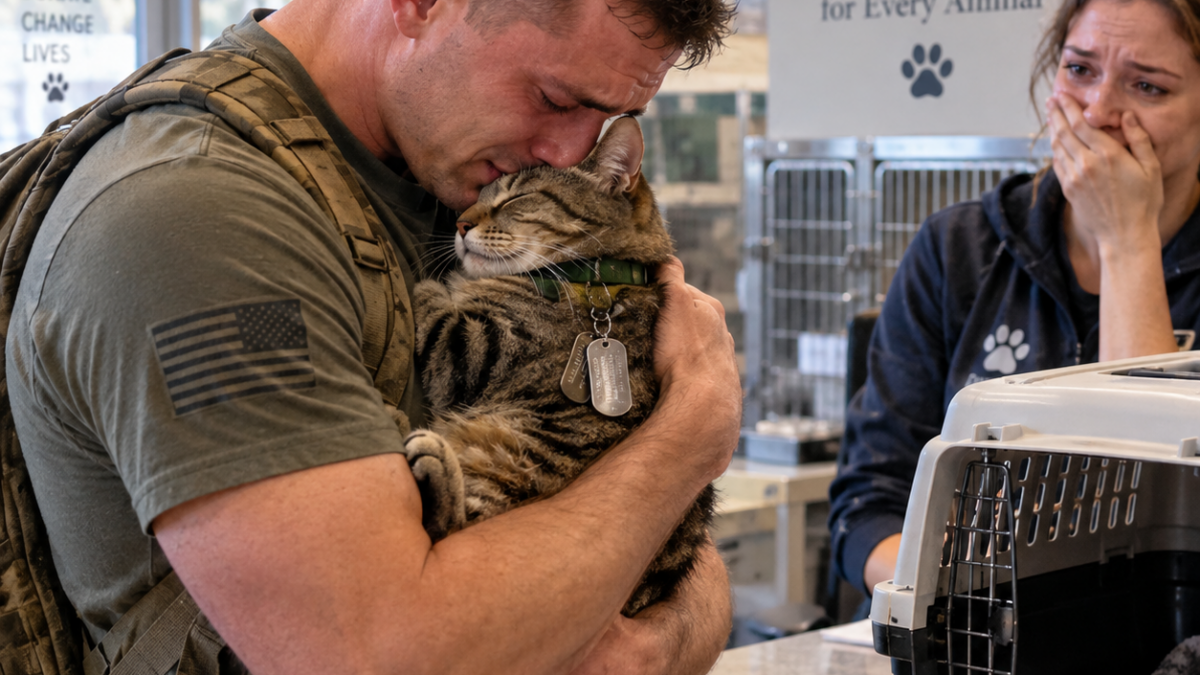
She walked straight into his arms.
Front paws against his chest.
Head under his chin.
He held her with both hands.
Not loosely.
Not desperately either.
He held her the way you hold something completely familiar.
His cheek against the top of her head.
Sergeant purred.
Loud.
The sound filled the lobby.
He closed his eyes.
And stood there.
Five minutes.
Ten.
Fifteen.
At some point, I moved away from the counter.
Pretended to organize files.
Not because he needed privacy exactly.
Because I did.
His shoulders shook.
He kept trying to contain the sound.
Sergeant lifted her face.
Touched her nose to his chin.
He whispered something I could not hear.
Twenty minutes passed.
I did not interrupt.
No one came into the lobby.
It felt as if the building somehow knew not to.
Then he did something I had never seen in thousands of surrenders.
He shifted Sergeant into one arm.
Reached under the collar of his shirt.
Pulled out his military dog tags.
Two metal identification tags on a chain.
They made a soft clicking sound.
Sergeant watched them.
He had also brought a short length of green cord.
Already cut.
Already prepared.
That told me he had planned this.
Probably the night before.
Maybe earlier.
His hands trembled as he threaded the cord.
I stepped forward.
“Would you like help?”
He shook his head.
“I need to do it.”
He looped the cord through the tags.
Then around Sergeant’s collar.
Carefully.
Not tight.
He checked it with two fingers.
Adjusted it.
Moved the tags so they rested against her chest.
The metal looked oversized against the small tabby.
I asked:
“Why the tags?”
He stopped.
Looked at Sergeant.
Then at me.
There are faces you remember because they are beautiful.
Faces because they are frightening.
Faces because of grief.
I will remember his because it contained all the effort of a person trying not to collapse in front of someone he had just met.
“For her.”
He cleared his throat.
“So she knows…”
He stopped.
I waited.
“So she knows somebody chose her once.”
I felt something in my chest break loose.
He continued.
“And when somebody adopts her…”
His voice failed.
He tried again.
“I want them to know she wasn’t abandoned because nobody wanted her.”
He looked down.
“She was mine.”
The word nearly became a sob.
“Mine.”
Sergeant pushed her face against his neck.
He held her tighter.
“I just can’t keep her.”
I had heard thousands of reasons for surrender.
Some were careless.
Some infuriating.
Some heartbreaking.
Some unavoidable.
But I had never heard someone so desperately need the shelter to understand the difference between leaving and not loving.
He whispered:
“I don’t want her thinking I didn’t come back.”
I did not tell him cats conceptualize absence differently than people.
This was not the moment for facts.
“She’ll be cared for.”
I said.
He nodded.
“Please keep those with her.”
“The tags?”
“Yes.”
“You can have them back.”
“No.”
He answered immediately.
“They stay.”
“Are you sure?”
“They have my name.”
“Exactly.”
He looked down.
“That’s why.”
Then he signed.
Or tried to.
His hand shook so badly the first line barely resembled writing.
He stopped.
Took a breath.
Tried again.
The signature came out crooked.
He stared at it.
“I’m sorry.”
“It’s fine.”
“I usually have better handwriting.”
“I believe you.”
He smiled weakly.
Then placed one hand on Sergeant’s head.
“Be good, Sarge.”
She blinked.
He rubbed behind her ears.
“You hear me?”
Purrrr.
“Don’t terrorize anybody.”
I smiled.
“Was that a concern you forgot to disclose?”
“She has opinions.”
“Noted.”
One final kiss between her ears.
Then he handed her to me.
That was the moment.
Not the paperwork.
Not the dog tags.
Not the crying.
The transfer.
Until then, Sergeant was still physically in his arms.
The second he gave her to me, his hands remained suspended in the air for half a second.
Empty.
That image stays with me.
People talk about surrender as if it is one action.
It is not.
There is a precise instant when responsibility changes hands.
One person lets go.
Another takes hold.
He stepped backward.
Sergeant looked toward him.
He turned immediately.
Maybe he knew if he looked back, he would not leave.
He walked across the lobby.
Reached the door.
Stopped with his hand on the handle.
I thought he would turn.
He did not.
He whispered something.
Maybe goodbye.
Then left.
Through the front window, I watched him cross the parking lot.
He unlocked his car.
Sat behind the wheel.
Did not start it.
He stayed there.
Five minutes.
Maybe longer.
Head down.
Hands on the steering wheel.
Eventually another staff member came toward intake.
I looked away.
I carried Sergeant into the cat wing.
The dog tags rested against her chest.
Clink.
Clink.
With every step.
I could have removed them.
Probably should have for safety while she was unattended.
Instead, I unclipped them from the collar once she was inside the enclosure and hung them on the door.
Right beside her information card.
Visible.
SERGEANT
6 YEARS
FEMALE
BROWN TABBY
FRIENDLY
NO DOGS
And beside that:
Two military identification tags.
I told the staff:
“These stay with her.”
Nobody argued.
Then I went to the employee restroom.
Locked myself inside a stall.
Sat down.
And cried for five minutes.
Exactly five.
At six, somebody knocked.
“You okay?”
“Yes.”
It was not completely true.
But there were animals waiting.
So I washed my face.
Went back to work.
Professional again.
At least enough.
By afternoon, everyone knew about Sergeant.
Shelter workplaces spread stories quickly.
A veterinary technician came by.
“Is this the deployment cat?”
“Yes.”
She crouched.
Sergeant immediately walked to the front of the enclosure.
Head-butted her fingers.
“Oh, she’s sweet.”
“Extremely.”
The tech looked at the tags.
Then at me.
“You serious?”
“Yes.”
She read the name.
Her expression changed.
“Wow.”
The next person reacted the same way.
And the next.
Not because military dog tags are magical.
They are metal.
Identification.
But hanging from that cage door, they changed the way people understood what they were seeing.
Without them:
Adult tabby surrendered by owner.
With them:
A six-year relationship interrupted by something neither of them chose.
The first night was hard.
Sergeant ate.
Used the litter box.
Accepted attention.
Physically, she was fine.
Emotionally, we could not know exactly.
But she watched the hallway constantly.
Every time boots approached, her head lifted.
That got to me.
Military-style boots were common among staff and visitors.
Each time:
Head up.
Eyes on the door.
Then relaxed when the person passed.
I told myself not to anthropomorphize.
I failed.
The next morning, Sergeant had pulled her blanket into the corner.
She was sleeping on it.
When I opened the enclosure, she stood.
Walked to me.
Climbed partly onto my shoulder.
I laughed.
“So we’re doing this?”
She purred against my neck.
Her intake notes changed.
Very affectionate.
Likes being held.
May climb onto shoulders.
Strong attachment to people.
Then:
Appears to prefer sleeping against humans.
That was not normally a shelter-note category.
We added it anyway.
I thought about the soldier constantly.
Deployment in two days now.
Packing.
Briefings.
Airport.
Whatever came next.
I wondered whether he was checking his phone.
Waiting for us to call.
We had a policy about updates.
Surrendering owners could ask about adoption status, but communication depended on circumstances.
He had signed the section permitting us to contact him by email.
I sent one photograph.
Sergeant sitting at the front of the enclosure.
Dog tags hanging beside her.
She ate dinner, used the litter box, and has been very affectionate. She is safe.
I stared at the message for a long time before sending.
His response arrived eleven minutes later.
Thank you.
Then another.
Seriously. Thank you.
No more.
Two days later, he deployed.
I knew because he had written the date on the form.
At 8:00 that morning, I walked past Sergeant.
“Your guy leaves today.”
She stretched.
“You’d better make this easy on him.”
She yawned.
Typical.
The first adoption inquiry came that afternoon.
A woman named Marissa.
Thirty-four.
Elementary school counselor.
She had recently lost her seventeen-year-old cat.
She said she was not ready for another kitten.
Wanted an adult.
Calm.
Affectionate.
Her apartment allowed cats.
No dogs.
Perfect on paper.
She walked through the cat room.
Stopped at Sergeant.
Saw the tags.
“What are those?”
I knew the question would come eventually.
I told her.
Not dramatically.
Just facts.
Owner deploying.
No safe foster option.
Six years together.
He left the tags.
Marissa put one hand over her mouth.
“Oh.”
Sergeant approached the cage door.
Marissa knelt.
“Hi, Sarge.”
Sergeant rubbed the bars.
Marissa looked at me.
“Can I meet her?”
“Yes.”
Inside the visitation room, Sergeant inspected everything.
Chair.
Table.
Window.
Marissa sat on the floor.
Did not reach immediately.
Good sign.
Sergeant circled.
Then climbed straight into her lap.
Marissa froze.
“Okay.”
Sergeant turned twice.
Settled.
Purred.
Marissa laughed.
Then cried.
“This is unfair.”
“What?”
“She knows exactly what she’s doing.”
I smiled.
“She has opinions.”
Marissa spent forty-five minutes with her.
Then asked:
“Do you think it’s too soon?”
That question surprised me.
“For you?”
“No.”
“For him.”
I understood.
“Her previous owner?”
“Yes.”
Marissa looked at Sergeant.
“I don’t want him to think somebody replaced him in three days.”
That sentence told me almost everything I needed to know about Marissa.
I sat across from her.
“Adoption wouldn’t erase him.”
She looked up.
“The goal is exactly what he wanted.”
“A home.”
She nodded.
“I want her.”
We processed the application.
References.
Housing verification.
Veterinary history from her previous cat.
Everything cleared.
She could have taken Sergeant that afternoon.
Instead she asked:
“Can I come back tomorrow?”
“Sure.”
“I want to set everything up.”
“Bed.”
“Litter.”
“Same food.”
“She had a favorite blanket?”
Her owner had left one.
“Can I take it home today so it smells like where she’s going?”
I had never been asked that.
We allowed it.
The next morning, Marissa returned.
Carrier.
Soft towel.
A new collar.
And something else.
A shadowbox.
Small.
Wooden.
She placed it on the counter.
“What’s that?”
“For the dog tags.”
I stared.
Marissa said:
“I don’t think she should wear them all the time.”
“She could snag them.”
“I know.”
“So I thought…”
She opened the box.
Inside was a backing of dark green fabric.
Hooks.
Space for the two tags.
At the bottom, a small blank metal plate.
“What goes there?”
Marissa looked embarrassed.
“I was hoping you’d know his first name.”
Privacy rules.
We could not simply hand over his personal information.
I told her that.
She nodded immediately.
“Right.”
“Of course.”
Then she smiled.
“Then I’ll leave it blank.”
Sergeant’s adoption paperwork took thirty minutes.
When we reached the final page, Marissa stopped.
“Can you contact him?”
“We can send an update if he permitted communication.”
“Would you?”
“What should I say?”
She thought.
Then:
“Tell him she has a home.”
I swallowed.
“Anything else?”
Marissa looked through the window toward Sergeant.
“Tell him I know she was loved first.”
I stopped pretending professionalism mattered.
I had to look away.
When Sergeant left the shelter, the dog tags left with her.
I watched Marissa clip the carrier into the back seat.
Not place it loosely.
Clip it.
Another good sign.
Then they drove away.
The cage was empty.
I stood there longer than necessary.
On the intake card, I wrote:
ADOPTED.
Then went to the computer.
I emailed him.
I kept it short because I did not know where he was, what security restrictions existed, or when he would see it.
Sergeant was adopted today by a woman with previous cat experience and no other pets. She spent almost an hour meeting Sergeant before deciding. Sergeant climbed into her lap on her own.
I paused.
Then:
Her adopter asked me to tell you: “I know she was loved first.”
I attached one photograph.
Sergeant in Marissa’s lap.
Dog tags visible in the foreground.
Send.
No response.
That did not surprise me.
Hours passed.
Then a day.
Three.
A week.
By then I had processed dozens more animals.
Life at a shelter does not stop long enough for you to finish feeling one story.
Then nine days after the adoption, an email appeared.
His name.
I opened it.
Only five lines.
I’m sorry I couldn’t respond sooner.
I’ve looked at that picture about fifty times.
Please tell her thank you.
Tell her Sergeant sleeps behind your knees if she gets cold.
Then:
And tell Sarge I kept my promise.
I cried at the desk.
Again.
My coworker looked at me.
“Deployment cat?”
I nodded.
She pushed a tissue box across the counter.
Three weeks later, Marissa sent a photograph.
Sergeant asleep on her bed.
Behind her knees.
Exactly where predicted.
The shadowbox hung on the wall above the nightstand.
Two dog tags inside.
Under them, Marissa had eventually added a small engraved plate.
It did not contain the soldier’s name.
Instead:
CHOSEN TWICE.
I stared at that for a long time.
Marissa wrote:
She cried at the bedroom door the first two nights. Now she sleeps with me. She waits outside the bathroom. She steals my hair ties. She sits on the windowsill every afternoon. I think we’re going to be okay.
I forwarded the message.
Weeks later:
Thank you.
That became our pattern.
Not constant.
Every few weeks, Marissa sent a picture.
Sergeant in a paper grocery bag.
Sergeant on a windowsill.
Sergeant sprawled across a pile of clean laundry.
Sergeant lying directly across Marissa’s laptop keyboard.
I forwarded the best ones.
Sometimes he responded.
Sometimes months passed.
One email arrived after midnight our time.
She always did that with the laptop. If you move her, she comes back twice as angry.
Another:
That green toy mouse was mine. I bought it at a gas station in Kansas when she was eight months old. I can’t believe it survived.
Another:
She looks happy.
That one was hardest.
Because it was only three words.
I imagined what it cost him to type them.
There is a complicated kindness in loving an animal enough to want them happy somewhere you cannot be.
Six months after the surrender, Marissa came into the shelter.
Without Sergeant.
My first thought was panic.
Return.
It happens.
Good adoptions fail.
People change.
Circumstances change.
I prepared myself.
Marissa smiled.
“I’m not returning her.”
I exhaled so visibly she laughed.
“Sorry.”
“You almost killed me.”
“I brought something.”
She placed an envelope on the counter.
Inside were printed photographs.
Sergeant.
Home.
Christmas tree.
Window.
Bed.
Blanket.
The shadowbox.
“I thought you could keep one.”
I picked a photograph of Sergeant lying under the framed dog tags.
“You know he gets the updates?”
“Yes.”
“Did he ever…”
She hesitated.
“Did he ever ask for her back?”
That question had lived underneath everything.
“No.”
Marissa nodded slowly.
“I feel guilty about that sometimes.”
“Why?”
“She was his.”
I looked at her.
“She was.”
Marissa’s face tightened.
“And now she’s yours.”
She looked uncomfortable.
I continued.
“Both things can be true.”
Marissa nodded.
“I would give her back if…”
She stopped.
I knew what she meant.
“If he came home and asked?”
“Yes.”
That was not legally required.
The adoption was permanent.
He had surrendered ownership.
But Marissa was not talking about law.
She was talking about love.
“I think he’d want you to keep her.”
“How do you know?”
“Because every message he sends is about whether she’s happy.”
Marissa looked down.
That answered enough.
Nine months after the original surrender, an email came from him.
Subject:
Home.
I opened it.
I got back yesterday.
I stared.
Then read the rest.
I don’t know if it’s appropriate to ask, but is there any way I could see her?
My stomach tightened.
This was new territory.
Sergeant was no longer ours.
I could not make that decision.
I contacted Marissa.
Explained.
Long silence on the phone.
Then:
“When?”
“You’re okay with it?”
Another silence.
“I’m terrified.”
“Why?”
“What if she wants him?”
I did not know what to say.
Marissa continued.
“What if she sees him and I realize I’ve just been babysitting somebody else’s cat?”
“She’s legally yours.”
“That isn’t what I mean.”
I understood.
Marissa loved Sergeant.
The visit threatened no paperwork.
It threatened her heart.
“I can tell him no.”
“No.”
She answered quickly.
“No.”
She breathed.
“He deserves to see her.”
We arranged it at the shelter.
Neutral place.
Saturday morning.
Before opening.
I arrived early.
Marissa came carrying Sergeant.
The cat looked healthy.
Beautiful coat.
A little heavier.
Relaxed.
She wore a simple green collar.
No dog tags.
Those remained in the shadowbox.
The soldier arrived five minutes later.
Civilian clothes.
Same short hair.
Same posture.
But different.
Nine months changed something around his eyes.
He stopped outside the glass doors.
Saw the carrier.
Did not enter.
Just stood there.
Marissa saw him.
Whispered:
“Oh my God.”
I opened the door.
He walked inside.
Nobody knew what to say.
Finally:
“Hi.”
Marissa nodded.
“Hi.”
He looked at the carrier.
“Is she…”
“She’s good.”
He smiled.
“Yeah?”
“She runs my house.”
“That sounds right.”
Marissa crouched.
Opened the carrier.
Sergeant stepped out.
She looked around.
Then saw him.
Everything stopped.
I have worked with animals long enough to be careful about assigning human narratives to behavior.
But I know what I saw.
Sergeant froze.
Her ears went forward.
The soldier lowered himself slowly to the floor.
“Sarge.”
One word.
The cat ran.
Not walked.
Ran.
Straight into him.
Front paws on his chest.
Climbing.
He caught her.
Then he broke.
Completely.
He folded over her.
Face in her fur.
Crying so hard he could not speak.
Sergeant rubbed against his jaw.
Purred.
Head-butted his chin.
Walked around his shoulders as if nine months had compressed into seconds.
Marissa cried too.
So did I.
Nobody pretended otherwise.
The soldier kept repeating:
“Hey.”
“Hey, girl.”
“Hey.”
“She remembers me.”
Marissa whispered:
“Of course she does.”
He held Sergeant for a long time.
Then he looked at Marissa.
“She looks really good.”
“Thank you.”
“No.”
He shook his head.
“Thank you.”
Marissa wiped her face.
“I have your tags.”
He smiled.
“I know.”
“How?”
“The picture.”
“Oh.”
“They’re framed.”
She nodded.
“I didn’t want them getting caught.”
“Good.”
She hesitated.
“I can give them back.”
He looked at Sergeant.
Then shook his head.
“They belong with her.”
Marissa swallowed.
“There’s something else.”
She pulled out her phone.
Showed him the shadowbox.
CHOSEN TWICE.
He stared.
His mouth tightened.
He looked away.
Then back.
“That’s…”
He stopped.
“Thank you.”
Marissa said:
“I wasn’t trying to replace you.”
“I know.”
“I need you to know that.”
He nodded.
“I do.”
Sergeant climbed from his lap.
Walked toward Marissa.
Rubbed against her legs.
The soldier watched.
Something moved across his face.
Pain.
Relief.
Maybe both.
“She loves you.”
Marissa cried harder.
“Yes.”
He nodded.
“Good.”
That word held nine months.
Maybe more.
Marissa sat on the floor opposite him.
Sergeant moved between them.
First him.
Then her.
Again.
As if refusing the entire premise that love had to belong to only one person.
Eventually the soldier said:
“I’m not here to take her.”
Marissa closed her eyes.
I think she had been waiting for those words even though she never asked.
“I couldn’t do that.”
He looked toward Sergeant.
“I surrendered her.”
“That was my decision.”
“The hardest one I’ve ever made.”
“But you gave her a home.”
He looked at Marissa.
“I’m not undoing the good part because I miss her.”
Marissa nodded.
“If you want to visit…”
His eyes filled again.
“I’d like that.”
They exchanged contact information.
Not because the shelter required it.
Because two strangers had become connected by one cat.
The soldier visited Sergeant several times over the following months.
Not constantly.
Enough.
Sometimes Marissa sent me photographs.
Sergeant sitting between them on the couch.
Sergeant wearing a ridiculous holiday bandana.
Sergeant asleep across the soldier’s old military jacket during one visit.
He eventually told Marissa his first name.
Ethan.
I will use it now because it became part of Sergeant’s story.
Ethan never asked for the dog tags back.
The shadowbox remained in Marissa’s home.
Eventually Ethan added something to it.
A small photograph.
Him at twenty-two.
Holding kitten Sergeant against his chest outside his first apartment.
Marissa placed another beside it.
Sergeant at seven.
Sitting in her sunny apartment window.
Past.
Present.
No competition.
Just a life.
A year after he returned, Ethan came back to the shelter alone.
I recognized him immediately.
My stomach did the same nervous thing.
“What happened?”
He smiled.
“Nothing.”
“Sergeant’s okay?”
“She’s perfect.”
I exhaled.
“You people need to start opening with that.”
He laughed.
“I’m here because I want to foster.”
That surprised me.
“Cats?”
He nodded.
“Deployment surrenders if possible.”
I stared.
“You know that’s very specific.”
“I know.”
“Why?”
He leaned against the counter.
“Because I keep thinking about how close I was to having no option.”
“There have to be other people in that situation.”
There are.
Military deployment creates complicated animal-care problems.
Some programs provide temporary foster support.
Availability varies.
Not everyone finds help in time.
Ethan had started volunteering with a regional network matching deploying service members with temporary foster families.
He had space now.
Stable housing.
And Sergeant lived safely with Marissa.
“I can’t take dogs.”
“Apartment rules?”
“No.”
He smiled.
“Sergeant trained me.”
“Absolutely no dogs.”
We matched him with a cat named Pepper.
Eleven months.
Owner deploying.
Temporary foster.
When the owner returned, Ethan handed Pepper back.
He later told me:
“That was harder than I expected.”
I laughed.
“You thought temporary meant easy?”
“Yes.”
“It does not.”
Over the next several years, he fostered nine cats.
Every one returned to their military owner.
No shelter surrender.
No permanent separation.
The first time I realized Sergeant’s story had grown larger than Sergeant was when a young Air Force woman walked into intake carrying a tuxedo cat.
She was crying.
I recognized the situation immediately.
Deployment.
No family.
No friend.
She began explaining.
I said:
“Before we do surrender paperwork, I may know another option.”
We called the foster network.
Ethan answered.
He took the cat that afternoon.
Eight months later, owner and cat reunited.
No dog tags left behind.
No permanent goodbye.
That mattered.
Marissa remained part of all of it.
She volunteered at adoption events.
Not every week.
Enough.
Sergeant became a strange little ambassador.
Marissa created a social media page for her.
Nothing huge.
Mostly photographs.
But the story of the tags spread.
People wrote messages.
Military families.
Shelter workers.
People who had surrendered animals during housing crises.
People carrying guilt years later.
One comment stayed with me.
I gave up my dog when I became homeless. I’ve hated myself for eleven years. Thank you for reminding me that surrender is not always the absence of love.
That sentence changed how I spoke to people at intake.
Before Sergeant, I thought I was already compassionate.
Maybe I was.
But I had still developed assumptions.
You do that in shelter work.
You see patterns.
Patterns become shortcuts.
Shortcuts become judgments if you are not careful.
A person surrendering an animal was sometimes irresponsible.
Sometimes careless.
Sometimes avoidable.
But not always.
Sometimes love looked like holding on.
Sometimes love looked like letting go before your circumstances harmed the animal you were trying to protect.
My job was not to erase accountability.
It was to learn the difference.
Sergeant taught me that.
Or maybe Ethan did.
Six years after that first morning, Sergeant turned twelve.
She slowed.
Developed mild arthritis.
Still slept behind Marissa’s knees.
Still recognized Ethan instantly.
Her brown tabby coat had silver around the muzzle.
The dog tags remained above the bed.
One spring afternoon, Marissa brought her to the shelter for our annual alumni event.
Ethan was there helping at the military foster information table.
Sergeant sat in a stroller.
Yes.
A stroller.
Marissa insisted it was easier on her joints.
Ethan mocked her until Sergeant immediately fell asleep in it.
“You’ve become one of those people.”
He told Marissa.
“What people?”
“Cat stroller people.”
“Your cat likes it.”
“Our cat?”
The words came out naturally.
They both stopped.
Then smiled.
Neither corrected it.
That might be my favorite detail.
Not because ownership became confused.
It did not.
Marissa was Sergeant’s legal owner.
Her everyday person.
Her home.
But love had expanded enough that the possessive word stopped needing sharp boundaries.
Our cat.
Chosen twice.
At the event, a teenager asked why Sergeant had military dog tags in the photograph on her display board.
Ethan looked at me.
I looked at him.
“Your story.”
He crouched near the girl.
“I had to leave.”
He explained.
“I couldn’t take her.”
The teenager asked:
“Did you abandon her?”
The word landed.
Ethan did not flinch.
“I surrendered her.”
“What’s the difference?”
He thought carefully.
“Sometimes none.”
“Sometimes everything.”
The girl frowned.
Ethan continued.
“I had exhausted the safe choices I knew about.”
“I gave her to a place that could care for her because keeping her without a plan would have been worse.”
“Did it hurt?”
He laughed softly.
“More than almost anything.”
The teenager looked at Sergeant.
“Did she forgive you?”
Ethan stroked the cat’s head.
“I don’t know if she thought of it that way.”
Sergeant opened one eye.
Ethan smiled.
“But she still loves me.”
Marissa added:
“And she loves me.”
The girl asked:
“Can she love both?”
Ethan and Marissa answered together.
“Yes.”
Sergeant died at fourteen.
Kidney disease.
Slow decline.
Marissa called Ethan before she called me.
They made the final veterinary appointment together.
I was not there.
They later told me.
Sergeant lay on a blanket between them.
Marissa’s hand beneath her chin.
Ethan’s hand along her back.
The shadowbox with the dog tags stayed home.
They did not bring it.
She did not need metal proof anymore.
Ethan whispered the same words he had whispered at the shelter years before.
“Be good, Sarge.”
Marissa corrected him through tears.
“She already was.”
He laughed.
Then cried.
Sergeant died surrounded by both people who had chosen her.
First Ethan.
Then Marissa.
Neither cancelled the other.
Afterward, Ethan came to the shelter.
Same lobby.
Same counter.
Older.
A little gray at the temples.
No carrier.
He placed the dog tags in front of me.
I stared.
“I thought these stayed with her.”
“They did.”
He smiled.
“Marissa wants them here.”
“Why?”
“Because this is where the promise happened.”
I did not know what to say.
The tags had scratches now.
Tiny marks.
Years of being handled.
Framed.
Moved.
Preserved.
Ethan said:
“We thought maybe you could hang them somewhere.”
Not as decoration.
Not as military memorabilia.
As a reminder.
We created a small shadowbox near intake.
No last names.
No unit information.
No identifying numbers visible.
Just the tags turned safely so private details could not be read.
A photo of Sergeant.
And a sentence Ethan approved:
Surrender does not always mean unloved. Sometimes letting go is the last loving option someone has left.
People stop and read it.
Some cry.
Some ask.
Shelter employees explain.
New intake staff hear the story during training.
Not because every surrender resembles Ethan’s.
They do not.
Some require hard conversations.
Some animals arrive because humans made preventable choices.
Compassion does not mean pretending otherwise.
But Sergeant reminds us not to decide the whole story before someone finishes speaking.
Sometimes the person standing at the counter has spent weeks trying everything.
Sometimes the person can barely sign.
Sometimes the carrier contains the one constant thing in a life defined by moving.
Sometimes the goodbye you are witnessing is not convenience.
It is grief.
I still work intake.
More than four years now.
Thousands more animals.
The faces still blur eventually.
That is not cruelty.
It is survival.
But some remain.
I remember Sergeant’s small brown face behind the carrier door.
I remember Ethan’s hands trembling.
I remember the sound of the tags when he removed them.
I remember asking why.
I remember his answer.
So she knows somebody chose her once.
At the time, he believed he was leaving his identity behind because it was the only thing he could give her.
He did not know Sergeant would be chosen again within days.
He did not know her new owner would preserve those tags over the bed.
He did not know he would return from deployment and hold her again.
He did not know he would eventually help other service members avoid the goodbye he had been forced to make.
He did not know one surrender would change the way an entire shelter talked about people walking through its doors.
He knew only that he loved his cat.
And he could not take her where he was going.
Sometimes life gives you choices.
Sometimes it gives you losses dressed as choices.
Ethan signed the papers anyway.
Marissa opened her home anyway.
Sergeant loved them both anyway.
And those dog tags remained long after the worst day was over—not proof that Sergeant had once belonged to a soldier, but proof of something much simpler.
She had never been discarded.
She had never been forgotten.
She had never stopped mattering.
She had been loved before the shelter.
Loved inside it.
Loved after it.
And in the end, the little brown tabby who entered our building wearing one man’s name left behind a lesson I have carried into every surrender since:
Sometimes letting go is not the opposite of love.
Sometimes it is the most painful form of love a person is ever asked to give.








