I Went to the Shelter to Donate Old Towels—Then the Cat Nobody Wanted Put His Head Against My Heart and Wouldn’t Let Go
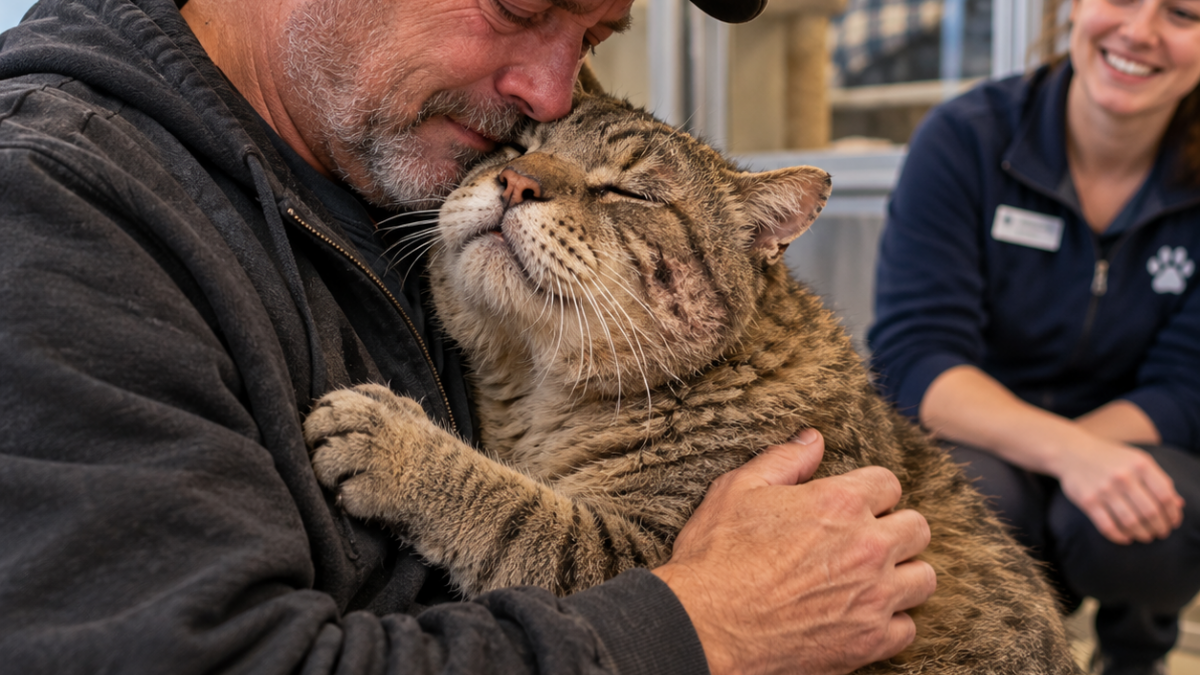
PART3:
Most nights I pulled into my driveway a few minutes after midnight.
The neighborhood was dark.
Porch light on.
No other car in the driveway.
No one looking through the curtain because they heard me pull in.
I would unlock the door, step inside, and turn on the television before taking my boots off.
I did not care what was on.
News.
Old sitcom.
Baseball replay.
Late-night infomercial.
Anything with voices.
Silence had become too noticeable.
That sounds sadder when I say it out loud than it felt at the time.
That is the thing about loneliness.
It often does not feel dramatic.
It feels practical.
You buy smaller cartons of milk because you never finish the big one.
You stop cooking certain meals because recipes serve four.
You leave the television on while washing dishes.
You realize you have gone three days without speaking to anyone outside work.
Then someone asks:
“How you doing?”
And you say:
“Fine.”
Fine is one of the most useful words in the English language.
It can mean:
I am healthy enough to work.
I am paying my bills.
Nothing is actively on fire.
Please do not ask another question.
I had become very good at fine.
Maren knew.
Daughters sometimes know things fathers work hard to hide.
She called me several nights a week.
Usually when I was driving to work.
Sometimes on Sundays.
She would ask what I had done.
“Nothing.”
“What did you eat?”
“Food.”
“Dad.”
“What?”
“You know normal people answer questions.”
“Meatloaf.”
“From when?”
I would tell her.
She would make a disgusted noise.
“You cannot eat one meatloaf for six days.”
“Watch me.”
Then she would ask if I had seen anyone.
Coworkers counted.
Apparently not.
She had been pushing me to get a dog for almost a year.
I told her no.
A dog needed walks.
My schedule was wrong.
Then she suggested a cat.
“No.”
“Why?”
“I’m not a cat person.”
“You’ve never had one.”
“Exactly.”
“That makes no sense.”
“It makes perfect sense.”
Then she started talking about volunteering.
That also failed.
Eventually she focused on towels.
I had a hallway closet full of them.
Old bath towels.
Beach towels.
One with a faded university logo.
Several I should have thrown away years earlier.
Maren saw them during a visit.
“Animal shelters use old towels.”
“I use old towels.”
“For what?”
“Emergencies.”
“You have twenty-seven emergency towels.”
“You counted?”
“Yes.”
“That is invasive.”
For three weeks she reminded me.
Text:
Did towels make it to shelter?
No.
A few days later:
Any progress on Great Towel Donation of 2024?
No.
Then:
Dad, those towels have not left the closet since Obama was president.
Finally, mostly to end conversation, I loaded two bags into my truck on a Saturday morning.
The shelter sat across town near an industrial strip.
Low brick building.
Metal kennels behind fence.
A mural of cartoon dogs and cats on one wall.
I walked in carrying bags.
A woman named Keely met me near front counter.
Maybe late thirties.
Dark hair tied back.
Green shelter T-shirt.
She looked at towels as though I had donated medical equipment.
“Oh, these are great.”
“They were threatening to form their own government in my closet.”
She laughed.
“We go through these constantly.”
“Then everybody wins.”
That was supposed to be end.
Hand towels.
Leave.
Go home.
Maybe stop for coffee.
Instead, Keely walked with me toward exit.
And I looked through a glass door.
That was where I saw him.
Rourke.
He sat completely still.
Watching me.
There were other cats nearby.
One black kitten climbed cage door like it was escaping prison.
A white cat rubbed against glass.
Another slept curled in blanket.
Rourke did none of that.
He simply watched.
I stopped.
“Good grief.”
Keely followed my gaze.
“What?”
“That cat looks like I owe him money.”
She laughed hard enough that someone at front desk turned around.
“That’s Rourke.”
“Rourke?”
“R-O-U-R-K-E.”
“Sounds appropriate.”
“He’s a sweetheart.”
I looked again.
“Are we talking about same animal?”
“Yes.”
“He looks like he runs protection racket.”
“He kind of does.”
“How long’s he been here?”
Her expression changed.
Small change.
But I saw it.
“A while.”
“How long is a while?”
“A little over four months.”
That surprised me.
“Why?”
She looked through glass.
“Some cats photograph better.”
I understood.
Rourke was not ugly.
I want to make that clear.
But beauty in shelter animals is often about immediate softness.
Big eyes.
Clean fur.
Symmetry.
Cute.
Rourke looked like life had already happened to him.
Keely told me he had lived outdoors for years.
Nobody knew exactly how long.
A woman feeding neighborhood strays started seeing him near dumpsters behind an apartment complex.
At first he would not let her approach.
Then winter came.
He began waiting beneath staircase for food.
Eventually he showed up limping.
She trapped him.
Brought him in.
Old bite wounds.
Dental problems.
Ear infection.
Parasites.
Scars from fighting.
A couple broken teeth.
Nothing catastrophic.
Just accumulation.
The bill life sends animals that spend years having no one.
“He was intact when he came in,” Keely said.
I nodded as though I understood why that mattered.
I did not.
“He’s been neutered now.”
“Congratulations to him.”
She smiled.
“His cheeks may shrink a little eventually.”
“Those are going away?”
“Maybe some.”
“That seems unfair.”
“He has tomcat cheeks.”
“I don’t know what that means.”
“Basically hormones and years of being an intact male can give them that big head.”
I looked through glass.
“So he really was fighting in parking lots.”
“Probably.”
Rourke continued staring.
“Does he hate people?”
“No.”
“Looks like he does.”
“Open the door.”
I laughed.
Keely did not.
“You’re serious?”
“Yes.”
“I didn’t come to adopt anything.”
“I know.”
“I’m giving towels.”
“I know.”
“Those are separate activities.”
“I’m not asking you to adopt him.”
That bothered me.
If she had tried selling him, I could have left.
Instead she just stood there.
So I opened the door.
Rourke’s room was not really a cage.
Small glass-fronted enclosure with shelf, litter box, blanket, food.
He stood when I entered.
I expected him to back away.
Most animals I had known would have.
Instead he walked straight toward me.
Slow.
Confident.
He stopped at my boots.
Placed one paw on my left boot.
Looked up.
I said:
“Well?”
Rourke rose slightly.
Then pushed his forehead directly into my chest.
Hard.
Not a polite cat rub.
A body check.
I staggered half a step.
“What are you doing?”
He pushed harder.
Then the purr started.
It sounded ridiculous.
Deep.
Rumbling.
I could feel it through my jacket.
My hands hovered because I had no idea where to put them.
I had never owned a cat.
People think that means you automatically know how to pet one.
You do not.
Dogs are obvious.
Cats seem like there are rules nobody gives you.
Keely smiled through glass.
“Back and cheeks.”
“What?”
“Pet his back.”
I put one hand between his shoulders.
Rourke leaned into me harder.
My other hand touched one of those enormous cheeks.
His eyes closed.
The purr got louder.
“There is no way this is same animal.”
“He likes people.”
“Then why does he look like he’s done time?”
“Genetics and bad decisions.”
I laughed.
Rourke lifted his face.
Then head-butted me again.
He did not act tough.
That was the surprising part.
Once I entered the room, all that hard exterior disappeared.
He wanted contact.
Constant contact.
Hand on his back.
Cheek against my arm.
Forehead into chest.
He followed me when I moved six inches.
At one point I sat on bench.
He climbed partially into my lap, discovered there was not enough room for fifteen pounds of confidence, and settled beside me with half his body pressed against my thigh.
“How old is he?”
“Best guess? Seven or eight.”
“Healthy?”
Keely hesitated.
That word again.
Not alarming.
Just careful.
“He has some chronic issues.”
“What kind?”
“Dental. He may need another extraction later. His kidneys are okay now. He had pretty severe skin irritation. We’re treating it. And he tested positive for FIV.”
That sounded serious.
“What’s that?”
She explained feline immunodeficiency virus.
Not same as human HIV.
Not transferable to humans.
Cats with FIV can live good lives, especially indoors, but it scares adopters.
He should be kept inside.
Regular veterinary care.
Watch infections.
Some rescues placed FIV-positive cats with other compatible cats depending circumstances, but a single-cat home could be easiest.
I looked down.
Rourke had put his paw across my leg.
“He knows?”
Keely smiled.
“No.”
“Good.”
I sat with him twenty minutes.
Maybe thirty.
Longer than I intended.
Eventually I stood.
Rourke stood.
I stepped toward door.
He followed.
When I opened it, he pushed his head into my leg one more time.
Something tightened in my chest.
“I work nights.”
Keely nodded.
“My house is small.”
Another nod.
“I don’t know anything about cats.”
She kept nodding.
“I’ve never had one.”
“I heard you.”
“You are supposed to tell me this is a bad idea.”
“I’m not telling you anything.”
That made it worse.
“What would he do while I’m working?”
“Sleep.”
“He’d be alone.”
“He’s alone here.”
I looked at her.
She seemed to realize she had said too much.
“Sorry.”
“No.”
I looked through glass.
Rourke sat exactly where I had been standing.
I said:
“I’m not adopting a cat.”
Keely said:
“Okay.”
Then thanked me again for towels.
I drove home.
Without Rourke.
For the first hour I felt relieved.
I had done sensible thing.
I was fifty-eight.
Worked nights.
Had no idea how to own cat.
Rourke needed someone experienced.
Maybe a retired person.
Someone home all day.
Someone with a bigger house.
Someone who knew what FIV meant before five minutes ago.
Someone better.
That evening I heated leftover meatloaf.
Sat at kitchen table.
Television played in living room.
Nobody watched.
And I kept thinking about the pressure of that enormous forehead against my chest.
I told myself:
He does that with everyone.
Keely said he was affectionate.
It wasn’t special.
He would be adopted.
Somebody would see past face.
Somebody would know exactly what to do.
I watched television.
Then turned volume up.
That made the house louder.
Not less empty.
Sunday I worked.
Monday too.
Rourke appeared in my head at strange times.
While wrapping pallet.
While drinking coffee.
At two in morning.
I imagined him sitting behind glass.
Then told myself to stop being stupid.
Monday evening Maren called.
I had sent her a photo Saturday.
Just:
Look at this guy.
I forgot she would remember.
“So.”
“So?”
“When are you bringing him home?”
“I’m not.”
“Dad.”
“What?”
“That cat is terrifying.”
“Exactly.”
“I love him.”
“You can adopt him.”
“I live a thousand miles away.”
“Excuses.”
“Why aren’t you getting him?”
“I work nights.”
“So?”
“I’m gone.”
“Cats sleep eighteen hours a day.”
“Where did you get that statistic?”
“The internet.”
“Reliable.”
“He’d probably enjoy having house to himself while you work.”
“Maren.”
“What?”
“I don’t need a cat.”
She went quiet.
Then:
“That isn’t what I asked.”
“I said I’m not adopting him.”
“Why?”
“He doesn’t need me.”
Silence.
Long enough that I thought call dropped.
“Maren?”
Then she said:
“Dad, I think you two are both pretty good at pretending that’s true.”
I had no answer.
I changed subject.
Asked about work.
She let me.
Daughters also know when they have already landed punch.
Tuesday morning my shift ended at eleven-thirty.
I drove home.
Turned onto my street.
Passed house.
Kept driving.
I told myself I wanted breakfast.
Shelter was nowhere near breakfast.
Still, twenty minutes later I parked outside.
I had not called.
That felt important.
Calling would imply intention.
I was checking.
That is all.
Maybe bring him treats.
Did cats eat treats?
Obviously.
Keely was not at desk.
Another employee pointed toward cat rooms.
I walked back.
Rourke’s enclosure was empty.
I stopped.
Blanket gone.
Food bowl gone.
Name card gone.
For maybe three seconds, something irrational happened inside me.
Anger.
Sharp.
Immediate.
Someone adopted him.
Of course.
Good.
That was what shelters existed for.
That was what I told myself would happen.
He was safe.
He had home.
Why did it feel like somebody had taken something from me?
Then embarrassment.
I had walked away.
I did not get to feel betrayed because someone else chose him.
I stood there staring at empty room.
Keely came around corner.
“Hey.”
I turned.
“You okay?”
“Rourke’s gone.”
She looked at me.
There was a pause just long enough to make me hate my own voice.
Then she smiled.
“He’s in the back.”
“What?”
“Medical recheck.”
“Oh.”
Relief hit me so hard I actually laughed.
Keely saw it.
Of course she did.
“You thought he got adopted.”
“No.”
She raised an eyebrow.
“Maybe.”
“Come on.”
“I’m not—”
“Come on.”
She led me down hallway.
Before we reached treatment area, I heard a rough meow.
Then another.
A technician rounded corner with Rourke.
The second he saw me, his body changed.
He pulled forward.
Not violently.
Determined.
The tech loosened hold.
Rourke walked straight toward me.
I knelt.
Did not think.
He pressed into my chest.
Same huge head.
Same rumbling purr.
But this time, I put both arms around him.
No hovering.
No confusion.
Just held him.
Keely leaned against wall.
“You just checking on him?”
I looked at Rourke.
He had one paw on my shoulder.
I said:
“Shut up.”
She laughed.
I took him home that afternoon.
Adoption paperwork took less time than buying a truck and felt more serious.
Indoor only.
Veterinary care.
Medication instructions.
FIV information.
Dental follow-up.
Food recommendations.
Litter advice.
Carrier.
Keely talked me through everything.
At one point she said:
“You can still think about it.”
Rourke was sitting beside my chair with his side pressed against my boot.
“No.”
“No?”
“I’m done thinking.”
Keely smiled.
Before leaving, she gave me his medical folder.
Then she said:
“One thing.”
“What?”
“He may hide for a few days.”
“He just tried climbing into my coat.”
“New houses can be different.”
“Okay.”
“Let him set pace.”
“Okay.”
“Don’t force affection.”
I looked at Rourke.
“Does he know that?”
“No.”
At pet store, I spent more money than expected.
Cat bed.
Food.
Litter box.
Litter.
Bowls.
Scratching post.
Toys.
A brush.
Treats.
Another toy because it looked like mouse.
Then a larger bed because first seemed small.
The cashier looked at cart.
“New cat?”
“No.”
She stared.
“Yes.”
At home, I opened carrier in living room.
Rourke stepped out.
Looked around.
No fear.
Just inspection.
Kitchen.
Hallway.
Bedroom.
Second bedroom.
Bathroom.
He walked with slow authority of landlord checking property after tenant moved out.
I followed.
At one point he turned and looked at me.
“How’s everything?”
He continued.
Apparently acceptable.
I showed him expensive bed.
He sniffed it.
Walked away.
Of course.
He chose rug beside couch.
That evening I turned on television.
Habit.
Rourke sat at far end of couch.
Ten minutes later, he moved closer.
Then closer.
Eventually he laid his head on my thigh.
I froze.
He sighed.
Actually sighed.
His body went heavy.
Purring slowed.
He fell asleep.
I looked at television.
Some game show.
People clapping.
A host shouting.
Suddenly it felt unnecessary.
I picked up remote.
Turned it off.
Silence.
Normally silence in that house felt like an empty room had become larger.
That night it was different.
Rourke breathed.
Occasional purr.
Refrigerator hummed.
Rain touched window.
The house was completely quiet.
And for the first time in years, I did not need to fill it.
That is how it started.
Not with grand transformation.
With silence becoming tolerable.
Rourke adjusted quickly.
Too quickly in some areas.
He discovered my bed first night.
I woke at four with fifteen pounds on my chest.
For half second, I thought I was having a heart attack.
Then two green eyes appeared inches from mine.
“Get off.”
Purr.
“Rourke.”
He put one paw on my chin.
“Absolutely not.”
He stayed.
I learned cats do not respond to reasonable negotiations.
He hated the expensive bed.
Preferred cardboard box.
Ignored three toys.
Loved bottle cap.
Scratching post became acceptable after I put it exactly where I did not want it.
He followed me into bathroom.
I objected.
He did not.
He sat outside shower like security.
The night schedule was strange at first.
I left for work around three in afternoon.
Rourke often watched from window.
Coming home after midnight changed immediately.
First night, I unlocked door quietly.
Before I stepped inside, I heard something.
Thump.
Then Rourke appeared.
He walked toward me with tail up.
Rubbed legs.
Head-butted shin.
I stood there with keys in hand.
Somebody had noticed I came home.
That hit harder than expected.
“Hey, tough guy.”
He followed me to kitchen.
I heated leftovers.
He sat nearby.
Television stayed off.
I started talking to him.
Not consciously.
Just:
“Long night.”
“We had two guys call out.”
“Forklift three is making that noise again.”
“You do not care.”
Rourke blinked.
“Fair.”
For years I thought talking to yourself meant loneliness.
Turns out talking to a cat feels completely normal.
Maybe cats invented that service.
A week after adoption, I came home exhausted.
Bad shift.
Argument with supervisor.
Truck late.
Inventory wrong.
One of younger guys nearly dropped pallet.
The kind of night where irritation follows you through door.
I sat in recliner without turning lights on.
Rourke came over.
Normally he head-butted.
That night he paused.
Then climbed onto my lap.
Slowly.
He placed forehead under my chin.
Did not purr immediately.
Just stayed.
I put hand on his back.
“Yeah.”
That was all I said.
He stayed an hour.
The thing about loneliness is you can get accustomed to it enough that you stop calling it loneliness.
It becomes routine.
Then something changes and you realize what was missing by contrast.
Rourke did not fix my life.
My job was still my job.
Marriage was still over.
Maren still lived far away.
I was still fifty-eight with knees that disliked stairs.
But there was a living creature in the house who noticed movement.
Expected meals.
Waited near door.
Sat on my chest.
Wanted me.
That last part embarrassed me at first.
Need is a strange thing for men my age.
At least men like me.
We grew up learning how to be useful before learning how to be vulnerable.
Fix things.
Carry things.
Pay bills.
Show up.
Do not complain.
If somebody asks how you are:
Fine.
Rourke did not care about any of that.
He was not impressed I could replace garbage disposal.
Did not care about warehouse seniority.
Did not need advice.
He wanted my hand on his head.
That was it.
And somehow that simplicity exposed how little physical affection had been in my life for years.
Maren called on video two weeks later.
I answered from couch.
Rourke occupied half my lap.
She screamed.
“You got him!”
“Keep your voice down.”
“Oh my God.”
Rourke stared at phone.
“That face!”
“He can hear you.”
“I love him.”
“You say that from a safe distance.”
“Show me cheeks.”
I turned camera.
Maren laughed.
“He looks like he owns a towing company.”
“That is disrespectful.”
“You said he looked like debt collector.”
“That was before we were family.”
I said it.
Then stopped.
Maren did too.
For a second neither of us spoke.
She softened.
“Family?”
I looked at Rourke.
He was washing his shoulder.
“Apparently.”
She smiled.
“Good.”
I pretended to adjust phone.
“Don’t make it weird.”
“Too late.”
Rourke’s first vet appointment after adoption was not fun.
For anyone.
Getting him into carrier required:
Two treats.
One towel.
Several lies.
And apology.
At clinic, he became angel.
Of course.
Vet examined mouth.
Skin.
Weight.
Talked FIV.
He explained that many FIV-positive cats live long, comfortable lives with appropriate care.
Keep indoors.
Monitor.
Regular checkups.
Dental health especially important.
Rourke needed one more broken tooth removed.
I scheduled procedure.
The morning I dropped him off, I felt stupidly anxious.
It was dental work.
Routine.
Still.
I sat in truck outside clinic ten minutes after handing carrier over.
I almost went back inside.
The house felt wrong without him.
When clinic called that afternoon saying everything went well, I exhaled in a way that told me I had been holding breath all day.
I picked him up.
He was groggy.
Angry.
One side of face slightly swollen.
Back home he walked three steps out carrier.
Then sat on my foot.
I crouched.
“Okay.”
He pushed his head into my hand.
That was when I understood adoption was already permanent in a way paperwork could not describe.
I was responsible for whether this animal hurt.
A creature who had spent years with nobody responsible for that.
The thought made me unexpectedly angry.
Not at a particular person.
At all those years.
Rain.
Cold.
Infections.
Broken teeth.
Fights.
Hunger.
Rourke had developed the face of an animal who survived because he had to.
But the minute survival was no longer required, toughness disappeared.
That taught me something uncomfortable.
Sometimes toughness is not personality.
It is circumstance.
Take away danger.
Add safety.
And underneath is something entirely different.
Rourke became absurdly affectionate.
If I sat, he sat against me.
If I lay down, he joined.
If I worked in garage, he watched through screen door.
If I left shower, he inspected.
He developed a ritual when I came home.
I opened door.
He walked forward.
One meow.
Then forehead against my leg.
Every night.
One night I got home thirty minutes later than usual.
Overtime.
Rourke was sitting directly in front of door.
When I opened it, he complained loudly.
“I know.”
More meows.
“I had work.”
Meow.
“You do not pay mortgage.”
Meow.
“I buy your food.”
He rubbed against me.
Argument over.
A few months later Maren flew in.
She had not been home since adoption.
I picked her up at airport.
The entire drive she asked about Rourke.
“You know I’m your father.”
“I know.”
“You could ask about me.”
“I can see you.”
“Good point.”
When we entered house, Rourke stood in hallway.
Maren stopped.
“Oh my God.”
“What?”
“He is enormous.”
“I told you.”
“Photos do not capture his head.”
Rourke looked at her.
She crouched.
“Hi, handsome.”
He did not move.
She held hand out.
He sniffed.
Then turned away.
Maren looked offended.
“He hates me.”
“He has standards.”
For first hour he ignored her.
Then she opened bag of treats.
Standards became flexible.
By evening he was sprawled on living-room floor.
Belly up.
Legs in directions no dignified animal should choose.
Maren started laughing.
“He looks even tougher in person and somehow sleeps like this?”
I scratched his cheek.
“People misread him.”
She looked at me.
“Yeah.”
Something in her tone made me look up.
“What?”
“Nothing.”
“No. What?”
She sat on couch.
“I think people used to misread you too.”
I leaned back.
“Meaning?”
“You know exactly what I mean.”
“I really don’t.”
“Dad, for years anytime I asked how you were, you said fine.”
“I was fine.”
She looked around the house.
Rourke snoring.
Television off.
Cat toys beneath coffee table.
A cardboard box in corner because expensive bed remained rejected.
Then back at me.
“You were surviving.”
I felt defensive immediately.
“People survive.”
“I know.”
“Nothing wrong with it.”
“No.”
“So?”
“You made surviving look so normal nobody knew you wanted more.”
“I didn’t.”
“Okay.”
She said it gently.
Too gently.
I hate when my daughter is gentle while proving point.
I looked at Rourke.
He had one paw over face.
Maren said:
“He did same thing.”
“What?”
“Looked like he didn’t need anybody.”
“That’s different.”
“Is it?”
“He’s a cat.”
“Very observant.”
“Maren.”
She smiled.
Then her eyes filled.
I did not know what to do with that.
“What’s wrong?”
“I worried about you.”
“You didn’t need to.”
“That doesn’t stop it.”
I looked away.
The old reflex.
Fine.
Make joke.
Change subject.
Instead I said:
“I was lonely.”
The words felt strange.
Like admitting crime.
Maren nodded.
“I know.”
“Not miserable.”
“I know.”
“I wasn’t—”
“I know, Dad.”
“I just…”
I looked around.
“The house got really quiet.”
She crossed room.
Wrapped arms around me.
I stood stiff for one second.
Then hugged her back.
Rourke woke.
Stood between us.
Started purring.
Like an old lawn mower.
Maren laughed into my shoulder.
“This is ridiculous.”
“He thinks this is about him.”
“It probably is.”
That weekend was one of best we had in years.
Not because anything dramatic happened.
We cooked.
Maren made fun of my refrigerator.
We took Rourke to pet store for harness, which failed spectacularly.
Watched movie.
Walked along river.
But something between us shifted.
Maybe because I had finally said one honest sentence.
I was lonely.
There is power in naming what you have spent years disguising as routine.
After Maren left, the house was quiet again.
But not empty.
Rourke stood at window while I watched her rideshare pull away.
Then came to me.
I crouched.
“Just us again.”
He pushed head under my chin.
“Yes.”
A year passed.
Rourke got healthier.
His coat softened.
Weight remained around fifteen pounds, but it changed shape.
Less muscle from street fights.
More comfortable bulk.
His cheeks shrank slightly.
Not enough to ruin reputation.
The scars stayed.
One across bridge of nose.
Small notch ear.
A few patches where fur grew differently.
I loved them.
Not because suffering made him better.
I would erase whatever pain caused them if I could.
But because they were his.
History.
One evening Keely sent me an old photograph from the day he arrived at shelter.
I almost did not recognize him.
Thin.
Fur dull.
Eyes guarded.
Head lowered.
He looked older than he did now.
That struck me.
Safety had made him look younger.
Maybe people are like that too.
Maren said:
“Send me before and after.”
I did.
She replied:
You both look less grumpy now.
“Both?”
Then she sent photo of me from years earlier.
At Thanksgiving.
Sitting alone end of couch.
Arms folded.
Expression tired.
Then a photo from her last visit.
Rourke on my lap.
Me laughing.
I stared.
Same face.
Different posture.
“Very funny.”
She replied:
I’m serious.
I did not answer.
Rourke and I developed routines.
Breakfast after my shift.
Technically midnight meal for me, breakfast for him.
He sat while I ate.
Sometimes I gave tiny piece plain chicken.
He learned sound of my truck.
I learned every type of meow.
Short:
Hello.
Long:
Food.
Low rough one:
Door.
Sharp repeated:
Emergency, usually meaning a bug existed.
Silent mouth opening:
Manipulation.
He learned my days off.
On those days, he slept longer because apparently my presence removed need for surveillance.
I started sleeping better.
That surprised me.
I had never thought I slept badly.
Then Rourke came.
Deep purr near my feet.
Some nights beside chest.
My body relaxed in ways I had not noticed it was holding tension.
I stopped leaving television on to sleep.
Electric bill even dropped a little.
I joked Rourke was paying rent.
Then there were difficult things.
FIV made me worry.
Every sneeze.
Every appetite change.
Once he developed respiratory infection.
Nothing severe, but medication.
I panicked.
Called vet twice.
Maren said:
“Congratulations. You are officially a cat dad.”
“I hate that phrase.”
“Too bad.”
Rourke recovered.
Another year later dental issue returned.
More extractions.
He came home missing several teeth but still demanded food as though deprived.
The first time I saw him struggle with kibble, my throat tightened.
I switched food.
Bought fountain.
Started reading ingredient labels like chemist.
The man who had not known what FIV stood for now had opinions about phosphorus levels.
Life is humiliating.
At warehouse, coworkers discovered cat.
That became its own problem.
I had been private.
Then one night someone saw Rourke as my phone wallpaper.
“You have a cat?”
“No.”
He pointed.
“That is clearly cat.”
“Could be anything.”
Within week everyone knew.
One guy named Denny asked to see picture.
Then said:
“That thing is terrifying.”
“Watch your mouth.”
Another coworker had three cats and immediately became advisor.
Soon I was receiving links.
Food recommendations.
Litter tips.
Videos.
One Christmas, my shift crew gave me mug with:
WORLD’S GRUMPIEST CAT DAD.
I threatened all of them.
I use mug every morning.
Something else changed.
I started talking more at work.
Not because cat taught conversation.
But Rourke gave people easy way in.
“How’s your thug?”
“How’s debt collector?”
“Rourke still running house?”
I would answer.
Then ask about their dogs.
Kids.
Weekend.
Tiny exchanges.
Connection grows strangely.
Sometimes it needs safe subject.
People.
Pets.
Weather.
Complaining about forklifts.
My life did not suddenly fill with friends.
But it widened.
I accepted barbecue invitation from Denny.
Went bowling with two guys from night shift.
Terrible.
Went again.
Maren noticed.
“Who are you?”
“Very funny.”
“You have plans?”
“Yes.”
“With humans?”
“Yes.”
“I’m so proud.”
“Hang up.”
She laughed.
Rourke changed too.
At first he startled at loud noises.
Vacuum.
Truck outside.
Something dropping.
He would crouch automatically.
Muscles tense.
Later those reactions faded.
One day I dropped pan in kitchen.
Bang.
Rourke lifted his head from couch.
Looked offended.
Then went back to sleep.
That moment nearly made me cry.
Because fear had become annoyance.
That is what safety looks like sometimes.
Not gratitude.
Boredom.
An animal hearing a crash and believing nothing bad follows.
I wanted that for him.
I wanted ordinary.
Rourke was never especially playful at first.
Maybe no one taught him.
Maybe street life used different energy.
Then I bought wand toy.
Feather.
He stared at it like insult.
I moved it.
Nothing.
Again.
His eyes tracked.
Third pass, paw shot out.
He froze.
As if surprised by himself.
Five minutes later he was launching fifteen pounds across living room.
Furniture moved.
Lamp nearly died.
I laughed so hard I had to sit.
That became nightly.
Eight years old.
Maybe nine.
Playing like kitten.
Again:
Safety makes room for useless joy.
That line stayed with me.
Survival does not.
On streets, energy buys food and avoids danger.
In home, energy can chase feather nobody needs.
That is privilege animals understand through body.
Maybe humans too.
When every day is survival, hobbies look foolish.
When safety returns, foolishness becomes life.
Rourke taught me to waste time again.
Sit on porch.
Watch him sleep in sun.
Spend twenty minutes throwing toy he might ignore.
Take photographs.
Call Maren for no reason.
I had treated life like warehouse inventory for years.
Necessary.
Organized.
Nothing extra.
Rourke was extra.
Maren came home the following spring.
This time Rourke greeted her at door.
No aloof inspection.
He walked straight over and head-butted her shin.
She gasped.
“He remembers me!”
“He remembers treats.”
“Let me have this.”
Later she sat in Mom’s old chair.
Rourke climbed onto her lap.
Barely fit.
Maren ran fingers through his fur.
“He really is a baby.”
“Do not tell him.”
“He knows.”
Then she looked at me.
“Do you remember when you said he didn’t need you?”
“No.”
“Yes, you do.”
“I deny everything.”
“And I said—”
“Yes.”
She smiled.
“You both got good at pretending.”
I looked at Rourke.
His eyes closed.
Head against her stomach.
“You were annoyingly right.”
Maren put hand to chest.
“Can you repeat that?”
“No.”
“I want recording.”
“Absolutely not.”
She laughed.
But she was right.
Rourke had spent years looking like an animal who needed nobody because needing anybody when nobody is reliable can be dangerous.
I spent years doing human version.
Keep routines.
Pay bills.
Say fine.
Look capable.
Do not ask.
Do not admit quiet hurts.
We both knew independence.
We were less skilled at trust.
Rourke learned faster.
He walked into shelter room, pressed his head against my chest, and took chance.
I needed two more days.
That is probably why I think he chose me.
I know how ridiculous that sounds.
Shelter staff say animals respond to scent, posture, tone, experience.
Maybe my jacket smelled like warehouse cardboard.
Maybe Rourke liked men.
Maybe he did that to twenty visitors.
Keely says no.
I asked.
“He liked people.”
She said.
“But not like that.”
I pretended I did not care.
I cared.
A lot.
Years passed.
Rourke became famous in our family.
Maren sent birthday packages.
Mostly toys he ignored.
My sister mailed Christmas card addressed to:
Tom and Rourke.
Yes, my name is Tom.
I have waited this long because Rourke clearly is main character.
My ex-wife even asked about him once.
“You adopted a cat?”
“Yes.”
“You?”
“Yes.”
She laughed for full minute.
“I’m sorry.”
“Anything else?”
“That cat must be special.”
“He is.”
I surprised myself with how quickly I said it.
One winter Spokane had heavy snow.
I came home after difficult shift.
Roads bad.
Cold.
When I opened door, Rourke did not greet me.
Instant panic.
“Rourke?”
Nothing.
I checked living room.
Kitchen.
Bedroom.
Bathroom.
Called.
Then found him in hallway closet.
The old towel closet.
Of all places.
Door had drifted partly closed.
He had apparently pushed inside and trapped himself.
He sat on pile of newer towels looking furious.
I opened fully.
“You’re an idiot.”
He walked out.
Head-butted me.
I sat on floor laughing.
There was something perfect about it.
The cat I met because Maren forced me to donate old towels ended up trapped in replacement towel closet years later.
I took photo.
Sent to her.
She replied:
Full circle.
Then:
Also buy doorstop.
I did.
Rourke aged.
Slowly.
Gray appeared around muzzle, though difficult to tell with his coloring.
He slept more.
Jumped less.
I put small step near bed.
The first time he used it, I looked away because something about an old animal accepting help is heartbreaking.
The big cheeks remained.
Less dramatic.
The tough face softened with age.
One night Denny came over.
He had seen photos for years but never met Rourke.
Rourke walked over.
Pressed head into his knee.
Denny stared.
“This is the scary cat?”
“Don’t ruin his image.”
“He’s ridiculous.”
“I know.”
Rourke rolled halfway onto back.
Denny scratched chest.
“That cat would invite burglars in.”
“Only if they pet correctly.”
Everyone misread him.
That became family line.
People misread him.
They misread me too.
Except maybe Maren.
She always saw.
Children often see through fathers before fathers are ready.
One afternoon she called and said she was moving back to Washington.
Not Spokane.
Seattle area.
Still closer.
I was happier than I wanted to show.
“That’s good.”
“That’s it?”
“What do you want?”
“Maybe enthusiasm.”
“I said good.”
“Dad.”
“I’m happy.”
“Say that.”
“I just did.”
“You said good.”
I looked at Rourke.
He was asleep in sun.
“I’m really happy.”
Maren went quiet.
“Me too.”
Progress is small.
When she moved, we saw each other more.
Weekends.
Holidays.
She brought boyfriend named Luke.
Rourke inspected him.
Ignored for two hours.
Then climbed into lap.
I told Luke:
“This is more important than anything I think about you.”
He looked terrified.
Good.
Maren rolled eyes.
Luke became husband eventually.
Rourke attended wedding by photograph taped inside Maren’s getting-ready room.
Apparently that counted.
A year later, Maren was pregnant.
When she told me, I sat at kitchen table.
Rourke beside me.
I cried.
Not much.
Enough.
Maren saw through video.
“Dad?”
“Something in eye.”
“Sure.”
“I work warehouse. Dust.”
“You’re home.”
“Residual.”
She laughed.
When my grandson was born, I drove over.
Held him.
Tiny.
Warm.
Terrifying.
I thought about all years I had believed simple life was enough.
Then this little person existed.
Rourke met him months later.
Supervised.
He sniffed baby’s sock.
Then walked away.
No interest.
Excellent judgment.
As grandson grew, Rourke tolerated visits.
Never loved noise.
But he was gentle.
One photograph shows my grandson sitting on floor, Rourke beside him, both staring toward camera with identical expressions of mild suspicion.
Maren framed it for me.
It sits in living room.
The hardest year came when Rourke was around twelve.
His kidney values changed.
Not catastrophic.
Early chronic kidney disease.
The veterinarian explained management.
Food.
Water.
Monitoring.
Bloodwork.
I nodded.
Asked questions.
Acted practical.
Then sat in truck afterward and cried.
Because once you have loved an animal with unknown early life, age feels unfair.
You do not get enough beginning.
I had not known Rourke as kitten.
Had not seen first year.
Missed years outside.
I wanted compensation.
More time.
Life does not negotiate that way.
We managed it.
Special food he disliked.
Then tolerated.
More water bowls.
Fountain.
Medication later.
Rourke stayed Rourke.
Head-butts.
Purr.
Sunlight.
Less jumping.
More sleep.
I retired at sixty-four.
That was unplanned.
Warehouse offered package.
My knees supported decision.
First week home full-time, Rourke appeared annoyed.
He had apparently built routine around my absence.
I sat in living room at four afternoon.
He looked at me.
“What?”
He walked away.
“You wanted me around.”
No response.
“Six years ago you practically climbed into my jacket.”
Tail flick.
Retirement was difficult for me at first.
Work had structured life more than I knew.
Rourke helped again.
Breakfast.
Medication.
Walk outside by myself because doctor insisted.
Coffee.
Read.
Vet appointment.
Maren visits.
I started volunteering at same shelter.
That surprised everyone.
Especially me.
One Saturday a month.
Then two.
I did laundry.
Carried food.
Fixed shelves.
Repaired kennel latch.
Did not work adoption floor much.
I told Keely:
“I’m not good with people.”
“You adopted Rourke.”
“That was cat.”
“You still had to speak to me.”
“Unfortunately.”
She had become manager by then.
Rourke’s old room no longer existed after renovation.
But I remembered exact spot.
Sometimes an older ugly-by-adoption-standards cat arrived.
Scar.
Missing ear.
Too big.
Too shy.
FIV.
People passed.
I understood.
Kittens are easy to imagine.
Older animals come with history.
History scares people.
One day there was black cat named Bernard.
Ten.
Diabetic.
Nobody interested.
I sat beside his enclosure.
Another volunteer said:
“Hard placement.”
I thought of Rourke.
“Maybe.”
A week later retired nurse adopted Bernard.
People choose when given time.
I started telling visitors:
“Don’t only look for cutest one.”
Not pushy.
Just:
“Sometimes ask staff which animal has been here longest.”
Some did.
Several animals went home because of that.
I am not taking credit.
But Rourke deserves some.
He changed what I noticed.
That is what love does at its best.
It expands attention.
One evening, years after meeting, Rourke climbed onto couch slower than usual.
He rested his head on my thigh.
Same position from first night.
I looked down.
His face looked old.
Still huge.
Still tough from certain angles.
But I knew every softness.
The tiny place behind left ear he liked scratched.
The scar on nose.
The one tooth that showed when sleeping.
I put hand on his side.
“You know you ruined everything.”
He purred.
“I had system.”
Purr.
“Television.”
Purr.
“Meatloaf.”
He opened one eye.
“And now look.”
My house was different.
Photos.
Grandson toys in basket.
Shelter volunteer schedule on fridge.
Maren’s spare mug.
Cat medication.
Rourke’s blanket.
Silence no longer something to fear.
“You did this.”
He closed eye.
Cats do not accept responsibility.
Rourke lived several more good years.
I will not make ending dishonest.
He did not live forever.
No animal does.
His kidneys worsened.
There were good months.
Then not-so-good ones.
Weight loss.
Appetite changes.
More vet visits.
We adjusted.
One winter, he stopped jumping onto couch entirely.
So I put wider step.
He used it.
Then one day he sat beside step and looked at me.
I lifted him.
That became normal.
The animal who once survived alone outside now trusted me enough to wait for help.
That trust felt sacred.
Maren came more often.
She knew.
We did not say much at first.
Then one afternoon she sat on floor beside Rourke.
“He looks tired.”
“I know.”
“You okay?”
“Fine.”
She looked at me.
I laughed.
“Sorry.”
Then:
“No.”
She nodded.
“Me neither.”
We sat.
Rourke between us.
I remembered her saying years earlier:
You two are both pretty good at pretending.
Not anymore.
When time came, veterinarian came to house.
I wanted Rourke home.
He hated clinic.
He had earned better.
That morning he ate little chicken.
Sat in window.
Snow outside.
Maren drove over.
My grandson was older by then but stayed home with Luke.
Rourke spent afternoon on couch beside me.
Head on thigh.
Same enormous head, though now thinner.
I kept hand on his back.
The vet arrived quietly.
Explained everything.
I had already signed forms.
Already cried.
Rourke did not seem afraid.
He was tired.
When first medication made him sleepy, he shifted.
Then pressed forehead against my chest.
Exactly like first day.
Hard enough I felt it.
I broke.
“I got you.”
Those were only words I could say.
“I got you, buddy.”
Maren sat on other side.
One hand on him.
Rourke purred.
Weak.
Still there.
Then he relaxed.
For the first time since shelter, he stopped holding himself up entirely.
Put his weight against me.
Trusted.
And left.
The house was silent that night.
Completely.
No paws.
No purr.
No cat at door.
I sat in recliner.
Remote beside me.
Television off.
Years earlier, I would have turned it on immediately.
I did not.
Silence hurt.
But I let it.
Because Rourke had taught me silence did not have to mean nothing was there.
Sometimes silence is full of what mattered.
Maren stayed.
She slept in guest room.
The next morning, she found me at kitchen table.
Rourke’s bowl still by wall.
She sat.
Neither of us said anything for a while.
Then:
“Dad?”
“Yeah?”
“You gave him a good life.”
I stared at bowl.
“He gave me one too.”
Maren reached across table.
Took my hand.
I let her.
No joke.
No fine.
Just let her.
That was Rourke’s final lesson, I suppose.
Being needed and needing are not opposites.
They can exist at the same time.
I thought adoption meant one direction.
Human rescues animal.
Human provides food, shelter, medicine.
Animal receives.
That is not what happened.
I gave Rourke a house.
He gave me reason to turn television off.
I gave him veterinary care.
He gave me a way to admit I was lonely.
I gave him a warm place to sleep.
He taught me quiet could be warm.
I gave him a home after years outside.
He made that home feel inhabited again.
Who rescued whom?
People love that question because it sounds profound.
Truth is simpler.
Neither of us needed to be drowning for companionship to matter.
We were both surviving.
Then life became more than survival.
That is enough.
I still volunteer at shelter.
There is a photograph of Rourke near laundry room.
Keely put it there after he died.
I told her not to make big thing.
So naturally she made plaque.
ROURKE
PROFESSIONAL DEBT COLLECTOR
AMATEUR THERAPIST
I laughed the first time I saw it.
Then cried.
Then threatened to remove it.
It remains.
Maren approves.
When I volunteer, I still bring towels.
New ones sometimes.
Old ones.
Whatever shelter needs.
Once a man about my age came in carrying two bags.
He handed them over.
Started toward exit.
Then stopped by an enclosure.
Older orange cat.
One cloudy eye.
The man looked.
The cat looked back.
I watched from distance.
Did not interfere.
After a few minutes, he asked:
“How long has this one been here?”
I smiled to myself.
Keely answered.
The man opened enclosure.
Cat walked over.
Not dramatic.
No destiny.
Just contact.
He stayed twenty minutes.
Then left without adopting.
Keely looked at me.
“Don’t.”
“I didn’t say anything.”
“You’re making face.”
“I don’t make faces.”
Two days later, man returned.
Took cat home.
I never told him Rourke’s story.
Did not need to.
Some stories repeat without knowing one another.
People arrive planning to drop something off.
Then notice something looking back.
Maybe animal.
Maybe part of themselves.
I have thought a lot about first day.
What if I had not gone?
What if Maren stopped reminding me about towels?
What if I walked past glass?
What if Keely tried too hard and I got defensive?
What if Rourke stayed sitting instead of coming forward?
Life changes through stupid little hinges.
A hallway closet.
Two garbage bags.
A shelter employee.
One open door.
A cat putting paw on boot.
That was all.
People expect transformation to announce itself.
It usually does not.
Sometimes it purrs.
Sometimes it has terrible teeth.
Sometimes it looks like it wants your wallet.
Rourke did not look like rescue.
Neither did I.
That is another thing.
We are often bad at recognizing need when it is wearing a hard face.
A scarred animal looks self-sufficient.
A quiet man looks content.
An old person who never asks looks independent.
A teenager who jokes looks fine.
We read surfaces.
Then call it truth.
Rourke taught me not to.
He looked like he had won every fight he entered.
What he wanted most was a hand resting on his back.
I looked like a man who preferred living alone.
What I wanted, though I had forgotten how to say it, was something to notice when I came through the door.
That does not make either of us weak.
Need is not failure.
Affection is not dependence in the insulting sense.
Connection is not something people outgrow if they are tough enough.
That may sound obvious.
It was not obvious to me at fifty-eight.
I had spent years thinking adulthood meant reducing need until you became convenient.
Pay your own bills.
Solve your own problems.
Do not burden anyone.
Fine.
Then a former street cat leaned his entire body into me and asked for affection without embarrassment.
No pride.
No apology.
Just:
Here I am.
Touch me.
Stay.
Animals can be shameless about things humans spend decades hiding.
Maybe that is one reason we love them.
Rourke never pretended not to miss me.
When I returned, he came to door.
If he wanted closeness, he pushed closer.
If afraid, he hid.
If hungry, he complained.
If comfortable, he slept belly-up like dignity was myth.
Nothing disguised.
Nothing “fine.”
He lived honestly.
I got better at that because of him.
Not perfect.
Ask Maren.
She will provide documentation.
But better.
I tell people I miss them now.
I say when I am tired.
I ask for help moving furniture.
I admit when a day is bad.
I answer phone without always saying everything is fine.
That is a legacy too.
Not dramatic.
Useful.
Years after Rourke died, I still turn television on sometimes.
I enjoy it now.
That is different.
Noise is no longer anesthesia.
Silence does not scare me.
There are photographs.
Family.
Grandson running through house.
Maren closer.
Friends from warehouse.
Shelter people.
Some evenings no one is there.
I sit with coffee.
The house quiet.
And I think:
This is not empty.
Empty and quiet are different.
Rourke taught me that.
I keep his collar in drawer.
Plain dark collar.
No special display.
Sometimes I find it looking for batteries.
Hold it.
Remember weight of enormous head against chest.
The vibration.
That first purr.
I remember thinking:
That guy?
That scary-looking animal?
Biggest baby.
Yes.
That was Rourke.
Toughness was what strangers saw.
Tenderness was what safety revealed.
I hope when people hear his story, they think about shelter animals that do not photograph perfectly.
Older ones.
Scarred ones.
FIV-positive ones.
Big-headed ones.
Quiet ones.
Animals whose histories show.
Not because everyone should adopt an animal they cannot care for.
They should not.
Adoption is responsibility.
Time.
Money.
Medical care.
Patience.
But if you are looking, maybe do not let the first photograph make entire decision.
Ask who has waited longest.
Ask staff who is overlooked.
Open door.
Sit down.
Sometimes the animal with least polished face has been waiting years to put that face against somebody willing to stay.
And if you are not looking for animal at all?
Be careful with old towels.
That is how they get you.
Maren still laughs about that.
Every birthday she gives me something cat-related.
A mug.
Socks.
One year a framed picture of Rourke looking directly into camera with caption:
PAYMENT OVERDUE.
I told her it was stupid.
It hangs in hallway.
Right beside closet.
The same closet those towels came from.
Sometimes I look at photograph before leaving for shelter.
Those massive cheeks.
Serious eyes.
Face of debt collector.
Then I remember what happened when door opened.
He walked straight to me.
No hesitation.
Pressed his forehead against my chest.
And trusted me before I had done anything to deserve it.
Maybe he was not collecting a debt.
Maybe he was offering one.
Stay with me and I’ll stay with you.
I did not understand the agreement that day.
I do now.
I had gone to the shelter to give away things I no longer needed.
Two bags of old towels.
Nothing important.
I came home days later carrying something I had spent years pretending I did not need at all.
Company.
Warmth.
Responsibility.
Affection.
A reason to come home and know it mattered that I did.
I thought Rourke needed someone to choose him.
He did.
But so did I.
And maybe that is why the sight of his empty enclosure frightened me so badly that second morning.
For two days, I had been telling myself somebody else would choose him.
Then I saw the place empty and realized I wanted to be that somebody.
That is what choosing is sometimes.
Not discovering another person or animal is helpless.
Realizing you care whether they belong to you.
Realizing their absence would matter.
Realizing you want to be responsible for part of their future.
Rourke chose first.
He had no shame about it.
He walked across the room.
Put his paw on my boot.
Then pushed that ridiculous head directly over my heart.
I was the one who needed two days to catch up.
And for every year after that, until the final afternoon when he did it one last time, Rourke kept teaching me the same lesson.
Looking tough and being okay are two different things.
Living alone and wanting nobody are two different things.
Surviving and living are two different things.
And sometimes the ones who seem like they need the least are simply the ones who have gotten very good at carrying the most by themselves.
Rourke had.
So had I.
Then, by accident, we stopped doing it alone.








