I Went to Adopt One Senior Cat—Then a Trembling Paw Reached Through the Bars and Made Him Refuse to Leave.
PART3:
Waiting turned out to be more complicated.
I opened the door, set the carrier in front of him, and softened my voice the way people do when they want to seem harmless.
“Hey, buddy,” I whispered. “Let’s go home.”
Walter did not move.
I smiled because cats are cats.
“Okay. Fair.”
I reached in slowly, hand low, giving him space to smell me.
He ignored my hand.
That was when I noticed his eyes.
He was not looking at me.
He was looking across the aisle.
I followed his gaze.
In the cubby opposite him stood Sadie.
I had seen her earlier but not truly seen her.
She was smaller than Walter, maybe thinner than she should have been, with scruffy brown-and-gray fur that looked like it had been cut unevenly by weather. One ear bent slightly at the top, healed wrong a long time ago. Her face was narrow and wary. Not ugly, exactly. Just tired in a way that made you understand she had learned caution before comfort.
Sadie was not performing either.
No yowling.
No rolling.
No pressing her full body against the front of the kennel to charm me.
She stood very still.
Then she stepped forward.
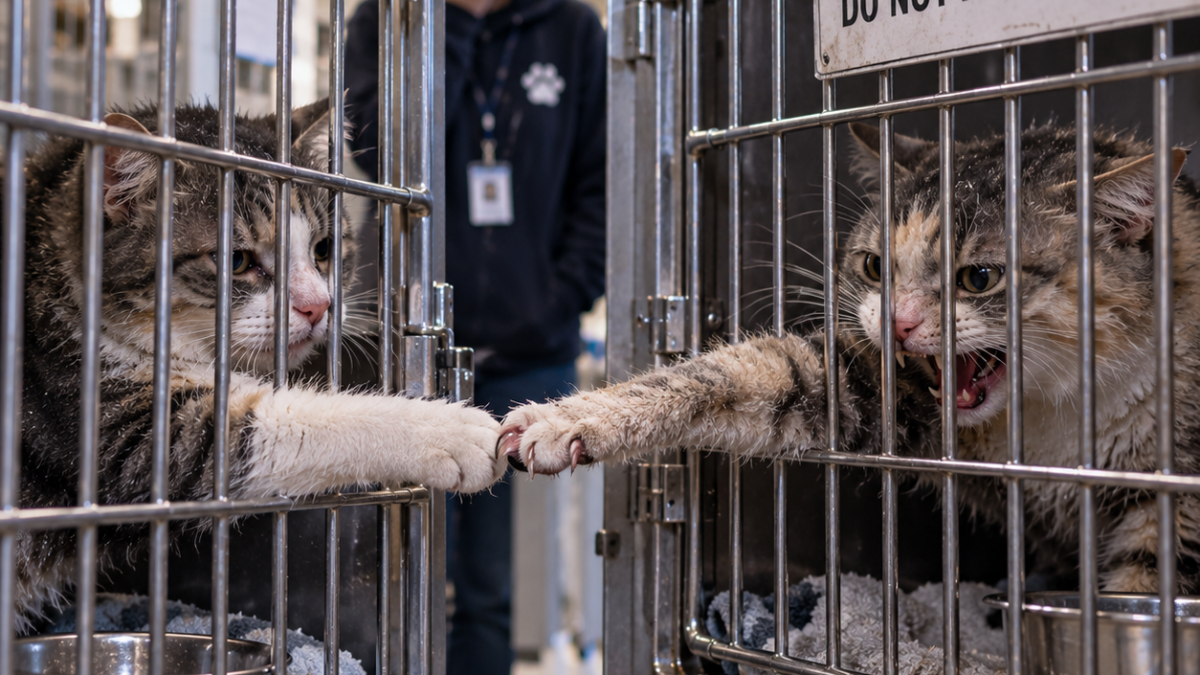
Slowly, carefully, she pushed her right paw through the bars.
Not clawing.
Not grabbing.
Not trying to escape.
Reaching.
Her paw stretched toward Walter’s enclosure across the aisle, toes spread, claws barely showing, as if she was trying to touch something precious without damaging it.
Walter made a sound.
It was so small it almost did not count as a meow.
More like a cracked exhale.
Then he moved to the side of his enclosure and pressed his body against the metal bars directly across from her paw.
Sadie’s toes hovered just short of his fur.
Walter stayed there anyway.
I froze with the adoption paperwork still in my hand.
For a second, the entire hallway seemed to narrow to those two cats.
Metal bars.
A gap of cold air.
One trembling paw.
One old body leaning into it.
That was not casual companionship.
That was not two cats who happened to know each other.
That was something deeper.
Something built in hard weather.
“The two of them…”
I turned.
Marlene was standing behind me, hands tucked into the pocket of her hoodie.
“We call them the survivors,” she said.
I looked back at Walter and Sadie.
“What does that mean?”
Marlene’s face changed.
Shelter workers know how to carry many kinds of sadness. This one seemed older than the others.
“They came in together,” she said. “Same house.”
I waited.
“An older man lived out on the edge of town. Kept to himself. No close family. Not many visitors. He passed away at home.”
My grip tightened around the carrier handle.
“Nobody found him right away?”
Marlene shook her head.
“Not for weeks.”
The word landed in the hallway like something heavy.
Weeks.
I looked at the two cats again.
Sadie’s paw was still stretched through the bars.
Walter was still pressed against the metal.
“There was food in the house,” Marlene said. “Enough that they could have survived more comfortably than they did. But they barely touched it. They stayed near him. Stayed close to each other. When animal control brought them in, they were dehydrated, underweight, stressed out of their minds.”
She took a breath.
“If we separate them to clean, Sadie panics. She overgrooms until she’s raw. Walter stops eating.”
I looked at Walter.
The cat I had chosen.
The calm one.
The steady one.
The easy one.
“He stops eating?”
Marlene nodded.
“Like he’s not interested in living if she’s not in the room.”
The paperwork in my hand suddenly felt wrong.
One cat.
That had been the plan.
My apartment was not huge. My routine was tight. I was the kind of person who liked knowing where everything went before anything arrived. I had already pictured one bed by the window, one food station in the kitchen, one litter box in the bathroom corner.
Two older cats with trauma?
Two cats who might need patience I was not sure I had?
Two cats who came with a grief I had no right to underestimate?
It felt risky.
It felt expensive.
It felt inconvenient.
It felt like stepping off the edge of the neat little life I had built and hoping there would be ground beneath me.
“I only applied for Walter,” I said.
“I know.”
Marlene did not pressure me.
That almost made it worse.
She did not give me a speech.
Did not say they had to stay together.
Did not tell me I would be a bad person if I left Sadie behind.
She just stood there with her hands in her hoodie pocket, letting the truth remain visible.
Walter pressed harder against the bars.
Sadie’s paw trembled.
I crouched beside Walter again.
“Come on,” I whispered. “Let’s go.”
He looked at me.
Then back at Sadie.
I shifted the carrier closer.
He did not step inside.
Across the aisle, Sadie did not pull her paw back.
She left it hanging there in the empty air, like an outstretched hand that did not know if it would be held.
Then her whole body seemed to dim.
No theatrics.
No cry.
She simply sank down in her cubby with a slow, defeated heaviness that made my stomach twist.
I stood.
I hated myself a little.
Then I walked out to the lobby anyway.
I told myself I was being responsible.
Responsible people know their limits.
Responsible people do not make emotional decisions in animal shelters.
Responsible people do not double their commitment because one sad cat reaches through a cage.
Responsible people stick to the plan.
I reached the front door.
Outside, the sun hit my eyes hard.
The snow in the parking lot crunched under my boots.
I opened my car door and set the carrier on the passenger seat.
Walter was inside now because Marlene had helped gently guide him in.
But he was not settled.
He turned his body toward the shelter.
Stared through the carrier door.
Waiting.
Not clawing.
Not fighting.
Just waiting.
As if he trusted me to come to my senses.
That look did it.
All the arguments in my head—space, money, routine, plans, practicality—suddenly shrank into something flimsy and embarrassed.
There are moments when reasonable begins to sound like cowardly with better posture.
I closed the car door without getting in.
“Okay,” I muttered. “Okay.”
I walked back into the shelter like someone trying to repair a mistake before it became permanent.
Marlene was at the front desk typing into the computer. She looked up.
She did not look surprised.
Only calm.
As if she had seen this battle happen before and knew the exact second the heart usually won.
“I need a new form,” I said.
Her shoulders softened.
“Change of heart?”
“I’m not taking him without her.”
My voice shook.
“I’m taking them both.”
Marlene smiled then.
Not big.
Not sentimental.
Relieved.
“All right,” she said. “Let’s do it.”
Ten minutes later, we were back in the hallway.
Walter’s carrier sat open.
Sadie’s enclosure door opened next.
There was no dramatic reunion.
No sprinting.
No cinematic leap into each other’s arms.
They were old cats, not actors.
But the second Sadie stepped out, something in the air changed.
Walter exhaled audibly, like he had been holding his breath for days.
Sadie walked straight to him and leaned her head against his shoulder.
The tremble in her legs stopped.
They stood side by side in the thin winter sunlight, small and steady, like a little fortress.
I stood there watching them and felt my neat little life opening wider than I had planned.
On the drive home, the heater hummed and the windshield slowly cleared.
I checked the rearview mirror once.
Then again.
On the back seat, on the old blanket I had tossed down “just in case,” Walter and Sadie were curled together in a tight, familiar knot of fur and trust.
Sadie’s body rose and fell in a deep, peaceful rhythm.
Walter’s head rested against her like it belonged there.
Outside, the winter landscape slid by in gray-white streaks.
Inside my car, it was warm.
I had gone in thinking I was going to rescue one cat.
By the time I pulled into my apartment parking lot, I knew rescue was the wrong word.
I had not rescued them.
I had agreed not to separate what had already survived together.
That was different.
And harder.
The first night, my apartment felt smaller than it ever had.
Not because the walls had moved.
Because I suddenly noticed every inch of space as if it were a test I might fail.
The heater hummed.
The kitchen light buzzed faintly.
December pressed cold fingers against the windows.
Inside, I laid out everything I had prepared and everything I had not expected to need.
Two bowls.
Two beds.
Two litter boxes.
A soft blanket in the living room.
Another near the bedroom door.
Food.
Water.
A cardboard box with one side cut lower because I had read that scared cats liked hiding places.
I had spent one hour after leaving the shelter making panicked stops at a pet store, where a teenage cashier with blue hair told me I looked like someone who had “accidentally adopted a situation.”
“She’s right,” I told Walter and Sadie when I carried them upstairs.
They did not answer.
Walter stepped out of the carrier first.
Slow.
Measured.
Not exactly scared.
More like a retired bouncer entering a room he did not yet trust.
His whiskers twitched.
His eyes narrowed.
He sniffed the air.
Then he turned back toward the carrier.
And waited.
Sadie did not move.
Not even a little.
At first I thought she was being stubborn.
Then I saw her sides.
They were rising and falling too fast, like she was breathing with her whole body, like the air itself had edges.
“Hey,” I whispered, crouching several feet away. “It’s okay. It’s just me.”
Walter made his tiny cracked sound.
Sadie shifted.
Not courage.
Not confidence.
Trust in him.
That was all.
She slid forward an inch.
Then another.
Until she emerged low to the ground, scruffy fur uneven, bent ear tilted like a question mark.
She did not look at me.
She looked at Walter.
Walter walked to her and pressed his shoulder to hers.
Solid.
Steady.
Like a wall.
Sadie leaned into him so hard her body trembled.
Then she exhaled.
I swallowed hard.
In that moment, I understood something obvious only after I had seen it:
I had not brought home two cats.
I had brought home one heart with two bodies.
I gave them space.
I kept my movements slow.
I sat on the floor with my back against the couch, trying to make myself smaller, quieter, less human in all the ways that might scare them.
Walter explored first.
A cautious loop around the living room.
Baseboards.
Chair legs.
Kitchen doorway.
Hallway.
Back to Sadie.
Sadie stayed near the carrier, half-hidden behind it as if it remained a doorway back to somewhere she understood.
Every time Walter moved too far, her head snapped up.
Every time he returned, her shoulders dropped.
I watched them until the room grew dim and the winter light outside turned the color of old steel.
Finally, Walter climbed onto the blanket I had placed near the couch.
He turned in a slow circle.
Once.
Twice.
Sadie crept closer.
Then closer.
Then folded herself against his side so tightly there was no space between them.
Walter’s eyes half closed.
Sadie’s eyes did not.
She stared around the apartment like she was waiting for it to change its mind.
I told myself it was normal.
First night jitters.
New smells.
New sounds.
A new human who had no idea what she was doing.
But my chest stayed tight.
Because the organized part of me kept whispering:
You did something impulsive.
You did something emotional.
You did something that does not fit inside your life.
And another part of me—the part that had seen Sadie’s paw reaching through the bars—answered:
Good.
Around midnight, I got up to shower.
Nothing dramatic.
I stood slowly.
Walked down the hall.
Turned on the bathroom light.
Closed the door.
The moment it clicked shut, I heard the sound.
Thin.
Frayed.
Not a howl.
Not a yowl.
The edge of panic scraping against a throat.
Sadie.
I froze with my hand on the towel rack.
Then came Walter’s paws in the hallway.
Quick.
Sharp.
A soft thump against the bathroom door.
Not anger.
Urgency.
As if the closed door was a mistake that needed correcting immediately.
“I’m right here,” I called. “I’m not leaving.”
Sadie cried again.
Higher this time.
Tighter.
I opened the door.
Walter stood directly outside, staring up at me like a disappointed principal.
Sadie was behind him, low and trembling, her fur puffed in all the wrong places.
When she saw me, she did not run to me.
She ran to Walter.
Pressed her face into his shoulder.
And shook.
I sat down on the hallway floor in my pajamas and waited for her breathing to slow.
The heater hummed.
The bathroom light buzzed.
My own heartbeat sounded too loud in my ears.
That was the moment I whispered to the empty hallway:
“Okay. I get it.”
I did not mean I get it as some cute rescue lesson.
I meant it as a correction.
These cats were not going to fit into my routine.
My routine was going to have to bend around them.
By day three, the honeymoon glow was gone.
Not because I regretted them.
Because practical reality arrived the way it always does: without music, without sentiment, and usually when you have not slept enough.
Walter would not eat unless Sadie was close enough to touch.
Sadie would not use the litter box unless Walter walked with her and stood nearby like a bodyguard.
If I moved too fast, Sadie flinched so hard her whole body folded inward.
If I left the room, she paced.
If Walter went behind the couch, she followed even when she clearly did not want to.
And the hardest part was how quiet it all was.
There were no dramatic messes.
No shredded curtains.
No theatrical destruction.
No obvious “bad behavior” I could point to and explain to someone else.
Just tension under the surface.
Like a wire pulled too tight.
One afternoon, I found Sadie grooming her side in a frantic, repetitive rhythm.
Not normal grooming.
Not comfort.
Panic.
Her tongue moved too quickly.
Her head jerked with each lick.
Her eyes looked far away.
I reached toward her without thinking.
Sadie snapped.
A quick flash of teeth.
A warning.
I pulled my hand back instantly.
“Okay,” I murmured. “Okay. My fault.”
Walter moved between us.
He pressed his body against Sadie until the licking slowed.
Then he looked up at me.
I know this will sound ridiculous to anyone who has never been humbled by an animal, but his eyes seemed to say:
Do not make her choose between you and survival.
I sat on the floor and stared at them, throat tight.
I had been telling myself I was helping.
But that afternoon forced an uncomfortable question into the room:
What if helping and knowing how to help were not the same thing?
People do not like that question.
Some hear it and say, “Then do not adopt traumatized animals.”
Others hear it and say, “Then learn.”
Both believe they are being responsible.
The truth lives somewhere messier.
I called the shelter that night.
Marlene answered on the second ring.
“You okay?” she asked, like she knew the answer would not fit inside yes or no.
“I’m fine,” I lied.
Then I exhaled.
“I’m not fine. I mean, I am, but they’re… I didn’t expect…”
Marlene did not rush me.
That was her gift.
“They’re unlearning something,” she said.
“What?”
“That love disappears. That doors close and people don’t come back.”
I looked across the room.
Sadie was grooming Walter’s ear with slow, careful licks.
Walter sat perfectly still and allowed it, like he understood she needed to prove he was still there.
“Everyone keeps telling me I did a good thing,” I admitted. “And I don’t know why that makes me angry.”
Marlene was quiet for a moment.
Then she said, “Because people like the story more than the work.”
That landed harder than comfort would have.
Because it was true.
People love the adoption photo.
They love the moment someone says, “I’ll take them both.”
They love the idea of the happy ending beginning the second the shelter door closes behind you.
But adoption is not the ending.
Not for animals carrying grief in their bones.
It is the first sentence of a harder story.
The work starts at home.
It starts when the scared cat will not eat.
When the other cat panics at a closed bathroom door.
When you have to leave for groceries and return to find one of them has licked a bald patch into her side.
When you are tired.
When your apartment smells faintly like wet food and stress.
When you miss your old predictable life and then feel guilty for missing it.
Marlene listened while I admitted all of that.
Then she said, “Let them talk. But don’t let them decide.”
“Who?”
“Anyone who only likes the easy part.”
The next week was a slow, awkward dance.
Sadie began to map the apartment like a cautious explorer.
First the living room.
Then the hallway.
Then the kitchen, where she discovered the can opener and stared at it like it was sorcery.
Walter followed her, always one step behind.
Not controlling.
Not hovering.
Just present.
Like he was saying:
You can be brave. I am right here.
Every time the apartment got too quiet, Sadie spiraled.
If I stood at the window too long, she paced.
If I closed the bedroom door, she cried.
If Walter climbed onto the couch and she could not see him, she searched until she found him.
And then, on the fifth day, I got a note taped to my apartment door.
Plain paper.
Black ink.
Hi—just a heads-up. Building policy requires pets to be registered with management. Please stop by the office.
No threat.
No attitude.
Nothing dramatic.
Still, my stomach dropped.
Because in America, a lot of people live one policy away from panic.
One fee.
One form.
One rule they did not read closely enough.
One “we’re sorry, but…”
And I had brought home two cats.
Two senior cats.
Two bonded cats finally—barely—beginning to exhale.
I imagined a clipboard.
A computer screen.
A rule about one pet.
A polite voice saying I could only keep one.
My throat tightened so fast it felt like swallowing glass.
Walter and Sadie were curled together on the blanket.
Sadie’s paw rested over Walter’s front leg like she was holding him in place.
Walter’s eyes were half closed.
For the first time since coming home, they looked almost peaceful.
I could not break that.
So I went downstairs.
The building office smelled like stale coffee and old paper.
A fake plant sat in the corner, dusty and sad, like someone had once decided greenery would make the place friendly and then forgotten the part where living things require attention.
A woman behind the desk looked up.
“Hi.”
“I adopted two cats,” I said before fear could stop me. “I’m here to register them.”
Her eyebrows lifted slightly.
“Two?”
“Bonded pair,” I said quickly.
The words came out sharper than I meant.
I softened my voice.
“They need to stay together.”
She typed something into her computer.
The keyboard clicks felt too loud.
Then she said, “Okay. There’s an additional monthly pet fee for the second one, and we’ll need vaccination records.”
Relief hit so hard my knees weakened.
No lecture.
No ultimatum.
No demand that I choose.
Just paperwork.
Logistics.
A fee I would have to adjust my grocery budget around.
I nodded too fast.
“Yes. Of course. I can bring the records.”
I walked back upstairs feeling like I had survived something, even though on paper nothing terrible had happened.
Fear is not always rational.
Sometimes fear is just the body remembering how quickly things can be taken away.
When I opened my apartment door, Sadie was standing in the hallway.
Not hiding.
Not crouched.
Standing.
Walter was beside her, eyes locked on me.
Sadie’s tail flicked once, anxious.
Walter’s ears were forward.
They had been listening.
Waiting.
As if my leaving had triggered the old question again:
Are we safe, or are we about to be abandoned?
I crouched.
“I’m here,” I whispered. “It’s okay. I’m still here.”
Sadie took one step forward.
Then she pressed her forehead against Walter’s shoulder.
Still not me.
But closer than before.
I took that as a victory.
Progress with frightened animals is often invisible unless you learn the scale.
One step closer.
One blink longer.
One meal finished.
One door closed for five seconds without panic.
One paw not licking itself raw.
Those are victories.
Small does not mean small.
Two nights later, the real scare happened.
Walter stopped eating.
Not picky-cat stopped.
Not I-prefer-the-other-flavor stopped.
Stopped.
He sniffed his bowl, turned away, and sat down like food no longer applied to him.
Sadie hovered beside him, eyes wide.
She nudged his cheek with her nose.
Walter did not respond.
I tried everything.
Different dish.
Warm water.
The food from the shelter.
Treats.
A bite from my hand.
Nothing.
Walter stared past me like he was looking at something I could not see.
Fear hit me hard.
Because I had heard Marlene’s voice.
Walter stops eating if she is not in the room.
What she had not said out loud, but what I suddenly understood, was the other half of it.
Walter had been holding himself together for Sadie.
He had been the steady one.
The calm one.
The wall.
And walls do not look like they are cracking until they do.
I bundled Walter into the carrier.
Sadie panicked immediately.
She circled the carrier, crying that thin sound, pawing at the plastic like she could pry it open with desperation.
Walter did not fight me.
That scared me most.
He just let me place him inside.
Like he did not care what happened.
“I’m not taking him away from you,” I whispered to Sadie. “I’m taking him to help him.”
She pressed her face against the carrier door, breathing fast.
Walter lifted his head slowly and nudged the inside of the carrier toward her, trying to comfort her even while he was fading.
Something in me cracked.
I grabbed the shelter blanket, the one that still smelled like both of them, and pushed it into Walter’s carrier.
Then I got Sadie’s carrier too.
I was not making her wait alone.
Not again.
The after-hours animal clinic was bright in that harsh late-night way.
White walls.
Humming lights.
The smell of antiseptic strong enough to sting.
A technician at the counter glanced at the carriers.
“Two cats?”
“Bonded pair,” I said.
By then, it had become a password.
Sadie trembled so hard I could see it through the carrier vents.
Walter lay still.
Not unconscious.
Just heavy.
The technician’s face softened.
“Okay. We’ll take them back.”
“Both?” I asked.
She hesitated.
“We usually separate for exams.”
“No,” I said, too sharply.
Then I forced myself to breathe.
“Please. If you separate them, she panics. And he…”
I could not finish.
The technician looked at me for a long moment.
Then she nodded once.
“We’ll do what we can. She can stay with him as long as it is safe.”
I sat in the waiting room with my hands twisted together so tightly my fingers ached.
Across from me, an older man stared at his phone like he was trying to disappear into it.
A woman in a hoodie held a small dog wrapped in a blanket.
No one made eye contact.
Everyone was inside a private emergency.
My brain did what brains do when fear has too much space.
It started building arguments.
You should not have taken two.
You should have stuck to your plan.
You do not have the time for this.
You do not have the emotional bandwidth for this.
And then the other voice, the stubborn one, answered:
So what? The plan was not the point.
I stared at the floor.
I thought about Walter and Sadie’s first owner.
The older man on the edge of town.
The house.
The silence.
The weeks before anyone knew.
A dark thought rose in me.
How many people live that way?
How many people die that way?
How many of us mind our own business so well that we do not notice someone disappearing?
People love independence.
Privacy.
Boundaries.
The idea that nobody owes anyone anything.
Maybe on paper that is true.
But in real life, there are moments when “nobody owes anyone anything” begins to sound like an excuse used by the parts of us that do not want to be bothered.
I did not like that thought.
It made me uncomfortable.
Usually, discomfort means you have found something real.
The veterinarian came out around two in the morning.
She looked tired, kind, and direct.
“Walter is dehydrated,” she said. “He’s stressed. That’s a big part of this. Senior cats can crash faster than people realize.”
I nodded, throat tight.
“Is he…”
I could not say dying.
She read my face.
“He’s not dying tonight.”
The sentence nearly folded me in half with relief.
“But he needs support,” she continued. “Fluids. Appetite help. Monitoring. Calm. Consistency. And he needs to feel safe.”
“And Sadie?”
Because I could not pretend she was not part of the emergency.
The veterinarian’s expression softened.
“She is intensely attached.”
A laugh came out of me, but it sounded like a sob.
“That is one way to put it.”
The vet leaned against the counter.
“I’m going to say something that might make some people angry,” she said. “Sometimes bonded pairs are not just friends. Sometimes they are coping mechanisms. Sometimes separating them is like pulling away a life raft.”
A life raft.
In my mind, I saw Sadie’s paw reaching through the bars.
Not cute.
Not dramatic.
A life raft.
“People say it’s just an animal,” the vet continued. “But that phrase can be a weapon. It is often used to dismiss attachment because the attachment makes people uncomfortable.”
I stared at her.
Pets as family.
Pets as property.
Too much love.
Not enough boundaries.
Loneliness.
Responsibility.
A person could start a war online with those words.
But in that clinic at two in the morning, none of that mattered.
Walter needed fluids.
Sadie needed to see him.
And I needed to stop pretending love could always be tidy.
They let me bring both cats home before dawn.
Walter was weak but alert.
Sadie pressed herself against the carrier door the whole ride, as if her body could hold him in place through plastic.
When we got inside, I did not try to do everything perfectly.
I laid their blanket on the floor.
Opened both carriers.
Walter stepped out slowly.
Sadie crawled out like she was emerging from a storm shelter.
Then she pressed herself against Walter so tightly it looked as if she were trying to become part of him.
Walter leaned back into her.
His eyes closed.
He exhaled.
Audibly.
Like he had been holding his breath for days.
In that dim early-morning light, I sat on the floor and cried.
Silently.
Shoulders shaking.
Face hot.
Because the truth had finally arrived in a form I could not dodge anymore.
Love is not a cute decision.
Love is not the moment in the shelter hallway when you say the beautiful thing.
Love is what keeps showing up when you are tired.
When you are scared.
When you are not sure you are enough.
When your routine breaks.
When the vet bill is higher than you expected.
When your apartment is no longer arranged around your convenience.
When the work is not photogenic.
Love is inconvenient.
Love is work.
Love is the thing you choose anyway.
A week after the emergency clinic, Sadie did something small that felt enormous.
I was sitting on the couch, exhausted, staring at nothing.
Walter was dozing on the blanket.
Sadie stood near the doorway, watching me like she still was not sure what I was.
Then she walked into the living room.
Slowly.
Cautiously.
She did not freeze.
Did not flinch.
She walked all the way to Walter.
Sniffed his ear.
Then turned.
And walked to me.
My breath stopped.
Sadie lifted her head and looked at me for one long moment.
Not pleading.
Not performing.
Deciding.
Then she reached out her right paw—the same paw she had pushed through the shelter bars—and touched my ankle.
Light as air.
Almost nothing.
But it landed like a vow.
I did not move.
I did not want to break the fragile bridge she had built.
Walter opened one eye, watched, and closed it again.
As if to say:
Finally.
I sat there barely breathing.
There are people who would say animals should not change your life this much.
There are people who would say you should not let pets control your routine.
There are people who would say you must save yourself first.
Sometimes they are right.
Sometimes capacity matters.
Sometimes love cannot pay rent, create time, or turn a studio apartment into a mansion.
But sometimes the thing you call boundaries is actually fear wearing better clothes.
Sometimes “I can’t” means “I do not want to be changed.”
That was the truth for me.
Walter and Sadie changed me.
Not dramatically.
Not in a movie-montage way.
In a slow, stubborn, daily way.
In the way I moved through the apartment.
In the way I stopped closing doors carelessly.
In the way I learned to announce when I was leaving a room and return before panic took hold.
In the way I woke earlier so meals were consistent.
In the way I checked on my elderly neighbor across the hall after realizing I did not know his first name.
In the way I thought about the man who had died alone while two cats kept watch.
That thought stayed with me.
What do we owe each other?
Not legally.
Not on paper.
Not as a social media argument.
Just as people trying to pretend we are not all fragile.
Walter kept improving.
Slowly.
Not like a kitten.
Not with some magical transformation.
But he ate.
At first only when Sadie was beside him.
Then when she was within sight.
Then one morning, while Sadie slept on the chair, Walter walked into the kitchen alone and meowed at his bowl.
It was the loudest sound I had ever heard from him.
I nearly cried into the canned food.
Sadie changed too.
Her panic did not vanish.
Healing is not a switch.
Sometimes she still paced if I was gone too long.
Sometimes she overgroomed when snow tapped the window in a certain rhythm.
Sometimes a sudden noise made her bolt under the couch.
But she also began to stay.
That was the miracle.
Not that she never feared.
That she feared and stayed.
She began sitting in the doorway when I cooked.
She slept near Walter, then near my feet, then one night against my thigh.
She did not ask permission.
She simply arrived.
Walter, for his part, became the quiet ruler of the apartment.
He developed opinions about blankets.
He preferred the left side of the couch.
He disliked the expensive senior-cat food the vet recommended and loved the cheaper one that smelled like fish and regret.
He sat beside me during work calls and stared at my laptop camera until coworkers began asking, “Is Walter joining today?”
Sadie usually hid during calls.
Then one afternoon, she appeared behind him.
Just her bent ear at first.
Then both eyes.
Then her whole scruffy face.
My manager paused mid-sentence.
“Is that the other one?”
“That’s Sadie.”
“She looks suspicious of quarterly planning.”
“She is.”
Sadie blinked slowly at the screen.
My manager said, “Honestly, fair.”
By February, the apartment had stopped feeling like my apartment with cats in it.
It felt like our home.
Their blanket stayed in the living room permanently.
Their bowls occupied the kitchen corner.
A low shelf near the window became Walter’s observation deck.
A cardboard box I had planned to recycle became Sadie’s office.
I bought a second heated bed even though they still used the first one together.
I learned the choreography of their bond.
Walter always ate first, but only after Sadie sniffed the bowl.
Sadie always checked the hallway before settling down.
Walter always slept on the outside of their curled shape, closer to the room, like a guard.
Sadie always tucked her face under his chin during storms.
And every night, around eleven, Walter would walk to the hallway, look at me, then look at the bedroom.
Bedtime.
Not a request.
An announcement.
They slept on the bed eventually.
Walter at my feet.
Sadie pressed against him.
Then, over time, Sadie moved closer to me.
Inches over weeks.
One night, I woke to find her paw resting on my wrist.
The same right paw.
I lay still in the dark and let her keep it there as long as she wanted.
Spring came slowly.
Snow melted into gray slush.
The sun shifted angles.
Birds returned to the tree outside my window, and Sadie discovered them with the stunned intensity of a person seeing television for the first time.
Walter watched birds like a man reading the newspaper.
Sadie watched them like they had personally wronged her.
One Saturday in March, I visited the shelter to drop off supplies.
Nothing dramatic.
A bag of food Walter refused.
A few towels.
A check I could not really afford but wanted to give anyway.
Marlene was there, of course.
Hoodie pocket.
Knit cap.
Tired kindness.
“How are my survivors?”
“Yours?”
She shrugged.
“I get visitation rights emotionally.”
I showed her photos.
Walter in the window.
Sadie touching my ankle.
Both of them asleep in the heated bed meant for one cat.
Marlene looked at each picture slowly.
Her eyes shone, but she did not cry.
Shelter people ration tears.
“They look good,” she said.
“They are good.”
“No. I mean they look settled.”
I understood the difference.
A cat can be safe without being settled.
Fed without feeling home.
Alive without believing life will stay kind.
Walter and Sadie looked settled.
That word meant everything.
Before I left, Marlene said, “You know, a lot of people asked about Walter before you.”
I turned.
“They did?”
“He was the easy sell. Quiet senior gentleman. People liked him.”
“But nobody took him?”
“Not after we told them about Sadie.”
I looked toward the cat hallway.
“She was the condition.”
Marlene nodded.
“They wanted him. Not the whole truth of him.”
That sentence followed me home.
They wanted him.
Not the whole truth of him.
I thought about how often we do that.
With animals.
With people.
With love itself.
We want the part that fits.
Not the history.
Not the attachment.
Not the inconvenient need.
Not the other half reaching through the bars.
But love, real love, rarely arrives alone.
It comes with context.
With grief.
With habits.
With fear.
With someone or something else attached to it.
Walter without Sadie would not have been Walter.
Not fully.
Sadie without Walter might not have survived the shelter.
They were not accessories to each other.
They were witnesses.
They had survived a silent house together.
They had stayed close when the world outside did not notice.
They had come into the shelter with the kind of bond that forms not because life is sweet, but because life became unbearable and someone stayed.
Who was I to decide that bond was inconvenient?
The first time I checked on my neighbor across the hall, I told myself it was because I had accidentally received one of his packages.
That was partly true.
His name was Mr. Alvarez.
Seventy-eight.
Widower.
Polite but reserved.
I had lived across from him for two years and knew almost nothing about him except that he watered the hallway plant no one else touched.
He opened the door slowly.
“Package mix-up,” I said, holding out the box.
He smiled.
“Thank you.”
I should have left.
Instead, I heard myself say, “How are you doing?”
He seemed surprised.
People often are when a question is asked like someone actually wants the answer.
“I’m all right,” he said.
Then, after a moment, “My daughter is visiting next week.”
“That’s nice.”
“Yes.”
Silence.
Then he looked past me into my apartment, where Walter had appeared in the doorway.
“That your cat?”
“One of two.”
“Two?”
“Bonded pair.”
I explained.
Briefly.
He listened.
When I said they had stayed with their owner after he died, Mr. Alvarez looked down.
“My wife had a cat,” he said. “Before she passed.”
“What was her name?”
“My wife or the cat?”
“Either.”
That made him laugh.
A small laugh, but real.
“Rosa,” he said. “My wife. The cat was Pepita.”
The next week, when his daughter visited, she thanked me in the hallway.
“For what?”
“For talking to him,” she said. “He mentioned you.”
That was all.
Not a dramatic rescue.
Not a life-changing intervention.
Just a question at the door.
But I thought about the old man from Walter and Sadie’s house.
How silence can grow around a person until it becomes dangerous.
How easy it is to mistake privacy for safety.
How many doors we pass every day without wondering what is happening behind them.
Walter and Sadie had changed more than my apartment.
They had changed what I noticed.
In April, Sadie stopped overgrooming.
Not entirely.
Stress still found old paths sometimes.
But the frantic patches ended.
Her fur began to fill in.
Unevenly at first.
Then softer.
Her bent ear remained bent.
Her face stayed wary with strangers.
She never became the kind of cat who greeted visitors.
That was fine.
Not every animal owes the world friendliness.
Walter remained steady, but he aged in ways I could not ignore.
Senior cats carry time in small signs.
Longer naps.
Slower jumps.
More careful steps.
A deeper sleep.
The first time he missed the window shelf and slipped, I moved furniture that same afternoon, creating easier steps.
Sadie watched the whole process from her cardboard office.
Walter pretended the new arrangement had always been his idea.
I knew our time might be short.
That thought hurt more than I expected.
I had adopted older cats because I believed I could handle endings.
That belief turned out to be theoretical.
Loving something old is not easier because you knew.
Knowing does not make the days less precious.
It makes them more precise.
You notice meals finished.
Morning sun.
The sound of old paws crossing the floor.
A cat breathing beside another cat in sleep.
You learn that a limited future does not make love smaller.
It makes presence more urgent.
One evening, months after the adoption, I found the original shelter paperwork in my desk drawer.
Walter’s form.
Sadie’s form.
Two names.
Two ages estimated.
Two medical notes.
Two histories reduced to boxes and lines.
Bonded pair.
Owner deceased.
Stress behaviors when separated.
Must go together if possible.
If possible.
Those two words made me sit down.
So much suffering hides inside if possible.
Keep them together if possible.
Call someone if possible.
Check on the neighbor if possible.
Take the senior cat if possible.
Do the harder kindness if possible.
The problem is that possible is often wider than convenient.
Not always.
But often.
I had almost narrowed possible to match my comfort.
Then Sadie reached through the bars.
I keep a photo from their first car ride on my refrigerator now.
It is blurry because I took it in the rearview mirror at a stoplight.
Walter and Sadie curled together on the back seat.
You cannot see their faces clearly.
Just two bodies pressed into one shape.
Warm.
Tired.
Going home.
People who visit sometimes ask about it.
I tell the short version.
I went in for one.
Came out with two.
They were bonded.
I could not separate them.
Most people smile.
Some say, “You’re a good person.”
I never know what to do with that.
Because I remember walking to the car the first time.
I remember trying to leave Sadie.
I remember telling myself it was responsible.
I am not a good person in the simple way people mean.
I am a person who almost made the wrong choice and turned around.
Maybe that is enough.
Maybe goodness is not purity.
Maybe it is correction.
Maybe it is the moment you realize your plan is about to hurt something and decide the plan can lose.
Walter is eating as I write this.
Slowly.
Messily.
With Sadie sitting three inches away, pretending she is not watching every bite.
The apartment smells faintly like cat food.
There is fur on my sweater.
The second pet fee came out yesterday, and yes, I noticed.
My couch has become theirs in every meaningful sense.
My routine is no longer neat.
My life is not as manageable as I wanted.
It is better.
Not easier.
Better.
Sadie has just walked into the room.
She does this now.
Appears.
Assesses.
Decides whether I am worthy.
Sometimes she touches my ankle with that same paw.
Sometimes she keeps walking.
Walter has finished his food and is heading toward the window.
Sadie follows, not because she cannot be without him for one second anymore, but because she wants to.
That difference took months.
It matters.
They climb onto the low bench I bought for them.
Walter sits first.
Sadie settles beside him.
Their bodies touch.
The afternoon light falls across both of them.
They look old.
They look worn.
They look safe.
I went to the shelter with a clean little plan.
One carrier.
One senior cat.
One manageable change.
Then a trembling paw slipped through cold metal bars, and Walter pressed his body against it like his life depended on it.
I almost called that inconvenient.
I almost called it too much.
I almost called it not my responsibility.
But love does not always arrive in the shape you prepared for.
Sometimes it arrives as two older cats with a past too heavy for one body to carry.
Sometimes it asks for more space than you planned.
More patience.
More money.
More humility.
Sometimes it asks you to admit that the easy choice is only easy because someone else will pay for it.
I do not ask people whether they would have taken both to shame them.
I know the answer is not simple.
Some people do not have the space.
Some do not have the money.
Some do not have the stability.
Wanting to help does not magically create capacity.
But I also know this:
Sadie’s paw through the bars was not asking me to be a hero.
It was asking me not to be another door that closed.
And once you have seen a love like that—once you have watched two living beings cling to each other like their hearts were stitched together—it becomes hard to hide behind a plan.
Plans are neat.
Love is not.
Love is two older cats on a worn blanket, breathing in sync, daring to believe they will not be abandoned again.
Love is a senior cat who will not eat unless the other half of his world is close enough to touch.
Love is a scruffy cat with a bent ear learning, inch by inch, that doors can close and open again.
Love is a person on a cold December afternoon walking back into a shelter and asking for a new form.
Sometimes the only right decision makes no sense on paper.
Sometimes it doubles the fee.
Sometimes it breaks your routine.
Sometimes it scares you.
Sometimes it reaches through metal bars with a trembling paw and waits to see who you are willing to become.
I thought I was adopting one cat.
Walter knew better.
Sadie asked.
And thank God, before it was too late, I listened.








