I Went to a Garage Sale for Tools and Found a 17-Year-Old Cat Beside a Handwritten “Free” Sign—After 30 People Walked Past Him, I Became Number 31.
PART3:
You could tell what had happened without anyone needing to say it.
Someone had died.
And now their life had been sorted into categories.
Keep.
Donate.
Sell.
Throw away.
I slowed down, not because I needed anything, but because grief has a gravity to it. Even when it is not yours, you feel it.
The woman looked up and gave me a tired smile.
“Morning.”
“Morning,” I said.
I glanced over the table.
Everything was priced low.
Too low, honestly.
A dollar.
Two dollars.
Fifty cents.
Like she wasn’t trying to make money so much as make things disappear.
I was about to keep walking when I saw the carrier.
It sat on the ground beside the table, partly shaded by the folding tablecloth.
Large wire carrier.
Blue plastic base.
Old towel inside.
And inside the carrier was a cat.
A big white-and-gray cat.
At least, he had probably been big once.
Now he looked like an old soldier wearing a uniform two sizes too large.
His face was thin and angular.
His ears were slightly ragged at the tips.
His fur was clean, but noticeably thinner than it must have been years ago. Around his shoulders, the coat had that separated look old cats sometimes get, like grooming had become more work than pride could manage.
He was sitting upright.
Not crying.
Not pawing at the door.
Not throwing himself against the wire.
Just sitting.
Watching.
People moved around him with bags and boxes and conversation, and he watched them pass with cloudy green eyes.
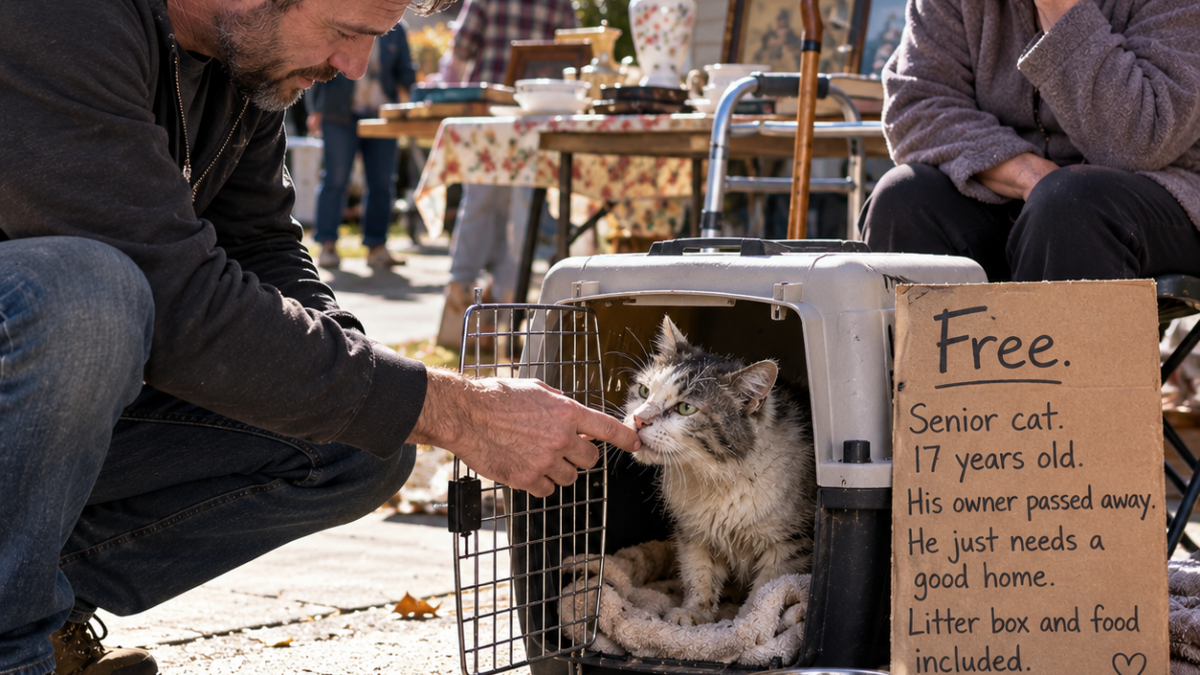
Beside the carrier was a piece of cardboard.
The message was written in black marker.
Free. Senior cat. 17 years old. His owner passed away. He just needs a good home. Litter box and food included.
I read it once.
Then I looked at the cat.
He looked back at me.
I wish I could tell you I knew right then.
I did not.
I kept walking.
That is the truth.
I kept walking because I had not come for a cat.
I kept walking because seventeen sounded ancient.
I kept walking because old animals mean vet bills, special food, hard choices, and heartbreak arriving sooner rather than later.
I kept walking because I told myself someone else would stop.
Someone who had experience with cats.
Someone retired.
Someone with a bigger house.
Someone softer than me.
Someone better prepared.
That phrase is a convenient little cowardice.
Someone else.
I paid for my socket set two houses down and headed back toward my car.
But I stopped before I reached it.
I do not know why at first.
Maybe it was the sign.
Maybe it was the way he had not cried.
Maybe it was the phrase “His owner passed away.”
Maybe it was the fact that he had been sitting beside the last pieces of an old woman’s life like he was one of the items being cleared out.
I turned around.
From where I stood, I could still see the carrier at the end of the street.
The cat had not moved much.
The woman still sat beside him.
People were walking past.
A couple glanced down at the sign and kept going.
A boy pointed.
“Mom, look, a cat.”
His mother tugged him gently along.
“No, honey. We’re not getting a cat.”
A man in a baseball cap stopped, read the sign, made a sad face, and walked away.
Two women approached together.
They paused.
One leaned down slightly.
“Seventeen?” she said.
The other made the expression people make when a thing is already dead in their minds.
“That’s too old.”
They walked on.
I stood there longer than I meant to.
At first, I was not counting.
Then I started.
One.
Two.
Three.
A family of four.
An older couple.
Two teenagers.
A woman carrying a lamp.
A man with a box of books.
Thirty people.
Thirty people walked past that carrier after I started counting.
Some looked.
Some did not.
Some read the sign.
Some avoided reading it.
A few made sympathetic sounds.
Nobody crouched.
Nobody said his name.
Nobody asked the woman about him.
Nobody even reached a finger toward the wire.
The cat remained still.
That was the part that got me.
He did not beg.
He did not perform.
He did not make himself impossible to ignore.
He just sat there with the quiet patience of a creature whose whole world had disappeared and who had no idea what was supposed to happen next.
Around two o’clock, the garage sale began thinning out.
The morning rush was over.
Cars pulled away one by one.
Tables that had been full now stood half empty.
People started packing boxes.
At the quiet house, most of the china was gone.
The old coats were gone.
The walker was still there.
The framed photographs remained face-down in the box.
The woman stood slowly and began folding newspaper around the few dishes left.
Then she looked down at the carrier.
Arthur, though I did not know his name yet, looked back at her.
Something passed over her face.
Not panic.
Not dramatic grief.
Just a small collapse.
The look of a person realizing the plan she had been holding onto all morning might not work.
Maybe she had told herself someone would stop.
Someone would see him.
Someone would understand.
Someone would want him.
But the street was emptying, and the cat was still there.
That was when I walked back.
Not confidently.
Not heroically.
I walked back like a man trying to outrun his own excuses.
The woman looked up as I approached.
“Hi again,” she said.
I nodded toward the carrier.
“Can I meet him?”
Her face changed so quickly it hurt to see.
“Of course.”
I crouched down.
My knees cracked.
The cat looked directly at me.
Up close, he was older than he had seemed from the road.
His whiskers were long and white.
One eye was a little cloudier than the other.
There was a small notch missing from one ear.
His nose had a gray smudge down the bridge like someone had marked him gently with ash.
He did not move away when I put my fingers near the wire.
He leaned forward.
Slowly.
Carefully.
Then pressed his nose against my hand through the carrier door.
It was cold.
A small, soft touch.
Barely anything.
But it went straight through me.
I looked at the woman.
“Tell me about him.”
She swallowed.
“This is Arthur.”
Arthur.
Of course his name was Arthur.
He looked like an Arthur.
Dignified.
Tired.
A little formal.
Like he should have owned a library card and judged your grammar.
“He was my mom’s cat,” she said. “She adopted him as a kitten seventeen years ago. Right after she retired.”
I stayed crouched.
Arthur kept his nose near my fingers.
“She always said he saved her from being lonely,” the woman continued. “Dad had passed the year before. She didn’t want a dog because walking one felt like too much. So she went to the shelter and came home with him.”
She smiled weakly.
“Apparently, he was the loudest kitten there.”
Arthur blinked slowly.
“I find that hard to believe,” I said.
That made her laugh, but it broke halfway through.
“He slept on her bed every night,” she said. “Every night. Same spot. Right side, near her knees. If anyone sat there, he would stare until they moved.”
I looked at Arthur.
“Sounds like property law.”
“Oh, he had rules.”
She leaned down and touched the top of the carrier.
“When Mom got sick, he stayed with her. I mean, constantly. We tried to move him because the hospital bed took up half the room, and nurses were coming in and out, and he was always underfoot. But he wouldn’t leave. He just stayed on the bed or under it or beside her chair.”
Her voice thinned.
“The last few weeks, he barely left the room.”
Arthur’s eyes shifted toward her when she spoke.
Not much.
Just enough.
“After she died,” the woman said, “he stayed on the bed for two days. Even after they took her. He sat on the quilt and wouldn’t come down.”
She pressed her lips together.
“I finally had to remove the bedding because he wouldn’t eat. He kept waiting.”
I did not know what to say.
There are moments when words feel like cheap furniture.
Useful in ordinary rooms, ridiculous in a cathedral.
So I said nothing.
The woman continued because sometimes grief does not need a response; it just needs a door.
“I tried to take him home. I really did. I have two dogs. They’re not bad dogs, but they’re loud. He hid under the guest bed for a week. He barely ate. He wouldn’t use the litter box unless I shut the dogs completely out of that side of the house. My husband travels. I work full time. I just…”
She wiped her face quickly, embarrassed by her own tears.
“I couldn’t make it work.”
Arthur shifted inside the carrier.
His old bones moved carefully.
“He was shutting down,” she said. “I could tell. He had lost Mom. Then he lost the house. Then he was hiding from dogs. I called two rescues, but they were full. One said I could surrender him to the shelter, but…”
She looked at him.
“He’s seventeen.”
We both understood what she did not finish.
A seventeen-year-old cat in a shelter does not have time to become marketable.
Kittens get attention.
Young cats get second chances.
Old cats get kind voices and sad smiles and not much else.
“So I brought him here,” she said. “I thought maybe someone would see him.”
She tried to laugh.
“Stupid, probably.”
“No,” I said.
She looked at me.
“No,” I repeated. “Not stupid.”
Arthur lifted one paw and placed it against the wire.
His paw was large, but bony.
The fur between his toes had grown long and soft.
I thought about thirty people walking past him.
I thought about his owner dying.
I thought about him sitting on the bed for two days, waiting for someone who would never come back.
I thought about my own apartment, quiet and empty, with a couch nobody used but me.
I thought about the fact that I had no idea how to care for a seventeen-year-old cat.
Then Arthur blinked at me again.
Slow.
Trusting.
Or maybe just tired.
Sometimes those look the same.
“I’ll take him,” I said.
The woman stared at me.
For a second, I thought she had not heard.
Then her face crumpled.
Not dramatically.
Not like in movies.
She just folded inward around the words.
“Oh,” she whispered.
Then she started crying.
Right there in the driveway, beside a folding table and a half-packed box of china dishes.
“I’m sorry,” she said immediately, wiping her cheeks. “I’m sorry. I just—”
“It’s okay.”
“My mom would be so relieved.”
That sentence did something to me.
It made Arthur heavier before I ever lifted him.
Not physically.
In meaning.
This was not a free cat.
This was someone’s last companion.
Someone’s bedroom shadow.
Someone’s witness.
Someone’s little heartbeat in the house after her husband died.
And now the daughter was handing him to a stranger at the end of a garage sale because love does not always come with enough room, time, or options.
“I should tell you everything,” she said quickly. “He’s old. He has arthritis. He eats wet food mostly. He can still use the litter box, but the sides have to be low. He likes warm places. He doesn’t jump much anymore. He may hide at first. He might not have much time. I don’t want you to feel tricked.”
“I don’t.”
“I mean it. He’s seventeen.”
“I know.”
“He might only have months.”
“I know.”
“He might need a vet soon.”
“I know.”
I did not know.
Not really.
But I understood the shape of the commitment forming in front of me.
It was not a long future.
It was not a guarantee.
It was not adopting a kitten and imagining years of chaos.
It was opening the door at the end of a life and saying:
You do not have to finish alone.
That felt like enough.
She gave me everything.
The carrier.
The food.
A half-used bag of litter.
A low-sided litter box.
A stainless-steel bowl.
A brush with white-and-gray fur still caught in the bristles.
A little bottle of joint supplement.
A folded blanket.
“That was on Mom’s bed,” she said.
The blanket was faded blue fleece with tiny white stars.
It looked soft from years of washing.
When she placed it near the carrier, Arthur leaned toward it immediately.
His eyes changed.
Not much.
But enough.
Memory has a smell.
I believe that now.
Then she hesitated and went into the garage.
When she came back, she carried a framed photograph.
An older woman sat in a recliner by a window, smiling down at a tiny white-and-gray kitten in her lap.
The kitten was mostly ears and paws.
Arthur.
Seventeen years younger.
His eyes bright.
His body small enough to fit in two hands.
The woman in the photograph looked happy in a way people only look when they are not posing for the camera but have been caught inside a real moment.
The daughter handed it to me.
“He should have this.”
I took it carefully.
“Are you sure?”
She nodded.
“I have copies. And honestly…” She looked at Arthur. “It belongs with him.”
I paid her for nothing because she would not take money.
Then I loaded Arthur into my car.
The carrier took up most of the passenger seat.
I buckled it in because I did not know what else to do.
The woman stood by the driveway with one hand over her mouth.
Before I closed the door, she crouched by the carrier.
“Be good, Arthur,” she whispered.
Arthur looked at her.
She touched the wire.
“I’m sorry.”
Those two words were so full of grief that I had to look away.
She stood quickly.
“Thank you,” she said to me.
“No,” I said. “Thank you for trusting me.”
She nodded, but I do not think she could speak anymore.
I drove home slower than usual.
Not because Arthur made noise.
He did not.
He sat inside the carrier on the passenger seat, watching the road through the wire door.
Every time I glanced over, his eyes were open.
“Just so you know,” I told him, “I have no idea what I’m doing.”
Arthur blinked.
“I have never owned a cat.”
He stared.
“I had a fish once. He lasted nine days. In my defense, the pet store guy gave terrible instructions.”
No reaction.
“You’re going to have to be patient with me.”
Arthur lowered his head onto the towel.
I took that as agreement.
When we got home, I carried him inside and set the carrier in the living room.
My apartment suddenly looked wrong to me.
Too bare.
Too sharp.
Too unprepared.
I had never noticed how loud the refrigerator was.
How empty the corner near the window looked.
How high the couch might seem to old legs.
How little softness I had allowed into the place.
I set up the litter box in the bathroom.
Put water nearby.
Opened a can of wet food and immediately got some on my shirt because the pull tab broke halfway.
Then I opened the carrier door.
Arthur did not rush out.
He looked at the open door.
Looked at me.
Looked around the room.
Then stayed exactly where he was.
“Fair,” I said.
I placed the blue blanket on the couch.
That changed things.
Arthur’s head lifted.
He smelled it from across the room.
Slowly, carefully, he stepped out of the carrier.
His movements were stiff.
His hips swayed slightly.
His back legs worked, but not confidently.
He walked like each step required paperwork.
He crossed the room in no hurry.
Stopped once to inspect the leg of the coffee table.
Then reached the couch.
He looked up.
The couch was not high, but for a seventeen-year-old cat, it might as well have been a fence.
I almost picked him up.
Something stopped me.
Maybe I did not want to take another choice from him.
Maybe I was scared he would hate me.
Maybe I was already learning.
I moved the ottoman closer instead.
Arthur studied it.
Then placed one front paw on it.
Paused.
Second front paw.
Pause.
Back legs, one at a time.
He climbed onto the ottoman.
Then from the ottoman to the couch.
By the time he reached the blanket, he was breathing a little harder.
He circled once.
Twice.
Then lowered himself down with the slow dignity of an elderly king returning to a throne.
He pressed his face into the blanket.
For a long moment, he did not move.
I stood in the middle of the living room holding an open can of cat food and felt like I had just witnessed something private.
He slept there for two hours.
I barely moved.
I sat in the chair across from him and searched online:
How to care for senior cat.
Seventeen-year-old cat adoption.
Cat arthritis signs.
Best food for old cat.
How often do senior cats need vet.
Can cats grieve.
That last search nearly broke me.
Yes.
Cats can grieve.
They can lose appetite.
Hide.
Vocalize.
Search for the missing person.
Sleep in their belongings.
Sit in familiar places waiting.
I closed the laptop.
Arthur slept with his nose tucked into the blanket that smelled like the woman who raised him from a kitten.
I said quietly, “I’m sorry, buddy.”
His ear twitched.
That evening, he ate.
Not a nibble.
Not a polite little taste.
A full bowl.
Slowly, but completely.
I sat on the floor several feet away and tried not to stare like a man watching a miracle.
When he finished, he licked his mouth, looked at me, and gave one rough little sound.
Not quite a meow.
More like a question dragged over gravel.
“You want more?”
He stared.
I gave him a little more.
He ate that too.
The woman had said he barely ate after leaving his old home.
Maybe he had been too afraid.
Maybe the dogs had overwhelmed him.
Maybe he had needed his blanket.
Maybe he needed quiet.
Maybe he needed someone to sit nearby without asking anything from him.
Maybe all of that.
That night, I expected him to hide.
Instead, he slept on the couch.
I slept badly.
Every sound woke me.
A soft thump.
A tiny cough.
The scrape of claws against fabric.
Once, around 3 a.m., I got up to check whether he was breathing because he was sleeping too still.
He opened one cloudy green eye and looked at me with pure annoyance.
“Sorry,” I whispered.
He closed the eye.
By morning, he had moved from the blue blanket to the warm spot where sunlight crossed the couch.
That felt like progress.
I called the woman at ten.
She had written her number on the food bag in case I had questions.
“Hello?”
“It’s Daniel. The guy who took Arthur.”
Her breath caught.
“Is everything okay?”
“Yes. I just wanted you to know he ate last night.”
Silence.
Then:
“He did?”
“A full bowl.”
She started crying again.
I looked at Arthur, who was washing one paw with serious concentration.
“He’s on the couch now. On the blanket.”
“Oh, thank God.”
“I’m going to make a vet appointment Monday.”
“Thank you.”
“I’ll send you pictures, if that’s okay.”
“That would mean everything.”
So I did.
One photo.
Arthur curled on the blue blanket, sunlight on his old gray face.
She replied:
Mom would have loved this.
I saved that message.
The next few days rearranged my life in small ways.
I learned Arthur preferred food slightly warmed.
Not hot.
Just warm enough to smell stronger.
I learned he drank more if the bowl was wide and shallow.
I learned he hated the sound of the dishwasher.
I learned he liked being brushed around the cheeks but not near his hips.
I learned he could still purr, though the sound was quiet and uneven, like an old engine catching after years in storage.
The first time he purred, I froze.
He had settled beside me on the couch while I watched TV. Not touching me. Just near.
I moved one finger along the side of his face.
His eyes closed.
Then the purr began.
Soft.
Rough.
Fragile.
I did not move for ten minutes because I was afraid I would break it.
A seventeen-year-old cat’s trust is not loud.
It does not leap.
It arrives like a letter that almost got lost in the mail.
I took him to the vet three days later.
He complained the entire car ride.
Apparently silence at a garage sale did not mean silence in general.
At the clinic, the vet confirmed what I expected.
Arthritis.
Early kidney concerns.
Dental disease.
Cloudy eyes from age.
Slight heart murmur.
Old cat things.
Manageable, she said.
Not curable.
Manageable.
I liked that word better than I expected.
Manageable meant not over.
Manageable meant comfort.
Care.
Time.
She estimated he might have months.
Maybe a year or more.
No one could promise.
“He’s very old,” she said gently.
“I know.”
“But he’s alert. Hydrated enough. A good weight for his age, though a little thin. His coat could improve. He’s clearly been cared for.”
“He was loved,” I said.
The vet nodded.
“That shows.”
On the drive home, Arthur stopped complaining halfway and fell asleep.
I kept one hand near the carrier at red lights.
Not touching.
Just near.
When we got home, he went straight to the couch.
Then looked back at me as if I was responsible for everything he had just endured.
“Fair,” I said. “I did take you to the doctor.”
He ignored me for three hours.
Then forgave me around dinner.
I have been thinking a lot about the phrase “good home.”
It was on the sign.
He just needs a good home.
People say that about animals all the time.
As if a good home is a simple thing.
A house.
A bowl.
A warm place to sleep.
Those matter.
Of course they do.
But Arthur has taught me that a good home for an old animal is something more specific.
A good home is patience when they move slowly.
It is lowering the litter box because pride should not have to climb over a wall.
It is warming food.
It is accepting that the couch belongs to them now because comfort outranks interior design.
It is learning which touch hurts and which touch heals.
It is not being offended when they grieve someone else.
That was the hardest lesson at first.
Arthur did not love me immediately.
Why would he?
He had a person.
For seventeen years, he had a person.
She adopted him as a kitten.
She gave him a bed, a routine, a name, and probably hundreds of small rituals no one else will ever know.
Maybe she spoke to him every morning.
Maybe he knew the sound of her slippers.
Maybe he sat beside her when she read.
Maybe she shared bits of chicken she should not have.
Maybe he slept against her knees through winters and thunderstorms and lonely anniversaries.
Then one day she was gone.
And now there was me.
A stranger with the wrong voice, wrong house, wrong smells, wrong hands.
A good home does not demand that grief end at the door.
So I let him miss her.
I keep her photograph on the bookshelf, low enough that Arthur can see it when he passes, though I do not know whether that matters to him.
It matters to me.
The first week, he slept every night on the blue blanket.
Sometimes he pressed his paw into it while sleeping.
Sometimes he woke and looked around like he had expected another room.
I did not call him away.
I did not try to replace her.
I just kept showing up.
Breakfast.
Dinner.
Fresh water.
Medication hidden badly in food.
Brushing.
Soft words.
Quiet evenings.
That is how trust began.
Not with one grand moment.
With repetition.
On the eighth night, I woke to weight on my bed.
Not much.
But enough.
I opened my eyes.
Arthur stood near my feet, having apparently used the storage trunk at the foot of the bed as a step. His eyes glowed faintly in the dark.
“You okay?”
He did not answer.
He walked slowly up the blanket, every step careful, then turned in a circle near my knees.
Right side.
Near my knees.
The spot his old owner’s daughter had described.
For a moment, I could not breathe.
He settled there.
Not curled against me exactly.
Close enough that I could feel the warmth of him.
He slept.
I did not, not for a while.
I lay still in the dark with an old cat near my knees and understood I had been given something I had not earned yet.
Not replacement.
Never that.
Continuation.
The next morning, I texted the woman.
Arthur slept on the bed last night.
Her reply came twenty minutes later.
That was his spot with Mom.
Then:
Thank you for letting him have it.
I stared at those words for a long time.
Thank you for letting him have it.
That is what old love asks sometimes.
Not a new world.
Just one familiar shape inside a new one.
I began telling people about Arthur.
Not in a big way.
Just when it came up.
A coworker asked why I had cat hair on my sleeve.
“I adopted a seventeen-year-old cat from a garage sale.”
That sentence got attention.
Some people reacted beautifully.
“Oh my God, that’s wonderful.”
Others said things they did not realize sounded cruel.
“Why would you do that to yourself?”
“He won’t live long.”
“That’s just asking for heartbreak.”
“He’s probably going to cost a fortune.”
“Couldn’t you have gotten a kitten?”
I learned to answer calmly.
“He needed a home.”
That usually ended it.
But inside, the comments bothered me.
Not because they were entirely wrong.
Arthur would not live forever.
He might cost money.
There would be heartbreak.
Probably soon.
But I began to wonder when we decided love was only worth giving when it came with enough guaranteed time.
People adopt kittens because they imagine years.
People choose puppies because they want a beginning.
Old animals arrive as endings.
That does not make them less worthy.
It makes the time sharper.
More honest.
Arthur does not promise me ten years.
He promises me today.
A warm body on the couch today.
A rough purr today.
A slow blink today.
A bowl emptied today.
A little weight near my knees tonight.
That is not nothing.
That may, in fact, be everything.
A month has passed now.
Arthur has gained half a pound.
His coat looks better.
Still thin.
Still old.
But softer.
He has decided the windowsill belongs to him between ten in the morning and two in the afternoon.
I bought pet stairs for the couch, but he refuses to use them if I am watching.
If I look away, he uses them.
If I look back, he pretends he appeared on the couch by magic.
He has started greeting me at the door.
Not by running.
Arthur does not run.
He appears in the hallway like an elderly landlord checking whether rent will be paid on time.
Then he gives one scratchy meow and leads me to the kitchen.
He likes chicken baby food.
He hates salmon.
He enjoys sitting on newspaper, which has complicated my attempts to read anything.
He has knocked exactly one item off a table, a pen, and looked mildly impressed with the result.
He lets me brush him every evening.
Only for four minutes.
At minute five, he leaves.
His boundaries are clear.
I respect them.
Sometimes I wonder about the thirty people who walked past him.
Not with anger, exactly.
I was almost one of them.
That is the uncomfortable truth.
I had already walked away once.
I was not better than those thirty people.
I was just the one who stopped the second time.
That matters to me because it means goodness is not always a trait you either have or do not have.
Sometimes it is a decision made after failing the first test.
Sometimes it is turning around.
Sometimes it is counting thirty people and realizing you are about to become number thirty-one in the worst possible way unless you move your feet.
I think about the woman too.
Arthur’s first owner’s daughter.
Her name is Karen, though I did not learn that until after.
I send her pictures twice a week.
Not too many.
I do not want to hurt her.
But enough.
Arthur on the couch.
Arthur by the window.
Arthur asleep with one paw over his face.
Arthur judging my laundry.
She told me last week she still reaches for the phone sometimes to call her mom.
Then remembers.
Grief does that.
It creates tiny habits with nowhere to go.
I told her she can text me about Arthur whenever she wants.
She said it helps.
It helps me too.
Through her, I have learned pieces of the woman Arthur loved first.
Her name was Margaret.
She worked as a school secretary for thirty-two years.
She loved crossword puzzles.
She drank tea from the same blue mug every morning.
She adopted Arthur six months after her husband died.
She called him “Sir Arthur” when he was being dramatic.
She watched old black-and-white movies with him on rainy afternoons.
She kept treats in the drawer of her nightstand and pretended he did not know.
He knew.
Of course he knew.
Cats always know where the treats are.
Arthur is sleeping under Margaret’s photograph as I write this.
The blue blanket is beneath him.
His paws twitch occasionally.
Maybe he is dreaming.
Maybe of her.
Maybe of nothing.
I hope, if he dreams of her, it does not hurt too much.
I hope he feels, in whatever way cats understand such things, that he was not abandoned.
He was carried forward.
That is what I want this to be.
Not rescue.
That word feels too big for what I did.
Rescue sounds like danger and heroism.
I did not pull him from a burning building.
I did not save him from a flood.
I stopped at a garage sale after almost walking away.
I asked his name.
I opened my home.
Maybe that is smaller than rescue.
Maybe it is exactly what rescue usually is.
A second look.
A question.
A yes.
A willingness to be inconvenienced by a life that still matters.
Arthur is seventeen.
His steps are slow.
His fur is thin.
His eyes are cloudy.
Some days his hips bother him.
Some nights he needs help getting comfortable.
He sleeps more than any creature I have ever known.
He also purrs when sunlight touches his face.
He still lifts his head when I open a can.
He still presses his nose into my hand.
He still has opinions about blankets.
He still wants to be near someone at night.
There is life here.
Not young life.
Not easy life.
But life.
Warm.
Stubborn.
Tender.
Present.
A few days ago, I found him standing in front of Margaret’s photograph.
Maybe coincidence.
Probably coincidence.
Still, he stood there for almost a minute.
Then he turned and looked at me.
I do not pretend to know what animals understand.
But I sat beside him anyway.
“That’s your first mom,” I said.
He blinked.
“She loved you a long time.”
He blinked again.
“I’m going to love you for the rest.”
Then Arthur walked over, slowly, creakily, with all the dignity seventeen years can carry, and pressed his forehead against my knee.
That was all.
That was enough.
Yesterday, I went to a garage sale to look for tools.
I came home with Arthur.
A big white-and-gray cat with cloudy green eyes, thin fur, stiff hips, and a heart that had survived the loss of its whole world.
Thirty people walked past him.
I was number thirty-one.
I am not proud that I almost kept walking.
I am grateful I turned around.
Arthur is on my couch now, sleeping on the old blue blanket that still smells faintly like the woman who loved him first.
His food bowl is empty.
His litter box is clean.
Margaret’s photograph is on the shelf.
The socket set I bought is still sitting by the front door because I forgot all about the project I needed it for.
That can wait.
Arthur cannot.
He is old.
He is slow.
He is creaky.
He may not be mine for long.
But tonight he is warm.
Tonight he is safe.
Tonight he is wanted.
And as long as he has left, this is his home.








