I Wasn’t Going to Adopt a Dog—Then a Six-Year-Old German Shepherd Wrapped Both Paws Around My Leg
PART3:
The other was pointing at me because I had apparently said something stupid immediately before the shutter clicked.
I stared at the photograph too long.
Then I closed the album.
Grabbed my keys.
And left the house without knowing where I was going.
Twenty minutes later, I pulled into the parking lot of Horizon Animal Shelter.
To this day, I cannot explain why.
Margaret and I had talked about getting a dog.
But that had been our plan.
Not mine.
Ours.
Doing it without her felt almost dishonest.
I sat in my truck for several minutes while rain moved across the windshield.
Then I started the engine.
I almost drove away.
Instead, I shut it off again.
“Ridiculous,” I muttered.
Then went inside.
A young volunteer named Emily smiled from the front desk.
She couldn’t have been older than twenty-five.
“Looking for anyone in particular?”
“No.”
The answer came too quickly.
She noticed.
I added:
“Can I just look?”
“Of course.”
She pointed toward a hallway.
“Take your time.”
The kennel corridor was loud.
Dogs barked.
Paws slammed against metal gates.
Tails wagged.
One hound made a sound resembling a fire alarm.
Every animal seemed determined to convince me that they were the one I had come for.
Except one.
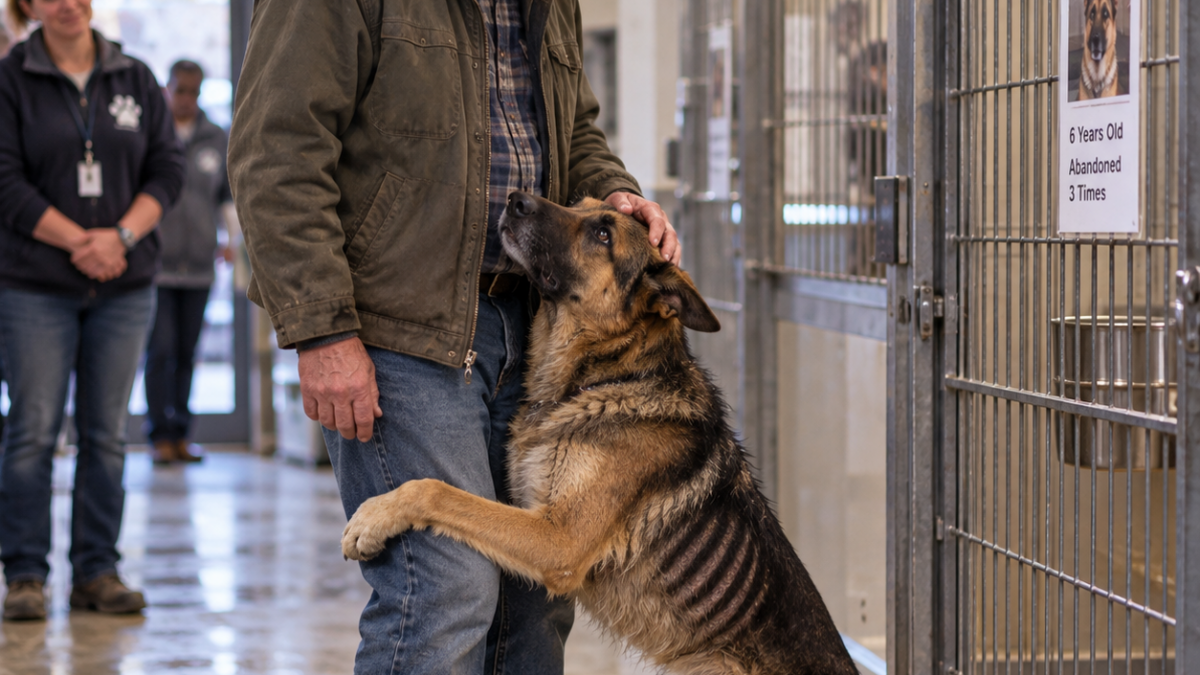
Near the end of the hallway, a large German Shepherd lay in the far corner of his kennel.
Back toward me.
He was thinner than a dog that size should have been.
His black-and-tan coat was dull and rough.
The black saddle across his back seemed almost gray beneath the shelter lights.
His ribs were visible.
One ear stood upright while the other leaned slightly outward, giving him a strangely unfinished appearance.
He did not bark.
Did not stand.
Did not even turn when I stopped.
The card attached to his kennel read:
CHARLIE.
MALE.
GERMAN SHEPHERD.
APPROXIMATELY SIX YEARS OLD.
RETURNED/ABANDONED THREE TIMES.
TRUST ISSUES.
SEPARATION ANXIETY.
NEEDS A PATIENT, QUIET HOME.
Three times.
I read it again.
RETURNED/ABANDONED THREE TIMES.
Something tightened in my chest.
“Hey, Charlie.”
Nothing.
I crouched outside the gate.
“I’m not here to bother you.”
One ear moved.
That was all.
Emily appeared behind me.
“He’s been through a lot.”
“What happened?”
“Different circumstances each time.”
She lowered her voice even though Charlie could obviously still hear us.
“But every time he started settling somewhere, he ended up back here.”
“How long this time?”
“Almost four months.”
“Does he ever come to the front?”
“Sometimes.”
She looked at him.
“Not for everybody.”
I studied the shepherd.
German Shepherds have expressive faces.
Margaret used to joke that you could tell when one was judging you.
Charlie did not look judgmental.
He looked absent.
As though disappointment had become more efficient than hope.
Eventually Emily opened the kennel and led Charlie into a quiet visiting room.
There was an old couch.
Two chairs.
Gray carpet.
A basket of toys.
Charlie ignored all of it.
He walked to the farthest corner and lowered himself to the floor.
I sat on the couch.
Neither of us moved.
Five minutes.
Ten.
Fifteen.
He watched me.
Not directly.
Shepherds are observant dogs.
You can feel their attention even when they appear not to be looking.
Charlie tracked every movement I made.
When I shifted one foot, his ear moved.
When I crossed my arms, his eyes lifted.
When somebody closed a door in the hallway, his body stiffened.
He was not relaxed.
He was monitoring.
I understood that.
I had spent seven years doing something similar.
Keeping enough distance from life that I could see disappointment before it reached me.
I don’t know why I started talking to him.
Maybe because he wasn’t asking me to pretend I was fine.
“My wife died seven years ago.”
Charlie watched.
“I retired recently.”
His ears shifted.
“Turns out those two things don’t go particularly well together.”
Nothing.
I leaned forward.
“Every morning I wake up and wonder what I’m supposed to do with the day.”
Charlie blinked.
“At least when I worked, somebody needed something.”
I looked around the small room.
“You probably understand that better than most people.”
His eyes stayed on me.
Half an hour passed.
Nothing dramatic happened.
Charlie never crossed the room.
Never put his head in my lap.
Never suddenly decided humans were wonderful.
I checked my watch.
“This was nice, buddy.”
He watched.
“I should go.”
I stood.
Three steps.
That was how far I got.
Behind me, nails clicked rapidly against the floor.
Then something hit my right leg.
Not hard.
Heavy.
I looked down.
Charlie had crossed the entire room.
The large German Shepherd had raised himself onto his hind legs just enough to wrap both front paws around my thigh.
His chest pressed against my shin.
He was trembling.
Not violently.
Deeply.
His entire body seemed to vibrate with the effort of holding on without hurting me.
“Charlie?”
I tried to shift one foot.
His paws tightened.
And then he looked up.
Dark brown eyes.
Large ears.
Thin face.
I had spent forty-two years studying stress fractures.
Steel fatigues in recognizable ways.
Concrete cracks where forces exceed what it was designed to carry.
Bearings deform.
Joints loosen.
A structure tells you when something has been loaded beyond its limits if you know where to look.
Charlie’s eyes looked exactly like that.
Something had been carrying too much weight for too long.
“Please,” I whispered.
I still don’t know which one of us I meant.
Then I lowered myself to my knees.
Charlie still wouldn’t let go.
For several seconds, I simply knelt there.
His paws remained around my leg.
His nails didn’t dig in.
He wasn’t frantic.
That somehow made it worse.
He was holding on carefully.
Deliberately.
Like a dog who had learned that if he asked for too much, somebody might decide he wasn’t worth the trouble.
I put one hand on the floor.
The other hovered over his head.
“Can I touch you?”
Absurd question.
He could not answer.
But after what that animal had endured, permission suddenly seemed important.
Charlie looked at my hand.
Then at me.
I lowered it.
My palm touched the top of his head between his ears.
His eyes closed.
And I broke.
I had not truly cried in front of another person since Margaret’s funeral.
There had been wet eyes.
Rough voice.
Moments alone in the shower.
But not this.
I cried on the floor of an animal shelter because a wounded German Shepherd had wrapped himself around my leg and somehow decided I might be safe.
Emily stood near the doorway.
She gave us both the dignity of pretending not to notice.
I pressed my hand into Charlie’s rough coat.
“All right.”
His grip stayed.
“All right, buddy.”
I swallowed.
“I’m not leaving you.”
His ears moved.
“I’m taking you home.”
That time his paws loosened.
Not completely.
Just enough for me to shift closer.
I sat on the floor.
Charlie leaned his shoulder against my chest.
He was larger than he had looked inside the kennel.
Even underweight, he carried the long, powerful frame of a shepherd.
The feeling was unfamiliar.
The weight of another living thing depending on me.
I had spent months silently complaining that nobody needed me.
Now the answer had arrived with visible ribs, oversized paws, a dull black-and-tan coat, and trust fragile enough to terrify me.
Emily crouched several feet away.
“Mr. Collins?”
“Yes?”
“Are you sure?”
I looked at her.
That question mattered.
Emotion makes people promise things they have not considered.
Charlie did not need another emotional adoption followed by another return.
He had already survived three.
“How long do German Shepherds usually live?”
“Nine to thirteen years. Sometimes longer.”
“He’s six?”
“Approximately.”
“Medical issues?”
“Ear infection we’ve treated. Underweight. Bloodwork looks okay. He’ll probably need dental work eventually. Nothing urgent.”
“Bites?”
“No bite history.”
“Children?”
“He gets nervous around loud environments. We’d recommend a quiet home.”
“Other dogs?”
“Selective. He likes some. Ignores others.”
“Protection issues?”
“No known aggression.”
She paused.
“He is very bonded once he chooses somebody.”
I looked down.
Charlie had placed his chin across my thigh.
I thought about my house.
Two bedrooms.
Fenced backyard.
Quiet street.
No children.
No animals.
I thought about my health.
Money.
Time.
Then asked:
“What would make you reject my application?”
Emily blinked.
“We verify housing. Veterinary plan. Identification. Lifestyle. Emergency contact. Things like that.”
“Good.”
I pushed myself up.
Charlie stood immediately.
His flank pressed against my leg.
“I want to apply.”
Emily smiled.
“Okay.”
“No.”
I looked directly at her.
“I want to adopt him.”
Her smile changed.
Softer.
“Then let’s make sure we do it right.”
The paperwork took almost an hour.
Travel.
Veterinary care.
Exercise.
Training.
What I would do if Charlie developed behavioral problems.
Whether I understood adoption was a lifelong commitment.
That word stopped me.
Lifelong.
Simple word until you’ve lived long enough to understand what it costs.
Through the glass partition, Charlie lay beside Emily’s desk.
His head remained pointed toward me.
Every time I moved, his eyes followed.
I checked:
YES.
LIFELONG COMMITMENT.
Emily reviewed everything.
Then disappeared into another office.
Charlie stood immediately.
I watched panic arrive.
Breathing faster.
Eyes toward hallway.
“Hey.”
I crouched.
“She’s coming back.”
He watched the door.
“So am I.”
His eyes returned to me.
“I know you don’t believe that yet.”
I rubbed beneath his ear.
“But I’ve got time.”
Emily returned carrying a blue folder and leash.
“We’re good.”
“That’s it?”
“That’s the beginning.”
She clipped the leash onto Charlie’s collar.
Then handed it to me.
It weighed almost nothing.
I had held plans worth hundreds of millions of dollars.
Signed certifications that made my hand shake.
Nothing ever felt as serious as that leash.
Emily crouched beside him.
“You’re going home, handsome.”
His tail moved once.
Then she looked at me.
“He’s spent almost a year here altogether across three separate stays.”
My stomach tightened.
“Why?”
“The first owner surrendered him after moving somewhere that prohibited large dogs.”
Charlie stayed pressed against my leg.
“Second?”
“Family kept him eight months. Divorce. Housing changed.”
“And the third?”
Emily hesitated.
“They wanted an adult German Shepherd because they thought he’d already be calm and trained.”
“What happened?”
“They returned him after six weeks.”
“Why?”
She looked uncomfortable.
“They said he was too clingy.”
I stared down.
Charlie’s shoulder rested against my knee.
Too clingy.
A shepherd abandoned twice had been returned a third time because he had become terrified of losing people.
I had to look away.
“People have complicated lives,” Emily said.
“I know.”
I did.
I had inspected structures after failures.
Most collapses do not begin with one dramatic mistake.
Stress accumulates where nobody notices.
A compromised joint.
Water inside a crack.
One bolt loosening.
One warning ignored.
Charlie had cracks nobody could see.
That didn’t mean he was defective.
It meant somebody needed to stop adding weight.
We walked toward the exit.
Charlie stayed close enough that his body brushed my leg every few steps.
The automatic doors opened.
He froze.
Outside, the rain had stopped.
Late-afternoon sunlight broke through.
Charlie stared into the parking lot.
Emily whispered:
“You remember this part, don’t you?”
“What?”
“The leaving.”
My chest tightened.
How many times had somebody led this dog through those same doors?
How many cars had he entered believing:
Home.
Forever.
I shortened the leash.
Crouched.
“Charlie.”
He looked at me.
“I don’t know how to prove anything today.”
His ears lifted.
“But you’re not coming back because I get bored.”
Tail shifted.
“You’re not coming back because you follow me from room to room.”
I touched his chest.
“And you’re not coming back because retirement turns out harder than I expected.”
Emily wiped beneath one eye.
I pretended not to notice.
“You’re coming home.”
Charlie stepped outside.
Sunlight crossed his coat.
For the first time, I could see the rich tan beneath the dirt and the broad black saddle across his back.
He climbed into the passenger side of my truck after three attempts.
I fastened the safety harness.
He sat upright like a sentry.
I walked around the hood.
The second I vanished from his view, he began whining.
I opened my door.
His whole body relaxed.
“I was gone six seconds.”
Tail hit seat.
“This is going to take some work.”
He leaned toward me.
I started the engine.
For years, Margaret and I ended trips with the same sentence.
Whenever we turned toward our street, she said:
“Home, Michael.”
That afternoon, I looked at Charlie.
“All right, buddy.”
My throat tightened.
“Home.”
The first problem appeared before we entered the house.
Charlie refused the threshold.
Door open.
Me inside.
Dog on porch.
“Come on.”
Nothing.
He stretched his neck forward.
Sniffed.
But his front paws stayed outside.
Behind me:
Margaret’s green velvet chair.
Photographs.
Hallway table she bought at an estate sale and made me refinish twice.
Seven years.
Almost nothing changed.
People called it sentimental.
Maybe.
Maybe it was fear.
Changing the house felt like admitting she was not coming back.
Charlie stared inside with the same hesitation I had experienced after Margaret’s funeral.
I remembered standing on the threshold that first night for nearly twenty minutes.
Key in my hand.
Knowing she was gone.
Still expecting:
“Michael? Is that you?”
I looked at Charlie.
“I know.”
His eyes shifted toward me.
“It’s strange when a place is supposed to be home and you don’t trust it yet.”
One paw crossed.
Stopped.
“That’s enough.”
Another.
I sat just inside.
“You don’t have to do it fast.”
Charlie stepped farther.
His whole body entered.
Then immediately turned toward the open door.
Escape route.
Of course.
I closed it slowly.
Breathing changed.
“Hey.”
I stayed seated.
“No surprises.”
After a minute, he began exploring.
Living room.
Dining room.
Kitchen.
Every chair.
Every corner.
Every baseboard.
German Shepherd nose working constantly.
When he reached Margaret’s chair, he stopped.
Sniffed the cushion.
Wooden arm.
Floor beside it.
I don’t know whether any scent remained after seven years.
Probably not.
Maybe it was dust.
Old fabric.
Grief makes meaning out of small things.
“That was Margaret’s.”
Charlie looked toward me.
“My wife.”
He sat beside the chair.
Not on it.
Beside it.
My chest tightened.
“She would have liked you.”
He lowered himself onto the rug.
That became his first chosen place in the house.
Beside Margaret’s chair.
That evening I set up a new orthopedic dog bed in my bedroom.
Expensive.
Thick foam.
Washable cover.
I had stopped at a pet store and purchased enough equipment to prepare for a natural disaster.
Food.
Bowls.
Leashes.
Harness.
Brush.
Toys.
Treats.
Waste bags.
Shampoo.
A rain jacket that Charlie would later consider a personal insult.
I pointed.
“There.”
He stared at the bed.
“That cost more than my first mattress.”
Nothing.
I got into bed.
Turned off the lamp.
Nails paced on hardwood.
Back.
Forth.
Back.
Forth.
Light on.
Charlie stood near the door.
“You okay?”
He stared.
Light off.
Pacing again.
Eventually he lay on the floor against the side of my mattress.
Ignored the orthopedic bed completely.
I let one hand hang over the edge.
My fingers found the thick fur behind his shoulder.
Charlie exhaled.
Tail tapped once.
Thump.
“Good night, Charlie.”
I slept better than I had in months.
Morning arrived at 5:48.
A cold nose touched my hand.
I opened one eye.
“You cannot possibly need something.”
Stare.
I closed my eye.
Nose again.
“I spent forty-two years getting up before sunrise. I retired specifically to stop doing this.”
Thump.
Tail against bed.
“Traitor.”
I got up.
The house felt different.
Not magically fixed.
Margaret remained gone.
Retirement remained strange.
Seven years of silence had not vanished.
But something moved through the rooms now.
Large paws.
Breathing.
A long tail striking cabinets.
Need.
That word.
Need.
Charlie needed breakfast.
Water.
Outside.
Walking.
Training.
Attention.
Someone to notice whether he ate.
Whether he limped.
Whether something frightened him.
For months I woke asking:
Why get up?
Charlie answered before six.
Because I need you to open the back door.
It wasn’t philosophy.
It was better.
The first days showed how deeply abandonment lived inside him.
He followed me everywhere.
Bathroom.
Garage.
Kitchen.
Laundry room.
Study.
If I closed a door between us, he scratched once.
Only once.
Then waited.
That single scratch was worse than frantic barking.
It sounded like:
Are you still there?
So I talked through doors.
“Still here.”
Shower:
“Still here.”
Garage:
“Still here.”
Trash outside, Charlie’s face in the window:
“Coming back.”
On the third day, I picked up my keys.
His body changed instantly.
Tail stopped.
Ears lowered.
He moved between me and the door.
Not aggressively.
Desperately.
“Oh.”
I put the keys down.
He relaxed.
Picked them up.
Panic.
There it was.
Keys meant someone disappears.
I crouched.
“Charlie.”
He wouldn’t look at me.
“I need groceries.”
He leaned his seventy-pound frame into my chest.
“And you’re not allowed inside the grocery store.”
Pressed harder.
I sat on the floor.
At sixty-three, I found myself explaining errands to a German Shepherd.
“I am coming back.”
He stared at the keys.
“People have said that before, haven’t they?”
His eyes met mine.
I called Horizon.
Emily answered.
I described the problem.
“Separation anxiety.”
“I assumed.”
“Start small.”
“How small?”
“Thirty seconds.”
I looked at Charlie.
“Thirty?”
“Go outside. Come back.”
“Then?”
“One minute. Three minutes. Five.”
“He’ll hate this.”
“Probably.”
“That doesn’t sound helpful.”
“Michael.”
“Yes?”
“He needs to learn something.”
“What?”
“That leaving and abandoning are not the same thing.”
I wrote it down.
Literally.
Leaving is different from abandoning.
Engineers appreciate instructions.
We began.
Keys.
Tension.
“I’ll be back.”
Outside.
Door closed.
Thirty seconds.
Longest half minute of my week.
When I reopened the door, Charlie stood exactly where I’d left him.
Trembling.
I crouched.
“Told you.”
He pressed his forehead into my chest.
Again.
One minute.
Two.
Five.
Ten.
The next morning fifteen.
Day four:
Grocery store.
“I’ll be forty-five minutes.”
He stared.
I pointed at the wall clock.
“When that hand reaches there, I’ll be home.”
Ridiculous.
He couldn’t read a clock.
I needed the promise to be measurable.
“I’m coming back.”
I left.
Every mile felt wrong.
Bought half my groceries.
Forgot coffee.
Milk.
Forgot the list itself.
At checkout, almost abandoned the cart.
I drove home faster than necessary.
Forty-two minutes later, I opened the door.
Charlie lay directly behind it.
Head lifted.
Then his whole body came alive.
Tail slammed wall.
One tight circle.
Then he pushed against both my legs.
“I came back.”
I knelt.
“You see?”
He licked my chin.
“I told you.”
For the first time in seven years, somebody celebrated my return home.
The realization stole my breath.
Margaret used to hear my truck.
Porch light.
Door opening.
“You’re late.”
I’d answer something idiotic like:
“Bridge didn’t care about dinner.”
How many ordinary homecomings had I wasted believing there would always be another?
I held Charlie tighter.
“I’ll come back.”
That became our first rule.
I leave.
I return.
Every time.
November 18 was Margaret’s birthday.
I had forgotten consciously.
My body had not.
Grief maintains its own calendar.
I moved heavily.
Burned toast.
Stared at nothing.
Charlie noticed.
By afternoon rain returned.
I sat in Margaret’s chair.
For years I had treated it like a shrine.
That day I sat because I was tired of worshiping emptiness.
Her photograph rested on the mantel.
Fifty-two.
Laughing.
I picked it up.
Charlie lay at my feet.
“She would have been sixty-one today.”
His head lifted.
“Margaret.”
Charlie stood.
“She liked dogs.”
He moved closer.
“We always said we’d get one after I retired.”
My voice broke.
“She wanted a German Shepherd, actually.”
I laughed once.
“Of course she did.”
Charlie put his head on my knee.
I had not called him.
Had not asked.
He simply knew something hurt.
I buried my fingers into the thick fur around his neck.
“She got sick two years before I planned to retire.”
He stayed.
“Breast cancer.”
Strange saying it aloud in that room.
“We thought treatment worked.”
Swallow.
“It didn’t.”
Charlie breathed.
Steady.
Warm.
Present.
“I worked too much.”
My eyes burned.
“Even after she got sick.”
Confession waiting seven years.
“She told me she understood.”
His head grew heavier.
“But I don’t know if I did.”
A tear landed in his black-and-tan fur.
“I kept thinking there would be more time.”
I had calculated service lives for cables.
Concrete.
Steel fatigue.
Earthquake probabilities.
Decades of planning for hypothetical forces far into the future.
Yet I lived as if the woman I loved came with no expiration date.
“She used to say, ‘Michael, life is short. Don’t forget to live it.’”
My voice collapsed.
Charlie moved closer.
Pressed his chest against my legs.
And I cried.
He did not fix grief.
People say animals heal us.
I think that is too clean.
Charlie did not erase Margaret.
He did not close the wound.
He sat beside it.
There is a difference.
Pain sometimes becomes survivable not because it disappears but because you are no longer carrying it alone.
That evening I called Emily.
“Something wrong?”
“No.”
“Charlie okay?”
“He put his head on my knee.”
Silence.
Then laughter.
“That’s why you called?”
“Yes.”
“I’m glad.”
“He’s never done that.”
“He’s trusting you.”
I looked across the room.
Charlie had returned to Margaret’s chair.
“Emily?”
“Yeah?”
“Do dogs know when we’re sad?”
“I think they smell changes. Hear voice. Read posture.”
“That is the scientific answer.”
“You’re an engineer.”
“I dislike it.”
She laughed.
“Fine. Other answer?”
“Yes.”
“Sometimes they just know.”
I kept that one.
On day five, we went to the park.
Quiet trail.
Charlie walked close with the leash nearly loose.
Every few yards, he checked my face.
Still here?
Still here.
An older woman approached.
“What a beautiful shepherd.”
Charlie shifted closer to my leg.
“Thank you.”
“How long have you had him?”
“Five days.”
She smiled.
“Newlyweds.”
I laughed.
“Something like that.”
Charlie sniffed her hand before permitting a brief touch.
“Rescue?”
“Yes.”
“What’s his name?”
“Charlie.”
She smiled at him.
“Charlie, you found yourself a good man.”
I almost corrected her.
She knew nothing about me.
Instead:
“I think we’re still figuring out who found whom.”
She nodded.
“That’s usually the truth.”
That afternoon, Charlie saw the ocean.
The beach had belonged to Margaret and me.
We lived near the Oregon coast because she believed no sane human being should spend life more than an hour from salt water.
I had avoided our favorite beach since she died.
Charlie pulled toward the access trail.
I almost stopped him.
Instead, I followed.
Wind first.
Then salt.
Kelp.
Wet sand.
Memory.
Charlie reached the beach.
Stopped.
A wave rolled toward us.
He jumped backward.
I laughed.
Actually laughed.
The wave retreated.
He barked.
Next wave.
He lunged forward.
Then retreated when it chased him back.
Within minutes the large German Shepherd was running circles through wet sand.
Ears upright.
Tail high.
His coat lifted in the wind.
I stood holding the long leash and felt something break open.
Not pain.
Space.
Margaret and I walked that beach hundreds of times.
For seven years, I avoided it because I thought coming without her would dishonor what the place meant.
Charlie ran straight through that belief.
The beach hadn’t died because Margaret had.
The ocean continued.
Wind.
Gulls.
Children drawing names.
Couples holding hands.
Dogs chasing waves.
I had confused continuing with betrayal.
Charlie ran toward me.
Paws hit my pants.
“Easy!”
He shook.
Water everywhere.
I laughed harder.
A young couple smiled as they passed.
I did not care.
That evening I hung Charlie’s leash beside Margaret’s old sun hat.
It looked right.
On the sixth day, I told Charlie everything.
Not because he understood every word.
Because I needed to hear them.
College.
How Margaret thought I was arrogant.
Wedding.
First apartment.
Miscarriage.
Decision not to keep trying.
Career.
Vacations.
Arguments.
Sunday crossword.
Cancer.
Hospice bed.
Her hand inside mine.
Her final word:
Live.
Not I love you.
She had already said that.
Live.
“I didn’t do very well with that.”
Charlie placed one huge paw against my thigh.
I looked down.
“I survived.”
Head tilted.
“That’s not the same thing.”
He leaned against me.
“She would have adored you.”
Charlie licked the photograph.
A wet streak crossed the glass.
“That seems disrespectful.”
Tail thump.
That night, Charlie jumped onto my bed without permission.
Turned three circles.
Collapsed near my feet.
“You know you have a bed.”
Eyes closed.
“The expensive one.”
Nothing.
“Orthopedic foam.”
Thump.
“You’re impossible.”
For the first time since Margaret died, I fell asleep smiling.
One week became two.
Then a month.
Charlie’s body improved faster than his mind.
Good food filled him out.
His ribs disappeared.
His black saddle regained its glossy depth.
The tan along his legs and chest became warm and rich again.
The ear infection cleared.
Muscle returned to his shoulders.
But fear remained.
Suitcases.
The first time I pulled one from a closet, Charlie ran into the bathroom and shook.
I put it away.
He emerged slowly.
Cars worried him if he thought he might remain inside alone.
Raised voices sent him under a table.
Men in baseball caps made him cautious.
Cardboard boxes terrified him.
I learned that one after a delivery.
I placed an empty box on the kitchen floor.
Charlie saw it.
Lowered himself.
Backed away.
Then fled.
Found him beside Margaret’s chair trembling.
I sat nearby.
“No box.”
I carried it outside.
Later Emily told me his third family had returned him in a large travel crate loaded into an SUV.
Maybe cardboard reminded him of confinement.
Maybe not.
Dogs don’t explain trauma.
They show us reactions.
Our responsibility is to respect what we cannot fully understand.
So boxes disappeared.
Trust grew in millimeters.
Engineering had prepared me for that.
People celebrate finished structures.
Ribbon cutting.
Photograph.
Cars driving across.
But real structural work occurs invisibly.
One weld.
One bolt.
One inspection.
One test.
Trust was similar.
Five minutes alone.
I returned.
Ten.
Returned.
Thirty.
Returned.
Two hours.
Returned.
Every return was a bolt tightened.
Gradually Charlie’s greetings became less desperate.
That was progress.
Some people might prefer the wild jumping.
I preferred the day I came home and found him still asleep on the sofa.
I stood in the doorway.
“You didn’t even notice?”
One eye opened.
Tail moved once.
That meant he believed I belonged.
He no longer needed to monitor the door.
I had become permanent.
At two months, Charlie played with his first tennis ball.
I tossed it.
He stared.
Ball rolled.
Charlie looked at me.
I pointed.
“That’s the game.”
Nothing.
I retrieved it.
Threw again.
This time he followed.
Sniffed.
Picked it up.
Dropped it.
I applauded like a fool.
“Yes!”
Charlie startled.
“Sorry.”
Tail wagged.
I threw again.
This time he ran.
Really ran.
Not away.
Not toward safety.
For joy.
I called Emily.
“He played.”
“Who?”
“Charlie.”
“Michael, I know which dog.”
“He chased a ball.”
“That’s wonderful.”
“He brought it back.”
“Even better.”
“Twice.”
She laughed.
“Are you recording statistics?”
“Yes.”
“You are such an engineer.”
By December, neighbors I barely knew had learned Charlie’s name.
Dog ownership apparently makes a retired man approachable.
“Morning, Charlie!”
Then sometimes:
“Morning, Michael.”
I noticed the order.
We walked twice daily.
I learned neighbors’ names.
Frank.
Rosa.
Daniel and Priya.
Mrs. Keene, eighty-one, who carried forbidden treats Charlie somehow detected from across the street.
My world expanded one sidewalk at a time.
I started cooking again.
Real meals.
Vegetables.
Soup.
Salmon.
Charlie sat in the kitchen doorway presenting a powerful legal argument for sharing.
“You have food.”
Stare.
“Excellent food.”
Stare.
“This has garlic.”
Head tilt.
“No.”
Long shepherd sigh.
“You are manipulative.”
Thump.
In January, I joined a book club.
I still consider this one of the stranger consequences of adopting Charlie.
I finished a novel one evening while his head rested across my feet.
I realized I wanted to discuss it.
Margaret and I used to argue about books.
She liked character.
I liked structure.
She said this was because I was incapable of experiencing art without making a spreadsheet.
Mostly accurate.
The library had a monthly group.
I almost stayed home.
Charlie followed me to the door.
I put on my coat.
“You cannot come.”
Disappointed face.
“I’ll be back.”
He stepped away from the door.
That alone felt miraculous.
There were twelve people.
I knew none.
A woman named Elizabeth sat beside me.
Silver-blond hair.
Underlined books in pencil.
“What did you think?”
“Of the book?”
“No, Michael. Of the fluorescent lighting.”
I stared.
Then laughed.
Margaret would have liked her.
That thought frightened me.
Elizabeth noticed.
“You okay?”
“Yes.”
I wasn’t.
Afterward, she asked what I did before retirement.
Bridge engineer.
“Do you miss it?”
“Sometimes.”
“What do you do now?”
I could have said nothing.
Instead:
“I have a dog.”
She smiled.
“That sounds serious.”
“Very.”
I showed one photo of Charlie.
Then twelve.
She laughed.
“You’re one of those people.”
“I don’t know what that means.”
“You absolutely know.”
At the second meeting, she told me her husband died four years earlier.
The air changed.
Not romance.
Recognition.
Widowed people share a language without needing words.
We recognize silence after laughter.
Guilt following a good day.
The instinct to mention somebody in present tense and correct ourselves halfway through.
Elizabeth met Charlie a month later.
He studied her carefully.
She sat on the floor.
Did not reach for him.
Waited.
I noticed.
“Dog person?”
“My husband and I had labs.”
Charlie approached.
Sniffed.
Then lowered himself beside her.
Traitor.
She stroked his shoulder.
“He’s beautiful.”
“He knows.”
“Did he always trust this much?”
I looked down.
“No.”
I told her about Horizon.
Not everything.
Enough.
When I described him wrapping his paws around my leg, her eyes filled.
“He chose you.”
“That’s what people keep saying.”
“What do you say?”
I thought.
“I think we recognized each other.”
Two abandoned lives.
Different forms.
Same emptiness.
Margaret did not abandon me.
Death isn’t abandonment.
I knew that intellectually.
Emotion is less precise.
Part of me still felt left.
Charlie understood absence.
So did I.
Three months after adoption, Horizon invited us back.
The closer we got, the more restless Charlie became.
At the entrance, he froze.
“No.”
I crouched.
“You are not staying.”
Breathing accelerated.
Door opened.
He backed away.
Emily saw us through the glass and came outside.
“Charlie.”
His ears moved.
“Look at you.”
He would not approach.
I felt guilty.
“This was a mistake.”
“No.”
“He thinks I’m returning him.”
“Maybe.”
The word hurt.
Emily looked at me.
“Then give him the experience of leaving again with you.”
That made sense.
We waited.
Ten minutes.
He eventually sniffed Emily.
Twenty.
He entered lobby.
I stayed beside him.
No kennel hallway.
No pressure.
Receptionist.
Technician.
Shelter manager.
They barely recognized him.
“He gained fifteen pounds.”
“Look at that coat.”
“He looks incredible.”
Charlie kept his body touching my leg.
Then an alarm sounded.
Metal door slammed.
Charlie bolted.
Leash tightened.
We went outside.
He pulled for the truck.
“All right.”
Passenger door open.
He jumped inside.
I stood beside him.
“He thinks I brought him back.”
Emily followed.
“Maybe he did for a moment.”
“I shouldn’t have done this.”
“Michael.”
“I promised.”
“You kept the promise.”
“He doesn’t know yet.”
“Then show him.”
I got into the truck.
Charlie pressed against me.
We drove home.
The moment we turned onto our street, he changed.
Ears up.
Body forward.
At driveway he whined.
Door open.
He ran to porch.
Waited.
I unlocked the house.
Charlie entered.
Ran directly to Margaret’s chair.
Turned once.
Lay down.
Looked at me.
I closed the door.
“Home.”
His tail hit the floor.
That afternoon I finally understood adoption wasn’t something I’d done once.
Not paperwork.
Fee.
Drive home.
Charlie needed adoption repeated emotionally.
Every meal.
Every night.
Every return.
Still chosen.
Still home.
Still mine.
Perhaps I needed repetition too.
Every sunrise.
Every walk.
Every conversation with Elizabeth.
Every moment I laughed without Margaret.
Still alive.
Still allowed.
Still here.
Spring came.
Charlie discovered mud.
A wet German Shepherd can somehow carry half a trail home in his coat and appear twice his normal size while doing it.
He found a flooded section beside the trail.
Before I could react:
Splash.
“Charlie!”
He emerged brown.
Black saddle vanished beneath mud.
Tail wagging.
“No.”
He shook.
Mud hit jacket.
Face.
Glasses.
A teenager laughed.
I pointed.
“You are seventy pounds of poor judgment.”
Charlie jumped back into the puddle.
I laughed so hard I had to sit.
Margaret would have loved it.
For once, remembering her did not cause happiness to collapse.
She became part of it.
That was new.
Nobody explained this stage of grief.
At first memories hurt because the person is gone.
Later happiness hurts because they cannot share it.
Then, if you are fortunate, memory changes again.
You carry them into joy.
Margaret had wanted me to live.
Charlie made the instruction impossible to ignore.
In April, Elizabeth invited me to dinner.
I almost declined.
Charlie walked in carrying his ball.
“What do you think?”
Dropped it.
“You are useless.”
Thump.
I went.
We talked.
Books.
Work.
Marriage.
Death.
Loneliness.
Her husband Thomas had died suddenly from a heart attack.
“He went to the grocery store.”
She swallowed.
“And never came home.”
My chest tightened.
“Charlie used to think whenever I went to the grocery store, I wasn’t coming back.”
Elizabeth looked at me.
“And you?”
“What?”
“Did you?”
“Did I what?”
“Think if you left home, something could happen?”
I stared.
For years after Margaret died, I declined travel.
Commitments.
Kept routines narrow.
Called it preference.
Maybe it was fear.
Keep life small enough and fewer things can surprise you.
Charlie destroyed that strategy.
“I think I stopped trusting the future.”
Elizabeth nodded.
“So did I.”
Charlie waited at home with Frank.
When I returned, he ran to me.
Joy.
No shaking.
No panic.
Progress.
The following month I made the first real change to the house since Margaret died.
I moved her chair.
Six feet.
Window to bookshelf.
It took two hours.
Lift.
Stop.
Put down.
Lift again.
“You think I’m insane.”
Charlie yawned.
I finally moved it.
Room looked wrong.
I almost moved it back.
Then sunlight fell across its new position.
Charlie walked over.
Lay beside it.
Exactly where he’d lain on day one.
I sat in the chair.
For the first time.
The fabric felt ordinary.
Soft.
Worn.
No lightning.
No betrayal.
I opened a book.
Charlie put his head on my foot.
That evening I cried.
But I did not move the chair back.
A bridge doesn’t survive by refusing movement.
It survives through controlled movement.
Expansion joints.
Flexibility.
Accommodation.
I understood that professionally for forty years.
Apparently I needed a German Shepherd to teach it personally.
Summer came.
Charlie’s coat shone.
His ribs disappeared.
His eyes changed most.
Guarded darkness softened.
He slept deeply.
Side.
Legs extended.
Sometimes belly exposed.
Trust is visible in sleep.
An animal expecting danger does not make itself vulnerable.
One afternoon the doorbell rang.
Charlie barely opened an eye.
I smiled.
He believed danger did not own the house anymore.
Neither did grief.
At six months, my daughter Anna asked me again to visit Seattle.
I had refused for months.
Charlie was the excuse.
“I can’t leave him.”
“Bring him.”
“He dislikes long drives.”
“Seattle is four hours.”
“Unfamiliar places make him nervous.”
“Hotels allow dogs.”
“It’s complicated.”
Finally Anna said:
“Dad, are you protecting Charlie, or is Charlie protecting you from going anywhere?”
I hated that question because it was excellent.
Emily said:
“Take him.”
“What if it sets him back?”
“What if it moves him forward?”
I packed.
Charlie saw suitcase.
Panic.
I stopped.
Sat beside him.
“This one is different.”
I opened the case.
Shirt.
His toy.
Another shirt.
His blanket.
Ears lifted.
Leash.
Head tilt.
“You’re coming.”
For the first time, suitcase did not mean abandonment.
It meant adventure.
We drove to Seattle.
First hour Charlie watched me.
Second he slept.
Anna had warned my grandchildren, twelve and nine, to give him space.
They did.
Within twenty minutes Charlie approached Sophie.
Within an hour he brought her a ball.
That evening both kids sat on the floor brushing him.
Anna stood beside me.
“He’s good for you.”
“So everybody says.”
“No.”
She looked at me.
“You are different.”
“I’m older.”
“You’re more here.”
That hurt.
Because daughters also lose versions of fathers.
Margaret died.
Anna lost her mother.
Maybe she lost part of me too.
“I’m sorry.”
“For what?”
“For disappearing while still alive.”
Her eyes filled.
She hugged me.
Charlie immediately wedged his shepherd body between us.
We laughed.
“Jealous,” Anna said.
“Protective.”
“Needy.”
I looked at Charlie.
“Careful. That word has history.”
Three days later we drove home.
Charlie slept with his head against the passenger door.
I realized I’d enjoyed myself.
No guilt.
No desperate need to get back to emptiness.
Home had traveled with me.
Eight months after Horizon, I cleaned my study.
Forty years of paper.
Reports.
Tax records.
Old drawings.
Photographs.
Charlie slept under the desk.
I opened a drawer.
Found envelopes tied with faded blue ribbon.
Margaret’s handwriting.
My hands shook.
Letters she wrote in her final months.
One envelope:
MICHAEL.
OPEN WHEN YOU’RE READY TO LIVE AGAIN.
Seven years.
Never opened.
Maybe I had seen it and refused.
Maybe grief had hidden it inside memory.
Charlie raised his head.
“I don’t know if I can.”
He stood.
Walked over.
Placed his chin on my knee.
Of course.
I opened it.
Three pages.
Margaret’s handwriting weaker near the end.
My dear Michael,
If you are reading this, enough time has passed that you are probably angry with me for writing letters like some sentimental movie character.
I laughed.
She knew me.
You spent your life building bridges, and I have always loved that about you. But you also have a terrible habit of standing on one side of things when you are afraid to cross.
I stopped.
Charlie stayed against my knee.
She wrote about our life.
Mistakes.
Good years.
My stubbornness.
Her fear I would retreat after she died.
Then:
Please do not make loneliness your monument to me.
I covered my mouth.
Charlie stood.
Pushed closer.
Love me. Miss me. Talk to me if you need to. Keep my chair if you want. Get rid of it if you don’t. But do not turn our home into a museum and call that devotion.
Tears hit the page.
Find something to love, Michael.
A person.
A place.
A dog.
A garden.
A ridiculous hobby.
I don’t care.
Just let something need you again.
And more importantly, let yourself need something.
Life is short.
You know I always told you that.
Please believe me now.
Live.
Margaret.
For several minutes, I could not see.
Charlie pushed his head beneath my hand.
I laughed through tears.
“A dog.”
Tail moved.
“She actually wrote dog.”
Thump.
“You smug bastard.”
Tail harder.
I walked to Margaret’s photograph.
Looked down at Charlie.
“I found something.”
Voice breaking.
“I found him.”
Charlie leaned against me.
“I found him, Margaret.”
The house was quiet.
But no longer empty in the same way.
Elizabeth came that evening.
I showed her the letter.
She read slowly.
“She knew you.”
“Unfortunately.”
“She gave you permission.”
“I didn’t know I needed it.”
“Most of us do.”
Charlie rested between our chairs.
“Do you ever feel guilty when you’re happy?”
“Yes.”
Immediate answer.
“Still?”
“Sometimes.”
“What do you do?”
She looked at Charlie.
“I remind myself Thomas loved me.”
Then:
“He didn’t love my sadness.”
Simple.
True.
I framed one sentence.
DO NOT MAKE LONELINESS YOUR MONUMENT TO ME.
Placed it in my study beside a photograph of Charlie on the beach.
October 14 returned.
One year.
Emily messaged:
HAPPY GOTCHA DAY TO OUR FAVORITE SHEPHERD.
I objected to “gotcha day.”
Then bought Charlie a steak.
Elizabeth came.
Anna joined by video.
Charlie got a tennis ball.
Destroyed it in seventeen minutes.
That evening I sat on porch.
Rain.
Same Oregon gray.
Charlie beside me.
“Remember Horizon?”
Head turned.
“Remember grabbing my leg?”
Paw on my shoe.
“There. Evidence.”
I laughed.
“I thought you were begging me not to leave.”
Dark eyes looked up.
“But maybe I got that wrong.”
I rubbed his head.
“You weren’t begging.”
Maybe sentimental.
Dogs do not think in human metaphors.
I didn’t care.
“You were choosing.”
Charlie had crossed that room when every previous experience told him closeness was dangerous.
He touched me.
Risked another goodbye.
That was courage.
I had done something similar.
Walked into a shelter intending nothing.
Walked out holding a leash.
During the next year, I began volunteering at Horizon.
Accidentally.
Emily asked me to inspect a cracked support beam.
“Finally. Something I understand.”
Then another problem.
Sagging gate.
Poor drainage.
Covered exercise structure with design bad enough to offend me professionally.
Within six months, I was helping manage renovations.
Volunteer only.
No paycheck.
Never happier working for free.
Charlie came.
At first he stayed away from kennel corridor.
Office.
Lobby.
Courtyard.
Eighteen months after adoption, he walked voluntarily down the hallway.
Dogs barking.
He stayed close.
We reached his old kennel.
Empty.
Charlie stopped.
Sniffed gate.
I crouched.
“You okay?”
He looked inside.
Then at me.
I wondered whether dogs remember trauma as stories.
Probably not.
Maybe sensations.
Fear without explanation.
I opened the gate.
Did not ask him inside.
Charlie sniffed.
Turned away.
Walked toward exit.
I followed.
Outside he stopped.
Waited for me.
No panic.
No pulling.
Just waited.
“You know.”
Tail wag.
“You know you aren’t staying.”
He licked my face.
Emily watched.
“He’s different.”
“So am I.”
The shelter gave me purpose.
Charlie gave me community.
Elizabeth gave me companionship.
I was careful about that last one.
Too careful.
Dinner weekly.
Books.
Walks.
Movies.
Coast.
People assumed romance.
We ignored them.
Then nearly two years after Charlie came home, Elizabeth stood at my door after dinner.
“Michael.”
“Yes?”
“You know we’re allowed to care about each other without betraying anyone.”
I froze.
She looked tired.
Not angry.
Sad.
“I know.”
“No. You understand the sentence.”
Her voice softened.
“I don’t think you believe it.”
Charlie sat between us.
I looked at Margaret’s photograph.
Then Elizabeth.
“I loved her thirty-eight years.”
“I know.”
“I still love her.”
“I know.”
“She’s everywhere.”
“I know.”
Elizabeth touched my arm.
“And Thomas is still everywhere in mine.”
I looked at her.
“I’m not asking you to erase anything.”
“What are you asking?”
“For you not to disappear every time something feels good.”
Margaret’s letter in another voice.
Don’t stand on one side because you’re afraid to cross.
Charlie placed one paw over my shoe.
Again.
Always the engineer.
Load paths.
Supports.
Maybe some bridges are built through repetition.
Trust.
Risk.
A hand left on somebody’s arm.
“I’m afraid.”
Elizabeth nodded.
“So am I.”
That answer saved me.
Not nothing bad will happen.
Not I promise not to hurt you.
Just:
So am I.
Truth instead of guarantee.
I kissed her.
Charlie sneezed.
We laughed.
Our relationship grew slowly.
Age teaches caution.
Loss teaches more.
Margaret and Thomas remained part of our lives.
We did not pretend otherwise.
We never used the word replacement.
Because there is no such thing.
Charlie adored Elizabeth.
She brought better treats.
This weakened my authority considerably.
Three years passed.
Charlie was nine.
Gray began appearing around his muzzle.
Mine had arrived much earlier.
We had routines.
Morning walk.
Coffee.
Horizon twice weekly.
Book club.
Dinner with Elizabeth.
Calls with Anna.
Seattle.
Beach Sundays.
And every time I came home:
Charlie.
Not frantic anymore.
Sometimes he stayed lying down until I came to him.
That was my favorite.
People thought calm greeting meant less attachment.
It meant more trust.
He believed I belonged.
The fourth year brought our first health scare.
Charlie refused breakfast.
Charlie had never casually refused breakfast in his life.
Veterinarian.
Bloodwork.
Ultrasound.
Waiting.
My mind went instantly to cancer.
Loss.
Another ending.
Charlie rested his head on my shoe.
I realized I was trembling.
“Not yet.”
Elizabeth held my hand.
Veterinarian returned.
Pancreatitis.
Treatable.
Painful.
Manageable.
I nearly collapsed from relief.
Charlie stayed two nights for fluids.
The house became unbearable.
I had forgotten silence.
Not quiet.
Absence.
Empty bed.
Untouched bowl.
No paws outside bathroom.
No breathing beside mattress.
On the second night I sat beside Margaret’s chair and understood:
Charlie had not cured loneliness.
He taught me belonging again.
That made absence hurt more.
I would choose that pain over numbness.
The clinic called.
“You can take him home.”
I arrived twenty minutes early.
Charlie emerged wearing a ridiculous bandage.
Saw me.
Tail moved steadily.
I crouched.
“Come here.”
The German Shepherd walked directly into my arms.
Elizabeth took a photograph.
Later I noticed:
My eyes closed.
His too.
Trust.
Both directions.
Years continued.
Stories rush years.
But the years are the story.
Charlie did not save me in one afternoon.
I did not save him by signing adoption paperwork.
We saved each other through repetitions.
Food.
Walk.
Return.
Stay.
Again.
Again.
Again.
Thousands of ordinary days.
Trust becoming muscle memory.
By ten, Charlie slowed.
At eleven, arthritis.
I bought rugs to prevent slipping.
Ramp for truck.
Medication.
Supplements.
An orthopedic bed he finally used.
I considered that a seven-year personal victory.
We still visited the coast.
Walks shortened.
Rest grew longer.
Charlie no longer chased waves.
He stood beside me watching.
One evening, Pacific copper under sunset, Elizabeth collected shells nearby.
Charlie leaned against my leg.
“You know, I built bridges forty-two years.”
Ear moved.
“Big ones.”
Nothing.
“You remain unimpressed.”
Thump.
“I thought the purpose of a bridge was getting from one side to another.”
Charlie looked up.
“I was wrong.”
Maybe retirement makes engineers philosophical.
Maybe dogs do.
“The point is that crossing can exist at all.”
Wind moved through his thick coat.
“Before you, I thought I was done crossing.”
Charlie pressed his head against my thigh.
“Then you grabbed my leg.”
Elizabeth came back.
“What are you telling him?”
“Professional secrets.”
“He looks bored.”
“He has no respect for engineering.”
She took my hand.
We watched the ocean.
At twelve, Charlie developed kidney disease.
Early.
Manageable.
Diet.
Hydration.
Medication.
Monitoring.
I took three pages of notes.
Created a spreadsheet.
Elizabeth discovered it.
“You made a kidney dashboard.”
“Yes.”
“For a dog.”
“Yes.”
“You are insane.”
“I know.”
Charlie lived another two years comfortably.
Not perfectly.
Comfortably.
Good months.
Slower months.
Still ate.
Still wanted walks.
Still followed me into kitchen.
Still placed one paw over my shoe when he wanted attention.
I learned the difference between extending life and extending suffering.
That terrified me.
Margaret had told me her wishes.
Charlie could not.
I had to know him well enough to speak when he could no longer speak for himself.
No engineering decision had ever felt heavier.
One rainy October morning, almost nine years after I entered Horizon, Charlie refused breakfast.
Then water.
He tried to stand.
Could not.
I lifted him.
My back protested.
“Don’t make me admit I’m old.”
Tail moved weakly.
Elizabeth drove.
Tests confirmed it.
Kidneys failing badly.
Options existed.
Hospitalization.
Aggressive fluids.
Maybe days.
Maybe weeks.
No guarantee.
I looked at Charlie.
He was tired.
Not shelter tired.
That had been hopelessness.
This was different.
His body had carried him as far as it could.
I asked:
“If he were yours?”
The veterinarian sat beside me.
“I would take him home for one good day if we can keep him comfortable.”
My heart broke cleanly.
Knowledge can be cruel.
I wanted uncertainty.
Another test.
Another calculation.
One more factor of safety.
None existed.
We took Charlie home.
Rain stopped by noon.
Of course.
Elizabeth called Anna.
She came with family.
Emily came.
Charlie lay in the yard beneath a blanket.
People visited quietly.
Anna.
Grandchildren now teenagers.
Elizabeth.
Emily.
Frank.
Mrs. Keene’s daughter.
We told stories.
Charlie rested.
At sunset, everyone left except Elizabeth.
His head lay in my lap.
“Remember the first day?”
Slow breathing.
“You grabbed me.”
I stroked his ears.
“I thought you were asking me not to leave.”
My voice broke.
“But look at you.”
I swallowed.
“You spent nine years teaching me how.”
I cried.
Not politely.
Charlie lifted his head with effort.
Then put one paw over my leg.
Same leg.
Same gesture.
Weak now.
But unmistakable.
I bent down.
“Oh, Charlie.”
His eyes met mine.
I was back in Horizon.
Sixty-three.
Retired.
Lost.
Angry at silence.
A German Shepherd holding my leg.
Only now I understood.
It had never only meant:
Don’t leave me.
It meant:
Stay long enough for both of us to learn that love can be survived.
The veterinarian came to our house.
I wanted Charlie where every smell was known.
Margaret’s chair.
His blanket.
Our floor.
My hands.
She explained.
I nodded.
Elizabeth held my shoulder.
I held Charlie.
“I’m here.”
His breathing calm.
“You don’t have to hold on anymore.”
That sentence destroyed me.
For nine years, holding on had been our language.
Now love required letting go.
“You were never abandoned here.”
Tears fell into his fur.
“Not once.”
Tail moved.
One soft thump.
“You were chosen.”
Breath.
“You were loved.”
His eyes stayed on mine.
“And you saved me.”
Medication.
Charlie relaxed.
Head heavier.
I kept talking.
Beach.
Tennis balls.
Mud.
Seattle.
Margaret.
Horizon.
First night beside bed.
Everything.
Until breathing stopped.
The room became silent.
I placed my hand on his chest.
Nothing.
I had lived that stillness with Margaret.
Different.
Same.
Love ending in silence.
For several minutes I hated the universe.
Then I looked at Charlie.
No fear.
No kennel.
No return.
No fourth abandonment.
He died at home in the arms of the man he had chosen.
That mattered.
Elizabeth stayed.
We sat on floor until midnight.
Charlie’s collar lay on table.
“I don’t know how to do this house without him.”
Elizabeth touched my hand.
“Yes, you do.”
“No.”
“You taught him that you always came back.”
I looked at her.
“Now you have to keep coming back too.”
“To what?”
“Life.”
I almost became angry.
Then Margaret’s word returned.
Live.
Same damn lesson.
The next morning was terrible.
No nose.
No paws.
No breakfast bowl.
I stayed in bed.
Nine.
Ten.
Eleven.
The old question returned.
What for?
Charlie had answered once.
But he could not answer forever.
That had never been his responsibility.
I got up.
Made coffee.
Called Elizabeth.
Anna.
Then Horizon.
Emily answered.
I couldn’t speak.
She knew.
“I’m sorry, Michael.”
“I want to come in.”
“You don’t have to.”
“I know.”
The shelter smelled exactly as before.
Disinfectant.
Food.
Wet fur.
Memory.
I walked down kennels.
Dogs barked.
Jumped.
Reached.
Near the end, one kennel stayed quiet.
A black mixed-breed dog sat facing away.
I stopped.
No.
Absolutely not.
I was not ready.
Card:
MOOSE.
MALE.
AGE 8.
OWNER DECEASED.
SHUT DOWN IN SHELTER.
I almost laughed.
Life can be offensively obvious.
Emily stood behind me.
“You do not have to do anything.”
“I know.”
Moose didn’t turn.
I sat outside the gate.
Not inside.
No promises.
Ten minutes.
Twenty.
Ear moved.
I smiled.
“Take your time.”
Emily left.
Half an hour later, Moose looked back.
Our eyes met.
I did not move.
“Hey.”
He stood.
Walked closer.
Stopped several feet away.
Enough.
I went home alone.
Important.
I did not replace Charlie.
Love is not an empty position to refill.
I returned two days later.
Sat.
Then next week.
Eventually Moose accepted a treat.
Then touch.
A month later, a widowed schoolteacher named Carol adopted him.
I carried supplies to her car.
Moose looked back at me.
I smiled.
“Go.”
He went.
And I was okay.
More than okay.
I understood.
I did not need another dog immediately.
What Charlie rebuilt could not disappear merely because he did.
That was the final bridge.
He began as a dog needing proof someone would return.
He ended by making me someone capable of returning to the world.
I increased my hours at Horizon.
Not because I believed I could save everything.
Impossible.
Because I had learned what patience could accomplish.
I became the old man who sat with animals nobody could touch.
Anxious ones.
Seniors.
Returned dogs.
Especially the ones labeled clingy.
When volunteers said:
“He won’t come near me.”
I answered:
“Stop trying to make him.”
“How long do we wait?”
“As long as he needs.”
Horizon eventually hung a photograph in the quiet visiting room.
I objected.
Lost.
Charlie and me on the Oregon beach.
He was seven.
Black saddle glossy.
Tan coat rich.
Ears forward.
Mouth open.
Dark eyes alive.
Underneath:
THE CHARLIE ROOM
For animals learning that not every goodbye is forever.
The first time I saw it, I walked into the parking lot and cried.
Emily found me.
“You hate it?”
“Yes.”
She smiled.
“Liar.”
Through the window, a volunteer sat with a terrified dog.
Neither touched the other.
Good.
Trust sometimes begins with not asking for anything.
Years have passed.
I am older.
Much older.
Elizabeth and I are still together.
We never married.
Didn’t need to.
We share dinners.
Books.
Holidays.
Grief.
Joy.
Anna calls too often because she believes I am incapable of basic self-preservation.
My grandchildren are adults.
The house changed.
Margaret’s chair remains.
Not where it used to be.
Her photos remain.
Charlie’s collar remains too.
Not monuments.
History.
I understand the difference now.
One afternoon I found Margaret’s letter again.
The framed line had faded slightly.
DO NOT MAKE LONELINESS YOUR MONUMENT TO ME.
I carried it into the living room.
Elizabeth was reading.
“You all right?”
“Yes.”
I sat.
“I think I finally did what she asked.”
Elizabeth took my hand.
“You did more than that.”
I looked at the empty place near Margaret’s chair where Charlie used to sleep.
“No.”
I smiled.
“I think Charlie did.”
That evening rain touched windows.
Oregon rain.
Soft.
Persistent.
Same weather as the morning I wandered into Horizon because I could no longer tolerate my own house.
I remembered the man I had been.
Retired bridge engineer believing usefulness had an expiration date.
Widower mistaking isolation for loyalty.
Man standing in an animal shelter with his hand nearly on the door.
Ready to leave.
Then Charlie crossed the room.
That movement changed everything.
People say I rescued him.
I understand.
I signed paperwork.
Bought food.
Paid veterinarian bills.
Provided home.
Those are logistical facts.
The deeper truth is harder.
Charlie gave me mornings.
Walks.
Neighbors.
Ocean.
Books.
Elizabeth.
My daughter again.
The shelter.
He gave Margaret’s memory back without only pain.
He gave me courage to move a chair.
Open a suitcase.
Leave home.
Return.
Love while knowing love ends.
That last gift was the hardest.
And greatest.
For most of my career, I believed the strongest bridge was one that resisted every force.
I was wrong.
Rigid structures fail.
Strong structures move.
Absorb.
Adjust.
Carry weight without pretending weight is absent.
Charlie taught me hearts work similarly.
Mine did not heal by becoming the man I was before Margaret.
His did not heal by forgetting three families had left him.
We changed shape around damage.
Then continued.
Some mornings I still wake before sunrise.
For a fraction of a second, I expect Charlie’s nose against my hand.
It never comes.
That hurts.
Then I get up.
Coffee.
Horizon twice weekly.
Sometimes there is a dog in the Charlie Room.
Sometimes not.
When there is, I sit.
I do not promise adoption.
I do not tell them everything will be okay.
Animals recognize false confidence.
I stay.
A young volunteer once asked:
“Why do you spend so much time with dogs nobody wants?”
Through the glass sat an old hound mix returned twice.
“Because somebody stayed for me once.”
“You mean Charlie?”
“Yes.”
She smiled.
“I thought you stayed for him.”
I smiled back.
“Exactly.”
That is what I hope people understand.
Rescue is rarely one direction.
We prefer stories where strong human saves helpless animal.
Clean.
Comfortable.
Hero.
Victim.
Love is messier.
Charlie was damaged.
So was I.
His wounds were visible.
Mine had retirement savings and a mortgage.
He clung to people because he feared they would leave.
I avoided people because I knew they could.
Different strategies.
Same fear.
We met between them.
The day Charlie wrapped his paws around my leg, I thought he was asking:
Please don’t abandon me a fourth time.
Maybe he was.
Looking back, I hear something else.
Stay.
Not forever.
Nothing is forever.
Stay now.
Stay long enough for trust to become possible.
Stay long enough for the house to become home.
Stay long enough for grief to stop owning every room.
Stay long enough to laugh.
Stay long enough to learn that endings do not cancel beginnings.
And when the time finally comes to leave—
Leave loved.
Charlie never experienced a fourth abandonment.
That promise I kept.
Until his last breath, I was there.
And there is one thing I know with absolute certainty.
He knew.
He knew he was home.
Sometimes I still imagine Horizon’s visiting room.
Old couch.
Gray carpet.
Charlie in the corner.
Me beside the door.
I wish I could speak to the man I was then.
I would tell him not to be afraid when the shepherd stands.
I would tell him the paws wrapping around his leg will become nine years of mornings.
Nine years of black-and-tan fur on furniture.
Nine years of muddy floors.
Nine years of tennis balls beneath couches.
Nine years of being waited for.
Nine years of learning how to live after loss.
I would tell him that one day this dog will die and break his heart.
And I would still tell him to kneel.
Especially then.
Because protecting yourself from grief by refusing love is not safety.
It is another form of loss.
Margaret knew that before I did.
Charlie taught it until I understood.
So when I remember October 14, I do not remember rain first.
Or Horizon’s faded sign.
Or the kennel card reading:
ABANDONED THREE TIMES.
I remember pressure around my leg.
Two large black-and-tan paws.
A trembling German Shepherd.
Dark brown eyes looking up at me.
And a man who thought he’d entered a shelter for no reason finally understanding how wrong he was.
There was a reason.
Charlie was waiting.
Maybe I was too.
I bent down that day believing I was promising one frightened German Shepherd that I would not leave him.
Instead, I made a promise to life itself.
I would stay.
I would risk caring.
I would cross.








