I Was Told a Dying Stray Cat Needed Help—Months Later, I Realized Jasper Wasn’t Waiting for a Forever Home Anymore.
PART3:
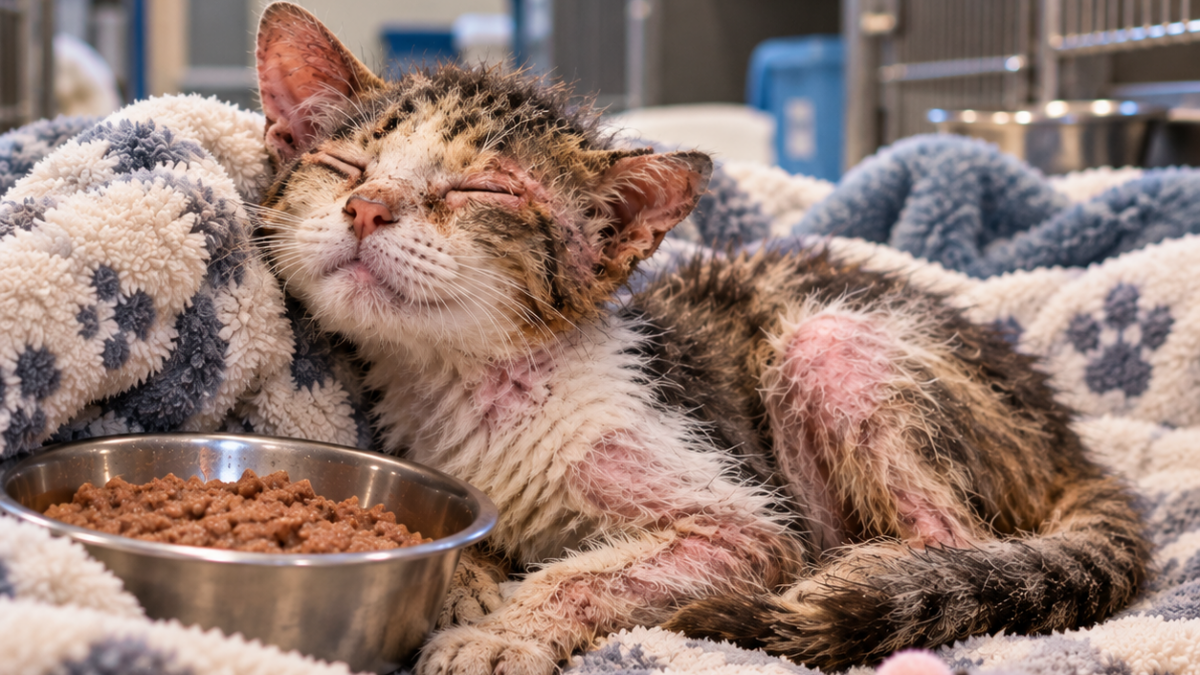
The way he had apparently dragged himself toward food rather than away from the person offering it.
At 12:14 a.m., Michael texted.
He ate everything.
At 1:03:
He drank some water.
At 2:22:
He’s sleeping.
I answered every time.
By five, I gave up pretending to sleep.
The sky was still dark when I left home.
Michael lived on the edge of a semi-rural neighborhood outside Dayton, Ohio.
Older house.
Two acres.
Woodpile.
Detached garage.
A line of bare trees behind the property.
He met me in the driveway wearing work boots and a sweatshirt.
“You Claire?”
“Yes.”
He looked exhausted.
“Thank God.”
“How is he?”
“Still alive.”
“That’s a good start.”
He led me toward the garage.
Before opening the door, he stopped.
“I just want you to know something.”
“What?”
“I didn’t dump him.”
“I didn’t think you did.”
“I’ve never seen him before yesterday.”
“I believe you.”
“I posted in the neighborhood group.”
“Anybody recognize him?”
“No.”
He rubbed his face.
“My wife said maybe he belongs to someone.”
“Maybe.”
“But if he does…”
He looked toward the garage.
“Where have they been?”
I did not answer.
Because there are situations where righteous anger arrives before facts.
Maybe somebody had been searching.
Maybe Jasper had been lost for months.
Maybe he belonged to an elderly person who had died.
Maybe he had once been feral.
Maybe he had slipped through every crack nobody noticed.
We did not know yet.
Michael opened the door.
The garage was warm.
Quiet.
The carrier sat in one corner under a towel.
Food bowl empty.
Water partly gone.
I crouched.
“Hey.”
Nothing.
I lifted the towel slowly.
Two cloudy eyes looked back.
The photograph had been bad.
Reality was worse.
The smell hit first.
Infection.
Old skin.
Urine.
That particular sour odor animals develop when they have been too weak to care for themselves.
He was curled into the farthest corner of the carrier.
Head low.
One front paw tucked beneath him.
The other stretched awkwardly.
He did not hiss.
Did not flatten his ears.
Did not swipe.
He simply watched.
“Hi, buddy.”
His eyes narrowed.
Michael stood behind me.
“He let me put the carrier down around him.”
“He walked into it?”
“No.”
“I put the food inside.”
“He crawled after it.”
There was that word again.
I unlatched the door.
Slowly extended one hand.
“It’s okay.”
His body tightened.
I stopped.
“I’m not going to touch you yet.”
Michael whispered:
“Can they understand us?”
“Words?”
“Probably not all of them.”
“Tone?”
“Yes.”
I looked at the cat.
“Nobody’s going to hurt you here.”
I had no way of knowing whether that sentence meant anything to him.
But I wanted it to.
I wanted those to be the first words of whatever came next.
We loaded the carrier into my car.
Michael put a bag beside it.
“What’s this?”
“Food he ate.”
“Keep it.”
“You sure?”
“Yes.”
“He likes it.”
Michael looked embarrassed.
“It’s cheap stuff.”
“He doesn’t care.”
He stood there with both hands in his sweatshirt pockets.
“Can you tell me what happens?”
“I’ll update you.”
“If he…”
He couldn’t finish.
“I’ll tell you.”
He nodded.
“Okay.”
Then:
“Tell him I’m sorry I didn’t find him sooner.”
I almost said:
You found him when you found him.
Instead I said:
“I will.”
The veterinary clinic was twenty minutes away.
Halfway there, I realized I had been calling him buddy because he didn’t have a name.
At a red light I looked into the carrier.
“What do you look like?”
Nothing.
“George?”
No.
“Walter?”
Wrong.
“Jasper?”
The cat blinked.
I laughed quietly.
“Jasper?”
Another blink.
“All right.”
“That’s probably meaningless, but you look like a Jasper.”
The clinic staff was ready.
They took one look and moved us into an exam room immediately.
Dr. Hannah Lee entered wearing navy scrubs.
She had treated several rescue animals for me over the years.
She was kind without being sentimental.
The kind of veterinarian who will tell you exactly how sick an animal is and then spend forty minutes figuring out what might still be done.
She looked through the carrier.
“Oh, sweetheart.”
Jasper lifted his head slightly.
Hannah did not reach for him immediately.
She sat on the floor.
Let him smell her fingers.
“Do we know anything?”
“Found yesterday.”
“Age?”
“No.”
“Owner?”
“Unknown.”
“Eating?”
“Yes.”
“Drinking?”
“A little.”
“Vomiting?”
“No.”
“Diarrhea?”
“Not that Michael saw.”
“Mobility?”
“Very weak.”
She nodded.
“Let’s go slowly.”
We removed Jasper from the carrier using a towel.
He weighed less than six pounds.
An adult male cat.
Six pounds.
The number made my stomach turn.
Hannah palpated carefully.
Muscle wasting.
Severe dehydration.
Skin disease.
Eye inflammation.
Ear infection.
Possible mites.
Open sores from scratching.
Fleas.
Lots of them.
We discussed bloodwork.
FeLV/FIV testing.
Kidney values.
Liver.
Electrolytes.
Possible parasites.
Potential fungal or bacterial causes for the skin.
She looked at me.
“He’s very compromised.”
“I know.”
“Claire.”
That tone.
“How compromised?”
“If he stops eating, this becomes dangerous very quickly.”
“Hospitalize?”
“Possibly.”
“Can he recover?”
She glanced at Jasper.
“I don’t know.”
That is one of the hardest sentences a veterinarian can give you.
Not no.
Not yes.
A door.
Barely open.
“What do you need from me?”
“Permission to run everything I think is reasonable.”
“You have it.”
She nodded.
Then something happened.
Hannah placed one hand beneath Jasper’s chin.
Her thumb moved gently along the side of his face.
And Jasper purred.
So faintly I thought at first it was equipment humming.
Hannah stopped.
Looked at me.
“You hear that?”
I leaned closer.
There it was.
A tiny motor.
Weak.
Broken around the edges.
But unmistakable.
Jasper was purring.
This animal whose skin hurt.
Whose body had been starving.
Whose eyes barely opened.
Who had every reason to associate hands with fear or nothing at all.
He pressed his head into Hannah’s fingers.
And purred.
I turned away.
Hannah pretended not to notice.
That was kind of her.
I stared at a poster about dental disease until my eyes stopped burning.
Then said:
“How does he still do that?”
Hannah knew what I meant.
“Animals don’t think about fairness the way we do.”
“I know.”
“They respond to the moment.”
“Someone is touching him gently now.”
“So now matters.”
That became Jasper’s whole recovery.
Now.
Not what happened yesterday.
Not what might happen next week.
What does he need now?
Fluids.
Food.
Medication.
Clean skin.
Warmth.
Rest.
Safety.
The bloodwork was not perfect.
But it was better than I feared.
No catastrophic organ failure.
No immediate evidence of terminal disease.
Severe anemia.
Dehydration.
Malnutrition.
Inflammation.
Parasites.
Significant skin infection.
Eye infection.
But treatable problems.
Many of them.
Layered.
Accumulated.
Hannah said:
“He didn’t get like this in three days.”
“How long?”
“Impossible to know.”
“Weeks?”
“At minimum.”
“Months?”
“Possibly.”
I looked at Jasper.
“How does nobody see this?”
Hannah took off her gloves.
“Sometimes they do.”
That answer bothered me.
“What do you mean?”
“People see.”
“They assume someone else is helping.”
“They think it’s a feral cat.”
“They worry about getting bitten.”
“They don’t know who to call.”
“They tell themselves they’ll check tomorrow.”
She looked at me.
“Sometimes everybody is waiting for somebody.”
That stayed with me.
We decided Jasper could come home with strict monitoring.
He had eaten enough.
His vitals stabilized with fluids.
He was exhausted but responsive.
I left the clinic carrying:
Medication.
Eye ointment.
Skin treatment instructions.
Special food.
Supplements.
A schedule.
And a cat who looked as if a strong breeze could still carry him away.
My spare bathroom became the recovery room.
Tile floor.
Easy to disinfect.
Warm.
Quiet.
I removed cleaning chemicals.
Put down washable pads.
Blankets.
Low-sided litter box.
Water.
Several shallow dishes.
A heating pad under half the bed so he could move away if warm.
I sat on the floor.
Opened the carrier.
Jasper did not come out.
Five minutes.
Ten.
I did not reach.
Eventually he crawled forward.
Crawled.
Again.
He crossed perhaps two feet.
Stopped beside the food.
Ate.
Not slowly.
Frantically.
Head deep in the dish.
Shoulders hunched.
As if another animal might appear and take it.
I gave him a small portion.
He finished.
Looked up.
Waited.
I gave another.
Gone.
I remembered Hannah’s instructions.
Small frequent meals.
Do not let him gorge.
His body had not been handling regular food.
I moved the bowl.
Jasper followed it with his eyes.
Then looked at me.
That expression hurt more than the sores.
“No.”
He stared.
“You get more later.”
He stared harder.
“I promise.”
Promises mean nothing to starving animals.
Only repetition teaches abundance.
Two hours later:
Food.
Three hours:
Food.
Medication.
Warm cloth for his eyes.
Fresh blanket.
Midnight:
Food.
Morning:
Food.
Again.
Again.
Again.
Our world shrank.
Jasper.
Me.
Bathroom floor.
Medication alarms.
Laundry.
Food.
Vet appointments.
One day at a time.
For the first three days, Jasper hardly walked.
He ate.
Used the litter box.
Slept.
Sometimes purred when I touched his head.
I sat beside him while answering emails from my laptop.
My job was freelance editing, which meant I could rearrange my schedule enough to become temporarily ridiculous.
I began taking client calls sitting cross-legged outside a bathroom.
One afternoon a client asked:
“What is that sound?”
“Cat.”
“You got a cat?”
“Temporarily.”
That word came easily then.
Temporarily.
I had fostered before.
That was the rule.
Help them heal.
Do not confuse helping with keeping.
If you keep every animal, eventually you cannot help the next one.
I knew that.
I believed it.
Jasper was not staying.
Day four, he walked from the bed to the water bowl without stopping.
I texted Hannah.
HE WALKED ACROSS THE BATHROOM.
Her reply:
THIS IS WHAT YOUR LIFE IS NOW.
She was right.
The victories became absurdly small.
He sneezed less.
Victory.
He scratched less.
Victory.
He gained three ounces.
Celebration.
One crust came off his ear without bleeding.
I photographed it like someone witnessing a lunar landing.
Then, about a week in, something happened that made me stand in the bathroom smiling at a dirty food bowl.
Jasper left food.
Not much.
Maybe a tablespoon.
But food remained.
I checked him immediately.
“Are you sick?”
He blinked.
“Jasper.”
Nothing.
I touched his abdomen.
Fine.
Offered fresh food.
He looked away.
And suddenly I understood.
He was full.
Full.
He had eaten enough to decide he could stop.
I stared at the leftovers.
Maybe for the first time in a very long time, Jasper believed food was not an emergency.
There would be another meal.
The bowl would return.
No need to consume every calorie before the world changed again.
I sat down.
“You left food.”
Jasper began washing one paw.
“You trust me?”
He ignored me.
“Okay.”
That felt appropriate.
The next milestone was his eyes.
At first, cleaning them was difficult.
Warm compress.
Medication.
He tolerated it with heartbreaking passivity.
Not trust exactly.
Surrender.
There is a difference.
One morning, I opened the bathroom door.
Jasper was sitting upright.
Both eyes open.
Not completely clear.
Not fully healed.
But open.
Green.
I had not known they were green.
“Good morning.”
He blinked.
“Oh.”
I crouched.
“Look at you.”
Slow blink.
“Beautiful.”
Another blink.
Then the tears came.
Not dramatic sobbing.
Just sudden.
I sat beside him.
Jasper leaned against my thigh.
He had no idea why I was emotional.
That was probably for the best.
Weeks passed.
His skin changed first.
Less red.
Less thick.
Sores closed.
Then fuzz appeared.
Tiny patches of fur.
Around his shoulders.
Along his flanks.
A soft dusting.
I rubbed my fingers over it.
“You’re growing a cat.”
Jasper purred.
He gained weight.
Six pounds became six and a half.
Then seven.
He became stronger enough to make bad decisions.
That was wonderful.
The first time he tried to jump onto the toilet lid and missed, I nearly cheered.
Because sick cats don’t usually attempt stupid jumps.
Healthy cats do.
He glared at me from the floor.
“I’m sorry.”
I was not.
His personality emerged in pieces.
First:
Breakfast complaints.
A small rasping meow.
Then louder.
If I was three minutes late, apparently I had violated a treaty.
Second:
Doors.
Jasper hated closed doors.
Once he gained strength, the spare bathroom became offensive.
He began sitting beside the door.
Meowing.
I expanded his territory to the hallway.
Then bedroom.
Then living room.
Every new space was inspected slowly.
He discovered the couch.
Claimed the right cushion.
Discovered my bed.
Claimed the center.
Discovered the windowsill.
Claimed sunlight.
My house turned into a real-estate acquisition project conducted by one recovering seven-pound cat.
The bathroom recovery room remained set up.
Jasper stopped using it voluntarily.
Good.
One Saturday morning, I found him sleeping upside down on my pillow.
Four legs loose.
Belly partly exposed.
No tension in his body.
For several seconds, I did not move.
A frightened animal sleeps differently.
Even when their eyes close, some part remains ready.
Ears alert.
Paws tucked.
Body prepared to move.
Jasper was sprawled.
Unprotected.
Completely ridiculous.
Safe.
I took a picture.
Sent it to Michael.
Remember him?
He still asked about Jasper every week.
His reply came almost immediately.
NO WAY.
Then:
THAT’S THE SAME CAT?
I sent the first photograph beside the new one.
Michael called.
“Jesus.”
“I know.”
“Can I show my wife?”
“Of course.”
He went quiet.
Then:
“Claire?”
“Yes?”
“I keep thinking I should’ve noticed him sooner.”
“You’d never seen him.”
“He was probably around.”
“Maybe.”
“What if he was in those woods for weeks?”
“You can’t know.”
“I should’ve—”
“Michael.”
Silence.
“You stopped.”
He breathed.
“What?”
“You stopped.”
“That matters.”
Michael eventually came to visit.
Jasper did not recognize him in any obvious way.
Michael sat on my floor.
Jasper sniffed his hand.
Then walked away.
Michael laughed.
“Well.”
“Don’t take it personally.”
“I saved your life, you jerk.”
Jasper looked back.
Michael’s eyes became wet.
He looked embarrassed.
“I thought he was going to die in my garage.”
“So did I.”
“Does he remember?”
“Probably not the way we do.”
Michael nodded.
“Good.”
I understood.
Not everything needs to remain a memory.
By the second month, Jasper looked like a different animal.
His coat remained thin in places.
His ears carried scars.
One eye stayed slightly cloudy.
His body would probably always look a little narrow.
But now you saw a cat first.
Not damage.
That distinction mattered.
People who visited my house stopped making the sympathetic face.
They said:
“He’s cute.”
Instead of:
“Oh my God.”
Jasper preferred neither.
He preferred snacks.
One evening, I sat on the floor scrolling through his original photographs.
I had avoided them.
Recovery makes suffering easier to look at retroactively.
When you know what came after.
I opened the first photograph Michael sent.
The bowl.
The body.
Those eyes.
I zoomed in.
Still difficult.
Jasper walked over.
He had been on the couch.
He stepped directly onto my legs.
Turned once.
Curled against my chest.
Then purred.
I looked at the photograph.
Then at him.
Photograph:
Bones.
Sores.
Fear.
My lap:
Warm fur.
Full stomach.
Eyes closed.
Paws loose.
He fell asleep.
Deeply.
When I shifted, he barely moved.
That was the moment I understood safety more clearly than any dramatic rescue ever taught me.
Safety is not an animal being indoors.
It is the ability to sleep deeply.
The belief that nothing bad will happen while you are unconscious.
Jasper had learned that.
I kissed the top of his head.
He opened one eye.
Annoyed.
Good.
By then, people were asking when he would be available for adoption.
That was normal.
Healthy enough?
Great.
Find the home.
I had a waiting list of three interested families.
One had recently lost a senior cat.
One had no other animals.
One was a retired couple who spent most days home.
Excellent options.
I began taking photographs for his adoption profile.
Jasper on windowsill.
Jasper looking toward camera.
Jasper curled on blanket.
Then sat at my laptop.
Template open.
MEET JASPER.
I typed:
Jasper is a sweet adult male who came to us after being found in very poor condition…
Stopped.
Too clinical.
Deleted.
Tried:
Jasper has had a difficult start, but he is ready for the loving forever home he deserves.
I stared.
Deleted.
Forever home.
I typed again.
Jasper is looking for—
Stopped.
My throat tightened.
This was absurd.
I had written hundreds of posts.
Dogs.
Cats.
Senior animals.
Tripods.
Blind animals.
Shy animals.
I knew how to make adoption copy warm without manipulating people.
Why couldn’t I write Jasper’s?
He was asleep beside my laptop.
One paw touching my wrist.
I looked at him.
Then at the blank screen.
“Problem.”
Jasper slept.
“You’re supposed to leave.”
No response.
“That is the system.”
Purr.
“I’m serious.”
His paw flexed.
I closed the laptop.
Walked into the kitchen.
Made coffee I did not need.
Returned.
Jasper had moved into my chair.
I stood there.
“You’re not subtle.”
He looked up.
I sat beside him.
And finally said the truth out loud.
“I don’t want you to go.”
Jasper yawned.
I laughed.
Then cried.
Of course.
Again.
Somewhere between the medications and laundry and middle-of-the-night feedings, I had crossed a line without noticing.
Jasper was no longer an animal recovering in my house.
He was the animal whose breakfast bowl belonged beside my refrigerator.
Whose fur was on my pillow.
Whose medication sat beside my coffee filters.
Whose small footsteps I recognized from another room.
Whose presence had already become part of the architecture.
I called Hannah.
“I have a problem.”
“Jasper sick?”
“No.”
“Then what?”
“I can’t write the adoption post.”
Pause.
Then Hannah laughed.
Hard.
“That’s not funny.”
“It is extremely funny.”
“I foster.”
“You failed.”
“That’s not the preferred terminology.”
“Foster fail.”
“I hate that phrase.”
“Adoption success?”
“Better.”
“So you’re keeping him.”
“I think so.”
“You think?”
Jasper walked across my desk and stepped on the keyboard.
“I’m keeping him.”
“Good.”
“That’s it?”
“What do you want, confetti?”
“I expected professional concern.”
“He’s healthy enough.”
“You can afford his care.”
“You adore him.”
“He owns your bed.”
“He’s home.”
I called Michael next.
“You keeping him?”
“Yes.”
“Good.”
“You don’t sound surprised.”
“Claire.”
“What?”
“You sent me forty-three pictures last week.”
Fair.
The official adoption paperwork took ten minutes.
I signed my own name.
It felt ridiculous.
And enormous.
That evening, I changed his microchip registration.
Owner:
Claire Morgan.
I stared at the word.
Owner.
Technically correct.
Emotionally inaccurate.
Jasper belonged to himself.
He had simply allowed me to manage logistics.
Life settled.
Months passed.
His coat grew fuller.
Dark gray and white.
I had originally thought he might be black under all the damaged fur.
No.
Charcoal tabby pattern.
Subtle.
Beautiful.
His appetite normalized completely.
The first few times he walked away from a full bowl, part of me still felt proud.
Abundance had become ordinary.
That may have been the most important recovery of all.
He learned hunger was temporary.
He learned doors reopened.
He learned hands could touch without pain.
He learned medication did not mean abandonment.
He learned that if I left the house, I came back.
That last one took time.
For weeks, whenever I returned, Jasper waited near the front door.
At first I interpreted it as affection.
Then I installed a camera.
I saw him.
After I left, he often sat there.
Five minutes.
Ten.
Sometimes twenty.
Watching.
Waiting.
So I started leaving predictable cues.
Same phrase:
“Back soon.”
Same small treat.
Same radio station.
Same return.
Over time, he stopped waiting at the door.
Instead, the camera showed him climbing onto the couch.
Sleeping.
Trust again.
Not dramatic.
Repetition.
People love stories about rescue because they imagine one decisive moment.
The animal is taken from danger.
Now saved.
But rescue is not the carrier.
It is what happens after.
It is the fourteenth eye treatment.
The thirty-sixth bowl of food.
The day you wash diarrhea out of a blanket at 2:00 a.m.
The vet bill.
The follow-up appointment.
The patience after the inspirational part is over.
It is showing an animal the same answer until its body finally believes you.
Yes.
Food comes back.
Yes.
Water stays.
Yes.
I come back.
Yes.
This bed is yours tomorrow too.
Yes.
You can sleep.
Jasper taught me that.
Then, about eight months after Michael found him, something happened I did not expect.
I received an email.
Subject:
FOUND CAT — POSSIBLE MATCH.
My stomach tightened.
I opened it.
A woman named Teresa.
She had seen one of the rescue organization’s old before-and-after posts featuring Jasper.
She thought he might have belonged to her former neighbor.
An elderly man named Mr. Callahan.
He had lived about three miles from Michael.
Died the previous winter.
Owned a gray cat.
Outdoor sometimes.
After Mr. Callahan was hospitalized, relatives cleared the house.
Teresa thought the cat had disappeared.
Could Jasper be him?
I stared.
My first reaction was defensive.
No.
He was mine.
That surprised me.
Then guilt.
If someone had been looking—
I called Teresa.
“What was the cat’s name?”
“Smokey.”
Jasper slept beside me.
“What markings?”
“Gray.”
“White chest.”
“Little notch in one ear.”
Jasper had a notch.
My heart sped.
“Age?”
“Maybe eight?”
Jasper’s vet estimate had been six to ten.
Possible.
“Microchip?”
“I don’t know.”
“Photos?”
Teresa sent three.
I opened them.
Similar.
But not Jasper.
Different face.
Different white pattern.
I exhaled.
Then felt terrible for the relief.
Teresa said:
“That’s not him, is it?”
“No.”
“I knew it was a long shot.”
“I’m sorry.”
She sighed.
“I still wonder what happened to Smokey.”
That conversation reopened the question I had avoided.
Where had Jasper come from?
We never found out.
No chip.
No matching lost reports.
No neighbor recognized him.
Maybe he’d always been stray.
Maybe abandoned.
Maybe lost.
Maybe someone’s outdoor cat whose illness went unnoticed.
At first I needed a story.
A villain.
A reason.
By then, I had stopped.
Jasper did not care why he had suffered.
He cared that he wasn’t suffering now.
Humans need narratives.
Animals need conditions.
Warm.
Fed.
Safe.
Loved.
That distinction freed me.
A year after his rescue, I took Jasper back to Hannah for his annual exam.
He weighed nine pounds.
Nine.
Hannah put him on the scale twice.
“I remember six.”
“So do I.”
“He’s almost fat.”
I gasped.
“Don’t body shame him.”
Jasper complained loudly during the exam.
Hannah smiled.
“Good.”
“Why good?”
“He didn’t have enough energy to object the first time.”
She listened to his heart.
Checked his skin.
Eyes.
Teeth.
Then looked at me.
“He’s doing well.”
“How well?”
“Stop asking for guarantees.”
I smiled.
“I know.”
His kidney values were slightly elevated.
Nothing alarming.
Monitor.
Senior food eventually.
The word senior surprised me.
He had been so close to death that I had not thought about age.
Now we were planning years.
Maybe.
That word no longer scared me as much.
Maybe is what every relationship gets.
We just pretend otherwise.
Jasper remained demanding.
Breakfast at 6:00.
Not 6:04.
If late, he stood on my chest.
He stole my couch spot.
Followed me into the bathroom.
Sat outside the shower.
Attacked one specific shoelace and ignored the other.
Disliked closed laptop screens for reasons unknown.
Became obsessed with roasted chicken.
Hated salmon.
Loved cardboard.
Feared the vacuum.
Distrusted umbrellas.
Accepted exactly three visitors.
Everyone else was evaluated from a distance.
His favorite person besides me became Michael.
That was unexpected.
Michael visited every couple months.
Eventually, Jasper began walking toward him.
One day he climbed into Michael’s lap.
Michael froze.
“Claire.”
“Yes?”
“He’s touching me.”
“I can see.”
“What do I do?”
“Nothing.”
“I don’t want to ruin it.”
“Then definitely stop talking.”
He sat there for twenty minutes.
When Jasper left, Michael wiped his eyes.
“Don’t say anything.”
“I wasn’t going to.”
“You were.”
“I absolutely was.”
Michael told me later that finding Jasper changed how he paid attention to stray animals.
He kept carriers in his garage.
Learned local rescue numbers.
Built two insulated winter shelters behind his shed for community cats.
One animal stopped.
Then another person learned to stop.
That is how rescue spreads.
Not through heroism.
Through attention.
Two years after Jasper came home, I found the original disposable food bowl in a box of rescue supplies.
Michael had accidentally packed it with the carrier.
Cheap plastic.
Cracked.
I stood in the garage holding it.
For a moment, I saw the photograph again.
Jasper beside it.
Waiting.
I almost threw it away.
Instead, I washed it.
Then changed my mind.
Why keep an object from the worst day of his life?
Recovery does not require preserving evidence of suffering.
I threw it out.
That felt good.
Jasper did not need his before photograph displayed like a trophy either.
I still kept it in my phone.
But not because I wanted people to gasp.
I kept it because sometimes I needed to remind myself that survival can look unimpressive while it is happening.
No dramatic leap.
No sudden transformation.
A bowl.
A pill.
Sleep.
Another bowl.
A little fur.
One open eye.
A full stomach.
The courage to leave food.
Healing often looks boring from the outside.
That may be why people underestimate it.
Three years after Jasper arrived, my father had a stroke.
Not catastrophic.
But serious.
I spent weeks driving between my home and my parents’ house.
Hospitals.
Rehab.
Insurance calls.
Meals.
Appointments.
For the first time since adopting Jasper, my life became chaotic enough that I understood a little more about how animals can become casualties of human crises.
I never considered surrendering him.
But I understood how rapidly certainty disappears.
Schedules broke.
Money changed.
Energy vanished.
There were days I left at six in the morning and returned at ten at night.
I hired a pet sitter.
Asked Michael to help.
Rearranged work.
Managed.
But only because I had resources.
People.
Money.
A flexible job.
If one of those pieces had been missing?
I do not know.
That humbled me.
It is easy to say:
I would never.
Never abandon.
Never surrender.
Never choose between rent and veterinary care.
Never make the wrong decision.
Life enjoys testing the word never.
During my father’s recovery, Jasper changed roles.
He had always been the one receiving care.
Now I came home exhausted.
Sat on the couch.
He climbed beside me.
No medication.
No rescue.
No fixing.
Just weight against my hip.
Purring.
My father called one evening.
“How’s your ugly cat?”
“He’s beautiful.”
“He looked dead in that first picture.”
“He nearly was.”
Dad paused.
“You know why I like him?”
“Because you’re secretly sentimental?”
“No.”
“Because he doesn’t complain.”
I laughed.
“He complains constantly.”
“Then never mind.”
Months later, Dad visited.
Jasper climbed into his lap.
My father pretended indifference for three minutes.
Then began scratching behind his ears.
“You’re all right.”
Jasper purred.
Dad whispered:
“Don’t tell Claire.”
I heard him.
I said nothing.
Years passed.
Jasper became older for real.
Not damaged-looking.
Old.
White appeared around his face.
His jumps shortened.
I bought pet stairs.
He ignored them.
Then one day used them.
Pretended he had always intended to.
Breakfast moved from 6:00 to 5:45 because apparently age creates entitlement.
He slept more.
Still followed me.
Still stole the couch.
Still left food sometimes.
Every single time, a tiny part of me remembered the cat who ate like the bowl would vanish.
One winter morning, snow covered the yard.
Jasper sat at the window.
Warm house.
Radiator beneath him.
Full bowl behind him.
I took a picture.
Sent it to Michael.
He replied:
LOOK AT THAT SPOILED MONSTER.
I wrote:
HE EARNED IT.
Michael answered:
NO CAT SHOULD HAVE TO EARN SAFETY.
I stared at that message.
He was right.
I had said versions of “he deserves this” for years.
But safety should not be a reward for suffering well.
Food should not be earned through tragedy.
Kindness is not compensation.
It should have been there from the start.
I called Michael.
“That was annoyingly profound.”
“What?”
“Your text.”
“I was eating cereal.”
“Still.”
“Can I put that on a shirt?”
“No.”
We laughed.
Jasper slept.
Five years after his rescue, Hannah found more significant kidney disease.
Manageable.
For now.
Special diet.
More water.
Medication.
Monitoring.
I knew the road.
The old fear returned anyway.
“How long?”
Hannah looked at me.
“Claire.”
“Sorry.”
She smiled.
“You’ve learned nothing.”
“I’ve learned enough to know I hate uncertainty.”
“Then you have learned something useful.”
“What?”
“Uncertainty is the whole deal.”
Jasper adapted.
He drank from a fountain.
Then refused the fountain.
Preferred a mug.
I gave him his own mug.
He ignored it.
Wanted mine.
He became increasingly ridiculous.
I increasingly surrendered.
Medication hidden in food worked twice.
Then he identified betrayal.
Pill pockets insulted him.
Eventually I learned the exact method.
Quick.
Gentle.
Treat after.
He forgave me immediately because unlike humans, Jasper had no interest in building a case.
His health declined gradually.
No dramatic collapse.
Good days.
Less good.
Then good again.
That made decisions harder.
People imagine you know when an old animal reaches the end.
Sometimes you do.
Sometimes the line is fuzzy.
Is he sleeping because he is old?
Or uncomfortable?
Did he skip breakfast because he feels sick?
Or because he wants chicken?
Does he still enjoy enough?
Hannah gave me a quality-of-life worksheet.
Mobility.
Appetite.
Hydration.
Pain.
Hygiene.
Interaction.
Good days versus bad.
I hated it.
I used it anyway.
Because love can become selfish when you refuse measurement.
One afternoon, Jasper climbed onto the couch beside me.
Slowly.
Turned.
Pressed his forehead to my chest.
Exactly as he had in that shelter exam room years earlier.
I put my arms around him.
“You remember?”
Purr.
“Probably not.”
Purr.
“I do.”
I thought about the first words I had said to him.
Nobody is going to hurt you here.
I had kept that promise as best I could.
But now another promise mattered.
I would not make him suffer because I was afraid of an empty house.
That is the hidden final responsibility.
Not holding on so tightly that safety becomes captivity.
Jasper gave me two more months.
Maybe he gave me nothing.
Maybe biology gave us two months and I simply had the privilege of being there.
Then one morning, he did not want breakfast.
Not even chicken.
He drank.
Walked to the window.
Sat.
Then lay down.
His eyes still followed me.
But his body looked tired in a way I recognized from the beginning.
Not starving.
Not frightened.
Just finished.
I called Hannah.
She came to my house that evening.
Michael came too.
I had not planned that.
He asked.
“Can I say goodbye?”
“Of course.”
Jasper lay on my bed.
The bed he had claimed years earlier.
Michael sat beside him.
“You remember me?”
Jasper blinked.
“I found you.”
Slow blink.
“You scared the hell out of me.”
Jasper purred faintly.
Michael cried.
“Look what you did.”
He laughed through it.
“You made me build cat houses.”
Jasper did not care.
Then Michael whispered:
“Good job, buddy.”
After he left, Hannah sat beside me.
“No rush.”
“I know.”
“Are you sure?”
I looked at Jasper.
He had stopped purring.
Eyes half closed.
I touched his head.
He leaned into my hand.
“Yes.”
Hannah explained everything.
I had heard it before for other animals.
It sounded different when it was mine.
Sedation first.
Sleep.
Then goodbye.
I held Jasper against my chest.
He was warm.
Light.
Not six pounds light.
Not starving.
Just old.
Loved.
I said:
“You’re okay.”
His breathing slowed.
“You don’t have to be hungry again.”
Another breath.
“You don’t have to be scared.”
Another.
“You don’t have to wait for me.”
My voice broke.
“You can sleep.”
And he did.
Quietly.
No drama.
No fear.
Just the end of a life I almost never knew.
Afterward, Hannah left me alone with him.
I sat on the bed.
For how long, I do not know.
The house felt impossible.
People say empty.
That word is too simple.
A room after an animal dies still contains everything except the one thing that organized it.
Food bowl.
Blanket.
Toy mouse.
Stairs.
Window.
Couch.
All the objects remain.
Their meaning has changed.
That night, for the first time in years, no one complained about dinner.
No paws followed me.
No shape occupied my pillow.
I slept badly.
At 5:45, I woke automatically.
Breakfast time.
I lay there staring at the ceiling.
Then cried harder than I had at the euthanasia.
Grief is rude.
It ignores the moments you prepare for and ambushes you during routine.
Michael texted at seven.
YOU OKAY?
No.
I wrote.
He responded:
GOOD.
I stared.
Then another message:
WOULD BE WEIRD IF YOU WERE.
That made me laugh.
Then cry.
Weeks passed.
People suggested another cat.
I said no.
Some rescuers move quickly.
I couldn’t.
The bathroom remained empty.
I packed Jasper’s medication.
Donated unopened food.
Washed blankets.
Kept one.
The old gray fleece from the recovery room.
The first safe bed.
One afternoon I opened my laptop.
Found the adoption post I had never finished.
MEET JASPER.
Blank beneath it.
I stared.
Then typed.
Not for adoption.
For myself.
Meet Jasper.
He was found starving.
He crawled to a food bowl.
He purred when someone touched him gently.
He learned food would come back.
He learned doors would open.
He learned how to sleep.
He became demanding.
He stole pillows.
He hated pills.
He liked chicken.
He trusted tomorrow.
And for several years, he let me live inside that trust with him.
I stopped.
Read it.
Then added:
I thought saving him meant keeping him alive.
It didn’t.
Saving him meant making life safe for however long it lasted.
That sentence finally answered the question people had asked for years.
“How did you save Jasper?”
I didn’t.
Not by myself.
Michael stopped.
The veterinarian treated.
Technicians cleaned him.
Medication worked.
Food nourished him.
His own body fought.
I opened a door.
Then kept opening it.
That is less dramatic than rescue stories like to sound.
But maybe more useful.
One person stopped.
One bowl appeared.
One carrier opened.
One veterinarian touched him kindly.
One spare bathroom became warm.
One meal came after another.
One hand returned.
Again.
Again.
Again.
Until a frightened animal learned tomorrow was not a threat.
Months after Jasper died, Michael called.
“Don’t get mad.”
“That’s never a good opening.”
“There’s a cat.”
“No.”
“Claire.”
“No.”
“She’s behind the grocery store.”
“No.”
“Three legs.”
“That is manipulative.”
“Very ugly.”
“You’re lying.”
“Extremely ugly.”
“Michael.”
“She’s at the shelter.”
“Good.”
“Needs foster.”
Silence.
He knew me.
“Temporary,” he added.
I laughed.
“That word ruined my life once.”
“Worked out pretty well.”
I did foster her.
Her name became Ruthie.
Three legs.
Bad attitude.
Healthy appetite.
She stayed six weeks.
Then went to a family with two teenagers and a sunroom.
I cried when she left.
Then felt proud.
I could foster again.
Jasper had not ruined me for goodbye.
He had taught me goodbye could exist beside love without canceling it.
That mattered.
I still keep his first photograph.
I rarely look.
When I do, I no longer see only suffering.
I see a cat beside an empty bowl.
Waiting.
He did not know Michael was coming back.
Did not know a carrier was coming.
Did not know a clinic.
A bathroom.
A couch.
Five more years.
Chicken.
Snow.
My father.
A gray blanket.
Nothing.
He simply sat beside the bowl.
And waited.
Maybe that is what breaks me most.
He still had enough hope to wait.
People sometimes say animals are resilient.
True.
But I think we romanticize resilience.
Surviving neglect should not be treated as a beautiful character trait.
Jasper’s trust was not proof suffering was harmless.
It was proof kindness still mattered after suffering.
That is different.
He did not need pain to become special.
He was special because he was alive.
He did not earn rescue by purring.
He did not earn food by being sweet.
He did not earn my bed because his before photographs were shocking.
He deserved care before anyone knew his story.
Every animal does.
Every living thing does.
The world did not change the night Michael stopped.
There were still stray cats.
Shelters stayed full.
People still abandoned animals.
Bad things continued.
But Jasper’s world changed.
Sometimes we dismiss small acts because they do not solve everything.
One bowl does not solve animal homelessness.
One adoption does not empty a shelter.
One foster does not fix neglect.
True.
But Jasper never needed Michael to fix the whole world.
He needed him to notice one cat.
I never needed to become a hero.
I needed to set an alarm for medication.
Hannah did not need a miracle.
She needed fluids and lab work and patience.
Change becomes manageable when you stop asking whether you can save everyone and ask who is in front of you.
Jasper was in front of us.
That was enough.
Years later, I can still hear the first purr.
Faint.
Almost lost beneath the clinic noise.
I remember thinking:
How can you still trust?
Now I think I asked the wrong question.
Trust was not something Jasper possessed forever despite everything.
It was something he offered in tiny pieces whenever the present moment felt safe.
A hand.
Warmth.
Food.
My voice.
Then another safe moment.
Then another.
Trust was rebuilt exactly the way his body was.
Slowly.
One ordinary thing after another.
And maybe that’s why, by the end, he could sleep so deeply beside me.
Not because he forgot what hunger felt like.
Not because the world had always been kind.
Because for long enough, his small world became predictable.
Food came back.
Hands were gentle.
Doors opened.
Morning followed night.
I came home.
Again.
Again.
Again.
The night Michael first messaged me, I thought I was going to pick up a dying stray.
I thought the story would be about saving him.
Maybe three weeks.
Maybe two months.
Get him healthy.
Find a family.
Move on to the next animal.
Instead, Jasper stayed long enough to change what the word rescue meant to me.
Rescue was not the morning I carried him into the clinic.
It was the afternoon he left food in his bowl.
The first morning both eyes opened.
The first ridiculous jump onto the couch.
The first time the camera showed him sleeping while I was gone.
The first adoption post I couldn’t finish.
The thousandth breakfast.
The final promise I kept when loving him meant letting him stop.
People ask whether Jasper saved me.
I hesitate because I had a good life before him.
I was not broken.
I did not need a cat to repair me.
But he changed something.
He made me pay attention differently.
To quiet suffering.
To small improvement.
To the difference between surviving and feeling safe.
To the fact that care is mostly repetition.
And to the uncomfortable truth that tomorrow becomes trustworthy only when today keeps its promises.
I thought I gave Jasper a second chance.
Maybe I did.
But he gave me something too.
He made an ordinary house feel like home.
He made routine feel important.
He made one small life impossible to dismiss as “just a stray.”
And somewhere between the empty food bowl, the bathroom floor, the pills, the purring, the couch, the years, and that final quiet evening on my bed, Jasper stopped being the cat I rescued.
He became the life I was lucky enough to witness.
I thought I was saving Jasper.
In the end, neither of us needed a hero.
We just needed someone to stop.
And somehow, we found each other.








