I Took Home the Cat Everyone Had Given Up On—Then the Truth About Why He Was So Afraid Broke My Heart
PART3:
“Absolutely not. Carrier the whole way. He’s a big lad, but he’s contained.”
Something in that phrase should have warned me.
A big lad.
But I was still standing in my kitchen in the warm fog of my own routine, foolishly believing some days remain what you planned them to be.
“Fine,” I said. “Text me the address.”
“You’re an angel.”
“I’m a driver.”
“Today you’re both.”
Half an hour later, I pulled up outside the rescue center, a low converted building wedged between a plumbing supplier and a closed-down carpet shop. The sign above the door had faded in the sun. Someone had painted paw prints along the side wall, cheerful little black shapes leading to the entrance, though the building itself looked less like a place where happy beginnings happened and more like a place doing its best against impossible odds.
Niamh was waiting under the awning with a carrier at her feet.
At first, I thought there were two cats in it.
Then the carrier shifted.
No. Just one.
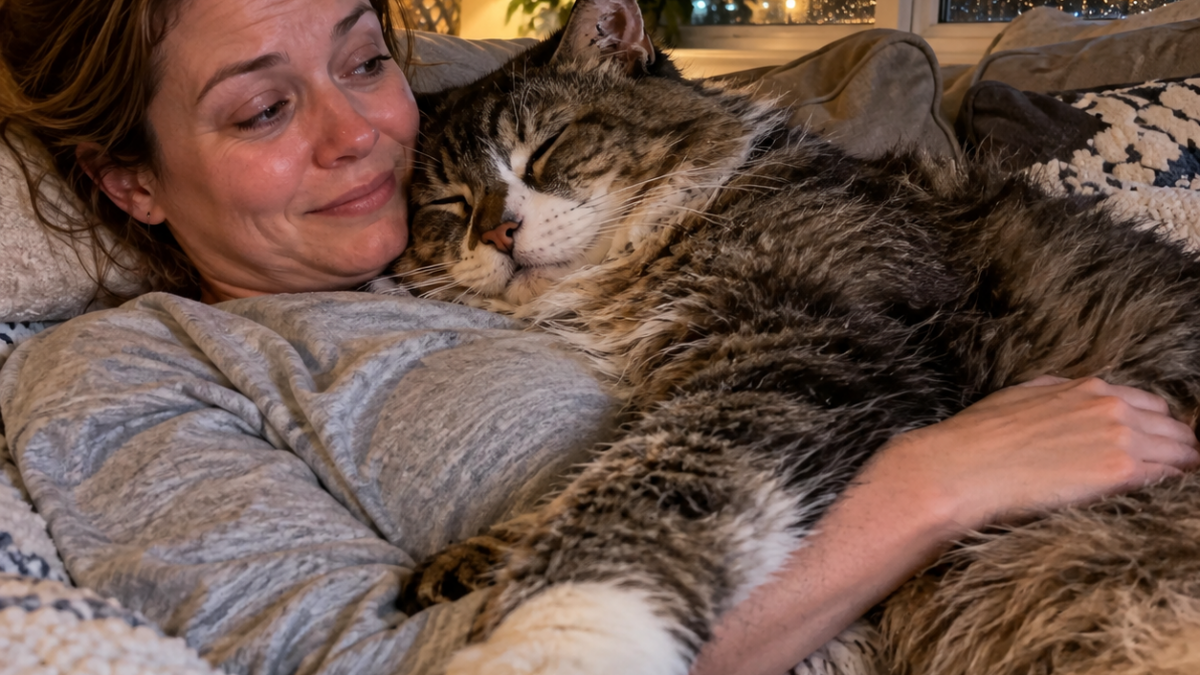
One enormous, scruffy, broad-headed creature who seemed to fill the plastic box like smoke fills a room. His fur was a muddled blend of gray, brown, and weathered black, thick in some places, patchy in others, not dirty exactly but rough, as if life had handled him too often with unwashed hands. He had a wide face, a strong neck, and yellow-green eyes set beneath heavy lids that gave him the look of a retired bouncer judging everyone’s life choices.
One ear stood upright, sharply alert.
The other folded softly forward and had a tiny nick along the edge.
Not a cute little bend. Not cartoonish.
A wound that had healed into personality.
He stared at me through the carrier door.
Not frightened.
Not friendly.
Assessing.
I looked at Niamh. “That is not a cat. That is a landlord.”
Niamh laughed, but it came out tired. “This is Atlas.”
“Of course it is.”
“He’s very good in the car.”
“He looks like he repossesses cars.”
“He’s had a hard life.”
Most rescue people say that. Sometimes they say it so often the words become thin. But Niamh said it differently, and I heard what sat behind it.
A hard life.
Not a rough week.
Not a dramatic personality.
A life.
Atlas did not blink.
“Hello,” I said, because I am British and apparently even when confronted with a massive suspicious cat in a carrier, manners persist.
Atlas continued to stare.
Niamh crouched and slipped two fingers through the front grate. He lowered his head, almost imperceptibly, and allowed her to touch the bridge of his nose.
Allowed. That was the word.
“He’s not aggressive,” she said.
“I didn’t ask.”
“You were thinking it.”
“I was thinking he looks like he knows where bodies are buried.”
“He probably does.”
Atlas’s upright ear twitched.
“What happened to his ear?” I asked.
Niamh’s face changed. Not much. Just enough.
“Old injury. We think. He came in like that.”
“Came in from where?”
“Industrial estate near Mill Road. Someone had been feeding him behind the storage units. He was limping, underweight, full of fleas. Took us three weeks to trap him because he’d go into the trap, eat the food, and somehow back out without setting it off.”
“That sounds intelligent.”
“That sounds infuriating.”
“And now?”
“Now he’s healthy enough. Tested, vaccinated, neutered. Teeth aren’t perfect, but whose are? He’s just…” She looked down at him. “He’s Atlas.”
The cat shifted inside the carrier, slow and heavy. His paw slid forward and rested against the plastic lip near the door.
I noticed then that his front paws were huge.
Ridiculously huge.
The paws of a cat who had walked many miles without being invited anywhere.
Niamh handed me a folded vet form and a small bag of documents. “Oak & Vale. Ten o’clock. They know he’s coming. Just check-up and weight. Bring him back here after. I’d go myself, but the car’s currently making a noise like a washing machine full of forks.”
“And he won’t howl?”
“He might not make a sound.”
“Why is that worse?”
Niamh smiled, but there was sadness in it. “Because some cats learn noise doesn’t help.”
I wanted to ask what she meant, but Atlas chose that exact moment to look at me again.
There are looks animals give you that you can dismiss as instinct. Hunger. Fear. Curiosity. But this was not any of those. This was the look of a creature who had already learned the world’s terms and did not expect them to change.
I opened the back door and helped Niamh secure the carrier with the seatbelt.
“Half an hour,” I told myself.
Atlas blinked slowly, as if he had heard every lie human beings tell themselves to survive the beginning of things.
The drive to the vet took twenty-three minutes.
I know because I checked the clock three times, partly because I was worried about being late and partly because silence makes you aware of time. Atlas did not yowl. He did not throw himself against the carrier. He did not dig at the door or plead for release. He sat upright, perfectly still, watching the world through the slats.
Buses sighed at curbs. Schoolchildren in puffy coats dragged backpacks through puddles. A man in a fluorescent jacket crossed the street carrying two coffees. A terrier barked from the passenger seat of a van.
Atlas observed all of it.
Every moving thing. Every sound. Every sudden shadow.
Once, when a motorbike roared past, he flinched so quickly I almost missed it. His body compressed, his ears flattened—one high, one crooked—and then he returned to stillness, as if stillness was a place he knew how to hide.
“It’s all right,” I said softly.
I felt ridiculous the moment I said it.
He did not know me. I did not know him. I was a temporary driver in a compact car that smelled faintly of peppermint gum and old receipts. He was a rescue cat with scars I could see and probably many I could not.
Nothing was all right just because I said it was.
Still, I spoke again.
“Nearly there.”
His eyes shifted toward the rearview mirror.
Not trusting.
Listening.
Oak & Vale Vets had warm lights, framed certificates, and a reception desk covered in leaflets about dental cleaning, pet insurance, and fireworks anxiety. A spaniel with a cone around its head leaned sadly against its owner’s shin. A woman in yoga leggings whispered apologies to a rabbit carrier every time something moved inside it. Somewhere behind a closed door, a dog barked once, deep and startled.
Atlas froze.
I felt it through the carrier handle.
His weight seemed to become denser, as if fear had gravity.
“It’s okay,” I murmured.
The receptionist looked up. “Atlas?”
I nodded.
“Lovely. Take a seat. Shouldn’t be long.”
Lovely was not the word I would have chosen, but I sat.
The carrier rested at my feet. Atlas turned inside it, slowly, carefully, and faced outward. His eyes scanned the room. Spaniel. Rabbit. Receptionist. Door. Exit. Me.
Especially me.
As if my role in this disaster remained unclear.
A little girl across the room pointed. “Mummy, look at that big cat.”
Her mother pulled her hand down gently. “Don’t point, sweetheart.”
“He looks grumpy.”
“He might just be scared.”
Atlas looked at the child with grave disapproval.
The girl giggled.
For a second, something in him softened. Not friendliness. Not even interest. But the tension around his eyes shifted, like a curtain moving in a room where someone has opened a window.
Then the exam room door opened.
“Atlas?”
The vet was a woman about my age with short silver-streaked hair, kind eyes, and hands that moved with calm purpose. Her badge said Dr. Patel. She took one look at the carrier and smiled.
“There’s our magnificent gentleman.”
“Gentleman?” I said before I could stop myself.
Dr. Patel laughed. “All cats are gentlemen until they decide otherwise.”
Inside the exam room, Niamh’s promise proved true.
Atlas did not fight.
He did something worse.
He disappeared into himself.
Dr. Patel opened the carrier. For one wild moment, I expected that big body to explode outward, claws and panic and insult. Instead, he stayed crouched inside until she slid one hand beneath his chest and the other under his hindquarters and lifted him onto the table.
He was heavier than he looked.
And he looked heavy.
His paws spread on the stainless steel. His shoulders rose. His tail tucked close but did not thrash. He stared at the far wall with that same solemn judgment, but his body had gone rigid.
Not defiant.
Resigned.
Dr. Patel worked slowly. She listened to his heart. Checked his breathing. Opened his mouth, murmuring apologies. Felt along his ribs and spine. His fur parted beneath her hands, revealing old scars under the scruff—thin pale lines hidden like secrets.
When she touched the folded ear, Atlas flinched.
It was tiny.
A movement most people might have missed.
But I saw it.
His whole history crossed his face for half a second.
Then he went still again.
Dr. Patel paused immediately. “All right. We won’t fuss with that today.”
I swallowed.
“What happened to him?”
She looked at the form, then at Atlas. “We don’t know everything. Stray adult male, likely outdoors a long time. Evidence of old bites. Ear trauma. Some healed fractures in the tail. Nothing fresh now.”
“Fractures?”
“Old ones.”
As if old pain was better because it had stopped bleeding.
Atlas stood beneath the fluorescent lights and said nothing on his own behalf.
“How long has he been at the rescue?” I asked.
Dr. Patel’s eyes flicked to mine. “You’re not with the rescue?”
“I’m just driving him today.”
“Ah.” She stroked the top of his head once. He tolerated it. “Eight months, I think.”
“Eight months?”
“Adult cats are hard. Big adult cats are harder. Scruffy big adult cats with funny ears and no interest in charming adopters…” She sighed. “They wait.”
Atlas looked at me then.
Wait.
That was the first word that truly attached itself to him.
Not stray.
Not difficult.
Not big.
Wait.
On the way back, the rain began properly.
Not dramatic rain. Not film rain. British rain. Thin, gray, persistent, and intimate enough to find the back of your collar. The wipers squeaked across the glass. Traffic slowed near the roundabout. A delivery truck blocked one lane while a man argued with a parking attendant beneath a dripping hood.
Atlas remained quiet.
Too quiet.
I found myself glancing in the mirror again and again. He had shifted down from sitting to lying against the side of the carrier, his enormous head resting near the door. His eyes were open. Watching. Always watching.
At the roundabout, the car jolted over a shallow pothole.
Atlas slid slightly, and one paw came forward through the wire door.
Not far. Not enough to escape.
Just enough that the pads of his paw pressed against the grate.
The gesture hit me with unreasonable force.
I have seen people cry at weddings and felt less.
It was not cute. It was not a trick. It was not one of those viral animal moments where a paw reaches dramatically for a human hand.
It was smaller than that.
More devastating.
It looked like a creature checking whether the world was still solid.
My throat tightened so suddenly I had to blink hard and focus on the road.
“Why has no one taken you?” I whispered.
Of course Atlas did not answer.
So I called Niamh on hands-free.
“Everything all right?” she asked.
“Yes. Vet said he’s fine. Well, fine-ish.”
“That’s Atlas.”
I glanced into the mirror. His paw remained against the grate.
“Niamh, why has he been there so long?”
Silence.
Then a sigh.
“Because people say they want a rescue until rescue looks like him.”
I said nothing.
“He doesn’t rush the door,” she continued. “Doesn’t rub up on visitors. Doesn’t roll over or chirp or do anything adorable when families come through. Kittens get chosen. Pretty young cats get chosen. Cats who perform get chosen.”
“And Atlas?”
“He sits in the back and watches them walk past.”
Rain blurred the road ahead.
“Does he like people?” I asked.
“Yes,” Niamh said. Softer now. “But he doesn’t trust them to stay.”
Those words entered my car and sat between us like a third passenger.
He doesn’t trust them to stay.
I knew that feeling.
I hated that I knew it.
When we reached the rescue center, I parked in the same place by the awning. Niamh came out wearing a raincoat with the hood half-fallen back, curls frizzing around her face. She looked tired and grateful and ready to return Atlas to whatever kennel had become his almost-home but not quite.
I turned off the engine.
For a moment, neither of us moved.
Atlas’s paw was still pressed against the grate.
Niamh opened the rear door. “Right then, big man. Back we go.”
The phrase was harmless.
Back we go.
But Atlas lowered his head.
He did not fight. He did not cry. He did not claw at the carrier or perform a heartbreak for our benefit.
He simply pressed his cheek against the inside of the door.
Gentle.
Deliberate.
Then he looked up at me.
Not at Niamh.
At me.
His face, lopsided and scarred and permanently unimpressed, held no plea I could explain. He was not asking to be saved in any obvious way. He had probably stopped asking for things long ago.
But there was a question in him.
Not Will you love me?
Not Will you feed me?
Something much worse.
Is this all there is?
I sat there with my hands on the steering wheel and felt my carefully controlled life tilt on its axis.
My sensible brain began listing facts.
I had no supplies.
My building required pet paperwork.
I worked full-time.
I had not planned this.
I liked quiet.
I did not know how to care for a cat with old injuries and door fears and eyes that saw through every excuse.
Atlas waited.
That was his terrible gift.
He did not push.
He waited until you had to meet yourself.
“Niamh,” I said.
She paused with one hand on the carrier.
“What?”
“I don’t think he’s going back in today.”
Her fingers tightened around the handle. “Beth.”
“I mean it.”
“You’re emotional.”
“I’m always emotional. I’m just usually organized about it.”
“Beth, listen to me.” Her voice changed then. Became less rescue volunteer, more friend. “If you take him, even as a foster, you need to understand something. He will attach. Maybe not how a kitten does. Maybe not in a way that looks sweet for photos. But he will. And if he comes back again…”
She stopped.
The rain tapped on the roof of the car.
“If he comes back again,” she said quietly, “something in him will break.”
I looked at Atlas.
He blinked once.
Slowly.
As if he had all the time in the world because time had never brought him anything.
“I’m not promising what I can’t do,” I said. “We’ll do the paperwork. Foster first, properly. I’ll register him with the building. I’ll buy what he needs. If there is some genuine reason it can’t work, we’ll handle it carefully. But I’m not putting him back in that kennel today.”
Niamh stared at me for a long moment.
Then she looked down at Atlas.
His cheek still rested against the door.
“Oh, you manipulative old sofa cushion,” she whispered.
For the first time, Atlas made a sound.
Not a meow.
A low, cracked rumble from somewhere deep in his chest.
Niamh’s eyes filled immediately.
“Oh,” she said, turning away fast. “Brilliant. Fine. Ruin my mascara, why don’t you?”
The paperwork was not cinematic.
That is one of the first things I learned about rescue. The moments that change your life often arrive with cheap pens, clipboards, and a printer that jams.
Inside the rescue office, Atlas remained in his carrier while Niamh explained his feeding schedule, litter preference, medical history, flea treatment dates, insurance trial, and the difference between a slow blink and a warning stare. A younger volunteer named Callum came in halfway through, saw Atlas’s carrier beside my chair, and stopped.
“Is he going foster?”
Niamh nodded.
Callum’s face did something I was not prepared for.
He smiled and looked wounded at the same time.
“Atlas,” he said softly, crouching. “You old legend.”
Atlas turned his head away as if praise was embarrassing.
Callum looked at me. “He likes chicken.”
“Most cats do, don’t they?”
“No. I mean he really likes chicken. But he pretends he doesn’t at first because he’s dramatic.”
“I’m beginning to see that.”
“He knows when people are sad,” Callum added. “He sits near them. Not on them, usually. Near them.”
“Usually?”
Callum grinned. “Well, he sat on me once, but I’d just been dumped and was crying in the store cupboard, so he probably considered it an emergency.”
Niamh gave him a look.
“What?” he said. “It’s relevant character evidence.”
They gave me a starter bag of food, a blanket from his kennel that smelled of disinfectant and old warmth, and a folder with his records. On the front, in black marker, someone had written ATLAS.
Underneath, in smaller handwriting, someone had added, WONKY.
I stared at the second name.
Niamh noticed.
“It’s affectionate,” she said quickly. “The volunteers—”
“I know.”
And I did know. I knew people use humor to soften what hurts. I knew nicknames can be love with a clumsy coat on. I knew no one meant harm.
But Atlas, with his folded ear and tired eyes, had probably been reduced his whole life to the easiest thing to notice.
Wonky.
Scruffy.
Big.
Difficult.
Not chosen.
I ran my thumb over the black letters of his real name.
Atlas.
A creature condemned to carry the world.
By the time I got him home, the rain had become a steady silver veil.
Hawthorne Court looked especially judgmental in bad weather, its front steps slick, its lobby lights bright against the dim afternoon. I parked, carried the heavy carrier through the entrance, and prayed not to run into anyone.
Naturally, I ran into Mrs. Whitcomb.
Mrs. Whitcomb lived on the ground floor and seemed to exist primarily to know things. She was in her late sixties, always dressed as if expecting a solicitor or minor royalty, and had a small white dog named Pippin who wore jumpers more expensive than some of my shoes. Mrs. Whitcomb was chair of the residents’ association, which was not the same as building management but gave her just enough imagined authority to behave as if it were.
Her eyes dropped to the carrier.
Then widened.
“My goodness,” she said. “That’s a large animal.”
“Good afternoon, Mrs. Whitcomb.”
“Is it yours?”
The question came too quickly.
“Foster,” I said.
“Temporary, then?”
I felt Atlas shift inside the carrier.
“We’ll see.”
Mrs. Whitcomb’s mouth tightened. “You have informed management, of course.”
“I will.”
“Pets do require registration.”
“I know.”
“And approval.”
“I know.”
“And fees.”
“I do know.”
She peered through the grate. Atlas stared back.
Pippin, tucked beneath her arm like a powdered wig with eyes, let out a tiny growl.
Atlas did not move.
Mrs. Whitcomb took one step back.
“Some rescue animals,” she said carefully, “come with behavioral issues.”
“So do some people,” I replied.
The words escaped before my fear could catch them.
Her eyebrows lifted.
I shifted the carrier against my hip. “Excuse me.”
I carried Atlas upstairs with my heart pounding harder than the climb required.
Inside my flat, I set the carrier in the living room and opened the door.
Then I stepped back.
The advice Niamh had given me repeated in my head.
Let him come out in his own time.
Don’t crowd him.
Don’t reach in.
Let the space become his idea.
Atlas did not come out.
He sat inside the carrier for twenty-seven minutes.
I know because I pretended not to watch while watching constantly.
I made tea. Badly. I forgot the milk until it was too strong. I arranged the borrowed food bowls in the kitchen. I unfolded his kennel blanket in the corner of the living room. I Googled “what do rescue cats need first day,” read six conflicting answers, and closed my phone when one article suggested a “calm, prepared environment,” which felt like a personal attack.
Atlas remained in the carrier.
From the doorway, he observed me fail.
At last, when the flat had quieted and I had taken a seat on the sofa with my tea untouched on the table, Atlas placed one huge paw outside.
Then another.
He emerged slowly, head low, shoulders rolling under rough fur. Outside the carrier, he looked even bigger. Not fat. Solid. A cat made of old weather and stubborn survival.
He sniffed the rug.
Stopped.
Sniffed the air.
Stopped.
Looked at me.
I did not move.
He walked along the edge of the sofa, keeping enough distance to flee if needed. He inspected the bookshelf. The radiator. The television stand. The front door. Especially the front door. He lowered his head and sniffed the gap beneath it for a long time.
Then he turned and walked into the kitchen.
I heard a bowl scrape.
A cautious crunch.
Then another.
I sat completely still, absurdly moved by the sound of a cat eating in my kitchen like it was a sacred ceremony.
After a while, he returned to the living room and stopped in front of me.
We looked at each other.
“Hello,” I whispered again.
This time, Atlas blinked.
Not slowly enough to be affection, perhaps.
But not nothing.
That evening, my flat changed without asking permission.
There was a litter tray in the bathroom, making my neat little space feel suddenly intimate and ridiculous. There were food bowls on the kitchen floor. A bag of litter by the cupboard. A folded blanket in the corner. The carrier by the wall. Atlas himself moved from room to room like an inspector assessing whether any of it met his standards.
At eight, I sat on the sofa with the television on low.
Atlas stood near the armchair.
He looked at it.
Then at me.
Then at the sofa.
“Your choice,” I said.
He chose neither.
He walked to the window and sat on the sill, watching rain draw crooked lines through the glass. From outside, car headlights slid across his face. His folded ear glowed faintly at the edge.
I took a photo.
I did not mean to.
My phone was beside me, and something about the shape of him there—huge, silent, battered, dignified—made me want proof.
Not for anyone else.
For myself.
Proof that in the morning I had been alone, and by nightfall my home contained a living creature who had survived things and still sat upright watching rain.
I sent the photo to Niamh.
Her reply came within seconds.
Look at him. He looks like he’s pretending not to be impressed.
Then another message.
How are YOU?
I looked around the flat.
At the tea gone cold.
At the cat by the window.
At my own reflection faintly visible in the dark glass, looking softer and more frightened than I liked.
I typed: Fine.
Deleted it.
Typed: Terrified.
Deleted that too.
Finally, I sent: I think he’s staying near the exit in case I change my mind.
Niamh replied: Or in case you leave.
That one hurt.
At half past ten, I stood to get ready for bed.
Atlas turned immediately.
Not panicked. But alert.
“I’m just going to the bathroom,” I said, because apparently I had begun narrating my movements to a cat.
He followed.
Not close enough to trip me. Not affectionately. Just behind me.
I stepped into the bathroom and, out of habit, pushed the door nearly shut.
Atlas froze.
The door clicked.
What came from the other side was not a meow.
It was a low, rough, broken sound that went through me like a key turning in a lock I had forgotten existed.
I opened the door at once.
Atlas stood in the hallway, body low, eyes wide, breathing fast through his nose.
Not angry.
Not demanding.
Afraid.
“Oh,” I whispered.
He stepped forward and pressed his cheek hard against my shin.
Once.
Then again.
Checking.
You’re still there?
I crouched slowly.
“No closed doors,” I said. “All right. I can do that.”
Atlas leaned his weight against my leg for exactly three seconds.
Then he walked away as if embarrassed by both of us.
That night, I left the bedroom door open.
I expected him to sleep under the bed. Or in the living room. Or not sleep at all.
For the first hour, I heard him moving.
Pad across floorboards.
Pause.
Sniff.
Jump lightly onto chair.
Jump down.
A bowl nudged in the kitchen.
Then silence.
I lay awake in the dark, listening like a new mother in a film, except I was forty-three and the baby was a battle-scarred cat named Atlas who judged furniture.
At some point after midnight, the bed dipped.
I held my breath.
A heavy weight stepped onto the blanket.
One paw.
Another.
Another.
He walked along the edge of the mattress, paused near my knees, and stood there so long I began to wonder whether I should say something.
Then he came up my body like a cautious storm.
Not graceful.
Not light.
He climbed onto my chest, turned twice, and settled with his full weight over my ribs.
A warm, stubborn boulder.
I could barely breathe.
I also did not dare move.
His head tucked beneath my chin. His body rose and fell against mine. His fur smelled faintly of rescue disinfectant, rain, and something earthy underneath.
Then, deep in his chest, the purr began.
Low.
Uneven.
Like an engine that had not been started in years.
My eyes filled in the dark.
It embarrassed me, even alone.
I had survived divorce without crying in front of Daniel. I had packed half a house into boxes with dry eyes. I had signed papers, changed my name back, sold the dining table we chose together, and smiled politely through friends saying, “You’re so strong.”
But a cat purring on my chest broke something open.
I placed one hand gently on his back.
He tensed.
I froze.
After a moment, he relaxed.
“Okay,” I whispered. “We’re doing this.”
By morning, my life had become absurd.
I woke at 3:12 with Atlas still on my chest, his face inches from mine, one eye half-open like he suspected I might vanish if unsupervised. My left arm had gone numb. My neck hurt. I needed the toilet. Atlas appeared unconcerned.
“Excuse me,” I whispered.
No response.
“I need to get up.”
His upright ear twitched.
“I realize this is sudden.”
He opened both eyes.
I tried to slide gently sideways.
His paw landed on my collarbone with the weight of legal authority.
“Right,” I said. “Negotiation.”
Eventually I escaped by offering breakfast, which felt less like training and more like bribery during a hostage situation.
In the kitchen, he ate quickly at first, then slowed as if remembering no one was taking the bowl away. That detail pierced me more than I wanted it to. Animals tell you their histories without language. They flinch at hands, guard food, panic at doors, freeze at raised voices, trust sleep only when pressed against another heartbeat.
I watched him from the counter, my tea cooling beside me.
“What happened to you?” I asked.
Atlas looked up with a piece of kibble stuck to his whisker.
For one second, he looked foolish.
Then he licked it away and restored his dignity.
After breakfast, I made a list.
Litter tray, because the borrowed one was too small and Atlas used it with the grim resignation of a giant man squeezing into a child’s chair.
More litter.
Food.
Bowls that did not slide.
Brush.
Scratching post.
A bed, though he had already made it clear my ribcage was acceptable.
A blanket for the sofa, because denial is an important stage of pet ownership.
I left him in the flat reluctantly.
He sat in the living room window when I closed the door. Not crying. Not scratching. Just watching me go.
That was worse.
At the pet shop, under fluorescent lights and cheerful signs, I found myself overwhelmed by choices. There were entire aisles devoted to objects I had never considered. Feather wands. Dental treats. Calming sprays. Cat fountains. Beds shaped like caves, doughnuts, bananas, sharks.
I stood in front of a display of scratching posts, holding two options, wondering whether Atlas preferred sisal or carpet, as if he had not spent years sharpening his claws on survival itself.
A woman behind me laughed lightly. “New cat?”
I turned.
She was maybe fifty, with a tidy bob and a basket full of premium dog treats. Friendly face. Curious eyes.
“Sort of,” I said. “Foster. Maybe.”
“Oh, you’re one of those.”
The tone was small. Almost joking. But something in it snagged.
“One of those?”
“You know. Rescue people.” She smiled as if softening the words. “Always making everyone feel guilty. Adopt, don’t shop, all that.”
“I haven’t made anyone feel anything.”
“Not yet.”
I looked at the scratching post in my hand.
She leaned closer. “They do come with baggage, rescues. My sister adopted one. Cost her a fortune in vet bills and ruined her curtains.”
“Curtains can be replaced.”
“Yes, well, peace of mind can’t.”
She said it lightly.
But I felt my face warm.
Peace of mind.
Wasn’t that exactly what I had been protecting?
The woman glanced at my basket. Litter. Food. Brush. Bowls. Toys I had added without admitting why.
“Hope you own your place,” she said. “Landlords are funny about these things.”
There it was.
The cold finger of reality pressing against the warm bruise of impulse.
“I’ll handle it,” I said.
But by the time I reached the checkout, I was not sure I would.
Back at Hawthorne Court, Atlas was still in the window.
He watched me come up the path carrying three bags and a scratching post that made me look ridiculous. When I entered the flat, he did not run to greet me. Of course he didn’t. He stood three feet away and sniffed the air like customs enforcement.
“I brought tribute,” I said.
He inspected every item.
The brush offended him.
The toy mouse insulted him.
The scratching post received cautious approval after he hooked one claw into it and pulled with enough force to make me grateful I had not chosen the cheaper one.
The bed shaped like a soft gray cave was ignored entirely.
Naturally, he settled on the cardboard box.
By late afternoon, exhaustion settled over me. Not bad exhaustion. The kind that comes when your life changes shape too quickly and your mind keeps bumping into the new corners.
Atlas lay on the sofa beside me.
Not touching.
But near.
I took another photo.
This one was better than the first. Atlas sprawled against the gray cushion, one huge paw extended, folded ear soft, upright ear alert, eyes half-lidded with that magnificent disapproval. He looked terrible and beautiful. Like an old prizefighter who had no intention of telling you where the fight happened.
Without thinking too hard, I opened the neighborhood community group.
Hawthorne & Mill Road Residents.
Mostly, it was lost parcels, plumber recommendations, parking complaints, and weekly arguments about fireworks. I typed a caption beneath the photo.
Yesterday I had no cat. Today a giant stray named Atlas is asleep on my sofa like he pays rent. He spent eight months at the rescue because he’s big, scruffy, and doesn’t do the cute little “pick me” routine. If you’ve ever walked past the quiet ones, maybe look again.
I stared at the post.
My finger hovered.
A voice in my head spoke sharply.
Don’t be dramatic.
Don’t expose him.
Don’t expose yourself.
Then Atlas shifted closer in his sleep, his paw brushing my thigh.
I posted it.
At first, the responses were lovely.
Aw, bless him.
What a handsome boy.
Those ears!
I remember seeing him at the rescue. So glad he found someone.
Please post updates.
Then the post moved beyond the people I knew.
Someone shared it to a town page.
Then a rescue page shared it.
Then a larger animal group.
By evening, my phone would not stop buzzing.
Hundreds of reactions became thousands. Comments came faster than I could read them. Strangers adored Atlas. Strangers demanded more photos. Strangers told me about their own old cats, scarred cats, ugly cats, cats nobody wanted until they became the center of someone’s universe.
And then, because the internet is a room where tenderness and cruelty stand shoulder to shoulder, the other comments arrived.
If your building doesn’t allow pets, you’re irresponsible.
This is emotional manipulation. Not everyone wants a damaged animal.
Cats belong outside. You kidnapped him from his territory.
Rescue people are so smug.
He’ll scratch everything and she’ll dump him back.
Why was he in rescue for eight months? Sounds like neglect.
Hard pass. I’d rather get a kitten without trauma.
I stared at the screen while Atlas slept beside me, unaware that strangers were debating his worth.
My heart began beating strangely. Fast, then hollow.
I told myself not to read more.
I read more.
Someone named Elaine wrote: People romanticize these animals until reality hits. Big old strays are unpredictable. Hope there are no children nearby.
There were twenty-seven replies beneath it.
Some defended him. Some agreed. Some turned the entire thing into a fight about rescue fees, breeders, renters, landlords, responsibility, virtue signaling, outdoor cats, indoor cats, and whether compassion had become performative.
Atlas opened one eye.
His upright ear twitched at the buzz of another notification.
I placed the phone face-down.
“Sorry,” I said.
He blinked.
I did not know whether I was apologizing for the noise, the strangers, or the fact that even love becomes content the moment you show it to the world.
That evening, just as the sky turned dark and the rain began again, someone knocked on my door.
Not a neighborly knock.
A firm, official knock.
Atlas stood immediately.
Not ran. Not hid.
Stood.
He placed himself between me and the hallway, broad body facing the door.
My throat tightened.
“Atlas,” I whispered. “It’s all right.”
He did not believe me.
I opened the door.
Mr. Leonard Voss stood outside holding a clipboard.
Building manager.
Early fifties, sharp parting in his hair, narrow glasses, narrow mouth, narrow everything. He wore a navy coat and the expression of a man who had never once been softened by surprise. I had dealt with him twice before—once over a leaking radiator, once over a bike wrongly chained in the entryway. Both times he had spoken to me as if reading from a policy manual translated into human language against its will.
“Ms. Carter,” he said.
My surname hit the air like a notice being served.
“Mr. Voss.”
“We’ve received a report.”
Of course we had.
His eyes moved past my shoulder.
Atlas sat in the hallway, huge and unmistakable.
Mr. Voss’s expression flickered.
It was subtle, but I saw it.
Disapproval first.
Then calculation.
“I see,” he said.
“He’s a foster,” I said quickly. “I picked him up unexpectedly yesterday. I was going to come to the office tomorrow to register him.”
“All animals must be approved before entering the premises.”
“I understand. It happened quickly.”
“Policies exist precisely because people are poor judges of when exceptions should apply.”
Atlas’s tail flicked once.
I felt heat climb my neck. “I’m not trying to avoid anything. I have his records. Vaccinations. Rescue paperwork. I’ll pay whatever fee is required.”
Mr. Voss glanced again at Atlas. “That animal appears considerably larger than an ordinary domestic cat.”
“He is an ordinary domestic cat.”
“He looks like a feral.”
The word landed hard.
Atlas did not move.
“He was a stray,” I said carefully. “He is not feral.”
“Our concern is safety, hygiene, noise, and potential property damage.”
“He hasn’t damaged anything.”
“He has been here one day.”
The humiliation of standing in my doorway defending a creature who had done nothing but survive made my voice go thin.
“I’ll file the paperwork.”
“You have forty-eight hours,” Mr. Voss said. “Pending review. If the animal is not approved, it must be removed immediately. Failure to comply can affect your tenancy.”
My hand tightened around the door.
“My tenancy?”
“Persistent lease violations are taken seriously.”
“This is one cat.”
“This is an unapproved animal.”
His tone was not loud. That almost made it worse. Loud cruelty gives you something to fight. Polite cruelty wraps itself in procedure and calls your pain an administrative matter.
“I said I’ll handle it.”
“I hope so.” He looked over my shoulder once more. “Animals with unknown histories can be unpredictable.”
Atlas rose then.
Slowly.
He walked to my side and pressed his shoulder against my calf.
Not dramatic. Not aggressive.
Present.
Mr. Voss stepped back.
It was slight.
But he stepped back.
“Good evening, Ms. Carter.”
He left down the corridor, his polished shoes tapping against the floor.
I closed the door and leaned against it.
For a moment, I could not move.
Then I slid down until I was sitting on the floor.
Atlas remained standing beside me.
I pressed my forehead into his rough neck before I could think better of it.
“I’m not sending you back,” I whispered.
His fur was warm.
He did not purr.
He did not nuzzle.
He simply stood there and let me borrow his strength.
The next morning began with paperwork.
So much paperwork.
I called Niamh. She emailed vaccination records, foster documentation, vet notes, and a letter stating Atlas had shown no aggression while in rescue care. I printed everything at the library before my shift, fed coins into the old staff printer when it jammed, and spent my lunch break filling out Hawthorne Court’s pet application form, which was written with the warmth of a tax audit.
Type of animal.
Breed.
Weight.
Age.
Insurance status.
Veterinary practice.
Emergency contact.
Behavioral history.
Has the animal ever caused injury to a person or animal?
I paused there.
How do you answer for a creature whose life you did not witness?
No, I wrote.
Then I stopped, because honesty mattered.
No known incidents.
That felt safer. Smaller. Legally precise and emotionally cowardly.
At three, I dropped the folder at the management office.
Mr. Voss was not there.
Mrs. Whitcomb was.
She stood beside the reception counter, speaking to a young woman named Tasha who worked part-time in the office and always looked slightly frightened of the printer. Mrs. Whitcomb wore a burgundy coat and an expression of grave civic duty.
When she saw the folder in my hand, her eyes brightened.
Not with kindness.
With opportunity.
“Ah,” she said. “The cat application.”
I looked at Tasha. “Is Mr. Voss available?”
“He stepped out,” Tasha said. “I can take that.”
I handed it over.
Mrs. Whitcomb leaned closer. “I do hope they consider everyone’s safety.”
I turned to her. “Atlas is not dangerous.”
“I didn’t say he was.”
“You implied it.”
“I said safety matters.”
“So does minding your business.”
Tasha looked down at the desk with sudden fascination.
Mrs. Whitcomb’s mouth opened.
I surprised myself more than I surprised her.
Before Atlas, I would have smiled tightly and gone home angry. I had spent years treating other people’s rudeness as weather: unpleasant, uncontrollable, something to endure. But there was something about defending a voiceless animal that made embarrassment less powerful.
Mrs. Whitcomb recovered quickly.
“Well,” she said, “when one posts private matters online, one rather invites public concern.”
So she had seen it.
Of course she had.
My stomach tightened. “My post did not name this building.”
“No, but people know where you live.”
“People?”
She adjusted the cuff of her coat. “Communities function on trust, Ms. Carter. And rules.”
There it was again.
Rules.
The holy word of people who use order as a mask for control.
“I have followed the process,” I said.
“We shall see.”
That evening, I came home to find Atlas waiting by the door.
Not at the window.
At the door.
The moment I stepped inside, he sniffed my shoes, my bag, the hem of my coat. Then he bumped his head against my shin twice and walked away, as if satisfied I was still the same person.
The flat felt different with him in it.
Not messier, though it was. Not louder, though sometimes he made strange chirping sounds in his sleep. Different in a deeper way. The air had another heartbeat.
I brushed him for the first time that night.
It took twenty minutes of diplomacy.
At first, he eyed the brush as if it had committed crimes. I let him sniff it. He batted it once. I placed it on the floor. He ignored it. I touched it to his shoulder lightly.
He froze.
I withdrew.
“Fine,” I said. “Democracy.”
A minute later, he stepped closer.
I tried again.
This time he tolerated three strokes.
A cloud of dull fur lifted away.
Underneath, his coat looked darker. Softer.
He leaned, almost by accident, into the fourth stroke.
Then caught himself and glared at me.
“I won’t tell anyone,” I said.
The purr started as a faint vibration beneath my palm.
I brushed his back, careful around old scars. He lowered himself slowly onto the rug. His eyes half-closed. Every so often, he twitched when the brush touched a hidden tender place, and I stopped until he settled.
Trust, I learned, was not a door swinging open.
It was a series of inches.
That night, I posted another update.
I should not have.
I know that now.
But the first post had become bigger than me, and strangers were asking whether Atlas had settled. There were messages from people saying they had visited shelters because of him. One woman wrote that she had adopted a twelve-year-old black cat that afternoon because she “didn’t want to walk past the quiet one again.” Another said her teenage son, who had been bullied at school, saw Atlas and whispered, “He looks how I feel.”
So I posted a photo of Atlas lying on the rug beside the brush, surrounded by enough loose fur to make a second cat.
Update: Atlas has accepted four minutes of brushing and one compliment. He remains suspicious of the toy mouse, the bathroom door, and my life choices. He is safe tonight.
Then, because I was tired and angry at the comments that treated compassion as irresponsibility, I added one more line.
It is easier to love rescue stories when they are already cleaned up for you. The hard part is loving them while they are still inconvenient.
The post exploded.
Again.
Some people loved it.
Some people hated it.
Some people took “inconvenient” personally, as if Atlas had climbed through the screen and accused them.
By nine, the comment section had become a battlefield.
By ten, someone had tagged the building’s public page.
By ten fifteen, Mr. Voss emailed me.
Ms. Carter,
Due to concerns raised regarding the unapproved animal currently housed in your unit, your pet application has been escalated for review. Until approval is granted, please ensure the animal remains contained within your unit and does not enter communal areas. Any incident may result in immediate denial.
Regards,
Leonard Voss
Property Manager
Any incident.
The phrase sat there like a trap waiting to be sprung.
I read it twice.
Then I locked my phone and looked at Atlas.
He was asleep upside down on the rug, one paw curled against his chest, folded ear flattened softly beneath his head. For once, he looked less like a survivor and more like a tired old fool.
“You have no idea you’re controversial,” I said.
He snored.
The first incident happened the next morning.
I was taking rubbish down to the bins. Atlas, who had become deeply suspicious of doors, followed me into the hallway before I could stop him. He did not bolt. He did not run wild. He simply stepped over the threshold, sniffed the communal carpet, and looked left.
At that exact moment, Mrs. Whitcomb came out of the lift with Pippin.
Pippin saw Atlas.
Pippin barked.
Not a polite little bark. A shrill, continuous alarm.
Atlas froze.
His body dropped low.
His eyes went huge.
“Atlas,” I said softly. “Come here.”
Pippin lunged against his lead, yapping. Mrs. Whitcomb gasped as if a tiger had entered the corridor.
“Control that animal!”
“He’s not moving.”
“He’s frightening my dog!”
“Your dog is barking at him.”
Atlas backed up.
Not toward my flat.
Toward the stairwell.
My heart slammed.
“No,” I whispered.
He slipped through the stairwell door.
I dropped the rubbish bag and followed.
“Atlas!”
Behind me, Mrs. Whitcomb shouted something about reporting this.
I heard Pippin still barking.
In the stairwell, Atlas had pressed himself against the wall on the landing below, breathing hard, pupils blown wide. He was not running now. He was trapped between fear and the memory of escape.
I stopped three steps above him and crouched.
“Atlas,” I said gently. “It’s me.”
He stared at me.
His body trembled.
Not visibly from a distance, perhaps, but I could see it in his shoulders.
A door slammed somewhere below.
He flinched.
“Okay,” I whispered. “Okay. We’re not doing doors. We’re not doing noise. I’m right here.”
For three minutes, neither of us moved.
Then I sat down on the cold stair.
I did not reach for him.
I remembered Niamh’s words.
Let the space become his idea.
People underestimate how hard it is to sit still when something you love is afraid. Instinct tells you to grab, fix, comfort, control. But fear does not always understand rescue. Sometimes being grabbed feels like being caught.
So I waited.
Atlas stared.
I breathed slowly, exaggerating it like a fool.
In.
Out.
In.
Out.
At last, his body shifted.
One paw moved forward.
Then another.
He climbed the three steps toward me, low to the ground, and pressed himself against my side so hard it hurt.
I wrapped one arm around him gently.
Only then did he shake.
“Oh, sweetheart,” I whispered into his fur.
I had not meant to use that word.
Sweetheart.
It came from somewhere unguarded.
Mrs. Whitcomb’s voice cut through the stairwell from above.
“Is he contained?”
Atlas stiffened.
I closed my eyes.
“Yes,” I called back, fighting to keep my voice calm. “And your dog needs to stop barking.”
“How dare you!”
I lifted Atlas carefully, expecting resistance.
He allowed it.
That was worse than resistance.
In my arms, he was heavy and hot and shaking. I carried him back to the flat while Mrs. Whitcomb stood in the hall clutching Pippin as if she had survived a natural disaster. Her eyes gleamed.
“This will be reported.”
“I’m sure it will,” I said.
I closed my door.
Atlas hid beneath the sofa for five hours.
That day, I learned the shape of rage when it has nowhere useful to go.
I wanted to march downstairs and defend him. I wanted to write a post naming everyone, exposing the pettiness, rallying the internet like an army. I wanted to tell Mrs. Whitcomb that a frightened animal was not a public menace, that her pampered dog had caused the chaos, that rules without compassion become weapons.
Instead, I lay on the floor beside the sofa and read aloud from my library book.
Atlas did not come out.
I read three chapters.
My voice went hoarse.
At some point, a huge paw emerged from beneath the sofa and rested on the rug.
Not touching me.
But visible.
I kept reading.
That evening, Mr. Voss’s second email arrived.
Ms. Carter,
We have received a report that the unapproved animal escaped into a communal area and caused distress to another resident and her registered pet. This incident will be considered in the review of your application. Please attend the management office tomorrow at 11:00 a.m. to discuss the matter.
Regards,
Leonard Voss
Escaped.
Caused distress.
Unapproved animal.
I read the email until the words blurred.
Then I called Niamh.
She answered on the second ring. “What happened?”
I told her.
All of it.
The hallway. Pippin. The stairwell. Atlas shaking. The email.
Niamh went quiet.
Then she said, “They’re building a record.”
“What?”
“People like that. They decide the outcome first, then collect phrases to justify it.”
“He didn’t do anything.”
“I know.”
“He was scared.”
“I know.”
“They’re going to send him back.”
“Beth.”
I hated how my name sounded in her mouth then. Gentle. Warning.
“I can’t,” I said.
“No one is asking you to.”
“The rescue said if he comes back again—”
“Listen to me. He is not back. He is in your flat. Breathing. Fed. Warm. Loved, even if you’re too emotionally constipated to say it.”
“I’ve had him two days.”
“Love is not a timesheet.”
I laughed once, badly, and then started crying.
Not pretty crying. Not film crying. Exhausted, embarrassed, silent crying with one hand over my mouth because Atlas had finally come out from under the sofa and was staring at me as if human leakage was yet another suspicious household event.
Niamh stayed on the phone.
“You need documentation,” she said when I could breathe again. “Write down what happened. Time, location, sequence. Save emails. Don’t argue in the comments. Don’t give them anything messy to use. If there’s CCTV in the hallway, ask them to preserve it.”
“They’ll ignore me.”
“Then ask in writing.”
I wiped my face. “You sound like you’ve done this before.”
“I work in rescue. Half my job is animals. The other half is humans being absolute goblins with paperwork.”
After we hung up, I typed a calm email.
Mr. Voss,
Thank you for your message. For accuracy, I want to note that at approximately 8:15 a.m., my foster cat stepped briefly into the hallway while I was taking rubbish out. He did not approach any resident or animal. Mrs. Whitcomb’s dog barked and lunged, after which my cat retreated into the stairwell in fear. I recovered him safely without injury or damage. Please preserve any hallway CCTV from that time, as it will show the sequence clearly.
I will attend tomorrow at 11:00.
Regards,
Beth Carter
I read it three times before sending.
No emotion.
No accusation.
Just facts.
Then I posted nothing.
That was harder.
At 11:00 the next morning, I sat across from Mr. Voss in the management office while Mrs. Whitcomb sat beside him as if auditioning for a courtroom drama.
Tasha was at the side desk, typing quietly.
A framed print on the wall read WELCOME HOME.
Mr. Voss folded his hands. “Ms. Carter, we appreciate that you may have acted from good intentions.”
“I did.”
“However, good intentions do not override resident safety.”
“Atlas did not endanger anyone.”
Mrs. Whitcomb made a small sound. “My dog was extremely distressed.”
“Your dog barked and lunged at a frightened cat.”
“My dog is registered.”
“My cat is in the process of being registered.”
“Your animal is the size of a badger.”
I looked at Mr. Voss. “Is this meeting about size discrimination against cats?”
Tasha coughed.
Mr. Voss frowned. “This meeting is about compliance.”
Of course it was.
He opened my folder.
“I note the animal has an unknown history.”
“He has rescue and vet records.”
“His history prior to rescue is unknown.”
“As is true for many rescue animals.”
“And he has visible deformity.”
Something inside me went still.
Across the room, Tasha stopped typing.
I looked at Mr. Voss.
“His ear was injured,” I said.
“That is what I mean.”
“No. You said deformity.”
He adjusted his glasses. “Ms. Carter, please don’t become emotional over terminology.”
There are moments when a person reveals themselves so clearly that anger becomes almost clean.
“I’m not emotional,” I said. “I’m listening.”
Mrs. Whitcomb leaned forward. “The concern, Ms. Carter, is whether an animal of that background is suitable for a respectable residential building.”
A respectable residential building.
There it was.
Not safety.
Not noise.
Not hygiene.
Respectability.
Atlas was not their kind of animal.
Too big. Too scarred. Too visibly poor. Too much evidence that suffering exists even in neighborhoods with polished lobbies and artificial plants.
“And what background is that?” I asked.
Mrs. Whitcomb’s face tightened.
“You know what I mean.”
“I’d like you to say it.”
Mr. Voss interjected. “Let’s remain productive.”
“No,” I said. My voice surprised me. Calm, but firmer than I felt. “Because this matters. Atlas has not attacked anyone. He has not damaged property. He has not made noise. The only incident occurred when a registered dog barked and lunged at him, and he retreated. So if the issue is not behavior, what is it?”
Silence.
Tasha looked at me quickly, then down.
Mrs. Whitcomb’s cheeks flushed. “Some of us have standards.”
“And there it is,” I said.
Mr. Voss closed the folder. “The application remains under review. In light of the hallway incident, I am inclined to deny it unless additional assurances can be provided.”
“What assurances?”
“A behavior assessment from a qualified professional. Confirmation of insurance coverage. Written agreement that the animal will be transported in a carrier through all communal areas. Additional pet deposit.”
I stared at him.
“How much?”
He named a figure that made my stomach drop.
“That is more than the policy states.”
“Given the circumstances, management has discretion.”
“Show me where.”
He blinked. “Excuse me?”
“In the lease. Show me where management has discretion to increase the pet deposit beyond the listed amount.”
Mrs. Whitcomb shifted.
Mr. Voss’s mouth flattened. “I don’t have the lease text in front of me.”
“I do.”
I opened my bag and removed the copy I had printed the night before.
Thank God for rage and library printers.
I turned to the marked page.
“The pet deposit is fixed. Cats allowed subject to registration, vaccination records, and management approval, not unreasonably withheld. No weight limit for cats. No additional fee listed for rescue animals, unknown histories, or ears you dislike.”
Tasha’s eyes widened.
Mr. Voss stared at the page.
For the first time since I had known him, he looked less like authority and more like a man whose script had been taken away.
Mrs. Whitcomb recovered first. “Regardless, residents have a right to feel comfortable.”
“Comfortable is not the same as safe.”
“She was frightened.”
“Atlas was frightened.”
“He is an animal.”
“So is Pippin.”
Her face hardened.
Mr. Voss cleared his throat. “We will take this under advisement.”
“No,” I said.
Both of them looked at me.
“I will provide the behavior assessment and insurance confirmation because I want everything documented. But I also want written confirmation that Atlas may remain in my flat while the review is pending, provided he is transported in a carrier outside the unit.”
“That is already implied.”
“Write it.”
Mr. Voss’s eyes narrowed slightly.
Something passed between us then.
He understood I was not going to be easy.
I understood that bothered him more than the cat.
“Fine,” he said.
When I left the office, my hands were shaking.
Not from fear.
From the terrible thrill of having stood up for something and survived the sound of my own voice.
Outside, Tasha caught me near the lobby mailboxes.
“Ms. Carter,” she whispered.
I turned.
She glanced toward the office, then lowered her voice. “The CCTV from yesterday. I pulled it before anyone asked.”
My heart lurched. “You did?”
She nodded quickly. “It shows Mrs. Whitcomb’s dog lunging first. Your cat just backs away. I can’t give you the footage without authorization, but it exists. They can’t say it doesn’t.”
“Thank you.”
Her face softened. “I saw your post. My mum adopted a senior cat last year. He was… awful at first.” She smiled. “Now he sleeps on her pillow and bites anyone who says her ex-husband’s name.”
Despite everything, I laughed.
Tasha glanced back again. “Just be careful. Mrs. Whitcomb has Leonard’s ear. And she hates being challenged.”
I went upstairs thinking about that.
People like Mrs. Whitcomb always do.
That afternoon, Niamh arranged for a behaviorist named Mara Ellison to visit.
Mara arrived wearing muddy boots, a navy jumper, and no-nonsense kindness. She had short hair, sharp eyes, and the calming presence of someone who had been bitten enough times to respect boundaries.
Atlas liked her immediately.
By which I mean he did not leave the room.
Mara sat on the floor and ignored him for ten minutes.
“Good,” she said.
“What’s good?”
“He hasn’t hidden.”
“He might be planning something.”
“Planning is confidence.”
Atlas watched her from beneath the coffee table.
Mara tossed a treat gently to the side, not toward him.
He waited.
Then reached out one paw and dragged it closer.
“A thinker,” she said.
“Judgmental,” I said.
“That too.”
For an hour, she assessed him. Not by forcing him, not by picking him up, not by proving dominance the way internet experts love to suggest, but by watching. She watched how he reacted to movement, sound, doorways, sudden gestures, the carrier, the hallway smell on my shoes. She watched how he looked at me.
At the end, she sat at my kitchen table and wrote notes.
“He’s traumatized,” she said.
The word landed heavier than I expected.
“I thought so.”
“No, I mean clinically. Not just nervous. He has clear fear responses around confinement, closed doors, sudden barking, and hands near the head. But he shows no signs of aggression toward people. His default response is freeze or retreat. That’s important.”
“So he’s safe?”
“No animal is guaranteed. Neither are humans. But he is not dangerous based on what I’ve seen. He’s frightened, not aggressive. And he’s attaching to you fast.”
I looked into the living room.
Atlas sat on the rug, pretending not to listen.
“Is that bad?”
“It’s not bad. But it’s serious. He’s chosen you as a safe person. That means you need to be consistent.”
My throat tightened. “I’m trying.”
Mara’s face softened. “I can tell.”
She handed me the report two days later.
Professional. Clear. Impossible to twist.
Atlas demonstrates fear-based responses consistent with prior trauma but no observed aggression toward humans or animals. In the reported hallway scenario, retreat rather than confrontation would be expected. Placement stability is strongly recommended, as repeated returns may worsen stress behaviors.
Placement stability.
A polished phrase for: Do not break him again.
I submitted the report, proof of insurance, and a written care plan.
Then I waited.
Waiting with Atlas was different from waiting alone.
Alone, I would have cleaned the flat, refreshed my email too often, and pretended I did not care.
With Atlas, I learned the rituals of another creature’s trust.
Morning: food, tea, window inspection.
Midday, if I was home: brushing negotiations.
Evening: sofa, television low, Atlas beside me but not always touching.
Night: the slow, heavy climb onto my chest.
He began to change in small ways.
He stopped flinching when I stood up too quickly.
He learned the kettle’s click meant nothing terrible.
He began sleeping with his belly partly exposed, though he looked personally offended if I noticed.
He discovered the radiator and became a creature of luxury.
He accepted the gray cave bed only after I placed it inside the cardboard box, because apparently compromise was possible if one dressed it as rebellion.
He learned my name too, in his way.
Not Beth, exactly.
But the sound of me.
My footsteps in the hallway. My key in the lock. My sigh when I dropped my bag after work.
One Friday, after a long shift at the library, I came home exhausted from helping a man print a passport form four times because he kept entering his date of birth in the wrong box and blaming the computer. I opened the flat door and said, “Hello, Atlas.”
He came trotting from the living room.
Trotting.
Not rushing.
Not panicked.
A heavy, uneven, undignified trot.
He stopped two feet away, lifted his head, and made the smallest sound.
Mrrp.
I froze.
“Did you just greet me?”
He looked away immediately, as if denying everything.
I laughed so hard I had to sit down.
He bumped my knee once.
Then twice.
And that was the evening I realized I had stopped thinking of him as temporary.
The internet, however, had not stopped thinking of us at all.
Atlas’s posts had taken on a life I never intended. People asked for updates every day. Some sent messages describing their own rescued animals. Some sent photos of elderly cats with cloudy eyes and crooked tails. A shelter two towns over wrote that three adult cats had been adopted after people mentioned Atlas.
That part felt good.
Dangerously good.
Because attention is warm until it burns.
One Saturday morning, I woke to sixty-three notifications and a message from Niamh.
Don’t panic, but have you seen this?
She sent a link.
The post was in a local gossip group I had never joined.
The title read:
Woman Risks Neighbors’ Safety for “Viral” Stray Cat
My stomach went cold.
There was my photo of Atlas on the sofa.
My words had been copied, but twisted around commentary from someone calling herself “Concerned Hawthorne Resident.”
The post claimed I had smuggled an aggressive feral cat into a pet-regulated building, allowed it to terrorize a small dog, and was now using “internet sympathy” to pressure management. It said residents had a right to know whether unstable rescue animals were being housed near vulnerable people.
Vulnerable people.
It was almost impressive, how cruelty always finds noble clothing.
The comments were vicious.
Some people defended me.
Others did not.
I saw words like irresponsible, attention seeker, dangerous, selfish, unstable.
And then one comment stopped my breath.
Isn’t this the same Beth Carter whose husband left because she was impossible to live with? Sounds like she’s replacing people with animals now.
I stared at it.
The username was fake.
But the knowledge was not.
My divorce was not public gossip, at least not widely. A few people in the building knew I was divorced because Daniel had lived there with me for six months before moving out. Mrs. Whitcomb had once seen him collecting boxes.
My hands began to shake.
Not because a stranger had insulted me.
Because someone close enough to know a wound had pressed their thumb into it for sport.
Atlas jumped onto the sofa beside me. The cushion dipped.
I turned the phone away from him, absurdly, as if he could read.
Then another message came in.
From Daniel.
Saw some post about you and a cat. Hope you’re not getting yourself into trouble.
I had not spoken to my ex-husband in eleven months.
I stared at his name.
Once, seeing it would have hurt.
Now it irritated me.
I typed: I’m fine.
He replied almost immediately.
You always say that.
Then, a second message.
You do tend to get attached to lost causes.
I looked at Atlas.
He was washing one paw with grave concentration.
A lost cause.
Something in me went quiet.
I wrote back: No. I used to get attached to people who wanted me small. I’m done with that.
Then I blocked him.
My thumb hovered after I did it, expecting regret.
None came.
Only a strange, clean space.
By noon, the gossip post had spread.
By one, Mr. Voss emailed again.
Ms. Carter,
Given the growing concern among residents and reputational implications for Hawthorne Court, management has determined that your pet application will require review at the residents’ association meeting Monday evening. You may attend and present documentation. Until then, the animal remains conditionally tolerated but not approved.
Regards,
Leonard Voss
Reputational implications.
A cat who had spent eight months being ignored was now a reputational issue.
I sent the email to Niamh.
She called immediately.
“Absolutely not,” she said.
“That’s not a strategy.”
“It’s a mood.”
“I have the behavior report. The lease. Insurance.”
“Good. Bring all of it.”
“I hate this.”
“I know.”
“I hate that they’re making me prove he deserves to exist here.”
Niamh was quiet for a moment.
Then she said, “Beth, this is not just about Atlas anymore.”
“I know.”
“Do you?”
I looked at the phone.
She continued, softer. “You’ve spent a long time making yourself easy for other people. Quiet. Reasonable. Not too much trouble. This cat is trouble, at least to them. Not because he’s bad. Because loving him requires you to become visible.”
My throat tightened.
“I don’t want to be visible.”
“No one who’s been hurt does.”
Atlas looked up at me.
His folded ear twitched.
Niamh said, “But he’s watching you learn.”
Monday arrived heavy and wet.
All day at work, I moved through tasks with the detached focus of someone carrying a storm under her ribs. I stamped returns. Reshelved crime novels. Helped a teenager find revision guides. Smiled at patrons. Answered questions.
At five, my manager, Ruth, found me in the staff room staring into an untouched cup of tea.
“Beth,” she said gently, “are you all right?”
The question nearly undid me.
I told her a shorter version.
Cat. Rescue. Building. Meeting.
Ruth listened without interrupting. She was sixty, widowed, practical, and capable of making silence feel safe.
When I finished, she said, “Do you want me to come?”
I blinked. “What?”
“To the meeting. As moral support.”
“You don’t live there.”
“No. But I am excellent at sitting in rooms disapprovingly.”
I laughed despite myself.
“I’ll be fine.”
Ruth looked at me over her glasses. “That was not the question.”
For a moment, I considered saying yes.
Then I pictured the residents’ room filled with people from my building, Mrs. Whitcomb in the front row, Mr. Voss at the table, my private life turned into a topic beneath fluorescent lights.
“No,” I said finally. “I think I need to do this.”
Ruth nodded. “Then do not shrink.”
I carried those words home.
Do not shrink.
At six thirty, I placed Atlas in his carrier.
He hated it.
Not violently. Not with claws. With that awful silent collapse into himself. The carrier meant transport. Transport meant leaving. Leaving meant perhaps not returning.
I crouched beside him.
“I know,” I whispered. “I hate this too.”
His eyes fixed on me through the grate.
“I’m bringing you because they need to see what they’re judging. And because I don’t want to leave you alone when everyone is downstairs deciding your life like you’re a broken appliance.”
He did not look comforted.
Fair.
The residents’ meeting room was on the ground floor, beside the laundry area. Folding chairs had been arranged in rows. A long table sat at the front with Mr. Voss, Mrs. Whitcomb, and two other residents’ association members: Mr. Avery, a retired accountant with a soft voice, and Leanne Price, a young mother who looked like she wished she were anywhere else.
About twenty residents had come.
More than usual, judging by the whispers.
I entered carrying Atlas.
The room shifted.
People turned.
Some faces softened. Others sharpened.
I took a seat near the front.
Atlas sat inside the carrier at my feet, silent.
Mrs. Whitcomb watched him as if waiting for proof of monstrosity.
Mr. Voss opened the meeting with updates about parking permits and bin collection, though everyone knew why they were there. The ordinary items passed quickly. Then he adjusted his papers.
“Next matter,” he said. “Pet application, Unit 2B. Ms. Carter has requested approval for a foster cat currently residing in her unit. Concerns have been raised.”
Every eye moved to me.
My body wanted to vanish.
But Atlas was at my feet.
So I stood.
“His name is Atlas,” I said.
My voice sounded steadier than I felt.
“He is an adult rescue cat from Mill Road Animal Rescue. He has been vaccinated, neutered, assessed by a veterinarian, insured, and evaluated by a qualified behaviorist. I have provided all required documents under the lease.”
Mrs. Whitcomb’s hand rose before I finished.
“May I?”
Mr. Voss nodded.
Of course he did.
Mrs. Whitcomb stood, holding a printed copy of my first post.
My words.
My photo.
Something ugly moved in my stomach.
“This,” she said, “is what concerns many residents. Ms. Carter has made this animal into an online spectacle. She admits he is a giant stray. She admits he was overlooked because of his appearance. She admits he has difficulties.”
A murmur.
I gripped the back of my chair.
“She also allowed him into a communal area, where he frightened my registered dog.”
Leanne Price looked uncomfortable. Mr. Avery frowned faintly.
“I have young grandchildren who visit,” Mrs. Whitcomb continued. “Other residents have pets. Some are elderly. Are we expected to share space with an unpredictable animal because Ms. Carter enjoys attention from strangers online?”
There it was.
The humiliation.
Public, polished, delivered in the voice of concern.
I felt the old instinct rise.
Apologize.
Explain.
Make yourself smaller so the room will stop looking at you.
Then Atlas shifted inside the carrier.
A tiny sound came from him.
Not a meow.
That low, broken hinge noise.
The sound he made when a door closed.
I looked down.
His eyes were fixed on me.
And I remembered what I had promised.
I’m not sending you back.
I straightened.
“Mrs. Whitcomb has left out several facts,” I said.
My voice carried.
Good.
“The hallway CCTV shows her dog barked and lunged first. Atlas did not approach anyone. He retreated. I recovered him safely. There was no injury, no damage, and no aggression.”
Mrs. Whitcomb’s face tightened.
“I did not make him an online spectacle,” I continued. “I posted about a rescue animal who had waited eight months for a home. People responded because many understand what it means to be overlooked. That may make some residents uncomfortable, but discomfort is not danger.”
Mr. Voss leaned forward. “Ms. Carter—”
“No,” I said. “I’m not finished.”
The room went very still.
My heart hammered.
“I have lived here seven years. I pay rent on time. I keep to myself. I follow rules. I have never had a complaint against me. The lease permits cats subject to approval not unreasonably withheld. There is no basis in the lease for denying him because he is large, scarred, old, or not aesthetically pleasing.”
A woman in the back whispered, “Good for her.”
Mrs. Whitcomb flushed.
I picked up the behavior report.
“This assessment states Atlas is frightened, not aggressive. His response to fear is retreat. It also states placement stability is important because repeated returns can worsen trauma.”
I looked at Mr. Voss.
“So I am asking this room to decide what kind of community we are. Are we enforcing reasonable rules? Or are we punishing a harmless animal because he looks like he has had a hard life?”
Silence.
For the first time, Mrs. Whitcomb looked uncertain.
Then she made her mistake.
Cruel people often do. They become so used to politeness shielding them that they forget other people can hear what cruelty sounds like once it is naked.
“Oh, please,” she snapped. “It is a mangy old street cat, not a child.”
The room changed.
A few people inhaled.
Leanne Price looked down sharply.
Mr. Avery’s mouth tightened.
Mrs. Whitcomb realized too late she had said the quiet part aloud.
I felt something inside me settle.
“No,” I said softly. “He is not a child. He is a living creature who has done nothing wrong. And sometimes how we treat the powerless says more about us than any rule we claim to defend.”
From inside the carrier, Atlas moved.
Then his paw came through the grate.
Slowly.
Just like it had in the car.
One huge paw, resting against the wire.
The room saw it.
Not everyone, perhaps.
But enough.
Leanne’s face crumpled a little.
Mr. Avery removed his glasses and wiped them with a handkerchief.
Even Tasha, standing near the doorway with a folder in her arms, blinked hard.
Mrs. Whitcomb sat down.
Mr. Voss cleared his throat, but the authority had drained from him.
“We will review the documentation,” he said.
Mr. Avery spoke then.
“Leonard, I’ve reviewed the lease. Ms. Carter is correct. Denial requires reasonable grounds. I don’t see them.”
Mrs. Whitcomb turned. “Harold—”
He raised one hand. “Margaret, I watched the CCTV. Your dog lunged. The cat retreated. That is what happened.”
Her mouth opened.
Closed.
Leanne Price spoke next, quietly but firmly. “My daughter saw the post. She asked why nobody wanted the big cat. I told her sometimes people are afraid of things that look different.” She swallowed. “I’d rather not teach her that fear gets the final vote.”
Mr. Voss’s jaw worked.
He looked at the room.
He was counting.
Power always counts before it concedes.
“Very well,” he said at last. “Conditional approval may be granted subject to the standard pet deposit and compliance with transport rules.”
Standard.
Not inflated.
Approval.
My knees almost gave.
I gripped the chair.
“Thank you,” I said.
But I was not looking at Mr. Voss.
I was looking at Atlas.
His paw remained against the grate.
This time, I reached down and touched one finger gently to it.
He did not pull away.
After the meeting, people came up to me awkwardly.
Not too many. Not dramatically. Real life rarely gives you standing ovations when you need them. But a few.
The woman from the back said, “He’s handsome.”
A man from the third floor admitted his late mother had rescued cats and “would have liked that one.”
Leanne crouched near the carrier and said softly, “Hi, Atlas.”
Atlas stared at her with solemn suspicion.
“That’s fair,” she said.
Mr. Avery approached last.
“I’m sorry,” he said.
“For what?”
“For letting Margaret steer things this far. Some people mistake tidiness for goodness.”
That sentence stayed with me.
Because I had done that too, hadn’t I?
Mistaken my tidy life for a healed one.
Upstairs, I let Atlas out of the carrier.
He emerged slowly, shook one paw, and walked straight to the sofa.
Then he jumped up, turned twice, and looked at me.
I sat beside him.
For a long moment, he did nothing.
Then he climbed into my lap.
Not my chest.
My lap.
It was less desperate than before.
Less survival.
More choice.
His purr began almost immediately.
I bent over him and cried into his scruffy fur.
This time, I did not apologize.
Approval should have ended the story.
In a simpler world, it would have.
Woman rescues cat. Neighbors object. Woman proves them wrong. Cat stays. Everyone learns compassion.
But life does not tie bows that quickly.
Three weeks later, Atlas stopped eating.
At first, it was subtle. He left a few bites in the bowl. Then half. Then he sniffed breakfast and walked away. He still drank water. Still sat with me. Still climbed onto my chest at night, though his weight felt different somehow. Less anchored.
By the second day, fear had wrapped around my throat.
At Oak & Vale, Dr. Patel examined him while I stood beside the table trying not to become the kind of person who cries before bad news officially arrives.
Atlas tolerated the exam, but when she touched his jaw, he jerked back.
“There,” Dr. Patel murmured.
“What?”
“Dental pain, I think. Possibly an abscess. We’ll need X-rays under sedation.”
“Is it serious?”
“Treatable, likely. But he’s in pain.”
Pain.
Of course he was.
He had been eating through pain because that was what survivors did.
They endured until endurance became dangerous.
The estimate made me dizzy.
I had savings, but not much. Divorce had eaten plenty. Rent ate the rest. The pet insurance had a waiting period and dental exclusions complicated enough to make me want to scream into a cushion.
I approved the treatment.
What else was there?
They kept him that afternoon.
I went home to an empty flat.
No heavy body in the window.
No inspection at the door.
No suspicious stare from the sofa.
The silence I had once built my life around returned, and I discovered it was not peaceful anymore.
It was absence.
I sat on the floor where his cardboard-box bed still sat and finally understood something with brutal clarity.
I had not saved Atlas.
Not exactly.
I had opened the door, yes.
I had fought for him, yes.
But somewhere between his paw through the carrier and his weight on my chest, he had entered the locked rooms in me and started clearing out the dust.
At six, Dr. Patel called.
“He’s done well,” she said.
I nearly dropped the phone with relief.
“He had two badly infected teeth. We removed them. He’ll be sore, but he should feel much better once he heals.”
“Can I bring him home?”
“Tonight, yes.”
When I picked him up, Atlas was groggy and furious.
His pupils were huge. His tongue stuck out slightly. His dignity had suffered a catastrophic injury.
“Oh, sweetheart,” I said.
He glared at me with betrayal so complete I almost laughed.
The bill was worse than expected.
I paid it anyway.
On the drive home, Atlas made one raspy complaint from the carrier.
Just one.
It was the most beautiful sound I had ever heard.
That night, I posted an update after days of silence.
Atlas had dental surgery today. Two infected teeth removed. He is home, furious, and currently looking at me like I personally invented dentistry. Thank you to everyone who has loved him from afar. Please send soft-food energy.
The comments flooded with relief.
Then came the messages.
People asked if they could help with the bill.
I said no at first.
Automatically.
I was good at no.
Good at managing alone.
Good at not needing.
But then Niamh called.
“Stop being proud in a stupid way,” she said.
“Hello to you too.”
“People want to help because he helped them feel something. Let them.”
“It feels wrong.”
“Why?”
“Because I chose him. He’s my responsibility.”
“Yes. And community is not the opposite of responsibility.”
I sat with that.
Community is not the opposite of responsibility.
I had spent so long believing strength meant needing no one that I had forgotten help could be a circle, not a debt.
So I posted the vet invoice with personal details hidden and wrote:
A few people asked if they could contribute. I feel awkward saying yes, but I am learning that caring for the overlooked cannot be a solo sport. Anything beyond Atlas’s bill will go directly to Mill Road Animal Rescue for the next quiet one waiting in the back.
By morning, the bill was covered.
By evening, the rescue had received enough extra donations to fund dental treatment for another senior cat named Mabel and emergency care for a kitten found under a shed.
Niamh sent me a photo of Mabel, a tiny ancient tortoiseshell with a face like a furious walnut.
Look what Atlas did, she wrote.
I showed the photo to Atlas.
He was wearing the soft recovery collar the vet had given him, which made him look like an offended flower.
“This is Mabel,” I said. “You helped her.”
Atlas blinked slowly.
Then turned away, unimpressed by philanthropy.
The gossip page tried one more time.
Someone posted: Funny how a viral cat suddenly needs money.
But this time, something had changed.
People defended him before I saw it.
They posted receipts.
They posted screenshots of my transparency.
They posted their own rescue bills, their own stories, their own quiet animals who had cost too much and given more back than anyone could calculate.
The cruelty that had once felt like a flood now looked smaller.
Still ugly.
But no longer alone.
Mrs. Whitcomb avoided me for two weeks.
Then, one cold morning in early December, I found her standing frozen in the lobby while Pippin trembled beside the mailboxes.
Not barking.
Trembling.
The little dog’s eyes were wide. His tiny sweater was damp. Mrs. Whitcomb’s face was pale.
“What happened?” I asked before I remembered we were enemies, or neighbors, or whatever people become after public ugliness.
She looked at me, and for once there was no polish.
“He slipped his lead outside,” she said. “A car backfired. He ran behind the bins. I got him, but now he won’t walk.”
Pippin shook so hard his collar tags jingled.
I looked at him.
Small.
Ridiculous.
Terrified.
Atlas had taught me something about fear.
It does not care whether others find it reasonable.
I crouched slowly, not reaching.
“Hi, Pippin,” I said softly. “Rough morning?”
The dog stared at me.
Mrs. Whitcomb’s voice was thin. “He’s never done that before.”
“Fear surprises everyone.”
She looked away.
Something fragile passed through her face.
“I didn’t know what to do,” she admitted.
For a moment, I saw not the residents’ association chair, not the woman who had called Atlas mangy, not the polished cruelty of rules and standards.
I saw an older woman holding a shaking creature she loved and realizing love makes fools of everyone.
“Do you have a blanket?” I asked.
“In my flat.”
I unwound my scarf and handed it to her. “Wrap him. Hold him against you. Don’t make him walk yet. Let him come down.”
She hesitated.
Then took it.
“Thank you,” she said.
It sounded painful.
“You’re welcome.”
She wrapped Pippin carefully. The little dog burrowed against her chest.
Before I went upstairs, she said, “Ms. Carter.”
I turned.
Her mouth worked as if forcing words past pride.
“I should not have said what I said about your cat.”
No excuses.
No speech.
Just that.
It was not enough to erase everything.
But it was something.
“No,” I said. “You shouldn’t have.”
She nodded.
I went upstairs.
Atlas greeted me at the door, sniffed the air, and immediately detected the betrayal.
“Yes,” I said, taking off my coat. “I helped Pippin.”
He stared.
“He was scared.”
Stare.
“Don’t be petty.”
Atlas walked away with great dignity.
Healing, I learned, is rarely grand.
It is not always forgiveness. Sometimes it is simply choosing not to become cruel because someone else was.
Winter settled around us.
Atlas gained weight. Good weight. His fur grew glossier, though still wild around the neck like an old lion. His folded ear remained folded. The nick stayed. The scars did not vanish. But they stopped being the first thing I saw.
He became known in Hawthorne Court despite himself.
Not everyone loved him.
That was fine.
He did not require universal approval.
Tasha brought him a feather toy after her mother’s senior cat passed away. Atlas ignored it until she left, then played with it so violently I had to hide it under a cushion.
Mr. Avery asked after him in the lift.
Leanne’s daughter drew a picture of him with enormous paws and a crown.
Even Mr. Voss, trapped by his own paperwork into civility, nodded stiffly when he saw the carrier and said, “Good afternoon, Ms. Carter. Atlas.”
Atlas once sneezed in response.
It felt like justice.
The viral attention faded, as all internet storms do.
But it left things behind.
Mill Road Animal Rescue saw an increase in applications for adult cats. Not all became adoptions. Not every impulse turned into commitment. But some did. Mabel found a home with a retired bus driver named Graham who sent monthly photos of her sleeping on his newspaper. Callum joked that Atlas needed an agent. Niamh said he needed royalties in chicken.
One afternoon, she asked if I would come to the rescue for a small open day.
“Absolutely not,” I said.
“You didn’t hear what I was asking.”
“I heard ‘people’ and ‘rescue center.’ No.”
“Beth.”
“No.”
“Just one hour. Talk about fostering older cats.”
“I am not a spokesperson.”
“You sort of became one when your cat got more followers than our official page.”
“He is not my cat’s brand ambassador.”
“He could be.”
“He hates everyone.”
“He hates selectively.”
I looked at Atlas, who was asleep in the cardboard box bed, one paw over his face.
“I don’t know what I would say.”
“The truth.”
The truth.
Always inconvenient.
I went.
Of course I went.
Not because I had become brave, exactly. Because bravery, I was learning, was often just love with somewhere to be.
The rescue center looked different that day. Brighter. Busy. Volunteers had set up tables with leaflets, donation tins, and photos of cats needing homes. Families drifted through. Children pressed noses to glass. Adults made soft noises at kittens.
And in the back kennels, the quiet ones waited.
I saw them differently now.
A black cat with cloudy eyes.
A ginger tom missing half a tail.
A shy tabby curled so tightly she looked like a question mark.
Creatures not performing.
Not selling themselves.
Just enduring the terrible audition of being looked at and passed by.
Niamh gave me tea in a paper cup and pointed me toward a small group of visitors.
I nearly fled.
Then I saw a woman standing near the back kennel.
She was about my age, maybe older, wearing a dark green coat and holding herself with the careful stillness of someone trying not to need anything. She stared at the shy tabby curled in the corner.
A little boy beside her tugged her sleeve. “Mum, that one’s boring.”
The woman did not move.
I walked over.
“She might not be boring,” I said gently. “She might just be tired.”
The woman looked at me.
Her eyes were red-rimmed.
“My husband died last year,” she said suddenly, as if the words had been waiting for any open door. “The house is too quiet. But I don’t want a kitten. I can’t manage chaos.”
I thought of my flat before Atlas.
The silence I had mistaken for peace.
“Quiet cats can still change everything,” I said.
She looked back at the tabby.
“What if she never likes me?”
“Then you’ll be kind anyway,” I said. “And one day she might believe you.”
The woman pressed her lips together.
Inside the kennel, the tabby opened one eye.
That was all.
But sometimes one eye is enough.
Three days later, Niamh sent me a photo.
The shy tabby was on the woman’s sofa, sitting three feet away from her, both of them facing the television like awkward strangers learning the same language.
Caption: Day one. Not touching yet. But staying.
I showed Atlas.
He yawned.
“You started something,” I told him.
He closed his eyes.
By Christmas, Atlas had been with me nearly two months.
I bought him a ridiculous stocking and told myself it was ironic.
It was not ironic.
I filled it with treats, a new brush, and a soft blanket. On Christmas morning, he climbed inside the empty gift bag instead.
Naturally.
I had no family visiting that year. My parents were gone. My sister lived in Australia and called at odd hours with sunshine behind her while I sat in winter dark. Daniel used to make Christmas feel like a test I was failing—too quiet, too simple, too few guests, too little sparkle.
That year, I made roast chicken for myself and a tiny plain portion for Atlas.
He ate it with such reverence I forgave him for ignoring the stocking.
In the evening, snow began to fall.
Rare, soft, brief.
Atlas sat on the windowsill, watching flakes drift past the glass. His face reflected faintly over the dark courtyard lights. I sat beside him with a mug of tea and felt, for the first time in years, not healed exactly.
But present.
There is a difference.
Healing sounds complete. Present is humbler. It means you are no longer living entirely in what happened before or what might hurt later. You are here. In this room. With this breath. With this ridiculous giant cat whose folded ear catches the lamplight.
My phone buzzed.
A message from an unknown number.
I almost ignored it.
Then I opened it.
Beth, it’s Margaret Whitcomb. I got your number from the residents’ emergency list, which I know is probably inappropriate, but I wanted to ask whether Mill Road Rescue accepts blankets. Pippin has several he doesn’t use.
I stared.
Then laughed softly.
Atlas glanced at me.
I wrote back: They do. Wash them first, please.
Three dots appeared.
Then: Of course.
A pause.
Then another message.
Also, there is a senior cat on their website called Mabel. Do you know if she is still available?
I looked at the message for a long time.
Mabel, furious walnut queen, had already been adopted. But there were others.
So many others.
I replied: Mabel has a home. But I can ask Niamh which older cats are still waiting.
Mrs. Whitcomb sent: Thank you.
Then, after a full minute: Pippin may not approve.
I glanced at Atlas, who had never approved of anything in his life and still somehow changed mine.
I typed: Sometimes approval comes later.
In January, the final adoption papers arrived.
Foster-to-adopt trial completed.
Ownership transfer.
Atlas Carter.
I held the form at my kitchen table while Atlas attempted to sit on it.
“No,” I said, lifting the paper.
He placed one paw on the corner.
“Fine. Joint decision.”
The adoption fee had already been paid quietly by donations after his surgery, but I added extra for the rescue. Not because I had plenty. I didn’t. Because some debts are not financial, and gratitude needs somewhere practical to go.
Niamh came over that afternoon with the official paperwork and a small bag of chicken treats.
She stood in my living room, looking at Atlas sprawled on the sofa like he had never been unsure of anything in his life.
“Well,” she said, voice thick. “Look at you.”
Atlas opened one eye.
“Rude,” she told him. “After all we’ve been through.”
He closed it again.
Niamh handed me the papers.
“Congratulations,” she said. “He’s yours.”
I looked down at the form.
Yours.
The word scared me more than I expected.
Not because I doubted it.
Because loving something officially means accepting the future will someday ask for a price.
Niamh seemed to know.
“He was always going to break your heart eventually,” she said gently. “That’s the deal.”
“Awful sales pitch.”
“Honest one.”
I ran my thumb over his name.
Atlas Carter.
“He’s worth it,” I said.
Atlas chose that moment to roll onto his back and expose a vast, fluffy stomach he would absolutely not allow anyone to touch.
Niamh laughed through tears.
“Yes,” she said. “He is.”
That night, I wrote one last long post.
Not because the internet deserved an ending.
Because the story did.
I posted a photo of Atlas asleep on my chest, his heavy head tucked beneath my chin, his folded ear soft under my hand.
Then I wrote:
Yesterday, I had no cat.
That was how this started.
I thought I was helping for half an hour. I thought I was just driving a rescue cat to the vet. I thought my life was quiet because I liked it that way.
Then Atlas put one paw through a carrier door and asked a question without making a sound.
Since then, he has cost money, sleep, furniture dignity, and several illusions I had about myself. He has also taught me that fear can look like indifference, that rules without compassion are just tidy cruelty, and that the quiet ones are not unlovable. They are often just tired of auditioning.
He is officially adopted now.
He is not a viral moment.
He is not a debate.
He is not a symbol when he wants breakfast.
He is Atlas.
He is big, scarred, dramatic, suspicious of closed doors, and deeply committed to sleeping on my lungs.
He was overlooked for eight months because he did not know how to ask to be chosen.
I almost overlooked my own life for the same reason.
So here is what I know now: sometimes the best mistake is the one that interrupts the life you built to avoid being hurt. Sometimes the creature you save becomes the witness who teaches you to stay. And sometimes love does not arrive clean, young, easy, or convenient.
Sometimes it arrives scruffy, heavy, frightened, and silent.
And if you are lucky, it puts one paw through the door and waits for you to become brave enough to open it.
I posted it.
Then I put my phone away.
This time, I did not watch the comments arrive.
I did not need to.
Atlas was asleep on my chest, his purr steady beneath my hand. Outside, rain tapped the window with the same soft persistence as the day I brought him home. The flat was no longer spotless. Fur clung to my trousers. A cardboard box sat in the corner like ugly furniture. A scratching post leaned near the radiator. One of my books had tooth marks on the cover because Atlas had apparently objected to the ending.
My life was not quiet anymore.
Not the old way.
It had sounds now.
A bowl nudged across tile.
A deep purr in the dark.
A questioning chirp when I came home.
A heavy body landing on the bed at night.
The soft, stubborn rhythm of another living thing choosing to trust me again and again.
I thought about the woman I had been that morning with the kettle, the clean flat, the untouched day ahead. How certain she had been that she was not ready.
Maybe she wasn’t.
Maybe no one ever is.
Maybe love does not wait for readiness because readiness is often just fear wearing sensible shoes.
Atlas shifted in his sleep and pressed his cheek harder against my collarbone.
His folded ear brushed my chin.
I looked down at him, this giant stray everyone had walked past, and felt the strange ache of being chosen by something that had every reason not to choose anyone.
“Atlas,” I whispered.
His upright ear flicked.
He did not wake.
But his paw stretched forward until it rested against my hand.
Not asking this time.
Not checking whether the world was still there.
Just resting.
Staying.
And for the first time in years, I understood that peace was not the absence of mess or need or risk.
Peace was this.
A scarred old cat asleep against my heart.
A home that had made room.
A woman who had stopped mistaking loneliness for safety.
Yesterday, I had no cat.
Today, I had Atlas.
And if that was a mistake, it was the one that finally brought me back to life.








