I Threw My Old Cat Into a Snowstorm Because I Thought She Was a Stray—Then I Opened a Red Notebook in My Wife’s Handwriting and Read One Line That Sent Me Running Outside.
PART3:
I clapped my hands once.
Loud.
“Out.”
She flinched.
Not much.
Just enough.
That tiny flinch should have stopped me.
It did not.
“Out,” I snapped again.
She climbed down from the chair.
Slow.
Careful.
Not frightened exactly.
Confused.
That was the look that came back to me later and broke me clean in two.
Confused.
As if she could not understand why the man she had loved and guarded and slept beside was suddenly sending her into the storm.
She walked toward the door.
Each step was stiff.
Old hips.
Old bones.
Old trust.
She paused at the threshold and looked back at me.
I did not understand what she was asking.
So I hardened myself against it.
“Go on.”
She stepped into the snow.
I shut the door.
Right after that, the house went dead quiet.
Not normal quiet.
Not peaceful quiet.
Dead quiet.
I stood there holding Rose’s scarf against my chest, listening to the wind and the soft tick of the stove cooling behind me.
No paws on the floor.
No raspy little cry by the heater.
No old body settling into the corner near the vent.
No gray tail disappearing around the hallway.
I did not know why the silence felt wrong.
But it did.
It felt like I had removed one of the walls from the house and was now standing in the cold without understanding how the roof was still above me.
I went back to the table and sat down.
The two mugs waited there.
One for me.
One for Rose.
I watched the front window.
Snow blurred the glass.
The porch light glowed weakly through the storm.
I kept waiting to see her blue coat coming up the walk, a paper bag tucked under one arm, her hair damp from snow, her cheeks red from cold.
I could almost hear what she would say when she came in.
“Henry Wallace, why is there snow in my kitchen?”
I smiled at the thought.
Then lost it.
Time slipped.
Maybe ten minutes passed.
Maybe twenty.
Maybe an hour.
That is how it is with me now. Time is no longer a straight road. It folds. It drops me places. It leaves me sitting with mugs of soup waiting for a woman who has been buried for three winters.
The wind got louder.
The house creaked.
I reached for the junk drawer because I wanted a pen, though I cannot tell you why.
Rose used to keep everything in that drawer.
Rubber bands.
Takeout menus.
Birthday candles.
Loose batteries.
Old receipts.
Pens that barely worked but that she refused to throw away because “a pen with one more sentence in it deserves dignity.”
That was Rose.
She gave dignity to broken things.
I opened the drawer and saw the notebook.
Small.
Red.
Worn at the corners.
My name was written on the front in her handwriting.
For Henry, if you get confused.
My stomach dropped before I even touched it.
Some part of me knew.
Some part of me always knows, even on the bad days, that the truth is waiting somewhere close by.
I opened the notebook.
The first page was written in Rose’s careful print.
Henry, if you’re reading this, it means you’re having one of the bad days. I’m sorry, honey. I know this is hard. I need you to remember two things. First, I love you. Second, I died three winters ago.
I read that line once.
Then again.
Then a third time.
Second, I died three winters ago.
My hands started shaking so badly the page rattled.
“No,” I whispered.
But the notebook did not argue.
It just waited.
That was Rose too.
She always knew when to wait.
I read on.
She told me things gently.
That our daughter, Claire, lived forty minutes away and called every morning.
That the pills in the blue container were for breakfast.
That I should not use the stove unless someone was with me.
That the photographs in the hallway were real, even if I did not remember the faces right away.
That if I woke up looking for her, I should sit down, breathe, and read the notebook before leaving the house.
Then came the page about the cat.
Henry, the gray cat’s name is Millie.
I stared at the name.
Millie.
Something stirred in me, but it stayed below the surface.
We brought her home from the shelter the winter I got sick. You said we were too old for a cat. I told you lonely people and lonely animals understand each other.
My breathing changed.
Millie is not a stray. She is ours.
Ours.
She sleeps by your side now that I can’t.
I pressed one hand against my mouth.
She cries when you forget your pills.
She scratches at the bedroom door if you fall asleep with the stove on.
On your bad nights, when you wake up calling for me, she climbs onto your chest and stays there until you calm down.
The room blurred.
I tried to swallow and could not.
Then came the line that took the air out of my body.
If one day you forget me, please don’t forget the little soul that stayed behind to love you for both of us.
The notebook fell from my hands.
The chair scraped backward so hard it tipped over.
Pieces of memory came at me like broken glass catching light.
Millie stealing turkey from Rose’s plate one Thanksgiving.
Rose laughing so hard she had to hold her napkin over her mouth.
Millie curled in the crook of my knees.
Millie sitting outside the bathroom door every morning, waiting as if I had gone on a dangerous journey.
Millie’s rough purr against my ribs after Rose’s funeral.
Millie pressing her head under my hand when I woke in the dark calling my wife’s name.
Millie.
Not a stray.
Not an intruder.
Not some wrong thing in my kitchen.
Millie.
The little soul Rose left behind.
I had thrown her into the storm.
I grabbed my coat from the hook near the door.
My arms would not work right.
One sleeve turned inside out.
My fingers fumbled with the zipper.
I was shaking too hard to close it.
I did not put on boots.
I was wearing slippers.
Thin ones.
The kind Rose used to scold me for wearing outside.
The back door banged open so hard it hit the wall.
Snow rushed into the kitchen.
“Millie!” I shouted.
The wind took her name and tore it apart.
I stepped onto the porch.
Cold went through my slippers instantly.
The railing was slick beneath my hand.
Snow came sideways, thick and blinding, stinging my eyes and cheeks.
“Millie!”
Nothing.
The yard was a white confusion of shapes.
The old grill near the fence.
The bench under the maple tree.
The birdbath Rose loved but never filled after October.
The garden beds buried beneath snow.
I shuffled forward, one hand out, afraid of falling but more afraid of not finding her.
My knees screamed.
My lungs burned.
Snow soaked through my slippers and numbed my toes.
“Millie!”
My voice cracked.
I thought of her slow steps at the door.
The way she had looked back.
Confused.
Trusting me even then.
“Please,” I said, though I do not know who I was saying it to. “Please, please.”
The storm answered with wind.
I made it down the porch steps and nearly fell at the bottom.
My hand caught the railing, hard enough to tear skin from one knuckle.
I did not feel it until later.
“Millie!”
I moved toward the fence.
Toward the old wooden bench I had promised Rose I would repaint every spring and never did.
Then I heard it.
A weak little meow.
So small I might have missed it if the wind had risen half a second earlier.
I froze.
“Millie?”
Again.
A broken little sound from beneath the bench.
I dropped to my knees.
Snow soaked through my pajama pants.
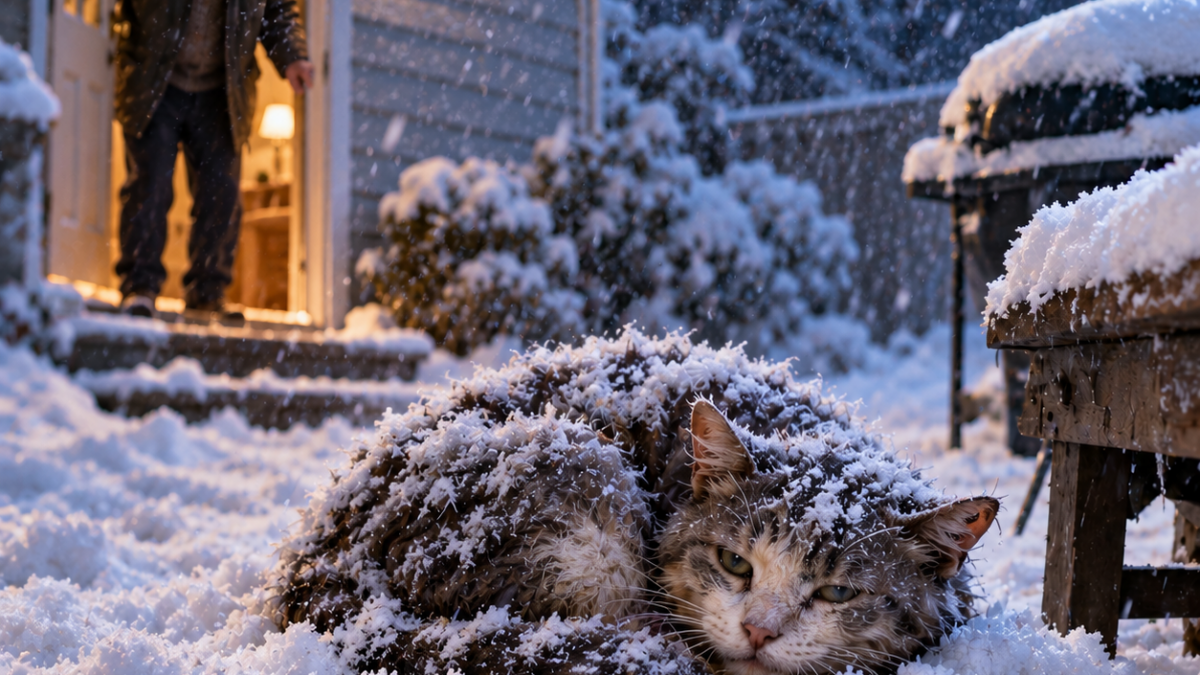
Under the bench, curled into herself near the old grill, was a small gray shape.
She was covered in snow.
Her whiskers were frosted white.
Her body trembled so hard it seemed less like shaking and more like flickering.
She looked too small.
Too old.
Too close to giving up.
“Oh God,” I said.
I reached for her.
She did not run.
Of course she did not run.
She had never been running from me.
She had been waiting to be let back in.
I gathered her against my chest.
She was cold.
Colder than any living thing should be.
Light as kindling.
Her fur was wet against my hands.
“I’m sorry,” I said.
Then again.
“I’m sorry.”
Then again.
I kept saying it because there was nothing else left.
I carried her inside, stumbling once on the porch steps, clutching her too tightly and then loosening my grip because I was afraid of hurting her.
The kitchen was still full of snow.
The back door still open.
I kicked it shut.
Then I wrapped Millie in Rose’s scarf.
That blue wool scarf.
The one I had been angry about.
The one Millie had touched because it smelled like home.
I sat with her by the heater.
My whole body shook now.
Not from cold.
From horror.
From the knowledge of what I had almost done.
Millie lay in my lap wrapped in Rose’s scarf. Her eyes were half closed. Her breathing was shallow.
I rubbed her gently through the wool.
“Stay,” I whispered. “Please stay. Please, sweetheart. I know you. I know you now.”
The phone rang.
I nearly jumped out of my skin.
It was Claire.
My daughter.
I stared at the screen until her name became familiar.
Then unfamiliar.
Then familiar again.
I answered.
“Dad?”
I could not speak.
“Dad, are you okay?”
“I put Millie out,” I said.
Silence.
“What?”
“I forgot. I forgot her. I thought she was a stray. Claire, I put her out in the snow.”
“Oh, Dad.”
“I found her. She’s cold. She’s so cold.”
Claire’s voice changed immediately.
“I’m coming.”
“The roads—”
“I’m coming. Keep her warm. Wrap her in blankets. Not too hot. Warm. I’ll call the emergency vet on the way.”
“I’m sorry.”
“I know, Dad.”
“I didn’t know her.”
“I know.”
“I didn’t know Rose was gone.”
My daughter was quiet.
Then very softly, she said, “I know.”
That broke me again.
Because this was not the first bad day.
Of course it was not.
It was only the first one I had returned from in time to see the damage clearly.
Claire arrived twenty-five minutes later.
Maybe thirty.
I do not know.
She came through the front door with snow in her hair, boots untied, coat half-zipped, face pale with fear.
She found us by the heater.
Millie wrapped in Rose’s scarf.
Me bent over her like a man praying to a god he had not spoken to in years.
Claire knelt beside us.
She touched Millie’s ears.
“Hi, sweet girl,” she whispered.
Millie’s eyes opened.
Just a little.
Claire exhaled.
“She’s responsive.”
“I killed her.”
“No.”
“I did.”
“No, Dad. She’s here.”
“I threw her out.”
Claire looked at me.
I saw exhaustion in my daughter’s face then.
Not anger.
Something harder.
The tired love of a person who has been losing her father in pieces while still trying to keep him safe.
“We’re going to the vet,” she said.
At the clinic, they took Millie from my arms.
I almost refused to let go.
Claire had to put one hand over mine.
“Dad. Let them help her.”
I released her.
The empty space in my arms felt like punishment.
The veterinarian was young.
Too young, I thought at first, though everyone looks young when you are eighty-one.
She was kind but direct.
Mild hypothermia.
Shock.
Possible respiratory stress from exposure.
Old age complicating recovery.
They warmed Millie slowly.
Checked her heart.
Her lungs.
Her paws.
Her ears.
No frostbite yet, thank God.
No immediate organ failure.
But she was old.
Frail.
The vet said they wanted to keep her for observation overnight.
I sat in the waiting room with Rose’s scarf in my hands.
It smelled like snow now.
Snow and cat and old wool.
Claire sat beside me.
For a while, neither of us spoke.
Then she said, “Dad, we need to talk about more help.”
I closed my eyes.
“I know.”
“You can’t be alone during storms anymore.”
“I know.”
“And the stove—”
“I know.”
“And Millie—”
My throat closed.
Claire softened.
“She loves you.”
“I don’t deserve it.”
“That isn’t how animals love.”
“I hurt her.”
“Yes.”
The honesty stung.
Claire reached for my hand.
“But you went after her.”
“Too late.”
“In time.”
I looked at the scarf.
“I read your mother’s notebook.”
Claire nodded.
“She wrote it before she died.”
“I forgot she died.”
“I know.”
“How many times?”
Claire did not answer.
That was answer enough.
The next morning, they let us see Millie.
She was in a warmed kennel, curled on a towel.
Smaller than I remembered.
Older than I wanted to see.
When the vet opened the door, Millie lifted her head.
I expected her to shrink away from me.
I would have understood.
I almost hoped she would.
Punishment would have made sense.
Instead, she made one rough little sound.
The same sound she had made in the kitchen.
Then she tried to stand.
Her legs wobbled.
I reached for her.
Stopped myself.
“May I?” I asked the vet.
The vet nodded.
I slipped my hands beneath Millie and lifted her carefully.
She weighed almost nothing.
I sat in the little exam room chair with Rose’s scarf over my lap, and the vet placed Millie against my chest.
For a moment, she was still.
Then she pressed her head beneath my chin.
Just like that.
No anger.
No lesson.
No demand that I explain myself.
Warmth given back where cruelty had been.
I cried harder then than I did at Rose’s funeral.
That is the truth.
At Rose’s funeral, I was surrounded by people.
Everyone watched.
Everyone expected grief.
So some part of me stood straight and shook hands and thanked them for coming.
But in that little exam room, with my old cat pressing her cold nose beneath my chin, there was no dignity left to protect.
“I’m sorry,” I whispered into her fur.
Millie purred.
Faint.
Rough.
Uneven.
But there.
The sound went through me like absolution I had not earned.
We brought her home that afternoon.
Claire stayed three days.
She made changes.
Practical ones.
Daughter changes.
A new lock high on the back door, not to trap me, she said, but to slow me down.
A sign taped above the knob:
STOP. IS MILLIE INSIDE? CALL CLAIRE IF CONFUSED.
A larger note near the stove:
DO NOT COOK ALONE.
A picture of Rose on the refrigerator with dates written beneath it.
ROSE WALLACE.
YOUR WIFE.
MARRIED 54 YEARS.
DIED JANUARY 18, THREE WINTERS AGO.
SHE LOVES YOU.
Beside it, Claire taped a photo of Millie.
MILLIE.
YOUR CAT.
SHE BELONGS HERE.
SHE LOVES YOU TOO.
At first, I hated the signs.
They made the house look like evidence of my failure.
Then one morning, two weeks later, I woke up angry because I thought a stranger had left a gray cat on my bed.
I sat up.
Millie blinked at me from beside my hip.
For one terrifying second, I did not know her.
Then I saw the picture on the nightstand.
MILLIE.
YOUR CAT.
SHE BELONGS HERE.
I read it twice.
The fog thinned.
I reached out.
Millie sniffed my fingers.
Then pushed her head into my palm.
The sign had not humiliated me.
It had protected her.
That is when I stopped hating them.
My life became smaller after that.
Claire arranged for a neighbor, Mrs. Alvarez, to check in every evening.
A home aide began coming four mornings a week.
Then five.
My license disappeared from my wallet, though everyone insisted I had agreed to stop driving.
Maybe I did.
Maybe I did not.
The stove knobs came off and were placed in a drawer.
Meals appeared in containers with labels.
Monday lunch.
Tuesday dinner.
Soup, microwave two minutes.
Millie’s food moved to a low shelf with a bright note:
MILLIE EATS AT 8 AND 5.
I resented all of it sometimes.
Then I would find Millie sleeping in the sun, alive because people had decided my pride mattered less than her safety.
That helped.
She forgave me faster than I forgave myself.
Animals often do.
Or maybe forgiveness is the wrong word.
Maybe Millie simply continued.
She still slept near my knees.
Still scratched at the bedroom door if I closed it.
Still followed me to the bathroom in the morning, slow and stiff, her old claws clicking on the hall floor.
Still cried when I forgot my pills.
Still climbed onto my chest on bad nights.
The first time she did that after the storm, I woke in darkness calling Rose’s name.
I was sure my wife was in the next room.
Sure she needed me.
Sure something terrible would happen if I did not find her.
I tried to get out of bed.
Millie climbed onto my chest.
She was not heavy.
Barely more than a folded blanket.
But she was warm.
Real.
Present.
She pressed her forehead beneath my chin and purred that broken little purr.
I froze.
My hands gripped the blanket.
The room slowly returned.
My bedroom.
My old dresser.
The photograph on the wall.
Rose gone.
Millie here.
I cried quietly so I would not wake Claire, who was sleeping in the guest room that week.
Millie stayed until my breathing settled.
Rose had written the truth.
The little soul had stayed behind to love me for both of them.
I do not know how much time I have left.
That is a frightening sentence, but also a plain one.
I know my memory will keep leaving me in pieces.
I know there may come a day when I look at Claire and see only a kind woman with sad eyes.
I know there may come a day when I stand in my own kitchen and do not know which drawer holds spoons.
I know there may come a day when Rose’s notebook no longer leads me back.
But I know something else too.
Love leaves tracks deeper than memory.
It hides in the body.
In habits.
In the way my hand lowers automatically to the side of the chair because Millie likes to pass beneath it.
In the way I wake when she cries.
In the way she still comes to me, even after what I did.
There are mornings now when I remember everything.
Rose’s laugh.
The hospital bed.
The funeral.
Millie arriving at the shelter door in Claire’s arms because Rose had insisted we needed someone alive in the house.
The storm.
The bench.
The snow on Millie’s fur.
The scarf.
Those mornings hurt.
But they are gifts too.
Because on those mornings, I can kneel beside Millie’s food bowl, scratch the soft place under her chin, and say her name with full knowledge.
“Millie.”
She always answers.
Not loudly.
Not dramatically.
Just one rough little sound.
Here.
That is what it means to me.
Here.
Still here.
Still yours.
Still willing.
Three months after the storm, Claire brought me a new notebook.
Blue this time.
She said the red one was getting worn.
On the first page, she copied Rose’s words.
First, I love you.
Second, I died three winters ago.
Then she added pages of her own.
Dad, if you are reading this, you may be confused. That’s okay. Sit down. Breathe. Call me. Look for Millie. Do not open the back door unless someone is with you.
On the next page, she wrote:
Millie is old. She gets cold easily. She belongs inside.
Then:
If she looks like a stranger, read this again. She is not a stranger. She is family.
I read that page every morning now.
Even on good days.
Especially on good days.
Because good days make a man arrogant. They make him believe he can trust himself completely.
I cannot.
Not always.
That does not mean I am gone.
It means I need help staying found.
Millie helps.
Claire helps.
Rose still helps through ink on paper.
That is love too.
A map left behind for the person you know may one day lose the road.
Last week, snow came again.
Not like that storm.
Gentler.
Soft flakes falling through afternoon light.
I sat by the window with Millie in my lap.
Rose’s scarf was around my shoulders.
Millie’s paws rested on my arm.
Outside, the yard turned white.
The bench near the fence disappeared beneath a clean layer of snow.
I looked at it for a long time.
Millie lifted her head.
Maybe she heard my breathing change.
Maybe she remembered too.
“I’m sorry,” I told her again.
She blinked slowly.
Then lowered her head back onto my arm.
Maybe old cats understand that some apologies must be said more than once.
Maybe they simply prefer warmth to guilt.
Either way, she stayed.
The mind can lose its way.
I know that better than most.
It can turn a kitchen into a stranger’s room.
It can turn a beloved cat into an intruder.
It can send a man waiting for a wife who is not coming home.
It can make you cruel without meaning to be.
That is the part people do not like to say out loud.
Confusion is not always soft.
Sometimes it has teeth.
Sometimes it opens doors in storms.
But love—
Love is stranger and stronger than memory.
Love was Rose writing the notebook before I needed it.
Love was Claire driving through snow because I had lost myself.
Love was Millie waiting under the bench instead of running into the dark.
Love was the little gray cat pressing her frozen head against my chest after I had failed her.
Love was her climbing onto me again the next bad night anyway.
The world calls old things worn out.
Old men.
Old scarves.
Old houses.
Old cats with cloudy eyes and stiff hips.
But sometimes the old and worn-out things are the ones still doing the most sacred work.
Holding memory.
Keeping watch.
Waiting by doors.
Staying warm enough for someone else to find their way back.
Millie is asleep beside me now.
She is wrapped in Rose’s scarf, the same one I once held against my chest like it belonged only to the past.
It belongs to all three of us now.
Rose, who wore it.
Millie, who survived it.
Me, who was forgiven beneath it.
The snow is quiet tonight.
The back door is locked.
There is a note above it.
There is soup in the microwave with a label from Claire.
There are two mugs on the table because sometimes I still set one out for Rose.
I do not scold myself for that anymore.
If love can outlive memory, it can surely sit in an empty chair.
And Millie—
Millie is inside.
Warm.
Safe.
Home.
Exactly where she always belonged.








