I Thought I Rescued a Stray Cat on My Evening Walk—Then He Led Me to the Empty House Where He’d Been Waiting for His Owner.
PART3:
He blinked slowly.
Then stood.
Stretched.
And walked directly toward me.
No hesitation.
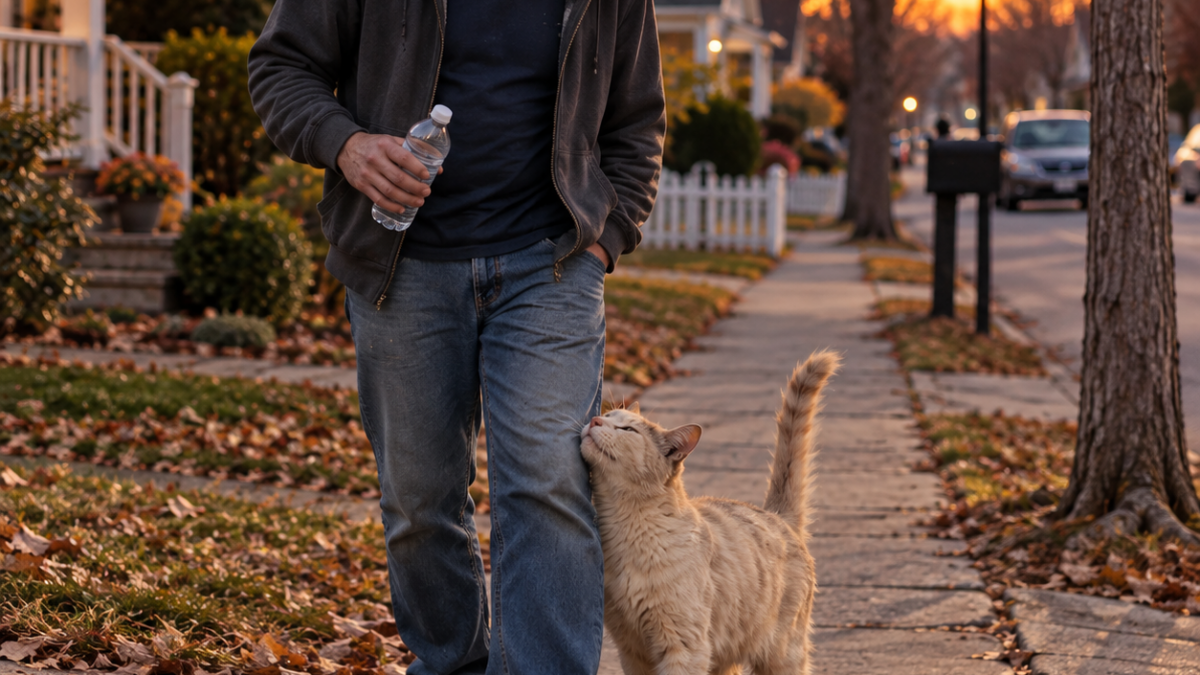
He rubbed against my shin once.
Then sat on top of my sneaker.
I laughed.
Actually laughed.
It startled me.
I had laughed since Mom died.
Of course I had.
But not like that.
Not unexpectedly.
Not because some ridiculous animal had decided my foot was furniture.
“Well,” I said, “I guess we’re doing this.”
I carried water on my walks.
I poured some into the bottle cap.
He drank immediately.
Again.
Again.
Then bumped his forehead against my ankle.
When I resumed walking, he followed.
I expected him to stop after one house.
He didn’t.
Two houses.
Still there.
At the corner, I turned.
He turned.
“You know you’re a cat, right?”
He continued.
By the time I reached my porch, I had apparently acquired an escort.
I gave him water in a bowl.
Then some cooked chicken.
He ate slowly.
That was my first clue he had belonged to someone.
Truly hungry feral animals often eat as if the bowl might disappear.
This cat ate like he remembered dishes.
He finished.
Washed one paw.
Then sat beside my front door and stared at it.
“You don’t live here.”
Blink.
“I mean it.”
Blink.
“I am not becoming a cat person because you sat on my shoe.”
He turned his head toward the door.
I opened it.
He walked inside.
That was negotiation.
I named him Fortunato that evening.
Lucky.
Mostly because I had taken Spanish for three years and wanted my useless education to accomplish something.
I told myself he was lucky.
Lucky I stopped.
Lucky I had chicken.
Lucky I did not leave him outside.
That interpretation lasted approximately three days.
I posted his photograph online.
Checked neighborhood groups.
Called the local shelter.
No reports matching him.
I took him to a vet to scan for a microchip.
Nothing.
The veterinarian said he was thin but healthy enough.
No obvious injuries except old tear in his ear.
Probably had been outside a while.
I bought cat food.
Litter.
A cheap box.
A blanket.
A scratching pad.
Everything temporary.
I said “temporary” each time I put another item into the cart.
The cashier did not believe me.
Fortunato adjusted quickly.
Too quickly.
He knew what a litter box was.
Knew couch rules, though he ignored them.
Knew refrigerator sounds.
Knew opening a can could be meaningful.
He slept in the green armchair that had belonged to my mother.
I nearly moved him the first time.
That chair was one of the few things I kept from her apartment.
Faded green fabric.
Wood arms worn pale at the edges.
Mom refused to replace it.
“A good chair earns its wrinkles.”
Fortunato jumped into it the first night.
Turned around twice.
Went to sleep.
I stood in the doorway.
“Of course.”
The third evening he refused dinner.
I opened his food.
Set bowl down.
He sniffed.
Walked to porch door.
“Seriously?”
He looked back.
One sharp meow.
“What?”
He walked down the steps.
Stopped.
Looked back again.
I followed.
He went six houses down.
Past the blue ranch.
Past the brick duplex.
Past a split-level with peeling shutters.
Then to a little yellow house I had stopped noticing.
Grass too high.
Mailbox overflowing.
Curtains drawn.
A plastic wind chime hung from porch.
The cat climbed the steps.
Pressed his nose against front door.
Then scratched.
Softly.
Not trying to get in.
Almost like knocking.
And suddenly I remembered the woman.
Helen Carter.
Mrs. Carter.
Tiny.
White hair.
Pink cardigans.
I had seen her gardening.
Carrying groceries.
Sitting on porch with coffee.
For five years we lived six houses apart.
I had probably waved four times.
Then one spring afternoon an ambulance came.
After that, house went dark.
Fortunato scratched again.
A strange sound came from him.
Small.
Broken.
I crouched.
“Oh.”
He looked at me.
“You had a home.”
Through front window I could see a faded armchair.
Empty.
A dry water bowl by wall.
One little toy mouse lying beside rug.
This cat was not wandering.
He was waiting.
The next morning I checked mailbox because that felt less wrong than breaking into somebody’s house.
Inside was a forwarding notice with assisted-living address.
Oak Meadow Residence.
Across town.
I stood there holding it.
Then almost put it back.
This is where people decide whether they are going to become involved.
I told myself:
Maybe family handled it.
Maybe Mrs. Carter did not want the cat.
Maybe she had memory problems.
Maybe Oak Meadow did not allow pets.
Maybe this was none of my business.
All reasonable.
All convenient.
Back home, Fortunato sat beside my car keys.
Stared at me.
“You are manipulative.”
Blink.
“I don’t know this woman.”
Blink.
“I waved at her four times.”
He put one paw on the keys.
That was how a cream-colored cat with one torn ear turned me into a trespasser in other people’s emotional lives.
Oak Meadow looked nicer than I expected.
Landscaped courtyard.
Wide windows.
Bird feeders.
The lobby smelled faintly of coffee and disinfectant.
I carried Fortunato in a borrowed carrier.
At the desk, I said:
“I’m looking for Helen Carter.”
The receptionist checked.
“Are you family?”
“No.”
“Friend?”
I hesitated.
“Neighbor.”
That felt dishonest.
Acquaintance was more accurate.
Barely.
“What is this regarding?”
I lifted carrier slightly.
“Her cat, I think.”
That got attention.
Ten minutes later, a staff member led me to a sitting room.
Mrs. Carter sat near window.
Smaller than I remembered.
White hair cut shorter.
Pink sweater.
Hands folded.
She looked toward me politely.
Then the carrier made one sound.
Mrs. Carter froze.
I put it down.
Opened door.
The cat stepped out.
For one second, nobody moved.
Then Mrs. Carter covered her mouth.
“Oh.”
Her voice broke.
“My Frankie.”
Frankie.
Not Fortunato.
He ran.
Not cautiously.
Not politely.
He leapt into her lap so hard she almost lost balance.
She grabbed him with both arms.
Pressed her face into dusty fur.
“My baby.”
Frankie purred.
Deep.
Loud.
His entire body relaxed.
Mrs. Carter cried into his neck.
I stood three feet away feeling like an intruder at a reunion I had accidentally arranged.
“I thought you were gone.”
She kept saying it.
“I thought you were gone.”
Eventually she looked at me.
“When they took me to hospital, I think someone left door open.”
Her voice shook.
“My son looked everywhere.”
She stroked Frankie’s face.
“I kept praying somebody kind found him.”
Then she looked straight at me.
“But I think he found someone lonely.”
That sentence hit me in a place I had been protecting.
I started crying.
Embarrassing.
Immediate.
Mrs. Carter did not seem surprised.
Frankie stayed in her lap while I sat beside her and told a near stranger about my mother.
Six months.
Quiet house.
Evening walks.
The way I sometimes drove slowly after work because going home felt unnecessary.
Mrs. Carter squeezed my hand.
“Cats know.”
I smiled through tears.
“Do they?”
“They know where the cracks are.”
That sounded like something Mom would have said.
I brought Frankie home that evening with Mrs. Carter’s blessing.
Oak Meadow did not permit full-time pets in her section.
Her mobility had declined.
She had fallen at home.
Hospitalized.
Then transferred.
Her son was managing sale of house.
She could not take Frankie back.
She kissed his forehead before I left.
“You stay with her.”
Then to me:
“Bring him sometimes?”
“Yes.”
Every Saturday.
That became our arrangement.
First Saturday, Mrs. Carter had brushed her hair.
Lipstick.
Pink sweater.
Treat bag waiting.
When we walked in, her whole face changed.
Frankie climbed into her lap.
Second Saturday, same.
Third.
Fourth.
She laughed more.
Talked more.
Told me stories.
Her husband.
Daniel’s childhood.
Her garden.
Frankie’s habit of digging basil plants out of pots.
My house changed too.
Frankie did not make it noisy.
That isn’t what cats do.
He made silence inhabited.
When I sat on couch, he climbed beside me.
Placed one paw on my wrist.
Not dramatic.
Just contact.
At night, he slept in Mom’s chair or at my feet.
I still missed Mom.
But grief was no longer the only living thing in house.
I thought that was the ending.
Stray cat.
Lost owner.
Lonely woman.
Assisted-living visits.
Maybe a lesson about kindness.
The kind of story people like because everyone knows who helped whom.
Then, three Saturdays later, a man stepped in front of me at Oak Meadow and said:
“You need to stop bringing that cat here.”
Frankie was pressed to my chest.
Purring.
Behind the man, Mrs. Carter sat by window.
Her cardigan was buttoned wrong.
Her eyes stayed fixed on Frankie.
“I’m sorry?”
“I said you need to stop.”
He was around my age.
Maybe fifty.
Tall.
Good coat.
Exhausted face.
Dark circles.
Not mean-looking.
Worn.
“I’m Daniel Carter.”
Everything clicked.
Helen’s son.
“Mrs. Carter talks about you.”
His jaw tightened.
“I know.”
Behind him, she lifted hand.
“Frankie?”
The cat leaned toward her voice.
Daniel moved slightly in front of me.
Cold moved through my chest.
“I bring him every Saturday.”
“I know.”
“She looks forward to it.”
“I know.”
“Then why—”
“Because after you leave, she cries for two days.”
That stopped me.
“She asks why he can’t stay.”
Daniel’s voice remained low.
“She asks why she can’t go home. She asks why I let strangers take her cat when she was in hospital.”
Strangers.
“I didn’t take him.”
“I know.”
His eyes softened for half second.
“She doesn’t always.”
I looked past him.
Mrs. Carter smiled at Frankie.
That beautiful open smile.
“How can that be bad?”
Daniel closed eyes.
When he opened them, wet.
“I have spent six months helping my mother accept she cannot safely live alone.”
He swallowed.
“Then you show up every week with the one thing that makes her think she can go back.”
I wanted to tell him he was cruel.
But he was crying.
That complicated everything.
“She’s happy when he’s here.”
“I know.”
“That matters.”
“It does.”
“Then—”
“And afterward?”
I had not stayed afterward.
Not long.
I brought Frankie.
Watched joy.
Then went home.
Daniel stayed with aftermath.
The questions.
The accusations.
The grief.
“I didn’t know.”
“No.”
Not angry.
Just tired.
“You didn’t.”
Mrs. Carter called again.
“My Frankie.”
Daniel looked toward his mother.
Then at me.
“Please.”
He did not sound controlling.
He sounded exhausted.
“Don’t make this harder.”
That is the thing nobody tells you about doing good.
Sometimes kindness is not clean.
Sometimes two loving people can stand on opposite sides of the same choice.
I left with Frankie.
Without letting Mrs. Carter hold him.
I hated myself before I reached parking lot.
She did not scream.
Did not protest.
She sat still.
Her hand slowly lowered.
Frankie twisted in my arms, looking backward.
In car he made one confused sound.
“I know.”
Except I did not.
That night, he sat at front door.
Would not come to couch.
Tail wrapped around paws.
Waiting.
“I’m sorry.”
He turned toward door.
As if apology was beside point.
The next Saturday I did not bring him.
I cleaned my refrigerator.
Folded towels.
Made coffee.
Anything except think about Oak Meadow.
At noon Frankie jumped onto kitchen table and put one paw on my car keys.
“No.”
Stare.
“You heard Daniel.”
Stare.
“He’s her son.”
Frankie bumped keys.
They slid.
“Don’t.”
He bumped again.
They hit floor.
And I started crying.
Because he had done this before.
He had sat beside my keys and made me go somewhere I was afraid to go.
Only this time there was no simple rescue waiting at end.
I drove to Oak Meadow alone.
Mrs. Carter saw me.
Smiled.
Then looked at my arms.
Smile disappeared.
“Where’s Frankie?”
I sat.
“He’s okay.”
“Is he sick?”
“No. He’s home.”
“Why?”
There were a hundred honest answers.
Your son asked.
I’m afraid I’m hurting you.
I don’t know what kindness is anymore.
I don’t know where my right to help ends.
I said:
“I thought we could talk today.”
She nodded.
Polite.
We talked fourteen minutes.
I remember because I watched clock.
Lunch pudding too sweet.
Woman across hall snored.
She used to grow basil.
Then she went quiet.
“Frankie liked basil.”
Small smile.
“He knocked pots over and pretended it wasn’t him.”
Then:
“I had a home.”
The words were almost a whisper.
I held her hand.
She let me.
Did not squeeze.
Daniel waited near lobby.
“Thank you.”
I nodded.
I wanted his gratitude to make me feel virtuous.
Instead, I felt hollow.
At home Frankie sat in Mom’s green chair.
“I did what he asked.”
Slow blink.
I hated how much that looked like judgment.
Wednesday evening, I walked.
Same route.
But something had changed.
Not street.
Me.
I noticed newspapers piled at blue house.
A porch light burning before sunset.
A man sitting in parked car staring straight ahead for ten minutes before getting out.
Six houses down, a FOR SALE sign stood in Mrs. Carter’s yard.
Grass cut now.
Mailbox cleared.
I stopped.
“You’re the woman with cat.”
Daniel stood behind me beside gray sedan.
Cardboard box on trunk.
“I’m cleaning out house.”
“I see.”
“She can’t come back.”
“I know.”
He gave short humorless laugh.
“You say that like it’s easy to know.”
“It isn’t.”
He looked at me differently.
Then:
“I searched for Frankie.”
I stayed quiet.
“Every night for almost two weeks.”
He rubbed his mouth.
“Food under porch. Flyers. Walked block calling him.”
His voice cracked.
“I probably looked insane.”
“No.”
“When Mom got sick, everything happened at once.”
Hospital.
Doctors.
Forms.
Bills.
Rehab.
Oak Meadow.
House.
Insurance.
Power of attorney.
Every person needed signature.
Every person said he was doing right thing.
Then he looked at yellow house.
“Nobody tells you what to do with cat.”
There was his anger.
Not cruelty.
Failure.
“I told her he probably found a family because that sounded better than saying I failed him too.”
“You didn’t fail him.”
“He got out.”
“He found me.”
“He found you because he was looking for her.”
Daniel’s eyes filled.
“Yes.”
He opened box.
Mug.
Mail.
Photos.
Ceramic cat with broken ear.
At bottom, red collar.
Tiny bell.
Frankie’s.
I reached before thinking.
Daniel handed it to me.
“He hated that thing.”
“Your mom put it on him so she could hear him?”
He smiled.
“Yes.”
“He still walks like he expects applause.”
Daniel laughed.
It surprised both of us.
Then he said:
“I don’t want to be villain in your story.”
“You aren’t.”
“You think I’m wrong.”
I looked at house.
“I think you’re trying to protect her from pain.”
“Yes.”
“And maybe we confuse pain with love sometimes.”
His eyes narrowed.
“Pain can hurt people.”
“Yes.”
“Hope can hurt people too.”
That was true.
A visit can comfort.
Then wound.
A memory can heal.
Then reopen.
There are no clean lines.
“She thinks you’re family now,” Daniel said.
“I’m not.”
“No.”
The truth stung.
Then:
“Maybe that’s not worst thing.”
He left collar with me.
“For Frankie.”
That night I placed it on coffee table.
Frankie jumped up.
Sniffed.
Stopped.
Touched bell.
Tiny sound.
Then he crawled into my lap and pushed his face against my wrist.
First time since hallway.
Friday Oak Meadow called.
Ms. Reed, administrator.
“Mrs. Carter has been asking for Frankie.”
“I thought Daniel said no.”
“He has concerns.”
“That sounds like no.”
“It isn’t exactly.”
They had a family-council meeting.
Other residents had similar issues.
Pets left behind.
Families divided.
Therapy animal questions.
“Would you come speak?”
My instinct:
Absolutely not.
I did not speak at meetings.
I did not insert myself into family matters.
I had lived forty-six years by being polite and separate.
Wave.
Smile.
Do not interfere.
Then Frankie jumped onto counter and looked at me.
I sighed.
“What time?”
The meeting room had long table and bad coffee.
Six family members.
Two staff.
Daniel.
Ms. Reed.
Me.
No Frankie.
Daniel insisted.
“If we’re deciding whether cat creates distress, we shouldn’t use him as emotional evidence.”
I hated that he was right.
A woman with silver glasses spoke first.
“My father had dog twelve years. When we moved him here, he asked every day. We stopped mentioning dog because it made him upset.”
Man across table:
“My aunt eats better after therapy-animal visits.”
“That isn’t same as bringing back pet they lost.”
“Why not?”
“Because it reopens wound.”
“Maybe wound is already open.”
Daniel said:
“My mother cries after every visit.”
Ms. Reed nodded.
“That is true.”
Then:
“She also laughs during every visit.”
Daniel looked down.
“That is also true.”
A staff member said residents got upset after family visits too.
Nobody suggested banning families.
The room changed.
The man across table leaned forward.
“Maybe question isn’t whether emotions happen.”
He paused.
“Maybe question is whether we only allow easy emotions here.”
Easy emotions.
Smiles.
Thank-yous.
Compliance.
Not longing.
Not grief.
Not anger.
Not the inconvenient evidence that people still love lives they cannot return to.
Silver glasses removed her glasses.
“My father’s dog died two years ago.”
Her voice shook.
“He asks for her and breaks down.”
She wiped lenses.
“I’m not heartless.”
Nobody said she was.
“I’m tired.”
There it was.
Under so many hard choices.
Exhaustion.
Adult children raising children while caring for parents.
Staff stretching two hands across twenty people.
Older adults losing homes and routines.
Neighbors staying separate because seeing creates responsibility.
Ms. Reed asked me to speak.
I stood.
“I don’t know right policy.”
That surprised them.
“I’m not family. Daniel is right.”
He looked up.
“I barely knew Mrs. Carter before this. I lived six houses away for five years and waved at her maybe four times.”
My throat tightened.
“I had years to know her. I didn’t.”
Nobody moved.
“I found Frankie because he found me first.”
Small smiles.
“I thought bringing him here was obviously kind.”
I looked at Daniel.
“It isn’t obvious.”
He nodded once.
“She laughs when he comes. She cries when he leaves.”
I took breath.
“Maybe answer isn’t preventing sadness.”
I swallowed.
“Maybe answer is not leaving people alone with sadness afterward.”
Silence.
“If he visits, somebody stays.”
“If she talks about home, we don’t promise what isn’t possible, but we don’t shut her down because it hurts.”
“If she cries, we don’t automatically call visit failure.”
I looked around.
“I’m not here demanding anything.”
My voice shook.
“If visits are allowed, I’ll follow rules. Stay whole time. Come back next day if needed.”
Then I looked at Daniel.
“And if you still say no, I’ll respect it.”
He held my eyes.
“But please don’t say no only because missing him is uncomfortable for us to witness.”
Daniel pushed chair back.
Walked out.
My stomach dropped.
Ms. Reed followed.
Meeting continued.
Allergies.
Cleaning.
Supervision.
Consent.
Emergency contacts.
The ordinary details that keep kindness from becoming chaos.
Twenty minutes later Daniel returned.
Eyes red.
He stood.
“I don’t want my mother used as symbol.”
No one spoke.
“She is not a lesson.”
His voice shook.
“She’s my mom.”
I nodded.
He looked toward door.
“But I also don’t want fear making every decision.”
His breath caught.
“I’m so afraid of losing more of her that I think I started taking away pieces she still had.”
Silver-glasses woman covered mouth.
Daniel looked at me.
“She can see Frankie.”
I exhaled.
“But I’m there.”
“Okay.”
“And afterward we stay.”
“Yes.”
“No dropping cat in her lap, letting her light up, then disappearing and leaving her with ache.”
“Yes.”
“If it becomes too much, we pause.”
“Yes.”
He nodded.
Not friendship.
Not forgiveness.
A workable agreement.
The next afternoon I brought Frankie.
Private side room.
Mrs. Carter waited.
Daniel sat beside her.
I opened carrier.
Frankie walked out with confidence of somebody arriving at property he owned.
“My Frankie.”
He jumped into her lap.
Turned twice.
Settled.
Her hands came down over him.
Slowly.
Reverently.
For several minutes nobody spoke.
Just purring.
Daniel looked away.
I pretended not to see him wipe his face.
Then Mrs. Carter opened one eye.
“Daniel.”
“Yes, Mom?”
“You look awful.”
I coughed to hide laugh.
Daniel stared.
Mrs. Carter smiled.
“You should pet cat. It helps.”
Something in his face broke open.
He reached.
Two fingers between Frankie’s ears.
“Still bossy.”
“He gets it from me.”
We laughed.
After visit, Mrs. Carter cried.
Exactly as Daniel warned.
But nobody panicked.
Daniel held one hand.
I held other.
Frankie sat between us washing paw like he had organized entire therapeutic intervention himself.
“I want to go home.”
Daniel tightened.
“I know.”
“My basil.”
“I know.”
“My blue mug.”
“I brought it.”
“You did?”
“It’s in your room.”
She turned toward me.
“And Frankie?”
Daniel swallowed.
“Frankie lives with her now.”
“With you?”
“Yes.”
Mrs. Carter studied my face.
“You lonely?”
Tears came.
“Less than before.”
She nodded.
“Good.”
Then looked at Daniel.
“You lonely?”
He froze.
“I’m okay.”
Her eyebrows narrowed.
“That is not what I asked.”
For a moment, there was Helen Carter.
Mother.
Not patient.
Not resident.
Not fragile old woman.
Mother.
Daniel’s eyes filled.
“Yes.”
He looked down.
“Sometimes.”
She touched his cheek.
“My boy.”
And there it was.
Memory imperfect.
Body weak.
But love completely intact.
Saturdays became ritual.
Daniel came when possible.
I came every week.
Frankie behaved like celebrity with no manners.
Oak Meadow created supervised animal-visit hour after other residents asked.
That caused arguments.
Of course.
One daughter said cats did not belong in care facility.
A grandson said his grandmother had not smiled in months until Frankie sat on her walker.
Staff worried about workload.
Others said joy was care too.
Someone asked liability.
Somebody else asked who was responsible for what happened when people spent all day staring at televisions because meaningful messiness was considered too complicated.
Everybody was partly right.
That made conversation worth having.
Oak Meadow wrote rules.
One supervised hour.
Vaccination records.
Permission.
Allergy screening.
Cleaning procedures.
No animals in dining area.
Common sense.
Frankie became first regular visitor.
He ignored expensive cat bed Ms. Reed bought.
Chose paper bag.
Stole cracker from Mr. Bell.
Fell asleep through forty-minute story from retired music teacher.
Ignored one woman until she stopped saying “pretty kitty” and called him “sir.”
Mrs. Carter was always first.
That was Daniel’s rule.
Twenty minutes.
Her lap.
Nobody argued.
Sometimes she called him Frankie.
Sometimes Fortunato because I had told her my accidental name.
Sometimes “little prince.”
Once she called him Daniel.
Daniel shrugged.
“Honestly, fair.”
My house changed.
Curtains stayed open.
I put second chair on porch.
I bought basil for Mrs. Carter and killed it in nine days.
Daniel brought replacement.
“Try not to commit another herb tragedy.”
“Don’t get attached.”
We were not friends.
Not exactly.
We were two people tied together by his mother and a cat with no respect for boundaries.
But conversations grew.
Parking lot.
Vending machine.
Outside yellow house during sale.
He told me about his children.
Wife.
Work.
How elder care turned love into paperwork.
Forms.
Bills.
Appointments.
I told him about Mom.
How sometimes I still bought her tea.
How I had cleaned her closet too quickly because everyone said it would help.
How later I wished I had saved one more sweater with her smell.
Daniel listened.
One evening he asked:
“Do you think we did right thing?”
I looked through glass.
Mrs. Carter talking with both hands.
Frankie in lap.
“I don’t know.”
He looked surprised.
“I don’t know if this is right.”
I said.
“I just know we stopped doing nothing.”
He nodded.
“Maybe that’s best we get.”
That sentence changed me.
We live in a culture obsessed with clean answers.
Set boundaries.
Protect peace.
Cut people off.
Mind your business.
Those ideas can be necessary.
But sometimes “not my problem” is fear in respectable clothes.
I had minded my business past Mrs. Carter for five years.
Past weeds.
Pink cardigan.
Coffee.
A whole life six houses away.
Frankie did not mind his business.
He scratched door.
Made us look.
One Saturday, Mrs. Carter asked to go home.
Daniel said no immediately.
“No, Mom.”
“I want to say goodbye.”
“House is empty.”
“I know what empty means.”
Sale closed next day.
“There’s nothing there.”
“My memories are there.”
“That’s why I don’t think it’s good.”
Mrs. Carter’s mouth tightened.
For a moment she looked decades younger.
“You keep saying good for me.”
Daniel went still.
“But you mean easier for you.”
The room became silent.
He stood.
“I’m trying.”
“I know.”
“So am I.”
Frankie sneezed.
Mrs. Carter laughed.
Daniel did not.
He walked out.
I found him against exterior wall.
“I can’t take her there.”
“I didn’t say you should.”
“You’re thinking it.”
I was.
“She’ll fall apart.”
“Maybe.”
“That house is gone.”
“Not yet.”
He glared.
“You don’t deal with aftermath.”
“That isn’t true anymore.”
Long silence.
Then I asked:
“Does she need protection from goodbye?”
I hesitated.
“Or do you?”
His face changed.
I regretted question immediately.
Then he spoke.
“My dad died there.”
I hadn’t known.
“Mom found him in garden.”
Daniel stared at parking lot.
“I was twenty-eight. She sat on porch steps in robe with cup of coffee she never drank.”
He rubbed face.
“She never left after that. Not emotionally.”
“She stayed because leaving house felt like leaving him.”
Then she fell.
Hospital.
Everything accelerated.
“Suddenly I was supposed to dismantle my parents’ life without breaking my mother.”
He laughed once.
“I sold dining table from every birthday.”
“Donated Dad’s coats.”
“Threw away drawers full of batteries, keys, receipts, buttons.”
His eyes filled.
“I had to be practical.”
Then:
“Practical is a terrible word sometimes.”
“Yes.”
“If I take her back, I’m afraid she’ll see what I did.”
“What did you do?”
“I erased it.”
“No.”
He looked at me.
“You packed what you could carry.”
That sentence landed.
Next day, Daniel took Helen home.
One last time.
I met them with Frankie.
Mrs. Carter sat in wheelchair on front walk.
Grass newly cut.
Windows bare.
Wind chime gone.
Daniel’s hands gripped chair handles.
Frankie jumped out carrier.
Trotted to porch.
Pressed nose to front door exactly as he had first night.
Mrs. Carter made a sound like something trapped finally leaving her chest.
“My Frankie.”
Daniel knelt.
“I’m sorry.”
She looked at him.
“For what?”
“Not finding him.”
She took his hand.
“You were finding me.”
Daniel broke.
Head in her lap.
Helen stroked his hair.
I turned away.
Some things deserve privacy even when happening in open yard.
Frankie scratched door.
Daniel laughed through tears.
“Still demanding.”
“Can we go in?”
Daniel still had key.
Empty house sounded wrong.
Footsteps echoed.
Mrs. Carter visited kitchen.
Porch.
Spot where chair had been.
Daniel had saved chair.
“In my garage.”
She nodded.
Satisfied.
Then Frankie walked down hallway.
Scratched at closet door.
Daniel frowned.
“Nothing there.”
Frankie continued.
I opened door.
Bare floor.
Shelf.
Hangers.
He scratched at loose wooden panel along back.
Daniel pulled it.
Behind was small tin box.
Helen stared.
“Oh.”
Inside:
Photos.
Letters.
Thin envelope with Daniel’s name.
Another with mine.
Mine.
Mrs. Carter smiled, embarrassed.
“I wrote that after your first visit.”
“Then forgot where I put it.”
Daniel handed mine.
My first name in shaky writing.
Inside:
Thank you for stopping.
Four words.
I sat on floor.
Not:
Thank you for cat.
Not rides.
Not Saturdays.
Stopping.
That was miracle.
Everything else followed.
Daniel opened his later.
Alone.
I never asked what it said.
When he returned, he hugged his mother for long time.
After that, something settled.
Not perfectly.
Nothing real settles perfectly.
Mrs. Carter still missed home.
Daniel still worried.
I still missed Mom.
Frankie still knocked things from counters and blamed gravity.
But we stopped treating sadness as evidence we had made wrong choice.
We let love hurt.
A month later, Mrs. Carter declined.
Less eating.
More sleeping.
More confusion.
Thursday evening Daniel called.
“She’s asking for Frankie.”
I looked at clock.
Late.
“I can come tomorrow.”
Silence.
“I think she means now.”
Frankie already sat by door.
I took keys.
Oak Meadow at night felt softer.
Dim halls.
Common room dark.
Mrs. Carter in bed.
Propped with pillows.
Tiny.
Daniel beside her.
His wife near window.
Nobody mentioned policy.
I placed Frankie on blanket.
He walked carefully to her chest.
Lay down.
She opened eyes.
No confusion then.
“Frankie.”
He purred.
She smiled.
Then looked at me.
“Fortunato.”
I laughed through tears.
“Yes.”
“Lucky.”
“Yes.”
She turned to Daniel.
“No one belongs to just one person.”
He leaned closer.
“What?”
Her hand rested on Frankie.
“Love passes through.”
She breathed.
“Don’t close the door.”
Those were last clear words I heard from her.
Helen Carter died two days later.
I grieved.
Even though she was not my mother.
Even though I had known her deeply only months.
Grief is not employment benefit requiring proof of relationship category.
She mattered.
So I grieved.
Frankie did too.
For three days he slept on her pink cardigan Daniel gave me.
Barely ate.
No waiting at door.
Just curled into fabric.
Saturday, Daniel came.
He carried faded floral armchair.
It looked ridiculous beside my mother’s green one.
Too small.
Too worn.
Perfect.
“I thought Frankie should have it.”
Frankie jumped into it before Daniel finished.
Then looked at us like we finally managed one competent decision.
Daniel reached into coat.
Red collar.
Tiny bell.
“I kept it for service.”
He handed it to me.
“Mom wanted you to keep him.”
“Are you sure?”
“She wrote it down.”
Then:
“Also he likes you better.”
“That’s not true.”
Frankie yawned at Daniel.
“Evidence.”
I laughed.
“But I’d like to visit him.”
“Of course.”
“And maybe…”
He hesitated.
“Could we keep doing Saturdays at Oak Meadow?”
I looked at Frankie.
Helen’s words came back.
Love passes through.
Don’t close door.
So we didn’t.
First Saturday without Helen was hard.
I nearly left from parking lot.
Daniel pulled in beside me.
Cat treats in hand.
“You too?”
“Almost ran?”
“Almost.”
Frankie meowed from carrier.
Daniel nodded.
“Boss says no.”
Inside, residents waited.
Mr. Bell had saved cracker.
Ms. Reed confiscated it.
Music teacher had written song Frankie ignored.
Silver-glasses woman stopped me.
Held framed photograph of old golden dog.
“My father’s dog.”
Her voice trembled.
“I showed him yesterday.”
“He cried.”
I did not know if she regretted.
Then she smiled.
“And told me a story I’d never heard.”
The day they brought dog home.
Her mother laughing.
Old backyard.
“I thought I was protecting him from grief.”
She looked toward father.
“Maybe I was protecting myself from seeing it.”
That was Oak Meadow’s real change.
Not cat.
Not policy.
People began telling truth.
A woman admitted she missed garden more than house.
A man said he hated being called sweetie.
A daughter admitted resentment at mother’s needs and guilt for resentment.
A caregiver confessed she sometimes sat in car after shift because she had used up patience.
Nobody solved those things.
They listened.
I began knowing neighbors too.
Blue house with newspapers belonged to retired bus driver recovering from surgery, too proud to ask help with bins.
Man sitting in parked car was caring for wife who did not recognize him until after dinner most evenings.
Porch-light woman left me note after I knocked.
Thank you. I forgot it was on.
Then:
Also, I forgot people noticed.
People do notice.
We just don’t always stop.
That became the word.
Stop.
One pause.
One question.
One bowl of water.
One Saturday.
One uncomfortable meeting.
One family willing to argue and stay.
I had thought loneliness looked dramatic.
Crying at kitchen table.
Widow staring at photographs.
Stray cat beside road.
Sometimes.
But loneliness also looks like a trimmed lawn.
Closed garage.
Polite smile.
A son saying, “I’m okay,” because he does not want to be another problem.
A woman folding towels on Saturday because she is afraid to go where she is needed.
Six months after Helen died, Oak Meadow held afternoon gathering.
Folding chairs.
Lemonade.
Cookies.
Stories about animals residents had loved.
Daniel brought children.
Frankie sat on his daughter’s backpack and refused to move.
She called him rude but cute.
Daniel looked lighter.
Not healed.
Lighter.
“My mom would have liked this.”
“Yes.”
“She’d say cookies were dry.”
“Yes.”
He laughed.
Then:
“I was angry at you.”
“I know.”
“I thought you were making my life harder.”
“I was.”
He smiled.
“You were.”
Then serious.
“But you made it bigger too.”
“What?”
“My life.”
He looked at Frankie.
“Hers too.”
Frankie rubbed against Daniel’s leg.
Then mine.
Not choosing.
Passing through.
That evening I carried him home.
Same neighborhood.
Same sidewalks.
Same houses.
Different world.
The porch-light woman walked with me once a week now.
Retired bus driver left tomatoes on porch and denied it.
Daniel texted photos of basil plants:
Think you can keep this one alive?
I still missed my mother.
That did not vanish.
Some nights grief arrived uninvited.
But I was not always alone with it.
Frankie climbed beside me.
Daniel sent a message.
Oak Meadow called because somebody wanted “the rude cream cat.”
My world did not become loud.
It became less empty.
At porch, I opened carrier.
Frankie sat where he had sat first morning.
Front paws tucked.
Tail wrapped.
Perfect manners.
“You caused a lot of trouble.”
Blink.
“You broke facility policy.”
Blink.
“You made a grown man cry in a meeting.”
Blink.
“You exposed my inability to keep basil alive.”
He looked away.
Rude.
I laughed.
A real laugh.
Like the first night he sat on my shoe.
I looked down street.
Yellow house had new family.
Bicycles.
Dog barking at leaves.
Helen’s home did not belong to her anymore.
But that did not mean she was gone.
She was in floral chair in my living room.
In Daniel’s softer face.
In Saturday sign-up sheet.
In basil I had not killed yet.
In the way I slowed when mailbox got full.
In the way I no longer assumed “not my business” always meant respect.
Sometimes it does.
Sometimes privacy is love.
Sometimes boundaries are necessary.
But sometimes a closed door is not a boundary.
Sometimes it is simply a quiet plea nobody has tested because everyone is afraid to knock.
Frankie leaned against me.
The red collar sat on table beside photograph of Mom and Helen’s note.
Thank you for stopping.
Four words.
Whole lesson.
Not save everyone.
Not fix every lonely person.
Not become hero.
Stop.
Look.
Ask once.
Come back when it matters.
And when love hurts, do not run so quickly that someone else carries ache alone.
I thought I had saved a stray cat on my evening walk.
Then I thought he had saved me.
Now I think Frankie was never saving just one person.
He found Helen.
He found me.
He found Daniel under anger.
He found a room full of families who were afraid sadness meant failure.
He found residents who had spent months being protected from memories they still needed to speak.
He found a street where people lived yards apart and hardly knew one another.
He was not magical.
He was a cat.
Dusty.
Stubborn.
Torn ear.
Terrible manners.
But he forced us to notice.
People do not become invisible all at once.
We let them fade gradually.
One missed wave.
One closed garage.
One full mailbox.
One polite excuse.
One sentence:
Not my business.
Sometimes that sentence is wise.
Sometimes it is abandonment dressed in manners.
Frankie did not understand the difference.
So he ignored it entirely.
He walked straight toward whoever needed him.
Mrs. Carter once said cats know where cracks are.
Maybe.
Or maybe they simply go where warmth is.
Either way, Frankie found enough cracks to let light through.
My mother’s chair still sits beside Helen’s.
Green and floral.
Neither matches anything.
Frankie moves between them as he pleases.
Some evenings he sleeps in Mom’s.
Others Helen’s.
Sometimes mine.
No one belongs to just one person.
Helen was right.
Love passes through.
That does not mean ownership does not matter.
It means care leaves traces beyond the person who first gave it.
Helen loved Frankie.
Frankie came to me carrying that love.
He took me back to Helen.
Helen pulled Daniel back into memories he was afraid to touch.
Daniel taught me that protecting somebody can become controlling if fear takes over.
I reminded him sadness is not always harm.
Oak Meadow learned care includes more than keeping bodies safe.
And I learned grief is not solved by isolation.
It is survived through contact.
That is what Mom’s death had done to me.
It made me smaller.
Not bitter.
Just withdrawn.
I stopped asking.
Stopped staying.
Walked same route without seeing anybody on it.
Then a cat sat on my shoe.
Sometimes change begins with something embarrassingly small.
A bowl of water in a bottle cap.
A cat at curb.
A door you decide to knock on.
Years later, when people asked how Frankie came into my life, I stopped saying:
“I rescued him.”
That was never accurate.
I gave him chicken.
That is about extent of rescue.
He already knew where he was going.
He just needed someone willing to follow.
That may be truest thing about entire story.
Frankie did not need hero.
Neither did Helen.
Neither did Daniel.
Neither did I.
We needed witnesses.
People willing to see what was difficult and stay long enough to let difficulty become relationship.
That is rarer than heroism.
Heroes arrive for emergencies.
Witnesses come back Saturday.
Frankie understood that.
Or maybe Helen did.
Her note remains beside my mother’s picture.
Thank you for stopping.
Sometimes I think about how close I came to not.
I almost kept walking when I saw the cream-colored cat.
Almost decided he looked fine.
Almost told myself somebody else would handle him.
Almost did not visit Oak Meadow because it “wasn’t my place.”
Almost stopped permanently when Daniel confronted me because disappearing would have been easier.
Almost avoided meeting.
Almost avoided yellow house.
A life can change through decisions so small nobody watching would call them decisions.
Stop.
Follow.
Call.
Show up.
Stay.
Maybe that is why I still walk evenings.
Not because house is too quiet anymore.
Frankie helps with that.
I walk because streets look different when you understand how much invisible life is happening behind windows.
I notice lights.
Mail.
Cars sitting too long.
Gardens that stop being tended.
People who wave.
People who don’t.
I don’t knock on every door.
That would be ridiculous.
I am not neighborhood savior.
People deserve privacy.
But I no longer use privacy as automatic excuse not to care.
There is difference.
A subtle one.
Frankie taught me to look twice.
Sometimes that is enough.
The red collar bell still works.
Every now and then I pick it up.
Tiny sound.
Frankie looks over.
Then goes back to sleep.
He never wears it.
Helen told me he hated it.
I keep it anyway.
Not as his collar.
As her voice.
She wanted to hear him coming.
Now when it rings, I remember an old woman in pink cardigan opening arms.
“My Frankie.”
I remember Daniel kneeling on front walk.
“You were finding me.”
I remember four words on shaky paper.
Thank you for stopping.
I remember Mom too.
Maybe because all grief eventually connects if you let it.
Her chair.
Helen’s chair.
Frankie between them.
I used to think grief was what remained when someone left.
Now I think grief is also what teaches us what staying means.
Mom died.
Helen died.
The houses changed hands.
Furniture moved.
Children grew.
Care facilities changed rules.
The street stayed mostly the same.
But I did not.
I became somebody who stops.
Not always.
Not perfectly.
But more often.
And maybe that is all love can reasonably ask from us.
Not perfection.
Attention.
When Frankie first followed me home, I named him Fortunato because I believed he was lucky.
A homeless cat found food.
Water.
Warm house.
I was wrong.
He was not homeless exactly.
He had a home.
He had just lost access to the person who made it one.
And somehow, while looking for her, he created another home around all of us.
A strange one.
Me.
Daniel.
Oak Meadow.
Residents.
Two mismatched chairs.
A Saturday schedule.
A basil plant.
A red collar.
Memories of two women no longer here.
Frankie connected people who would otherwise have passed one another for years.
That is why I no longer think “Lucky” was wrong.
Only incomplete.
Luck was not that I found him.
Luck was that he refused to let me keep walking.
And sometimes, when he sits beside me on porch and looks down the street toward the yellow house, I wonder if he remembers.
Probably.
Animals carry places differently than we do.
Scent.
Sound.
Routine.
Maybe he remembers Helen’s hands.
The basil.
The little blue mug.
Maybe he remembers waiting outside the house after ambulance.
Maybe he remembers being hungry.
Maybe none of that works the way I imagine.
It doesn’t matter.
I remember for both of us.
The first time I saw him, he looked like a lonely animal beside road.
Now I know loneliness is rarely that simple.
Sometimes the lonely one is the cat.
Sometimes the woman in assisted living.
Sometimes her adult son doing too much and saying he is okay.
Sometimes the neighbor who takes evening walks because home is quiet.
Sometimes everybody in the story.
And sometimes rescue is not one person saving another.
Sometimes it is a chain.
One living thing notices another.
Then another.
Then another.
Until isolation breaks somewhere.
That is what Frankie did.
Not with wisdom.
Not with speeches.
With stubbornness.
With keys knocked onto floor.
With a paw on a wrist.
With scratching at one door after another until human beings stopped pretending doors were the end of responsibility.
There is no grand lesson beyond that.
No promise that stopping always saves somebody.
Sometimes you stop and nothing changes.
Sometimes you offer help and it is refused.
Sometimes boundaries need to remain closed.
Sometimes the kindest answer really is no.
But I know one thing now.
You cannot know which kind of door you are standing in front of if you never look.
Helen’s door looked abandoned.
Behind it was history.
Daniel’s anger looked hostile.
Behind it was guilt.
My quiet house looked peaceful.
Behind it was grief.
Frankie looked stray.
Behind him was an entire map connecting us.
Look closer.
That is what he taught me.
The world is full of people who do not ask.
Some because they are proud.
Some because they are tired.
Some because they have asked before.
Some because they no longer know what asking would sound like.
Sometimes all they can do is sit quietly near the road and hope somebody finally notices.
Frankie did.
So did Helen.
So did I.
And because one ridiculous cream-colored cat refused to mind his own business, eventually so did everyone else.
I thought I saved a stray cat on my evening walk.
Three days later, I learned he had been looking for home.
A few weeks later, I learned home was not always a place someone could return to.
Months later, I learned love could hurt and still be worth allowing.
And years later, the lesson is still sitting on my shelf in Helen Carter’s shaky handwriting.
Thank you for stopping.
Four words.
That was enough.
It still is.








