I Sued a 60-Something Biker for $50,000 After He Rear-Ended Me—Then 20 People Walked Into Court Wearing the Same Little Girl’s Face on Their Shirts.
PART3:
I stared at him.
“My car,” I said, because that was easier than answering whether I was hurt.
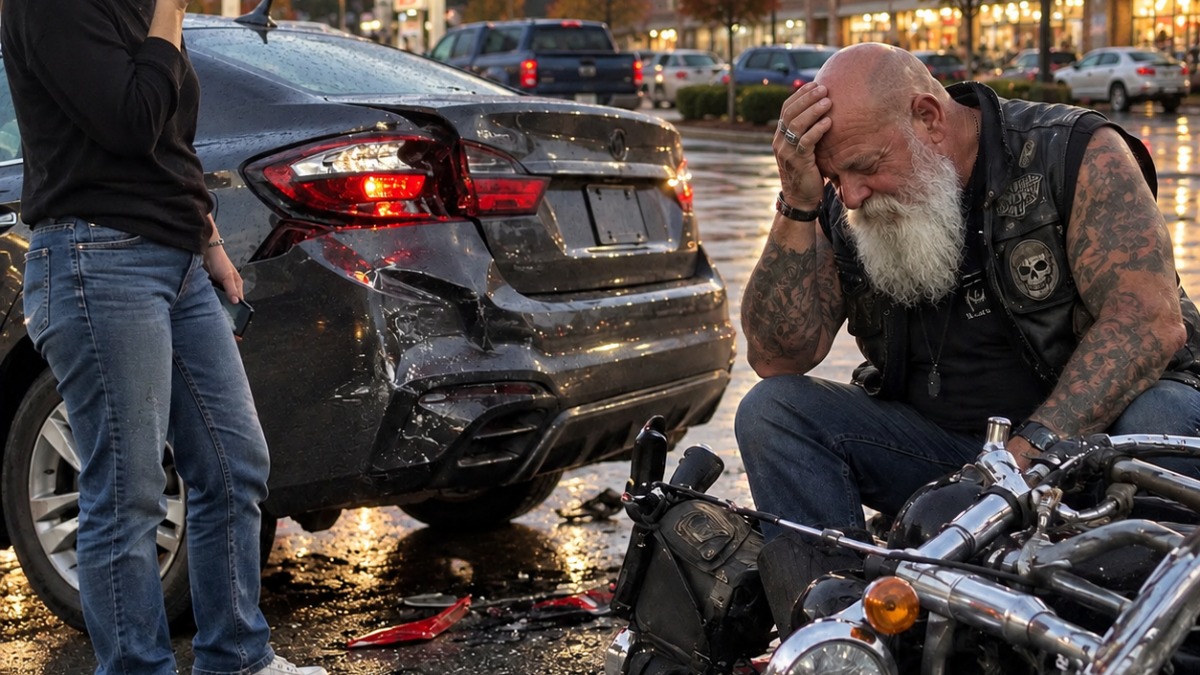
The rear bumper had cracked along the left side. Not destroyed. Not hanging off. But damaged enough that I knew it would cost more than I wanted to imagine.
“I’ll cover everything,” he said quickly. “Anything you need. Repairs. Rental. Doctor, if you need one. I’m insured. I wasn’t paying attention like I should have been. I’m sorry.”
That should have mattered to me.
His apology.
His honesty.
The fact that he did not make excuses.
Instead, I looked at the crack in my bumper and felt fury spread through me like heat.
“You hit me while I was stopped at a red light.”
“I know.”
“You could have hurt me.”
“I know.”
“What were you doing?”
He swallowed.
For one strange second, his face changed so deeply that I thought he might collapse.
“I don’t know,” he said.
That made me angrier.
“You don’t know?”
“I mean…” He looked past me, not at traffic, not at the light, but somewhere very far away. “I mean I thought I stopped. I thought I had room. I don’t know. I’m sorry.”
The driver behind him had gotten out too, a woman in a red coat holding her phone.
“Police are on the way,” she called.
The biker nodded like he had expected that.
“Good,” he said. “That’s good.”
The light turned green.
Cars edged around us with slow, irritated caution.
A man in a pickup honked once as if our accident had been personally arranged to inconvenience him.
The biker flinched at the sound.
I noticed.
Then I filed it away in the wrong place.
At the time, I thought he was afraid of getting in trouble.
When the officer arrived, the man gave his name without hesitation.
Frank Morrison.
He admitted fault before the officer asked the second question.
“I hit her,” he said. “She was stopped. I didn’t brake in time. That’s on me.”
The officer looked almost surprised.
People, apparently, did not usually make his job that easy.
Frank handed over his insurance card, registration, and license.
He apologized to me twice more while the officer took notes.
“Ma’am,” he said quietly, while we waited near the curb, “if your neck or back hurts at all, please go get checked. Sometimes these things show up later.”
I crossed my arms.
“I know.”
He nodded.
He looked like he wanted to say more but did not trust himself.
The officer gave us the report number. Frank’s insurance information. Instructions. Standard phrases delivered in a standard tone. The whole thing took less than thirty minutes.
My car was drivable.
His motorcycle had a bent front fender, but he still managed to roll it to the side lot of a closed pharmacy, where I watched him sit on the curb with his helmet between his feet.
I remember that image now more clearly than I remember the impact.
Frank Morrison, sitting alone in a gray parking lot, staring at the ground like the world had already ended before he ever touched my bumper.
At the time, I thought, Good.
Let him feel bad.
Then I got in my car and drove home.
By the next morning, my neck had stiffened into something I could barely move.
It was not unbearable.
Not dramatic.
But real.
Turning my head to check traffic hurt. Reaching into the cabinet hurt. Looking down at my phone hurt. Even brushing my hair made a sharp line of pain pull from the base of my skull to my shoulder blade.
I called out of work and went to urgent care.
The doctor was young, efficient, and clearly in a long-term relationship with his tablet.
“Whiplash,” he said, after moving my head gently from side to side. “Mild, but real. It may feel worse for a few days before it feels better.”
He prescribed muscle relaxers, recommended physical therapy if it did not improve, and told me to use heat, rest, and patience.
I had heat.
I had rest.
Patience was less available.
That afternoon, I called my insurance company.
Then Frank Morrison’s insurance company.
Then, because my coworker Tessa told me I would be stupid not to, I called a personal injury attorney.
His name was Greg Harlan.
His office smelled like coffee, printer toner, and confidence.
The reception area had leather chairs too firm to be comfortable and framed newspaper clippings about settlements large enough to make numbers feel unreal.
Greg was in his late forties, handsome in the polished way of men who know which angle makes them look trustworthy. He wore a navy suit, a silver watch, and a sympathetic expression that seemed practiced but effective.
He listened to my story without interrupting.
He nodded at the right moments.
He frowned when I mentioned my neck.
He studied the photos of my bumper like they showed more damage than they did.
Then he leaned back.
“This is worth a lot more than a repair check.”
I shifted in my chair.
“How much more?”
“Clear liability. Police report. Admission of fault. Soft tissue injury. Medical treatment. Time off work. Pain and suffering.”
He tapped his pen against the file.
“I’d start at fifty thousand.”
I laughed because I thought he was joking.
He did not laugh.
“Fifty thousand dollars?”
“At least as a demand.”
“For a cracked bumper and whiplash?”
“For an injury caused by negligence,” he corrected smoothly. “Don’t minimize what happened to you. Insurance companies count on that.”
The phrase landed exactly where he aimed it.
Do not minimize what happened to you.
I thought of my credit card balance.
Eight thousand dollars and change.
I thought of the student loan payment I dreaded seeing hit my account every month.
I thought of the raise I had not received, the refrigerator knocking in the kitchen, the dental work I kept postponing, the way every unexpected expense felt like someone pushing my head underwater for a few more seconds.
Fifty thousand dollars would not make me rich.
But it would let me breathe.
Greg watched me watching that number move around in my mind.
“His insurance may settle,” he said. “Most do. They’ll negotiate. We demand high. They come back low. We meet somewhere reasonable.”
“What’s reasonable?”
He smiled.
“That depends how much pressure we apply.”
I should have asked more questions.
I should have asked what Frank Morrison’s limits were.
I should have asked whether he had assets.
I should have asked what happened if insurance did not cover it.
I should have remembered the old man sitting in the pharmacy parking lot with his helmet between his feet.
Instead, I heard fifty thousand dollars.
I heard breathing room.
I heard my life getting easier.
“Do it,” I said.
And I did not think twice.
At first, everything felt procedural.
Clean.
Paperwork creates distance.
That is its special talent.
Greg filed forms.
Insurance adjusters called.
I went to three physical therapy appointments where a woman named Jenna taught me stretches I pretended were not helping until they did.
I missed two days of work.
My bumper was repaired within three weeks.
The pain in my neck faded faster than my irritation.
But the case continued.
Greg told me that was normal.
“Insurance companies drag their feet,” he said. “They hope you get tired. You don’t get tired. That’s how you win.”
I liked how that sounded.
Winning.
I began to describe the accident differently.
At first, I said, “A man rear-ended me.”
Then, “A biker crashed into me.”
Then, “I got injured because some guy on a motorcycle wasn’t paying attention.”
The story hardened each time I told it.
Frank Morrison became less a person and more a category.
Negligent driver.
Defendant.
Policyholder.
Payday.
Months passed.
Frank would not settle.
Or maybe he could not.
Greg phrased it as resistance.
“He’s being difficult,” he said.
“How?”
“They’re requesting delays. His attorney wants more time. Medical review. Financial disclosures. All the usual stall tactics.”
“Can they do that?”
“They can try.”
He sounded annoyed, but not worried.
“This is still straightforward. Don’t let them make you feel guilty.”
I had not said I felt guilty.
The fact that he said it first should have warned me.
Instead, I accepted the permission.
I told myself I was owed this.
Pain was pain.
Fault was fault.
The law was the law.
I had not done anything wrong by asking for what I deserved.
That sentence became my shield.
What I deserved.
By early June, the case had turned into something larger in my mind than the accident itself.
I was not thinking about my neck anymore.
My neck had stopped hurting.
I was not thinking about my car.
My bumper looked new.
I was thinking about the number.
Fifty thousand.
Not because I expected all of it anymore.
Greg had explained negotiation.
But even half would change things.
Even twenty thousand would change things.
I began planning.
Credit card paid off.
Emergency fund started.
Student loan principal reduced.
Maybe a new refrigerator before the old one died dramatically in the middle of summer.
I told myself these were responsible plans.
Adult plans.
Plans that proved I was not greedy.
Then June 15th arrived.
The courthouse was colder than I expected.
Not physically, though the air-conditioning was aggressive enough to make me regret wearing a sleeveless blouse.
It was cold in the way public buildings can be cold.
Stone floors.
Fluorescent lights.
Metal detectors.
Benches worn smooth by people waiting for decisions that might change their lives.
Greg met me near security with a leather briefcase and a paper cup of coffee.
“You okay?”
“Nervous.”
“Don’t be. This is simple.”
He said that word often.
Simple.
Clear liability.
Clear damages.
Clear case.
Clear payday.
He walked beside me down the hallway, speaking in low tones.
“We present the facts. We emphasize ongoing discomfort, stress, interruption to your life. Let me do most of the talking. If the judge asks you anything, answer directly. Don’t ramble. Don’t apologize.”
“Why would I apologize?”
He glanced at me.
“You’d be surprised.”
The courtroom smelled faintly of old wood and carpet cleaner.
I saw Frank Morrison before he saw me.
He was already seated at the defense table.
He looked smaller than I remembered.
That was my first thought.
Smaller.
Not physically, maybe. But hollowed out. As if someone had scooped part of him away and left the clothes behind.
He wore a gray suit that did not fit quite right at the shoulders. His silver beard had been trimmed. His hands shook in his lap.
Beside him sat his attorney, a woman in her fifties with short dark hair and a stack of folders arranged so precisely they seemed to accuse Greg’s briefcase of disorder.
Frank looked up once.
Our eyes met.
He did not look angry.
That would have been easier.
He looked tired.
More than tired.
Empty.
I looked away first.
Greg leaned toward me.
“Don’t stare. Sympathy is not relevant.”
The judge entered.
Everyone stood.
The formalities began.
Names.
Case number.
Preliminary remarks.
I focused on the seal behind the judge’s bench and tried to look composed.
Then the back doors opened.
Nearly twenty people filed in together.
At first, I noticed only that they moved quietly, respectfully, taking seats behind Frank.
Then I saw the shirts.
Every single one wore the same white T-shirt beneath jackets or cardigans or flannel.
On the front was a photograph of a little girl.
Maybe seven years old.
Gap-toothed.
Curly brown hair.
Freckles across her nose.
A grin so wide it looked like she believed the whole world had been made specifically for her amusement.
Beneath the picture were the words:
SARAH’S RIDE
IN LOVING MEMORY OF OUR ANGEL
My stomach dropped into my shoes.
I looked from one shirt to another.
Same child.
Same smile.
Same words.
A woman in the front row looked like an older version of the girl, except all the light had gone out of her face. Her hands were clasped so tightly her knuckles had whitened.
An elderly man held a motorcycle helmet in his lap.
A teenage boy stared at Frank’s back with wet eyes.
I turned to Greg.
“Who is that?”
He barely glanced back.
“Family, probably.”
“Whose family?”
“His.”
“What is Sarah’s Ride?”
Greg’s jaw tightened slightly.
“Not relevant.”
Not relevant.
Those two words should have sounded impossible.
Instead, they sounded legal.
The judge asked Greg to proceed.
He stood, buttoned his jacket, and became the version of himself that belonged in a courtroom.
“Your Honor, the facts in this matter are not in dispute. My client, Ms. Claire Bennett, was stopped at a red light when the defendant, Mr. Frank Morrison, failed to brake and struck her vehicle from behind.”
He laid out the photographs.
My cracked bumper.
The repair estimate.
The urgent care record.
Physical therapy invoices.
Lost wages.
Pain.
Stress.
Inconvenience.
“The defendant’s negligence is not in dispute,” Greg said. “My client deserves to be made whole.”
Made whole.
I had liked that phrase in his office.
In court, with that little girl’s face staring from twenty shirts, it sounded different.
Frank’s attorney rose slowly.
“Your Honor, my client does not dispute fault. He has already paid to repair the plaintiff’s vehicle through insurance. He has apologized repeatedly. The injury documentation reflects approximately eighteen hundred dollars in medical expenses. What is at issue is the plaintiff’s demand for fifty thousand dollars from a man who does not have fifty thousand dollars to give.”
Greg stood immediately.
“Objection. Counsel is attempting to turn this into a sympathy exercise.”
The judge lifted one hand.
“Sit down, Mr. Harlan. I’ll allow limited context.”
Greg sat, annoyed.
Frank’s attorney turned a page.
“And I ask the court’s permission to explain why this demand is not merely disproportionate, but devastating.”
The judge nodded.
“Proceed.”
The attorney took a breath.
“Three weeks before this accident, my client’s seven-year-old granddaughter, Sarah Morrison, was struck and killed by a distracted driver while crossing the street to meet her grandfather.”
The courtroom went utterly silent.
Not quiet.
Silent.
The kind of silence that becomes an object in the room.
I could hear my own pulse in my ears.
Frank bowed his head.
The woman in the front row covered her mouth.
His attorney continued, her voice steady but softer now.
“Sarah was walking from her elementary school to the corner where Mr. Morrison picked her up every Tuesday and Thursday. A driver texting behind the wheel ran a red light.”
I could not move.
“Mr. Morrison witnessed the aftermath. He has been in grief counseling since. He has been prescribed medication for depression and panic attacks he had never experienced before. On the day of this accident, he had just left a memorial planning meeting for Sarah. It was the first time he had driven alone since her death.”
My hands went cold.
“He was not drunk. He was not reckless. He was not racing. He was a destroyed grandfather who made a mistake in traffic, accepted fault, and attempted to make it right.”
Greg scribbled something on a legal pad.
I stared at Frank.
His shoulders had folded inward.
“Since Sarah’s death,” the attorney said, “Mr. Morrison and his family have been raising money for the Sarah Morrison Memorial Scholarship Fund, which will support students entering early childhood education, because Sarah wanted to be a teacher. The plaintiff’s demand threatens the money set aside for that fund.”
She turned toward me for the first time.
Not cruelly.
That almost made it worse.
“The question before this court is not whether Mr. Morrison is responsible for the accident. He is. The question is whether a cracked bumper and mild whiplash, already treated and largely resolved, justify stripping a grieving family’s memorial fund down to nothing.”
I felt Greg lean toward me.
Do not react, his posture said.
Do not give them anything.
But something inside me had already begun to split.
I looked at the photograph on the nearest shirt.
Sarah.
A child I had never met.
A child with a missing front tooth and eyes that looked like she had asked a hundred questions the minute before the picture was taken.
I thought about Frank in the pharmacy lot.
His hands shaking.
His helmet between his feet.
I thought about the way he had said, I don’t know, when I asked what he was doing.
Not careless.
Not indifferent.
Not trying to escape blame.
Destroyed.
That was the word his attorney used.
Destroyed.
And for the first time, I saw exactly what I had become.
The judge called a recess.
Greg stood quickly.
“Come on.”
He guided me into the hallway with one hand near my elbow, though I did not remember standing.
The hallway seemed louder than before.
Shoes on tile.
A vending machine humming.
A baby crying somewhere near family court.
Greg turned to me.
“Do not let that performance shake you.”
I stared at him.
“Performance?”
“Yes. A very effective one. But still a performance.”
“His granddaughter died.”
“And that is tragic. It is also not a legal defense to negligence.”
“He had just come from planning her memorial.”
Greg lowered his voice.
“Claire, listen to me carefully. Sympathy is exactly how defendants avoid accountability. You cannot let emotion override your interests.”
“My interests?”
“Yes. Your interests. Your case. Your compensation.”
I looked through the glass panel in the courtroom door.
Frank was being helped out by the woman from the front row.
His daughter, I guessed.
She had one hand pressed flat against his back like she was the only thing keeping him upright.
Both of them were crying.
Quietly.
Without drama.
Without looking around to see who noticed.
“He buried his granddaughter three weeks before the accident,” I said.
Greg sighed.
“No. Sarah died three weeks before the accident. The funeral timeline is different. Don’t muddy facts.”
I turned to him.
That correction did something to me.
It was not wrong.
That was the problem.
It was precise.
Useful.
Heartless.
“You knew,” I said.
He paused.
“What?”
“You knew about the granddaughter.”
He looked briefly irritated.
“I knew there was a family death. Counsel disclosed it during settlement discussion.”
“And you didn’t tell me?”
“It was not relevant to liability.”
I laughed once.
The sound startled us both.
“Not relevant.”
“Claire—”
“You knew I was trying to take money from a dead child’s scholarship fund.”
“That is an emotional characterization.”
“Is it true?”
He looked down the hallway.
“Funds are fungible. We do not know the exact source of—”
“Is it true?”
Greg’s expression hardened.
“You hired me to represent you. I am doing that. Right now, you need to decide whether you want to be compensated or manipulated by a courtroom full of matching T-shirts.”
I stepped back.
A week earlier, I might have accepted that sentence.
A day earlier, maybe.
Now all I saw was Sarah Morrison’s grin.
A little girl who would never be eight.
“I need a minute.”
“We don’t have time for a minute.”
“I’m taking one.”
I walked away before he could stop me.
I found Frank Morrison near the end of the hallway.
He sat on a wooden bench with his face in his hands.
The people in Sarah’s shirts gathered around him like a wall.
His daughter stood closest.
Her eyes were red and furious when she saw me.
I stopped several feet away.
“Mr. Morrison,” I said. “Please. I need to say something to you.”
His daughter stepped between us.
“I think you’ve done more than enough already.”
Her voice shook.
Not with fear.
With rage barely held by skin.
“I know,” I said.
“No, you don’t. You have no idea.”
“I didn’t.”
She stared.
“What does that mean?”
“It means I didn’t know about Sarah.”
That name made several people turn.
Frank lifted his head slowly.
His eyes looked bloodshot and old.
Older than any man’s eyes should look.
His daughter did not move.
“Please,” I said. “Just one thing.”
Frank lifted one hand, waving her back.
“It’s all right, Rachel.”
Rachel.
That was her name.
She did not move right away.
Then she stepped aside but stayed close enough to stop me if I deserved stopping.
Frank pushed himself upright with both hands on his knees.
Every joint in his body seemed to resist.
“Say it, then.”
The speech I thought I might make disappeared.
All I had was the truth.
“I didn’t know about Sarah. I am so, so sorry.”
His face did not change.
“Everyone’s sorry.”
The words came out flat.
“The woman who killed her was sorry. I was sorry when I hit your car. Sorry hasn’t brought her back once.”
The sentence hit harder than anger would have.
I nodded.
“You’re right.”
He waited.
I swallowed.
“I’m withdrawing the lawsuit.”
The hallway seemed to still around us.
Frank stared at me like I had spoken a foreign language.
Rachel’s eyes narrowed.
“What?”
“I’m withdrawing it.”
Frank’s voice came slowly.
“Your lawyer will fight you on that. You’re too close to a verdict.”
“Then I’ll fire him. I won’t take money that belongs to her memory.”
His expression sharpened for the first time.
“Why the sudden change of heart? You seemed so certain in there.”
Because I saw her face on all those shirts, I thought.
Because your attorney held up a mirror and I hated what was looking back.
Because I had reduced you to a payout while you were trying to survive the worst thing a human being can survive.
I said, “Because I saw her face. And I saw yours. And I finally saw what I was turning into.”
An older man standing nearby spoke up.
Quiet but sharp.
“Might’ve been nice to realize that before you dragged him into a courtroom after he buried his grandbaby.”
Rachel whispered, “Dad.”
But the man was not wrong.
I looked at him.
“You’re right.”
That surprised him.
Maybe he wanted me to defend myself.
Maybe I wanted to.
But I could not.
“I only saw an opportunity,” I said. “I never once asked myself who I’d be taking it from.”
Frank sank back onto the bench.
For a long time, he said nothing.
Then, so softly I almost missed it, he said, “Sarah loved motorcycles.”
No one moved.
“She’d climb up on a crate in my garage and watch me work for hours,” he continued. “Asking me a hundred questions a minute. Why does that part spin? Why does it smell like that? Why is that wrench called that? Why do engines sound angry when they’re really just working hard?”
His voice thinned.
“I told her she could ride when she turned twelve. Not before. She hated that. Said I was violating her freedom.”
A few people smiled through tears.
Frank did not.
“I told her rules exist because I loved her. Helmet. Boots. Gloves. Training. Safety class. Every step. She asked if she could at least sit on the bike every birthday until then.”
He looked down at his hands.
“I said yes.”
The hallway blurred.
“She didn’t make it to eight.”
I wanted to say something, but everything sounded insulting before it reached my mouth.
So I stayed quiet.
Frank looked at me again.
“It was an accident,” I said finally. “What happened between us.”
His mouth tightened.
“An accident with a fifty-thousand-dollar price tag, according to your attorney.”
“My attorney is a vulture,” I said. “And I let him turn me into one too.”
Rachel’s voice cut through, tight and shaking.
“What were your actual medical bills?”
I looked at her.
“Eighteen hundred dollars.”
“Total?”
“Yes.”
“Physical therapy?”
“Mostly.”
“And you were suing for fifty thousand.”
I looked at the floor.
“Yes.”
“Twenty-eight times that.”
The shame hit so hard I felt dizzy.
“I know.”
Frank pushed himself up again.
Slower this time.
“So what is it you actually want?”
His voice was not cruel.
That made it worse.
“Absolution? You want me to tell you dropping the case makes you a good person?”
“No.”
“Then what?”
“I want to make this right,” I said. “If there’s any way left to.”
He looked at me for a long, unreadable moment.
Then he said, “Walk with me.”
Rachel immediately protested.
“Dad, no.”
“It’s all right.”
“You don’t have to—”
“I know what I have to do.”
He started down the hallway.
I followed.
So did Rachel, a few steps behind, because she was not about to let her grieving father walk anywhere alone with the woman who had sued him.
I did not blame her.
We passed Greg near the courtroom doors.
He looked at me sharply.
“Claire. Recess is nearly over.”
“I’m withdrawing.”
His face darkened.
“No, you are emotional.”
“I’m done.”
“You cannot make legal decisions in a hallway because defense counsel staged a sympathy parade.”
Frank stopped walking.
Rachel turned.
I saw her hands curl.
Before anyone else could speak, I looked at Greg and said, “You’re fired.”
The words came out quieter than I expected.
Greg blinked.
“That is not how this works.”
“It is now.”
“You will regret this.”
I thought of Sarah’s grin.
“Maybe. But not as much as I’d regret listening to you.”
For once, Greg Harlan had no polished answer ready.
Frank resumed walking.
We left the courthouse through the side entrance and stepped into the parking lot.
The air smelled like hot asphalt and rain waiting to happen.
Frank led me to an old blue pickup parked near the far edge.
In the bed sat a small motorcycle.
Not a toy.
Not exactly.
A real bike, but small.
Carefully rebuilt.
Painted a deep, rich blue that looked almost black where the clouds reflected in it.
The chrome had been polished to a mirror shine.
The leather seat was small enough for a child.
A white ribbon was tied loosely around one handlebar, dirty now from weather and time.
Frank stood beside the tailgate.
For a moment, he did not touch it.
Then he reached out and ran his palm over the seat as if the machine were something alive.
“I spent two years of weekends rebuilding this,” he said.
Rachel covered her mouth behind us.
“It was going to be hers. For her twelfth birthday. I was going to teach her how to shift. How to brake. How to respect a machine that could kill her if she stopped paying attention to it.”
His hand stilled.
“It doesn’t have anybody to belong to anymore.”
I stared at the bike.
For reasons I still cannot explain, that was the moment Sarah became real to me in a way the photo had not finished making her.
Not an argument.
Not a tragedy.
Not a courtroom fact.
A little girl who should have had a twelfth birthday.
A little girl whose grandfather had spent weekends restoring a motorcycle she would never ride.
Frank looked at me.
“You want to make this right?”
“Yes.”
“Then you’re buying this bike from me.”
I blinked.
“What?”
“Eighteen hundred dollars. Every last cent of what your medical bills cost. Not fifty thousand. Not a settlement. Eighteen hundred.”
He patted the tailgate once.
“That money goes straight into a youth motorcycle safety program. So some other child learns to ride safely instead of dying because somebody looked down at a phone for four seconds.”
I could barely breathe.
“And you’re signing away this lawsuit. Today. In writing.”
I nodded.
“Today.”
He held out his hand.
“We have a deal?”
I looked at his hand.
Weathered.
Shaking.
Still reaching.
“We have a deal.”
I shook it.
Rachel looked at me like she still did not trust me.
She was right not to.
Trust should not be given just because someone finally stops doing the wrong thing.
Frank’s attorney drew up the paperwork that afternoon.
Greg tried to call me eight times.
I did not answer.
When I finally spoke to him two days later, he told me I was making a catastrophic financial mistake.
“You had leverage,” he said.
“I had shame.”
“Those are not the same thing.”
“No,” I said. “They’re not.”
I lost every dollar I had already paid him.
I have never once regretted it.
Two weeks later, I came back with a cashier’s check for eighteen hundred dollars and the name of a motorcycle safety program two counties away.
Frank met me at the garage behind his house.
It was the first time I had seen his home.
A small white place with green shutters.
A porch swing.
A bird feeder shaped like a barn.
A driveway cracked in three places.
The garage door was open, and inside, every tool seemed to have a proper place.
On the far wall hung photos.
Motorcycles.
Old road trips.
Frank younger, darker-bearded, standing beside men in leather jackets.
A woman I assumed had been his wife.
And Sarah.
Sarah everywhere.
Sarah with ice cream on her chin.
Sarah wearing a helmet three sizes too big.
Sarah holding a wrench like a sword.
Sarah sitting cross-legged on the garage floor beside a disassembled engine, her face serious with concentration.
Frank saw me looking.
“She liked to supervise.”
I smiled faintly.
“I can tell.”
“She once told me I was using the wrong screwdriver.”
“Were you?”
“No.”
He paused.
“Maybe.”
Rachel arrived just after noon with two men from the safety program and a trailer. She barely spoke to me, though she accepted the cashier’s check and verified the amount.
I did not expect warmth.
I had no right to expect anything.
The man from the safety program was named Dennis. He wore jeans, a faded riding jacket, and the kind of expression people get when they are trying to be respectful inside someone else’s grief.
When Frank explained Sarah’s bike, Dennis removed his cap.
“We’ll honor her,” he said.
Frank nodded.
“I know.”
They loaded the little blue motorcycle carefully.
Before they strapped it down, Frank touched the handlebar.
Just once.
Rachel turned away.
I looked down because some moments are too intimate for outsiders, and I was still an outsider.
Before I left, Dennis said, “We’ll call it Sarah’s Bike.”
Frank closed his eyes.
Rachel cried then.
Not dramatically.
Just one hand over her mouth.
A sound that broke from somewhere deep.
Frank put an arm around her, but he kept looking at the motorcycle.
I drove home that day with no lawsuit, no expected payout, and a strange, hollow feeling inside me.
I had done the minimum.
That was the truth.
I had not become noble.
I had not undone harm.
I had simply stopped adding to it.
That distinction mattered.
For three days, I tried to go back to my normal life.
Work.
Groceries.
Bills.
Laundry.
My refrigerator still knocked.
My credit card balance still existed.
My student loans did not disappear because I had discovered empathy.
But something had changed.
Every time I opened my laptop, I saw Greg’s number in old emails.
Every time my neck moved without pain, I remembered the number fifty thousand and felt sick.
Every time I closed my eyes, I saw Sarah’s face on those shirts.
Gap-toothed.
Grinning.
In loving memory of our angel.
On the fourth night, I did something I did not plan.
I built a fundraising page.
At first, I wrote the safe version.
A grieving grandfather.
A memorial scholarship fund.
A little girl named Sarah who wanted to be a teacher.
Please donate.
It sounded fine.
Clean.
Respectable.
And false.
Not because the facts were wrong, but because I had removed myself from the ugly part.
I deleted it.
Then I wrote the truth.
All of it.
My name is Claire Bennett.
Three months ago, I sued a grieving grandfather for $50,000 after he rear-ended my car at a red light.
My medical bills were $1,800.
My car was repaired.
My pain resolved.
But I let an attorney convince me to chase money I did not actually need from a man whose seven-year-old granddaughter, Sarah Morrison, had been killed by a distracted driver weeks before our accident.
I did not know that at first.
Then I did.
And what I saw in court made me withdraw the lawsuit.
I am not writing this to make myself look good.
There is no version of this story where I look good.
I am writing because Sarah Morrison deserved better from the world than what happened to her, and her grandfather is trying to build something in her name.
She wanted to be a teacher.
Her family has created the Sarah Morrison Memorial Scholarship Fund to support students pursuing early childhood education and youth safety programs.
I tried to take from that fund.
Now I am asking people to help build it.
I included a photo of Sarah that Rachel gave me permission to use only after Frank asked her to.
She did not want to at first.
Again, I did not blame her.
The photo showed Sarah sitting on Frank’s motorcycle in his garage, helmet too big, hands on the bars, mouth wide open in laughter.
I posted the link on my social media at 11:37 p.m.
I expected maybe a few hundred dollars.
Maybe.
I expected criticism.
I deserved that too.
The first wave of comments tore me apart.
You’re disgusting.
Only donated because you got caught.
Imagine suing a grieving grandfather.
This is performative guilt.
People like you are why everything is broken.
I read every word.
Some were cruel.
Most were not wrong.
I almost took the page down.
Not because I thought they were unfair, but because shame made me want to disappear.
Then, around 2 a.m., the first donation from a stranger came in.
Twenty-five dollars.
For Sarah.
Then fifty.
Then ten.
Then one hundred.
A woman wrote, My son died because of a distracted driver. For Sarah and every child who should still be here.
A retired teacher wrote, She wanted to be one of us. We claim her.
A biker from Kansas wrote, Ride high, little sister.
By morning, the page had raised three thousand dollars.
By lunch, eight.
By dinner, twenty-one.
The story moved beyond me quickly, thank God.
At first, the comments focused on what I had done.
Then slowly, they shifted toward Sarah.
People asked what she liked.
Frank’s sister posted that Sarah loved pancakes with chocolate chips but insisted they tasted better if cut into triangles.
Rachel wrote that Sarah had once corrected her kindergarten teacher’s spelling and then cried because she thought she might have hurt her feelings.
An uncle posted that Sarah believed worms had families and should be relocated from sidewalks after rain.
Frank did not comment for two days.
Then he posted one sentence.
She asked too many questions, and I would give anything to answer one more.
After that, donations climbed faster.
Five dollars.
Fifty.
Two hundred.
A classroom in Ohio raised four hundred and sent a photo of children holding paper motorcycles.
A motorcycle club in Arizona donated seventeen hundred dollars from a weekend breakfast ride.
A woman who had lost her daughter sent seven dollars and wrote, It isn’t much, but grief recognizes grief.
By the end of that month, the total read seventy-three thousand dollars.
Seventy-three thousand.
Every cent went into the Sarah Morrison Memorial Scholarship Fund.
When I called Frank to tell him, my hands shook so badly I nearly dropped the phone.
He answered on the fourth ring.
“Hello?”
“Mr. Morrison, it’s Claire Bennett.”
A pause.
“Yes?”
“I wanted you to know the fundraiser total.”
Another pause.
“How much?”
“Seventy-three thousand dollars.”
Silence.
So long I thought the call had dropped.
“Mr. Morrison?”
He made a sound I cannot describe.
Not quite a sob.
Not quite a laugh.
Something grief becomes when it hits something unexpectedly gentle.
“That’s enough,” he said finally, his voice breaking open. “That’s enough for scholarships every single year.”
“Yes.”
“Every year?”
“Yes.”
I pressed my fingers to my eyes.
“Thank you,” he whispered.
“Don’t thank me.”
“I am thanking you.”
“Please don’t. Thank yourself for not letting me become who I was turning into.”
He was quiet for a moment.
Then he said, “You got there on your own. I just happened to be standing there holding up the mirror.”
I did not deserve that generosity.
But I have carried it ever since.
The first annual Sarah Morrison Memorial Scholarship Ceremony was held the following June.
An envelope arrived at my apartment six weeks before the event.
Inside was an invitation.
Cream cardstock.
Blue lettering.
A small motorcycle silhouette in the corner.
Rachel’s handwriting on the outer envelope.
For three days, I moved it from my kitchen table to my desk to the counter by the door and back again.
I wanted to go.
I did not want to go.
Both feelings were honest.
Some part of me was still ashamed to stand in a room full of people who had worn Sarah’s face on their chests to defend her grandfather from me.
Another part of me knew shame was not a good enough excuse to stay away from something I had helped start, even for all the wrong reasons.
I went.
The ceremony was held in the community center on Maple Street.
By the time I arrived, the parking lot was full.
Motorcycles lined one side.
Family cars filled the other.
A banner hung above the entrance.
SARAH MORRISON MEMORIAL SCHOLARSHIP
FIRST ANNUAL AWARDS CEREMONY
Inside, the room was packed.
A hundred people, maybe more.
Many wore the same shirts I had seen in court.
Sarah’s face.
Sarah’s smile.
But the room felt different now.
Not lighter exactly.
Grief remained.
Grief always remains.
But it had been given somewhere to go.
A table near the front displayed photographs.
Sarah at the zoo.
Sarah in a Halloween costume.
Sarah holding a book upside down as a toddler.
Sarah sitting on Frank’s motorcycle.
Sarah missing both front teeth.
Sarah with paint on her hands.
Sarah asleep against Rachel’s shoulder.
Beside the photos sat a small blue motorcycle helmet with white stars.
I stood in front of that table for a long time.
Rachel found me there.
My stomach tightened.
“Hi,” I said.
She looked at me for a moment.
“Hi.”
“I almost didn’t come.”
“I know.”
That surprised me.
She shrugged.
“I wouldn’t have, if I were you.”
“I wasn’t sure you wanted me here.”
“I wasn’t sure either.”
Fair.
I nodded.
“I can leave.”
Rachel looked at the photos.
Then at me.
“No. Stay.”
It was not forgiveness.
Not yet.
Maybe not ever.
But it was permission.
Sometimes that is enough.
Five scholarships were awarded that night.
Three thousand dollars each.
All to students pursuing early childhood education or child development.
The first recipient was a young man named Luis, who wanted to become a kindergarten teacher because his own kindergarten teacher had been the first adult outside his family to notice he needed glasses.
The second was Maya, who planned to work with children in foster care.
The third was Hannah, who cried so hard during her acceptance speech that her little brother had to stand beside her holding tissues.
The fourth was a grandmother returning to school at fifty-six to become a preschool teacher after raising four grandchildren.
The fifth was a quiet student named Emily who said she wanted her classroom to be a place where children felt safe asking too many questions.
That line broke Frank.
He sat in the front row, one hand over his mouth, shoulders shaking.
When it was his turn to speak, he walked slowly to the microphone.
The room went still.
He wore a dark jacket and jeans.
No tie.
His hands trembled as he unfolded a piece of paper.
Then he looked at the audience and set the paper down.
“I wrote something,” he said. “But Sarah hated when people read from papers.”
Soft laughter moved through the room.
“She used to say, ‘Grandpa, if you know it, why are you looking down?’”
More laughter.
Frank smiled.
Just for a second.
Then the smile faded into something tender.
“My granddaughter believed the world was fundamentally good,” he said. “Not because she was naive. She knew sadness. She lost her grandmother young. She got scared like any kid. She fell off her bicycle and accused the sidewalk of betrayal.”
People laughed again.
“But she always expected goodness to show up eventually. If a stranger looked angry, she thought maybe they needed a snack. If someone honked in traffic, she asked if their horn had feelings. If I complained about bills, she told me money was weird because everybody invented it and then acted surprised when it caused problems.”
A ripple of laughter.
Rachel wiped her face.
Frank looked toward Sarah’s photos.
“She wanted to be a teacher. Not a princess. Not famous. A teacher. She said teachers knew everything except why glue smelled bad, and she intended to solve that.”
His voice wavered.
“She didn’t get the years she deserved.”
The room tightened.
“I cannot make sense of that. I have stopped trying. But I can make sure her name helps somebody else become the thing she wanted to become.”
He looked at the scholarship recipients.
“Teach them kindly. Answer the annoying questions. Especially the annoying ones. Sarah believed annoying questions were just important questions wearing tap shoes.”
People laughed through tears.
Frank looked down.
Then up again.
“And please, when you see someone at a crosswalk, when your phone buzzes, when you think four seconds won’t matter—remember that four seconds took her from us.”
The silence that followed was painful.
Necessary.
“That’s all,” Frank said softly.
The room stood.
All of it.
The applause did not feel celebratory.
It felt like a promise.
Afterward, people gathered around the scholarship recipients. Photos were taken. Cake was cut. Stories were shared.
I stayed near the back, unsure where to put myself.
Frank found me near the door.
He held something in his hand.
A photograph.
He pressed it into mine.
Sarah on his motorcycle.
Helmet too big.
Grinning so wide it looked like her face could barely hold the joy.
“So you never forget,” he said.
I looked down at the picture.
“I won’t.”
“Our worst moments don’t get the final say,” Frank said. “What we choose to do after them—that’s the part that actually counts.”
I could not answer.
If I had tried, I would have cried too hard.
So I nodded.
That photograph sits on my desk to this day.
Not tucked away.
Not hidden in a drawer.
On my desk.
In a small blue frame Rachel mailed me after the second ceremony.
I see Sarah every morning before I answer emails, before I pay bills, before I complain about traffic, before I convince myself that my inconvenience is the center of the world.
She reminds me of scale.
She reminds me that facts without compassion can become weapons.
She reminds me that being legally entitled to something does not automatically make taking it right.
And yes, she reminds me of the ugliest version of myself.
I need that too.
Because memory without honesty becomes decoration.
The second year, seven scholarships were awarded.
The third year, nine.
The fund grew.
People kept donating on Sarah’s birthday.
On the anniversary of her death.
On Christmas.
On random Tuesdays because grief does not follow calendars and neither does kindness.
Frank and I did not become friends in the neat way stories sometimes want people to become friends.
Real life is more complicated than that.
At first, we spoke only about the fund.
Receipts.
Donations.
Event planning.
Website updates.
Then gradually, small things entered.
He told me when the youth safety program used Sarah’s Bike for the first time.
A twelve-year-old girl named Priya rode it in a closed training course, wearing a helmet with purple flames.
Frank said he watched from the fence and cried so hard Dennis had to pretend not to notice.
I told him my refrigerator finally died, dramatically, in July, just as expected.
He recommended a repairman who charged half what the big company quoted.
I sent Rachel a birthday card the year she turned thirty-five.
She texted me two words.
Thank you.
The year after that, she hugged me at the ceremony.
Briefly.
Stiffly.
But it happened.
I did not mistake it for absolution.
I accepted it as grace.
There is a difference.
I began volunteering at the scholarship events every year.
At first, I handled registration because it gave me something to do with my hands.
Then fundraising emails.
Then donor thank-you notes.
Then scholarship application reading.
That last part undid me.
Every year, students wrote essays about why they wanted to teach.
Some were polished.
Some were awkward.
Some had grammar problems and more heart than structure.
I loved those most.
A young woman wrote about teaching her little brother to read while their mother worked nights.
A man wrote about learning English from cartoons and wanting to help immigrant children feel less lost.
A student who had grown up in foster care wrote that the first teacher who remembered her name made her believe she existed.
I read that one three times.
Then I sat in my apartment and cried.
Because somewhere between lawsuit and scholarship committee, my idea of being “made whole” had changed.
Money had once seemed like the thing that would fix my life.
Not all of it.
But enough.
Now I was watching money become something else entirely.
A door.
A classroom.
A year of books.
A childcare stipend.
A future teacher standing in front of future children, carrying Sarah’s name into rooms she never got to enter.
Five years after the accident, the fund had helped send more than forty young people to college.
Forty.
Frank called me after the board meeting where we confirmed the number.
“Forty,” he said.
“I know.”
“That’s a lot of teachers.”
“It is.”
“She would have bossed all of them.”
“Probably.”
“No. Definitely.”
I smiled.
Then he went quiet.
“Claire?”
“Yes?”
“In some backward, impossible way, you helped save me.”
I closed my eyes.
“Frank—”
“No, listen.”
I did.
“I was drowning in grief with nowhere to put it. Everybody kept telling me to rest. To heal. To take time. But time was the problem. Every hour was another hour without her.”
His voice thickened.
“When you sued me, I hated you.”
“I know.”
“I hated that I had to fight. Hated that Sarah’s name had to be dragged into a courtroom. Hated all of it.”
“I know,” I said again.
“But fighting to protect her memory gave me something to hold onto. Then the fundraiser happened. Then the scholarships. Then the safety program. Suddenly grief had work to do.”
I could hear him breathing.
“That fund became my healing. And you’re the one who started it, even for all the wrong reasons in the world.”
I pressed the phone hard against my ear.
“I don’t know what to do with that.”
“Neither do I,” he said. “But it’s true.”
That is the strangest mercy I have ever received.
Not forgiveness.
Not exactly.
Something more difficult.
The knowledge that even harm can be turned, if everyone involved is willing to tell the truth about it.
I still think about the accident.
Not every day.
But often.
I think about how easy it would have been for the story to end differently.
If Frank’s attorney had not explained Sarah.
If I had listened to Greg.
If Rachel had refused to let me speak.
If Frank had hardened instead of offering me a way to repair one small part of what I had done.
If the fundraiser had failed.
If shame had made me hide.
So many turns.
So many chances to become worse.
That is what scares me most.
Not that I became greedy.
People become greedy all the time.
What scares me is how reasonable it felt while I was doing it.
I had medical bills.
I had pain.
He was at fault.
The law allowed it.
My attorney encouraged it.
Every sentence was true.
And still, together, they formed a lie.
A lie about proportion.
A lie about what I needed.
A lie about who Frank was.
A lie about what I deserved.
That word still makes me careful.
Deserved.
It can be honest.
It can also become a mask greed wears when it does not want to recognize itself.
I do not say that as someone who has risen above it.
I say it as someone who has been caught inside it.
There are mornings I still want the easy road.
The selfish road.
The one where I am the injured party and everyone else is supporting cast.
On those mornings, I look at Sarah’s photograph.
Gap-toothed.
Helmet too large.
Hands on the bars.
Joy pouring out of her like light.
I remember Frank saying, Our worst moments don’t get the final say.
And I choose something better.
Not always perfectly.
But more often than before.
Last spring, at the sixth scholarship ceremony, Frank asked me to speak.
I said no immediately.
He laughed.
“You didn’t ask what I wanted you to say.”
“No.”
“That’s rude.”
“I’m comfortable with that.”
He grew serious.
“People should hear it from you.”
“They know.”
“They know the clean version.”
“There is no clean version.”
“Exactly.”
I hated that he was right.
So I stood in front of two hundred people inside that community center, with Sarah’s photo on a table beside me and Frank seated in the front row.
Rachel sat next to him.
Her son, Noah, slept against her shoulder.
She had named him Noah Frank.
Frank pretended not to cry whenever anyone mentioned it.
I unfolded my paper.
Then I remembered Sarah’s rule.
If you know it, why are you looking down?
So I set the paper aside.
“My name is Claire Bennett,” I said. “And the first time I came into Sarah Morrison’s story, I came as someone trying to take money from it.”
The room went very still.
Good.
It needed to.
“I wish I could tell you I immediately recognized what mattered. I didn’t. I wish I could tell you I was misled completely by a bad attorney. I wasn’t. He encouraged the worst part of me, but he did not create it.”
Frank watched me, his face unreadable.
“I had been hurt in an accident. That was true. My car was damaged. That was true. Frank Morrison was at fault. That was true. But truth without proportion can still become injustice.”
I looked toward the scholarship recipients.
“I asked for money I did not need from a man who was trying to keep his granddaughter’s name alive. I did not see him. I saw a case. I saw numbers. I saw my own debts, my own stress, my own inconvenience. Then I walked into court and saw Sarah’s face.”
My voice almost broke.
I let it.
“I never met her. But she changed my life.”
I turned toward Frank.
“So did her grandfather. Not because he shamed me. Not because he punished me. Because he gave me a way to become better than the person I had been five minutes earlier.”
Frank looked down.
Rachel wiped her face.
I faced the room again.
“The scholarships awarded tonight exist because Sarah mattered. Because her family loved her. Because a community chose to turn grief into doors other people could walk through. I am honored to do a small part of the work now. But I want to be clear about something.”
I took a breath.
“I did not start as the hero of this story. I started as the warning.”
No one spoke.
“That matters too. Because people can change. But only if they stop editing the ugly parts out of their own stories.”
When I sat down, my hands were shaking.
Frank reached across the aisle and squeezed my shoulder.
Not for long.
Just once.
Enough.
After the ceremony, a woman approached me near the dessert table.
She looked about my age, maybe a little older.
“I almost didn’t talk to you,” she said.
“That’s okay.”
“My brother was killed by a distracted driver.”
“I’m sorry.”
She nodded.
“I was ready to hate you when you started speaking.”
“I understand.”
“But then you said you were the warning.”
I waited.
She swallowed.
“I’ve been one too. Different story. Same kind of selfish. I just never said it out loud.”
We stood there together in the strange intimacy that happens when strangers tell the truth.
Then she hugged me.
I hugged her back.
The following year, she donated five thousand dollars in her brother’s name.
That is how these things move.
Not cleanly.
Not predictably.
Not because everyone becomes good overnight.
But because one honest story gives another person permission to stop lying.
The woman who killed Sarah eventually wrote to Frank.
I learned that from Rachel, not from him.
It happened seven years after Sarah’s death.
The woman’s name was Melissa.
She had served time, lost her license, lost her job, and from what Rachel said, lost whatever version of herself had existed before the crash.
Her letter was twelve pages long.
Frank did not read it for two months.
Then one Sunday afternoon, he called Rachel over, and they read it together on the porch.
He never told me everything it said.
Only one part.
“She wrote that she looked down for four seconds,” he said. “Four seconds to read a text from her sister asking what time dinner was.”
He was quiet for a long time.
“Four seconds,” he repeated.
I did not know what to say.
There may be no language for that.
Later, he asked the scholarship board to add a distracted driving education component to Sarah’s fund.
We did.
Every recipient now attends and helps lead at least one safety presentation for high school students.
Frank speaks when he can.
Not every time.
Some days, it costs too much.
When he does speak, he brings Sarah’s helmet.
He sets it on the table and says, “This weighed less than two pounds. It has carried more grief than any object should have to.”
Then he tells them about four seconds.
Phones go away in that room.
Every time.
Sarah’s Bike stayed in use for six years.
Dozens of kids learned balance, braking, and respect on that little blue machine.
Then Dennis retired it.
Not because it broke.
Because he said some objects become too important to risk.
Frank agreed.
Now Sarah’s Bike sits in the lobby of the safety program building behind a glass barrier.
Not sealed away like something untouchable.
Displayed like something still teaching.
A small plaque beneath it reads:
SARAH’S BIKE
BUILT WITH LOVE BY HER GRANDFATHER
USED TO TEACH CHILDREN THAT JOY AND SAFETY CAN RIDE TOGETHER
The first time I saw the plaque, I cried in public.
I am less embarrassed by that kind of thing now.
Frank stood beside me.
“She would hate the glass,” he said.
“Why?”
“She’d say bikes are for riding.”
“She’d be right.”
“She usually was.”
He smiled.
More easily now.
Not without pain.
Never without pain.
But with room beside it.
That is what healing seems to be.
Not grief leaving.
Grief making space for other things to sit down.
Ten years have passed since the accident.
I am no longer the woman who walked into Greg Harlan’s office and heard fifty thousand dollars like a door opening.
I am also not free of her.
She is still part of me.
That matters.
People love stories where someone learns a lesson and becomes new.
But most change is less dramatic than that.
You do not become new.
You become responsible for knowing what you now know.
I know how easy it is to turn another person into a transaction.
I know apologies do not erase harm.
I know shame can either bury you or teach you where to build.
I know grief can become scholarship applications, safety classes, memorial rides, and a little blue motorcycle behind glass.
I know a seven-year-old girl I never met can become one of the most important people in my life.
Sarah Morrison would be seventeen now.
Sometimes Frank says that.
Not often.
But sometimes.
“She’d be seventeen.”
Or, “She’d be graduating next year.”
Or, “She’d be asking to borrow my truck and pretending she wasn’t going to scratch it.”
Rachel has learned to answer when he does.
“She’d be impossible,” she says.
Frank always smiles.
“She came by it honestly.”
At the tenth scholarship ceremony, there were no longer enough chairs in the community center.
People stood along the walls.
Former recipients came back.
Some were teachers now.
Real teachers.
Classrooms.
Students.
Name badges.
Tired eyes.
Full hearts.
One recipient, Maya, brought a stack of letters from her second-grade class. Each child had written one question they would ask Sarah if they could.
Why did you like motorcycles?
What is heaven like?
Do you know my grandma?
Do angels go to school?
Do you like glitter?
Frank read every letter.
Every single one.
Then he sat outside for twenty minutes with Sarah’s old helmet in his lap.
I sat beside him.
Neither of us spoke.
Eventually, he said, “I used to think the worst thing was that she disappeared.”
I looked at him.
“Now I think maybe love doesn’t let people disappear all at once.”
The wind moved through the trees near the parking lot.
Motorcycles lined the curb.
Students laughed inside.
Somewhere, someone dropped a tray, and Rachel shouted that nobody was allowed near the cake without supervision.
Frank smiled faintly.
“She’s noisy still,” he said.
I nodded.
“She is.”
After the ceremony, he handed me a folded paper.
“What’s this?”
“Read it later.”
I did.
At home.
At my desk.
Beside Sarah’s photograph.
It was a letter.
Claire,
I have been thinking about what you said years ago, that I held up a mirror.
I want you to know you did the same for me.
When Sarah died, I wanted the whole world to pay for still moving. Cars kept driving. People kept laughing. Bills came. Mail came. The sun came up like it had no manners.
Then you sued me, and I had somewhere to put the anger. I put it on you. Some of it belonged there. Some did not.
When you withdrew the lawsuit, I did not forgive you right away. I need you to know that. I said generous things before I felt all of them. Sometimes I was trying to be the man Sarah thought I was.
Maybe that is not fake. Maybe that is how we become better.
You helped build something that carries her name. You have stayed. That matters more than getting it right at the beginning.
Our worst moments do not get the final say.
Thank you for proving that with me.
Frank
I read it three times.
Then I put it behind Sarah’s photograph.
Not because I need people to see it.
Because I need to remember.
I sued a grieving man for money I never actually needed.
That is true.
I withdrew the lawsuit.
That is true.
I bought his granddaughter’s motorcycle for the exact cost of my medical bills.
That is true.
The fundraiser raised seventy-three thousand dollars.
The fund has now helped more than forty young people pursue teaching.
That is true.
But facts alone cannot carry the weight of what happened.
The truth is this:
I walked into court wanting to win.
I walked out wanting to be different.
Everything important in my life since has come from trying to honor that difference.
I never met Sarah Morrison.
I never heard her laugh in person.
Never answered one of her hundred questions.
Never saw her climb onto that crate in Frank’s garage, chin in her hands, supervising a repair she did not yet understand but fully intended to master.
I never watched her cross that street.
Thank God.
I never saw what Frank saw.
But I have seen what love did after.
I have seen her grandfather stand in rooms full of students and say her name without letting grief swallow the last syllable.
I have seen her mother hand scholarships to future teachers and smile through tears.
I have seen children learn to ride safely on a little blue motorcycle built for a birthday that never came.
I have seen strangers send five dollars with messages that simply say, For Sarah.
I have seen former scholarship recipients return as teachers, carrying her story into classrooms she would have loved.
I have seen my own worst moment become the doorway to the best work I have ever done.
That does not make the worst moment good.
Nothing does.
But it means it did not get the final say.
Some things are worth more than winning a case.
Some things are worth infinitely more than money.
A child’s name.
A grandfather’s grief.
A scholarship.
A second chance.
A choice made in a hallway after you finally see yourself clearly and hate what you see enough to change.
I keep Sarah’s photograph on my desk.
On the mornings when I am tempted to take the easy road, the selfish road, the road that turns other people into obstacles or opportunities, I look at that gap-toothed smile and remember the courtroom.
Twenty shirts.
One little face.
A man with shaking hands.
A lawsuit I had no business carrying any further.
Then I remember what Frank told me.
Our worst moments do not get the final say.
What we choose to do after them—that is the part that actually counts.
So I choose again.
Every day, if I have to.
I choose again.








