I Paid Cash for a Bankrupt 47-Acre Lakeside Ranch—Then an HOA I’d Never Joined Blocked My Gate and Claimed the Property Owed Them $47,000.
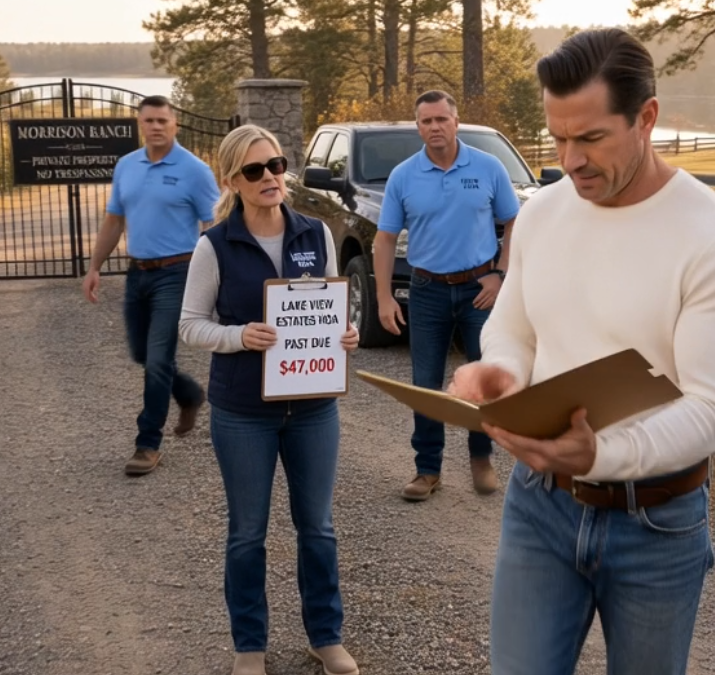
I Paid Cash for a Bankrupt 47-Acre Lakeside Ranch—Then an HOA I’d Never Joined Blocked My Gate and Claimed the Property Owed Them $47,000.
I paid cash for a bankrupt lakeside ranch because I wanted one quiet place no one could take from me.
Then an HOA I had never joined blocked my gate with three trucks and told me the land already belonged to them.
By the time the sheriff cut their chain off my entrance, the woman trying to steal my ranch learned that a clipboard cannot outrank a recorded deed.
I knew something was wrong before I saw the gate.
The road to Morrison Ranch should have been empty. That was one of the reasons I had bought the place. Forty-seven acres at the edge of a quiet lake, tucked behind a long dirt road that cut through pine trees and wild grass, far enough from town that the air changed before you reached it.
Cleaner.
Colder.
Full of resin and water and old soil.
For three weeks after the auction closed, I had pictured that first drive a hundred different ways.
I imagined stopping at the gate and sitting there for a moment with both hands on the steering wheel, letting myself believe it was real. I imagined walking through the farmhouse with a flashlight, seeing the work ahead of me and not being afraid of it. I imagined standing on the dock at dusk, listening to the water tap against the pilings, and feeling, for the first time in years, that I had not lost everything.
I did not imagine three pickup trucks blocking my entrance.
They were parked in a V formation across the road, their bumpers nearly touching, their hoods angled toward my truck as if they had been positioned to stop a fleeing car. Each one had a magnetic sign slapped onto the door.
LAKE VIEW ESTATES HOA
OFFICIAL BUSINESS
Beyond them stood the gate.
My gate.
Old iron, rusted at the hinges, with a sagging chain hanging loose from one post. Behind it, the ranch spread out under the late afternoon sun—overgrown pasture, leaning fence lines, a weather-beaten farmhouse with peeling white paint, and beyond that, between the dark trunks of the pines, a strip of lake shining like cut glass.
It was not beautiful in the way polished places are beautiful.
It was beautiful in the way broken things are beautiful when you can still imagine saving them.
I slowed to a stop twenty feet from the trucks.
A woman stepped into the center of the road.
She was in her mid-fifties, maybe a little older, with blonde hair pulled back so tightly it seemed to sharpen her cheekbones. She wore a navy-blue vest over a cream blouse, and the vest had the same Lake View Estates logo embroidered over the breast. The stitching was cheap. The letters leaned slightly uphill, and the little picture of a lake under a rising sun looked like something copied from a template.
She held a clipboard against her ribs.
Two others stood behind her. A man with a shaved head and heavy shoulders, wearing a polo shirt stretched too tight across his chest. A narrow-faced woman with short brown hair and a permanent frown, her arms folded so tightly it looked painful.
The blonde woman lifted one hand, palm outward, like a traffic officer.
I rolled down my window.
“Mr. Johnson?” she asked.
Her voice was flat and rehearsed.
“Yes.”
“My name is Christine Gray. I’m president of the Lake View Estates Homeowners Association.”
I looked past her again at the gate.
“I don’t belong to an HOA.”
She smiled a little.
Not kindly.
“Unfortunately, that is not accurate.”
I turned off the engine.
The silence came in fast.
No traffic behind me.
No neighbors.
No voices except hers and the wind moving through the trees.
I stepped out of my truck.
The gravel shifted under my boots.
“I bought Morrison Ranch at bankruptcy auction,” I said. “The deed is recorded. The title is clean.”
Christine tilted her head as if I had given her a child’s answer to an adult question.
“The deed is not the issue, Mr. Johnson.”
“That’s usually the issue when we’re talking about who owns land.”
The man moved then, just half a step, putting himself more directly between me and the gate.
His name tag read:
GREG NOLAN
ENFORCEMENT
That word caught my eye.
Enforcement.
PART2:
HOAs had boards. Committees. Treasurers. Architectural review panels. They did not usually send enforcement men to block private roads with pickup trucks.
Christine lifted a paper from her clipboard.
“The previous owner of the Morrison property accumulated forty-seven thousand dollars in unpaid assessments, penalties, special fees, and enforcement costs. That debt remains attached to the property.”
I stared at her.
“Forty-seven thousand dollars.”
“That is correct.”
“And you’re saying I owe it.”
“We are saying the property owes it.”
I let that sit for a second.
“You have a recorded lien?”
“You’ll receive documentation by email.”
“When was the lien recorded?”
“You’ll receive documentation.”
“What county office recorded it?”
Her smile thinned.
“Mr. Johnson, I’m not here to debate public records on a dirt road.”
“No. You’re here blocking my gate on a dirt road.”
Greg shifted again.
This time, I looked straight at him.
He was big.
I had dealt with big men before.
Big men with radios. Big men with uniforms. Big men leaning over counters in county offices because they believed volume could change permit requirements.
Size did not worry me much.
Confidence without paperwork worried me more.
Christine stepped closer.
“We want this to be civil.”
“Move your trucks.”
“That will not be possible until the account status is resolved.”
“The account does not exist.”
“It exists.”
“Not with me.”
“With the property.”
PART3:
“That phrase does not make it true.”
The narrow-faced woman finally spoke.
Her voice was sharp enough to cut paper.
“Mr. Johnson, you purchased a distressed property. Distressed properties come with obligations.”
I looked at her.
“And you are?”
“Ellen Voss. Compliance secretary.”
“Of an HOA I never joined.”
She sniffed.
“Membership runs with the land.”
“Not this land.”
Christine’s smile returned, but it was thinner now.
“The Morrison Ranch has always benefited from Lake View Estates roads, security, lake preservation, and common area management.”
“No, it has not.”
“It sits adjacent to our community.”
“Adjacent is not inside.”
“It uses the lake.”
“The lake is public on this side and privately bordered by separate parcels on the north bank.”
“You seem to think you know a great deal.”
“I paid cash for the property. I knew enough to read the title report.”
Christine’s eyes narrowed.
That was the first time I saw real irritation beneath the performance.
Not anger.
Irritation.
Like I was not following the scene she had rehearsed.
“My advice,” she said, “is to avoid starting your ownership with conflict.”
“My advice is to stop trespassing before I call the sheriff.”
Greg laughed under his breath.
Not loud.
Just enough.
I looked at him again.
“Something funny?”
He folded his arms.
“You’re not the first guy who thought buying something at auction made him special.”
“No,” I said. “But I may be the first one you met who paid for a full title packet, bankruptcy order, survey, and county tax certification before wiring the money.”
Christine’s face changed.
Only slightly.
But I saw it.
She had expected someone lucky.
Not prepared.
My name is Caleb Johnson, and I did not buy Morrison Ranch on a whim.
I had spent twenty-seven years rebuilding things other people had abandoned.
Not ranches at first.
Companies.
Old buildings.
Contaminated lots.
Warehouses with bad roofs and good bones.
My father called me a salvage man.
He meant it as criticism at first.
Later, after I turned a boarded-up textile plant into a distribution center and paid off his mortgage, he meant it with pride.
I understood broken things.
I understood unpaid bills.
I understood how desperation leaves paperwork behind like footprints in mud.
That was why Morrison Ranch interested me.
The ranch had belonged to the Morrison family for almost eighty years. It had once been a working horse ranch with lake frontage, a small orchard, two barns, and a farmhouse built from local pine. Then the family fractured the way families sometimes do when land becomes more valuable than love.
The last owner, Warren Morrison, borrowed against it, neglected it, tried to develop part of it, fought with his siblings, lost two lawsuits, drank too much, stopped paying contractors, and finally pushed the ranch into bankruptcy.
The auction listing was ugly.
Bankruptcy sale.
As-is.
No warranties.
Deferred maintenance.
Encroachments possible.
Waterfront access subject to independent verification.
Structures in poor condition.
No financing contingency.
Cash only.
Most bidders saw risk.
I saw a place no bank could take from me if I bought it clean.
That mattered.
Five years earlier, my life had been bigger.
A wife.
A house.
A company with eighty employees.
A calendar full of flights, inspections, bank meetings, and problems that made me feel important until they ate me alive.
Then my wife, Anna, got sick.
Autoimmune first.
Then complications.
Then infections.
Then bills that arrived with the cheerful cruelty of printed envelopes.
I sold one property.
Then another.
I borrowed.
I negotiated.
I fought insurance denials until the hold music felt like part of our marriage.
Anna died on a Wednesday morning while rain tapped against the hospital window.
Afterward, I kept working because grief did not cancel payroll.
Then a major client defaulted.
Then a lender called a note.
Then I sold my company for less than it was worth because I no longer had the energy to pretend I was fine.
By the time Morrison Ranch appeared at bankruptcy auction, I had money again, but it did not feel like success.
It felt like wreckage turned into a bank balance.
I did not want to build another empire.
I wanted one place.
One deed.
One gate.
One dock where silence did not feel like punishment.
So I did what cautious men do when hope scares them.
I investigated it until there was almost nothing left to fear.
I hired a title attorney.
I ordered a boundary survey.
I reviewed tax records.
I checked easements.
I read every recorded covenant within a mile.
I requested bankruptcy court filings.
I spoke with the trustee.
I confirmed no recorded HOA declaration covered Morrison Ranch.
Lake View Estates sat east of the property, a gated subdivision of eighty-two homes built around the old resort road. Its boundary touched the former Morrison land near the northeast corner, but the ranch had never been annexed into it. There was no signed joinder agreement. No recorded declaration. No deed restriction tying the ranch to the association.
There had been an old access agreement once.
That part mattered.
Years earlier, Warren Morrison had allowed Lake View Estates residents to use a footpath across a narrow strip near the lake during construction of their community dock. In exchange, the developer improved fencing along one shared boundary.
The agreement had been temporary.
Six months.
Recorded termination.
Done.
But people like Christine Gray loved dead documents.
They dug them up, dressed them in new language, and hoped no one checked the dates.
My attorney checked.
The bankruptcy court checked.
The trustee checked.
The title company checked.
The final sale order stated that Morrison Ranch was sold free and clear of liens, claims, interests, and encumbrances except recorded easements expressly listed in the order.
Lake View Estates HOA was not listed.
Because it had no valid recorded claim.
I knew that when I stood on that road facing Christine Gray.
I also knew something else.
People who block a gate with three trucks are rarely there for a misunderstanding.
“Move the trucks,” I said again.
Christine looked at Greg.
Greg reached into his pocket.
For one second, I thought he was reaching for a weapon.
He was not.
He pulled out a folded orange notice and slapped it onto my gate.
PROPERTY ACCESS SUSPENDED
PENDING HOA DEBT RESOLUTION
I felt my pulse slow.
That happens to me when I get truly angry.
Not faster.
Slower.
Like everything inside me narrows into a line.
“Take that off,” I said.
Greg smiled.
“Or what?”
I took out my phone and started recording.
He looked at Christine.
Christine’s expression tightened.
“Mr. Johnson, recording is unnecessary.”
“No,” I said. “It’s exactly necessary.”
I aimed the camera at the trucks.
The signs.
The gate.
The orange notice.
Christine’s face.
Greg’s name tag.
Ellen’s folded arms.
Then I spoke clearly.
“My name is Caleb Johnson. Date is October 23. I am at the entrance to Morrison Ranch, parcel number 14-7-19-022. I purchased the property through bankruptcy court sale. The deed is recorded in my name. Three vehicles marked Lake View Estates HOA are blocking my private entrance. Christine Gray, who identifies herself as HOA president, has refused to move them. Greg Nolan, wearing a badge marked enforcement, has attached a notice to my gate claiming access is suspended pending HOA debt resolution.”
Christine stepped toward me.
“Stop recording.”
I looked at her over the phone.
“No.”
“This is private association business.”
“This is my driveway.”
I called the sheriff.
Christine stood there while I did it.
That told me she still believed the sheriff would not care.
People like Christine often mistake uncertainty for safety.
They assume that if the situation sounds complicated enough, law enforcement will shrug and tell everyone to hire lawyers.
Sometimes they are right.
But only when no one brings the right paper.
Deputy Aaron Pike arrived twenty-six minutes later.
He was in his forties, square-jawed, quiet, and moved with the calm of a man who preferred facts to feelings. He stepped out of the cruiser, looked at the three trucks, the magnetic signs, the orange notice, and then at me.
“Who called?”
“I did.”
Christine answered at the same time.
“We did.”
Pike looked between us.
“You both called?”
Christine blinked.
“Yes. We were about to report a hostile property owner.”
Pike looked at me.
“Are you hostile?”
“No.”
Greg snorted.
I held up my phone.
“I have video.”
Pike nodded.
“Let’s start with documents.”
Christine moved first, thrusting her clipboard toward him.
“Deputy, this property is subject to Lake View Estates HOA authority. There is an outstanding debt of forty-seven thousand dollars. We are preventing unauthorized occupation pending account resolution.”
Pike did not take the clipboard immediately.
He looked at the gate.
“Unauthorized occupation by the owner?”
“The ownership is not disputed,” Christine said smoothly. “The account status is.”
“That did not answer my question.”
Her mouth tightened.
I handed Pike my folder.
Not a clipboard.
A folder.
Folders beat clipboards because folders close.
Inside were certified copies of the trustee’s deed, bankruptcy sale order, title commitment, final title policy, survey, tax certificate, and a one-page letter from my attorney summarizing the absence of any recorded HOA declaration affecting the ranch.
Pike read silently.
Christine watched with growing irritation.
Wind moved through the pines.
Somewhere beyond the gate, a bird called once and went quiet.
After several minutes, Pike looked up.
“Mrs. Gray.”
“President Gray,” she corrected.
He stared at her.
“Mrs. Gray, do you have a recorded lien?”
“You’ll need to speak with our attorney.”
“Is that a yes?”
“The association’s position is that the debt runs with the property.”
“I did not ask for the association’s position.”
Ellen stepped in.
“We have internal ledgers.”
Pike looked at her.
“Internal ledgers are not recorded liens.”
Greg said, “Deputy, we’re not leaving until this is handled.”
Pike turned slowly.
That was the first time Greg looked less comfortable.
“You are blocking a private entrance,” Pike said.
“We’re enforcement.”
“No,” Pike replied. “You are a man standing in a road.”
That sentence did something wonderful to the air.
Christine’s face flushed.
“Deputy, I must insist that you not oversimplify a complex matter.”
“It appears simple enough for today. Mr. Johnson has recorded title. You have not shown a court order, recorded lien, writ, injunction, or lawful authority allowing you to block his access.”
“This is civil.”
“Not when you block the road after being told to move.”
Pike looked at the trucks.
“Move them.”
Greg opened his mouth.
Pike raised one finger.
“Now.”
For a moment, nobody moved.
Then Ellen walked quickly to the first truck.
Greg cursed under his breath but followed.
Christine stayed where she was.
“This does not resolve the debt,” she said.
“No,” Pike replied. “It resolves the trespass happening in front of me.”
Her jaw tightened.
“We will pursue remedies.”
“That is your right.”
I said, “Remove the notice.”
Christine looked at Greg.
Greg, now behind the wheel of one truck, pretended not to see her.
So Deputy Pike removed it himself.
He peeled the orange notice off my gate, folded it once, and handed it to me.
“For your records.”
I almost smiled.
Almost.
Christine pointed at the ranch beyond the gate.
“You will not be able to occupy that property peacefully until this account is resolved.”
Pike looked at her.
“Mrs. Gray.”
She turned.
“If that was meant as a threat, I recommend you rethink it before saying anything else.”
She shut her mouth.
That was the first time Lake View Estates lost at my gate.
It would not be the last.
After they drove away, I stood alone with Deputy Pike in front of the old iron gate.
He handed back my folder.
“You should get better locks,” he said.
“I planned to.”
“Cameras too.”
“Already ordered.”
He nodded.
“Good.”
“You think they’ll come back?”
He looked down the empty road where the HOA trucks had disappeared.
“Yes.”
I respected honesty.
“Anything else I should do?”
“Keep everything documented. Don’t threaten them. Don’t touch them. Don’t block any public road. If they enter your property, call us. If they file paperwork, call your attorney.”
“That sounds like you’ve dealt with HOAs before.”
His expression did not change.
“I live in one.”
“My condolences.”
He almost smiled.
Then he left.
I opened the gate, drove through, and locked it behind me with the old chain.
The ranch waited in late afternoon light.
For a few minutes, I let myself forget Christine Gray.
The driveway curved through tall grass and past a collapsed section of fence. The farmhouse stood on a gentle rise facing the lake, its porch sagging slightly on the east corner. Paint peeled from the siding in long strips. One upstairs window was cracked. The barn roof had rust stains. The orchard was half wild. The dock leaned but still reached into the water like it remembered better days.
I walked through the house with a flashlight.
Dust.
Mice.
Old wallpaper.
A kitchen sink stained brown from minerals.
A stone fireplace big enough to heat the main room.
In the back bedroom, sunlight slipped through a curtain and fell across a built-in shelf where someone had left a row of empty mason jars.
I stood there longer than I expected.
Anna had loved old houses.
She used to say every neglected room was asking one question.
Will you see what I can still become?
That was how I looked at Morrison Ranch.
Not as an investment.
Not as a prize.
As a place asking to be believed in.
I spent that first night on an air mattress in the living room.
The house creaked.
Wind moved under the eaves.
Somewhere outside, something small scratched in the wall, then stopped.
I slept better than I had in months.
At 6:12 the next morning, someone started hammering on the gate.
I saw them on the temporary trail camera I had strapped to a pine tree before dark.
Greg Nolan.
Of course.
He was alone this time, standing beside a black pickup, pounding a metal stake into the ground near my entrance.
The sign attached to it read:
LAKE VIEW ESTATES HOA
DELINQUENT PROPERTY
NO TRESPASSING WITHOUT BOARD APPROVAL
I watched the live feed from the farmhouse floor with one shoe half on.
Then I called the sheriff.
Deputy Pike returned.
This time, he looked less patient.
Greg tried to argue that he had placed the sign “outside the gate.”
Pike looked at the survey flag I had installed the night before.
Then at the sign.
Then at Greg.
“You placed it six feet inside Mr. Johnson’s parcel.”
Greg looked at the flag.
“That flag wasn’t there yesterday.”
“The property line was.”
Pike made him remove it.
I recorded.
Greg stared at me through the gate while he pulled the stake from the ground.
“You think you’re smart.”
“No,” I said. “I think you’re trespassing on camera.”
He threw the sign into his truck bed.
Pike wrote a warning citation.
Greg drove off.
That afternoon, I installed cameras at the gate, driveway, dock, barn, and farmhouse.
By the end of the week, I had new locks, fresh no-trespassing signs, a temporary alarm system, and a steel chain across the old service path near the lake where a person might try to enter from Lake View Estates.
Christine responded with paperwork.
Lots of it.
First came the invoice.
Forty-seven thousand dollars.
The line items were absurd.
Unpaid annual assessments: $12,600.
Late fees: $8,900.
Architectural violations: $6,500.
Common area preservation fees: $5,200.
Lakefront impact surcharge: $4,700.
Legal administrative costs: $9,100.
There were charges dating back seven years, all addressed to Warren Morrison, all created by Lake View Estates, none recorded against the property in county records, and none included in the bankruptcy claim schedule.
I sent the invoice to my attorney, Denise Harrow.
Denise had handled the auction review and title work. She was sixty, sharp-eyed, and had a voice that made judges sit up straighter.
She called me twenty minutes later.
“Do not pay one cent.”
“I wasn’t tempted.”
“This is garbage.”
“That was my impression.”
“No recorded lien. No joinder. No declaration. No bankruptcy claim. No notice to trustee. No preserved interest. They are trying to resurrect unsecured invoices against a discharged estate.”
“In English?”
“They missed their chance, if they ever had one.”
“Did they ever?”
“No.”
“Good.”
“Not good. Stupid people with fake invoices can still waste your time.”
She sent Christine a letter.
It was six pages.
It began politely.
It ended with phrases like tortious interference, slander of title, trespass, attempted conversion, and preservation of evidence.
Christine responded with a one-paragraph email.
Ms. Harrow,
Lake View Estates HOA rejects your characterization of its lawful enforcement efforts. Morrison Ranch has benefited from association stewardship for years, and Mr. Johnson purchased the property with constructive knowledge of outstanding obligations. The Board intends to proceed accordingly.
Regards,
Christine Gray
President
Denise forwarded it to me with a note.
She writes like a woman who has never lost badly enough.
I printed that.
Then came the letters to vendors.
The first contractor I hired was a local carpenter named Pete to stabilize the porch. He called me the morning he was supposed to start.
“Caleb, I got a weird email.”
“From Christine Gray?”
“Yeah. Says I might be participating in unauthorized improvements on disputed HOA property.”
I closed my eyes.
“Forward it to me.”
By noon, three vendors had received warnings.
The well company.
The roofing estimator.
The electrician.
All told the same thing: Morrison Ranch was under HOA enforcement review, and contractors performing work without board approval could be barred from Lake View Estates projects.
That was when this stopped being annoying and became expensive.
Denise filed a notice with the county recorder attaching my deed and a statement of ownership, not because we needed to prove title, but because she wanted a public marker before Christine tried something worse.
Christine tried something worse four days later.
She recorded an “Association Claim of Assessment Interest.”
Not a lien.
She avoided that word.
Assessment interest.
The document claimed Lake View Estates HOA maintained “equitable enforcement rights” over Morrison Ranch due to historical lake access, community preservation responsibilities, and unpaid owner obligations.
It was nonsense.
But it was recorded nonsense.
And recorded nonsense can cloud a title long enough to damage a sale, financing, insurance, or construction plan.
Denise called me at 7:30 that evening.
“She recorded it.”
“I saw.”
“We move tomorrow.”
“What does that mean?”
“It means I am done sending letters.”
The lawsuit was filed in county court two days later.
Quiet title.
Declaratory judgment.
Slander of title.
Trespass.
Interference with contractual relations.
Request for emergency injunctive relief.
Denise attached everything.
The bankruptcy order.
The trustee’s deed.
The title report.
The survey.
The HOA invoice.
The gate videos.
The vendor interference emails.
The false recorded claim.
Christine’s own statements.
The hearing was scheduled for the following Thursday.
Christine apparently believed court would feel like an HOA meeting with a taller desk.
She was wrong.
Judge Marjorie Bell had been on the bench for eighteen years and looked like she had been born unimpressed.
Christine arrived wearing a navy suit and pearls, flanked by Greg, Ellen, and a nervous young attorney named Philip Dane who kept flipping through papers as if hoping a better argument might appear near the back.
I sat with Denise.
The courtroom smelled faintly of old wood and toner.
Denise leaned toward me.
“Do not react.”
“I wasn’t planning to.”
“You have a face.”
“I’ve had it for years.”
“It comments without permission.”
I folded my hands.
Christine took the stand first because Philip apparently thought confidence would help.
It did not.
He asked her to explain Lake View Estates’ position.
She spoke for nearly nine minutes.
Community stewardship.
Shared lake identity.
Historical access.
Unpaid obligations.
Preservation of property values.
Burden shifting.
Equitable participation.
Judge Bell finally raised a hand.
“Mrs. Gray.”
Christine stopped.
“Yes, Your Honor?”
“Do you have a recorded declaration binding Morrison Ranch to Lake View Estates HOA?”
Christine blinked.
“The property has historically—”
“That was not my question.”
Philip stood.
“Your Honor, if I may clarify—”
“You may answer my question through your client if the answer is yes.”
Philip sat slowly.
Christine’s mouth tightened.
“No, Your Honor. Not in the form you are asking.”
Judge Bell wrote something down.
“The form I am asking is recorded.”
Christine said nothing.
Denise did not smile.
She was too professional.
I was not, but I tried.
Then Denise stood.
She did not give a speech.
She gave the judge paper.
Deed.
Plat.
Bankruptcy sale order.
Title commitment.
Final title policy.
Survey.
HOA boundary map.
Temporary access agreement termination.
No joinder.
No lien.
No bankruptcy claim.
No listed encumbrance.
Each document did one small job.
Together, they closed every door Christine had tried to open.
Philip argued that Lake View Estates had acted in good faith to preserve community resources.
Judge Bell looked over her glasses.
“By blocking a gate?”
Philip swallowed.
“By attempting to resolve a disputed account.”
“An account unsupported by a recorded obligation.”
“A historical obligation, Your Honor.”
“Mr. Dane, history is not a lien.”
That sentence should have ended it.
But Christine could not help herself.
She stood.
“Your Honor, with respect, if Mr. Johnson is allowed to ignore these obligations, every homeowner in Lake View Estates will be harmed. He bought a property connected to our community. He cannot simply hide behind technicalities.”
The courtroom went quiet.
Judge Bell looked at her.
“Mrs. Gray, recorded land records are not technicalities. They are the system by which property rights exist.”
Christine’s face flushed.
Judge Bell continued.
“You may believe Morrison Ranch should belong to your association. You may believe Mr. Johnson should contribute to your community. You may believe many things. But belief does not create jurisdiction.”
Denise looked down at her notes.
I looked at my hands.
Because if I looked at Christine, my face would comment.
The judge issued a temporary injunction that afternoon.
Lake View Estates HOA, its officers, agents, representatives, and anyone acting in concert with them were prohibited from entering Morrison Ranch, blocking access, contacting my contractors with false claims, recording further claims without court approval, or representing that the ranch was subject to HOA authority.
The recorded assessment interest had to be withdrawn within five business days.
Christine left court without looking at me.
Greg looked at me once.
Less confident now.
I thought that would end it.
That was my mistake.
A person like Christine Gray does not stop when the law tells her no.
She stops when consequences become personal.
Three weeks later, I woke to the sound of engines.
It was 5:41 a.m.
Still dark.
The farmhouse windows were black mirrors.
At first, I thought it was a delivery truck.
Then I saw the gate camera.
Headlights.
Five vehicles.
A flatbed trailer.
Men in reflective vests.
Greg Nolan cutting my chain.
My body went cold.
I called 911 before I put on boots.
Then I grabbed my jacket, keys, and the folder Denise had told me to keep near the door.
By the time I reached the gate, Greg had the chain on the ground.
A crew was unloading temporary fencing.
Christine stood near the first truck in a long coat, holding a flashlight and talking to a man with a tablet.
A new sign leaned against one of the pickups.
UPCOMING HOA TRUSTEE SALE
MORRISON LAKE ACCESS PARCEL
For a moment, I just stared.
Not because I did not understand.
Because I did.
Christine had found a private auction company willing to post a foreclosure-style sale notice based on her fake assessment interest before the withdrawal deadline expired. She was trying to create momentum. Confusion. A public event. Another layer of paperwork she could point to later and call process.
She was trying to steal the ranch in the gray space between court order and enforcement.
I pulled up behind them and left my headlights on.
Everyone turned.
Christine’s face went tight.
“Mr. Johnson,” she said.
“Christine.”
“This is a legally noticed association action.”
“You are violating a court injunction.”
She lifted her chin.
“Our attorney believes the injunction does not apply to preexisting collection remedies.”
“No, he doesn’t.”
That part was true.
Philip Dane might have been young and nervous, but he was not stupid enough to advise this.
Christine had either misunderstood him deliberately or ignored him entirely.
Greg walked toward me.
“You need to leave.”
I looked at the cut chain on the ground.
“You cut my lock.”
“Association access.”
“No.”
He stepped closer.
I heard tires on gravel behind me.
Deputy Pike’s cruiser appeared first.
Then another.
Then Sheriff Daniel Ames himself, driving a black county SUV.
That surprised Christine.
It surprised Greg more.
Sheriff Ames was in his late fifties, broad through the shoulders, with a gray mustache and the expression of a man who had already been told too much nonsense before breakfast.
He stepped out, looked at the cut chain, the trucks, the fencing, the sign, and Christine.
Then he said, “Mrs. Gray, I was hoping not to see you again this week.”
Christine smiled too quickly.
“Sheriff, we are conducting a lawful association action.”
“No, ma’am. You are standing on land you have been court-ordered not to enter.”
She held up paperwork.
“We have trustee sale documents.”
Sheriff Ames did not take them.
“Judge Bell signed an injunction.”
“That matter is being reviewed.”
“Not by you at 5:46 in the morning with bolt cutters.”
The auction man with the tablet stepped back.
That was smart.
Deputy Pike picked up the cut chain and photographed it.
Another deputy photographed the sale sign.
Greg’s face hardened.
“Sheriff, this is civil.”
Ames looked at him.
“Cutting a chain isn’t.”
Greg shut up.
Christine’s voice rose.
“This man is avoiding legitimate debt.”
Ames turned to me.
“Mr. Johnson, do you have the injunction?”
I handed it to him.
He read the first page.
Then the last.
Then he handed it to Deputy Pike.
“Remove them.”
Christine blinked.
“What?”
Ames looked at her.
“You, your people, your vehicles, and everything you brought. Off the property. Now.”
“You cannot interfere with an association foreclosure.”
“I am interfering with trespass, violation of court order, and property damage.”
Her face went pale.
“You are taking his side.”
“No, ma’am. I’m taking the side of the judge’s signature.”
Greg muttered something.
Pike stepped toward him.
“Hands where I can see them.”
Greg laughed.
Wrong move.
Pike did not.
Within ten seconds, Greg was handcuffed beside the first pickup, shouting that he was HOA enforcement.
Sheriff Ames looked at him.
“Not anymore.”
The auction crew began loading the fencing back onto the trailer with impressive speed.
The man with the tablet approached me.
“Sir, we were told this was common association land.”
“No, you weren’t,” Christine snapped.
He looked at her.
“Yes, we were.”
Christine’s mouth closed.
Sheriff Ames heard that.
So did the body cameras.
By sunrise, Christine was standing beside her Lexus while deputies inventoried the sign, the cut chain, the bolt cutters, the auction paperwork, and the temporary fencing.
She was not handcuffed.
Not yet.
But she was no longer speaking.
The sheriff attached a red county notice to my gate.
COURT INJUNCTION ENFORCEMENT
NO ENTRY BY LAKE VIEW ESTATES HOA
VIOLATORS SUBJECT TO ARREST
Then he looked at me.
“Get a better gate.”
“I will.”
“And cameras.”
“I have six.”
“Get twelve.”
I nodded.
Christine’s people left in a line.
This time, no one looked official.
They looked small.
That morning changed everything.
The court hearing two days later was short and brutal.
Judge Bell was not angry in the loud way.
She was worse.
Calm.
“Mrs. Gray,” she said, “did you enter Morrison Ranch after this court issued an injunction prohibiting entry?”
Christine’s attorney stood.
“Your Honor, my client believed—”
Judge Bell raised one finger.
“I am asking Mrs. Gray what she did, not what she believed.”
Christine swallowed.
“Yes.”
“Did you authorize removal of a chain from Mr. Johnson’s gate?”
Christine hesitated.
“Yes.”
“Did you arrange for a trustee sale sign to be posted on the property?”
Her voice dropped.
“Yes.”
“On what recorded lien?”
No answer.
Judge Bell waited.
Silence became the answer.
The judge found Lake View Estates HOA and Christine individually in contempt pending further proceedings. She ordered sanctions, attorney fees, immediate withdrawal of all recorded claims, and a written correction sent to every contractor, vendor, resident, and third party contacted by the HOA.
She also referred the matter to the district attorney for review regarding false filings, attempted theft by deception, trespass, and property interference.
Christine finally cried.
I felt less satisfaction than I expected.
Maybe because tears from someone like her did not mean remorse.
They meant consequences had reached her.
Those are not the same thing.
The HOA turned on her within a week.
Not out of morality.
Out of liability.
An emergency meeting removed her as president. Ellen Voss resigned as compliance secretary. Greg Nolan was fired from his imaginary enforcement position, though the word fired seemed generous for a role that should never have existed.
Lake View Estates sent me a formal apology.
It was stiff.
Legal.
Carefully worded.
But it admitted the essential truth.
Morrison Ranch was not part of Lake View Estates.
No debt was owed.
No lien existed.
No HOA authority applied.
All prior claims were withdrawn.
Denise called it a “beautifully reluctant surrender.”
I called it Tuesday.
The settlement took longer.
It always does.
Lake View Estates paid damages for trespass, title slander, vendor interference, legal fees, chain replacement, security upgrades, delayed restoration work, and the cost of clearing the false recorded claim.
Christine personally paid part of the sanctions after the HOA’s insurance carrier reserved rights and pointed to intentional conduct exclusions.
Greg took a plea on property damage related to the gate.
The auction company sent a separate apology and cooperated.
Philip Dane withdrew as HOA counsel and, according to Denise, looked ten years older by the end.
By spring, Morrison Ranch had a new gate.
Steel.
Heavy.
Custom-built by a welder in town.
Across the top, in simple black letters, it read:
MORRISON RANCH
No warning.
No threat.
No explanation.
The cameras handled the rest.
I restored the farmhouse slowly.
Not like television.
There was no magical montage.
There were rot repairs, busted pipes, contractor delays, permit inspections, mice in insulation, a cracked chimney liner, and one deeply personal war against poison ivy.
I fixed the porch first.
Then the roof.
Then the kitchen.
The dock came later, after a marine contractor told me the pilings were “more memory than structure.”
The barn, surprisingly, was better than it looked.
By June, the pasture had been mowed, the fences repaired, and the orchard pruned back from wildness into something like intention.
I kept the old farmhouse paint color.
White.
Not polished white.
Working white.
The kind that accepts weather.
People in town began waving when they saw my truck.
At first, because they knew the story.
Later, because I stayed long enough to become something other than gossip.
Deputy Pike stopped by one afternoon with his son to fish from the dock.
Sheriff Ames came once for coffee and pretended he was not checking the new gate.
Denise visited in July, stood on the porch, and said, “You know, for a property that inspired felony-adjacent stupidity, it’s peaceful.”
“That may be my favorite description of it.”
She smiled.
“Frame the apology letter?”
“In the office.”
“Good.”
In late August, Lake View Estates held its annual picnic near their community clubhouse.
I was not invited.
That was fine.
But a week later, I received a handwritten note from a woman named Marsha Ellison, a resident I had never met.
Mr. Johnson,
I was one of the people who believed Christine when she said your ranch owed money to our HOA. I repeated things I did not understand. I am sorry. I should have asked for proof before judging you.
Sincerely,
Marsha Ellison
I read it twice.
Then I placed it in the same folder as the apology letter.
Not because I needed it legally.
Because it reminded me that not everyone who follows a bully is one.
Some people are careless.
Some are afraid.
Some are busy.
Some mistake confidence for truth because checking would require discomfort.
That was how Christine had gotten as far as she did.
She did not need everyone to be corrupt.
She only needed enough people to be incurious.
The first night I slept in the finished bedroom upstairs, I woke just before dawn.
For a second, I did not know where I was.
Then I heard the lake.
Soft against the pilings.
Wind in the pines.
A board settling somewhere in the old house.
No hospital machines.
No courthouse hallway.
No HOA trucks.
No clipboard voice telling me my own gate did not belong to me.
I got up, made coffee, and walked down to the dock.
Mist hovered over the lake. The water was silver. Across the way, the roofs of Lake View Estates were barely visible through the trees.
For the first time since buying the ranch, I felt what I had imagined before the gate.
Not victory.
Not relief from a fight.
Something quieter.
Ownership, maybe.
Not the legal kind.
The lived kind.
The feeling that comes when a place has stopped being an asset and started becoming where your mornings happen.
I stood there until the sun cleared the far ridge.
Then my phone buzzed.
A text from Denise.
Court recorded final satisfaction. All HOA claims fully released. You are officially boring again.
I smiled.
Then I typed back:
Best news I’ve had all year.
In October, one year after I bought Morrison Ranch, I held a small gathering.
Not a party.
I told myself it was not a party.
Claire from the title company came because she had stayed late twice fixing recording problems. Deputy Pike came with his wife and son. Pete the carpenter brought his old guitar. Denise came with a bottle of bourbon and a look that said she would deny enjoying herself if questioned.
Even Sheriff Ames stopped by for twenty minutes, which became two hours.
We grilled near the barn.
Kids fished from the dock.
Someone built a fire in the stone ring near the lake.
At dusk, I walked up to the gate alone.
The new steel bars were warm from the last of the sun.
Beyond them, the dirt road disappeared through the pines.
I remembered the first day.
The three trucks.
Christine Gray’s raised palm.
Greg’s enforcement badge.
That orange notice slapped onto rusted iron.
I remembered how close broken places sometimes come to being stolen simply because the thief arrives before the owner has finished believing he belongs there.
Then I looked back at the ranch.
Lights glowed in the farmhouse windows.
Smoke lifted from the fire ring.
Voices carried faintly from the lake.
The place no longer looked abandoned.
It looked claimed.
Not conquered.
Claimed.
There is a difference.
Later that night, after everyone left, I stood on the dock with a glass of bourbon in my hand and Anna’s old sweater around my shoulders.
I had found it in a storage box weeks earlier.
It no longer smelled like her.
That hurt.
But wearing it still helped.
“I did it,” I said quietly.
The lake answered in small taps against the pilings.
I thought about how I had come there believing I was buying land.
Forty-seven acres.
A farmhouse.
A dock.
A barn.
A deed clean enough to trust.
But land is never only land.
It is memory waiting to happen.
It is work.
It is boundary.
It is the place where grief either hardens or starts becoming soil.
Christine had looked at Morrison Ranch and seen leverage.
Lake frontage.
Unpaid phantom fees.
A chance to expand authority.
A property she could drag into her little kingdom if she spoke with enough certainty and moved fast enough.
I had looked at it and seen a place that deserved saving.
In the end, the difference mattered.
People will probably tell the story wrong someday.
They will say an HOA tried to steal my ranch.
They will say the sheriff chased them off.
They will say Christine cried in court.
They will remember the trucks, the fake debt, the cut chain, the trustee sale sign, and the judge saying history is not a lien.
Those parts are true.
But they are not the whole truth.
The real story is that I almost let myself believe peace was something other people got to keep.
After Anna died, after the company sale, after the hospital bills and the quiet house and the years of feeling like everything I touched turned into an ending, I thought Morrison Ranch might be a place where I could begin again.
Christine tried to take that before I even got through the gate.
She failed because paper mattered.
Because Denise was better at law than Christine was at intimidation.
Because Deputy Pike read documents before forming opinions.
Because Sheriff Ames cared more about a judge’s signature than an HOA president’s tone.
Because I recorded everything.
Because I did not leave.
That last part mattered most.
I did not leave.
Not when they blocked the gate.
Not when they sent the invoice.
Not when they scared off contractors.
Not when they recorded lies.
Not when they came before dawn with bolt cutters and a fake sale sign.
I stayed.
And sometimes, staying is the first real act of ownership.
The next morning, I walked to the gate with coffee in one hand.
No trucks blocked it.
No magnetic signs.
No orange notices.
No woman with a clipboard telling me the deed was not the issue.
Just iron, gravel, pine trees, and the long road home.
I unlocked the gate, swung it open, and listened to it move on new hinges.
Smooth.
Heavy.
Certain.
Then I drove down the road toward the farmhouse, the lake flashing between the trees, and for the first time in years, I felt no need to imagine what it would be like to have a place no one could take from me.
I was already there.








