I Found a Lonely Cat at a Highway Rest Stop Beside Food, Water, and a Heartbreaking Note: “I Live in My Car. I’m Sorry. I Tried.” What I Discovered Broke My Heart.
PART3:
Nothing that would allow the person reading it to call and say, I found your cat.
Just those final words.
I tried.
I sat down on the bench because, for reasons I couldn’t explain then, my knees suddenly felt unreliable.
Honey jumped up beside me.
She rubbed the side of her face against my coat sleeve.
I stared at the highway beyond the parking lot.
Cars moved through the darkness, red taillights disappearing around a bend.
Somewhere out there was a person who had sat at this bench before me.
Maybe an hour earlier.
Maybe six.
Someone had filled that bowl.
Someone had opened the food carefully.
Someone had put the note inside plastic because they had checked the weather or seen the rain coming.
Someone had thought about every small thing Honey might need after they drove away.
I looked at the cat.
“You have any idea what you’ve gotten yourself into?” I whispered.
She stepped directly onto my lap.
I laughed once, but there was no humor in it.
“I don’t even have a litter box.”
Honey pushed her head under my hand.
I had never owned a cat.
I wasn’t planning on owning a cat.
My ex-wife, Megan, had been allergic, and even though Megan had been gone for four years, I had somehow never reconsidered all the little household rules that had once belonged to a marriage that no longer existed.
No pets.
No shoes upstairs.
No eating on the couch.
It occurred to me, sitting there in the cold beside a highway, that I was still living around the preferences of a woman who lived six hundred miles away with someone else.
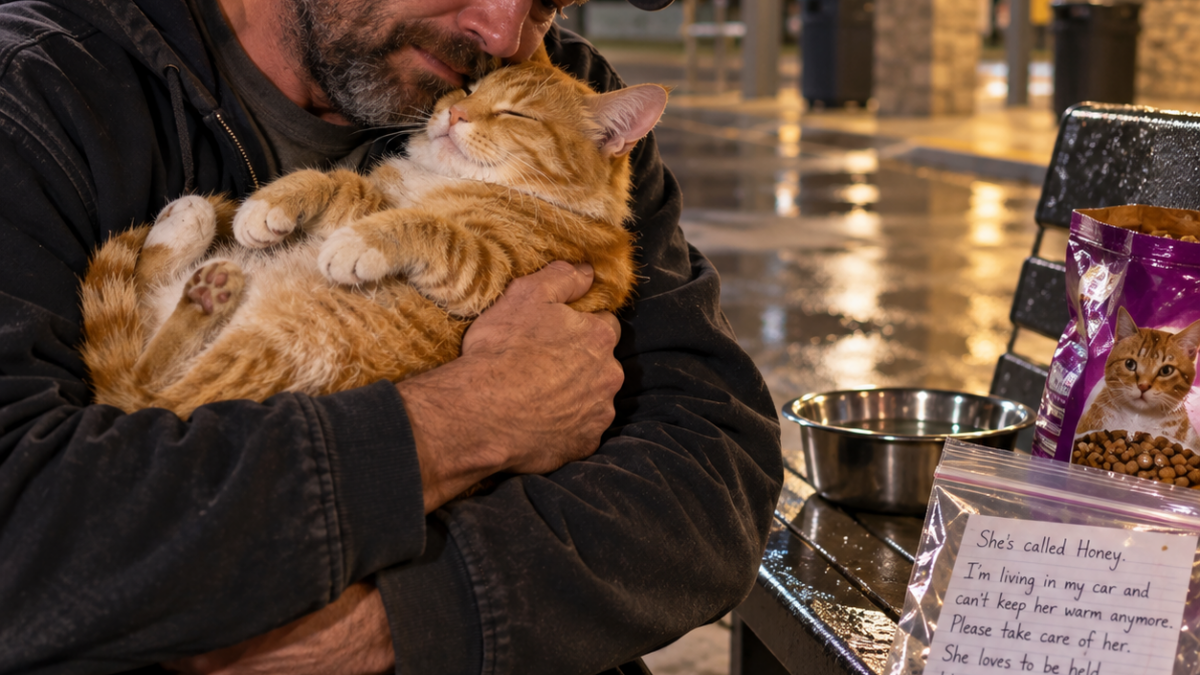
Honey purred.
I read the note again.
Then I picked her up the way the note instructed.
On her back.
Like a baby.
Honey’s body went limp against my chest.
Her paws curled inward.
Her eyes half closed.
The purr got louder.
That broke me.
Not dramatically.
I didn’t sob in the parking lot.
I just sat there holding somebody else’s cat while something in my throat tightened so hard I could barely swallow.
Because whoever had written that note knew this.
They knew this exact position made Honey feel safe.
They had learned it over years.
They had probably carried her through apartments, hallways, vet offices, maybe thunderstorms.
They had probably held her this way when they were scared too.
I took Honey to my car.
She climbed onto the passenger seat as if she had been riding there all her life.
I put the food bag on the floor, the water bowl in the trunk, and the note inside the center console.
Then I sat behind the wheel and looked at her.
“Well,” I said, “I guess we’re doing this.”
Honey stared through the windshield.
For the next two and a half hours, she barely made a sound.
She sat on the passenger seat and watched headlights pass.
Every twenty minutes or so, she looked at me as if checking that I was still there.
I stopped at a twenty-four-hour grocery store outside Carlisle and bought everything I could think of.
Litter box.
Litter.
Food bowls.
Wet food.
A bag of better dry food.
A cheap cat bed.
Two toys.
A cardboard scratch pad.
I stood in the pet aisle at eleven-thirty at night reading labels like I was preparing for a licensing exam.
Honey waited in the locked car with the heat running low.
When I came back carrying three bags, she had moved into the driver’s seat.
“That’s mine,” I told her.
She did not appear concerned.
At home, she walked through every room slowly, sniffing baseboards and furniture.
Then she followed me upstairs.
I set the cat bed beside my bed.
She looked at it once.
Five minutes later she was asleep against my ribs.
The next morning, I called my veterinarian, a man named Dr. Patel who had treated my sister’s dogs for years.
“I found a cat,” I said.
He paused.
“You found a cat.”
“At a rest stop.”
Another pause.
“You hate cats.”
“I don’t hate cats.”
“You told me cats look at people like tiny landlords.”
“That was a joke.”
“You also said you would never own an animal that could walk across your kitchen counters.”
“I’m evolving.”
He laughed.
“Bring her at eleven.”
Honey was healthy.
That was the first thing he told me.
Normal weight.
Clean ears.
Good teeth.
No fleas.
No obvious skin problems.
Her coat was soft and groomed.
She had been spayed.
There was no microchip.
“That happens,” Dr. Patel said, running the scanner over her shoulders again. “Older clinic may not have chipped her. Or someone couldn’t afford it.”
I handed him the note.
He read it quietly.
His expression changed.
When he reached the bottom, he exhaled through his nose.
“This wasn’t someone who got tired of having a pet.”
“I know.”
“She’s been cared for.”
“I know.”
He looked at Honey, who was sitting on the examination table with her tail wrapped around one of my hands.
“Whoever owned her kept caring for her after they stopped being able to care for themselves.”
That sentence stayed with me.
I asked the question that had been bothering me since the rest area.
“Can we find the owner?”
“Without a chip? Maybe. Vaccination records if we know the clinic, but we don’t. Local shelters might recognize her. Social media.”
“I don’t want to get anyone in trouble.”
“For abandoning an animal?”
I looked at the note.
“No. For being poor.”
Dr. Patel nodded slowly.
“That’s a different question.”
I took a picture of Honey that afternoon.
She was sitting in the patch of sunlight beside my living-room window.
I posted it to a community Facebook group for lost and found pets.
I did not post a photograph of the note.
It felt too personal.
Instead I wrote that I had found a friendly orange female cat at a highway rest area, that food, water, and a handwritten message had been left with her, and that I was trying to make sure the person who had cared for her knew she was safe.
I included one sentence from the note.
“She likes being held like a baby.”
I expected maybe a dozen shares.
By dinner, it had three thousand.
By the next morning, it had more than twelve thousand.
People from three counties were sharing it.
Someone copied it to a regional rescue page.
Someone else posted it to a homelessness outreach group.
A local radio station messaged me.
Then a television reporter.
That was when things became complicated.
For every person who wrote something kind, somebody else wanted someone punished.
“Find this monster.”
“Animal abandonment is a crime.”
“If she loved the cat, she would have taken it to a shelter.”
“Living in a car is no excuse.”
One woman wrote, “People always invent sad stories for irresponsible people.”
I found myself replying to strangers, which was unlike me.
“She left fresh water.”
Delete.
“She made sure the food bag stayed open.”
Delete.
“She wrote down how Honey likes to be held.”
Delete.
I didn’t post any of it.
Arguing online would not help the person I was looking for.
But I was angry.
The comments became worse after a local news site published a short article.
They used a photograph of Honey I had posted and titled it:
CAT ABANDONED AT REST STOP WITH HEARTBREAKING NOTE.
The word abandoned bothered me.
Technically, yes.
But it seemed to erase everything that mattered.
By the third day, two reporters were waiting outside my office.
I worked as a commercial insurance claims investigator. Most of my job involved damaged warehouses, questionable invoices, and contractors who suddenly forgot how math worked when insurance companies were involved.
I was good at noticing when stories didn’t line up.
I was less good at having cameras pointed at me.
One reporter asked, “Do you believe the former owner should face charges?”
“No.”
“Why not?”
“Because I read the note.”
“Plenty of people abandon animals and make excuses.”
“Then those people probably don’t leave clean water, food, medical history, and instructions on how the animal feels safest.”
The reporter leaned forward.
“So you sympathize with her.”
“I think she was in trouble.”
“Do you plan to keep the cat?”
I looked down.
Honey was not there, obviously, but I could already picture her sleeping on the back of my couch.
“Yes.”
I had not planned to say it.
It was simply true by the time the word came out.
The clip spread.
That night, I received an email from someone using an address made of random numbers and letters.
The subject line said:
I KNOW HONEY.
The message was short.
The woman who owned that cat is named Rebecca Nolan.
She lived at the Cedar Grove Apartments in Bellwood.
Do not post my name.
Ask what happened to Apartment 214.
I read it three times.
Then I called Dr. Patel.
“You ever heard of Cedar Grove?”
“Unfortunately.”
“What does that mean?”
“My receptionist used to live there. Why?”
I told him.
He went quiet.
“Daniel, be careful.”
“Of what?”
“People who make money off people with nowhere else to go.”
The next morning I drove ninety minutes to Bellwood.
Cedar Grove Apartments sat behind an abandoned shopping plaza and a payday-loan store.
There were four brick buildings around a cracked central parking lot.
The complex looked tired.
Not destroyed.
Not the kind of place that would make the news.
Just neglected enough that every problem could be blamed on age.
Rust beneath balconies.
Plywood over one basement window.
A gutter hanging loose.
A playground with one broken swing.
I parked near Building B.
Apartment 214 was upstairs.
The door had been repainted recently.
I knocked.
A young mother answered with a toddler balanced on one hip.
“Rebecca Nolan?” I asked.
Her expression immediately changed.
“No.”
“Did she used to live here?”
“I don’t know anything.”
She started closing the door.
“I found her cat.”
The door stopped.
The toddler grabbed at her hair.
The woman looked over my shoulder toward the parking lot.
“You’re the guy from Facebook.”
“Yes.”
She opened the door two inches wider.
“Honey?”
“You know her?”
“Everybody knew Honey.”
My chest tightened.
“Do you know where Rebecca is?”
The woman looked frightened.
“Mr. Vale told us not to talk about her.”
“Who is Mr. Vale?”
Before she could answer, a voice behind me said, “That would be me.”
I turned.
A man in a dark quarter-zip jacket was climbing the stairs.
Mid-fifties.
Silver hair.
Expensive watch.
The kind of smile people practice because they think friendliness is mostly about teeth.
“I’m Curtis Vale,” he said. “Property manager.”
I introduced myself.
He already knew who I was.
“I saw the little story online,” he said. “Sad business.”
“What happened to Rebecca Nolan?”
He shrugged.
“She stopped paying rent.”
“That’s it?”
“That is generally what results in eviction.”
The young mother closed her door.
Curtis watched it shut.
Then he turned back to me.
“Rebecca had problems.”
“What kind?”
“Financial. Emotional. Maybe substance related. Hard to know.”
My investigator instincts woke up immediately.
“Substance related?”
“She lived in her car. People don’t usually get there by making good choices.”
“Did you ever see her use drugs?”
His smile thinned.
“I don’t discuss former tenants.”
“You just suggested she was an addict.”
“I said maybe.”
“Why?”
He stepped closer.
“Mr. Mercer, I understand you’ve found yourself at the center of a touching internet story. You have the cat. Congratulations. But Rebecca Nolan owes this property more than six thousand dollars. She violated her lease by keeping an unauthorized animal. She created disturbances. She refused assistance. Whatever version of herself she wrote on some sad little note does not change the facts.”
“Was Honey unauthorized?”
“Yes.”
“Then why did everyone here know her?”
Curtis stared at me.
I held his gaze.
He looked toward the parking lot.
“I have work to do.”
“Did you throw Rebecca’s belongings away?”
His head snapped back.
I had guessed.
Nothing more.
But his reaction told me the question mattered.
“Who told you that?”
“No one.”
“Then don’t repeat rumors.”
“Where is she?”
“I have no idea.”
He walked away.
I stood there another minute.
Then the door to Apartment 210 opened.
An old man in a Pittsburgh Steelers sweatshirt looked out.
“You the cat fellow?”
“Yes.”
He jerked his head toward his apartment.
“Come inside before Vale comes back.”
His name was Walter Greene.
Seventy-two.
Retired machinist.
Widower.
He had lived at Cedar Grove for nineteen years.
His apartment smelled like coffee and furniture polish.
There were framed photographs of a woman named Janice on nearly every surface.
Walter waited until I sat down.
Then he said, “Curtis Vale is a liar.”
I took out my notebook.
“Tell me.”
“Rebecca didn’t owe six thousand dollars.”
“How do you know?”
“Because I drove her to the county assistance office twice.”
According to Walter, Rebecca Nolan was fifty-eight years old.
She had lived at Cedar Grove for eleven years.
She worked as a dietary aide at a nursing home.
Honey had belonged originally to Rebecca’s daughter, Emily.
Emily died at twenty-six.
A drunk driver crossed the center line outside Altoona four years earlier.
Rebecca took Honey after the funeral.
“She wasn’t just a cat to Rebecca,” Walter said. “She was what was left.”
In March, the nursing home cut Rebecca’s hours after new ownership took over.
Then her car needed a transmission repair.
Then she fell behind on rent.
Not by thousands.
By six hundred and eighty dollars.
She applied for emergency rental assistance through a county program.
Walter had driven her.
The application was approved.
“How much?” I asked.
“Three months’ rent plus fees. County sent payment directly to Cedar Grove.”
I stopped writing.
“Then why was she evicted?”
Walter’s mouth tightened.
“That’s the question.”
He told me the payment arrived in April.
Curtis Vale claimed it didn’t.
Rebecca showed him the approval letter.
Vale told her paperwork wasn’t money.
Then late fees accumulated.
Then legal fees.
Then pet fees.
Then a lease-violation fee for Honey.
“She had permission for the cat?”
“Had it in writing from the old manager. Emotional-support animal after Emily died. Doctor letter and everything.”
“Did she have a copy?”
“Not after they emptied her apartment.”
I looked up.
Walter stared into his coffee.
“What happened?”
“They posted eviction paperwork while she was working. She tried to fight it. Went to court alone. Vale showed a ledger saying she owed more than four thousand by then.”
“Did Rebecca have proof of the assistance payment?”
“She thought she did. County told her it had been sent.”
“Did the judge verify?”
Walter gave a bitter laugh.
“You ever been in eviction court?”
I had not.
“It moves fast,” he said. “Vale had a lawyer. Rebecca had a folder.”
He swallowed.
“She cried afterward.”
The image landed hard.
Not because crying was unusual.
Because I had seen that folder in my head.
A woman who believed if she brought the right pieces of paper, facts would protect her.
I knew professionally how often that belief failed.
“What about her belongings?”
“She got seventy-two hours. Vale changed the locks before forty-eight.”
“That’s illegal.”
“Tell him.”
“Did anyone document it?”
“I took pictures.”
Walter stood.
He returned with his phone.
There were photographs.
Rebecca on a sidewalk beside black trash bags.
A mattress leaning against a dumpster.
Boxes soaked from rain.
A cat carrier.
A woman with graying brown hair sitting on the curb with Honey in her lap, one hand covering her mouth.
Walter swiped.
Another image showed two maintenance workers throwing furniture into a roll-off container.
Another showed Curtis Vale standing near the building.
“What happened to the rest?”
“Dumped. Some went into storage. Vale said she could retrieve it after paying a removal fee.”
“How much?”
“Eight hundred.”
“She didn’t have eight hundred.”
“She didn’t have eighty.”
I asked Walter where Rebecca went.
“Car.”
“Did she have family?”
“A sister in Florida. They hadn’t spoken in years.”
“Why?”
“Emily.”
“What about Emily?”
Walter shook his head.
“Not my story to tell.”
I looked at the photographs again.
“Do you have Rebecca’s number?”
He did.
Disconnected.
“Any idea where she parked?”
“At first she stayed behind the nursing home until they told her she couldn’t. Then Walmart. Church lots. Sometimes the truck stop on Route 22.”
“The rest area where I found Honey is forty miles east.”
Walter nodded.
“She was moving farther away.”
Before I left, he grabbed my sleeve.
“Don’t make her famous if you find her.”
“I won’t.”
“She’s proud.”
“I understand.”
“No.” His eyes hardened. “You don’t.”
I said nothing.
Walter let go.
“She would rather sleep in a freezing car than let somebody look at her like she’s a charity case.”
That afternoon, I drove to the county housing office.
I expected bureaucracy.
Instead I met a woman named Denise Barker who became furious within ten minutes.
I gave her Rebecca’s full name.
Denise could not disclose case details without authorization, but when I described what Walter had told me, she went very still.
“We’ve had other complaints about Cedar Grove,” she said.
“What kind?”
“Payments not credited properly.”
“How many?”
“I can’t discuss specific cases.”
“Enough to know this might not be a clerical error?”
She looked at me.
Then she said carefully, “If an assistance payment was issued to a landlord and that landlord later represented in court that the payment was never received, that would be something our fraud unit would want to examine.”
“Can you check Rebecca?”
“I cannot tell you what I find.”
“But you can check.”
“Yes.”
I gave her my card.
That night, Honey slept against my shoulder.
Around two in the morning, I woke because she was kneading the blanket under my chin.
I stared at the ceiling.
A woman had lost her daughter.
Then her hours.
Then her apartment.
Then nearly everything she owned.
Then, months later, she had sat at a highway rest area with the last living creature connecting her to her daughter and written:
I tried.
I got out of bed.
I opened the kitchen drawer.
The note was still in its plastic bag.
I read it again.
For the first time, I noticed something I had missed.
There were faint water marks on the paper.
Not rain.
The plastic had kept rain out.
The paper had been wet before it went inside.
Tears, probably.
I sat at the kitchen table until sunrise.
At eight-thirty, Denise Barker called.
Her voice was tight.
“I need you to tell me exactly who gave you the information about Ms. Nolan’s eviction.”
“Why?”
“I can’t discuss an active matter.”
“Then tell me whether you found something.”
Silence.
“Mr. Mercer, I strongly recommend that any former Cedar Grove tenants who believe assistance payments were mishandled contact the county fraud office.”
“How many?”
“I didn’t say there were multiple.”
“You didn’t have to.”
She sighed.
“Please don’t put anything online yet.”
That was the first moment I understood this might be bigger than Honey.
Over the next two days, I did what I knew how to do.
I investigated.
Not as an insurance representative.
As a private citizen with too much anger and a cat sleeping on his paperwork.
I searched court records.
Curtis Vale managed three apartment complexes through Vale Residential Services.
Cedar Grove had filed forty-three eviction actions in eighteen months.
That alone meant nothing.
Then I began comparing names with public assistance reports and nonprofit housing records where available.
I called former tenants.
Most hung up.
Some were afraid.
Five talked.
Three told nearly identical stories.
Emergency rental assistance had been approved.
Cedar Grove said payment never arrived.
Late fees multiplied.
Eviction followed.
One woman, Tasha Monroe, had a receipt showing a nonprofit paid $2,400 directly to Vale Residential.
She still got an eviction notice claiming the exact same $2,400 as unpaid rent.
“Why didn’t you fight it?” I asked.
“I did.”
“What happened?”
“I missed work twice for court. My boss fired me after the second time.”
Her voice broke.
“I had two kids. I couldn’t keep fighting a man who got paid to be there.”
That sentence made me put my pen down.
A man who got paid to be there.
Curtis Vale could spend eight hours in court.
His tenants couldn’t.
He could hire a lawyer.
They were counting grocery money.
He could call their confusion proof.
He could call their exhaustion consent.
By Friday, the local news story about Honey had become national.
A morning show requested an interview.
I declined.
A pet-food company offered free food for a year.
I asked them to donate it to a shelter.
Then the public mood shifted.
Someone found Rebecca’s eviction record.
Her name appeared online.
The comments turned ugly.
“So the owner was a deadbeat.”
“Mystery solved.”
“Could pay for cat food but not rent?”
“This is why landlords have rules.”
Then a man named Curtis Vale gave an interview.
I watched it on my laptop with Honey in my lap.
He stood in front of Cedar Grove wearing a pressed blue shirt and concerned expression.
“We’re very sympathetic to Ms. Nolan,” he told the reporter. “Unfortunately, this was an individual who repeatedly rejected opportunities to stabilize her life. We cannot force adults to make responsible choices.”
I felt Honey’s claws press lightly into my jeans as my leg tensed.
The reporter asked, “Did your company receive rental assistance on Ms. Nolan’s behalf?”
Vale smiled.
“Our accounting records are accurate and have already been reviewed through the appropriate legal process.”
“Did you dispose of her belongings before the legal deadline?”
“That claim is false.”
“Residents have photographs.”
“Disgruntled former tenants often make accusations after lawful evictions.”
Then he made the mistake that eventually destroyed him.
He said, “The tragedy here is the cat. Animals depend on us to make better decisions.”
I replayed that sentence three times.
Then I called the reporter.
Her name was Rachel Kim.
“I’ll go on camera,” I said.
She arrived at my house that evening.
I told her about Honey.
I showed her the food bag.
The water bowl.
The note.
I did not allow the camera to film the entire note.
Only the last line.
I tried.
Then Rachel asked me about Curtis Vale.
I said, “I think before people judge Rebecca Nolan for the worst night of her life, they should ask how she got there.”
“Are you alleging misconduct?”
“I’m saying there are former Cedar Grove tenants who have receipts showing rental assistance payments that were later listed as unpaid rent in eviction cases.”
Rachel’s eyebrows lifted.
“Do you have documentation?”
“Yes.”
“Can we verify it?”
“Yes.”
The story aired at eleven.
By midnight, I had thirty-seven missed calls.
By morning, Curtis Vale’s lawyer had emailed me a cease-and-desist letter.
By noon, Vale Residential announced that my statements were “false, reckless, and defamatory.”
At two, my employer called me into a video meeting.
My director, Paul Hendricks, looked miserable.
“Daniel, what are you doing?”
“I’m not representing the company.”
“That’s not the issue.”
“Then what is?”
“One of our major commercial clients is insured through a real-estate group that does business with Vale Residential.”
I stared at him.
“Are you asking me to stop?”
“I’m asking you to consider whether you want personal media activity affecting your professional reputation.”
“Is that a yes?”
Paul rubbed his forehead.
“Take the weekend. Stay off television.”
“I have documentation.”
“This isn’t one of your files.”
“No.”
“It isn’t your job.”
“No.”
“Then why are you risking your job for it?”
I looked down.
Honey was under my desk, asleep on my shoe.
“Because nobody else got paid to stay in the room.”
Paul frowned.
“What?”
“Nothing.”
He ended the call.
I knew then there would be consequences.
I just didn’t know how many.
That evening, someone threw a brick through my front window.
It landed six feet from the couch.
Honey vanished upstairs.
The brick had a piece of paper taped around it.
STOP LYING.
I called the police.
The officer took photographs.
My neighbor’s doorbell camera showed a dark pickup, but not the plate.
I boarded the window with plywood.
Then I found Honey beneath my bed.
She was trembling.
I lay on the floor and stretched my hand toward her.
She crawled out slowly.
When I picked her up, she twisted onto her back.
Like a baby.
I held her against my chest in the dark.
“I know,” I whispered.
I wasn’t sure whether I was talking to her or myself.
The next morning, Walter called.
“They found Rebecca’s car.”
My heart stopped.
“Where?”
“St. Joseph’s Hospital.”
“Is she okay?”
“I don’t know.”
I drove ninety miles in seventy-four minutes.
Rebecca Nolan had been admitted the night before with pneumonia, dehydration, and hypothermia.
A church volunteer had found her semiconscious in her car behind a supermarket.
She had been sleeping there for three nights.
The temperature had dropped below twenty degrees.
The hospital would not tell me anything because I wasn’t family.
I left my number.
Then I sat in the waiting room.
Three hours later, a social worker came out.
“Mr. Mercer?”
I stood.
“She agreed to speak with you.”
The room was small.
Rebecca looked older than fifty-eight.
Not because of wrinkles.
Because exhaustion has its own way of aging a face.
Her brown hair was streaked with gray and pulled back loosely.
There were oxygen tubes beneath her nose.
Her hands were thin.
She looked at me with suspicion.
Then at the carrier in my hand.
I had brought Honey.
I had debated it all morning.
The social worker said the hospital would allow a brief visit if the cat remained in the carrier until the room was closed and Rebecca’s doctor approved it.
I set the carrier on the chair.
Rebecca stared at it.
Her mouth opened.
No sound came out.
I opened the door.
Honey stepped onto the bed.
Rebecca made a sound I will never forget.
Not a word.
Something lower.
Raw.
She covered her face with both hands.
Honey climbed directly onto her chest.
Rebecca folded around her.
“Oh, baby.”
Honey pressed her face beneath Rebecca’s chin.
“Oh, my baby. My baby.”
I turned away.
It felt wrong to watch.
For several minutes, Rebecca cried into Honey’s fur.
Then she looked at me.
“You found her.”
“Yes.”
“Where?”
“The rest area.”
Her eyes closed.
“I stayed across the highway for three hours.”
I felt something inside me crack.
“What?”
“There’s an access road by the maintenance building. I parked where I could see the lot.”
She stroked Honey’s back.
“I couldn’t leave until somebody took her.”
“You watched?”
Rebecca nodded.
“I saw your car.”
I sat down.
“You saw me?”
“I saw you walk past her.”
My stomach dropped.
She gave the faintest smile.
“I thought, okay. Not him.”
I actually laughed.
So did she, barely.
“Then you stopped,” she said.
“I almost didn’t.”
“But you did.”
“I read the note.”
“I’m sorry.”
“Don’t apologize to me.”
She looked down at Honey.
“I kept thinking if I could just make it until spring.”
“What happened?”
Rebecca was quiet.
Then she told me.
Some of it matched Walter’s story.
Some of it was worse.
Her daughter Emily had been her only child.
Emily had died four years earlier.
Honey had been in Emily’s apartment when the police called Rebecca.
After the funeral, Rebecca could not bear to go home alone.
So she took Honey.
“The first night,” she said, “that cat screamed outside my bedroom door until I let her in.”
Honey’s eyes were closed now.
Rebecca ran one finger over the white fur beneath her chin.
“Emily used to carry her like this.”
“Like a baby?”
Rebecca nodded.
“She was ridiculous with her.”
For three years, Rebecca managed.
Not well.
But enough.
She worked forty hours a week at Briar Ridge Nursing Center.
Then new owners cut staffing.
Her hours fell to twenty-eight.
Some weeks twenty-four.
She applied everywhere.
Grocery stores.
Cleaning services.
Assisted-living facilities.
She was fifty-eight, had a bad knee, and no college degree.
“No one says you’re too old,” she told me. “They just say they went with another candidate.”
Then her transmission failed.
She borrowed money to repair it because without a car she couldn’t work.
She fell behind on rent.
The county approved assistance.
Cedar Grove received the payment.
Rebecca knew because Denise Barker had personally confirmed it.
But Vale’s office claimed they had not.
“When I showed Curtis the approval notice, he laughed.”
“He laughed?”
“He told me government workers lose things all the time.”
Then fees appeared.
Late fees.
Attorney fees.
Inspection fees.
A pet violation.
“They knew about Honey for years.”
“Did you have written approval?”
“In my lease file. Doctor wrote the letter after Emily died.”
“What happened to it?”
“Same place everything else went.”
She looked toward the window.
“I went to court. Curtis brought a ledger. I brought printouts. Judge asked if I had proof the money reached their bank.”
“Did you?”
“No. County wouldn’t give me their banking information, obviously.”
Vale won.
Rebecca had ten days.
She appealed.
The appeal required money she didn’t have.
Then management entered her apartment while she was working.
“They said there was an emergency inspection.”
“What emergency?”
“Never told me.”
After that, Rebecca’s folder disappeared.
Her assistance approval.
Her old lease.
Honey’s veterinary records.
Emily’s death certificate.
Everything she had collected for court.
“You think they took it?”
Rebecca looked at me.
“I know what I think.”
Two days later the locks changed.
Some of her things went into dumpsters.
Some disappeared.
Emily’s jewelry box vanished.
So did a small wooden urn.
I stared at her.
“Emily’s ashes?”
“Half.”
Rebecca’s voice flattened.
“I kept half. Her father kept half.”
I felt suddenly sick.
“They threw away your daughter’s ashes?”
“I don’t know what they did.”
That was the first moment I stopped thinking of Curtis Vale as merely greedy.
Greed is ugly.
But there is a kind of cruelty beyond greed that comes from knowing another human being has no leverage and choosing to press harder because of it.
Rebecca slept in her car.
At first, she kept working.
Then a supervisor complained that she smelled like cigarette smoke even though she did not smoke.
She washed in truck-stop bathrooms.
She changed clothes in the car.
She kept Honey’s litter box behind the passenger seat.
One coworker discovered she was homeless.
By the end of the week, everyone knew.
“Some were nice,” Rebecca said.
“Some?”
She smiled without humor.
“One lady left a bag of travel shampoo on my locker. Didn’t say anything. Another started spraying air freshener whenever I came into the break room.”
I closed my eyes.
“Rebecca—”
“Please don’t do that.”
“What?”
“Make that face.”
“What face?”
“The one where you feel sorry for me.”
I sat back.
She was right.
“I’m sorry.”
“I made mistakes.”
“So does everybody.”
“I should’ve saved more.”
“You were raising a daughter alone.”
“I should’ve fought harder.”
“You did.”
“I should’ve called my sister.”
“Why didn’t you?”
Her face closed.
“That’s personal.”
I nodded.
Then she asked, “How long has Honey been with you?”
“Eight days.”
“Where does she sleep?”
“My bed.”
A small smile.
“She took over?”
“Within an hour.”
“Does she still steal cheese?”
“I didn’t know she stole cheese.”
“Oh, she steals cheese.”
“I’ll secure the refrigerator.”
Rebecca laughed.
It turned into coughing.
The nurse came in.
Our visit was ending.
I stood.
Rebecca tightened her arms around Honey.
Her face changed.
I knew that expression.
It was the face of someone preparing to lose something for the second time.
“You can keep her,” she whispered.
I said nothing.
“She’s yours now.”
“She’s not an object.”
Rebecca looked at me sharply.
“I know that.”
“I mean she doesn’t have to become anybody’s property today.”
“She needs stability.”
“Yes.”
“You have a house.”
“Yes.”
“I have a car.”
“You’re in a hospital.”
“Exactly.”
I pulled my chair closer.
“Honey is staying with me as long as she needs to.”
Rebecca’s eyes filled.
“But she still knows you.”
She looked away.
“She still loves you.”
Her mouth trembled.
“And I’m not going to pretend the last five years disappear because I found her beside a highway.”
Rebecca wiped at her cheek angrily.
“I left her.”
“You made sure someone found her.”
“I left her.”
“You stayed across the road for three hours.”
She stared at me.
“I watched you pick her up.”
Her voice broke.
“I watched her relax in your arms.”
I swallowed.
“That’s how I knew I could drive away.”
The room became very quiet.
I reached into my coat.
I removed the Ziploc bag.
Rebecca looked at it and immediately began crying again.
“I kept it,” I said.
“Why?”
“Because it mattered.”
She touched the plastic with two fingers.
“I wrote it three times.”
“What?”
“I kept messing up.”
She laughed through tears.
“First one sounded too desperate. Second one sounded like I was giving instructions to a kennel.”
She shook her head.
“I didn’t know how to explain five years of loving something on one piece of notebook paper.”
“You did okay.”
“No.”
“Yes.”
She looked at the final words.
I tried.
“I hated writing that.”
“Why?”
“Because it sounded like an excuse.”
“It didn’t.”
“It felt like one.”
I leaned forward.
“Rebecca, listen to me.”
She looked at me.
“You kept Honey healthy while you lived in a car for eight months.”
Her chin tightened.
“You fed her.”
A tear slid down her cheek.
“You kept her vaccinated as long as you could.”
She lowered her eyes.
“You stayed awake on cold nights running the heater until you were afraid you’d run out of gas.”
Her face changed because I had guessed correctly.
“You gave her the last warm thing you could give her.”
“What?”
“A chance.”
Rebecca covered her mouth.
I kept going.
“You didn’t throw her away. You didn’t leave her behind a dumpster. You didn’t dump her on a back road. You chose a place with people, lights, cameras, shelter, food, water, and a note protected from the rain.”
Her shoulders shook.
“And then you sat across the highway until somebody picked her up.”
I pointed to the note.
“You wrote, ‘I tried.’”
I felt my own eyes burning.
“You did.”
A nurse appeared at the door.
I picked Honey up.
Rebecca kissed her forehead.
“Be good.”
Honey purred.
Rebecca laughed through tears.
“She won’t.”
The nurse smiled.
I put Honey into the carrier.
Before leaving, I turned.
“Rebecca.”
“Yes?”
“I’m going after Vale.”
Fear flashed across her face.
“No.”
“He stole rental assistance.”
“Daniel—”
“He may have done it to other people.”
“He has lawyers.”
“So do insurance companies. I spend my life dealing with them.”
“You have a job. A house. Don’t let my mess ruin your life.”
“It isn’t your mess.”
“You don’t know people like him.”
I looked at her.
“I’m starting to.”
She shook her head.
“Please.”
I stopped at the doorway.
“I won’t use your name without permission.”
“That’s not what I mean.”
“I know.”
“What if he comes after you?”
“He already threw a brick through my window.”
Rebecca went white.
“What?”
“That probably wasn’t him.”
“You don’t know that.”
“No.”
She gripped the blanket.
“Then stop.”
I stood there.
She looked terrified.
Not for herself.
For me.
That was the moment I understood exactly how Curtis Vale had stayed in business.
Fear was cheaper than security.
Most of the people he hurt had children.
Jobs.
Old parents.
Cars that could be repossessed.
Records they didn’t want damaged.
He did not need to win every fight.
He only needed people to calculate what fighting him might cost.
I left the hospital.
I did not stop.
Three days later, the county suspended all rental assistance payments to Vale Residential pending an audit.
Rachel Kim broke the story.
Eleven former tenants contacted her station.
Then nineteen.
Then twenty-six.
One had bank records.
Another had email chains.
A third had a voicemail from a Cedar Grove employee telling her to “ignore the county payment because management hadn’t decided where to apply it yet.”
Denise Barker’s fraud office referred the case to the state attorney general.
Then the police called me about the brick.
They had located the pickup.
It belonged to Cedar Grove’s maintenance supervisor.
His name was Dean Wallace.
Dean denied throwing the brick.
Then police showed him traffic-camera footage.
He changed his story.
He said Curtis Vale had never asked him to threaten me.
Vale had only told him I was “trying to destroy everybody’s jobs.”
Dean said he acted alone.
I believed that about halfway.
It didn’t matter.
He was charged with criminal mischief and intimidation.
Vale Residential put him on unpaid leave.
Then fired him.
Publicly.
That was another mistake.
Dean got angry.
Angry employees are dangerous when your business depends on silence.
He called Rachel.
Then he called investigators.
Dean had worked maintenance for Vale Residential for nine years.
He knew where old files were kept.
He knew why certain tenant ledgers had two versions.
He knew why some assistance checks were deposited into a management account before being transferred.
He knew which tenants had their apartments cleared early.
He knew where Rebecca’s belongings had gone.
That call changed everything.
A week later, investigators executed search warrants on the Vale Residential office and a storage warehouse outside Altoona.
I was at work when Rachel called.
“They found boxes.”
“What boxes?”
“Tenant property.”
I stood.
“How many?”
“Dozens.”
“Rebecca?”
“We don’t know yet.”
Three hours later, Denise called.
“Can Ms. Nolan identify her belongings?”
“She’s still in the hospital.”
“She may not need to.”
My skin prickled.
“What did you find?”
“I can’t discuss evidence.”
“Denise.”
Silence.
Then she said, “Tell Rebecca not to give up on what she thinks she lost.”
Rebecca was discharged two days later.
She had nowhere to go.
The hospital arranged seven nights at a transitional motel through a local nonprofit.
She hated every second of accepting it.
“I can pay it back.”
“You don’t have to.”
“I will.”
The social worker smiled.
“We’ll argue about that when you’re healthy.”
Honey visited every afternoon.
Rebecca never asked to take her back.
That was one of the hardest parts.
I could see how badly she wanted to.
She would hold Honey for an hour, whispering into her fur, then hand her to me before I asked.
One afternoon I said, “You know you’re allowed to say you want her.”
Rebecca looked down.
“What good would that do?”
“It would be honest.”
“I want my daughter back.”
My breath caught.
She continued.
“I want my apartment back. My job before they cut my hours. My mother before Alzheimer’s. My knees from when I was thirty-five.”
She smiled sadly.
“Wanting is cheap, Daniel.”
“Honey isn’t Emily.”
“I know.”
“But losing Honey doesn’t honor Emily.”
Rebecca looked at me for a long time.
Then she said, “You say things like a man who hasn’t lost enough yet.”
That hurt because it was true.
A week later, I lost my job.
Paul Hendricks called me into the office.
Human resources was waiting.
They used words like external reputational exposure and conflict concerns.
They emphasized that my investigation into Vale Residential had been private.
They said I had not violated a specific rule.
Then they told me my position was being eliminated due to restructuring.
I almost laughed.
My position.
The one I had held for eleven years.
Eliminated on a Tuesday morning.
Paul couldn’t look me in the eye.
“Is this Vale?”
HR interrupted.
“This decision is unrelated to any outside party.”
I looked at Paul.
“Is it?”
He said nothing.
That was my answer.
I packed my office into one cardboard box.
At the elevator, Paul followed me.
“I’m sorry.”
“Did they threaten the client relationship?”
He stared at the floor.
“Paul.”
“Yes.”
There it was.
I nodded.
He looked ashamed.
“You were good at your job.”
“I know.”
“I fought it.”
I thought of Rebecca’s note.
I tried.
Funny how differently those words could sound depending on who said them.
I lifted the box.
“Did you?”
The elevator opened.
I left.
The story hit the news that evening.
INSURANCE INVESTIGATOR WHO EXPOSED LANDLORD FRAUD LOSES JOB.
I hated the headline.
Rebecca hated it more.
She called me.
“You should have stopped.”
“No.”
“I told you.”
“Yes.”
“You lost your job because of me.”
“No.”
“Don’t do that.”
“Do what?”
“Turn everything into principle.”
I sat on my kitchen floor.
Honey was chasing a bottle cap beneath the table.
“I lost my job because people with money leaned on people who cared more about a business relationship than they cared about keeping me.”
“That happened because of me.”
“It happened because of Vale.”
Rebecca was silent.
Then she said, “Come to the motel.”
When I arrived, she was waiting outside.
No coat.
I took mine off and handed it to her.
She rolled her eyes but put it on.
We sat on the curb.
For several minutes, neither of us spoke.
Then Rebecca said, “My sister called.”
“Florida?”
She nodded.
“How?”
“She saw the news.”
“What did she say?”
Rebecca stared at the parking lot.
“That she was sorry.”
“For what?”
Rebecca rubbed her hands together.
“Emily’s father was my sister’s husband’s brother.”
I tried to follow.
“Okay.”
“After Emily died, there was a lawsuit.”
“The drunk driver?”
“Insurance settlement.”
Rebecca closed her eyes.
“Emily didn’t have a will. Her father and I weren’t together. We fought over everything. Funeral. Ashes. Settlement.”
“And your sister?”
“She sided with him.”
“Why?”
“She thought I was too emotional to make decisions.”
Rebecca laughed bitterly.
“Imagine that. Your child dies and people become concerned you’re emotional.”
I said nothing.
“She told me I should give Emily’s father most of the settlement because he had younger children.”
“Did you?”
“No.”
“What happened?”
“Lawyers. Two years. Half the money disappeared into legal fees. I used the rest paying bills and helping with my mother’s nursing care.”
Her voice dropped.
“My sister said I was selfish.”
“So you stopped speaking.”
“She stopped first.”
“What did she say today?”
“That she saw Honey.”
Rebecca looked at me.
“She recognized her.”
“And?”
“She cried.”
“What does she want?”
“To come here.”
“Do you want that?”
“I don’t know.”
I nodded.
Rebecca looked at the motel.
“You know what the worst part of being homeless is?”
“The cold?”
“No.”
“Hunger?”
“No.”
“What?”
“Everybody starts talking to you like you already disappeared.”
I frowned.
“What do you mean?”
“Doctors ask the social worker questions while you’re sitting there. Police call you ‘ma’am’ in that tone. Store managers watch you. People decide you’re either dangerous or helpless.”
She swallowed.
“You become a situation.”
I looked at her.
She continued.
“You’re the homeless woman. The evicted tenant. The lady sleeping in the car.”
Her eyes filled.
“You stop being Rebecca.”
I understood then what she had been resisting from me.
Not help.
Erasure.
I had been so determined to prove she deserved compassion that I had sometimes forgotten she deserved something more basic.
Agency.
“What do you want?” I asked.
She blinked.
“What?”
“Not what do you need. What do you want?”
Rebecca took a long time.
“I want my things back.”
“Okay.”
“I want Curtis Vale to admit he lied.”
“Okay.”
“I want Walter to stop paying twelve dollars every time he’s three days late.”
I smiled.
“Okay.”
“I want Emily’s urn.”
Her voice nearly vanished.
“And after that?”
She looked toward the road.
“I want a little apartment with a window.”
“Anything else?”
She glanced at me.
“A job.”
“And?”
For the first time, she smiled fully.
“Honey.”
Three days later, investigators returned Rebecca’s property.
Not everything.
But enough.
Two boxes.
A plastic tote.
A jewelry case.
Her old lease.
The assistance paperwork.
Photographs.
Emily’s high-school yearbooks.
A ceramic coffee mug that said WORLD’S OKAYEST MOM.
And the urn.
Rebecca held it against her chest for nearly ten minutes.
No one spoke.
Rachel Kim was there but kept her camera outside.
Denise Barker cried.
Walter cried and pretended allergies were responsible.
I stood in the corner holding Honey.
Rebecca finally looked at Curtis Vale’s former warehouse manager, who was assisting investigators.
“Where was this?”
“Back shelf,” he said.
“Why?”
The man looked down.
“I don’t know.”
Rebecca’s face hardened.
“Yes, you do.”
He swallowed.
“Mr. Vale told us valuables could be held against balances.”
“That’s theft.”
“Yes, ma’am.”
“My daughter was not collateral.”
“No, ma’am.”
Rebecca stepped closer.
“My daughter was not a late fee.”
The man’s eyes filled.
“No, ma’am.”
That sentence became the line every news station played after Curtis Vale’s arrest.
He was charged two weeks before Christmas.
The initial charges included theft by deception, fraud involving public benefits, falsifying business records, and unlawful retention of tenant property.
More came later.
Twenty-three tenants were eventually identified as having payments mishandled.
Not all had been evicted.
Some had simply paid twice.
Some had borrowed money from family.
One pawned her wedding ring.
One moved her children into a shelter.
Vale’s scheme was not spectacular.
That was what made it so ugly.
He did not steal millions in one dramatic act.
He took hundreds here.
Thousands there.
From people unlikely to afford lawyers.
He added fees.
Changed ledgers.
Delayed credits.
Held property.
Used eviction court as pressure.
He relied on exhaustion.
And for years, it worked.
At his preliminary hearing, he saw Rebecca.
She had come wearing a navy-blue dress her sister mailed from Florida.
I sat beside her.
Walter sat on her other side.
Rachel was in the back.
Curtis entered with two attorneys.
For a second, his eyes met Rebecca’s.
Then he smiled.
Actually smiled.
A tiny private curl of the mouth.
Rebecca went rigid.
I whispered, “Don’t.”
“I’m not doing anything.”
“Good.”
“I’m just imagining something illegal.”
“That’s allowed.”
The hearing lasted two hours.
Vale’s attorneys argued accounting errors.
Administrative confusion.
Employee misconduct.
They suggested Dean Wallace had acted without authorization.
Then the prosecutor introduced emails.
One from Vale to an accountant read:
Hold county credits until delinquency fees clear. Apply tenant cash first.
Another said:
If they can’t prove source deposit, ledger stands.
Rebecca closed her eyes.
There it was.
Not confusion.
Not a mistake.
A strategy.
At the end, charges were held for trial.
Outside, reporters crowded the courthouse steps.
Vale’s attorney tried to guide him around them.
Then one reporter shouted, “Mr. Vale, do you still believe Rebecca Nolan failed to make responsible choices?”
Curtis stopped.
His lawyer grabbed his arm.
Too late.
Vale turned.
His face was red.
“You people have turned a delinquent tenant into some kind of saint!”
The cameras moved closer.
Curtis pointed toward Rebecca.
“She didn’t pay her rent! She kept an animal against policy! She lived in her car because she refused to take responsibility!”
His attorney whispered urgently.
Vale pulled away.
“You think one sad cat story changes what she is?”
Everything became still.
Rebecca stepped forward.
I touched her arm.
She shook me off.
Not angrily.
Deliberately.
She walked down three steps until she was close enough for Vale to hear her without microphones.
“My name is Rebecca Nolan.”
Vale stared.
She continued.
“I worked thirty-seven years.”
A camera shutter clicked.
“I raised a daughter.”
Her voice trembled, but she did not stop.
“I buried her.”
Vale’s expression shifted.
“I cared for my mother.”
Another step.
“I paid rent at Cedar Grove for eleven years.”
Vale looked at his attorney.
“And when I needed help once, public assistance paid you money meant to keep me housed.”
No one moved.
“You took it.”
Vale opened his mouth.
Rebecca raised one hand.
“You took my rent.”
Her voice grew stronger.
“You took my furniture.”
She stepped closer.
“You took my records.”
Curtis looked suddenly smaller.
“You took my daughter’s ashes and put them in a warehouse.”
A reporter gasped.
Rebecca’s chin lifted.
“But you did not take my name.”
Curtis said nothing.
“You called me irresponsible because you thought nobody would check.”
Vale’s attorney pulled him backward.
“You called me a bad pet owner because you thought people would rather judge a homeless woman than ask why she became homeless.”
Rebecca’s voice broke.
Then steadied.
“I left Honey at that rest area because I loved her more than I loved keeping the last thing that made me feel like Emily was still close.”
Tears were running down her face.
“You will never understand what that cost.”
Vale looked away.
Rebecca said, “So don’t stand there and explain responsibility to me.”
No one asked another question for several seconds.
Then Rebecca turned and walked back up the steps.
Walter took her hand.
I put my coat around her shoulders.
The clip received millions of views.
Rebecca hated that.
Mostly.
But something unexpected happened.
A woman in Ohio saw it.
She owned three assisted-living facilities.
She called Rebecca.
Not to offer charity.
To offer work.
“I saw how you spoke,” the woman told her. “I need somebody in resident services who can stand up for people.”
Rebecca laughed when she told me.
“I said I don’t have a degree.”
“What did she say?”
“She said dignity doesn’t require one.”
Rebecca accepted a part-time position.
Then full-time.
The salary was better than the nursing home.
A local housing nonprofit helped her secure a small one-bedroom apartment.
Second floor.
Quiet street.
Big window in the living room.
The exact thing she had asked for.
She insisted on paying the security deposit herself.
She bought almost no furniture.
A thrift-store table.
A used couch.
A mattress.
Walter gave her two lamps.
Her sister came from Florida.
I was there when they saw each other.
Neither knew what to say.
Rebecca’s sister, Anne, stood in the apartment doorway holding a suitcase.
Rebecca crossed her arms.
Anne started crying.
“That’s not fair,” Rebecca said.
“What?”
“You cry first, now I look mean.”
Anne laughed through tears.
Then Rebecca did too.
They hugged.
Not like movies.
Not perfectly.
There was too much history.
Too many years.
But they hugged.
Sometimes healing does not arrive as forgiveness.
Sometimes it arrives as permission to begin speaking again.
Vale eventually pleaded guilty to multiple felony and misdemeanor charges as part of an agreement that required restitution.
Cedar Grove was sold.
A court-appointed administrator audited tenant accounts.
Thousands in improper fees were refunded.
Walter received $1,860.
He called me and said, “I’m buying a recliner so expensive it’ll offend God.”
Dean Wallace pleaded guilty to the brick incident.
He received probation, community service, and restitution for my window.
A month later, he wrote me a letter.
Not an excuse.
An apology.
He said he had spent years doing things he knew were wrong because Vale had convinced everyone that tenants were trying to cheat the system.
He said once you start calling people “units” and “balances,” it becomes easier not to see them carrying trash bags full of their lives.
I kept that letter too.
My former employer offered me my job back after a newspaper reported that pressure from a client relationship had influenced my termination.
I said no.
Paul called personally.
“You sure?”
“Yes.”
“What are you going to do?”
“I don’t know.”
That was terrifying.
It was also the first honest answer I had given about my future in years.
Eventually Rachel introduced me to an attorney who represented tenants in housing disputes.
He needed an investigator.
The salary was slightly lower.
The work was not.
I took the job.
Three months after the night I found Honey, Rebecca invited me to dinner.
When I arrived, she had made pot roast.
Walter was there.
Anne was there.
Denise came after work.
Dr. Patel brought a bottle of wine.
Honey was sitting in the front window.
Her window.
Rebecca’s apartment allowed cats.
The property manager had the paperwork ready before she moved in.
I stood just inside the doorway.
Honey saw me.
She jumped down.
She ran toward me.
Rebecca watched.
I crouched.
Honey rubbed against my legs.
“Well,” Rebecca said, “looks like somebody remembers her other boyfriend.”
“She used me for housing.”
“She’s shameless.”
Honey rolled onto her side.
I scratched beneath her chin.
The room felt strange.
Warm.
Full.
For months, I had known this moment was coming.
Nobody had said it aloud.
Honey had lived with me for almost four months.
She slept in my bed.
She sat beside me while I worked.
She waited at the door when I came home.
When my house had felt empty after losing my job, she had been there.
I loved her.
That was no longer complicated.
What happened next was.
Rebecca sat on the couch.
“We should talk about Honey.”
I nodded.
Anne suddenly found something fascinating in the kitchen.
Walter studied the ceiling.
Cowards.
Rebecca stroked Honey’s back.
“I have a place.”
“Yes.”
“A job.”
“Yes.”
“I can afford food.”
“Yes.”
“Vet bills.”
“Yes.”
She looked at me.
“And I want her.”
There it was.
My chest hurt.
I nodded.
“I know.”
Rebecca’s eyes filled immediately.
“But.”
I waited.
“She waits for you.”
I frowned.
“What?”
“When you leave.”
Rebecca smiled.
“She sits by the door.”
Honey jumped onto the couch between us.
Rebecca continued.
“I think I spent months believing love meant proving I could keep her.”
She looked down.
“But maybe that’s the same mistake I made at the rest area.”
“What mistake?”
“Thinking love is about possession.”
I said nothing.
“She’s yours too.”
My throat tightened.
Rebecca laughed.
“Look at you.”
“Shut up.”
“You’re crying over a cat.”
“I have allergies.”
“You don’t.”
Honey climbed into my lap.
Rebecca said, “I’m not asking you to disappear.”
“What are you asking?”
“That we stop making her choose.”
It was such a simple answer that I felt foolish for never considering it.
Honey stayed primarily with Rebecca.
Because that was home.
Not because my house had mattered less.
Because Rebecca was the person whose voice Honey had known for years.
The person connected to Emily.
The person whose grief Honey had slept beside before I even knew either of them existed.
But every Wednesday evening, I picked Honey up.
She stayed with me until Friday morning.
If Rebecca traveled, Honey stayed at my house.
If I had a bad week, Rebecca sometimes showed up with Honey and takeout food.
Walter called it joint custody.
Dr. Patel called it “the most emotionally complicated feline arrangement in Pennsylvania.”
Honey did not care what anyone called it.
She had two homes.
Two beds.
Far too many toys.
And an expanding number of humans who understood that she belonged to herself.
One Saturday in early spring, Rebecca and I drove back to the rest area.
She had asked me to go.
The trees were beginning to bud.
The air smelled like wet earth.
The green metal bench was still there.
Rebecca stood beside it for a long time.
“That’s where I put the bowl.”
I nodded.
“And the food there.”
“Yes.”
She touched the edge of the bench.
“I sat here with her for an hour.”
I could picture it.
Rebecca alone.
Car packed with everything she had left.
Honey beside her.
The note inside the plastic bag.
“I kept changing my mind,” she said.
“I figured.”
“I would put her down. Then pick her up.”
She smiled sadly.
“At one point she climbed back into the car.”
I swallowed.
“What made you finally do it?”
Rebecca looked toward the highway.
“The weather report.”
“What?”
“It was supposed to drop to twelve degrees two nights later.”
She shoved her hands into her coat pockets.
“I had twenty-three dollars.”
Her voice softened.
“I did the math. Gas. Food. Maybe a cheap motel if I got lucky.”
She shook her head.
“I knew there was no version where both of us were warm.”
I stared at the bench.
Rebecca continued.
“So I chose her.”
“You chose yourself too.”
“No.”
“Yes.”
She looked at me.
“You survived.”
“That wasn’t the plan.”
“Maybe it should have been.”
She considered that.
Then smiled.
“Maybe.”
I took the Ziploc bag from my jacket.
Rebecca laughed.
“You carry that around?”
“No.”
“You absolutely do.”
“I brought it today.”
She held out her hand.
I gave it to her.
The paper was creased now.
The writing slightly faded.
She read it silently.
When she reached the end, her lips moved.
I tried.
She stood there a long time.
Then she handed it back.
“You keep it.”
“Why?”
“Because you believed it before I did.”
I placed it inside my coat.
A family pulled into the parking lot.
Children spilled out of a minivan.
A truck driver carried coffee toward his cab.
A woman walked a little white dog near the grass.
Ordinary life moving through an ordinary place.
Rebecca watched them.
“I used to hate this rest area.”
“Used to?”
She nodded.
“I thought it was the place where I failed.”
“And now?”
She looked at me.
“Now I think it’s the place where one part of my life ended before another one knew how to start.”
We sat on the bench.
Neither of us spoke for a while.
Then she said, “You know you almost didn’t stop.”
“I know.”
“I watched you unlock your car.”
“I know.”
“You were leaving.”
“I know.”
She laughed.
“You’re not going to defend yourself?”
“Nope.”
“What made you turn around?”
I thought about it.
The bowl.
The food.
Honey sitting too calmly.
The care inside desperation.
“I noticed somebody had made it easy for her to eat.”
Rebecca’s eyes filled.
“That’s it?”
“That’s it.”
She wiped at one eye.
“Emily used to tell me I worried about stupid things.”
“That wasn’t stupid.”
“The bag kept falling over in the car. I spent twenty minutes trying to figure out how to wedge it against that bench.”
I laughed.
Rebecca did too.
Then she said something I still think about.
“People think rock bottom means you stop caring.”
I looked at her.
She watched a tractor-trailer merge back onto the highway.
“But sometimes you’re at the bottom because you’ve cared as long as you possibly could.”
A year has passed now.
Honey is six.
According to Dr. Patel, she needs to lose a pound.
According to Honey, Dr. Patel is a propagandist.
Rebecca still works at the assisted-living facility.
She has become the person families ask for when a resident is frightened, angry, confused, or being ignored.
She keeps emergency-resource brochures in her desk.
She knows every local food pantry.
Every heating-assistance program.
Every pet-friendly shelter within fifty miles.
Once a month, she volunteers with a street-outreach group.
She keeps bags in her trunk containing socks, hand warmers, bottled water, cat food, and dog food.
Not because every homeless person has a pet.
Because some do.
And too often, people are told the only way to save themselves is to abandon the one living creature that still treats them like themselves.
Cedar Grove has new owners.
Walter still lives there.
The broken swing was replaced.
The gutters were repaired.
Late fees were capped.
Tenants now receive itemized payment records.
The new management company probably does not consider any of this revolutionary.
That is the point.
Basic decency often looks remarkable only after you have seen how profitable cruelty can become.
Curtis Vale was sentenced in March.
Rebecca attended.
She did not speak at sentencing.
People expected her to.
Reporters asked.
The prosecutor offered.
She said no.
“I already told him my name.”
That was enough.
As for me, my house is no longer quiet.
Even when Honey is at Rebecca’s, there are usually signs that she has been there.
Orange fur on the couch.
A toy mouse beneath the refrigerator.
Scratches on one chair I used to care about.
I still live alone.
But my sister no longer tells me I am too comfortable that way.
Maybe because she knows I’m not hiding inside it anymore.
Sometimes loneliness is not about how many people live in your house.
Sometimes it is about whether you have allowed anyone to matter enough to disturb your routines.
Honey disturbed mine.
Then Rebecca did.
Then Walter.
Denise.
Rachel.
Even Dean, in his own broken way.
Lives get crowded when you start paying attention.
The note is still in my kitchen drawer.
Same Ziploc bag.
Same lined paper.
I have read it more times than I can count.
But I no longer stop at the last two sentences.
I notice the others now.
She is friendly.
She loves everybody.
She likes being held like a baby.
She has never scratched anyone.
Those were not instructions for a stranger.
They were pieces of a life Rebecca was afraid would vanish once she drove away.
Tiny pieces of Honey.
Tiny pieces of Emily.
Tiny pieces of herself.
People sometimes ask why Rebecca didn’t take Honey to a shelter.
Why she didn’t call more charities.
Why she didn’t ask strangers for help sooner.
Those questions are easy to ask from warm rooms.
The truth is that poverty does not arrive as one clear emergency.
It arrives as a hundred humiliating calculations.
Can I afford gas or dinner?
Can I miss work for court?
Can I tell my boss?
Can I sleep here without police knocking on the window?
Can I run the heater another ten minutes?
Can I buy cat food if I skip breakfast?
Can I ask my sister after four years of silence?
Can I walk into a shelter if they tell me my cat cannot come?
Can I survive one more night?
By the time someone reaches the decision everybody else considers unthinkable, they may have already survived fifty decisions no one saw.
I used to think rescue stories were simple.
One creature needs saving.
Another arrives.
That is not what happened at that rest area.
I picked Honey up.
But Rebecca’s note changed the direction of my life.
Walter’s photographs exposed a lie.
Denise followed paperwork someone hoped nobody would examine.
Rachel kept asking questions.
Dean finally told the truth.
Rebecca stood on courthouse steps and reclaimed her name.
And Honey, who had no idea what any of us were doing, simply kept loving whoever held her gently.
That is the part I understand now.
Nobody saved anybody alone.
A few months ago, Rebecca framed a photograph of Honey sitting in her apartment window.
Beneath it, she placed a copy of the note.
Not the original.
The original stays with me.
At the bottom of the frame, she added one sentence.
I noticed it the last time I went over for dinner.
It said:
Trying counts when love is the reason you keep going.
I stood there reading it.
Rebecca came up behind me.
“Too much?”
“A little.”
She smacked my shoulder.
“I’m serious.”
“So am I.”
She looked at the photograph.
Honey was asleep on the couch behind us, belly up, paws curled.
“She looks happy.”
“She is.”
Rebecca nodded.
“So am I.”
There was no dramatic music.
No courtroom applause.
No television cameras.
Just a woman in a small apartment with a window.
A cat asleep in a warm room.
A pot of soup on the stove.
Her daughter’s urn on a shelf beside photographs.
Ordinary things.
That is what justice looked like in the end.
Not revenge.
Not getting back everything exactly as it was.
You never get that.
Emily was still gone.
Months in the car were still months in the car.
The nights Rebecca spent afraid were not erased because Curtis Vale went to prison.
The job I lost did not magically return as something that had never happened.
Justice could not reverse time.
But it could name what had been done.
It could return what was stolen.
It could stop the person doing harm.
It could put a key back into someone’s hand.
It could give a woman a door that locked from the inside.
It could give a cat two people arguing over who loved her more.
Before I left that night, Rebecca picked Honey up.
On her back.
Like a baby.
Honey melted into her arms.
Same as the first night I held her.
Rebecca kissed the top of her head.
Then she looked at me.
“You know what I wish?”
“What?”
“I wish I could talk to myself that night.”
“At the rest stop?”
She nodded.
“What would you say?”
Rebecca looked down at Honey.
For a moment she was quiet.
Then she said, “I’d tell her not to be ashamed.”
Her eyes shone.
“I’d tell her the stranger is going to stop.”
I swallowed.
“I’d tell her Honey is going to sleep somewhere warm that night.”
Her voice trembled.
“I’d tell her the note matters.”
Honey began to purr.
“And I’d tell her that when she writes ‘I tried,’ she doesn’t know it yet, but one day she’s going to read those words again and finally understand they don’t mean she failed.”
I couldn’t speak.
Rebecca smiled through tears.
“They mean she loved her enough to let someone else help.”
Honey opened her eyes.
She reached one paw toward Rebecca’s chin.
Rebecca laughed.
Then she handed her to me.
Honey rolled against my chest, belly up, completely trusting.
Exactly like the note said she would.
Sometimes I still think about what would have happened if I had gotten into my car that night.
Maybe someone else would have stopped.
I hope so.
Maybe Honey would have sat beside that bowl until morning.
Maybe Rebecca would have kept watching from across the highway, unable to drive away.
There are too many maybes.
So I try not to live there.
I live with what happened.
I stopped.
I saw a cat.
I saw a bowl of clean water.
I saw an opened bag of food carefully propped against a bench.
I read a note written by someone who believed she had reached the end of what she could do.
And because she took the time to protect that note from the rain, the rest of us learned where to look.
Not just for Honey.
For her.
The last two lines are still the ones people remember.
“I’m sorry.
I tried.”
But they are no longer the end of the story.
If I could add anything beneath them now, it would be this:
Honey is safe.
Honey is warm.
Honey is loved.
Rebecca is safe.
Rebecca is warm.
Rebecca is working again.
She has a home.
She has her daughter’s ashes.
She has her name.
And almost every night, Honey climbs into her arms, rolls onto her back, closes her eyes, and lets herself be held like a baby.
Rebecca tried.
It worked.
They both made it home.








