I Found a Little Girl Alone in the Rain Waiting for “the Wolves”—Then the Sheriff Arrived, She Saw the Necklace Under His Collar, and Begged Me Not to Let Him Take Her.
PART2:
The rain came down thick enough that the road disappeared under spray from passing trucks.
I had a waterproof jacket strapped behind my seat and finally admitted I was too old to prove something to weather.
I turned onto an abandoned logging spur where the trees opened enough to get off the highway safely.
Gravel.
Mud.
Blackberry vines.
Old timber company signs with half the paint gone.
I killed the engine.
The sudden silence after a motorcycle shuts down in heavy rain is strange.
You notice everything.
Water hitting leaves.
Wind rubbing branches.
A distant truck changing gears.
My own breathing inside the helmet.
Then I heard something crack in the woods.
Not loud.
One branch.
I took my helmet off.
Waited.
Another movement.
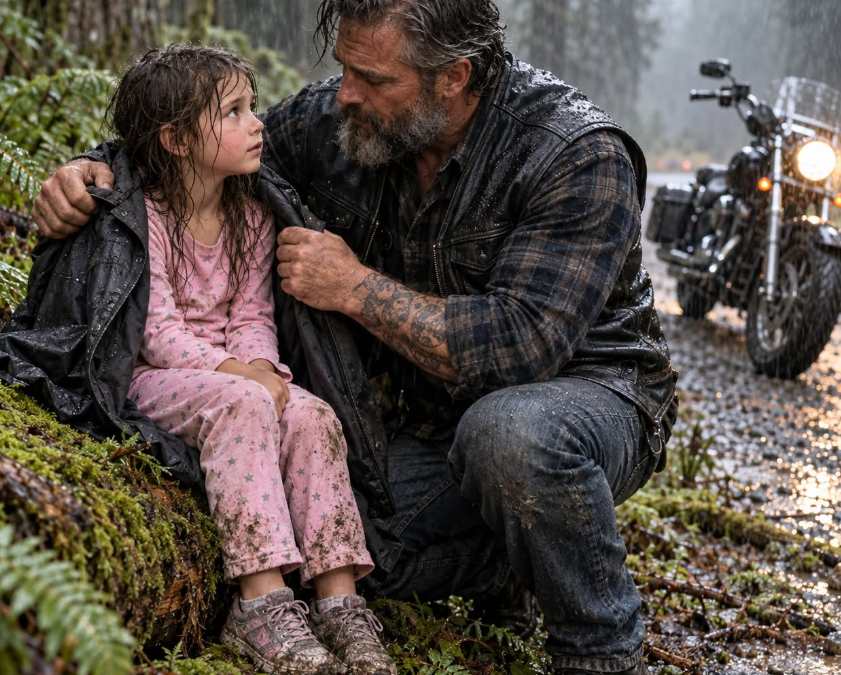
Twenty feet beyond the gravel, something pink showed through the sword ferns.
My first thought was jacket.
Trash.
Maybe a child’s backpack somebody had thrown away.
Then it moved.
I stepped off the road.
That’s when I saw her.
A little girl sitting on a fallen cedar.
Pink pajamas.
No coat.
Mud to her knees.
One shoe tied.
The other missing a lace.
Dark hair plastered across her cheeks.
Hands shoved beneath her armpits because she was trying to keep them warm.
She wasn’t crying.
That scared me more than crying would have.
Children cry when the world still feels safe enough to expect somebody to respond.
This kid looked like she had moved beyond expecting anything.
I stopped several yards away.
“Hey.”
Her eyes went straight to me.
Big.
Brown.
Still.
I removed my gloves.
Set them down.
Then I crouched so I didn’t look like six feet of wet leather moving toward her.
“You don’t have to come close.”
Nothing.
“My name is Jack.”
Rain ran off my beard.
“I’ve got a sister who says I look friendlier without the helmet.”
Nothing.
“She lies.”
One blink.
That was something.
I waited.
Working around wreck scenes teaches patience.
So does growing up in a house where you learn to listen before opening doors.
“Somebody out here with you?”
She stared toward the trees.
“Are you lost?”
Her lips moved.
I leaned slightly.
“What?”
“The wolves.”
Cold moved through me that had nothing to do with rain.
“What about the wolves?”
“He said they’d come when it got dark.”
I looked toward the timber.
Afternoon light was already thinning under clouds.
“Who said that?”
“The man.”
“What man?”
No answer.
“Your dad?”
Nothing.
“Someone you know?”
She wrapped herself tighter.
I changed direction.
“What’s your name?”
“Ellie.”
“Okay, Ellie.”
I kept my voice even.
“I’m going to put my jacket on the ground. You can take it if you want. I won’t come closer.”
I slowly removed the rain shell from behind my bike.
Walked two steps.
Set it down.
Backed away.
She looked at it.
Then me.
Then finally stood.
Her legs shook.
That was when I realized how cold she was.
She walked to the jacket.
Picked it up.
Tried to put one arm through and couldn’t.
I held my hands open.
“Can I help?”
A tiny nod.
I moved slowly.
Wrapped it around her shoulders instead of trying sleeves.
The jacket swallowed her.
She smelled like rain, mud, and wood smoke.
I could feel the shaking through the fabric.
“Where’s your mom?”
Her entire body changed.
Not much.
Just a tightening.
Eyes down.
Mouth closed.
I knew that kind of silence.
My younger sister, Maggie, used to do the same thing when our father came home drunk.
Maggie could disappear while sitting at the kitchen table.
I was eleven the first time I understood she wasn’t ignoring anyone.
She was surviving.
I didn’t ask Ellie again.
“Do you know where your house is?”
No.
“Did somebody bring you here?”
Small nod.
“The man?”
Another nod.
“Did he hurt you?”
Nothing.
I let it go.
“What did he tell you to do?”
“Stay on the log.”
“Until when?”
“The wolves.”
I swallowed.
“Okay.”
She looked toward the road.
“He said if I moved, they would find me.”
I had spent years repairing trucks used in logging country.
I knew what lived in those woods.
Black bears.
Cougars.
Coyotes.
Not packs of storybook wolves waiting behind trees.
But six-year-olds don’t need real wolves when an adult has already put them somewhere to die.
“We’re not waiting for them.”
Her eyes snapped to mine.
“He said stay.”
“I know.”
“He said they’d know.”
“Who?”
“The wolves.”
I crouched lower.
“Ellie, listen to me.”
She stared.
“You are not in trouble.”
No reaction.
“You didn’t do anything wrong.”
Still nothing.
“I’m going to get you somewhere warm.”
“What if he comes back?”
The question nearly stopped my heart.
“I’ll be there.”
It was not a promise I had authority to make forever.
Only for the next few minutes.
Sometimes that’s enough.
I reached out one finger.
Not my hand.
One finger.
Ellie looked at it.
Then reached from inside the oversized jacket and wrapped her tiny hand around it.
That was how we left the woods.
Not heroically.
A giant wet biker moving at the pace of a freezing child because she would not let go of one finger.
My phone showed no service.
The motorcycle was useless.
There was no safe way I was putting a six-year-old child on the back of a bike in freezing rain.
I walked her to the turnout.
Waited.
The first vehicle passed too fast.
The second slowed, then continued.
The third was a white plumbing van.
I stepped into the edge of road and waved both arms.
It braked.
A woman rolled the window down halfway.
“What happened?”
I stepped aside so she could see Ellie.
Her expression changed immediately.
“Jesus.”
“Found her alone in the woods.”
The doors unlocked.
“Get in.”
Her name was Tessa Morgan.
Thirty-eight.
Plumber.
Mother of two.
I learned all that later.
In the moment, she was simply the first stranger who looked at a muddy little girl in my raincoat and decided stopping mattered more than whatever appointment she was heading toward.
Ellie sat between us because the back of Tessa’s van was full of tools.
I put my motorcycle key in my pocket and left the bike at the turnout.
Tessa said:
“Nearest place with people is Marlene’s.”
I knew it.
Small diner and gas station off Route 18.
Yellow sign.
Coffee good enough if you had never had good coffee.
Fifteen minutes.
The entire drive, Ellie stared through the windshield.
Tessa tried once.
“Honey, are you hurt?”
Ellie leaned toward me.
I shook my head slightly.
Tessa understood.
No more questions.
Marlene’s diner glowed through the rain like somebody had plugged a small piece of summer into a gray afternoon.
We pulled in.
I carried Ellie because she could barely walk by then.
Marlene herself met us.
She was sixty-something, with white hair cut short and a voice that could cross a kitchen full of frying bacon without effort.
Her eyes went to my vest first.
IRON PINES.
Then to the child.
Whatever judgment might have followed died immediately.
“What happened?”
“Found her on a logging spur.”
“Alone?”
“Yes.”
“Jesus.”
“Call an ambulance.”
Marlene pointed toward a booth.
“Put her there.”
She grabbed towels.
Blankets.
A mug she filled with warm water, then changed her mind because she didn’t know if Ellie should drink before medical evaluation.
Good instinct.
Tessa stayed.
I called 911 from the diner phone because my cell still had one useless bar.
Dispatcher took details.
Child.
Approximately six.
Cold exposure.
Possible abandonment.
Logging road coordinates as best I could describe.
She said a county unit was only minutes away.
Ambulance farther.
I felt relief.
Real, immediate relief.
Police.
Uniform.
Radio.
Authority.
Adults whose entire job was taking over situations exactly like this.
I have remembered that relief more often than I want to.
Because of how completely wrong it was.
Ellie sat wrapped in two blankets.
Marlene dried her hair with a clean kitchen towel.
I stayed beside the booth.
Not touching.
Close.
“You did good.”
She looked at me.
“Will Mommy know where I am?”
There are answers children deserve that adults sometimes don’t have.
I wasn’t going to invent one.
“We’re going to tell the people helping us everything we know.”
“Will they find her?”
“I hope so.”
Not:
Yes.
Not:
I promise.
Children who have already been lied to deserve fewer comforting lies, not more.
Red and blue light crossed the front windows.
Ellie’s hand immediately found my sleeve.
“That’s help.”
She gripped harder.
The first man through the diner door was broad, mid-fifties, with a gray mustache and heavy rain jacket over brown county uniform.
His patch said sheriff.
Behind him came a younger deputy.
Maybe thirty.
Short hair.
Narrow face.
He scanned the room and immediately locked onto me.
Vest.
Beard.
Child.
I watched his assumptions form.
The sheriff smiled at Ellie.
“Well.”
He glanced at me.
“Interesting company you’ve found yourself, sweetheart.”
I disliked him instantly.
Not because he insulted me.
Because his first concern appeared to be me instead of the hypothermic child.
I stood halfway.
“I made the call.”
“We’ll handle it.”
“She needs the ambulance.”
“It’s coming.”
He stepped toward Ellie.
“Come on, honey.”
She recoiled.
Not hesitation.
Terror.
She shoved herself against the wall so hard the booth rattled.
Her hand twisted my sleeve.
The sheriff stopped.
“Ellie.”
My eyes went to him.
He knew her name.
I had not said it in the call.
Maybe dispatch got it from Marlene?
Possible.
Then his next sentence erased that.
“You know me.”
Ellie’s entire face changed.
I had seen fear before.
Road accidents.
Fights.
Burns.
A young mechanic once trapped beneath a dump truck axle.
Fear is usually movement.
This was the opposite.
Ellie froze.
“Give her a second,” I said.
The sheriff looked at me.
“Step aside.”
“She is scared.”
“Of you?”
“No.”
The younger deputy shifted toward me.
Watching hands.
Not Ellie.
I could hear the refrigerator compressor kick on behind the counter.
A spoon hit tile somewhere in the kitchen.
The sheriff crouched.
“Ellie.”
She pulled on my shirt.
Hard.
I bent toward her.
His rain jacket had fallen open.
Beneath the uniform collar was a thin silver chain.
Small pendant.
A bird.
One blue stone set into the wing.
Ellie stared.
Her fingers tightened until cloth cut into my neck.
Then she whispered.
Barely enough for me.
“That’s Mommy’s.”
I looked at her.
“What?”
“The necklace.”
I looked again.
The sheriff was reaching toward her.
“Come on, Ellie.”
Her breath touched my ear.
“He took it.”
My stomach dropped.
“From Mommy?”
She nodded.
Then came the words that changed everything.
“He took it before he put her in the ground.”
I moved between them.
Not dramatically.
One step.
Enough.
“Don’t touch her.”
The sheriff straightened.
His face emptied.
Not anger yet.
Something colder.
“You want to reconsider that?”
“No.”
The younger deputy’s hand moved toward my shoulder.
I did not look away from the sheriff.
“Marlene.”
She stood behind counter.
“Yes?”
“Call state police.”
The sheriff’s jaw tightened.
I continued.
“Tell them the child just identified the sheriff as having her mother’s necklace and said he put her mother in the ground.”
The room changed.
Marlene did not ask if I was sure.
She grabbed the phone.
The younger deputy seized my shoulder.
“Turn around.”
Everything happened badly after that.
I jerked free instinctively.
Not a punch.
Not attack.
Just a lifetime of not liking somebody grabbing me from behind.
The sheriff reached past.
Ellie screamed.
I shoved his chest.
One push.
He stumbled into chair.
The deputy drew his pistol.
“Hands!”
Marlene shouted:
“Put that damn thing away!”
Tessa was already moving toward Ellie.
I raised both hands.
Then the sheriff lunged toward booth.
I blocked him again.
The deputy’s gun fired.
The sound inside a diner was enormous.
Plaster burst from ceiling.
A light fixture swung.
For one second everyone froze.
The smell of burnt powder cut through coffee and grease.
Then Tessa opened the swinging kitchen door.
“Back!”
I scooped Ellie.
Not because it was clever.
Because a gun had just fired and the man she accused was reaching for her.
We ran through kitchen.
Marlene remained on phone.
I heard:
“State police. We need state police. Deputy fired a weapon inside my restaurant.”
Tessa led us through rear door.
Her van was parked side lot.
She hit unlock from thirty feet.
I put Ellie inside.
Climbed beside her.
Tessa backed out so fast a bucket of copper fittings tipped over behind us.
“Where?”
I thought.
Not my house.
I lived forty miles away.
Not biker clubhouse.
Too easy to paint that wrong.
“Across county line.”
“Where?”
“My friend Miles has repair shop near Tillamook.”
“Call.”
I finally had signal.
Miles answered.
“Bear?”
“Open the shop.”
“What?”
“Call state police. Tell them we’re bringing a six-year-old girl who identified a county sheriff in her mother’s death.”
Silence.
Then:
“Where are you?”
I told him.
“I’m calling.”
I ended.
Then I called state police myself.
Full name.
Jack Harlan.
Location.
Vehicle description.
Child’s name.
What she said.
I also told them I had shoved the sheriff.
That a deputy discharged a weapon.
That we had left the diner with the child because I believed immediate danger existed.
I was not going to make them discover those facts from someone else’s version.
In the passenger seat, Ellie was curled inside my jacket.
“Did I do bad?”
I turned.
“No.”
“He said nobody would want me if I told.”
I looked through windshield because I couldn’t let her see what my face did.
“I’m glad you told.”
“Are they going to put you in jail?”
“Maybe they’ll ask me a lot of questions.”
“Because of me?”
“No.”
“Because you pushed him?”
Six years old.
Tracking cause better than most adults.
“Yes.”
She looked down.
“I’m sorry.”
“Don’t be.”
“But—”
“Ellie.”
She looked.
“The grown-ups did the bad things today.”
That silenced her.
At Miles’s shop, the office heater was blasting.
Miles Brennan was fifty-two, bald, former Marine, and one of the few people in my life who could look at a freezing child, three police cruisers approaching, and six bikers pulling into his lot without asking a stupid question.
He gave Ellie an oversized sweatshirt.
Tessa stayed.
That mattered.
She did not have to.
She could have left once we were somewhere public.
She didn’t.
I called Luis Ortega, president of Iron Pines.
“I need witnesses.”
“You need backup?”
“No backup.”
I made that clear.
“No weapons. No confrontation. I need people who’ll stand somewhere visible and record.”
“Understood.”
“We’ve got sheriff coming.”
“Understood.”
“Stay calm.”
“Bear.”
“What?”
“You called the wrong people if you wanted chaos.”
Fair.
Luis arrived with seven riders.
Not a hundred.
No dramatic army.
Seven.
They parked at far side of lot.
Removed helmets.
Kept hands visible.
Phones out.
That would matter later.
Ellie sat on old couch inside Miles’s office.
Every time headlights passed, she flinched.
“Are they coming?”
“Who?”
“The other ones.”
“I don’t know.”
She stared at me.
I realized she was surprised.
Adults in her life had apparently always pretended certainty.
“I don’t know who’s coming,” I said. “But I’m staying here.”
That answer seemed to settle her more than promises had.
Three cruisers turned into lot.
The sheriff got out first.
Jacket zipped all the way to his throat now.
Pendant hidden.
Deputy with him.
A third local officer.
A loudspeaker crackled.
“Jack Harlan. Bring the child outside.”
Ellie slid from couch and crawled under Miles’s desk.
I stayed where she could see my boots.
“Not leaving.”
The speaker repeated.
“You are unlawfully holding a minor child.”
There it was.
The story he needed.
Kidnapping.
Biker abducts child.
Police recover victim.
Simple.
Recognizable.
Powerful.
I had leather.
He had uniform.
For one dangerous stretch of minutes, I understood how little truth matters if the wrong story gets organized first.
Miles stayed on phone with state dispatcher.
Tessa filmed from window.
Luis and the riders remained behind the line local deputies ordered them not to cross.
Nobody yelled except sheriff.
Then he saw motorcycles.
“What the hell is this?”
Luis called:
“We’re witnesses.”
“Leave the property.”
“Miles invited us.”
Miles yelled from doorway:
“They’re staying.”
The sheriff stepped toward them.
“Disperse.”
Nobody moved.
No threats.
No engines.
Phones.
An audience he couldn’t send away with a look.
Then more lights.
State troopers.
Ambulance.
The first trooper spoke to local officers before approaching shop.
A female paramedic named Natalie came with him.
Miles opened door.
I lifted hands.
“There’s a child under the desk. She’s scared of sheriff.”
The trooper looked at me carefully.
“Are you armed?”
“Pocketknife.”
“Don’t touch it.”
“I won’t.”
“Any firearms?”
“No.”
“Anyone else?”
“No.”
Natalie knelt several feet from desk.
“Ellie?”
Silence.
“My name is Natalie.”
Silence.
“I’m a paramedic. Jack says you’ve been cold.”
Ellie looked at me from under desk.
I nodded.
“You can talk to her.”
Ellie crawled out holding the hem of my jacket.
They checked temperature.
Hands.
Breathing.
Bruises.
No obvious major injury.
Then procedure took over.
Correctly.
I was separated.
Tessa.
Miles.
Luis.
Local officers.
Marlene at diner.
Ellie.
Everyone.
A state trooper cuffed me.
Not aggressively.
“I need to secure you while we sort.”
“I understand.”
Ellie saw.
That’s when she finally cried.
Not woods.
Not diner.
Not gunshot.
My wrists cuffed.
“Jack!”
I turned.
“I’m here.”
“Don’t go!”
“They’re going to ask me questions.”
“No!”
I looked at trooper.
He looked toward ambulance.
Then made one small decision I will always respect.
“Tessa.”
She turned.
“Will you ride with child until child-services representative arrives?”
“Yes.”
He looked at Ellie.
“Tessa will stay with you where you can see her.”
Ellie cried harder but nodded.
That kindness cost him nothing.
It mattered forever.
I spent that night in an interview room.
Not jail cell.
Interview room.
Hands free after initial processing.
Coffee terrible.
A state investigator named Dana Whitlock asked questions in chronological order.
Over and over.
Where did I first see Ellie?
What exactly did she say?
Did I ask leading questions?
Did I touch sheriff first?
Did sheriff touch me?
Did I know him?
Had I ever met Ellie?
Had Iron Pines had conflicts with law enforcement?
Why leave diner?
Why not surrender child immediately?
I answered.
Every time.
No embellishment.
“I shoved him.”
“Why?”
“He was reaching around me toward Ellie after she accused him.”
“Did he strike you?”
“No.”
“Did deputy fire because you attacked?”
“I can’t tell you why he fired. I can tell you where everybody stood.”
Good investigators want facts, not speeches.
At 3:14 a.m., Dana came back.
“Marlene’s cameras work.”
I exhaled.
“Good.”
“Tessa’s statement matches substantial portions.”
“Good.”
“The 911 call captured gunshot.”
I nodded.
“And the pendant?”
She stopped.
“What about it?”
“The sheriff says it’s family jewelry.”
I looked at her.
“Ellie says mother’s.”
“We’re checking.”
No promise.
At 6:40, Dana returned with another investigator.
They put photograph on table.
A woman in her early thirties.
Brown hair.
Smiling beside another woman.
Around her neck:
Silver chain.
Blue-stone bird.
“Is this Ellie’s mother?” Dana asked.
“I don’t know.”
“Her aunt says yes.”
I looked at necklace.
Same.
Dana said:
“The aunt identified pendant independently.”
My stomach turned.
“Where’s Ellie?”
“Safe.”
“With sheriff?”
“No.”
I closed eyes.
First relief in twelve hours.
Then fear.
Because if necklace really belonged to her mother, Ellie hadn’t imagined anything.
Something had happened.
The state moved fast after that.
Not movie fast.
No immediate confession.
No dramatic arrest inside interview room.
They removed the sheriff from active contact with investigation.
His deputy too.
County district attorney requested outside investigative control.
A warrant secured the sheriff’s residence, vehicle, and office.
Search teams went to logging road.
I was released pending review of diner incident.
No charges filed.
Not cleared yet.
Just released.
Miles picked me up.
I slept three hours on couch at his shop.
When I woke, Luis sat opposite.
No vest.
Coffee.
“You okay?”
“No.”
“Good.”
“What?”
“If you’d said yes I’d worry.”
We sat.
Then my phone rang.
Dana.
They found Nora Bell.
Ellie’s mother.
Near the logging road.
Not visible from the main track.
A shallow grave under brush.
I thanked her.
Hung up.
Walked into Miles’s restroom.
Sat on the closed toilet.
And shook.
I had needed Ellie to be wrong about something.
Maybe necklace stolen earlier.
Maybe mother alive.
Maybe “put her in ground” meant something a child had confused.
Kids misunderstand.
Memory distorts.
Fear turns fragments into strange language.
I had needed that.
There was no misunderstanding.
Nora was dead.
The investigation took months.
What happened became clearer piece by piece.
Nora Bell had known Sheriff Calvin Mercer for almost two years.
Not publicly.
He was married.
Nora wasn’t.
Their relationship became volatile.
She attempted to end it.
According to recovered messages, Mercer threatened her.
Not in cinematic language.
Subtle.
He could make custody difficult.
He knew judges.
He knew social workers.
He knew where she drove.
He knew everybody.
Power works best when threat does not need to be explicit.
Nora began collecting evidence.
Screenshots.
Voice recordings.
Photographs.
She told her sister Beth she was afraid.
She intended to contact state police because she did not trust county.
Before she could, Mercer confronted her.
Ellie was present.
The exact sequence took investigators time to reconstruct.
Nora drove with Ellie to meet someone? Mercer intercepted? Let’s keep source: involved with sheriff, trying leave/report threats, he killed her; Ellie saw enough; he abandoned Ellie. We shouldn’t overinvent too much. We can narrate with caveat.
What prosecutors ultimately proved was that Mercer killed Nora during that confrontation.
Ellie saw enough to become a problem.
He took necklace.
Why?
No one ever got a satisfying answer.
Trophy.
Impulse.
Something sentimental twisted into ownership.
His defense suggested Nora had given it earlier.
Family photographs, messages, and witness testimony undermined that.
Then he drove Ellie into logging country.
Told her to sit.
Told her wolves would come at dark.
Told her no one would want her if she talked.
Then left.
Not a complicated plan.
Cruelty rarely needs sophistication.
His deputy, Aaron Pike, helped afterward.
He did not participate in murder according to evidence.
But he helped conceal vehicle movements.
Altered an incident log.
Repeated Mercer’s story.
At Marlene’s diner, Pike escalated instead of questioning why a child appeared terrified of sheriff.
The gunshot became a major part of his case.
Ballistics and video showed he fired during chaotic confrontation without lawful justification.
He later cooperated.
Mercer did not.
The diner footage saved me.
Not heroically.
Factually.
It showed I did not attack without cause.
It showed Ellie’s panic before physical conflict.
It showed Mercer reaching.
It showed Pike grabbing me.
My push.
The firearm discharge.
Tessa’s testimony matched.
Marlene’s 911 call recorded her saying:
“The child says the sheriff has her mother’s necklace.”
Before anyone could coordinate a story.
That mattered.
State prosecutors eventually told me they would not charge me over the shove.
I was relieved.
People later acted like that decision proved everything I did was perfect.
It didn’t.
Running with Ellie after the gunshot carried risks.
Keeping her from officers carried risks.
Calling Iron Pines created optics that could have made situation worse.
I made decisions with incomplete information.
Some worked.
Some might have gone badly.
The thing that mattered was that I kept trying to reduce danger instead of win a confrontation.
I never wanted showdown.
I wanted Ellie alive.
The trial came almost a year later.
By then, Ellie lived with Beth.
Nora’s sister.
Three hours from me.
I didn’t see Ellie constantly.
That was deliberate.
People heard the story and started saying things like:
“Bet you’ll end up adopting her.”
No.
Children are not rewards for adult bravery.
Ellie had a family.
An aunt who loved her.
A school.
A therapist.
A life that did not need a leather-vested mechanic inserting himself at the center because one terrible afternoon connected us.
Beth called me six weeks after the rescue.
“Ellie asks about you.”
“How’s she doing?”
“That depends on day.”
Nightmares.
Food hoarding.
Panic when Beth left rooms.
Refusal to wear pink pajamas.
Fear of trees after dark.
And an intense need to know where every adult was going.
Beth said:
“She keeps your jacket under her bed.”
“My rain jacket?”
“Yes.”
“I thought state police had it.”
“They returned evidence.”
“Tell her she can keep it.”
“She already decided.”
That sounded like Ellie.
Beth asked:
“Would you visit?”
I thought about it.
Not because I didn’t want.
Because I did.
Too much.
“Ask her therapist.”
Beth went quiet.
“That was therapist’s suggestion.”
“Then yes.”
First visit, I stood on Beth’s porch holding a bag with crayons, a card game, and the wrong kind of cookies.
Ellie opened door behind Beth.
She was wearing jeans.
Yellow sweater.
Hair brushed.
For one horrible second I saw the girl on the log.
Then she lifted my rain jacket.
“You forgot this.”
I swallowed.
“Thought you might need it awhile.”
She hugged it.
Not me.
Fine.
We played cards.
She cheated.
Badly.
Beth made coffee.
No dramatic conversation.
Ellie never mentioned woods.
I did not ask.
A child does not owe you retelling because you were part of rescue.
That became a rule.
I followed.
The trial was different.
There, facts had to be spoken.
Ellie testified through protected procedures appropriate for a child witness.
I was not in room for every part.
I didn’t need to hear everything.
My testimony was simple.
Rain.
Logging road.
Pink pajamas.
Wolves.
Diner.
Necklace.
Whisper.
Don’t touch her.
Gunshot.
Exit.
Repair shop.
The defense attorney did his job.
He asked about Iron Pines.
Prior arrests?
None serious.
Club violence?
No.
Weapons?
No.
Had I consumed alcohol?
No.
Did I dislike police?
No.
Did I shove sheriff?
Yes.
“Hard?”
“Hard enough to move him.”
“You physically assaulted elected law-enforcement officer.”
“I pushed a man trying to reach a child who had just accused him of killing her mother.”
The prosecutor objected.
Judge instructed jury to focus question.
Defense tried again.
“Did you know allegation was true?”
“No.”
“So you acted on statement of six-year-old child.”
“I acted on her terror, the specific necklace she identified, and his attempt to take her before outside police arrived.”
“You decided sheriff was murderer.”
“No.”
“What did you decide?”
“That he shouldn’t touch her until state police got there.”
That was truth.
The necklace became devastating evidence.
Beth testified Nora wore it constantly.
Photographs.
Family video.
A jeweler who repaired clasp months earlier.
Nora’s DNA remained in crevices.
Mercer’s explanation shifted.
Gift.
Found item.
Property recovered from scene.
Each contradicted something else.
The deputy’s cooperation added more.
Phone records.
Deleted messages.
Location data.
Nora’s recordings.
Soil.
Tire impressions.
The prosecution didn’t need one magical piece.
Cases rarely work that way.
Evidence becomes weight through accumulation.
Mercer was convicted of Nora’s murder.
Also charges tied to abandoning Ellie in circumstances prosecutors argued were intended to cause her death.
The deputy received prison time for his role in concealment and other offenses.
I don’t remember exact sentences when people ask.
Not because I wasn’t there.
Because numbers became less important than they expected.
Thirty years.
Life.
Whatever.
Nora remained dead.
Ellie still woke from nightmares.
A sentence is consequence.
Not reversal.
After conviction, reporters called.
A biker saves little girl from corrupt sheriff.
Easy headline.
Too easy.
They wanted photographs of Iron Pines outside courthouse.
Luis refused.
Good.
One television producer asked if I would reunite with Ellie on camera.
I hung up.
Beth received worse.
Offers.
Documentary.
Podcast.
True-crime series.
She said no.
Ellie was six.
Her trauma was not content.
Maybe someday she would decide what story belonged to her.
Until then, adults needed to shut up more.
I wish I could say public attention faded immediately.
It didn’t.
People sent letters to my shop.
Some nice.
Some unhinged.
One woman proposed marriage.
She had never met me.
Someone mailed wolf stuffed animal.
I threw it away before Ellie could ever see it.
Iron Pines members teased me about “hero.”
I told them anyone who used word at shop changed oil filters for free all week.
That stopped most.
Marlene put a small brass plate under one repaired ceiling tile:
THIS IS WHY WE DON’T FIRE GUNS IN DINERS.
I thought inappropriate.
She thought hilarious.
Tessa came to the Iron Pines barbecue the next year.
Her plumbing van surrounded by motorcycles.
She said:
“My mother thinks I’ve joined gang.”
Luis said:
“We have excellent dental.”
We don’t.
Life became funny again in pieces.
That matters.
Trauma stories often skip laughter because people think sadness must remain pure to be respectful.
Real survivors laugh.
Not because things stop hurting.
Because bodies cannot live forever at full alarm.
Ellie’s recovery was not cinematic.
No single therapy session fixed her.
No birthday erased woods.
There were good months.
Bad weeks.
Regression.
Progress.
She had trouble with uniforms.
That was one of the hardest things.
Police officers are supposed to represent safety.
Her nervous system had learned opposite.
Beth’s counselor worked slowly.
Photos.
Stories.
Meeting carefully selected female school-resource officer in plain clothes first.
Then uniform.
No forced trust.
No speeches about “not all police.”
Trust rebuilt through choice.
One step at time.
Ellie stopped sleeping with shoes on.
Then stopped checking doors five times.
Then allowed bedroom door closed halfway.
She ate full meals.
Went to school.
Made a friend named Casey.
Got obsessed with frogs.
Hated peas.
Normal details.
Beautiful details.
On Sundays when Beth said okay, I visited.
Sometimes Ellie talked.
Sometimes she ignored me and colored.
I learned not to confuse silence with failure.
I had spent childhood thinking my sister’s silence meant there was nothing to say.
Later I understood silence can be the safest language available.
With Ellie, I let quiet exist.
She would sit at kitchen table drawing while I drank coffee with Beth.
Sometimes after twenty minutes, Ellie would slide a picture toward me.
A frog wearing a helmet.
A motorcycle with twelve wheels.
A house with a yellow roof.
I kept them.
Every one.
Two years after rescue, she finally asked:
“Did you think I was weird?”
We were sitting on porch steps.
“For what?”
“Waiting.”
“For wolves?”
She nodded.
“No.”
“Why?”
“Because somebody bigger scared you.”
She picked at sleeve.
“I knew wolves weren’t coming.”
I looked at her.
“What?”
“I think I knew.”
“You were six.”
“He told me.”
“Okay.”
“But I think…”
She struggled.
“I think I stayed because if he came back and I wasn’t there, he’d be mad.”
There.
Trauma logic.
Not belief in wolves.
Fear of man.
I said:
“That makes sense.”
She looked suspicious.
“You don’t think it’s dumb?”
“No.”
“I stayed for hours.”
“You survived for hours.”
Different sentence.
She went quiet.
Then:
“You came.”
“Yeah.”
“Why?”
I smiled.
“Needed my rain jacket.”
She rolled her eyes.
Seven-year-old now.
Good.
“No.”
“Because I heard a branch.”
“What if you didn’t?”
I had asked myself that too often.
“I don’t know.”
“Would I be dead?”
There are questions adults want to dodge.
I wouldn’t lie.
“Maybe.”
She stared toward yard.
Then I added:
“But I did hear it.”
She nodded.
That was enough for day.
My sister Maggie met Ellie eventually.
That mattered to me.
Maggie was forty-two then, married, two boys.
We had never fully talked about our childhood.
We had survived same father differently.
I fought.
She disappeared.
After Dad died, we both pretended it was ancient history.
Ellie changed that.
One night Maggie and I sat outside Beth’s house after birthday party.
Maggie said:
“You did for her what you tried to do for me.”
I looked at her.
“I didn’t do anything for you.”
“You stood between.”
“Not enough.”
“We were children.”
“I should’ve told someone.”
“You were eleven.”
“I knew.”
She put hand on my forearm.
“That doesn’t mean you had power.”
That sentence broke something old.
I cried.
Quietly.
Forty-seven-year-old men can cry.
Even bikers.
Especially when little sisters tell them the child they failed to save never thought they failed.
Maybe part of why I refused to move away from Ellie in that diner was not only Ellie.
Maybe I was standing between my father and Maggie forty years late.
People love pure motives.
We rarely have them.
Sometimes present courage grows from old guilt.
Doesn’t make courage false.
Just human.
At Ellie’s eighth birthday, Beth invited me.
I arrived early.
The backyard had a flower bed bordered by logs.
Ellie sat on one.
My feet stopped.
Pink was gone.
Rain was gone.
But the shape of child on fallen wood pulled me straight backward.
She looked up.
Then held out a paper plate.
“You’re early.”
“Sorry.”
“I’m saving you cake.”
“Then I’m exactly on time.”
I sat beside her.
From house, Beth yelled:
“Everybody ready!”
Ellie stood.
She slipped her hand around my finger.
Not whole hand.
One finger.
Same as logging road.
“Come on, Jack.”
I followed.
People later ask if she called me Bear.
No.
Never.
To Ellie, I was Jack.
I liked that.
Bear belonged to people who saw vest first.
Jack belonged to girl who saw who stayed.
Years passed.
I remained part of life, not center.
Important.
Beth raised her.
Beth attended school meetings.
Beth sat through nightmares.
Beth signed report cards.
Beth was there at 2 a.m.
I visited.
Helped when asked.
Taught Ellie how spark plugs work when she was eleven.
Regretted immediately because she disassembled lawn mower carburetor at thirteen.
Beth called:
“Your child.”
“Yours.”
“She says you taught her.”
“That was theory, not vandalism.”
Ellie shouted from background:
“It runs better now!”
It did.
At fourteen, she asked about motorcycles.
Beth said no.
I said no.
Ellie said betrayal.
At sixteen, Beth let her ride behind me once in parking lot.
Helmet.
Gear.
Slow.
She laughed so hard I could hear through helmet.
I almost had to stop because my eyes filled.
There is no way to explain what it feels like watching a child once frozen on a log learn to lean into a turn without fear.
The woods never completely left her.
She did.
Gradually.
At seventeen, she went camping with school group.
Her choice.
Beth texted me:
She’s going.
I stared at phone for minutes.
I did not call Ellie.
Did not make it heavy.
When she came home she sent picture.
Trees.
Tent.
Her smiling.
Caption:
No wolves.
I laughed and cried.
She knew.
Of course she knew.
The necklace stayed in evidence for years.
After appeals ended, Beth received it.
Nora’s necklace.
Silver bird.
Blue stone.
Beth asked Ellie what she wanted to do.
Ellie was old enough to decide.
She didn’t want to wear it.
Not then.
They put it away.
At eighteen, before graduation, she asked Beth for it.
She wore it beneath dress.
Not visible.
Private.
After ceremony she showed me.
I went still.
“You okay?”
“Yeah.”
“You don’t have to wear that.”
“I know.”
“Why?”
She touched pendant.
“Because it was hers before it was his.”
That sentence.
Restoration without pretending.
She reclaimed meaning.
I nodded.
“Looks good.”
She smiled.
“That’s all?”
“What do you want, speech?”
“No.”
“Good. I don’t have one.”
Lie.
I had hundreds.
I kept them.
Ellie went to community college first.
Then university.
Studied social work.
Not because every survivor needs to choose helping profession.
She just liked psychology and hated math.
When she told me major, I asked:
“You sure?”
She glared.
“Why?”
“People.”
“What about them?”
“They’re exhausting.”
“You run a motorcycle club?”
“I ride with one.”
“You voluntarily spend weekends with thirty men who argue about barbecue.”
“Different.”
She laughed.
By then, story belonged mostly to past.
Not gone.
Placed.
There were anniversaries she struggled.
Nora’s birthday.
Date of murder.
Certain rainstorms.
But life expanded around the wound until wound no longer occupied whole map.
That is what healing looked like.
Not erasure.
Proportion.
I stayed mechanic.
Iron Pines got older.
More knee replacements.
Less midnight riding.
Luis developed cholesterol problem and became furious that doctor blamed bacon.
Marlene sold diner to niece but kept coming in because retirement bored her.
Tessa opened her own plumbing company.
Miles finally replaced office couch where Ellie once hid near desk.
Before throwing it away, he called me.
“You want this?”
“No.”
“You sure? Historical artifact.”
“Burn it.”
“Dramatic.”
“It’s a couch.”
Good.
Objects don’t need carry every trauma.
Some can be trash.
Others matter.
My rain jacket mattered.
Ellie kept it until she outgrew childhood by several years.
At twenty, she gave it back.
Folded.
Clean.
A little torn at cuff.
“You can have this now.”
I held it.
“You sure?”
“Yeah.”
“Thought you stole it.”
“Statute of limitations.”
Smart kid.
I put it in closet.
Never wore again.
People ask why.
It wasn’t sacred exactly.
Just done.
The jacket had completed job.
One winter, years after trial, I rode past the logging road alone.
I hadn’t planned to stop.
I did anyway.
The turnout looked smaller.
That’s common with places associated with fear.
Memory enlarges.
I walked into trees.
Found what I thought was fallen cedar.
Maybe same.
Maybe not.
Rain had softened everything.
Moss.
New growth.
Birds.
Nothing evil about place.
Woods had never been villain.
No wolves.
Just a man who used them as threat.
I stood there maybe five minutes.
Then left.
I did not build memorial.
Did not carve Nora’s name.
Her family had a real place for her.
The forest didn’t need claim.
On way back, I thought about first moment I saw pink through ferns.
Chance.
Pure chance.
If rain had been lighter, I might not have stopped.
If jacket was already on, I would have ridden past.
If branch had not snapped.
If Tessa had not stopped.
If Marlene had not called state police.
If cameras failed.
If Luis riders had panicked.
If state troopers arrived ten minutes later.
Lives turn on tiny decisions people rarely recognize while making.
That can be frightening.
It can also make kindness feel urgent.
You may not know which ordinary choice becomes somebody else’s line between before and after.
Stop the van.
Make the call.
Keep recording.
Stay calm.
Believe the scared child long enough to get them somewhere safer.
Not blindly.
Not by deciding guilt yourself.
By taking fear seriously enough that truth gets chance.
That was all I really did.
I did not solve murder.
Investigators did.
I did not convict sheriff.
Jury did.
I did not raise Ellie.
Beth did.
I did not heal her.
Ellie did that work with therapists, family, time, and herself.
My role was smaller.
I stopped.
Then, when an adult she feared tried to take her, I said:
Not yet.
Let’s get someone else.
People call that heroic because they know ending.
At the time, I was mostly afraid.
That’s something stories clean up.
Courage rarely feels like courage while it’s happening.
It feels like:
This is wrong.
Do something.
Don’t make it worse.
Keep your hands visible.
Remember details.
Protect the child.
Call someone with more authority.
Stay.
Fear came with every step.
The gunshot terrified me.
Being accused of kidnapping terrified me.
Watching cruisers surround Miles’s shop terrified me.
Wondering if I had just guaranteed nobody would believe Ellie terrified me.
I did not feel brave.
I felt responsible for the next thirty seconds.
Then next.
Maybe that’s courage.
Thirty seconds at a time.
Ellie once asked me, when she was twenty-two:
“What would you have done if he didn’t have necklace?”
We were at diner.
Not Marlene’s.
Different town.
I thought.
“I’d have let state police sort it.”
“What about sheriff?”
“I still would’ve asked why you were terrified.”
“Would you have handed me to him?”
That question took longer.
“Not while you were panicking and he knew you before I understood how.”
She nodded.
“Even if I never said anything?”
“Yes.”
“Why?”
“Kids don’t owe adults perfect evidence before adults take fear seriously.”
She stirred coffee.
“I like that.”
“Good.”
Then:
“You know you shoved sheriff.”
“Yes.”
“That was stupid.”
“Extremely.”
“You could’ve gotten shot.”
“I know.”
She smiled.
“Beth says same.”
“Beth is smart.”
“Smarter than you.”
“Obviously.”
Normal conversation.
That is my favorite part of everything.
Not courtroom.
Not conviction.
Coffee.
Ellie making fun of me.
The future continues.
Nora didn’t get that.
We don’t romanticize.
Every good thing afterward exists beside an absence.
At Ellie’s college graduation, Beth carried framed photo of Nora in purse.
After ceremony, we took picture.
Ellie in middle.
Beth one side.
Me other.
Then Ellie asked:
“Can we do one with Mom?”
Beth pulled photograph.
We held.
No one pretended Nora was there.
We included her because she had been.
That is grief done honestly.
A reporter once contacted Ellie after she turned eighteen.
She declined.
Years later, she wrote a short essay for a child-advocacy publication.
No names.
No crime details.
One sentence she sent me before publication:
The safest adult in the room was the one everyone thought looked dangerous.
I told her remove.
She refused.
“Why?”
“Too sentimental.”
“It’s true.”
“I look charming.”
“You look like you eat mechanics.”
“I am a mechanic.”
“Exactly.”
She published.
Fine.
But the sentence I cared about came later:
He did not ask me to prove I was afraid before he treated my fear as information.
That mattered.
Children get disbelieved because stories are incomplete.
They use wrong words.
They protect people hurting them.
They contradict.
They remember fragments.
That doesn’t mean accept every allegation uncritically.
It means create safety before demanding clarity.
Ellie could not tell me:
The county sheriff murdered my mother and abandoned me as witness.
She said:
The wolves are coming.
Then:
That’s Mommy’s necklace.
Then:
He put her in the ground.
Fragments.
Enough to stop.
Enough to call outside authority.
Enough not to force her into hands she feared.
That distinction saved us.
I tell Iron Pines younger riders same thing when we do charity rides now.
No hero fantasies.
No chasing predators.
No vigilante nonsense.
If you find vulnerable child:
Call emergency services.
Stay where visible.
Document.
Get witnesses.
Do not interrogate.
Do not post.
Do not turn it into biker story.
Protect first.
Professionals investigate.
Luis says I sound like safety manual.
Good.
Safety manuals exist because somebody got hurt.
Marlene still has repaired ceiling.
The brass plate remains.
I told her again it’s tacky.
She said:
“Don’t come.”
I still do.
Tessa’s plumbing company has eight vans now.
One has tiny Iron Pines sticker in rear window.
Her employees don’t know why.
Miles retired.
Sold shop to nephew.
The desk Ellie hid under stayed until renovation.
Gone now.
The sheriff’s name slowly disappeared from road signs, charity plaques, county newsletters.
That is strange too.
Power looks permanent while someone holds it.
Then letterhead changes.
Uniform transferred.
Office repainted.
Life covers.
Ellie changed last name in adulthood.
Not because of sheriff.
Because she wanted Nora’s maiden name.
Bell.
Ellie Bell.
I liked sound.
At twenty-five she got married.
Small ceremony.
Beth walked her halfway down aisle.
Then Ellie stopped.
Turned toward me.
I panicked.
She held one finger out.
The entire first day came back.
Rain.
Pink pajamas.
Mud.
Tiny hand.
She whispered:
“Come on, Jack.”
I looked at Beth.
Beth was crying.
I walked to Ellie.
Not replacing anyone.
Not father.
Not hero.
Just Jack.
I took her finger for three steps.
Then let go before altar.
That was enough.
At reception, Luis—older, slower, still angry about cholesterol—leaned over.
“You crying?”
“No.”
“Your beard wet.”
“Drink your water.”
He laughed.
Ellie danced.
Beth laughed.
Nora’s silver bird hung at Ellie’s neck.
This time visible.
Blue stone catching lights.
Nobody took it.
Nobody hid it.
Nobody needed explain.
The necklace had been evidence.
Then heirloom.
Objects change meaning when control changes hands.
People do too.
I think often about first words Ellie said.
The wolves.
For years I thought that was story’s beginning.
It wasn’t.
The story began before I arrived.
Nora trying to leave.
Ellie watching adults.
Sheriff building fear.
Deputy choosing loyalty over law.
Every decision stacked until a child ended on a log in rain.
My arrival was simply where my part began.
And maybe that’s the thing worth remembering.
You rarely know when you are stepping into middle of somebody else’s nightmare.
The woman at grocery store.
Kid at bus stop.
Neighbor whose explanation doesn’t make sense.
Coworker suddenly afraid to go home.
Sometimes the clue is not dramatic.
No bruise.
No scream.
Just a person watching woods as if they have appointment.
You do not have to become detective.
You do not have to solve.
Sometimes you only have to stop.
Ask.
Listen.
Call.
Stay.
Let experts take over once safety exists.
That’s what I did.
And when the sheriff arrived, I almost surrendered that responsibility too quickly because a uniform made me relieved.
I don’t hate police because of Mercer.
The state trooper who slowed down for Ellie mattered.
The investigators mattered.
The paramedic mattered.
The prosecutor mattered.
Institutions contain people.
Some protect.
Some abuse.
Uniform is evidence of role, not character.
Leather vest too.
That afternoon, appearances failed everyone.
The biker looked dangerous.
The sheriff looked safe.
The little girl looked calm.
All three impressions were wrong.
Years later, Ellie asked:
“What did you think when you first saw me?”
I said:
“That somebody needed to buy you better shoes.”
She laughed.
“No, really.”
I thought.
“You looked like you were waiting.”
“I was.”
“For wolves?”
“For him.”
I looked at her.
“What?”
“I think I thought he’d come back.”
“To check?”
She shrugged.
“Maybe.”
“Were you scared?”
“Yes.”
“Were you hoping he’d come?”
She took a long time.
“Kids do stupid things.”
“No.”
“Jack.”
“You were six.”
She looked down.
“I wanted an adult to come back even if it was the bad one.”
That truth broke me more than anything.
Children would rather have dangerous attachment than none.
Being left alone can feel worse than being hurt by someone familiar.
That is why safe adults matter.
Not perfect adults.
Consistent ones.
Beth became that.
Therapist.
Teachers.
Eventually me.
People who returned when promised.
Security built slowly.
One ordinary kept promise at a time.
So if someone asks me what saved Ellie, I don’t say motorcycle club.
I don’t say I did.
I say a chain.
Not silver chain.
People.
Tessa stopped van.
Marlene called.
Cameras recorded.
Miles opened shop.
Iron Pines stayed calm.
State troopers came.
Natalie knelt.
Beth took her home.
Therapist stayed.
Ellie kept living.
That is rescue.
Not one hero.
Enough people refusing to be the next person who lets harm continue.
I still ride.
Less far.
Knees complain.
Bike same.
Iron Pines vest more gray around patches.
I still repair diesel.
Hands ache mornings.
People still occasionally lock doors when they see me.
Fine.
One afternoon last year, I stopped at gas station.
A little boy stared at vest.
His mother noticed and pulled him slightly closer.
Then he said:
“Cool motorcycle.”
I smiled.
“Thanks.”
She relaxed.
Tiny.
Ordinary.
No lesson needed.
Not every misunderstanding requires correction.
But some do.
The day Ellie saw that necklace was one.
If I had stepped aside because the sheriff told me to, I don’t know what would have happened.
Maybe another officer would have noticed.
Maybe not.
Maybe Mercer would’ve taken her.
Maybe investigation would eventually uncover Nora.
Maybe Ellie would survive.
Maybe.
That word can eat a person alive.
I don’t spend much time there anymore.
We know what did happen.
Ellie whispered.
I listened.
Marlene called.
The wrong man reached.
I said no.
Everything after grew from that.
At Ellie’s wedding, after music ended and most guests left, she walked outside with me.
Rain had started.
Light.
Oregon rain.
She stood beneath awning.
“You know what’s weird?”
“What?”
“I like rain now.”
I looked at her.
“When did that happen?”
“College.”
“Why?”
She shrugged.
“It stopped belonging to that day.”
I nodded.
That’s healing again.
Not forgetting.
Reclaiming weather.
She held out hand.
Rain touched palm.
“Wolves never came.”
“No.”
She looked at me.
“You did.”
I hated that sentence.
Too perfect.
“That’s terrible.”
She laughed.
“Shut up, Bear.”
First time she called me Bear.
I stared.
She grinned.
Then walked back inside before I could answer.
I stayed under awning another minute.
Watching rain.
Thinking about a fallen tree.
Pink pajamas.
A frightened child waiting for something terrible because a powerful man told her she had no better option.
She had one.
She just didn’t know yet.
Neither did I.
Maybe none of us do when the road turns.
All we can do is make the next decision carefully enough that somebody gets another one after it.
That afternoon in the woods, Ellie reached for one finger.
At the diner, she reached for my shirt.
At the repair shop, she called my name while state troopers cuffed me.
At her eighth birthday, she took my finger again and pulled me toward cake.
Years later, she wore her mother’s necklace and walked toward a life nobody had managed to steal from her.
That’s the part I carry.
Not Mercer.
Not the gunshot.
Not courtroom.
Ellie walking forward.
Because fear had taught her to wait.
For wolves.
For bad men.
For punishment.
For someone to leave.
Healing taught her something else.
She could move.
She could choose.
She could trust carefully.
And she didn’t have to wait in the dark for whatever somebody else said was coming.
The last time she asked me what I remembered most from that first day, I surprised both of us with the answer.
Not the necklace.
Not the sheriff.
Not the gun.
I remembered her hand.
That tiny grip around one finger when she finally stepped away from the fallen tree.
Because before there was evidence, before there were troopers, before anyone knew what had happened to Nora, there was one decision that mattered more than all the rest.
A frightened child decided to leave the place where a dangerous adult had told her she belonged.
And somebody went with her.








