I Found a Dying Dog in the Snow—Then I Saw What She Was Keeping Warm Beneath Her Body
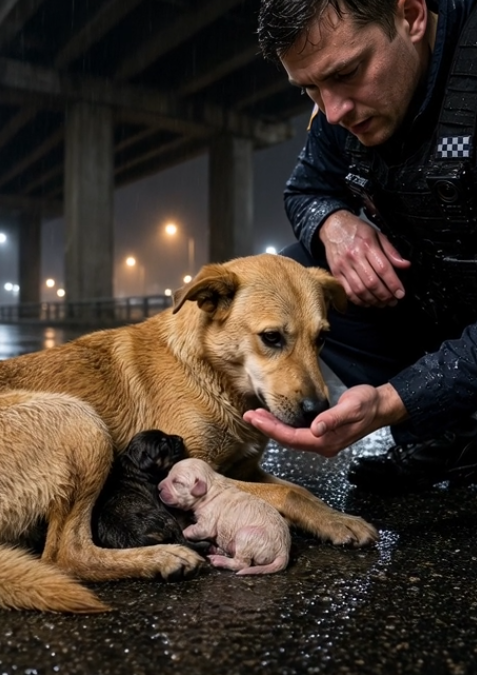
I Found a Dying Dog in the Snow—Then I Saw What She Was Keeping Warm Beneath Her Body
The dog should have run from my patrol lights, but instead she stayed curled in the snow like she was guarding the last thing in the world that mattered.
I thought I was rescuing one frozen stray until I lifted her coat and heard the smallest cries coming from beneath her ribs.
By morning, the whole shelter would understand that she had not survived the cold by accident—she had survived because she refused to let three helpless kittens die alone.
“She survived the cold,” Dr. Lena Morrison said quietly, “but only because she chose them first.”
I stood in the hallway outside the treatment room with snow melting off my uniform and blood pounding behind my eyes. The cuffs of my pants were soaked. My boots left dirty puddles on the clinic floor. My hands still smelled like wet fur, road salt, and the cheap wool blanket I had wrapped around the dog before carrying her into the back of my cruiser.
I had been a police officer for sixteen years.
I had seen car wrecks, house fires, domestic fights, overdoses, and lonely people sitting under bridges in weather no human being should have to endure. I knew how to stand still when my body wanted to panic. I knew how to keep my voice steady while other people fell apart.
But that night, outside the emergency veterinary clinic, with three newborn kittens barely alive in a heated carrier and a golden-brown dog fighting for breath behind a glass door, I could not seem to get air into my lungs.
“The kittens?” I asked.
Dr. Morrison pulled her mask down. Her hair was coming loose from its clip. There was a streak of something on her sleeve—formula, medicine, maybe melted snow. She looked exhausted in that particular way emergency vets do, like sleep was a rumor she had stopped believing in.
“The kittens are alive,” she said. “Hypothermic, but alive. Their temperatures are coming up slowly.”
I exhaled for the first time in what felt like hours.
“And the dog?”
The vet hesitated.
That hesitation frightened me more than any bad news spoken plainly.
“She has pneumonia,” Dr. Morrison said. “Severe exposure. Frostbite starting along the edges of both ears. She’s underweight, dehydrated, and her lungs sound terrible.”
I looked through the narrow window in the door.
The dog lay on a padded table under warmed towels, an oxygen line near her nose, one front paw shaved for an IV. Her coat was mostly tan, darker along the back, white under the chin. She was not young. Not old either. Maybe five or six. A dog who should have been sleeping beside somebody’s fireplace instead of lying half-dead after a blizzard.
“But she’s fighting,” Dr. Morrison added.
I turned back to her.
“She stayed with them,” I said.
“I know.”
“No, Doctor. I don’t think you understand. She could have left.”
My voice cracked at the end.
I hated that.
Dr. Morrison’s expression softened.
“I think I do understand.”
But she couldn’t.
Not yet.
Nobody could understand until they saw where I found her.
The call came in at 11:43 p.m.
Possible animal in distress near Old Mill Road.
That was how dispatch said it.
Possible animal in distress.
As if the whole world did not change depending on what “possible” turned out to mean.
It was the third snowstorm in ten days, the kind that turned rural roads into pale, empty tunnels and made even familiar places feel abandoned. The temperature had dropped below ten degrees. Wind pushed snow sideways across my windshield. The heater in my cruiser whined like it was fighting for its own life.
Old Mill Road ran past shuttered warehouses, a drainage ditch, two abandoned farm lots, and a stretch of woods where people dumped things they did not want to pay to dispose of properly.
Mattresses.
Broken furniture.
Trash bags.
Sometimes animals.
I had answered enough of those calls to feel anger before I saw anything.
Dispatch said a trucker pulling into the closed grain depot had spotted movement near the ditch. He thought it might be a dog. He could not get close. The animal had not come when called, but it had not run either.
That last part stayed with me.
Strays run in weather like that.
Fear keeps them moving.
Pain sometimes makes them still.
When I reached the depot entrance, the trucker was waiting in his cab with hazards blinking red through the snow. He rolled down his window and pointed with a gloved hand.
“Down there,” he shouted over the wind. “Near that busted fence. I saw eyes.”
“You try to approach?”
“Yeah. Got maybe twenty feet. Dog growled. Not mean. Just… desperate.”
Desperate.
That was exactly the word.
I took the flashlight from my belt and stepped out.
The cold hit like punishment.
My boots sank into snow nearly to the ankle as I moved toward the ditch. The world beyond the cruiser lights was gray and black, all edges softened by blowing snow. The old mill fence leaned at an angle, wire twisted where someone had cut through it years ago. Beyond it, weeds stuck out of the snow like dead fingers.
Then I saw her.
At first she looked like a mound of dirty fur beside a collapsed wooden pallet.
Then the flashlight caught her eyes.
Amber.
Wide.
Watching me.
She was curled tightly against the wind, body curved around something I could not see. Her head lifted an inch when I approached. Not more. Either she was too weak or unwilling to leave what she protected.
“Hey, sweetheart,” I said softly.
PART2:
Her lips lifted.
A low growl moved through her chest.
The trucker had been right.
Not mean.
Warning.
Begging.
I stopped.
“Okay,” I whispered. “Okay. I hear you.”
Her body shivered so violently that snow slid from her back.
I crouched several feet away, keeping my flashlight angled low, not directly in her face. Most scared animals hate direct light. Most scared people do too.
“My name’s Owen,” I told her, because I have always talked too much to animals in bad situations. “Officer Owen Briggs. Not that you care about rank right now. I wouldn’t either.”
Her eyes flicked toward my hands.
I removed my gloves slowly and opened my palms.
“Nothing in my hands.”
The wind cut straight through my fingers.
She growled again when I shifted closer.
Then I heard it.
Tiny.
Thin.
Almost swallowed by the storm.
A cry.
Not from the dog.
From under her.
I froze.
The dog saw my face change and pulled her body tighter around whatever she was covering.
“No,” I whispered.
I moved around slowly, trying to see without crowding her. The flashlight beam caught something pale beneath her chest. A tiny paw. Gray. No bigger than my thumb.
A kitten.
Then another sound.
Another small cry.
My throat closed.
The dog was not curled in the snow because she had given up.
She was curled there because three kittens were tucked beneath her body, pressed against the only heat they had left.
I called dispatch with fingers so numb I nearly dropped the radio.
“Dispatch, Briggs. I need animal control and emergency vet contact now. I’ve got one adult dog, severe exposure, guarding newborn kittens. Three, maybe more. They’re alive but critical.”
Dispatch went quiet for half a second.
“Copy that. Animal control ETA twenty-five minutes.”
“They don’t have twenty-five.”
I looked at the dog.
She looked back.
And that was when I realized the hardest part was not going to be saving them.
It was convincing her that saving them did not mean taking them from her.
I returned to the cruiser and grabbed the emergency blanket from my trunk, plus the small carrier I kept after too many roadside animal calls taught me police departments plan for traffic cones better than living creatures. The trucker, whose name I later learned was Mike Donnelly, climbed down with a moving blanket from his cab.
“She got babies?” he shouted.
“Kittens.”
He stared. “Those aren’t hers.”
“No.”
But the way the dog curled around them said otherwise.
I approached again with the blanket low.
The dog tried to stand.
Her legs failed.
She collapsed with a sound I will remember the rest of my life.
Not a yelp.
Not a bark.
A breath knocked out of a body that had nothing left to spend.
“Easy,” I said, dropping to my knees. “Easy. I’m not taking them away. I’m not.”
She snapped once when my hand got too close.
Her teeth clicked an inch from my wrist.
Mike flinched behind me.
“She’ll bite you.”
“Maybe.”
“You got gloves?”
“Yes.”
“You gonna wear them?”
“No.”
He stared at me like I was stupid.
Maybe I was.
But I had handled enough terrified dogs to know gloves sometimes made hands look less human. This dog had already been failed by humans. I needed every fragile advantage I had.
I slid the blanket toward her, inch by inch.
She watched.
I did not reach under her.
Not yet.
I let the blanket touch her paw first.
She growled.
I stopped.
The kittens cried again.
The dog turned her head toward them and licked the closest one weakly.
That was when I saw it.
Her tail moved.
Not happy.
Not relaxed.
Just one tiny movement, as if even near death she was trying to comfort them.
Something inside me broke open.
“Okay,” I whispered. “You love them. I understand.”
My voice was not steady anymore.
“I understand.”
It took twelve minutes to get the blanket around her.
Twelve minutes in freezing wind, kneeling in snow, bargaining with a dog who had every reason not to trust me. She allowed me closer only when I moved the kittens with her, keeping them against her chest. One gray. One orange. One black-and-white, so small its ears were still folded.
They were ice cold.
Too cold.
I tucked them into the blanket against her body, then lifted the whole bundle.
The dog made a weak sound and tried to nose the kittens closer.
“I’ve got them,” I said. “I’ve got all of you.”
Mike opened the cruiser’s rear door.
“I’ll follow,” he said. “Where?”
“Northside Emergency Vet.”
“The one on Route 8?”
“Yes.”
He nodded.
“I’ll call ahead if dispatch doesn’t.”
He did.
By the time I reached Northside, Dr. Morrison and two techs were waiting with warmed towels, heated pads, and the grim faces of people who know every second matters.
The dog tried to lift her head when they took the kittens.
A raw, broken sound came from her throat.
I stepped between her and the tech only long enough to keep her from hurting herself.
“They’re helping,” I told her. “They’re helping them.”
She stared at me, wild-eyed.
“They’re helping.”
I did not know whether she understood the words.
But maybe she understood tone.
Maybe she understood that I was still there.
The first hour became a blur of heat, oxygen, towels, thermometers, IV fluids, and whispered urgency.
The kittens were warmed slowly because warming too quickly can kill. I learned that standing uselessly in a hallway with my hat in my hands. Their temperatures were dangerously low. Their bellies empty. Umbilical cords gone but they could not have been more than a week old.
The dog’s condition was worse.
Her lungs crackled.
Her temperature was low too.
She had old scars on both front legs, a healed rib injury, and raw skin around her neck where a collar had once been too tight for too long.
“She had milk?” I asked when one tech mentioned checking her abdomen.
“No,” Dr. Morrison said. “She hasn’t nursed pups recently.”
“So she just found them.”
“Or they were dumped together.”
The idea made my jaw tighten.
No crate had been found. No box. No blanket except trash frozen beneath the pallet. If someone had left them there, they had left them to die.
The dog had chosen differently.
Hours later, close to dawn, she opened her eyes.
I was still in the chair outside treatment, coffee untouched beside me, reports unfinished on my lap. Mike the trucker had stayed too, though he kept saying he needed to get back on the road and then not leaving.
Dr. Morrison opened the door.
“She’s awake.”
I stood too quickly.
My knees popped.
The dog lay on her side beneath warming blankets. The oxygen line remained near her nose. Her eyes moved around the room, unfocused at first, then sharper.
Searching.
Not for me.
Not for the vet.
For them.
Dr. Morrison noticed.
“Bring the incubator closer.”
A tech wheeled the small incubator near the treatment table. Inside, the three kittens lay in a pile under controlled heat, each one wrapped loosely, their tiny sides moving.
The dog lifted her head.
Barely.
Her tail moved once.
Weak.
But there.
The tech covered her mouth.
Dr. Morrison looked away for a second, pretending to check a monitor.
I turned toward the wall because I had already cried once that night and had no intention of making a habit of it in front of civilians.
By morning, the story had spread through the clinic.
By noon, animal control had contacted the county shelter.
That was when the argument began.
Not an ugly argument at first.
A practical one.
The shelter coordinator, Dana Price, was a good woman. I knew her. She had pulled half-dead dogs from hoarding houses, bottle-fed kittens through nights most people spent sleeping, and fought city budget cuts like a boxer with paperwork.
She looked at the dog through the treatment window and said, “The kittens need foster care with someone experienced in neonates.”
Dr. Morrison nodded. “Yes.”
“And the dog needs intensive treatment.”
“Yes.”
“They can’t be housed together.”
The dog, who had been watching the incubator, lifted her head at the sound of unfamiliar voices.
Dana lowered her voice.
“I’m not saying permanently. But medically, they need different care.”
“I know,” Dr. Morrison said.
It made sense.
Of course it made sense.
The kittens needed round-the-clock bottle feeding, temperature control, stimulation, weighing, careful monitoring. The dog needed fluids, antibiotics, oxygen support, rest, possibly hospitalization for several days. A shelter could not simply place newborn kittens beside a sick stray dog and hope love handled the medical details.
So they moved the incubator out first.
The dog watched.
Her head rose.
Her front paws pushed against the blanket.
Dr. Morrison stepped forward.
“Easy.”
The kittens disappeared through the doorway.
The dog made no sound.
That was worse.
She turned her face toward the wall and stopped moving.
For three hours, she refused food.
Would not drink.
Would not rest.
Every time someone approached, she stared past them toward the door where the kittens had gone. Her breathing grew more strained. Her heart rate climbed. She trembled until the IV tape loosened against her paw.
Dr. Morrison finally said, “Bring them back where she can see them.”
Dana hesitated.
“Lena—”
“I’m not putting them on her. I’m putting the incubator in sight.”
The kittens came back.
The dog’s head turned before the wheels stopped.
Her breathing slowed.
The tech placed the incubator near the foot of her table.
The dog watched the kittens settle beneath the heat.
Only then did she close her eyes.
That was the moment everyone understood.
This was not instinct in the simple way people use that word when they want to make animal love less mysterious.
It was not chance.
It was choice.
She had chosen them in the storm.
She was choosing them still.
By the second day, the clinic staff had started calling her Mama.
By the third day, Dr. Morrison corrected them.
“She needs her own name.”
The room went quiet.
It was Mike, the trucker, who said it first.
“Keeper.”
Everyone looked at him.
He shrugged, embarrassed.
“Because she stayed.”
No one argued.
Keeper.
It fit her the way a name sometimes does, like it had been waiting for the right animal to survive into it.
The kittens were named Flint, Ember, and Clover.
Flint was the gray male, stubborn from the start, always pushing his head toward warmth. Ember was the orange female, loud enough to shame animals ten times her size. Clover was the black-and-white runt, the one Dr. Morrison worried about most and the one Keeper watched with particular intensity, as if she knew fragility when she saw it.
For the first week, Keeper remained at Northside.
I visited every day.
At first, I told myself it was for the report.
Then for the investigation.
Then because Mike kept asking for updates and I needed firsthand knowledge.
By the fifth visit, Dr. Morrison did not bother pretending.
“She’s in treatment two, Owen.”
“I didn’t ask.”
“You were about to.”
I brought blankets.
That became my excuse.
First a fleece one from my house.
Then two donated by dispatch.
Then an entire box collected by the department after word got around that Officer Briggs had become personally invested in “the snow dog and her kittens.”
My partner, Ruiz, leaned against my desk one afternoon and said, “You know you’re allowed to just admit you care.”
“I care professionally.”
“You bought kitten formula.”
“For evidence.”
“Evidence of what?”
“That you ask too many questions.”
He laughed and left a bag of towels on my chair.
I began sitting on the floor beside Keeper’s kennel after my shifts.
Not touching her at first.
Just sitting.
She was wary of men.
Not aggressive.
Wary.
There is a difference.
Aggression moves toward you.
Fear measures exits.
Keeper always measured exits.
But after a few days, she stopped turning away when I entered. After a week, she sniffed my sleeve. After ten days, she rested her chin on her paws and watched me talk nonsense about traffic stops, bad coffee, and how Ruiz snored in the break room.
The kittens grew stronger.
Their eyes opened.
Ember screamed at everything.
Flint climbed over his siblings as if life were a ladder and he had appointments at the top.
Clover remained smaller, but she latched to the bottle with fierce determination, tiny paws flexing against the tech’s glove.
Whenever the kittens cried, Keeper lifted her head.
Every time.
Even feverish.
Even exhausted.
Even when pneumonia made her cough so hard her whole body shook.
“She’s not their mother,” Dana said one evening, standing beside me.
“No.”
“But she thinks they’re hers.”
I watched Keeper watching Clover drink from a bottle.
“Maybe family isn’t always about who gave birth.”
Dana looked at me.
There are some sentences that reveal more about the speaker than the subject.
I knew it the moment I said it.
Dana knew too.
She said nothing.
My wife, Rachel, had died three years earlier.
A drunk driver crossed the centerline on Route 12 at 2:17 in the afternoon and ended twenty-eight years of marriage in a sound of twisted metal and broken glass. Our daughter, Nora, was twenty-five then, married, living two states away. She came home for the funeral, stayed two weeks, and returned to her life because that is what children are supposed to do. Live.
I told her I was fine.
She pretended to believe me.
After Rachel died, the house became a museum of unfinished things.
Her gardening shoes by the back door.
Her mug in the cabinet.
Her mystery novel facedown on the nightstand, bookmark still in place.
People brought casseroles. Then stopped. They invited me to dinners. I declined until they stopped that too.
Work kept me upright.
Routine kept me moving.
But living?
That was a different thing.
When I found Keeper in the snow, curled around lives that were not hers, I understood something I had avoided for three years.
Sometimes survival becomes a habit.
You keep breathing because your body does not ask permission from your grief.
But choosing to care again?
That is harder.
The investigation into who dumped the kittens started with Mike’s dash camera.
His truck had caught a partial image of a white pickup near the grain depot forty minutes before he called 911. The plate was obscured by snow, but one taillight was cracked in a distinct pattern. The truck had a feed store decal on the rear window.
Ruiz and I canvassed nearby roads.
A week later, we found the pickup parked behind a rental house outside town.
The owner, a man named Travis Keene, first denied everything.
Then said he had only dumped trash.
Then claimed he thought the kittens were already dead.
Then said the dog had followed him there and he had nothing to do with her.
That last part may have been true.
A neighbor reported seeing Keeper around the neighborhood for months, eating from trash cans, sleeping near an abandoned shed. Another neighbor said she had once chased coyotes away from a feral cat colony behind the old laundromat.
“She was always hanging around little things,” the woman said. “Cats. Pups. Kids waiting for the school bus. Like she had a job nobody gave her.”
Travis Keene was charged with animal abandonment and cruelty.
Not enough, in my opinion.
But enough to put his name in a report.
Enough to make people in town look at him differently.
Sometimes justice is not as large as anger wants it to be.
Sometimes it is a file, a court date, a fine, probation, community service, and the loss of the easy lie that nobody saw.
Keeper recovered slowly.
Her cough lingered.
Her strength returned in pieces.
First she stood without trembling.
Then she ate a full meal while the kittens slept nearby.
Then she wagged her tail twice when Dr. Morrison entered.
“Progress,” the vet said.
Keeper stared at her.
“Fine,” Dr. Morrison added. “Emotional progress. Medically, you remain stubborn.”
By week four, the kittens were moved to foster care with Leah Patterson, one of the shelter’s best neonatal fosters. Keeper did not like it.
That is an understatement.
She panicked the first time the carrier left the clinic room.
Not violently.
Silently.
She pressed herself into the corner, shaking, eyes locked on the door.
So Leah brought the kittens back every day for short visits.
The first time, Keeper sniffed each one through the carrier bars with the seriousness of a mother counting children after a fire.
Flint batted her nose.
Ember screamed.
Clover pressed her tiny face against the bars and squeaked.
Keeper’s tail moved.
One slow sweep.
Then another.
When the kittens became old enough to wobble around safely under supervision, the staff placed them in a small enclosed playpen beside Keeper’s bed. Keeper lay with her head against the mesh while they climbed over one another, sneezed, fell, rose, and attacked invisible enemies.
“They’ll be adopted fast,” Dana said.
I knew that.
Kittens always were.
Dogs like Keeper were not.
Adult.
Scarred.
Medical history.
Fearful of certain men.
Too gentle with kittens to be called dangerous, too guarded to be called easy.
I began seeing the future before anyone said it aloud.
Flint would go to some family with laughing children.
Ember to a woman who wanted a loud orange menace.
Clover, once strong enough, to a quiet home where someone would adore her for being small and fierce.
And Keeper?
Keeper might wait.
Weeks.
Months.
Longer.
People would share her story, cry over her photos, call her an angel, and then adopt a puppy.
I hated them preemptively for it.
On a rainy Thursday afternoon, I came to the shelter and found a couple standing outside Keeper’s kennel.
The woman had kind eyes. The man held a leash he had clearly bought new. Dana was explaining Keeper’s story.
“She’s wonderful,” the woman said. “But do you think she’d be good on hikes?”
Keeper sat at the back of the kennel, watching the man’s hands.
Dana answered carefully.
“She may enjoy quiet walks eventually, but she’s recovering. She needs patience.”
The man frowned.
“We were hoping for a dog we could take camping this summer.”
I walked past without stopping.
In the laundry room, I found Leah folding towels.
“She’s not camping gear,” I said.
Leah looked up.
“Hello to you too.”
“They should adopt a backpack.”
Leah smiled softly.
“You know, Owen…”
“No.”
“You don’t know what I was going to say.”
“Yes, I do.”
She folded another towel.
“Your house has a fenced yard.”
“So do many houses.”
“You live alone.”
“That is not a medical qualification.”
“You visit her every day.”
“I’m part of the case.”
“The case is closed.”
I took a towel from the pile and folded it badly.
Leah watched.
“She trusts you.”
“She tolerates me.”
“She sleeps when you sit beside her.”
“That could be boredom.”
“She refused food yesterday until you came.”
I stopped folding.
Leah’s voice softened.
“No one is saying you have to decide now.”
I put the towel down.
“I lost my wife.”
“I know.”
“You don’t know what that house feels like.”
“No,” she said. “I don’t.”
“Rachel wanted a dog.”
Leah stayed silent.
“She asked for years. I always said after retirement. After the porch repairs. After the next budget review. After life settled down.”
My throat tightened.
“Life doesn’t settle. It just leaves.”
Leah’s eyes filled.
I looked away.
“I don’t know if I can bring a dog into that house now.”
“Because of Rachel?”
“Because if I love something again, I have to be willing to lose it.”
Leah nodded.
“Yes.”
“That’s your comfort?”
“No,” she said. “That’s the price.”
I laughed once, but it hurt.
“You’re terrible at this.”
“I’m a shelter volunteer. We specialize in emotional ambushes.”
That evening, I sat outside Keeper’s kennel.
She lay with her chin on her paws, watching me.
“The thing is,” I told her, “Rachel would have loved you.”
Keeper blinked.
“She would have said I was being stubborn. Then she would have bought you an orthopedic bed and pretended it was on sale.”
Keeper’s ears shifted.
“I’m not saying yes.”
She sighed.
It sounded judgmental.
“Don’t start.”
Two days later, Clover got sick.
Not badly at first. Just sluggish, less interested in the bottle, a little too quiet. In tiny kittens, quiet can become fatal faster than fear can react.
Leah rushed her to Northside.
Dr. Morrison treated her through the night.
Keeper knew something was wrong.
No one told her.
She knew.
When the shelter opened the next morning, she refused breakfast. Paced the kennel. Whined once, a sound so small Dana called me before she even called Leah.
I arrived in uniform, half-shaved, with coffee on my sleeve.
“What happened?”
“Clover’s at Northside. Respiratory infection. They caught it early.”
“Keeper?”
Dana nodded toward the kennel.
Keeper stood at the door, eyes fixed on me.
I had never seen her look at me like that.
Not asking.
Demanding.
So I did something no manual recommended.
I signed her out for a supervised clinic visit.
In the treatment room, Clover lay in a heated box with oxygen flowing. She looked impossibly small. Leah sat nearby, eyes red.
Keeper entered slowly.
Dr. Morrison allowed it because she had long since given up pretending this dog followed normal rules.
Keeper approached the incubator.
Sniffed.
Then lay down beside it and did not move for three hours.
Clover’s breathing steadied.
I am not claiming Keeper healed her.
Medicine did that.
Heat did that.
Fluids did that.
But I watched the little kitten turn toward the side of the incubator closest to Keeper and press one paw against the plastic.
And I knew comfort was not a small thing.
Clover recovered.
That scare settled the question everyone had been avoiding.
The kittens could not stay with Keeper forever.
But Keeper had earned the right to say goodbye.
When adoption day came, the shelter made it quiet.
No big event.
No cameras shoved in her face.
No strangers crying over her like she existed for their feelings.
Flint went first, to a retired couple with two gentle older cats and a sunroom full of plants he immediately tried to destroy.
Ember went to a young firefighter who said he wanted “a cat with personality” and was warned by three separate people that he was underestimating the word.
Clover’s adoption took longer.
Leah considered keeping her.
Everyone knew it.
Then a librarian named Mrs. Alvarez came in, sat on the floor, and waited forty minutes while Clover decided whether to inspect her purse. That was enough.
Keeper met each adopter.
Not because she understood adoption paperwork.
Because she needed to see them.
When Clover’s carrier was placed near her, Keeper sniffed the kitten through the bars. Clover reached one small paw out. Keeper touched it with her nose.
Then she lay down.
Not because she did not care.
Because sometimes love means not chasing what is leaving.
I sat beside her for a long time after the last kitten went home.
The shelter hallway felt too quiet.
Keeper rested her head on my boot.
I did not breathe for a second.
Then I lowered my hand and touched her shoulder.
She did not move away.
“Do you want to come home with me?” I whispered.
Her tail moved once.
Weak? No.
Not anymore.
Just enough.
The first night at my house, Keeper walked through every room like she was reading a difficult book.
She sniffed Rachel’s chair.
The kitchen rug.
The back door.
The laundry basket.
At the bedroom, she stopped.
I had not changed much after Rachel died. Her robe still hung behind the door. Her paperback still sat on the nightstand. Dust had gathered on the jewelry box because I could not bring myself to move it and could not bear to clean around it too often.
Keeper stood in the doorway.
Then looked at me.
“You can come in,” I said.
She did not.
Instead, she walked to the hallway and lay down where she could see the bedroom, the front door, and me.
A guard post.
Of course.
“You don’t have to work here,” I said.
She ignored me.
By morning, she had dragged the blanket from her new bed and placed it outside my door.
Not inside.
Outside.
Progress, Leah called it when I sent a photo.
Bossy, Ruiz called it.
Rachel would have called it perfect.
Keeper became part of my life quietly.
No dramatic transformation.
No instant healing.
She did not leap into my arms or suddenly forget every fear.
She disliked raised voices.
She hated fireworks.
She inspected every cardboard box like it might contain abandoned babies.
She watched the neighborhood children with serious concern, especially if one cried.
She refused to walk past the grain depot for months.
Then one day, she did.
Only to the entrance.
Then back.
I did not push.
Eventually, we walked Old Mill Road together in daylight. The ditch looked smaller without the storm. The pallet was gone. Snow had melted. Weeds grew through mud.
Keeper stopped at the spot.
Sniffed.
Then leaned against my leg.
I put my hand on her back.
“Not tonight,” I said softly.
Her ears shifted.
“That’s what you decided, wasn’t it?”
She looked toward the road.
“Not tonight.”
The court ordered Travis Keene to pay restitution to the shelter and perform community service under supervision. It was not enough.
But during the hearing, Dr. Morrison spoke.
So did Dana.
So did I.
I described the storm, the ditch, the kittens, and the dog curled around them until her own body nearly failed.
The judge looked at Travis Keene and said, “The fact that an animal showed more moral courage than you did should shame you for the rest of your life.”
It was the best sentence handed down that day.
Months passed.
Keeper gained weight.
Her coat shone.
Her cough disappeared.
The frostbitten edges of her ears remained slightly ragged, giving her the look of an old soldier who had stopped caring about polish.
Every Sunday, we visited the shelter.
I brought blankets.
Keeper inspected them.
She became unofficial quality control.
If a blanket was too thin, she refused to lie on it.
If a dog was too frightened, she sat outside the kennel until it stopped shaking.
If kittens cried in the nursery, she stood at the door with such grave urgency that staff began calling her Aunt Keeper.
One afternoon, a school group came to tour the shelter.
A little boy asked, “Why did she stay with kittens that weren’t hers?”
Dana looked at me.
I looked at Keeper.
Keeper was lying in a patch of sun near the front desk, one eye open, pretending not to supervise everyone.
“I don’t know exactly,” I said.
The children waited.
People always wanted simple answers.
Instinct.
Motherhood.
Trauma.
Loyalty.
All true, maybe.
None enough.
“I think,” I said slowly, “she knew what it felt like to be left. And when she found something smaller than her in the cold, she decided that wasn’t going to happen again.”
The little boy thought about that.
Then nodded.
Kids understand justice better than adults sometimes.
That winter, on the anniversary of the storm, Northside Emergency Vet and the shelter held a blanket drive. Nothing fancy. No gala. No speeches planned.
But people came.
Mike the trucker came with twelve heavy blankets from his company.
Ruiz came with towels and pretended they were not from his own linen closet.
Dr. Morrison brought photos of Flint, Ember, and Clover in their new homes.
Flint sleeping in a flowerpot he had destroyed.
Ember sitting on the firefighter’s helmet like a queen of disaster.
Clover curled on Mrs. Alvarez’s lap beside a stack of library books.
Keeper sniffed each photo.
At Clover’s, she paused.
Then touched it with her nose.
I had to step outside for a minute.
Leah followed me.
“You okay?”
“No.”
“Good answer.”
Snow was falling lightly over the parking lot.
Not like that night.
Gentler.
The kind that made streetlights glow.
Leah stood beside me.
“You ever figure out why she stayed?”
I watched through the window as Keeper settled beside a donation box, letting a little girl place a purple blanket next to her.
“No,” I said. “Not in a way I can explain.”
Leah nodded.
“Love rarely fits in reports.”
I smiled.
“That why you never became a cop?”
“One of many reasons.”
Inside, Keeper looked toward the door.
Toward me.
Waiting.
For three years after Rachel died, I thought grief meant my life had become smaller.
Work.
House.
Sleep.
Repeat.
Then one freezing night, a dog in a ditch showed me something I should have known already.
Love does not always arrive as rescue.
Sometimes it arrives as responsibility.
A reason to get down in the snow.
A reason to bring blankets.
A reason to open the door again.
Sometimes rescue does not look dramatic.
Sometimes it looks like a tired dog lying down in the cold and deciding, Not tonight.
Not these babies.
Not while I can still breathe.
Keeper never explained why she stayed.
She could not tell us whether she had lost puppies once, whether she remembered hunger, whether she simply heard the kittens crying and answered the way no human had answered her. She could not explain choice, sacrifice, fear, or mercy.
But every time she slept in my hallway with one ear lifted toward the world, every time she nudged a blanket toward a frightened foster, every time she stood still while some trembling creature found courage beside her, I understood a little more.
Maybe she stayed because she knew being abandoned should not be the end of a story.
Maybe she stayed because love, real love, does not ask whether someone belongs to you before deciding they matter.
Maybe she stayed because in the coldest moment of her life, with every reason to save herself, Keeper looked at three helpless kittens and chose to become the warmest thing they had.
And maybe that is why she saved me too.
Not by pulling me from a ditch.
Not by guarding me from danger.
But by walking into my silent house with ragged ears, tired eyes, and a heart that had already given everything once, then somehow still had more to give.
She survived the cold because she chose them first.
I survived what came after because, one day, she chose me next.








