I Found a Broken, Blind Cat Crawling From Beneath My Car—Months Later, After Everyone Else Passed Him By, He Reached Through the Cage and Found Me Without Seeing a Thing.
PART3:
But when I spoke, his ears moved.
“Hey, buddy.”
The cat lifted his head.
Then he dragged himself toward my voice.
Not fast.
Not smoothly.
His body shook with the effort. His front paws pulled. His back legs pushed weakly. His head dipped once and struck the pavement, but he lifted it again.
That broke something in me.
I had seen people cry in my back seat. I had seen drunk kids vomit on themselves and businessmen scream at wives on speakerphone. I had seen a woman clutch hospital discharge papers like they were a verdict.
But I had never seen anything so small and hurt still choose to move toward a human voice.
“Okay,” I whispered. “Okay, I’ve got you.”
I grabbed an old sweatshirt from the back seat, the gray one Lily used to steal when she was home from college. I wrapped him as gently as I could, though he made a sound that went straight through my chest.
“I’m sorry,” I kept saying. “I’m sorry, I know.”
He smelled like infection, street water, and fear.
I drove to the nearest emergency veterinary clinic with one hand on the wheel and the other resting lightly on the sweatshirt in the passenger seat.
Every few minutes, I spoke.
“You’re okay.”
A lie.
“Stay with me.”
A selfish request.
“We’re almost there.”
That one, at least, became true.
The emergency clinic sat in a low brick building beside a pharmacy and a closed bakery. The sign glowed blue in the dark.
I carried him in with blood on my sleeves.
A technician behind the desk stood so quickly her chair rolled backward.
“What happened?”
“I found him under my car.”
“Is he yours?”
“No.”
She took one look at the bundle and hit a button near the desk.
“Dr. Warren!”
A woman in navy scrubs came through a side door.
Dr. Elise Warren was probably in her late thirties, maybe early forties, with tired eyes and hair pinned up messily like she had done it twelve hours earlier and never gotten another chance to think about it.
She opened the sweatshirt.
Her expression changed.
Not horror.
Professionals learn to control that.
But something in her jaw tightened.
“How long ago did you find him?”
“Twenty minutes. Maybe twenty-five.”
“Did he get hit by your car?”
“No. I was parked. I heard him underneath.”
She nodded once.
“We’ll take him back.”
A tech reached for him.
The cat’s paw moved out of the sweatshirt and brushed my wrist.
Barely.
Almost nothing.
But I felt it.
Dr. Warren saw me freeze.
“You can wait here,” she said more gently. “We’ll do what we can.”
They took him through the doors.
I sat in a plastic chair beneath fluorescent lights with blood drying on my sleeves.
There was a poster across from me about flea prevention. A vending machine hummed near the corner. Somewhere behind the wall, a dog barked once, then stopped.
I should have left.
He was not my cat.
I had known him for less than an hour.
I had passengers to drive, bills to pay, a quiet house waiting no matter what time I went home.
But every time I stood, I saw that little broken face turning toward my voice.
So I sat back down.
An hour passed.
Then two.
Dr. Warren came out a little after midnight.
Her face told me plenty before she spoke.
“He’s alive,” she said.
I exhaled so hard it hurt.
“But he’s in very serious condition.”
I stood.
“What does that mean?”
“His jaw is broken. There are severe facial injuries, especially around the nose and muzzle. There’s a significant infection already. He’s dehydrated, underweight, and anemic.”
She paused.
I waited for the part she did not want to say.
“And his eyes?”
Dr. Warren looked down for half a second.
“The damage is too extensive.”
“He’ll be blind?”
“Yes. Permanently.”
The word permanently seemed to expand in the room.
I looked through the little window in the treatment door.
He was lying beneath a blanket, barely moving, an oxygen tube near his face.
“Does he have a chance?”
Dr. Warren was quiet.
“He has a chance if his body can handle what’s ahead. But I need to be honest. Surgery will be expensive. Recovery will be difficult. And even if he survives, he’ll need a safe environment. He may always need extra care.”
I nodded as if I understood.
I did not.
“How much?”
She gave me the estimate.
It was more than I had in my checking account.
More than I wanted to admit I did not have.
I looked at the little cat through the glass.
My first instinct was shame.
Not sadness.
Shame.
Because before I thought, Can he survive? I thought, Can I afford him?
Dr. Warren must have seen something in my face.
“There’s a rescue we work with sometimes,” she said. “If they agree to take the case, they can help fundraise. But tonight we need a decision about emergency stabilization.”
I thought of Lily’s old bedroom.
The unpaid furnace bill.
The empty passenger seat.
The way the cat had dragged himself toward me.
“Do it,” I said.
“Mr…”
“Hale. Martin Hale.”
“Mr. Hale, you understand he may not make it.”
“Yes.”
“And if he does, that doesn’t mean you’re obligated to—”
“I said do it.”
My voice came out sharper than I intended.
Dr. Warren did not react.
She only nodded.
“We’ll start.”
I sat back down.
At 2:30 in the morning, I called Lily.
She answered on the fifth ring, voice thick with sleep.
“Dad?”
“I’m sorry.”
“What happened?”
“Nothing to me.”
That woke her up.
“What do you mean nothing to you?”
“I found a cat.”
Silence.
“A cat?”
“Under my car.”
“Are you okay?”
“I think so.”
“What happened to the cat?”
I looked at the blood on my sleeve.
“He’s hurt bad.”
“Oh, Dad.”
“I don’t know why I called.”
“Yes, you do.”
That sentence almost undid me.
Lily had always been too perceptive. Even as a child, she would ask questions that felt like doors opening where I had stacked boxes against them.
“I’m at an emergency vet,” I said.
“Do you want me to stay on the phone?”
“You have work tomorrow.”
“Dad.”
I looked toward the treatment room.
“They said he’ll be blind.”
Lily went quiet.
“What’s his name?”
“He doesn’t have one.”
“You should give him one.”
“I shouldn’t get attached.”
“You called me at two in the morning from a vet clinic.”
A laugh came out of me.
It sounded broken.
“I don’t know. He’s orange, I think. But when I found him, he looked like he’d crawled out of ashes.”
“Cinder,” she said.
I repeated it.
“Cinder.”
Through the window, the little cat shifted beneath the blanket.
“Yeah,” I said softly. “That’s him.”
Cinder survived the first night.
Then the second.
Surgery came on the third day.
They wired his jaw.
Cleaned infected tissue.
Removed what could not be saved.
Dr. Warren called me with updates that swung between cautious hope and careful warning.
“He made it through anesthesia.”
“The infection is still a concern.”
“He’s not eating.”
“We placed a feeding tube.”
“He responded to your voice when we played the recording.”
That one stopped me.
“What recording?”
“You left a voicemail asking about him. One of the techs played it near him while changing his bedding. He lifted his head.”
I drove to the clinic that evening after work with my hands shaking.
Dr. Warren met me in the hall.
“He may look worse before he looks better,” she warned.
“I understand.”
I did not.
When I saw him, my knees almost weakened.
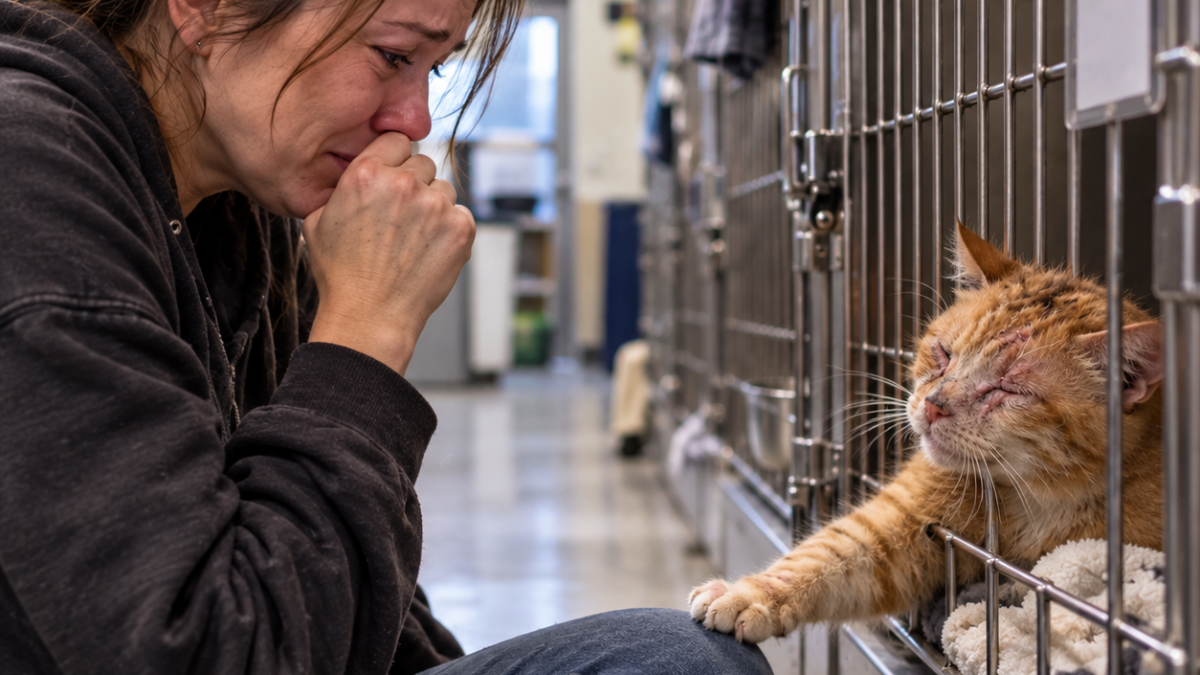
His face was shaved in places. Swollen. Stitched. His eyes were gone, the lids closed and healing. A feeding tube was secured carefully. He looked less like a cat than a small exhausted survivor of some war no one had declared.
I pulled a chair beside the cage.
“Hey, buddy.”
His ears moved.
“Hey, Cinder.”
His head lifted.
That was when I sat down and cried.
Not because of his face.
Because this animal had spent what might have been the worst days of his life injured, blind, infected, handled by strangers, surrounded by sounds he could not understand.
And somehow, he still turned toward a person.
I slipped two fingers near his paw.
Slowly, shakily, his paw moved until it rested on top of my hand.
“All right,” I whispered. “I’m still here.”
For the next two weeks, the clinic became the place I went instead of home.
I drove passengers until nine or ten, then stopped at the clinic before it closed to visitors. Sometimes I sat for fifteen minutes. Sometimes an hour.
Dr. Warren began expecting me.
So did the techs.
So did Cinder.
He was not affectionate in the easy way people imagine rescued animals become affectionate. He did not magically forgive the world. He hurt. He hid. He flinched at sudden sounds.
But when I spoke, he listened.
When I rested my hand near him, he found it.
The first time he purred, everyone in the treatment room froze.
It was faint.
A broken motor deep in his chest.
One tech named Marnie covered her mouth.
Dr. Warren turned away, pretending to check medication labels.
I leaned close.
“You’re making the whole staff emotional, buddy.”
Cinder purred again.
Then the infection worsened.
It happened so quickly that hope felt foolish.
One evening, Dr. Warren called before I could leave for the clinic.
“Martin,” she said.
She had never used my first name before.
I pulled over even though I was only three blocks from home.
“What happened?”
“He has a fever again. His white count is up. He’s stopped tolerating tube feedings.”
I closed my eyes.
“How bad?”
“I’m concerned.”
That word.
Concerned.
Doctors and vets use it when they do not want to say afraid.
I drove straight there.
Cinder lay still beneath a warmed blanket.
Too still.
His breathing sounded shallow.
I sat beside him and placed my hand near his paw.
No movement.
I waited.
Nothing.
Dr. Warren came in quietly.
“We can continue supportive care tonight,” she said. “But if he declines further, we need to talk about whether we’re helping him or asking too much of him.”
I knew what she meant.
I hated her for saying it.
Then hated myself for hating the person trying to keep him from suffering.
After she left, I leaned close.
“You don’t have to keep fighting because I’m sitting here,” I whispered. “If you’re tired, I understand.”
He did not move.
I sat there for a long time.
The clinic lights dimmed for overnight.
Somewhere, a phone rang.
A dog whined in another room.
My back ached from the chair.
I thought of Lily as a little girl sleeping in the back seat during road trips, her mouth open, her hand still sticky from candy.
I thought of my mother’s old saying: Sometimes love is knowing when to stop pulling.
I did not want to stop pulling.
Then something touched my wrist.
Weak.
Shaky.
Barely there.
Cinder’s paw.
I bent over him so quickly my chair scraped the floor.
“All right,” I whispered. “Then I’m still here too.”
Somehow, Cinder pulled through.
I do not say that lightly.
It was not a miracle in the shiny way people like.
It was medicine.
Skill.
Antibiotics.
Donations from strangers after the rescue posted his story online.
Dr. Warren sleeping on a cot in her office during the worst weekend.
Techs who warmed food and whispered encouragement to a blind cat at three in the morning.
A stubborn little orange body that refused to quit.
And me, sitting there with my old sweatshirt folded beneath his paws, pretending I was helping more than I probably was.
The rescue named Hope Harbor agreed to take him once he was stable enough to leave the clinic.
A woman named Paula ran it from a converted storefront on the north side. She had the calm authority of someone who had cleaned every bodily fluid known to mammals and no longer feared anything.
“He’ll need time,” she told me.
“He’s had time.”
“No,” Paula said. “He’s survived time. That’s different.”
She was right.
Cinder moved into a quiet enclosure with soft bedding, low-sided litter, bowls that stayed in fixed places, and toys that made noise.
I visited whenever I could.
That was when I noticed something almost harder to watch than his recovery.
People passed him by.
Not cruelly.
That might have been easier.
They would stop, read his card, smile sadly, then look closer at his face.
“He’s completely blind?”
“Yes,” Paula would say.
“Will he always look like that?”
“He’s healed, but yes, he has scars.”
“Does he need special care?”
“Some. He does best in a consistent home.”
Then they would move on.
Toward kittens.
Toward cats with symmetrical faces.
Toward animals whose suffering did not ask anything too complicated from them.
I did not blame them exactly.
People know what they can handle.
Still, it hurt.
Cinder did not understand any of it.
Whenever footsteps approached, he stood.
He moved toward the front of the enclosure, sometimes bumping gently into the side, and pushed his scarred face forward because he wanted someone to touch him.
Every single time.
He kept expecting kindness.
There is something devastating about an animal who has every reason to stop trusting and simply does not.
One Saturday, a couple came in with a boy about eight years old.
The boy noticed Cinder first.
“What happened to that one?”
His mother pulled him back slightly.
“Don’t point.”
Cinder stood and walked toward the sound of the child’s voice.
The boy crouched.
“Can I pet him?”
Paula looked at the mother.
The mother hesitated.
Just enough.
Then she said, “Maybe let’s look at the others first.”
The boy remained crouched.
Cinder pressed his face toward the front.
“He wants me to pet him.”
“I know, honey. Come on.”
They moved away.
Cinder stayed standing for almost a minute after their footsteps left.
Waiting.
That night, I sat in my car outside Hope Harbor and cried like I had not cried since Lily moved.
Not loud.
Not dramatic.
Just a fifty-two-year-old man sitting behind a steering wheel while traffic passed, crying because a blind cat kept walking toward people who kept deciding he was too much.
A few weeks later, I arrived without announcing myself.
Cinder was asleep.
I sat outside his enclosure and said nothing.
His nose did not work well after the injuries.
He could not see me.
Yet after a few seconds, he lifted his head.
He turned.
Slowly, carefully, he walked straight toward where I sat.
Then he pushed one paw through the opening and touched my knee.
Dr. Warren happened to be there that afternoon, volunteering for checkups.
“He probably recognized your voice,” she said.
“I didn’t say anything.”
We both went quiet.
Maybe he knew my footsteps.
Maybe the way I breathed.
Maybe the old sweatshirt still smelled like me.
I do not know.
But he knew I was there.
That was when I finally admitted the thing I had been avoiding.
I thought I kept visiting because Cinder needed me.
But I needed him too.
Since Lily left, I had built my whole life around avoiding an empty house.
Extra shifts.
Late grocery runs.
Sitting in my car after work for no reason.
Cinder gave me somewhere I wanted to be.
Someone who knew when I arrived.
Someone who moved toward me.
A few weeks later, I asked Paula, “Has anyone applied for him?”
She looked at me for a long moment.
“No.”
I looked into the enclosure.
Cinder was playing with a ball that had a bell inside.
He had learned to follow the sound.
He swatted it.
Missed.
Found it again.
Swatted harder.
The ball rolled away.
He hurried after it, bumped into his blanket, stumbled, then immediately got back up.
I started laughing.
Then crying.
“Close his adoption file,” I said.
Paula tilted her head.
“Why?”
“Because he’s going home.”
The first night Cinder came home, I walked through every room with him in my arms.
“This is the kitchen.”
He turned his head toward the hum of the refrigerator.
“This is the hallway.”
His ears moved.
“This is the living room.”
I placed him on the rug.
He crouched low.
Listened.
Took one step.
Then another.
He bumped softly into the coffee table.
I had wrapped the corners in foam like I was babyproofing for a tiny old man with whiskers.
He turned, mapped the edge with his shoulder, then continued.
By midnight, he knew where the water bowl was.
By the third day, he knew the route from the couch to the litter box.
By the end of the first week, he knew the sound of my keys in the door.
Most nights, he was already waiting when I came in.
Not at the exact door at first.
Sometimes three feet to the left.
Sometimes facing the closet.
But waiting.
That mattered more than accuracy.
I sent Lily a picture.
Cinder sitting proudly on the rug, scarred face lifted toward the camera.
She called immediately.
“Oh, Dad.”
“What?”
“He’s beautiful.”
I looked at the photo.
For the first time, I saw him the way she did.
Not damaged.
Not pitiful.
Alive.
“He knows the house already,” I said.
“Of course he does.”
“He attacks this little bell ball like it owes him money.”
Lily laughed.
I had missed that sound so much it hurt.
“You sound happier,” she said.
I almost denied it.
Then I didn’t.
“I think I am.”
Cinder became the ruler of my house.
He discovered the couch and claimed the left cushion.
He learned that if he lifted his chin, I would scratch beneath it.
He hated the vacuum with a pure, reasonable hatred.
He loved the radio.
Not television.
Radio.
Voices without flashing light.
Sometimes I put on old baseball games, and he would sleep near the speaker as if listening to a world described kindly.
I drove less.
At first, I told myself it was because Cinder needed consistency.
That was partly true.
But so did I.
I started coming home earlier.
Cooking actual meals.
Calling Lily on Wednesdays too, not only Sundays.
I even fixed the furnace.
One evening, Lily said, “I think Cinder adopted you.”
“He doesn’t pay bills.”
“Neither did I at his age.”
“You were seven.”
“And very expensive.”
I laughed.
The house no longer felt empty.
It felt quiet in a different way.
A living quiet.
The kind with breathing in it.
Then the investigation found us.
It started with a phone call from Dr. Warren.
“Martin, do you have a minute?”
Something in her tone made me sit down.
“Is this about Cinder?”
“Yes.”
My heart dropped.
“He’s fine,” she said quickly. “This isn’t medical. Not exactly.”
She explained that during one of Cinder’s later dental follow-ups, imaging showed something lodged beneath old scar tissue near his cheek.
A small fragment.
Metal.
“Could it be from a car?”
“No,” she said. “It looks like part of a pellet.”
I did not speak.
“I reported it,” she continued. “I’m required to when injuries suggest possible cruelty.”
Cruelty.
The word turned the room cold.
“There’s more,” she said. “A rescue volunteer remembered a post from a neighborhood group around the same time you found him. Someone had complained about ‘stray cats’ behind a warehouse near where you stopped.”
I thought about the lot.
The scraping under my car.
The way Cinder had looked when I found him.
“Do they know who hurt him?”
“Not yet.”
But they would.
A humane officer named Carla Ruiz came to my house the next week.
She was short, direct, and carried a notebook that looked like it had survived weather, bites, and bureaucracy.
Cinder greeted her by walking directly into her boot.
She crouched.
“Hello, survivor.”
He sniffed her hand.
Then allowed one brief head scratch.
Carla asked me to tell the story from the beginning.
I did.
Every detail.
The warehouse lot.
The sound.
The blood.
The clinic.
She wrote almost everything down.
“Did you see anyone nearby?”
“No.”
“Vehicles?”
“I wasn’t paying attention.”
“Any cameras?”
“There was a gas station at the corner. Maybe the warehouse had security.”
“We’ll check.”
I looked at Cinder.
He was attacking his bell ball under the table.
“Why now?”
Carla’s face softened, but only slightly.
“Because cases like this often connect. One animal is rarely the first.”
That sentence kept me awake.
A week later, Carla called.
The gas station footage showed an old dark pickup entering the warehouse lot eighteen minutes before I arrived.
The driver stayed six minutes.
Then left.
The footage was grainy, but the license plate was visible enough.
The truck belonged to a man named Blake Morrow, who managed a nearby storage yard.
Blake was known in the neighborhood.
Loud.
Angry.
The kind of man who thought cruelty sounded like honesty.
He had posted online more than once about “getting rid of pests.”
Carla found traps behind the storage yard.
Not humane traps.
She found food dishes too, which made my stomach twist.
He had been luring them.
Several neighborhood cats had disappeared.
One woman had been searching for a black-and-white cat named Jasper for three months.
Another family lost two.
No one had proof.
Until Cinder.
The case moved forward slowly.
Too slowly for my anger.
Blake denied everything.
Said the traps were for raccoons.
Said the posts were jokes.
Said the pellet fragment could have come from anywhere.
Then the warehouse camera footage came in.
Clearer.
It showed Blake getting out of the truck with a bundle wrapped in something dark.
It showed him dropping it near the far side of the lot.
It showed the bundle moving.
It showed him driving away.
It did not show the injuries happening.
But it showed enough.
He had left Cinder there to die.
When Carla told me, I had to sit down.
I had imagined Cinder crawling from some hidden alley after an accident.
I had imagined him unlucky.
Not discarded.
There is a different pain in learning that suffering had a hand behind it.
Blake was charged with animal cruelty and illegal trapping.
The local news picked up the story after Hope Harbor posted carefully worded updates asking for help identifying missing cats.
Cinder’s photo spread online.
Not the worst photo.
I would not allow that.
A newer one.
His scarred face lifted, his ears forward, his bell ball beneath one paw.
People called him inspirational.
Brave.
A miracle.
I understood why.
I also hated it sometimes.
Because making him inspirational allowed people to look away from what had been done to him.
Cinder was brave.
But he should never have needed to be.
The court hearing happened on a rainy Tuesday.
I had not planned to speak.
Carla said I did not have to.
Dr. Warren came.
Paula came.
So did Lily.
She flew in the night before without telling me until she was already at my door.
When I opened it, she was standing there with a suitcase and tears in her eyes.
“Surprise,” she said weakly.
I hugged her so hard she laughed.
Then she met Cinder.
He walked toward her voice, bumped her shin, and lifted his chin.
Lily knelt.
“Oh, sweetheart.”
He pressed his scarred face into her hand.
She cried instantly.
“I know,” I said.
“How did anyone hurt him?”
I had no answer.
In court, Blake looked smaller than I expected.
Men like him often do when placed in rooms where shouting does not make them powerful.
His lawyer argued stress.
Financial problems.
Stray animals damaging property.
No direct proof of who caused every injury.
Then Dr. Warren testified.
Calm.
Precise.
She described Cinder’s injuries without making them more graphic than necessary.
She explained the pellet fragment.
The infection.
The blindness.
She explained that Cinder had been alive when abandoned and would have died without intervention.
Blake stared at the table.
When it was my turn, I stood.
My hands shook.
Lily sat behind me.
I looked at the judge because I could not look at Blake.
“I found Cinder under my car,” I said. “At first I thought he was dead. Then I spoke, and he crawled toward me.”
My voice cracked.
I paused.
No one interrupted.
“He was blind. He was bleeding. He was terrified. But he still moved toward a human voice.”
I looked at Blake then.
“For months, people passed him by because his face made them uncomfortable. But he never stopped walking toward footsteps. He never stopped expecting someone to be kind.”
Blake looked away.
“That is what I want this court to understand. You did not just hurt a cat. You hurt something that still trusted the world more than the world deserved.”
The courtroom was silent.
I swallowed.
“And if there is any justice in this, it should not be because Cinder became loved after. It should be because what happened to him was wrong before anyone knew his name.”
Blake was sentenced to jail time, probation, restitution to the rescue, mandatory counseling, and a ban on owning animals.
Was it enough?
No.
Nothing would give Cinder his eyes back.
Nothing would erase the nights he shook in recovery.
Nothing would return the cats who never made it to someone’s car.
But when the judge said the words, I felt something unclench.
Not forgiveness.
Never that.
But recognition.
The record would say Cinder mattered.
After court, reporters waited outside.
One asked me, “Do you feel like a hero?”
I almost laughed.
“No.”
“What do you feel?”
I looked at Lily.
At Dr. Warren.
At Paula.
At Carla.
“I feel like I should’ve gone home earlier that night.”
The reporter frowned, confused.
Lily took my hand.
She understood.
If I had gone home earlier, I would have missed him.
If I had gone home earlier, Cinder would have died alone in the dark.
That thought haunted me more than anything Blake had said.
Cinder’s story brought donations to Hope Harbor.
The rescue repaired its cat rooms.
Created a medical fund.
Named it Cinder’s Light, though I argued against it because Cinder himself cared only about bell toys and food.
People sent letters.
Some kind.
Some strange.
One child mailed a drawing of an orange cat wearing sunglasses.
I taped it to my refrigerator.
Cinder did not care.
He was busy learning new ways to wake me at five in the morning.
Life softened.
Not quickly.
Not perfectly.
But noticeably.
Lily began visiting more.
Sometimes for holidays.
Sometimes for no reason except she found a cheap flight.
She said Cinder needed to know his sister.
I said she was projecting.
She said I had replaced her with a cat.
I said Cinder complained less.
She said that was impossible.
We laughed more.
Talked more honestly.
One night, while washing dishes after dinner, she said, “I used to worry about you.”
“I know.”
“No, Dad. I really worried.”
I turned off the faucet.
“Why didn’t you say something?”
“I did. You said you were fine.”
I leaned against the counter.
“I thought saying I wasn’t fine would make you feel like you shouldn’t have left.”
Lily’s face crumpled.
“Oh, Dad.”
“I was proud of you.”
“I know.”
“I didn’t want my loneliness to become your leash.”
She hugged me from behind.
I stood there with wet hands and let my daughter hold me.
Cinder sat near the refrigerator, unimpressed by emotional breakthroughs that did not involve treats.
For almost three years, Cinder ruled my house.
His scars remained.
His blindness remained.
But those things stopped being the first things people saw.
They saw the way he attacked his bell ball like it was an enemy army.
They saw how he lifted his chin for scratches.
They saw him navigate rooms by memory.
They saw him wait at the door when my keys jingled outside.
They saw him trust.
Then, in the fourth winter, he began losing weight.
At first, I blamed age.
The vet did bloodwork.
Kidney disease.
Manageable, Dr. Warren said.
For a while.
I learned fluids.
Medication.
Special food.
Schedules.
Cinder tolerated all of it with the offended dignity of a king being asked to file paperwork.
Some days were good.
Some days were not.
Lily flew in when she could.
Dr. Warren checked on him more than she needed to.
Paula visited with toys.
Carla came once and brought a blanket donated by a child who had followed his story.
Cinder accepted every offering as his due.
But the disease kept moving.
Quietly.
Cruelly.
By spring, he no longer chased the bell ball.
He listened to it.
Sometimes he tapped it once, gently, as if remembering who he had been.
One evening, I came home and he was not at the door.
I found him on the couch.
He lifted his head when he heard my keys, but he did not get down.
I sat beside him.
“Hey, buddy.”
His paw moved slowly until it rested on my hand.
The same gesture as the clinic.
Weak.
Shaky.
There.
I knew.
I called Lily.
She answered and heard my breathing.
“I’m coming,” she said.
“You have work.”
“I’m coming.”
She arrived the next afternoon.
Cinder was on the couch with his blue-gray blanket beneath him, the one Lily had bought during her first visit.
Dr. Warren came to the house that evening.
Not the clinic.
I had promised him no more terrifying places if I could help it.
The living room was warm.
Rain touched the windows.
Lily sat on the floor with one hand on Cinder’s side.
I sat near his head.
His bell ball was beside his paw.
Dr. Warren explained everything gently.
I heard almost none of it.
I was back in that parking lot, crouched on wet pavement, saying, “Hey, buddy,” and watching a broken little animal crawl toward my voice.
“You don’t have to keep fighting because I’m sitting here,” I whispered.
Cinder’s ears moved.
“If you’re tired, I understand.”
Lily began to cry.
I placed two fingers beside his paw.
For a moment, nothing happened.
Then his paw shifted.
Rested on my hand.
“All right,” I whispered, my voice breaking. “Then I’m still here too.”
Dr. Warren gave the first injection.
Cinder relaxed.
The tension left his body.
For the first time in weeks, he looked comfortable.
I scratched beneath his chin the way he liked.
He lifted it slightly.
One last time.
“You made my house a home,” I told him. “You made me come back to it.”
His breathing slowed.
“You didn’t need too much, buddy.”
I pressed my forehead to his.
“You gave me too much.”
The second injection was quiet.
That felt unfair.
Something so important should have made a sound.
The rain kept touching the window.
The refrigerator hummed in the kitchen.
A car passed outside.
Cinder left the world with his paw on my hand and my daughter’s hand on his back.
Dr. Warren cried.
She tried to hide it.
Failed.
Lily and I stayed on the floor long after Cinder was gone.
At some point, Lily whispered, “I thought I came home for him.”
I nodded.
“But I think I came home for you.”
I could not answer.
After Cinder died, the house became quiet again.
But it was not the same quiet as before.
This quiet had memory in it.
His bell ball under the chair.
The foam still wrapped around the coffee table corners.
The little rug path through the hallway.
The food bowl I could not move for eleven days.
On the twelfth day, Lily moved it for me.
Not away.
Just onto a small shelf near the window.
Beside his ashes.
Beside the child’s drawing of an orange cat wearing sunglasses.
Beside a photo of Cinder with his scarred face lifted toward the sound of my keys.
Hope Harbor held a small fundraiser in his memory that summer.
They asked me to speak.
I almost said no.
Then I thought of Cinder walking toward footsteps no matter how many people moved on.
So I stood in front of a room full of strangers and told them the truth.
Not the polished version.
Not the inspirational version.
The true one.
“I used to think Cinder’s scars were the saddest thing about him,” I said. “I was wrong.”
Lily stood near the back.
Dr. Warren stood beside Paula.
Carla wiped her eyes and pretended she had allergies.
“His scars were not the saddest thing. The saddest thing was how many people looked at him and saw only what had happened to him.”
I gripped the podium.
“But Cinder was not what happened to him. He was what survived it. He was trust after cruelty. He was courage after pain. He was a blind cat who knew my footsteps when I did not even know where I belonged anymore.”
My voice broke.
“And the animal everyone thought would need too much from someone turned out to be the one who made me feel needed again.”
No one spoke for a moment.
Then people stood.
I did not feel proud.
I felt emptied.
But afterward, a woman approached me.
She was holding the hand of a teenage boy.
“My son wants to meet the blind cat in the rescue room,” she said.
I looked toward the back where Paula had brought adoptable animals.
There was an old black cat there.
Cloudy-eyed.
Nervous.
Overlooked.
The boy shifted awkwardly.
“I saw Cinder’s picture,” he said. “I think maybe that cat needs someone who knows he’s not scary.”
I had to turn away.
That old black cat went home with them two days later.
Cinder was gone.
But something he started kept moving.
Months later, Lily took a job closer to Pittsburgh.
Not in the city, but close enough for Sunday dinners.
She insisted it was a career decision.
I pretended to believe her.
The house became less empty.
Not because grief left.
It never really leaves.
It just learns where to sit.
Sometimes mine sits near the window where Cinder liked to listen to rain.
Sometimes in the passenger seat where I first placed that bloody sweatshirt.
Sometimes in the quiet after Lily leaves and I still, for one foolish second, expect to hear a bell ball roll across the floor.
I kept driving rideshare, but not every night.
Not to avoid home.
Only when I wanted to.
And when passengers asked about the small orange paw-print charm hanging from my rearview mirror, I told them about a cat named Cinder.
Not always the whole story.
Some people only want a sentence.
“He was my cat,” I say.
But sometimes, if the night is long and the passenger is quiet in a way I recognize, I tell them more.
I tell them how I found him under my car.
How he crawled toward my voice.
How he lost his sight but not his trust.
How a broken little animal made a lonely man go home again.
The last time I visited Hope Harbor, Paula showed me the wall near the entrance.
There was a framed photograph of Cinder.
Under it were the words:
Cinder’s Light Fund
For the animals who look hard to love until someone gets close enough to see them.
I stood there a long time.
Then I felt a small hand slip into mine.
Lily.
She had driven over with me.
“You okay?” she asked.
I looked at Cinder’s picture.
His scarred face.
His lifted chin.
His invisible eyes turned toward a sound only he could understand.
“No,” I said.
Then I squeezed her hand.
“But I’m here.”
That was the truth Cinder left me.
You can be broken and still move toward love.
You can be scarred and still become someone’s reason to come home.
You can lose the life you thought you were supposed to have and still find something waiting under the car, in the dark, breathing, hurting, refusing to give up.
I do not believe everything happens for a reason.
I will never believe Cinder suffered so I could heal.
That would make his pain too convenient.
Too human.
Too selfish.
What I believe is this:
Cruelty happened.
Pain happened.
Blindness happened.
Loneliness happened.
And then, one cold night in Pittsburgh, a tiny broken cat heard a tired man’s voice and chose to crawl toward it.
I stopped.
I opened the sweatshirt.
I carried him.
He stayed.
For a little while, we saved each other.
And even now, when I unlock my front door and the house is quiet, I still pause before turning on the light.
Some part of me remembers.
Some part of me listens.
For the faint sound of a bell ball rolling across the floor.
For one small paw finding my hand in the dark.
For Cinder, still teaching me that scars do not show what love failed to protect.
They show what love arrived in time to hold.








