I Fell Asleep With My Hand on My 15-Year-Old Cat—By Morning, Jerry Was Gone, and What He Did Before Dying Broke Me.
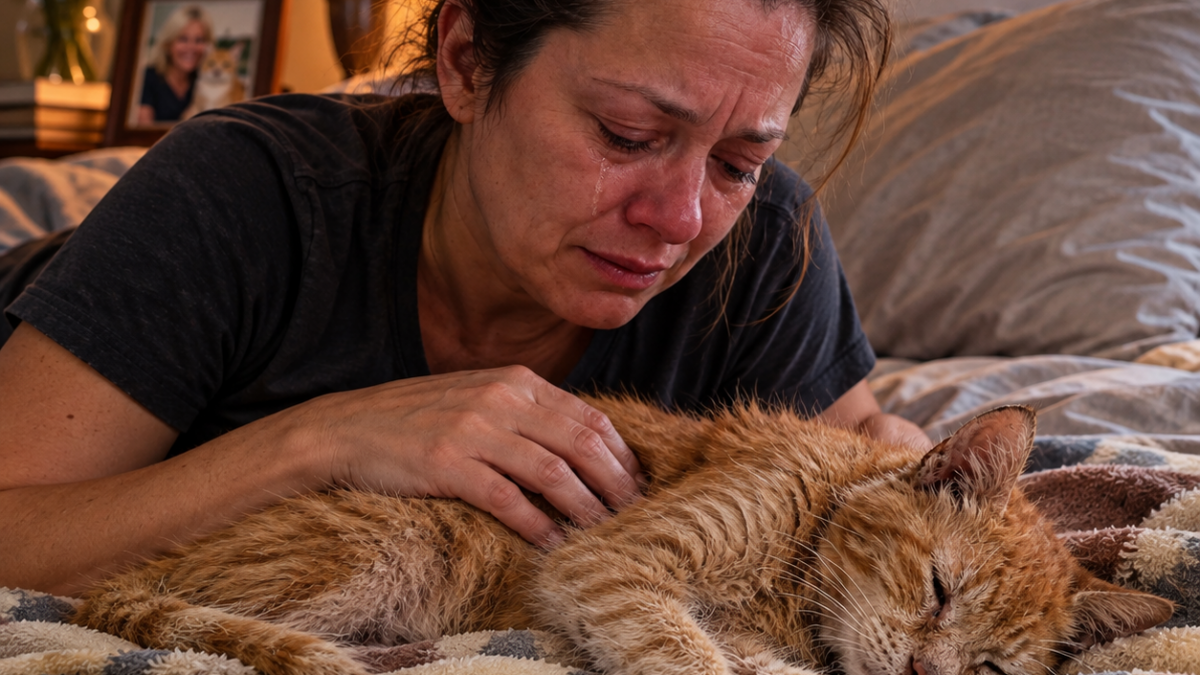
PART3:
The second day, I tried chicken.
The third, tuna.
The fourth, the expensive prescription food the vet recommended.
Nothing.
He drank some water.
Ate tiny amounts.
Then slept.
The veterinarian had already warned me.
Kidneys.
Age.
Weight loss.
The kinds of numbers that change the tone of a veterinary appointment.
We talked about comfort.
Hydration.
Signs of suffering.
When to call.
The conversation nobody wants to have.
I kept hoping for one of those miraculous old-animal rebounds people tell stories about.
A week.
A month.
One more summer.
One more Christmas.
One more morning with orange fur stuck to my pillow.
Grief bargains before death even happens.
You begin losing them while they are still sitting in front of you.
But even when Jerry was weak, he kept following me.
That broke me more than anything.
If I moved from the bedroom to the kitchen, eventually I would hear him.
Slow paws.
Pause.
Another few steps.
He would appear in the doorway.
If I sat on the couch, he would climb onto the cushion beside me, sometimes needing a little help.
If I got up during the night, I would turn and find him standing there as though he still believed his responsibility was to make sure I did not wander too far without supervision.
“Go sleep,” I would tell him.
He never listened.
That was Jerry.
He was independent right up until I moved to another room.
Then apparently my location became a matter of national security.
On his last afternoon, I cried in front of him.
I had tried not to.
That sounds ridiculous now.
I know.
He was a cat.
He had watched me cry before.
Divorce.
My mother’s funeral.
Bad days at work.
The night I learned an old friend had died.
Those ordinary private heartbreaks nobody photographs.
Jerry had sat through all of them.
But during his final days, I kept trying to be brave around him.
As though he needed me calm.
As though my fear might frighten him.
That afternoon I sat beside him on the bed and the tears came before I could stop them.
Jerry opened his eyes.
Slowly raised his head.
Then nudged my hand.
Barely.
His strength was almost gone.
Still, he touched me.
I said his name.
“Jerry.”
He blinked.
That slow cat blink he had given me thousands of times.
Calm.
Unhurried.
I scratched under his chin.
He leaned into my fingers.
For a moment, the relationship reversed completely.
I was supposed to be comforting him.
Instead, there I was crying while my dying cat used the last of his energy to press his face into my hand.
“Don’t worry about me,” I whispered.
That sentence destroyed me the second I heard myself say it.
Because Jerry had spent fifteen years not worrying about anything except himself, food, sunlight, and where I was.
And somehow, at the end, I still felt like he was checking on me.
That night I moved his favorite blanket onto the bed.
It was ugly.
Brown fleece.
Worn thin in the middle.
One edge had a tear Jerry created years earlier while kneading it.
I had almost thrown it away several times.
Never did.
He loved it.
I lifted him carefully and placed him beside me.
He weighed almost nothing.
That frightened me.
Jerry had once been a solid cat.
Not fat.
Substantial.
The kind of cat who stepped onto your stomach at two in the morning and made you reconsider whether affection was worth internal injury.
Now he felt like fur wrapped around bones.
I tucked the blanket around him.
His head rested near my pillow.
I put one hand against his side.
Breathing.
Still breathing.
I was terrified to fall asleep.
I kept telling myself:
Stay awake.
Stay awake.
Stay with him.
Don’t miss it.
I watched the clock.
11:47.
12:16.
12:52.
Jerry’s breathing became slow.
Then steadier.
Then shallow again.
Every time there was a pause, my heart stopped.
Then his side moved.
I would breathe.
At some point, I whispered:
“You can go if you need to.”
I immediately hated myself for saying it.
Then I said:
“No, you don’t have to.”
As if Jerry needed my permission either way.
As if love is not full of contradictions when somebody is leaving.
Stay.
Please stay.
But don’t hurt.
I don’t want to lose you.
But I don’t want you here for me if staying hurts you.
Nobody teaches you how to hold both truths at once.
Eventually exhaustion won.
Grief is physically exhausting.
So is fear.
At some point in the dark, with my hand beside Jerry’s body, I fell asleep.
When I woke, I knew.
Before I opened my eyes fully.
Before I reached for him.
The room felt different.
That sounds impossible until you experience it.
Some mornings feel wrong before your mind understands why.
The light was gray.
Early.
My bedroom was quiet.
Not ordinary quiet.
A deeper quiet.
I reached across the blanket.
Jerry was still warm.
For one second, hope is cruel.
My fingers touched his fur.
Warm.
My mind said:
He’s sleeping.
Then my hand moved to his side.
Nothing.
“Jerry?”
I knew.
Still I said it.
“Jerry?”
No movement.
No breath.
No slow blink.
No irritated little tail flick because I had disturbed him.
His body was there.
Jerry was not.
I sat upright.
Put both hands around him.
Then stayed that way for I don’t know how long.
Ten minutes.
An hour.
Time stopped being useful.
I kept touching him.
His head.
His back.
His little torn ear.
I straightened the ear because it had folded under itself.
That detail remains clearer than almost anything else.
I remember thinking:
That looks uncomfortable.
And fixing it.
He was dead.
I knew that.
But my hands had spent fifteen years caring for him.
They did not understand how to stop because his heart had.
That is one of the things nobody tells you.
After somebody dies, love keeps making practical gestures.
You smooth hair.
Adjust blankets.
Reach for a hand.
Fix an ear.
The body learns loss slower than the mind.
I cried into his fur.
Then something else came over me.
A strange certainty.
I think Jerry waited until I was asleep.
I cannot prove that.
Nobody can.
Maybe his body simply reached its final moment while I happened to be sleeping.
That is the rational answer.
I understand biology.
I know love does not make animals control the exact timing of death.
Still.
I knew Jerry.
He had been quiet his whole life.
Gentle.
Never demanding.
Never dramatic.
And I had been terrified of watching him die.
Maybe some part of him knew.
Maybe he felt my hand relax.
Heard my breathing change.
Knew the human who had spent two nights watching him had finally stopped fighting sleep.
Then let go.
It felt like him.
One final kindness performed so quietly I almost missed it.
I stayed in bed with him.
The sun came higher.
A garbage truck stopped outside.
Somebody’s car alarm beeped.
A dog barked three houses away.
The world had the indecency to continue.
That surprised me.
Every major loss contains that insult.
You expect reality to recognize what happened.
At minimum, the weather should change.
Traffic should pause.
Someone should announce:
A fifteen-year-old orange cat named Jerry has died, and the woman in this house is not prepared for Tuesday to proceed normally.
Instead, sunlight came through the blinds.
Coffee makers clicked on in other homes.
People checked email.
A truck reversed somewhere.
The world did not know.
My whole life had shifted before breakfast.
Nobody else’s had.
Eventually I stood.
That felt like betrayal.
I did not want to leave him on the bed.
So I carried Jerry into the kitchen.
Still wrapped in his blanket.
I found a shallow cardboard box in the hall closet.
That nearly broke me again.
A cardboard box.
After fifteen years.
I stood there looking at it.
You spend fifteen years loving an animal.
Buying food.
Medicine.
Toys.
Beds.
Scratching posts.
Paying vet bills.
Opening doors.
Closing doors.
Opening the same door again because they changed their mind.
You shape your home around them.
Then one morning you are looking for a box.
I lined it with another towel.
Placed Jerry inside carefully.
Adjusted the blanket.
Then stood over him.
“I’m sorry.”
Sorry for what?
I still don’t know.
Sorry he died.
Sorry I could not stop it.
Sorry a box was all I had.
Sorry we only get to borrow anything we love.
I called the veterinary clinic.
The receptionist answered cheerfully.
“Good morning, Lakeview Animal Clinic. How can I help you?”
I opened my mouth.
Nothing came out.
“Hello?”
“My cat…”
My voice broke.
She waited.
“My cat died this morning.”
Her tone changed instantly.
Not fake sympathy.
Not customer-service sympathy.
Human sympathy.
“Oh.”
Then softly:
“I’m so sorry.”
That sentence nearly put me on the floor.
Because somebody had acknowledged it without minimizing.
“He was fifteen.”
“I’m so sorry.”
“What do I do?”
That is what grief does.
Turns competent adults into children asking what comes next.
She explained.
I could bring Jerry in.
They could arrange cremation.
Private or communal.
I could choose a paw print.
They would help with everything.
Then she said:
“You can come whenever you’re ready.”
Whenever you’re ready.
Not:
Bring him immediately.
Not:
We close at five.
Not:
Here is the procedure.
Whenever you’re ready.
I cried again.
Those words mattered more than she probably knew.
Sometimes mercy is not extraordinary.
Sometimes it is simply refusing to hurry another person through something unbearable.
I carried Jerry to the car.
Placed the box in the passenger seat.
Then buckled the seat belt around it.
Yes.
I did.
And no, I am not embarrassed.
He had ridden beside me for fifteen years.
Mostly in a carrier.
Usually complaining.
This time he was riding beside me once more.
At the first red light, I looked over.
“We’ll be there soon.”
The words came out automatically.
I froze.
Then put one hand on the blanket.
Habit is cruel.
At the clinic, the waiting room was quieter than usual.
An older man sat in one corner with an empty carrier between his feet.
A woman near the counter held a leash with no dog attached.
Her hands were wrapped around it.
Nobody looked at anybody too long.
It felt like a room full of people holding different versions of the same heartbreak.
The receptionist recognized me.
She came around the desk.
Looked at the box.
Then at me.
“Take your time.”
There it was again.
Permission.
To move slowly.
To not be reasonable.
To not pretend this was a routine transaction.
A veterinary technician came after a few minutes.
Young woman.
Dark-blue scrubs.
She knelt instead of standing over me.
“Would you like a paw print?”
“Yes.”
The answer came so fast I surprised myself.
Then I cried because I had said yes so quickly.
Some part of me had already moved into the future.
A future where Jerry was gone.
Where I would need evidence.
A shape.
A mark.
Something physical saying:
He existed.
As though fifteen years were not proof.
As though orange fur embedded in every upholstered surface I owned were not proof.
As though grief itself were not proof.
They asked about cremation.
Private meant his ashes came home.
Communal did not.
I chose private.
I did not ask price first.
I know how money works.
I know pet services cost money.
I know not everybody can afford every choice.
This was mine.
I needed him home.
The technician reached toward the box.
My hands tightened.
I didn’t mean to.
It was instinct.
For one terrible second, handing the box over felt like losing Jerry a second time.
She noticed.
Stopped.
“Would you like another minute?”
I nodded.
She stepped back.
I bent over him.
Pressed my face into his fur.
He still smelled like home.
That was the thing that broke whatever was left of me.
Not the paperwork.
Not the word cremation.
Not the box.
His smell.
The ordinary smell I had stopped noticing years ago because it had become part of my bedroom.
Part of my sweater.
Part of home.
“I love you.”
I said it out loud.
Not quietly enough to hide it.
I did not care who heard.
“I love you, Jerry.”
Then I kissed his head.
And let go.
The technician lifted the box.
Walked away.
My arms felt wrong immediately.
Too light.
That is another thing people don’t tell you.
Your body remembers weight.
A sleeping cat against your legs.
A carrier in your hand.
A box against your chest.
Then suddenly there is nothing.
I walked to the car carrying nothing.
The passenger seat was empty.
The drive home was worse.
On the drive there, Jerry had still been beside me.
On the drive back, every inch of empty upholstery looked offensive.
I kept glancing over.
The seat belt was still extended.
At home I opened the door.
Silence hit me so hard I sat on the kitchen floor.
Jerry used to stand in that doorway.
Sometimes directly in the way.
He had a talent for positioning himself exactly where feet needed to go.
I sat there staring at his water bowl.
Half full.
That felt impossible.
How could water still be there?
The whole system should have known.
The bowl should have disappeared when he died.
The blanket.
The toys.
The hair.
The scratch on the corner of the hallway.
Instead, evidence remained everywhere.
Grief is partly the experience of living among objects that have not received the news.
My phone buzzed.
I ignored it.
Buzzed again.
My sister.
I answered because otherwise she would worry and keep calling.
“Hey.”
One word.
I started sobbing.
Could not speak.
To her credit, she stayed quiet.
She let me cry.
Eventually she said:
“I’m so sorry.”
“Thank you.”
“He was really old, wasn’t he?”
“Yes.”
“Fifteen?”
“Yes.”
“Well… at least he had a long life.”
I knew what she meant.
Comfort.
Perspective.
The familiar attempt to put a frame around pain so it looks manageable.
I said nothing.
Then she said:
“At least he didn’t suffer long.”
Another pause.
Then:
“And honey… he was just a cat.”
Just.
Four letters.
A small word capable of doing enormous damage.
Just a cat.
Just a dog.
Just an animal.
People use “just” when they want to shrink something they cannot understand.
I stared at Jerry’s bowl.
“He wasn’t just anything.”
My sister sighed.
Not cruelly.
Tiredly.
“I know you loved him.”
Loved.
Past tense.
Something in me tightened.
“No.”
“What?”
“I love him.”
She went quiet.
I repeated:
“I love him.”
Death changes tense in grammar faster than it changes tense in the heart.
I could not say “loved.”
Not yet.
Maybe not ever.
My sister recovered.
“Of course.”
Then, because people become uncomfortable when grief has no solution, she said:
“Maybe after a little while you could get another cat.”
I closed my eyes.
There it was.
Replacement.
Not because my sister believed Jerry was disposable.
She didn’t.
She was trying to imagine a future in which I hurt less.
But that sentence landed like someone suggesting another husband at a funeral.
“I don’t want another cat.”
“I mean someday.”
“I know.”
“I just thought—”
“Jerry isn’t a lamp.”
“What?”
“He isn’t something that left an empty spot in the room that I can fill with another version.”
“I didn’t mean it that way.”
“I know.”
And I did.
That is what hurt.
Most people who minimize grief are not cruel.
They are uncomfortable.
They want to move you somewhere easier for them to stand.
My sister did not want me suffering.
So she reached for practical language.
Long life.
No suffering.
Another cat.
Words that make death sound solvable.
It isn’t.
After we hung up, I picked up Jerry’s bowls.
I told myself I was only washing them.
Food was still drying around the rim.
Water would get stale.
Practical.
I carried them to the sink.
The metal dish tapped porcelain.
And I started crying so hard I had to grip the counter.
Because washing a dead animal’s bowl is not washing a bowl.
It is a ceremony.
Nobody calls it that.
Nobody prepares you.
But it is.
You rinse the last meal they didn’t finish.
You dry something that will not be used tomorrow.
You place it somewhere else because leaving it on the floor hurts and moving it hurts differently.
Grief turns ordinary chores into rituals.
Still, chores continue.
That is another insult.
Trash day remains trash day.
Bills arrive.
Dishwasher needs unloading.
Someone sends a calendar invitation.
A work email appears with the word URGENT.
By early afternoon, one of my coworkers texted.
Are you coming tomorrow?
I had forgotten work existed.
I wrote:
Jerry died this morning. I honestly don’t know yet.
She replied almost immediately.
Oh no. I’m so sorry. Take the day if you need it.
Then another message arrived.
My manager.
I’m sorry for your loss. Pet-related bereavement is not covered under company policy, but you can use personal time if needed.
Perfectly professional.
Not mean.
Not wrong, technically.
Still, I stared at it.
Pet-related bereavement is not covered.
There was the same “just” in more respectable clothing.
Your pain exists.
We acknowledge it.
But it belongs to a lesser category.
I know companies need policies.
I know businesses cannot function by individually measuring every employee’s grief.
I know paid bereavement structures are complicated.
That was not what bothered me.
It was how quickly human systems rank sorrow.
Parent.
Spouse.
Sibling.
Child.
Approved.
Cat.
Dog.
Rabbit.
Horse.
Use PTO.
The policy did not say Jerry didn’t matter.
Still, the message felt like a bureaucratic version of the same idea.
Please grieve, but understand this does not count in the official way.
I used personal time.
Didn’t go to work.
I spent the next day wandering through my own house like a person inspecting the scene of a crime.
Jerry’s brush.
Treats he would never eat.
A tiny bell from a collar he hated.
The catnip fish he had kicked under the couch.
I found things and lined them up.
Not intentionally.
I would discover one object, sit down with it, then another.
Evidence.
That is what they felt like.
Proof of fifteen years.
At one point I heard something in the hallway and turned.
My body expected Jerry.
There was nothing.
That happened constantly.
I opened bathroom door carefully because Jerry used to sit on the other side.
I stepped around the coffee table and said:
“Move, Jerry.”
The words came automatically.
Then I stopped.
The silence after that sentence was so absurd and painful I laughed once.
Then cried.
Grief is not one emotion.
People talk about it as sadness.
That is like calling weather water.
Grief is crying in the kitchen.
Then laughing at a memory.
Then feeling guilty because you laughed.
Then forgetting for twelve seconds.
Then remembering.
Then getting angry because the world looks normal.
Then becoming hungry.
Then feeling guilty for being hungry.
Then sleeping.
Then waking and experiencing the loss again from the beginning because for two seconds your brain had not loaded reality yet.
That first night without Jerry, I reached toward his side of the bed twice.
Both times I knew he was gone.
Both times my hand moved anyway.
Around midnight, I sat in the living room without turning lights on.
The refrigerator hummed.
A car passed.
The house felt crowded with absence.
That is the best description I have.
Silence after loss is not empty.
It is full.
Full of every sound you expect and do not hear.
Paws in hallway.
Collar bell.
Water dish.
Jump onto couch.
Small body turning in a blanket.
Jerry had been quiet.
His absence was louder.
Sitting there, I started remembering the beginning.
Before kidney numbers.
Before medication.
Before old-cat stairs beside the bed.
Before the slow walk.
Before he was Jerry.
Fifteen years earlier, I walked into a shelter because my life had become too quiet.
I was recently divorced.
Nobody cheated.
Nobody threw anything.
The marriage simply died slowly.
By the time the papers were signed, we had already been roommates for years.
He took some furniture.
I kept the house.
Everybody told me I was lucky.
The house felt enormous.
Loneliness is rarely cinematic.
It is not always crying into wine while rain runs down a window.
Mostly it is practical.
Eating dinner standing at the counter because setting the table seems ridiculous.
Leaving television on while showering because silence feels strange.
Going to the grocery store at nine at night because there is no reason to hurry home.
Realizing on Sunday afternoon that you have not spoken out loud since Friday.
Coming through the door and understanding nobody knows whether you came home.
That was my life when I went to the shelter.
I did not tell anyone I was lonely.
I said I wanted a cat.
There were kittens.
Beautiful cats.
Friendly cats rubbing cages.
Cats reaching paws between bars.
Jerry sat at the back of his kennel.
Orange.
Too thin.
One torn ear.
Expression of profound skepticism.
The volunteer said:
“He’s sweet once he trusts you.”
“How old?”
“About one.”
“Why is he back there?”
“Shy.”
Jerry looked at me like he wanted to make clear that “shy” was propaganda.
She opened cage.
He did not approach.
I sat on floor.
Waited.
Jerry looked away.
Five minutes.
Ten.
Eventually he stepped forward, sniffed my shoe, then sat down with his back partially turned toward me.
The volunteer whispered:
“That’s actually good.”
“That?”
“He’s staying.”
I laughed.
Something about him felt familiar.
Not desperate.
Not performing.
Just cautious.
I understood cautious.
I filled out paperwork.
On drive home he cried from carrier as though being abducted by pirates.
At the house I opened carrier.
He disappeared under bed.
For one week I mostly owned cat food and darkness beneath furniture.
Second week he started coming out at night.
I would hear movement while pretending to sleep.
Third week I woke with warm weight at my feet.
Jerry.
Curled into smallest possible ball.
When I moved, he jumped down and vanished.
Next night he returned.
Then again.
By the end of month, he had moved from my feet to my knees.
Two months later, pillow.
No ceremony.
No dramatic breakthrough.
Jerry entered my life through repetition.
A little closer.
A little longer.
Until one morning I realized he no longer hid when I walked through a room.
He had decided this was home.
And somehow, so had I.
Jerry did not fix my loneliness.
Animals cannot repair every human wound.
He did something simpler.
He gave loneliness structure.
Six o’clock:
Feed Jerry.
Open blinds.
Clean litter.
Come home after work because Jerry needs dinner.
Sit on couch.
Warm cat appears.
Go to bed.
Leave space.
Routine is not boring when you are lonely.
Routine can be a handrail.
Jerry gave me reasons to move through a day even when the day itself did not feel especially important.
There are people who hate when pet owners say things like this.
“A cat can’t replace people.”
Correct.
Jerry did not replace my husband.
He was not a child.
Not a therapist.
Not human.
He did not need to be any of those things to matter.
Water does not replace food.
Sleep does not replace medicine.
Different things can be essential without being interchangeable.
Jerry was companionship.
Responsibility.
Touch.
Presence.
He was another living creature whose life was connected to mine.
That connection mattered.
Especially during years when I did not admit how isolated I was.
There were nights when I came home after bad days and said:
“You’re all I’ve got tonight, buddy.”
Jerry did not answer.
Usually he wanted dinner.
Still, he stayed.
I began thinking about all of that after he died because grief rewrites ordinary memory.
Things you thought were small become foundational.
You suddenly realize how much of your life had been built around a creature that weighed fifteen pounds on his best day.
The next morning I went to the grocery store.
I needed coffee.
Bread.
Milk.
I thought fluorescent lighting and strangers might make me feel normal.
Then I turned down the pet aisle.
Accidentally.
Rows of cat food.
Litter.
Treats.
Bright packages.
I stopped.
My chest closed.
I cried beside canned cat food.
Not quiet tears.
Real crying.
A young employee stocking shelves looked over.
“Ma’am, are you okay?”
I wiped my face.
“My cat died.”
His expression changed immediately.
“Oh, man.”
He set the box down.
“I’m really sorry.”
That was it.
No age.
No perspective.
No “just.”
He simply accepted that the thing hurting me was real.
I thanked him.
Walked away.
Later I thought:
Why was that so comforting?
Because he did not try to edit my grief.
Kind people often understand that.
They make room.
They do not rearrange your pain into a shape they prefer.
That evening I posted a photograph of Jerry online.
I almost didn’t.
I felt embarrassed by how much I was grieving.
Even after everything I just said, some part of me still carried the same cultural rule:
Don’t make too much of it.
It was a cat.
Be reasonable.
The picture was Jerry three summers earlier.
On his windowsill.
Sunlight across orange fur.
One paw hanging over edge.
Eyes half closed.
Face serious.
I wrote about his last night.
How I had been afraid to sleep.
How my hand had been near him.
How his body was still warm when I woke.
How I believed, rational or not, that Jerry waited until I was asleep because he knew I could not bear to watch him go.
Then I wrote:
Please stop telling people it was just a cat.
I posted.
Put phone down.
Expected a few hearts.
Maybe comments from friends.
By morning, there were hundreds.
Then more.
Stories.
Not advice.
Stories.
A woman wrote about her beagle sleeping against her back every night after her husband died.
When the dog passed fourteen years later, she said the bed felt “like a parking lot.”
A man wrote that he cried harder when his mutt died than when an uncle died, and had felt ashamed for eight years.
A nurse wrote that she had seen dying patients ask for pets who had been gone decades.
A widow wrote:
“My dog was the only living thing that touched me every day for three years.”
A college student wrote:
“My cat is why I survived last winter.”
I read that one several times.
The words frightened me.
And moved me.
Because suddenly Jerry’s story was not only mine.
Thousands of private griefs had been waiting for permission.
People wrote:
I thought I was crazy.
I lied at work about why I called out.
My family laughed at me.
I slept with his collar for a month.
I still say goodnight to her.
I never told anyone how much that hurt.
I read until my eyes burned.
Of course there were ugly comments.
Internet remains internet.
“People care more about animals than humans.”
“This generation is too soft.”
“It’s a cat. Get perspective.”
Perspective.
One of the most abused words in grief.
Usually meaning:
Your pain is inconvenient to my scale of importance.
I did not respond much.
Did not have energy.
But I began thinking about why visible grief for animals irritates some people.
Maybe tenderness embarrasses them.
Maybe they were raised to believe adulthood requires emotional hierarchy.
Maybe they were punished when they cried over something adults considered small.
Maybe numbness became their definition of strength.
I don’t know.
I do know mocking someone for grieving does not make a person wise.
It only tells you which kinds of love they recognize.
The third day after Jerry died, my body kept forgetting.
Six o’clock came.
I looked toward kitchen.
Dinner.
Then remembered.
I opened the bathroom door slowly.
Remembered.
Came home from taking trash out and paused because nobody met me.
Remembered.
Grief is repetition.
Death happens once.
Loss happens hundreds of times afterward.
Every routine must learn the new version.
The first dinner without them.
First night.
First vacuuming.
First time you find an old toy.
First time you come home distracted and call their name.
First time you wake from dream where they were alive.
First time you realize you went an entire hour without thinking about them and then feel guilty.
People say grief comes in waves.
For me, it came in collisions.
Memory walking into reality.
Over and over.
Several days later, my sister came over.
She brought soup.
She stood on porch holding container like a peace offering.
When I opened door, I almost said I wasn’t hungry.
Then I saw her face.
She looked ashamed.
Not defensive.
That mattered.
She came in.
Looked around.
Jerry’s scratching post remained in corner.
Food mat by wall.
Brush on side table.
Blanket at foot of bed.
Objects gave my grief shape.
My sister sat.
“I was wrong.”
I nodded.
I did not save her from discomfort.
She continued.
“I knew you loved Jerry.”
I waited.
“But I think I said what people say when they want somebody to feel better quickly.”
“Yes.”
“I didn’t understand.”
“No.”
She looked toward the scratching post.
“I read the comments.”
That surprised me.
“Your post.”
“Oh.”
“So many people.”
“Yes.”
“I had no idea.”
“About what?”
“How many people… carry this.”
She struggled.
“This kind of grief.”
Part of me wanted to say:
Why didn’t you know?
But another answer came first.
“Maybe people don’t talk about it because they’re embarrassed.”
She looked at me.
“Why would they be embarrassed?”
I almost laughed.
“Because people say ‘just a cat.’”
She closed her eyes.
“Okay. Fair.”
We sat.
Then she apologized.
No excuses.
“I’m sorry I said it.”
“Thank you.”
“I’m also sorry I said get another one.”
“Thank you.”
“I know he isn’t replaceable.”
“No.”
She looked around.
“You really loved that little jerk.”
I smiled.
That was first smile that did not immediately become crying.
“He was a jerk.”
“Remember when he bit me at Thanksgiving?”
“You touched his stomach.”
“He rolled over.”
“That was a trap.”
We laughed.
For the first time since Jerry died, laughter did not feel like betrayal.
My sister stayed for dinner.
We ate soup.
She told a Jerry story I had forgotten.
And I realized people can learn tenderness.
Even after failing it first.
That mattered.
A week after Jerry died, the clinic called.
“Jerry’s ashes are ready.”
Ready.
Such a strange word.
As though grief had been packaged for pickup.
I drove there.
Same receptionist.
When she saw me, she came around the desk.
Handed me a small wooden box.
And a clay paw print wrapped in tissue.
The box was too light.
Everything after death becomes lighter than it should be.
A body.
A collar.
Ashes.
The physical weight disappears while emotional weight remains exactly where it was.
I held the box with both hands.
The receptionist said:
“He was very handsome.”
“You saw him?”
“She showed me his picture from chart.”
I started crying.
She squeezed my arm.
Not much.
Just enough.
At home, I placed the box on bookshelf.
Not shrine.
Not hidden.
Beside photographs.
Next to a plant Jerry had repeatedly tried to kill.
I looked at it.
“You’re still causing trouble in this room.”
I laughed.
A real laugh.
That was the first moment I understood healing might not mean forgetting sadness.
It might mean sadness slowly making room for affection again.
The paw print was harder.
His little pad marks pressed into clay.
Final.
I ran my thumb around edge.
Remembered those paws walking across my clean laundry.
Books.
Keyboard.
Chest.
Once across a plate of pancakes.
Fifteen years of paws in hallway.
That sound.
People don’t know what belongs to them until it disappears.
I had never once stopped and thought:
How lucky I am to hear Jerry walking toward me.
Now I would have given anything for it.
More comments kept appearing under the post.
Thousands eventually.
One woman:
“My dog slept beside me through chemo. When he died people told me I could get another. I wanted to scream.”
Another:
“My cat slept on my son’s bed after he died. Don’t tell me that animal wasn’t family.”
Some people argued:
“It isn’t the same as losing a person.”
That sentence came up repeatedly.
I understood why.
Nobody wants profound human losses diminished.
But grief is not a competition.
We do not honor one death by invalidating another.
A cat is not a child.
A dog is not a spouse.
A horse is not a parent.
They do not have to be equivalent to be meaningful.
Loss is not a tournament where only the worst pain qualifies as real.
What disturbed me most were comments full of shame.
“I thought something was wrong with me.”
“I called in sick and said migraine because I was afraid my boss would laugh.”
“I threw away her bed before anyone came over because I didn’t want them seeing me cry.”
“I still have his collar hidden in my nightstand.”
How many people have grieved animals secretly because they believed open heartbreak would look childish?
How many have sat in cars outside work trying to stop crying after leaving a pet at a veterinary clinic?
How many have wrapped up a leash and gone straight into a Zoom meeting?
How many have apologized for saying:
He was family?
Maybe Jerry’s story spread because it wasn’t unusual.
Maybe recognition is what makes stories move.
People see their private life reflected publicly and suddenly realize they were not alone.
A few weeks passed.
The house changed.
Not normal.
Different.
Silence softened.
My body stopped expecting Jerry every second.
Not because I loved him less.
Because it learned the new map.
No bowl.
No cat near kitchen.
No orange shape in the window.
His brush went into drawer.
His scratching post stayed longer.
I folded his blanket at the bottom of the bed.
Every night before turning lamp off, I touched it.
“Goodnight, Jerry.”
I kept saying it.
At first through tears.
Then softly.
Eventually almost normally.
Somebody might call that unhealthy.
I don’t.
Humans use ritual for every important loss.
We light candles.
Keep photographs.
Visit graves.
Wear wedding rings after spouses die.
Save voicemails.
Why should speaking to a dead cat be stranger than any other way love continues?
One evening, a neighbor stopped me at mailbox.
She had seen the post.
“I lost my terrier last year.”
“I’m sorry.”
“I still say hello when I come home.”
She laughed, embarrassed.
Then I laughed because I understood.
“We whisper these things like we’re confessing crimes.”
She nodded.
“Half the neighborhood is probably doing it.”
Probably.
That was when I began thinking about how often people confuse unhidden humanity with oversensitivity.
We praise strength.
Productivity.
Resilience.
Showing up.
Holding it together.
There is value in all of those.
But sometimes what we call resilience is simply grief hidden well enough not to inconvenience anyone.
I am less impressed by that now.
Healthy grief may sometimes sound like:
No, I’m not over it.
No, I don’t want another cat right now.
No, I don’t need perspective.
No, I won’t apologize because this mattered.
Jerry mattered.
This hurts.
That is not instability.
That is consequence.
Something precious occupied fifteen years of my life.
Of course its absence has weight.
One afternoon I found a single orange hair inside cuff of black sweater.
For fifteen years I had complained about Jerry’s fur.
On coats.
Couch.
Bed.
Car.
Once inside a coffee mug.
How?
No one knows.
Now I found one hair and sat at kitchen table holding the sleeve like a religious relic.
Grief makes sacred objects out of ridiculous things.
Hair.
Bell.
Toy.
Blanket.
Scratch marks.
Because these are physical leftovers of relationship.
Eventually I stopped trying to decide whether that was rational.
Love is not improved by pretending it is tidy.
Months earlier, I had wanted Jerry’s hair off every sweater.
Now I could not bring myself to pull one strand loose.
There was another part of the story I had not expected.
People began sending me messages privately.
Not comments.
Messages.
Long ones.
Some were from strangers.
A widower whose cat slept on his late wife’s pillow.
A veteran whose dog woke him from nightmares for eleven years.
A woman whose rabbit sat beside her while she recovered from surgery.
An older man who said after his wife moved into memory care, his parakeet was the only voice in the house.
These were not people claiming animals replaced human relationships.
They were describing something more subtle.
Animals had occupied spaces where human life had become thin.
Loneliness.
Illness.
Grief.
Isolation.
And I kept thinking:
There are people alive today partly because some animal needed them to come home.
I believe that.
Maybe someone got out of bed because a dog needed walking.
Maybe somebody opened curtains because a cat wanted sunlight.
Maybe somebody survived an awful winter because food bowl had to be filled every morning.
That isn’t silly.
Responsibility can anchor people.
Routine can save people.
Being needed can matter.
Jerry had done that for me after my divorce.
I never came close to anything dramatic.
I wasn’t suicidal.
I wasn’t falling apart publicly.
I was simply lonely in a slow way.
And Jerry gave my life little appointments.
Wake.
Feed.
Come home.
Sit.
Sleep.
Repeat.
He noticed me.
That sounds small until you’ve lived alone and no one notices you.
Pets are witnesses.
That word became important to me.
Witnesses.
Jerry witnessed versions of me nobody else saw.
The woman eating crackers over the sink at midnight.
The woman sitting on bathroom floor crying after bad news.
The woman laughing alone at television.
The woman sick with flu, wrapped in blankets.
The woman who came home from my mother’s funeral and sat in silence because there was nobody left to perform strength for.
Jerry climbed beside me.
He had no language for my grief.
Maybe that was why he was good at it.
No advice.
No comparison.
No “at least.”
Just presence.
How much of human comfort is simply staying?
Animals understand that better than many people.
My manager eventually asked how I was doing.
We had a one-on-one meeting two weeks later.
She said:
“I hope taking personal day helped.”
“It did.”
She looked uncomfortable.
Then:
“I’m sorry policy doesn’t provide pet bereavement.”
“I know.”
“I didn’t want message to sound cold.”
“It sounded like policy.”
She nodded.
“That’s probably cold by definition.”
I almost laughed.
She continued.
“My dog died when I was in college.”
That surprised me.
“I skipped three days of classes.”
“Did anyone understand?”
“No.”
We looked at each other.
Something shifted.
Later that year, our company changed the language in employee handbook.
Not paid bereavement exactly.
But managers were explicitly allowed to approve personal wellness days following loss of a companion animal without requiring people to invent illness.
Was that because of me?
Partly.
I never made a campaign.
I did share what happened in an employee feedback meeting.
Someone in HR had lost a dog recently.
Another employee spoke.
Then another.
Policy softened.
Not revolutionary.
But kinder.
That mattered.
My sister changed too.
She began sending me photographs she had saved of Jerry.
One showed him asleep in a laundry basket during Christmas.
One showed him staring furiously at her after the Thanksgiving stomach incident.
One I had never seen.
Me on my couch several years earlier.
Asleep.
Jerry curled against my chest.
My hand resting over him.
When she sent it, she wrote:
I understand better now.
That photograph became my favorite.
Not because Jerry looked beautiful.
He looked ordinary.
Which was the point.
Love often looks ordinary while it’s happening.
A body on a couch.
A hand.
An afternoon.
Then one day you realize ordinary was the whole treasure.
That is what Jerry taught me after dying.
Life is mostly repetitive love.
Feeding.
Waiting.
Opening a door.
Brushing fur.
Giving medicine.
Saying goodnight.
Nothing dramatic.
Until it ends.
Then you understand those repetitions were the architecture.
I sometimes wondered whether I was making Jerry into something larger after death.
Grief does that.
It edits.
Softens.
Turns annoying things sweet.
Jerry knocked a full glass of water onto my laptop once.
Vomited directly into a shoe ten minutes before work.
Screamed in the car like a person being murdered during every vet appointment.
Stole turkey from Thanksgiving platter.
Woke me at four because food bowl had a visible patch of metal at bottom, which he interpreted as famine.
He was not a saint.
He was a cat.
That makes memory better.
Love does not require perfection.
It requires familiarity.
I miss the ridiculous parts.
Maybe especially those.
Eventually somebody asked whether I would adopt again.
Months had passed.
This time question didn’t hurt.
I said:
“Maybe.”
And meant it.
Not because Jerry had become replaceable.
Because he had changed me.
He had expanded the part of me capable of giving a home to an animal.
Maybe one day that part would need somewhere to go.
That became one of the kinder ways I learned to think about legacy.
An animal’s legacy is not only what you lose.
It is what they enlarge.
Patience.
Tenderness.
Attention.
Capacity for care.
Jerry had made me gentler.
More observant.
More willing to sit still.
More aware that companionship does not require conversation to be real.
His death hurt because his life had changed mine.
But his death did not erase those changes.
Love left evidence in me too.
Months after Jerry died, I changed bedroom furniture around.
I had avoided it.
His windowsill remained exactly as he left it.
Blanket.
Small cushion.
A few hairs.
One Saturday, I washed the cushion.
Wiped the sill.
Moved a chair.
Cried.
Then stood back.
For first time, the room looked like mine without him.
That hurt.
But it also felt peaceful.
Grief has strange milestones.
First time you put away a blanket.
First time you stop expecting sound.
First time memory makes you smile before it makes you cry.
None means betrayal.
That took me time to learn.
For weeks I felt guilty whenever I was okay.
If I laughed at work, some part of me thought:
Jerry is dead. Why are you laughing?
If I slept through night:
How can you sleep?
If I went an hour without thinking of him:
How could you forget?
Grief creates impossible loyalty tests.
You think suffering is proof of love.
Then eventually you realize love does not require continuous pain to remain real.
Jerry did not need me miserable.
If I believe anything about that cat, it is that he preferred warm blankets, dinner on time, and a calm house.
I started letting myself heal.
Not “move on.”
I hate that phrase.
Move forward, maybe.
Carry.
Integrate.
Learn.
But not move on as if Jerry were a location I had left behind.
He is woven into the version of me moving forward.
There is no before-him self to return to.
Fifteen years is too long.
Eventually his ashes stopped looking like an emergency in my living room.
They became part of it.
The little wooden box sat beside photographs and murderous plant.
Sometimes I touched it.
Sometimes weeks passed and I didn’t.
That was okay.
The paw print went into a shadow box with his collar tag.
Not because I needed shrine.
Because I liked knowing where it was.
I still said goodnight.
Not every night eventually.
But often.
One night almost a year later, I turned off the lamp and realized I had forgotten.
I turned it back on.
Looked toward bookshelf in other room even though I couldn’t see it.
“Goodnight, Jerry.”
Then I laughed.
“Sorry.”
That is love too.
Not perfect ritual.
Familiarity continuing.
The post about Jerry kept resurfacing.
Every few months someone shared it and new comments arrived.
Different countries.
Different animals.
Same sentence again and again:
Thank you for saying this.
That taught me something.
People are starving for permission to be tender.
Modern life rewards performance.
Be productive.
Efficient.
Entertaining.
Strong.
Informed.
Busy.
Reasonable.
Grief refuses all of that.
Grief says:
Something mattered.
I cannot optimize this.
That is why people rush it.
Pain we cannot solve makes us feel powerless.
So we offer replacement.
Perspective.
Advice.
Anything except sitting beside it.
Jerry never did that.
He sat.
That became the standard I wanted to bring to other grieving people.
When a coworker’s dog died, I did not say:
At least he had a long life.
I said:
“Tell me about him.”
She talked twenty minutes.
When my neighbor’s terrier died, I brought coffee.
Did not mention getting another.
When my sister later lost a cat of her own—one she adopted years after Jerry died—she called crying.
The first thing she said was:
“I understand now.”
I said:
“I’m sorry.”
Nothing else.
She cried.
I listened.
Sometimes life gives you a chance to return kindness more skillfully than it was first given.
I do not resent my sister anymore.
She learned.
So did I.
There is no value in making people forever guilty for once not understanding.
Jerry’s death made me more protective of grief, not more punitive.
That distinction matters.
Years later, I can talk about him without crying every time.
Some days I still do.
A smell.
Orange cat in window.
The sound of nails on hardwood.
A blanket that feels like his.
Grief doesn’t vanish.
It changes temperature.
At first it burns.
Then aches.
Eventually it becomes something you can hold without dropping everything else.
Still there.
But integrated.
I have heard people say grief is the price of love.
I think that is only partly true.
Grief is also evidence.
It tells you:
This mattered.
This mattered every morning.
This mattered when nobody was looking.
This changed a life.
Jerry’s death did not matter because society classified him as family.
He mattered because relationship made him family in practice.
He was fifteen years of being met at the door.
Fifteen years of soft orange fur against dark clothes.
Fifteen years of feeding and waiting and complaining about litter and making vet appointments and saying:
Move, Jerry.
Fifteen years of watching sunlight move across floor because Jerry always found it first.
Fifteen years of a house feeling occupied.
Some people will still say:
But he was an animal.
Yes.
Exactly.
An animal.
Not human.
I never needed him to be human.
He was Jerry.
That was enough.
Animals bring their own kind of companionship.
Different.
Simpler in some ways.
Complicated in others.
They cannot explain themselves.
Cannot promise forever.
Cannot understand every word.
But they share time.
And time is one of most valuable things any living creature can give.
Jerry gave me almost fifteen years.
I gave him almost fifteen years.
That exchange mattered.
Near the end, when he followed me from room to room even though walking had become difficult, I used to say:
“You don’t have to keep checking on me.”
Now I understand he probably was not checking on me in human way.
Maybe he wanted warmth.
Familiar smell.
Safety.
Maybe being near me was simply where his old body felt best.
That is enough too.
We do not have to turn animals into little humans for their love to count.
Love can be animal-shaped.
Routine-shaped.
Presence-shaped.
I still believe he waited until I was asleep.
Maybe that belief is sentimental.
I’m comfortable with that now.
Jerry had been gentle.
I had been afraid.
He left quietly.
Whether coincidence or kindness, the story feels true to him.
I do not need science to certify every emotional meaning.
Some truths are about relationship, not mechanism.
He did not make me watch.
That is how I remember his last gift.
And if someone says:
He was just a cat.
I no longer get angry the way I did that first day.
Mostly.
Instead, I think:
You did not know him.
You did not know me then.
You did not hear those paws.
You did not live through those years.
You are measuring a relationship from outside.
That is impossible.
We all carry bonds invisible to other people.
A song.
A house.
A person.
An animal.
A place.
A routine.
Something can look small from outside and be load-bearing from within.
Jerry was load-bearing.
When he died, part of my life sagged.
Then, slowly, I rebuilt around the absence.
That is grief.
Not replacement.
Reconstruction.
One morning, many months later, I noticed sunlight on bedroom floor.
A bright rectangle.
For fifteen years, Jerry would have been lying directly in it.
I stopped.
Expected pain.
Instead, I smiled.
“Found your spot.”
Then went on with my morning.
That might have been moment I understood I was going to be okay.
Not because Jerry mattered less.
Because memory had finally learned how to warm instead of only wound.
I thought about the woman I had been fifteen years earlier.
Newly divorced.
Eating dinner standing up.
Going to shelter because house was too quiet.
She had no idea what she was bringing home.
A skinny orange cat with torn ear.
A creature who ignored her for days.
Who slowly decided bed was safe.
Who would become part of every major chapter that followed.
She thought she was adopting something to care for.
She did.
But Jerry also cared for a shape in her life she did not know how to name yet.
That reciprocity is what people miss when they say “just.”
Just a cat means they are looking at species.
I was looking at history.
He had been there when my mother died.
There when I changed jobs.
There during nights of insomnia.
There through illnesses.
There through ordinary Tuesdays nobody remembers.
There when I became comfortable living alone.
There when living alone stopped feeling like loneliness.
There when I grew older.
And I was there for him.
Dental surgery.
Upset stomach.
The year he stopped jumping onto counters.
The first gray hairs under his chin.
Kidney diagnosis.
Medicine hidden in treats he always discovered.
The little stairs beside bed.
The final blanket.
The final night.
Relationships are built through mutual witnessing.
Jerry witnessed me becoming myself again.
I witnessed him becoming old.
That is not “just.”
Nothing loved that long is just anything.
I still have the black sweater with the orange hair.
Not because I carefully preserved that exact hair.
Eventually it disappeared.
Laundry.
Time.
But I remember finding it.
That moment became more important than strand.
Memory does not need every object forever.
At first, I thought it did.
That is why I panicked over brush.
Bell.
Blanket.
Paw print.
Later I learned love is not stored only in things.
Objects help.
But Jerry had already become part of my language.
I still say “Jerry move” when something is underfoot.
I still call suspiciously serious cats “tax auditors.”
I still leave a little extra room at foot of bed sometimes without thinking.
These habits are fossils.
Evidence inside behavior.
I am okay with that.
Maybe one day another cat will sleep there.
Maybe not.
I stopped deciding.
Love does not need a succession plan.
What comes comes.
Jerry’s story already has ending.
A gentle one.
A painful one.
A real one.
He grew old.
He stayed near me.
I tried to stay awake.
I failed.
He left.
I woke.
His body was warm.
And I learned there are some mornings that divide a life into before and after without making any sound at all.
Everything after that morning taught me something about grief.
The clinic taught me kindness can be “whenever you’re ready.”
The grocery-store employee taught me sympathy does not need explanation.
My sister taught me careless words can hurt and people can still learn.
My workplace taught me institutions are often less flexible than human hearts.
Thousands of strangers taught me private grief becomes easier to carry when somebody names it publicly.
And Jerry taught me love does not require language to be real.
That last one was fifteen-year lesson.
Every night near end, I said:
“Goodnight, Jerry.”
I said it first night after he died.
Then second.
Then third.
For months.
I say it still sometimes.
Not because I believe ashes hear me.
Not because I cannot accept death.
Because ritual is one of the ways love survives change.
The words no longer mean:
Sleep beside me.
They mean:
You were here.
I remember.
Thank you.
Goodnight.
There are people who will read this and think it is too much.
Too sentimental.
Too long.
Too emotional.
For a cat.
That is fine.
This story is not for them.
It is for the person sitting on floor beside an empty water bowl.
The person driving home from the vet with a passenger seat that suddenly feels enormous.
The person who called in sick and lied about why.
The person holding a collar nobody understands why they cannot throw away.
The person who woke this morning and reached toward a warm body that was already gone.
The person who keeps hearing:
It was just a dog.
Just a cat.
Just a rabbit.
Just an animal.
To that person, I want to say what I needed somebody to say to me.
You do not have to prove the size of your grief.
You do not have to compare it.
You do not have to make it smaller so somebody else feels comfortable.
You do not have to replace the one you lost.
You do not have to stop saying their name.
Grieve what was real.
That is enough.
If the bond mattered to you, the loss matters.
Simple.
Jerry was fifteen years old.
That number still means something to me.
Fifteen years of mornings.
Fifteen years of nights.
Fifteen years of being greeted.
Fifteen years of reaching down and finding warm fur.
Fifteen years of having one quiet little creature in the house whose presence said:
You came home.
And yes, I eventually learned to live in a house without him.
The bed became mine again.
The bowls disappeared.
The blanket went into closet.
The scratching post finally left.
The sound of paws became memory instead of expectation.
Life resumed because it always does.
But resume is not erase.
The part of me Jerry occupied did not close.
It changed.
It became memory.
Tenderness.
Story.
The way I respond when somebody else loses an animal.
The way I no longer use “just” when speaking about another person’s grief.
The way I understand that some of most important relationships in a life may never appear on a family tree.
I think about his last night sometimes.
My hand beside him.
His breathing.
Me fighting sleep.
Whispering:
You can go if you need to.
Then contradicting myself.
Falling asleep anyway.
Morning.
Warm fur.
Silence.
For a long time, that memory hurt more than anything.
Now it feels almost gentle.
I got what so many people do not.
A goodbye without panic.
He was home.
On his blanket.
Beside the person he trusted.
No strange room.
No fear.
No rush.
He simply became tired enough to stop.
If he chose to wait for sleep, thank you, Jerry.
If he didn’t, thank you anyway.
Thank you for the years.
For the fur.
For the inconvenience.
For the judgmental dinner stare.
For taking up half the bed despite weighing fifteen pounds.
For every ruined sweater.
For every ordinary night I failed to recognize as precious because I thought there would always be another.
That may be final thing old animals teach.
Nothing announces the last normal day.
There is a last time they jump onto the couch.
A last meal they finish.
A last walk to the window.
A last time they follow you down hallway.
A last slow blink.
You rarely know when it happens.
So love is repetition performed without knowing which repetition will be last.
Feed them.
Pet them.
Complain about hair.
Move over in bed.
Open door.
Say goodnight.
Then one day repetition ends.
And you discover those small acts were not background.
They were the relationship.
That is why grief lives in ordinary places.
Food bowl.
Blanket.
Hallway.
Passenger seat.
Sunlight.
Not because we are dramatic.
Because that is where love lived.
Jerry never made speeches.
Never promised anything.
Never told me what I meant to him.
He just stayed.
Until he couldn’t.
And when he couldn’t, he left so quietly I was asleep.
Maybe that is why I still say goodnight.
Because some goodbyes are not one moment.
They happen slowly.
The first morning.
The empty bowl.
The first night.
The ashes.
The blanket.
The first time you laugh.
The first day you forget for an hour.
The first memory that warms instead of hurts.
Goodbye keeps changing.
It softens.
It settles.
Eventually it becomes gratitude wearing sadness around the edges.
So tonight, when the lamp goes off and the room is quiet, I may say it again.
“Goodnight, Jerry.”
Not because I am trapped in the past.
Because love leaves echoes.
Because fifteen years deserves more than a shrug.
Because the heart does not use the word “just” the way strangers do.
He was an old orange cat with one torn ear.
He was also a witness to a large part of my life.
A routine.
A comfort.
A companion.
A ridiculous tax auditor on a windowsill.
A warm body near my knees.
A reason to come home.
A small life that helped hold up mine.
And when that life ended, the structure changed.
Of course I grieved.
Of course it hurt.
That hurt was never an embarrassment.
It was evidence.
Evidence that something gentle and faithful had existed here for fifteen years.
Evidence that love can be quiet.
Evidence that family can arrive through a shelter cage and spend its first week hiding under your bed.
Evidence that an animal does not need human language to become part of your private language.
Evidence that when people say “just a cat,” they are often measuring only what they can see.
They did not see the mornings.
They did not see the lonely years.
They did not hear paws in the hallway.
I did.
Jerry did.
That is enough.
It was never just a cat.
It was never just anything.
It was love.
And love deserves to be mourned like it mattered.








