I Caught the Biker Next Door Secretly Teaching My 13-Year-Old Son to Fight—Then I Saw the Bruises He’d Been Hiding for Months. What the Retired Marine Told Me Changed Everything
PART2:
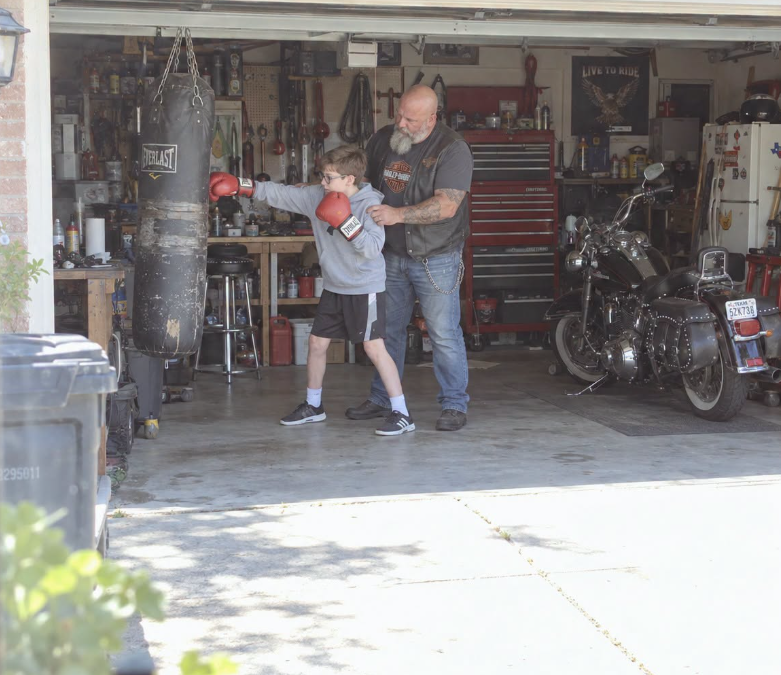
Dark hair he never combed properly. Thick black glasses. Narrow shoulders. A collection of model airplanes hanging from his ceiling by fishing line.
He could tell you the difference between an F-14 Tomcat and an F-18 Super Hornet from a blurry photograph.
He cried when our old golden retriever died.
He hated contact sports.
The closest Tyler had ever come to throwing a punch was arguing with his younger sister Sophie over a Nintendo controller.
But there he was.
Feet spread.
Hands up.
Sweat darkening the collar of his T-shirt.
Frank stood in front of him holding two red focus mitts.
“Again,” Frank said.
Tyler jabbed.
“Don’t reach.”
Another jab.
“Turn your shoulder.”
Tyler did.
“Better.”
There was no yelling.
No macho nonsense.
No music blasting.
No motorcycle gang standing around drinking beer while my kid learned to break someone’s jaw.
Just Frank and Tyler in the hot garage.
A fan rattled near a workbench.
Tools hung neatly along the wall.
PART3:
A Marine Corps flag was folded inside a glass case next to a photograph of a young man in dress blues.
Tyler threw another combination.
Jab.
Cross.
Step back.
Hands up.
Frank tapped his right glove.
“Protect your face.”
Tyler corrected.
Then he smiled.
That stopped me.
Not the punch.
Not the gloves.
The smile.
It was small.
Quick.
But real.
And I hadn’t seen it in months.
That realization landed harder than anything happening in Frank’s garage.
For most of that school year, Tyler had been disappearing in pieces.
At first it was little things.
He stopped asking me to shoot baskets in the driveway.
He started saying he wasn’t hungry at dinner.
He quit the robotics club even though he’d spent the entire previous summer begging us to let him join.
He stopped inviting his friend Ben over.
Then he started staying in his room.
Door closed.
Headphones on.
Long sleeves even when the weather turned warm.
Megan noticed before I did.
“Something’s wrong,” she told me one night in February.
“He’s thirteen,” I said.
She gave me a look.
“What?”
“You say that like thirteen explains everything.”
“It explains some of it.”
“He’s barely talking.”
“Teenager.”
“He doesn’t laugh anymore.”
“Middle school.”
“He dropped robotics.”
“Maybe he’s bored with it.”
“David.”
That was my name.
She only used it like that when she wanted me to stop giving answers and start listening.
I put my phone down.
“What do you want me to do?”
“Talk to him.”
“I do talk to him.”
“You ask if homework is done.”
“I ask about school.”
“And when he says ‘fine,’ you say ‘good.'”
That stung enough that I got defensive.
“What am I supposed to do, interrogate him?”
“I’m asking you to notice him.”
I noticed him.
At least I thought I did.
I noticed his grades were still good.
I noticed his room was messy.
I noticed he forgot to bring the trash cans in.
I noticed he was spending too much time online.
What I didn’t notice was that a kid can be getting straight A’s while his life is falling apart.
We tried family dinners without phones.
He barely spoke.
We signed him up with a counselor.
He went three times and told us it was stupid.
We limited screen time.
That made him angry.
We gave him more freedom.
That made no difference.
We asked if someone at school was bothering him.
“No.”
We asked if he was depressed.
“No.”
We asked if anything had happened.
“No.”
After a while, our questions started feeling like knocking on a door nobody was going to open.
So I did what a lot of fathers do when they’re afraid.
I renamed the problem.
Hormones.
Middle school.
Moodiness.
A phase.
Anything that sounded temporary.
Anything that meant I didn’t have to admit I was losing access to my own kid.
And now, watching through the kitchen window, I saw Tyler smiling while a man I barely knew taught him how to fight.
I should have walked over that first day.
I didn’t.
I told myself I wanted to understand what was happening before I reacted.
That was partly true.
The other truth was uglier.
I was relieved.
Whatever Frank was doing, Tyler seemed alive.
So I watched.
The next afternoon, same thing.
Tyler got home at 3:27.
I know because I checked the clock.
He walked up our driveway with his backpack hanging from one shoulder.
He looked toward the house.
Then toward Frank’s.
He waited until the school bus turned the corner.
Then he crossed the grass and slipped into Frank’s garage.
I stood behind the kitchen curtain like I was spying on my own family.
Frank had taped white lines onto the concrete floor.
That day, they barely punched.
Frank worked on footwork.
“Never cross your feet.”
Tyler shuffled.
“Again.”
He moved left.
“Good.”
Right.
“Don’t bounce.”
“Why?”
“Because this isn’t a movie.”
Tyler laughed.
I heard it through the open window.
Frank pointed to his chest.
“You want balance. Somebody shoves you, you don’t want to fall because your feet are tangled.”
Somebody shoves you.
The phrase stuck with me.
The next day, Frank taught him how to cover his head.
The day after that, how to step backward without tripping.
Then how to slip away from a grab.
Frank never encouraged him to attack.
Not once.
If anything, I kept hearing the same instructions.
“Create space.”
“Protect your head.”
“Get away.”
“Don’t chase.”
“Leave if you can.”
On Friday, Tyler punched the bag badly and winced.
Frank stopped immediately.
“Hand hurt?”
“A little.”
“Gloves off.”
“I’m okay.”
“Didn’t ask if you’re okay. Asked if it hurts.”
Tyler hesitated.
“Yeah.”
“Then we’re done punching.”
“It’s not that bad.”
“That’s how people turn little injuries into permanent ones.”
Tyler looked annoyed.
Frank didn’t care.
They spent the rest of the session stretching and talking.
I couldn’t hear everything.
I heard one sentence.
Frank said, “Being scared doesn’t mean you’re weak.”
Tyler stared at the concrete.
Frank added, “It means your body understands danger.”
That night at dinner, Tyler asked for seconds.
Megan looked at me across the table.
I shrugged.
“What?” Tyler asked.
“Nothing,” she said.
“You guys are being weird.”
Sophie, who was nine and treated subtlety like an enemy combatant, pointed her fork at him.
“You ate vegetables.”
“So?”
“You never eat vegetables.”
“They’re green beans.”
“You hate green beans.”
Tyler rolled his eyes.
But he smiled.
Megan looked at me again.
Later, in our bedroom, she whispered, “Did you notice?”
“Yeah.”
“Something happened.”
“I know.”
“What?”
I almost told her.
I don’t know why I didn’t.
Maybe I was afraid she’d march next door immediately.
Maybe I was still deciding whether Frank was helping or crossing a line.
Maybe I didn’t want to explain why I’d been watching for days without intervening.
“I’m not sure yet,” I said.
Megan frowned.
“David.”
“I’ll tell you when I know.”
That answer would come back to haunt me.
For three weeks, I watched.
Not every afternoon.
I had work.
Errands.
Meetings.
But often enough.
Some days Tyler trained thirty minutes.
Some days an hour.
Sometimes they didn’t box at all.
They sat on folding chairs in the driveway and talked.
Once I saw Frank hand Tyler a wrench and show him something on the motorcycle.
Another time they worked on a lawn mower.
On the Saturday before Memorial Day, Frank fired up his grill and I saw Tyler sitting beside him eating a cheeseburger.
I walked outside.
Tyler immediately looked guilty.
Frank looked at me.
For half a second, something passed between us.
He knew I knew.
I could tell.
I nodded.
He nodded back.
That was it.
Cowardly, maybe.
But at the time, I thought I was protecting whatever fragile thing was pulling Tyler back into the world.
Then came the Thursday that changed everything.
It was ninety-one degrees.
Humidity made the air feel thick.
I was in my home office when I heard the heavy bag.
I stepped outside to move a sprinkler.
Frank’s garage door was fully open.
Tyler had been training maybe twenty minutes.
His hoodie was dark with sweat.
Frank pointed at him.
“Take that thing off before you cook yourself.”
“I’m fine.”
“You’re not fine. You’re wearing a hoodie in a sauna.”
Tyler shook his head.
Frank studied him.
“Your dad home?”
Tyler glanced toward our house.
“Yeah.”
“You worried he’ll see?”
Tyler didn’t answer.
Frank lowered the pads.
“Kid.”
“I’m fine.”
“That’s the second time you’ve used that word in ten seconds. Usually means the opposite.”
Something cold moved through my stomach.
Tyler stared at the floor.
Frank softened his voice.
“You don’t have to.”
Tyler swallowed.
Then he grabbed the bottom of his hoodie and pulled it over his head.
I stopped breathing.
There were bruises.
Not one.
Not two.
A constellation.
Yellow ones fading along his side.
Purple ones near his shoulder.
A dark bruise below his ribs.
Scratches across his upper back.
A scabbed line along his elbow.
And around his left forearm was a long, angry welt.
For a second, my brain refused to interpret what my eyes were seeing.
Then rage arrived.
Hot.
Instant.
Blinding.
I crossed the yard before I’d decided to move.
Frank saw me first.
His face changed.
Tyler turned.
“Dad—”
I walked straight into the garage.
“How long has my son been getting hurt?”
My voice didn’t sound like mine.
Tyler stepped backward.
Frank slowly removed the focus mitts.
“David.”
“How long?”
“Dad, it’s not—”
I pointed toward the bruises.
“Tyler, go inside.”
“No.”
That stopped me.
My son had never said no to me like that.
Not loud.
Not disrespectful.
Just terrified.
Frank set the mitts on the workbench.
“Nobody’s going anywhere yet.”
I turned on him.
“Excuse me?”
“You’re angry.”
“You’re damn right I’m angry.”
“Good. You should be.”
“Then answer me.”
Frank’s eyes stayed on mine.
“Sit down.”
“Don’t tell me to sit down.”
“Then stand. But lower your voice.”
“This is my son.”
“Exactly.”
Frank’s voice went hard.
“And he’s standing three feet away listening to whether this turns into another reason he shouldn’t have told anybody.”
I looked at Tyler.
He had folded his arms across his bare chest.
Not casually.
Protectively.
Like he wanted to disappear inside himself.
I shut my mouth.
Frank pulled two folding chairs from beside the workbench.
He opened one.
Then another.
He handed me a bottle of water from a small refrigerator.
I didn’t take it.
He put it on the floor anyway.
“Tyler,” Frank said.
My son stared at him.
“Your call.”
Tyler shook his head.
Frank waited.
“He needs to hear it from you.”
“I can’t.”
“You can.”
“No.”
Frank nodded.
“Okay.”
He looked at me.
“Six weeks ago, I was working on the bike. Your boy came home wearing that same hoodie. It was eighty-seven degrees.”
My stomach tightened.
“He sat on your front step.”
I remembered that day.
Vaguely.
A Tuesday.
I had been on a conference call.
Tyler had come inside and gone straight upstairs.
“I watched him sit there almost twenty minutes,” Frank continued. “Didn’t go inside. Didn’t look at his phone. Just sat.”
Frank rubbed his beard.
“I walked over because something wasn’t right.”
Tyler stared at the floor.
“His lip was bleeding.”
My eyes moved to him.
“His glasses were cracked.”
I remembered that too.
He’d told me they fell out of his backpack.
“He had a bruise here.”
Frank touched the side of his own neck.
“Looked like a hand.”
I felt sick.
“Somebody choked him.”
Silence swallowed the garage.
The fan clicked as it turned.
A lawn mower ran somewhere down the street.
I heard a dog bark.
Every ordinary sound made the moment worse.
I looked at Tyler.
“Who?”
No answer.
“Tyler.”
He flinched.
Frank lifted a finger.
“Careful.”
I looked at him sharply.
He didn’t back down.
“He’s not under interrogation.”
I forced myself to inhale.
“Okay.”
My voice cracked.
“Okay.”
I crouched so I wasn’t towering over Tyler.
“Who did this?”
He looked at Frank.
Then at me.
“Marcus.”
The name landed with history.
“Marcus Peterson?”
Tyler nodded.
“And Owen Clark.”
Another nod.
“Brady Wells.”
I knew Brady’s father.
Our daughters had played soccer together.
“And Connor Reeves.”
Four boys.
I sat down because my legs stopped feeling reliable.
“How long?”
Tyler whispered something.
“What?”
“January.”
I stared at him.
“January?”
His face crumpled.
“Since January.”
Eight months.
Eight months of school.
Eight months of dinners.
Eight months of car rides.
Eight months of “How was your day?”
Fine.
Eight months of my son carrying a private war home in his backpack.
“Why didn’t you tell me?”
The second the words left my mouth, I saw Frank close his eyes.
Not because the question was unreasonable.
Because the way I asked it made Tyler responsible for my ignorance.
Tyler’s face changed.
Fear became something sharper.
Anger.
“Because you wouldn’t do anything.”
That hurt.
“Tyler—”
“You’d say the same thing you always say.”
“What do I always say?”
He gave a broken laugh.
“‘Toughen up.'”
I froze.
“‘Ignore them.'”
His voice grew louder.
“‘Don’t give them a reaction.’ ‘Be the bigger person.’ ‘Boys mess around.'”
I opened my mouth.
He wasn’t finished.
“Remember fifth grade?”
I did.
Marcus Peterson.
A playground incident.
Shoving.
Name-calling.
Tyler had come home angry.
I’d told him bullies wanted attention.
Walk away.
Be mature.
Don’t sink to their level.
At the time, it had sounded wise.
“Mrs. Rivera called his parents,” Tyler said. “The next day Marcus waited for me outside the bathroom and slammed my head into a locker.”
“What?”
“He said if I told again he’d make it worse.”
“Why didn’t—”
I stopped myself.
Tyler noticed.
“So I stopped telling.”
His eyes filled.
“And guess what? It didn’t stop.”
Tears ran down his face.
“I ignored them.”
His voice cracked.
“They hit harder.”
Frank didn’t move.
“I walked away. They followed me.”
Tyler wiped his nose with the back of his hand.
“I told a teacher once this year. Mr. Phelps said he didn’t see anything and that we should all try to get along.”
Something inside me twisted.
“Then Marcus cornered me after gym because he knew somebody said something.”
“What did he do?”
Tyler looked away.
Frank answered quietly.
“He made him kneel.”
My hands went cold.
“What?”
Tyler spoke without looking at me.
“They said I had to apologize for snitching.”
“Apologize?”
“I wouldn’t.”
He swallowed.
“So Connor kicked the back of my legs and Marcus pushed me down.”
My fingernails dug into my palms.
“Owen filmed it.”
Tyler’s voice was barely audible.
“They made me say I was sorry.”
There are moments when rage is so complete it becomes quiet.
That was one.
I could see the school hallway in my imagination.
My son on his knees.
Four boys laughing.
A phone recording.
Adults somewhere nearby.
Maybe twenty feet away.
Maybe forty.
A bell ringing.
Lockers closing.
Children walking around them.
Life continuing.
“There’s more,” Frank said.
Tyler whispered, “Don’t.”
“Your choice.”
Tyler squeezed his eyes shut.
Then nodded.
Frank looked at me.
“Last month they took him into the second-floor boys’ bathroom.”
I didn’t want to hear the next sentence.
I already knew it would divide my life into before and after.
“They held his head in a toilet.”
I stood up so fast the chair fell backward.
Tyler recoiled.
I saw it.
I saw my own son recoil from me.
Not because I’d hurt him.
Because anger from an adult had become dangerous territory.
I forced my hands open.
“They filmed that too?”
Tyler nodded.
I paced toward the driveway.
Came back.
“Where are these videos?”
“His phone,” Frank said.
Tyler hugged himself.
“I deleted them.”
“Cloud backup,” Frank said. “Messages too. Screenshots. I told him not to erase anything else.”
I looked at Frank.
“You’ve seen them?”
“Some.”
“And you didn’t tell me?”
There it was.
The accusation.
Frank took it.
“I asked him if there was an adult he trusted.”
Tyler lowered his head.
“He said no.”
That sentence was worse than any insult Frank could have thrown at me.
I stared at my son.
“No one?”
Tyler didn’t answer.
“Not me?”
His chin trembled.
“No.”
I looked away.
Frank spoke carefully.
“He came here three days after I found him on your step.”
“What did he say?”
“He knocked on my garage door.”
Frank looked at Tyler, asking permission with his eyes.
Tyler nodded.
“He said, ‘Can you teach me how to hurt somebody?'”
My stomach dropped.
Frank continued.
“I said no.”
I looked at him.
“He asked again. I said I could teach him how not to get hurt as easily.”
Frank folded his arms.
“I asked if he planned to attack those boys. He said no. He said he just wanted them to stop.”
Tyler wiped his face.
“I wanted to stop being scared.”
Frank nodded.
“So we started with standing.”
“Standing?”
“How to plant his feet. How to keep his head up. How to breathe when adrenaline hits. How to protect himself if somebody grabs him. How to create distance. How to get off the ground.”
He pointed at the heavy bag.
“Punching came later.”
“You kept this from us.”
“I kept his confidence.”
“He’s thirteen.”
“I know exactly how old he is.”
“You should’ve told me.”
“Maybe.”
The word infuriated me.
“Maybe?”
Frank’s eyes hardened.
“First day he came here, I asked what would happen if I called you.”
I looked at Tyler.
Frank continued.
“He said you’d tell him to ignore it.”
The air left my lungs.
“I asked what would happen if I called the school.”
“He said they’d pull all four boys into an office, tell them to knock it off, and then send everybody back to class.”
Frank’s jaw tightened.
“I asked why he was so sure.”
Tyler answered.
“Because that’s what they did last time.”
I sat again.
Frank leaned against the workbench.
“I wasn’t going to ignore him, David.”
My name sounded like a verdict.
“I also wasn’t going to grab his phone and betray him the first time he trusted somebody.”
“So what, you were just going to train him forever?”
“No.”
Frank paused.
“I was working toward this.”
“This?”
“You finding out.”
“You could’ve called me.”
“I almost did.”
“Why didn’t you?”
He looked at Tyler.
“Because he was scared you’d take the one thing away that was making him feel less helpless.”
I looked at my son.
He nodded.
Frank continued.
“I told him secrets like this don’t stay secret. Told him we needed his parents involved. Told him the school needed to answer for what happened.”
He rubbed the back of his neck.
“But every week he asked me for one more week.”
Tyler’s voice cracked.
“I wasn’t ready.”
I wanted to say I was his father.
I wanted to say he didn’t get to decide.
I wanted to say Frank had no right.
But every argument I had sounded small beside eight months of bruises.
“There’s one more thing,” Frank said.
Tyler stiffened.
“No.”
Frank stopped.
I felt panic rise.
“What?”
“Frank.”
Tyler’s voice sharpened.
“Don’t.”
Frank looked at me.
Then back at Tyler.
“I won’t.”
That frightened me more.
I knelt beside my son.
“What is it?”
“Nothing.”
“Tyler.”
He looked at Frank.
Frank said nothing.
I put my hands on my knees.
“I won’t yell.”
Tyler’s face tightened.
“I promise.”
He stared at me for a long time.
Then he whispered, “I didn’t want to go anymore.”
“To school?”
He shook his head.
My body went cold.
“Where?”
He didn’t answer.
Frank said quietly, “Ask a different question.”
I knew.
I just didn’t want to know.
I looked at my son.
“Did you think about hurting yourself?”
Tyler’s lips pressed together.
One tear slid down his cheek.
“Sometimes.”
Everything inside me stopped.
The world narrowed to a thirteen-year-old boy standing barefoot on a concrete garage floor.
My son.
My Tyler.
The kid whose first word had been “truck.”
Who had slept holding a plastic airplane until he was seven.
Who once cried because he accidentally stepped on a beetle.
Who thought I didn’t care whether he lived.
“Did you have a plan?”
“No.”
“Did you try anything?”
“No.”
“Do you feel that way now?”
He shook his head.
“Not like before.”
Not like before.
I couldn’t breathe.
Frank pulled the other chair closer.
I sat because he guided me toward it.
For a while nobody spoke.
I covered my face with both hands.
I wasn’t crying yet.
I was somewhere past crying.
Then Tyler said the thing that finally broke me.
“I didn’t think anybody would notice.”
A sound came out of me.
Not a word.
I pulled him toward me.
He resisted for half a second.
Then collapsed.
I held my thirteen-year-old son while he sobbed against my shoulder.
“I’m sorry.”
I kept saying it.
“I’m sorry.”
Not “You’ll be okay.”
Not “Be strong.”
Not “Don’t cry.”
Just the truth.
“I’m sorry.”
After a while, Tyler went inside to shower.
I stayed in the garage.
Frank picked up the fallen chair.
I stared at the concrete.
“Why?”
He knew what I meant.
Why him?
Why my kid?
Why did you care?
Why didn’t you walk away?
Frank sat across from me.
For the first time since I’d known him, he looked old.
Not fifty-four.
Older.
Tired in a permanent way.
“I had a son.”
Had.
The word made my chest tighten again.
“Jake.”
Frank looked toward the glass case holding his Marine photograph.
“He was a lot like Tyler.”
“Was?”
“He’s alive.”
I exhaled.
Frank gave a humorless smile.
“Barely wasn’t, though.”
He rubbed his palms together.
“Jake was smart. Quiet. Weird in the best ways. Loved astronomy. Could name every moon around Jupiter when he was eight.”
Frank looked down.
“Middle school ate him alive.”
I didn’t interrupt.
“Started seventh grade. A couple boys called him names because he was skinny and awkward. Then it turned physical. Shoving. Backpack dumped out. Food knocked off trays.”
He swallowed.
“I knew some of it.”
“What did you do?”
“Exactly what you did.”
The words weren’t cruel.
That made them worse.
“I told him to toughen up.”
Frank’s eyes went somewhere far away.
“Told him every man gets tested.”
He shook his head.
“God, I hate that sentence now.”
He inhaled slowly.
“I’d spent twenty years around Marines. You learn how to solve problems through endurance. Pain comes, you keep moving. Fear comes, you do your job.”
His mouth tightened.
“That’s useful when you’re thirty and people are shooting at you.”
He looked at me.
“It’s a terrible thing to say to a twelve-year-old who’s drowning.”
I thought of every time I’d told Tyler to ignore Marcus.
Frank continued.
“Jake got quieter.”
His voice dropped.
“Long sleeves. Headaches. Stomachaches. Didn’t want to go to school.”
He stared at his hands.
“I thought he was trying to get out of responsibilities.”
My throat tightened.
“One Tuesday night, I came home late. His mother was screaming.”
Frank stopped talking.
The silence lasted so long I thought he might not continue.
“Bathroom door was locked.”
His voice was rough now.
“We broke it.”
He closed his eyes.
“Jake was on the floor.”
I said nothing.
“Empty prescription bottle.”
Frank swallowed.
“His mom’s migraine medication.”
I looked away.
“Ambulance got there fast. ICU. Ventilator. Doctor told us he might not wake up.”
Frank’s fingers trembled.
Barely.
But I saw it.
“He did.”
Frank looked toward my house.
“Two weeks in the hospital. Three months inpatient psychiatric care. Years of therapy after.”
“How old?”
“Fourteen.”
He leaned back.
“He’s thirty-one now. Lives outside Portland. Married to a good woman. Daughter who’s four and thinks dinosaurs are prettier than princesses.”
A real smile crossed his face for one second.
“He’s okay.”
Then it disappeared.
“But I came within inches of losing him because I thought being tough meant staying quiet.”
I didn’t know what to say.
Frank saved me the trouble.
“When I saw Tyler sitting on that step, I saw Jake.”
He looked me directly in the eyes.
“Same shoulders folded in.”
“Same way he wouldn’t look up.”
“Same hoodie when it was too hot.”
Frank’s jaw tightened.
“I wasn’t making the same mistake twice.”
The garage blurred.
“You think I failed him.”
“I think you missed it.”
“That’s the same thing.”
“No.”
Frank shook his head.
“Failure is seeing it and choosing not to care.”
I stared at him.
“Missing it means you better decide what you do next.”
That night, Megan learned everything.
There was no graceful way to tell her.
I waited until Sophie was asleep.
Tyler sat between us on the couch.
He wore a T-shirt.
For the first time, Megan saw the bruises.
Her hand went over her mouth.
“Oh my God.”
Tyler stared at the carpet.
She reached for him.
He flinched.
Megan froze.
I watched my wife understand that her son had learned to associate reaching hands with danger.
Her face crumpled.
“Tyler.”
She didn’t touch him again.
She waited.
“Can I hug you?”
He nodded.
She moved slowly.
Then she pulled him into her arms.
I told her about the videos.
The bathroom.
The threats.
The thoughts Tyler had been having.
When I told her I’d known about the training for three weeks, she stared at me.
“You knew he was going over there?”
“I didn’t know why.”
“You watched?”
“I wanted to figure it out.”
“For three weeks?”
“I saw him smiling.”
Her voice rose.
“You saw our thirteen-year-old son secretly learning how to fight in a grown man’s garage and you didn’t tell me?”
Tyler shrank into the couch.
I saw it immediately.
“Not now.”
Megan did too.
She closed her eyes.
“You’re right.”
She looked at Tyler.
“I’m sorry.”
Then she looked at me.
“We’ll talk later.”
We did.
At one in the morning.
In whispers behind our bedroom door.
She was furious.
Not just at the boys.
At the school.
At me.
At herself.
At everyone.
“How did we not know?”
“I don’t know.”
“We eat with him every night.”
“Not every night.”
“Don’t.”
“I’m not blaming you.”
“It sounds like it.”
“I’m blaming both of us.”
She sat on the edge of the bed.
“I asked him.”
“So did I.”
“We asked the wrong way.”
That stopped us.
Megan wiped her eyes.
“We asked like we wanted him to say no.”
I thought about that.
Had anyone hurt you?
No.
Okay.
Are you being bullied?
No.
Good.
Everything fine?
Yeah.
Great.
Questions designed to end conversations.
Not begin them.
We told ourselves we were available.
Tyler had learned we were relieved not to be needed.
At 1:40, Megan said, “We’re not sending him back tomorrow.”
“No.”
“And I’m calling his counselor.”
“Yes.”
“And the pediatrician.”
“Yes.”
“And the police.”
I hesitated.
She looked at me.
“David.”
“I agree.”
“That video is assault.”
“I know.”
“No.”
Her voice hardened.
“Say it.”
I looked at her.
“Our son was assaulted.”
The words changed everything.
Bullying sounded like childhood.
Assault sounded like what it was.
The next morning, we sat at the dining room table with Tyler’s phone.
Frank had helped him preserve everything.
Screenshots.
Text messages.
Deleted videos recovered from cloud storage.
A private group chat.
Months of cruelty compressed into a six-inch screen.
Megan cried silently while I scrolled.
Marcus: freak.
Connor: airplane boy gonna cry.
Owen: wear the blue hoodie tomorrow lol.
Brady: he tells again we’re cooking him.
There were photos.
Tyler eating alone.
Tyler’s backpack dumped into a toilet.
A picture of him asleep on the school bus with something obscene drawn digitally across his face.
Then videos.
I didn’t want to watch.
I watched anyway.
If my son had survived it, I could endure witnessing it.
The hallway video showed Tyler surrounded by four boys.
Marcus was taller.
Probably five-foot-nine.
Athletic.
Hair styled perfectly.
The kind of kid adults called confident.
In the video, he shoved Tyler.
“Say it.”
Tyler tried moving away.
Connor blocked him.
“Say you’re sorry.”
Tyler’s voice was thin.
“For what?”
The boys laughed.
“For being a snitch.”
“I’m not.”
Marcus shoved him again.
Tyler hit a locker.
I heard someone behind the camera laughing.
A girl passed in the background.
She looked.
Then kept walking.
Marcus kicked Tyler behind the knee.
My son dropped.
Someone said, “There you go.”
Marcus stood over him.
“Say it.”
Tyler whispered, “I’m sorry.”
“For what?”
“Reporting you.”
“Louder.”
“I’m sorry for reporting you.”
They laughed.
The clip ended.
Megan covered her face.
I sat frozen.
Then the bathroom video started.
I lasted eleven seconds.
I slammed the phone down.
Tyler jumped.
“Sorry.”
I grabbed the phone again.
“I won’t do that.”
He watched me.
“This isn’t your shame.”
His eyes filled.
“It’s theirs.”
At 9:00, we were in the principal’s office.
Dr. Susan Holloway had been principal at Tyler’s school for six years.
She had silver-framed glasses, immaculate blond hair, and a wall covered in framed slogans.
BE KIND.
CHOOSE COURAGE.
EVERY STUDENT MATTERS.
I remember those because I spent most of the meeting staring at them.
Vice Principal Aaron Blake sat beside her.
Counselor Denise Carter joined us.
Tyler chose to stay home with Frank.
I had mixed feelings about that.
But if he’d trusted Frank through hell, I wasn’t going to punish him for it now.
Dr. Holloway folded her hands.
“We’re very concerned by what you’ve shared.”
Megan placed printed screenshots on the desk.
“Concerned isn’t the word.”
“We take allegations of bullying extremely seriously.”
I leaned forward.
“Stop calling it bullying.”
Dr. Holloway blinked.
“Excuse me?”
“Four boys held my son’s head in a toilet.”
Her face tightened.
“Mr. Mercer—”
“His name is Tyler.”
“Yes.”
“And they assaulted Tyler.”
She glanced toward the screenshots.
“We will investigate.”
Megan laughed once.
There was no humor in it.
“You have videos.”
“We still have procedures.”
“Of course you do.”
Mrs. Carter leaned forward.
“We want to create a safety plan immediately.”
“Where was the safety plan for the last eight months?” Megan asked.
Dr. Holloway said, “We had no reports suggesting violence at this level.”
I looked at her.
“Tyler reported Marcus Peterson in fifth grade.”
“That was an elementary school.”
“Same district.”
“Different administration.”
“Same kid.”
I pointed at the hallway screenshot.
“Same result.”
Vice Principal Blake spoke.
“Did Tyler report any of these specific incidents this year?”
“Once.”
“To whom?”
“Mr. Phelps.”
Blake wrote something.
“What did he say?”
“That he didn’t see anything and everybody should try to get along.”
Dr. Holloway exhaled.
“We’ll speak with him.”
I stared at the wall behind her.
EVERY STUDENT MATTERS.
“Here’s what I want.”
They looked at me.
“I want the security footage preserved.”
Dr. Holloway’s eyebrows lifted.
“All of it.”
“Mr. Mercer—”
“The hallways. The cafeteria. The second-floor corridor near the boys’ bathroom. From January until yesterday.”
“That may be a significant amount of data.”
“Preserve it.”
“We’ll have to speak with district counsel.”
“Good.”
I put a business card on the desk.
“So will I.”
It belonged to a lawyer named Rebecca Sloan.
I had called her at seven that morning.
A coworker had used her when his daughter was injured during a hazing incident.
Dr. Holloway picked up the card.
Her expression changed.
Good.
Megan said, “We’re also filing a police report.”
Vice Principal Blake looked uncomfortable.
“Sometimes involving law enforcement can escalate student conflict.”
My chair scraped backward.
Megan grabbed my wrist.
Not because I was going to hit anybody.
Because she knew exactly what that sentence had done to me.
I looked at Blake.
“My son had his head shoved into a toilet while four boys filmed it.”
“I understand.”
“No, you don’t.”
My voice stayed low.
“You understand paperwork.”
His face reddened.
“I understand schools.”
“And I understand my son thought about dying because the adults in this building taught him reporting made things worse.”
Nobody spoke.
Dr. Holloway finally said, “That is a very serious statement.”
“Everything about this is serious.”
We left with promises.
Interim no-contact orders.
Schedule changes.
Supervised transitions.
Investigation.
Parent meetings.
Counseling support.
Security review.
A lot of professional words for the simple truth that my kid hadn’t been safe.
We drove directly to the police station.
Detective Maria Santos met us in a small interview room.
She was in her early forties and had the calmest voice I’d heard in twenty-four hours.
She didn’t call it bullying.
She called it evidence.
She watched the videos once.
Asked permission before asking Tyler difficult questions.
Explained everything before she did it.
When Tyler couldn’t answer, she waited.
When he cried, she didn’t rush him.
At one point she asked, “Did you ever fight back?”
Tyler looked ashamed.
“No.”
“Why do you look embarrassed?”
He shrugged.
She leaned forward.
“Tyler, four people attacking one person doesn’t become acceptable because the one person doesn’t fight back.”
His eyes lifted.
“Freezing is a survival response.”
She tapped the table gently.
“You survived.”
I watched those two words reach him.
Not coward.
Not weak.
Not victim.
Survived.
Detective Santos asked about the training.
I tensed.
Tyler told her.
She asked whether Frank had ever told him to attack anyone.
“No.”
“Did he tell you to bring a weapon?”
“No.”
“Did he encourage you to retaliate?”
“No.”
“He says if I can leave, leave.”
“What if you can’t?”
Tyler hesitated.
“Protect my head. Stay on my feet. Make space. Get somewhere with adults.”
Detective Santos nodded.
“Sounds sensible.”
I exhaled.
The school investigation detonated faster than I expected.
By Monday, all four boys were suspended pending disciplinary review.
Parents started calling us.
The first was Brady Wells’s mother.
She sobbed.
“I didn’t know.”
Neither had we.
That didn’t make me sympathetic.
But there was something real in her voice.
Brady had apparently told them Tyler was part of the friend group.
That they all messed with one another.
“We failed to look closer,” she said.
Megan was quiet.
Mrs. Wells continued.
“Brady is horrified.”
“Brady filmed my son with his head in a toilet.”
“I know.”
“No. He was laughing.”
Silence.
“Mrs. Mercer, I don’t know what to say.”
“Neither do I.”
They hired a therapist.
Brady’s father brought his phone to police voluntarily.
They cooperated.
That mattered later.
Owen Clark’s parents called too.
His father sounded defensive at first.
“Kids do stupid things.”
I nearly hung up.
Then I heard Owen’s mother in the background.
“Stop.”
She took the phone.
“What our son did was cruel.”
Her voice shook.
“We are not asking you to forgive him.”
That sentence surprised me.
“We’re asking what evidence you need us to preserve.”
Connor’s parents hired an attorney and said nothing.
Marcus’s father called me himself.
Eric Peterson owned three car dealerships outside town.
His face appeared on billboards smiling beside slogans about trust.
He didn’t apologize.
“David.”
We weren’t friends, but he said my name like we were negotiating a golf bet.
“Eric.”
“I’ve heard there’s been an incident.”
“Eight months is a long incident.”
“Marcus says there’s context.”
I laughed.
“Context?”
“Teenage boys say things. They roughhouse.”
“They shoved Tyler’s head into a toilet.”
“Marcus says your son provoked some of this.”
My vision narrowed.
“How?”
“I’m not interested in arguing.”
“You called me.”
“I’m interested in protecting our children.”
“Our children?”
“Both boys’ futures.”
I understood then.
This wasn’t a father calling about harm.
This was a businessman managing exposure.
“Marcus is a strong student,” Eric continued. “Varsity baseball next year. Honor roll. One bad situation shouldn’t define him.”
“One?”
“David.”
“Your son has been tormenting mine since January.”
“Allegedly.”
“There’s video.”
“Edited clips don’t always show what came before.”
I went quiet.
Eric mistook that for weakness.
“I think we can resolve this without lawyers and police making everything worse.”
“What are you suggesting?”
“A meeting.”
“Between who?”
“The families.”
“No.”
“Let the boys talk.”
“No.”
“Kids need to learn conflict resolution.”
“Your son can practice conflict resolution with his attorney.”
His voice hardened.
“Be careful.”
There it was.
The man beneath the billboard smile.
“Excuse me?”
“You don’t want to turn a school issue into something that follows everyone forever.”
“Is that a threat?”
“Don’t be dramatic.”
“I’m not.”
I glanced through the kitchen window.
Tyler and Frank were in the driveway.
No gloves.
Frank was teaching him how to change the oil on the motorcycle.
“For eight months,” I said, “my son was terrified of your kid.”
Eric sighed.
“David—”
“Now Marcus gets to be scared of consequences.”
I hung up.
Two days later, things got uglier.
Someone leaked the story.
Not the full story.
A version.
The neighborhood Facebook group erupted.
“Local teen faces police investigation after school fight.”
Fight.
As if both sides had agreed to meet in an alley.
Someone wrote that Tyler had been “secretly training with a former Marine.”
Another person said he’d been planning revenge.
A woman I recognized from school pickup wrote, “Maybe there are two sides.”
Then somebody posted a photograph of Frank.
He was standing beside his motorcycle at a veterans’ fundraiser.
The caption read:
WHY IS A GROWN BIKER TRAINING A MIDDLE SCHOOL KID TO FIGHT?
I showed Frank.
He snorted.
“That’s a good picture.”
“You’re not upset?”
“I’ve been called worse by better people.”
But it spread.
Parents questioned whether Tyler had become dangerous.
Rumors said he carried a knife.
He didn’t.
Rumors said Frank ran an illegal fight club.
He didn’t.
Rumors said Tyler had threatened Marcus.
He hadn’t.
The school called an emergency meeting.
This time Rebecca Sloan came with us.
Rebecca was five-foot-four, wore navy suits, and had the conversational warmth of a tax audit.
I liked her immediately.
Dr. Holloway tried to discuss “community concerns.”
Rebecca opened a folder.
“Before we discuss rumors, I’d like to discuss documented facts.”
The room changed.
She laid out dates.
January 12.
First recorded threatening message.
January 19.
Hallway shove visible on school camera.
February 2.
Cafeteria incident.
February 26.
Tyler absent after reporting stomach pain.
Medical record noted bruising.
March 11.
Teacher report describing “peer conflict.”
March 12.
Video of forced apology.
April 7.
Bathroom assault.
April 8.
Tyler visits school nurse with red eyes and headache.
April 18.
Screenshot showing Marcus telling Connor, “He won’t snitch again.”
May 10.
Frank photographs bruise on Tyler’s neck with Tyler’s permission.
May 12.
Training begins.
May 29.
Parents notified.
Rebecca slid a copy across the table.
“This timeline does not describe mutual conflict.”
Nobody argued.
“It describes prolonged victimization followed by institutional failure.”
Dr. Holloway said quietly, “We’re still investigating staff response.”
Rebecca nodded.
“You should.”
Then Vice Principal Blake made a mistake.
“We also need to evaluate whether Mr. Deluca’s training may have contributed to an escalation.”
Rebecca looked at him.
“What escalation?”
“The potential for confrontation.”
“Did Tyler confront anyone?”
“No.”
“Threaten anyone?”
“Not that we’re aware.”
“Bring a weapon?”
“No.”
“Start a fight?”
“No.”
“Then what exactly escalated?”
Blake shifted.
“His capacity to engage physically.”
Rebecca waited.
“You mean his ability to defend himself.”
Nobody spoke.
She closed the folder.
“That’s not an escalation.”
Afterward, I found Frank in his garage.
He was wrapping Tyler’s hands.
“You don’t need to stop,” I said.
Frank looked up.
“Wasn’t planning to.”
I smiled despite everything.
“But there is one condition.”
His eyebrows rose.
“I want in.”
Tyler blinked.
“What?”
“I want you to train me too.”
Frank stared at me for a few seconds.
Then laughed.
A deep, surprised laugh.
“Your knees work?”
“Mostly.”
“Back?”
“Depends what day.”
“Any boxing experience?”
“College.”
Tyler looked impressed.
“You boxed?”
I scratched my neck.
“Technically, I got drunk once and fought a guy named Derek outside a fraternity house.”
Frank nodded solemnly.
“Extensive background.”
Tyler laughed.
That laugh became one of my favorite sounds.
Frank tossed me a pair of gloves.
“All right, college.”
I put them on.
“What now?”
He pointed at the white tape on the floor.
“Stand there.”
I did.
He shook his head.
“Terrible.”
“I haven’t moved.”
“Exactly.”
Tyler laughed harder.
For the next hour, my thirteen-year-old son corrected my stance.
“Feet too wide.”
“Hands up.”
“Dad, you’re crossing.”
“I’m not crossing.”
“You literally crossed.”
“Whose side are you on?”
“The side that doesn’t fall down.”
Frank nodded.
“Kid’s learning.”
I was terrible.
Truly.
My jab looked like I was reaching for groceries on a high shelf.
My left hook was an insult to biomechanics.
Frank hit my gloves with the mitts and said, “I have seen folding chairs with better defense.”
But something happened while we trained.
Tyler talked.
At first about boxing.
Then school.
Then everything.
He told me Marcus started targeting him after a science fair.
Tyler had won first place.
Marcus placed third.
“Seriously?”
Tyler shrugged.
“I don’t think that’s why exactly.”
“Then why?”
“He started calling me Professor.”
“That sounds harmless.”
“It was at first.”
Tyler punched the mitt.
Then another.
“He’d ask me questions in front of everybody. Stuff he knew I wouldn’t know.”
Punch.
“If I answered wrong, they’d laugh.”
Punch.
“If I answered right, he’d say I was showing off.”
Punch.
“There wasn’t a right answer.”
Frank said, “That’s how control works.”
Tyler looked at him.
“What?”
“The point isn’t the answer.”
Frank tapped his glove.
“The point is teaching you that whatever you do can be punished.”
Tyler went still.
“Yeah.”
He understood.
So did I.
That evening, Tyler and I walked home across twenty feet of grass that suddenly felt like a bridge we’d spent years building.
“Dad?”
“Yeah?”
“Your left hook really is terrible.”
“Your mother married me anyway.”
“Maybe she didn’t know.”
I nudged him.
He smiled.
Halfway across the yard, he stopped.
“Can I tell you something?”
“Always.”
“Don’t freak out.”
Parents should understand that whenever a child says don’t freak out, the next sixty seconds matter.
Every instinct screams to demand the information.
But how you receive it teaches them whether they’ll ever tell you anything difficult again.
I remembered Frank’s warning.
He’s standing right there listening to how you react.
I put my hands in my pockets.
“Okay.”
Tyler looked toward Frank’s garage.
“Before I started training…”
His voice faded.
I waited.
“I used to think about not being here.”
“I know.”
“No.”
He looked at me.
“I mean a lot.”
My throat closed.
“I’d be sitting in class and think, if I disappeared, this would stop.”
I stayed still.
“I’d think about everybody being sad for like a week.”
His eyes watered.
“And then they’d forget.”
I wanted to grab him.
I didn’t.
“What changed?”
“Frank.”
He looked embarrassed saying it.
I swallowed my ego.
“Good.”
“He made me promise something.”
“What?”
“If I ever got to where I thought I might actually do something, I had to tell him before I did.”
My knees nearly gave out.
“I promised.”
“Did you ever have to tell him?”
“No.”
He looked at me.
“And now you too.”
I breathed.
“Me too.”
“And Mom.”
“Her too.”
“I don’t think like that now.”
“I’m glad.”
He nodded.
Then I asked the question I should’ve asked months earlier.
“What does it feel like when it gets bad?”
Tyler thought.
“Like you’re trapped in a room everybody else says doesn’t exist.”
I will remember that sentence until I die.
The disciplinary hearing happened in June.
The boys sat with their parents.
Tyler didn’t have to attend.
He chose to.
He wore a blue button-down shirt.
No hoodie.
Frank offered to come.
Tyler wanted him there.
The district tried to object because Frank wasn’t family.
Rebecca asked Tyler whom he considered a support person.
“Frank.”
That ended the discussion.
We sat together.
Me.
Megan.
Tyler.
Rebecca.
Frank.
Across the room sat the four boys who had made my son afraid to exist.
Seeing them in person was strange.
They looked young.
That’s the uncomfortable truth.
Cruelty doesn’t always wear a villain’s face.
Marcus had acne along his jaw.
Connor bounced one knee nervously.
Owen kept staring at his shoes.
Brady looked like he’d been crying.
They were children.
Children who had done terrible things.
That distinction mattered.
Not because it excused them.
Because consequences and vengeance are not the same thing.
The hearing officer reviewed evidence.
Videos.
Messages.
Witness interviews.
Security footage.
The school nurse’s records.
Teachers’ statements.
Then came something we didn’t expect.
A sixth-grade teacher named Ms. Alvarez had kept notes.
She testified that Tyler repeatedly asked to spend lunch in her classroom.
She’d assumed he liked quiet.
“He often waited until the hallway cleared before leaving,” she said.
“Did you ask why?” Rebecca asked.
Ms. Alvarez’s face fell.
“No.”
“Did you see injuries?”
“Once.”
“What did you see?”
“A bruise near his wrist.”
“Did you report it?”
She swallowed.
“No.”
“Why?”
“He said he fell during PE.”
Rebecca nodded.
“Do you believe that now?”
Ms. Alvarez looked at Tyler.
“No.”
She started crying.
“I’m sorry.”
Tyler stared at her.
Then something unexpected happened.
He said, “It’s okay.”
I felt Frank shift beside me.
Later, he whispered, “Kid’s got more grace than most adults.”
The most damning evidence came from school security footage.
The district had said cameras couldn’t capture every incident.
True.
But they captured enough.
Marcus shoving Tyler into lockers.
Connor knocking books from his hands.
Brady and Owen waiting outside classrooms.
All four surrounding him near stairwells.
Teachers walking past.
Not always seeing.
Sometimes seeing something and continuing.
The final clip showed the second-floor bathroom entrance.
Four boys entered.
Tyler entered seconds later.
He did not come out for eleven minutes.
When he did, his shirt was wet.
His glasses were off.
He stood alone in the hallway for thirty-two seconds.
A teacher passed him.
The teacher stopped.
Said something.
Tyler shook his head.
The teacher walked away.
Thirty-two seconds.
I watched my son standing there.
Wet.
Humiliated.
Terrified.
Waiting, maybe, for someone to insist.
No one did.
The hearing officer paused the video.
No one in the room spoke.
Then Marcus’s attorney stood.
He argued that the boys had engaged in a pattern of inappropriate conduct but disputed some characterizations.
“Characterizations?”
Megan whispered beside me.
The attorney suggested the bathroom incident started as horseplay.
That word almost broke the room.
Detective Santos, who attended because the criminal case was ongoing, visibly stiffened.
Then Marcus spoke.
Not because anyone forced him.
Because he was angry.
“It wasn’t like that.”
His attorney touched his arm.
Marcus pulled away.
“Tyler acted like he was better than everybody.”
My son looked at him.
Marcus continued.
“He always knew answers. Teachers liked him. He made people feel stupid.”
Eric Peterson whispered sharply, “Marcus.”
But the boy was committed.
“He never fought back.”
There it was.
Not remorse.
Resentment.
“So you thought that meant you could hurt him?” the hearing officer asked.
Marcus’s face reddened.
“We were messing around.”
“You held his head in a toilet.”
“He could’ve fought.”
Tyler went still.
Frank’s hands clenched.
The hearing officer stared at Marcus.
“You’re saying his failure to physically resist made your actions acceptable?”
Marcus’s father whispered again.
“Stop talking.”
Marcus looked at Tyler.
“He learned to fight now, didn’t he?”
Rebecca leaned forward.
Eric Peterson whispered, “Marcus, enough.”
But arrogance had opened the door, and arrogance rarely knows when to stop.
“I heard that biker’s been training him so he can come after us.”
Frank smiled.
It wasn’t pleasant.
The hearing officer looked at Tyler.
“Is that true?”
Tyler shook his head.
“No.”
“What have you been taught?”
Tyler glanced at Frank.
Then answered.
“How to leave.”
The room became very quiet.
“Can you explain?”
Tyler swallowed.
“Frank says if somebody wants to fight and I can leave, I leave.”
He looked down.
“If they grab me, I break the grip.”
“If I fall, I protect my head and get up.”
“If there’s an adult, I go to the adult.”
He raised his eyes.
“He says winning means I get home.”
Frank looked away.
I realized he was crying.
Just a little.
The hearing officer asked, “Has Mr. Deluca ever told you to retaliate against these boys?”
“No.”
“Has he ever encouraged you to seek them out?”
“No.”
“What does he tell you about revenge?”
Tyler almost smiled.
“That it’s stupid.”
A couple people actually laughed.
Even Detective Santos.
Then Tyler added, “He says revenge lets the person who hurt you keep deciding who you are.”
Frank looked at him.
I watched something pass between them.
The hearing ended three hours later.
The district expelled Marcus for the remainder of the academic year and barred him from school-sponsored athletics during the first semester of high school.
Connor received the same academic expulsion.
Brady and Owen, because they cooperated immediately and because evidence showed they had participated differently, were assigned lengthy suspensions, mandatory counseling, community service, and transfer to another middle school program for the following year.
Some people thought it was too harsh.
Others thought it wasn’t harsh enough.
I stopped caring what strangers thought.
The criminal process moved separately.
Juvenile court is complicated.
Confidential.
Designed, at least theoretically, to rehabilitate kids rather than destroy them.
Charges were filed related to assault, harassment, unlawful restraint, and distribution of humiliating recordings.
There were plea agreements.
Probation.
Court-ordered counseling.
Community service.
No-contact orders.
For Marcus and Connor, more severe restrictions.
But the biggest consequence wasn’t criminal.
It came from the district’s own investigation.
Rebecca had pushed hard.
Parents began requesting records.
Other students came forward.
Tyler hadn’t been the only one.
Marcus’s group had targeted at least six students over two years.
One girl transferred schools.
A boy stopped attending band after repeated harassment.
Another student had been shoved down stairs but told everyone he’d tripped.
The pattern had existed in fragments.
No one had assembled it.
Until Tyler.
Mr. Phelps was placed on administrative leave after investigators found he’d received multiple complaints and documented several as “peer disagreements.”
Vice Principal Blake had approved informal mediation sessions that put targeted students face-to-face with kids who intimidated them.
The district eventually reassigned him.
Dr. Holloway kept her job, but the school implemented a new reporting system, bathroom monitoring procedures, anonymous student reporting, and mandatory follow-up after harassment complaints.
I wish I could say that felt like victory.
It didn’t.
Justice rarely feels like movies.
Nobody clapped.
No triumphant music played.
The bruises didn’t vanish when policies changed.
Tyler still woke from nightmares.
He still flinched when someone came up behind him.
He still avoided the second-floor bathroom.
Some mornings he stood at our front door with his backpack on and couldn’t make himself leave.
Healing turned out to be boring and repetitive.
Therapy every Tuesday.
Training Monday, Wednesday, Friday.
Medication for anxiety for a while.
Family counseling.
Long drives where nobody spoke.
Bad days.
Better days.
Then another bad day for no obvious reason.
We learned not to treat setbacks like failure.
One afternoon in July, Tyler froze in a grocery store.
We were in the cereal aisle.
A group of teenagers came around the corner laughing loudly.
One bumped the cart.
Tyler dropped the box he was holding.
His breathing changed.
I started to say, “You’re okay.”
Then I stopped.
Because maybe he didn’t feel okay.
I moved beside him.
“What do you need?”
He stared at the floor.
“Can we go outside?”
“Yes.”
We left the cart.
Walked out.
Sat on the curb in ninety-degree heat.
He breathed.
I breathed.
Five minutes later he said, “This is stupid.”
“No.”
“They weren’t even doing anything.”
“Your body remembered something.”
He looked at me.
“Frank tell you that?”
“Maybe.”
He laughed a little.
We went back inside.
Finished shopping.
That counted as a win.
Frank became part of our family slowly enough that none of us noticed when it happened.
At first he came over for dinner once.
Then twice.
Then Sophie started knocking on his door asking whether she could see the motorcycle.
Megan began sending him plates when she cooked too much.
I helped him rebuild part of his back deck.
Tyler spent hours in his garage.
Not always training.
Sometimes they built model airplanes.
Frank was terrible at them.
He used too much glue.
Tyler criticized him relentlessly.
“You put the decal crooked.”
“It flies in my imagination.”
“It’s an F-16. The tail marking matters.”
“Does it?”
“Yes.”
“To who?”
“People with standards.”
Frank looked at me.
“Your kid’s mean.”
“Defend yourself.”
By August, Tyler had gained seven pounds.
He started running.
His posture changed.
Not dramatically.
He was still skinny.
Still wore glasses.
Still nerded out when military aircraft flew overhead.
But he stopped making himself small.
That’s difficult to explain unless you’ve watched someone do the opposite.
He took up space.
Not aggressively.
Normally.
Like he had finally accepted he was entitled to exist in a room.
One evening, Frank and I sat in folding chairs at the edge of his driveway while Tyler worked the heavy bag.
Frank handed me a beer.
“You ever talk to Jake?” I asked.
“Yesterday.”
“How’s he doing?”
“Good.”
Frank smiled.
“His daughter started kindergarten.”
“Grandpa handling it?”
“No.”
I laughed.
“You’re terrifying.”
“She owns me.”
We watched Tyler.
His jab snapped out.
Returned quickly.
“He’s fast,” I said.
“Faster.”
Frank corrected him.
“Hands up, kid.”
Tyler raised them.
I took a sip.
“Why’d you move here?”
Frank was quiet.
“Divorce.”
“You told me that.”
“That’s the easy answer.”
I waited.
He rubbed his thumb against the beer bottle label.
“My wife and I didn’t survive Jake’s attempt the way Jake did.”
I looked at him.
“We stayed married another fifteen years.”
He shrugged.
“Stayed angry too.”
“At each other?”
“Mostly ourselves.”
He stared at the street.
“She blamed me for being hard on him.”
“Were you?”
“Yeah.”
“And you?”
“I blamed her for not telling me how bad he was doing.”
He laughed sadly.
“Truth was, she didn’t know either.”
Frank took a drink.
“Pain likes somebody to blame.”
I knew that.
“So what happened?”
“Eventually we got tired.”
“That’s it?”
“Sometimes that’s it.”
He smiled faintly.
“She moved to Arizona. Met a dentist.”
“How dare she.”
“Exactly.”
He laughed.
“We’re friendly now.”
I nodded.
Frank watched Tyler.
“I moved here because Jake asked me to.”
“Here?”
“Closer.”
“He lives in Oregon.”
“Closer than Florida, where I was.”
I hadn’t known.
“He wanted his daughter to know me.”
Frank’s voice softened.
“So I sold the house.”
He looked at his garage.
“Bought this place.”
“Then got stuck next to us.”
“God punishes everybody differently.”
I laughed.
Tyler turned.
“What are you guys laughing about?”
“You,” I said.
“Figures.”
In September, Tyler returned to school.
Different hallways.
Different schedules.
Marcus and Connor were gone.
Brady and Owen transferred.
But ghosts don’t need enrollment forms.
The first morning, Tyler stood in the kitchen wearing a gray T-shirt.
No hoodie.
He hadn’t worn one in weeks.
Megan packed his lunch even though he said he wasn’t a baby.
Sophie drew a smiley face on the paper bag.
Tyler complained.
Then quietly put it in his backpack.
At 7:36, the bus stopped outside.
Tyler didn’t move.
I stood beside him.
“Want me to drive you?”
He looked at the bus.
“No.”
“Want me to walk outside?”
“No.”
The driver waited.
Tyler inhaled.
Frank’s garage door opened.
He stepped out holding coffee.
Didn’t wave.
Didn’t say anything.
Just stood there.
Tyler saw him.
Straightened.
Opened the front door.
Then stopped.
“Hey, Dad?”
“Yeah?”
“Show up.”
I knew exactly what he meant.
I stepped onto the porch.
Megan joined me.
Sophie ran out barefoot.
Frank stood across the lawn.
Four people.
Watching.
Not crowding.
Not rescuing.
Showing up.
Tyler walked to the bus.
Climbed aboard.
Found a seat.
He looked through the window.
Raised one hand.
We waved.
The bus drove away.
Megan cried.
Sophie said, “Why is Mom crying?”
I put my arm around my wife.
“Because your brother went to school.”
“That’s weird.”
“Very.”
Three weeks into the semester, Tyler called me from the counselor’s office.
My heart stopped when I saw the school number.
“What’s wrong?”
“I’m okay.”
Those words used to end conversations.
Now they started them.
“What happened?”
“Connor’s cousin said something to me.”
I stood from my desk.
“What?”
“Called me a snitch.”
“Did he touch you?”
“No.”
“Threaten you?”
“No.”
“What did you do?”
“I went to Mrs. Carter.”
I closed my eyes.
Pride hurt almost as much as fear.
“Good.”
“She handled it.”
“You want me there?”
“No.”
“Want Mom?”
“No.”
“You sure?”
“Yeah.”
Then he paused.
“I just wanted you to know.”
I sat down.
“Thank you for telling me.”
That was all.
No lecture.
No immediate problem-solving.
No “ignore him.”
Just thank you.
A month later, Tyler stood up for someone else.
His name was Evan Chu.
New kid.
Seventh grade.
Small.
Quiet.
Played violin.
Three eighth graders had started mocking him in the hallway.
Tyler saw it between classes.
He didn’t punch anybody.
Didn’t threaten anybody.
Didn’t perform some cinematic rescue.
He walked over.
Stood beside Evan.
That’s all.
One bully said, “What?”
Tyler shrugged.
“Nothing.”
“You got a problem?”
“Nope.”
The boy recognized Tyler.
Everybody knew by then.
Not details.
Enough.
The bullies left.
Later, a teacher asked why Tyler got involved.
He said, “Because nobody stood next to me.”
When he told me that story at dinner, my fork stopped halfway to my mouth.
“Did Frank teach you that?”
Tyler shrugged.
“Kind of.”
Frank was eating with us.
He shook his head.
“Nope.”
Tyler looked at him.
“You said sometimes you don’t have to fight.”
“I said that.”
“You said presence changes things.”
Frank pointed at him with a fork.
“That part I said.”
Sophie frowned.
“What does presence mean?”
Tyler answered.
“It means showing up.”
In November, almost a year after Frank moved in, Jake came to visit.
He brought his wife, Rachel, and their daughter Lily.
I knew who he was the moment he stepped out of the rental car.
Same eyes as Frank.
Thinner build.
Nervous smile.
He hugged his father.
Frank held him longer than most grown men hug their sons.
Nobody joked about it.
That evening, we had a cookout despite the cold.
Patio heater roaring.
Kids running around.
Lily followed Tyler everywhere because she decided he was “the airplane boy.”
After dinner, Jake and I ended up by the fence.
“You’re David.”
“That’s me.”
“Dad talks about Tyler constantly.”
“Tyler talks about him constantly.”
Jake smiled.
“He does that.”
“What?”
“Saves people because he couldn’t save me the first time.”
I didn’t know how to answer.
Jake looked toward his father.
Frank was showing Lily how to toast a marshmallow.
“He carries a lot of guilt.”
“So do I.”
Jake nodded.
“Parents are good at that.”
“You remember?”
“Everything.”
He said it without drama.
“The bullying?”
“Some.”
“The hospital?”
“Most of it.”
I swallowed.
“Can I ask you something?”
“Sure.”
“Did your dad fail you?”
Jake considered.
“No.”
I looked at him.
“He made mistakes.”
Jake shrugged.
“So did my mom.”
“So did teachers.”
“So did I.”
“You were fourteen.”
“I know.”
He looked at me.
“But if you make every mistake into a permanent identity, nobody gets to become better.”
I thought about Marcus.
That was uncomfortable.
Jake continued.
“Dad listened after.”
“After the hospital?”
“Yeah.”
“Really listened.”
He smiled.
“Terribly at first.”
I laughed.
“He’d sit there staring at me like every sentence was a bomb.”
“Sounds familiar.”
“But he learned.”
Jake looked toward Tyler.
“So will you.”
“I hope so.”
“You already are.”
Months passed.
Life became ordinary again.
Not the old ordinary.
A better one.
Messier.
More honest.
Tyler returned to robotics.
He started sitting with Evan at lunch.
He still trained with Frank.
I still joined when work allowed.
My left hook improved from catastrophic to embarrassing.
Frank called that progress.
In February, nearly a year after the bullying started, we got unexpected mail.
A letter.
Handwritten.
No return address I recognized.
Tyler opened it at the kitchen table.
His face changed.
I watched him read.
“What is it?”
He slid it across.
It was from Brady.
The boy who had filmed some of the videos.
The letter wasn’t polished.
There were crossed-out words.
Spelling mistakes.
It said he was sorry.
Not “sorry if.”
Not “sorry things got out of hand.”
Sorry.
He wrote that he’d laughed because he was afraid Marcus would turn on him.
He wrote that wasn’t an excuse.
He wrote that he’d watched the bathroom video during therapy and vomited.
He wrote that Tyler never had to forgive him.
He wrote, “I was a coward because I made you pay for me being scared.”
I read that sentence twice.
“What do you want to do?” I asked.
Tyler shrugged.
“I don’t know.”
“You don’t have to do anything.”
“I know.”
He folded the letter.
Three weeks later, he wrote back.
He didn’t show me everything.
That was his right.
He showed me one line.
“I don’t forgive you yet, but I hope you become somebody who wouldn’t do it again.”
I stared at my son.
Thirteen years old.
Still carrying scars.
Already understanding something it had taken me forty-two years to learn.
Justice isn’t always destroying the person who hurt you.
Sometimes it’s making sure they can never hurt you again.
Sometimes it’s giving them the responsibility to change without giving them access to you.
Marcus never apologized.
His father fought every consequence.
They filed appeals with the district.
Threatened lawsuits.
Blamed social media.
Blamed Frank.
Blamed me.
Blamed school culture.
Blamed everyone except Marcus.
Then something strange happened.
Eric Peterson’s own employees started speaking publicly after the local paper reported the school case.
Former staff described a workplace where complaints were buried.
Where managers protected high performers.
Where people were told not to “make trouble.”
The irony was almost too perfect.
Eric hadn’t taught Marcus cruelty in a single lesson.
He had taught him something subtler.
If you’re valuable enough, rules bend.
If someone complains, attack the complaint.
If evidence appears, challenge the context.
If harm becomes undeniable, protect the brand.
One day Rebecca called me.
“You’re going to enjoy this more than you should.”
“What?”
“The Peterson dealership group just hired an outside workplace investigator.”
I leaned back.
“You’re kidding.”
“Nope.”
“Because of Marcus?”
“Indirectly.”
I looked out the window.
Frank and Tyler were sparring lightly.
“Funny.”
“What?”
“Consequences.”
Rebecca laughed.
“They travel.”
We eventually settled our civil claims with the district.
The amount stayed confidential.
What mattered more to Megan and me were the nonfinancial terms.
Mandatory incident tracking.
Independent review of repeated harassment reports.
Parent notification standards.
Mental health screening after serious incidents.
A confidential reporting channel.
Staff training on retaliation after reporting.
Rebecca called those provisions “the part they’ll hate longer than the money.”
The district superintendent asked whether Tyler would speak at a school safety forum.
My first instinct was no.
Megan’s too.
We’d spent months trying to keep him from becoming “the bullied kid.”
But Tyler surprised us.
“I want to.”
“Why?” I asked.
He shrugged.
“Because teachers are going.”
“So?”
“They should hear what it’s like when adults say to report things.”
His eyes hardened.
“And then nothing happens.”
The forum took place in the high school auditorium.
Three hundred people.
Teachers.
Counselors.
Administrators.
Parents.
Students.
Tyler stood backstage shaking.
Frank stood beside him.
I approached.
“You don’t have to do this.”
“I know.”
“You can walk out.”
“I know.”
“No one will think less of you.”
He nodded.
Frank handed him a bottle of water.
Tyler looked at both of us.
“I’m scared.”
My old instinct whispered.
Be brave.
My new instinct knew better.
“I’d be scared too.”
He took a breath.
Frank said, “Scared can come with you.”
Tyler smiled faintly.
Then walked onstage.
He didn’t give a dramatic speech.
He didn’t tell every detail.
He stood behind the podium and unfolded two pages.
“My name is Tyler Mercer.”
His voice shook.
“I’m fourteen now.”
A few people smiled.
“Last year four students at my school bullied me.”
He stopped.
Then corrected himself.
“They assaulted me.”
The auditorium became silent.
“I was told to report things.”
He gripped the podium.
“I did.”
“Sometimes adults helped.”
“Sometimes they didn’t.”
“Sometimes reporting made things worse because everyone found out.”
He looked toward the audience.
“So eventually I stopped.”
Someone coughed.
Tyler continued.
“I started thinking I was the problem.”
His voice cracked.
“I thought maybe I was weak because I couldn’t make them stop.”
Megan grabbed my hand.
“Then my neighbor found me after school.”
Tyler glanced toward Frank.
“He didn’t tell me to toughen up.”
Frank looked down.
“He didn’t tell me to ignore it.”
“He asked what happened.”
Tyler paused.
“And then he believed me.”
That sentence broke something open in the auditorium.
Teachers wiped their eyes.
A counselor lowered her head.
Tyler continued.
“Believing somebody doesn’t mean you have to know how to fix everything.”
His voice steadied.
“It means you don’t make them prove they’re hurting before you care.”
I will never forget that.
“It means if a kid suddenly changes, maybe don’t just call it hormones.”
A few parents laughed softly.
I did too, though tears ran down my face.
“It means if somebody tells you they’re scared, don’t tell them there’s nothing to be scared of.”
Tyler looked at the crowd.
“Ask them what they’re scared of.”
Then he said the line that later got printed in the newspaper.
“If someone is drowning, telling them to swim harder isn’t the same thing as throwing them a rope.”
He folded his pages.
“Sometimes people don’t need advice first.”
“They need someone to show up.”
Then he walked away from the podium.
The entire auditorium stood.
Tyler froze.
Three hundred people applauded.
He looked terrified.
Then he saw Frank.
Frank touched two fingers to his own chest.
Breathe.
Tyler inhaled.
He smiled.
And for the first time, applause didn’t look like something he wanted to escape.
It looked like something he could survive.
That night, after everyone went home, I found Frank in his garage.
Two folding chairs.
Same ones.
A lot had happened in those chairs.
He handed me a beer.
We sat.
For a while neither of us said anything.
Tyler was inside showing Megan video from the speech.
Sophie was probably telling everyone she had always known her brother was famous.
The neighborhood was quiet.
Spring air.
Crickets.
A motorcycle cooling in the garage.
“You were right,” I said.
Frank looked at me.
“About?”
“He needed me to pay attention.”
Frank nodded.
“Yeah.”
“I thought being a good dad meant providing.”
“It does.”
“Working.”
“That too.”
“Keeping the lights on.”
“Important.”
“Teaching him to be tough.”
Frank looked at his beer.
“Depends what you mean.”
I thought about that.
“My dad never asked how I felt.”
“Mine either.”
“He worked sixty hours a week.”
“Mine worked seventy.”
“I worshipped him.”
Frank nodded.
“Same.”
“I was also terrified of disappointing him.”
Frank smiled without humor.
“Same.”
I leaned back.
“Funny what we inherit.”
“Funniest part is thinking it’s all money and cheekbones.”
I laughed.
The garage door was open.
Warm light spilled across the driveway.
“I almost hated you that day.”
“I know.”
“When I saw the bruises.”
“You looked like you wanted to kill me.”
“I did.”
“Would’ve been embarrassing.”
“For who?”
“You.”
I laughed again.
Then grew serious.
“You saved him.”
Frank shook his head immediately.
“No.”
“You did.”
“No.”
“You were there when I wasn’t.”
“That’s different.”
I looked at him.
Frank set the bottle down.
“Listen to me.”
His voice changed.
“He saved himself.”
I frowned.
“He knocked on my door.”
Frank pointed toward the house.
“He showed me the messages.”
“He put the gloves on.”
“He went to therapy.”
“He went back to school.”
“He stood on that stage.”
Frank shook his head.
“Don’t take that away from him by turning me into some hero.”
I sat quietly.
“You helped.”
“Absolutely.”
“You saved his life.”
“Maybe.”
Frank looked toward our house.
“But help only works when someone decides to take the hand.”
I nodded.
He was right.
Again.
Annoyingly.
A few weeks later, something happened that closed a circle none of us knew was still open.
Marcus Peterson showed up.
Not at our house.
At Frank’s.
Saturday morning.
I was washing my truck when I saw a dark SUV stop across the street.
Marcus climbed out.
Alone.
He had grown.
Maybe half an inch.
Still looked like a kid.
He stood on the sidewalk for almost a minute before crossing.
Frank was inside the garage.
Tyler was there too.
My entire body tensed.
I started walking over.
Frank saw me.
Raised one hand.
Wait.
I stopped at the edge of my driveway.
Marcus stood outside the garage.
Frank stepped toward him.
“What do you need?”
Marcus looked at Tyler.
Tyler’s shoulders stiffened.
“I’m not supposed to contact him.”
“Correct.”
“I know.”
“Then why are you here?”
Marcus swallowed.
“My dad doesn’t know.”
Frank’s face didn’t change.
“That doesn’t improve this.”
Marcus looked at Tyler again.
“I’m sorry.”
Tyler said nothing.
Marcus’s eyes reddened.
“I know that doesn’t matter.”
Still nothing.
“I just…”
He stopped.
For the first time, Marcus Peterson looked like the child he was.
“My counselor said I keep saying everybody ruined my life.”
Frank crossed his arms.
Marcus continued.
“She asked me whose head I put in the toilet.”
Nobody moved.
Marcus’s face twisted.
“I told her Tyler’s.”
His voice cracked.
“She said then maybe I ruined my life.”
I saw Tyler’s expression change.
Not sympathy exactly.
Recognition.
Marcus looked down.
“My dad says this is all overblown.”
Frank’s jaw tightened.
“He says you guys wanted money.”
I started forward.
Frank’s hand rose again.
Wait.
Marcus continued.
“But I watched the video.”
His voice broke.
“I watched all of them.”
He wiped his face angrily.
“And I hate who I am in them.”
Tyler spoke for the first time.
“You should.”
Marcus nodded.
“I know.”
No excuses.
No argument.
Tyler stepped closer.
Not close enough to touch.
“What do you want from me?”
Marcus shook his head.
“Nothing.”
“Then why come here?”
“I don’t know.”
He looked at Frank.
Then me.
Then Tyler.
“I thought saying sorry would make me feel better.”
“Does it?”
Marcus shook his head.
“No.”
Tyler’s voice was quiet.
“Good.”
Marcus stared at him.
Tyler continued.
“You don’t get to make me fix that.”
I felt pride burn through my chest.
Marcus nodded.
“I know.”
“Do better.”
Marcus swallowed.
“I’m trying.”
Tyler looked at him for a long time.
Then said, “Keep trying.”
That was all.
No handshake.
No hug.
No magical friendship.
Marcus walked away.
He got in the SUV.
Drove off.
Tyler stood perfectly still.
Then his knees started shaking.
Frank noticed.
“Sit.”
“I’m okay.”
Frank raised an eyebrow.
Tyler laughed nervously.
“Right.”
He sat.
I crossed the yard.
“You okay?”
He looked at me.
“Ask better.”
I smiled despite myself.
“What are you feeling?”
Tyler stared toward the street.
“Mad.”
I nodded.
“Scared.”
I nodded again.
“Kind of sad.”
“Okay.”
“And…”
He thought.
“Proud.”
“Of what?”
He looked at his hands.
“I didn’t need him to be scared of me.”
Frank smiled.
Tyler continued.
“I used to think that’s what I wanted.”
“What changed?” I asked.
He looked toward the heavy bag.
“I don’t know.”
Frank answered for him.
“Power.”
Tyler frowned.
“What?”
Frank leaned against the workbench.
“You’re learning the difference between power and control.”
“What’s the difference?”
“Control is making somebody else small.”
Frank looked at him.
“Power is knowing you don’t have to.”
Tyler absorbed that.
So did I.
Later that afternoon, we trained.
All three of us.
Frank.
Tyler.
Me.
The heavy bag swung.
Gloves cracked against leather.
Sweat ran down my back.
My footwork was still ugly.
My left hook remained a family embarrassment.
But something about standing beside my son, both of us learning, felt sacred.
A year earlier, I thought fathers were supposed to stand in front of their children.
Block danger.
Give answers.
Know things.
Frank taught me sometimes fatherhood means standing beside them.
Not because you can stop every blow.
Because nobody should have to take one alone.
Tyler turned fifteen this spring.
He’s taller than Megan now.
Almost taller than me, which he mentions every forty-eight hours.
He still wears glasses.
Still builds model airplanes.
His latest one is an absurdly detailed P-51 Mustang that Frank isn’t allowed to touch because of what Tyler calls “the F-16 decal incident.”
He still sees his therapist.
Not because he’s broken.
Because talking helps.
He still has bad days.
Certain bathrooms bother him.
Someone grabbing his neck, even playfully, can send a jolt through him.
He knows that now.
His friends know.
His teachers know.
And most importantly, he knows how to say it.
“I need a minute.”
“I don’t like that.”
“Don’t touch me.”
“I’m not okay.”
Words I once thought sounded weak now sound like strength.
Last month, the school called again.
For one terrifying second, my heart returned to that first summer.
Then Mrs. Carter laughed.
“Tyler isn’t in trouble.”
“What happened?”
“A sixth grader named Noah has been having a hard time.”
“Bullying?”
“A little.”
My stomach tightened.
“What did Tyler do?”
“Sat with him at lunch.”
I smiled.
“That’s it?”
“Every day this week.”
She paused.
“Noah’s mother says it’s the first week he’s come home without asking to transfer schools.”
I looked through the kitchen window.
Frank’s garage door was open.
Tyler was inside.
Older.
Taller.
Stronger.
He was showing Noah how to stand.
Not punch.
Stand.
Feet shoulder-width apart.
Knees relaxed.
Eyes up.
I walked over.
Frank sat nearby drinking coffee.
Watching.
Tyler tapped Noah’s shoe.
“Don’t cross your feet.”
Noah corrected.
“Why?” he asked.
Tyler smiled.
“Because this isn’t a movie.”
Frank almost choked on his coffee.
I laughed.
Tyler looked at me.
“What?”
“Nothing.”
He returned to Noah.
“Okay. If somebody shoves you, what do you do?”
Noah raised his fists.
Tyler lowered them gently.
“No.”
Noah looked confused.
Tyler stepped backward.
“You leave.”
“What if they follow?”
“Find an adult.”
“What if there’s no adult?”
Tyler demonstrated covering his head.
“Protect yourself.”
Noah nodded.
Then asked, “What if I’m scared?”
Tyler looked at Frank.
Frank looked at me.
For a second, nobody spoke.
Then Tyler crouched slightly so he was eye level with the younger boy.
“You’re probably going to be.”
Noah frowned.
“That’s bad.”
“No.”
Tyler shook his head.
“Frank says scared just means your body knows something matters.”
Noah considered that.
“Did you get scared?”
Tyler smiled sadly.
“All the time.”
“Do you still?”
“Sometimes.”
Noah looked surprised.
“But you’re good at fighting.”
Tyler glanced at me.
Then Frank.
Then back at Noah.
“That’s not why I’m not scared as much anymore.”
“Why?”
Tyler thought about it.
Then pointed toward us.
“Because I know I’m not alone.”
I had to look away.
There are moments when life hands you back something you thought you’d lost.
Not exactly as it was.
Better because it survived.
I once believed my greatest responsibility as a father was teaching my son how to face the world.
Turns out I had that backward.
My job was making sure he never had to face it believing he was alone.
That evening, I carried two beers next door.
Frank was closing his garage.
I held one up.
He smiled.
“Training wore you out?”
“I’m old.”
“You’re forty-three.”
“Exactly.”
We sat in the folding chairs.
Same driveway.
Same garage.
Different lives.
Tyler and Noah were in our yard throwing a football with Sophie.
Noah missed badly.
Sophie informed him his technique was “tragic.”
Frank watched them.
“Kid’s going to be all right.”
“Which one?”
He smiled.
“Both.”
I looked at him.
“Frank?”
“Yeah?”
“Thank you for not ignoring my kid.”
His expression softened.
He lifted his beer.
“That’s what neighbors are for, brother.”
Brother.
The first time he’d called me that, I felt like I’d earned something.
Now I understood differently.
Brother wasn’t a reward.
It wasn’t a title.
It wasn’t blood.
It was a promise.
I see you.
I’m here.
You don’t have to do this alone.
Across the yard, Tyler laughed.
Loud.
Unselfconscious.
Alive.
The sound carried through the warm evening.
Frank and I sat there listening.
Neither of us said anything else.
We didn’t need to.
Sometimes the most important thing a person can do is not fix the pain, not explain it, not tell somebody to toughen up or move on or be the bigger person.
Sometimes courage isn’t throwing a punch.
Sometimes strength isn’t winning a fight.
Sometimes saving someone begins with noticing they’re disappearing.
And sometimes the person who changes your family forever isn’t the counselor, the principal, the lawyer, or even the father who finally realizes how badly he got it wrong.
Sometimes it’s the tattooed biker next door with a battered heavy bag, two folding chairs, an old regret he refuses to repeat, and enough wisdom to understand that before you teach a frightened kid how to fight, you first teach him something far more important.
You teach him that when he finally turns around, someone will still be standing there.








