I Came to the Shelter for a Kitten With No Baggage—Then the Cat in Box 43 Slid His Battered Teddy Bear Toward Me Like It Was the Only Thing He Had Left to Offer.
PART3:
People become weird around childless women.
They want reasons.
Medical?
Choice?
Regret?
Career?
As if adulthood requires completing a questionnaire.
I had grown good at changing subjects.
The shelter visit began because my coworker Maya sent me a video of kittens.
“You need one,” she wrote.
I sent back:
I need sleep.
She replied:
KITTEN WILL HELP.
I said:
KITTEN WILL ATTACK MY CURTAINS AT 3AM.
She said:
YOU HAVE UGLY CURTAINS.
She was correct.
Then I began looking.
Not seriously.
At first.
Shelter pages.
Rescue groups.
Photos.
Tiny faces.
Names like Pumpkin, Beans, Atlas, Miso.
A kitten seemed manageable.
A blank slate.
No trauma.
No behavioral mysteries.
No previous family.
No complicated loyalties.
Something light.
Something easy to love.
I did not recognize how revealing that thought was until later.
The Saturday I finally drove to Maple Grove Animal Shelter, I rehearsed the plan the entire way.
Kitten.
Young.
Healthy.
Social.
No major medical needs.
No tragic story.
No heroic rescue narrative.
I had spent too much of the previous five years carrying things.
A marriage.
A team at work that kept shrinking while the workload grew.
My mother’s recovery after hip surgery.
My father’s finances after he died.
My own shame about feeling relieved when some of those responsibilities ended.
I wanted one part of my life to arrive uncomplicated.
The parking lot was almost full.
Families came and went carrying cardboard carriers.
A woman stood by her SUV crying while her teenage daughter hugged a small white dog.
An older man sat on a bench with his hands folded between his knees, staring at the building as if gathering enough courage to walk inside.
It struck me that shelters were full of endings before you ever reached the animals.
I finished my coffee.
Went inside.
The smell hit first.
Clean floors.
Disinfectant.
Old blankets.
Dog fur.
Something sour underneath.
Fear, maybe.
A volunteer at the desk looked up.
She was around sixty, with silver hair cut short and reading glasses hanging from a cord.
Her nametag said MARCY.
“First time?”
“Is it that obvious?”
“You’re looking around like you expected a hotel lobby.”
I smiled.
“I’m thinking about adopting.”
“What kind?”
“Kitten.”
She pointed.
“Kittens are that way.”
Then, almost as an afterthought:
“Adults are down this row.”
I followed the kitten sign like it was an exit.
There they were.
Everything I had come for.
Tiny paws.
Bright eyes.
Chaos.
Two black kittens wrestling over a felt mouse.
A little calico climbing a blanket.
An orange one rolling onto his back when anyone approached.
People laughed.
Children pressed their faces toward the glass.
I felt myself relaxing.
This was the decision I understood.
Cute.
Young.
Future.
I stopped in front of a gray-and-white kitten named Pickle.
Pickle came straight to the door.
One paw up.
No hesitation.
“That’s dangerous,” Marcy said behind me.
“What?”
“The confident ones.”
“Why?”
“You fall in love before reading the paperwork.”
Pickle attacked his own tail.
I laughed.
I was about to say:
That one.
Then I heard a sound behind me.
Not a meow.
Not scratching.
A small thump.
I turned.
The adult row was quieter.
Larger enclosures.
Fewer people.
Some cats slept.
Some watched.
One hid completely beneath a blanket.
Then:
Thump.
Box 43.
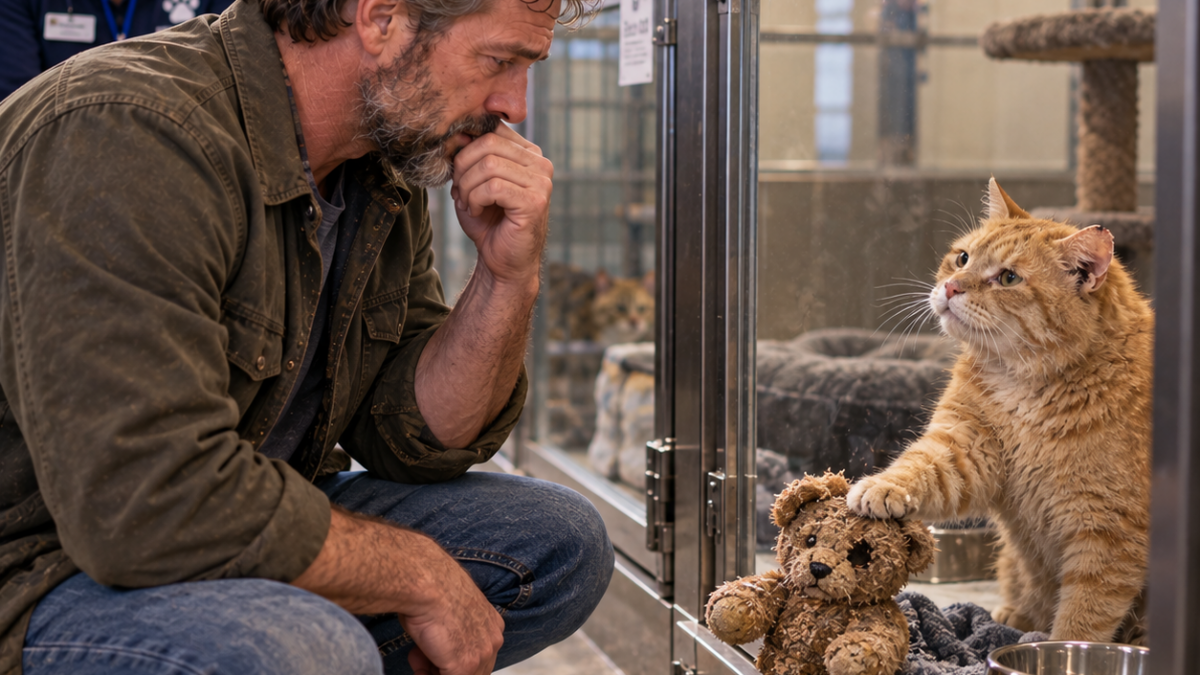
Inside sat a large golden cat.
Not orange exactly.
His coat was pale, almost the yellow-brown color of a ripe pear.
He was solid.
Maybe thirteen pounds.
One ear bent slightly at the top.
Whiskers uneven.
A faint white patch under his chin.
He was not pawing at the door.
Not meowing.
Not performing.
He was watching me.
At the front of his enclosure sat a teddy bear.
It looked terrible.
One plastic eye missing.
The other cracked.
The fur had been rubbed almost bare across one arm.
One ear was partly detached and repaired with blue thread that did not match anything.
It looked like a toy that had survived childhood, moving trucks, washing machines, dogs, closets, and a small apocalypse.
Pear placed one paw against the bear.
Then nudged it forward.
Thump.
Against the clear door.
Marcy appeared beside me.
“That’s Pear.”
“Pear?”
“Apparently named after candy.”
I looked at the cat.
“He does that?”
“All day.”
“With the bear?”
She nodded.
“Every time someone stops.”
“Why?”
Marcy folded her arms.
“It’s the only thing he came in with.”
I looked again.
Pear had not moved his eyes from me.
“He offers it?”
“That’s what it looks like.”
“Why?”
She did not answer immediately.
That pause changed something.
Finally:
“Some cats reach.”
“Some cry.”
“Some hide.”
“Pear brings the bear forward.”
“Then what?”
“If they leave, he pulls it back.”
As if on cue, a family approached.
Mom.
Dad.
Boy maybe eight.
The child stopped.
“Look at that one.”
Dad looked at Pear.
“That’s a big cat.”
Mom checked card.
“Seven years old.”
“Oh.”
The sound carried a whole calculation.
Seven.
Not kitten.
Not blank.
Not new.
The child pointed at bear.
“He has a teddy.”
“He’s cute,” Mom said.
Then she turned toward kittens.
“We’re looking for something younger.”
They walked away.
Pear watched.
Then lowered his head.
He hooked one paw over the bear.
Pulled it back against himself.
Slowly.
Almost privately.
Then, after a few seconds, pushed it forward again.
Thump.
That second push did something to me.
Because it did not look pathetic.
It looked brave in a way I did not want to witness.
Hope after disappointment is more painful than despair.
Despair at least protects itself.
Hope keeps walking back toward the door.
I crouched.
“Hey, Pear.”
He blinked.
Slow.
I pointed at bear.
“That your best offer?”
Marcy smiled.
“He doesn’t have much else.”
I stood.
“That isn’t funny.”
“I know.”
I looked toward kittens.
Pickle was now climbing another kitten.
Easy.
Bright.
No history.
I tried returning.
I really did.
I stood in front of Pickle’s enclosure.
He reached for my sleeve.
Perfect.
Exactly what I came for.
Then I looked over my shoulder.
Box 43.
Pear sat exactly where I had left him.
The teddy bear at the door.
Waiting.
Marcy said quietly:
“People want blank slates.”
I turned.
“What?”
“Adults get passed over.”
“Especially bigger ones.”
“Especially quiet ones.”
“Everyone says they want a rescue, but what most people mean is they want an animal that makes them feel loved immediately.”
That was unfair.
Probably.
It also felt true.
“What happened to him?”
“Family surrendered.”
“Why?”
“Housing change.”
“Anything else?”
“That’s all intake says.”
“No abuse?”
“Not that we know.”
“No aggression?”
“No.”
“Health?”
“Basic exam was fine.”
“Why bear?”
She shrugged.
“Came with him.”
Pear pushed it again.
I felt irritation rising.
At him.
At myself.
At the whole ridiculous scene.
“I came for a kitten.”
“I know.”
“You keep saying adults get passed over like I’m doing something wrong.”
Marcy looked surprised.
“I’m not.”
“It sounds like it.”
She stepped back.
“Then I’m sorry.”
That disarmed me.
She continued.
“You are allowed to choose what fits your life.”
“Really.”
“Really.”
“Pear isn’t a moral test.”
I looked at him.
“Feels like one.”
“That’s between you and Pear.”
I laughed despite myself.
Then I asked:
“How long has he been here?”
“Twenty-three days.”
“Is that long?”
“For a kitten?”
“Yes.”
“For a seven-year-old large cat with no interest in marketing himself?”
“Not especially.”
I hated the phrase.
No interest in marketing himself.
Because that was what he was doing.
The bear was marketing.
The saddest version imaginable.
Here.
This is what I have.
Will this do?
A couple walked up.
Pear nudged bear.
They looked.
The woman smiled.
“Aww.”
Then:
“We already have two.”
They left.
Pear pulled bear back.
My chest tightened.
I thought about my own divorce.
About all the advice:
Start fresh.
No baggage.
No drama.
Don’t date someone with unresolved issues.
Protect yourself.
Choose peace.
I had absorbed those words like commandments.
Maybe because they made fear sound wise.
Pear nudged the bear forward one more time.
I heard myself ask:
“If I take him, does the bear come too?”
Marcy’s face changed.
Not excitement.
Careful hope.
“He would want that.”
“Does it smell?”
“Terrible.”
“Great.”
I stared at Pear.
“This is stupid.”
“Probably.”
“I’m serious.”
“So am I.”
I exhaled.
“Can I meet him?”
Marcy opened Box 43.
Pear backed up.
Not far.
Just enough to remind me he had boundaries.
I sat on small stool.
Did not reach.
Pear watched.
Marcy left the door open.
Minutes passed.
I became painfully aware of my hands.
My breathing.
Every sound.
Then Pear walked forward.
Not to me.
To teddy bear.
He picked it up by the neck.
Carried it.
Dropped it on floor between us.
Then sat behind it.
I looked at Marcy.
She looked at me.
“No,” I said.
She covered a smile.
“This is emotional extortion.”
“Pear has no legal representation.”
I looked at cat.
“Are you doing this on purpose?”
Pear blinked.
I should have picked Pickle.
I knew that.
Pickle would have been easy.
Kittens adjust.
Kittens play.
Kittens fit the fantasy of beginning again without having to look backward.
Pear had one bent ear, a terrible toy, and the emotional presence of a divorced accountant.
I understood him immediately.
That was the problem.
“I’ll take him.”
Marcy did not move.
“What?”
“I said I’ll take him.”
“You’re sure?”
“No.”
She smiled.
“That is becoming theme today.”
Paperwork took fifteen minutes.
The pen barely worked.
Pear’s adoption fee was fifty dollars.
He came with vaccination records, a starter bag of food, and several paragraphs about slow introductions.
Marcy asked:
“Do you want a new toy?”
I looked at teddy bear.
“Apparently we already own one.”
When she placed Pear into carrier, he stepped in without fighting.
Then turned.
The bear remained on floor.
Pear stared.
Marcy picked it up.
Before she could place it inside, Pear reached through carrier opening, took the bear gently from her hand, and pulled it against his chest.
I felt my throat close.
On the drive home, Pear did not cry.
He sat behind carrier door with bear.
I talked anyway.
“You should know this apartment has rules.”
Nothing.
“No clawing furniture.”
Nothing.
“No waking me at four.”
One ear moved.
“Absolutely no emotional manipulation.”
He stared.
I sighed.
“We’re going to have problems.”
At home, I set carrier in living room.
I had bought nothing.
No litter box.
No cat bed.
No bowls.
Because I had intended to choose cat and then shop.
Now I had a cat.
So I improvised.
A shallow storage bin with litter from emergency bag Maple Grove provided.
Water in a cereal bowl.
Food on saucer.
Folded blanket.
Then I opened carrier.
Pear did not move.
I sat on floor.
Ten minutes.
Twenty.
Coffee went cold again.
He blinked.
Then nudged bear halfway out.
I laughed quietly.
“You’re still negotiating?”
He watched me.
Finally he stepped out.
Low.
Careful.
He walked entire living room perimeter.
Sniffed couch.
Table.
Wall.
Door.
Then sat in middle of rug.
Still.
As if waiting for environment to announce its intentions.
I reached toward teddy bear.
Because I thought:
I should wash that.
Pear stood immediately.
Not hissing.
No claws.
He put one paw firmly on the bear.
I stopped.
“Oh.”
His paw stayed.
“Okay.”
I pulled my hand back.
He sat.
For some reason, that made me happy.
The cat who offered his possession at shelter still understood it belonged to him.
That mattered.
His first night was quiet.
Too quiet.
Pear stayed behind armchair.
Ate a little.
Drank.
Used litter box.
Perfectly.
Covered everything with absurd precision.
Then carried bear behind chair and slept with it under his chin.
I lay in bed thinking:
What have I done?
At 2:47 a.m., I heard a soft thump.
My eyes opened.
Another.
I turned on bedside lamp.
Pear stood in doorway.
Golden shape.
One ear uneven.
Teddy bear at his feet.
I did not move.
“Hey.”
He blinked.
Then picked bear up.
Walked toward bed.
Dropped it.
Thump.
I sat up.
Pear nudged it closer.
I got out of bed slowly.
Sat on floor.
He watched.
I picked up teddy bear with both hands.
Not like trash.
Like something valuable.
I do not know why that distinction felt important.
Pear’s eyes followed.
I set it beside my knee.
“Okay.”
That was all.
No promise.
No speech.
Okay.
Pear stepped forward.
Leaned forehead against my shin.
Two seconds.
Maybe three.
Then walked away.
I remained on floor.
The next morning he carried bear into kitchen.
Set it beside his food.
A pattern began.
The bear traveled.
Living room.
Hallway.
Bedroom.
Kitchen.
Always wherever Pear wanted to be.
Like a passport.
Or witness.
My coworker Maya demanded photos.
I sent one.
Pear on rug with bear under paw.
She replied:
YOU WENT FOR KITTEN.
I wrote:
I KNOW.
SHE SAID:
THAT CAT LOOKS LIKE HE HAS A MORTGAGE.
Accurate.
Work became strangely easier with Pear.
Not less stressful.
Different.
At noon, I got up because Pear ate lunch.
At five, I stopped because he appeared beside desk.
He hated laptop notification sounds.
He sat outside bathroom while I showered.
Never demanding.
Just present.
The apartment’s silence changed.
Not disappeared.
Changed texture.
There is a difference between silence because nobody is there and silence shared by two beings doing separate things.
The latter feels like peace.
Four days after adoption, I posted Pear online.
I almost did not.
The internet felt increasingly like a room full of strangers waiting to misunderstand each other.
But I kept thinking about Box 43.
The bear sliding forward.
The people walking past.
I posted a photo and wrote:
I went to Maple Grove for a kitten with no baggage.
The cat in Box 43 slid me his battered teddy bear like a final offer.
So I brought both home.
That was it.
Maya shared.
Then shelter shared.
Then somebody else.
Within an hour:
Hundreds of likes.
Comments.
Messages.
At first sweet.
“He chose you.”
“Adult cats are the best.”
“That teddy bear!”
“I’m crying.”
Then:
“You got manipulated by a cat.”
I laughed.
Then read another:
“Adults are risky. Kittens bond better.”
Another:
“This is exactly how shelters guilt people into taking problem animals.”
Another:
“Stop anthropomorphizing.”
Another:
“Cute now. Wait until he pees everywhere.”
Another:
“People assign trauma to animals to feel heroic.”
I stared.
Pear slept on couch.
Bear under paw.
No heroism visible.
Then another comment:
“Why didn’t his old family just take care of him?”
I did not know.
Another:
“Anyone who dumps a pet is trash.”
That bothered me.
I did not know why yet.
Comments divided.
Team Kitten.
Team Adult.
Team Rescue.
Team “Animals Don’t Think Like That.”
People argued about whether Pear understood the bear as bargaining.
They argued about surrender.
Attachment.
Human projection.
I became defensive.
Then embarrassed about being defensive.
Then angry at being embarrassed.
At one point I typed a twelve-paragraph response.
Deleted.
Typed:
Maybe being loved isn’t about being easy.
Maybe it’s about being real.
Posted.
That sentence spread farther.
The next morning I regretted entire internet.
But something else happened.
Strangers began confessing.
A woman wrote:
“I surrendered my cat last year when I became homeless. I left his blanket because it was all I could give him. I still dream about him.”
A man:
“I returned a dog once because his separation anxiety was destroying my apartment. I still don’t know if I failed him.”
A mother:
“We had to surrender our cat when my daughter got leukemia and we moved for treatment. People called us monsters. They had no idea.”
A veteran:
“Adopted a ten-year-old cat because nobody else wanted him. Best five years of my life.”
The comments became less about Pear.
More about shame.
Second chances.
Limits.
Who gets judged when life becomes impossible.
I started realizing how hungry people were for stories where nobody had to pretend their past disappeared.
Pear’s popularity grew.
I hated calling it popularity.
He did not know.
He cared about chicken and windows.
The shelter emailed asking if they could share more.
I agreed.
Then I went back.
Not because they asked.
Because something in me needed to know.
What had happened before Box 43?
Marcy was at desk.
“How’s Pear?”
“Judgmental.”
“Sounds right.”
“He owns my apartment now.”
“Also sounds right.”
I hesitated.
“Can I see his intake notes?”
She became cautious.
“Some information is private.”
“I know.”
“I don’t need names.”
She disappeared.
Returned with thin folder.
The notes were ordinary.
That made them worse.
OWNER SURRENDER.
Reason:
Housing transition.
Household unable to retain animal.
No reported bite history.
Indoor only.
Good litter habits.
Favorite toy included.
Then:
Arrived with one stuffed toy. Keeps it close.
There was no horror story.
No cruelty narrative.
No abandoned roadside box.
Just a family that could not keep him.
Then Marcy turned one more page.
Stopped.
“There’s something.”
“What?”
She hesitated.
“I don’t know if I should show you.”
“Why?”
“Because it isn’t necessary for his care.”
I waited.
She took out photocopy.
Handwritten note.
Uneven letters.
Child’s handwriting.
His name is Pear because he’s the color of my favorite candy.
Please don’t take his bear away.
He sleeps better when he has it.
I’m sorry.
That was all.
I read it once.
Again.
Third time.
My eyes blurred.
“Who wrote this?”
“We don’t know age.”
“Family had a child?”
“Apparently.”
“What happened?”
Marcy shook head.
“We do not have full circumstances.”
I stared at note.
I’m sorry.
A child apologizing because adults could not keep cat.
Something inside me cracked.
Not because it was tragic in dramatic sense.
Because it was familiar.
Children apologize for situations they did not create.
Adults do too.
We apologize for getting sick.
For needing help.
For losing jobs.
For being poor.
For grieving too long.
For being difficult when life has stripped our capacity.
I had spent two years apologizing for divorce as if marriage ending proved defective character.
Even when nobody asked.
I am sorry it didn’t work.
I am sorry plans changed.
I am sorry I’m tired.
I’m sorry I am not ready.
I’m sorry I have history.
I took photo of note only after shelter approved.
I did not post immediately.
I drove home.
Sat in car.
Heater running.
Exactly like adoption day.
This time I cried.
When I walked inside, Pear was on couch.
Bear beside him.
He looked at me.
I sat slowly.
He moved one inch closer.
I touched bear’s worn ear.
“Someone loved you.”
Pear blinked.
“That makes this worse somehow.”
He stood.
Walked over.
Pressed his side against my thigh.
I closed eyes.
That night I posted again.
I did not share child’s note image.
Too private.
I wrote:
Some people called Pear manipulative.
Some called me naïve.
Some said whoever surrendered him was trash.
His intake file included a note written by a child asking the shelter not to take away his teddy bear because he sleeps better with it.
Sometimes surrender is cruelty.
Sometimes it is crisis.
Sometimes love is real and still loses to housing, money, illness, or circumstances.
The animal still hurts either way.
Then I wrote:
If the only love you respect is the kind that costs you nothing, you are describing convenience.
The post exploded.
More than first.
People argued.
Hard.
But they also confessed.
Thousands of small griefs.
A man who surrendered a dog when he entered rehab.
A woman who kept her mother’s cat after dementia changed everything.
A college student whose father gave away her childhood dog after eviction.
People writing:
I still wonder where she ended up.
I still have his collar.
I hope somebody was kind.
It overwhelmed me.
I stopped reading after two days.
Pear had no interest in viral ethics.
He had begun leaving bear in strange places.
Bathroom door.
Near shoes.
Kitchen mat.
Middle of bed.
At first I thought random.
Then I noticed pattern.
Wherever he felt safe enough to settle, bear appeared.
He was not offering it anymore.
He was placing it.
Claiming territory.
Building a map of home.
One spot at a time.
That changed me more than I expected.
Because I had been living in my apartment like it was temporary for two years.
I had never hung several framed pictures.
Kept books in boxes.
Used cheap folding chair at desk.
I told myself maybe I would move.
Maybe buy condo.
Maybe change cities.
Maybe begin again somewhere.
Pear did not understand provisional living.
He had been here three weeks and was already mapping safety with teddy bear.
So I unpacked boxes.
Hung a photograph of my parents.
Bought real desk chair.
Put books on shelves.
I bought a plant and almost killed it immediately.
Pear chewed one leaf.
I bought cat-safe plant after that.
I started making apartment mine.
Not blank slate.
Mine.
One evening, Maya came over.
Pear disappeared.
Of course.
“He hates me.”
“He has not reviewed you yet.”
We drank wine.
Maya saw bear on couch.
“Can I touch it?”
I looked toward hallway.
“Probably.”
“Why did you answer like he’s a landlord?”
“Because he is.”
She picked bear up gently.
“That thing is disgusting.”
“Correct.”
“You wash it?”
“No.”
“Why?”
“He objected.”
“Your cat has emotional boundaries.”
“More than me.”
We laughed.
Then Pear appeared at hallway.
Saw Maya holding bear.
Stopped.
Maya froze.
“Oh no.”
She set bear down immediately.
Pear approached.
Took it.
Walked away.
Maya whispered:
“I have been judged.”
“You have.”
“That cat is powerful.”
He did not come back until she left.
But two days later, when Maya visited again, Pear stayed visible.
Across room.
Progress.
Months passed.
Pear’s routine became ours.
Breakfast at six-thirty.
Window at seven.
Sleep during meetings.
Yell at printer.
Carry bear.
Dinner.
Evening couch.
He never became lap cat at first.
He leaned.
That was his affection.
A side pressed against my leg.
Head against shin.
One paw on foot.
I respected it.
Then one night while I read comments from another online argument I should not have been reading, Pear dragged bear across rug and dropped it against my ankle.
He sat.
Looked.
I picked it up.
Held it.
He climbed into my lap.
Slowly.
One paw.
Pause.
Second paw.
Pause.
Whole body.
He pressed his side against me.
Not face.
Not chest.
Side.
His usual lean, expanded.
My eyes filled.
“I’m not going anywhere.”
I whispered it before thinking.
Pear closed his eyes.
I did not post that part.
Some things become smaller when turned into content.
I was learning that too.
Then, in early December, I received a message from someone named Claire Benton.
Hi. I think Pear used to belong to my niece.
I almost ignored it.
Too many people online had opinions.
Then she wrote:
Was the teddy bear missing one eye before he came to you?
I answered:
Yes.
She replied with photo.
Pear.
Younger.
Same bent ear.
Same bear.
A little girl holding both.
My heart started beating hard.
The girl looked maybe ten.
Pear sat in her lap.
Bear under his paw.
“What happened?” I wrote.
Claire did not answer immediately.
Then:
It is complicated.
Of course.
Everything worth knowing becomes complicated eventually.
We arranged phone call.
Claire was the girl’s aunt.
The girl’s name was Emma.
She was eleven when family surrendered Pear.
Her mother, Claire’s younger sister Danielle, had spent nearly a year leaving an abusive relationship.
That sentence rearranged everything.
Danielle had moved twice.
Then once more.
Her ex-husband controlled finances.
The final apartment accepted children.
Not pets.
Emergency housing would not allow Pear.
They had thirty days initially.
Then circumstances changed and they had less than a week.
They called rescues.
Friends.
Family.
Claire had two dogs that chased cats.
Another relative lived out of state.
They tried temporary foster.
Nothing lasted.
Maple Grove was last option.
“Emma wrote the note,” Claire said.
I closed my eyes.
“She cried for days.”
“Does she know where Pear is?”
“Yes.”
“Now.”
“She saw the post.”
“Why didn’t her mother contact me?”
Silence.
“She’s ashamed.”
I felt anger rise.
“He sat at shelter offering his bear to strangers.”
“I know.”
“He waited almost a month.”
“I know.”
“He—”
I stopped.
What was I doing?
Prosecuting a woman for not solving an impossible situation I had not lived through?
Claire said quietly:
“Danielle made mistakes.”
“She would tell you that.”
“But leaving Pear was not because she stopped loving him.”
I thought of handwritten note.
I’m sorry.
I asked:
“Is Emma okay?”
“Better.”
“Would she want to know Pear is okay?”
“More than anything.”
I looked across room.
Pear asleep.
Bear under chin.
I said:
“I’ll send photos.”
I started with ordinary ones.
Pear in window.
Pear sleeping upside down.
Pear glaring at vacuum.
Pear inside cardboard box too small for him.
Claire forwarded to Emma.
The reply came through her:
She says thank you for keeping his bear.
That broke me.
I sat at kitchen table and cried.
Then I became angry again.
Not at Danielle.
At systems.
At how quickly crisis forces choices.
At landlords.
At housing.
At money.
At everything that makes a child write an apology because keeping a beloved animal becomes impossible.
I had once thought adoption meant I was rescuing Pear from people who did not want him.
Now I understood I had become next chapter in a story where love had existed before me.
That did not lessen our bond.
It made it richer.
Pear was not waiting in Box 43 because nobody had ever loved him.
He was waiting because love had failed to keep circumstances from changing.
That is a more frightening truth.
A week before Christmas, Danielle messaged.
Not through Claire.
Directly.
Natalie, I don’t know what I am supposed to say to you.
I stared.
Then replied:
The truth is usually easiest.
Hours passed.
Finally:
I loved Pear. Emma loved Pear. We still do.
I wrote:
I believe you.
That surprised both of us.
Then:
I should have found another way.
I wrote:
Maybe.
Then deleted.
Rewrote:
I don’t know what options you actually had.
She responded:
Not enough.
That was honest.
She did not ask for Pear back.
That mattered.
Instead:
Please don’t worry. We are not trying to disrupt his home.
Emma just needed to know he was alive and loved.
I looked at Pear.
He had no idea three adults were discussing ownership of his emotional continuity.
I asked:
“Would you ever want to video call?”
We did.
Emma appeared first.
Fourteen now.
Older than intake note.
Hair pulled back.
Nervous.
Pear was on couch.
I positioned phone low.
Emma whispered:
“Pear-Pear.”
His head lifted.
That was all.
She started crying.
“Pear-Pear.”
He stood.
Walked toward phone.
Sniffed.
Then looked away.
I refused to invent recognition.
Maybe voice.
Maybe tone.
Maybe coincidence.
But Emma smiled through tears.
“He always does that when you cry.”
“What?”
“Looks away like you’re embarrassing him.”
I laughed.
That sounded like Pear.
Danielle appeared beside her.
She looked exhausted.
Still.
Even after years.
“Thank you,” she said.
I nodded.
“No.”
“I mean it.”
“I know.”
Pear picked up bear.
Emma covered mouth.
“He has Bear-Bear.”
Of course bear had a name.
“Bear-Bear?”
She nodded.
“I named him when I was four.”
Pear carried it past phone.
Emma laughed.
For ten minutes, we did nothing extraordinary.
They watched a cat.
He ignored them.
Emma told me stories.
Pear used to sleep on her backpack.
He liked turkey but not ham.
He once got stuck behind washing machine.
The bent ear came from childhood infection, not injury.
The bear originally belonged to Emma.
She gave it to Pear when he was a kitten because he slept on her bed every night.
“I thought he needed his own toy.”
She smiled.
“He stole mine anyway.”
Pear’s history expanded.
He was not a shelter tragedy.
He had a childhood.
A girl.
A home.
Years of being ordinary.
That was healing for me too.
I had been so eager to interpret his bear as trauma that I forgot objects can represent love.
Maybe he offered it at shelter because it carried home.
Maybe not.
We cannot know.
But I stopped telling people:
Pear thought he had to trade his teddy bear for love.
Instead:
Pear kept bringing forward the one thing that still smelled like his old life.
That was enough.
The internet liked the simpler version more.
I stopped caring.
By spring, Pear had changed.
Not radically.
He was still Pear.
Visitors required review.
Vacuum remained enemy.
He disliked being held.
He liked head scratches and exactly three strokes along back before becoming offended.
But he waited by door when I came home.
He slept beside my legs.
He stopped carrying bear everywhere.
That was the biggest shift.
Bear stayed on couch sometimes for hours.
Then days.
At first I worried.
Was he sick?
Did he stop caring?
Then I realized:
He no longer needed to know where it was every minute.
Safety had grown larger than one object.
That nearly broke my heart in new way.
I washed the bear for first time one Saturday.
Very gently.
Hand wash.
Cold water.
Mild soap.
Pear watched entire process like OSHA inspector.
I kept one hand on toy.
He sat beside bathtub.
“You’re making me nervous.”
He meowed.
First actual conversation.
“I know.”
Afterward I dried bear with towels.
Air dried overnight.
Pear slept beside it.
Next morning he carried it into bedroom.
Approved.
Months later, Maple Grove asked if I would volunteer at adult-cat adoption weekends.
My immediate answer:
Absolutely not.
Then I said yes.
Once a month.
I did not become evangelist.
I did not guilt people for kittens.
Some people need kittens.
Some households fit certain animals.
Adoption should not be punishment for not choosing hardest case.
Instead, I told truth.
Adult cats can surprise you.
They are not blank slates.
Neither are you.
Sometimes that is good.
One Saturday a couple came with little boy.
They wanted kitten.
Then boy saw a six-year-old tuxedo cat named Marty.
Marty had one white mustache.
Boy laughed.
They adopted Marty.
Another day a woman wanted senior cat.
She had recently lost husband.
She sat with twelve-year-old calico for forty-five minutes.
No drama.
Just two tired beings existing near each other.
She adopted her.
I cried in supply closet.
Marcy found me.
“You cry a lot.”
“I hate this place.”
“Clearly.”
Pear’s online post kept circulating.
Every few months, someone rediscovered.
Arguments resumed.
I stopped participating much.
But one comment stayed with me.
A man wrote:
Baggage is just proof somebody made it somewhere.
I liked that.
Because by then, I had begun dating again.
Not seriously.
Coffee.
Dinner.
A man named Aaron from work’s vendor team.
Divorced.
Two teenagers.
Complicated schedule.
Baggage.
When he first came to apartment, Pear watched from hallway.
Aaron saw teddy bear.
“What happened to that thing?”
“Careful.”
He looked at me.
“Is this a test?”
“Yes.”
He crouched.
Did not reach for Pear.
“Nice bear.”
Pear blinked.
Aaron passed first review.
We dated six months.
Then realized better as friends.
No disaster.
No failure.
No clean slate.
Just two adults trying something and discovering shape did not fit.
I handled ending better than old me would have.
Pear, unfortunately, loved Aaron’s shoes.
He searched hallway after last visit.
I felt guilty.
Then reminded myself:
Love does not promise no endings.
Only honesty during them.
Pear stayed.
That helped.
My mother eventually met him.
She said:
“He’s bigger than he looked online.”
Pear hated her perfume.
She took personally.
“He doesn’t like me.”
“He hates Chanel.”
“Same thing.”
She brought catnip mouse next visit.
Pear accepted bribe.
My life became less narrow.
Not because Pear magically fixed loneliness.
He did not.
I still had bad days.
Work remained tiring.
My apartment still needed repairs.
I still sometimes woke at 3:00 a.m. thinking about marriage.
But Pear disrupted the idea that safety came from avoiding complicated attachment.
Safety came from learning I could survive attachment being complicated.
That was different.
Then came first real scare.
Pear stopped eating.
Not completely.
Enough.
He hid under bed.
Not normal.
I took him to vet.
Kidney values slightly off.
Dental issue.
Pain.
Nothing catastrophic.
Treatment.
Special food.
The bill hurt.
I posted nothing.
This was not content.
It was care.
For two weeks I measured food.
Gave medicine.
Sat on floor.
Pear recovered.
On third morning he yelled at refrigerator.
I cried.
Again.
I understood then why people fear adult animals.
Not because they are less lovable.
Because time feels more visible.
A kitten lets you pretend there are endless years.
An adult reminds you every love has a clock.
Pear’s clock terrified me.
Then I realized mine had one too.
So did my mother.
So did Maya.
So did everybody.
We just hide ours better.
Emma remained in touch occasionally.
Birthday messages.
Pictures.
At sixteen, she sent Pear a new teddy bear.
Perfect.
Two eyes.
Soft fur.
Store-new.
I placed it beside old Bear-Bear.
Pear sniffed.
Walked away.
Never touched it.
Emma laughed.
“Of course.”
She wrote:
He has taste.
The new bear stayed on shelf.
Old one remained.
One afternoon Danielle asked if she and Emma could visit in person.
I hesitated.
Pear was settled.
Would this confuse him?
I asked vet.
She said:
“Cats do not conceptualize reunion like movies.”
“Keep expectations low.”
“Let him choose.”
So they came.
Danielle arrived holding nothing.
Good.
Emma brought a photograph.
Pear hid initially.
We sat.
Talked.
After twenty minutes, he appeared.
Emma’s breath caught.
She did not move.
Pear stared.
Then walked to coffee table.
Sniffed her shoes.
Emma whispered:
“Hey, Pear-Pear.”
He paused.
His tail rose halfway.
Then he walked past.
That was all.
Emma cried quietly.
Danielle looked at me.
“I’m sorry.”
“For what?”
“All of it.”
I nodded.
“I know.”
Later Pear sat across room.
Not close.
But stayed.
Emma did not ask to hold him.
Did not ask if he remembered.
She respected who he was now.
Before leaving, she handed me photograph.
Pear as kitten asleep beside Bear-Bear.
“For you.”
“You should keep it.”
“I have copies.”
I took.
After they left, Pear walked around apartment sniffing their path.
Then curled on couch.
Bear under chin.
Life continued.
That was the lesson again.
Second chances do not erase first homes.
New love does not cancel old love.
We are not required to make past villains so present can feel pure.
Years passed.
Pear turned nine.
Then ten.
His face softened with age.
Whiskers grew whiter.
He moved slower.
He stopped jumping onto kitchen counter, which I appreciated.
He developed arthritis.
Joint supplement.
Heated bed.
Small steps beside couch.
He began sleeping deeper.
Sometimes with bear several feet away.
I would stand in doorway and watch.
Both eyes closed.
Body loose.
If someone had told me on adoption day that this would become the thing I loved most, I would not have understood.
Not cuddling.
Not purring.
Sleep.
Complete unguarded sleep.
That is what safety looks like when a body finally believes tomorrow is allowed.
I left healthcare software at forty-two.
Not because Pear inspired me to follow dreams.
I hate stories like that.
I left because company restructured and offered severance.
I spent three months unemployed.
Terrified.
Practical Natalie panicked.
No income.
Insurance.
Savings.
Mortgage—
Apartment, not mortgage.
Still.
Bills.
For first time, I understood something Danielle had said years earlier:
Not enough options.
When life tightens, morality becomes harder to perform elegantly.
I took contract work.
Then a permanent job at nonprofit health system.
Less money.
Better hours.
I could breathe.
Pear did not care.
Food arrived.
That was his metric.
I started volunteering more at Maple Grove.
Eventually I joined foster-support committee.
Not because I wanted institutional drama.
Because I had learned how often surrender happens at intersection of temporary crisis and permanent consequence.
We created emergency foster network.
Short-term.
Two weeks.
Thirty days.
Sometimes three months.
For families facing hospitalization, eviction transitions, domestic violence, military deployment, rehab.
Not every case could be saved.
But some could.
That mattered.
Danielle helped anonymously with first donation.
I knew.
She asked shelter not to use name.
The program was called Bridge Beds.
Marcy chose it.
A bed between homes.
Pear’s story became part of orientation but with nuance.
Not:
Bad family abandons cat.
Good woman rescues.
Instead:
A family crisis separated a child and cat.
Shelter kept him safe.
Another person adopted.
Later everyone learned to hold the whole story.
Messy.
Real.
One year, Bridge Beds kept thirty-eight animals from permanent surrender.
Thirty-eight.
Not all.
Enough.
That number meant more to me than Pear’s viral shares.
Internet counts attention.
Life counts outcomes.
Pear never knew.
He spent his days in heated bed.
At eleven, his kidneys worsened.
We managed.
At twelve, he lost weight.
The vet adjusted diet.
At thirteen, he stopped carrying Bear-Bear altogether.
The bear stayed on his bed.
Not forgotten.
Integrated.
He slept with one paw touching it sometimes.
At thirteen and a half, he began having bad days.
More than good?
Not yet.
Then maybe.
The question came slowly.
Quality of life.
Pain.
Appetite.
Movement.
Joy.
That is another kind of baggage no one tells you about when adopting older animal.
Eventually love asks you to stop asking how long and start asking how it feels.
I kept a calendar.
Good day.
Okay day.
Bad day.
At first mostly good.
Then more okay.
Then bad.
One Sunday Pear could not get onto litter box edge even though it was low.
I lifted him.
He looked embarrassed.
Yes, projection.
Still.
That night he did not eat.
Monday, vet.
Kidney disease advanced.
Arthritis.
Dehydration.
Could hospitalize.
Fluids.
Maybe rebound.
Maybe weeks.
Maybe months.
I asked:
“If he were yours?”
Veterinarians hate that question.
Mine answered anyway.
“I would ask whether I’m treating him for him or because I’m not ready.”
I cried.
Pear sat beside me on blanket.
Bear in carrier.
I had brought it automatically.
I realized then:
The teddy bear had come to first shelter.
First home.
My home.
Every vet.
Every storm.
Every move within apartment.
Now final room.
I called Emma.
She was twenty.
College.
She cried.
Danielle cried.
Maya cried.
Everyone cried except Pear.
He was tired.
I decided.
Not that day.
One more night.
At home, I put heated pad near couch.
Pear ate three bites of chicken.
Then walked to bedroom.
I followed.
He climbed halfway onto small steps.
Stopped.
I helped.
He lay at foot of bed.
Bear beside him.
I got down next to him.
“You know what?”
His eyes half closed.
“I was supposed to get a kitten.”
One ear moved.
“You ruined everything.”
Nothing.
“I wanted no baggage.”
His paw touched bear.
I laughed through tears.
“Yeah.”
“I know.”
That night I slept on floor beside him.
At dawn, Pear woke.
Looked at me.
Pressed forehead against my wrist.
Same small contact from first week.
Full circle stories sound artificial.
Life does them anyway sometimes.
At vet, Emma joined by video.
Danielle too.
Maya sat in parking lot because she thought I should not drive home alone.
The veterinarian placed catheter.
Pear stayed calm.
I held Bear-Bear near his chest.
His paw rested over its worn arm.
Emma whispered through phone:
“I love you, Pear-Pear.”
Danielle:
“I’m sorry.”
I said:
“You were loved before me.”
Then:
“You were loved with me.”
“That’s enough.”
The medication went in.
Pear relaxed.
Breathing slowed.
Stopped.
The room did not change.
That always shocks me.
The world should react.
Lights should dim.
Something.
Instead fluorescent hum continued.
Cars passed outside.
A phone rang somewhere.
My hand rested on fur that was still warm.
I cried until I could not breathe properly.
Maya drove me home.
The apartment was unbearable.
Not because empty.
Because full of Pear without Pear.
His food mat.
Bed.
Steps.
Hair on couch.
Bear—
No.
Bear was with me.
I had brought it home.
I sat on floor holding that disgusting one-eyed toy and understood why Pear had carried it.
Objects become proof.
This existed.
This mattered.
Someone was here.
For weeks, Bear-Bear stayed on my bed.
Then I moved it to shelf beside Emma’s kitten photograph.
Not hidden.
Not shrine exactly.
History.
Pear’s ashes came back in a wooden box.
I placed them below.
The internet learned months later.
I posted one picture.
Pear asleep.
Bear beside him.
I wrote:
He got older.
He got tired.
He was loved before me and with me.
He died at home in every way that matters.
Thank you for making room for his story.
No debate question.
No invitation.
I disabled comments after a day.
Some things do not need a stage.
Bridge Beds received donations anyway.
Emma donated twenty-three dollars.
She said it was all she could afford.
That contribution meant more than big ones.
Maple Grove placed a small photo of Pear in adult cat room.
Not viral photo.
Not bear at door.
A later one.
Pear sprawled on couch.
Belly partly exposed.
No vigilance.
Under it:
PEAR
BOX 43
SECOND CHANCES DO NOT ERASE THE PAST.
THEY MAKE ROOM FOR IT.
I cried when I saw.
Marcy said:
“You cry constantly.”
“I’m consistent.”
She smiled.
Years later, people still ask:
Would you have walked past Box 43?
I almost did.
That is the answer.
I was not inherently kinder than the families who kept walking.
I had my plan.
Kitten.
Bright eyes.
No history.
Clean start.
I wanted love without emotional complication because I thought complication was what had ruined my marriage.
Pear changed that.
Not by teaching me pain is romantic.
It isn’t.
Not by teaching me everyone should choose hardest option.
They shouldn’t.
He taught me that history is not contamination.
Baggage is not proof of failure.
Sometimes baggage is proof something mattered enough to carry.
The teddy bear looked ruined.
Missing eye.
Cracked face.
Worn fur.
Blue thread.
But Pear never confused worn with worthless.
Humans do.
We worship new.
New phones.
New homes.
New relationships.
New versions of ourselves.
We talk about becoming unrecognizable.
Starting over.
Leaving baggage behind.
As if healing requires amnesia.
Pear never left his bear behind.
He brought it.
That was his model.
Carry what matters.
Place it somewhere safe.
Rest beside it.
Move forward anyway.
I still have Bear-Bear.
Of course.
Emma once asked if I wanted her to take it.
No.
Then felt guilty.
“It was yours first.”
She shook head.
“I gave it to him.”
“So it belongs with him.”
“Then it belongs with you.”
We left it there.
Some decisions do not need legal clarity.
I am forty-six now.
Different apartment.
I eventually bought townhouse.
I have another cat.
Yes.
Adult.
Of course.
Her name is Ruthie.
Ten years old.
One missing canine.
No teddy bear.
Hates all toys.
Loves cardboard.
I did not choose her because Pear demanded lifetime mission.
I chose her because she looked at me from cage and yawned like none of this impressed her.
Perfect.
Pear’s bear sits above bookshelf.
Ruthie ignores.
Sometimes I imagine Pear offended.
Bridge Beds has expanded.
Three partner rescues.
Emergency foster families.
Temporary boarding grants.
We still cannot help everyone.
That phrase no longer sounds like excuse to me.
It sounds like fact that should make us decide who we can help rather than do nothing.
We cannot save them all.
We can save some.
We can ask better questions.
We can build one bridge.
One bed.
One month.
One ride.
One fee.
One foster.
Sometimes that changes entire life.
Danielle now volunteers with domestic violence housing group.
Emma is studying social work.
She tells people Pear is part of reason.
I tell her not to burden dead cat with career choice.
She laughs.
We have dinner sometimes when she is in Richmond.
Our relationship would sound strange to anyone outside.
Woman who adopted surrendered cat.
Girl who had to give him up.
No villain.
No winner.
Just two people connected by an animal both loved at different times.
That is more beautiful than original story I tried to tell.
The first viral version needed me to be rescuer.
Pear to be victim.
Former family to be careless.
Simple.
Shareable.
Wrong.
Truth was:
Pear had been loved.
Then lost home.
Then shelter.
Then me.
He carried one object through every chapter.
I carried my own.
Divorce.
Fear.
Shame.
Need for clean beginnings.
We both arrived with history.
Neither of us needed erasing.
Maybe that is what second chances actually are.
Not replacement.
Continuation.
A different chapter written around scars instead of pretending paper is blank.
One evening, years after Pear died, Emma sent me a photograph.
She had found it while helping Danielle move.
Pear as kitten.
Tiny.
Golden.
Sleeping with his head on Bear-Bear’s stomach.
The bear had both eyes then.
Fur thick.
Ear intact.
It looked new.
Under photo, Emma wrote:
Before all the baggage.
I stared.
Then replied:
No.
Before all the evidence.
She called.
“What does that mean?”
“The damage is evidence.”
“Of what?”
“That he lived.”
“That the bear was loved.”
“That things happened.”
“That he kept going.”
Emma was quiet.
Then:
“That sounds like something you’d put online.”
“Do not encourage me.”
She laughed.
I printed photo anyway.
Now two pictures sit together.
Bear new.
Pear kitten.
Bear destroyed.
Pear old and safe.
Neither is better.
Both are life.
That may be the thing I wish people understood when they walk through shelters.
The kitten aisle glows with possibility.
No shame in wanting that.
But the adult row holds something else.
Proof.
Proof a heart survived previous chapter.
Proof love can continue after change.
Proof a life does not become less valuable because somebody already touched it, lost it, failed it, or loved it before you.
Pear did not need me to pretend the bear was beautiful.
It wasn’t.
It needed room.
So did he.
So did I.
That is the whole story.
I went to the shelter looking for something with no baggage because I was afraid I had too much of my own.
Pear slid me a battered teddy bear.
I thought he was making an offer.
Maybe he was.
But not the one I imagined.
He was not saying:
Take this and take me.
He was saying:
This comes with me.
Can you make room?
I did.
And once I did, somehow there was more room for everything else too.








