I Came Home Two Weeks Early and Found the HOA President Living in My Mansion—Then She Walked Outside Wearing My Late Mother’s Silk Robe and Called 911 on Me.
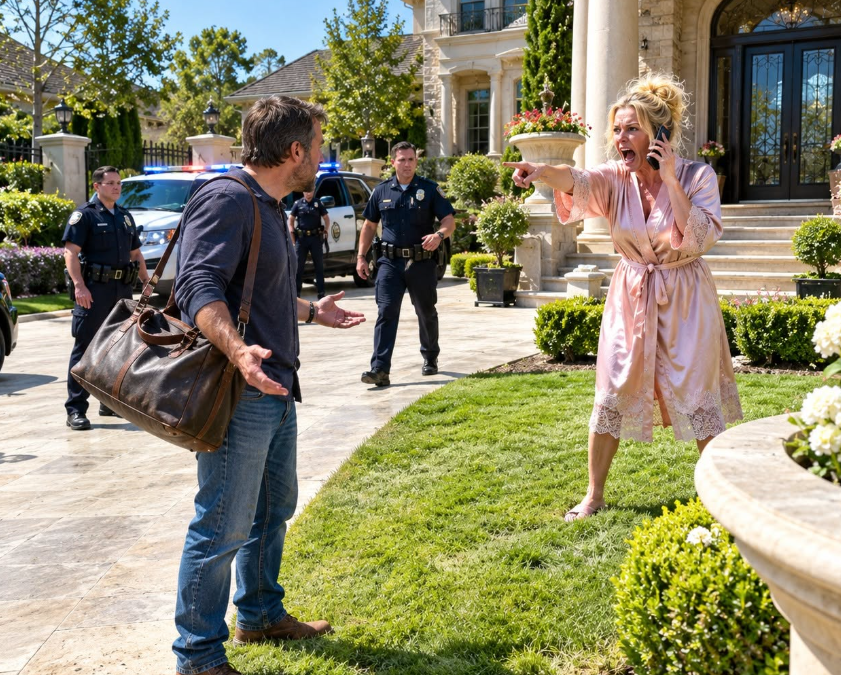
I Came Home Two Weeks Early and Found the HOA President Living in My Mansion—Then She Walked Outside Wearing My Late Mother’s Silk Robe and Called 911 on Me.
The woman wearing my late mother’s silk robe stood on my front lawn screaming into 911 that a dangerous stranger was trying to break into her house.
I was the stranger.
The mansion was mine, and I had come home two weeks before she expected me.
My name is Arthur Brooks.
I was forty-eight years old when Susan Higgins decided that my six-thousand-square-foot Mediterranean home in Cedar Creek was apparently available for temporary occupancy simply because I happened to be on another continent.
Even now, years later, I sometimes have trouble explaining the first few seconds after I pulled into my driveway.
There are moments when your brain recognizes every individual object in front of you but refuses to assemble those objects into a logical picture.
I recognized my garage.
I recognized my stone driveway.
I recognized the pool beyond the side courtyard.
I recognized the olive trees, the stucco walls, the terracotta roof, and the arched windows I had spent far too much money restoring.
What I did not recognize was the white Range Rover parked inside my garage.
I did not recognize the bright pink inflatable flamingo floating in my pool.
And I certainly did not recognize the jazz music drifting from a house that was supposed to have been empty for nearly a month.
I sat behind the steering wheel for maybe ten seconds.
Jet lag made everything feel slightly unreal.
I had landed only hours earlier after returning unexpectedly from Europe. My original trip was supposed to last six weeks. I had been in Munich helping finalize a major development agreement, one of the larger deals my company had handled since I stepped back from daily operations.
I called myself semi-retired.
My employees called that optimistic.
I still reviewed contracts, negotiated acquisitions, and flew internationally when something complicated required my attention. But I no longer worked fourteen-hour days unless I absolutely had to. At forty-eight, after decades in construction and development, I had finally learned that owning a company did not mean I had to personally suffer through every email.
My Cedar Creek estate was supposed to be where I disappeared when business became exhausting.
It sat on a large lot toward the quieter end of the neighborhood.
Six thousand square feet.
Mediterranean architecture.
A pool.
Covered patio.
Guest wing.
Three-car garage.
More house than one divorced man technically needed, but there were reasons I kept it.
My mother had loved the place.
She spent several years living with me before she died. She had decorated the upstairs sitting room, chosen the dining room chandelier, filled the rear garden with lavender, and kept a collection of vintage silk robes that she claimed made breakfast taste better.
After she passed, I could not bring myself to give all of them away.
One particular robe remained hanging in the master closet.
Deep blue silk.
Gold embroidery.
Old-fashioned.
Beautiful.
Absolutely unmistakable.
That detail became relevant very quickly.
My trip to Europe had been routine at first.
Munich.
Meetings.
Hotel conference rooms.
Too much coffee.
PART2:
More attorneys than any human being should endure in one building.
I had planned to spend the full six weeks overseas. Then negotiations moved faster than expected. We reached agreement early. Documents were finalized. The last major obstacle disappeared.
Suddenly I had a choice.
Stay in Europe for another two weeks pretending I had work to do.
Or go home.
I chose home.
I told only my assistant.
No social media post.
No neighborhood message.
No call to the HOA.
No announcement to friends.
I booked the flight, packed, and came back.
That decision was the only reason I caught Susan Higgins completely unprepared.
Three days before my return, my neighbor Thomas had sent me a photograph.
Blurry.
Taken through a window or possibly from behind a hedge.
The image showed someone lying beside my pool.
The message underneath read:
HEY ARTHUR. SOMEONE’S SUNBATHING IN YOUR BACKYARD. THOUGHT YOU SHOULD KNOW.
At the time, I did not understand what I was seeing.
I zoomed in.
Woman.
Hat.
Large sunglasses.
Drink beside her.
I called Thomas.
“Who is that?”
“I couldn’t tell.”
“Pool company?”
PART3:
“Since when does your pool company wear a sun hat and drink rosé?”
Fair question.
“Maybe someone from maintenance?”
“Arthur.”
“What?”
“I’ve seen people at your place more than once.”
That got my attention.
“How many?”
“Different times. Cars in and out.”
“Why didn’t you tell me?”
“I thought maybe you rented it.”
“No.”
“Then you should probably check your cameras.”
I did.
Or I tried.
My home had exterior cameras covering the entrances, driveway, side yard, and portions of the pool area. I also had smart locks and an alarm system. I checked them periodically while traveling. Nothing had triggered a serious security alert.
That should have reassured me.
Instead, Thomas’s message bothered me enough that I started reviewing stored footage.
What I saw initially did not make sense.
Susan Higgins.
HOA president.
Entering my property.
Once.
Then again.
Then carrying bags.
Then a moving van.
I remember sitting in my Munich hotel room staring at my phone.
Susan and I were not friends.
We were barely friendly acquaintances.
She had been president of the Cedar Creek HOA for several years and had developed an impressive reputation for finding violations most human beings would never notice.
Mailbox color.
Trash can placement.
Holiday decorations displayed a day too long.
Landscaping borders.
Driveway stains.
Exterior light temperatures.
One year, she sent me a violation because my mailbox had allegedly been painted the wrong shade of beige.
Not brown.
Not blue.
Not neon green.
Beige.
The wrong beige.
I paid nothing and challenged it.
Eventually the violation disappeared.
Susan never forgot.
She treated Cedar Creek like a sovereign territory where she served simultaneously as mayor, zoning department, prosecutor, historian, and royal family.
Some residents laughed at her.
Others feared her.
Most tried to avoid attracting attention.
I was in a slightly different position.
Years of construction work had made me comfortable reading contracts and regulations. Whenever Susan sent something ridiculous, I asked her to identify the actual covenant.
That irritated her more than anger ever could.
People who rely on confident interpretation tend to dislike page numbers.
But despite our history, I never imagined she would enter my house.
The security footage suggested otherwise.
I saw her arrive approximately two weeks earlier.
A moving van came with her.
Furniture went inside.
Boxes.
Clothing.
Decorative items.
At first, I genuinely wondered whether there had been some bizarre misunderstanding involving a home staging company. Susan did occasional work as a home stager. Maybe she had confused the address.
It sounded ridiculous.
Still less ridiculous than the truth.
Then I watched footage of her answering my front door.
A delivery driver handed her a package.
She signed.
Another day, multiple women arrived carrying wine.
The pool lights came on.
Music.
Food.
Susan in the backyard.
Another evening, cars lined the curb.
More guests.
That was when I stopped thinking mistake.
I called my assistant.
“I’m coming home.”
“You said next week.”
“Today.”
“Problem?”
“Yes.”
“Do you need someone at the house?”
“No.”
In retrospect, I probably should have called the police before arriving.
But I still had not accepted what the evidence meant.
Some part of me believed I would get there and discover a rational explanation.
Perhaps Susan was housesitting.
Maybe a document existed that I had somehow forgotten.
Maybe she had been asked to inspect something by a service company.
Maybe Thomas and the camera angles created a stranger story than reality.
Human beings are remarkably committed to assuming normal explanations, even when abnormality is standing in front of the camera with a wine glass.
The flight home was long.
I barely slept.
By the time I reached Cedar Creek, all I wanted was a shower and my own bed.
Then I saw the Range Rover.
I parked behind it.
My first thought was extremely practical.
Who parks inside another man’s garage?
Not in front.
Inside.
One of the garage bays stood open. The Range Rover occupied the center space where I usually kept my Mercedes.
My Mercedes was gone because I had taken a car service to the airport before leaving. Susan had apparently decided the empty bay was hers.
I got out.
The air smelled warm and dry. Afternoon sun reflected from the windows. The property looked almost normal.
Almost.
Patio cushions had changed.
My dark gray outdoor cushions were gone.
In their place were cream and coral patterned ones.
A decorative lantern sat near the entrance.
Not mine.
The pool flamingo drifted slowly across the water.
Then came faint music.
Jazz.
From inside my living room.
I walked toward the front door.
My suitcase remained in the car.
I just carried my phone and keys.
When I reached the porch, the door opened.
Susan Higgins stepped outside barefoot.
For a second, neither of us spoke.
She wore sunglasses pushed into her hair.
She held a wine glass.
And over her clothes was my mother’s robe.
I recognized it instantly.
Deep blue silk.
Gold embroidery.
The robe my mother had worn on Christmas mornings.
The robe I had carefully wrapped and stored after she died.
Something inside me went very still.
Susan looked at me.
Her expression was relaxed at first.
Then recognition struck.
Her eyes widened.
Color left her face.
Wine tilted dangerously in the glass.
“What are you doing here?”
That was what she said.
Not hello.
Not Arthur.
Not I can explain.
What are you doing here?
I looked at her.
Then at the robe.
Then behind her, into my house.
“What am I doing here?”
She took one step backward.
“Stop right there.”
I almost thought she was joking.
Then she raised her free hand.
“This is private property.”
I stared.
“Susan.”
“Do not come any closer.”
“This is my house.”
She reached for her phone.
“What are you doing?”
“Calling the police.”
That was the moment absurdity passed through anger and became something almost surreal.
“You’re calling police?”
“Yes.”
“On me?”
“You’ve arrived unexpectedly, and you’re behaving aggressively.”
I actually looked around.
Maybe there was another man standing behind me acting aggressively.
No.
Just me.
Jet-lagged.
Still wearing travel clothes.
Standing on my own porch.
“Susan,” I said carefully, “why are you wearing my mother’s robe?”
Her face tightened.
“I don’t know what you’re talking about.”
I pointed.
“That robe.”
She looked down.
For half a second, something like embarrassment appeared.
Then she immediately converted it into authority.
“This property required monitoring.”
“Monitoring?”
“Yes.”
“With wine?”
She lifted the phone.
“I am calling 911.”
“Please do.”
That surprised her.
I think she expected the threat of police to make me retreat.
Instead, I stepped back from the porch, far enough to remove any claim that I was physically pressuring her. Then I pulled out my own phone and started recording.
Susan dialed.
She paced across my lawn.
My lawn.
Barefoot.
In my mother’s robe.
“911? Yes. I need officers immediately.”
She glanced at me dramatically.
“There is a man here trying to break into a home.”
I laughed.
I should not have.
But sometimes the body makes decisions before the brain catches up.
Susan’s eyes flashed.
“Yes. He’s being aggressive.”
“I’m standing twenty feet away.”
She turned her back.
“He claims he owns the property.”
Claims.
I looked at the address numbers beside the door.
4721 Independence Drive.
Mine.
The dispatcher apparently asked something.
Susan answered, “The owner is overseas.”
I almost interrupted.
Then decided not to.
Let her talk.
Every sentence was becoming evidence.
She continued, “I’m the HOA president. I’ve been monitoring the home for security reasons.”
Monitoring.
That word again.
The call ended.
Susan folded her arms.
“You should leave before officers arrive.”
“No.”
“You are trespassing.”
“No.”
“Arthur, don’t make this worse.”
That sentence genuinely impressed me.
“You’re wearing a dead woman’s robe inside her son’s house, and I’m making it worse?”
Her lips tightened.
“You’ve always been hostile toward the association.”
“Take off the robe.”
“What?”
“Take off my mother’s robe.”
She looked away.
“No.”
I felt anger then.
Real anger.
Not loud.
Not theatrical.
The kind that makes your hearing sharpen.
I wanted to walk past her. I wanted to go inside and see exactly what she had done. But police were already coming.
The smartest thing I could do was wait.
Ten minutes later, two patrol cars entered the street.
Neighbors began appearing.
Curtains moved.
Garage doors opened.
Thomas stood near the edge of his property. He saw me and raised both hands like he was asking what the hell was happening.
I shook my head.
The officers parked.
Two stepped out.
One younger.
Officer Miller.
The other slightly older.
Officer Davis.
Both approached carefully.
Susan immediately moved behind them and pointed toward me.
“That’s him.”
Officer Miller looked at me.
“Sir, please keep your hands where we can see them.”
“Of course.”
I placed my phone on the hood of my car and kept my hands visible.
Susan started talking before anyone asked.
“This man has been harassing our HOA for months. He has a history of hostility over property enforcement.”
I almost admired the speed.
She was building a narrative.
Not intruder versus owner.
Dangerous anti-HOA homeowner versus responsible president.
Then came the truly remarkable part.
“He’s trying to break into this vacant home.”
Vacant.
I looked at Officer Miller.
He looked at me.
“Sir, can you explain why you’re here?”
“My name is Arthur Brooks.”
I moved slowly toward my wallet.
“May I?”
He nodded.
I removed my driver’s license and handed it over.
The address was printed clearly.
4721 Independence Drive.
Miller looked at it.
Then at the house.
Then at Susan.
“This is your current address?”
“Yes.”
“You own the property?”
“Yes.”
Susan stepped forward.
“That can’t be verified from a driver’s license.”
Officer Davis raised one hand.
“Ma’am, we’ll speak with you in a moment.”
I unlocked my phone.
“I can show property documents.”
“Please.”
I opened digital copies of my mortgage records, closing documents, and county property information I kept in cloud storage.
Miller read.
His posture changed.
Not dramatically.
But enough.
Susan noticed.
“The owner is in Europe,” she said.
I looked at her.
“I was.”
She flushed.
Officer Davis turned to her.
“Ma’am, what is your relationship to the property?”
“I’ve already explained. I’m HOA president.”
“That isn’t what I asked.”
Susan inhaled.
“I’ve been monitoring it.”
“Did Mr. Brooks ask you to?”
No answer.
“Ma’am?”
“As HOA president, I have a responsibility to protect neighborhood property values.”
Officer Davis looked toward the Range Rover.
“Is that your vehicle?”
Susan hesitated.
“Yes.”
“Why is it inside his garage?”
“I needed secure parking.”
I closed my eyes for one second.
Miller looked like he was trying very hard not to react.
Davis continued.
“Do you have written permission to enter this residence?”
Susan straightened.
“The HOA has broad authority regarding vacant homes.”
“Do you have written permission?”
“The landscaping was out of compliance.”
Officer Miller looked at her.
“That’s not an answer.”
Susan turned toward me.
“This is exactly what Arthur does. He weaponizes technicalities.”
I almost smiled.
“Technicality number one is ownership.”
Miller looked down, hiding something that may have been a smile.
Then I remembered the camera footage.
“Officers.”
Both looked at me.
“I can show you how she entered.”
Susan immediately interrupted.
“You don’t need to see that.”
Officer Davis turned.
“Why not?”
She froze.
I opened the camera app.
“I’ve been overseas, but the cameras have been recording.”
Susan’s face changed.
It was the first moment I saw genuine fear.
Not irritation.
Not anger.
Fear.
I found the date.
“Two weeks ago.”
Video.
Moving van entering my driveway.
Susan beside it.
Workers unloading furniture.
Officer Miller leaned closer.
“That you?”
Susan said nothing.
“Ms. Higgins?”
“It was staging furniture.”
I looked at her.
“Staging what?”
“The property.”
“For sale?”
“No.”
“Then why stage it?”
She didn’t answer.
Officer Davis watched the video.
“You hired these movers?”
“Yes.”
“To bring furniture into Mr. Brooks’s home?”
“For neighborhood presentation.”
He stared at her.
I found another clip.
Tuesday night.
Women arriving.
Bottles.
Pool towels.
Susan greeting guests.
“That’s one of her wine nights,” I said.
Susan’s voice rose.
“This is being taken out of context.”
“What context makes it normal?”
I played another clip.
Thursday.
Book club.
Women sitting in my living room.
Drinks on my coffee table.
One of them holding a book.
My house had apparently become a community venue.
Officer Miller looked through the window.
On my kitchen counter sat multiple wine bottles.
He glanced back at Susan.
“Ma’am, how long have you been staying here?”
“I haven’t been staying here.”
I pointed at the robe.
“Then why are you wearing clothes from my master closet?”
Susan looked down again.
For the first time, she seemed to remember she was still wearing it.
“This was hanging in a guest area.”
“No.”
“I assumed it belonged to staging inventory.”
“No.”
She pulled the robe tighter around herself.
I had to look away.
Seeing her inside it made my skin crawl.
Then movement appeared behind the front windows.
A woman.
Then another.
One face vanished immediately when she saw police.
Officer Davis noticed.
“Is anyone else inside?”
Susan’s mouth opened.
Three women came out through the rear side gate almost simultaneously.
Purses.
Shoes.
One carrying what looked like a bottle of wine.
They moved quickly.
Not running exactly.
But definitely not strolling.
One knocked over a large planter.
It crashed.
Everyone turned.
The woman shouted, “Sorry!”
Then kept going.
Thomas started laughing from across the street.
I gave him a look.
He covered his mouth.
Officer Miller called after the women.
“Ladies, hold on.”
They stopped reluctantly.
He asked whether they had been invited.
One woman pointed toward Susan.
“She said Arthur let her housesit.”
Susan whipped around.
“I did not say that.”
The woman looked horrified.
“You absolutely did.”
“I said I was monitoring the house.”
“You said you were staying here while Arthur was gone.”
Another woman added, “She told us the owner approved it.”
Officer Davis looked at Susan.
She became visibly smaller without moving an inch.
I continued scrolling through the footage.
Amazon deliveries.
At least fifteen.
Susan accepting packages in her own name.
Boxes carried into my house.
One video showed her directing a delivery person toward the side entrance. Another showed her walking to the mailbox in slippers.
The idea of monitoring was collapsing minute by minute.
Then Officer Davis asked, “Ma’am, do you have a key?”
Susan hesitated.
“I have access.”
“How?”
“The smart lock.”
I took out my phone and tried my code.
The app showed something odd.
Access code changed.
I looked at Davis.
“My code isn’t working.”
“What?”
“She changed the lock credentials.”
Susan immediately said, “For security.”
That might have been the worst answer she could have given.
Officer Miller stared.
“You changed the owner’s access code?”
“Yes.”
“Without asking him?”
“He was overseas.”
“So?”
“The house needed to be secured.”
“It was secured,” I said.
“Not adequately.”
I looked at her.
“My security system was inadequate, so you secured the house against me?”
She folded her arms.
“You weren’t supposed to be home.”
There it was.
Nobody spoke.
Officer Davis repeated it slowly.
“He wasn’t supposed to be home?”
Susan realized what she had said.
“I mean his scheduled trip wasn’t finished.”
I laughed again.
Couldn’t help it.
Miller turned away for a second.
Davis remained expressionless.
“Ms. Higgins,” he said, “I’m going to ask you very clearly.”
She stared at him.
“Did Mr. Brooks give you permission to live here?”
“No,” I answered before she could.
Davis continued.
“Did he give you permission to change the access code?”
“No.”
“Did he give you permission to bring personal property inside?”
“No.”
“Did he give you permission to hold social gatherings here?”
“No.”
“Did he give you permission to use the pool?”
“No.”
“Did he give you permission to use clothing from inside?”
“No.”
Susan’s face had become bright red.
“But the HOA—”
Davis cut her off.
“HOA authority does not answer those questions.”
Susan took one step backward.
“I need to go inside.”
“No.”
“I need my phone charger.”
“You can wait.”
“My medication is inside.”
“We can retrieve necessary medication for you.”
“I can get it.”
“No.”
She turned suddenly toward the front door.
Not walking.
Moving quickly.
Officer Davis reacted immediately and caught her arm.
“Ma’am, stop.”
She twisted.
“Let go of me.”
“Stop moving.”
“This is outrageous.”
“Stay here.”
“I am the president of this association.”
“That is not relevant.”
Her voice became shrill.
“You are embarrassing me in front of the neighborhood.”
Davis looked at her.
“You called us.”
Thomas laughed again.
This time even I almost joined him.
The officers separated us.
Miller stayed near me.
Davis took Susan toward a patrol car and began asking more questions.
They ran her information.
They checked my documents.
Contacted dispatch.
Confirmed ownership.
Confirmed address.
Then something else emerged.
Susan had apparently received warnings before for entering properties without permission.
Nothing on this scale.
But enough to create context.
Eventually Davis walked Susan back toward us.
Her expression had changed again.
Less aggressive.
More frightened.
“Arthur,” she said.
I looked at her.
“This has gone too far.”
“You called 911.”
“We can resolve this.”
“Through the HOA?”
She ignored the sarcasm.
“I was protecting the property.”
“You moved into my bedroom.”
“You don’t know that.”
I held up the phone.
“I have entry logs and camera timestamps.”
Her eyes narrowed.
“You monitor people illegally.”
“Exterior security cameras on my property.”
She looked toward the officers.
“He’s threatening me.”
Officer Davis closed his notebook.
“No, ma’am.”
Then Miller spoke.
“Ms. Higgins, you’re being placed under arrest.”
Her entire body stiffened.
“What?”
The officer explained the charges then being pursued.
Breaking and entering.
Criminal trespassing.
Unauthorized use of property.
Susan actually laughed.
Not because she found it funny.
Because she could not process it.
“You’re arresting me?”
“Yes.”
“You cannot arrest me.”
Officer Miller stayed calm.
“I can.”
“I am HOA president.”
He looked at her for maybe two seconds.
“That doesn’t provide immunity.”
“This is insane.”
Davis moved behind her.
“Put your hands behind your back.”
Susan stepped away.
“No.”
“Ma’am.”
“I want my attorney.”
“You can contact counsel.”
“I know the mayor.”
Neither officer reacted.
“I know the district attorney.”
Still nothing.
“My lawyer will have both your badges.”
Davis calmly secured the cuffs.
“You have the right to remain silent.”
Susan did the opposite.
“This is a conspiracy.”
He continued reading.
“Anything you say can and will—”
“Arthur has always hated me.”
I stared.
She kept going.
“Ever since the mailbox violation.”
There it was.
The beige mailbox.
Of course.
“This man has deliberately undermined HOA enforcement.”
Officer Davis continued reading her rights.
Neighbors gathered along both sides of the street.
Phones out.
Mr. Vance across the road filmed everything.
Some people looked shocked.
Others looked like Christmas had arrived unexpectedly in summer.
Susan had issued violations to half the community over the years.
Apparently goodwill reserves were low.
As officers guided her toward the patrol car, she twisted enough to look at me.
“You will regret this.”
I did not respond.
The robe was still around her shoulders.
“Officer,” I said.
Davis looked at me.
“The robe belongs to me.”
He stared at Susan.
Then at the robe.
“Ma’am, we need you to remove that before transport.”
Her face looked like it might catch fire.
Underneath, she wore ordinary clothes.
Davis carefully handed the robe to me.
I took it.
That was the moment the situation stopped being funny.
I held the fabric.
My mother’s robe.
It smelled like perfume that was not hers.
For a second, everything around me faded.
Police.
Neighbors.
Susan shouting.
Phones filming.
All gone.
I remembered my mother making coffee in that robe.
Reading newspapers at the kitchen island.
Walking out to the garden.
I folded it carefully.
Susan was placed in the patrol car.
She kept talking through the open window until the door shut.
Officer Miller approached before leaving.
“Mr. Brooks, do a complete inventory.”
“I will.”
“Document anything missing or damaged.”
“Okay.”
“Change every code.”
“Already planning to.”
“Security system too.”
“Understood.”
“And if you find anything indicating additional offenses, call the case number we’re giving you.”
He handed me a card.
Then glanced toward the house.
“Two weeks?”
“Looks like it.”
He shook his head.
“I’ve seen strange neighbor disputes.”
“This one make the list?”
“Pretty high.”
The cruisers left.
Neighbors stayed.
I did not want to talk.
Thomas crossed the street.
He pointed at the house.
“So.”
“So.”
“I told you somebody was sunbathing.”
“You undersold it.”
“I didn’t know it was Susan.”
“Apparently she was monitoring the property.”
He laughed.
Then saw my face.
“You okay?”
I looked at the robe in my hands.
“No.”
His expression changed.
“You want help checking the house?”
“Give me a few minutes.”
“Sure.”
I reset the smart lock first.
Then the alarm credentials.
Then garage access.
Every code.
Every user.
I disabled everything except my own devices and approved service accounts.
Then I entered the house.
Walking into your own home after somebody has occupied it is difficult to describe.
Nothing looked destroyed.
That somehow made it worse.
If a burglar smashes a window and steals a television, the violation is obvious.
Susan had made herself comfortable.
The living room furniture was rearranged.
My chairs had been moved.
Her decorative pillows sat on my sofa.
Framed prints I had never seen hung on walls.
My own artwork leaned against a hallway.
A vase of flowers stood where I normally kept family photographs.
The house had been edited.
Not robbed.
Edited.
Like somebody had decided my life needed staging.
I walked into the kitchen.
Her groceries filled the refrigerator.
Organic almond milk.
Imported cheese.
Containers of prepared salad.
Berries.
Sparkling water.
And an absurd quantity of rosé.
Bottles on the counter.
More in a wine refrigerator.
I counted twenty-four before giving up.
On the island sat mail addressed to Susan Higgins.
At my address.
Packages.
Receipts.
A grocery delivery slip.
She had not merely stayed.
She had temporarily relocated her life.
I moved upstairs.
The master bedroom door was open.
My bed was unmade.
Her suitcase lay near the wall.
Clothes hung beside mine.
Shoes lined up near the closet.
One entire bathroom counter was covered with skin-care products.
Creams.
Serums.
Masks.
Bottles promising to reverse time itself.
My toothbrush drawer had been rearranged.
Towels moved.
Perfume.
Makeup.
Hair products.
Then I looked at the closet.
The hanger where my mother’s robe had been was empty.
I sat on the edge of the bed.
For the first time that day, anger gave way to something heavier.
Someone had slept here.
Not because she needed shelter.
Not because she was confused.
Because she decided she had the right.
That distinction mattered.
I walked room by room.
The guest bedroom had been turned into a temporary office.
Laptop charger.
HOA documents.
Folders.
Printer.
Stacks of violation notices.
Some with neighbors’ names.
Apparently, she had been running Cedar Creek governance from my house.
That detail was so absurd I nearly laughed again.
The pool area looked like a resort after closing.
Pink flamingo.
Partly inflated unicorn.
Extra towels.
Plastic glasses.
Wine corks.
New patio cushions.
A Bluetooth speaker.
I checked the garden.
No major damage.
Pool system fine.
Then Thomas came over.
He brought gloves and a legal pad.
“Thought you might want another set of eyes.”
“Thanks.”
For the next several hours, we inventoried.
Furniture.
Electronics.
Artwork.
Kitchen.
Bedrooms.
Garage.
Outdoor spaces.
Anything moved.
Anything missing.
Anything damaged.
There was damage.
Some relatively minor.
A scratched side table.
Broken planter.
Stains on fabric.
Small damage to decorative items.
The larger cost would come from cleaning, security replacement, and legal expenses.
But emotionally, the money was almost irrelevant.
I opened my security archive.
Two weeks of footage.
I started reviewing.
Susan arrived with the moving van.
Moved furniture.
Carried clothing.
The next day, she walked through the backyard with two friends.
Audio from one exterior camera caught her saying, “Arthur is gone for weeks.”
One woman asked, “He knows you’re here?”
Susan laughed.
“I’m keeping an eye on the place.”
Another clip.
Wine night.
Eight or nine women.
Later footage showed more guests.
Tuesday.
Thursday.
Book club.
Pool party.
Then I found a clip that made my jaw tighten.
Susan stood beside the pool on the phone.
I could not hear the other person.
Her voice was clear.
“Arthur needs to learn that the HOA has authority whether he likes it or not.”
Pause.
Then laughter.
“When he gets back, I’ll probably cite him immediately.”
Another pause.
“For something.”
She laughed again.
“Just to establish dominance.”
I replayed it.
Thomas stared.
“Did she really say that?”
“Yes.”
“Save that.”
“Already saved.”
I backed up the entire archive.
Cloud.
External drive.
Attorney folder.
By evening, the neighborhood had exploded.
Mr. Vance’s video reached the Cedar Creek Facebook group.
Then somebody posted screenshots.
Then someone else posted a short camera clip.
I had not released anything.
I did not even know who had obtained that one.
But by dinner, the story had become neighborhood wildfire.
HOA PRESIDENT ARRESTED AT OWNER’S HOUSE.
Then:
SHE WAS LIVING THERE.
Then:
SHE CALLED POLICE ON THE OWNER.
Comments multiplied.
People who had been silent for years suddenly discovered courage.
One homeowner described being fined because his children’s basketball hoop remained visible overnight.
Another had received repeated violations over garden decorations.
Someone else posted photographs of warning letters about a trash can visible from the street for less than one hour after pickup.
A woman claimed Susan had entered her backyard without permission to photograph a shed.
Another said Susan once looked through a side window during an architectural inspection.
I did not verify those stories.
I did not repost them.
The police case against Susan needed facts.
My facts were enough.
Still, the reaction revealed something.
People had resented her far more deeply than I realized.
My phone rang constantly.
I stopped answering.
My attorney called.
He asked one question.
“Did you authorize her entry in any form?”
“No.”
“Written?”
“No.”
“Verbal?”
“No.”
“Housesitting?”
“No.”
“Property management?”
“No.”
“HOA inspection access?”
“No.”
“Good.”
Then:
“Do not communicate directly with Susan.”
“Gladly.”
“Preserve every recording.”
“Already done.”
“Inventory damage.”
“Doing it.”
“Police report number?”
I sent it.
For the first night home, I did not sleep in the master bedroom.
I could not.
I changed the sheets.
Had the room cleaned.
Still could not.
I slept in one of the guest rooms.
At around three in the morning, I woke up and walked downstairs.
My house was quiet again.
No music.
No strangers.
No Range Rover.
No wine group.
But it did not feel entirely mine yet.
That is what unauthorized occupation does.
It changes the emotional geometry of a place.
You start noticing every surface somebody else touched.
Every drawer that may have been opened.
Every cabinet.
Every photograph.
Every closet.
You wonder what they looked at.
What they moved.
What they mocked.
What they told other people.
The next morning, I hired a professional security company.
Full review.
Smart locks replaced.
Codes wiped.
Garage controllers reset.
Alarm credentials regenerated.
Physical keys accounted for.
Window sensors checked.
Network passwords changed.
Camera permissions reviewed.
I also hired a cleaning crew.
Then another company to inspect the pool and exterior.
Not because I believed Susan had sabotaged anything.
Because I wanted certainty.
Police returned for supplemental documentation.
I gave them copies of video.
The moving van.
Parties.
Deliveries.
Lock changes.
I showed Amazon packages.
They photographed her belongings.
Her lawyer eventually arranged for her personal property to be removed under controlled conditions.
I did not want Susan entering the house again.
Ever.
Three days after the arrest, Cedar Creek HOA announced an emergency board meeting.
Normally twenty or thirty people attended.
That evening, the clubhouse was packed.
I almost did not go.
My attorney said I did not need to.
Then Thomas called.
“You’re coming.”
“Why?”
“Because half the neighborhood is bringing popcorn.”
“No.”
“Metaphorical popcorn.”
“Still no.”
Eventually I went.
I sat near the back.
Did not speak unless asked.
Susan was out on bail by then.
She did not attend personally.
Her attorney submitted a statement.
The board president’s chair sat empty.
The vice president opened the meeting.
His hands shook.
“This meeting has one agenda item.”
Someone shouted, “Only one?”
Laughter.
He waited.
“Removal of Susan Higgins from the Cedar Creek HOA board.”
Applause started immediately.
He raised his hand.
“We need to conduct this properly.”
The vote took less than twelve minutes.
Unanimous among residents and board members participating, except one vote in Susan’s favor submitted through counsel.
When that vote was announced, somebody near the front said, “Of course.”
More laughter.
I did not laugh.
I watched.
There was something sad about seeing years of accumulated neighborhood anger pour into twelve minutes.
Susan believed authority came from the office.
That night proved the office came from people.
And people could take it back.
After the meeting, residents approached me.
Too many.
Some apologized.
For what, I was not sure.
One older couple said they had always thought Susan’s behavior was excessive but never challenged her.
A young father told me she once threatened a fine because his daughter’s chalk drawings were still visible on the sidewalk after sunset.
Thomas stood nearby enjoying every story.
Eventually I escaped.
The criminal case moved slowly.
Real cases do.
Weeks.
Motions.
Evidence.
Attorney meetings.
Statements.
Months.
Susan’s lawyer initially pursued the idea that she had implicit permission as HOA president to protect a vacant home.
That argument faced an obvious problem.
An HOA president may have certain authority under governing documents.
But authority to protect community standards is not permission to move into somebody’s master bedroom.
They argued she had been performing security monitoring.
Then prosecutors introduced the moving van.
They argued she used the home only temporarily.
Then came the parties.
They argued staging explained the furniture.
Then came clothing.
Groceries.
Deliveries.
Smart lock changes.
Personal belongings.
The robe.
The story became harder to maintain with every piece of evidence.
I had to give statements several times.
Each time, I kept them simple.
No permission.
No request.
No housesitting agreement.
No invitation.
No reason for Susan to believe she had residential access.
My trip was six weeks.
I returned early.
I found her there.
She called police on me.
That was the case.
Everything else was decoration.
During discovery, I learned something the officers had mentioned that first day.
Susan had prior issues involving unauthorized entry.
At a previous apartment complex, she had repeatedly entered tenants’ units claiming she needed to inspect lease compliance. That behavior had contributed to her eviction.
When prosecutors learned the details, it became far more difficult for her defense to portray Cedar Creek as one innocent misunderstanding.
The pattern mattered.
Again, I stayed out of speculation.
I did not need to decide what was in Susan’s mind.
She could explain herself to the court.
My job was to tell the truth about what happened to me.
The public story grew anyway.
Local social media accounts had a field day.
People used phrases like:
HOA QUEEN ARRESTED IN STOLEN MANSION.
She had not stolen the mansion.
She had occupied it without permission.
Accuracy mattered to me even when exaggeration would make me look better.
Another post claimed she had planned to sell my house.
No evidence of that.
Another said she had forged a deed.
No.
Another claimed she tried to steal millions.
Also no.
The real facts were absurd enough.
No embellishment needed.
She moved into another person’s house for two weeks.
Changed the access code.
Hosted gatherings.
Used the pool.
Received packages.
Wore the owner’s late mother’s clothing.
Then called 911 when the owner came home.
That was plenty.
My own emotional reaction changed over time.
At first, rage.
Then disgust.
Then embarrassment.
Not because I had done anything wrong.
Because having your private life turned into neighborhood entertainment is uncomfortable.
People knew which bedroom she used.
What robe she wore.
How much wine was in my kitchen.
They knew details about my home because those details were now tied to a police report and social media story.
I am a private person.
The attention bothered me.
For several weeks, I considered selling.
Thomas heard me mention it.
He immediately said, “No.”
“I didn’t ask.”
“You’re thinking about selling.”
“How do you know?”
“You’ve been looking at listings.”
“I work in real estate.”
“You’ve been looking at residential listings.”
I sighed.
“Maybe.”
“Then she wins.”
“This isn’t a movie.”
“I know.”
“I don’t care whether she wins.”
“Then why sell?”
That question stopped me.
Why?
Because my house felt contaminated?
Because neighbors knew too much?
Because Susan had slept in my bedroom?
Those feelings were real.
But did I really want her actions deciding where I lived?
No.
So I stayed.
I changed things instead.
New bedroom rug.
New bedding.
New patio cushions.
The coral cushions disappeared immediately.
The flamingo went in the trash.
So did the unicorn.
My mother’s robe was professionally cleaned.
When it came back, I did not return it to the closet.
I folded it and placed it in archival storage with family photographs.
That felt better.
Months later, the case reached judgment.
I sat near the back of the courtroom.
Susan looked different.
No pearl authority.
No clipboard.
No HOA binder.
Plain suit.
Her attorney beside her.
The prosecutor summarized the evidence.
Two weeks of occupancy.
No permission.
Moving van.
Parties.
Access code changed.
Prior warnings involving unauthorized entry elsewhere.
Property damage and expenses.
Then the defense spoke.
Susan had believed she was helping.
She had acted within a mistaken understanding of responsibility.
She had no intent to permanently deprive me of the home.
She had not attempted to sell it.
She did not steal the title.
Those distinctions were true.
But none answered why she moved in.
Then the judge addressed her.
His voice was stern but not theatrical.
“Ms. Higgins, being president of a homeowners association does not make you the feudal lord of a neighborhood.”
Nobody laughed.
Not then.
He continued.
“You cannot occupy someone’s residence simply because you disapprove of their landscaping, mailbox, or absence.”
Susan stared straight ahead.
The judge spoke about boundaries.
Authority.
Consent.
The extraordinary nature of changing access credentials to somebody else’s home.
Then sentencing.
Eighteen months in prison.
Possibility of serving less depending on applicable rules and good behavior.
Twenty-five thousand dollars in restitution for damages and legal expenses.
I thought I would feel satisfaction.
Mostly, I felt tired.
Then Susan fainted.
Literally.
She swayed.
Her attorney reached for her.
Court staff moved.
For a moment, proceedings stopped.
Years of Susan Higgins insisting everyone else comply with procedures, and now the whole courtroom had to pause because she collapsed during her own sentencing.
I did not laugh.
I did not enjoy that part.
Whatever I thought of her behavior, watching another human being collapse is not funny when you are actually there.
She recovered.
Proceedings concluded.
Outside, reporters waited.
I gave no statement.
One called after me.
“Mr. Brooks, do you think the sentence is fair?”
I kept walking.
The judge made the decision.
I did not need to turn punishment into my personal victory.
The restitution eventually addressed cleaning, damage, security work, and legal costs.
Money helped.
But it did not explain why Susan did it.
That question followed me longer than the legal case.
Why my house?
Convenience?
Resentment?
Status?
She knew I was overseas.
She knew the home would be vacant for weeks.
She had enough familiarity with neighborhood routines to move around without raising immediate alarm.
Maybe she enjoyed the house.
Maybe she wanted to pretend for a few weeks that it was hers.
Maybe she convinced herself she was genuinely providing security and then gradually crossed more boundaries.
Maybe every small act made the next one feel normal.
Enter once.
Stay an hour.
Use the pool.
Bring wine.
Bring friends.
Move furniture.
Sleep overnight.
Change the code.
After enough steps, she may have stopped thinking of any individual step as shocking.
That explanation would fit the footage.
But it remains interpretation.
The only thing I knew for certain was what she did.
Neighbors helped fill in the timeline.
Thomas had seen activity during the first week but assumed I authorized it.
Another neighbor saw Susan taking trash bins to the curb and thought she was housesitting.
Delivery drivers saw her answer the door confidently.
No reason for them to question it.
Pool guests clearly believed she had permission.
At least some did.
Susan apparently presented herself as somebody entrusted with the property.
That confidence protected her.
People rarely challenge somebody who acts like they belong.
That is one reason unauthorized occupation can remain invisible longer than expected.
She did not climb through a broken window at midnight.
She arrived during daylight.
With movers.
Drove into the garage.
Opened the door.
Hosted friends.
Took out trash.
Accepted Amazon deliveries.
Behaved like an owner.
Confidence functioned as camouflage.
Thomas blamed himself for not calling sooner.
I told him not to.
“You sent the photo.”
“After almost two weeks.”
“You didn’t know.”
“I knew something was weird.”
“Weird isn’t enough to accuse somebody.”
He nodded.
“Still.”
“Thomas.”
“What?”
“If you had called police the first time you saw Susan at my house, what would you tell them?”
“The HOA president is at Arthur’s house.”
“Exactly.”
He laughed.
“Fair.”
The cameras were what turned suspicion into fact.
I was grateful I had them.
Not because I enjoy surveillance.
Because memory gets messy.
People disagree about timelines.
Words.
Permission.
Susan could say she visited twice.
Video showed more.
She could say no parties.
Video showed parties.
She could say she never received packages.
Video.
She could say the moving van carried maintenance items.
Video showed furniture.
Evidence simplifies arguments.
That became the biggest lesson I carried forward.
I upgraded my system.
Not because I expected another Susan.
Because I travel.
I added stronger access controls.
Temporary codes for service workers.
Automatic expiration.
Alerts for unusual unlock events.
Separate garage permissions.
No single neighborhood person ever received blanket access.
The HOA certainly did not.
Cedar Creek changed too.
After Susan’s removal, the board reviewed enforcement procedures.
Some policies were legitimate.
Others had been stretched through aggressive interpretation.
The new board president was a quiet accountant named Malcolm Reeves.
The first time he contacted me, he sent an email.
ARTHUR, WE ARE REVIEWING THE BOARD’S PROPERTY ACCESS POLICY. FOR CLARITY, THE HOA DOES NOT CLAIM ANY RIGHT TO ENTER A PRIVATE RESIDENCE WITHOUT OWNER CONSENT, LEGAL AUTHORITY, OR A TRUE EMERGENCY INVOLVING IMMINENT SAFETY.
I replied:
GOOD START.
He called laughing.
“I deserved that.”
“You didn’t do anything.”
“The association did.”
“Then fix it.”
“We are.”
And they did.
Notice requirements became clearer.
Board members could not perform private inspections alone.
Exterior inspections stayed exterior unless homeowners expressly allowed access.
Emergency entry required actual emergency conditions.
It sounds obvious.
Apparently obvious things sometimes need to be written after somebody proves they are not universally obvious.
A year after sentencing, Cedar Creek felt normal again.
Children rode bikes.
People argued over landscaping.
The pool opened.
Someone complained about dog waste.
Ordinary HOA life.
The absurdity faded.
My mailbox stayed the same shade of beige.
Nobody mentioned it.
Thomas did, once.
“You going to repaint that thing?”
“Why?”
“Wrong beige.”
I looked at him.
He ran.
I threw a garden glove after him.
The mansion slowly became home again.
For a while, I avoided hosting people.
Then one evening, my sister visited.
She opened wine.
Looked toward the pool.
“No flamingo?”
“Never again.”
“What about a swan?”
“Leave.”
She laughed.
We sat outside.
Normal conversation.
Family.
Food.
No police.
That night mattered more than I expected.
You reclaim spaces by living in them.
Not by staring at them as crime scenes.
The master bedroom took longer.
Eventually, I replaced the mattress.
Not strictly necessary.
Psychologically necessary.
I repainted one wall.
Moved furniture.
Changed the layout.
After that, the room stopped feeling like the place Susan had occupied.
It became mine again.
My mother’s stored belongings remained separate.
I sometimes opened the archive box containing the robe.
I did not wear it, obviously.
Just looked.
Remembered her.
Eventually, Susan’s presence stopped attaching itself to the memory.
That was important.
I refused to let one bizarre woman own the emotional meaning of something that had belonged to my mother.
There is another moment from that first day that still makes me angry when I remember it.
Not the police.
Not the Range Rover.
Not even the robe.
It was when Susan told the dispatcher, “The owner is overseas.”
The certainty.
She knew I owned the house.
She knew exactly who I was.
Yet she used my absence as evidence that I could not be standing in front of her.
Think about that.
She did not actually believe I was some random stranger.
She recognized me.
Her panic came because the owner had returned at the wrong time.
My unexpected presence threatened whatever narrative she had built.
So she tried to use police to restore it.
Owner overseas.
House under HOA monitoring.
Aggressive man claiming ownership.
If I had not had identification?
If my phone were dead?
If the officers accepted her title without checking?
Those possibilities bothered me.
Fortunately, the system worked.
They asked questions.
Checked documents.
Separated claims from evidence.
No dramatic force.
No assumption that a louder voice was more credible.
Officer Miller later called about supplemental evidence.
I thanked him.
“For what?” he asked.
“Checking.”
“That’s the job.”
“I know.”
He paused.
“Honestly, sir, your driver’s license helped.”
“I recommend addresses.”
He laughed.
Then said something serious.
“The weird part was how confident she was.”
“Yes.”
“People usually think guilt looks nervous.”
“Not always.”
“No.”
That stayed with me.
Confidence is not evidence.
Titles are not evidence.
HOA president.
Construction magnate.
Police officer.
Lawyer.
Mayor.
Whatever.
Claims still require verification.
Susan expected her office to carry weight.
At first, it did.
The officers listened to her.
As they should.
Then they listened to me.
Then they checked.
That process protected everyone.
People online wanted the scene to be more dramatic.
Some versions said officers immediately tackled Susan.
No.
They questioned.
Verified.
Then arrested.
Some said I arrived with a private security team.
No.
I arrived exhausted, with a suitcase still in the car.
Some said I owned half the neighborhood.
No.
I owned my house.
That was enough.
Sometimes the truth feels less cinematic but more satisfying.
One homeowner later asked whether I sued the HOA.
I did not bring some massive lawsuit against the entire association.
My focus remained Susan’s conduct, property damage, legal expenses, and the criminal proceeding.
The board removed her.
Policies changed.
I was not interested in financially punishing one hundred other households because their president went rogue inside my house.
That distinction mattered.
Residents already paid enough dues.
Dragging the entire HOA through years of litigation would have spread Susan’s damage to people who did not cause it.
My restitution addressed the losses recognized through the case.
That was enough for me.
I did insist on one thing from the new board.
Written confirmation that no HOA representative possessed or retained any authorized access credentials to my property.
Malcolm sent it.
Signed.
Board resolution attached.
I kept it.
Not because I expected problems.
Because after this experience, I liked clear records.
Susan’s Range Rover was removed the day after her arrest.
For several hours, it remained inside my garage because police did not want anyone entering until arrangements were made.
Seeing it there was irritating.
When a tow company finally removed it, Thomas stood across the street.
He clapped.
I shouted, “Stop.”
He clapped harder.
I laughed despite myself.
That might have been the first time I genuinely laughed after the incident.
Humor returned gradually.
First through neighbors.
Then family.
Eventually, I could tell the story without anger.
The details sound invented.
Woman moves into mansion.
Calls cops on owner.
HOA president.
Mother’s robe.
Pool flamingo.
Beige mailbox.
Courtroom fainting.
If somebody wrote it as fiction, an editor might say it was too much.
Yet those details were exactly why people remembered it.
The actual emotional experience was less funny.
There is nothing amusing about discovering someone has occupied your home.
Home is where you assume control.
You know who has keys.
You know which drawers are private.
You know where family things are kept.
Susan disrupted that assumption.
For weeks, I checked locks twice.
Then stopped.
For months, an unexpected car near my driveway caught my attention.
Then stopped.
Healing can be boring.
That is good.
One afternoon, maybe eighteen months later, a package arrived addressed incorrectly.
Susan Higgins.
4721 Independence Drive.
I stared at the label.
Probably some forgotten subscription.
Maybe old mailing data.
I did not open it.
I wrote:
NOT AT THIS ADDRESS.
RETURN TO SENDER.
Then put it back out.
The next day it was gone.
That simple action felt strangely final.
She did not live there.
Never had the right.
Now even the mail system was catching up.
I sometimes wondered whether Susan understood any of that afterward.
Did she still believe she was helping?
Did she see herself as a victim of overreaction?
People capable of extreme entitlement often rebuild the story around themselves.
Maybe in her version, she was a dedicated HOA president unfairly punished for protecting a home.
Maybe she eventually recognized the absurdity.
I do not know.
I stopped caring.
Closure does not require the other person to agree with your version of events.
Sometimes it only requires reality to stop being disputed where it matters.
Police records.
Court findings.
Property rights.
That was enough.
Thomas eventually moved.
Before leaving, he came over with a framed photograph.
It was the blurry picture he originally sent me.
Susan sunbathing beside my pool.
He had enlarged it.
Across the bottom, he printed:
THOUGHT YOU SHOULD KNOW.
I stared.
“You’re an idiot.”
“Housewarming gift.”
“You’re moving away.”
“Then farewell gift.”
“I hate it.”
“You love it.”
I did not display it inside the house.
But I kept it in a drawer.
The photograph represents the moment the hidden situation first became visible.
Without it, maybe I still would have come home early.
I already planned to once the deal finished.
But Thomas’s message pushed me to check the footage.
That preparation mattered.
When Susan called police, I was not depending only on my word.
I knew what cameras held.
I knew the moving van was recorded.
I knew parties were recorded.
I knew deliveries were recorded.
That changed my confidence.
When she said, “The owner is overseas,” I already knew exactly how easy it would be to prove otherwise.
A strange lesson.
Sometimes the difference between feeling helpless and feeling prepared is knowing where your records are.
My business had always taught me documentation.
Construction especially.
People forget conversations.
Plans change.
Contractors remember different versions.
Clients swear they approved something else.
You write things down.
Photograph progress.
Save change orders.
Track dates.
Apparently, that mentality protects mansions from rogue HOA presidents too.
I never imagined applying project documentation discipline to someone stealing access to my bedroom.
Yet here we are.
Cedar Creek’s next HOA election was almost boring.
Malcolm won another term.
A resident proposed stricter limits on board inspections.
Passed.
Someone asked whether exterior mailbox colors still had an approved palette.
Malcolm looked toward me.
I shook my head.
He smiled.
“Yes. But enforcement will follow actual written standards.”
Reasonable.
I did not hate HOAs.
That is another assumption people made.
After everything, they expected me to campaign against the entire concept.
I did not.
Shared communities need mechanisms for shared property.
Roads.
Pools.
Common landscaping.
Amenities.
Reasonable rules.
The problem is when administrators confuse managing common obligations with owning private lives.
Susan crossed that boundary so thoroughly she physically moved into my house.
Most HOA disputes will never approach that.
Thankfully.
Still, the underlying principle is useful.
Authority should be specific.
Documented.
Limited.
Reviewable.
The moment somebody’s title becomes an answer to every question, something has gone wrong.
“Why are you in my house?”
I’m HOA president.
No.
“Why did you change my lock?”
Security.
No.
“Why did you bring friends?”
Monitoring.
No.
“Why are you wearing my mother’s robe?”
At that point, even Susan stopped having answers.
Years afterward, I saw Officer Davis at a restaurant.
He recognized me before I recognized him.
“Mr. Brooks.”
I turned.
Then smiled.
“Officer Davis.”
“Still own your house?”
“Last I checked.”
He laughed.
His wife looked confused.
He gave her the shortest version.
“This is the mansion guy.”
Her eyes widened.
“That was you?”
Apparently even police spouses had heard the story.
I sat with them for a few minutes.
Davis told me the call became something of a station legend.
Not because it was funny from a policing perspective.
Because it began as a possible burglary and ended with the complainant being arrested.
“Does that happen often?” I asked.
“No.”
“HOA presidents?”
“Also no.”
“Good.”
Before leaving, he said, “You handled it well.”
“I laughed at her while she called 911.”
“Could’ve been worse.”
“Fair.”
That compliment mattered more than I expected.
Because I had replayed the encounter many times.
Should I have called police first?
Yes.
Probably.
Should I have waited at the gate instead of approaching?
Maybe.
Should I have avoided laughing?
Definitely.
But once officers arrived, I slowed down.
Hands visible.
Identification.
Documents.
No shouting.
Evidence.
That mattered.
People in stressful situations often feel compelled to prove themselves through emotion.
I had documents.
Emotion was unnecessary.
Susan relied on performance.
Pointing.
Declaring.
Explaining my supposed history of hostility.
Trying to frame my arrival as threatening.
Once facts entered, performance weakened.
That became another lesson.
If somebody is performing authority, do not compete with performance.
Bring proof.
Several years after the incident, my company received an offer from a developer interested in buying multiple Cedar Creek properties.
Mine included.
The amount was substantial.
For the first time since Susan, I considered selling seriously.
Not because of her.
Business.
I walked through the house.
Kitchen.
Pool.
Master bedroom.
My mother’s old sitting room.
Garden.
I realized I no longer associated those spaces with Susan at all.
The house had outlived her story.
That felt like real recovery.
I declined the offer.
Maybe someday.
Not yet.
My mother’s lavender still returned every year.
That was enough reason.
One spring morning, I sat beside the pool drinking coffee.
No flamingo.
No unicorn.
Just water.
Thomas’s old photo came to mind.
Someone sunbathing in your backyard.
Thought you should know.
I smiled.
Then checked my phone.
No security alerts.
Exactly how I liked it.
Had Susan not called 911, things might have unfolded differently.
I often think about that.
Suppose she saw me arrive and immediately said, “Arthur, I’m sorry. I thought I had authority to monitor the place.”
Still unacceptable.
But maybe she leaves.
Maybe we call attorneys.
Maybe police involvement happens later or not at all.
Instead, she doubled down.
Called me an intruder.
Tried to use law enforcement to remove the actual homeowner.
That decision transformed a bizarre property dispute into a criminal confrontation in broad daylight.
Arrogance tends to do that.
Each new choice becomes necessary to defend the previous one.
Entered without permission.
Then needed a justification.
Stayed.
Then called it monitoring.
Hosted parties.
Called them community activity.
Changed the lock.
Called it security.
Owner came home.
Called him an intruder.
Police arrived.
Claimed HOA authority.
Evidence appeared.
Tried to run inside.
At every point, Susan could have stopped.
Apologized.
Admitted reality.
Instead, she escalated until somebody with actual authority said stop for her.
That pattern is the part I remember most clearly.
Not the fainting.
Not the Facebook posts.
Not even the robe.
The escalation.
People sometimes destroy themselves because admitting one small wrong feels harder than committing another larger one.
By the time Susan faced court, the original decision to enter my house had accumulated into two weeks of evidence.
That accumulation defeated every excuse.
Another detail people ask about:
“Did she steal anything?”
Not in the traditional sense that mattered most.
We documented damage and unauthorized use.
Personal items were disturbed.
Her occupation cost money.
But the violation was never mainly about missing valuables.
I owned expensive things.
Electronics.
Art.
Jewelry in secure storage.
Most remained.
What Susan took was control.
For two weeks, she acted as if she decided who entered.
Who swam.
Who drank wine.
Which furniture belonged where.
Whether I could access my own lock.
That is why unauthorized occupation can feel more violating than simple theft.
A thief often wants an object.
Susan acted like she wanted authority.
At least temporarily.
When I returned, the police call was her attempt to preserve it.
It failed.
Completely.
The restitution eventually reached me.
Twenty-five thousand dollars.
I used part of it to cover costs.
Security.
Cleaning.
Legal expenses.
Repairs.
The rest I donated in my mother’s name to a local women’s housing charity.
I did not publicize that.
I am mentioning it here only because the robe mattered.
My mother’s home had been invaded.
Turning part of the compensation toward helping other women have secure housing felt right.
No grand symbolism.
Just something useful.
The robe remained in storage.
One Christmas, my sister asked about it.
“Do you still have Mom’s blue robe?”
“Yes.”
She looked surprised.
“After Susan?”
“It’s Mom’s robe.”
That was the answer.
Not Susan’s.
Never Susan’s.
She borrowed it without permission for one afternoon.
My mother owned the memory for years.
No contest.
We opened the box.
The silk looked almost new.
My sister touched the sleeve.
Then laughed.
“Mom would’ve killed her.”
“Yes.”
“She would’ve chased her across the lawn.”
“Probably.”
“Barefoot?”
“Definitely.”
We laughed until it hurt.
That memory finally reclaimed the robe completely.
Susan became a footnote.
My mother became the story again.
That is perhaps the best thing time did.
It put proportions back where they belonged.
Susan occupied two weeks.
My family occupied decades of meaning.
Two weeks do not win.
The house stands.
The pool is mine.
The garden is mine.
The master bedroom is mine.
The robe belonged to Mom.
The mailbox is still offensively beige.
Everything important survived.
Whenever someone asks how such a thing could happen, I give the same answer.
Confidence.
Absence.
Assumption.
Susan knew I was overseas.
Neighbors assumed she had permission because she acted like she did.
Delivery people assumed the person opening the front door belonged there.
Friends assumed the invitation was legitimate.
Nobody thought to call me until Thomas noticed enough odd activity to send a photograph.
That is how many unauthorized things happen.
Not through brilliant deception.
Through ordinary people making reasonable assumptions.
If someone has the garage open, answers the door, knows the alarm, and introduces herself as HOA president, why would a delivery driver question her?
Susan exploited social normality.
Whether consciously or simply through entitlement, that was the mechanism.
The solution is not turning every neighborhood into a surveillance state.
It is simpler.
When property access changes, document it.
When somebody claims authority, verify it.
When something feels wrong, ask.
Thomas did.
That one text mattered.
I later bought him a very expensive bottle of whiskey.
He opened it immediately.
“You were supposed to save that.”
“For what?”
“Something important.”
“You came home and found a woman in your mother’s robe calling the cops on you. I’m drinking now.”
Fair.
He poured two glasses.
We sat beside the pool.
No flamingo.
He raised his glass.
“To coming home early.”
I raised mine.
“To nosy neighbors with cameras.”
“I’m not nosy.”
“You photographed my backyard.”
“For public safety.”
“Don’t start.”
We both laughed.
That was the tone the story eventually acquired.
Not because what happened was harmless.
Because once harm is over and consequences are settled, humor can take some power away from memory.
Susan’s name slowly disappeared from community conversation.
New families moved in who did not know her.
One day, I heard two neighbors discussing a landscaping issue and realized neither knew why older residents joked about HOA presidents entering houses.
Good.
Communities should not be defined forever by their worst board member.
Cedar Creek moved forward.
So did I.
Business slowed.
I retired more seriously.
Still failed at it occasionally.
Travel became personal rather than professional.
Whenever I left home, I informed my assistant.
Thomas was gone, so I told another trusted neighbor.
Temporary security codes.
Clear service schedule.
No ambiguous access.
I learned.
There was one thing I never did again.
I never told the HOA my exact travel dates.
They did not need them.
The new board never asked.
Malcolm once joked, “We promise not to move in.”
I looked at him.
“Not funny.”
He immediately said, “Fair.”
Then we both laughed.
Even that became possible eventually.
The final court paperwork stayed in a file with the police report.
I rarely looked at it.
But one evening while reorganizing my office, I found Susan’s original beige mailbox citation.
I had kept it accidentally.
WRONG APPROVED COLOR.
I stared at it.
The fine had been trivial.
The argument had seemed trivial.
Yet Susan mentioned it during her arrest.
Arthur has always had it out for me ever since I fined him for painting his mailbox the wrong shade of beige.
Years later, that told me something.
She remembered every challenge to her authority.
What I regarded as a minor disagreement over written standards, she may have experienced as defiance.
That did not explain moving into my house.
Nothing reasonable could.
But perhaps it explained part of the hostility.
People who define themselves through control often experience questions as personal attacks.
Show me the covenant.
Show me the rule.
Show me where it says you can do this.
Those questions should be normal.
To Susan, they apparently were rebellion.
I threw away the citation.
Did not need it anymore.
The mailbox remained.
One morning, I had painters working outside.
The foreman asked, “What color should we do the mailbox?”
I almost said beige.
Then stopped.
“Charcoal.”
He looked at me.
“HOA allow it?”
I smiled.
“Check the approved palette.”
He laughed, thinking I was joking.
I was not.
Rules still mattered.
Even after everything.
That might surprise people.
I did not respond to authority abuse by deciding all authority was illegitimate.
That would be childish.
The new board had valid architectural standards.
If charcoal was not approved, I would choose an approved color or request permission.
Because consent and procedure apply both ways.
I wanted Susan to respect boundaries.
That meant I should respect legitimate community agreements too.
The mailbox ended up dark bronze.
Approved.
No drama.
Progress.
Another few years passed.
Someone at a charity dinner recognized my name.
“Arthur Brooks?”
“Yes.”
“Cedar Creek?”
I knew immediately.
“Oh no.”
She laughed.
“You’re the guy whose HOA president moved into the mansion.”
“Apparently this is my legacy.”
“My sister sent me that story.”
“Wonderful.”
“Did she really call 911?”
“Yes.”
“While wearing your mom’s robe?”
“Yes.”
She stared.
“That cannot be real.”
“It unfortunately was.”
“Did she really faint in court?”
“Yes.”
Then she laughed.
I did too.
No anger.
That was when I realized the story no longer owned me.
It had become something I could tell.
Not something I was still inside.
That difference took time.
When people hear the story, they focus on Susan’s panic when I came home early.
I understand why.
There is poetic symmetry.
She believed she controlled the timeline because my trip had another two weeks.
Then I arrived.
Every assumption collapsed.
But the real turning point was not my arrival.
It was verification.
Had the officers accepted the first story they heard, coming home early would not have solved anything.
What mattered was that claims met evidence.
Driver’s license.
Mortgage information.
Property records.
Security video.
Witnesses.
Smart lock data.
Delivery history.
Once evidence entered, titles stopped mattering.
HOA president became simply Susan Higgins standing on somebody else’s property.
That transformation is what I remember.
When Officer Davis asked, “Do you have any legal right to be inside this man’s home?”
All the performance fell away.
Susan could talk about landscaping.
Property values.
Vacant homes.
Community responsibility.
But the question remained.
Did Arthur give permission?
No.
That was the whole case in one word.
No.
No permission to move in.
No permission to change locks.
No permission to host gatherings.
No permission to wear private belongings.
No permission to call the house hers.
Everything complicated rested on something extremely simple.
I think many conflicts become easier when reduced to the right question.
Not:
Was Susan trying to help?
Not:
Did she believe the house needed monitoring?
Not:
Did the lawn need mowing?
Not:
Was the mailbox correctly beige?
Did she have permission to live there?
No.
The rest followed.
I kept the mansion.
I kept traveling.
I kept construction interests but finally delegated most of the work.
Cedar Creek elected normal people.
Susan served her sentence according to the court’s order.
I stopped tracking her life after that.
I did not search her name.
Did not ask neighbors for updates.
Did not care whether she moved.
There is a freedom in ending curiosity about someone who harmed you.
Her choices were hers.
My house was mine.
That was enough separation.
The pool remained popular with family.
My nieces loved it.
One summer, they arrived with an inflatable pink flamingo.
I stared at it.
My sister had clearly planned this.
“No.”
The girls looked devastated.
“Uncle Arthur.”
“No flamingos.”
“Why?”
My sister was already laughing.
“Because your uncle has trauma.”
I pointed at her.
“Leave.”
The flamingo went in anyway.
For one afternoon.
I survived.
Maybe that was the last stage of recovery.
A child can return a ridiculous pink bird to your pool, and it becomes just a ridiculous pink bird again.
Not evidence.
Not intrusion.
Just a toy.
By sunset, my nieces were jumping onto it and falling into the water.
I sat under an umbrella.
My sister handed me a drink.
“Look at you.”
“What?”
“Growth.”
“I will puncture that thing tonight.”
“You won’t.”
I did not.
The flamingo left with them.
Peacefully.
No police.
Years earlier, Susan Higgins had stood in almost the same spot wearing my mother’s robe, using my property like a stage from which to assert authority over me.
The memory no longer had power.
That felt good.
If I had to reduce everything to one lesson, it would not be never trust an HOA.
Too simple.
It would not be install cameras.
Useful, but incomplete.
It would not even be come home early.
Though I strongly recommend surprises if your HOA president happens to be illegally living in your house.
The real lesson is this:
Never confuse somebody’s confidence with their right.
Susan was confident when she entered.
Confident when she hosted friends.
Confident when she changed the access code.
Confident when she wore clothing from my closet.
Confident when she called 911.
Confident when she told officers I was the problem.
Every one of those confident actions was still wrong.
Authority is not created by tone.
Ownership is not transferred by assumption.
Permission is not generated by somebody else’s absence.
My house did not become Susan’s because I flew to Munich.
It did not become HOA property because the lawn grew half an inch.
It did not become vacant in the legal sense merely because I was traveling.
And being HOA president did not grant Susan a temporary crown over every locked door in Cedar Creek.
The judge said it better than I ever could.
She was not the feudal lord of the neighborhood.
Nobody is.
Years after the case ended, I came home from another trip.
This time only ten days.
I turned onto Independence Drive.
My driveway was empty.
Garage closed.
No music.
No unexpected Range Rover.
I opened the garage from the car.
The door rose.
Everything exactly where I had left it.
I parked.
Took my bag.
Walked inside.
My smart lock recognized me.
The alarm disarmed.
Quiet.
Kitchen clean.
Living room unchanged.
I walked to the back patio.
Pool still.
No flamingo.
Late afternoon sun across the water.
I stood there and realized how ordinary it felt.
That was the ending I valued most.
Not the arrest.
Not the unanimous HOA vote.
Not Susan’s conviction.
Not the eighteen months.
Not the twenty-five thousand dollars.
Those were consequences.
The real ending was coming home and finding home.
Nothing more.
Nothing less.
After Susan, I understood how valuable that ordinary experience was.
A front door that opens because your code works.
A garage containing your car.
A bedroom exactly as you left it.
A refrigerator containing your groceries.
A pool occupied only by the people you invite.
No stranger explaining why your absence gave her authority.
No police cruiser needed to establish who belongs.
Just home.
Mine.
The same home Susan once stood in front of and told police I was trying to invade.
The same home where she hosted wine nights and book club gatherings while I worked thousands of miles away.
The same home where she thought my return schedule protected her.
She had two more weeks.
At least, that was what she believed.
I came back early.
And when I did, Susan Higgins learned that the most dangerous assumption she had made was not that an HOA president could control somebody else’s property.
It was that the owner would stay gone long enough for her to get away with it.








