I Bought a Birthday Cake for a Stranger—Then I Saw the Photo of the Marine Who Saved My Life
PART3:
That sentence hit harder than a child complaining ever could.
Children are supposed to want things.
Birthdays especially.
They are supposed to ask for impossible cakes and too many candles and decorations adults complain about while secretly loving every second.
An eight-year-old should not already understand the mathematics of a household budget.
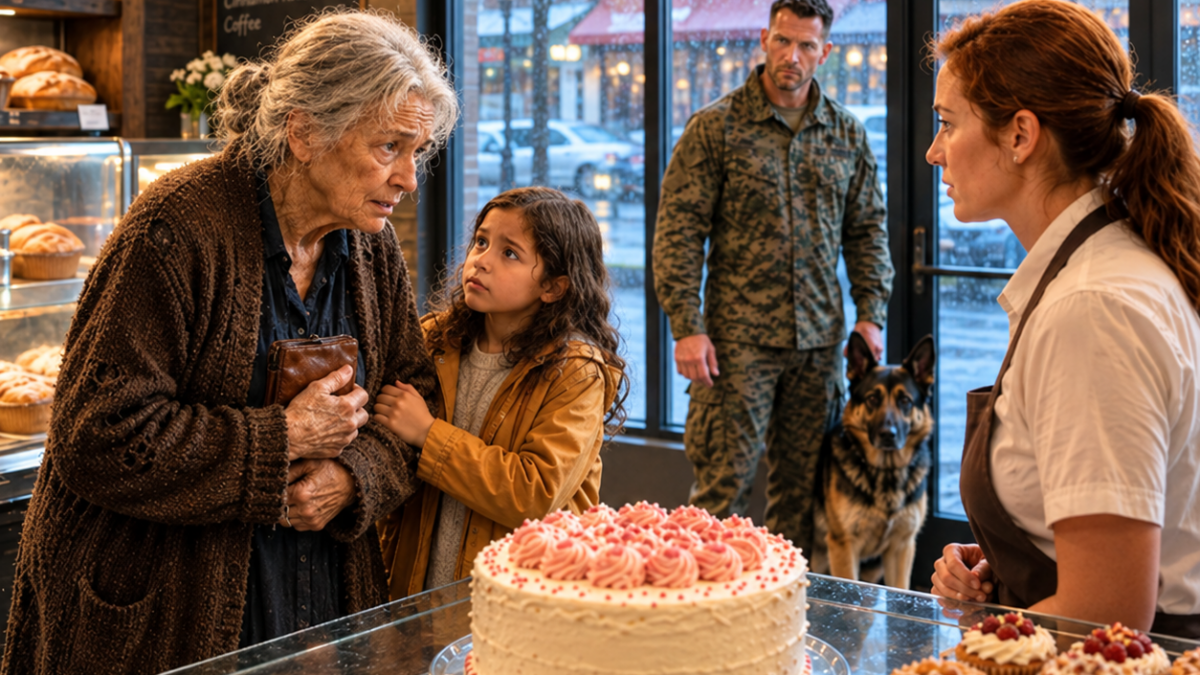
I looked toward the cake.
Then the woman.
She had straightened.
Chin lifted slightly.
Dignity moving into defensive position.
I knew that posture.
Help offered carelessly can feel like humiliation.
So I looked at the cashier.
“I’ll take the vanilla one.”
The old woman turned.
I ignored her confusion.
The cashier reached for the cake.
I added, “Whole thing.”
The little girl looked at me.
I kept my expression serious.
“This may have been a tactical error.”
She blinked.
“What?”
“I bought an entire cake.”
I looked toward Maverick.
“He doesn’t eat cake.”
Then back at her.
“And I haven’t had birthday cake in a long time.”
The girl’s eyes narrowed as if evaluating whether I was ridiculous.
“I need assistance.”
Her mouth twitched.
“What kind?”
“Eating it.”
A small smile appeared.
The old woman understood exactly what I was doing.
I knew because some of the tension left her shoulders.
“Only if you share it,” she said.
“That was the operation.”
The cashier found candles.
Eight.
The girl’s name was Lucy.
Her grandmother was Helen.
We sat near the window while rain streaked the glass.
Maverick stayed beside my chair until Lucy noticed him.
“Can I pet him?”
“Maybe.”
She looked surprised.
“Maybe?”
“He decides.”
Most children reach anyway.
Lucy did not.
She crouched several feet from him.
Hands on her knees.
Waited.
Maverick stared at her.
Ears forward.
She did not call.
Did not make kissing noises.
Did not hold out a hand for him to sniff.
Just waited.
Something about that interested him.
He walked forward.
Slowly.
Stopped beside her.
Lowered his head near her knee.
Lucy looked at me.
Permission.
I nodded.
She placed her fingers gently behind his ear.
Maverick closed his eyes.
That got my attention.
He did not do that often.
“Guess he likes you.”
Lucy smiled.
“He chose.”
The words sounded familiar somehow.
Maybe because I had spent most of my life around people whose choices had been made for them by orders, duty, illness, timing, or death.
The cake arrived.
Eight candles.
Helen lit them.
The flames reflected in Lucy’s eyes.
For about thirty seconds she stopped being the child who understood that Grandma could not afford a cake.
She became eight.
Exactly eight.
She closed her eyes.
Made a wish.
Blew.
Helen clapped softly.
I smiled.
Then Helen saw the Marine insignia beneath my jacket.
Her face changed.
“You’re a Marine.”
“Yes, ma’am.”
“My son was a Marine.”
I looked toward Lucy.
“Her father?”
Helen nodded.
The warmth in her expression faded beneath something old.
“Benjamin Marlow.”
My hand stopped against the coffee cup.
Benjamin Marlow.
The name did something.
Not memory exactly.
More like hearing a word from another room and knowing you should recognize it.
“Ben,” Helen added.
I repeated silently.
Ben Marlow.
Nothing clear.
Lucy had slipped a tiny piece of frosting onto her finger.
Maverick was watching with inappropriate interest.
Helen said:
“He died six years ago.”
“I’m sorry.”
She gave the practiced nod of somebody who had received that sentence too many times.
Lucy looked down at Maverick.
The dog put his muzzle on her knee.
Benjamin Marlow.
The name remained with me.
When we finished cake, the storm had worsened.
Rain moved horizontally now.
Helen buttoned Lucy’s coat.
“How are you getting home?”
“We’re walking.”
I looked through the window.
“You walked here?”
“We’ve done it before.”
“In this?”
Helen followed my eyes toward the rain.
Pride entered the room again.
I knew pushing directly would fail.
So I lied.
“I’m heading your direction.”
She looked at me.
“You don’t know where we live.”
“That is an obstacle.”
Lucy laughed.
I continued.
“You’d be helping me.”
“How?”
I looked at Maverick.
“He hates riding alone.”
Maverick stared back with the expression of a dog being slandered.
Lucy immediately looked at Helen.
Did not ask.
That restraint probably helped more than anything I said.
Helen sighed.
“One ride.”
“One.”
Their farmhouse was several miles outside town where neighborhoods gave way to fields, pines, and the dark unseen shape of a tidal creek.
Weathered two-story house.
Deep porch.
Pale siding.
Gravel road.
Warm light behind curtains.
As Helen climbed the steps, one board shifted beneath her foot.
I noticed.
“So did Maverick.”
“I can repair that.”
Helen stopped unlocking the door.
“No.”
“One step.”
“You bought Lucy cake.”
“Yes.”
“You drove us home.”
“Yes.”
“And now you want to fix my porch.”
“Yes.”
“It is my porch.”
Boundary.
Clear.
I nodded.
“Understood.”
She looked slightly surprised I did not argue.
Inside, the house told me everything Helen would never say.
Nothing expensive.
Nothing wasted.
Old furniture repaired carefully.
Quilt folded across the couch.
Curtains patched invisibly.
Photographs crowded the mantel.
A home kept alive through persistence.
Lucy sat on the rug.
Maverick settled near her.
She waited again.
Soon he shifted until his shoulder touched her knee.
Then I saw the photograph.
Young Marine.
Dress uniform.
Short sandy hair.
Gray-green eyes.
Crooked smile.
Toddler in his arms.
Lucy.
My chest tightened.
“That’s Dad,” Lucy said.
I stepped closer.
“Benjamin?”
Helen moved toward the mantel.
“Ben.”
The face pulled at memory harder than the name had.
“Was he stationed nearby?”
“For a while.”
“When did he…”
Helen knew what I meant.
“Car accident.”
Lucy was two.
“He was driving home.”
I looked at the photograph.
Something refused to settle.
Rachel—Lucy’s mother—had held things together afterward.
Then illness.
Two years later she died too.
Lucy stayed with Helen.
“She was here most days anyway,” Helen told me.
“After Rachel died, she just stopped leaving.”
Helen looked toward her granddaughter.
“Maybe we both did.”
I understood that better than she knew.
I left not long afterward.
Lucy hugged Maverick only after checking my face.
He allowed it.
At the door, Helen thanked me.
I glanced once at the damaged step.
She saw.
“No.”
“Yes, ma’am.”
I drove away.
Checked the farmhouse in the mirror longer than necessary.
Ben Marlow.
Back at my apartment, Maverick lay near the kitchen while I stared at four moving boxes stacked against the wall.
They had been there for months.
I told people I had not unpacked because transfers happened.
That night, the excuse sounded weak.
I opened the first box.
Old uniforms.
Notebooks.
Letters.
Challenge coins.
Photographs.
People I had not thought about in years.
People I thought about every night but never discussed.
Second box.
Nothing.
Third.
An envelope filled with unit photographs.
Training exercises.
Vehicles.
Faces.
I turned one over.
Then another.
Then stopped.
Third row.
Four men from the left.
Crooked smile.
Benjamin Marlow.
The room disappeared.
Memory does not always return as a story.
Sometimes it comes back as impact.
Heat.
Smoke.
Metal.
Blood in one eye.
A vehicle tilted at an angle vehicles should never occupy.
A training accident.
Years earlier.
I had been younger.
Different rank.
Different unit.
The vehicle rolled during an exercise.
Equipment shifted.
Metal collapsed inward.
My leg trapped.
Smoke filling the compartment.
I remembered shouting.
Someone outside yelling for everyone to clear.
I thought the others had.
Then somebody came back.
A Marine crawling through smoke.
Knife against a strap.
His arm under mine.
“Stay with me.”
I had forgotten the face.
Forgotten the name.
Trauma is cruel like that.
It preserves things that seem useless and erases things you desperately want.
I remembered his shoulder under my arm.
Remembered boots scraping dirt.
Remembered trying to tell him to leave.
Then words near my ear.
“Come on.”
More dragging.
Then:
“Get you home.”
I stared at the photograph.
“Ben.”
Maverick stood.
Came closer.
I sat on the floor.
Benjamin Marlow had gone back into that damaged vehicle for me.
He had already reached safety.
Then realized I was missing.
Came back.
Cut me loose.
Dragged me out.
Years later, he died driving home.
His wife died after him.
His daughter was eating birthday cake because a stranger happened to overhear her grandmother.
Not a stranger.
Me.
My hands started shaking.
Not from some idea of destiny.
I do not understand destiny well enough to claim it.
From the realization that I had lived years purchased partly by a man whose name I had forgotten.
I slept badly.
The next morning, I drove back to Helen’s farmhouse.
Maverick beside me.
Unit photograph inside my jacket.
Toolbox in my hand.
Helen opened the door.
Her eyes went immediately to the toolbox.
“I thought we discussed the step.”
“We did.”
“Then why—”
I held out the photograph.
“The step isn’t why I came.”
She saw Ben.
Everything in her face stopped.
“Where did you get that?”
“I was there.”
She looked up.
“What do you mean?”
I entered only after she stepped aside.
Lucy was drawing at the kitchen table.
Maverick went to her as though the house was already part of his route.
I put the photograph down.
Helen stared.
“There was an accident.”
No one spoke.
“A training vehicle.”
My mouth went dry.
“I was trapped.”
Lucy stopped drawing.
“Smoke was filling the cabin.”
Helen’s fingers touched the photograph.
“I couldn’t get my leg free.”
I looked at Ben’s face.
“He came back.”
Helen whispered:
“Ben?”
“He was already out.”
The memory was clearer now.
“He came back inside.”
Lucy’s pencil remained motionless in her hand.
“He cut the restraint.”
I could hear Ben again.
“Put my arm over his shoulder.”
My voice tightened.
“Dragged me out.”
Helen’s fingers curled against the table.
“Your son saved my life.”
I expected tears.
Helen got angry.
Not loud.
Worse.
Controlled.
“So that’s why you bought Lucy the cake?”
“No.”
“Because you knew?”
“I didn’t.”
“You heard Ben’s name and decided his daughter was your responsibility?”
“I did not remember him until last night.”
She searched my face.
I pushed the photograph toward her.
“I found this.”
Helen finally picked it up.
“If you came here because you think you owe us something, leave.”
“Helen—”
“My son did not crawl into danger so his mother could collect a debt six years later.”
“I know.”
“Do you?”
Her voice broke.
That changed my understanding immediately.
She was not defending herself.
She was defending Ben.
The living man beneath the legend.
The son who feared spiders.
The father who burned pancakes.
The man who had a family before he became a story somebody used to explain courage.
“I can’t repay him.”
I said it slowly.
“I know.”
“That isn’t why I’m here.”
“Then why?”
Good question.
I looked toward the window.
The damaged step.
Wet fields.
Maverick beside Lucy.
“He gave me another day.”
Helen said nothing.
“Then another.”
I swallowed.
“Those became years.”
My life appeared in my head as temporary quarters and packed boxes.
“I kept serving.”
“Moving.”
“Leaving.”
I laughed once without humor.
“I got very good at never staying anywhere long enough to owe anybody permanence.”
Helen’s expression softened slightly.
“My apartment still has boxes I haven’t unpacked.”
“So?”
“So maybe surviving isn’t the same thing as living.”
Long silence.
Then her eyes dropped to the toolbox.
“One step.”
I almost smiled.
“One step.”
“I’m helping.”
“Yes, ma’am.”
The step took longer because Helen did, in fact, help.
She measured twice.
Corrected me once.
With visible satisfaction.
Lucy sat on the porch reading.
Maverick lay across her boots.
Something strange happened while I worked.
The farmhouse stopped feeling like the home of a dead Marine.
It became simply a home.
Alive.
Three days later Helen admitted the back gate dragged.
Then coffee.
Then supper.
No discussion.
No arrangement.
A routine appeared before any of us gave it permission.
I never brought money.
Never arrived with groceries unless Helen specifically asked.
I learned quickly that helping her required allowing her to remain the owner of her own life.
She had been carrying too much too long to accept anyone trying to take control disguised as kindness.
Lucy started asking about Ben.
“Was Dad brave?”
I thought carefully.
“He came back for me when he didn’t have to.”
“So yes?”
“Yes.”
Helen put soup on the table.
“He was terrified of spiders.”
Lucy stared.
“Dad?”
“Terrified.”
“How big?”
Helen held thumb and finger maybe an inch apart.
“He woke me at two in the morning once.”
Lucy burst out laughing.
“Your brave Marine father stood in the hallway holding a shoe while I removed it.”
“That is operational support,” I said.
Helen pointed at me.
“Do not encourage him.”
We told Lucy about Ben’s pancakes.
His bad singing.
The way he forgot where he left his keys.
For the first time, I understood what Helen had been protecting.
Heroes become flat when they die.
People remember the one brave act.
The uniform.
The funeral.
The folded flag.
Families remember who left wet towels on the bathroom floor.
That matters too.
One evening Lucy looked toward a wooden box on a high shelf.
“There aren’t pictures of Dad making pancakes.”
Helen went completely still.
“Grandma?”
Dust outlined the box.
I understood immediately.
Memories not touched in six years.
I stood.
“Maverick needs dinner.”
Lucy frowned.
“He ate.”
“He needs… another dinner.”
Maverick looked interested.
I put on my jacket.
Privacy.
Then Helen said:
“Wade.”
I turned.
She was holding the box.
“Stay.”
She carried it to the table.
Lucy sat beside her.
The lid opened.
Photographs.
Ribbons.
Cards.
An old watch.
Letters tied with blue ribbon.
Lucy touched only after Helen nodded.
Baby Lucy sleeping on Ben’s chest.
Ben beside a burned pan.
“There!”
Lucy laughed.
“The pancakes.”
Helen laughed too.
Then cried at the same time.
Near the bottom lay an unstamped envelope.
Helen unfolded it.
Read.
Stopped.
Her breathing changed.
“What?”
She looked at me.
“This is about you.”
I froze.
The letter described the accident.
No name.
But enough.
Young Marine trapped inside damaged equipment.
Smoke.
Going back.
Ben wrote that courage often had very little to do with fearlessness.
Sometimes courage was simply refusing to leave somebody behind.
My hands went cold.
Helen continued reading.
Ben described dragging the Marine toward safety.
Repeating one sentence.
The memory snapped fully into place.
“Come on, Marine.”
Helen stopped.
I whispered the rest.
“Let’s get you home.”
Lucy looked at me.
“Dad said that?”
“Yes.”
The room seemed smaller.
“Yes, he did.”
Helen looked toward the box she had refused to open for years.
Then did something important.
She did not close it.
She picked up another photograph.
“Your father sang in the truck.”
Lucy smiled.
“Good?”
“Terrible.”
The box stayed open.
That night I stood on the porch with Maverick.
Through the window, Helen and Lucy sat together over photographs.
I had always thought memory was a road backward.
Toward smoke.
Loss.
Things you could not change.
That evening, for the first time, I wondered whether memory could point forward too.
December arrived.
More dinners.
Repairs.
Homework.
Coffee.
Maverick began waiting by the front window before Lucy’s school bus.
The dog who woke at every noise started sleeping on his back in the living room.
Completely vulnerable.
Feet in the air.
Lucy once used his stomach as a pillow.
“Military discipline is gone,” I said.
“He’s retired.”
Maverick opened one eye.
Closed it again.
Traitor.
The more normal everything felt, the more frightened I became.
That surprised me.
Danger I understood.
Attachment was harder.
One evening Lucy called from the kitchen:
“Wade, dinner!”
I stopped in the hallway.
Ben’s photograph stood on the mantel.
His daughter sat at the table.
His mother was setting plates.
My dog slept near their fireplace.
Something inside me said:
You are taking another man’s place.
After that, I started leaving early.
Not dramatically.
Small excuses.
“Early morning.”
“Need to check something.”
“Training tomorrow.”
Lucy noticed.
Children always do.
“You’re not staying?”
“Not tonight.”
“You said that yesterday.”
Helen looked at me.
Did not argue.
Simply removed the extra plate.
That felt worse.
Three nights later, a coastal storm trapped me at the farmhouse.
I had stopped by to reinforce a section of fence.
By seven, rain and wind made driving stupid.
Helen lit oil lamps.
Lucy sat on the rug beside Maverick.
Then came a crack behind the house.
Huge.
Tree.
The back door blew partially open from pressure.
Maverick was up instantly.
Before I caught him, he ran through the door.
“Maverick!”
Lucy saw him disappear.
“Stay inside!”
I went after him.
Rain blinded me.
Fence broken.
Large pine across it.
“Maverick!”
Behind me, movement.
The dog came racing back.
Alone.
My stomach dropped.
“Where is Lucy?”
No answer.
Then I turned.
The back door.
Yellow raincoat gone.
“No.”
Helen reached the porch.
“Where’s Lucy?”
I ran inside.
Her scarf hung near the mudroom.
Grabbed it.
Back outside.
“Maverick.”
He was spinning toward the trees.
I lowered the scarf.
“Find Lucy.”
One sniff.
His entire body changed.
Working dog again.
He went through the broken fence.
I grabbed a flashlight and utility rope.
Helen came too.
“Stay at the house.”
“She is my granddaughter.”
“Helen—”
“I buried my son.”
Rain ran down her face.
“Then his wife.”
Her voice broke.
“You are not asking me to sit inside and wait.”
No time to argue.
We followed.
Lucy’s footprints appeared in mud.
Then disappeared under rain.
Toward the tidal creek.
“Lucy!”
Nothing.
Maverick worked ahead.
Nose low.
Lost scent.
Circled.
My chest tightened.
Found it.
Pulled left.
Flashlight beam caught yellow fabric on a thorn.
Helen made a sound.
Part of Lucy’s raincoat.
“No blood.”
I checked ground.
“What if she’s in the creek?”
“Helen.”
She was panicking.
“Look at me.”
Could not.
“Helen.”
Finally.
“Maverick is still working.”
The dog moved forward.
“We keep moving.”
Then barking.
Ahead.
Alert bark.
Not distress.
We broke through the trees.
The creek had flooded.
A normally narrow channel now black water moving fast.
“Lucy!”
Small voice.
“Wade?”
Helen nearly collapsed.
My light found her.
Raised patch of ground across flooded water.
Holding a young pine.
Water around her ankles.
“I thought Maverick was hurt!”
Of course.
She followed him.
“Do not move!”
“I’m scared!”
“I know.”
I tested water.
Too deep.
Too fast.
Moved upstream.
Maverick followed the bank.
Found a narrower section.
Roots.
Higher ground.
I tied rope around a pine.
Looped it through my harness.
Handed Helen the free end.
“If I say pull—”
“I pull.”
I entered sideways.
Slow.
Water to thighs.
Then waist.
Cold enough to hurt immediately.
“Look at me, Lucy.”
She stared at water.
“Lucy!”
Her face lifted.
“Not the water.”
“I’m scared!”
“So am I.”
That surprised her.
Good.
“Being scared doesn’t mean we stop.”
Step.
Brace.
Step.
The current shoved hard.
I reached the raised ground.
Lucy launched into me.
“I’m sorry.”
“Later.”
I secured rope around us.
“Right now, I’ve got you.”
Her arms locked around my neck.
I looked across at Helen.
Maverick barking.
“We’re going home.”
Home.
The word struck somewhere deep.
The return crossing took longer.
When Lucy reached the bank, Helen dropped to her knees.
Maverick pressed against both of them so hard they nearly fell.
By the time we got back, electricity was out.
Helen wrapped Lucy in blankets near the fireplace.
Maverick lay soaked against her feet.
Would not leave.
Within an hour, Lucy slept.
I went to the porch.
Rain everywhere.
I had almost left before the storm.
That thought scared me more than the water.
Helen joined me.
“You’ve been pulling away.”
I stared into the yard.
“I’m not Ben.”
“I know.”
“I walk into his house.”
“My house.”
I looked over.
She continued.
“Sit at his table.”
“My table.”
“Hear his daughter laugh.”
Helen’s voice softened.
“She is also Lucy.”
I looked away.
“I don’t know what I’m supposed to be here.”
“Neither do I.”
That stopped me.
Helen leaned against the porch rail.
“After Ben died, and then Rachel, I decided loving people was just giving life another name to take away.”
Rain hammered the roof.
“So I kept people at a distance.”
She looked through the window.
Lucy asleep.
Maverick guarding her.
“Distance does not make loss hurt less.”
I said nothing.
“It only makes the days before it lonelier.”
My throat tightened.
“Ben gave me my life back.”
“Yes.”
“I’ve spent years feeling like I had to deserve that.”
Helen shook her head.
“My son did not drag you out of that wreck so you could spend the rest of your life apologizing for surviving.”
I looked at her.
“You don’t have to replace Ben.”
Inside, Maverick lifted his head.
Checked Lucy.
Settled again.
“Nobody can.”
Helen opened the door.
“You only have to decide whether you’re going to keep leaving.”
She went inside.
I stayed on the porch another minute.
Then followed.
Nothing transformed overnight.
I wish healing worked that way.
It would be efficient.
Instead, healing came as repetition.
Breakfast.
Coffee.
Fence repair.
Homework.
Lucy asking another question about Ben.
Helen answering without shutting down.
Maverick sleeping in sunlight.
Me staying for supper when every instinct told me to leave before anyone expected tomorrow.
Spring softened the coast.
Helen started taking Ben’s wooden box down without ceremony.
Lucy chose photographs.
“What happened here?”
“Who’s that?”
“Why is Dad wearing that?”
They talked about Rachel too.
Not just Ben.
Her barefoot dancing in the kitchen.
Her humming to baby Lucy.
Her habit of forgetting tea until it became cold.
The dead returned to conversation as people instead of wounds.
That seemed important.
One Saturday I returned to my apartment.
Opened the final sealed moving box.
No revelation.
Books.
Old coffee maker.
Photographs.
The point was not what was inside.
The point was unpacking.
I put things on shelves.
Hung clothes.
Placed Ben’s unit photograph where I could see it.
I stopped living as though orders were arriving tomorrow.
Months passed.
Sometimes I helped at Helen’s.
Sometimes I did absolutely nothing useful.
That was surprisingly difficult.
I had spent most of my adult life believing value came from fixing, protecting, achieving.
Helen occasionally handed me coffee and expected no labor.
Lucy asked me to help with math I barely remembered.
Maverick slept on my boots.
Apparently existence could be enough.
Lucy never called me Dad.
I never wanted her to.
Ben was Dad.
Rachel was Mom.
There was no vacancy to fill.
One afternoon I heard Lucy explaining me to a school friend.
“Wade’s not my dad.”
I stopped walking.
Then:
“He’s Wade.”
Simple.
Enough.
I smiled.
A year after the bakery, Lucy turned nine.
Helen announced we were going into town.
Blue Harbor Bakery looked almost exactly the same.
Warm light.
Cinnamon.
Vanilla.
Maverick walked in like he owned shares.
Lucy ran toward the display.
“That one.”
Vanilla.
White frosting.
Pink buttercream roses.
Same style.
This time Helen paid.
Full price.
I did not interfere.
Nine candles arrived.
Lucy counted.
Then asked:
“One more?”
Helen raised an eyebrow.
“You’re not ten.”
“I know.”
The cashier handed one more.
Lucy placed it slightly apart.
“This one’s for Dad.”
Helen went still.
A year earlier, the sentence might have broken the room.
Now she reached over.
Straightened the candle.
“He’d like that.”
Lucy thought.
“Mom too.”
“Yes.”
Helen touched her hand.
“Your mom too.”
I had brought Ben’s unit photograph.
I placed it beside the cake.
Lucy leaned close.
“There’s Dad.”
“Yes.”
Then pointed.
“And you.”
I nodded.
Young Wade Holloway.
Only a few Marines away from Ben.
Neither of us knew what was coming.
I pulled my chair slightly away from the table.
Old habit.
Make room.
Helen noticed.
She reached down.
Grabbed the chair leg.
Dragged it back toward them.
No words.
Then poured my coffee.
My throat tightened.
Candles lit.
Nine flames.
One separate.
“Make a wish,” I told Lucy.
She closed her eyes.
Helen warned:
“Don’t tell us.”
Lucy blew them out.
Smoke curled upward.
I asked anyway.
“What did you wish for?”
“Wade.”
She looked offended.
“That ruins it.”
“Operational curiosity.”
She hesitated.
Then smiled.
“I wished everybody I love would always find their way home.”
I stopped breathing.
Smoke.
Metal.
Blood.
Ben’s arm around me.
“Come on, Marine.”
Dragging.
“Let’s get you home.”
For years I thought he meant outside the wreck.
Safety.
Medics.
Survival.
Maybe that was exactly all he meant.
Ben was not a prophet.
He was a Marine trying to keep another Marine conscious.
But words sometimes grow beyond the moment that created them.
The first time Benjamin Marlow got me home, he dragged me through smoke.
The second time took years.
It required a rainy bakery.
An elderly woman asking for an old cake without surrendering her dignity.
A little girl who knew how to let a wary dog choose her.
A German Shepherd who ran through a storm to find that same child.
A wooden box left closed too long.
A flooded creek.
A chair pulled closer to a birthday table.
And the painful realization that surviving a life is not the same thing as inhabiting it.
Helen cut the cake.
Lucy secretly gave Maverick frosting.
I pretended not to notice.
Outside, November rain began touching the windows.
Nothing like the storm from the year before.
Soft.
Steady.
I looked around the table.
No one wanted me to replace Ben.
No one needed rescuing.
Nobody owed me anything.
Nobody was asking me to earn the chair.
It was simply there.
Close enough that if I left, the empty space would be noticed.
For most of my life, I knew how to deploy.
How to survive.
How to pack.
How to move on.
Ben taught me how to get out alive.
Helen taught me that accepting help without humiliation is its own kind of courage.
Lucy taught me that love does not require replacing the person who came before you.
And Maverick—the old working dog who learned to sleep upside down in front of a fireplace—taught me perhaps the simplest lesson.
Being off duty does not mean being without purpose.
Sometimes purpose is guarding a little girl while she does homework.
Sometimes it is sitting beneath a birthday table waiting for crumbs.
Sometimes it is showing up.
Sometimes it is staying.
Lucy looked at me across the candles.
“What?”
I realized I was staring.
“Nothing.”
“You look weird.”
Helen laughed.
“He always looks weird.”
“Thank you.”
Maverick sighed beneath the table.
I reached down and touched his head.
The farmhouse was waiting when we left the bakery.
Helen’s farmhouse.
Lucy’s home.
The place where Ben’s photographs stayed on the mantel.
The place where Rachel’s stories lived in the kitchen.
The place where Maverick waited by the window at three-thirty for the school bus.
The place where there was now a coffee mug nobody else used because Helen had quietly started calling it mine.
I no longer wondered what I was supposed to be there.
That question had been the problem.
Families do not always form because everyone gets a clearly labeled role.
Sometimes they form because people keep showing up until absence would hurt.
Ben was still Lucy’s father.
Rachel was still her mother.
Helen was still the woman who held the whole thing together after life gave her every reasonable excuse to collapse.
I was Wade.
That was enough.
And when I finally understood that, something I had carried for years became lighter.
Survivor’s guilt makes bargains nobody asks you to make.
You tell yourself you must use every second perfectly because someone else did not receive theirs.
Must be brave enough.
Useful enough.
Successful enough.
Must somehow prove the person who saved you made the correct investment.
That is impossible.
Ben did not rescue me because he knew who I would become.
He did not ask for repayment.
He saw a Marine trapped in smoke.
He went back.
That was it.
His courage was complete in the moment he chose it.
My obligation was never to deserve survival.
It was to live.
Fully.
Messily.
Without turning gratitude into punishment.
I wish I could tell Ben that.
Maybe someday, if there is somewhere people meet again, I will.
I would tell him Lucy has his smile when she thinks she is getting away with something.
That she inherited none of his fear of spiders.
That Helen still corrects everyone’s measurements.
That Rachel is spoken about again without the whole room falling apart.
That Maverick occupies too much space near the fireplace.
That the porch step is solid.
That the back gate no longer drags.
That his mother sometimes laughs so hard she has to sit down.
And that the Marine he pulled from a wreck finally stopped living out of boxes.
Then I would tell him something else.
Something I did not understand the day he put my arm across his shoulders.
“You got me home, Ben.”
Not all at once.
Not the way either of us imagined.
But eventually.
You got me home.








